Speech Function,
Politeness And Cross-
cultural Communication
    Language in Society
Group 9 ..
Fira
Nursya’bani
            Luciyana
0906856
            Dwiningrum
            0902428      Meyza
                         Pritama
                                   Riestia
                         0902467
                                   Handayani
                                   0902434
Politeness
   The
                                 and
Function of
 Speech                        Address
                                Forms


               Linguistic
              Politeness in
               Different
               Cultures
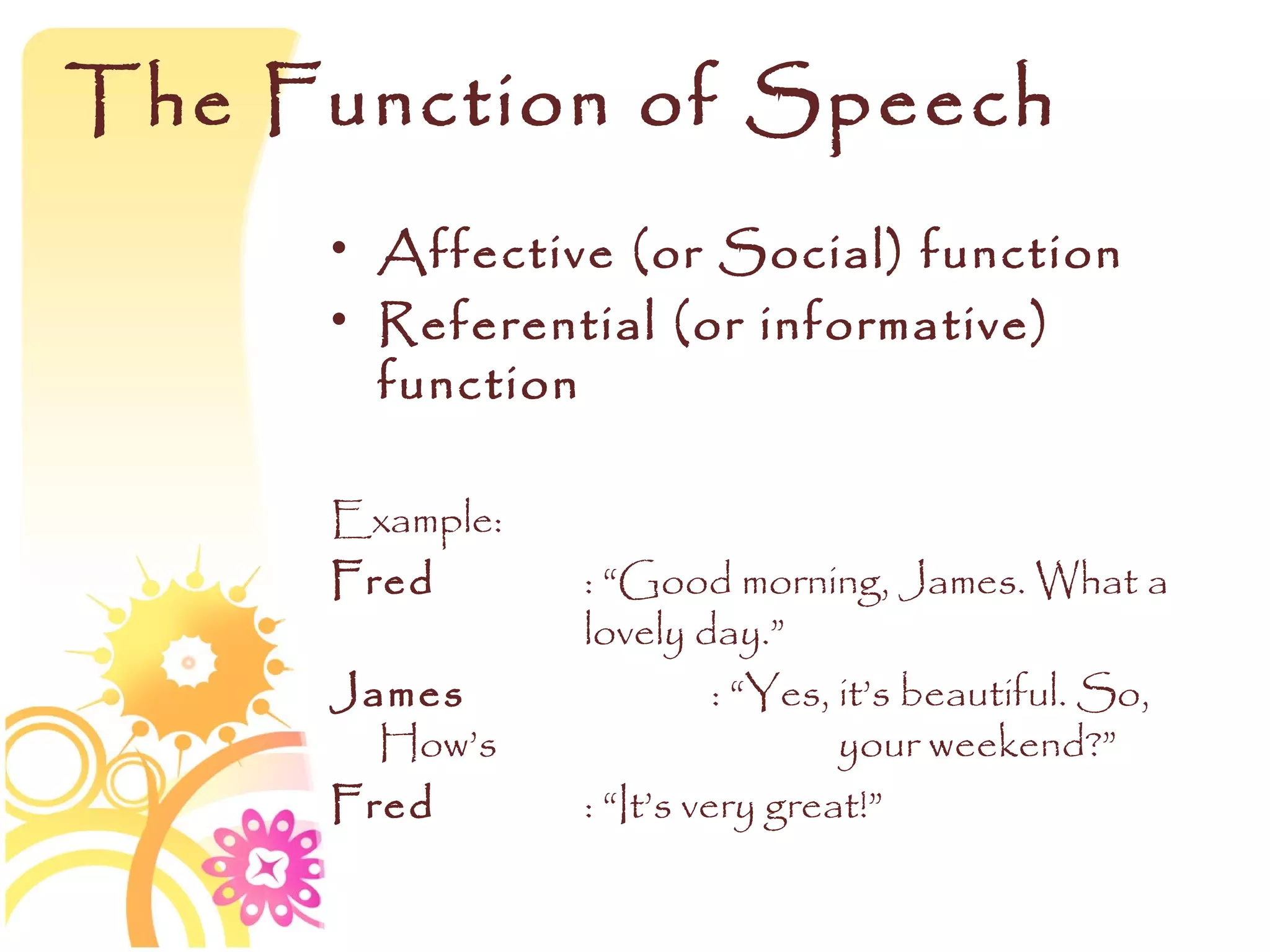
The Function of Speech
     • Affective (or Social) function
     • Referential (or informative)
       function

     Example:
     Fred       : “Good morning, James. What a
                lovely day.”
     James                : “Yes, it’s beautiful. So,
       How’s                      your weekend?”
     Fred       : “It’s very great!”
The Function of Speech

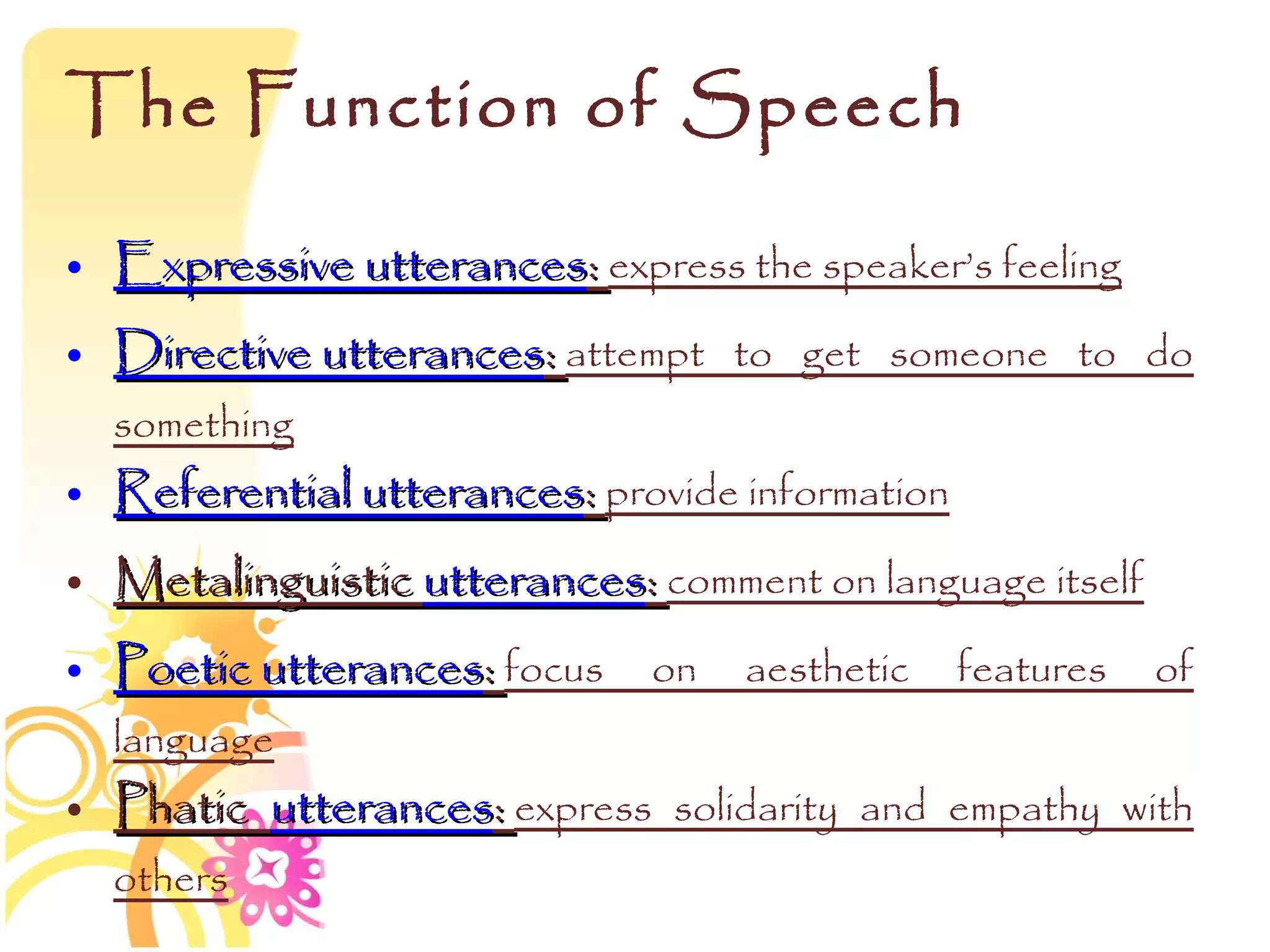
• Expressive utterances: express the speaker’s feeling
• Directive utterances: attempt to get someone to do
  something
• Referential utterances: provide information
• Metalinguistic utterances: comment on language itself
• Poetic utterances: focus on aesthetic features of
  language
• Phatic utterances: express solidarity and empathy with
  others
Examples…
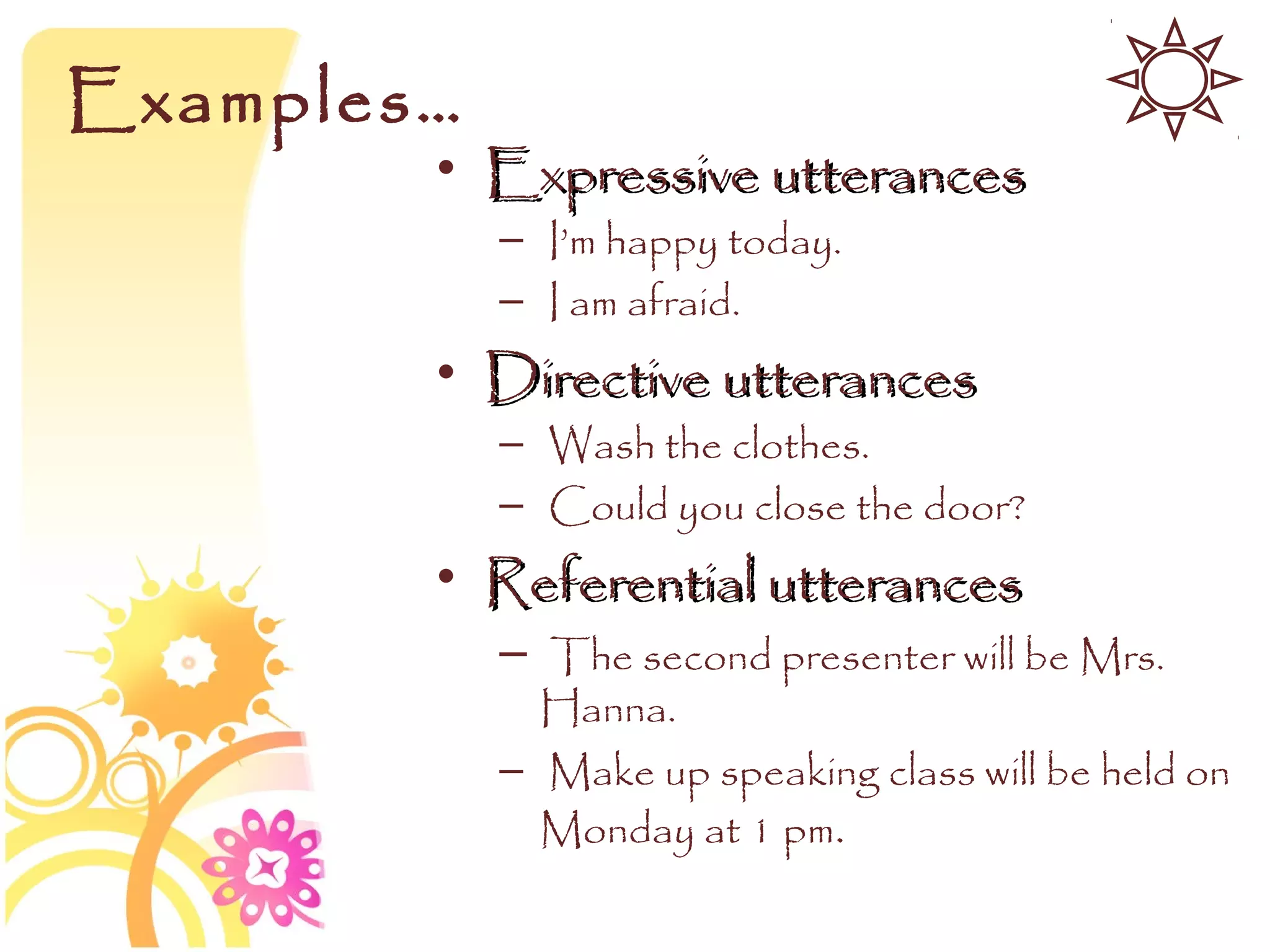
        • Expressive utterances
            – I’m happy today.
            – I am afraid.
        • Directive utterances
            – Wash the clothes.
            – Could you close the door?
        • Referential utterances
            – The second presenter will be Mrs.
              Hanna.
            – Make up speaking class will be held on
              Monday at 1 pm.
Examples…
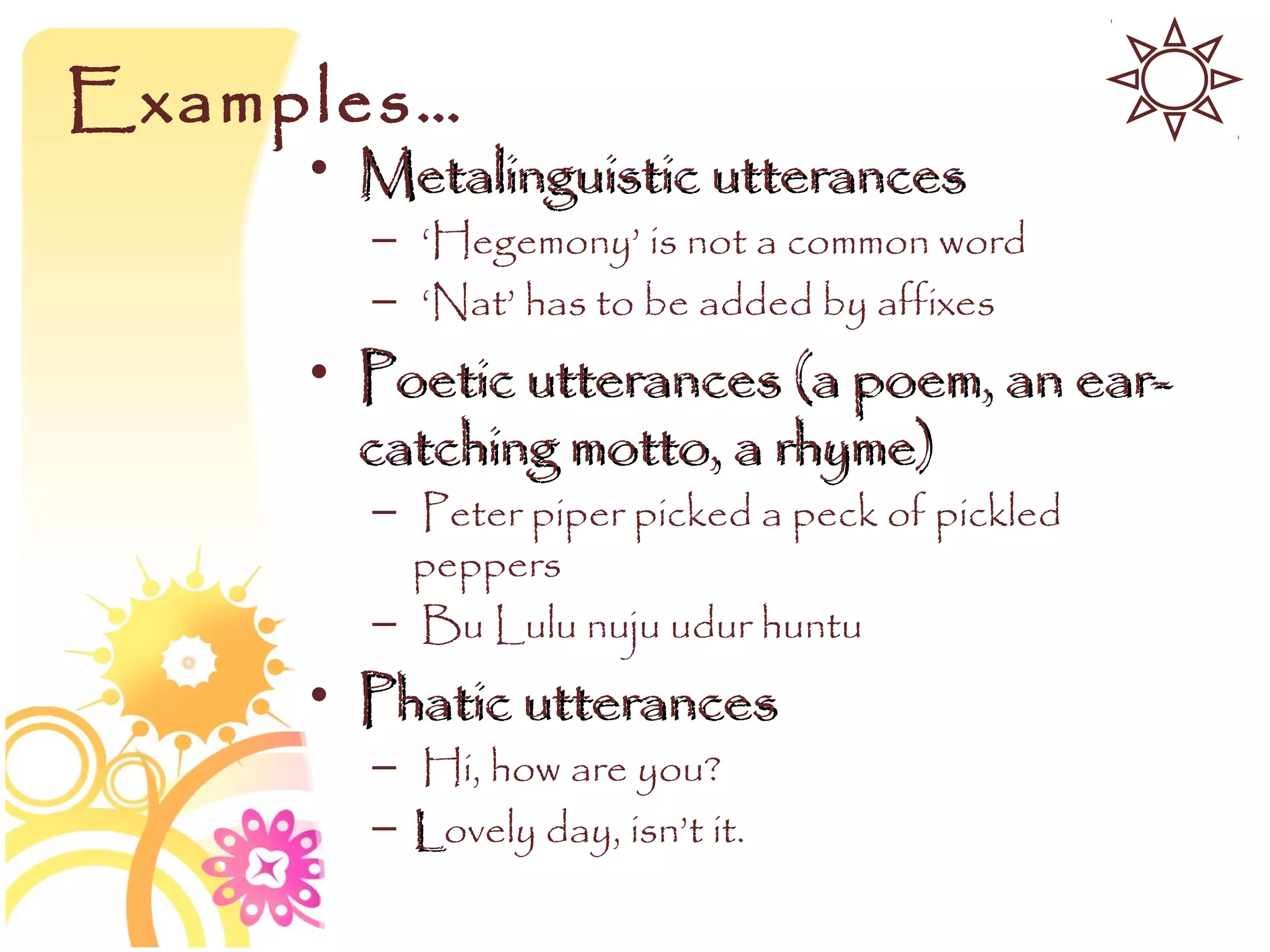
     • Metalinguistic utterances
       – ‘Hegemony’ is not a common word
       – ‘Nat’ has to be added by affixes
     • Poetic utterances (a poem, an ear-
       catching motto, a rhyme)
       – Peter piper picked a peck of pickled
         peppers
       – Bu Lulu nuju udur huntu
     • Phatic utterances
       – Hi, how are you?
       – Lovely day, isn’t it.
Basic component of
interaction…

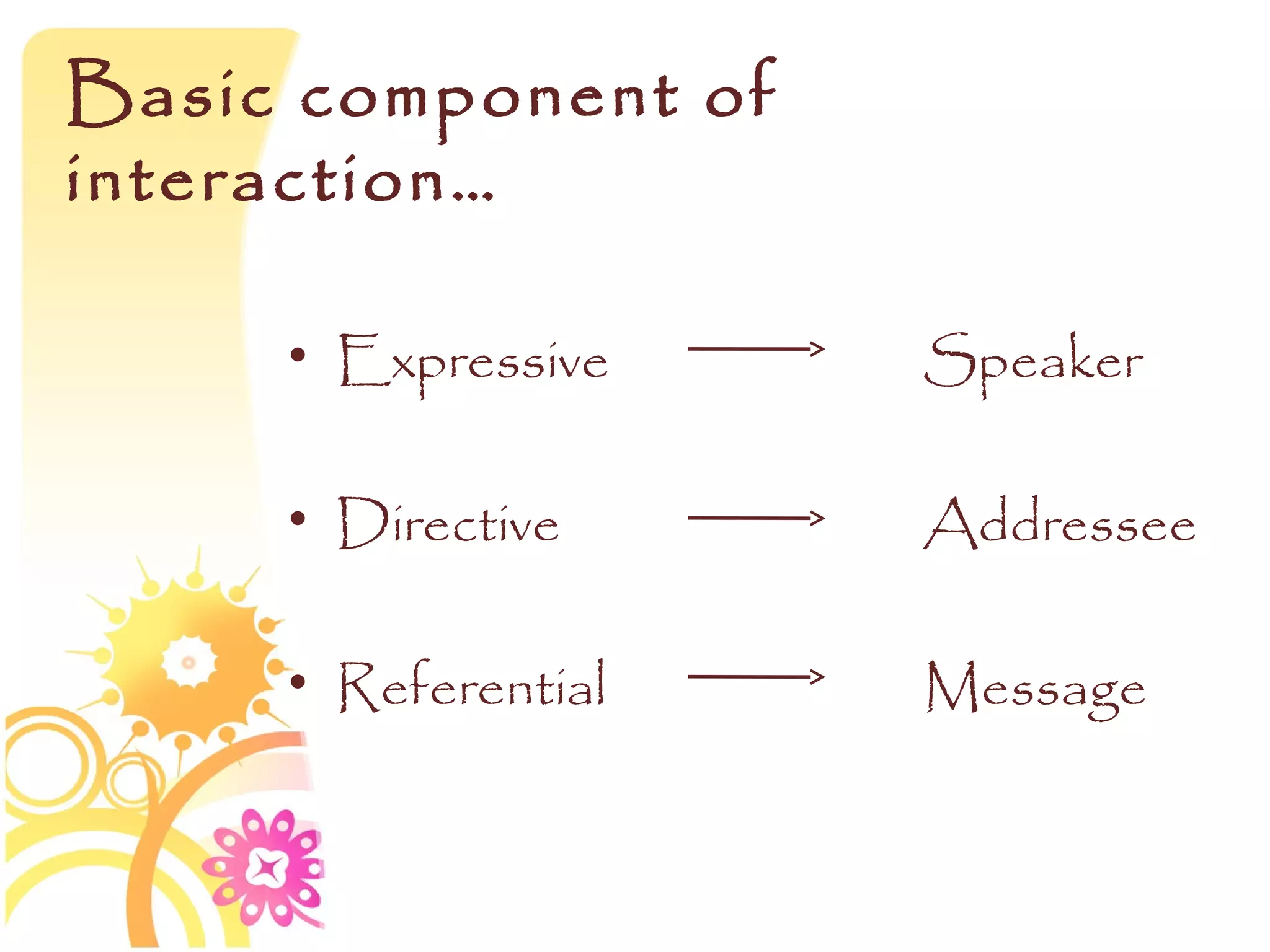
     • Expressive    Speaker

     • Directive     Addressee

     • Referential   Message
Addition…
     • Commissives: Promises and
       threat
       – I swear, I’ll do my revenge
       – I will kill you soon


     • Formatives or Declaration
       – And now, I declare you as
         husband and wife
Directives…
 …concern with getting people to do
  things…


          Examples:

          Imperative:      Sit   down!
          Interrogative:         Could you sit down?

          Declarative:           It’d be better you to sit
           down.
Factors that affect people in
using Directives..

        • The social distance between particip

        • Relative status

        • Formality of the context
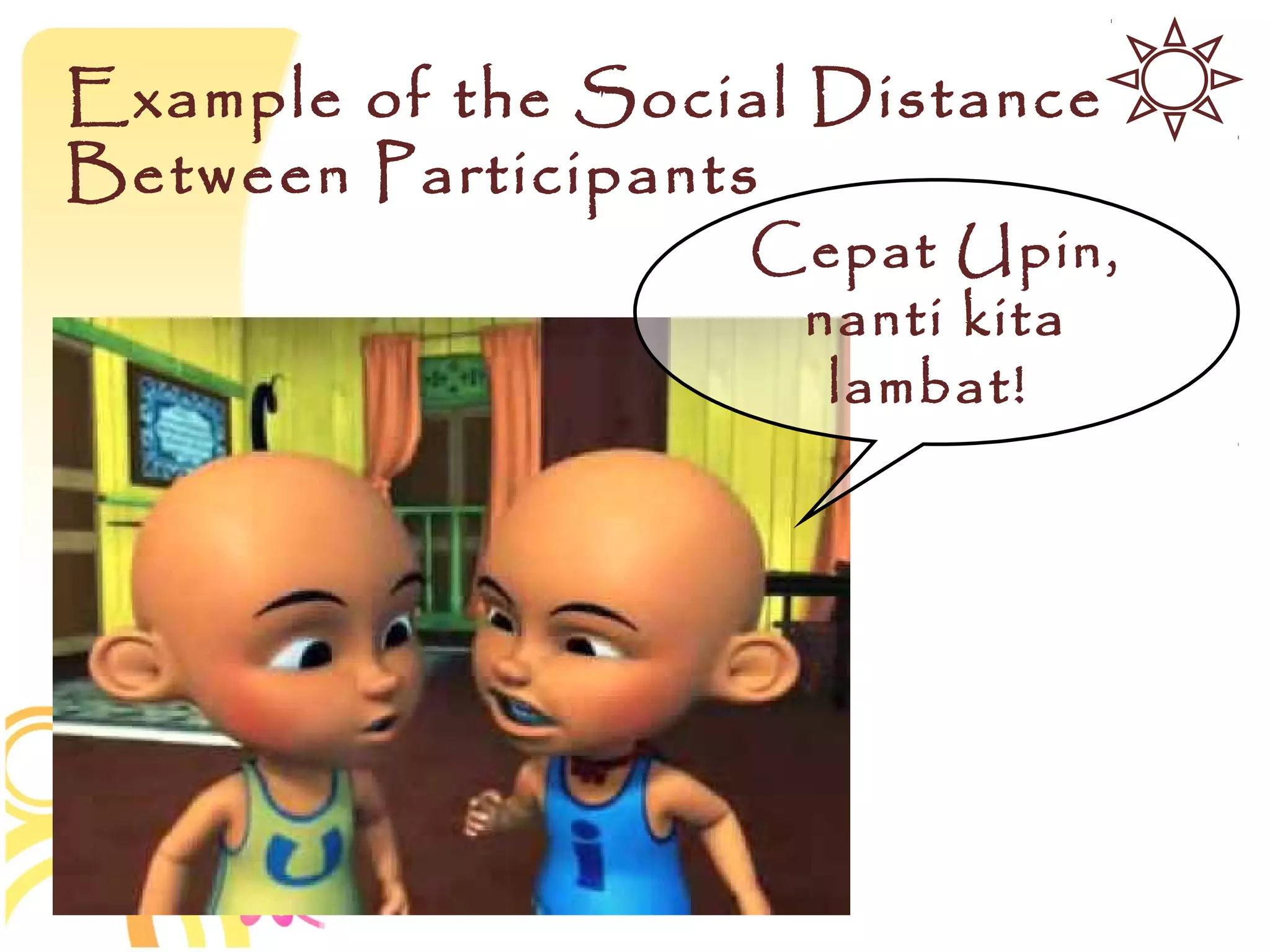
Example of the Social Distance
Between Participants
                   Cepat Upin,
                    nanti kita
                     lambat!
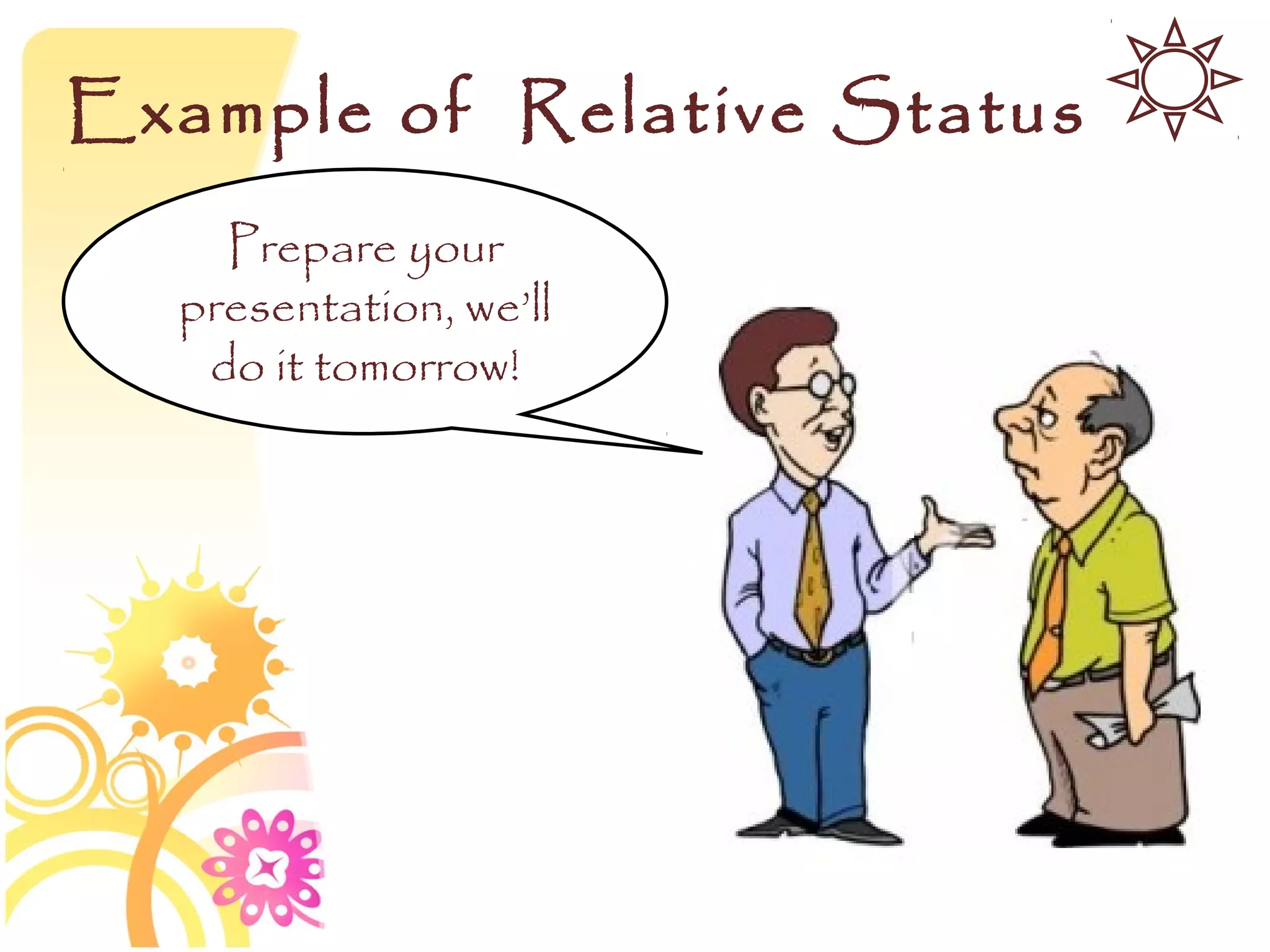
Example of Relative Status
    Prepare your
  presentation, we’ll
   do it tomorrow!
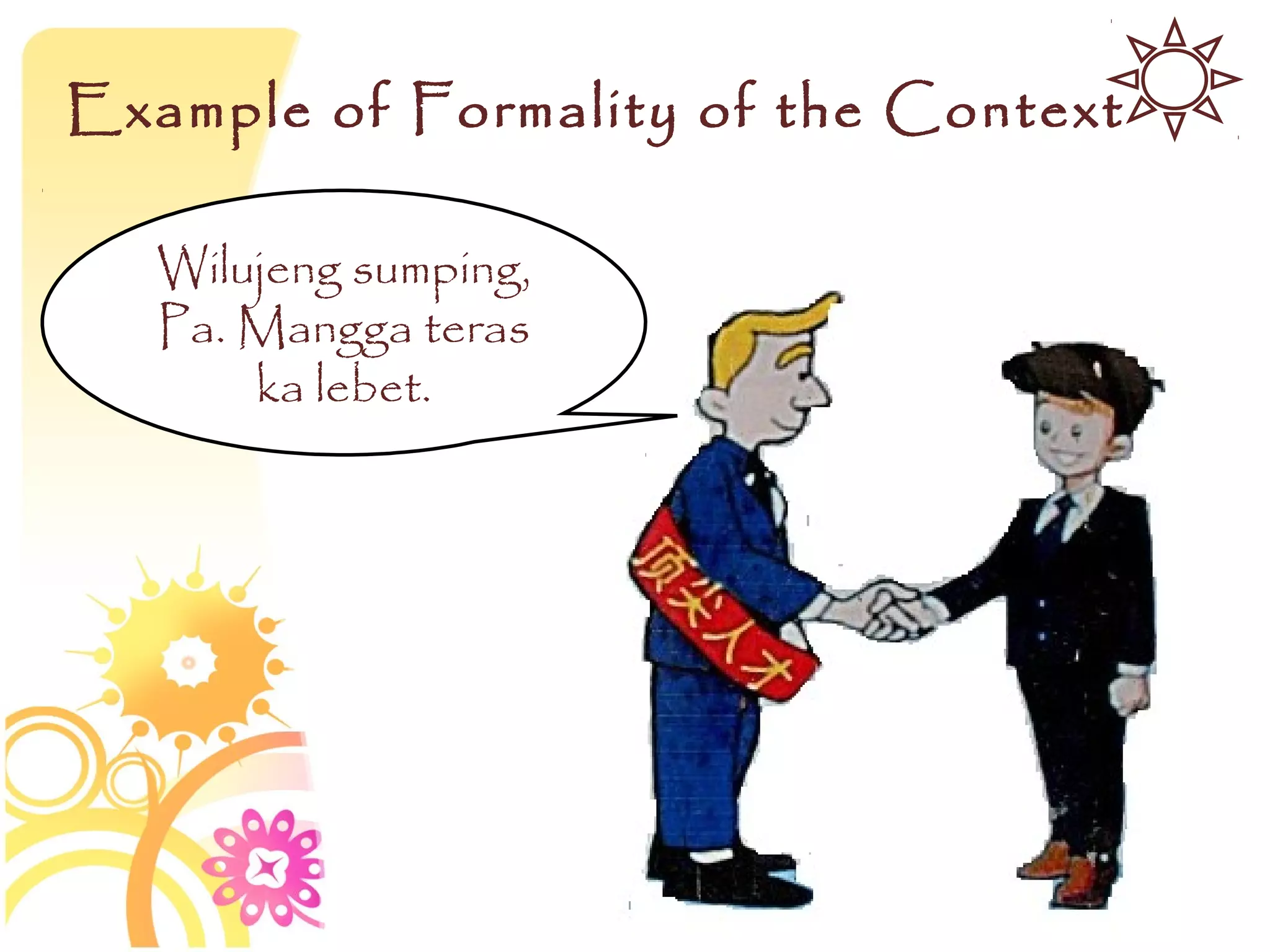
Example of Formality of the Context

   Wilujeng sumping,
   Pa. Mangga teras
       ka lebet.
Politeness and Address
Form
      Speaking politeness ---

      • The feelings of others
      • The social values of the
        society
      • Formality
Politeness and Address
Form
      Types of politeness

      • Positive politeness
      • Negative politeness
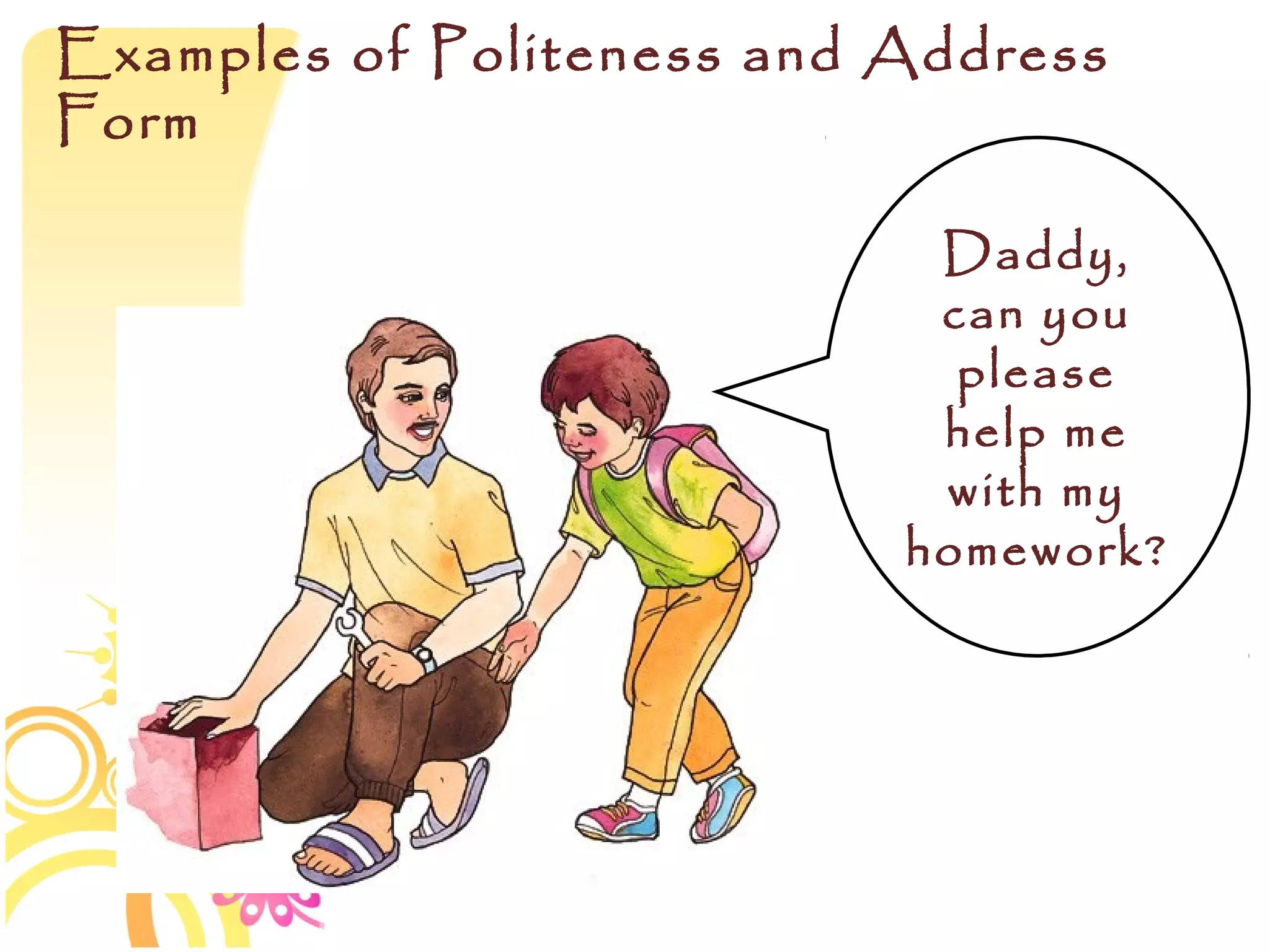
Examples of Politeness and Address
Form

                            Daddy,
                            can you
                             please
                            help me
                            with my
                           homework?
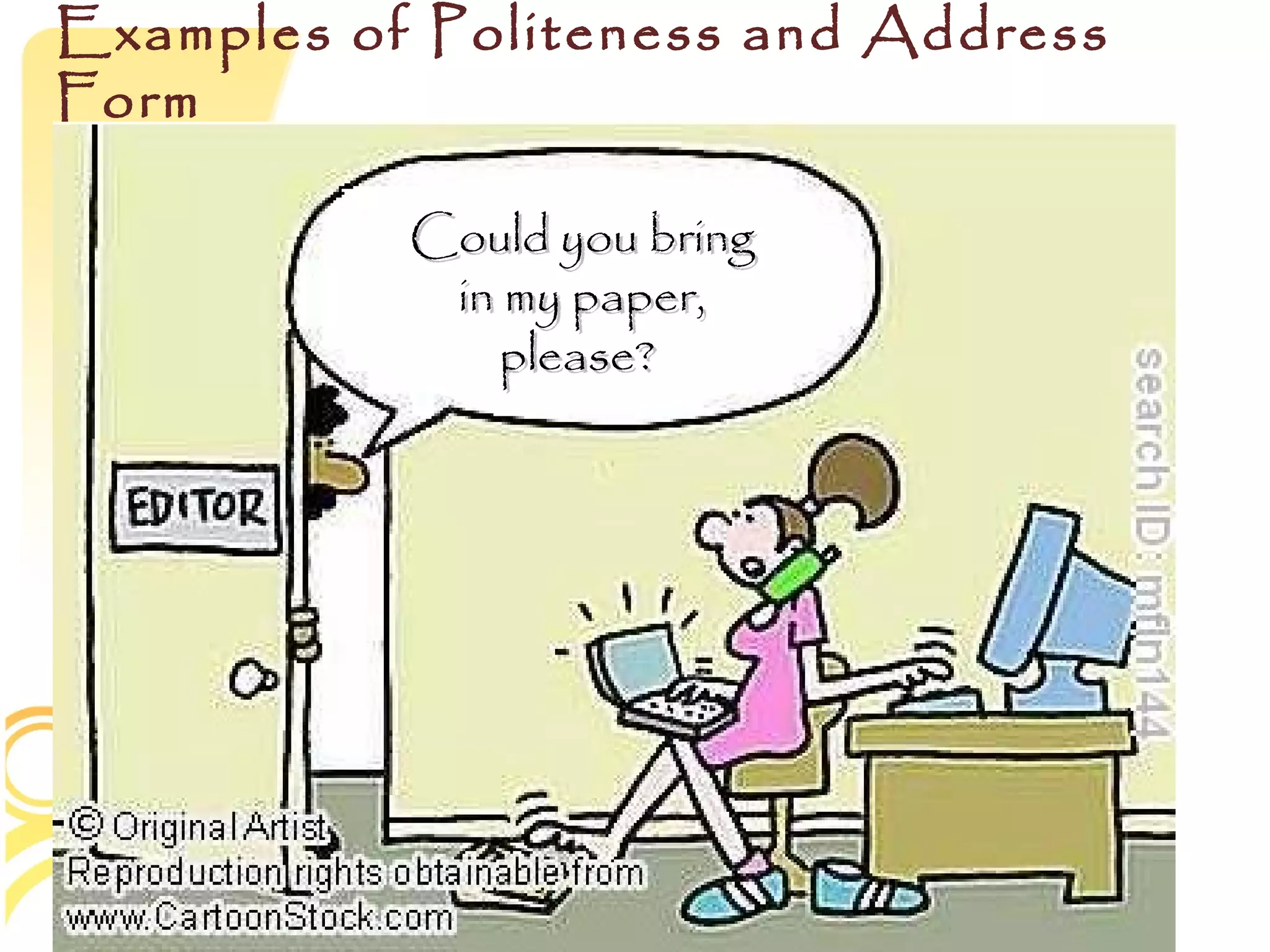
Examples of Politeness and Address
Form

           Could you bring
            in my paper,
              please?
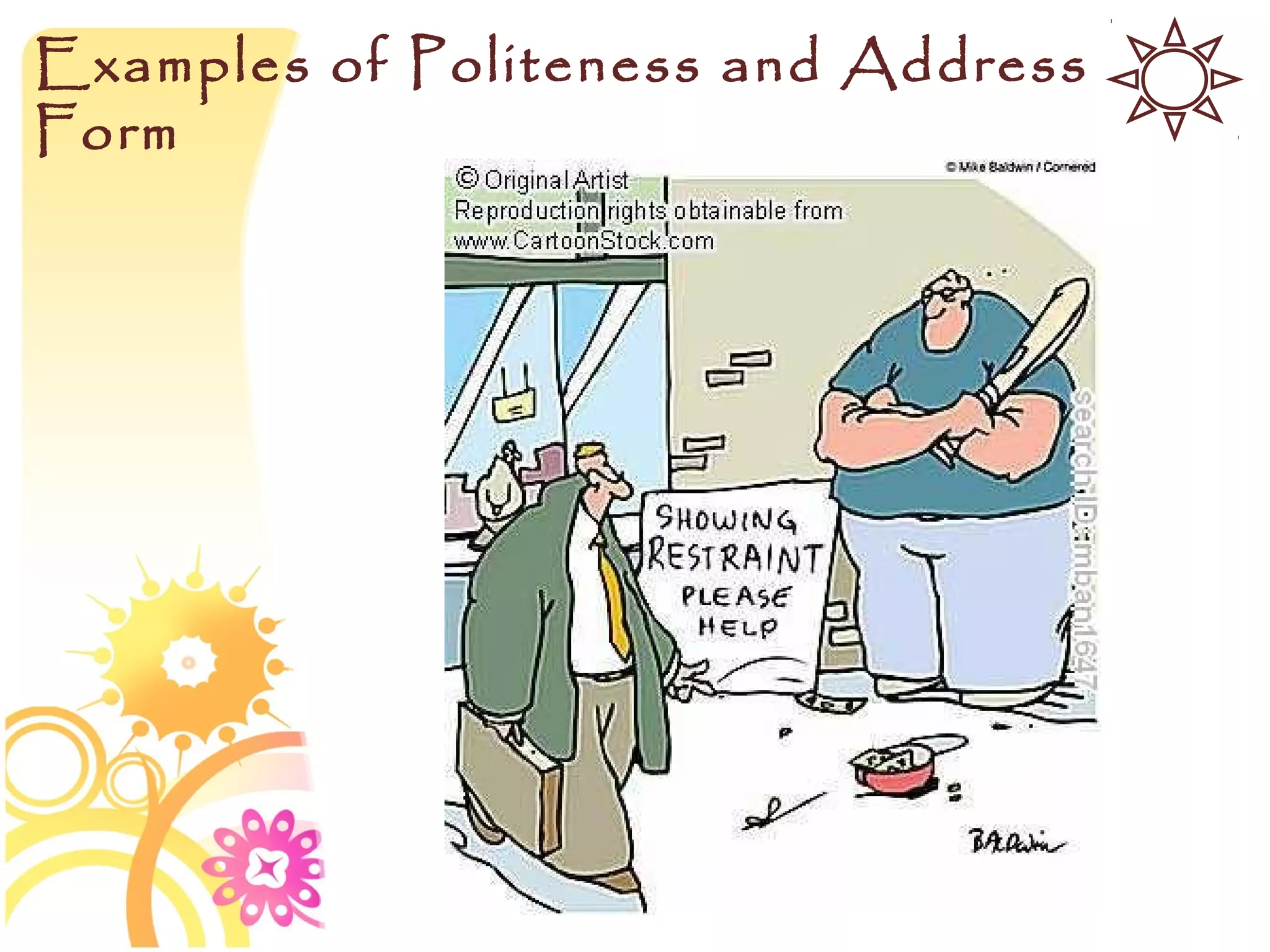
Examples of Politeness and Address
Form
Linguistic Politeness In Different
Cultures

       •   Miscommunication ..
       •   Learning another language
       •   Sociolinguistics assumption
       •   Acceptance and refusal an
           invitation
Example of miscommunication based on
cultural differences …

             In some villages in Subang, if
          someone wants to invite people
          to come to the wedding
          ceremony,       she/he       uses
          cigarettes as an invitation.
             If someone gets an expensive
          cigarette, it means that she/he
          has to give much money to the
          hostess and vice versa.
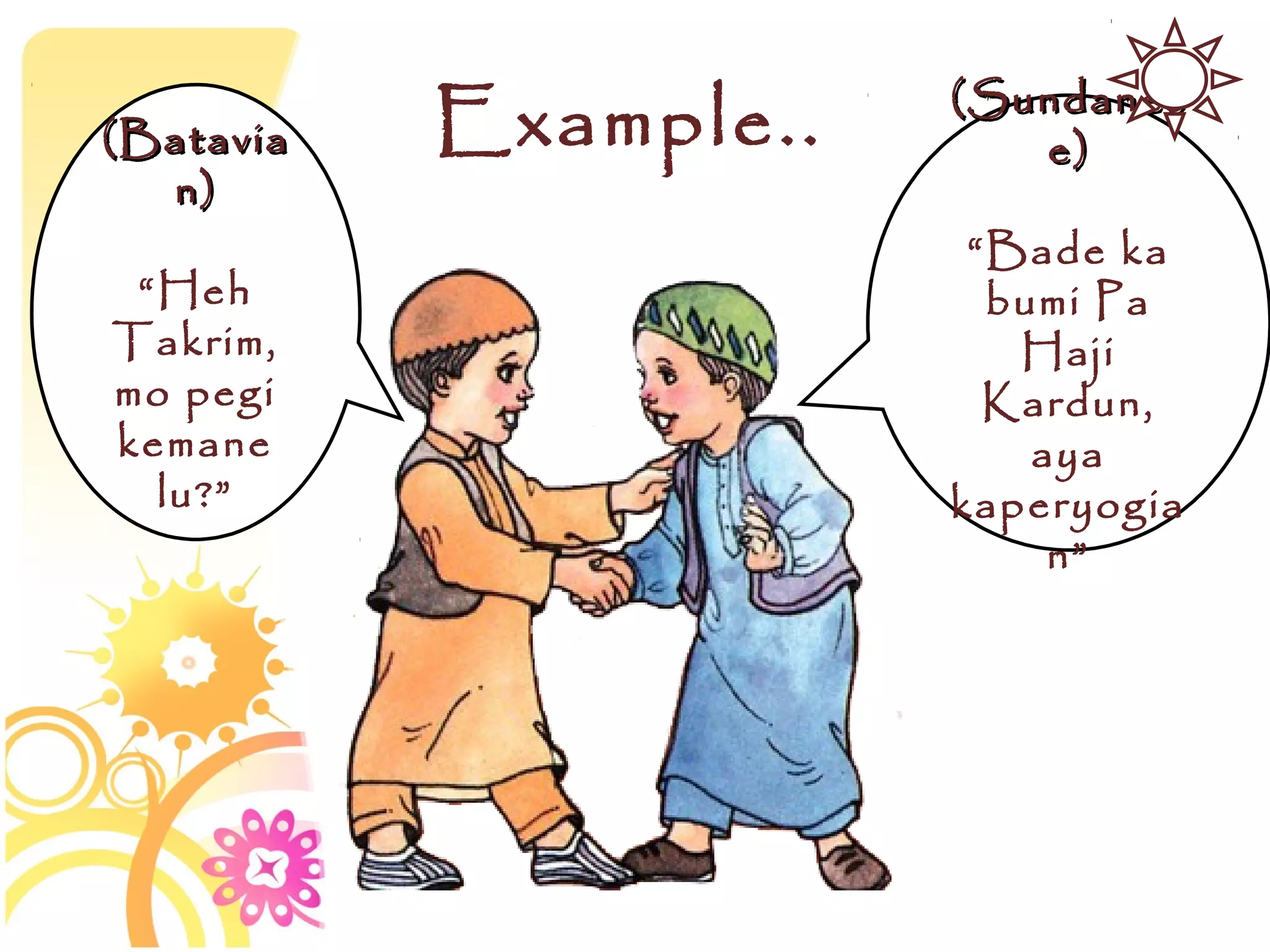
(Batavia   Example..   (Sundanes
                          e)
  n)
                        “Bade ka
 “Heh                    bumi Pa
Takrim,                   Haji
mo pegi                  Kardun,
kemane                     aya
  lu?”                 kaperyogia
                            n”
Example of linguistic politeness …

      In Karawang, if there is a wedding
  ceremony, the goods from the bridegroom
  are mentioned and the lists of price are also
  mentioned.
      If we come from outside of Karawang
  which have different culture we automatically
  think that culture is impolite because
  mentioning the goods and the price are
  unusual things.
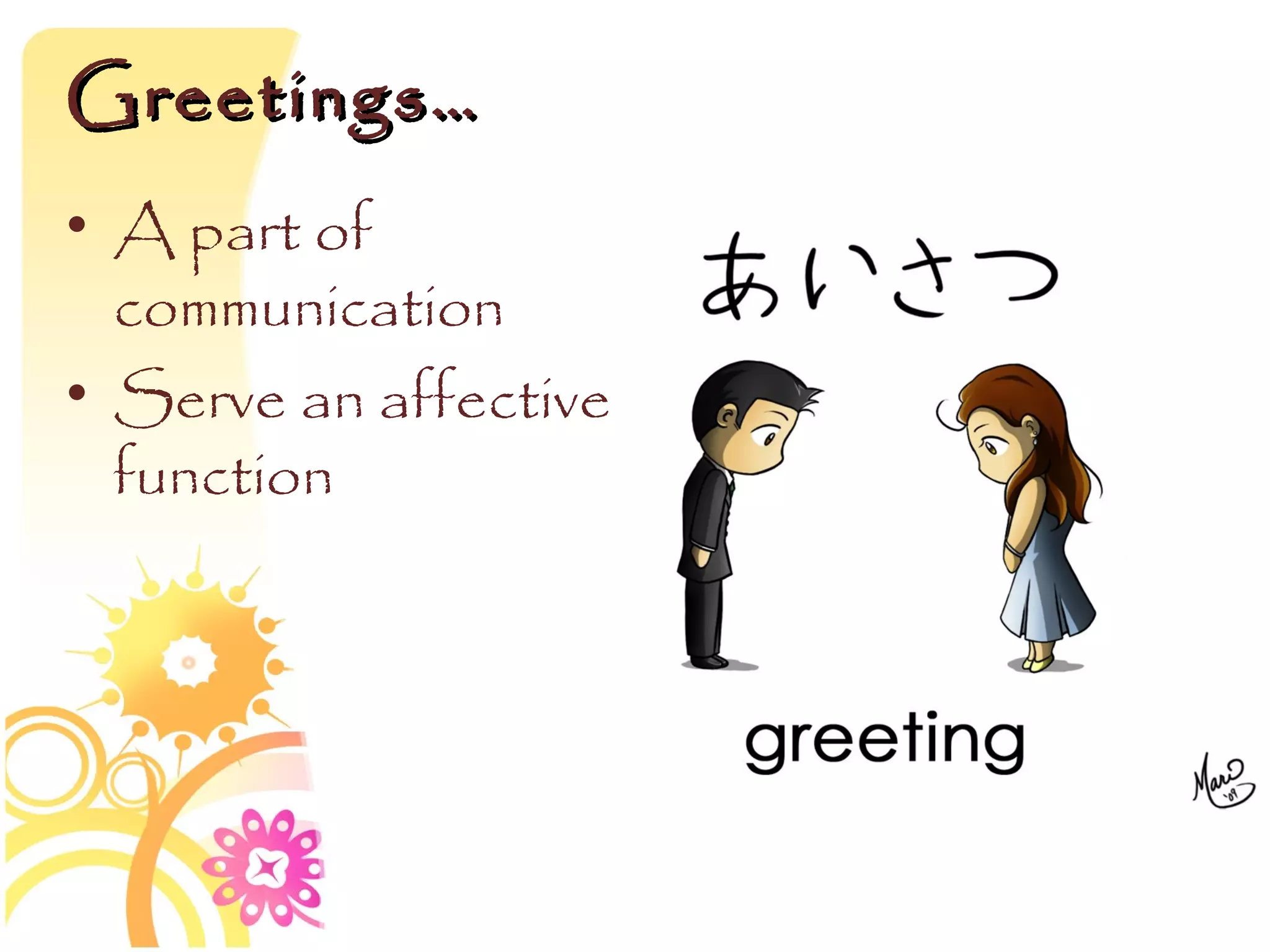
Greetings…
• A part of
  communication
• Serve an affective
  function
Examples..

      •   How are you?
      •   Apa kabar?
      •   Kumaha damang?
      •   Kia ora?
      •   Pripun kabare?
References..

Holmes, Janet. (2001). An Introduction to
 Sociolinguistics. Harlow: Pearson
 Education Limited
.. Thank you ..

Speech function, politeness and cross cultural communication

  • 1.
    Speech Function, Politeness AndCross- cultural Communication Language in Society
  • 2.
    Group 9 .. Fira Nursya’bani Luciyana 0906856 Dwiningrum 0902428 Meyza Pritama Riestia 0902467 Handayani 0902434
  • 3.
    Politeness The and Function of Speech Address Forms Linguistic Politeness in Different Cultures
  • 4.
    The Function ofSpeech • Affective (or Social) function • Referential (or informative) function Example: Fred : “Good morning, James. What a lovely day.” James : “Yes, it’s beautiful. So, How’s your weekend?” Fred : “It’s very great!”
  • 5.
    The Function ofSpeech • Expressive utterances: express the speaker’s feeling • Directive utterances: attempt to get someone to do something • Referential utterances: provide information • Metalinguistic utterances: comment on language itself • Poetic utterances: focus on aesthetic features of language • Phatic utterances: express solidarity and empathy with others
  • 6.
    Examples… • Expressive utterances – I’m happy today. – I am afraid. • Directive utterances – Wash the clothes. – Could you close the door? • Referential utterances – The second presenter will be Mrs. Hanna. – Make up speaking class will be held on Monday at 1 pm.
  • 7.
    Examples… • Metalinguistic utterances – ‘Hegemony’ is not a common word – ‘Nat’ has to be added by affixes • Poetic utterances (a poem, an ear- catching motto, a rhyme) – Peter piper picked a peck of pickled peppers – Bu Lulu nuju udur huntu • Phatic utterances – Hi, how are you? – Lovely day, isn’t it.
  • 8.
    Basic component of interaction… • Expressive Speaker • Directive Addressee • Referential Message
  • 9.
    Addition… • Commissives: Promises and threat – I swear, I’ll do my revenge – I will kill you soon • Formatives or Declaration – And now, I declare you as husband and wife
  • 10.
    Directives… …concern withgetting people to do things… Examples: Imperative: Sit down! Interrogative: Could you sit down? Declarative: It’d be better you to sit down.
  • 11.
    Factors that affectpeople in using Directives.. • The social distance between particip • Relative status • Formality of the context
  • 12.
    Example of theSocial Distance Between Participants Cepat Upin, nanti kita lambat!
  • 13.
    Example of RelativeStatus Prepare your presentation, we’ll do it tomorrow!
  • 14.
    Example of Formalityof the Context Wilujeng sumping, Pa. Mangga teras ka lebet.
  • 15.
    Politeness and Address Form Speaking politeness --- • The feelings of others • The social values of the society • Formality
  • 16.
    Politeness and Address Form Types of politeness • Positive politeness • Negative politeness
  • 17.
    Examples of Politenessand Address Form Daddy, can you please help me with my homework?
  • 18.
    Examples of Politenessand Address Form Could you bring in my paper, please?
  • 19.
    Examples of Politenessand Address Form
  • 20.
    Linguistic Politeness InDifferent Cultures • Miscommunication .. • Learning another language • Sociolinguistics assumption • Acceptance and refusal an invitation
  • 21.
    Example of miscommunicationbased on cultural differences … In some villages in Subang, if someone wants to invite people to come to the wedding ceremony, she/he uses cigarettes as an invitation. If someone gets an expensive cigarette, it means that she/he has to give much money to the hostess and vice versa.
  • 22.
    (Batavia Example.. (Sundanes e) n) “Bade ka “Heh bumi Pa Takrim, Haji mo pegi Kardun, kemane aya lu?” kaperyogia n”
  • 23.
    Example of linguisticpoliteness … In Karawang, if there is a wedding ceremony, the goods from the bridegroom are mentioned and the lists of price are also mentioned. If we come from outside of Karawang which have different culture we automatically think that culture is impolite because mentioning the goods and the price are unusual things.
  • 24.
    Greetings… • A partof communication • Serve an affective function
  • 25.
    Examples.. • How are you? • Apa kabar? • Kumaha damang? • Kia ora? • Pripun kabare?
  • 26.
    References.. Holmes, Janet. (2001).An Introduction to Sociolinguistics. Harlow: Pearson Education Limited
  • 27.