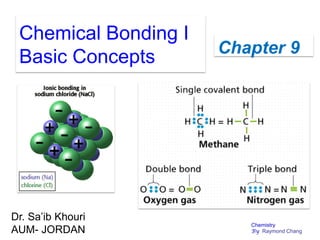
Chemical Bonding I
Basic Concepts Chapter 9
Chemistry
By Raymond Chang
Dr. Sa’ib Khouri
AUM- JORDAN
2
Valence electrons are the outer shell electrons of an
atom that participate in chemical bonding.
1A 1ns1
2A 2ns2
3A 3ns2np1
4A 4ns2np2
5A 5ns2np3
6A 6ns2np4
7A 7ns2np5
Group # of valence e-e- configuration
3
A Lewis dot symbol consists of the symbol of an element
and one dot for each valence electron in an atom of the
element.
Lewis Dot Symbols for representative elements and noble gases
No dot symbols for the transition metals, lanthanides, and actinides, because all have
incompletely filled inner shells.
4
Li + F Li+
F -
The Ionic Bond
1s22s11s22s22p5 1s21s22s22p6[He][Ne]
Li Li+ + e-
e- + F F -
F -Li+ + Li+
F -
LiF
Ionic bond: the electrostatic force that holds ions together in an
ionic compound.
5
HW. Do the same for the reaction between:
1. Ca and O2 2. Mg and N2 3. Li and O2
6
Lattice energy increases
as Q increases and/or
as r decreases.
Compound Lattice Energy
(kJ/mol)
MgF2
MgO
LiF
LiCl
2957
3938
1036
853
Q: +2,-1
Q: +2,-2
r F- < r Cl-
Lattice Energy of Ionic Compounds
E = k
Q+Q-
r
Q+: the charge on the cation
Q-: the charge on the anion
r : the distance between the ions
Lattice energy: the energy required to completely separate one
mole of a solid ionic compound into gaseous ions.
E: the potential energy
The magnitude of the
lattice energy indicates
the strength of ionic
interactions
Coulomb’s† law
7
The Born-Haber Cycle for Determining Lattice Energies
DHoverall = DH1 + DH2 + DH3 + DH4 + DH5
o ooooo
Lattice energy can be determined by Born-Haber cycle: e.g. LiF(s)
1. Atomization of Li (s): Li (s) Li (g) DH°1
2. Dissociation of F2 (g): ½ F2 (g) F (g) DH°2
3. Ionization of Li (g): Li (g) Li + (g) + e DH°3
4. Addition of e to F (g): F (g) + e F - (g) DH°4
5. Lattice reaction: Li + (g) + F - (g) LiF (s) DH°5
Li (s) + ½ F2(g) LiF(s) DH°f
DH°f = DH°1 + DH°2 + DH°3 + DH°4 + DH°5
 DH°5 = DH°f - (DH°1 + DH°2 + DH°3 + DH°4 )
9
There is a rough correlation between lattice energy and melting point.
The larger the lattice energy, the more stable the solid and the more
tightly held the ions. It takes more energy to melt such a solid, and so the
solid has a higher melting point than one with a smaller lattice energy.
10
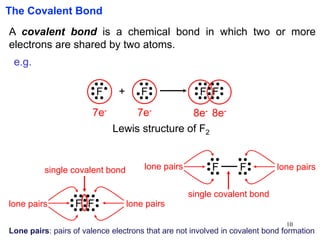
A covalent bond is a chemical bond in which two or more
electrons are shared by two atoms.
e.g.
F F+
7e- 7e-
F F
8e- 8e-
F F
F F
Lewis structure of F2
lone pairslone pairs
single covalent bond
Lone pairs: pairs of valence electrons that are not involved in covalent bond formation
The Covalent Bond
11
8e-
H HO+ + OH H O HHor
2e- 2e-
Lewis structure of water
Double bond – two atoms share two pairs of electrons, e.g. CO2
single covalent bonds
O C O or O C O
8e- 8e-8e-double bonds double bonds
Triple bond – two atoms share three pairs of electrons, e.g. N2
N N
8e-8e-
N N
triple bond
triple bond
or
12
Bonds length
the distance between the nuclei of two covalently bonded atoms
in a molecule
Bond Lengths
Triple bond < Double Bond < Single Bond
13
14
Electronegativity
The ability of an atom to attract toward itself the
electrons in a chemical bond.
Electron Affinity is a measurable, Cl is highest
Electronegativity is a relative concept, F is highest
X (g) + e- X-
(g)
Electrostatic potential map of the
HF molecule. The most electron-rich
region is red; the most electron-poor
region is blue
15
The Electronegativities of Common Elements
16
Variation of Electronegativity with Atomic Number
17
Covalent
share e-
Polar Covalent
partial transfer of e-
Ionic
transfer e-
Increasing difference in electronegativity
Classification of bonds by difference in electronegativity
Difference Bond Type
below 0.3 Covalent
2.0 or more Ionic
0.3 - 2.0 Polar Covalent
0 Pure covalent
18
Classify the following bonds as ionic, polar covalent, or covalent:
The bond in CsCl; the bond in H2S; and the NN bond in H2NNH2.
Cs – 0.7 Cl – 3.0 3.0 – 0.7 = 2.3 Ionic
H – 2.1 S – 2.5 2.5 – 2.1 = 0.4 Polar Covalent
N – 3.0 N – 3.0 3.0 – 3.0 = 0 Covalent
Example
19
1. Draw skeletal structure of compound showing
what atoms are bonded to each other. Put least
electronegative element in the center.
2. Count total number of valence e-. Add 1 for each
negative charge. Subtract 1 for each positive
charge.
3. Complete an octet for all atoms except hydrogen
4. If structure contains too many electrons, form
double and triple bonds on central atom as
needed.
Writing Lewis Structures
20
Example: write the Lewis structure of nitrogen trifluoride (NF3).
Step 1 - N is less electronegative than F, put N in center
F N F
F
Step 2 - Count valence electrons N - 5 (2s22p3) and F - 7 (2s22p5)
5 + (3 x 7) = 26 valence electrons
Step 3 - Draw single bonds between N and F atoms and complete
octets first on F atoms and the remaining on N atom.
Step 4 - Check, are number of e- in structure equal to the total number
of valence e- ?
3 single bonds (3x2) + 10 lone pairs (10x2) = 26 valence electrons
21
Example: write the Lewis structure of the carbonate ion (CO3
2-).
Step 1 – C is less electronegative than O, put C in center
Step 2 – Count valence electrons C - 4 (2s22p2) and O - 6 (2s22p4)
-2 charge – 2e-
4 + (3 x 6) + 2 = 24 valence electrons
Step 3 – Draw single bonds between C and O atoms and complete
octet on the surrounding O atoms.
Step 4 – Check, Are the number of e- in structure equal to number of valence e- ?
3 single bonds (3x2) + 9 lone pairs (10x2) = 24 valence electrons
Step 5 - form double bond and re-check number of e-
2 single bonds (2x2) = 4
1 double bond = 4
8 lone pairs (8x2) = 16
Total = 24
Practice—Lewis Structures
• NClO
• H3BO3
• NO2
-1
• H3PO4
• SO3
-2
• P2H4
18 e-
26 e-
32 e-
14 e-
24 e-
18 e-
22
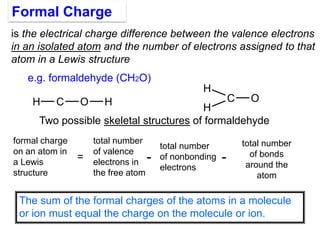
Formal Charge
H C O H
H
C O
H
formal charge
on an atom in
a Lewis
structure
=
total number
of valence
electrons in
the free atom
-
total number
of nonbonding
electrons
-
The sum of the formal charges of the atoms in a molecule
or ion must equal the charge on the molecule or ion.
Two possible skeletal structures of formaldehyde
is the electrical charge difference between the valence electrons
in an isolated atom and the number of electrons assigned to that
atom in a Lewis structure
e.g. formaldehyde (CH2O)
total number
of bonds
around the
atom
24
H C O H
C – 4 e-
O – 6 e-
2H – 2x1 e-
12 e-
2 single bonds (2x2) = 4
1 double bond = 4
2 lone pairs (2x2) = 4
Total = 12
formal charge on C = 4 -2 -3 = -1
formal charge on O = 6 -2 -3 = +1
-1 +1
formal charge
on an atom in
a Lewis
structure
=
total number
of valence
electrons in
the free atom
-
total number
of nonbonding
electrons
-
total number
of bonds
around the
atom
25
C – 4 e-
O – 6 e-
2H – 2x1 e-
12 e-
2 single bonds (2x2) = 4
1 double bond = 4
2 lone pairs (2x2) = 4
Total = 12
H
C O
H
formal charge on C = 4 -0 -4 = 0
formal charge on O = 6 -4 -2 = 0
0 0
26
Formal Charge and Lewis Structures
1. For neutral molecules, a Lewis structure in which there
are no formal charges is preferable to other structures in
which formal charges are present.
2. Lewis structures with large formal charges (+2, +3,
and/or -2, -3, and so on) are less plausible than those
with small formal charges.
3. Among Lewis structures having similar distributions of
formal charges, the most plausible structure is the one in
which negative formal charges are placed on the more
electronegative atoms.
Which is the most likely Lewis structure for CH2O?
H C O H
-1 +1 H
C O
H
0 0
Note that the sum of the formal charges is -2,
the same as the charge on the carbonate ion.
Example
28
A resonance structure
is one of two or more Lewis structures for a single molecule
that cannot be represented accurately by only one Lewis
structure.
O O O
+ -
OOO
+-
O C O
O
- -
O C O
O
-
-
OCO
O
-
-
What are the resonance structures of the
carbonate (CO3
2-) ion?
In fact, the distance between all adjacent C atoms in
benzene is 140 pm, which is shorter than a C-C bond
(154 pm) and longer than a C=C bond (133 pm).
The concept of resonance applies equally well to organic system. A
good example is the benzene molecule (C6H6):
Example
31
Exceptions to the Octet Rule
The Incomplete Octet
H HBe
Be – 2e-
2H – 2x1e-
4e-
BeH2
BF3
B – 3e-
3F – 3x7e-
24e-
F B F
F
3 single bonds (3x2) = 6
9 lone pairs (9x2) = 18
Total = 24
Exceptions to the Octet Rule
Odd-Electron Molecules
Nitric oxide (NO)
Nitrogen dioxide (NO2)
For example
when two nitrogen dioxide molecules collide, they form dinitrogen tetroxide
in which the octet rule is satisfied for the N and O atoms:
34
SF6
S – 6e-
6F – 42e-
48e-
S
F
F
F
F
F
F
6 single bonds (6x2) = 12
18 lone pairs (18x2) = 36
Total = 48
The Expanded Octet (central atom with principal quantum
number n > 2)
XeF4
37
The enthalpy change required to break a particular bond in
one mole of gaseous molecules.
H2 (g) H (g) + H (g) DH0 = 436.4
Cl2 (g) Cl (g)+ Cl (g) DH0 = 242.7
HCl (g) H (g) + Cl (g) DH0 = 431.9
O2 (g) O (g) + O (g) DH0 = 498.7 O O
N2 (g) N (g) + N (g) DH0 = 941.4 N N
Bond Enthalpy/kJ/mol
Bond Enthalpies
Single bond < Double bond < Triple bond
Bond enthalpy
38
Average bond enthapy in polyatomic molecules
H2O (g) H (g)+ OH (g) DH0 = 502 kJ/mol
OH (g) H (g)+ O (g) DH0 = 427 kJ/mol
Average OH bond enthalpy =
502 + 427
2
= 464 kJ/mol
40
41
Bond Enthalpies (BE) and Enthalpy changes in reactions
DH0 = total energy input – total energy released
= SBE(reactants) – SBE(products)
Imagine reaction proceeding by breaking all bonds in the reactants and
then using the gaseous atoms to form all the bonds in the products.
endothermic exothermic
42
H2 (g) + Cl2 (g) 2HCl (g) 2H2 (g) + O2 (g) 2H2O (g)
43
Use bond enthalpies to calculate the enthalpy change for:
H2 (g) + F2 (g) 2HF (g)
DH0 = SBE(reactants) – SBE(products)
Type of
bonds broken
Number of
bonds broken
Bond enthalpy
(kJ/mol)
Enthalpy
change (kJ/mol)
H H 1 436.4 436.4
F F 1 156.9 156.9
Type of
bonds formed
Number of
bonds formed
Bond enthalpy
(kJ/mol)
Enthalpy change
(kJ/mol)
H F 2 568.2 1136.4
DH0 = 436.4 + 156.9 – 2 x 568.2 = -543.1 kJ/mol
44
Estimate the enthalpy change for the reaction below,
given the following bond energies:
C2H4 (g) + H2 (g) C2H6 (g)
BE(H ̶ H) = 436 kJ/mol
BE(C ̶ H) = 414 kJ/mol
BE(C ̶ C) = 347 kJ/mol
BE(C=C) = 620 kJ/mol
a) -119 kJ b) +119 kJ c) -392 kJ
d) +392 kJ e) None of the above.
Example
45
Examples on Lewis structure

Ch9 chemical bonding i basic concepts

  • 1.
    Chemical Bonding I BasicConcepts Chapter 9 Chemistry By Raymond Chang Dr. Sa’ib Khouri AUM- JORDAN
  • 2.
    2 Valence electrons arethe outer shell electrons of an atom that participate in chemical bonding. 1A 1ns1 2A 2ns2 3A 3ns2np1 4A 4ns2np2 5A 5ns2np3 6A 6ns2np4 7A 7ns2np5 Group # of valence e-e- configuration
  • 3.
    3 A Lewis dotsymbol consists of the symbol of an element and one dot for each valence electron in an atom of the element. Lewis Dot Symbols for representative elements and noble gases No dot symbols for the transition metals, lanthanides, and actinides, because all have incompletely filled inner shells.
  • 4.
    4 Li + FLi+ F - The Ionic Bond 1s22s11s22s22p5 1s21s22s22p6[He][Ne] Li Li+ + e- e- + F F - F -Li+ + Li+ F - LiF Ionic bond: the electrostatic force that holds ions together in an ionic compound.
  • 5.
    5 HW. Do thesame for the reaction between: 1. Ca and O2 2. Mg and N2 3. Li and O2
  • 6.
    6 Lattice energy increases asQ increases and/or as r decreases. Compound Lattice Energy (kJ/mol) MgF2 MgO LiF LiCl 2957 3938 1036 853 Q: +2,-1 Q: +2,-2 r F- < r Cl- Lattice Energy of Ionic Compounds E = k Q+Q- r Q+: the charge on the cation Q-: the charge on the anion r : the distance between the ions Lattice energy: the energy required to completely separate one mole of a solid ionic compound into gaseous ions. E: the potential energy The magnitude of the lattice energy indicates the strength of ionic interactions Coulomb’s† law
  • 7.
    7 The Born-Haber Cyclefor Determining Lattice Energies DHoverall = DH1 + DH2 + DH3 + DH4 + DH5 o ooooo
  • 8.
    Lattice energy canbe determined by Born-Haber cycle: e.g. LiF(s) 1. Atomization of Li (s): Li (s) Li (g) DH°1 2. Dissociation of F2 (g): ½ F2 (g) F (g) DH°2 3. Ionization of Li (g): Li (g) Li + (g) + e DH°3 4. Addition of e to F (g): F (g) + e F - (g) DH°4 5. Lattice reaction: Li + (g) + F - (g) LiF (s) DH°5 Li (s) + ½ F2(g) LiF(s) DH°f DH°f = DH°1 + DH°2 + DH°3 + DH°4 + DH°5  DH°5 = DH°f - (DH°1 + DH°2 + DH°3 + DH°4 )
  • 9.
    9 There is arough correlation between lattice energy and melting point. The larger the lattice energy, the more stable the solid and the more tightly held the ions. It takes more energy to melt such a solid, and so the solid has a higher melting point than one with a smaller lattice energy.
  • 10.
    10 A covalent bondis a chemical bond in which two or more electrons are shared by two atoms. e.g. F F+ 7e- 7e- F F 8e- 8e- F F F F Lewis structure of F2 lone pairslone pairs lone pairslone pairs single covalent bond single covalent bond Lone pairs: pairs of valence electrons that are not involved in covalent bond formation The Covalent Bond
  • 11.
    11 8e- H HO+ +OH H O HHor 2e- 2e- Lewis structure of water Double bond – two atoms share two pairs of electrons, e.g. CO2 single covalent bonds O C O or O C O 8e- 8e-8e-double bonds double bonds Triple bond – two atoms share three pairs of electrons, e.g. N2 N N 8e-8e- N N triple bond triple bond or
  • 12.
    12 Bonds length the distancebetween the nuclei of two covalently bonded atoms in a molecule Bond Lengths Triple bond < Double Bond < Single Bond
  • 13.
  • 14.
    14 Electronegativity The ability ofan atom to attract toward itself the electrons in a chemical bond. Electron Affinity is a measurable, Cl is highest Electronegativity is a relative concept, F is highest X (g) + e- X- (g) Electrostatic potential map of the HF molecule. The most electron-rich region is red; the most electron-poor region is blue
  • 15.
  • 16.
  • 17.
    17 Covalent share e- Polar Covalent partialtransfer of e- Ionic transfer e- Increasing difference in electronegativity Classification of bonds by difference in electronegativity Difference Bond Type below 0.3 Covalent 2.0 or more Ionic 0.3 - 2.0 Polar Covalent 0 Pure covalent
  • 18.
    18 Classify the followingbonds as ionic, polar covalent, or covalent: The bond in CsCl; the bond in H2S; and the NN bond in H2NNH2. Cs – 0.7 Cl – 3.0 3.0 – 0.7 = 2.3 Ionic H – 2.1 S – 2.5 2.5 – 2.1 = 0.4 Polar Covalent N – 3.0 N – 3.0 3.0 – 3.0 = 0 Covalent Example
  • 19.
    19 1. Draw skeletalstructure of compound showing what atoms are bonded to each other. Put least electronegative element in the center. 2. Count total number of valence e-. Add 1 for each negative charge. Subtract 1 for each positive charge. 3. Complete an octet for all atoms except hydrogen 4. If structure contains too many electrons, form double and triple bonds on central atom as needed. Writing Lewis Structures
  • 20.
    20 Example: write theLewis structure of nitrogen trifluoride (NF3). Step 1 - N is less electronegative than F, put N in center F N F F Step 2 - Count valence electrons N - 5 (2s22p3) and F - 7 (2s22p5) 5 + (3 x 7) = 26 valence electrons Step 3 - Draw single bonds between N and F atoms and complete octets first on F atoms and the remaining on N atom. Step 4 - Check, are number of e- in structure equal to the total number of valence e- ? 3 single bonds (3x2) + 10 lone pairs (10x2) = 26 valence electrons
  • 21.
    21 Example: write theLewis structure of the carbonate ion (CO3 2-). Step 1 – C is less electronegative than O, put C in center Step 2 – Count valence electrons C - 4 (2s22p2) and O - 6 (2s22p4) -2 charge – 2e- 4 + (3 x 6) + 2 = 24 valence electrons Step 3 – Draw single bonds between C and O atoms and complete octet on the surrounding O atoms. Step 4 – Check, Are the number of e- in structure equal to number of valence e- ? 3 single bonds (3x2) + 9 lone pairs (10x2) = 24 valence electrons Step 5 - form double bond and re-check number of e- 2 single bonds (2x2) = 4 1 double bond = 4 8 lone pairs (8x2) = 16 Total = 24
  • 22.
    Practice—Lewis Structures • NClO •H3BO3 • NO2 -1 • H3PO4 • SO3 -2 • P2H4 18 e- 26 e- 32 e- 14 e- 24 e- 18 e- 22
  • 23.
    Formal Charge H CO H H C O H formal charge on an atom in a Lewis structure = total number of valence electrons in the free atom - total number of nonbonding electrons - The sum of the formal charges of the atoms in a molecule or ion must equal the charge on the molecule or ion. Two possible skeletal structures of formaldehyde is the electrical charge difference between the valence electrons in an isolated atom and the number of electrons assigned to that atom in a Lewis structure e.g. formaldehyde (CH2O) total number of bonds around the atom
  • 24.
    24 H C OH C – 4 e- O – 6 e- 2H – 2x1 e- 12 e- 2 single bonds (2x2) = 4 1 double bond = 4 2 lone pairs (2x2) = 4 Total = 12 formal charge on C = 4 -2 -3 = -1 formal charge on O = 6 -2 -3 = +1 -1 +1 formal charge on an atom in a Lewis structure = total number of valence electrons in the free atom - total number of nonbonding electrons - total number of bonds around the atom
  • 25.
    25 C – 4e- O – 6 e- 2H – 2x1 e- 12 e- 2 single bonds (2x2) = 4 1 double bond = 4 2 lone pairs (2x2) = 4 Total = 12 H C O H formal charge on C = 4 -0 -4 = 0 formal charge on O = 6 -4 -2 = 0 0 0
  • 26.
    26 Formal Charge andLewis Structures 1. For neutral molecules, a Lewis structure in which there are no formal charges is preferable to other structures in which formal charges are present. 2. Lewis structures with large formal charges (+2, +3, and/or -2, -3, and so on) are less plausible than those with small formal charges. 3. Among Lewis structures having similar distributions of formal charges, the most plausible structure is the one in which negative formal charges are placed on the more electronegative atoms. Which is the most likely Lewis structure for CH2O? H C O H -1 +1 H C O H 0 0
  • 27.
    Note that thesum of the formal charges is -2, the same as the charge on the carbonate ion. Example
  • 28.
    28 A resonance structure isone of two or more Lewis structures for a single molecule that cannot be represented accurately by only one Lewis structure. O O O + - OOO +- O C O O - - O C O O - - OCO O - - What are the resonance structures of the carbonate (CO3 2-) ion?
  • 29.
    In fact, thedistance between all adjacent C atoms in benzene is 140 pm, which is shorter than a C-C bond (154 pm) and longer than a C=C bond (133 pm). The concept of resonance applies equally well to organic system. A good example is the benzene molecule (C6H6):
  • 30.
  • 31.
    31 Exceptions to theOctet Rule The Incomplete Octet H HBe Be – 2e- 2H – 2x1e- 4e- BeH2 BF3 B – 3e- 3F – 3x7e- 24e- F B F F 3 single bonds (3x2) = 6 9 lone pairs (9x2) = 18 Total = 24
  • 33.
    Exceptions to theOctet Rule Odd-Electron Molecules Nitric oxide (NO) Nitrogen dioxide (NO2) For example when two nitrogen dioxide molecules collide, they form dinitrogen tetroxide in which the octet rule is satisfied for the N and O atoms:
  • 34.
    34 SF6 S – 6e- 6F– 42e- 48e- S F F F F F F 6 single bonds (6x2) = 12 18 lone pairs (18x2) = 36 Total = 48 The Expanded Octet (central atom with principal quantum number n > 2)
  • 36.
  • 37.
    37 The enthalpy changerequired to break a particular bond in one mole of gaseous molecules. H2 (g) H (g) + H (g) DH0 = 436.4 Cl2 (g) Cl (g)+ Cl (g) DH0 = 242.7 HCl (g) H (g) + Cl (g) DH0 = 431.9 O2 (g) O (g) + O (g) DH0 = 498.7 O O N2 (g) N (g) + N (g) DH0 = 941.4 N N Bond Enthalpy/kJ/mol Bond Enthalpies Single bond < Double bond < Triple bond Bond enthalpy
  • 38.
    38 Average bond enthapyin polyatomic molecules H2O (g) H (g)+ OH (g) DH0 = 502 kJ/mol OH (g) H (g)+ O (g) DH0 = 427 kJ/mol Average OH bond enthalpy = 502 + 427 2 = 464 kJ/mol
  • 40.
  • 41.
    41 Bond Enthalpies (BE)and Enthalpy changes in reactions DH0 = total energy input – total energy released = SBE(reactants) – SBE(products) Imagine reaction proceeding by breaking all bonds in the reactants and then using the gaseous atoms to form all the bonds in the products. endothermic exothermic
  • 42.
    42 H2 (g) +Cl2 (g) 2HCl (g) 2H2 (g) + O2 (g) 2H2O (g)
  • 43.
    43 Use bond enthalpiesto calculate the enthalpy change for: H2 (g) + F2 (g) 2HF (g) DH0 = SBE(reactants) – SBE(products) Type of bonds broken Number of bonds broken Bond enthalpy (kJ/mol) Enthalpy change (kJ/mol) H H 1 436.4 436.4 F F 1 156.9 156.9 Type of bonds formed Number of bonds formed Bond enthalpy (kJ/mol) Enthalpy change (kJ/mol) H F 2 568.2 1136.4 DH0 = 436.4 + 156.9 – 2 x 568.2 = -543.1 kJ/mol
  • 44.
    44 Estimate the enthalpychange for the reaction below, given the following bond energies: C2H4 (g) + H2 (g) C2H6 (g) BE(H ̶ H) = 436 kJ/mol BE(C ̶ H) = 414 kJ/mol BE(C ̶ C) = 347 kJ/mol BE(C=C) = 620 kJ/mol a) -119 kJ b) +119 kJ c) -392 kJ d) +392 kJ e) None of the above. Example
  • 45.