CHEMICAL BONDING I
THE CHEMICAL BONDING I
GCHEM1
Lesson 1 Lewis Dot Structure
In this lesson, you will learn that Lewis dot symbol consists of the
symbol of an element and one dot for each valence electron in an atom
of the element.
Lewis electron dot diagrams use dots to represent valence
electrons around an atomic symbol.
Lewis electron dot diagrams for ions have less (for cations) or
more (for anions) dots than the corresponding atom.
THE CHEMICAL BONDING I
GCHEM1
Lesson 1 Lewis Dot Structure
THE CHEMICAL BONDING I
GCHEM1
Lesson 1 Lewis Dot Structure
I. WRITING LEWIS STRUCTURES
The following guidelines are used in writing the Lewis structure of covalent molecules:
a. Draw a skeletal structure of the molecule putting bonded atoms next to each other. In general, the least
electronegative atom occupies the central position. H and F usually occupy terminal (end) positions.
b. Count the total number of valence electrons from all the atoms in the structure. Add electrons
corresponding to the charge for negative ions; subtract electrons corresponding to the charge for positive ions.
c. Distribute the valence electrons to the non-central atoms such that these atoms fulfill the octet rule.
Remaining electrons are assigned to the central atom. Remember that bonds are equivalent to 2 electrons.
d. If the valence electrons are not enough, multiple bonds may be formed.
THE CHEMICAL BONDING I
GCHEM1
Lesson 1 Lewis Dot Structure
I. Octet Rule
The octet rule dictates that atoms are most stable when their valence shells
are filled with eight electrons. It is based on the observation that the atoms
of the main group elements have a tendency to participate in chemical
bonding in such a way that each atom of the resulting molecule has eight
electrons in the valence shell.The octet rule is only applicable to the main
group elements.
The molecules of the halogens, oxygen, nitrogen, and carbon are known to
obey the octet rule. In general, the elements that obey this rule include the s-
block elements and the p-block elements (except hydrogen, helium, and
lithium).
I. WRITING LEWIS STRUCTURES
The following guidelines are used in writing the Lewis structure of covalent molecules:
a. Draw a skeletal structure of the molecule putting bonded atoms next to each other. In
general, the least electronegative atom occupies the central position. H and F usually occupy
terminal (end) positions.
b. Count the total number of valence electrons from all the atoms in the structure. Add electrons
corresponding to the charge for negative ions; subtract electrons corresponding to the
charge for positive ions.
c. Distribute the valence electrons to the non-central atoms such that these atoms fulfill the octet
rule. Remaining electrons are assigned to the central atom. Remember that bonds are
equivalent to 2 electrons.
d. If the valence electrons are not enough, multiple bonds may be formed.
Example:
Write the Lewis structure for NCl3.
a. Skeleton structure is
b. Count valence electrons:
N = 5
3 Cl = 3 (7) = 21
Total = 26
c. Distribute the 26 electrons to the atoms such that
they fulfill the octet rule. Bonds are equivalent to 2
electrons. Check if all atoms have 8 electrons around
them.
In combining with other atoms, only outer electrons,
the valence electrons, are involved. To keep track of
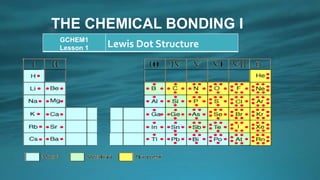
these valence electrons, the Lewis dot symbol is used.
The Lewis dot symbol consists of the symbol of an
element and one dot for each valence electron in an
atom of the element.
Octet Rule
It refers to the tendency of atoms to prefer to have eight electrons in the valence shell. When atoms
have fewer than eight electrons, they tend to react and form more stable compounds. When discussing
the octet rule, we do not consider d or f electrons. Only the s and p electrons are involved in the octet rule,
making it useful for the main group elements (elements not in the transition metal or inner-transition metal
blocks); an octet in these atoms corresponds to an electron configurations ending with s2p6.
Assessment
Draw the Lewis dot structures for each of the following molecules:
1. SiCl4 3. CCl4
2. BF3 4. BrF3
GCHEM1
Q2-MODULE 2:
Lesson 1
Covalent Compounds
In the previous lesson, you learned the function of Lewis Dot Structure. In this lesson, you will learn
how to share the electrons through covalent bonding by following the Octet Rule.
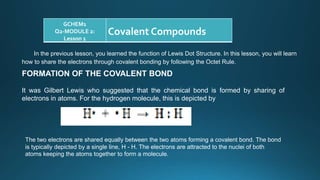
FORMATION OF THE COVALENT BOND
It was Gilbert Lewis who suggested that the chemical bond is formed by sharing of
electrons in atoms. For the hydrogen molecule, this is depicted by
The two electrons are shared equally between the two atoms forming a covalent bond. The bond
is typically depicted by a single line, H - H. The electrons are attracted to the nuclei of both
atoms keeping the atoms together to form a molecule.
GCHEM1
Q2-MODULE 2:
Lesson 1
Covalent Compounds
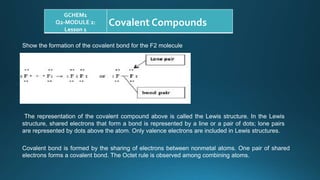
Show the formation of the covalent bond for the F2 molecule
The representation of the covalent compound above is called the Lewis structure. In the Lewis
structure, shared electrons that form a bond is represented by a line or a pair of dots; lone pairs
are represented by dots above the atom. Only valence electrons are included in Lewis structures.
Covalent bond is formed by the sharing of electrons between nonmetal atoms. One pair of shared
electrons forms a covalent bond. The Octet rule is observed among combining atoms.
GCHEM1
Q2-MODULE 2:
Lesson 1
Covalent Compounds
Consider the
following examples:
Types of Bond:
1. Single bonds are formed when two atoms are held together by one pair of electrons.
.
2. Double bond is from the sharing of two pairs of electrons.
3. Triple bond exists in N2 where the two N atoms are held by three pairs of electrons.
Show the covalent bonding of the following molecules providing its presentation of the octet
rule:
ASSESSMENT
1. Water, H2O
2. Phosphorous trichloride, PCl3
3. CO2

bonding 1.pptx

  • 1.
  • 2.
    THE CHEMICAL BONDINGI GCHEM1 Lesson 1 Lewis Dot Structure In this lesson, you will learn that Lewis dot symbol consists of the symbol of an element and one dot for each valence electron in an atom of the element. Lewis electron dot diagrams use dots to represent valence electrons around an atomic symbol. Lewis electron dot diagrams for ions have less (for cations) or more (for anions) dots than the corresponding atom.
  • 3.
    THE CHEMICAL BONDINGI GCHEM1 Lesson 1 Lewis Dot Structure
  • 4.
    THE CHEMICAL BONDINGI GCHEM1 Lesson 1 Lewis Dot Structure I. WRITING LEWIS STRUCTURES The following guidelines are used in writing the Lewis structure of covalent molecules: a. Draw a skeletal structure of the molecule putting bonded atoms next to each other. In general, the least electronegative atom occupies the central position. H and F usually occupy terminal (end) positions. b. Count the total number of valence electrons from all the atoms in the structure. Add electrons corresponding to the charge for negative ions; subtract electrons corresponding to the charge for positive ions. c. Distribute the valence electrons to the non-central atoms such that these atoms fulfill the octet rule. Remaining electrons are assigned to the central atom. Remember that bonds are equivalent to 2 electrons. d. If the valence electrons are not enough, multiple bonds may be formed.
  • 5.
    THE CHEMICAL BONDINGI GCHEM1 Lesson 1 Lewis Dot Structure I. Octet Rule The octet rule dictates that atoms are most stable when their valence shells are filled with eight electrons. It is based on the observation that the atoms of the main group elements have a tendency to participate in chemical bonding in such a way that each atom of the resulting molecule has eight electrons in the valence shell.The octet rule is only applicable to the main group elements. The molecules of the halogens, oxygen, nitrogen, and carbon are known to obey the octet rule. In general, the elements that obey this rule include the s- block elements and the p-block elements (except hydrogen, helium, and lithium).
  • 6.
    I. WRITING LEWISSTRUCTURES The following guidelines are used in writing the Lewis structure of covalent molecules: a. Draw a skeletal structure of the molecule putting bonded atoms next to each other. In general, the least electronegative atom occupies the central position. H and F usually occupy terminal (end) positions. b. Count the total number of valence electrons from all the atoms in the structure. Add electrons corresponding to the charge for negative ions; subtract electrons corresponding to the charge for positive ions. c. Distribute the valence electrons to the non-central atoms such that these atoms fulfill the octet rule. Remaining electrons are assigned to the central atom. Remember that bonds are equivalent to 2 electrons. d. If the valence electrons are not enough, multiple bonds may be formed.
  • 7.
    Example: Write the Lewisstructure for NCl3. a. Skeleton structure is b. Count valence electrons: N = 5 3 Cl = 3 (7) = 21 Total = 26 c. Distribute the 26 electrons to the atoms such that they fulfill the octet rule. Bonds are equivalent to 2 electrons. Check if all atoms have 8 electrons around them. In combining with other atoms, only outer electrons, the valence electrons, are involved. To keep track of these valence electrons, the Lewis dot symbol is used. The Lewis dot symbol consists of the symbol of an element and one dot for each valence electron in an atom of the element.
  • 8.
    Octet Rule It refersto the tendency of atoms to prefer to have eight electrons in the valence shell. When atoms have fewer than eight electrons, they tend to react and form more stable compounds. When discussing the octet rule, we do not consider d or f electrons. Only the s and p electrons are involved in the octet rule, making it useful for the main group elements (elements not in the transition metal or inner-transition metal blocks); an octet in these atoms corresponds to an electron configurations ending with s2p6. Assessment Draw the Lewis dot structures for each of the following molecules: 1. SiCl4 3. CCl4 2. BF3 4. BrF3
  • 9.
    GCHEM1 Q2-MODULE 2: Lesson 1 CovalentCompounds In the previous lesson, you learned the function of Lewis Dot Structure. In this lesson, you will learn how to share the electrons through covalent bonding by following the Octet Rule. FORMATION OF THE COVALENT BOND It was Gilbert Lewis who suggested that the chemical bond is formed by sharing of electrons in atoms. For the hydrogen molecule, this is depicted by The two electrons are shared equally between the two atoms forming a covalent bond. The bond is typically depicted by a single line, H - H. The electrons are attracted to the nuclei of both atoms keeping the atoms together to form a molecule.
  • 10.
    GCHEM1 Q2-MODULE 2: Lesson 1 CovalentCompounds Show the formation of the covalent bond for the F2 molecule The representation of the covalent compound above is called the Lewis structure. In the Lewis structure, shared electrons that form a bond is represented by a line or a pair of dots; lone pairs are represented by dots above the atom. Only valence electrons are included in Lewis structures. Covalent bond is formed by the sharing of electrons between nonmetal atoms. One pair of shared electrons forms a covalent bond. The Octet rule is observed among combining atoms.
  • 11.
    GCHEM1 Q2-MODULE 2: Lesson 1 CovalentCompounds Consider the following examples:
  • 12.
    Types of Bond: 1.Single bonds are formed when two atoms are held together by one pair of electrons. . 2. Double bond is from the sharing of two pairs of electrons. 3. Triple bond exists in N2 where the two N atoms are held by three pairs of electrons.
  • 13.
    Show the covalentbonding of the following molecules providing its presentation of the octet rule: ASSESSMENT 1. Water, H2O 2. Phosphorous trichloride, PCl3 3. CO2