Skeletal Structures and
Valance Shells
Dr. K. Shahzad Baig
Memorial University of Newfoundland
(MUN)
Canada
Petrucci, et al. 2011. General Chemistry: Principles and Modern Applications. Pearson Canada Inc., Toronto, Ontario.
Tro, N.J. 2010. Principles of Chemistry. : a molecular approach. Pearson Education, Inc.
Skeletal Structures
In a skeletal structure all the atoms in the structure of a molecule are arranged in the
order in which they are bonded to one another.
with more than two atoms, it need to distinguish between central and terminal atoms.
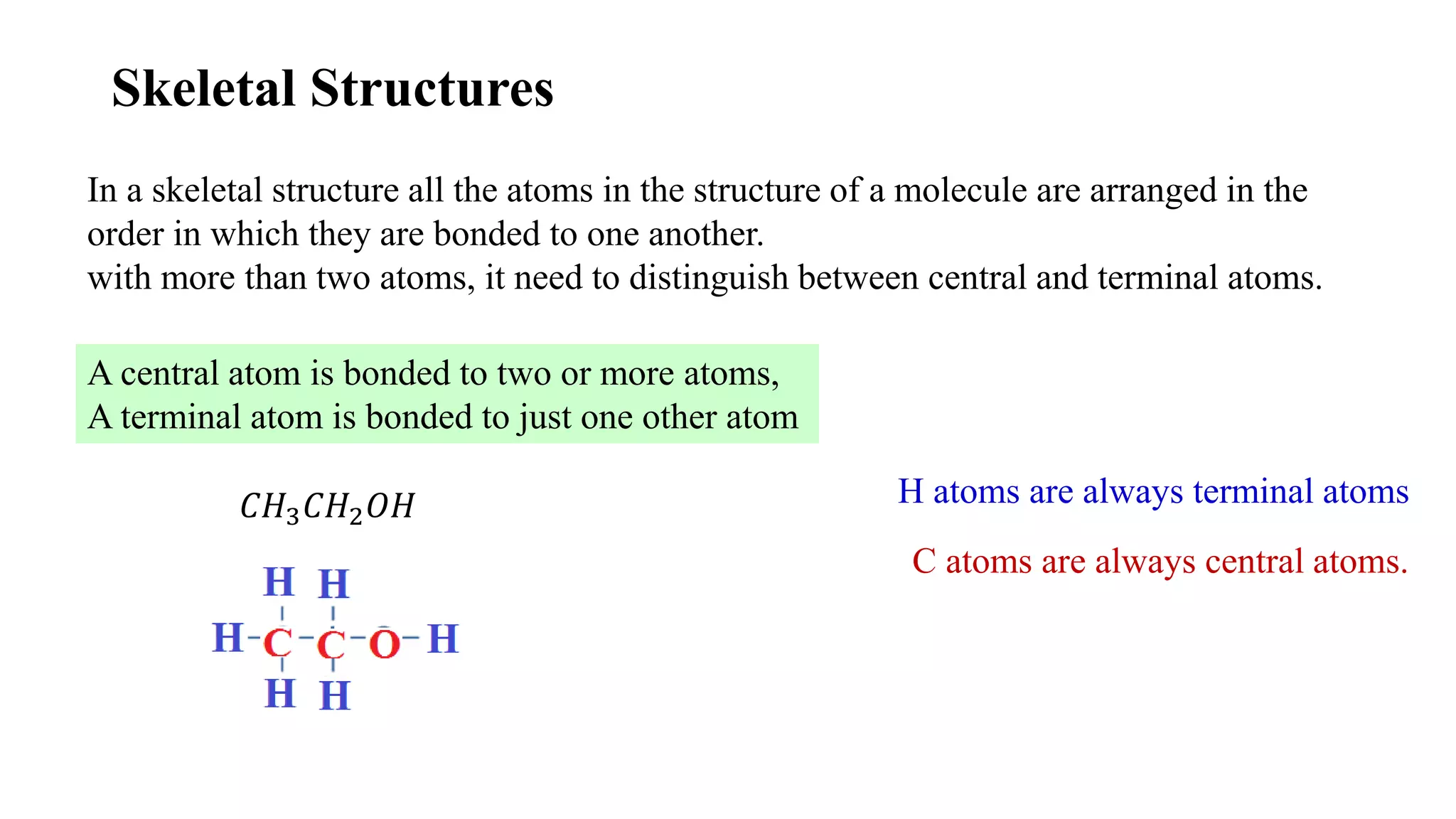
A central atom is bonded to two or more atoms,
A terminal atom is bonded to just one other atom
𝐶𝐻3 𝐶𝐻2 𝑂𝐻 H atoms are always terminal atoms
C atoms are always central atoms.
Except for the very large number of chain-like
organic molecules, molecules and polyatomic ions
generally have compact, symmetrical structures.
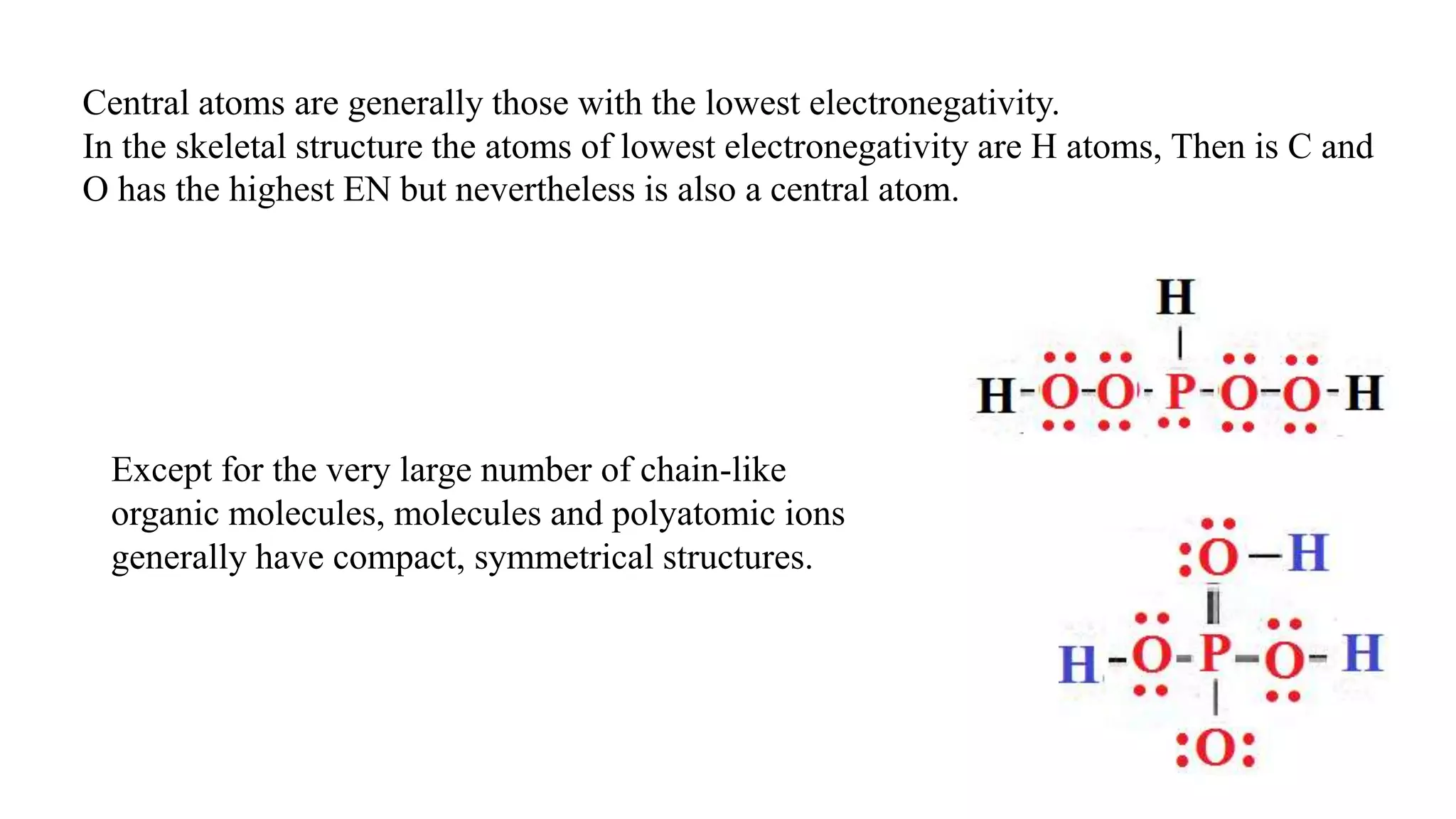
Central atoms are generally those with the lowest electronegativity.
In the skeletal structure the atoms of lowest electronegativity are H atoms, Then is C and
O has the highest EN but nevertheless is also a central atom.
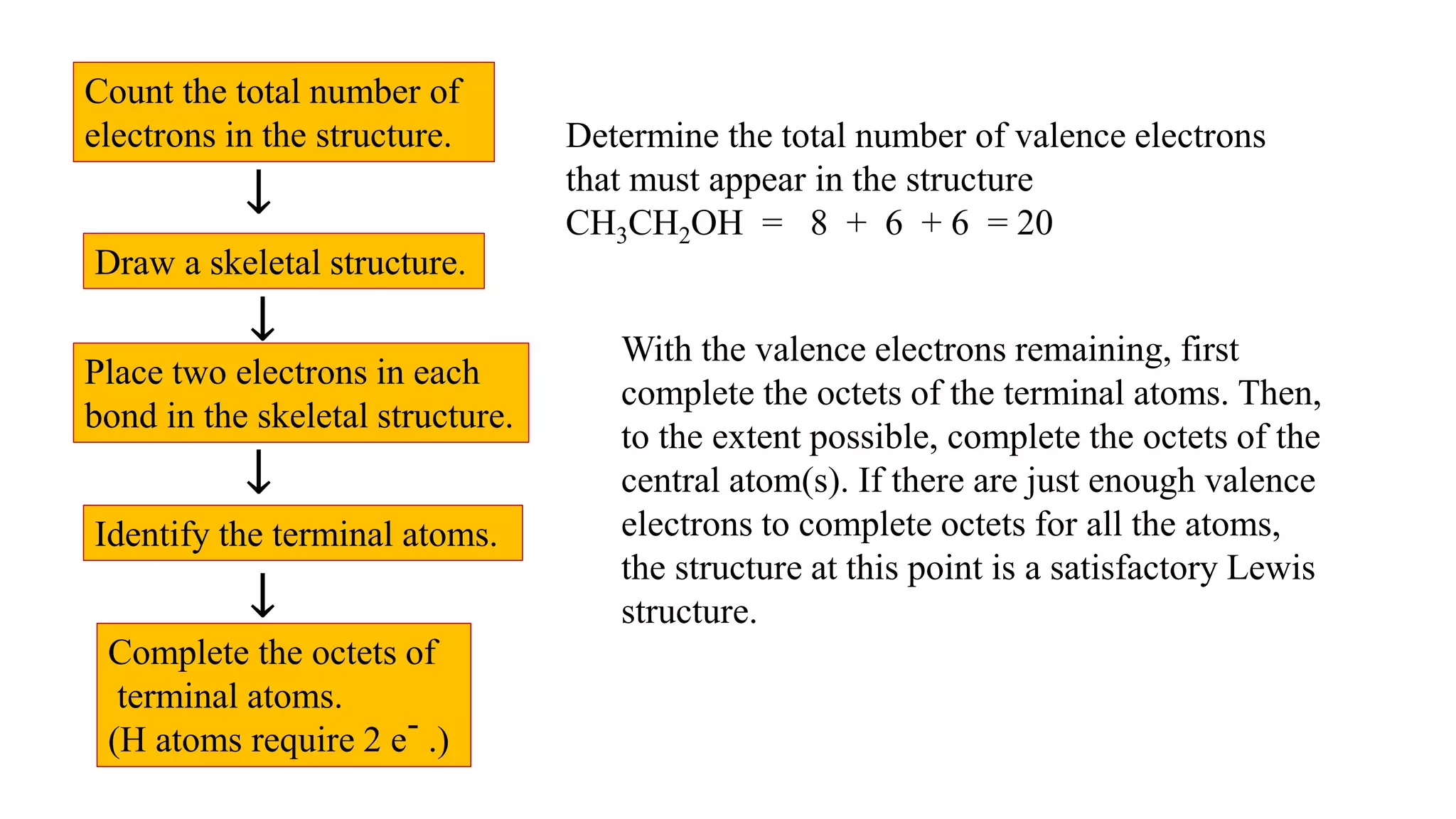
Count the total number of
electrons in the structure.
Draw a skeletal structure.
Place two electrons in each
bond in the skeletal structure.
Identify the terminal atoms.
Complete the octets of
terminal atoms.
(H atoms require 2 e- .)
↓
↓
↓
↓
Determine the total number of valence electrons
that must appear in the structure
CH3CH2OH = 8 + 6 + 6 = 20
With the valence electrons remaining, first
complete the octets of the terminal atoms. Then,
to the extent possible, complete the octets of the
central atom(s). If there are just enough valence
electrons to complete octets for all the atoms,
the structure at this point is a satisfactory Lewis
structure.
↓
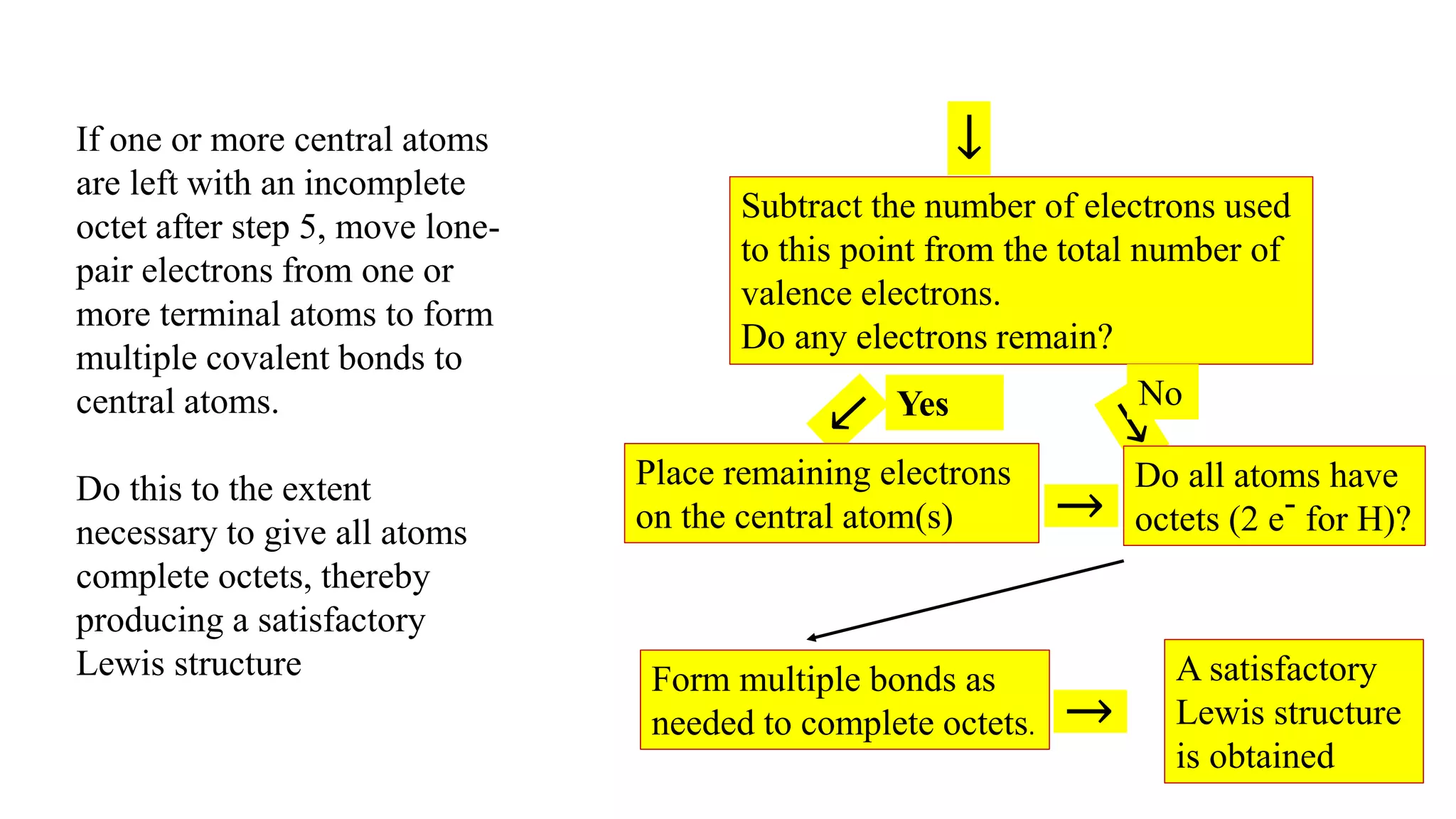
Subtract the number of electrons used
to this point from the total number of
valence electrons.
Do any electrons remain?
Place remaining electrons
on the central atom(s)
Yes
Do all atoms have
octets (2 e- for H)?
Form multiple bonds as
needed to complete octets.
A satisfactory
Lewis structure
is obtained
↓↓
No
If one or more central atoms
are left with an incomplete
octet after step 5, move lone-
pair electrons from one or
more terminal atoms to form
multiple covalent bonds to
central atoms.
Do this to the extent
necessary to give all atoms
complete octets, thereby
producing a satisfactory
Lewis structure
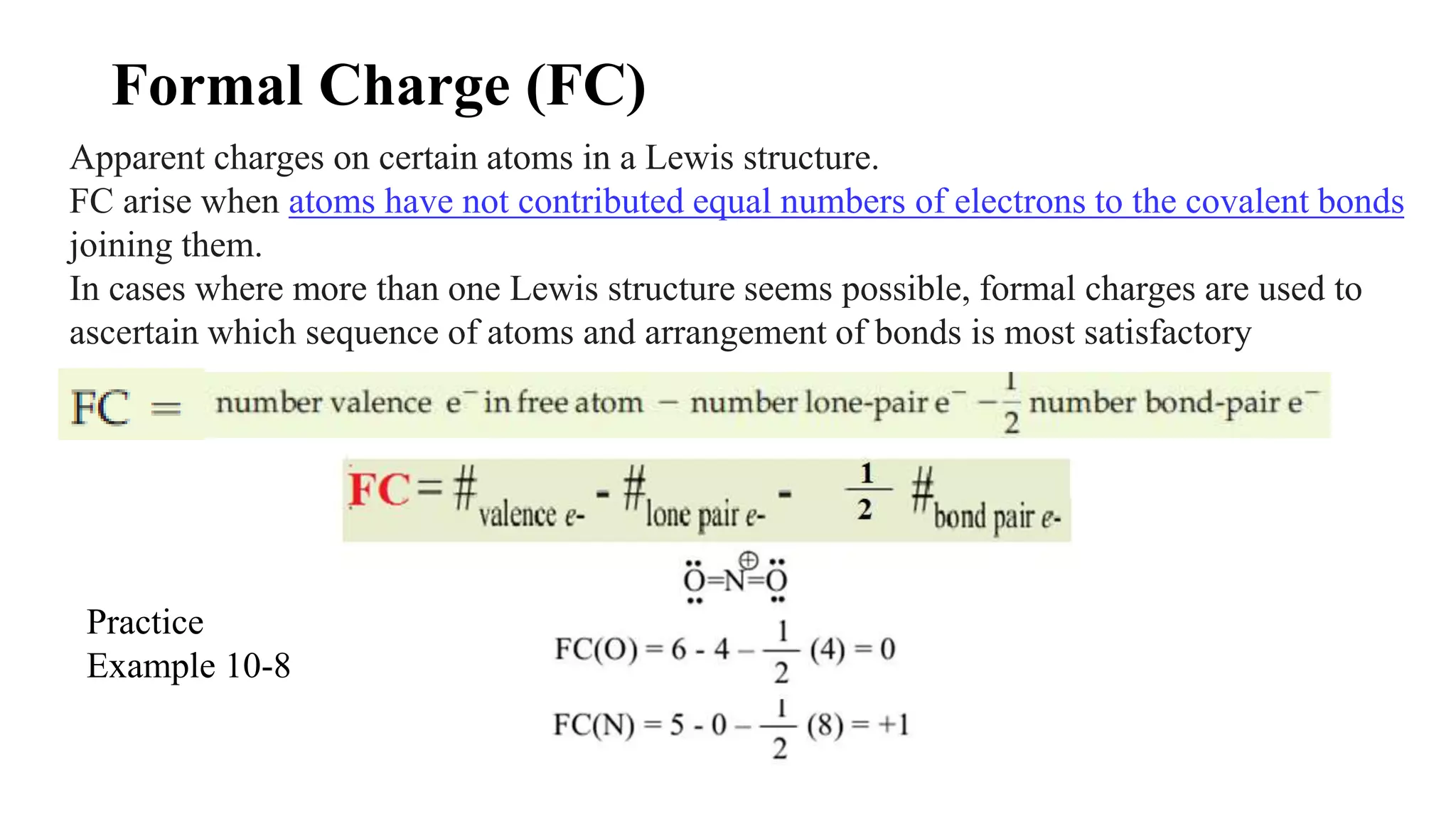
Formal Charge (FC)
Apparent charges on certain atoms in a Lewis structure.
FC arise when atoms have not contributed equal numbers of electrons to the covalent bonds
joining them.
In cases where more than one Lewis structure seems possible, formal charges are used to
ascertain which sequence of atoms and arrangement of bonds is most satisfactory
Practice
Example 10-8
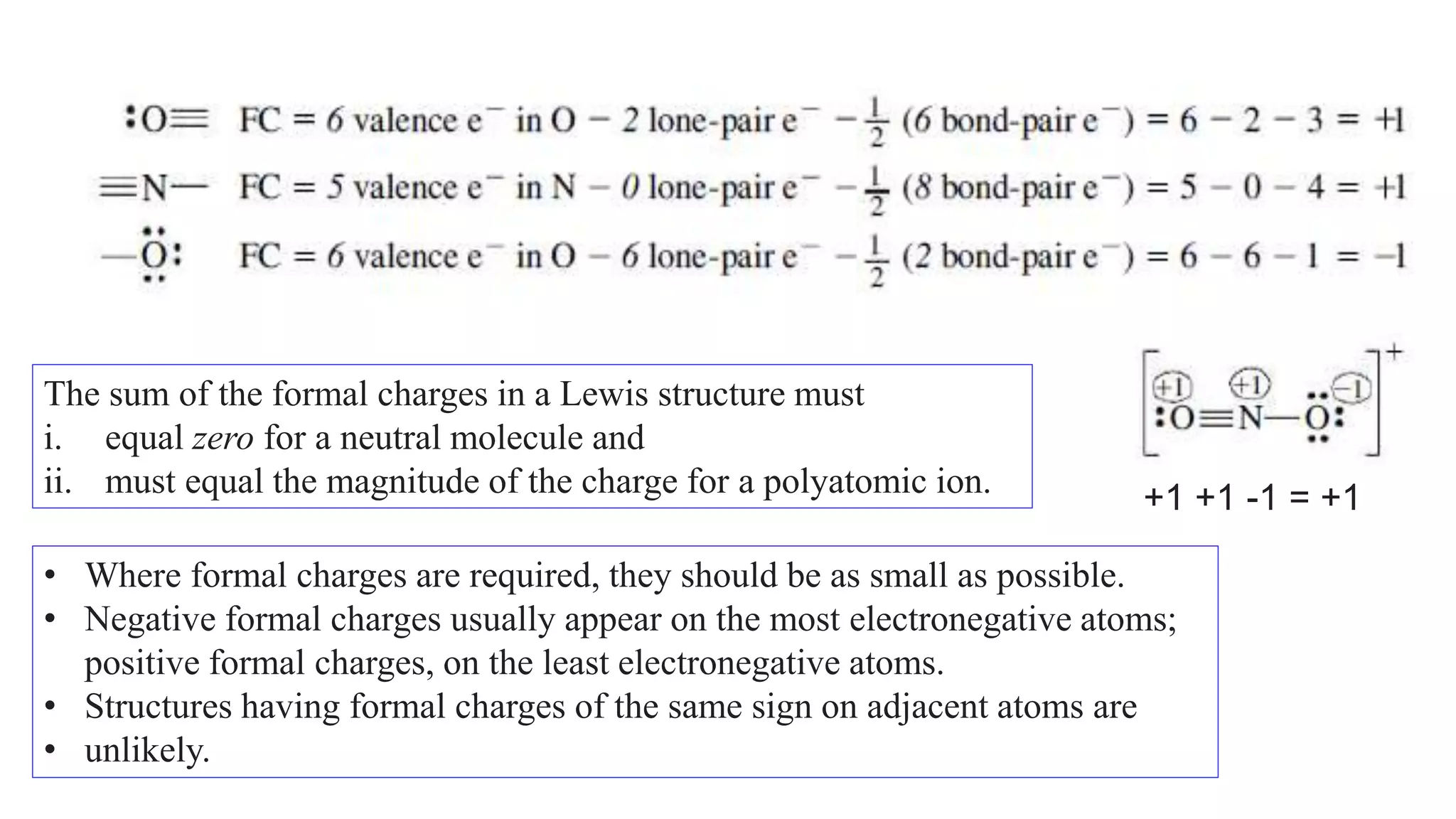
The sum of the formal charges in a Lewis structure must
i. equal zero for a neutral molecule and
ii. must equal the magnitude of the charge for a polyatomic ion. +1 +1 -1 = +1
• Where formal charges are required, they should be as small as possible.
• Negative formal charges usually appear on the most electronegative atoms;
positive formal charges, on the least electronegative atoms.
• Structures having formal charges of the same sign on adjacent atoms are
• unlikely.
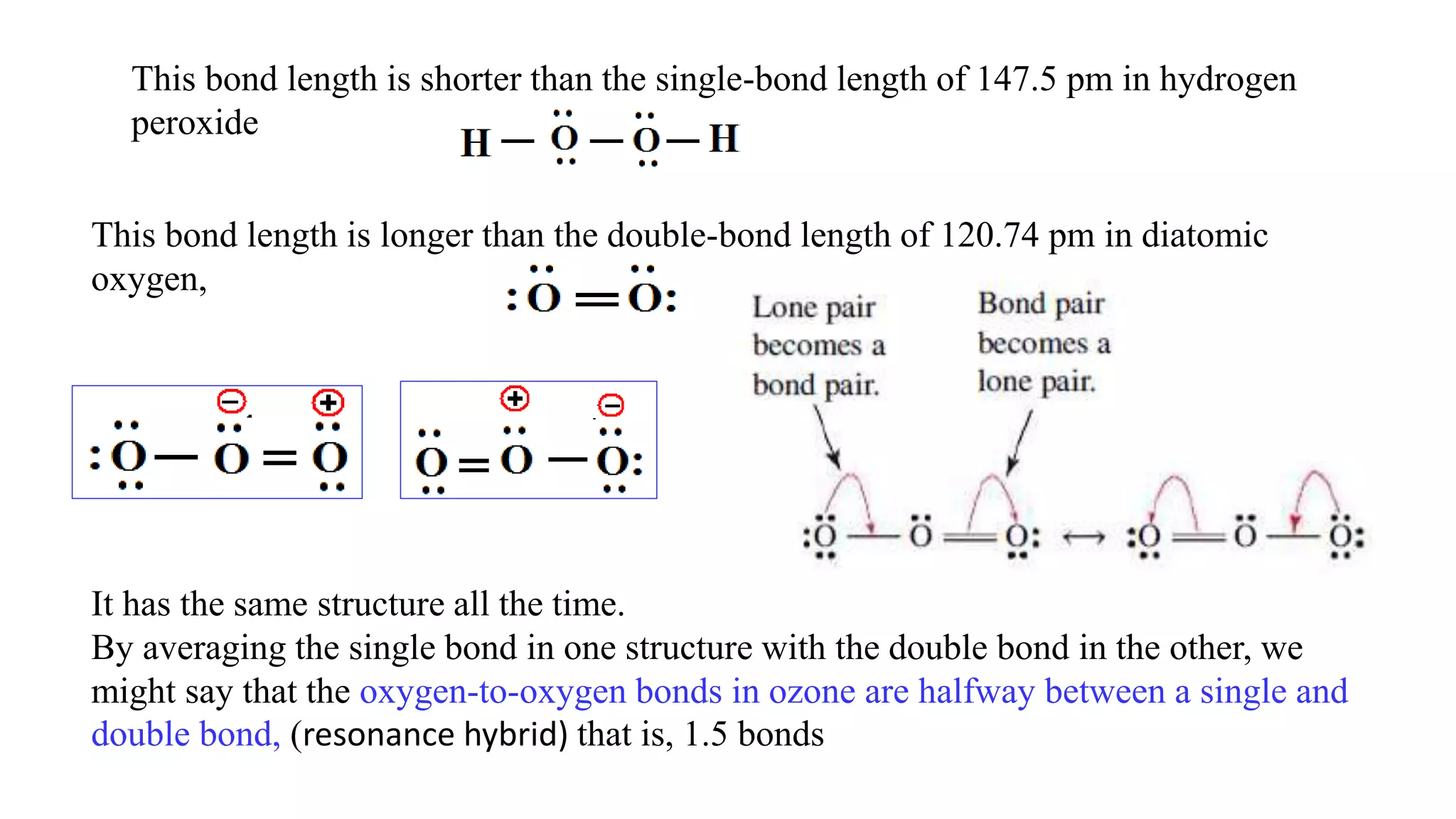
This bond length is shorter than the single-bond length of 147.5 pm in hydrogen
peroxide
This bond length is longer than the double-bond length of 120.74 pm in diatomic
oxygen,
It has the same structure all the time.
By averaging the single bond in one structure with the double bond in the other, we
might say that the oxygen-to-oxygen bonds in ozone are halfway between a single and
double bond, (resonance hybrid) that is, 1.5 bonds
Exceptions to the Octet Rule
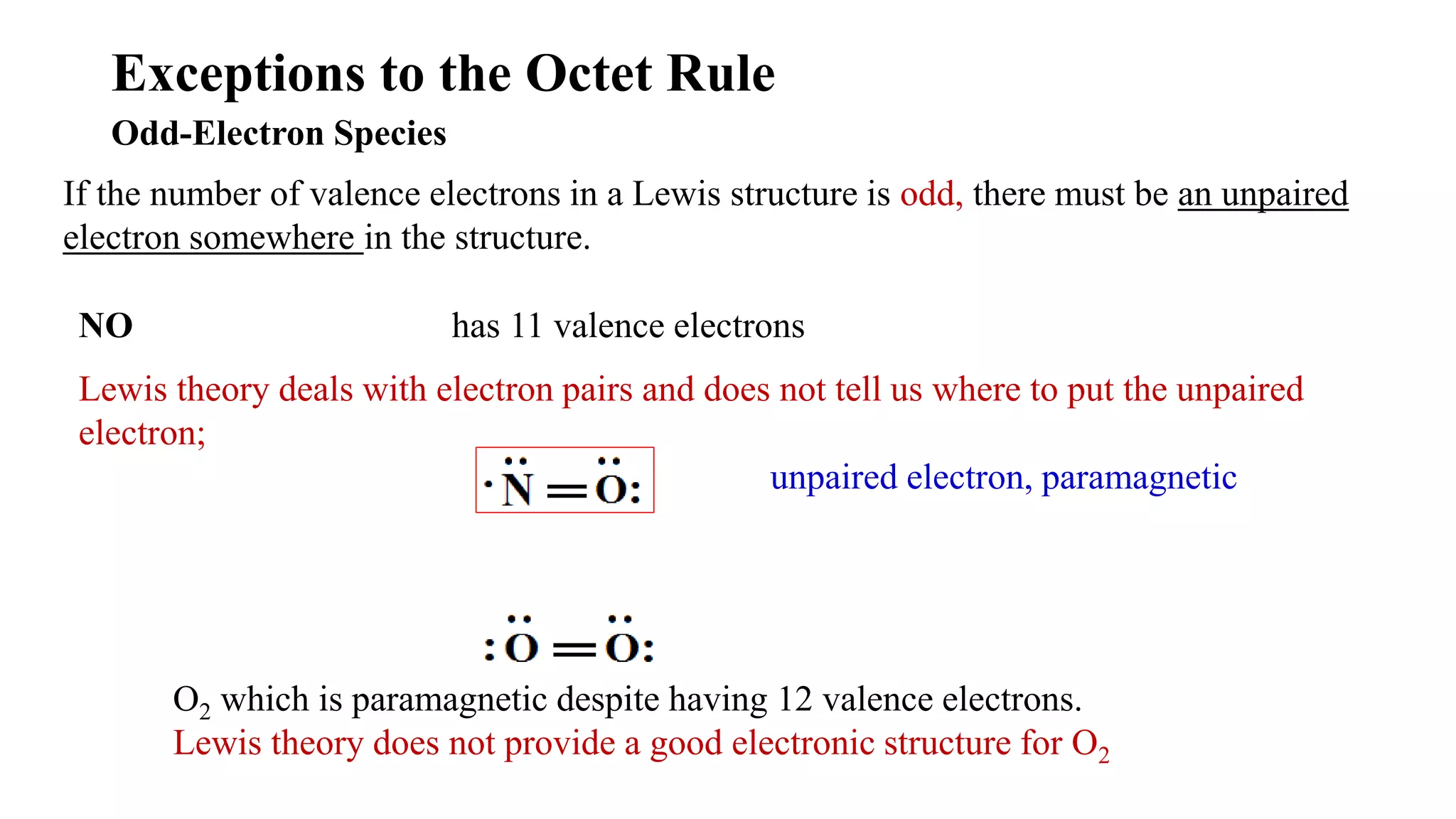
If the number of valence electrons in a Lewis structure is odd, there must be an unpaired
electron somewhere in the structure.
Odd-Electron Species
NO has 11 valence electrons
Lewis theory deals with electron pairs and does not tell us where to put the unpaired
electron;
unpaired electron, paramagnetic
O2 which is paramagnetic despite having 12 valence electrons.
Lewis theory does not provide a good electronic structure for O2
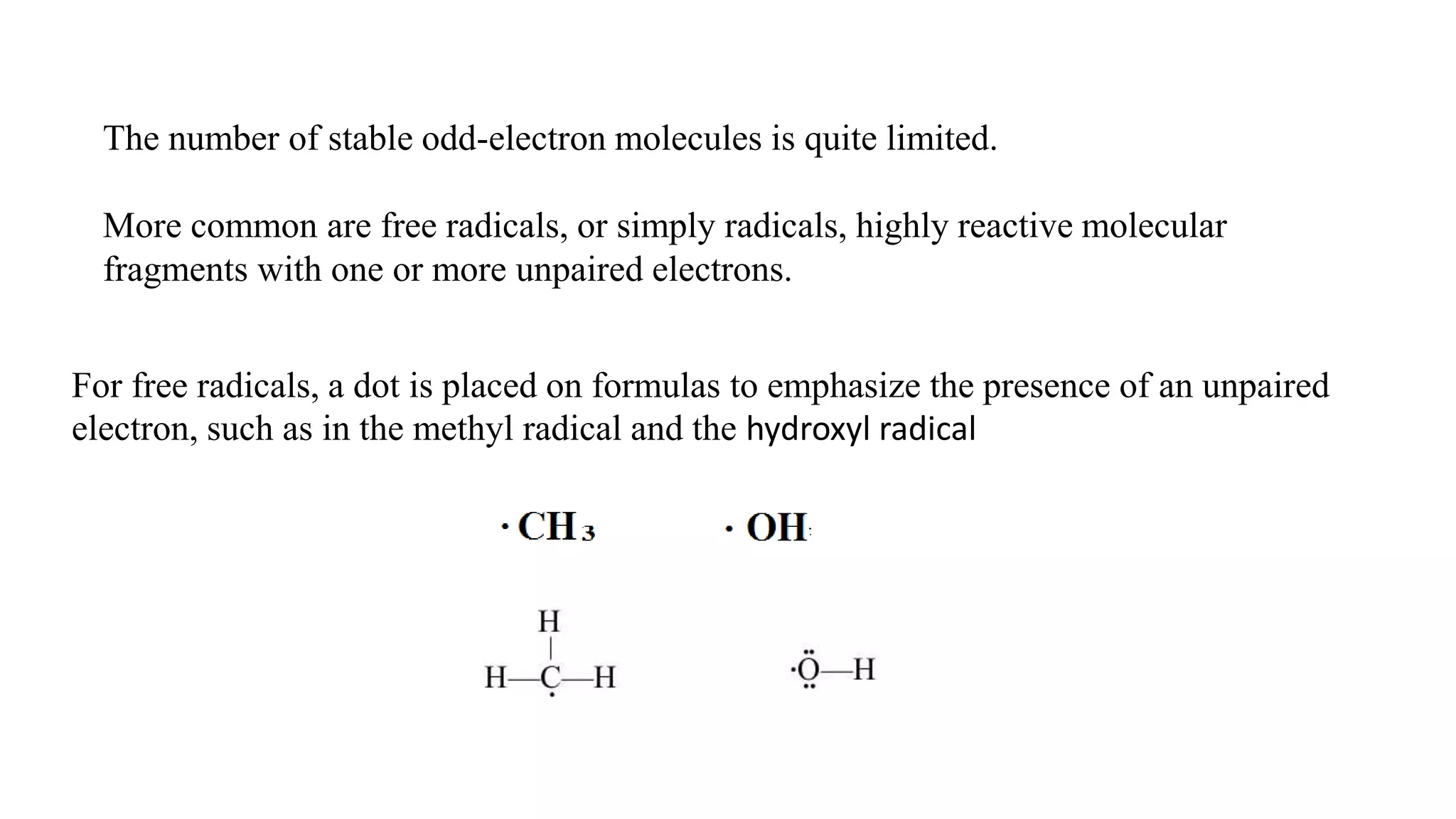
The number of stable odd-electron molecules is quite limited.
More common are free radicals, or simply radicals, highly reactive molecular
fragments with one or more unpaired electrons.
For free radicals, a dot is placed on formulas to emphasize the presence of an unpaired
electron, such as in the methyl radical and the hydroxyl radical
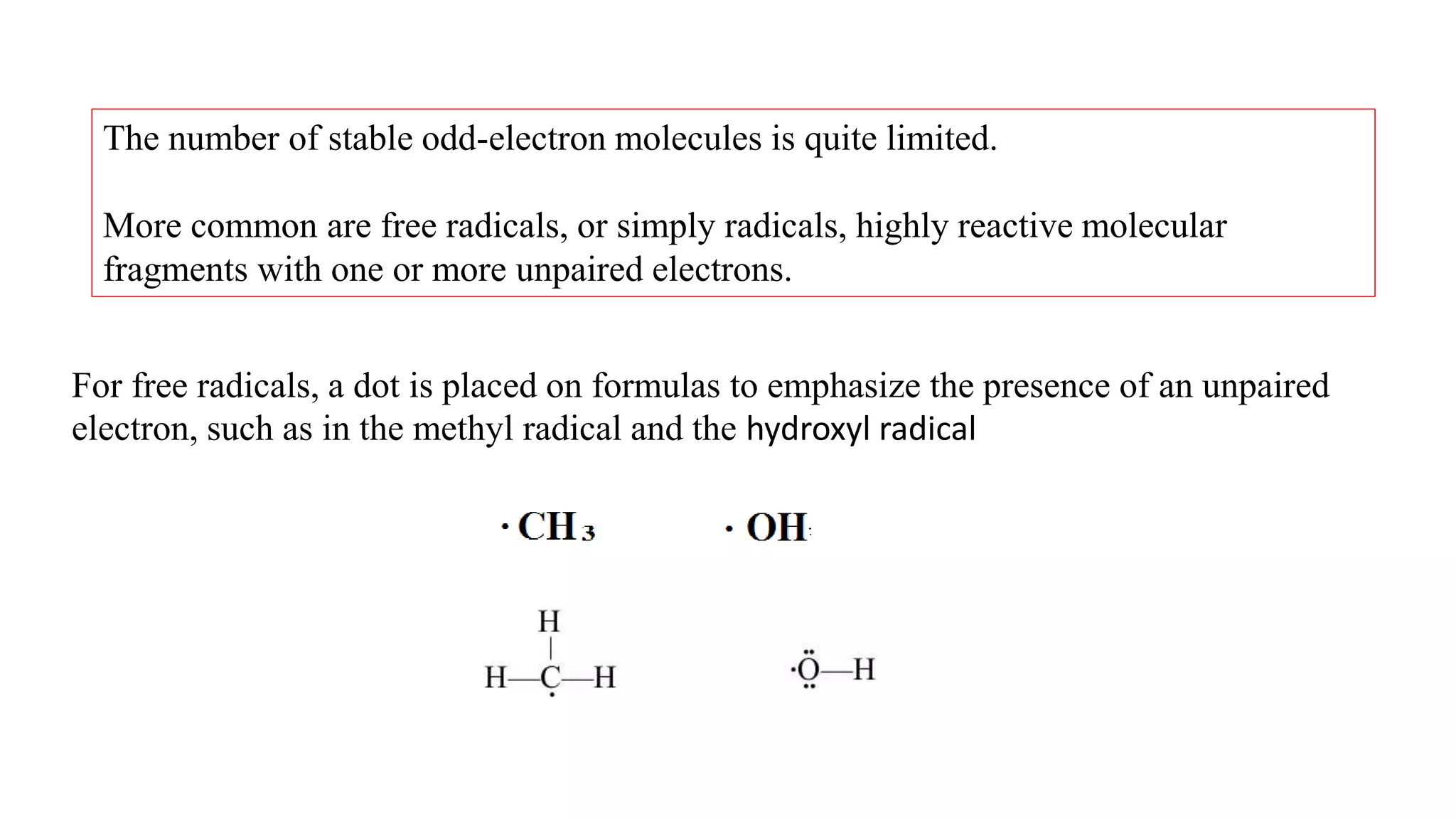
The number of stable odd-electron molecules is quite limited.
More common are free radicals, or simply radicals, highly reactive molecular
fragments with one or more unpaired electrons.
For free radicals, a dot is placed on formulas to emphasize the presence of an unpaired
electron, such as in the methyl radical and the hydroxyl radical
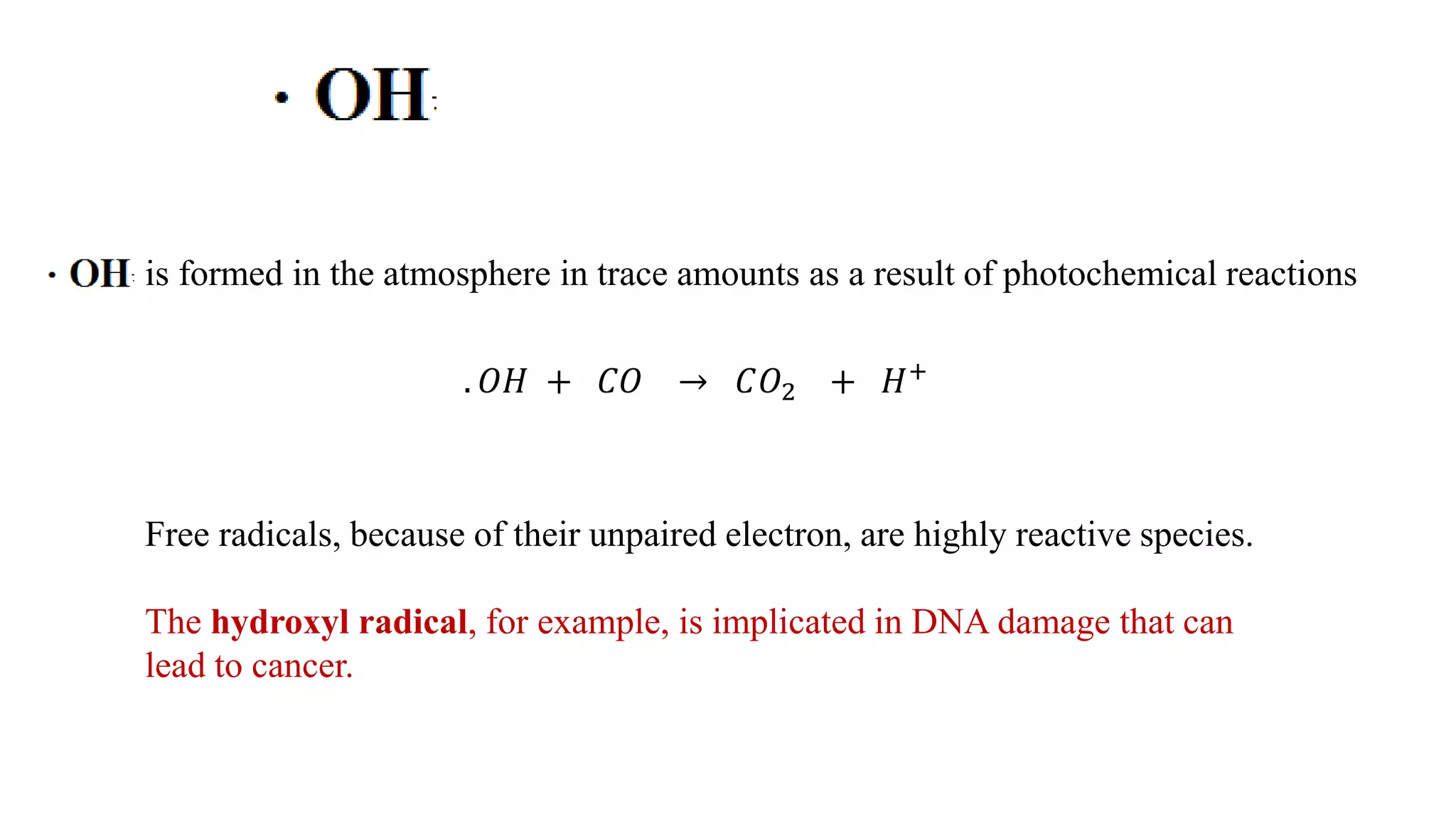
is formed in the atmosphere in trace amounts as a result of photochemical reactions
. 𝑂𝐻 + 𝐶𝑂 → 𝐶𝑂2 + 𝐻+
Free radicals, because of their unpaired electron, are highly reactive species.
The hydroxyl radical, for example, is implicated in DNA damage that can
lead to cancer.
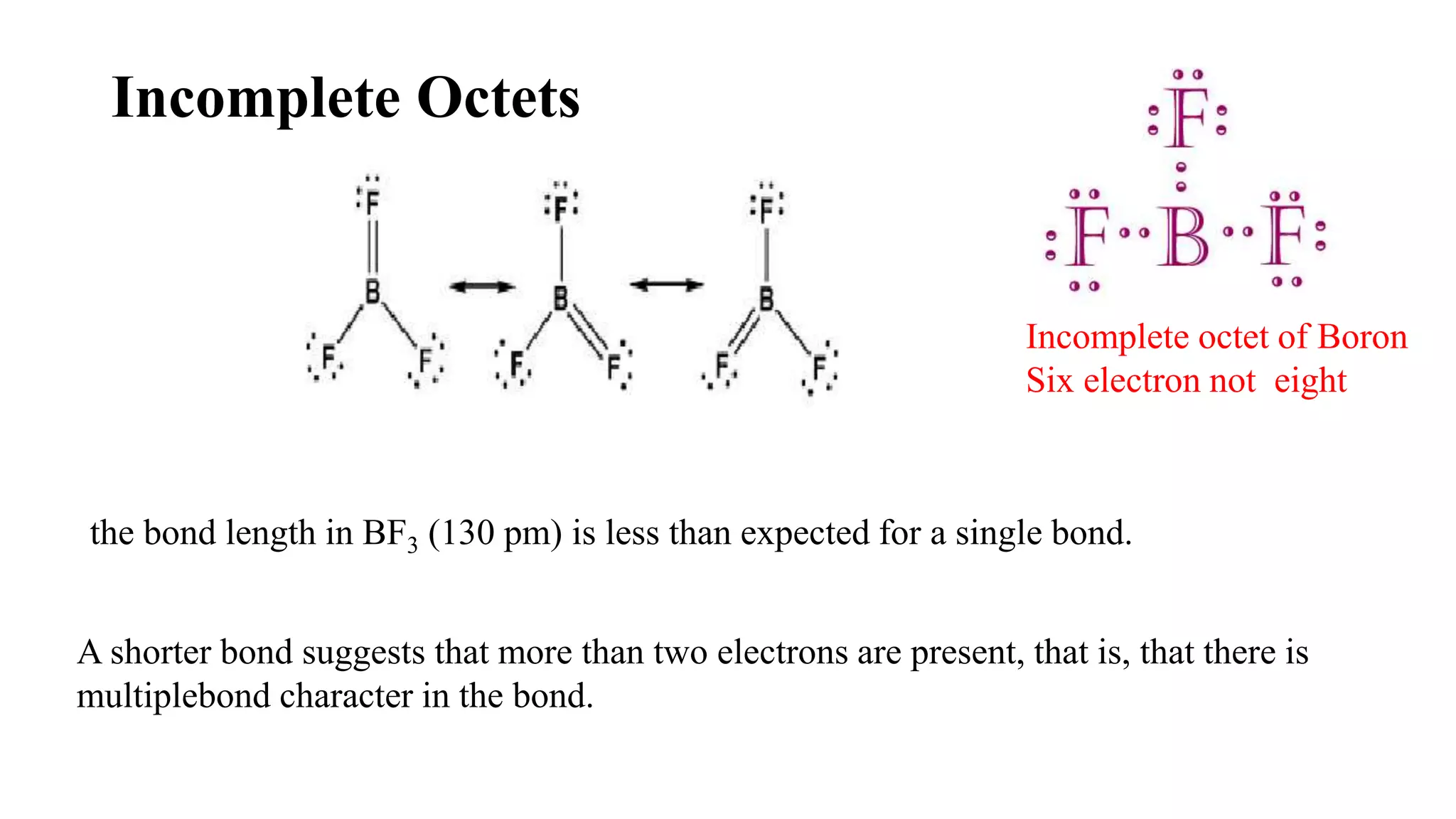
Incomplete Octets
Incomplete octet of Boron
Six electron not eight
the bond length in BF3 (130 pm) is less than expected for a single bond.
A shorter bond suggests that more than two electrons are present, that is, that there is
multiplebond character in the bond.
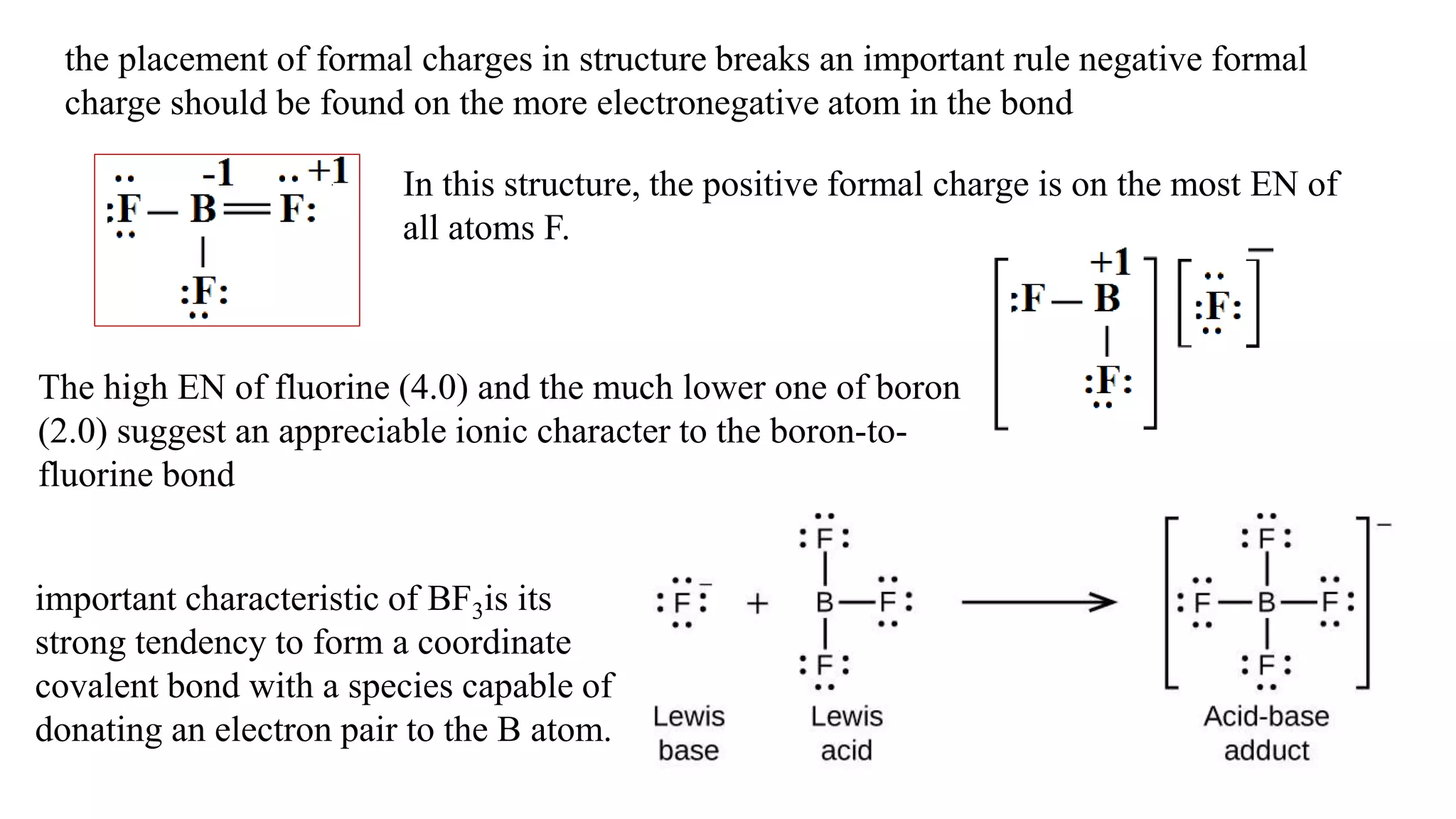
the placement of formal charges in structure breaks an important rule negative formal
charge should be found on the more electronegative atom in the bond
In this structure, the positive formal charge is on the most EN of
all atoms F.
The high EN of fluorine (4.0) and the much lower one of boron
(2.0) suggest an appreciable ionic character to the boron-to-
fluorine bond
important characteristic of BF3is its
strong tendency to form a coordinate
covalent bond with a species capable of
donating an electron pair to the B atom.
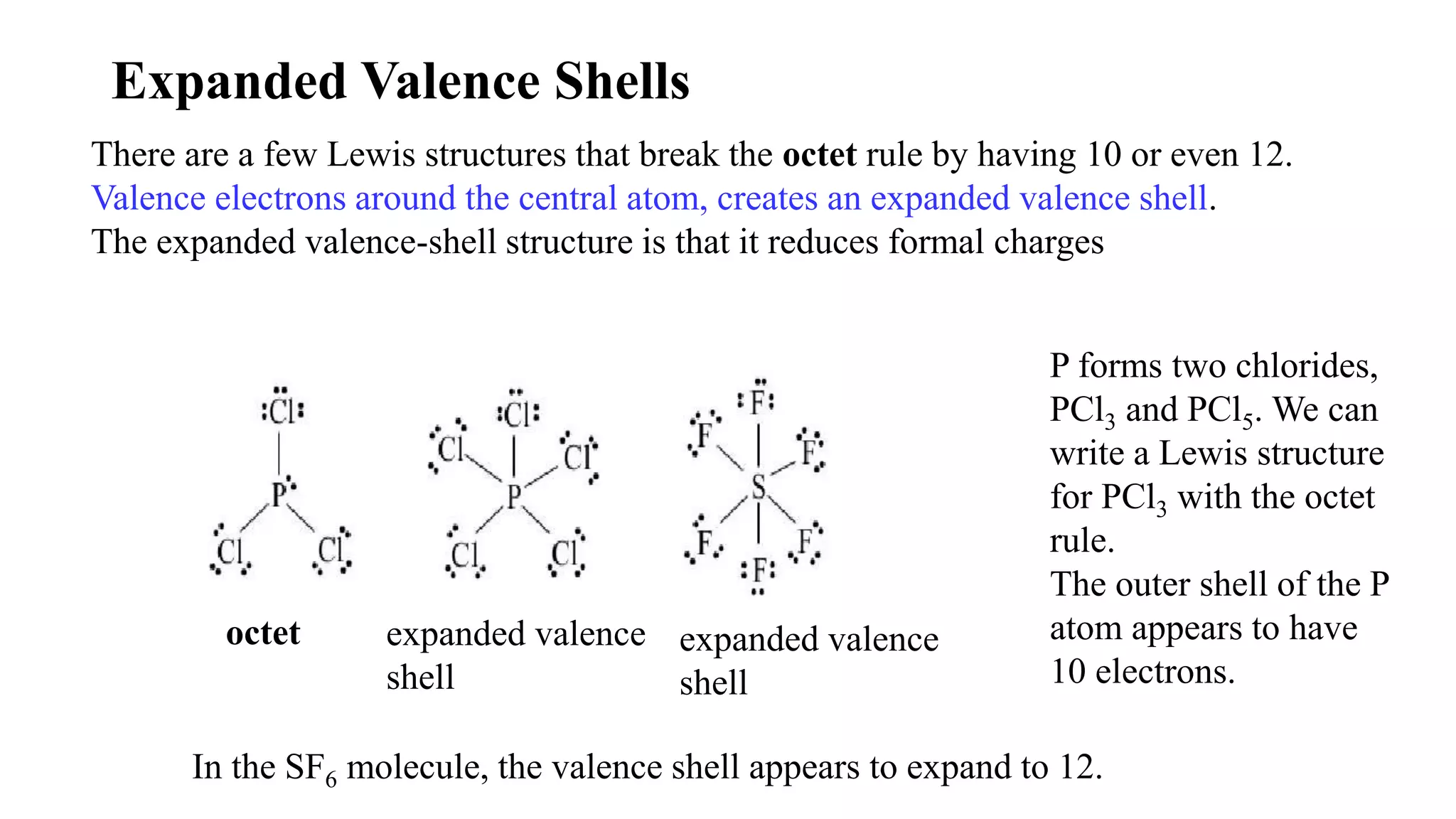
Expanded Valence Shells
There are a few Lewis structures that break the octet rule by having 10 or even 12.
Valence electrons around the central atom, creates an expanded valence shell.
The expanded valence-shell structure is that it reduces formal charges
octet expanded valence
shell
expanded valence
shell
P forms two chlorides,
PCl3 and PCl5. We can
write a Lewis structure
for PCl3 with the octet
rule.
The outer shell of the P
atom appears to have
10 electrons.
In the SF6 molecule, the valence shell appears to expand to 12.
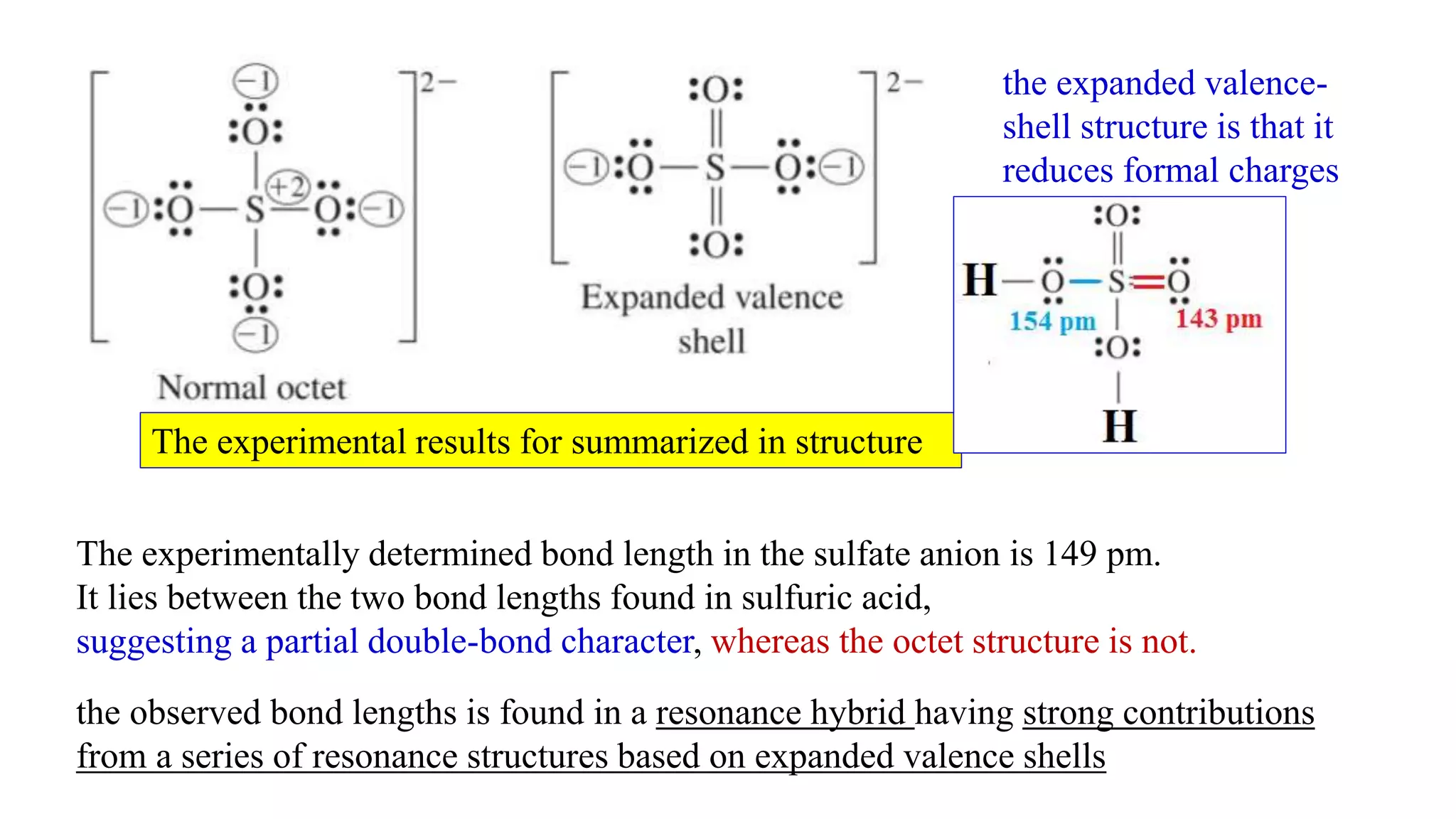
the expanded valence-
shell structure is that it
reduces formal charges
The experimental results for summarized in structure
The experimentally determined bond length in the sulfate anion is 149 pm.
It lies between the two bond lengths found in sulfuric acid,
suggesting a partial double-bond character, whereas the octet structure is not.
the observed bond lengths is found in a resonance hybrid having strong contributions
from a series of resonance structures based on expanded valence shells

Skeletal structure, 10 (2)

  • 1.
    Skeletal Structures and ValanceShells Dr. K. Shahzad Baig Memorial University of Newfoundland (MUN) Canada Petrucci, et al. 2011. General Chemistry: Principles and Modern Applications. Pearson Canada Inc., Toronto, Ontario. Tro, N.J. 2010. Principles of Chemistry. : a molecular approach. Pearson Education, Inc.
  • 2.
    Skeletal Structures In askeletal structure all the atoms in the structure of a molecule are arranged in the order in which they are bonded to one another. with more than two atoms, it need to distinguish between central and terminal atoms. A central atom is bonded to two or more atoms, A terminal atom is bonded to just one other atom 𝐶𝐻3 𝐶𝐻2 𝑂𝐻 H atoms are always terminal atoms C atoms are always central atoms.
  • 3.
    Except for thevery large number of chain-like organic molecules, molecules and polyatomic ions generally have compact, symmetrical structures. Central atoms are generally those with the lowest electronegativity. In the skeletal structure the atoms of lowest electronegativity are H atoms, Then is C and O has the highest EN but nevertheless is also a central atom.
  • 4.
    Count the totalnumber of electrons in the structure. Draw a skeletal structure. Place two electrons in each bond in the skeletal structure. Identify the terminal atoms. Complete the octets of terminal atoms. (H atoms require 2 e- .) ↓ ↓ ↓ ↓ Determine the total number of valence electrons that must appear in the structure CH3CH2OH = 8 + 6 + 6 = 20 With the valence electrons remaining, first complete the octets of the terminal atoms. Then, to the extent possible, complete the octets of the central atom(s). If there are just enough valence electrons to complete octets for all the atoms, the structure at this point is a satisfactory Lewis structure.
  • 5.
    ↓ Subtract the numberof electrons used to this point from the total number of valence electrons. Do any electrons remain? Place remaining electrons on the central atom(s) Yes Do all atoms have octets (2 e- for H)? Form multiple bonds as needed to complete octets. A satisfactory Lewis structure is obtained ↓↓ No If one or more central atoms are left with an incomplete octet after step 5, move lone- pair electrons from one or more terminal atoms to form multiple covalent bonds to central atoms. Do this to the extent necessary to give all atoms complete octets, thereby producing a satisfactory Lewis structure
  • 6.
    Formal Charge (FC) Apparentcharges on certain atoms in a Lewis structure. FC arise when atoms have not contributed equal numbers of electrons to the covalent bonds joining them. In cases where more than one Lewis structure seems possible, formal charges are used to ascertain which sequence of atoms and arrangement of bonds is most satisfactory Practice Example 10-8
  • 7.
    The sum ofthe formal charges in a Lewis structure must i. equal zero for a neutral molecule and ii. must equal the magnitude of the charge for a polyatomic ion. +1 +1 -1 = +1 • Where formal charges are required, they should be as small as possible. • Negative formal charges usually appear on the most electronegative atoms; positive formal charges, on the least electronegative atoms. • Structures having formal charges of the same sign on adjacent atoms are • unlikely.
  • 8.
    This bond lengthis shorter than the single-bond length of 147.5 pm in hydrogen peroxide This bond length is longer than the double-bond length of 120.74 pm in diatomic oxygen, It has the same structure all the time. By averaging the single bond in one structure with the double bond in the other, we might say that the oxygen-to-oxygen bonds in ozone are halfway between a single and double bond, (resonance hybrid) that is, 1.5 bonds
  • 9.
    Exceptions to theOctet Rule If the number of valence electrons in a Lewis structure is odd, there must be an unpaired electron somewhere in the structure. Odd-Electron Species NO has 11 valence electrons Lewis theory deals with electron pairs and does not tell us where to put the unpaired electron; unpaired electron, paramagnetic O2 which is paramagnetic despite having 12 valence electrons. Lewis theory does not provide a good electronic structure for O2
  • 10.
    The number ofstable odd-electron molecules is quite limited. More common are free radicals, or simply radicals, highly reactive molecular fragments with one or more unpaired electrons. For free radicals, a dot is placed on formulas to emphasize the presence of an unpaired electron, such as in the methyl radical and the hydroxyl radical
  • 11.
    The number ofstable odd-electron molecules is quite limited. More common are free radicals, or simply radicals, highly reactive molecular fragments with one or more unpaired electrons. For free radicals, a dot is placed on formulas to emphasize the presence of an unpaired electron, such as in the methyl radical and the hydroxyl radical
  • 12.
    is formed inthe atmosphere in trace amounts as a result of photochemical reactions . 𝑂𝐻 + 𝐶𝑂 → 𝐶𝑂2 + 𝐻+ Free radicals, because of their unpaired electron, are highly reactive species. The hydroxyl radical, for example, is implicated in DNA damage that can lead to cancer.
  • 13.
    Incomplete Octets Incomplete octetof Boron Six electron not eight the bond length in BF3 (130 pm) is less than expected for a single bond. A shorter bond suggests that more than two electrons are present, that is, that there is multiplebond character in the bond.
  • 14.
    the placement offormal charges in structure breaks an important rule negative formal charge should be found on the more electronegative atom in the bond In this structure, the positive formal charge is on the most EN of all atoms F. The high EN of fluorine (4.0) and the much lower one of boron (2.0) suggest an appreciable ionic character to the boron-to- fluorine bond important characteristic of BF3is its strong tendency to form a coordinate covalent bond with a species capable of donating an electron pair to the B atom.
  • 15.
    Expanded Valence Shells Thereare a few Lewis structures that break the octet rule by having 10 or even 12. Valence electrons around the central atom, creates an expanded valence shell. The expanded valence-shell structure is that it reduces formal charges octet expanded valence shell expanded valence shell P forms two chlorides, PCl3 and PCl5. We can write a Lewis structure for PCl3 with the octet rule. The outer shell of the P atom appears to have 10 electrons. In the SF6 molecule, the valence shell appears to expand to 12.
  • 16.
    the expanded valence- shellstructure is that it reduces formal charges The experimental results for summarized in structure The experimentally determined bond length in the sulfate anion is 149 pm. It lies between the two bond lengths found in sulfuric acid, suggesting a partial double-bond character, whereas the octet structure is not. the observed bond lengths is found in a resonance hybrid having strong contributions from a series of resonance structures based on expanded valence shells

Editor's Notes

  • #4 For O to be a terminal atom in structure (10.13) would require it to exchange places with an H atom, but this would make the H atom a central atom and that is not possible. The chief cases where O atoms are central atoms are in structures with a peroxo linkage (- O- O -) or a hydroxy group (-O – H) Otherwise, expect an O atom to be a terminal atom.
  • #7 Valance electron for O =6, Valance electron for N = 5
  • #10 The octet rule has been our mainstay in writing Lewis structures, and it will continue to be one. Yet at times, we must depart from the octet rule, as we will see in this section. . An important exception is seen in the case of O2 which is paramagnetic despite having 12 valence electrons. Lewis theory does not provide a good electronic structure for O2
  • #11 NO, NO 2, and ClO
  • #14 We have learned to complete the octets of central atoms by shifting lone-pair electrons from terminal atoms to form multiple bonds.
  • #16 Molecules with expanded valence shells typically involve nonmetal atoms of the third period and beyond that are bonded to highly electronegative atoms. Expanded valence shells have also been used in cases where they appear to give a better Lewis structure than strict adherence to the octet rule,