Sections 3.3 & 3.4 Covalent Bonding and Lewis
Structures
Learning goals:
Writing valid Lewis structures for molecular substances
Predicting molecular geometry from Lewis structures (VSEPR
theory)
Understanding electronegativity and how this concept allows the
distinction between polar bonds and non-polar bonds
Using Lewis structures to determine whether a molecule has a
dipole moment or not
Using the octet rule to compute formal charges on atoms and
multiple bonding between atoms
Sections 3.3 & 3.4 Covalent Bonding and Lewis
Structures
(1)Lewis “dot” (electron) structures of valence electrons for
atoms
(2)Use of Periodic Table to determine the number of “dots”
(3)Use of Lewis structures to describe the electronic
structures of atoms and molecules
(4)Works best for covalent bonds and for elements in the
first full row of the Periodic Table: H, He, Li, Be, B, C,
N, O, F, Ne
(5)Works with restrictions for second full row of the
Periodic Table and beyond: Na, Mg, Al, Si, P, S, Cl, Ar
Some issues about Lewis Structures to be discussed:
(1) Drawing “valid” Lewis structures which follow the “octet” rule
(holds almost without exception for first full row)
(2) Drawing structures with single, double and triple bonds
(3) Dealing with isomers (same composition, different constitution)
(4) Dealing with resonance structures (same constitution, different
bonding between atoms)
(5) Dealing with “formal” charges on atoms in Lewis structures
(6) Dealing with violations of the octet rule:
Molecules which possess an odd number of electrons
Molecules which are electron deficient
Molecules which are capable of making more than four covalent
bonds
Lewis “dot-line” representations of atoms and molecules
(1) Electrons of an atom are of two types: core electrons and
valence electrons. Only the valence electrons are shown
in Lewis dot-line structures.
(2) The number of valence electrons is equal to the group
number of the element for the representative elements.
(3) For atoms the first four dots are displayed around the four
“sides” of the symbol for the atom.
(4) If there are more than four electrons, the dots are paired
with those already present until an octet is achieved.
(5) Ionic compounds are produced by complete transfer of an
electron from one atom to another.
(6) Covalent compounds are produced by sharing of one or
more pairs of electrons by two atoms.
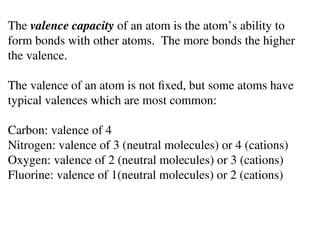
The valence capacity of an atom is the atom’s ability to
form bonds with other atoms. The more bonds the higher
the valence.
The valence of an atom is not fixed, but some atoms have
typical valences which are most common:
Carbon: valence of 4
Nitrogen: valence of 3 (neutral molecules) or 4 (cations)
Oxygen: valence of 2 (neutral molecules) or 3 (cations)
Fluorine: valence of 1(neutral molecules) or 2 (cations)
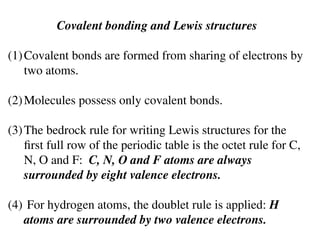
Covalent bonding and Lewis structures
(1)Covalent bonds are formed from sharing of electrons by
two atoms.
(2)Molecules possess only covalent bonds.
(3)The bedrock rule for writing Lewis structures for the
first full row of the periodic table is the octet rule for C,
N, O and F: C, N, O and F atoms are always
surrounded by eight valence electrons.
(4) For hydrogen atoms, the doublet rule is applied: H
atoms are surrounded by two valence electrons.
3.4
Covalent Bonds
and Lewis
Structures
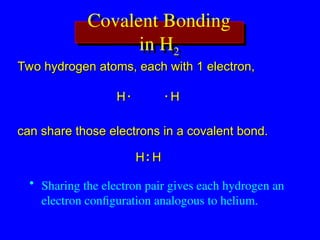
Covalent Bonding
in H2
H
H .
. H
H
.
.
Two hydrogen atoms, each with 1 electron,
can share those electrons in a covalent bond.
H
H:
: H
H
• Sharing the electron pair gives each hydrogen an
electron configuration analogous to helium.
Covalent Bonding
in F2
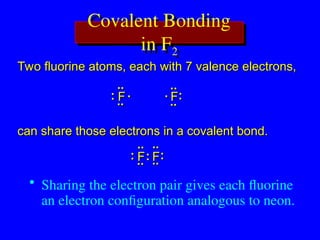
Two fluorine atoms, each with 7 valence electrons,
can share those electrons in a covalent bond.
• Sharing the electron pair gives each fluorine
an electron configuration analogous to neon.
..
..
..
..
F
F .
. F
F
.
.
:
: :
:
..
..
..
..
F
F:
: F
F
:
: :
:
..
..
..
..
..
..
..
..
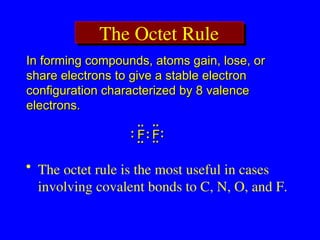
The Octet Rule
• The octet rule is the most useful in cases
involving covalent bonds to C, N, O, and F.
F
F:
: F
F
:
: :
:
..
..
..
..
..
..
..
..
In forming compounds, atoms gain, lose, or
share electrons to give a stable electron
configuration characterized by 8 valence
electrons.
electrons.
Example
Example
C
C.
.
.
.
.
.
.
.
F
F
:
:
..
..
..
..
.
.
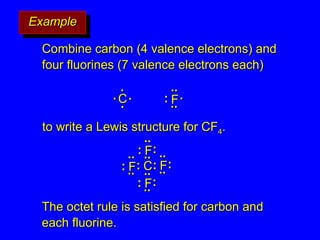
Combine carbon (4 valence electrons) and
four fluorines (7 valence electrons each)
to write a Lewis structure for CF
to write a Lewis structure for CF4
4.
.
:
: F
F:
:
..
..
..
..
C
C
:
: F
F:
:
..
..
..
..
:
: F
F:
:
..
..
..
..
:
: F
F:
:
..
..
..
..
The octet rule is satisfied for carbon and
each fluorine.
each fluorine.
Example
Example
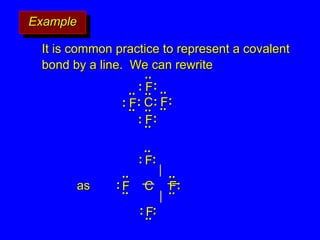
It is common practice to represent a covalent
bond by a line. We can rewrite
:
: F
F:
:
..
..
..
..
C
C
:
: F
F:
:
..
..
..
..
:
: F
F:
:
..
..
..
..
:
: F
F:
:
..
..
..
..
..
..
C
C
F
F
F
F
F
F
F
F
..
..
..
..
..
..
..
..
:
: :
:
:
: :
:
:
: :
:
..
..
as
as
3.4
Double Bonds and
Triple Bonds
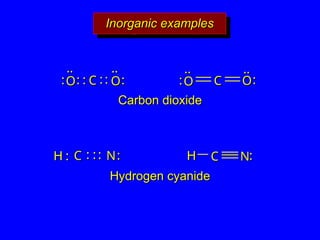
Inorganic examples
Inorganic examples
C
C
:
: :
: :
:
O
O
..
..
:
:
O
O
..
..
:
: :
: C
C :
:
O
O
..
..
O
O
..
..
:
:
:
: :
: :
:
N
N
:
:
C
C
:
:
H
H :
:
N
N
C
C
H
H
Carbon dioxide
Carbon dioxide
Hydrogen cyanide
Hydrogen cyanide
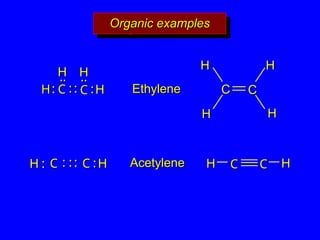
Organic examples
Organic examples
Ethylene
Ethylene
Acetylene
Acetylene
:
: :
: :
:
C
C
:
:
C
C
:
:
H
H H
H C
C
C
C
H
H H
H
C
C
:
: :
:
C
C
..
..
H
H :
: :
:
..
..
H
H
H
H
H
H
C
C C
C
H
H H
H
H
H
H
H
3.4
Formal Charges
• Formal charge is the charge calculated for an
atom in a Lewis structure on the basis of an
equal sharing of bonded electron pairs.
Nitric acid
..
.. :
:
..
..
H
H O
O
O
O
O
O
N
N
:
:
:
:
..
..
..
..
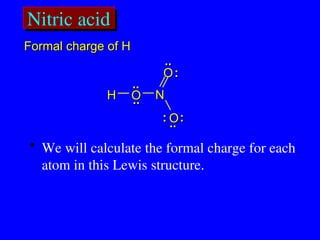
• We will calculate the formal charge for each
atom in this Lewis structure.
Formal charge of H
Formal charge of H
Nitric acid
..
.. :
:
..
..
H
H O
O
O
O
O
O
N
N
:
:
:
:
..
..
..
..
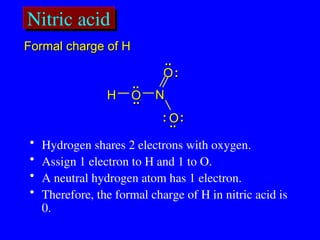
• Hydrogen shares 2 electrons with oxygen.
• Assign 1 electron to H and 1 to O.
• A neutral hydrogen atom has 1 electron.
• Therefore, the formal charge of H in nitric acid is
0.
Formal charge of H
Formal charge of H
Nitric acid
..
.. :
:
..
..
H
H O
O
O
O
O
O
N
N
:
:
:
:
..
..
..
..
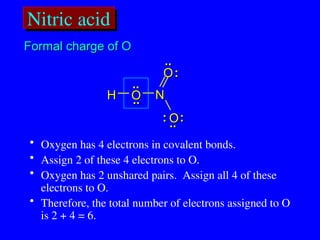
• Oxygen has 4 electrons in covalent bonds.
• Assign 2 of these 4 electrons to O.
• Oxygen has 2 unshared pairs. Assign all 4 of these
electrons to O.
• Therefore, the total number of electrons assigned to O
is 2 + 4 = 6.
Formal charge of O
Formal charge of O
Nitric acid
..
.. :
:
..
..
H
H O
O
O
O
O
O
N
N
:
:
:
:
..
..
..
..
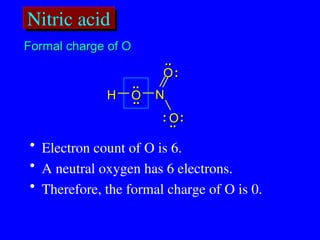
• Electron count of O is 6.
• A neutral oxygen has 6 electrons.
• Therefore, the formal charge of O is 0.
Formal charge of O
Formal charge of O
Nitric acid
..
.. :
:
..
..
H
H O
O
O
O
O
O
N
N
:
:
:
:
..
..
..
..
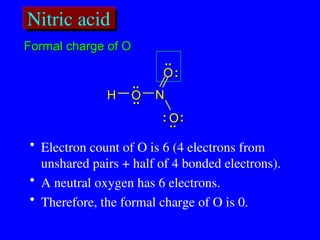
• Electron count of O is 6 (4 electrons from
unshared pairs + half of 4 bonded electrons).
• A neutral oxygen has 6 electrons.
• Therefore, the formal charge of O is 0.
Formal charge of O
Formal charge of O
Nitric acid
..
.. :
:
..
..
H
H O
O
O
O
O
O
N
N
:
:
:
:
..
..
..
..
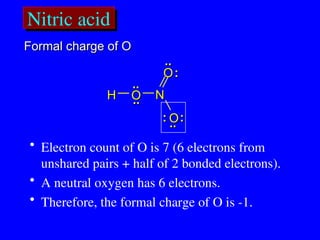
• Electron count of O is 7 (6 electrons from
unshared pairs + half of 2 bonded electrons).
• A neutral oxygen has 6 electrons.
• Therefore, the formal charge of O is -1.
Formal charge of O
Formal charge of O
Nitric acid
..
.. :
:
..
..
H
H O
O
O
O
O
O
N
N
:
:
:
:
..
..
..
..
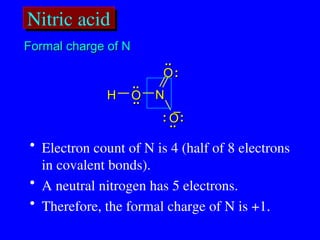
• Electron count of N is 4 (half of 8 electrons
in covalent bonds).
• A neutral nitrogen has 5 electrons.
• Therefore, the formal charge of N is +1.
Formal charge of N
Formal charge of N
–
–
Nitric acid
..
.. :
:
..
..
H
H O
O
O
O
O
O
N
N
:
:
:
:
..
..
..
..
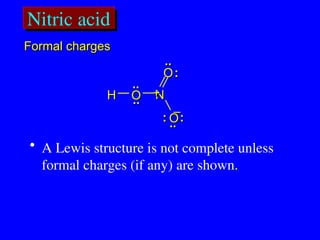
• A Lewis structure is not complete unless
formal charges (if any) are shown.
Formal charges
Formal charges
–
–
+
+
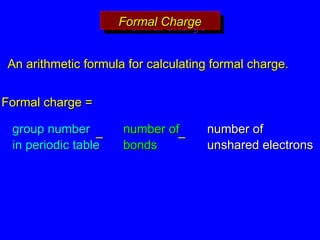
Formal Charge
Formal Charge
Formal charge =
Formal charge =
group number
group number
in periodic table
in periodic table
number of
number of
bonds
bonds
number of
number of
unshared electrons
unshared electrons
–
– –
–
An arithmetic formula for calculating formal charge.
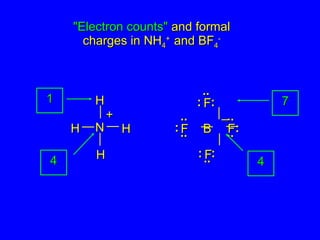
"Electron counts"
"Electron counts" and formal
and formal
charges in NH
charges in NH4
4
+
+
and BF
and BF4
4
-
-
1
1
4
4
N
N
H
H
H
H H
H
H
H
+
+
7
7
4
4
..
..
B
B
F
F
F
F
F
F
F
F
..
..
..
..
..
..
..
..
:
: :
:
:
: :
:
:
: :
:
..
..
–
–
3.5
Drawing Lewis Structures
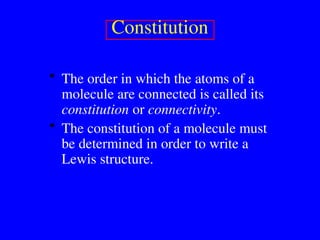
Constitution
• The order in which the atoms of a
molecule are connected is called its
constitution or connectivity.
• The constitution of a molecule must
be determined in order to write a
Lewis structure.
• Step 1:
The molecular formula and the
connectivity are determined by
experiment.
Table 1.4 How to Write Lewis
Structures
• Step 1:
The molecular formula and the
connectivity are determined by
experiment.
• Example:
Methyl nitrite has the molecular
formula CH3NO2. All hydrogens are
bonded to carbon, and the order of
atomic connections is CONO.
Table 1.4 How to Write Lewis
Structures
• Step 2:
Count the number of valence electrons.
For a neutral molecule this is equal to
the number of valence electrons of the
constituent atoms.
Table 1.4 How to Write Lewis
Structures
• Step 2:
Count the number of valence electrons. For
a neutral molecule this is equal to the number
of valence electrons of the constituent atoms.
• Example (CH3NO2):
Each hydrogen contributes 1 valence
electron. Each carbon contributes 4, nitrogen
5, and each oxygen 6 for a total of 24.
Table 1.4 How to Write Lewis
Structures
• Step 3:
Connect the atoms by a covalent bond
represented by a dash.
Table 1.4 How to Write Lewis
Structures
• Step 3:
Connect the atoms by a covalent bond
represented by a dash.
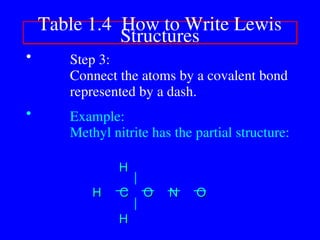
• Example:
Methyl nitrite has the partial structure:
Table 1.4 How to Write Lewis
Structures
C
C O
O N
N O
O
H
H
H
H
H
H
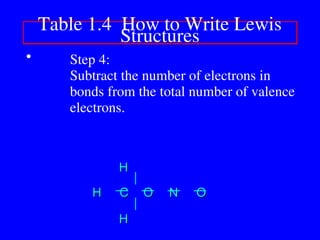
• Step 4:
Subtract the number of electrons in
bonds from the total number of valence
electrons.
Table 1.4 How to Write Lewis
Structures
C
C O
O N
N O
O
H
H
H
H
H
H
• Step 4:
Subtract the number of electrons in
bonds from the total number of valence
electrons.
• Example:
24 valence electrons – 12 electrons in
bonds. Therefore, 12 more electrons to
assign.
Table 1.4 How to Write Lewis
Structures
• Step 5:
Add electrons in pairs so that as many
atoms as possible have 8 electrons.
Start with the most electronegative
atom.
Table 1.4 How to Write Lewis
Structures
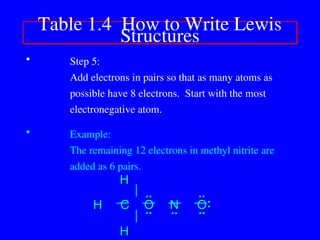
• Step 5:
Add electrons in pairs so that as many atoms as
possible have 8 electrons. Start with the most
electronegative atom.
• Example:
The remaining 12 electrons in methyl nitrite are
added as 6 pairs.
Table 1.4 How to Write Lewis
Structures
..
..
C
C O
O N
N O
O
H
H
H
H
H
H
..
..
..
.. :
:
..
.. ..
..
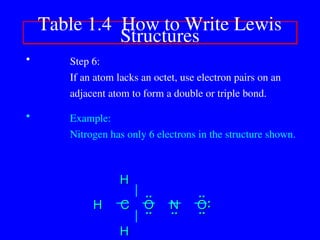
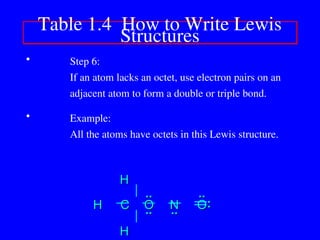
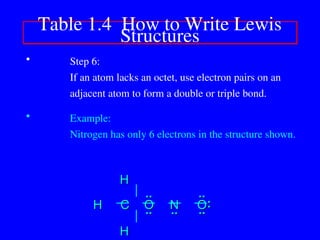
• Step 6:
If an atom lacks an octet, use electron pairs on an
adjacent atom to form a double or triple bond.
• Example:
Nitrogen has only 6 electrons in the structure shown.
Table 1.4 How to Write Lewis
Structures
..
..
C
C O
O N
N O
O
H
H
H
H
H
H
..
..
..
.. :
:
..
.. ..
..
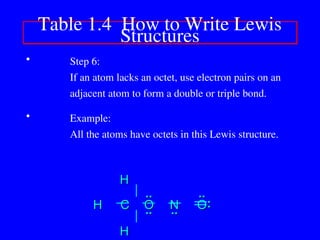
• Step 6:
If an atom lacks an octet, use electron pairs on an
adjacent atom to form a double or triple bond.
• Example:
All the atoms have octets in this Lewis structure.
Table 1.4 How to Write Lewis
Structures
..
..
..
..
C
C O
O N
N O
O
H
H
H
H
H
H
..
..
:
:
..
..
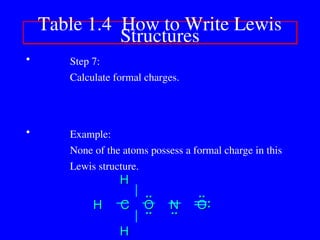
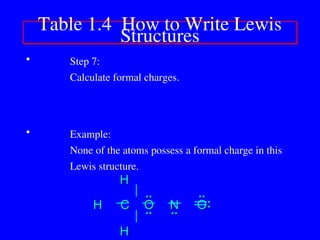
• Step 7:
Calculate formal charges.
• Example:
None of the atoms possess a formal charge in this
Lewis structure.
Table 1.4 How to Write Lewis
Structures
..
..
..
..
C
C O
O N
N O
O
H
H
H
H
H
H
..
..
:
:
..
..
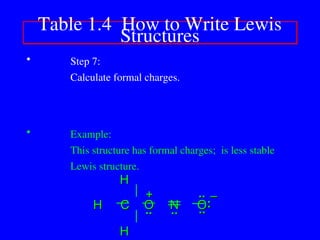
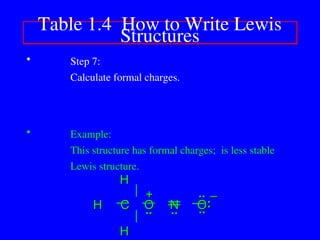
• Step 7:
Calculate formal charges.
• Example:
This structure has formal charges; is less stable
Lewis structure.
Table 1.4 How to Write Lewis
Structures
..
..
..
..
C
C O
O N
N O
O
H
H
H
H
H
H
..
.. :
:
..
..
+
+ –
–
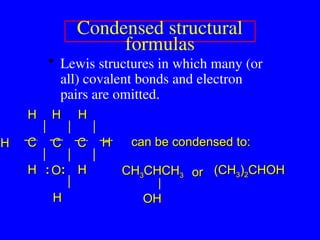
Condensed structural
formulas
• Lewis structures in which many (or
all) covalent bonds and electron
pairs are omitted.
H
H
O
O
C
C C
C C
C
H
H H
H H
H
H
H
H
H
H
H :
: :
:
H
H
can be condensed to:
CH
CH3
3CHCH
CHCH3
3
OH
OH
(CH
(CH3
3)
)2
2CHOH
CHOH
or
or
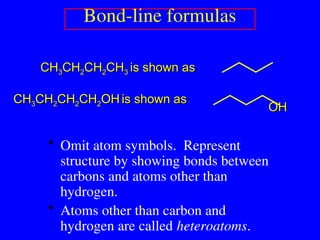
Bond-line formulas
• Omit atom symbols. Represent
structure by showing bonds between
carbons and atoms other than
hydrogen.
• Atoms other than carbon and
hydrogen are called heteroatoms.
CH
CH3
3CH
CH2
2CH
CH2
2CH
CH3
3 is shown as
is shown as
CH
CH3
3CH
CH2
2CH
CH2
2CH
CH2
2OH
OH is shown as
is shown as
OH
OH
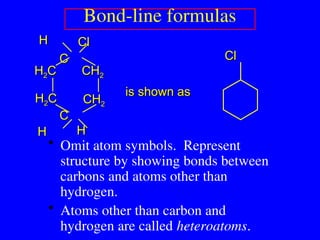
Bond-line formulas
• Omit atom symbols. Represent
structure by showing bonds between
carbons and atoms other than
hydrogen.
• Atoms other than carbon and
hydrogen are called heteroatoms.
H
H Cl
Cl
C
C
C
C
H
H2
2C
C
H
H2
2C
C
CH
CH2
2
CH
CH2
2
H
H
H
H
is shown as
is shown as
Cl
Cl
3.5
Constitutional Isomers
Constitutional isomers
• Isomers are different compounds
that have the same molecular formula.
• Constitutional isomers are isomers
that differ in the order in which the atoms
are connected.
• An older term for constitutional
isomers is “structural isomers.”
A Historical
Note
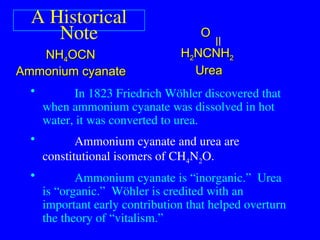
• In 1823 Friedrich Wöhler discovered that
when ammonium cyanate was dissolved in hot
water, it was converted to urea.
• Ammonium cyanate and urea are
constitutional isomers of CH4N2O.
• Ammonium cyanate is “inorganic.” Urea
is “organic.” Wöhler is credited with an
important early contribution that helped overturn
the theory of “vitalism.”
NH
NH4
4OCN
OCN
Ammonium cyanate
Ammonium cyanate
H
H2
2NCNH
NCNH2
2
O
O
Urea
Urea
Nitromethane
Nitromethane Methyl nitrite
Methyl nitrite
..
.. :
:
H
H C
C
O
O
O
O
N
N
:
:
:
:
..
..
–
–
+
+
H
H
H
H
Examples of constitutional
isomers
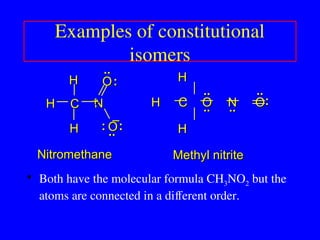
• Both have the molecular formula CH3NO2 but the
atoms are connected in a different order.
..
..
C
C O
O N
N O
O
H
H
H
H
H
H
..
..
:
:
..
.. ..
..
3.5
Resonance
two or more acceptable octet Lewis structures
may be
written for certain compounds (or ions)
Resonance
• Step 6:
If an atom lacks an octet, use electron pairs on an
adjacent atom to form a double or triple bond.
• Example:
Nitrogen has only 6 electrons in the structure shown.
Table 1.4 How to Write Lewis
Structures
..
..
C
C O
O N
N O
O
H
H
H
H
H
H
..
..
..
.. :
:
..
.. ..
..
• Step 6:
If an atom lacks an octet, use electron pairs on an
adjacent atom to form a double or triple bond.
• Example:
All the atoms have octets in this Lewis structure.
Table 1.4 How to Write Lewis
Structures
..
..
..
..
C
C O
O N
N O
O
H
H
H
H
H
H
..
..
:
:
..
..
• Step 7:
Calculate formal charges.
• Example:
None of the atoms possess a formal charge in this
Lewis structure.
Table 1.4 How to Write Lewis
Structures
..
..
..
..
C
C O
O N
N O
O
H
H
H
H
H
H
..
..
:
:
..
..
• Step 7:
Calculate formal charges.
• Example:
This structure has formal charges; is less stable
Lewis structure.
Table 1.4 How to Write Lewis
Structures
..
..
..
..
C
C O
O N
N O
O
H
H
H
H
H
H
..
.. :
:
..
..
+
+ –
–
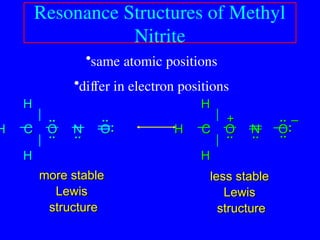
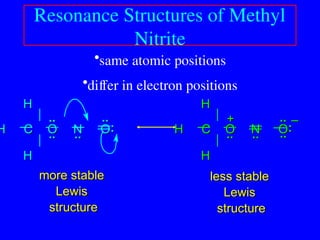
•same atomic positions
•differ in electron positions
more stable
more stable
Lewis
Lewis
structure
structure
less stable
less stable
Lewis
Lewis
structure
structure
..
..
..
..
C
C O
O N
N O
O
H
H
H
H
H
H
..
.. :
:
..
..
+
+ –
–
..
..
..
..
C
C O
O N
N O
O
H
H
H
H
H
H
..
..
:
:
..
..
Resonance Structures of Methyl
Nitrite
•same atomic positions
•differ in electron positions
more stable
more stable
Lewis
Lewis
structure
structure
less stable
less stable
Lewis
Lewis
structure
structure
..
..
..
..
C
C O
O N
N O
O
H
H
H
H
H
H
..
.. :
:
..
..
+
+ –
–
..
..
..
..
C
C O
O N
N O
O
H
H
H
H
H
H
..
..
:
:
..
..
Resonance Structures of Methyl
Nitrite
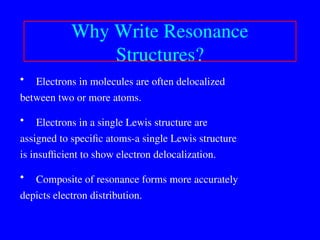
• Electrons in molecules are often delocalized
between two or more atoms.
• Electrons in a single Lewis structure are
assigned to specific atoms-a single Lewis structure
is insufficient to show electron delocalization.
• Composite of resonance forms more accurately
depicts electron distribution.
Why Write Resonance
Structures?
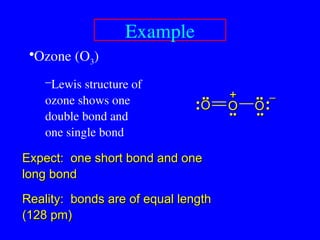
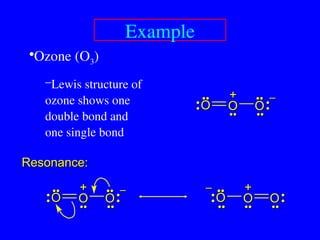
•Ozone (O3)
–Lewis structure of
ozone shows one
double bond and
one single bond
Expect: one short bond and one
long bond
long bond
Reality: bonds are of equal length
(128 pm)
(128 pm)
Example
O
O O
O
••
••
O
O
••
••
••
••
••
••
•
•
•
•
•
•
•
•
–
–
+
+
•Ozone (O3)
–Lewis structure of
ozone shows one
double bond and
one single bond
Resonance:
Resonance:
Example
O
O O
O
••
••
O
O
••
••
••
••
••
••
•
•
•
•
•
•
•
•
–
–
+
+
O
O O
O
••
••
O
O
••
••
••
••
••
••
•
•
•
•
•
•
•
•
–
–
+
+
O
O O
O
O
O
••
••
••
••
••
••
•
•
•
•
•
•
•
•
–
– +
+
••
••
3.7
The Shapes of Some Simple
Molecules
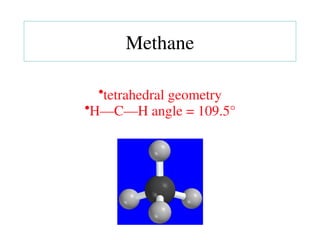
•tetrahedral geometry
•H—C—H angle = 109.5°
Methane
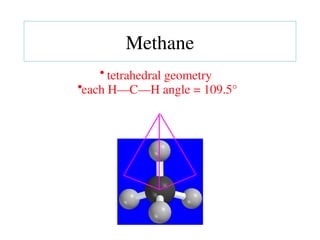
• tetrahedral geometry
•each H—C—H angle = 109.5°
Methane
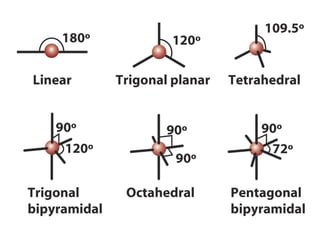
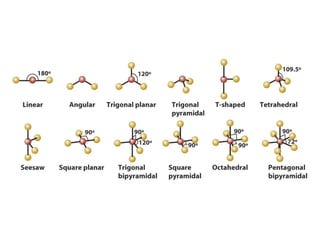
• The most stable arrangement of groups
attached to a central atom is the one that has
the maximum separation of electron pairs
(bonded or nonbonded).
Valence Shell Electron Pair
Repulsions
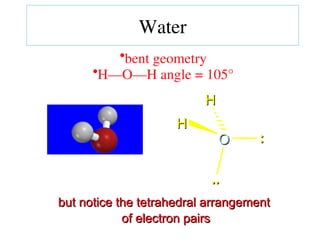
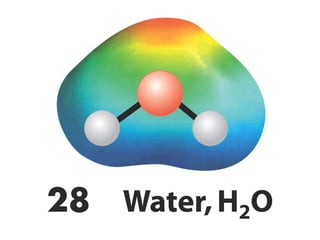
•bent geometry
•H—O—H angle = 105°
but notice the tetrahedral arrangement
of electron pairs
of electron pairs
O
O
H
H
..
..
H
H
:
:
Water
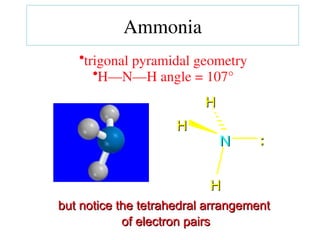
•trigonal pyramidal geometry
•H—N—H angle = 107°
but notice the tetrahedral arrangement
of electron pairs
of electron pairs
N
N
H
H
H
H
H
H
:
:
Ammonia
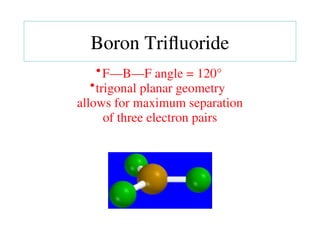
•F—B—F angle = 120°
•trigonal planar geometry
allows for maximum separation
of three electron pairs
Boron Trifluoride
• Four-electron double bonds and six-electron
triple bonds are considered to be similar to a
two-electron single bond in terms of their spatial
requirements.
Multiple Bonds
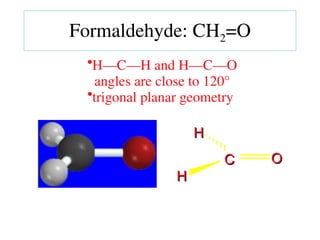
•H—C—H and H—C—O
angles are close to 120°
•trigonal planar geometry
C
C O
O
H
H
H
H
Formaldehyde: CH2=O
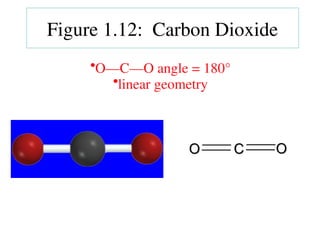
•O—C—O angle = 180°
•linear geometry
O
O C
C O
O
Figure 1.12: Carbon Dioxide
3.7:
Polar Covalent Bonds
and Electronegativity
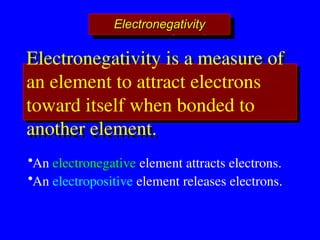
Electronegativity
Electronegativity
•An electronegative element attracts electrons.
•An electropositive element releases electrons.
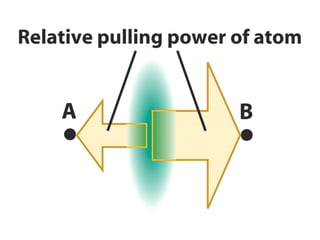
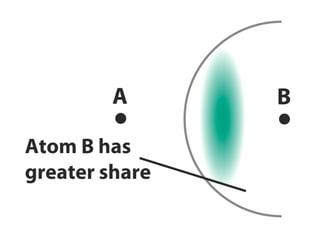
Electronegativity is a measure of
an element to attract electrons
toward itself when bonded to
another element.
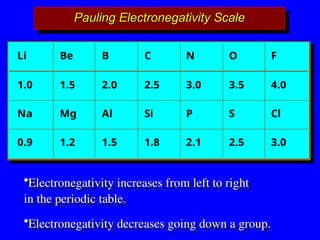
Pauling Electronegativity Scale
1.0
Na
0.9
Li Be B C N O F
1.5
Mg
1.2
2.0
Al
1.5
2.5
Si
1.8
3.0
P
2.1
3.5
S
2.5
4.0
Cl
3.0
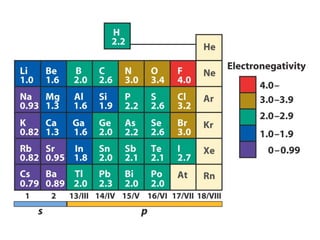
•Electronegativity increases from left to right
in the periodic table.
•Electronegativity decreases going down a group.
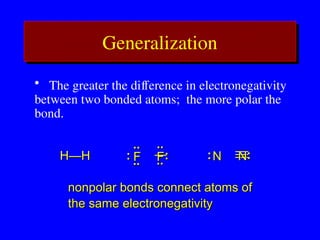
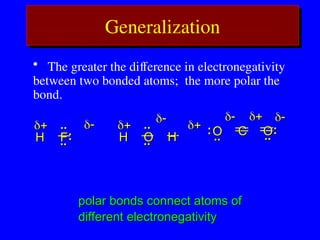
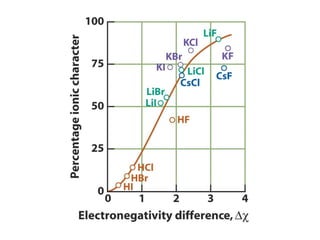
• The greater the difference in electronegativity
between two bonded atoms; the more polar the
bond.
Generalization
nonpolar bonds connect atoms of
the same electronegativity
H—H
H—H :
:N
N N
N:
:
F
F:
:
..
..
..
..
F
F
:
:
..
..
..
..
• The greater the difference in electronegativity
between two bonded atoms; the more polar the
bond.
Generalization
polar bonds connect atoms of
different electronegativity
:
:O
O C
C




F
F:
:
..
..
..
..
H
H

 

O
O
..
..
..
..
H
H




H
H


O
O:
:
..
.. ..
..


3.7
Molecular Dipole Moments
+
+
—
—
not polar
not polar
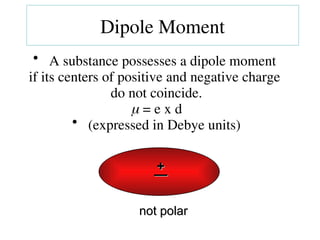
• A substance possesses a dipole moment
if its centers of positive and negative charge
do not coincide.
 = e x d
• (expressed in Debye units)
Dipole Moment
—
—
+
+
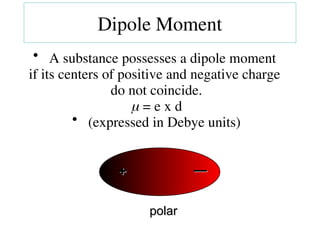
polar
polar
• A substance possesses a dipole moment
if its centers of positive and negative charge
do not coincide.
 = e x d
• (expressed in Debye units)
Dipole Moment
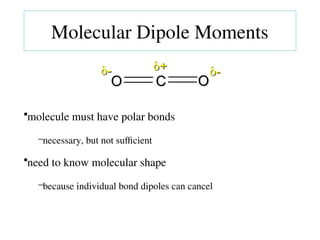
•molecule must have polar bonds
–necessary, but not sufficient
•need to know molecular shape
–because individual bond dipoles can cancel
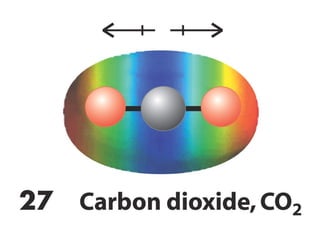
O
O C
C O
O

+
+

-
- 
-
-
Molecular Dipole Moments
O
O C
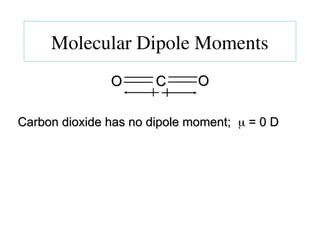
C O
O
Carbon dioxide has no dipole moment;
Carbon dioxide has no dipole moment; 
 = 0 D
= 0 D
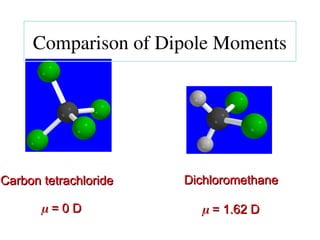
Molecular Dipole Moments

 = 1.62 D
= 1.62 D

 = 0 D
= 0 D
Carbon tetrachloride
Carbon tetrachloride Dichloromethane
Dichloromethane
Comparison of Dipole Moments
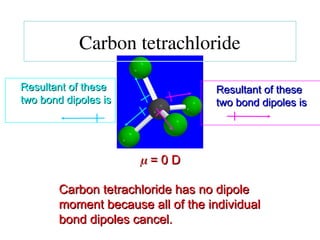
Resultant of these
Resultant of these
two bond dipoles is
two bond dipoles is

 = 0 D
= 0 D
Carbon tetrachloride has no dipole
moment because all of the individual
bond dipoles cancel.
Resultant of these
Resultant of these
two bond dipoles is
two bond dipoles is
Carbon tetrachloride
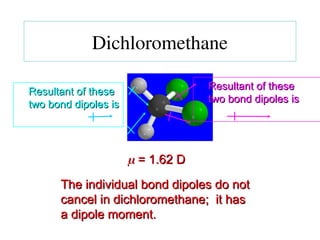
Resultant of these
Resultant of these
two bond dipoles is
two bond dipoles is

 = 1.62 D
= 1.62 D
Resultant of these
Resultant of these
two bond dipoles is
two bond dipoles is
The individual bond dipoles do not
cancel in dichloromethane; it has
a dipole moment.
a dipole moment.
Dichloromethane

Ch3_CovalentBonding FOR JUNIOR HIGH SCHOOL STUDENTS

  • 1.
    Sections 3.3 &3.4 Covalent Bonding and Lewis Structures Learning goals: Writing valid Lewis structures for molecular substances Predicting molecular geometry from Lewis structures (VSEPR theory) Understanding electronegativity and how this concept allows the distinction between polar bonds and non-polar bonds Using Lewis structures to determine whether a molecule has a dipole moment or not Using the octet rule to compute formal charges on atoms and multiple bonding between atoms
  • 2.
    Sections 3.3 &3.4 Covalent Bonding and Lewis Structures (1)Lewis “dot” (electron) structures of valence electrons for atoms (2)Use of Periodic Table to determine the number of “dots” (3)Use of Lewis structures to describe the electronic structures of atoms and molecules (4)Works best for covalent bonds and for elements in the first full row of the Periodic Table: H, He, Li, Be, B, C, N, O, F, Ne (5)Works with restrictions for second full row of the Periodic Table and beyond: Na, Mg, Al, Si, P, S, Cl, Ar
  • 3.
    Some issues aboutLewis Structures to be discussed: (1) Drawing “valid” Lewis structures which follow the “octet” rule (holds almost without exception for first full row) (2) Drawing structures with single, double and triple bonds (3) Dealing with isomers (same composition, different constitution) (4) Dealing with resonance structures (same constitution, different bonding between atoms) (5) Dealing with “formal” charges on atoms in Lewis structures (6) Dealing with violations of the octet rule: Molecules which possess an odd number of electrons Molecules which are electron deficient Molecules which are capable of making more than four covalent bonds
  • 4.
    Lewis “dot-line” representationsof atoms and molecules (1) Electrons of an atom are of two types: core electrons and valence electrons. Only the valence electrons are shown in Lewis dot-line structures. (2) The number of valence electrons is equal to the group number of the element for the representative elements. (3) For atoms the first four dots are displayed around the four “sides” of the symbol for the atom. (4) If there are more than four electrons, the dots are paired with those already present until an octet is achieved. (5) Ionic compounds are produced by complete transfer of an electron from one atom to another. (6) Covalent compounds are produced by sharing of one or more pairs of electrons by two atoms.
  • 5.
    The valence capacityof an atom is the atom’s ability to form bonds with other atoms. The more bonds the higher the valence. The valence of an atom is not fixed, but some atoms have typical valences which are most common: Carbon: valence of 4 Nitrogen: valence of 3 (neutral molecules) or 4 (cations) Oxygen: valence of 2 (neutral molecules) or 3 (cations) Fluorine: valence of 1(neutral molecules) or 2 (cations)
  • 6.
    Covalent bonding andLewis structures (1)Covalent bonds are formed from sharing of electrons by two atoms. (2)Molecules possess only covalent bonds. (3)The bedrock rule for writing Lewis structures for the first full row of the periodic table is the octet rule for C, N, O and F: C, N, O and F atoms are always surrounded by eight valence electrons. (4) For hydrogen atoms, the doublet rule is applied: H atoms are surrounded by two valence electrons.
  • 7.
  • 8.
    Covalent Bonding in H2 H H. . H H . . Two hydrogen atoms, each with 1 electron, Two hydrogen atoms, each with 1 electron, can share those electrons in a covalent bond. can share those electrons in a covalent bond. H H: : H H • Sharing the electron pair gives each hydrogen an electron configuration analogous to helium.
  • 9.
    Covalent Bonding in F2 Twofluorine atoms, each with 7 valence electrons, Two fluorine atoms, each with 7 valence electrons, can share those electrons in a covalent bond. can share those electrons in a covalent bond. • Sharing the electron pair gives each fluorine an electron configuration analogous to neon. .. .. .. .. F F . . F F . . : : : : .. .. .. .. F F: : F F : : : : .. .. .. .. .. .. .. ..
  • 10.
    The Octet Rule •The octet rule is the most useful in cases involving covalent bonds to C, N, O, and F. F F: : F F : : : : .. .. .. .. .. .. .. .. In forming compounds, atoms gain, lose, or In forming compounds, atoms gain, lose, or share electrons to give a stable electron share electrons to give a stable electron configuration characterized by 8 valence configuration characterized by 8 valence electrons. electrons.
  • 11.
    Example Example C C. . . . . . . . F F : : .. .. .. .. . . Combine carbon (4valence electrons) and Combine carbon (4 valence electrons) and four fluorines (7 valence electrons each) four fluorines (7 valence electrons each) to write a Lewis structure for CF to write a Lewis structure for CF4 4. . : : F F: : .. .. .. .. C C : : F F: : .. .. .. .. : : F F: : .. .. .. .. : : F F: : .. .. .. .. The octet rule is satisfied for carbon and The octet rule is satisfied for carbon and each fluorine. each fluorine.
  • 12.
    Example Example It is commonpractice to represent a covalent It is common practice to represent a covalent bond by a line. We can rewrite bond by a line. We can rewrite : : F F: : .. .. .. .. C C : : F F: : .. .. .. .. : : F F: : .. .. .. .. : : F F: : .. .. .. .. .. .. C C F F F F F F F F .. .. .. .. .. .. .. .. : : : : : : : : : : : : .. .. as as
  • 13.
  • 14.
    Inorganic examples Inorganic examples C C : :: : : : O O .. .. : : O O .. .. : : : : C C : : O O .. .. O O .. .. : : : : : : : : N N : : C C : : H H : : N N C C H H Carbon dioxide Carbon dioxide Hydrogen cyanide Hydrogen cyanide
  • 15.
    Organic examples Organic examples Ethylene Ethylene Acetylene Acetylene : :: : : : C C : : C C : : H H H H C C C C H H H H C C : : : : C C .. .. H H : : : : .. .. H H H H H H C C C C H H H H H H H H
  • 16.
    3.4 Formal Charges • Formalcharge is the charge calculated for an atom in a Lewis structure on the basis of an equal sharing of bonded electron pairs.
  • 17.
    Nitric acid .. .. : : .. .. H HO O O O O O N N : : : : .. .. .. .. • We will calculate the formal charge for each atom in this Lewis structure. Formal charge of H Formal charge of H
  • 18.
    Nitric acid .. .. : : .. .. H HO O O O O O N N : : : : .. .. .. .. • Hydrogen shares 2 electrons with oxygen. • Assign 1 electron to H and 1 to O. • A neutral hydrogen atom has 1 electron. • Therefore, the formal charge of H in nitric acid is 0. Formal charge of H Formal charge of H
  • 19.
    Nitric acid .. .. : : .. .. H HO O O O O O N N : : : : .. .. .. .. • Oxygen has 4 electrons in covalent bonds. • Assign 2 of these 4 electrons to O. • Oxygen has 2 unshared pairs. Assign all 4 of these electrons to O. • Therefore, the total number of electrons assigned to O is 2 + 4 = 6. Formal charge of O Formal charge of O
  • 20.
    Nitric acid .. .. : : .. .. H HO O O O O O N N : : : : .. .. .. .. • Electron count of O is 6. • A neutral oxygen has 6 electrons. • Therefore, the formal charge of O is 0. Formal charge of O Formal charge of O
  • 21.
    Nitric acid .. .. : : .. .. H HO O O O O O N N : : : : .. .. .. .. • Electron count of O is 6 (4 electrons from unshared pairs + half of 4 bonded electrons). • A neutral oxygen has 6 electrons. • Therefore, the formal charge of O is 0. Formal charge of O Formal charge of O
  • 22.
    Nitric acid .. .. : : .. .. H HO O O O O O N N : : : : .. .. .. .. • Electron count of O is 7 (6 electrons from unshared pairs + half of 2 bonded electrons). • A neutral oxygen has 6 electrons. • Therefore, the formal charge of O is -1. Formal charge of O Formal charge of O
  • 23.
    Nitric acid .. .. : : .. .. H HO O O O O O N N : : : : .. .. .. .. • Electron count of N is 4 (half of 8 electrons in covalent bonds). • A neutral nitrogen has 5 electrons. • Therefore, the formal charge of N is +1. Formal charge of N Formal charge of N – –
  • 24.
    Nitric acid .. .. : : .. .. H HO O O O O O N N : : : : .. .. .. .. • A Lewis structure is not complete unless formal charges (if any) are shown. Formal charges Formal charges – – + +
  • 25.
    Formal Charge Formal Charge Formalcharge = Formal charge = group number group number in periodic table in periodic table number of number of bonds bonds number of number of unshared electrons unshared electrons – – – – An arithmetic formula for calculating formal charge. An arithmetic formula for calculating formal charge.
  • 26.
    "Electron counts" "Electron counts"and formal and formal charges in NH charges in NH4 4 + + and BF and BF4 4 - - 1 1 4 4 N N H H H H H H H H + + 7 7 4 4 .. .. B B F F F F F F F F .. .. .. .. .. .. .. .. : : : : : : : : : : : : .. .. – –
  • 27.
  • 28.
    Constitution • The orderin which the atoms of a molecule are connected is called its constitution or connectivity. • The constitution of a molecule must be determined in order to write a Lewis structure.
  • 29.
    • Step 1: Themolecular formula and the connectivity are determined by experiment. Table 1.4 How to Write Lewis Structures
  • 30.
    • Step 1: Themolecular formula and the connectivity are determined by experiment. • Example: Methyl nitrite has the molecular formula CH3NO2. All hydrogens are bonded to carbon, and the order of atomic connections is CONO. Table 1.4 How to Write Lewis Structures
  • 31.
    • Step 2: Countthe number of valence electrons. For a neutral molecule this is equal to the number of valence electrons of the constituent atoms. Table 1.4 How to Write Lewis Structures
  • 32.
    • Step 2: Countthe number of valence electrons. For a neutral molecule this is equal to the number of valence electrons of the constituent atoms. • Example (CH3NO2): Each hydrogen contributes 1 valence electron. Each carbon contributes 4, nitrogen 5, and each oxygen 6 for a total of 24. Table 1.4 How to Write Lewis Structures
  • 33.
    • Step 3: Connectthe atoms by a covalent bond represented by a dash. Table 1.4 How to Write Lewis Structures
  • 34.
    • Step 3: Connectthe atoms by a covalent bond represented by a dash. • Example: Methyl nitrite has the partial structure: Table 1.4 How to Write Lewis Structures C C O O N N O O H H H H H H
  • 35.
    • Step 4: Subtractthe number of electrons in bonds from the total number of valence electrons. Table 1.4 How to Write Lewis Structures C C O O N N O O H H H H H H
  • 36.
    • Step 4: Subtractthe number of electrons in bonds from the total number of valence electrons. • Example: 24 valence electrons – 12 electrons in bonds. Therefore, 12 more electrons to assign. Table 1.4 How to Write Lewis Structures
  • 37.
    • Step 5: Addelectrons in pairs so that as many atoms as possible have 8 electrons. Start with the most electronegative atom. Table 1.4 How to Write Lewis Structures
  • 38.
    • Step 5: Addelectrons in pairs so that as many atoms as possible have 8 electrons. Start with the most electronegative atom. • Example: The remaining 12 electrons in methyl nitrite are added as 6 pairs. Table 1.4 How to Write Lewis Structures .. .. C C O O N N O O H H H H H H .. .. .. .. : : .. .. .. ..
  • 39.
    • Step 6: Ifan atom lacks an octet, use electron pairs on an adjacent atom to form a double or triple bond. • Example: Nitrogen has only 6 electrons in the structure shown. Table 1.4 How to Write Lewis Structures .. .. C C O O N N O O H H H H H H .. .. .. .. : : .. .. .. ..
  • 40.
    • Step 6: Ifan atom lacks an octet, use electron pairs on an adjacent atom to form a double or triple bond. • Example: All the atoms have octets in this Lewis structure. Table 1.4 How to Write Lewis Structures .. .. .. .. C C O O N N O O H H H H H H .. .. : : .. ..
  • 41.
    • Step 7: Calculateformal charges. • Example: None of the atoms possess a formal charge in this Lewis structure. Table 1.4 How to Write Lewis Structures .. .. .. .. C C O O N N O O H H H H H H .. .. : : .. ..
  • 42.
    • Step 7: Calculateformal charges. • Example: This structure has formal charges; is less stable Lewis structure. Table 1.4 How to Write Lewis Structures .. .. .. .. C C O O N N O O H H H H H H .. .. : : .. .. + + – –
  • 43.
    Condensed structural formulas • Lewisstructures in which many (or all) covalent bonds and electron pairs are omitted. H H O O C C C C C C H H H H H H H H H H H H : : : : H H can be condensed to: can be condensed to: CH CH3 3CHCH CHCH3 3 OH OH (CH (CH3 3) )2 2CHOH CHOH or or
  • 44.
    Bond-line formulas • Omitatom symbols. Represent structure by showing bonds between carbons and atoms other than hydrogen. • Atoms other than carbon and hydrogen are called heteroatoms. CH CH3 3CH CH2 2CH CH2 2CH CH3 3 is shown as is shown as CH CH3 3CH CH2 2CH CH2 2CH CH2 2OH OH is shown as is shown as OH OH
  • 45.
    Bond-line formulas • Omitatom symbols. Represent structure by showing bonds between carbons and atoms other than hydrogen. • Atoms other than carbon and hydrogen are called heteroatoms. H H Cl Cl C C C C H H2 2C C H H2 2C C CH CH2 2 CH CH2 2 H H H H is shown as is shown as Cl Cl
  • 46.
  • 47.
    Constitutional isomers • Isomersare different compounds that have the same molecular formula. • Constitutional isomers are isomers that differ in the order in which the atoms are connected. • An older term for constitutional isomers is “structural isomers.”
  • 48.
    A Historical Note • In1823 Friedrich Wöhler discovered that when ammonium cyanate was dissolved in hot water, it was converted to urea. • Ammonium cyanate and urea are constitutional isomers of CH4N2O. • Ammonium cyanate is “inorganic.” Urea is “organic.” Wöhler is credited with an important early contribution that helped overturn the theory of “vitalism.” NH NH4 4OCN OCN Ammonium cyanate Ammonium cyanate H H2 2NCNH NCNH2 2 O O Urea Urea
  • 49.
    Nitromethane Nitromethane Methyl nitrite Methylnitrite .. .. : : H H C C O O O O N N : : : : .. .. – – + + H H H H Examples of constitutional isomers • Both have the molecular formula CH3NO2 but the atoms are connected in a different order. .. .. C C O O N N O O H H H H H H .. .. : : .. .. .. ..
  • 50.
  • 51.
    two or moreacceptable octet Lewis structures may be written for certain compounds (or ions) Resonance
  • 52.
    • Step 6: Ifan atom lacks an octet, use electron pairs on an adjacent atom to form a double or triple bond. • Example: Nitrogen has only 6 electrons in the structure shown. Table 1.4 How to Write Lewis Structures .. .. C C O O N N O O H H H H H H .. .. .. .. : : .. .. .. ..
  • 53.
    • Step 6: Ifan atom lacks an octet, use electron pairs on an adjacent atom to form a double or triple bond. • Example: All the atoms have octets in this Lewis structure. Table 1.4 How to Write Lewis Structures .. .. .. .. C C O O N N O O H H H H H H .. .. : : .. ..
  • 54.
    • Step 7: Calculateformal charges. • Example: None of the atoms possess a formal charge in this Lewis structure. Table 1.4 How to Write Lewis Structures .. .. .. .. C C O O N N O O H H H H H H .. .. : : .. ..
  • 55.
    • Step 7: Calculateformal charges. • Example: This structure has formal charges; is less stable Lewis structure. Table 1.4 How to Write Lewis Structures .. .. .. .. C C O O N N O O H H H H H H .. .. : : .. .. + + – –
  • 56.
    •same atomic positions •differin electron positions more stable more stable Lewis Lewis structure structure less stable less stable Lewis Lewis structure structure .. .. .. .. C C O O N N O O H H H H H H .. .. : : .. .. + + – – .. .. .. .. C C O O N N O O H H H H H H .. .. : : .. .. Resonance Structures of Methyl Nitrite
  • 57.
    •same atomic positions •differin electron positions more stable more stable Lewis Lewis structure structure less stable less stable Lewis Lewis structure structure .. .. .. .. C C O O N N O O H H H H H H .. .. : : .. .. + + – – .. .. .. .. C C O O N N O O H H H H H H .. .. : : .. .. Resonance Structures of Methyl Nitrite
  • 58.
    • Electrons inmolecules are often delocalized between two or more atoms. • Electrons in a single Lewis structure are assigned to specific atoms-a single Lewis structure is insufficient to show electron delocalization. • Composite of resonance forms more accurately depicts electron distribution. Why Write Resonance Structures?
  • 59.
    •Ozone (O3) –Lewis structureof ozone shows one double bond and one single bond Expect: one short bond and one Expect: one short bond and one long bond long bond Reality: bonds are of equal length Reality: bonds are of equal length (128 pm) (128 pm) Example O O O O •• •• O O •• •• •• •• •• •• • • • • • • • • – – + +
  • 60.
    •Ozone (O3) –Lewis structureof ozone shows one double bond and one single bond Resonance: Resonance: Example O O O O •• •• O O •• •• •• •• •• •• • • • • • • • • – – + + O O O O •• •• O O •• •• •• •• •• •• • • • • • • • • – – + + O O O O O O •• •• •• •• •• •• • • • • • • • • – – + + •• ••
  • 61.
    3.7 The Shapes ofSome Simple Molecules
  • 64.
  • 65.
    • tetrahedral geometry •eachH—C—H angle = 109.5° Methane
  • 66.
    • The moststable arrangement of groups attached to a central atom is the one that has the maximum separation of electron pairs (bonded or nonbonded). Valence Shell Electron Pair Repulsions
  • 67.
    •bent geometry •H—O—H angle= 105° but notice the tetrahedral arrangement but notice the tetrahedral arrangement of electron pairs of electron pairs O O H H .. .. H H : : Water
  • 68.
    •trigonal pyramidal geometry •H—N—Hangle = 107° but notice the tetrahedral arrangement but notice the tetrahedral arrangement of electron pairs of electron pairs N N H H H H H H : : Ammonia
  • 69.
    •F—B—F angle =120° •trigonal planar geometry allows for maximum separation of three electron pairs Boron Trifluoride
  • 70.
    • Four-electron doublebonds and six-electron triple bonds are considered to be similar to a two-electron single bond in terms of their spatial requirements. Multiple Bonds
  • 71.
    •H—C—H and H—C—O anglesare close to 120° •trigonal planar geometry C C O O H H H H Formaldehyde: CH2=O
  • 72.
    •O—C—O angle =180° •linear geometry O O C C O O Figure 1.12: Carbon Dioxide
  • 75.
  • 76.
    Electronegativity Electronegativity •An electronegative elementattracts electrons. •An electropositive element releases electrons. Electronegativity is a measure of an element to attract electrons toward itself when bonded to another element.
  • 77.
    Pauling Electronegativity Scale PaulingElectronegativity Scale 1.0 Na 0.9 Li Be B C N O F 1.5 Mg 1.2 2.0 Al 1.5 2.5 Si 1.8 3.0 P 2.1 3.5 S 2.5 4.0 Cl 3.0 •Electronegativity increases from left to right in the periodic table. •Electronegativity decreases going down a group.
  • 79.
    • The greaterthe difference in electronegativity between two bonded atoms; the more polar the bond. Generalization nonpolar bonds connect atoms of nonpolar bonds connect atoms of the same electronegativity the same electronegativity H—H H—H : :N N N N: : F F: : .. .. .. .. F F : : .. .. .. ..
  • 80.
    • The greaterthe difference in electronegativity between two bonded atoms; the more polar the bond. Generalization polar bonds connect atoms of polar bonds connect atoms of different electronegativity different electronegativity : :O O C C     F F: : .. .. .. .. H H     O O .. .. .. .. H H     H H   O O: : .. .. .. ..  
  • 81.
  • 82.
    + + — — not polar not polar •A substance possesses a dipole moment if its centers of positive and negative charge do not coincide.  = e x d • (expressed in Debye units) Dipole Moment
  • 86.
    — — + + polar polar • A substancepossesses a dipole moment if its centers of positive and negative charge do not coincide.  = e x d • (expressed in Debye units) Dipole Moment
  • 87.
    •molecule must havepolar bonds –necessary, but not sufficient •need to know molecular shape –because individual bond dipoles can cancel O O C C O O  + +  - -  - - Molecular Dipole Moments
  • 88.
    O O C C O O Carbondioxide has no dipole moment; Carbon dioxide has no dipole moment;   = 0 D = 0 D Molecular Dipole Moments
  • 89.
      = 1.62D = 1.62 D   = 0 D = 0 D Carbon tetrachloride Carbon tetrachloride Dichloromethane Dichloromethane Comparison of Dipole Moments
  • 90.
    Resultant of these Resultantof these two bond dipoles is two bond dipoles is   = 0 D = 0 D Carbon tetrachloride has no dipole Carbon tetrachloride has no dipole moment because all of the individual moment because all of the individual bond dipoles cancel. bond dipoles cancel. Resultant of these Resultant of these two bond dipoles is two bond dipoles is Carbon tetrachloride
  • 91.
    Resultant of these Resultantof these two bond dipoles is two bond dipoles is   = 1.62 D = 1.62 D Resultant of these Resultant of these two bond dipoles is two bond dipoles is The individual bond dipoles do not The individual bond dipoles do not cancel in dichloromethane; it has cancel in dichloromethane; it has a dipole moment. a dipole moment. Dichloromethane