Understanding Operating SystemUnderstanding Operating System
ConfigurationsConfigurations
Lesson 2
ObjectivesObjectives
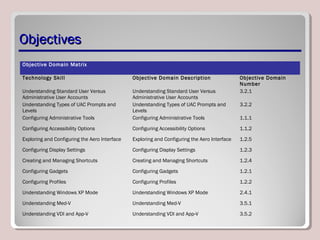
Objective Domain Matrix
Technology Skill Objective Domain Description Objective Domain
Number
Understanding Standard User Versus
Administrative User Accounts
Understanding Standard User Versus
Administrative User Accounts
3.2.1
Understanding Types of UAC Prompts and
Levels
Understanding Types of UAC Prompts and
Levels
3.2.2
Configuring Administrative Tools Configuring Administrative Tools 1.1.1
Configuring Accessibility Options Configuring Accessibility Options 1.1.2
Exploring and Configuring the Aero Interface Exploring and Configuring the Aero Interface 1.2.5
Configuring Display Settings Configuring Display Settings 1.2.3
Creating and Managing Shortcuts Creating and Managing Shortcuts 1.2.4
Configuring Gadgets Configuring Gadgets 1.2.1
Configuring Profiles Configuring Profiles 1.2.2
Understanding Windows XP Mode Understanding Windows XP Mode 2.4.1
Understanding Med-V Understanding Med-V 3.5.1
Understanding VDI and App-V Understanding VDI and App-V 3.5.2
User AccountsUser Accounts
• A collection of information that defines:
– Actions that can be taken on a computer
– Files and folders can be accessed (rights,
policies, and permissions)
• Keeps track of user preferences, such as the
desktop background, window color, and
screen saver
User AccountsUser Accounts
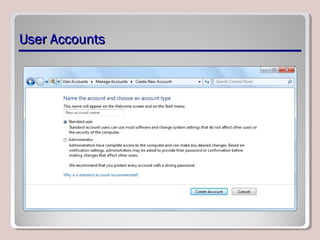
• Types of user accounts in Windows 7:
– Administrator
– Standard user
– Guest
• Run as administrator command enables
a standard user to run programs with
administrative-level permissions
User AccountsUser Accounts
User Account ControlUser Account Control
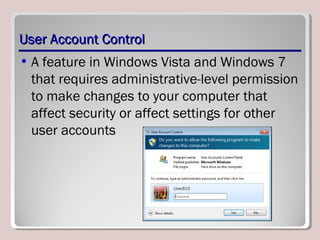
• A feature in Windows Vista and Windows 7
that requires administrative-level permission
to make changes to your computer that
affect security or affect settings for other
user accounts
User Account Control Prompts/LevelsUser Account Control Prompts/Levels
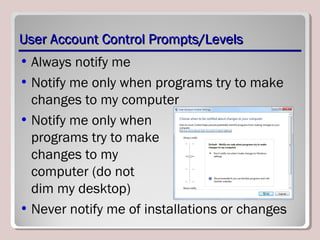
• Always notify me
• Notify me only when programs try to make
changes to my computer
• Notify me only when
programs try to make
changes to my
computer (do not
dim my desktop)
• Never notify me of installations or changes
Control PanelControl Panel
• A utility that allows you to:
– Configure operating system features
– Set up hardware
– Install and uninstall software
– Create and modify users
– Perform system maintenance
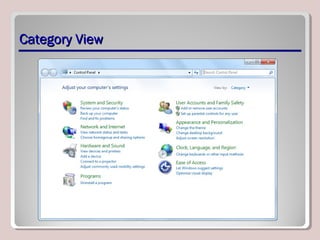
Category ViewCategory View
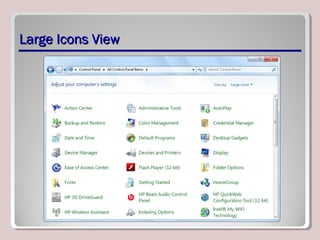
Large Icons ViewLarge Icons View
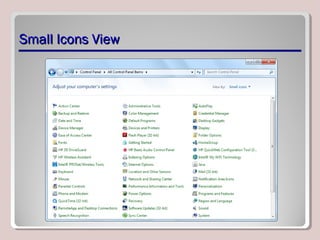
Small Icons ViewSmall Icons View
Administrative ToolsAdministrative Tools
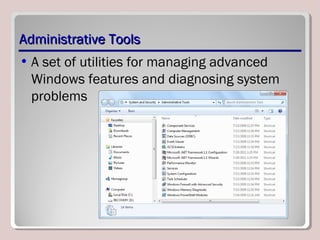
• A set of utilities for managing advanced
Windows features and diagnosing system
problems
Accessibility OptionsAccessibility Options
On-Screen KeyboardOn-Screen Keyboard
Microsoft Narrator Dialog BoxMicrosoft Narrator Dialog Box
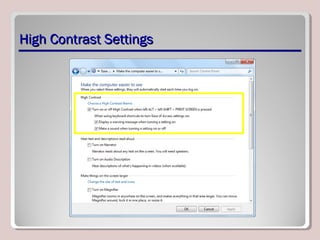
High Contrast SettingsHigh Contrast Settings
Windows Desktop SettingsWindows Desktop Settings
• A broad term that refers to many different
configurable settings for personalizing
Windows, such as the Windows theme, the
desktop background, mouse clicks and
pointer speeds, gadgets, shortcuts, and
more
• All settings are customizable—choosing the
right mix will make a user’s Windows
experience more enjoyable and more
productive
Windows Desktop SettingsWindows Desktop Settings
• Unlock and move the taskbar
• Pin programs to the taskbar
• Jump Lists
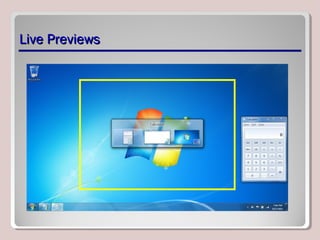
• Live previews
• Personalization page
– Windows 7 is the default theme in Windows
7
Live PreviewsLive Previews
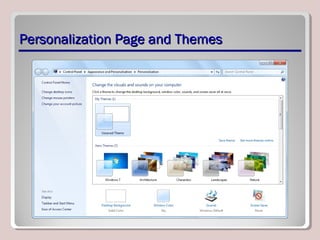
Personalization Page and ThemesPersonalization Page and Themes
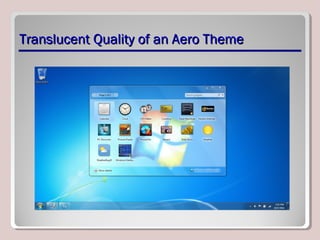
Translucent Quality of an Aero ThemeTranslucent Quality of an Aero Theme
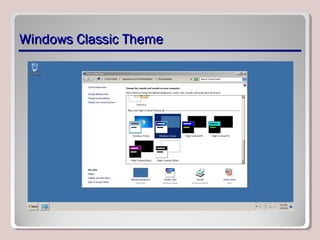
Windows Classic ThemeWindows Classic Theme
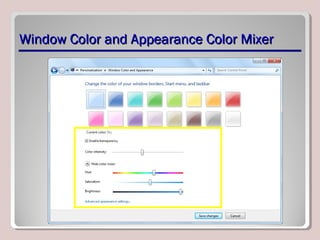
Window Color and Appearance Color MixerWindow Color and Appearance Color Mixer
Aero InterfaceAero Interface
• Aero Shake
• Aero Snap
• Aero Peek
• Show Desktop button (far right end of the
taskbar)
Display SettingsDisplay Settings
• Resolution
• Color depth
• Font size
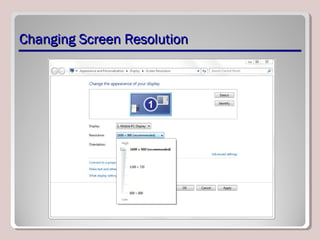
Changing Screen ResolutionChanging Screen Resolution
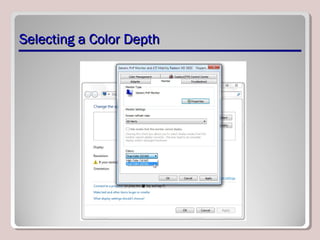
Selecting a Color DepthSelecting a Color Depth
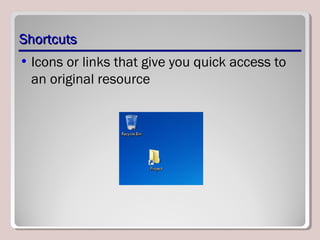
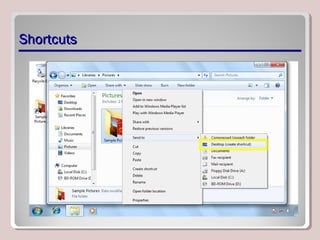
ShortcutsShortcuts
• Icons or links that give you quick access to
an original resource
ShortcutsShortcuts
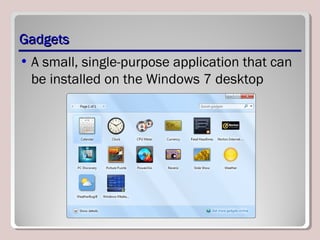
GadgetsGadgets
• A small, single-purpose application that can
be installed on the Windows 7 desktop
User ProfilesUser Profiles
• Contains all of a user’s personal preferences
—from theme choice to screen saver to
shortcuts
• Windows relates a user’s preferences to the
user account; each time a user logs on to
Windows, the user’s profile is loaded
• User profile is not the same as a user
account
User ProfilesUser Profiles
• Local and roaming profiles, stored in
Windows (C:Users<user>AppData)
• Local profile is available only on the
computer on which it was created
• Roaming profile enables a user to use any
computer to connect to a Windows domain
and access his or her profile
VirtualizationVirtualization
• A technology that creates an abstract
version of a complete operating environment
(including a processor, memory, storage,
network links, a display, and so forth)
entirely in software
• Software produces a virtual computer or a
virtual machine (VM)
• Has guest operating system
Microsoft VirtualizationMicrosoft Virtualization
• Windows Virtual PC
• Windows XP Mode
• Microsoft Enterprise Desktop Virtualization
(Med-V or MED-V)
• Virtual Desktop Infrastructure (VDI)
• Application Virtualization (App-V)
Windows XP ModeWindows XP Mode
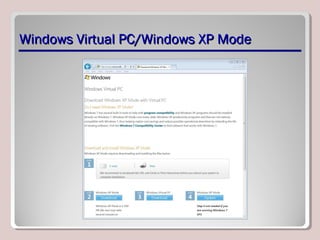
• An extension to Windows Virtual PC
• When installed in Windows 7, enables users
to run applications inside the VM that won’t
work on Windows 7
Windows Virtual PC/Windows XP ModeWindows Virtual PC/Windows XP Mode
Application VirtualizationApplication Virtualization
• Adds the ability to install and manage legacy
applications and virtual machines centrally
• Sometimes relies on additional Microsoft
technologies, including a virtual desktop
infrastructure (VDI)
Microsoft Enterprise Desktop VirtualizationMicrosoft Enterprise Desktop Virtualization
(Med-V or MED-V)(Med-V or MED-V)
• A way to deliver legacy applications to end
users, on centrally configured and managed
VMs
• Allows administrators to manage master
copies in the data center, while users work
on copies of the master on their desktops
Virtual Desktop Infrastructure (VDI)Virtual Desktop Infrastructure (VDI)
• Runs a desktop operating system within a
VM running on a server
• Depends on a special, licensed access right
that permits users to access a virtual
machine running a Windows client
Application Virtualization (App-V)Application Virtualization (App-V)
• Permits users to launch and run applications
on their desktops without installing or
rebooting their machines
• Makes instant use available through System
Center and special centralized configuration
and management utilities
SummarySummary
• Windows 7 includes the Administrator, Standard
user, and Guest accounts by default.
• User Account Control (UAC) is a security feature in
Windows Vista and Windows 7 that helps protect a
computer from unauthorized changes.
• There are four levels of UAC control, which result in
different types of alerts or notifications to the user.
• The Control Panel is a utility that allows you to
configure operating system features, set up
hardware, install and uninstall software, create and
modify users, and perform system maintenance.
SummarySummary
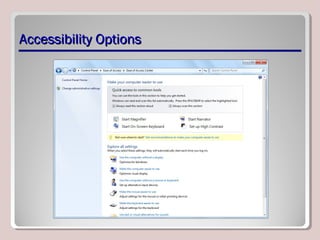
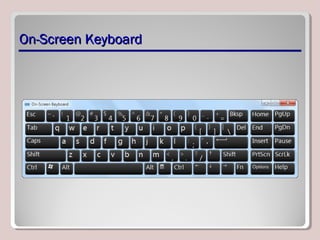
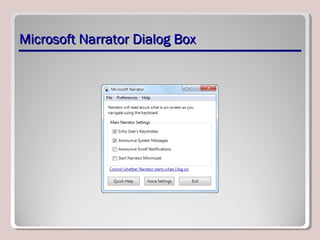
• The Ease of Access Center includes Magnifier,
Narrator, On-Screen Keyboard, and High Contrast.
• Windows desktop settings enable you to configure
the theme, desktop background, mouse click and
pointer speed, gadgets, shortcuts, and more.
• Microsoft virtualization products include Virtual PC,
Windows XP Mode, Microsoft Enterprise Desktop-
Virtualization (Med-V), Application Virtualization
(App-V), and Virtual Desktop Infrastructure (VDI).

Lesson 2 - Understanding Operating System Configurations

  • 1.
    Understanding Operating SystemUnderstandingOperating System ConfigurationsConfigurations Lesson 2
  • 2.
    ObjectivesObjectives Objective Domain Matrix TechnologySkill Objective Domain Description Objective Domain Number Understanding Standard User Versus Administrative User Accounts Understanding Standard User Versus Administrative User Accounts 3.2.1 Understanding Types of UAC Prompts and Levels Understanding Types of UAC Prompts and Levels 3.2.2 Configuring Administrative Tools Configuring Administrative Tools 1.1.1 Configuring Accessibility Options Configuring Accessibility Options 1.1.2 Exploring and Configuring the Aero Interface Exploring and Configuring the Aero Interface 1.2.5 Configuring Display Settings Configuring Display Settings 1.2.3 Creating and Managing Shortcuts Creating and Managing Shortcuts 1.2.4 Configuring Gadgets Configuring Gadgets 1.2.1 Configuring Profiles Configuring Profiles 1.2.2 Understanding Windows XP Mode Understanding Windows XP Mode 2.4.1 Understanding Med-V Understanding Med-V 3.5.1 Understanding VDI and App-V Understanding VDI and App-V 3.5.2
  • 3.
    User AccountsUser Accounts •A collection of information that defines: – Actions that can be taken on a computer – Files and folders can be accessed (rights, policies, and permissions) • Keeps track of user preferences, such as the desktop background, window color, and screen saver
  • 4.
    User AccountsUser Accounts •Types of user accounts in Windows 7: – Administrator – Standard user – Guest • Run as administrator command enables a standard user to run programs with administrative-level permissions
  • 5.
  • 6.
    User Account ControlUserAccount Control • A feature in Windows Vista and Windows 7 that requires administrative-level permission to make changes to your computer that affect security or affect settings for other user accounts
  • 7.
    User Account ControlPrompts/LevelsUser Account Control Prompts/Levels • Always notify me • Notify me only when programs try to make changes to my computer • Notify me only when programs try to make changes to my computer (do not dim my desktop) • Never notify me of installations or changes
  • 8.
    Control PanelControl Panel •A utility that allows you to: – Configure operating system features – Set up hardware – Install and uninstall software – Create and modify users – Perform system maintenance
  • 9.
  • 10.
  • 11.
  • 12.
    Administrative ToolsAdministrative Tools •A set of utilities for managing advanced Windows features and diagnosing system problems
  • 13.
  • 14.
  • 15.
    Microsoft Narrator DialogBoxMicrosoft Narrator Dialog Box
  • 16.
    High Contrast SettingsHighContrast Settings
  • 17.
    Windows Desktop SettingsWindowsDesktop Settings • A broad term that refers to many different configurable settings for personalizing Windows, such as the Windows theme, the desktop background, mouse clicks and pointer speeds, gadgets, shortcuts, and more • All settings are customizable—choosing the right mix will make a user’s Windows experience more enjoyable and more productive
  • 18.
    Windows Desktop SettingsWindowsDesktop Settings • Unlock and move the taskbar • Pin programs to the taskbar • Jump Lists • Live previews • Personalization page – Windows 7 is the default theme in Windows 7
  • 19.
  • 20.
    Personalization Page andThemesPersonalization Page and Themes
  • 21.
    Translucent Quality ofan Aero ThemeTranslucent Quality of an Aero Theme
  • 22.
  • 23.
    Window Color andAppearance Color MixerWindow Color and Appearance Color Mixer
  • 24.
    Aero InterfaceAero Interface •Aero Shake • Aero Snap • Aero Peek • Show Desktop button (far right end of the taskbar)
  • 25.
    Display SettingsDisplay Settings •Resolution • Color depth • Font size
  • 26.
  • 27.
    Selecting a ColorDepthSelecting a Color Depth
  • 28.
    ShortcutsShortcuts • Icons orlinks that give you quick access to an original resource
  • 29.
  • 30.
    GadgetsGadgets • A small,single-purpose application that can be installed on the Windows 7 desktop
  • 31.
    User ProfilesUser Profiles •Contains all of a user’s personal preferences —from theme choice to screen saver to shortcuts • Windows relates a user’s preferences to the user account; each time a user logs on to Windows, the user’s profile is loaded • User profile is not the same as a user account
  • 32.
    User ProfilesUser Profiles •Local and roaming profiles, stored in Windows (C:Users<user>AppData) • Local profile is available only on the computer on which it was created • Roaming profile enables a user to use any computer to connect to a Windows domain and access his or her profile
  • 33.
    VirtualizationVirtualization • A technologythat creates an abstract version of a complete operating environment (including a processor, memory, storage, network links, a display, and so forth) entirely in software • Software produces a virtual computer or a virtual machine (VM) • Has guest operating system
  • 34.
    Microsoft VirtualizationMicrosoft Virtualization •Windows Virtual PC • Windows XP Mode • Microsoft Enterprise Desktop Virtualization (Med-V or MED-V) • Virtual Desktop Infrastructure (VDI) • Application Virtualization (App-V)
  • 35.
    Windows XP ModeWindowsXP Mode • An extension to Windows Virtual PC • When installed in Windows 7, enables users to run applications inside the VM that won’t work on Windows 7
  • 36.
    Windows Virtual PC/WindowsXP ModeWindows Virtual PC/Windows XP Mode
  • 37.
    Application VirtualizationApplication Virtualization •Adds the ability to install and manage legacy applications and virtual machines centrally • Sometimes relies on additional Microsoft technologies, including a virtual desktop infrastructure (VDI)
  • 38.
    Microsoft Enterprise DesktopVirtualizationMicrosoft Enterprise Desktop Virtualization (Med-V or MED-V)(Med-V or MED-V) • A way to deliver legacy applications to end users, on centrally configured and managed VMs • Allows administrators to manage master copies in the data center, while users work on copies of the master on their desktops
  • 39.
    Virtual Desktop Infrastructure(VDI)Virtual Desktop Infrastructure (VDI) • Runs a desktop operating system within a VM running on a server • Depends on a special, licensed access right that permits users to access a virtual machine running a Windows client
  • 40.
    Application Virtualization (App-V)ApplicationVirtualization (App-V) • Permits users to launch and run applications on their desktops without installing or rebooting their machines • Makes instant use available through System Center and special centralized configuration and management utilities
  • 41.
    SummarySummary • Windows 7includes the Administrator, Standard user, and Guest accounts by default. • User Account Control (UAC) is a security feature in Windows Vista and Windows 7 that helps protect a computer from unauthorized changes. • There are four levels of UAC control, which result in different types of alerts or notifications to the user. • The Control Panel is a utility that allows you to configure operating system features, set up hardware, install and uninstall software, create and modify users, and perform system maintenance.
  • 42.
    SummarySummary • The Easeof Access Center includes Magnifier, Narrator, On-Screen Keyboard, and High Contrast. • Windows desktop settings enable you to configure the theme, desktop background, mouse click and pointer speed, gadgets, shortcuts, and more. • Microsoft virtualization products include Virtual PC, Windows XP Mode, Microsoft Enterprise Desktop- Virtualization (Med-V), Application Virtualization (App-V), and Virtual Desktop Infrastructure (VDI).

Editor's Notes

  • #4 Several users can share a computer each user should have his own account. With separate accounts, each user can personalize her desktop, keep her files and settings protected from other users, and so on.
  • #5 Administrator: Provides the broadest permissions and the most control over the computer; includes changing all settings, installing programs, and modifying the Windows registry Standard user: Fewer permissions than an administrative-level account but enough permissions to be productive; best used for day-to-day work Guest: An account with few permissions and no password that allows a user to use a computer without requiring a unique user account
  • #6 Administrator: Provides the broadest permissions and the most control over the computer; includes changing all settings, installing programs, and modifying the Windows registry Standard user: Fewer permissions than an administrative-level account but enough permissions to be productive; best used for day-to-day work Guest: An account with few permissions and no password that allows a user to use a computer without requiring a unique user account
  • #14 The Ease of Access Center in Windows 7 provides many accessibility options, which help visually and hearing impaired users use Windows more easily and efficiently.
  • #29 The links you see in Control Panel are also considered shortcuts. Because a shortcut only points to a resource, deleting a shortcut does not delete the actual item.
  • #32 A user account is used to log on to Windows. Every user account has a subfolder in the C:\Users folder and each account has at least one user profile associated with it.