Windows Operating System and its advancements
History   of    Operating   SystemHistory of operating system is one of years of experimentation. Operating system was absent in the first commercial form of electronic computer launched in 1940's. Rows of mechanical switches were used to enter programs. At that time programming languages were not in use. Naturally there was hardly any idea about operating system. The next generation of computers was introduced in the early phase of 1950's. The earliest version of operating system was used by the General Motors Research Laboratories. IBM 701 was the first operating system equipped computer architecture. It was a major mark in the history of operating system. This type of computer system was known as batch processing system.
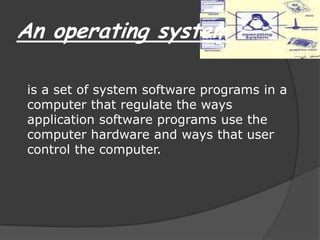
An operating systemis a set of system software programs in a computer that regulate the ways application software programs use the computer hardware and ways that user control the computer.
The os provides certain Services to programs and to The users  of the Programs. …..
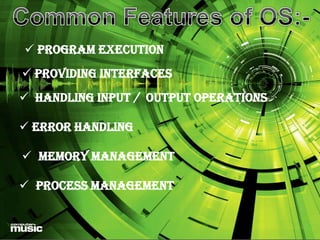
Common Features of OS:- Program Execution
 Providing Interfaces
  Handling Input /  Output Operations
 Error Handling
Memory management
Process managementProgram  ExecutionThe Operating System is responsible for executing various  programs whether user programs  or  system programs i.e , special programs required for the machine functioning
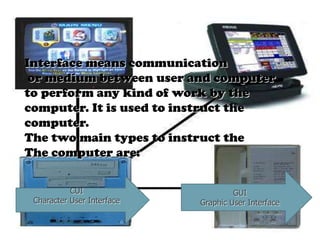
Interface means communication or medium between user and computerto perform any kind of work by the computer. It is used to instruct the computer.The two main types to instruct theThe computer are: GUIGraphic User InterfaceCUICharacter User Interface
Handling  Input/OutputOperationsThe os is responsible for handling various type of inputs and various types of outputs in the appropriate manner ..…….For instance if the input comes form mouse then it requires different type  of handling as compared  to  input coming from keyboard……
Error  HandlingThe Operating System is also responsible for the  detection any type of error that occurs and then properly handling it………
Memory Management Memory management is the act of managing computer memory. In its simpler forms, this involves providing ways to allocate portions of memory to programs at their request, and freeing it for reuse when no longer needed. The management of main memory is critical to the computer system.
Process ManagementProcess management is an integral part of any modern day operating system. The OS must allocate resources to processes, enable processes to share and exchange information, protect the resources of each process from other processes and enable synchronization among processes. To meet these requirements, the OS must maintain a data structure for each process, which describes the state and resource ownership of that process and which enables the OS to exert control over each process. Great Answer Not Helpful Report
LIST OF OPERATING SYSTEMSWindows 95Windows 98Windows  NTWindows MEWindows 2000Windows XPWindows VistaWindows 7
Windows 95 is a consumer-oriented graphical user interface-based operating system. It was released on August 24, 1995 by Microsoft[2], and was a significant progression from the company's previous Windows products. During development it was referred to as Windows 4.0 or by the internal codename Chicago.Windows 95 was intended to integrate Microsoft's formerly separate MS-DOS and Windows products, however it is still considered an operating environment that sits over the DOS operating system. It features significant improvements over its
Windows 98  is a graphical operating system by Microsoft. It is the second major release in the Windows 9x line of operating systems. It was released to manufacturing on May 15, 1998 and to retail on June 25, 1998. Windows 98 is the successor to Windows 95. Like its predecessor, it is a hybrid 16-bit/32-bit[2] monolithic product with an MS-DOS based boot loader[3]. Windows 98 was ucceeded by Windows Me on September 14, 2000. Microsoft support for Windows 98 ended on July 11, 2006.
Windows 2000Windows 2000 is a line of operating systems produced by Microsoft for use on personal computers, business desktops, laptops, and servers. Released on 17 February 2000,[3] it was the successor to Windows NT 4.0, and is the final release of Microsoft Windows to display the "Windows NT" designation. It was succeeded by Windows XP for desktop systems in October 2001 and Windows Server 2003 for servers in April 2003. Windows Me was released only a few months after Windows 2000 and one year before Windows XP, but Windows Me was not intended to be, nor did it serve as the successor to Windows 2000. Windows Me is designed for home use, while Windows 2000 is designed for business.

windows operating system and its advancements

  • 1.
    Windows Operating Systemand its advancements
  • 2.
    History of Operating SystemHistory of operating system is one of years of experimentation. Operating system was absent in the first commercial form of electronic computer launched in 1940's. Rows of mechanical switches were used to enter programs. At that time programming languages were not in use. Naturally there was hardly any idea about operating system. The next generation of computers was introduced in the early phase of 1950's. The earliest version of operating system was used by the General Motors Research Laboratories. IBM 701 was the first operating system equipped computer architecture. It was a major mark in the history of operating system. This type of computer system was known as batch processing system.
  • 3.
    An operating systemisa set of system software programs in a computer that regulate the ways application software programs use the computer hardware and ways that user control the computer.
  • 4.
    The os providescertain Services to programs and to The users of the Programs. …..
  • 5.
    Common Features ofOS:- Program Execution
  • 6.
  • 7.
    HandlingInput / Output Operations
  • 8.
  • 9.
  • 10.
    Process managementProgram ExecutionThe Operating System is responsible for executing various programs whether user programs or system programs i.e , special programs required for the machine functioning
  • 11.
    Interface means communicationor medium between user and computerto perform any kind of work by the computer. It is used to instruct the computer.The two main types to instruct theThe computer are: GUIGraphic User InterfaceCUICharacter User Interface
  • 12.
    Handling Input/OutputOperationsTheos is responsible for handling various type of inputs and various types of outputs in the appropriate manner ..…….For instance if the input comes form mouse then it requires different type of handling as compared to input coming from keyboard……
  • 13.
    Error HandlingTheOperating System is also responsible for the detection any type of error that occurs and then properly handling it………
  • 14.
    Memory Management Memorymanagement is the act of managing computer memory. In its simpler forms, this involves providing ways to allocate portions of memory to programs at their request, and freeing it for reuse when no longer needed. The management of main memory is critical to the computer system.
  • 15.
    Process ManagementProcess managementis an integral part of any modern day operating system. The OS must allocate resources to processes, enable processes to share and exchange information, protect the resources of each process from other processes and enable synchronization among processes. To meet these requirements, the OS must maintain a data structure for each process, which describes the state and resource ownership of that process and which enables the OS to exert control over each process. Great Answer Not Helpful Report
  • 16.
    LIST OF OPERATINGSYSTEMSWindows 95Windows 98Windows NTWindows MEWindows 2000Windows XPWindows VistaWindows 7
  • 17.
    Windows 95 isa consumer-oriented graphical user interface-based operating system. It was released on August 24, 1995 by Microsoft[2], and was a significant progression from the company's previous Windows products. During development it was referred to as Windows 4.0 or by the internal codename Chicago.Windows 95 was intended to integrate Microsoft's formerly separate MS-DOS and Windows products, however it is still considered an operating environment that sits over the DOS operating system. It features significant improvements over its
  • 18.
    Windows 98 is a graphical operating system by Microsoft. It is the second major release in the Windows 9x line of operating systems. It was released to manufacturing on May 15, 1998 and to retail on June 25, 1998. Windows 98 is the successor to Windows 95. Like its predecessor, it is a hybrid 16-bit/32-bit[2] monolithic product with an MS-DOS based boot loader[3]. Windows 98 was ucceeded by Windows Me on September 14, 2000. Microsoft support for Windows 98 ended on July 11, 2006.
  • 19.
    Windows 2000Windows 2000 isa line of operating systems produced by Microsoft for use on personal computers, business desktops, laptops, and servers. Released on 17 February 2000,[3] it was the successor to Windows NT 4.0, and is the final release of Microsoft Windows to display the "Windows NT" designation. It was succeeded by Windows XP for desktop systems in October 2001 and Windows Server 2003 for servers in April 2003. Windows Me was released only a few months after Windows 2000 and one year before Windows XP, but Windows Me was not intended to be, nor did it serve as the successor to Windows 2000. Windows Me is designed for home use, while Windows 2000 is designed for business.