
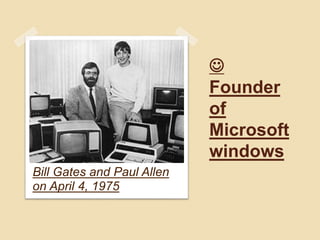
Founder
of
Microsoft
windows
Bill Gates and Paul Allen
on April 4, 1975
Year Event
1981 Microsoft buys the rights for QDOS from
Seattle Computer Products (SCP) for
$25,000 on July 27, 1981.
1981 MS-DOS 1.0 was released August, 1981.
1982 MS-DOS 1.25 was released August, 1982.
1983 MS-DOS 2.0 was released March, 1983.
1984 Microsoft introduces MS-DOS 3.0 for the
IBM PC AT and MS-DOS 3.1 for networks.
1986 MS-DOS 3.2 was released April, 1986.
1987 MS-DOS 3.3 was released April, 1987.
Year Event
1988 MS-DOS 4.0 was released July, 1988.
1988 MS-DOS 4.01 was released November,
1988.
1991 MS-DOS 5.0 was released June, 1991.
1993 MS-DOS 6.0 was released August, 1993.
1993 MS-DOS 6.2 was released November,
1993 .
1994 MS-DOS 6.21 was released March, 1994
1994 MS-DOS 6.22 was released April, 1994
 Types of windows os
 Windows 1.0 (1985)
 Windows 2.0 (1987)
 Windows 3.0 (1990, 1992)
 Windows 95 (1995)
 Windows 98 (1998)
 Windows ME (2000)
 Windows 2000 (2000)
 Windows XP (2001)
 Windows Vista (2006)
 Windows 7 (2009)
 Windows 8 (2012)
 Windows 8.1 (2013)
 Windows 10 (N/A)
 Windows 1.0
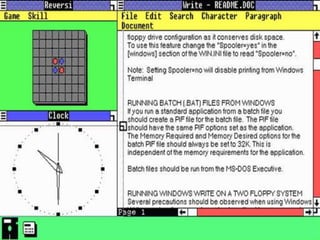
Released on 20th November 1985.
Founder:- The development of
Windows began after Microsoft.
The company initially considered
calling it “Interface Manager”.
Features :- It was Microsoft's first
attempt to implement a multi-tasking
graphical user interface-based
operating environment on the PC
platform.
 Windows 1.0
Limitation :- Windows 1.0 does not
allow overlapping windows. Instead all
windows are tiled. Only dialog boxes
can appear over other windows.
 Windows 2.0
Release on December 9, 1987.
Features :-
1. It introduced desktop icons,
expanded memory, and the ability to
overlap windows.
2. New features in Windows 2.0
included VGA (Video Graphics
Array)graphics (although 16 colors
only). It was also the last version of
Windows that did not require a hard
disk.
 Windows 2.0
Limitations :- Windows 2.0 did not
make big success due to the hardware
limitation and software limitation. It
was not successful comparing to
windows versions later than Windows
3.1.
 Windows 3.0
Released on 22 May 1990.
Features:-
1. Windows now has significantly better
performance, advanced graphics
with 16 colors, and improved icons.
2. Program Manager, File Manager, and
Print Manager arrive in Windows 3.0.
3. With full support for the Intel 386
processor, programs run noticeably
faster.
 Windows 3.0
Limitation:- Windows software is
installed with floppy discs bought in
large boxes with heavy instruction
manuals.
 Windows 95
Release on August 24, 1995.
Feature:-
1. “Start button” was provided on
taskbar in windows 95.
2. This is the era of fax/modems, email,
the new online world, and dazzling
multimedia games and educational
software.
 Windows 95
3. Windows 95 has built-in :-
-Internet support
-dial-up networking
-new Plug
-Play capabilities
-easy to install hardware and
software
-enhanced multimedia capabilities
-more powerful features for mobile
 Windows 95
Limitation:-
1. Windows 95 features the first
appearance of the Start menu,
taskbar, and minimize, maximize,
and close buttons on each window.
 Windows 95
2. Microsoft recommends an Intel
80486 or compatible microprocessor
with at least 8 MB of RAM. Windows
95 fails to boot on computers with
approximately more than 480 MB of
memory.
 Windows 98
Release on June, 1998.
Microsoft describes it as the first real
software release for consumers.
Feature:-
1. Windows 98 was the first operating
system to use the Windows Driver
Model(WDM).
2. Windows 98 had more robust USB
support than Windows 95.
 Windows 98
3. The ability to read DVDs and the
Quick Launch menu were among
Windows 98’s new features.
 Windows 98
Limitation:- Microsoft driver support
for both USB printers, and for USB
mass-storage device class is not
available for Windows 98.
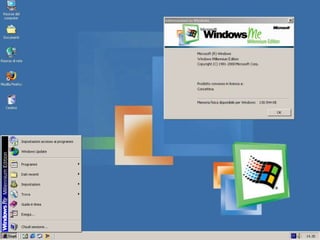
 Windows ME
Release on June 19, 2000.
Windows ME(Millennium Edition).
Feature:-
1. The notification area in Windows ME
and later supported 16-bit high color
icons.
2. The Multimedia control panel was also
updated from Windows 98.
3. Taskbar and Start Menu options
allowed disabling of the drag and drop
feature and could prevent moving or
resizing the taskbar, which was easier
for new users.
 Windows ME
4. Microsoft added new media-focused
features like Windows Movie Maker.
It was also the first version of
Windows to support System Restore,
which allows you to reset your
system’s preferences to before a
certain date.
 Windows ME
Limitation:-
1. Other features removed or never
updated to work with Windows ME
included Microsoft Fax, QuickView
and DriveSpace, as well as the
GUI FAT32 conversion tool.
2. Several Windows
Explorer commands were removed
in Windows ME.
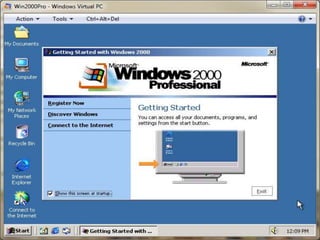
 Windows 2000
Released to manufacturing on December
15, 1999 and launched to retail on
February 17, 2000.
Feature:-
1. Windows 2000 introduced many of the
new features of Windows 98 such as
the Windows Desktop Update, Internet
Explorer 5 , Outlook
Express, NetMeeting, FAT32
support, Windows Driver
Model, Internet Connection
Sharing, Windows Media
 Windows 2000
2. A new capability designed to protect
critical system files called Windows
File Protection was introduced.
 Windows XP
Release on October 25, 2001.
 Feature:-
1. User interface
2. Infrastructure
3. Networking and internet functionality
4. Improved sorting and grouping
searching the document by it’s
categories, customizable info tips.
5. Built-in CD burning, AutoPlay, Simple
File Sharing and WebDAV mini-
redirector.
 Windows XP
Limitation:-
1. Some of the programs and features
that were part of the previous versions
of Windows did not make it to Windows
XP. CD Player, DVD
Player and Imaging for Windows are
removed as Windows Picture and Fax
Viewer, Windows Media Player and
Windows shell take over their duties.
2. Plug-and-play–
incompatible communication devices
 Windows Vista
Released on 30 November 2006.
Features :-
1. An updated graphical user interface ,
a new search component
called Windows Search, redesigned
networking, audio, print and display
sub-systems, and new multimedia
tools including Windows DVD Maker.
 Windows Vista
2. Vista aimed to increase the level of
communication between machines
on a home network, using peer-to-
peer technology to simplify
sharing files and media between
computers and devices.
3. Windows Vista included version 3.0
of the .NET Framework,
allowing software developers to write
applications without
traditional Windows APIs.
 Windows Vista
 Limitation:-
1. Windows Vista is not compatible with
too many old systems.
2. Support only a few manufacturers.
 Windows 7
 Released on October 22, 2009.
 Feature :-
1. Among Windows 7's new features support
for virtual hard disks , improved
performance on multi-core processors ,
improved boot performance.
2. Windows 7 adds support for systems using
multiple heterogeneous graphics cards from
different vendors , a new version
of Windows Media Center, a Gadget for
Windows Media Center, improved media
features and a redesigned Calculator with
multiline capabilities.
 Windows 7
3. Many new items have been added to
the Control Panel, including Clear
Type ,Text Tuner Display Color
Calibration Wizard,Gadgets,
Recovery, Troubleshooting,
Workspaces Center, Location and
Other Sensors, Credential Manager,
Biometric Devices, System Icons,
and Display
 Windows 7
 Limitation:-
1. Certain capabilities and programs that
were a part of Windows Vista are no
longer present or have been changed,
resulting in the removal of certain
functionalities. These include the
classic Start Menu user interface,
some taskbar features, Windows
Explorer features, Windows Media
Player features, Windows Ultimate
Extras and InkBall.
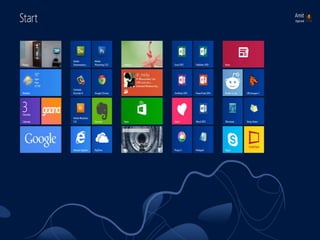
 Windows 8
Released on October 26, 2012.
Features :-
1. New features and functionality in
Windows 8 include a faster startup .
2. A new lock screen with a clock and
notifications, and the ability for
enterprise users to create live
USB versions of Windows (known
as Windows To Go).
 Windows 8
3. Windows 8 also adds native support
for USB 3.0 devices, which allow for
faster data transfers and improved
power management with compatible
devices , and hard
disk 4KB Advanced
Format support, as well as support
for near field communication to
facilitate sharing and communication
between devices.
 Windows 8
 Limitation:-
1. Several notable features have been
removed in Windows 8, beginning with
the traditional Start menu.
2. Support for playing DVD-Video has
been removed from Windows Media
Player due to the cost of licensing .
3. For the same reasons, Windows Media
Center is not included by default on
Windows 8, but Windows Media Center
and DVD playback support can be
purchased in the "Pro Pack".
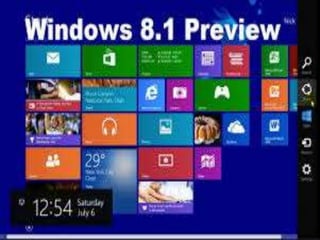
 Windows 8.1
Released on 27 august 2013.
Feature:-
1. The Start screen received several
enhancements on 8.1, including an
extended "All Apps" view with sort
modes (accessed by clicking a new
down arrow button or swiping
upward),
 Windows 8.1
2. Small and extra-large sizes for tiles,
and colored tiles for desktop program
shortcuts. Additional customization
options were also added and the ability
for the Start screen to use the desktop
background instead.
3. Applications are no longer added to the
Start screen automatically when
installed, and all applications now have
colored tiles (desktop programs were
previously shown in a single color).
 Windows 8.1
4. Windows 8.1 adds tighter integration
with several Microsoft-owned
services. OneDrive (formerly
SkyDrive) is integrated at the system
level to sync user settings and files.
Files are automatically downloaded
in the background when they are
accessed from the user's OneDrive
folder, unless they are marked to be
available offline.
 Windows 10
Feature:-
1. A major aspect of Windows 10 is a
focus on harmonizing user
experiences and functionality
between different classes of devices,
along with addressing shortcomings
in the Windows user interface that
was first introduced in Windows 8.
 Windows 10
2. A focus was placed on "universal
apps"—Windows Runtime software that
can be made to run across multiple
platforms and device classes (including
PC, smartphone, and tablet),
synchronize data between devices, and
allow developers to share code
between variations of the app for each
platform
3. First presented in April 2014 at
the Build Conference, it is scheduled to
be released in 2015, and is currently in
public beta testing.
 Queries…?
 Thank You…

Microsoft windows operating system

  • 1.
  • 2.
    Year Event 1981 Microsoftbuys the rights for QDOS from Seattle Computer Products (SCP) for $25,000 on July 27, 1981. 1981 MS-DOS 1.0 was released August, 1981. 1982 MS-DOS 1.25 was released August, 1982. 1983 MS-DOS 2.0 was released March, 1983. 1984 Microsoft introduces MS-DOS 3.0 for the IBM PC AT and MS-DOS 3.1 for networks. 1986 MS-DOS 3.2 was released April, 1986. 1987 MS-DOS 3.3 was released April, 1987.
  • 3.
    Year Event 1988 MS-DOS4.0 was released July, 1988. 1988 MS-DOS 4.01 was released November, 1988. 1991 MS-DOS 5.0 was released June, 1991. 1993 MS-DOS 6.0 was released August, 1993. 1993 MS-DOS 6.2 was released November, 1993 . 1994 MS-DOS 6.21 was released March, 1994 1994 MS-DOS 6.22 was released April, 1994
  • 4.
     Types ofwindows os  Windows 1.0 (1985)  Windows 2.0 (1987)  Windows 3.0 (1990, 1992)  Windows 95 (1995)  Windows 98 (1998)  Windows ME (2000)  Windows 2000 (2000)  Windows XP (2001)  Windows Vista (2006)  Windows 7 (2009)  Windows 8 (2012)  Windows 8.1 (2013)  Windows 10 (N/A)
  • 5.
     Windows 1.0 Releasedon 20th November 1985. Founder:- The development of Windows began after Microsoft. The company initially considered calling it “Interface Manager”. Features :- It was Microsoft's first attempt to implement a multi-tasking graphical user interface-based operating environment on the PC platform.
  • 6.
     Windows 1.0 Limitation:- Windows 1.0 does not allow overlapping windows. Instead all windows are tiled. Only dialog boxes can appear over other windows.
  • 8.
     Windows 2.0 Releaseon December 9, 1987. Features :- 1. It introduced desktop icons, expanded memory, and the ability to overlap windows. 2. New features in Windows 2.0 included VGA (Video Graphics Array)graphics (although 16 colors only). It was also the last version of Windows that did not require a hard disk.
  • 10.
     Windows 2.0 Limitations:- Windows 2.0 did not make big success due to the hardware limitation and software limitation. It was not successful comparing to windows versions later than Windows 3.1.
  • 11.
     Windows 3.0 Releasedon 22 May 1990. Features:- 1. Windows now has significantly better performance, advanced graphics with 16 colors, and improved icons. 2. Program Manager, File Manager, and Print Manager arrive in Windows 3.0. 3. With full support for the Intel 386 processor, programs run noticeably faster.
  • 13.
     Windows 3.0 Limitation:-Windows software is installed with floppy discs bought in large boxes with heavy instruction manuals.
  • 14.
     Windows 95 Releaseon August 24, 1995. Feature:- 1. “Start button” was provided on taskbar in windows 95. 2. This is the era of fax/modems, email, the new online world, and dazzling multimedia games and educational software.
  • 15.
     Windows 95 3.Windows 95 has built-in :- -Internet support -dial-up networking -new Plug -Play capabilities -easy to install hardware and software -enhanced multimedia capabilities -more powerful features for mobile
  • 17.
     Windows 95 Limitation:- 1.Windows 95 features the first appearance of the Start menu, taskbar, and minimize, maximize, and close buttons on each window.
  • 18.
     Windows 95 2.Microsoft recommends an Intel 80486 or compatible microprocessor with at least 8 MB of RAM. Windows 95 fails to boot on computers with approximately more than 480 MB of memory.
  • 19.
     Windows 98 Releaseon June, 1998. Microsoft describes it as the first real software release for consumers. Feature:- 1. Windows 98 was the first operating system to use the Windows Driver Model(WDM). 2. Windows 98 had more robust USB support than Windows 95.
  • 20.
     Windows 98 3.The ability to read DVDs and the Quick Launch menu were among Windows 98’s new features.
  • 22.
     Windows 98 Limitation:-Microsoft driver support for both USB printers, and for USB mass-storage device class is not available for Windows 98.
  • 23.
     Windows ME Releaseon June 19, 2000. Windows ME(Millennium Edition). Feature:- 1. The notification area in Windows ME and later supported 16-bit high color icons. 2. The Multimedia control panel was also updated from Windows 98. 3. Taskbar and Start Menu options allowed disabling of the drag and drop feature and could prevent moving or resizing the taskbar, which was easier for new users.
  • 24.
     Windows ME 4.Microsoft added new media-focused features like Windows Movie Maker. It was also the first version of Windows to support System Restore, which allows you to reset your system’s preferences to before a certain date.
  • 26.
     Windows ME Limitation:- 1.Other features removed or never updated to work with Windows ME included Microsoft Fax, QuickView and DriveSpace, as well as the GUI FAT32 conversion tool. 2. Several Windows Explorer commands were removed in Windows ME.
  • 27.
     Windows 2000 Releasedto manufacturing on December 15, 1999 and launched to retail on February 17, 2000. Feature:- 1. Windows 2000 introduced many of the new features of Windows 98 such as the Windows Desktop Update, Internet Explorer 5 , Outlook Express, NetMeeting, FAT32 support, Windows Driver Model, Internet Connection Sharing, Windows Media
  • 28.
     Windows 2000 2.A new capability designed to protect critical system files called Windows File Protection was introduced.
  • 30.
     Windows XP Releaseon October 25, 2001.  Feature:- 1. User interface 2. Infrastructure 3. Networking and internet functionality 4. Improved sorting and grouping searching the document by it’s categories, customizable info tips. 5. Built-in CD burning, AutoPlay, Simple File Sharing and WebDAV mini- redirector.
  • 32.
     Windows XP Limitation:- 1.Some of the programs and features that were part of the previous versions of Windows did not make it to Windows XP. CD Player, DVD Player and Imaging for Windows are removed as Windows Picture and Fax Viewer, Windows Media Player and Windows shell take over their duties. 2. Plug-and-play– incompatible communication devices
  • 33.
     Windows Vista Releasedon 30 November 2006. Features :- 1. An updated graphical user interface , a new search component called Windows Search, redesigned networking, audio, print and display sub-systems, and new multimedia tools including Windows DVD Maker.
  • 34.
     Windows Vista 2.Vista aimed to increase the level of communication between machines on a home network, using peer-to- peer technology to simplify sharing files and media between computers and devices. 3. Windows Vista included version 3.0 of the .NET Framework, allowing software developers to write applications without traditional Windows APIs.
  • 35.
     Windows Vista Limitation:- 1. Windows Vista is not compatible with too many old systems. 2. Support only a few manufacturers.
  • 37.
     Windows 7 Released on October 22, 2009.  Feature :- 1. Among Windows 7's new features support for virtual hard disks , improved performance on multi-core processors , improved boot performance. 2. Windows 7 adds support for systems using multiple heterogeneous graphics cards from different vendors , a new version of Windows Media Center, a Gadget for Windows Media Center, improved media features and a redesigned Calculator with multiline capabilities.
  • 38.
     Windows 7 3.Many new items have been added to the Control Panel, including Clear Type ,Text Tuner Display Color Calibration Wizard,Gadgets, Recovery, Troubleshooting, Workspaces Center, Location and Other Sensors, Credential Manager, Biometric Devices, System Icons, and Display
  • 39.
     Windows 7 Limitation:- 1. Certain capabilities and programs that were a part of Windows Vista are no longer present or have been changed, resulting in the removal of certain functionalities. These include the classic Start Menu user interface, some taskbar features, Windows Explorer features, Windows Media Player features, Windows Ultimate Extras and InkBall.
  • 41.
     Windows 8 Releasedon October 26, 2012. Features :- 1. New features and functionality in Windows 8 include a faster startup . 2. A new lock screen with a clock and notifications, and the ability for enterprise users to create live USB versions of Windows (known as Windows To Go).
  • 42.
     Windows 8 3.Windows 8 also adds native support for USB 3.0 devices, which allow for faster data transfers and improved power management with compatible devices , and hard disk 4KB Advanced Format support, as well as support for near field communication to facilitate sharing and communication between devices.
  • 43.
     Windows 8 Limitation:- 1. Several notable features have been removed in Windows 8, beginning with the traditional Start menu. 2. Support for playing DVD-Video has been removed from Windows Media Player due to the cost of licensing . 3. For the same reasons, Windows Media Center is not included by default on Windows 8, but Windows Media Center and DVD playback support can be purchased in the "Pro Pack".
  • 45.
     Windows 8.1 Releasedon 27 august 2013. Feature:- 1. The Start screen received several enhancements on 8.1, including an extended "All Apps" view with sort modes (accessed by clicking a new down arrow button or swiping upward),
  • 46.
     Windows 8.1 2.Small and extra-large sizes for tiles, and colored tiles for desktop program shortcuts. Additional customization options were also added and the ability for the Start screen to use the desktop background instead. 3. Applications are no longer added to the Start screen automatically when installed, and all applications now have colored tiles (desktop programs were previously shown in a single color).
  • 47.
     Windows 8.1 4.Windows 8.1 adds tighter integration with several Microsoft-owned services. OneDrive (formerly SkyDrive) is integrated at the system level to sync user settings and files. Files are automatically downloaded in the background when they are accessed from the user's OneDrive folder, unless they are marked to be available offline.
  • 49.
     Windows 10 Feature:- 1.A major aspect of Windows 10 is a focus on harmonizing user experiences and functionality between different classes of devices, along with addressing shortcomings in the Windows user interface that was first introduced in Windows 8.
  • 50.
     Windows 10 2.A focus was placed on "universal apps"—Windows Runtime software that can be made to run across multiple platforms and device classes (including PC, smartphone, and tablet), synchronize data between devices, and allow developers to share code between variations of the app for each platform 3. First presented in April 2014 at the Build Conference, it is scheduled to be released in 2015, and is currently in public beta testing.
  • 52.
  • 53.