
Measuring Business
Income:
The Adjusting Process
Chapter 3
Distinguish accrual
accounting from
cash-basis
accounting.
Objective 1
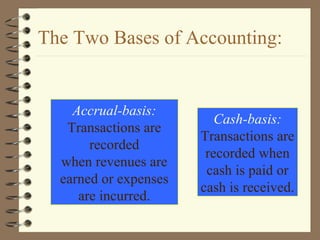
Accrual-basis:
Transactions are
recorded
when revenues are
earned or expenses
are incurred.
Cash-basis:
Transactions are
recorded when
cash is paid or
cash is received.
The Two Bases of Accounting:
Accrual Versus Cash Example
In January 2002, Prensa Insurance sells
a three-year health insurance policy to a
business client.
The contract specifies that the client had
to pay $150,000 in advance.
Yearly expenses amount to $20,000.
What is the income or loss?
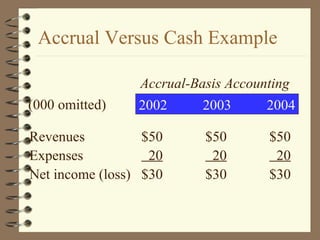
Accrual Versus Cash Example
Accrual-Basis Accounting
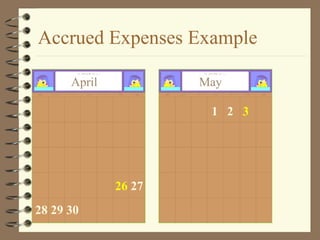
2002 2003 2004(000 omitted)
Revenues $50 $50 $50
Expenses 20 20 20
Net income (loss) $30 $30 $30
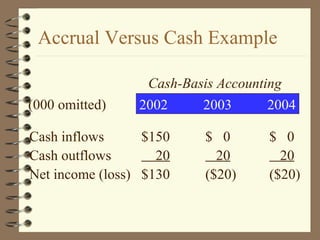
Accrual Versus Cash Example
Cash-Basis Accounting
2002 2003 2004(000 omitted)
Cash inflows $150 $ 0 $ 0
Cash outflows 20 20 20
Net income (loss) $130 ($20) ($20)
Managers adopt an
artificial period of time
to evaluate performance.
Accounting Period
Monthly
Quarterly
Semi-annually
Interim Period Statements
Apply the revenue
and
matching principles.
Objective 2
Revenue Principle
When is revenue recognized?
When it is deemed earned.
Recognition of revenue and cash receipts
do not necessarily occur at the same time.
The Matching Principle
What is the matching principle?
It is the basis for recording expenses.
Expenses are the costs of assets and the
increase in liabilities incurred in the earning
of revenues.
Expenses are recognized when the benefit
from the expense is received.
Matching Expenses with
Revenues Example
Parker Floor sells a wood floor for $15,000
on the last day of May.
The wood was purchased from the
manufacturer for $8,000 in March of the
same year.
The floor is installed in June.
When is income recognized?
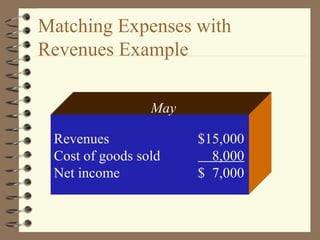
Revenues $15,000
Cost of goods sold 8,000
Net income $ 7,000
May
Matching Expenses with
Revenues Example
Interacts with the
revenue principle and
the matching principle
Requires that income
be measured
accurately each period
The Time Period Concept
It requires that accounting information be
reported at regular intervals.
Make adjusting
entries.
Objective 3
Adjusting Entries
Assign revenue to the period earned.
Assign expenses to the period incurred.
Bring related asset and liability accounts
into correct balance.
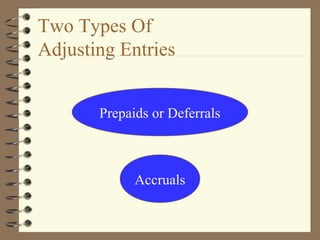
Prepaids or Deferrals
Accruals
Two Types Of
Adjusting Entries
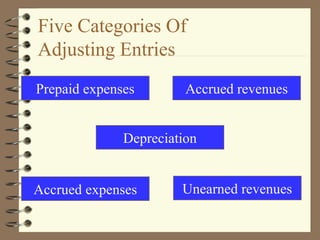
Prepaid expenses
Depreciation
Accrued expenses
Accrued revenues
Unearned revenues
Five Categories Of
Adjusting Entries
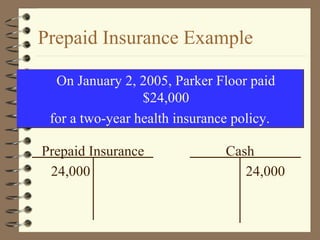
24,000
CashPrepaid Insurance
24,000
Prepaid Insurance Example
On January 2, 2005, Parker Floor paid
$24,000
for a two-year health insurance policy.
On January 2, 2005, Parker Floor paid
$24,000
for a two-year health insurance policy.
Prepaid Insurance Example
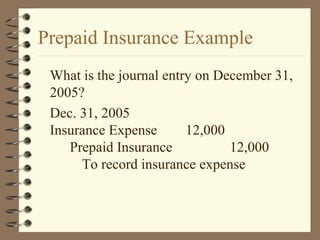
What is the journal entry on December 31,
2005?
Dec. 31, 2005
Insurance Expense 12,000
Prepaid Insurance 12,000
To record insurance expense
Time
Prepaid Insurance Example
What was the determining factor in
matching this expense?
Supplies Example
Wood Enterprise started business the
beginning of the month.
$800 worth of office supplies were
purchased on November 15, 2004, for cash.
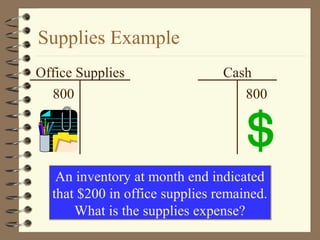
Office Supplies Cash
800 800
An inventory at month end indicated
that $200 in office supplies remained.
What is the supplies expense?
An inventory at month end indicated
that $200 in office supplies remained.
What is the supplies expense?
Supplies Example
Usage
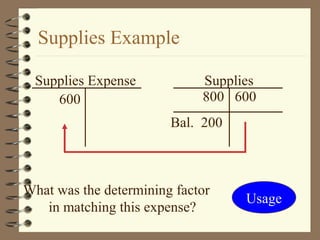
Supplies Expense
600
Supplies
800 600
Bal. 200
Supplies Example
What was the determining factor
in matching this expense?
Depreciation Example
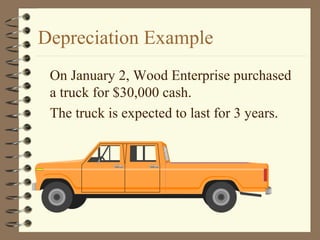
On January 2, Wood Enterprise purchased
a truck for $30,000 cash.
The truck is expected to last for 3 years.
Depreciation Example
The cost of the truck must be matched with
the accounting periods in which it was used
to earn income.
What is the journal entry for the year ended
December 31, 2005?
Dec. 31, 2005
Depreciation Expense 10,000
Accumulated Depreciation
10,000
To record depreciation on truck
Depreciation Example
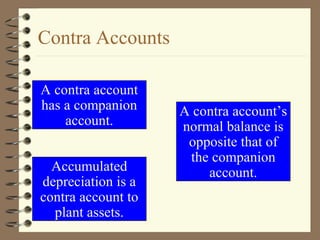
A contra account
has a companion
account.
A contra account’s
normal balance is
opposite that of
the companion
account.Accumulated
depreciation is a
contra account to
plant assets.
Contra Accounts
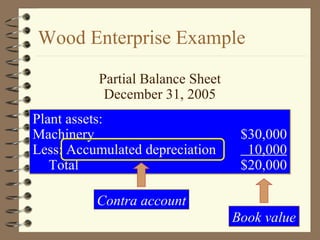
Wood Enterprise Example
Partial Balance Sheet
December 31, 2005
Plant assets:
Machinery $30,000
Less: Accumulated depreciation 10,000
Total $20,000
Plant assets:
Machinery $30,000
Less: Accumulated depreciation 10,000
Total $20,000
Contra account
Book valueBook value
Accruals
What is an accrual?
It is the recognition of an expense or
revenue that has arisen but has not yet
been recorded.
Expenses or revenues are recorded before
the cash settlement.
Accrued Expenses Example
Employees at Mary Business Services are
paid every Friday.
Weekly salaries total $30,000.
The business is closed on Saturday and
Sunday.
The employees were last paid on April 26,
which was a Friday.
They will be paid on May 3.
April May
26 27
28 29 30
1 2 3
Accrued Expenses Example
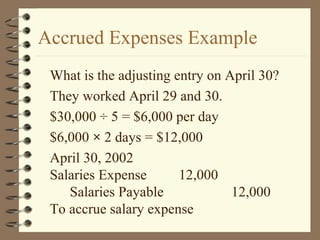
What is the adjusting entry on April 30?
They worked April 29 and 30.
$30,000 ÷ 5 = $6,000 per day
$6,000 × 2 days = $12,000
April 30, 2002
Salaries Expense 12,000
Salaries Payable 12,000
To accrue salary expense
Accrued Revenues Example
During the month of April, Mary Business
Services rendered services to customers
totaling $15,000.
At the end of April, the customers have not
as yet been billed.
Accrued Revenues Example
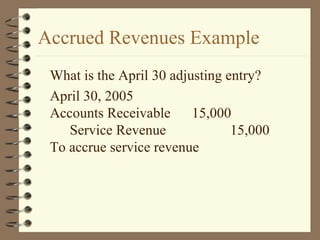
What is the April 30 adjusting entry?
April 30, 2005
Accounts Receivable 15,000
Service Revenue 15,000
To accrue service revenue
Performance
Accrued Revenues Example
What is the determining factor in
recognizing this service revenue?
Unearned or Deferred Revenue
Example
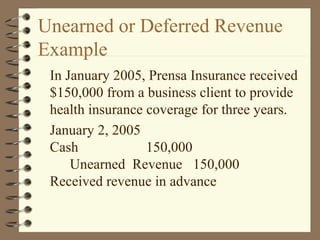
In January 2005, Prensa Insurance received
$150,000 from a business client to provide
health insurance coverage for three years.
January 2, 2005
Cash 150,000
Unearned Revenue 150,000
Received revenue in advance
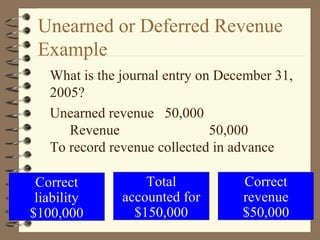
Correct
liability
$100,000
Total
accounted for
$150,000
Correct
revenue
$50,000
Unearned or Deferred Revenue
Example
What is the journal entry on December 31,
2005?
Unearned revenue 50,000
Revenue 50,000
To record revenue collected in advance
Notice
Adjusting entries always have...
– one income statement account and...
– one balance sheet account.
Adjusting entries never involve cash.
Prepare an
adjusted
trial balance.
Objective 4
Adjusted Trial Balance
The adjusting process starts with the
unadjusted trial balance.
Adjusting entries are made at the end of the
accounting period and then an adjusted trial
balance is prepared.
The adjusted trial balance serves as the
basis for the preparation of the financial
statements.
Prepare the financial
statements from the
adjusted trial
balance.
Objective 5
Financial Statements
Financial statements have two parts:
1 The first part includes the following:
– name of the entity
– title of the statement
– date or period covered
2 The second part is the body of the
statement.
Financial Statements Example
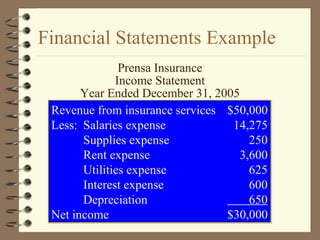
Revenue from insurance services $50,000
Less: Salaries expense 14,275
Supplies expense 250
Rent expense 3,600
Utilities expense 625
Interest expense 600
Depreciation 650
Net income $30,000
Revenue from insurance services $50,000
Less: Salaries expense 14,275
Supplies expense 250
Rent expense 3,600
Utilities expense 625
Interest expense 600
Depreciation 650
Net income $30,000
Prensa Insurance
Income Statement
Year Ended December 31, 2005
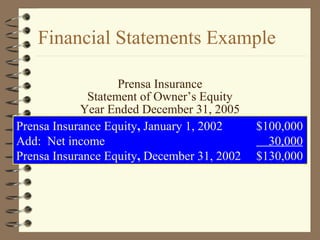
Prensa Insurance Equity, January 1, 2002 $100,000
Add: Net income 30,000
Prensa Insurance Equity, December 31, 2002 $130,000
Financial Statements Example
Prensa Insurance
Statement of Owner’s Equity
Year Ended December 31, 2005
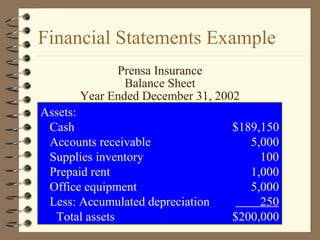
Assets:
Cash $189,150
Accounts receivable 5,000
Supplies inventory 100
Prepaid rent 1,000
Office equipment 5,000
Less: Accumulated depreciation 250
Total assets $200,000
Financial Statements Example
Prensa Insurance
Balance Sheet
Year Ended December 31, 2002
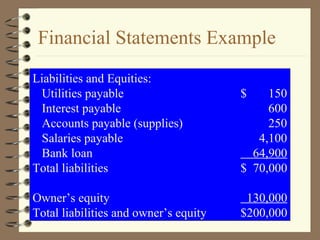
Liabilities and Equities:
Utilities payable $ 150
Interest payable 600
Accounts payable (supplies) 250
Salaries payable 4,100
Bank loan 64,900
Total liabilities $ 70,000
Owner’s equity 130,000
Total liabilities and owner’s equity $200,000
Financial Statements Example
End of Chapter 3

CHAPTER 3 Measuring Business Income: The Adjusting Process

  • 1.
  • 2.
  • 3.
    Accrual-basis: Transactions are recorded when revenuesare earned or expenses are incurred. Cash-basis: Transactions are recorded when cash is paid or cash is received. The Two Bases of Accounting:
  • 4.
    Accrual Versus CashExample In January 2002, Prensa Insurance sells a three-year health insurance policy to a business client. The contract specifies that the client had to pay $150,000 in advance. Yearly expenses amount to $20,000. What is the income or loss?
  • 5.
    Accrual Versus CashExample Accrual-Basis Accounting 2002 2003 2004(000 omitted) Revenues $50 $50 $50 Expenses 20 20 20 Net income (loss) $30 $30 $30
  • 6.
    Accrual Versus CashExample Cash-Basis Accounting 2002 2003 2004(000 omitted) Cash inflows $150 $ 0 $ 0 Cash outflows 20 20 20 Net income (loss) $130 ($20) ($20)
  • 7.
    Managers adopt an artificialperiod of time to evaluate performance. Accounting Period
  • 8.
  • 9.
    Apply the revenue and matchingprinciples. Objective 2
  • 10.
    Revenue Principle When isrevenue recognized? When it is deemed earned. Recognition of revenue and cash receipts do not necessarily occur at the same time.
  • 11.
    The Matching Principle Whatis the matching principle? It is the basis for recording expenses. Expenses are the costs of assets and the increase in liabilities incurred in the earning of revenues. Expenses are recognized when the benefit from the expense is received.
  • 12.
    Matching Expenses with RevenuesExample Parker Floor sells a wood floor for $15,000 on the last day of May. The wood was purchased from the manufacturer for $8,000 in March of the same year. The floor is installed in June. When is income recognized?
  • 13.
    Revenues $15,000 Cost ofgoods sold 8,000 Net income $ 7,000 May Matching Expenses with Revenues Example
  • 14.
    Interacts with the revenueprinciple and the matching principle Requires that income be measured accurately each period The Time Period Concept It requires that accounting information be reported at regular intervals.
  • 15.
  • 16.
    Adjusting Entries Assign revenueto the period earned. Assign expenses to the period incurred. Bring related asset and liability accounts into correct balance.
  • 17.
    Prepaids or Deferrals Accruals TwoTypes Of Adjusting Entries
  • 18.
    Prepaid expenses Depreciation Accrued expenses Accruedrevenues Unearned revenues Five Categories Of Adjusting Entries
  • 19.
    24,000 CashPrepaid Insurance 24,000 Prepaid InsuranceExample On January 2, 2005, Parker Floor paid $24,000 for a two-year health insurance policy. On January 2, 2005, Parker Floor paid $24,000 for a two-year health insurance policy.
  • 20.
    Prepaid Insurance Example Whatis the journal entry on December 31, 2005? Dec. 31, 2005 Insurance Expense 12,000 Prepaid Insurance 12,000 To record insurance expense
  • 21.
    Time Prepaid Insurance Example Whatwas the determining factor in matching this expense?
  • 22.
    Supplies Example Wood Enterprisestarted business the beginning of the month. $800 worth of office supplies were purchased on November 15, 2004, for cash.
  • 23.
    Office Supplies Cash 800800 An inventory at month end indicated that $200 in office supplies remained. What is the supplies expense? An inventory at month end indicated that $200 in office supplies remained. What is the supplies expense? Supplies Example
  • 24.
    Usage Supplies Expense 600 Supplies 800 600 Bal.200 Supplies Example What was the determining factor in matching this expense?
  • 25.
    Depreciation Example On January2, Wood Enterprise purchased a truck for $30,000 cash. The truck is expected to last for 3 years.
  • 26.
    Depreciation Example The costof the truck must be matched with the accounting periods in which it was used to earn income. What is the journal entry for the year ended December 31, 2005?
  • 27.
    Dec. 31, 2005 DepreciationExpense 10,000 Accumulated Depreciation 10,000 To record depreciation on truck Depreciation Example
  • 28.
    A contra account hasa companion account. A contra account’s normal balance is opposite that of the companion account.Accumulated depreciation is a contra account to plant assets. Contra Accounts
  • 29.
    Wood Enterprise Example PartialBalance Sheet December 31, 2005 Plant assets: Machinery $30,000 Less: Accumulated depreciation 10,000 Total $20,000 Plant assets: Machinery $30,000 Less: Accumulated depreciation 10,000 Total $20,000 Contra account Book valueBook value
  • 30.
    Accruals What is anaccrual? It is the recognition of an expense or revenue that has arisen but has not yet been recorded. Expenses or revenues are recorded before the cash settlement.
  • 31.
    Accrued Expenses Example Employeesat Mary Business Services are paid every Friday. Weekly salaries total $30,000. The business is closed on Saturday and Sunday. The employees were last paid on April 26, which was a Friday. They will be paid on May 3.
  • 32.
    April May 26 27 2829 30 1 2 3 Accrued Expenses Example
  • 33.
    Accrued Expenses Example Whatis the adjusting entry on April 30? They worked April 29 and 30. $30,000 ÷ 5 = $6,000 per day $6,000 × 2 days = $12,000 April 30, 2002 Salaries Expense 12,000 Salaries Payable 12,000 To accrue salary expense
  • 34.
    Accrued Revenues Example Duringthe month of April, Mary Business Services rendered services to customers totaling $15,000. At the end of April, the customers have not as yet been billed.
  • 35.
    Accrued Revenues Example Whatis the April 30 adjusting entry? April 30, 2005 Accounts Receivable 15,000 Service Revenue 15,000 To accrue service revenue
  • 36.
    Performance Accrued Revenues Example Whatis the determining factor in recognizing this service revenue?
  • 37.
    Unearned or DeferredRevenue Example In January 2005, Prensa Insurance received $150,000 from a business client to provide health insurance coverage for three years. January 2, 2005 Cash 150,000 Unearned Revenue 150,000 Received revenue in advance
  • 38.
    Correct liability $100,000 Total accounted for $150,000 Correct revenue $50,000 Unearned orDeferred Revenue Example What is the journal entry on December 31, 2005? Unearned revenue 50,000 Revenue 50,000 To record revenue collected in advance
  • 39.
    Notice Adjusting entries alwayshave... – one income statement account and... – one balance sheet account. Adjusting entries never involve cash.
  • 40.
  • 41.
    Adjusted Trial Balance Theadjusting process starts with the unadjusted trial balance. Adjusting entries are made at the end of the accounting period and then an adjusted trial balance is prepared. The adjusted trial balance serves as the basis for the preparation of the financial statements.
  • 42.
    Prepare the financial statementsfrom the adjusted trial balance. Objective 5
  • 43.
    Financial Statements Financial statementshave two parts: 1 The first part includes the following: – name of the entity – title of the statement – date or period covered 2 The second part is the body of the statement.
  • 44.
    Financial Statements Example Revenuefrom insurance services $50,000 Less: Salaries expense 14,275 Supplies expense 250 Rent expense 3,600 Utilities expense 625 Interest expense 600 Depreciation 650 Net income $30,000 Revenue from insurance services $50,000 Less: Salaries expense 14,275 Supplies expense 250 Rent expense 3,600 Utilities expense 625 Interest expense 600 Depreciation 650 Net income $30,000 Prensa Insurance Income Statement Year Ended December 31, 2005
  • 45.
    Prensa Insurance Equity,January 1, 2002 $100,000 Add: Net income 30,000 Prensa Insurance Equity, December 31, 2002 $130,000 Financial Statements Example Prensa Insurance Statement of Owner’s Equity Year Ended December 31, 2005
  • 46.
    Assets: Cash $189,150 Accounts receivable5,000 Supplies inventory 100 Prepaid rent 1,000 Office equipment 5,000 Less: Accumulated depreciation 250 Total assets $200,000 Financial Statements Example Prensa Insurance Balance Sheet Year Ended December 31, 2002
  • 47.
    Liabilities and Equities: Utilitiespayable $ 150 Interest payable 600 Accounts payable (supplies) 250 Salaries payable 4,100 Bank loan 64,900 Total liabilities $ 70,000 Owner’s equity 130,000 Total liabilities and owner’s equity $200,000 Financial Statements Example
  • 48.