This presentation provides an overview of the key features and functionality of the Windows 7 operating system. It describes the desktop environment including icons, arranging icons, and customizing properties. It also outlines the start menu, taskbar, search tools, and built-in applications. The presentation concludes with sections on internet security, free software included with Windows 7, and gadgets.
What is window7
• Window 7 is an operating system for personal computer
made by Microsoft that will be launched in October
2009 window 7 replaced windows vista as microsoft
newest operating system it was previously codenamed
“Blackcomb” and “ Vienna”.
• Window 7 is better than windows vista in terms of user
friendliness, stability and functionality.
How create, delete,rename icon.
• Create icone: To create an icone, right click anywhere on the desktop and
choose new shortcut browse for the file on program you want to create the icone, for
click next, name you icone, then click finish.
• Delete icone: To delete an icone, right-click on the icon and select delete, or
click once on the icon and press the delete key on your keyboard.
• Renaming icone: To rename an icon, right-click on the icon and choose
rename. You can then type in the new name. Also, try clicking once on the icon, wait
half a second, then click it a second time, the text area will be visible and you can
type a new name.
10.
Arranging icons
• Toarrange the icons on your desktop, right-click in an open area of the
desktop, click short By, and choose the appropriate option from the list
below.
• Name: short the icons alphabetically from top to bottom, left to right.
• Size: sort the icone by file size.
• Type: sorts the icons by the type of file that it is, such as word document program
etc.
Date modified: Arrange the icons with the most recent items in the top left
hand corner.
• Moving and Dragging: To move drag an icone, click on it once, holding
down the click, and drag it to another location.
11.
Interior decorating window7:
changingproperties
• So you’re bored with that plain background or that rolling green
hill? Don’t like the flashing stars screen saver that plagues your
screen? The Personalization (Display Properties) window is
your answer. From here you can change your wallpaper, screen
saver, and even your desktop theme. To access the window,
right-click anywhere on an open space of your desktop and click
Personalize. Here’s a rundown of what each area is.
12.
• Change desktopicons: Allows you to select which iteams will appear on
your desktop.
• Change mouse pointer: Allow you to pick a different mouse pointer. You
can also change how to mouse pointer looks during such activities as clicking and
selecting.
• Desktop: Allows you to set the desktop background picture.
• Display: Allows you to set your screen resolution and other advanced monitor
and video setting.
• Sounds: Changes which sounds are heard when you do everything from receiving
e-mail to emptying you recycle bin.
13.
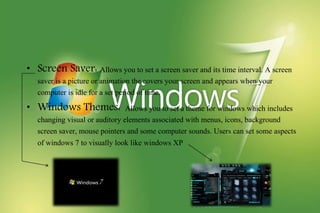
• Screen Saver:Allows you to set a screen saver and its time interval. A screen
saver is a picture or animation the covers your screen and appears when your
computer is idle for a set period of time.
• Windows Themes: Allows you to set a theme for windows which includes
changing visual or auditory elements associated with menus, icons, background
screen saver, mouse pointers and some computer sounds. Users can set some aspects
of windows 7 to visually look like windows XP
14.
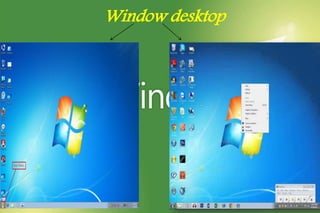
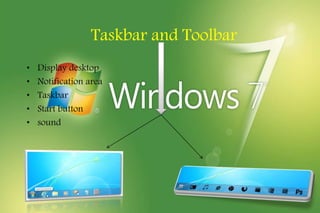
Taskbar and Toolbar
•Display desktop
• Notification area
• Taskbar
• Start button
• sound
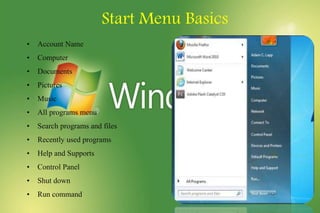
Start Menu Basics
•Account Name
• Computer
• Documents
• Pictures
• Music
• All programs menu
• Search programs and files
• Recently used programs
• Help and Supports
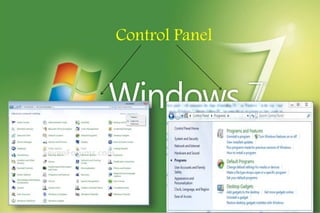
• Control Panel
• Shut down
• Run command
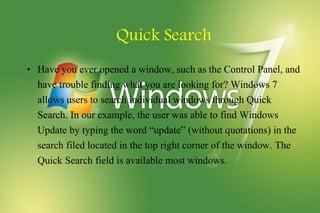
Quick Search
• Haveyou ever opened a window, such as the Control Panel, and
have trouble finding what you are looking for? Windows 7
allows users to search individual windows through Quick
Search. In our example, the user was able to find Windows
Update by typing the word “update” (without quotations) in the
search filed located in the top right corner of the window. The
Quick Search field is available most windows.
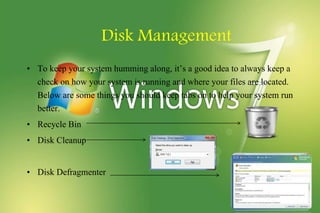
Disk Management
• Tokeep your system humming along, it’s a good idea to always keep a
check on how your system is running and where your files are located.
Below are some things you should keep tabs on to help your system run
better.
• Recycle Bin
• Disk Cleanup
• Disk Defragmenter
21.
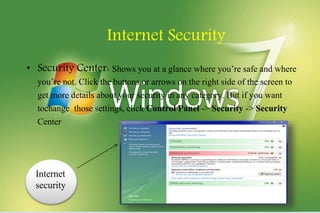
Internet Security
• SecurityCenter: Shows you at a glance where you’re safe and where
you’re not. Click the buttons or arrows on the right side of the screen to
get more details about your security in any category. But if you want
tochange those settings, click Control Panel -> Security -> Security
Center
Internet
security
22.
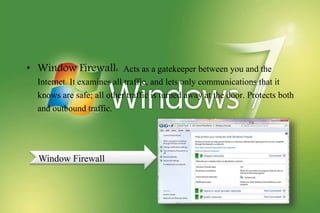
• Window Firewall:Acts as a gatekeeper between you and the
Internet. It examines all traffic, and lets only communications that it
knows are safe; all other traffic is turned away at the door. Protects both
and outbound traffic.
Window Firewall
23.
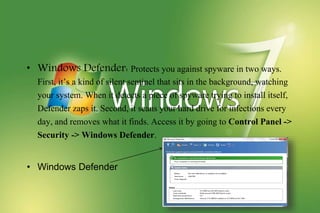
• Windows Defender:Protects you against spyware in two ways.
First, it’s a kind of silent sentinel that sits in the background, watching
your system. When it detects a piece of spyware trying to install itself,
Defender zaps it. Second, it scans your hard drive for infections every
day, and removes what it finds. Access it by going to Control Panel ->
Security -> Windows Defender.
• Windows Defender
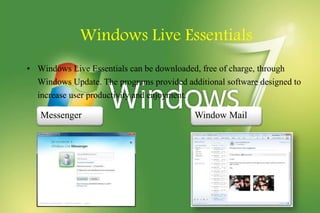
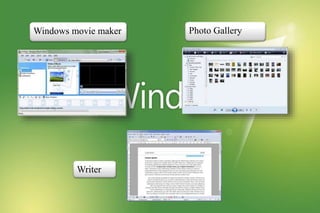
Windows Live Essentials
•Windows Live Essentials can be downloaded, free of charge, through
Windows Update. The programs provided additional software designed to
increase user productivity and enjoyment.
Messenger Window Mail
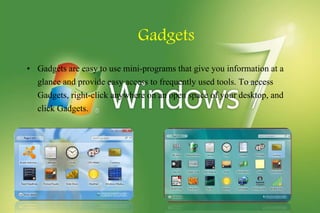
Gadgets
• Gadgets areeasy to use mini-programs that give you information at a
glance and provide easy access to frequently used tools. To access
Gadgets, right-click anywhere on an open space of your desktop, and
click Gadgets.