The Halide Salts. Aim: To identify and understand the general properties of the  halide salts. To understand that  halide ions  are  reducing agents  and identify their reactions with  concentrated sulphuric acid.
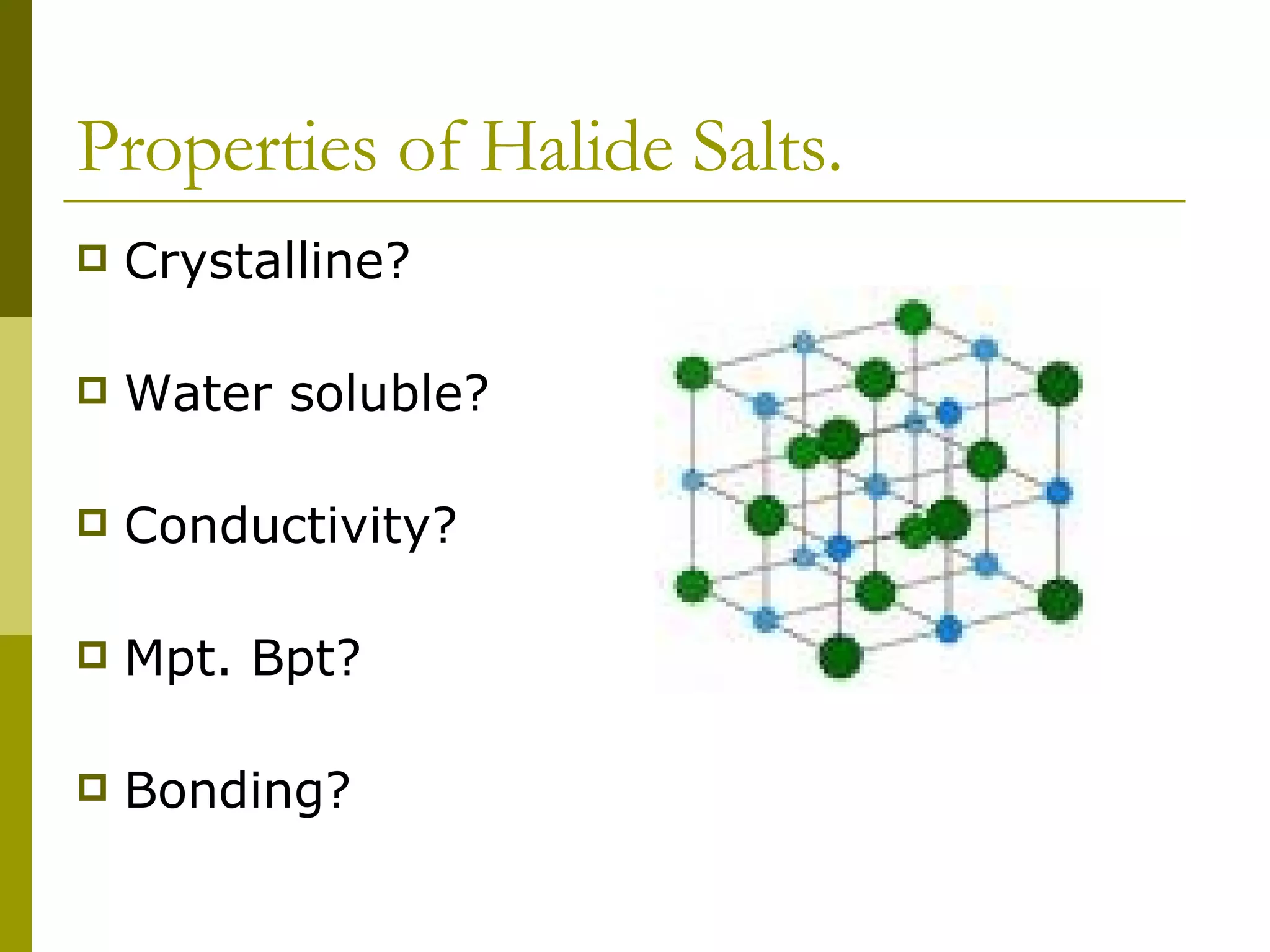
Properties of Halide Salts. Crystalline? Water soluble? Conductivity? Mpt. Bpt? Bonding?
Formation of Halide Salts. Reaction with group 1 metals. (Sodium chloride) Reaction with group 2 metals. (Magnesium chloride) Reaction with d-block metals.( Copper (II) Chloride)
Halide Ions as Reducing agents. The reaction between (aq) sodium iodide and iron (III) Chloride to make Iodine, Iron (II) chloride and Sodium chloride NaI + FeCl 3  I 2  + FeCl 2  +  NaCl.   Ionic half equation for Iodine: Ionic half equation for Iron:   Overall redox equation:   Reducing agent?
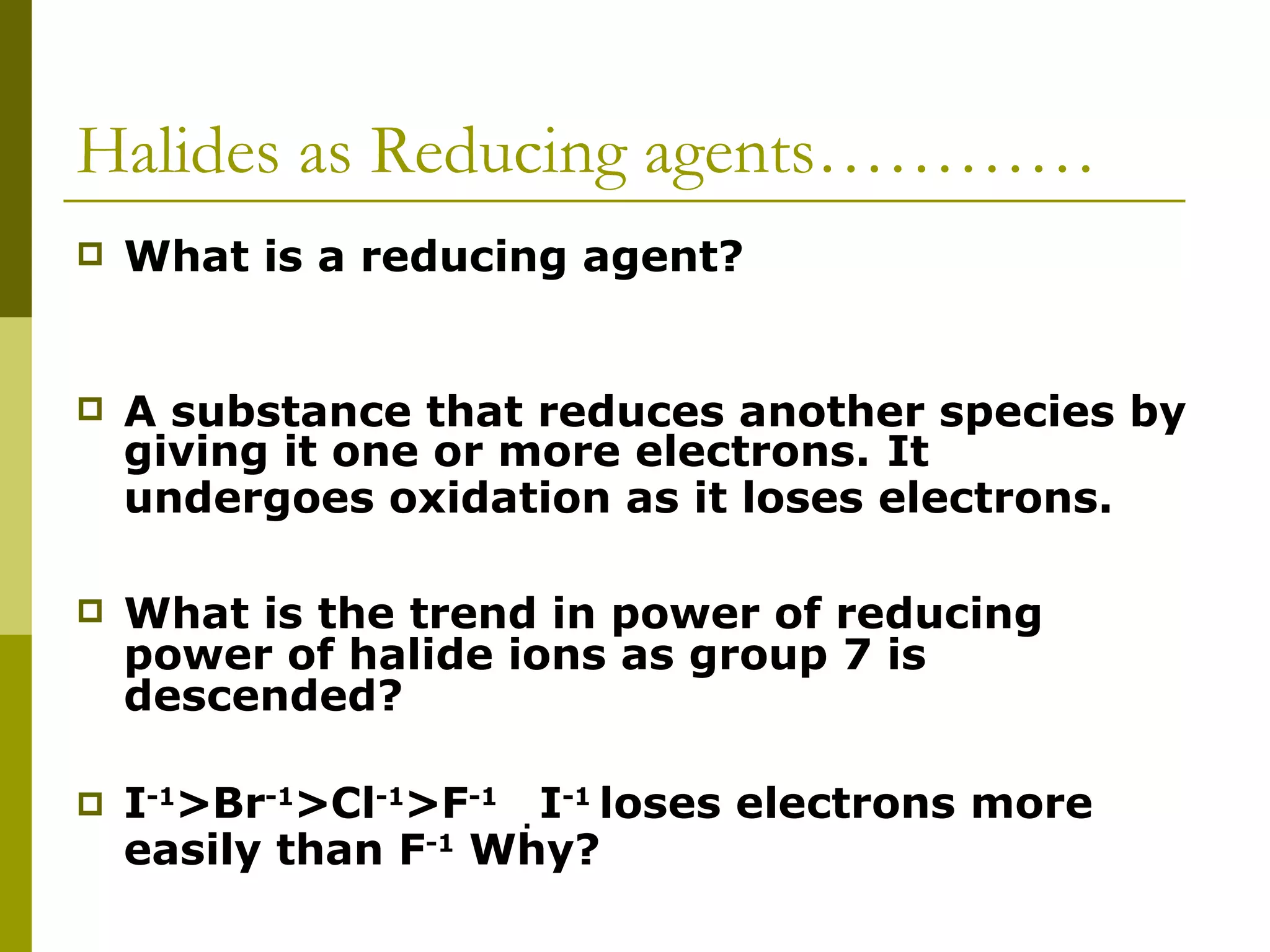
Halides as Reducing agents………… What is a reducing agent? A substance that reduces another species by giving it one or more electrons.   It undergoes oxidation as it loses electrons.   What is the trend in power of reducing power of halide ions as group 7 is descended? I -1 >Br -1 >Cl -1 >F -1   .  I -1  loses electrons more easily than F -1  Why?
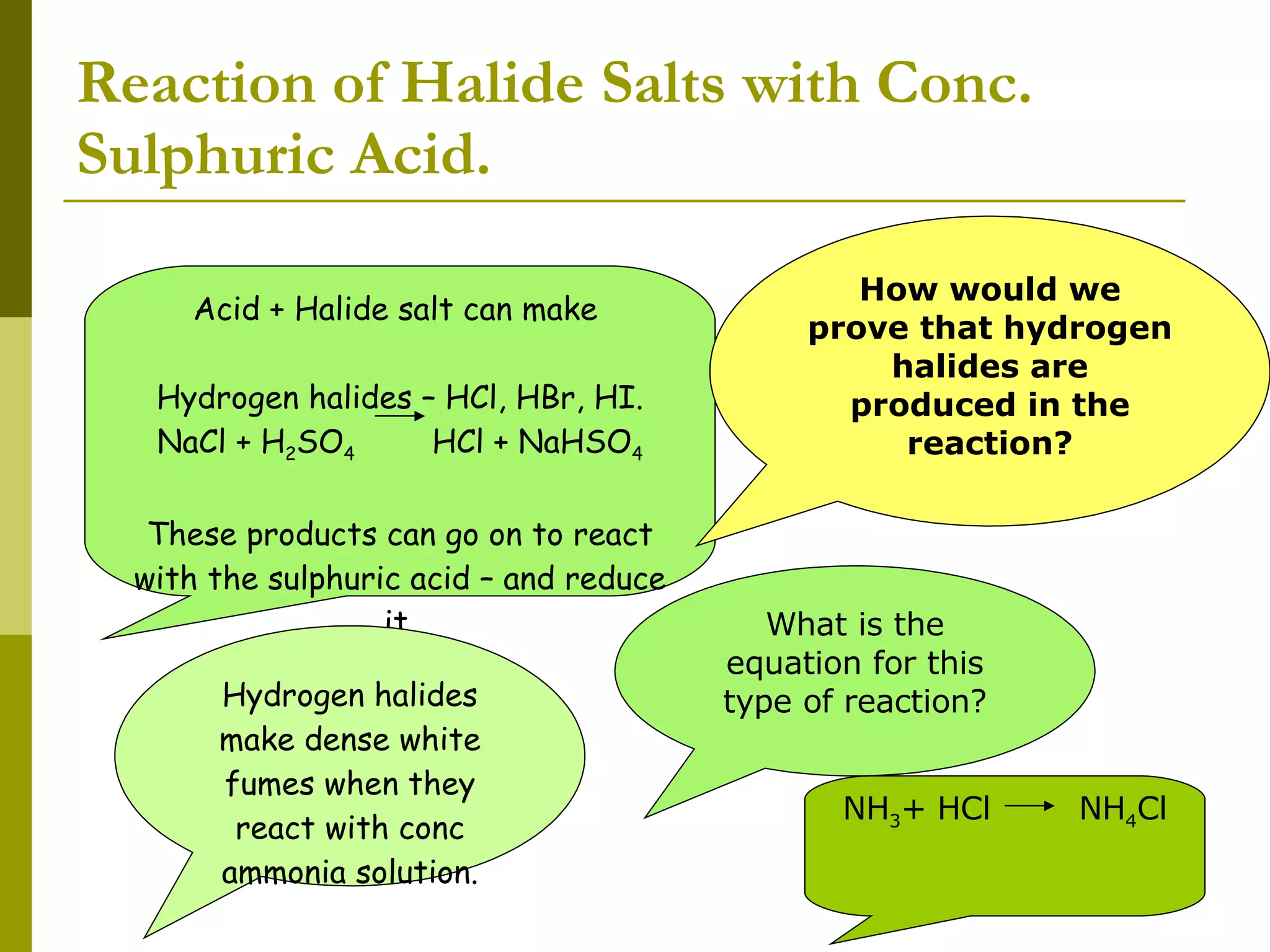
Reaction of Halide Salts with Conc. Sulphuric Acid. Acid + Halide salt can make  Hydrogen halides – HCl, HBr, HI. NaCl + H 2 SO 4  HCl + NaHSO 4 These products can go on to react with the sulphuric acid – and reduce it. How would we prove that hydrogen halides are produced in the reaction? Hydrogen halides make dense white fumes when they react with conc ammonia solution. What is the equation for this type of reaction? NH 3 + HCl  NH 4 Cl
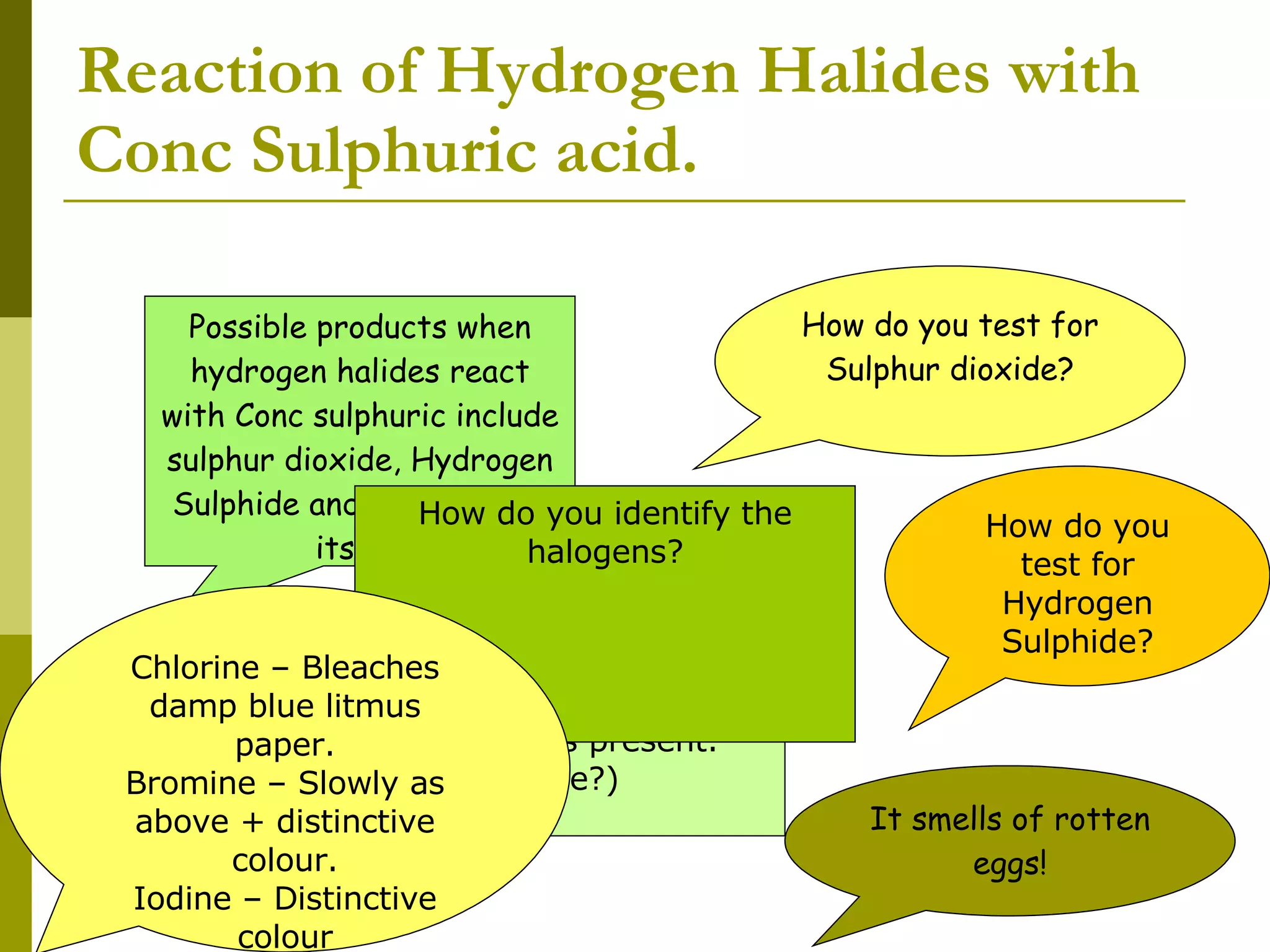
Reaction of Hydrogen Halides with Conc Sulphuric acid. Possible products when hydrogen halides react with Conc sulphuric include sulphur dioxide, Hydrogen Sulphide and the Halogen itself. How do you test for Sulphur dioxide? Acidified potassium dichromate paper turns form orange to green if sulphur dioxide is present. (Reaction type?)  How do you test for Hydrogen Sulphide? It smells of rotten eggs! How do you identify the halogens? Chlorine – Bleaches damp blue litmus paper. Bromine – Slowly as above + distinctive colour. Iodine – Distinctive colour
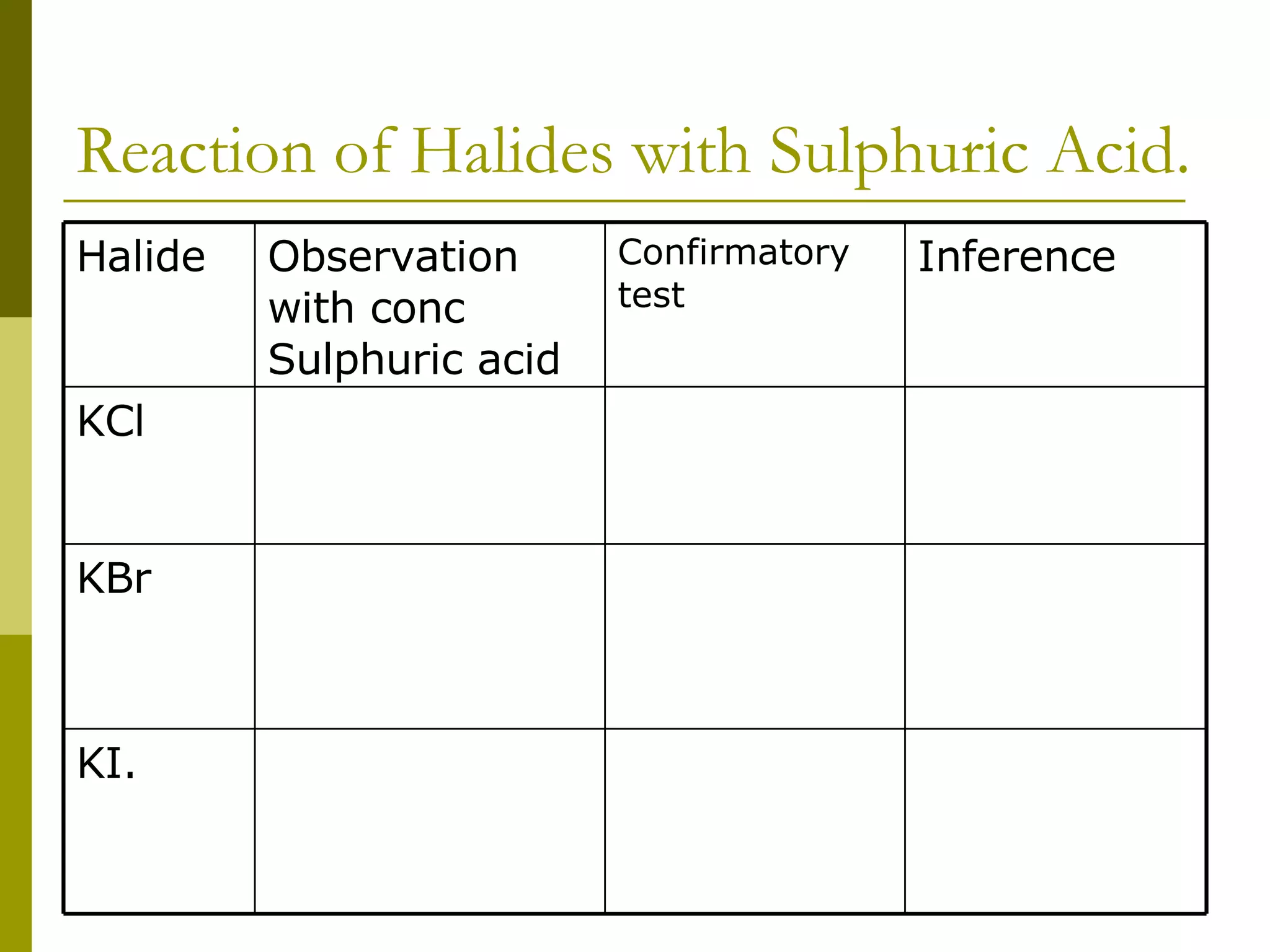
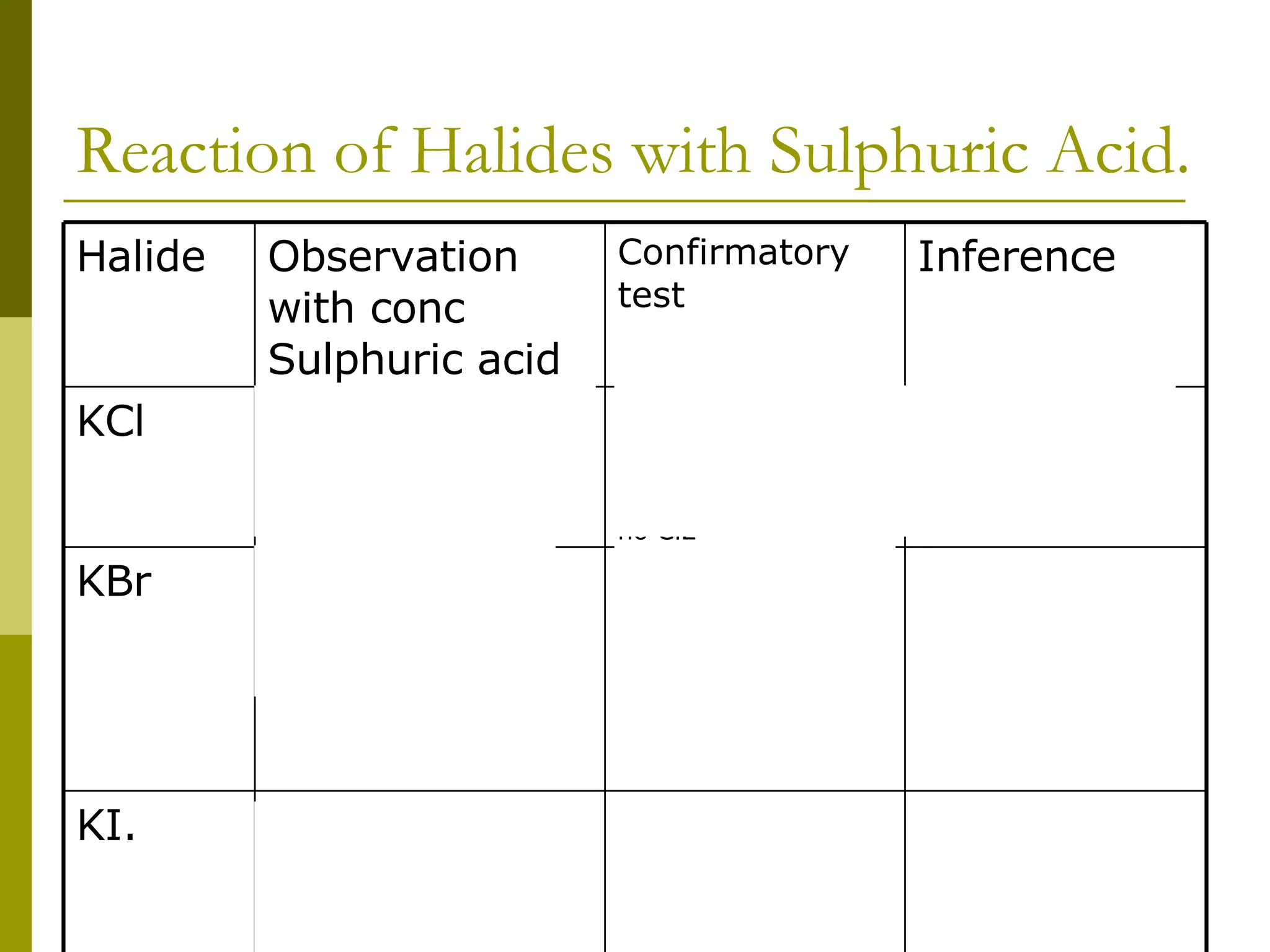
Reaction of Halides with Sulphuric Acid. KI. KBr KCl Inference Confirmatory test Observation with conc Sulphuric acid Halide
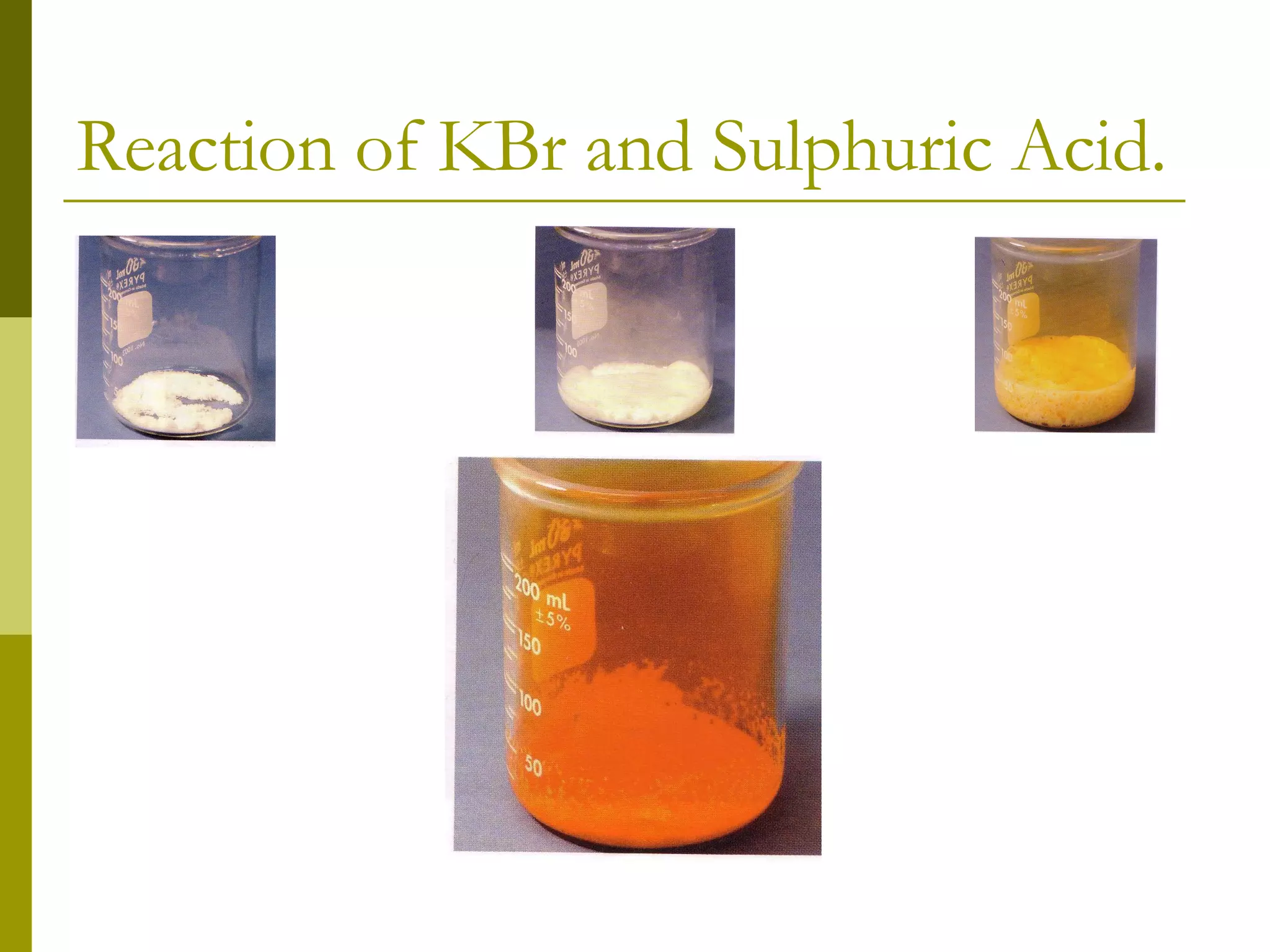
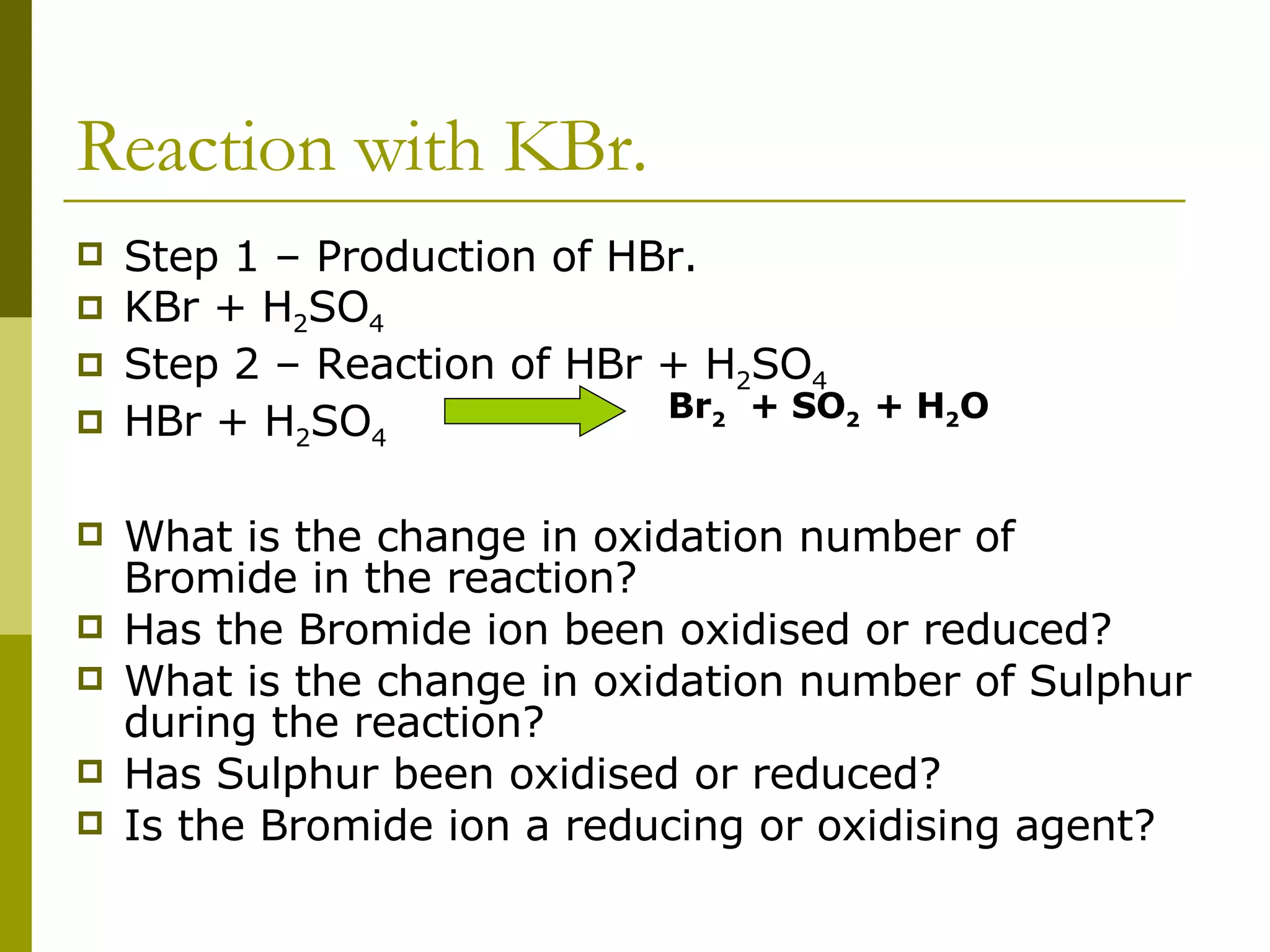
Reaction of Halides with Sulphuric Acid. HI, I2 & H2S & SO2   White smoke with ammonia – HI acidified potassium dichromate(VI) goes from orange to green – SO2   Steamy violet fumes in cold, more on warming (I2), bad egg smell (H2S)  KI. HBr & Br2, & SO2   White smoke with ammonia HBr. acidified potassium dichromate(VI) goes from orange to green – SO 2  .   Steamy fumes in cold, brown gas on warming (Br2)   KBr HCl   White smoke with ammonia - HCl, damp litmus paper turns red (not bleached) – no Cl2  Steamy fumes in cold, no apparent effect when heated   KCl Inference Confirmatory test Observation with conc Sulphuric acid Halide
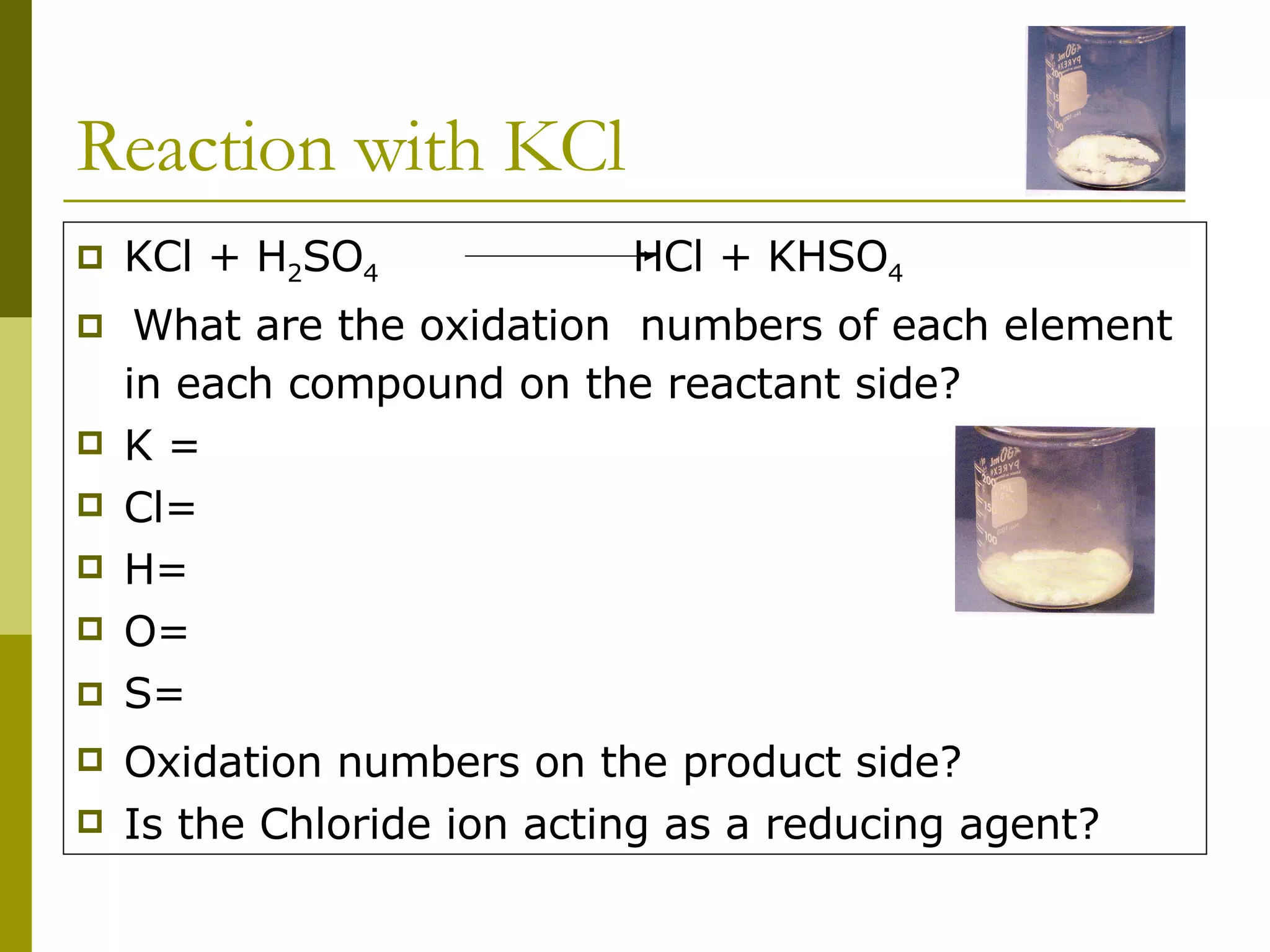
Reaction with KCl  KCl + H 2 SO 4  HCl + KHSO 4 What are the oxidation  numbers of each element in each compound on the reactant side? K = Cl= H= O= S=   Oxidation numbers on the product side? Is the Chloride ion acting as a reducing agent?
Reaction of KBr and Sulphuric Acid.
Reaction with KBr. Step 1 – Production of HBr. KBr + H 2 SO 4 Step 2 – Reaction of HBr + H 2 SO 4 HBr + H 2 SO 4  What is the change in oxidation number of Bromide in the reaction? Has the Bromide ion been oxidised or reduced? What is the change in oxidation number of Sulphur during the reaction? Has Sulphur been oxidised or reduced? Is the Bromide ion a reducing or oxidising agent? Br 2   + SO 2  + H 2 O
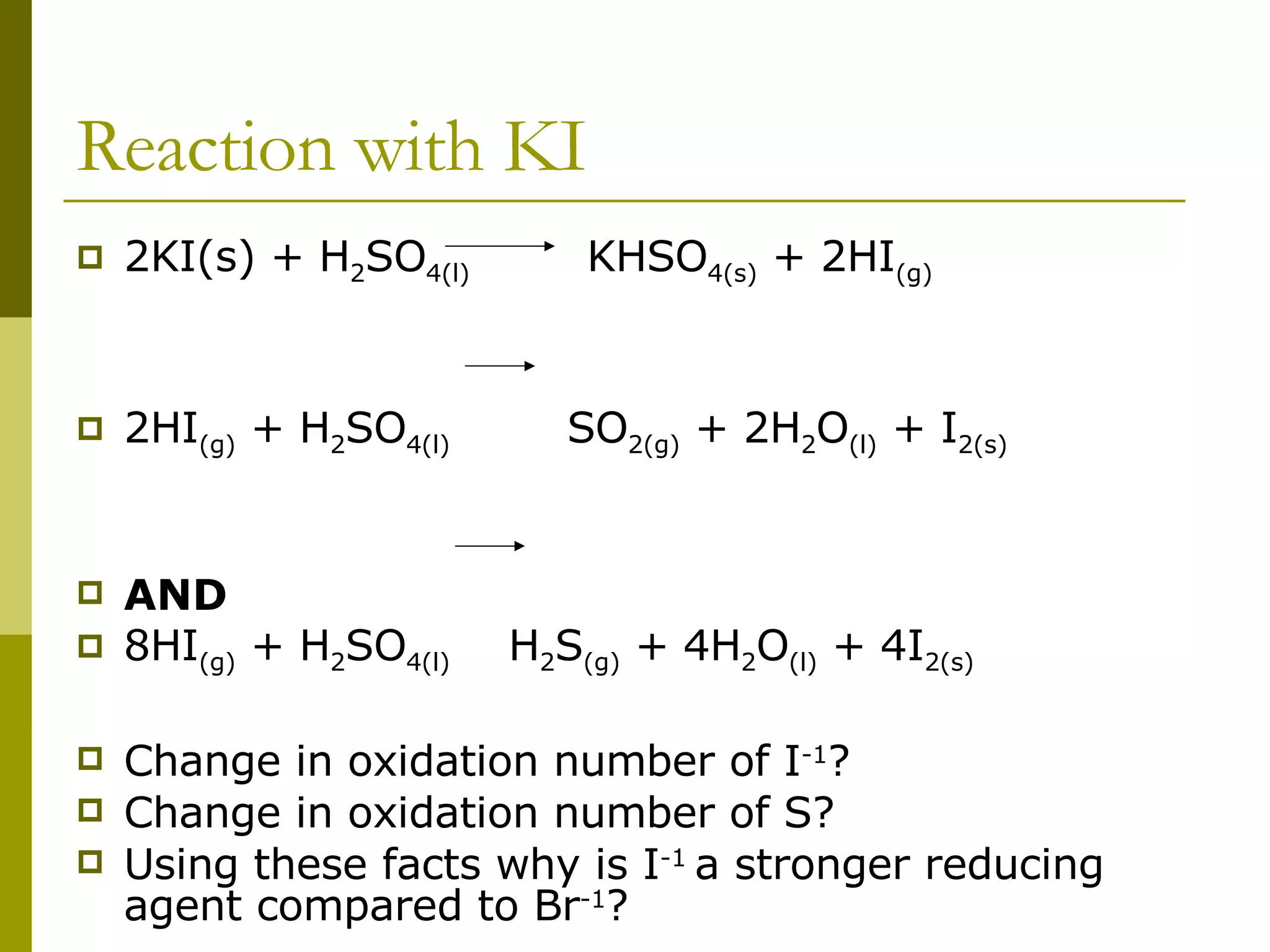
Reaction with KI 2KI(s) + H 2 SO 4(l)   KHSO 4(s)  + 2HI (g) 2HI (g)  + H 2 SO 4(l)   SO 2(g)  + 2H 2 O (l)  + I 2(s) AND   8HI (g)  + H 2 SO 4(l)   H 2 S (g)  + 4H 2 O (l)  + 4I 2(s) Change in oxidation number of I -1 ? Change in oxidation number of S? Using these facts why is I -1  a stronger reducing agent compared to Br -1 ?
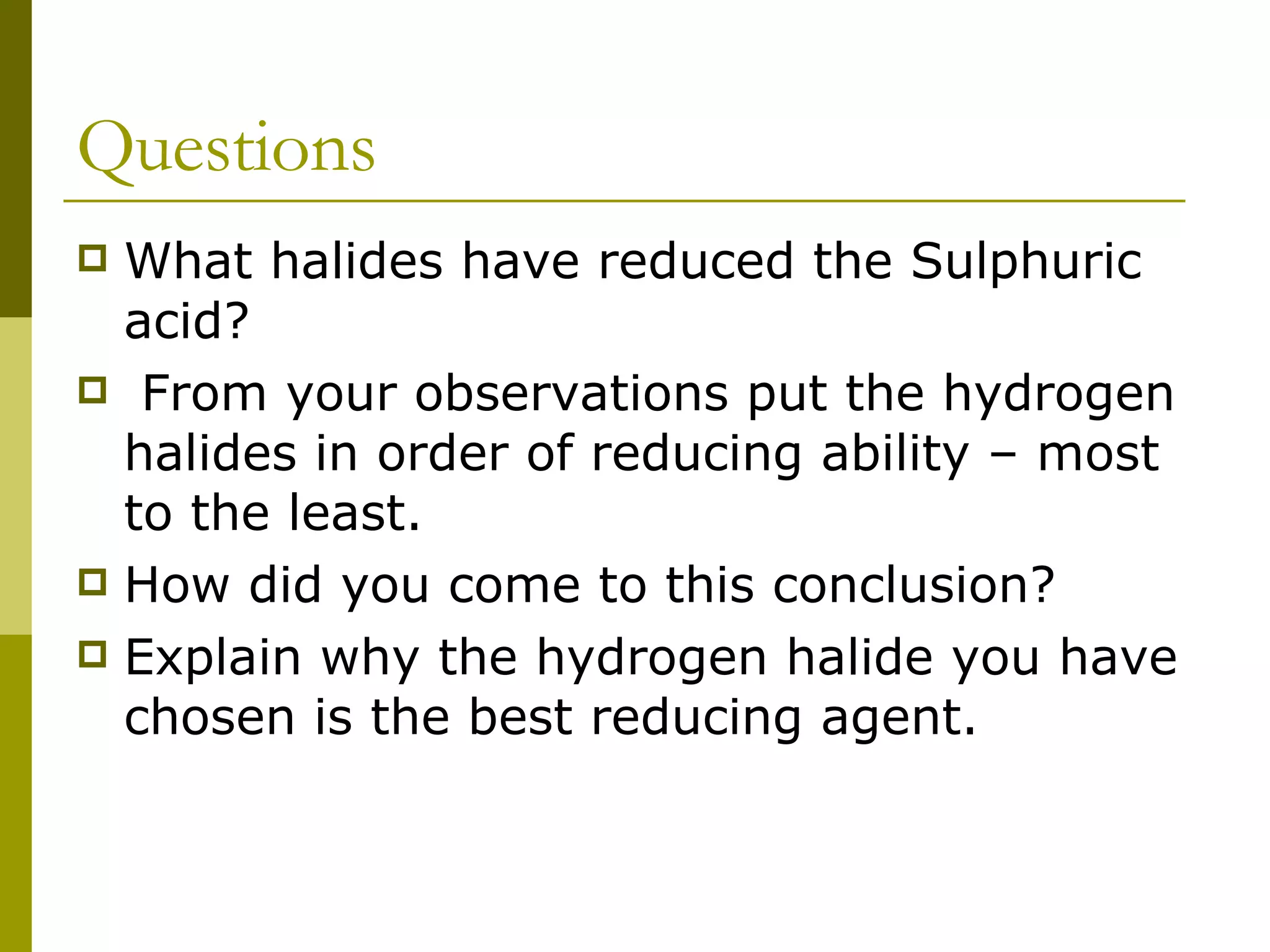
Questions What halides have reduced the Sulphuric acid? From your observations put the hydrogen halides in order of reducing ability – most to the least. How did you come to this conclusion?  Explain why the hydrogen halide you have chosen is the best reducing agent.
Homework Write up the halide ion tests in your lab book from last week. See p.154 AS chemistry. P156 AS chemistry Questions 1,2,3,4,6,7,10 –Only. For Thursday.

Lesson 4 The Halide Salts

  • 1.
    The Halide Salts.Aim: To identify and understand the general properties of the halide salts. To understand that halide ions are reducing agents and identify their reactions with concentrated sulphuric acid.
  • 2.
    Properties of HalideSalts. Crystalline? Water soluble? Conductivity? Mpt. Bpt? Bonding?
  • 3.
    Formation of HalideSalts. Reaction with group 1 metals. (Sodium chloride) Reaction with group 2 metals. (Magnesium chloride) Reaction with d-block metals.( Copper (II) Chloride)
  • 4.
    Halide Ions asReducing agents. The reaction between (aq) sodium iodide and iron (III) Chloride to make Iodine, Iron (II) chloride and Sodium chloride NaI + FeCl 3 I 2 + FeCl 2 + NaCl. Ionic half equation for Iodine: Ionic half equation for Iron: Overall redox equation: Reducing agent?
  • 5.
    Halides as Reducingagents………… What is a reducing agent? A substance that reduces another species by giving it one or more electrons. It undergoes oxidation as it loses electrons. What is the trend in power of reducing power of halide ions as group 7 is descended? I -1 >Br -1 >Cl -1 >F -1 . I -1 loses electrons more easily than F -1 Why?
  • 6.
    Reaction of HalideSalts with Conc. Sulphuric Acid. Acid + Halide salt can make Hydrogen halides – HCl, HBr, HI. NaCl + H 2 SO 4 HCl + NaHSO 4 These products can go on to react with the sulphuric acid – and reduce it. How would we prove that hydrogen halides are produced in the reaction? Hydrogen halides make dense white fumes when they react with conc ammonia solution. What is the equation for this type of reaction? NH 3 + HCl NH 4 Cl
  • 7.
    Reaction of HydrogenHalides with Conc Sulphuric acid. Possible products when hydrogen halides react with Conc sulphuric include sulphur dioxide, Hydrogen Sulphide and the Halogen itself. How do you test for Sulphur dioxide? Acidified potassium dichromate paper turns form orange to green if sulphur dioxide is present. (Reaction type?) How do you test for Hydrogen Sulphide? It smells of rotten eggs! How do you identify the halogens? Chlorine – Bleaches damp blue litmus paper. Bromine – Slowly as above + distinctive colour. Iodine – Distinctive colour
  • 8.
    Reaction of Halideswith Sulphuric Acid. KI. KBr KCl Inference Confirmatory test Observation with conc Sulphuric acid Halide
  • 9.
    Reaction of Halideswith Sulphuric Acid. HI, I2 & H2S & SO2 White smoke with ammonia – HI acidified potassium dichromate(VI) goes from orange to green – SO2 Steamy violet fumes in cold, more on warming (I2), bad egg smell (H2S) KI. HBr & Br2, & SO2 White smoke with ammonia HBr. acidified potassium dichromate(VI) goes from orange to green – SO 2 . Steamy fumes in cold, brown gas on warming (Br2) KBr HCl White smoke with ammonia - HCl, damp litmus paper turns red (not bleached) – no Cl2 Steamy fumes in cold, no apparent effect when heated KCl Inference Confirmatory test Observation with conc Sulphuric acid Halide
  • 10.
    Reaction with KCl KCl + H 2 SO 4 HCl + KHSO 4 What are the oxidation numbers of each element in each compound on the reactant side? K = Cl= H= O= S= Oxidation numbers on the product side? Is the Chloride ion acting as a reducing agent?
  • 11.
    Reaction of KBrand Sulphuric Acid.
  • 12.
    Reaction with KBr.Step 1 – Production of HBr. KBr + H 2 SO 4 Step 2 – Reaction of HBr + H 2 SO 4 HBr + H 2 SO 4 What is the change in oxidation number of Bromide in the reaction? Has the Bromide ion been oxidised or reduced? What is the change in oxidation number of Sulphur during the reaction? Has Sulphur been oxidised or reduced? Is the Bromide ion a reducing or oxidising agent? Br 2 + SO 2 + H 2 O
  • 13.
    Reaction with KI2KI(s) + H 2 SO 4(l) KHSO 4(s) + 2HI (g) 2HI (g) + H 2 SO 4(l) SO 2(g) + 2H 2 O (l) + I 2(s) AND 8HI (g) + H 2 SO 4(l) H 2 S (g) + 4H 2 O (l) + 4I 2(s) Change in oxidation number of I -1 ? Change in oxidation number of S? Using these facts why is I -1 a stronger reducing agent compared to Br -1 ?
  • 14.
    Questions What halideshave reduced the Sulphuric acid? From your observations put the hydrogen halides in order of reducing ability – most to the least. How did you come to this conclusion? Explain why the hydrogen halide you have chosen is the best reducing agent.
  • 15.
    Homework Write upthe halide ion tests in your lab book from last week. See p.154 AS chemistry. P156 AS chemistry Questions 1,2,3,4,6,7,10 –Only. For Thursday.