SALTS
   A salt is a compound formed when the
hydrogen ions in an acid are replaced by metal
         ions or by ammonium ions.
 Compounds in which the H+ ions in an acid
have been replaced by ammonium ions (NH4+)
        are called ammonium salts.
NOTE:
•An anion is a negatively charged ion. Hence:-
•Hydrochloric acid gives chlorides. E.g. sodium chloride,
ammonium chloride.
•Nitric acid gives nitrates. E.g. barium nitrate, copper nitrate.
•Sulphuric acid gives sulphates. E.g. silver sulphate, iron (ii)
sulphate.
•Phosphoric acid gives phosphates. E.g. sodium phosphate,
ammonium phosphate.
•Each acid gives rise to a series of salts named by the ANION
which they contain.
•Some acids can donate more than one replaceable hydrogen ion
(proton)
•E.g. sulphuric acid (H2SO4) and phosphoric acid (H3PO4).
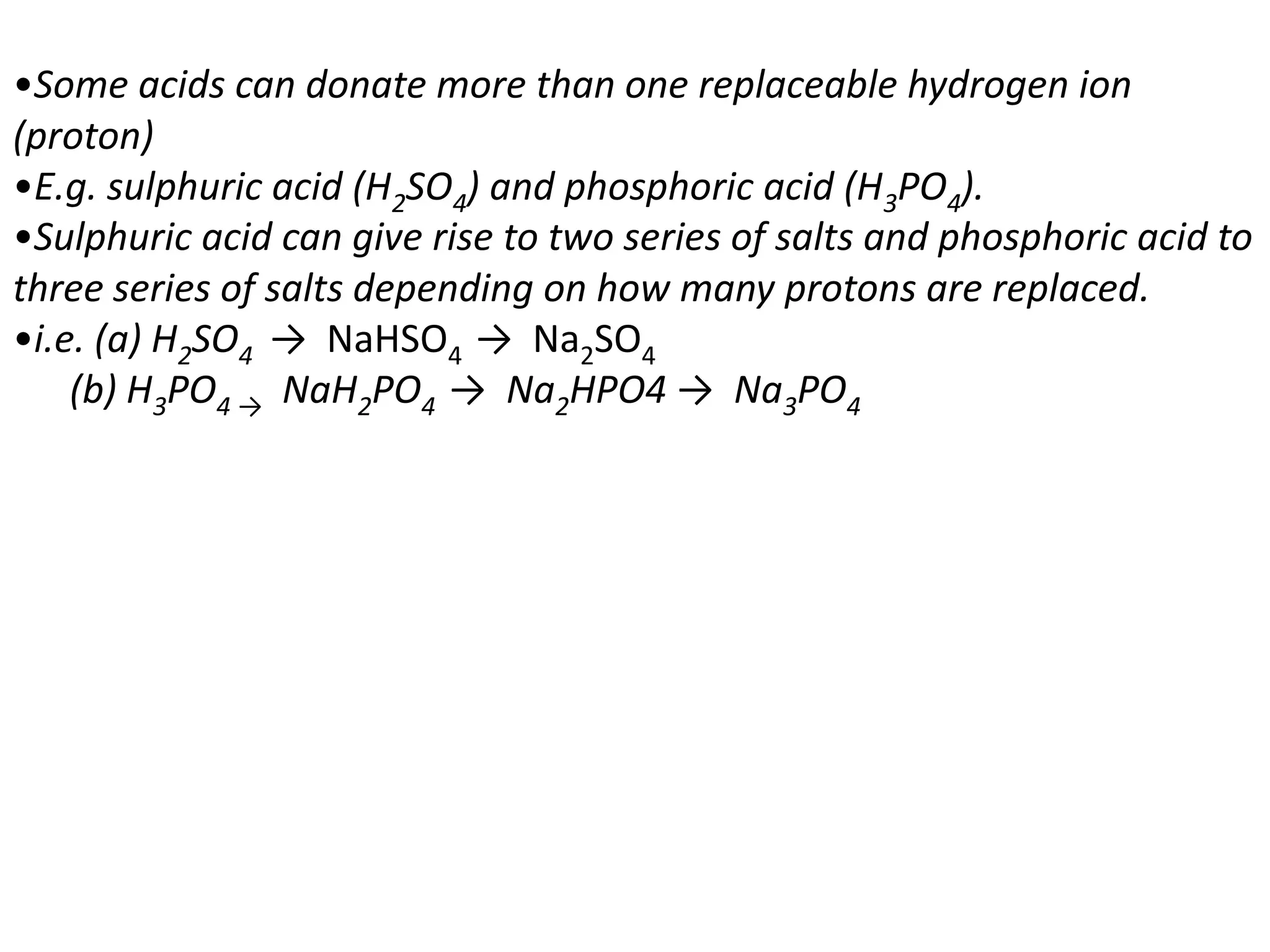
•Sulphuric acid can give rise to two series of salts and phosphoric acid to
three series of salts depending on how many protons are replaced.
•i.e. (a) H2SO4 → NaHSO4 → Na2SO4
    (b) H3PO4 → NaH2PO4 → Na2HPO4 → Na3PO4
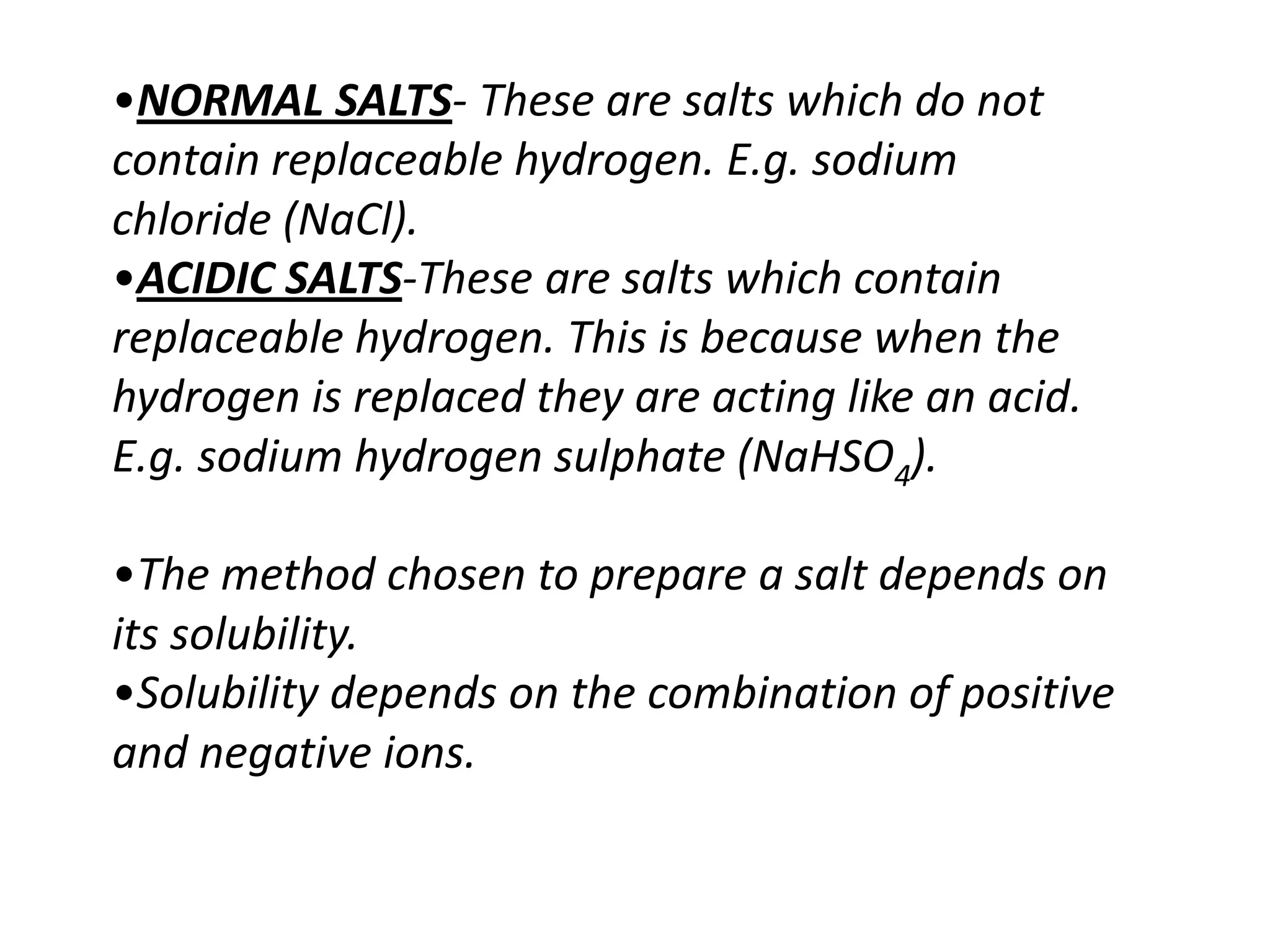
•NORMAL SALTS- These are salts which do not
contain replaceable hydrogen. E.g. sodium
chloride (NaCl).
•ACIDIC SALTS-These are salts which contain
replaceable hydrogen. This is because when the
hydrogen is replaced they are acting like an acid.
E.g. sodium hydrogen sulphate (NaHSO4).

•The method chosen to prepare a salt depends on
its solubility.
•Solubility depends on the combination of positive
and negative ions.
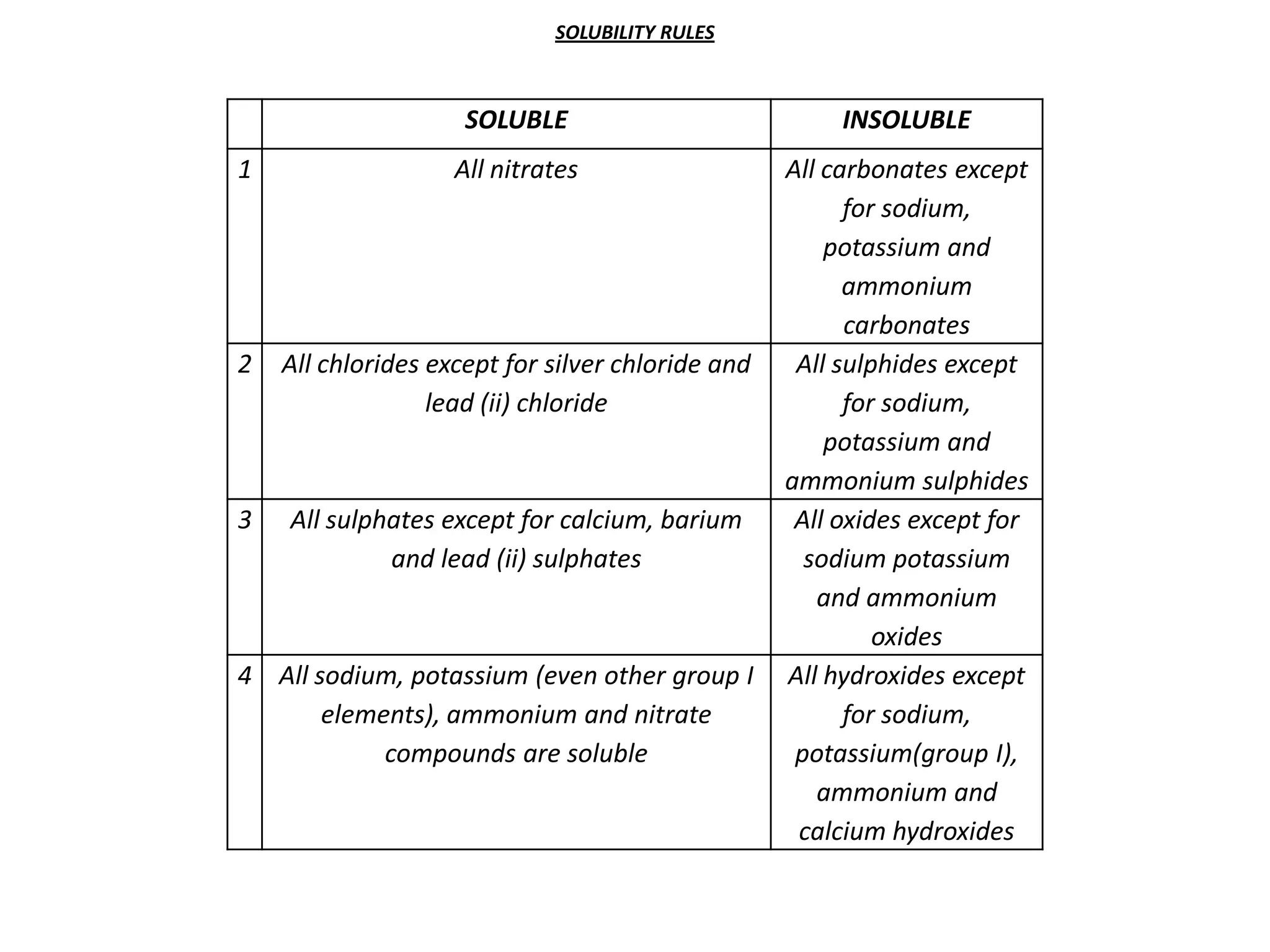
SOLUBILITY RULES


                     SOLUBLE                            INSOLUBLE
1                   All nitrates                   All carbonates except
                                                         for sodium,
                                                       potassium and
                                                         ammonium
                                                         carbonates
2   All chlorides except for silver chloride and    All sulphides except
                  lead (ii) chloride                     for sodium,
                                                       potassium and
                                                   ammonium sulphides
3   All sulphates except for calcium, barium        All oxides except for
             and lead (ii) sulphates                 sodium potassium
                                                      and ammonium
                                                            oxides
4 All sodium, potassium (even other group I        All hydroxides except
       elements), ammonium and nitrate                   for sodium,
            compounds are soluble                   potassium(group I),
                                                      ammonium and
                                                    calcium hydroxides
NOTE:
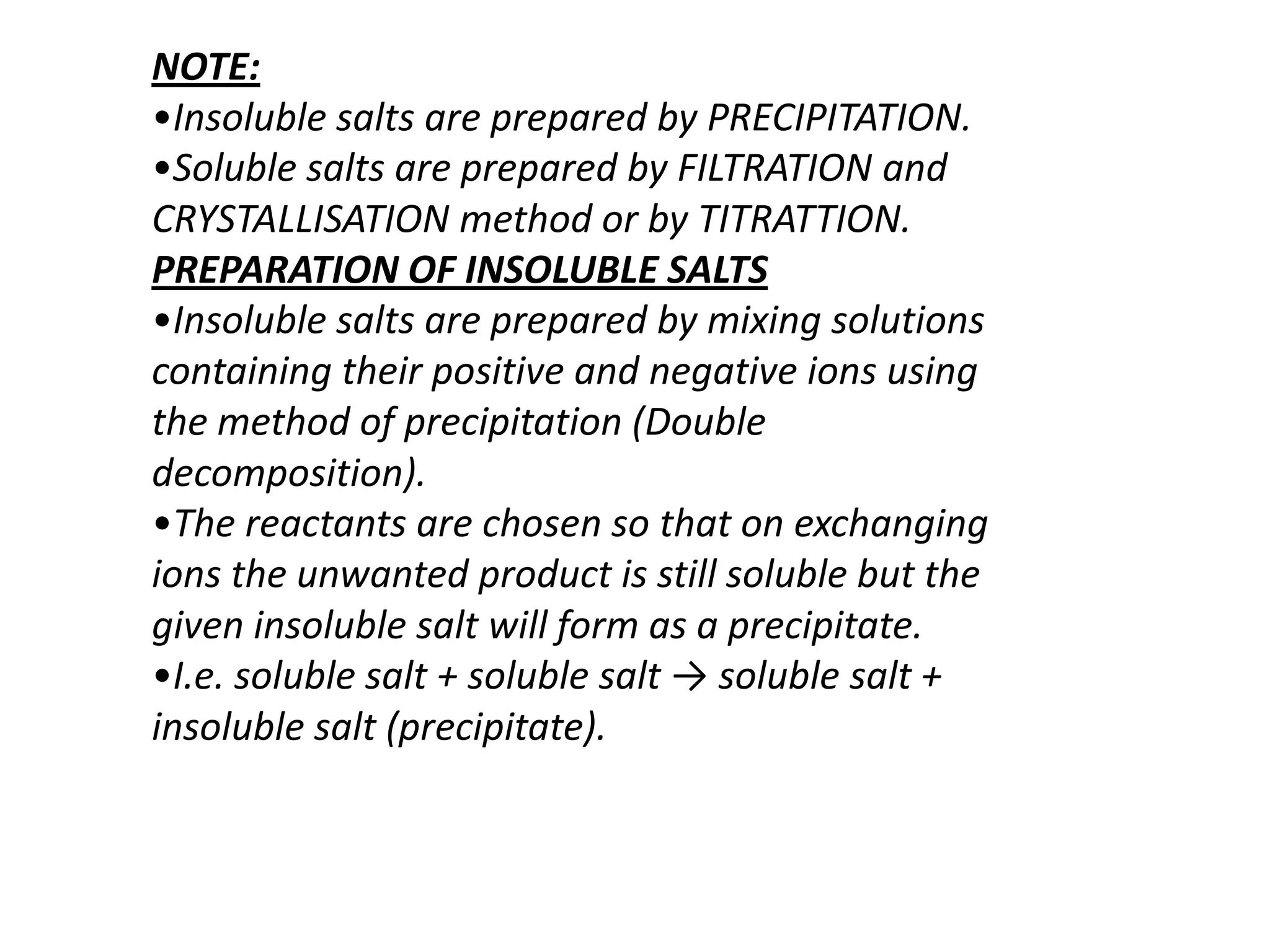
•Insoluble salts are prepared by PRECIPITATION.
•Soluble salts are prepared by FILTRATION and
CRYSTALLISATION method or by TITRATTION.
PREPARATION OF INSOLUBLE SALTS
•Insoluble salts are prepared by mixing solutions
containing their positive and negative ions using
the method of precipitation (Double
decomposition).
•The reactants are chosen so that on exchanging
ions the unwanted product is still soluble but the
given insoluble salt will form as a precipitate.
•I.e. soluble salt + soluble salt → soluble salt +
insoluble salt (precipitate).
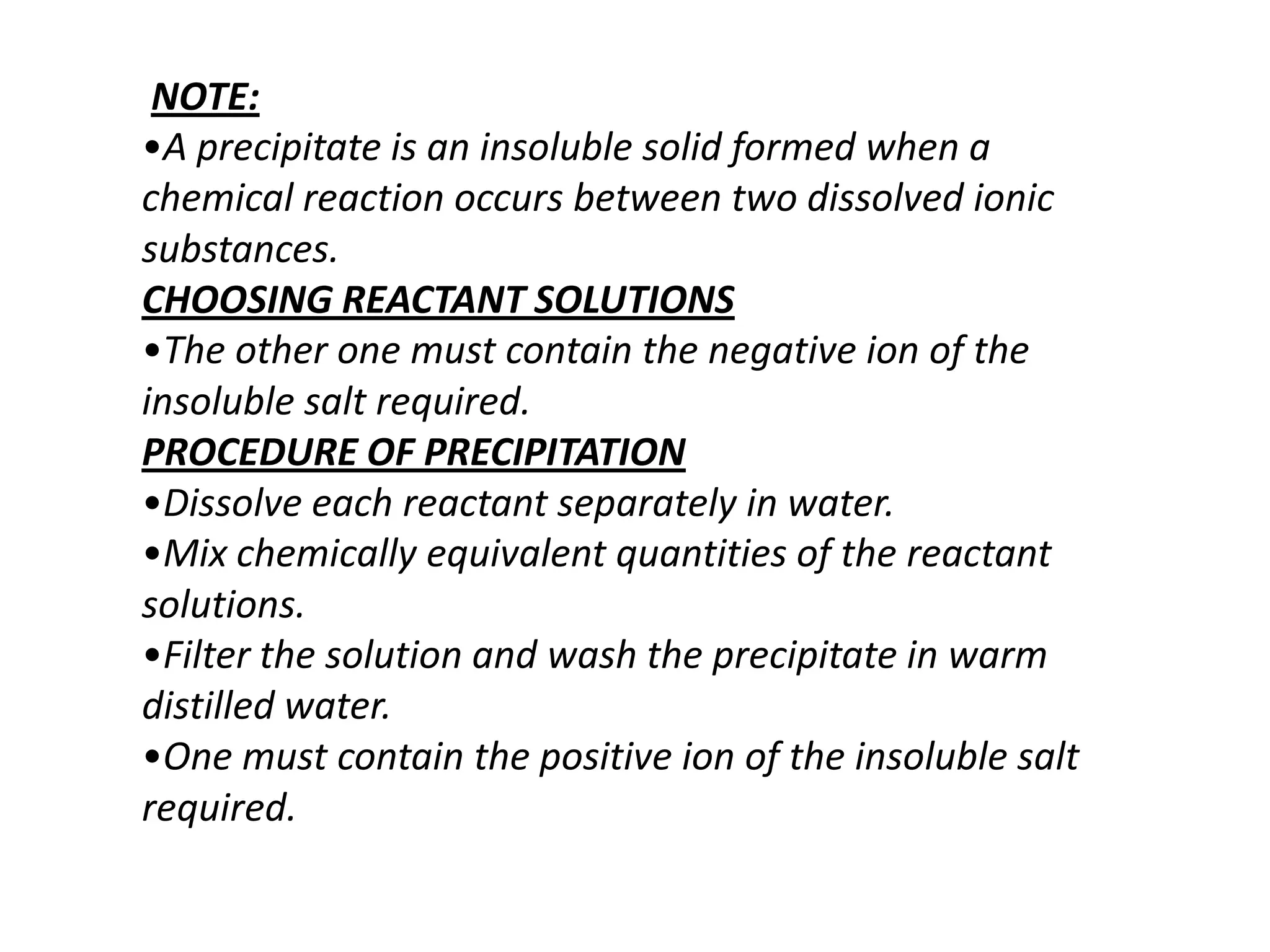
NOTE:
•A precipitate is an insoluble solid formed when a
chemical reaction occurs between two dissolved ionic
substances.
CHOOSING REACTANT SOLUTIONS
•The other one must contain the negative ion of the
insoluble salt required.
PROCEDURE OF PRECIPITATION
•Dissolve each reactant separately in water.
•Mix chemically equivalent quantities of the reactant
solutions.
•Filter the solution and wash the precipitate in warm
distilled water.
•One must contain the positive ion of the insoluble salt
required.
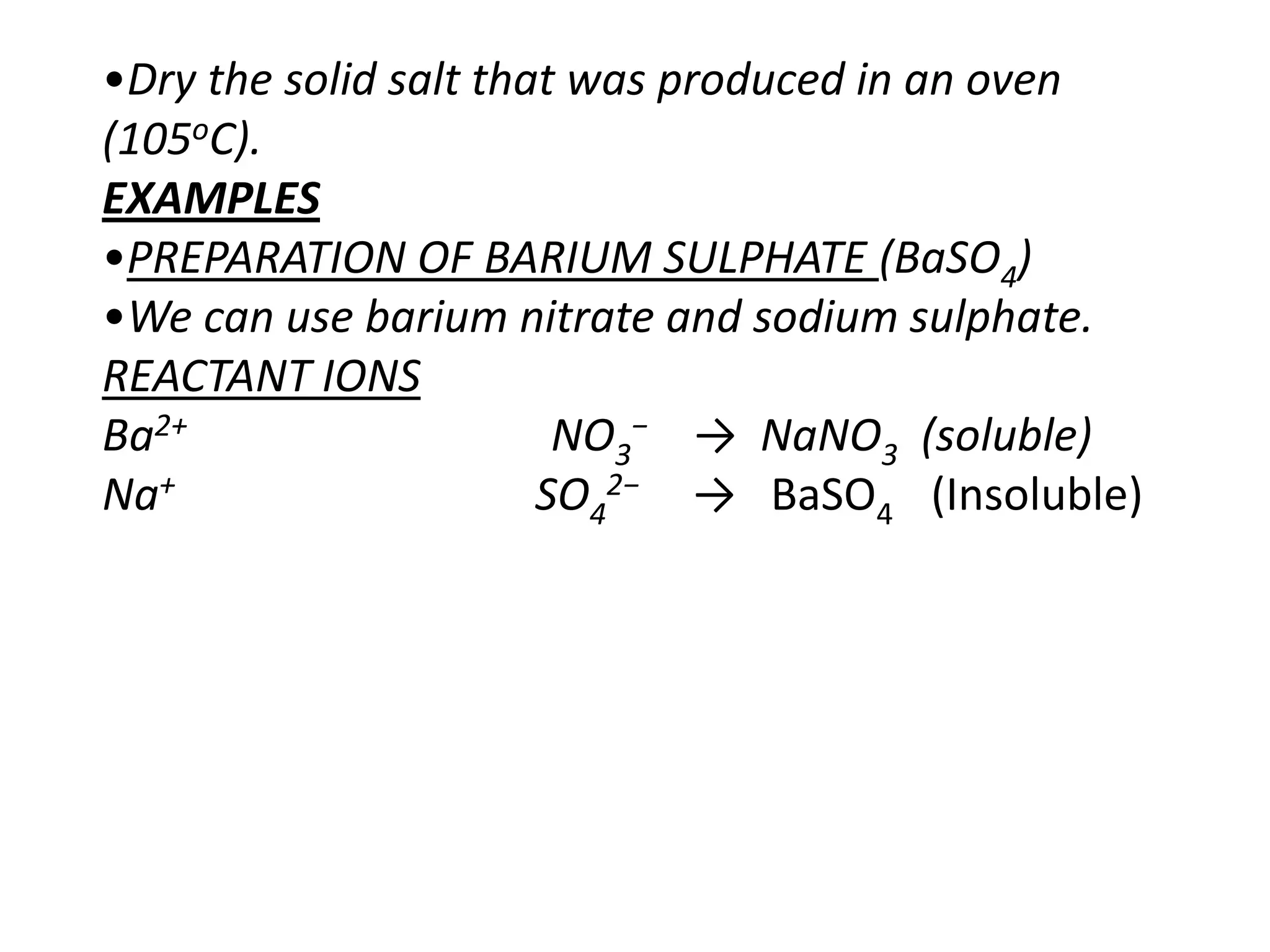
•Dry the solid salt that was produced in an oven
(105oC).
EXAMPLES
•PREPARATION OF BARIUM SULPHATE (BaSO4)
•We can use barium nitrate and sodium sulphate.
REACTANT IONS
Ba2+                    NO3− → NaNO3 (soluble)
Na+                    SO42− → BaSO4 (Insoluble)
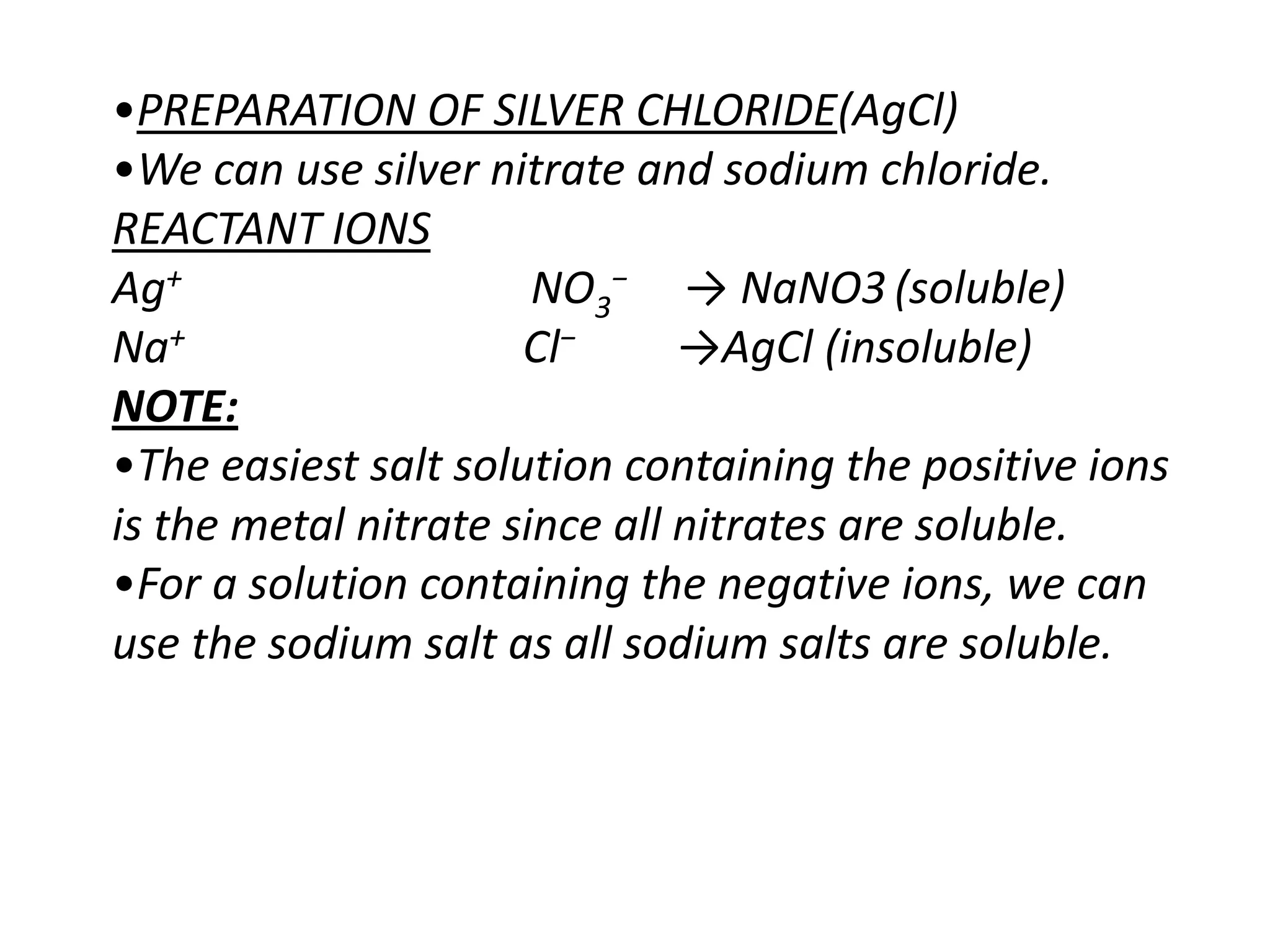
•PREPARATION OF SILVER CHLORIDE(AgCl)
•We can use silver nitrate and sodium chloride.
REACTANT IONS
Ag+                    NO3− → NaNO3 (soluble)
Na+                   Cl−      →AgCl (insoluble)
NOTE:
•The easiest salt solution containing the positive ions
is the metal nitrate since all nitrates are soluble.
•For a solution containing the negative ions, we can
use the sodium salt as all sodium salts are soluble.
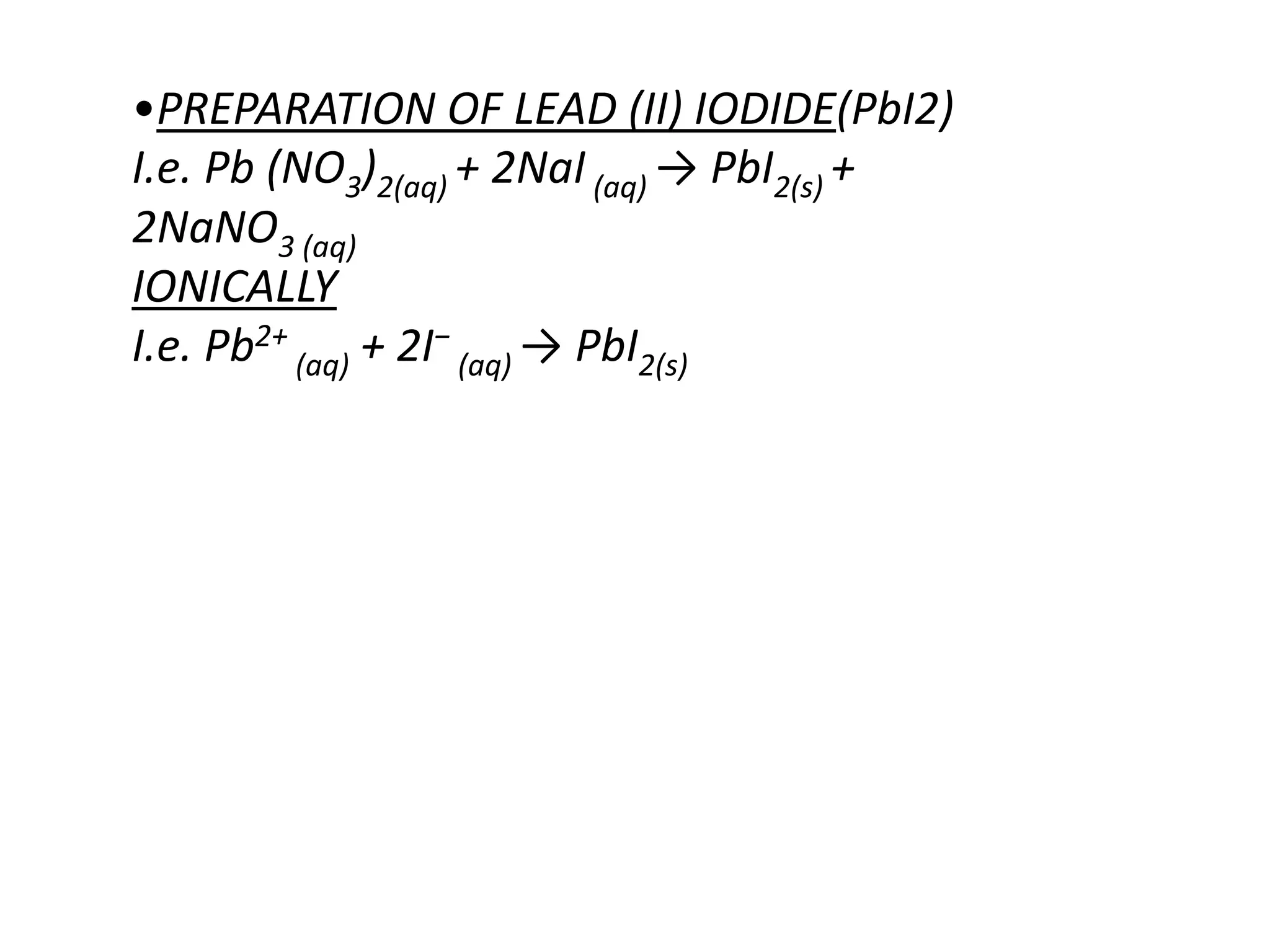
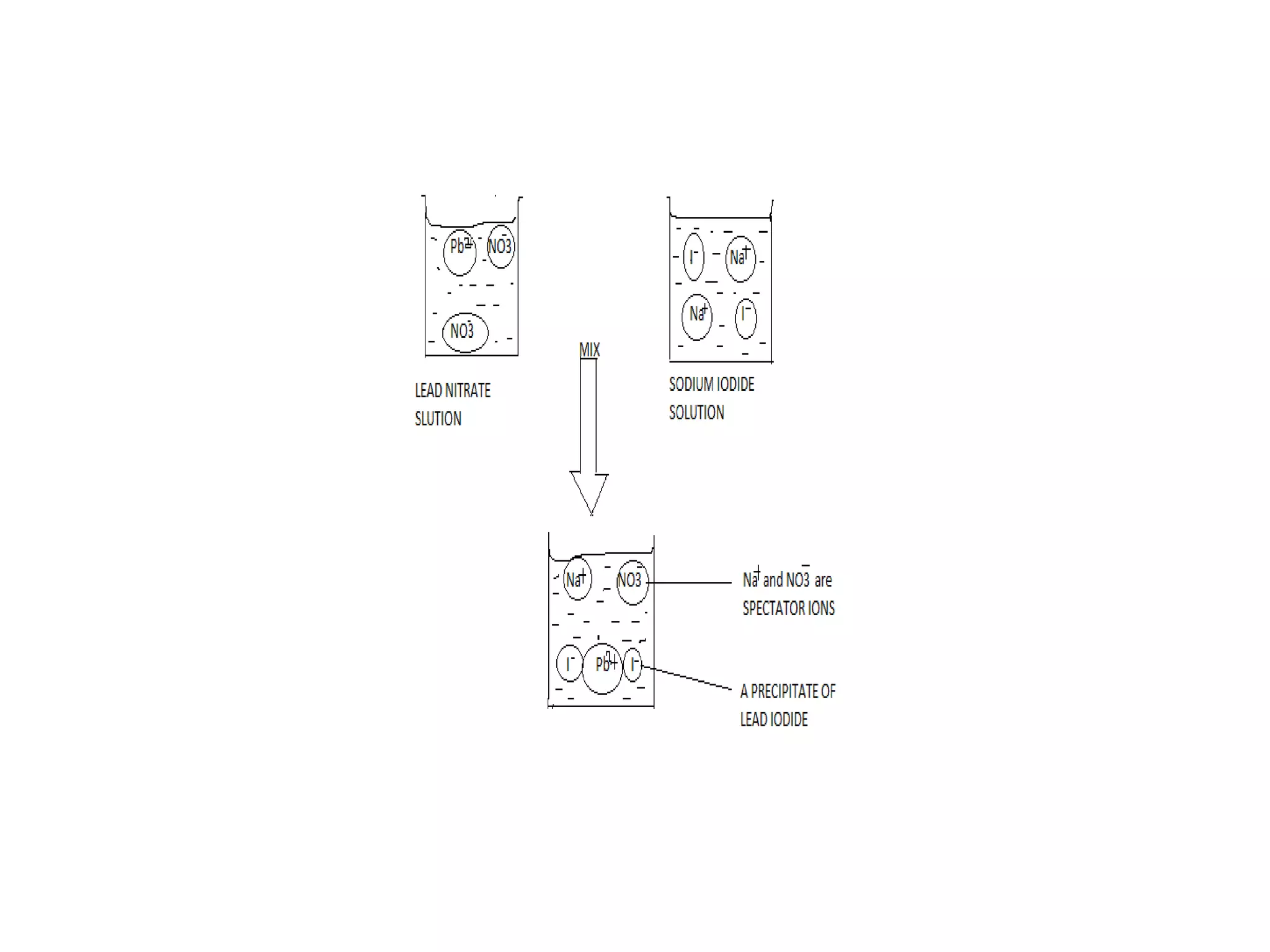
•PREPARATION OF LEAD (II) IODIDE(PbI2)
I.e. Pb (NO3)2(aq) + 2NaI (aq) → PbI2(s) +
2NaNO3 (aq)
IONICALLY
I.e. Pb2+ (aq) + 2I− (aq) → PbI2(s)
NOTE:
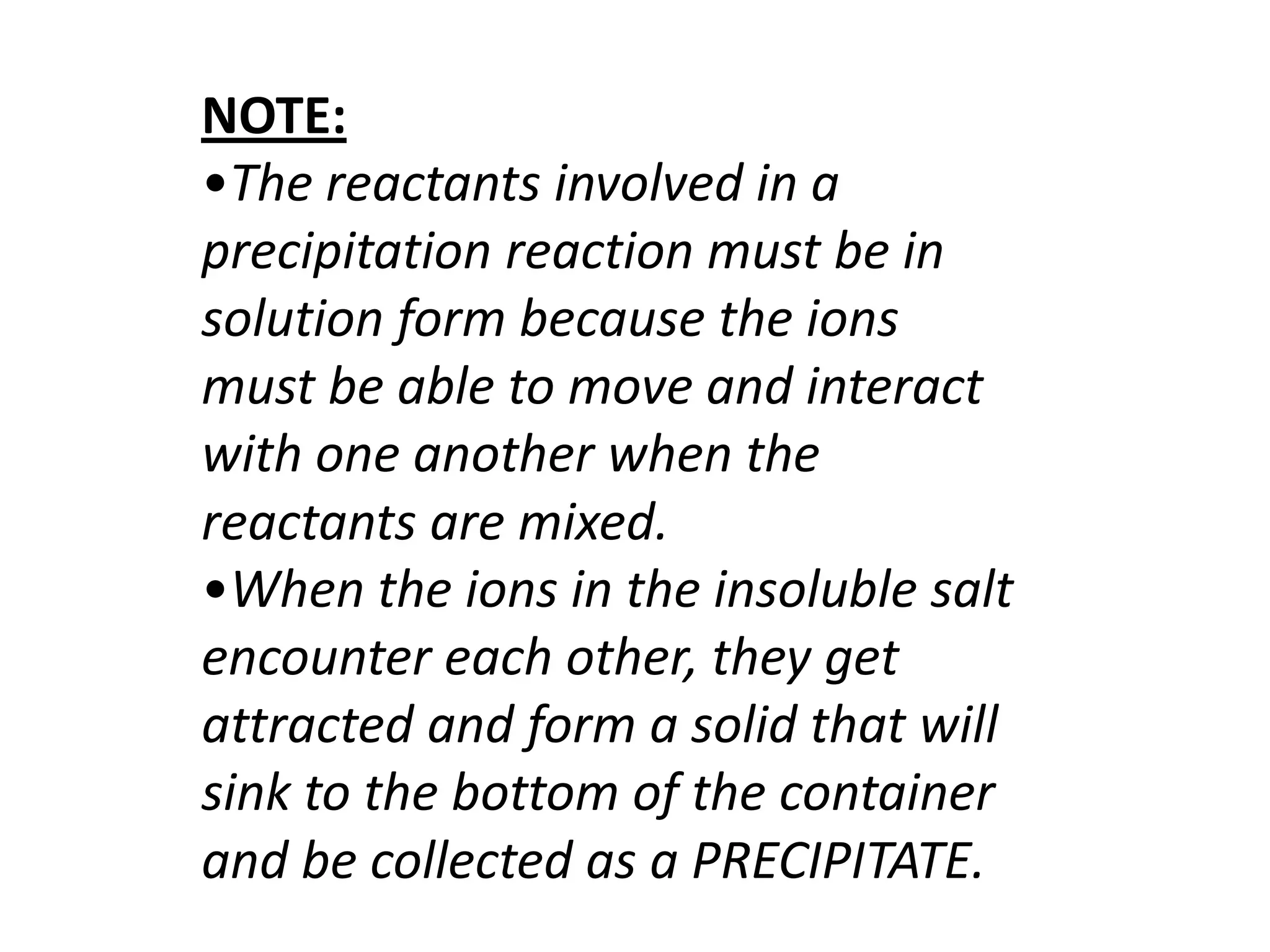
•The reactants involved in a
precipitation reaction must be in
solution form because the ions
must be able to move and interact
with one another when the
reactants are mixed.
•When the ions in the insoluble salt
encounter each other, they get
attracted and form a solid that will
sink to the bottom of the container
and be collected as a PRECIPITATE.
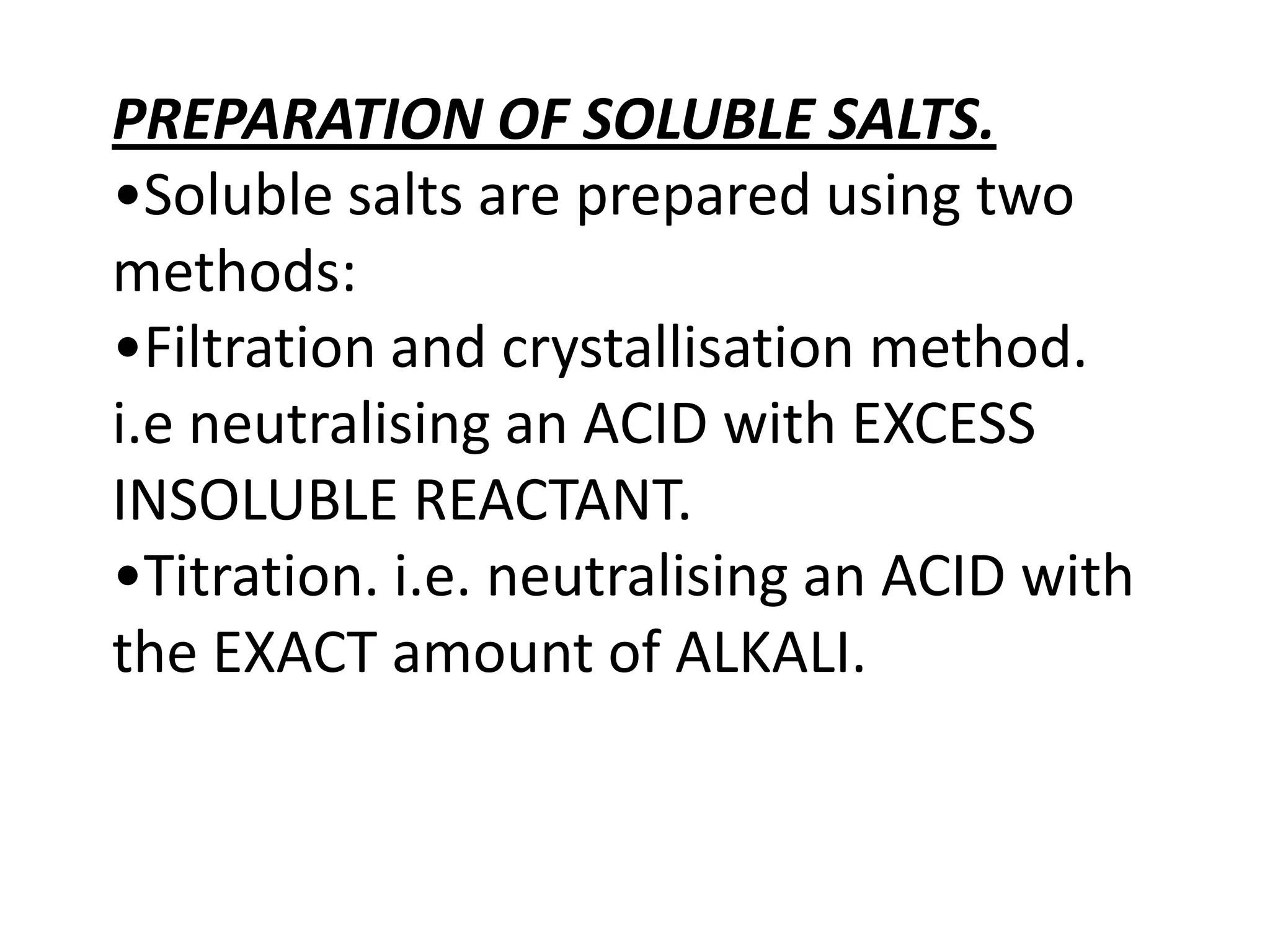
PREPARATION OF SOLUBLE SALTS.
•Soluble salts are prepared using two
methods:
•Filtration and crystallisation method.
i.e neutralising an ACID with EXCESS
INSOLUBLE REACTANT.
•Titration. i.e. neutralising an ACID with
the EXACT amount of ALKALI.
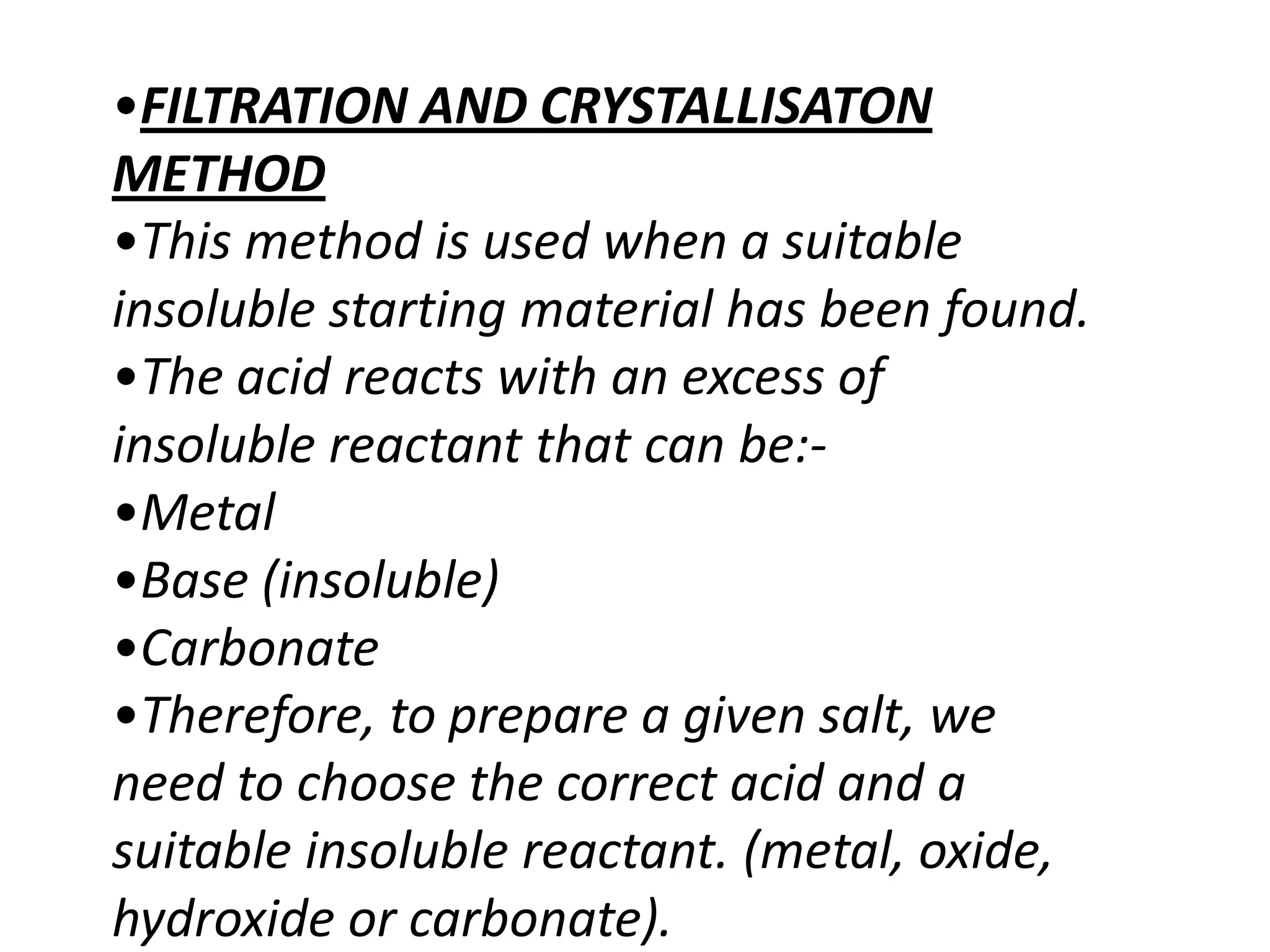
•FILTRATION AND CRYSTALLISATON
METHOD
•This method is used when a suitable
insoluble starting material has been found.
•The acid reacts with an excess of
insoluble reactant that can be:-
•Metal
•Base (insoluble)
•Carbonate
•Therefore, to prepare a given salt, we
need to choose the correct acid and a
suitable insoluble reactant. (metal, oxide,
hydroxide or carbonate).
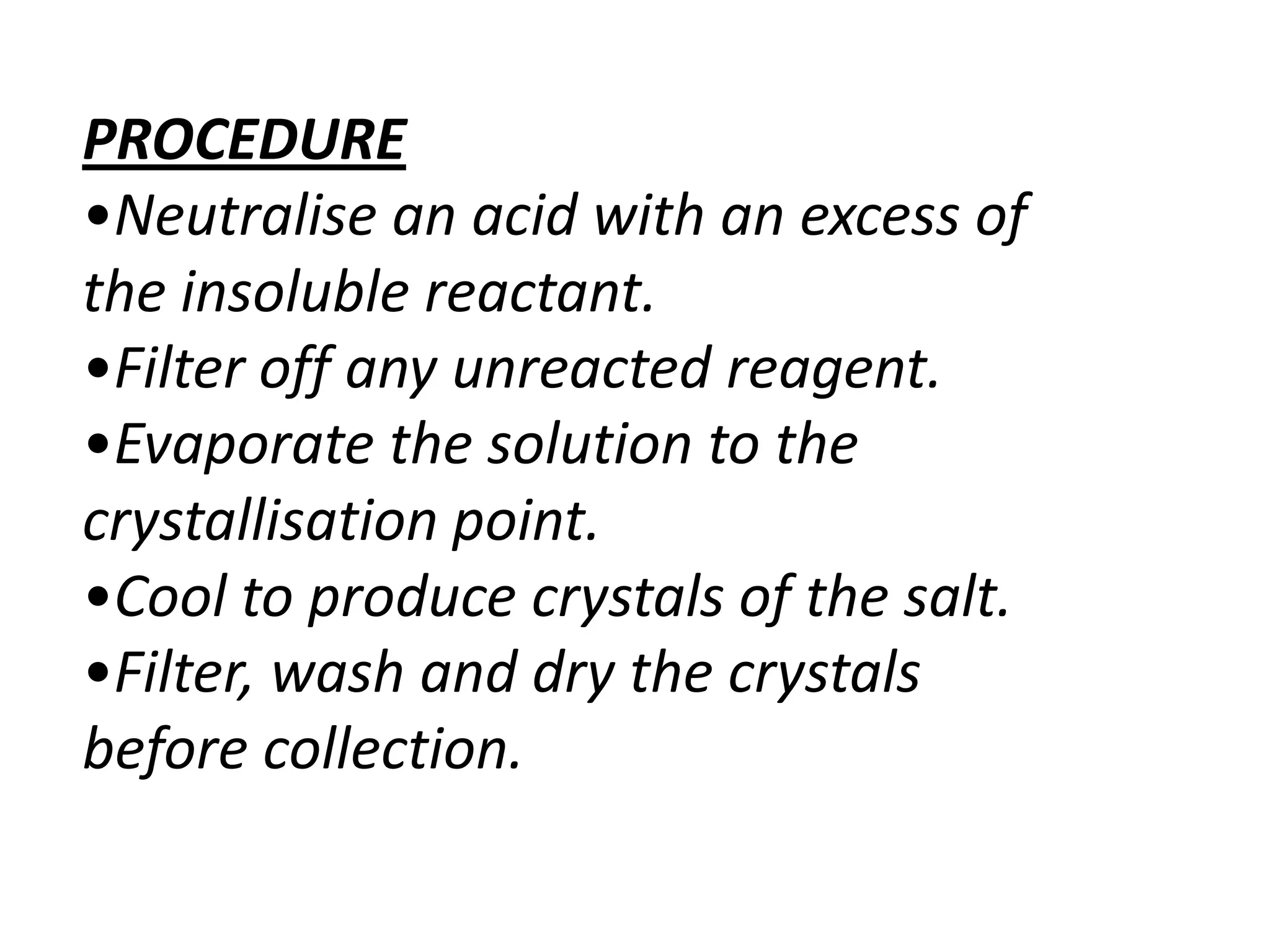
PROCEDURE
•Neutralise an acid with an excess of
the insoluble reactant.
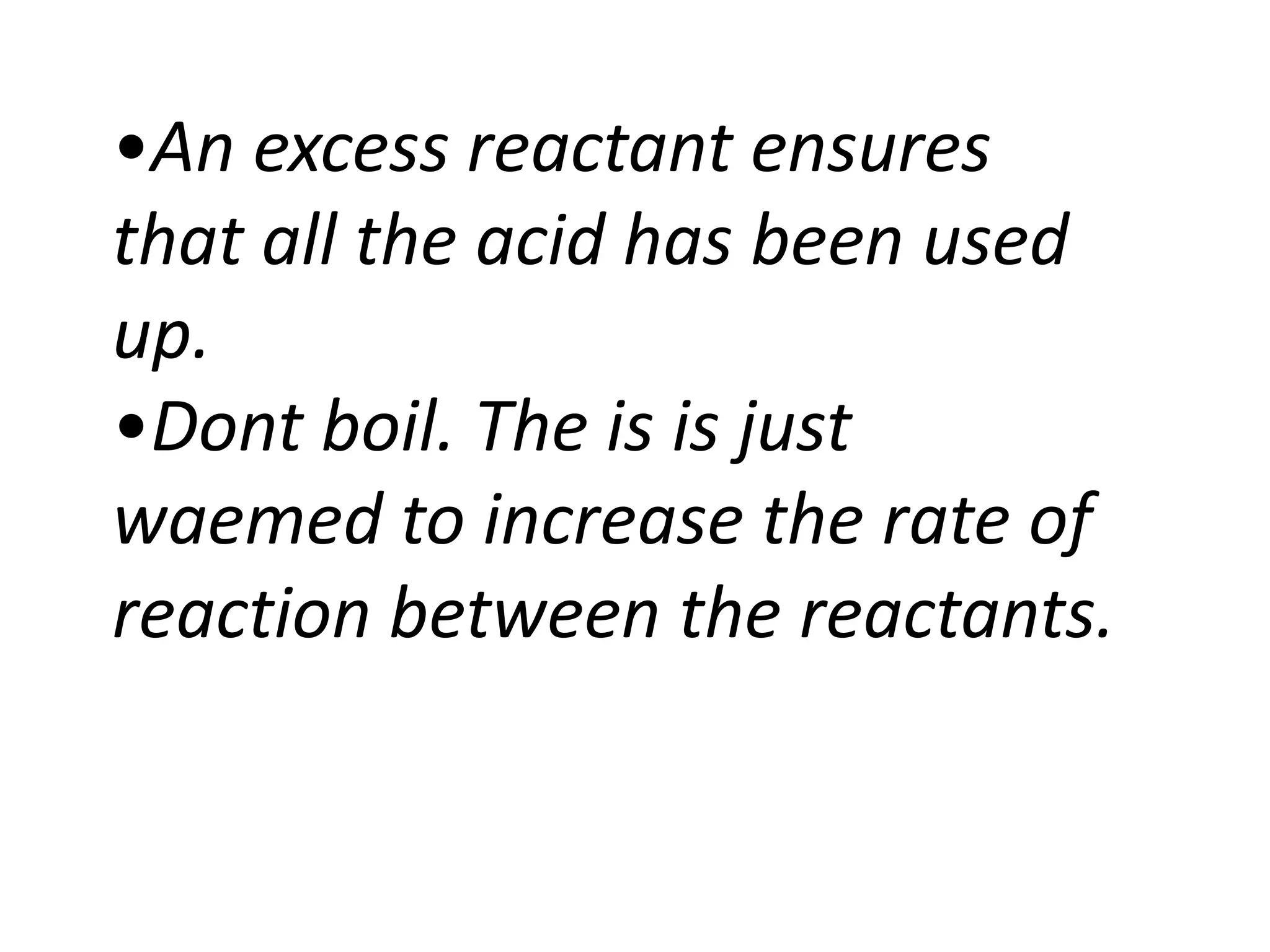
•Filter off any unreacted reagent.
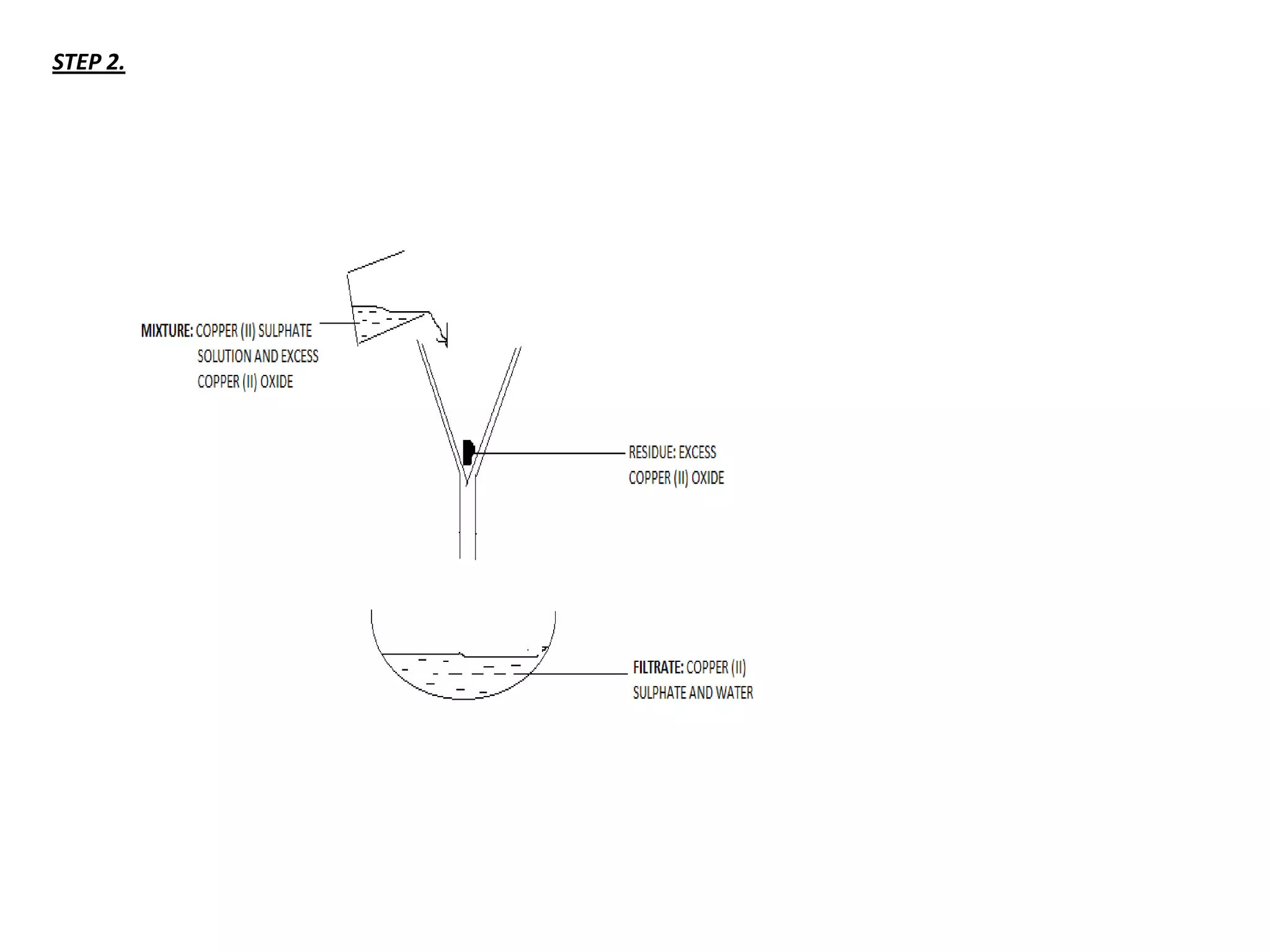
•Evaporate the solution to the
crystallisation point.
•Cool to produce crystals of the salt.
•Filter, wash and dry the crystals
before collection.
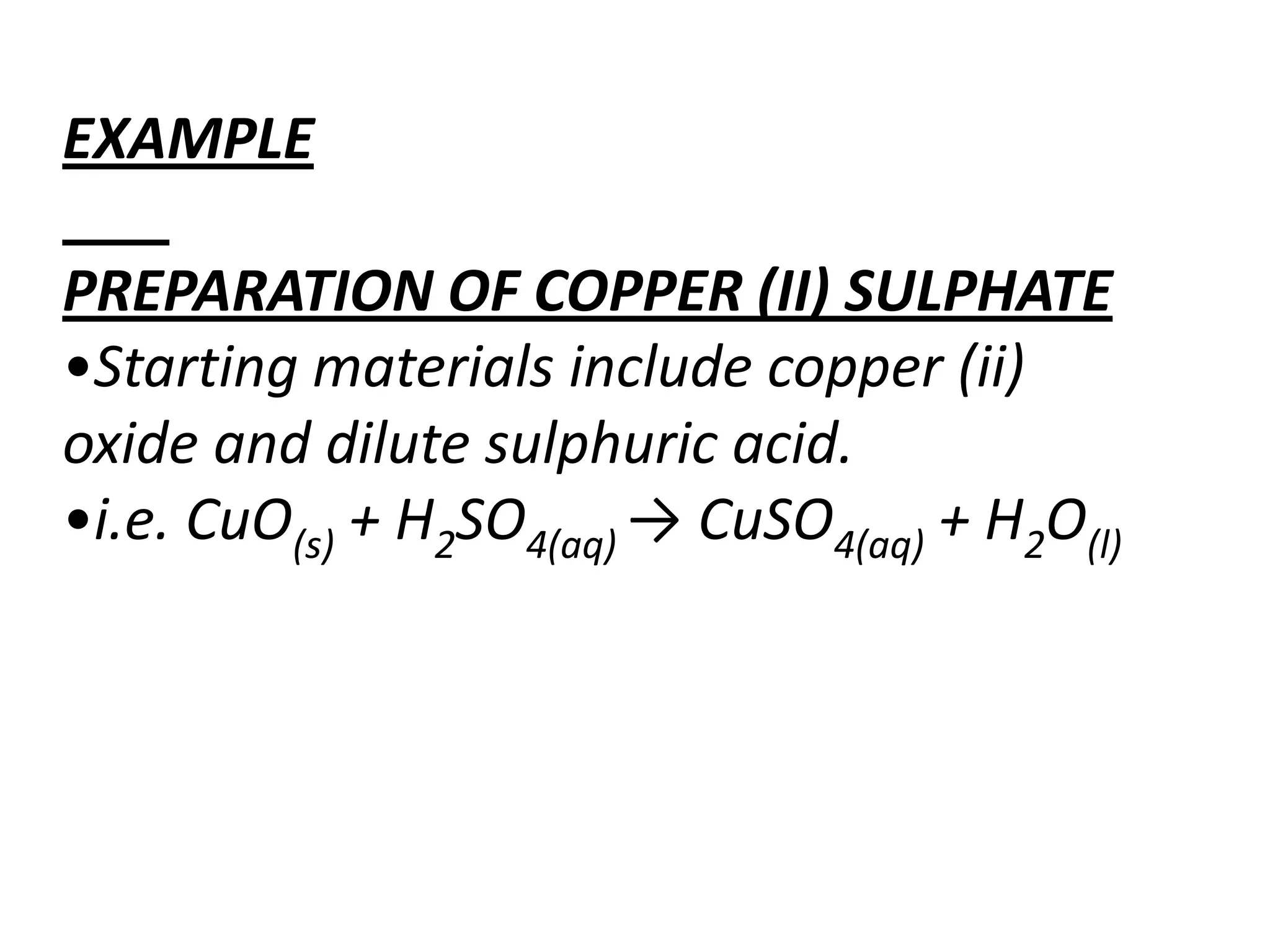
EXAMPLE

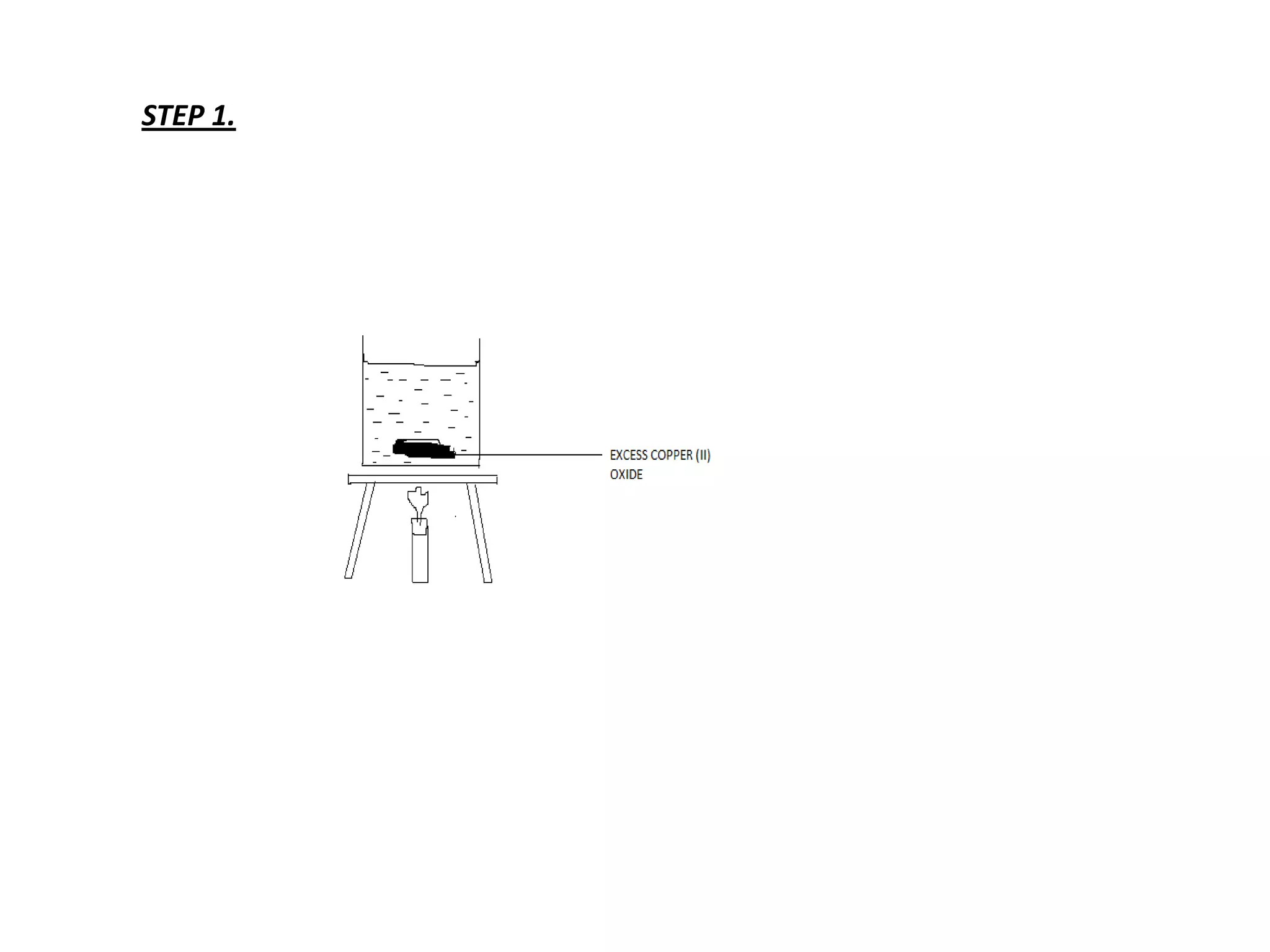
PREPARATION OF COPPER (II) SULPHATE
•Starting materials include copper (ii)
oxide and dilute sulphuric acid.
•i.e. CuO(s) + H2SO4(aq) → CuSO4(aq) + H2O(l)
STEP 1.
•An excess reactant ensures
that all the acid has been used
up.
•Dont boil. The is is just
waemed to increase the rate of
reaction between the reactants.
STEP 2.
STEP 3 AND 4.


•Dont evaporate all the water. The filtrate is heated until a
thin crust of cystals form on the surface of the liquid.
NOTE:
•If a metal carbonate is used to
prepare a salt using this method,
there will be bubbles of carbon
dioxide gas as the metal carbonate is
added to the acid in step 1.
•When there is no more bubbles, it
means that all the acid has been used
up and we can proceed to the next
step.
•TITRATION
•Soluble salts of ammonium and group I
metals (sodium, potassium and lithium) are
prepared using this method.
•This is because all their compounds are
soluble (including metals themselves) and
very reactive.
•Group I metals are very reactive resulting
in too violent reactions that we cannot use
excess reactant.
NOTE:
•Titration means using the EXACT
quantities of reactants for the
reaction.
•This method is used when it is not
possible to find a suitable insoluble
starting material like a metal, metal
oxide or a carbonate that can be easily
filtered off at the end of the reaction.
INDICATOR
•In titration, an indicator is needed to
show the endpoint of one reactant
needed to exactly neutralise a given
volume of the other reactant.
•A common indicator used in the
laboratory is the screened methyl
orange.
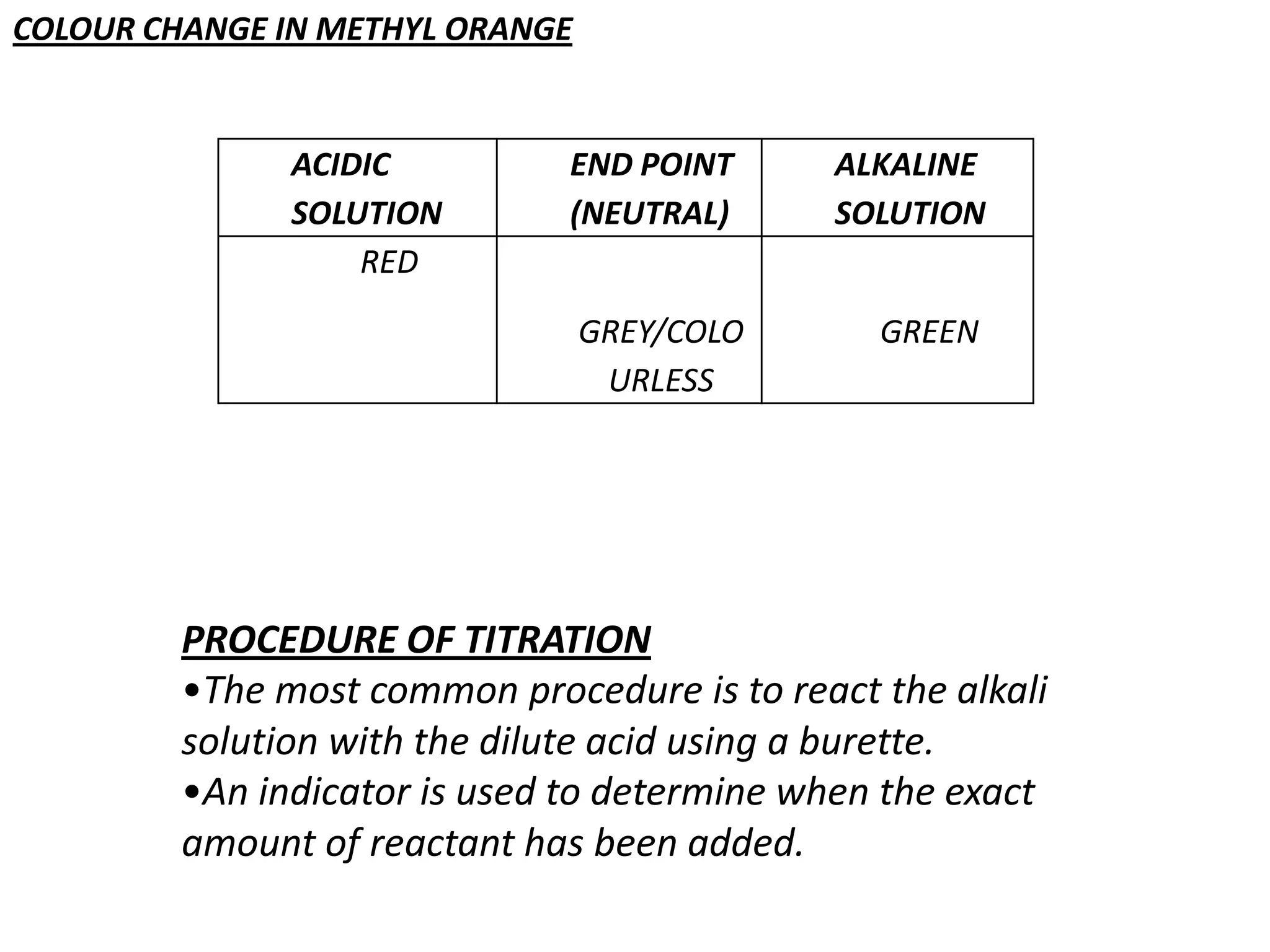
COLOUR CHANGE IN METHYL ORANGE


               ACIDIC         END POINT      ALKALINE
               SOLUTION       (NEUTRAL)      SOLUTION
                   RED
                                 GREY/COLO      GREEN
                                  URLESS


         PROCEDURE OF TITRATION
         •The most common procedure is to react the alkali
         solution with the dilute acid using a burette.
         •An indicator is used to determine when the exact
         amount of reactant has been added.
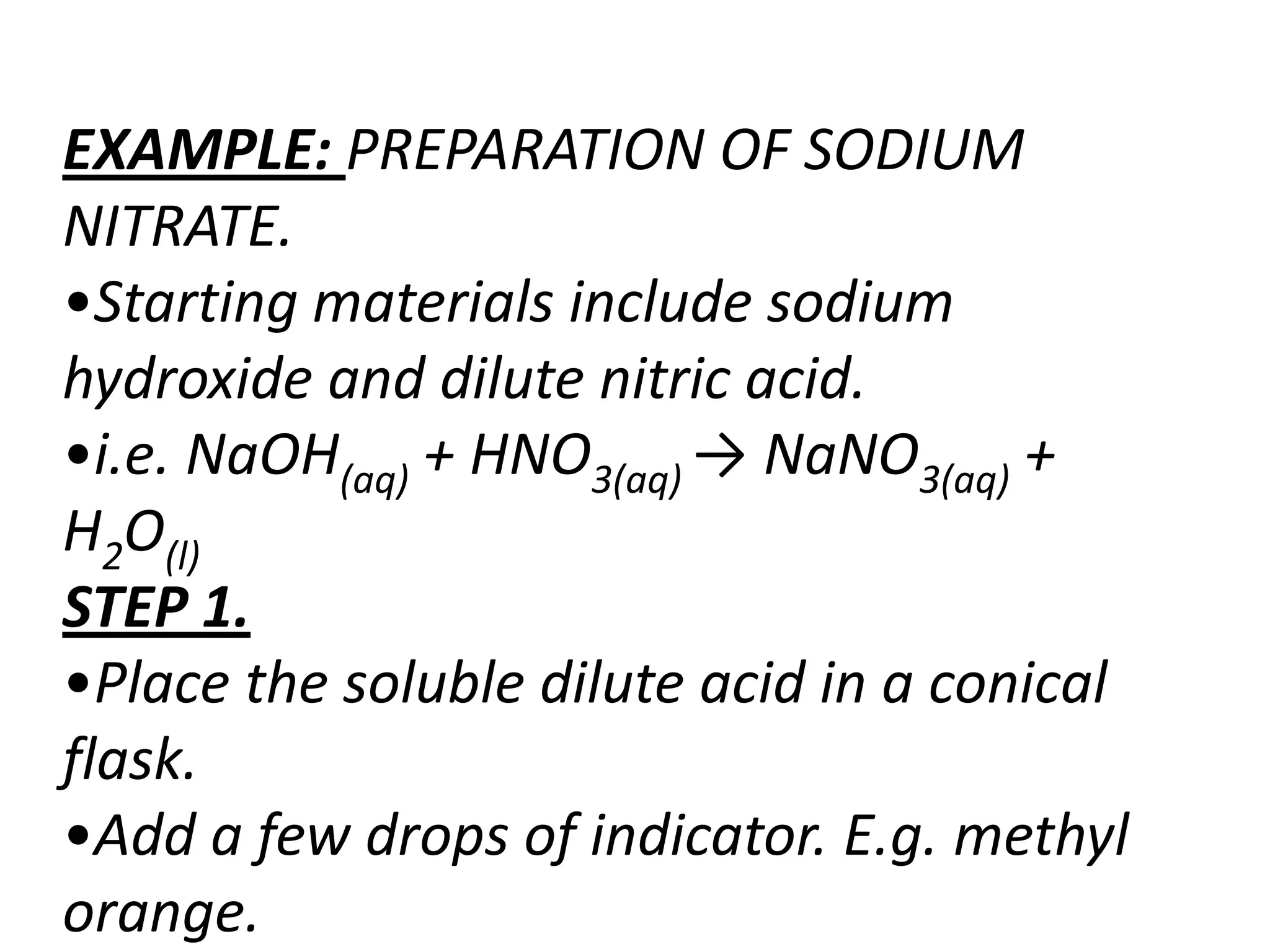
EXAMPLE: PREPARATION OF SODIUM
NITRATE.
•Starting materials include sodium
hydroxide and dilute nitric acid.
•i.e. NaOH(aq) + HNO3(aq) → NaNO3(aq) +
H2O(l)
STEP 1.
•Place the soluble dilute acid in a conical
flask.
•Add a few drops of indicator. E.g. methyl
orange.
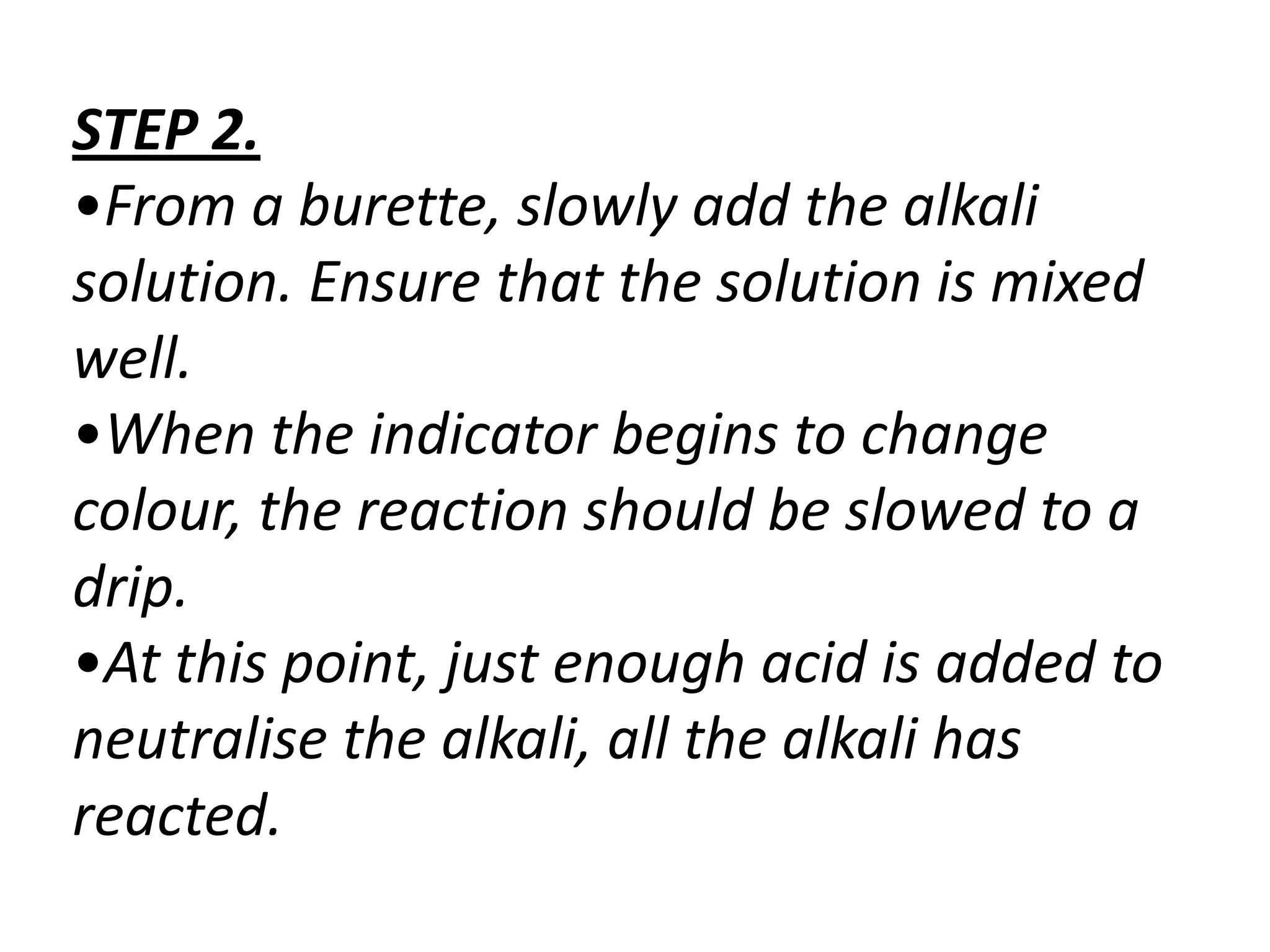
STEP 2.
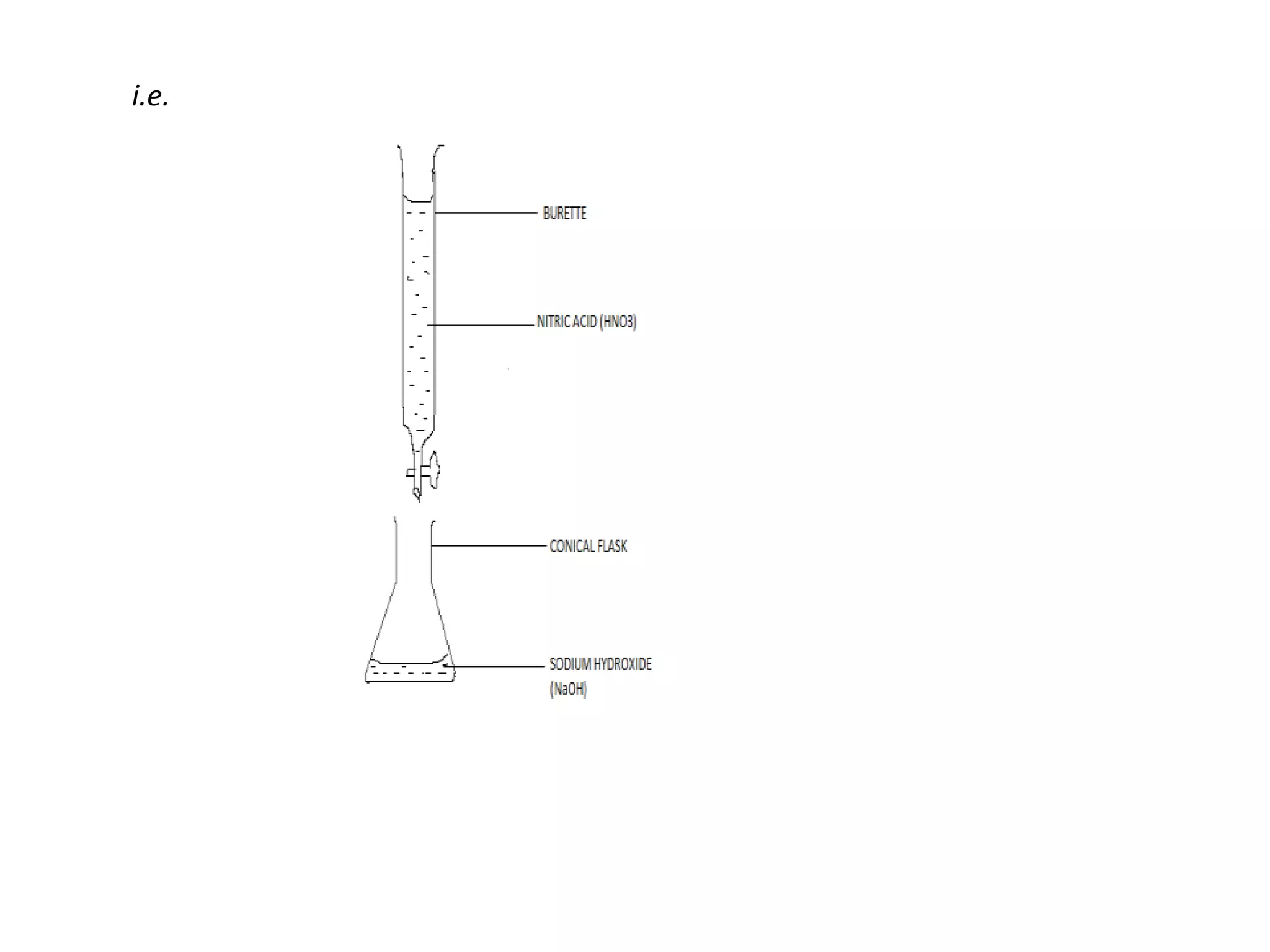
•From a burette, slowly add the alkali
solution. Ensure that the solution is mixed
well.
•When the indicator begins to change
colour, the reaction should be slowed to a
drip.
•At this point, just enough acid is added to
neutralise the alkali, all the alkali has
reacted.
i.e.
STEP 3.
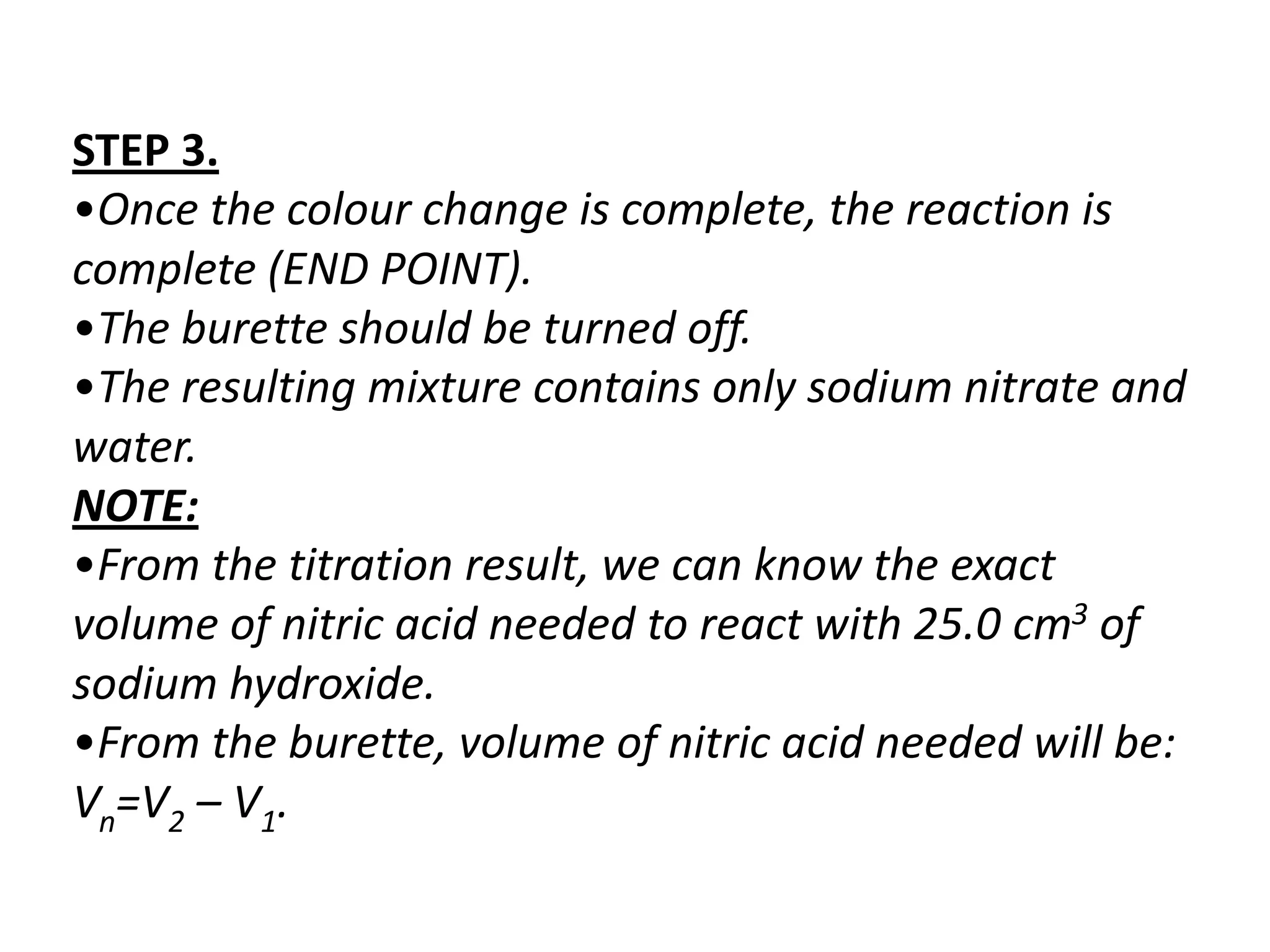
•Once the colour change is complete, the reaction is
complete (END POINT).
•The burette should be turned off.
•The resulting mixture contains only sodium nitrate and
water.
NOTE:
•From the titration result, we can know the exact
volume of nitric acid needed to react with 25.0 cm3 of
sodium hydroxide.
•From the burette, volume of nitric acid needed will be:
Vn=V2 – V1.
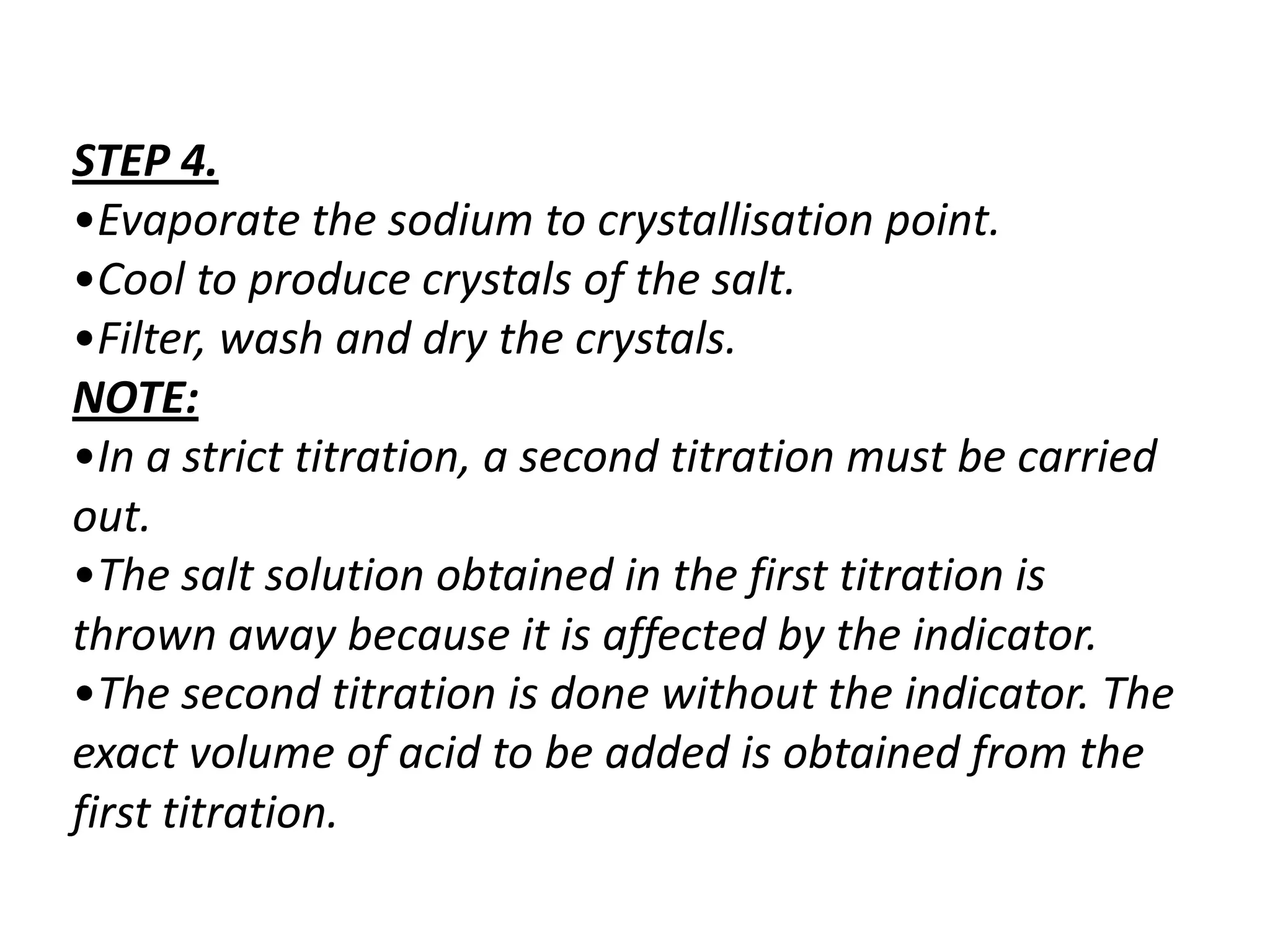
STEP 4.
•Evaporate the sodium to crystallisation point.
•Cool to produce crystals of the salt.
•Filter, wash and dry the crystals.
NOTE:
•In a strict titration, a second titration must be carried
out.
•The salt solution obtained in the first titration is
thrown away because it is affected by the indicator.
•The second titration is done without the indicator. The
exact volume of acid to be added is obtained from the
first titration.

Salts and their preparation power point

  • 1.
    SALTS A salt is a compound formed when the hydrogen ions in an acid are replaced by metal ions or by ammonium ions. Compounds in which the H+ ions in an acid have been replaced by ammonium ions (NH4+) are called ammonium salts.
  • 2.
    NOTE: •An anion isa negatively charged ion. Hence:- •Hydrochloric acid gives chlorides. E.g. sodium chloride, ammonium chloride. •Nitric acid gives nitrates. E.g. barium nitrate, copper nitrate. •Sulphuric acid gives sulphates. E.g. silver sulphate, iron (ii) sulphate. •Phosphoric acid gives phosphates. E.g. sodium phosphate, ammonium phosphate. •Each acid gives rise to a series of salts named by the ANION which they contain.
  • 3.
    •Some acids candonate more than one replaceable hydrogen ion (proton) •E.g. sulphuric acid (H2SO4) and phosphoric acid (H3PO4). •Sulphuric acid can give rise to two series of salts and phosphoric acid to three series of salts depending on how many protons are replaced. •i.e. (a) H2SO4 → NaHSO4 → Na2SO4 (b) H3PO4 → NaH2PO4 → Na2HPO4 → Na3PO4
  • 4.
    •NORMAL SALTS- Theseare salts which do not contain replaceable hydrogen. E.g. sodium chloride (NaCl). •ACIDIC SALTS-These are salts which contain replaceable hydrogen. This is because when the hydrogen is replaced they are acting like an acid. E.g. sodium hydrogen sulphate (NaHSO4). •The method chosen to prepare a salt depends on its solubility. •Solubility depends on the combination of positive and negative ions.
  • 5.
    SOLUBILITY RULES SOLUBLE INSOLUBLE 1 All nitrates All carbonates except for sodium, potassium and ammonium carbonates 2 All chlorides except for silver chloride and All sulphides except lead (ii) chloride for sodium, potassium and ammonium sulphides 3 All sulphates except for calcium, barium All oxides except for and lead (ii) sulphates sodium potassium and ammonium oxides 4 All sodium, potassium (even other group I All hydroxides except elements), ammonium and nitrate for sodium, compounds are soluble potassium(group I), ammonium and calcium hydroxides
  • 6.
    NOTE: •Insoluble salts areprepared by PRECIPITATION. •Soluble salts are prepared by FILTRATION and CRYSTALLISATION method or by TITRATTION. PREPARATION OF INSOLUBLE SALTS •Insoluble salts are prepared by mixing solutions containing their positive and negative ions using the method of precipitation (Double decomposition). •The reactants are chosen so that on exchanging ions the unwanted product is still soluble but the given insoluble salt will form as a precipitate. •I.e. soluble salt + soluble salt → soluble salt + insoluble salt (precipitate).
  • 7.
    NOTE: •A precipitate isan insoluble solid formed when a chemical reaction occurs between two dissolved ionic substances. CHOOSING REACTANT SOLUTIONS •The other one must contain the negative ion of the insoluble salt required. PROCEDURE OF PRECIPITATION •Dissolve each reactant separately in water. •Mix chemically equivalent quantities of the reactant solutions. •Filter the solution and wash the precipitate in warm distilled water. •One must contain the positive ion of the insoluble salt required.
  • 8.
    •Dry the solidsalt that was produced in an oven (105oC). EXAMPLES •PREPARATION OF BARIUM SULPHATE (BaSO4) •We can use barium nitrate and sodium sulphate. REACTANT IONS Ba2+ NO3− → NaNO3 (soluble) Na+ SO42− → BaSO4 (Insoluble)
  • 9.
    •PREPARATION OF SILVERCHLORIDE(AgCl) •We can use silver nitrate and sodium chloride. REACTANT IONS Ag+ NO3− → NaNO3 (soluble) Na+ Cl− →AgCl (insoluble) NOTE: •The easiest salt solution containing the positive ions is the metal nitrate since all nitrates are soluble. •For a solution containing the negative ions, we can use the sodium salt as all sodium salts are soluble.
  • 10.
    •PREPARATION OF LEAD(II) IODIDE(PbI2) I.e. Pb (NO3)2(aq) + 2NaI (aq) → PbI2(s) + 2NaNO3 (aq) IONICALLY I.e. Pb2+ (aq) + 2I− (aq) → PbI2(s)
  • 12.
    NOTE: •The reactants involvedin a precipitation reaction must be in solution form because the ions must be able to move and interact with one another when the reactants are mixed. •When the ions in the insoluble salt encounter each other, they get attracted and form a solid that will sink to the bottom of the container and be collected as a PRECIPITATE.
  • 13.
    PREPARATION OF SOLUBLESALTS. •Soluble salts are prepared using two methods: •Filtration and crystallisation method. i.e neutralising an ACID with EXCESS INSOLUBLE REACTANT. •Titration. i.e. neutralising an ACID with the EXACT amount of ALKALI.
  • 14.
    •FILTRATION AND CRYSTALLISATON METHOD •Thismethod is used when a suitable insoluble starting material has been found. •The acid reacts with an excess of insoluble reactant that can be:- •Metal •Base (insoluble) •Carbonate •Therefore, to prepare a given salt, we need to choose the correct acid and a suitable insoluble reactant. (metal, oxide, hydroxide or carbonate).
  • 15.
    PROCEDURE •Neutralise an acidwith an excess of the insoluble reactant. •Filter off any unreacted reagent. •Evaporate the solution to the crystallisation point. •Cool to produce crystals of the salt. •Filter, wash and dry the crystals before collection.
  • 16.
    EXAMPLE PREPARATION OF COPPER(II) SULPHATE •Starting materials include copper (ii) oxide and dilute sulphuric acid. •i.e. CuO(s) + H2SO4(aq) → CuSO4(aq) + H2O(l)
  • 17.
  • 18.
    •An excess reactantensures that all the acid has been used up. •Dont boil. The is is just waemed to increase the rate of reaction between the reactants.
  • 19.
  • 20.
    STEP 3 AND4. •Dont evaporate all the water. The filtrate is heated until a thin crust of cystals form on the surface of the liquid.
  • 21.
    NOTE: •If a metalcarbonate is used to prepare a salt using this method, there will be bubbles of carbon dioxide gas as the metal carbonate is added to the acid in step 1. •When there is no more bubbles, it means that all the acid has been used up and we can proceed to the next step.
  • 22.
    •TITRATION •Soluble salts ofammonium and group I metals (sodium, potassium and lithium) are prepared using this method. •This is because all their compounds are soluble (including metals themselves) and very reactive. •Group I metals are very reactive resulting in too violent reactions that we cannot use excess reactant.
  • 23.
    NOTE: •Titration means usingthe EXACT quantities of reactants for the reaction. •This method is used when it is not possible to find a suitable insoluble starting material like a metal, metal oxide or a carbonate that can be easily filtered off at the end of the reaction.
  • 24.
    INDICATOR •In titration, anindicator is needed to show the endpoint of one reactant needed to exactly neutralise a given volume of the other reactant. •A common indicator used in the laboratory is the screened methyl orange.
  • 25.
    COLOUR CHANGE INMETHYL ORANGE ACIDIC END POINT ALKALINE SOLUTION (NEUTRAL) SOLUTION RED GREY/COLO GREEN URLESS PROCEDURE OF TITRATION •The most common procedure is to react the alkali solution with the dilute acid using a burette. •An indicator is used to determine when the exact amount of reactant has been added.
  • 26.
    EXAMPLE: PREPARATION OFSODIUM NITRATE. •Starting materials include sodium hydroxide and dilute nitric acid. •i.e. NaOH(aq) + HNO3(aq) → NaNO3(aq) + H2O(l) STEP 1. •Place the soluble dilute acid in a conical flask. •Add a few drops of indicator. E.g. methyl orange.
  • 27.
    STEP 2. •From aburette, slowly add the alkali solution. Ensure that the solution is mixed well. •When the indicator begins to change colour, the reaction should be slowed to a drip. •At this point, just enough acid is added to neutralise the alkali, all the alkali has reacted.
  • 28.
  • 29.
    STEP 3. •Once thecolour change is complete, the reaction is complete (END POINT). •The burette should be turned off. •The resulting mixture contains only sodium nitrate and water. NOTE: •From the titration result, we can know the exact volume of nitric acid needed to react with 25.0 cm3 of sodium hydroxide. •From the burette, volume of nitric acid needed will be: Vn=V2 – V1.
  • 30.
    STEP 4. •Evaporate thesodium to crystallisation point. •Cool to produce crystals of the salt. •Filter, wash and dry the crystals. NOTE: •In a strict titration, a second titration must be carried out. •The salt solution obtained in the first titration is thrown away because it is affected by the indicator. •The second titration is done without the indicator. The exact volume of acid to be added is obtained from the first titration.