Lab Tests, results, and Sulphuric acid
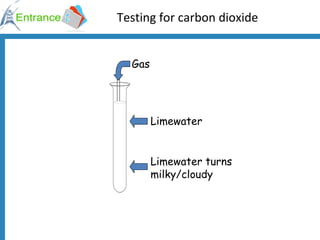
Testing for carbon dioxide Gas Limewater turns milky/cloudy Limewater
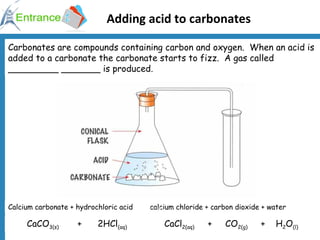
Adding acid to carbonates Carbonates are compounds containing carbon and oxygen.  When an acid is added to a carbonate the carbonate starts to fizz.  A gas called _________ _______ is produced.  Calcium carbonate + hydrochloric acid  calcium chloride + carbon dioxide + water CaCO 3(s)   +  2HCl (aq)   CaCl 2(aq)   +  CO 2(g)   +  H 2 O (l)
Flame tests Compound Colour of flame
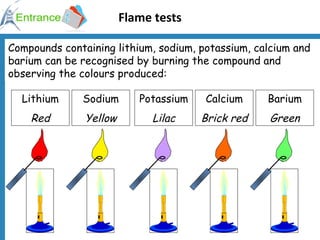
Flame tests Compounds containing lithium, sodium, potassium, calcium and barium can be recognised by burning the compound and observing the colours produced: Lithium Red Sodium Yellow Potassium Lilac Calcium Brick red Barium Green
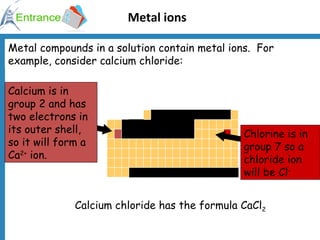
Metal ions Metal compounds in a solution contain metal ions.  For example, consider calcium chloride: Calcium chloride has the formula CaCl 2 Chlorine is in group 7 so a chloride ion will be Cl - Calcium is in group 2 and has two electrons in its outer shell, so it will form a Ca 2+  ion.
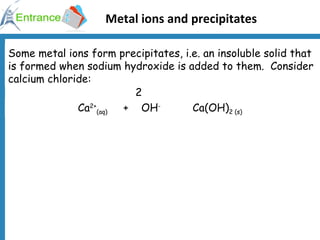
Metal ions and precipitates Some metal ions form precipitates, i.e. an insoluble solid that is formed when sodium hydroxide is added to them.  Consider calcium chloride: 2 Ca 2+ (aq)   +  OH -   Ca(OH) 2 (s)
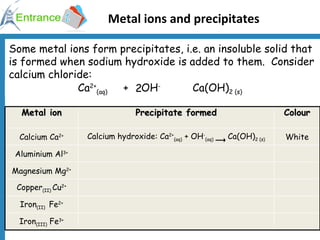
Metal ions and precipitates Some metal ions form precipitates, i.e. an insoluble solid that is formed when sodium hydroxide is added to them.  Consider calcium chloride: 2 Ca 2+ (aq)   +  OH -   Ca(OH) 2 (s) Metal ion Precipitate formed Colour Calcium Ca 2+ Calcium hydroxide: Ca 2+ (aq)  + OH - (aq)   Ca(OH) 2 (s) White Aluminium Al 3+ Magnesium Mg 2+ Copper (II)  Cu 2+ Iron (II)  Fe 2+ Iron (III)  Fe 3+
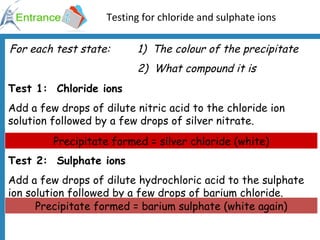
Testing for chloride and sulphate ions Test 1:  Chloride ions Add a few drops of dilute nitric acid to the chloride ion solution followed by a few drops of silver nitrate. Test 2:  Sulphate ions Add a few drops of dilute hydrochloric acid to the sulphate ion solution followed by a few drops of barium chloride. Precipitate formed = silver chloride (white) Precipitate formed = barium sulphate (white again) For each test state: 1)  The colour of the precipitate 2)  What compound it is
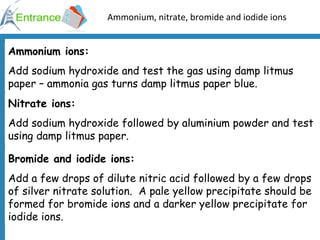
Ammonium, nitrate, bromide and iodide ions Ammonium ions: Add sodium hydroxide and test the gas using damp litmus paper – ammonia gas turns damp litmus paper blue. Nitrate ions: Add sodium hydroxide followed by aluminium powder and test using damp litmus paper. Bromide and iodide ions: Add a few drops of dilute nitric acid followed by a few drops of silver nitrate solution.  A pale yellow precipitate should be formed for bromide ions and a darker yellow precipitate for iodide ions.
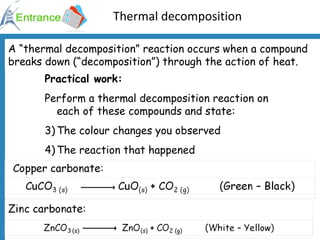
Thermal decomposition 01/04/11 A “thermal decomposition” reaction occurs when a compound breaks down (“decomposition”) through the action of heat. Practical work: Perform a thermal decomposition reaction on each of these compounds and state: The colour changes you observed The reaction that happened
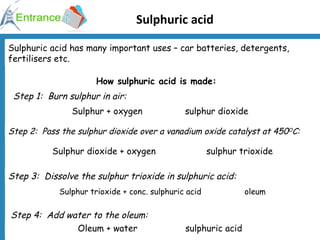
Sulphuric acid Sulphuric acid has many important uses – car batteries, detergents, fertilisers etc. How sulphuric acid is made: Step 1:  Burn sulphur in air: Step 2:  Pass the sulphur dioxide over a vanadium oxide catalyst at 450 O C: Step 3:  Dissolve the sulphur trioxide in sulphuric acid: Step 4:  Add water to the oleum: Sulphur + oxygen  sulphur dioxide Sulphur trioxide + conc. sulphuric acid  oleum Sulphur dioxide + oxygen  sulphur trioxide Oleum + water  sulphuric acid
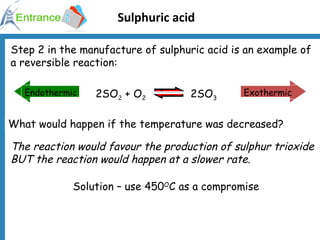
Sulphuric acid Step 2 in the manufacture of sulphuric acid is an example of a reversible reaction: What would happen if the temperature was decreased? Solution – use 450 O C as a compromise The reaction would favour the production of sulphur trioxide BUT the reaction would happen at a slower rate. 2SO 2  + O 2   2SO 3 Exothermic Endothermic

Lab tests ok1294990656

  • 1.
    Lab Tests, results,and Sulphuric acid
  • 2.
    Testing for carbondioxide Gas Limewater turns milky/cloudy Limewater
  • 3.
    Adding acid tocarbonates Carbonates are compounds containing carbon and oxygen. When an acid is added to a carbonate the carbonate starts to fizz. A gas called _________ _______ is produced. Calcium carbonate + hydrochloric acid calcium chloride + carbon dioxide + water CaCO 3(s) + 2HCl (aq) CaCl 2(aq) + CO 2(g) + H 2 O (l)
  • 4.
    Flame tests CompoundColour of flame
  • 5.
    Flame tests Compoundscontaining lithium, sodium, potassium, calcium and barium can be recognised by burning the compound and observing the colours produced: Lithium Red Sodium Yellow Potassium Lilac Calcium Brick red Barium Green
  • 6.
    Metal ions Metalcompounds in a solution contain metal ions. For example, consider calcium chloride: Calcium chloride has the formula CaCl 2 Chlorine is in group 7 so a chloride ion will be Cl - Calcium is in group 2 and has two electrons in its outer shell, so it will form a Ca 2+ ion.
  • 7.
    Metal ions andprecipitates Some metal ions form precipitates, i.e. an insoluble solid that is formed when sodium hydroxide is added to them. Consider calcium chloride: 2 Ca 2+ (aq) + OH - Ca(OH) 2 (s)
  • 8.
    Metal ions andprecipitates Some metal ions form precipitates, i.e. an insoluble solid that is formed when sodium hydroxide is added to them. Consider calcium chloride: 2 Ca 2+ (aq) + OH - Ca(OH) 2 (s) Metal ion Precipitate formed Colour Calcium Ca 2+ Calcium hydroxide: Ca 2+ (aq) + OH - (aq) Ca(OH) 2 (s) White Aluminium Al 3+ Magnesium Mg 2+ Copper (II) Cu 2+ Iron (II) Fe 2+ Iron (III) Fe 3+
  • 9.
    Testing for chlorideand sulphate ions Test 1: Chloride ions Add a few drops of dilute nitric acid to the chloride ion solution followed by a few drops of silver nitrate. Test 2: Sulphate ions Add a few drops of dilute hydrochloric acid to the sulphate ion solution followed by a few drops of barium chloride. Precipitate formed = silver chloride (white) Precipitate formed = barium sulphate (white again) For each test state: 1) The colour of the precipitate 2) What compound it is
  • 10.
    Ammonium, nitrate, bromideand iodide ions Ammonium ions: Add sodium hydroxide and test the gas using damp litmus paper – ammonia gas turns damp litmus paper blue. Nitrate ions: Add sodium hydroxide followed by aluminium powder and test using damp litmus paper. Bromide and iodide ions: Add a few drops of dilute nitric acid followed by a few drops of silver nitrate solution. A pale yellow precipitate should be formed for bromide ions and a darker yellow precipitate for iodide ions.
  • 11.
    Thermal decomposition 01/04/11A “thermal decomposition” reaction occurs when a compound breaks down (“decomposition”) through the action of heat. Practical work: Perform a thermal decomposition reaction on each of these compounds and state: The colour changes you observed The reaction that happened
  • 12.
    Sulphuric acid Sulphuricacid has many important uses – car batteries, detergents, fertilisers etc. How sulphuric acid is made: Step 1: Burn sulphur in air: Step 2: Pass the sulphur dioxide over a vanadium oxide catalyst at 450 O C: Step 3: Dissolve the sulphur trioxide in sulphuric acid: Step 4: Add water to the oleum: Sulphur + oxygen sulphur dioxide Sulphur trioxide + conc. sulphuric acid oleum Sulphur dioxide + oxygen sulphur trioxide Oleum + water sulphuric acid
  • 13.
    Sulphuric acid Step2 in the manufacture of sulphuric acid is an example of a reversible reaction: What would happen if the temperature was decreased? Solution – use 450 O C as a compromise The reaction would favour the production of sulphur trioxide BUT the reaction would happen at a slower rate. 2SO 2 + O 2 2SO 3 Exothermic Endothermic