June 06, 2011


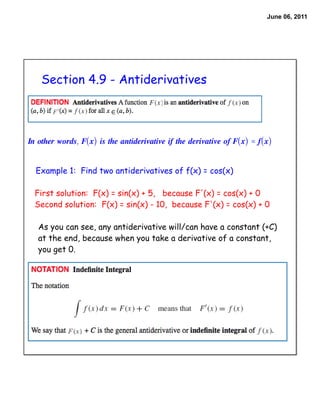
    Section 4.9 - Antiderivatives


In other words, F(x) is the antiderivative if the derivative of F(x) = f(x)


  Example 1: Find two antiderivatives of f(x) = cos(x)

  First solution: F(x) = sin(x) + 5, because F'(x) = cos(x) + 0
  Second solution: F(x) = sin(x) - 10, because F'(x) = cos(x) + 0

   As you can see, any antiderivative will/can have a constant (+C)
   at the end, because when you take a derivative of a constant,
   you get 0.
June 06, 2011

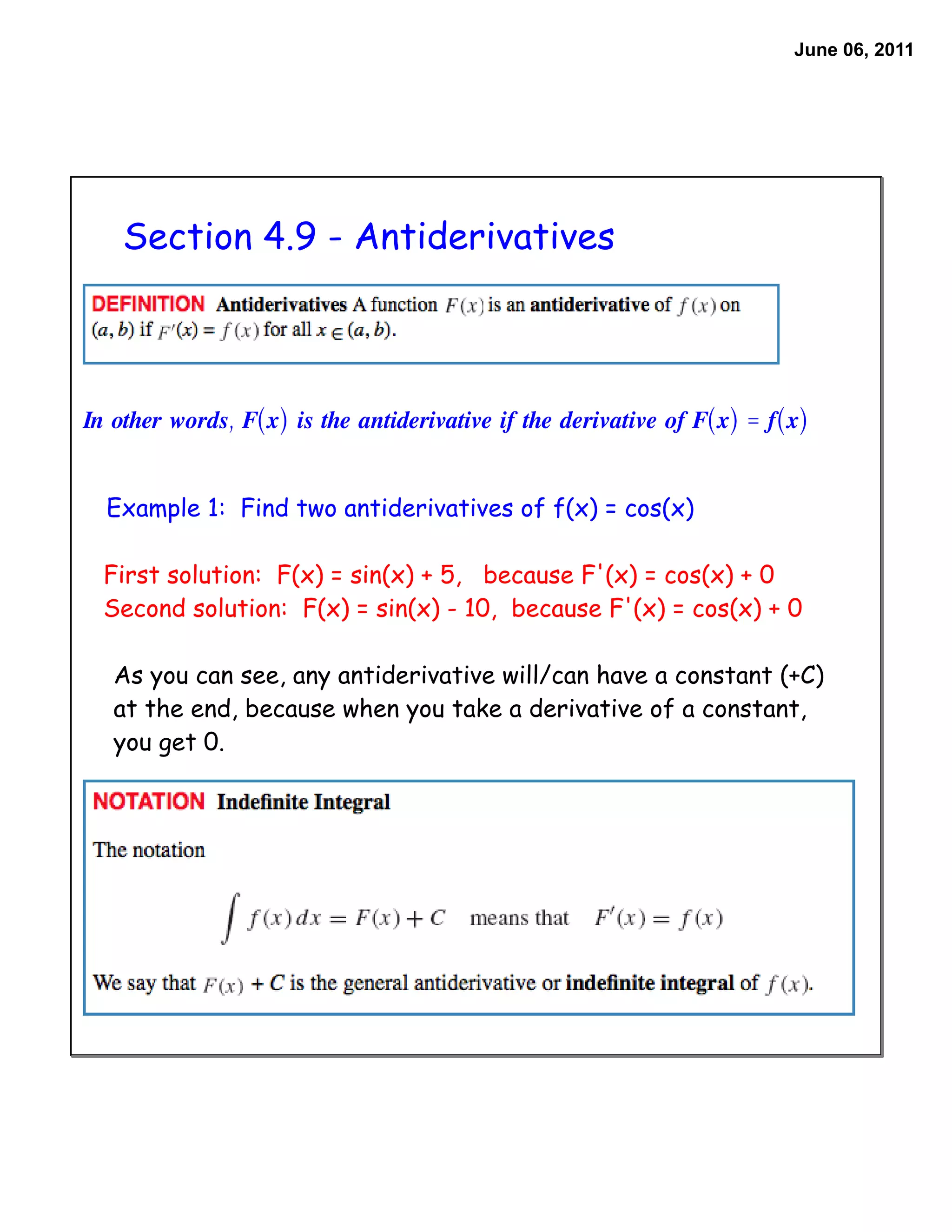
Taking an antiderivative is like un-doing a derivative.
To take a derivative using the power rule, we multiply by the
exponent then subtract one from the exponent.


 So...the "inverse" would be to add one to the exponent, then divide
 by the exponent. Theorem 2, states this in mathematical terms.


    Let's look at a quick problem. Evaluate

 Using the power rule, we will add one to the exponent making it a
 4, then we will divide by the exponent. So....


   A few rules that help us find antiderivatives


 The sum rule just tells us that we can integrate terms separately.
 THe multiple rule tells us that if a constant is multiplying out
 function, we can bring it outside the integral sign and multiply.


  Example 2: Evaluate
First, using the sum rule, we break apart the integral into 3 integrals


Second, we use the multiple rule and bring out any constants
that are multiplying our terms.


  Now we can apply the power rule to each term


                                 =


              Flip and multiply!
June 06, 2011


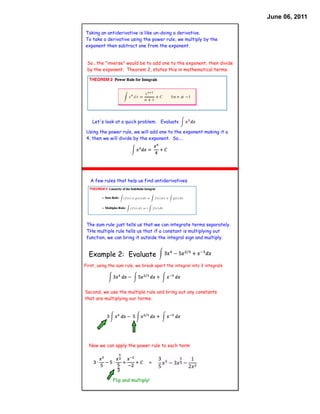
   More flashcards!!! Antiderivatives that
          need to be memorized!!!!!

   1.                                    2.


    3-8


So far, antiderivates can only be found if we are "un-doing" a
power rule. (If you have a function that requires a power rule to
differentiate, then you can use the power rule for integrals to
find the antiderivative.)
If you are finding an antiderivative of a function that would
require a product/quotient/chain rule to differentiate, then
we do not yet have the tools to find the antiderivative!!!

Special cases: If our function has a "linear" chain rule, we have a
way to find the antiderivative.


Example of the special case (linear chain rule)


                                        (Use the two rules we learned)

   k=2                            k=3
        Both linear chain rules

                                               Notice: THE ANGLES
 Answer:
                                               DO NOT CHANGE :)
June 06, 2011


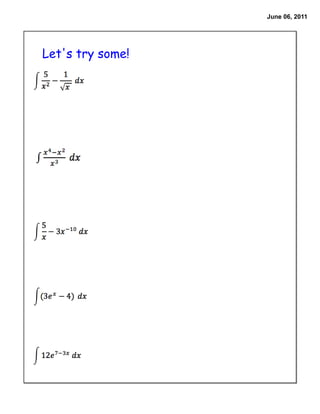
Let's try some!

Section 4.9

  • 1.
    June 06, 2011 Section 4.9 - Antiderivatives In other words, F(x) is the antiderivative if the derivative of F(x) = f(x) Example 1: Find two antiderivatives of f(x) = cos(x) First solution: F(x) = sin(x) + 5, because F'(x) = cos(x) + 0 Second solution: F(x) = sin(x) - 10, because F'(x) = cos(x) + 0 As you can see, any antiderivative will/can have a constant (+C) at the end, because when you take a derivative of a constant, you get 0.
  • 2.
    June 06, 2011 Takingan antiderivative is like un-doing a derivative. To take a derivative using the power rule, we multiply by the exponent then subtract one from the exponent. So...the "inverse" would be to add one to the exponent, then divide by the exponent. Theorem 2, states this in mathematical terms. Let's look at a quick problem. Evaluate Using the power rule, we will add one to the exponent making it a 4, then we will divide by the exponent. So.... A few rules that help us find antiderivatives The sum rule just tells us that we can integrate terms separately. THe multiple rule tells us that if a constant is multiplying out function, we can bring it outside the integral sign and multiply. Example 2: Evaluate First, using the sum rule, we break apart the integral into 3 integrals Second, we use the multiple rule and bring out any constants that are multiplying our terms. Now we can apply the power rule to each term = Flip and multiply!
  • 3.
    June 06, 2011 More flashcards!!! Antiderivatives that need to be memorized!!!!! 1. 2. 3-8 So far, antiderivates can only be found if we are "un-doing" a power rule. (If you have a function that requires a power rule to differentiate, then you can use the power rule for integrals to find the antiderivative.) If you are finding an antiderivative of a function that would require a product/quotient/chain rule to differentiate, then we do not yet have the tools to find the antiderivative!!! Special cases: If our function has a "linear" chain rule, we have a way to find the antiderivative. Example of the special case (linear chain rule) (Use the two rules we learned) k=2 k=3 Both linear chain rules Notice: THE ANGLES Answer: DO NOT CHANGE :)
  • 4.