Section	4.5
           Optimization	Problems

                 V63.0121.027, Calculus	I


                   November	24, 2009


Announcements
   Written	HW (inc. WebAssign	from	4.4)	due	Wednesday,
   Nov. 25, 11:00am	in	my	mailbox
   Quiz	5	next	week	on	§§4.1–4.4, 4.7

                                        .   .   .   .    .   .
Thank	you	for	the	evaluations
Comments	and	requests


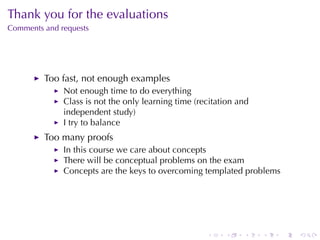
         Too	fast, not	enough	examples


                                         .   .   .   .   .   .
Thank	you	for	the	evaluations
Comments	and	requests


         Too	fast, not	enough	examples
              Not	enough	time	to	do	everything
              Class	is	not	the	only	learning	time	(recitation	and
              independent	study)
              I try	to	balance


                                                     .    .    .    .   .   .
Thank	you	for	the	evaluations
Comments	and	requests


         Too	fast, not	enough	examples
              Not	enough	time	to	do	everything
              Class	is	not	the	only	learning	time	(recitation	and
              independent	study)
              I try	to	balance
         Too	many	proofs


                                                     .    .    .    .   .   .
Thank	you	for	the	evaluations
Comments	and	requests


         Too	fast, not	enough	examples
              Not	enough	time	to	do	everything
              Class	is	not	the	only	learning	time	(recitation	and
              independent	study)
              I try	to	balance
         Too	many	proofs
              In	this	course	we	care	about	concepts
              There	will	be	conceptual	problems	on	the	exam
              Concepts	are	the	keys	to	overcoming	templated	problems


                                                     .    .    .    .   .   .
A slide	on	slides

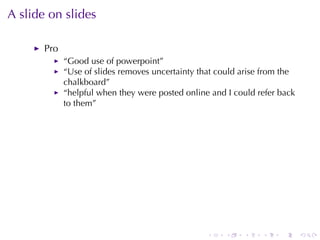
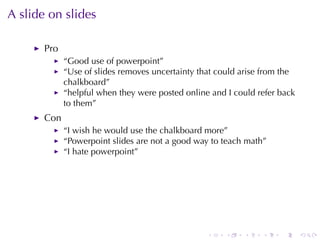
       Pro
             “Good	use	of	powerpoint”
             “Use	of	slides	removes	uncertainty	that	could	arise	from	the
             chalkboard”
             “helpful	when	they	were	posted	online	and	I could	refer	back
             to	them”


                                                  .    .   .    .    .      .
A slide	on	slides

       Pro
             “Good	use	of	powerpoint”
             “Use	of	slides	removes	uncertainty	that	could	arise	from	the
             chalkboard”
             “helpful	when	they	were	posted	online	and	I could	refer	back
             to	them”
       Con
             “I wish	he	would	use	the	chalkboard	more”
             “Powerpoint	slides	are	not	a	good	way	to	teach	math”
             “I hate	powerpoint”


                                                  .    .   .    .    .      .
A slide	on	slides

       Pro
             “Good	use	of	powerpoint”
             “Use	of	slides	removes	uncertainty	that	could	arise	from	the
             chalkboard”
             “helpful	when	they	were	posted	online	and	I could	refer	back
             to	them”
       Con
             “I wish	he	would	use	the	chalkboard	more”
             “Powerpoint	slides	are	not	a	good	way	to	teach	math”
             “I hate	powerpoint”
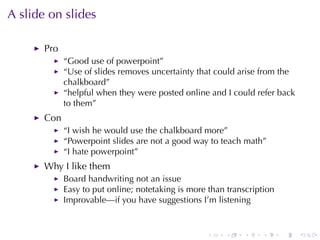
       Why	I like	them
             Board	handwriting	not	an	issue
             Easy	to	put	online; notetaking	is	more	than	transcription
             Improvable—if	you	have	suggestions	I’m	listening


                                                   .    .    .    .      .   .
A slide	on	WebAssign


      If	you	find	a	mistake, please	let	me	know.
      We	are	dropping	5	lowest	assignments	(roughly	two	weeks’
      worth)


                                             .    .   .   .   .   .
Also	requested, more:
    Tree	stretches
    Music
    Dancing
I’ll	see	what	I can	do!


                          .   .   .   .   .   .
Outline


  Leading	by	Example


  The	Text	in	the	Box


  More	Examples


                        .   .   .   .   .   .
Leading	by	Example


  Example
  What	is	the	rectangle	of	fixed	perimeter	with	maximum	area?


                                           .    .   .   .      .   .
Leading	by	Example


  Example
  What	is	the	rectangle	of	fixed	perimeter	with	maximum	area?

  Solution
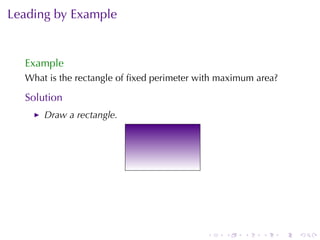
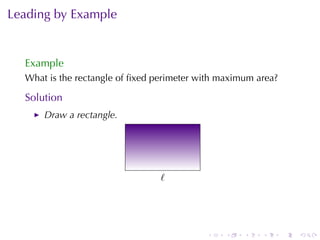
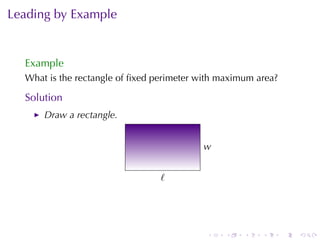
      Draw	a	rectangle.


                                 .

                          .


                                           .    .   .   .      .   .
Leading	by	Example


  Example
  What	is	the	rectangle	of	fixed	perimeter	with	maximum	area?

  Solution
      Draw	a	rectangle.


                                 .

                          .
                                 .
                                 ℓ


                                           .    .   .   .      .   .
Leading	by	Example


  Example
  What	is	the	rectangle	of	fixed	perimeter	with	maximum	area?

  Solution
      Draw	a	rectangle.


                                 .        w
                                          .

                          .
                                 .
                                 ℓ


                                           .    .   .   .      .   .
Solution	(Continued)
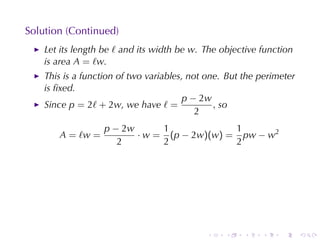
    Let	its	length	be ℓ and	its	width	be w. The	objective	function
    is	area A = ℓw.


                                            .    .   .    .    .     .
Solution	(Continued)
    Let	its	length	be ℓ and	its	width	be w. The	objective	function
    is	area A = ℓw.
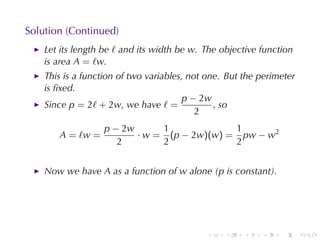
    This	is	a	function	of	two	variables, not	one. But	the	perimeter
    is	fixed.


                                            .    .    .   .    .      .
Solution	(Continued)
    Let	its	length	be ℓ and	its	width	be w. The	objective	function
    is	area A = ℓw.
    This	is	a	function	of	two	variables, not	one. But	the	perimeter
    is	fixed.
                                       p − 2w
    Since p = 2ℓ + 2w, we	have ℓ =             ,
                                           2


                                            .    .    .   .    .      .
Solution	(Continued)
    Let	its	length	be ℓ and	its	width	be w. The	objective	function
    is	area A = ℓw.
    This	is	a	function	of	two	variables, not	one. But	the	perimeter
    is	fixed.
                                       p − 2w
    Since p = 2ℓ + 2w, we	have ℓ =             , so
                                           2
                   p − 2w      1             1
       A = ℓw =           · w = (p − 2w)(w) = pw − w2
                      2        2             2


                                            .    .    .   .    .      .
Solution	(Continued)
    Let	its	length	be ℓ and	its	width	be w. The	objective	function
    is	area A = ℓw.
    This	is	a	function	of	two	variables, not	one. But	the	perimeter
    is	fixed.
                                       p − 2w
    Since p = 2ℓ + 2w, we	have ℓ =             , so
                                           2
                   p − 2w      1             1
       A = ℓw =           · w = (p − 2w)(w) = pw − w2
                      2        2             2


    Now	we	have A as	a	function	of w alone	(p is	constant).


                                            .    .    .   .    .      .
Solution	(Continued)
    Let	its	length	be ℓ and	its	width	be w. The	objective	function
    is	area A = ℓw.
    This	is	a	function	of	two	variables, not	one. But	the	perimeter
    is	fixed.
                                       p − 2w
    Since p = 2ℓ + 2w, we	have ℓ =             , so
                                           2
                   p − 2w      1             1
       A = ℓw =           · w = (p − 2w)(w) = pw − w2
                      2        2             2


    Now	we	have A as	a	function	of w alone	(p is	constant).
    The	natural	domain	of	this	function	is [0, p/2] (we	want	to
    make	sure A(w) ≥ 0).


                                            .    .    .   .    .      .
Solution	(Concluded)
                                                1
We	use	the	Closed	Interval	Method	for A(w) =      pw − w2 on
                                                2
[0, p/2].
     At	the	endpoints, A(0) = A(p/2) = 0.


                                            .   .   .   .      .   .
Solution	(Concluded)
                                               1
We	use	the	Closed	Interval	Method	for A(w) =     pw − w2 on
                                               2
[0, p/2].
     At	the	endpoints, A(0) = A(p/2) = 0.
                                        dA  1
     To	find	the	critical	points, we	find    = p − 2w.
                                        dw  2


                                         .     .   .   .      .   .
Solution	(Concluded)
                                               1
We	use	the	Closed	Interval	Method	for A(w) =     pw − w2 on
                                               2
[0, p/2].
     At	the	endpoints, A(0) = A(p/2) = 0.
                                        dA  1
     To	find	the	critical	points, we	find    = p − 2w.
                                        dw  2
     The	critical	points	are	when

                         1               p
                    0=     p − 2w =⇒ w =
                         2               4


                                         .     .   .   .      .   .
Solution	(Concluded)
                                                  1
We	use	the	Closed	Interval	Method	for A(w) =        pw − w2 on
                                                  2
[0, p/2].
     At	the	endpoints, A(0) = A(p/2) = 0.
                                        dA  1
     To	find	the	critical	points, we	find    = p − 2w.
                                        dw  2
     The	critical	points	are	when

                           1               p
                      0=     p − 2w =⇒ w =
                           2               4


     Since	this	is	the	only	critical	point, it	must	be	the	maximum.
                       p
     In	this	case ℓ = as	well.
                       4


                                              .   .    .    .    .    .
Solution	(Concluded)
                                                  1
We	use	the	Closed	Interval	Method	for A(w) =        pw − w2 on
                                                  2
[0, p/2].
     At	the	endpoints, A(0) = A(p/2) = 0.
                                        dA  1
     To	find	the	critical	points, we	find    = p − 2w.
                                        dw  2
     The	critical	points	are	when

                           1               p
                      0=     p − 2w =⇒ w =
                           2               4


     Since	this	is	the	only	critical	point, it	must	be	the	maximum.
                       p
     In	this	case ℓ = as	well.
                       4
     We	have	a	square! The	maximal	area	is A(p/4) = p2 /16.


                                              .   .    .    .    .    .
Outline


  Leading	by	Example


  The	Text	in	the	Box


  More	Examples


                        .   .   .   .   .   .
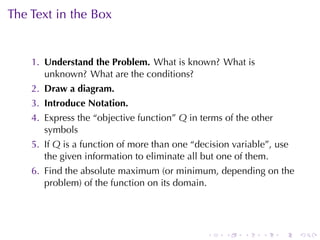
The	Text	in	the	Box


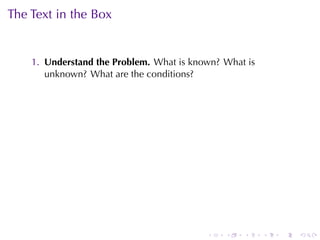
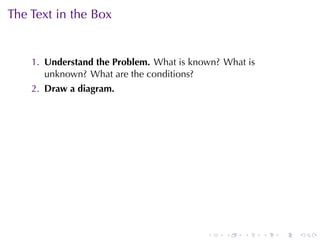
    1. Understand	the	Problem. What	is	known? What	is
       unknown? What	are	the	conditions?


                                          .   .   .     .   .   .
The	Text	in	the	Box


    1. Understand	the	Problem. What	is	known? What	is
       unknown? What	are	the	conditions?
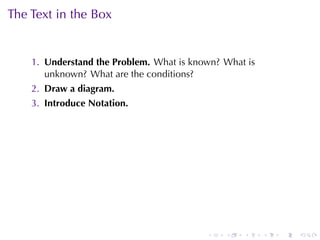
    2. Draw	a	diagram.


                                          .   .   .     .   .   .
The	Text	in	the	Box


    1. Understand	the	Problem. What	is	known? What	is
       unknown? What	are	the	conditions?
    2. Draw	a	diagram.
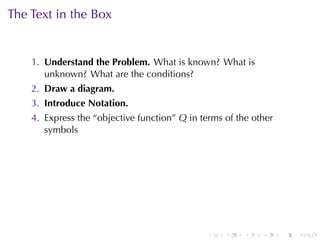
    3. Introduce	Notation.


                                          .   .   .     .   .   .
The	Text	in	the	Box


    1. Understand	the	Problem. What	is	known? What	is
       unknown? What	are	the	conditions?
    2. Draw	a	diagram.
    3. Introduce	Notation.
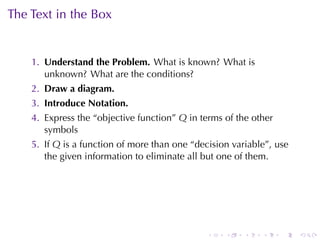
    4. Express	the	“objective	function” Q in	terms	of	the	other
       symbols


                                              .    .    .   .     .   .
The	Text	in	the	Box


    1. Understand	the	Problem. What	is	known? What	is
       unknown? What	are	the	conditions?
    2. Draw	a	diagram.
    3. Introduce	Notation.
    4. Express	the	“objective	function” Q in	terms	of	the	other
       symbols
    5. If Q is	a	function	of	more	than	one	“decision	variable”, use
       the	given	information	to	eliminate	all	but	one	of	them.


                                               .   .    .   .     .   .
The	Text	in	the	Box


    1. Understand	the	Problem. What	is	known? What	is
       unknown? What	are	the	conditions?
    2. Draw	a	diagram.
    3. Introduce	Notation.
    4. Express	the	“objective	function” Q in	terms	of	the	other
       symbols
    5. If Q is	a	function	of	more	than	one	“decision	variable”, use
       the	given	information	to	eliminate	all	but	one	of	them.
    6. Find	the	absolute	maximum	(or	minimum, depending	on	the
       problem)	of	the	function	on	its	domain.


                                               .   .    .   .     .   .
Recall: The	Closed	Interval	Method
See	Section	4.1


     To	find	the	extreme	values	of	a	function f on [a, b], we	need	to:
          Evaluate f at	the endpoints a and b
          Evaluate f at	the critical	points x where	either f′ (x) = 0 or f is
          not	differentiable	at x.
          The	points	with	the	largest	function	value	are	the	global
          maximum	points
          The	points	with	the	smallest	or	most	negative	function	value
          are	the	global	minimum	points.


                                                     .    .    .    .    .      .
Recall: The	First	Derivative	Test
See	Section	4.3


     Theorem	(The	First	Derivative	Test)
     Let f be	continuous	on [a, b] and c a	critical	point	of f in (a, b).
          If f′ (x) > 0 on (a, c) and f′ (x) < 0 on (c, b), then c is	a	local
          maximum.
          If f′ (x) < 0 on (a, c) and f′ (x) > 0 on (c, b), then c is	a	local
          minimum.
          If f′ (x) has	the	same	sign	on (a, c) and (c, b), then c is	not	a
          local	extremum.


                                                      .    .    .    .      .   .
Recall: The	Second	Derivative	Test
See	Section	4.3


     Theorem	(The	Second	Derivative	Test)
     Let f, f′ , and f′′ be	continuous	on [a, b]. Let c be	be	a	point	in
     (a, b) with f′ (c) = 0.
          If f′′ (c) < 0, then f(c) is	a	local	maximum.
          If f′′ (c) > 0, then f(c) is	a	local	minimum.

     If f′′ (c) = 0, the	second	derivative	test	is	inconclusive	(this	does
     not	mean c is	neither; we	just	don’t	know	yet).


                                                     .    .    .    .      .   .
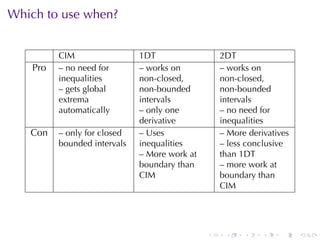
Which	to	use	when?


          CIM                 1DT                  2DT
    Pro   –	no	need	for       –	works	on           –	works	on
          inequalities        non-closed,          non-closed,
          –	gets	global       non-bounded          non-bounded
          extrema             intervals            intervals
          automatically       –	only	one           –	no	need	for
                              derivative           inequalities
   Con    –	only	for	closed   –	Uses               –	More	derivatives
          bounded	intervals   inequalities         –	less	conclusive
                              –	More	work	at       than	1DT
                              boundary	than        –	more	work	at
                              CIM                  boundary	than
                                                   CIM


                                               .    .    .    .    .    .
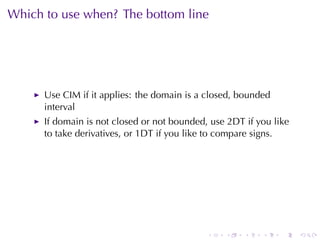
Which	to	use	when? The	bottom	line


      Use	CIM if	it	applies: the	domain	is	a	closed, bounded
      interval
      If	domain	is	not	closed	or	not	bounded, use	2DT if	you	like
      to	take	derivatives, or	1DT if	you	like	to	compare	signs.


                                             .   .    .   .    .    .
Outline


  Leading	by	Example


  The	Text	in	the	Box


  More	Examples


                        .   .   .   .   .   .
Another	Example


  Example	(The	Best	Fencing	Plan)
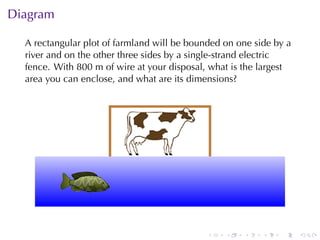
  A rectangular	plot	of	farmland	will	be	bounded	on	one	side	by	a
  river	and	on	the	other	three	sides	by	a	single-strand	electric
  fence. With	800	m	of	wire	at	your	disposal, what	is	the	largest
  area	you	can	enclose, and	what	are	its	dimensions?


                                             .   .   .    .   .     .
Solution
    1. Everybody	understand?


                               .   .   .   .   .   .
Another	Example


  Example	(The	Best	Fencing	Plan)
  A rectangular	plot	of	farmland	will	be	bounded	on	one	side	by	a
  river	and	on	the	other	three	sides	by	a	single-strand	electric
  fence. With	800	m	of	wire	at	your	disposal, what	is	the	largest
  area	you	can	enclose, and	what	are	its	dimensions?


                                             .   .   .    .   .     .
Another	Example


  Example	(The	Best	Fencing	Plan)
  A rectangular	plot	of	farmland	will	be	bounded	on	one	side	by	a
  river	and	on	the	other	three	sides	by	a	single-strand	electric
  fence. With	800	m	of	wire	at	your	disposal, what	is	the	largest
  area	you	can	enclose, and	what	are	its	dimensions?

      Known: amount	of	fence	used
      Unknown: area	enclosed


                                             .   .   .    .   .     .
Another	Example


  Example	(The	Best	Fencing	Plan)
  A rectangular	plot	of	farmland	will	be	bounded	on	one	side	by	a
  river	and	on	the	other	three	sides	by	a	single-strand	electric
  fence. With	800	m	of	wire	at	your	disposal, what	is	the	largest
  area	you	can	enclose, and	what	are	its	dimensions?

      Known: amount	of	fence	used
      Unknown: area	enclosed
      Objective: maximize	area
      Constraint: fixed	fence	length


                                             .   .   .    .   .     .
Solution
    1. Everybody	understand?


                               .   .   .   .   .   .
Solution
    1. Everybody	understand?
    2. Draw	a	diagram.


                               .   .   .   .   .   .
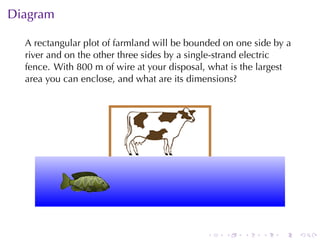
Diagram

  A rectangular	plot	of	farmland	will	be	bounded	on	one	side	by	a
  river	and	on	the	other	three	sides	by	a	single-strand	electric
  fence. With	800	m	of	wire	at	your	disposal, what	is	the	largest
  area	you	can	enclose, and	what	are	its	dimensions?


                      .   .

                                 .
          .


                                             .   .   .    .   .     .
Solution
    1. Everybody	understand?
    2. Draw	a	diagram.


                               .   .   .   .   .   .
Solution
    1. Everybody	understand?
    2. Draw	a	diagram.
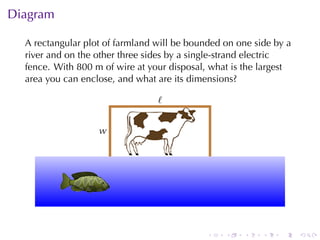
    3. Introduce	notation: Length	and	width	are ℓ and w. Length	of
       wire	used	is p.


                                             .   .    .   .   .      .
Diagram

  A rectangular	plot	of	farmland	will	be	bounded	on	one	side	by	a
  river	and	on	the	other	three	sides	by	a	single-strand	electric
  fence. With	800	m	of	wire	at	your	disposal, what	is	the	largest
  area	you	can	enclose, and	what	are	its	dimensions?


                      .   .

                                 .
          .


                                             .   .   .    .   .     .
Diagram

  A rectangular	plot	of	farmland	will	be	bounded	on	one	side	by	a
  river	and	on	the	other	three	sides	by	a	single-strand	electric
  fence. With	800	m	of	wire	at	your	disposal, what	is	the	largest
  area	you	can	enclose, and	what	are	its	dimensions?

                                 .
                                 ℓ


                   w
                   .

                       .   .

                                 .
          .


                                             .   .   .    .   .     .
Solution
    1. Everybody	understand?
    2. Draw	a	diagram.
    3. Introduce	notation: Length	and	width	are ℓ and w. Length	of
       wire	used	is p.


                                             .   .    .   .   .      .
Solution
    1. Everybody	understand?
    2. Draw	a	diagram.
    3. Introduce	notation: Length	and	width	are ℓ and w. Length	of
       wire	used	is p.
    4. Q = area = ℓw.


                                             .   .    .   .   .      .
Solution
    1. Everybody	understand?
    2. Draw	a	diagram.
    3. Introduce	notation: Length	and	width	are ℓ and w. Length	of
       wire	used	is p.
    4. Q = area = ℓw.
    5. Since p = ℓ + 2w, we	have ℓ = p − 2w and	so

                   Q(w) = (p − 2w)(w) = pw − 2w2

       The	domain	of Q is [0, p/2]


                                             .   .    .   .   .      .
Solution
    1. Everybody	understand?
    2. Draw	a	diagram.
    3. Introduce	notation: Length	and	width	are ℓ and w. Length	of
       wire	used	is p.
    4. Q = area = ℓw.
    5. Since p = ℓ + 2w, we	have ℓ = p − 2w and	so

                   Q(w) = (p − 2w)(w) = pw − 2w2

       The	domain	of Q is [0, p/2]
       dQ                                  p
    6.     = p − 4w, which	is	zero	when w = .
       dw                                  4


                                             .   .    .   .   .      .
Solution
    1. Everybody	understand?
    2. Draw	a	diagram.
    3. Introduce	notation: Length	and	width	are ℓ and w. Length	of
       wire	used	is p.
    4. Q = area = ℓw.
    5. Since p = ℓ + 2w, we	have ℓ = p − 2w and	so

                   Q(w) = (p − 2w)(w) = pw − 2w2

       The	domain	of Q is [0, p/2]
       dQ                                  p
    6.     = p − 4w, which	is	zero	when w = .
       dw                                  4


                                             .   .    .   .   .      .
Solution
    1. Everybody	understand?
    2. Draw	a	diagram.
    3. Introduce	notation: Length	and	width	are ℓ and w. Length	of
       wire	used	is p.
    4. Q = area = ℓw.
    5. Since p = ℓ + 2w, we	have ℓ = p − 2w and	so

                    Q(w) = (p − 2w)(w) = pw − 2w2

       The	domain	of Q is [0, p/2]
       dQ                                  p
    6.     = p − 4w, which	is	zero	when w = .
       dw                                  4
       Q(0) = Q(p/2) = 0, but
                   (p)         p     p2   p2
               Q         =p·     −2·    =    = 80, 000m2
                    4          4     16   8
       so	the	critical	point	is	the	absolute	maximum.
                                              .    .    .   .   .    .
Your	turn


   Example	(The	shortest	fence)
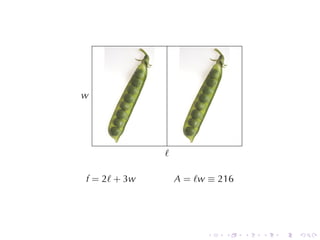
   A 216m2 rectangular	pea	patch	is	to	be	enclosed	by	a	fence	and
   divided	into	two	equal	parts	by	another	fence	parallel	to	one	of
   its	sides. What	dimensions	for	the	outer	rectangle	will	require	the
   smallest	total	length	of	fence? How	much	fence	will	be	needed?


                                                .   .    .    .   .      .
Your	turn


   Example	(The	shortest	fence)
   A 216m2 rectangular	pea	patch	is	to	be	enclosed	by	a	fence	and
   divided	into	two	equal	parts	by	another	fence	parallel	to	one	of
   its	sides. What	dimensions	for	the	outer	rectangle	will	require	the
   smallest	total	length	of	fence? How	much	fence	will	be	needed?

   Solution
   Let	the	length	and	width	of	the	pea	patch	be ℓ and w. The
   amount	of	fence	needed	is f = 2ℓ + 3w. Since ℓw = A, a
   constant, we	have
                                    A
                            f(w) = 2 + 3w.
                                    w
   The	domain	is	all	positive	numbers.


                                                .   .    .    .   .      .
.          .


w
.


    .
              .
              ℓ

f = 2ℓ + 3w       A = ℓw ≡ 216


                        .   .    .   .   .   .
Solution	(Continued)
                                             2A
We	need	to	find	the	minimum	value	of f(w) =      + 3w on
                                             w
(0, ∞).


                                        .     .   .   .   .   .
Solution	(Continued)
                                             2A
We	need	to	find	the	minimum	value	of f(w) =      + 3w on
                                             w
(0, ∞).
    We	have
                         df      2A
                            =− 2 +3
                         dw      w
                           √
                             2A
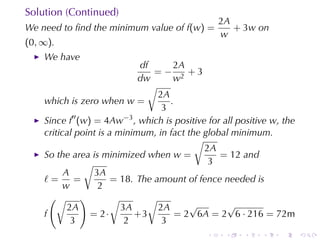
    which	is	zero	when w =      .
                              3


                                        .     .   .   .   .   .
Solution	(Continued)
                                                  2A
We	need	to	find	the	minimum	value	of f(w) =           + 3w on
                                                  w
(0, ∞).
    We	have
                             df      2A
                                =− 2 +3
                             dw      w
                               √
                                 2A
    which	is	zero	when w =          .
                                  3
    Since f′′ (w) = 4Aw−3 , which	is	positive	for	all	positive w, the
    critical	point	is	a	minimum, in	fact	the	global	minimum.


                                              .    .   .    .    .      .
Solution	(Continued)
                                                  2A
We	need	to	find	the	minimum	value	of f(w) =           + 3w on
                                                  w
(0, ∞).
    We	have
                              df      2A
                                 =− 2 +3
                             dw       w
                                √
                                  2A
    which	is	zero	when w =           .
                                   3
    Since f′′ (w) = 4Aw−3 , which	is	positive	for	all	positive w, the
    critical	point	is	a	minimum, in	fact	the	global	minimum.
                                           √
                                             2A
    So	the	area	is	minimized	when w =            = 12 and
               √                              3
          A       3A
    ℓ=       =         = 18. The	amount	of	fence	needed	is
         w         2
      (√ )             √        √
           2A            3A       2A      √        √
    f            = 2·       +3         = 2 6A = 2 6 · 216 = 72m
            3             2        3
                                              .    .   .    .    .      .
Example
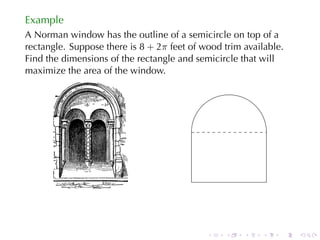
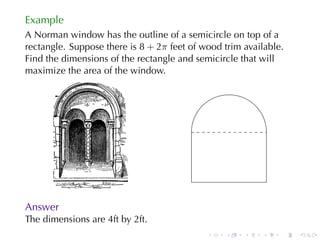
A Norman	window	has	the	outline	of	a	semicircle	on	top	of	a
rectangle. Suppose	there	is 8 + 2π feet	of	wood	trim	available.
Find	the	dimensions	of	the	rectangle	and	semicircle	that	will
maximize	the	area	of	the	window.


                                        .


                                            .   .    .   .    .   .
Example
A Norman	window	has	the	outline	of	a	semicircle	on	top	of	a
rectangle. Suppose	there	is 8 + 2π feet	of	wood	trim	available.
Find	the	dimensions	of	the	rectangle	and	semicircle	that	will
maximize	the	area	of	the	window.


                                        .

Answer
The	dimensions	are	4ft	by	2ft.
                                            .   .    .   .    .   .
Solution
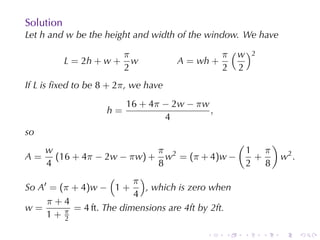
Let h and w be	the	height	and	width	of	the	window. We	have

                          π                      π ( w )2
           L = 2h + w +     w         A = wh +
                          2                      2 2
If L is	fixed	to	be 8 + 2π , we	have
                          16 + 4π − 2w − π w
                    h=                       ,
                                  4
so
                                                     (          )
     w                           π                        1 π
A = (16 + 4π − 2w − π w) + w2 = (π + 4)w −                 +        w2 .
     4                           8                        2 8
                    (     π )
So A′ = (π + 4)w − 1 +        , which	is	zero	when
                          4
     π+4
w=         = 4 ft. The	dimensions	are	4ft	by	2ft.
     1+ π2

                                            .    .    .     .       .      .
Summary


     Remember	the	checklist
     Ask	yourself: what	is	the	objective?
     Remember	your	geometry:
          similar	triangles
          right	triangles
          trigonometric	functions


                                            .   .   .   .   .   .

Lesson 24: Optimization

  • 1.
    Section 4.5 Optimization Problems V63.0121.027, Calculus I November 24, 2009 Announcements Written HW (inc. WebAssign from 4.4) due Wednesday, Nov. 25, 11:00am in my mailbox Quiz 5 next week on §§4.1–4.4, 4.7 . . . . . .
  • 2.
    Thank you for the evaluations Comments and requests Too fast, not enough examples . . . . . .
  • 3.
    Thank you for the evaluations Comments and requests Too fast, not enough examples Not enough time to do everything Class is not the only learning time (recitation and independent study) I try to balance . . . . . .
  • 4.
    Thank you for the evaluations Comments and requests Too fast, not enough examples Not enough time to do everything Class is not the only learning time (recitation and independent study) I try to balance Too many proofs . . . . . .
  • 5.
    Thank you for the evaluations Comments and requests Too fast, not enough examples Not enough time to do everything Class is not the only learning time (recitation and independent study) I try to balance Too many proofs In this course we care about concepts There will be conceptual problems on the exam Concepts are the keys to overcoming templated problems . . . . . .
  • 6.
    A slide on slides Pro “Good use of powerpoint” “Use of slides removes uncertainty that could arise from the chalkboard” “helpful when they were posted online and I could refer back to them” . . . . . .
  • 7.
    A slide on slides Pro “Good use of powerpoint” “Use of slides removes uncertainty that could arise from the chalkboard” “helpful when they were posted online and I could refer back to them” Con “I wish he would use the chalkboard more” “Powerpoint slides are not a good way to teach math” “I hate powerpoint” . . . . . .
  • 8.
    A slide on slides Pro “Good use of powerpoint” “Use of slides removes uncertainty that could arise from the chalkboard” “helpful when they were posted online and I could refer back to them” Con “I wish he would use the chalkboard more” “Powerpoint slides are not a good way to teach math” “I hate powerpoint” Why I like them Board handwriting not an issue Easy to put online; notetaking is more than transcription Improvable—if you have suggestions I’m listening . . . . . .
  • 9.
    A slide on WebAssign If you find a mistake, please let me know. We are dropping 5 lowest assignments (roughly two weeks’ worth) . . . . . .
  • 10.
    Also requested, more: Tree stretches Music Dancing I’ll see what I can do! . . . . . .
  • 11.
    Outline Leading by Example The Text in the Box More Examples . . . . . .
  • 12.
    Leading by Example Example What is the rectangle of fixed perimeter with maximum area? . . . . . .
  • 13.
    Leading by Example Example What is the rectangle of fixed perimeter with maximum area? Solution Draw a rectangle. . . . . . . . .
  • 14.
    Leading by Example Example What is the rectangle of fixed perimeter with maximum area? Solution Draw a rectangle. . . . ℓ . . . . . .
  • 15.
    Leading by Example Example What is the rectangle of fixed perimeter with maximum area? Solution Draw a rectangle. . w . . . ℓ . . . . . .
  • 16.
    Solution (Continued) Let its length be ℓ and its width be w. The objective function is area A = ℓw. . . . . . .
  • 17.
    Solution (Continued) Let its length be ℓ and its width be w. The objective function is area A = ℓw. This is a function of two variables, not one. But the perimeter is fixed. . . . . . .
  • 18.
    Solution (Continued) Let its length be ℓ and its width be w. The objective function is area A = ℓw. This is a function of two variables, not one. But the perimeter is fixed. p − 2w Since p = 2ℓ + 2w, we have ℓ = , 2 . . . . . .
  • 19.
    Solution (Continued) Let its length be ℓ and its width be w. The objective function is area A = ℓw. This is a function of two variables, not one. But the perimeter is fixed. p − 2w Since p = 2ℓ + 2w, we have ℓ = , so 2 p − 2w 1 1 A = ℓw = · w = (p − 2w)(w) = pw − w2 2 2 2 . . . . . .
  • 20.
    Solution (Continued) Let its length be ℓ and its width be w. The objective function is area A = ℓw. This is a function of two variables, not one. But the perimeter is fixed. p − 2w Since p = 2ℓ + 2w, we have ℓ = , so 2 p − 2w 1 1 A = ℓw = · w = (p − 2w)(w) = pw − w2 2 2 2 Now we have A as a function of w alone (p is constant). . . . . . .
  • 21.
    Solution (Continued) Let its length be ℓ and its width be w. The objective function is area A = ℓw. This is a function of two variables, not one. But the perimeter is fixed. p − 2w Since p = 2ℓ + 2w, we have ℓ = , so 2 p − 2w 1 1 A = ℓw = · w = (p − 2w)(w) = pw − w2 2 2 2 Now we have A as a function of w alone (p is constant). The natural domain of this function is [0, p/2] (we want to make sure A(w) ≥ 0). . . . . . .
  • 22.
    Solution (Concluded) 1 We use the Closed Interval Method for A(w) = pw − w2 on 2 [0, p/2]. At the endpoints, A(0) = A(p/2) = 0. . . . . . .
  • 23.
    Solution (Concluded) 1 We use the Closed Interval Method for A(w) = pw − w2 on 2 [0, p/2]. At the endpoints, A(0) = A(p/2) = 0. dA 1 To find the critical points, we find = p − 2w. dw 2 . . . . . .
  • 24.
    Solution (Concluded) 1 We use the Closed Interval Method for A(w) = pw − w2 on 2 [0, p/2]. At the endpoints, A(0) = A(p/2) = 0. dA 1 To find the critical points, we find = p − 2w. dw 2 The critical points are when 1 p 0= p − 2w =⇒ w = 2 4 . . . . . .
  • 25.
    Solution (Concluded) 1 We use the Closed Interval Method for A(w) = pw − w2 on 2 [0, p/2]. At the endpoints, A(0) = A(p/2) = 0. dA 1 To find the critical points, we find = p − 2w. dw 2 The critical points are when 1 p 0= p − 2w =⇒ w = 2 4 Since this is the only critical point, it must be the maximum. p In this case ℓ = as well. 4 . . . . . .
  • 26.
    Solution (Concluded) 1 We use the Closed Interval Method for A(w) = pw − w2 on 2 [0, p/2]. At the endpoints, A(0) = A(p/2) = 0. dA 1 To find the critical points, we find = p − 2w. dw 2 The critical points are when 1 p 0= p − 2w =⇒ w = 2 4 Since this is the only critical point, it must be the maximum. p In this case ℓ = as well. 4 We have a square! The maximal area is A(p/4) = p2 /16. . . . . . .
  • 27.
    Outline Leading by Example The Text in the Box More Examples . . . . . .
  • 28.
    The Text in the Box 1. Understand the Problem. What is known? What is unknown? What are the conditions? . . . . . .
  • 29.
    The Text in the Box 1. Understand the Problem. What is known? What is unknown? What are the conditions? 2. Draw a diagram. . . . . . .
  • 30.
    The Text in the Box 1. Understand the Problem. What is known? What is unknown? What are the conditions? 2. Draw a diagram. 3. Introduce Notation. . . . . . .
  • 31.
    The Text in the Box 1. Understand the Problem. What is known? What is unknown? What are the conditions? 2. Draw a diagram. 3. Introduce Notation. 4. Express the “objective function” Q in terms of the other symbols . . . . . .
  • 32.
    The Text in the Box 1. Understand the Problem. What is known? What is unknown? What are the conditions? 2. Draw a diagram. 3. Introduce Notation. 4. Express the “objective function” Q in terms of the other symbols 5. If Q is a function of more than one “decision variable”, use the given information to eliminate all but one of them. . . . . . .
  • 33.
    The Text in the Box 1. Understand the Problem. What is known? What is unknown? What are the conditions? 2. Draw a diagram. 3. Introduce Notation. 4. Express the “objective function” Q in terms of the other symbols 5. If Q is a function of more than one “decision variable”, use the given information to eliminate all but one of them. 6. Find the absolute maximum (or minimum, depending on the problem) of the function on its domain. . . . . . .
  • 34.
    Recall: The Closed Interval Method See Section 4.1 To find the extreme values of a function f on [a, b], we need to: Evaluate f at the endpoints a and b Evaluate f at the critical points x where either f′ (x) = 0 or f is not differentiable at x. The points with the largest function value are the global maximum points The points with the smallest or most negative function value are the global minimum points. . . . . . .
  • 35.
    Recall: The First Derivative Test See Section 4.3 Theorem (The First Derivative Test) Let f be continuous on [a, b] and c a critical point of f in (a, b). If f′ (x) > 0 on (a, c) and f′ (x) < 0 on (c, b), then c is a local maximum. If f′ (x) < 0 on (a, c) and f′ (x) > 0 on (c, b), then c is a local minimum. If f′ (x) has the same sign on (a, c) and (c, b), then c is not a local extremum. . . . . . .
  • 36.
    Recall: The Second Derivative Test See Section 4.3 Theorem (The Second Derivative Test) Let f, f′ , and f′′ be continuous on [a, b]. Let c be be a point in (a, b) with f′ (c) = 0. If f′′ (c) < 0, then f(c) is a local maximum. If f′′ (c) > 0, then f(c) is a local minimum. If f′′ (c) = 0, the second derivative test is inconclusive (this does not mean c is neither; we just don’t know yet). . . . . . .
  • 37.
    Which to use when? CIM 1DT 2DT Pro – no need for – works on – works on inequalities non-closed, non-closed, – gets global non-bounded non-bounded extrema intervals intervals automatically – only one – no need for derivative inequalities Con – only for closed – Uses – More derivatives bounded intervals inequalities – less conclusive – More work at than 1DT boundary than – more work at CIM boundary than CIM . . . . . .
  • 38.
    Which to use when? The bottom line Use CIM if it applies: the domain is a closed, bounded interval If domain is not closed or not bounded, use 2DT if you like to take derivatives, or 1DT if you like to compare signs. . . . . . .
  • 39.
    Outline Leading by Example The Text in the Box More Examples . . . . . .
  • 40.
    Another Example Example (The Best Fencing Plan) A rectangular plot of farmland will be bounded on one side by a river and on the other three sides by a single-strand electric fence. With 800 m of wire at your disposal, what is the largest area you can enclose, and what are its dimensions? . . . . . .
  • 41.
    Solution 1. Everybody understand? . . . . . .
  • 42.
    Another Example Example (The Best Fencing Plan) A rectangular plot of farmland will be bounded on one side by a river and on the other three sides by a single-strand electric fence. With 800 m of wire at your disposal, what is the largest area you can enclose, and what are its dimensions? . . . . . .
  • 43.
    Another Example Example (The Best Fencing Plan) A rectangular plot of farmland will be bounded on one side by a river and on the other three sides by a single-strand electric fence. With 800 m of wire at your disposal, what is the largest area you can enclose, and what are its dimensions? Known: amount of fence used Unknown: area enclosed . . . . . .
  • 44.
    Another Example Example (The Best Fencing Plan) A rectangular plot of farmland will be bounded on one side by a river and on the other three sides by a single-strand electric fence. With 800 m of wire at your disposal, what is the largest area you can enclose, and what are its dimensions? Known: amount of fence used Unknown: area enclosed Objective: maximize area Constraint: fixed fence length . . . . . .
  • 45.
    Solution 1. Everybody understand? . . . . . .
  • 46.
    Solution 1. Everybody understand? 2. Draw a diagram. . . . . . .
  • 47.
    Diagram Arectangular plot of farmland will be bounded on one side by a river and on the other three sides by a single-strand electric fence. With 800 m of wire at your disposal, what is the largest area you can enclose, and what are its dimensions? . . . . . . . . . .
  • 48.
    Solution 1. Everybody understand? 2. Draw a diagram. . . . . . .
  • 49.
    Solution 1. Everybody understand? 2. Draw a diagram. 3. Introduce notation: Length and width are ℓ and w. Length of wire used is p. . . . . . .
  • 50.
    Diagram Arectangular plot of farmland will be bounded on one side by a river and on the other three sides by a single-strand electric fence. With 800 m of wire at your disposal, what is the largest area you can enclose, and what are its dimensions? . . . . . . . . . .
  • 51.
    Diagram Arectangular plot of farmland will be bounded on one side by a river and on the other three sides by a single-strand electric fence. With 800 m of wire at your disposal, what is the largest area you can enclose, and what are its dimensions? . ℓ w . . . . . . . . . . .
  • 52.
    Solution 1. Everybody understand? 2. Draw a diagram. 3. Introduce notation: Length and width are ℓ and w. Length of wire used is p. . . . . . .
  • 53.
    Solution 1. Everybody understand? 2. Draw a diagram. 3. Introduce notation: Length and width are ℓ and w. Length of wire used is p. 4. Q = area = ℓw. . . . . . .
  • 54.
    Solution 1. Everybody understand? 2. Draw a diagram. 3. Introduce notation: Length and width are ℓ and w. Length of wire used is p. 4. Q = area = ℓw. 5. Since p = ℓ + 2w, we have ℓ = p − 2w and so Q(w) = (p − 2w)(w) = pw − 2w2 The domain of Q is [0, p/2] . . . . . .
  • 55.
    Solution 1. Everybody understand? 2. Draw a diagram. 3. Introduce notation: Length and width are ℓ and w. Length of wire used is p. 4. Q = area = ℓw. 5. Since p = ℓ + 2w, we have ℓ = p − 2w and so Q(w) = (p − 2w)(w) = pw − 2w2 The domain of Q is [0, p/2] dQ p 6. = p − 4w, which is zero when w = . dw 4 . . . . . .
  • 56.
    Solution 1. Everybody understand? 2. Draw a diagram. 3. Introduce notation: Length and width are ℓ and w. Length of wire used is p. 4. Q = area = ℓw. 5. Since p = ℓ + 2w, we have ℓ = p − 2w and so Q(w) = (p − 2w)(w) = pw − 2w2 The domain of Q is [0, p/2] dQ p 6. = p − 4w, which is zero when w = . dw 4 . . . . . .
  • 57.
    Solution 1. Everybody understand? 2. Draw a diagram. 3. Introduce notation: Length and width are ℓ and w. Length of wire used is p. 4. Q = area = ℓw. 5. Since p = ℓ + 2w, we have ℓ = p − 2w and so Q(w) = (p − 2w)(w) = pw − 2w2 The domain of Q is [0, p/2] dQ p 6. = p − 4w, which is zero when w = . dw 4 Q(0) = Q(p/2) = 0, but (p) p p2 p2 Q =p· −2· = = 80, 000m2 4 4 16 8 so the critical point is the absolute maximum. . . . . . .
  • 58.
    Your turn Example (The shortest fence) A 216m2 rectangular pea patch is to be enclosed by a fence and divided into two equal parts by another fence parallel to one of its sides. What dimensions for the outer rectangle will require the smallest total length of fence? How much fence will be needed? . . . . . .
  • 59.
    Your turn Example (The shortest fence) A 216m2 rectangular pea patch is to be enclosed by a fence and divided into two equal parts by another fence parallel to one of its sides. What dimensions for the outer rectangle will require the smallest total length of fence? How much fence will be needed? Solution Let the length and width of the pea patch be ℓ and w. The amount of fence needed is f = 2ℓ + 3w. Since ℓw = A, a constant, we have A f(w) = 2 + 3w. w The domain is all positive numbers. . . . . . .
  • 60.
    . . w . . . ℓ f = 2ℓ + 3w A = ℓw ≡ 216 . . . . . .
  • 61.
    Solution (Continued) 2A We need to find the minimum value of f(w) = + 3w on w (0, ∞). . . . . . .
  • 62.
    Solution (Continued) 2A We need to find the minimum value of f(w) = + 3w on w (0, ∞). We have df 2A =− 2 +3 dw w √ 2A which is zero when w = . 3 . . . . . .
  • 63.
    Solution (Continued) 2A We need to find the minimum value of f(w) = + 3w on w (0, ∞). We have df 2A =− 2 +3 dw w √ 2A which is zero when w = . 3 Since f′′ (w) = 4Aw−3 , which is positive for all positive w, the critical point is a minimum, in fact the global minimum. . . . . . .
  • 64.
    Solution (Continued) 2A We need to find the minimum value of f(w) = + 3w on w (0, ∞). We have df 2A =− 2 +3 dw w √ 2A which is zero when w = . 3 Since f′′ (w) = 4Aw−3 , which is positive for all positive w, the critical point is a minimum, in fact the global minimum. √ 2A So the area is minimized when w = = 12 and √ 3 A 3A ℓ= = = 18. The amount of fence needed is w 2 (√ ) √ √ 2A 3A 2A √ √ f = 2· +3 = 2 6A = 2 6 · 216 = 72m 3 2 3 . . . . . .
  • 65.
    Example A Norman window has the outline of a semicircle on top of a rectangle. Suppose there is8 + 2π feet of wood trim available. Find the dimensions of the rectangle and semicircle that will maximize the area of the window. . . . . . . .
  • 66.
    Example A Norman window has the outline of a semicircle on top of a rectangle. Suppose there is8 + 2π feet of wood trim available. Find the dimensions of the rectangle and semicircle that will maximize the area of the window. . Answer The dimensions are 4ft by 2ft. . . . . . .
  • 67.
    Solution Let h andw be the height and width of the window. We have π π ( w )2 L = 2h + w + w A = wh + 2 2 2 If L is fixed to be 8 + 2π , we have 16 + 4π − 2w − π w h= , 4 so ( ) w π 1 π A = (16 + 4π − 2w − π w) + w2 = (π + 4)w − + w2 . 4 8 2 8 ( π ) So A′ = (π + 4)w − 1 + , which is zero when 4 π+4 w= = 4 ft. The dimensions are 4ft by 2ft. 1+ π2 . . . . . .
  • 68.
    Summary Remember the checklist Ask yourself: what is the objective? Remember your geometry: similar triangles right triangles trigonometric functions . . . . . .