BMM 104: ENGINEERING MATHEMATICS I                                                   Page 1 of 13


                                CHAPTER 1: FUNCTIONS

Relations

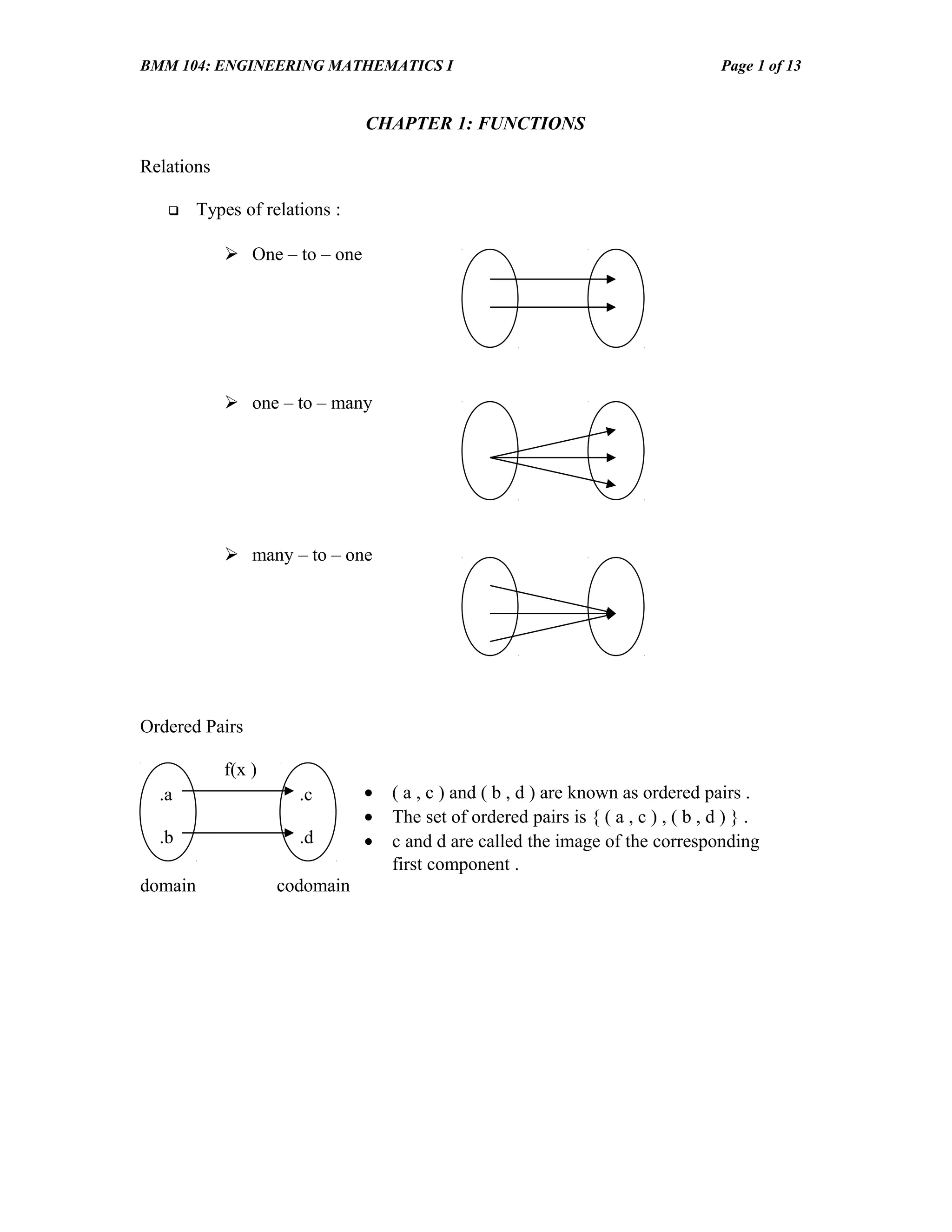
        Types of relations :

             One – to – one


             one – to – many


             many – to – one


Ordered Pairs

            f(x )
  .a                   .c       •   ( a , c ) and ( b , d ) are known as ordered pairs .
                                •   The set of ordered pairs is { ( a , c ) , ( b , d ) } .
  .b                   .d       •   c and d are called the image of the corresponding
                                    first component .
domain              codomain
BMM 104: ENGINEERING MATHEMATICS I                                              Page 2 of 13


Functions

        Definition       Function
                         A relation in which every element in the domain has a unique
                         image in the codomain.

        Notation of functions :
         A function f from x to y : f : x  y or y = f ( x )

            f(x )
  .a                    .c

  .b                    .d

domain                codomain

        Domain – set of input values for a function
         Range – the corresponding output values
                – is a subset of codomain
        Elements of domain { a , b }
         Elements of codomain { c , d }

NOTE: Vertical line test can be used to determine whether a relation is a function or
not. A function f ( x ) can have only one value f ( x ) for each x in its domain, so no
vertical line can intersect the graph of a function more than once.

Example: Determine which of the following equations defines a function y in terms of x.
Sketch its graph.

(i) y + 2 x = 1              (ii) y = 3 x 2             (iii) x 2 + y 2 = 1


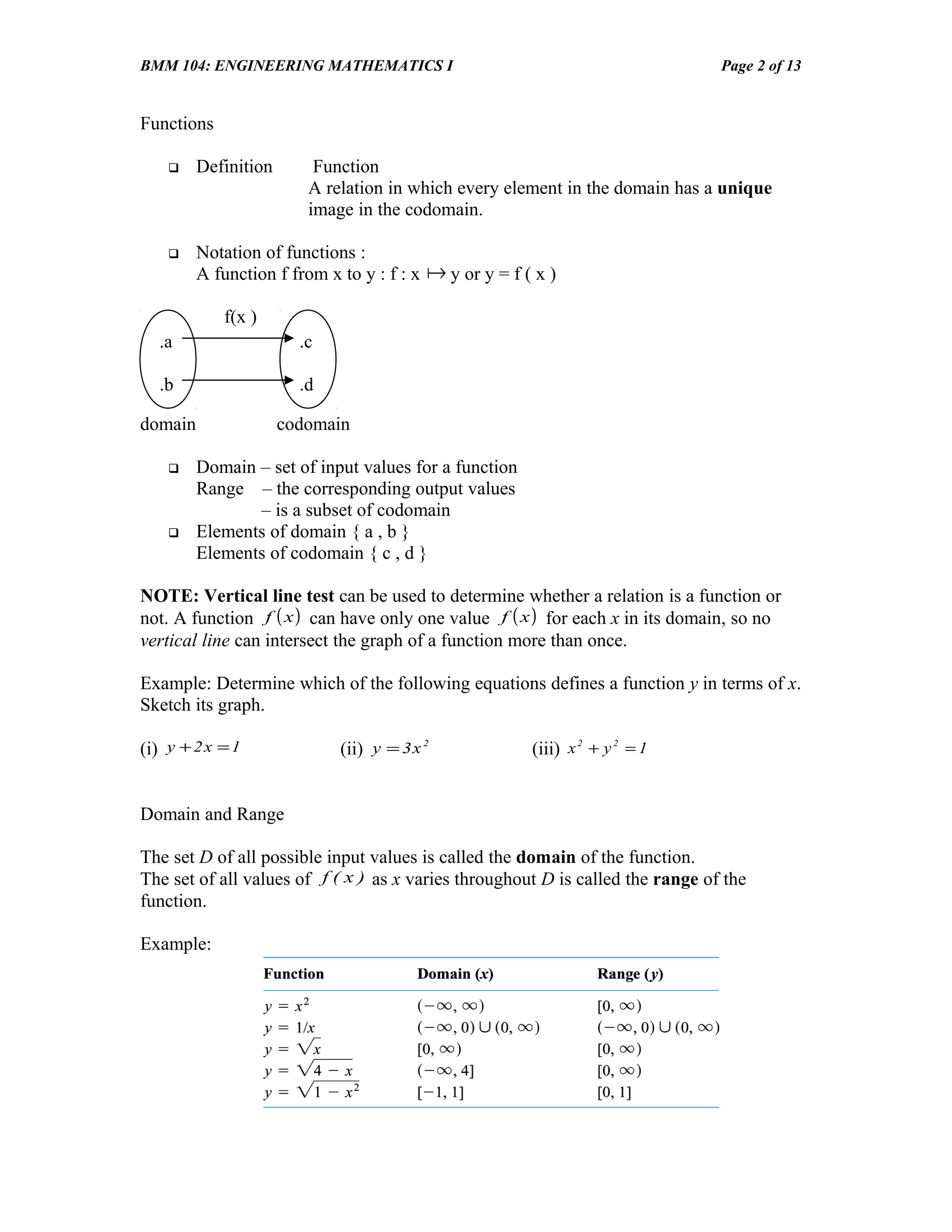
Domain and Range

The set D of all possible input values is called the domain of the function.
The set of all values of f ( x ) as x varies throughout D is called the range of the
function.

Example:
BMM 104: ENGINEERING MATHEMATICS I                                            Page 3 of 13


Combining Functions

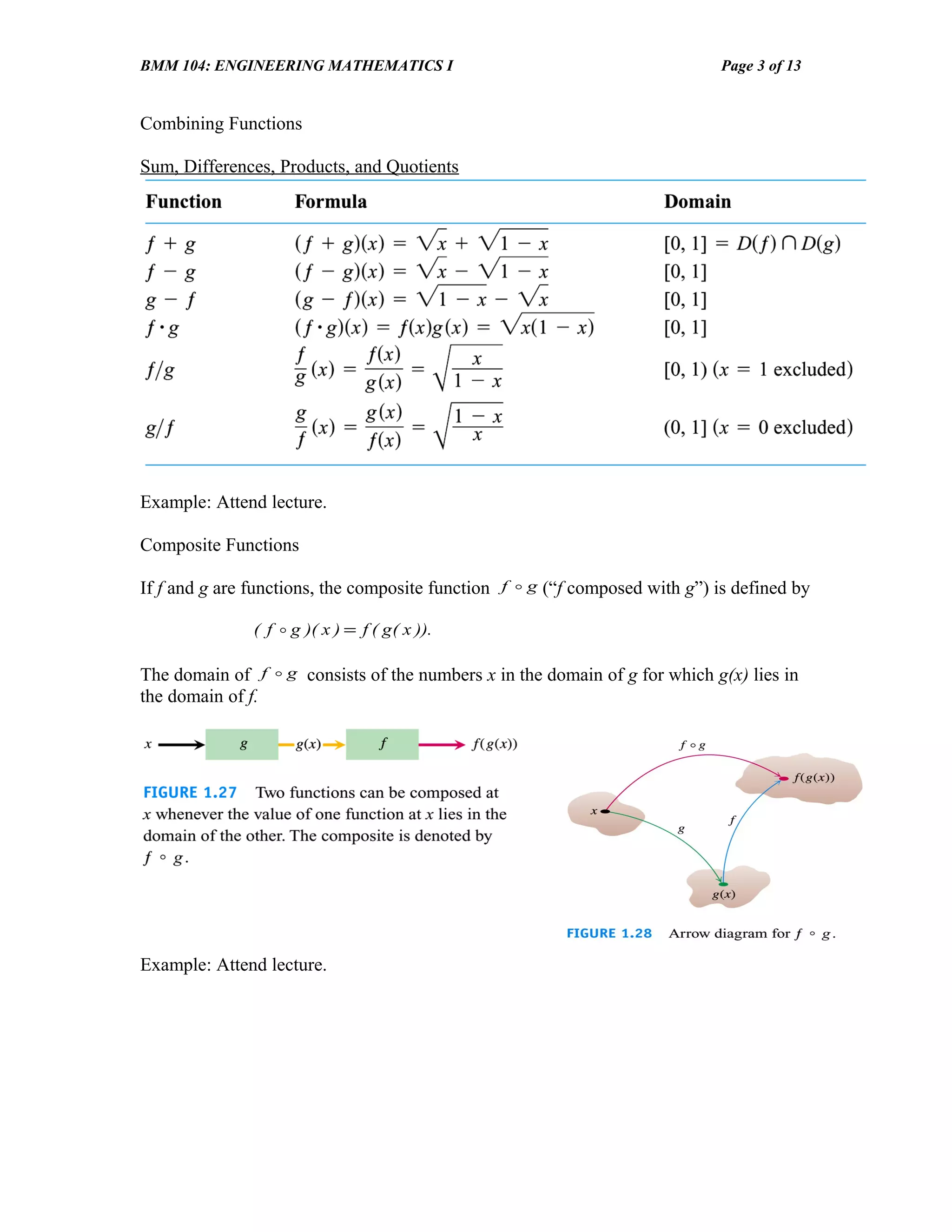
Sum, Differences, Products, and Quotients


Example: Attend lecture.

Composite Functions

If f and g are functions, the composite function f  g (“f composed with g”) is defined by

               ( f  g )( x ) = f ( g ( x )).

The domain of f  g consists of the numbers x in the domain of g for which g(x) lies in
the domain of f.


Example: Attend lecture.
BMM 104: ENGINEERING MATHEMATICS I                                                Page 4 of 13


Inverse Functions

One-to-One Functions

A function f(x) is one-to-one if every two distinct values for x in the domain, x1 ≠ x 2 ,
correspond to two distinct values of the function, f ( x1 ) ≠ f ( x 2 ) .

Properties of a one-to-one function

        (f   −1
                   f )( x ) = x   and          ( f  f )( y ) = y
                                                        −1


NOTE: A function y = f ( x ) is one-to-one if and only if its graph intersects each
horizontal line at most once.


Inverse Functions

Finding the Inverse of a Function

Step 1: Verify that f(x) is a one-to-one function.
Step 2: Let y = f(x).
Step 3: Interchange x and y.
Step 4: Solve for y.
Step 5: Let y = f −1 ( x ) .
Step 6: Note any domain restrictions on f −1 ( x ) .


NOTE:
                                         −1
             Domain of f = Range of f
                                         −1
             Range of f = Domain of f

Example:

1.     Find the inverse of the function f ( x ) = 2 x − 3 .
2.     Find the inverse of the function f ( x ) = x 3 + 2 .
3.     Find the inverse of the function f ( x ) = x + 2 .
                                                      2
4.     Find the inverse of the function f ( x ) =        , x ≠ −3 .
                                                    x +3


Even Function, Odd Function
BMM 104: ENGINEERING MATHEMATICS I                                              Page 5 of 13


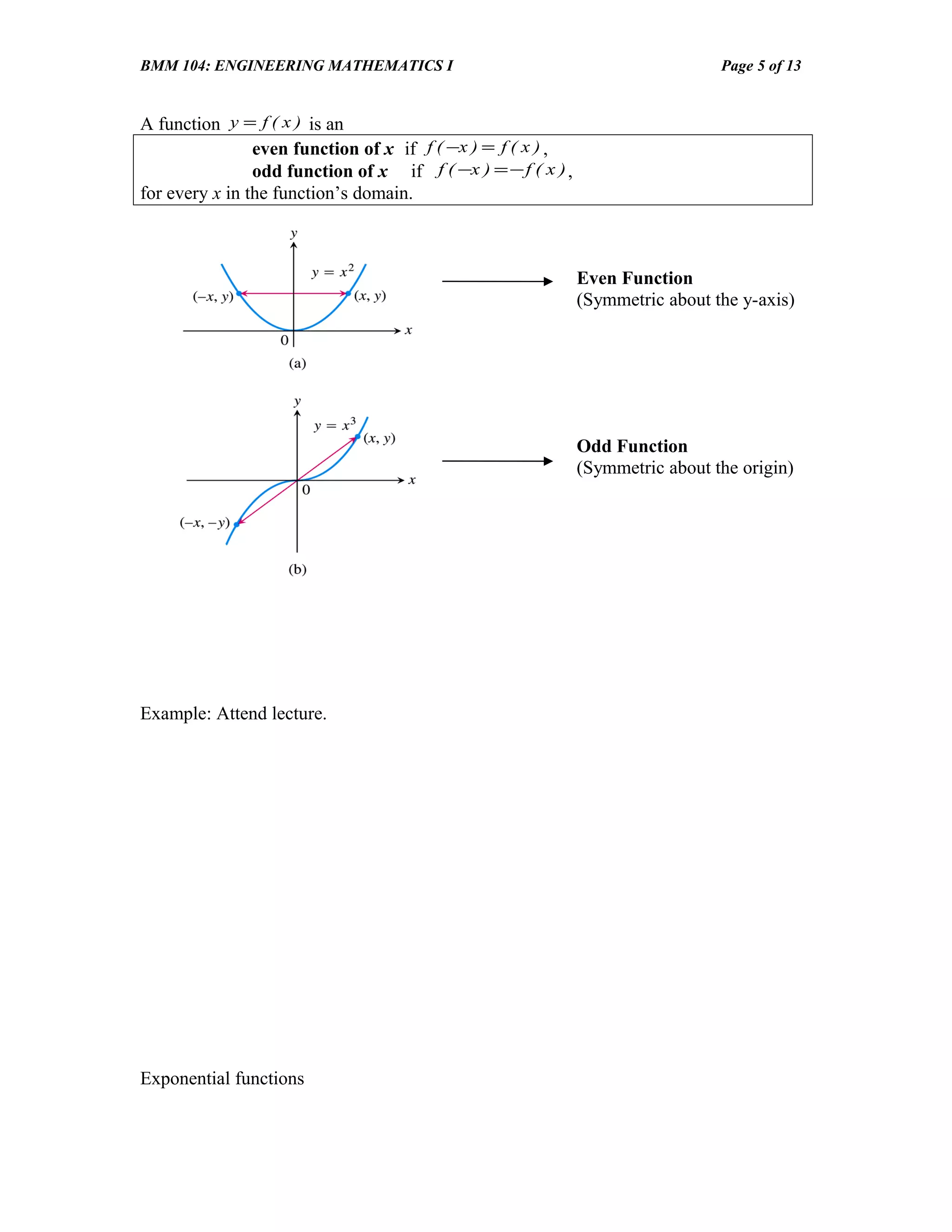
A function y = f ( x ) is an
                even function of x if f ( −x ) = f ( x ) ,
                odd function of x if f ( −x ) = − f ( x ) ,
for every x in the function’s domain.


                                                              Even Function
                                                              (Symmetric about the y-axis)


                                                              Odd Function
                                                              (Symmetric about the origin)


Example: Attend lecture.


Exponential functions
BMM 104: ENGINEERING MATHEMATICS I                                                              Page 6 of 13


Function of the form

        f ( x) = a x , a ≠ 1
where a is positive constant is the general exponential function with base a and x as
exponent.

The most commonly used exponential function, commonly called natural exponential
function is

        y =ex            or       y = exp( x )

where the base e is the exponential constant whose value is e ≈ 2.718281828...

Rules for exponential functions

       i.              e x .e y = e x + y      ~ Product Rule

                       ex
       ii.               y
                           = e x−y             ~ Quotient Rule
                       e

       iii.            (e )
                         x y
                                        ( )
                               = e xy = e y
                                               x
                                                   ~ Power Rule

                        1                       1
       iv.               x
                           = e − x or            −x
                                                    = ex         ~ Reciprocal Rule
                       e                       e

       v.              e0 = 1


Example:
Solve the following exponent equations.
(a)    2x
             2
                 +3
                      = 16        (b)         2 x 3 x +1 = 108       (c)   ( 2)   x2
                                                                                       =
                                                                                           8x
                                                                                           4


Logarithmic Functions
BMM 104: ENGINEERING MATHEMATICS I                                                     Page 7 of 13


The logarithm function with base a, y = log a x , is the inverse of the base a exponential
function y = a x ( a > 0 , a ≠ 1) .

The function y = ln x is called the natural logarithm function, and y = log x is often
called the common logarithm function. For natural logarithm,

                       y = ln x       ⇔ ey = x

Algebraic properties of the natural logarithm

For any numbers b > 0 and x > 0 , the natural logarithm satisfies the following rules:

1.          Product Rule:                ln bx = ln b + ln x
                                            b
2.          Quotient Rule:               ln = ln b − ln x
                                            x
3.          Power Rule:                  ln x r = r ln x
                                            1
4.          Reciprocal Rule:             ln = −ln x
                                            x

Inverse Properties for a x and log a x

1.          Base a: a log a x = x ,      log a a x = x ,        a > 0 , a ≠ 1, x > 0
2.          Base e: e ln x = x ,         ln e = x ,
                                               x
                                                                x >0

Change Base Formula

Every logarithmic function is a constant multiple of the natural logarithm.

                                  ln x
                     log a x =           ( a > 0 , a ≠ 1)
                                  ln a

NOTE:          log a 1 = 0 .

Example 1: Rewrite the following expression in terms of logarithm.

i.          32 = 2 5                     ii.       1000 = 10 3
                                                            1
iii.        0.001 = 10 −3                iv.       3 = 92


Example 2:

       i.       Evaluate log 2 3 .
BMM 104: ENGINEERING MATHEMATICS I                                         Page 8 of 13


                    1                 2
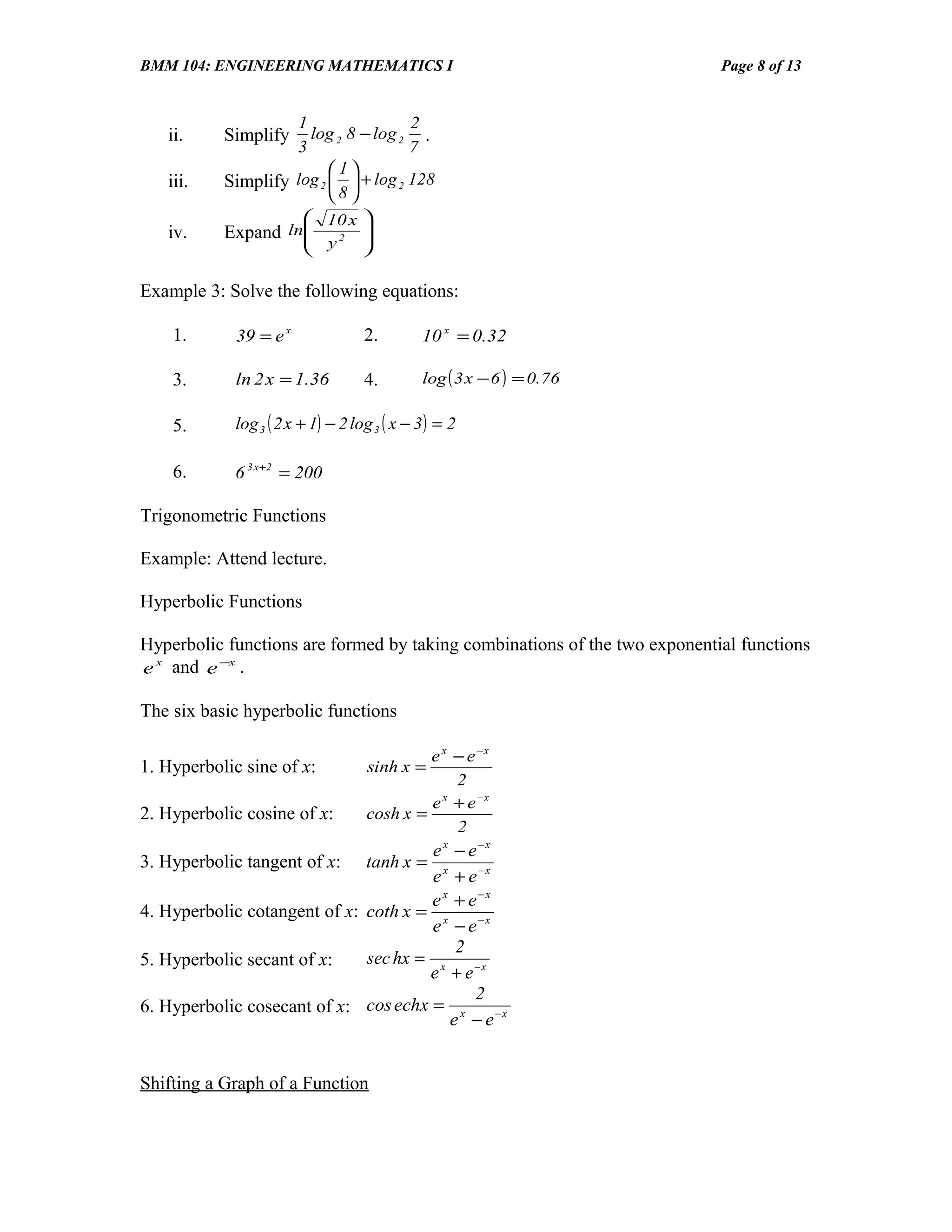
   ii.     Simplify   log 2 8 − log 2 .
                    3                 7
                           1
   iii.    Simplify log 2   + log 2 128
                          8
                         
                      10 x          
   iv.     Expand ln 2 
                     y    
                          

Example 3: Solve the following equations:

    1.       39 = e x               2.        10 x = 0.32

    3.       ln 2 x = 1.36          4.        log ( 3 x − 6 ) = 0.76

    5.       log 3 ( 2 x + 1) − 2 log 3 ( x − 3 ) = 2

    6.      6 3 x +2 = 200

Trigonometric Functions

Example: Attend lecture.

Hyperbolic Functions

Hyperbolic functions are formed by taking combinations of the two exponential functions
e x and e −x .

The six basic hyperbolic functions

                                             e x − e −x
1. Hyperbolic sine of x:            sinh x =
                                                 2
                                             e x + e −x
2. Hyperbolic cosine of x:          cosh x =
                                                 2
                                      ex − e −x
3. Hyperbolic tangent of x:         tanh x =
                                      ex + e −x
                                      ex + e −x
4. Hyperbolic cotangent of x: coth x = x
                                      e  − e −x
                                         2
5. Hyperbolic secant of x:   sec hx = x
                                     e + e −x
                                            2
6. Hyperbolic cosecant of x: cos echx = x
                                        e − e −x


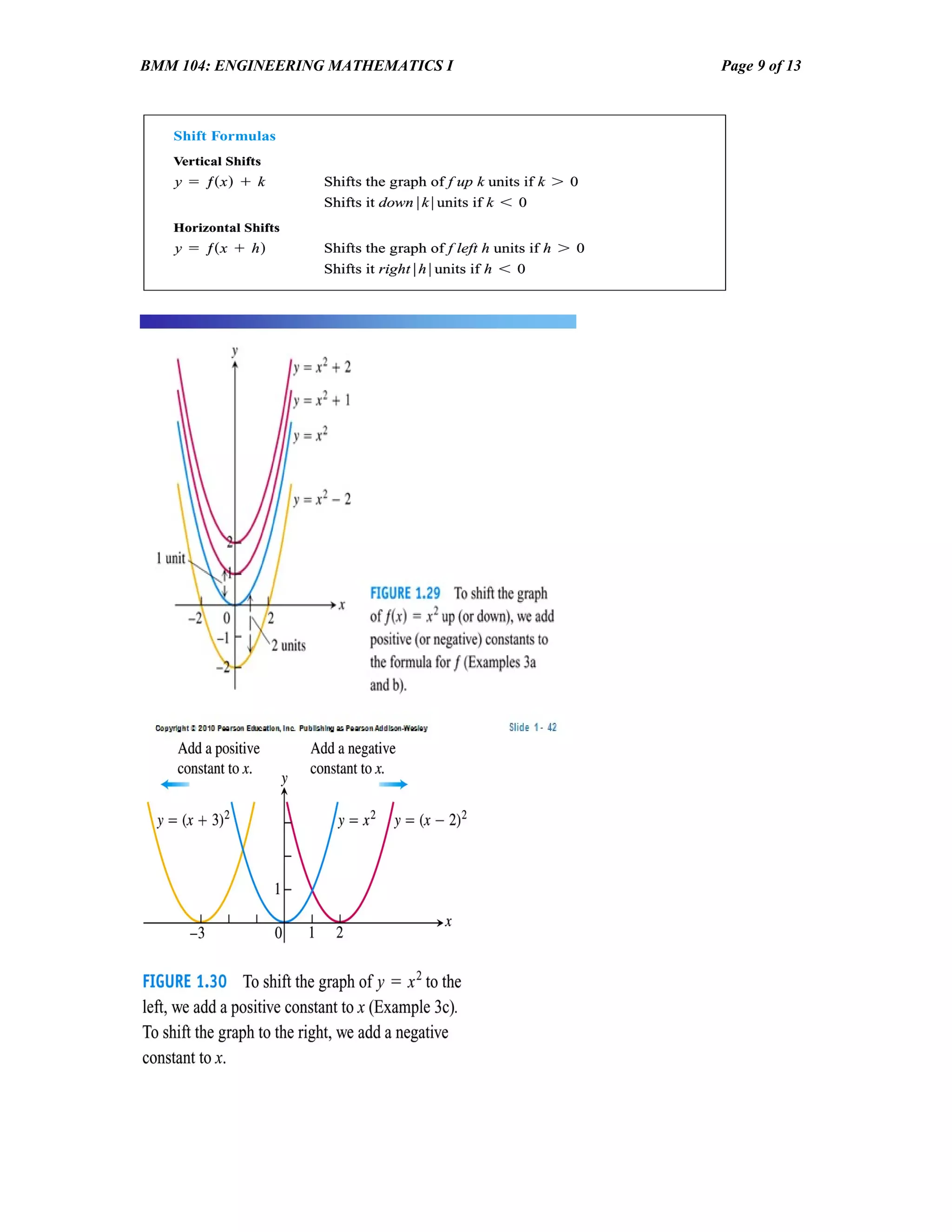
Shifting a Graph of a Function
BMM 104: ENGINEERING MATHEMATICS I   Page 9 of 13
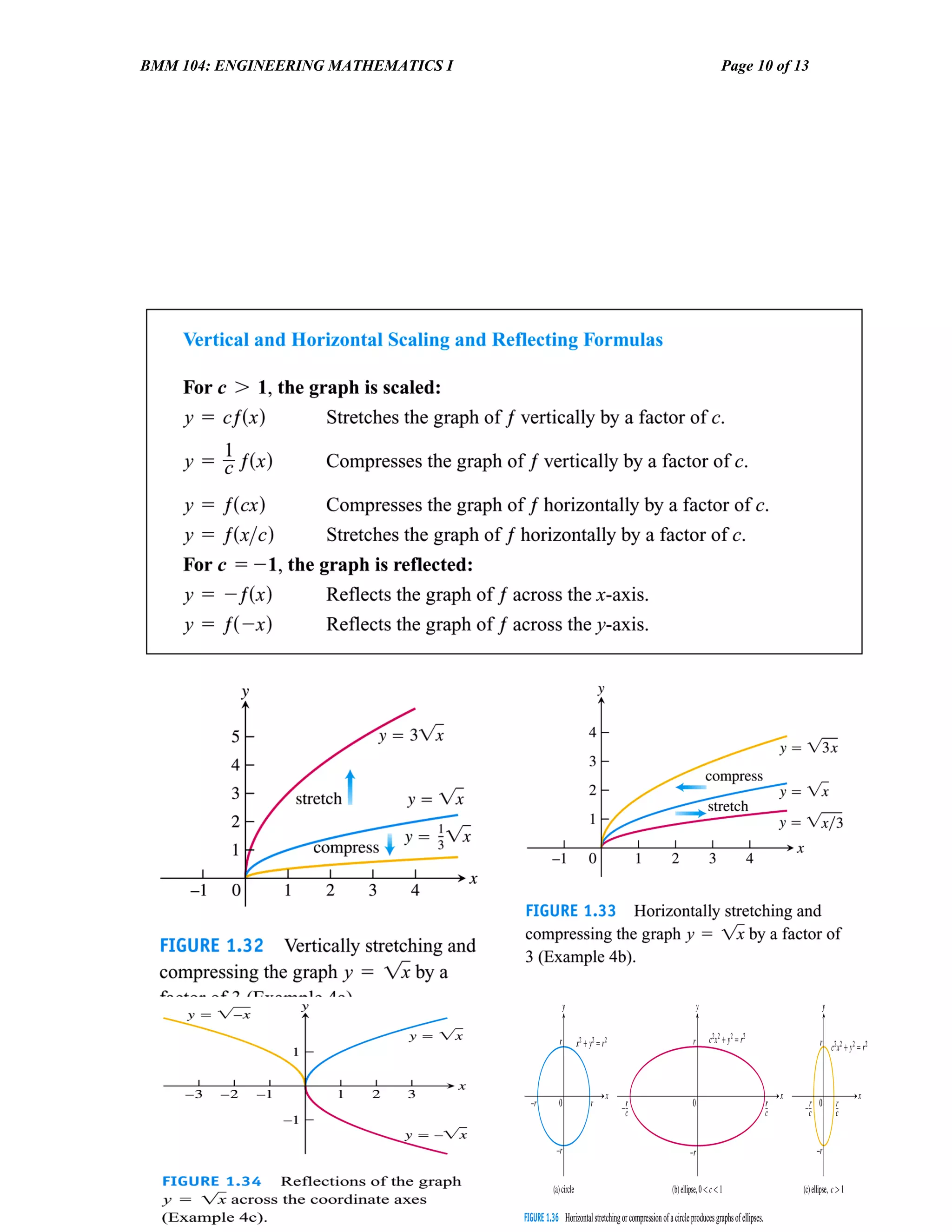
BMM 104: ENGINEERING MATHEMATICS I   Page 10 of 13
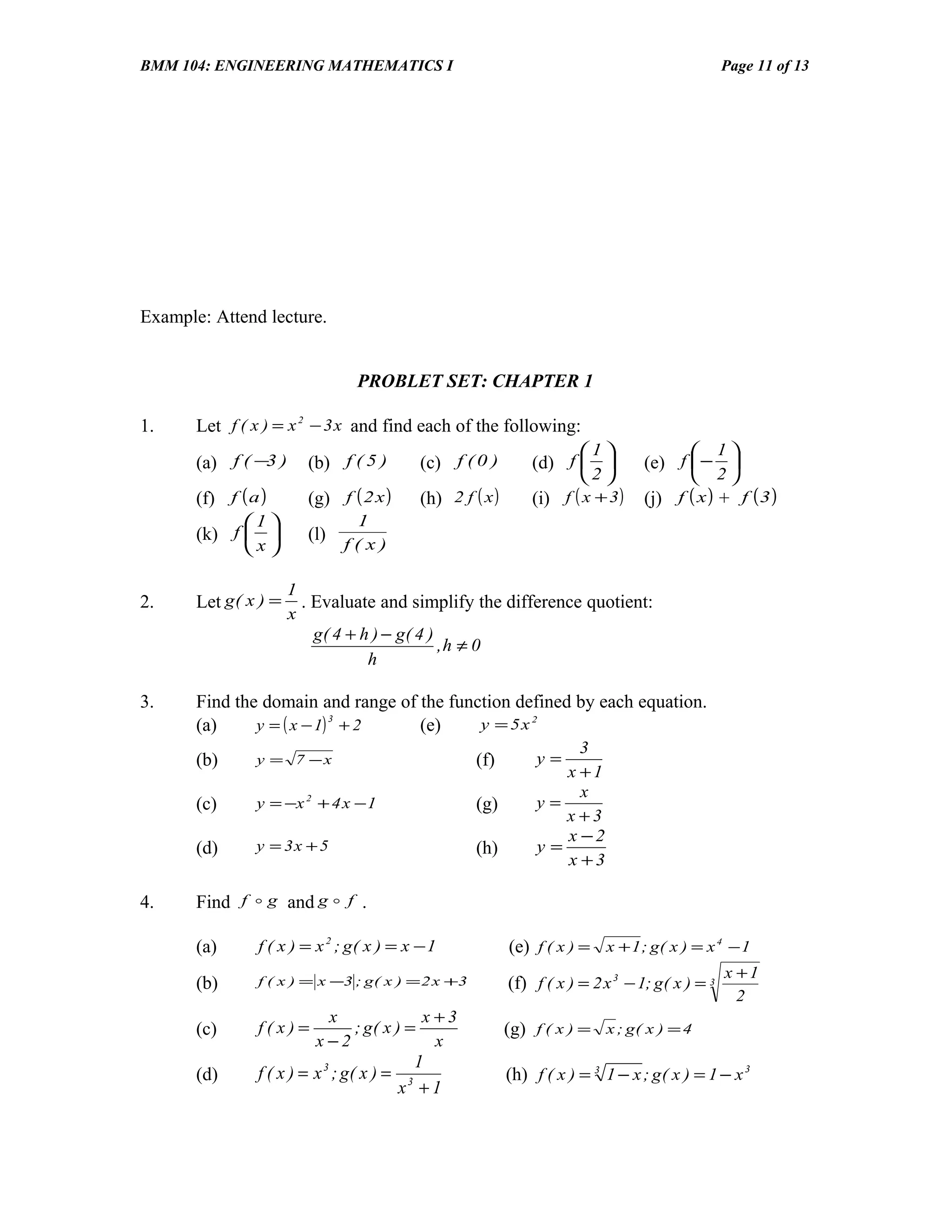
BMM 104: ENGINEERING MATHEMATICS I                                                                    Page 11 of 13


Example: Attend lecture.


                                 PROBLET SET: CHAPTER 1

1.     Let f ( x ) = x 2 − 3 x and find each of the following:
                                                                            1                      1
       (a) f ( −3 )      (b) f ( 5 )           (c) f ( 0 )           (d) f          (e) f  − 
                                                                            2                      2
       (f) f ( a )       (g) f ( 2 x )         (h) 2 f ( x )         (i) f ( x + 3)   (j) f ( x ) + f ( 3 )
              1               1
       (k) f           (l)
              x              f(x)

                       1
2.     Let g ( x ) =     . Evaluate and simplify the difference quotient:
                       x
                           g( 4 + h ) − g( 4 )
                                               ,h ≠ 0
                                   h

3.     Find the domain and range of the function defined by each equation.
               y = ( x − 1) + 2
                           3
       (a)                          (e)     y = 5x 2
                                                                          3
       (b)      y = 7 −x                                (f)          y=
                                                                        x +1
                                                                          x
       (c)      y = −x 2 + 4 x − 1                      (g)          y=
                                                                        x +3
                                                                        x −2
       (d)      y = 3x + 5                              (h)          y=
                                                                        x +3

4.     Find f  g and g  f .

       (a)      f ( x ) = x 2 ; g( x ) = x − 1                 (e) f ( x ) = x + 1 ; g( x ) = x 4 − 1
                                                                                                      x +1
       (b)      f ( x ) = x −3 ; g ( x ) = 2 x +3              (f) f ( x ) = 2 x 3 − 1; g ( x ) = 3
                                                                                                        2
                            x             x +3
       (c)      f(x)=          ; g( x ) =                      (g)   f(x)=      x ; g( x ) = 4
                          x −2              x
                                             1
       (d)      f ( x ) = x 3 ; g( x ) =                       (h) f ( x ) = 3 1 − x ; g ( x ) = 1 − x 3
                                           x +1
                                           3
BMM 104: ENGINEERING MATHEMATICS I                                                           Page 12 of 13


5.     Find the inverse g of the given function f, and state the domain and range of g.

                  y = ( x + 1) ; x ≥ −1
                                2
       (a).                                            (e).   y = x 2 − 4; x ≥ 0
       (b).       y = x 2 − 4 x + 4; x ≥ 2             (f).   y = 4 − x 2 ;0 ≤ x ≤ 2
                        1
       (c).       y=                                   (i).   y = x 2 − 4 x; x ≥ 2
                         x
       (d).       y =− x                               (j).   y = 4x − x2 ; x ≥ 2

6.     Determine whether the following functions are odd, even or neither even nor odd.

                              3
       (a).       f ( x) =       − 2x                         (f).    f ( x ) =−−8t + −7t
                              x2

       (b).
                               (1 − x ) 3                     (g).
                  f ( x) =      3
                                                                      f ( x) = 3 x 3 − 3 x
                                    x
                              cos x − x                                          sin x − ( cos x )
                                                                                                     2
       (c).       f ( x) =               2                    (h).    f ( x) =
                               3−x                                                  cot x sec x
                                                                                          x2
       (d).       f ( x ) = 3 x 4 sin x                       (i).    f ( x) = cos x +         +5
                                                                                         1− x4
                                                                                          x + x2
                                              3
                               −
                                1
                                        2
                                             2
       (e).       f ( x ) =x    3    −x 3
                                    1       
                                                             (j).    f ( x) = tan x +
                                                                                         sin x


                             ANSWERS FOR PROBLEM SET: CHAPTER 1


                                                                                         5                 7
1.     (a) 18                            (b) 10               (c) 0              (d) −               (e)
                                                                                         4                 4
       (f) a 2 − 3a          (g) 4 x 2 − 6 x (h) 2 x 2 − 6 x (i) x 2 + 3 x       (j) x 2 − 3 x
             1 3                             1
       (k) 2 −                       (l) 2
            x     x                       x − 3x
                1
2.      −
            4( 4 + h )

3.     (a)      D = ℜ; R = ℜ                             (e) D = ℜ R = [0 , ∞)
                                                                    ;
       (b)      D = ( − ∞7 ]; R = [0 , ∞
                               ,              )      (f)
D = ( − ∞,−1) ∪ ( 1, ∞) ; R = ( − ∞,0 ) ∪ ( 0 , ∞)
       (c)      D = ℜ R = ( −∞,3]
                          ;                       (g)
D = ( − ∞,−3 ) ∪ ( − 3 , ∞) ; R = ( − ∞,1) ∪ ( 1, ∞) (d)    D = ℜ; R = ℜ                                   (h)
D = ( − ∞,−3 ) ∪ ( − 3 , ∞) ; R = ( − ∞,1) ∪ ( 1, ∞)

                  f  g = ( x − 1) ; g  f = x 2 − 1
                                     2
4.     (a)
       (b)        f  g = 2 x ; g  f = 2 x −3 +3
BMM 104: ENGINEERING MATHEMATICS I                                                      Page 13 of 13


                     x +3                6
      (c)     f g =       ;g  f = 4 −
                     3−x                 x
                         1                    1
      (d)     f g =          − 1; g  f =
                        (
                     x +1
                       3    3
                                   )            3
                                           x −1 +1
                                            3
                                                    (         )
      (e)     f    g = x ; g  f = x + 2x
                            2              2


      (f)     f    g = x; g  f = x
      (g)     f    g = 2; g  f = 4
      (h)     f    g = x; g  f = x


5.    (a).   g( x ) =           x −1           D : x ≥ 0 ; R = y ≥ −1
      (b).   g( x ) =       x + 2 D : x ≥ 0; R = y ≥ 2
                            1
      (c).   g( x ) =                  D : x > 0; R = y > 0
                            x2
      (d).   g( x ) = x 2              D : x ≤ 0; R = y ≥ 0
      (e).   g( x ) = x + 4 D : x ≥ −4 ; R = y ≥ 0
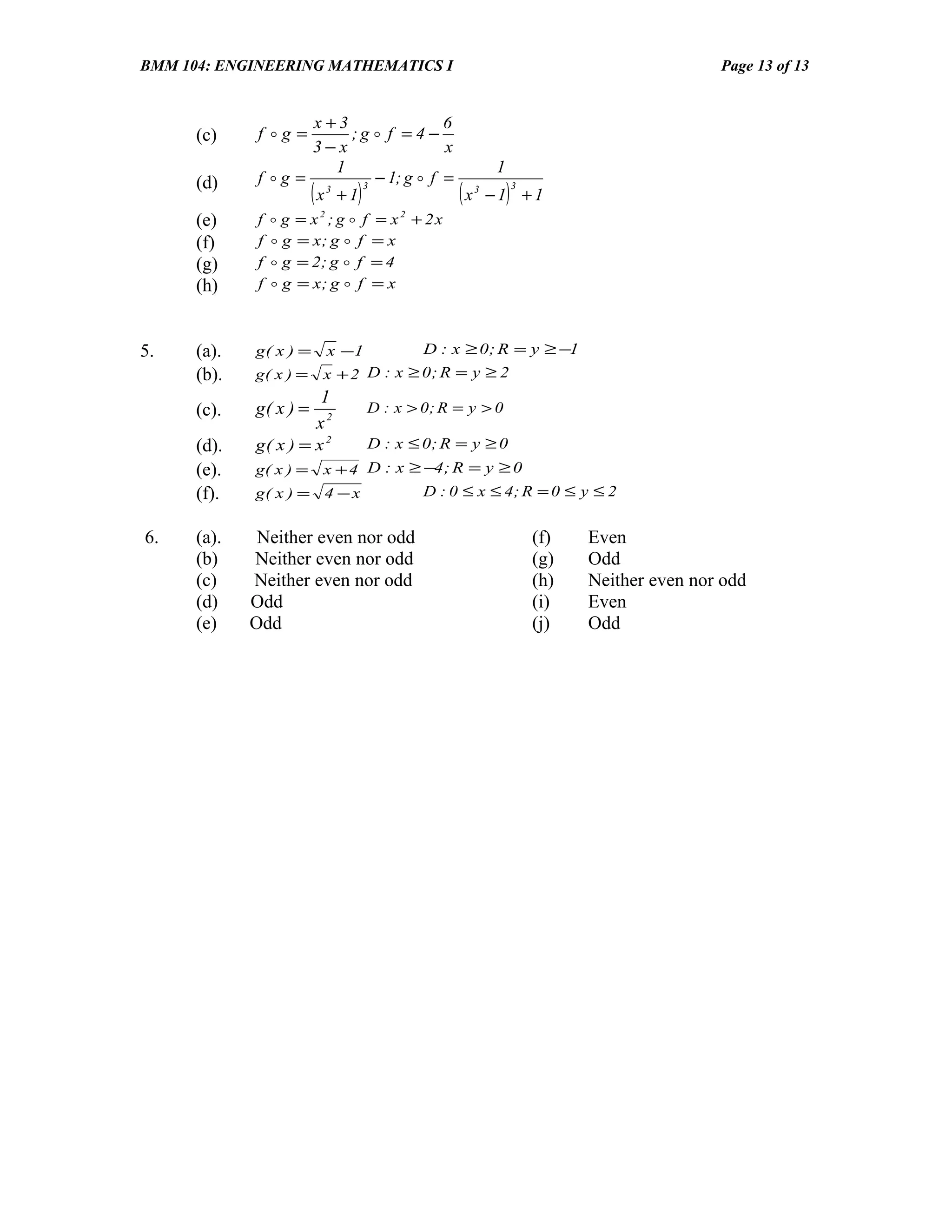
      (f).   g( x ) = 4 − x         D : 0 ≤ x ≤ 4; R = 0 ≤ y ≤ 2


6.    (a).    Neither even nor odd                                (f)   Even
      (b)    Neither even nor odd                                 (g)   Odd
      (c)    Neither even nor odd                                 (h)   Neither even nor odd
      (d)    Odd                                                  (i)   Even
      (e)    Odd                                                  (j)   Odd

Chapter 1 (functions).

  • 1.
    BMM 104: ENGINEERINGMATHEMATICS I Page 1 of 13 CHAPTER 1: FUNCTIONS Relations  Types of relations :  One – to – one  one – to – many  many – to – one Ordered Pairs f(x ) .a .c • ( a , c ) and ( b , d ) are known as ordered pairs . • The set of ordered pairs is { ( a , c ) , ( b , d ) } . .b .d • c and d are called the image of the corresponding first component . domain codomain
  • 2.
    BMM 104: ENGINEERINGMATHEMATICS I Page 2 of 13 Functions  Definition Function A relation in which every element in the domain has a unique image in the codomain.  Notation of functions : A function f from x to y : f : x  y or y = f ( x ) f(x ) .a .c .b .d domain codomain  Domain – set of input values for a function Range – the corresponding output values – is a subset of codomain  Elements of domain { a , b } Elements of codomain { c , d } NOTE: Vertical line test can be used to determine whether a relation is a function or not. A function f ( x ) can have only one value f ( x ) for each x in its domain, so no vertical line can intersect the graph of a function more than once. Example: Determine which of the following equations defines a function y in terms of x. Sketch its graph. (i) y + 2 x = 1 (ii) y = 3 x 2 (iii) x 2 + y 2 = 1 Domain and Range The set D of all possible input values is called the domain of the function. The set of all values of f ( x ) as x varies throughout D is called the range of the function. Example:
  • 3.
    BMM 104: ENGINEERINGMATHEMATICS I Page 3 of 13 Combining Functions Sum, Differences, Products, and Quotients Example: Attend lecture. Composite Functions If f and g are functions, the composite function f  g (“f composed with g”) is defined by ( f  g )( x ) = f ( g ( x )). The domain of f  g consists of the numbers x in the domain of g for which g(x) lies in the domain of f. Example: Attend lecture.
  • 4.
    BMM 104: ENGINEERINGMATHEMATICS I Page 4 of 13 Inverse Functions One-to-One Functions A function f(x) is one-to-one if every two distinct values for x in the domain, x1 ≠ x 2 , correspond to two distinct values of the function, f ( x1 ) ≠ f ( x 2 ) . Properties of a one-to-one function (f −1  f )( x ) = x and ( f  f )( y ) = y −1 NOTE: A function y = f ( x ) is one-to-one if and only if its graph intersects each horizontal line at most once. Inverse Functions Finding the Inverse of a Function Step 1: Verify that f(x) is a one-to-one function. Step 2: Let y = f(x). Step 3: Interchange x and y. Step 4: Solve for y. Step 5: Let y = f −1 ( x ) . Step 6: Note any domain restrictions on f −1 ( x ) . NOTE: −1  Domain of f = Range of f −1  Range of f = Domain of f Example: 1. Find the inverse of the function f ( x ) = 2 x − 3 . 2. Find the inverse of the function f ( x ) = x 3 + 2 . 3. Find the inverse of the function f ( x ) = x + 2 . 2 4. Find the inverse of the function f ( x ) = , x ≠ −3 . x +3 Even Function, Odd Function
  • 5.
    BMM 104: ENGINEERINGMATHEMATICS I Page 5 of 13 A function y = f ( x ) is an even function of x if f ( −x ) = f ( x ) , odd function of x if f ( −x ) = − f ( x ) , for every x in the function’s domain. Even Function (Symmetric about the y-axis) Odd Function (Symmetric about the origin) Example: Attend lecture. Exponential functions
  • 6.
    BMM 104: ENGINEERINGMATHEMATICS I Page 6 of 13 Function of the form f ( x) = a x , a ≠ 1 where a is positive constant is the general exponential function with base a and x as exponent. The most commonly used exponential function, commonly called natural exponential function is y =ex or y = exp( x ) where the base e is the exponential constant whose value is e ≈ 2.718281828... Rules for exponential functions i. e x .e y = e x + y ~ Product Rule ex ii. y = e x−y ~ Quotient Rule e iii. (e ) x y ( ) = e xy = e y x ~ Power Rule 1 1 iv. x = e − x or −x = ex ~ Reciprocal Rule e e v. e0 = 1 Example: Solve the following exponent equations. (a) 2x 2 +3 = 16 (b) 2 x 3 x +1 = 108 (c) ( 2) x2 = 8x 4 Logarithmic Functions
  • 7.
    BMM 104: ENGINEERINGMATHEMATICS I Page 7 of 13 The logarithm function with base a, y = log a x , is the inverse of the base a exponential function y = a x ( a > 0 , a ≠ 1) . The function y = ln x is called the natural logarithm function, and y = log x is often called the common logarithm function. For natural logarithm, y = ln x ⇔ ey = x Algebraic properties of the natural logarithm For any numbers b > 0 and x > 0 , the natural logarithm satisfies the following rules: 1. Product Rule: ln bx = ln b + ln x b 2. Quotient Rule: ln = ln b − ln x x 3. Power Rule: ln x r = r ln x 1 4. Reciprocal Rule: ln = −ln x x Inverse Properties for a x and log a x 1. Base a: a log a x = x , log a a x = x , a > 0 , a ≠ 1, x > 0 2. Base e: e ln x = x , ln e = x , x x >0 Change Base Formula Every logarithmic function is a constant multiple of the natural logarithm. ln x log a x = ( a > 0 , a ≠ 1) ln a NOTE: log a 1 = 0 . Example 1: Rewrite the following expression in terms of logarithm. i. 32 = 2 5 ii. 1000 = 10 3 1 iii. 0.001 = 10 −3 iv. 3 = 92 Example 2: i. Evaluate log 2 3 .
  • 8.
    BMM 104: ENGINEERINGMATHEMATICS I Page 8 of 13 1 2 ii. Simplify log 2 8 − log 2 . 3 7  1 iii. Simplify log 2   + log 2 128 8  10 x  iv. Expand ln 2   y    Example 3: Solve the following equations: 1. 39 = e x 2. 10 x = 0.32 3. ln 2 x = 1.36 4. log ( 3 x − 6 ) = 0.76 5. log 3 ( 2 x + 1) − 2 log 3 ( x − 3 ) = 2 6. 6 3 x +2 = 200 Trigonometric Functions Example: Attend lecture. Hyperbolic Functions Hyperbolic functions are formed by taking combinations of the two exponential functions e x and e −x . The six basic hyperbolic functions e x − e −x 1. Hyperbolic sine of x: sinh x = 2 e x + e −x 2. Hyperbolic cosine of x: cosh x = 2 ex − e −x 3. Hyperbolic tangent of x: tanh x = ex + e −x ex + e −x 4. Hyperbolic cotangent of x: coth x = x e − e −x 2 5. Hyperbolic secant of x: sec hx = x e + e −x 2 6. Hyperbolic cosecant of x: cos echx = x e − e −x Shifting a Graph of a Function
  • 9.
    BMM 104: ENGINEERINGMATHEMATICS I Page 9 of 13
  • 10.
    BMM 104: ENGINEERINGMATHEMATICS I Page 10 of 13
  • 11.
    BMM 104: ENGINEERINGMATHEMATICS I Page 11 of 13 Example: Attend lecture. PROBLET SET: CHAPTER 1 1. Let f ( x ) = x 2 − 3 x and find each of the following: 1  1 (a) f ( −3 ) (b) f ( 5 ) (c) f ( 0 ) (d) f   (e) f  −  2  2 (f) f ( a ) (g) f ( 2 x ) (h) 2 f ( x ) (i) f ( x + 3) (j) f ( x ) + f ( 3 ) 1 1 (k) f   (l) x f(x) 1 2. Let g ( x ) = . Evaluate and simplify the difference quotient: x g( 4 + h ) − g( 4 ) ,h ≠ 0 h 3. Find the domain and range of the function defined by each equation. y = ( x − 1) + 2 3 (a) (e) y = 5x 2 3 (b) y = 7 −x (f) y= x +1 x (c) y = −x 2 + 4 x − 1 (g) y= x +3 x −2 (d) y = 3x + 5 (h) y= x +3 4. Find f  g and g  f . (a) f ( x ) = x 2 ; g( x ) = x − 1 (e) f ( x ) = x + 1 ; g( x ) = x 4 − 1 x +1 (b) f ( x ) = x −3 ; g ( x ) = 2 x +3 (f) f ( x ) = 2 x 3 − 1; g ( x ) = 3 2 x x +3 (c) f(x)= ; g( x ) = (g) f(x)= x ; g( x ) = 4 x −2 x 1 (d) f ( x ) = x 3 ; g( x ) = (h) f ( x ) = 3 1 − x ; g ( x ) = 1 − x 3 x +1 3
  • 12.
    BMM 104: ENGINEERINGMATHEMATICS I Page 12 of 13 5. Find the inverse g of the given function f, and state the domain and range of g. y = ( x + 1) ; x ≥ −1 2 (a). (e). y = x 2 − 4; x ≥ 0 (b). y = x 2 − 4 x + 4; x ≥ 2 (f). y = 4 − x 2 ;0 ≤ x ≤ 2 1 (c). y= (i). y = x 2 − 4 x; x ≥ 2 x (d). y =− x (j). y = 4x − x2 ; x ≥ 2 6. Determine whether the following functions are odd, even or neither even nor odd. 3 (a). f ( x) = − 2x (f). f ( x ) =−−8t + −7t x2 (b). (1 − x ) 3 (g). f ( x) = 3 f ( x) = 3 x 3 − 3 x x cos x − x sin x − ( cos x ) 2 (c). f ( x) = 2 (h). f ( x) = 3−x cot x sec x x2 (d). f ( x ) = 3 x 4 sin x (i). f ( x) = cos x + +5 1− x4 x + x2 3 − 1  2 2 (e). f ( x ) =x 3  −x 3 1   (j). f ( x) = tan x +   sin x ANSWERS FOR PROBLEM SET: CHAPTER 1 5 7 1. (a) 18 (b) 10 (c) 0 (d) − (e) 4 4 (f) a 2 − 3a (g) 4 x 2 − 6 x (h) 2 x 2 − 6 x (i) x 2 + 3 x (j) x 2 − 3 x 1 3 1 (k) 2 − (l) 2 x x x − 3x 1 2. − 4( 4 + h ) 3. (a) D = ℜ; R = ℜ (e) D = ℜ R = [0 , ∞) ; (b) D = ( − ∞7 ]; R = [0 , ∞ , ) (f) D = ( − ∞,−1) ∪ ( 1, ∞) ; R = ( − ∞,0 ) ∪ ( 0 , ∞) (c) D = ℜ R = ( −∞,3] ; (g) D = ( − ∞,−3 ) ∪ ( − 3 , ∞) ; R = ( − ∞,1) ∪ ( 1, ∞) (d) D = ℜ; R = ℜ (h) D = ( − ∞,−3 ) ∪ ( − 3 , ∞) ; R = ( − ∞,1) ∪ ( 1, ∞) f  g = ( x − 1) ; g  f = x 2 − 1 2 4. (a) (b) f  g = 2 x ; g  f = 2 x −3 +3
  • 13.
    BMM 104: ENGINEERINGMATHEMATICS I Page 13 of 13 x +3 6 (c) f g = ;g  f = 4 − 3−x x 1 1 (d) f g = − 1; g  f = ( x +1 3 3 ) 3 x −1 +1 3 ( ) (e) f  g = x ; g  f = x + 2x 2 2 (f) f  g = x; g  f = x (g) f  g = 2; g  f = 4 (h) f  g = x; g  f = x 5. (a). g( x ) = x −1 D : x ≥ 0 ; R = y ≥ −1 (b). g( x ) = x + 2 D : x ≥ 0; R = y ≥ 2 1 (c). g( x ) = D : x > 0; R = y > 0 x2 (d). g( x ) = x 2 D : x ≤ 0; R = y ≥ 0 (e). g( x ) = x + 4 D : x ≥ −4 ; R = y ≥ 0 (f). g( x ) = 4 − x D : 0 ≤ x ≤ 4; R = 0 ≤ y ≤ 2 6. (a). Neither even nor odd (f) Even (b) Neither even nor odd (g) Odd (c) Neither even nor odd (h) Neither even nor odd (d) Odd (i) Even (e) Odd (j) Odd