Section	5.5
         Integration	by	Substitution

                  V63.0121.027, Calculus	I


                     December	10, 2009


Announcements
   Final	Exam: Friday	12/18, 2:00-3:50pm, Tisch	UC50
   Practice	finals	on	the	website. Solutions	Friday

                                          .    .     .   .   .   .
Schedule	for	next	week


      Tuesday, 8:00am: Review	session	for	all	students	with	8:00
      recitations	(Tuesday	or	Thursday)	in	CIWW 109
      Tuesday, 9:30am: Review	session	for	all	students	with	9:30
      recitations	(Tuesday	or	Thursday)	in	CIWW 109
      Office	Hours	continue
      Tuesday, class: review, evaluations, movie!
      Friday, 2:00pm: final	in	Tisch	UC50


                                             .      .   .   .   .   .
Resurrection	Policy
        If	your	final	score	beats	your	midterm	score, we	will	add	10%	to
        its	weight, and	subtract	10%	from	the	midterm	weight.


                                                                          .
.
Image	credit: Scott	Beale	/	Laughing	Squid
                                                   .   .   .    .   .         .
Outline


  Last	Time: The	Fundamental	Theorem(s)	of	Calculus


  Substitution	for	Indefinite	Integrals
     Theory
     Examples


  Substitution	for	Definite	Integrals
     Theory
     Examples


                                           .   .      .   .   .   .
Differentiation	and	Integration	as	reverse	processes


   Theorem	(The	Fundamental	Theorem	of	Calculus)
    1. Let f be	continuous	on [a, b]. Then
                               ∫ x
                            d
                                    f(t) dt = f(x)
                            dx a

    2. Let f be	continuous	on [a, b] and f = F′ for	some	other
       function F. Then
                         ∫ b
                             f(x) dx = F(b) − F(a).
                           a


                                                 .   .   .   .   .   .
Techniques	of	antidifferentiation?


   So	far	we	know	only	a	few	rules	for	antidifferentiation. Some	are
   general, like
                ∫                   ∫           ∫
                  [f(x) + g(x)] dx = f(x) dx + g(x) dx


                                               .   .    .   .    .     .
Techniques	of	antidifferentiation?


   So	far	we	know	only	a	few	rules	for	antidifferentiation. Some	are
   general, like
                ∫                   ∫           ∫
                  [f(x) + g(x)] dx = f(x) dx + g(x) dx

   Some	are	pretty	particular, like
                    ∫
                           1
                        √         dx = arcsec x + C.
                       x x2 − 1


                                               .       .   .   .   .   .
Techniques	of	antidifferentiation?


   So	far	we	know	only	a	few	rules	for	antidifferentiation. Some	are
   general, like
                ∫                   ∫           ∫
                  [f(x) + g(x)] dx = f(x) dx + g(x) dx

   Some	are	pretty	particular, like
                    ∫
                           1
                        √         dx = arcsec x + C.
                       x x2 − 1
   What	are	we	supposed	to	do	with	that?


                                               .       .   .   .   .   .
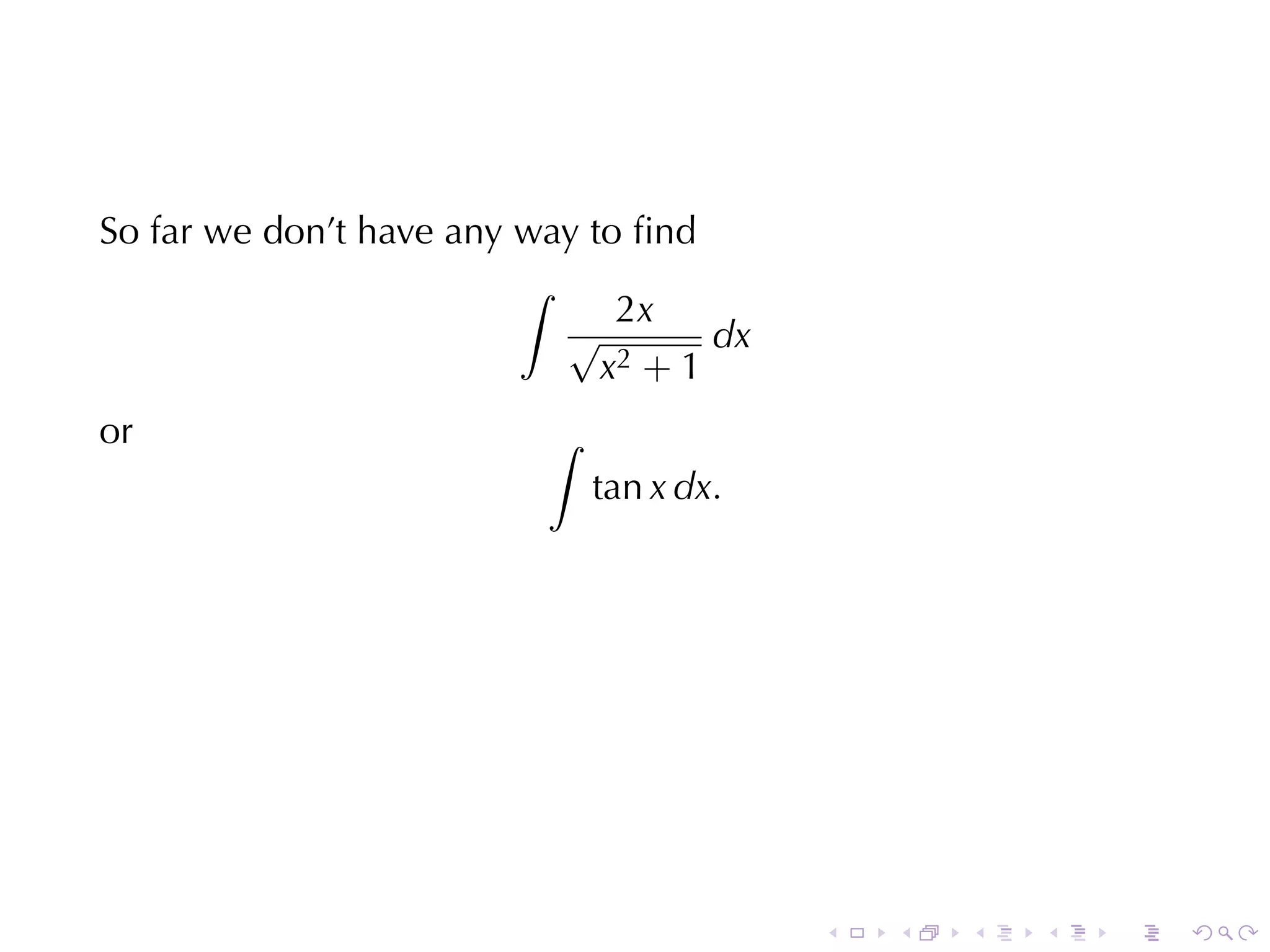
So	far	we	don’t	have	any	way	to	find
                         ∫
                               2x
                           √         dx
                              x2 + 1
or                        ∫
                              tan x dx.


                                          .   .   .   .   .   .
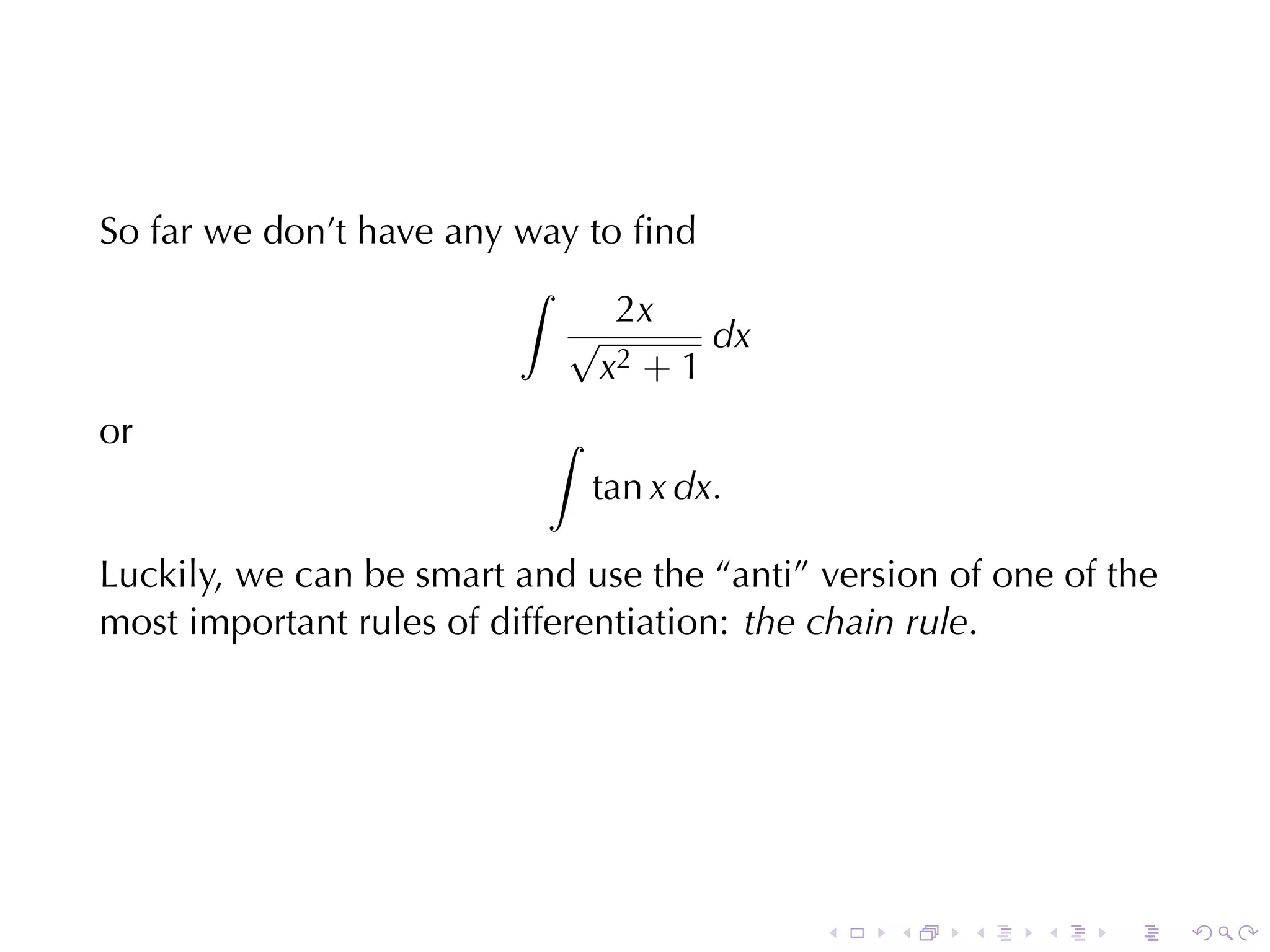
So	far	we	don’t	have	any	way	to	find
                         ∫
                               2x
                           √         dx
                              x2 + 1
or                         ∫
                               tan x dx.

Luckily, we	can	be	smart	and	use	the	“anti”	version	of	one	of	the
most	important	rules	of	differentiation: the	chain	rule.


                                            .   .    .   .    .     .
Outline


  Last	Time: The	Fundamental	Theorem(s)	of	Calculus


  Substitution	for	Indefinite	Integrals
     Theory
     Examples


  Substitution	for	Definite	Integrals
     Theory
     Examples


                                           .   .      .   .   .   .
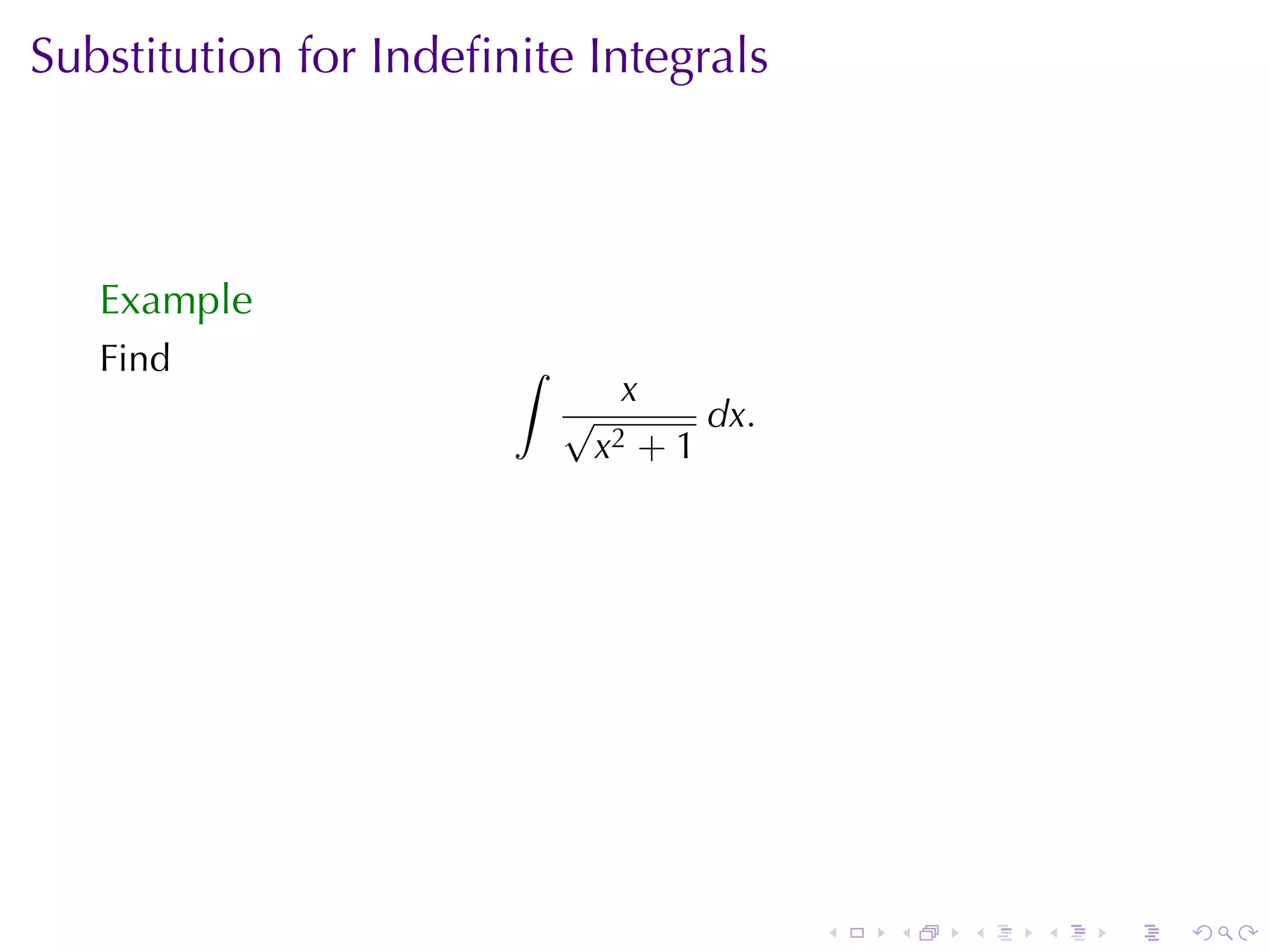
Substitution	for	Indefinite	Integrals


   Example
   Find                ∫
                              x
                           √      dx.
                            x 2+1


                                        .   .   .   .   .   .
Substitution	for	Indefinite	Integrals


   Example
   Find                     ∫
                                   x
                                √      dx.
                                 x 2+1


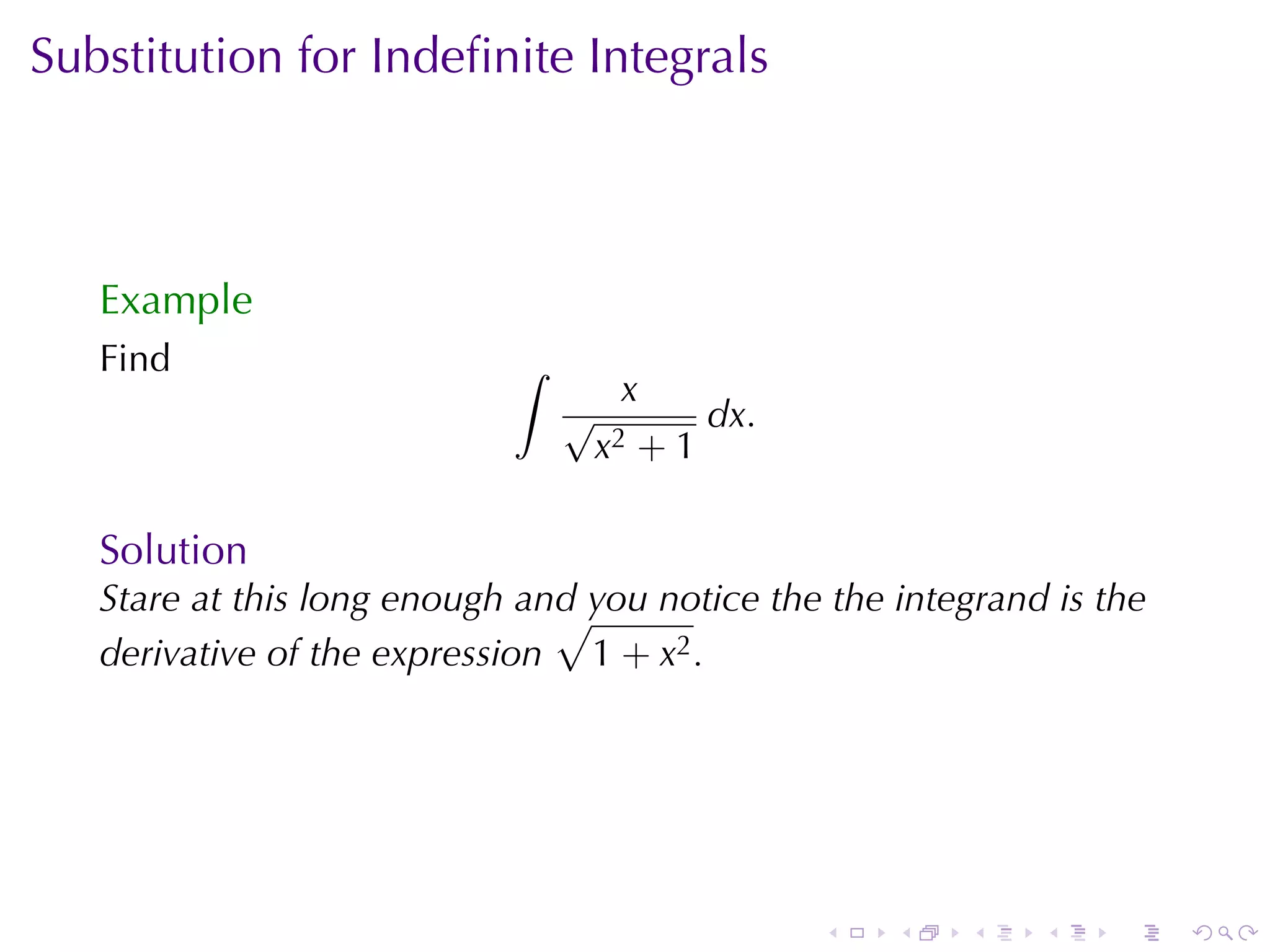
   Solution
   Stare	at	this	long	enough	and	you	notice	the	the	integrand	is	the
                               √
   derivative	of	the	expression 1 + x2 .


                                               .    .    .   .    .    .
Say	what?


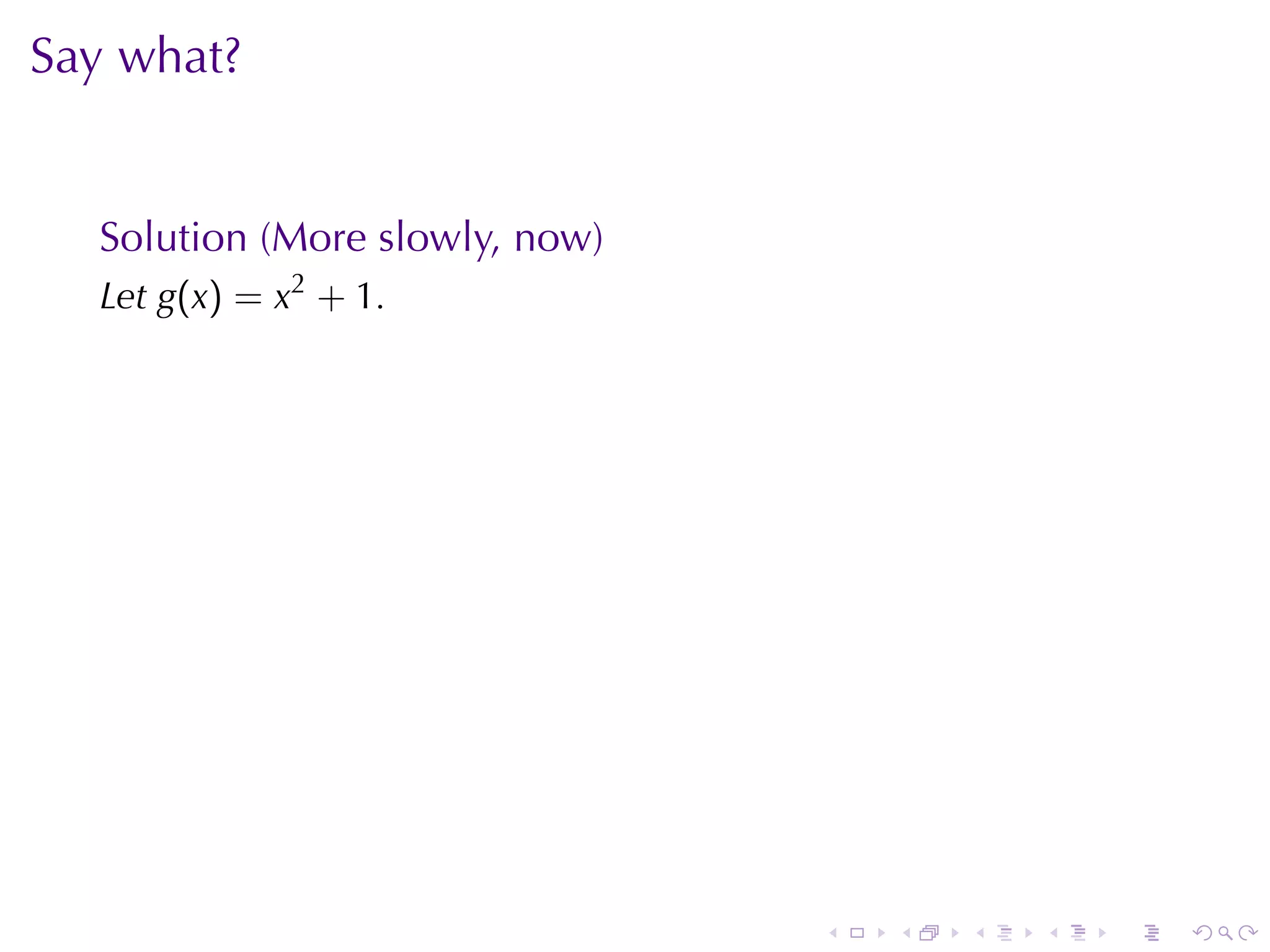
  Solution	(More	slowly, now)
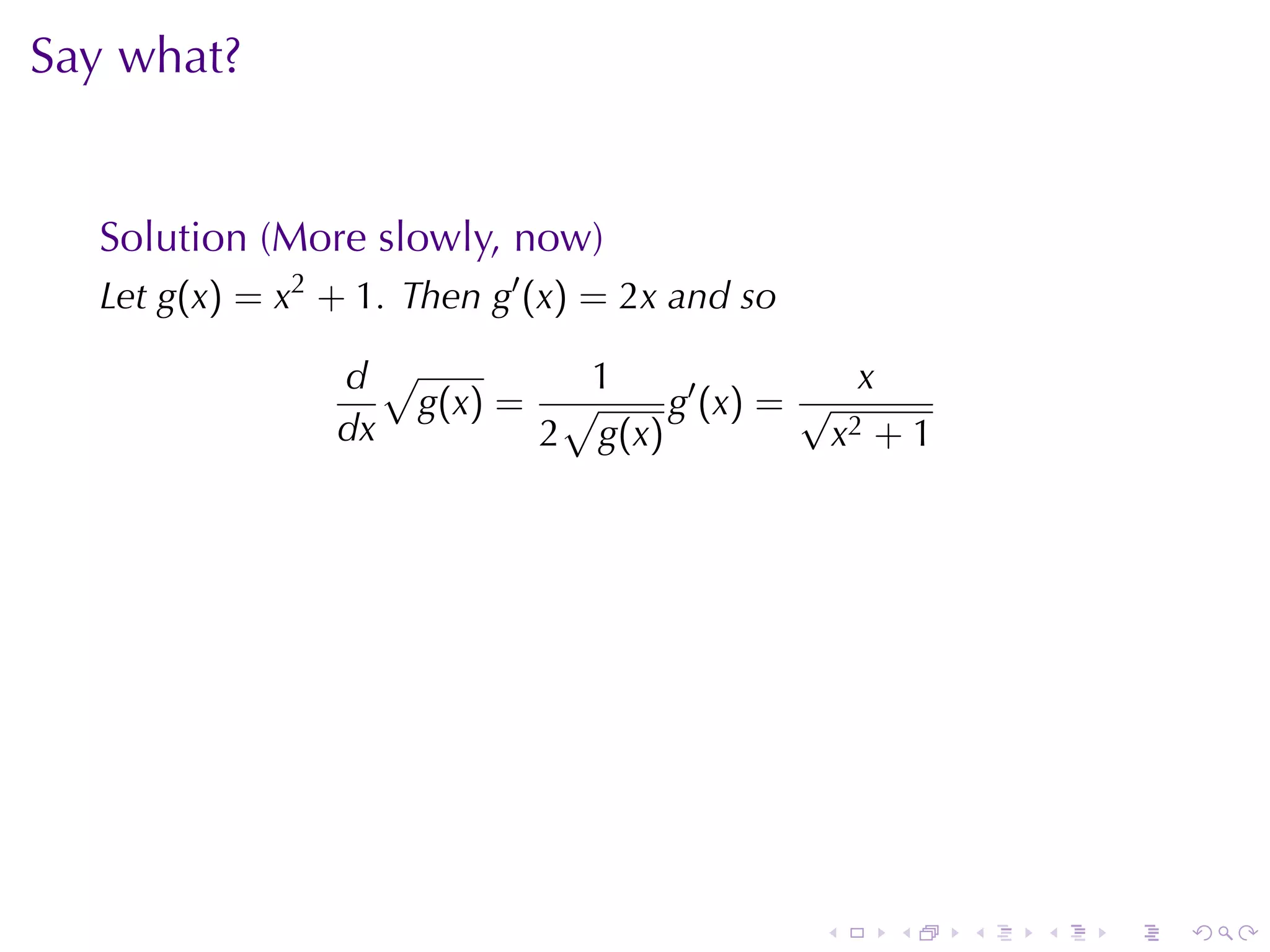
  Let g(x) = x2 + 1.


                                .   .   .   .   .   .
Say	what?


  Solution	(More	slowly, now)
  Let g(x) = x2 + 1. Then g′ (x) = 2x and	so

                d√         1                x
                   g(x) = √     g′ (x) = √
                dx       2 g(x)           x2 + 1


                                               .   .   .   .   .   .
Say	what?


  Solution	(More	slowly, now)
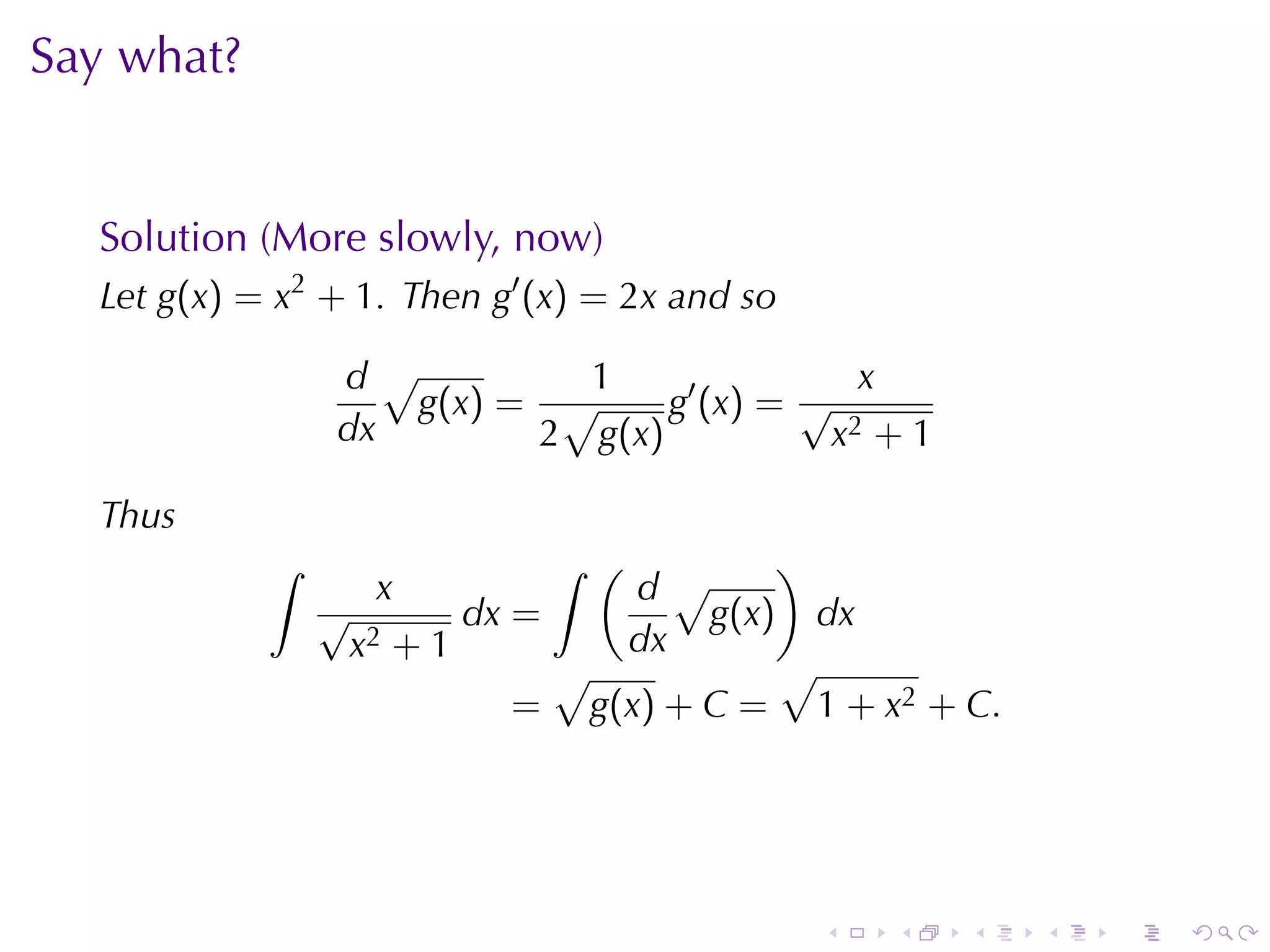
  Let g(x) = x2 + 1. Then g′ (x) = 2x and	so

                 d√         1                x
                    g(x) = √     g′ (x) = √
                 dx       2 g(x)           x2 + 1

  Thus
            ∫                 ∫ (       )
                   x            d√
                √       dx =        g(x) dx
                 x2 + 1        dx
                             √          √
                           = g(x) + C = 1 + x2 + C.


                                               .   .   .   .   .   .
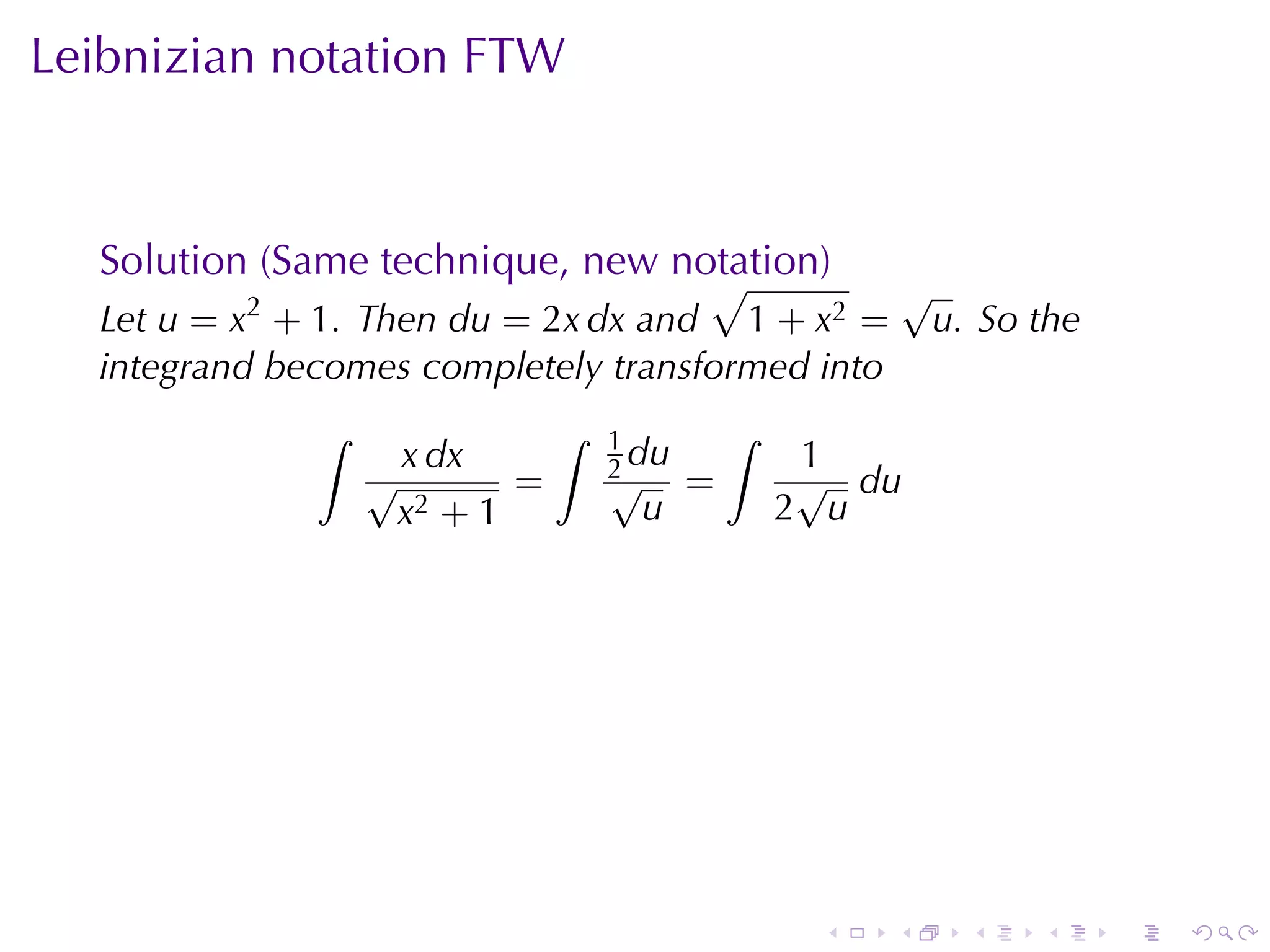
Leibnizian	notation	FTW


  Solution	(Same	technique, new	notation)
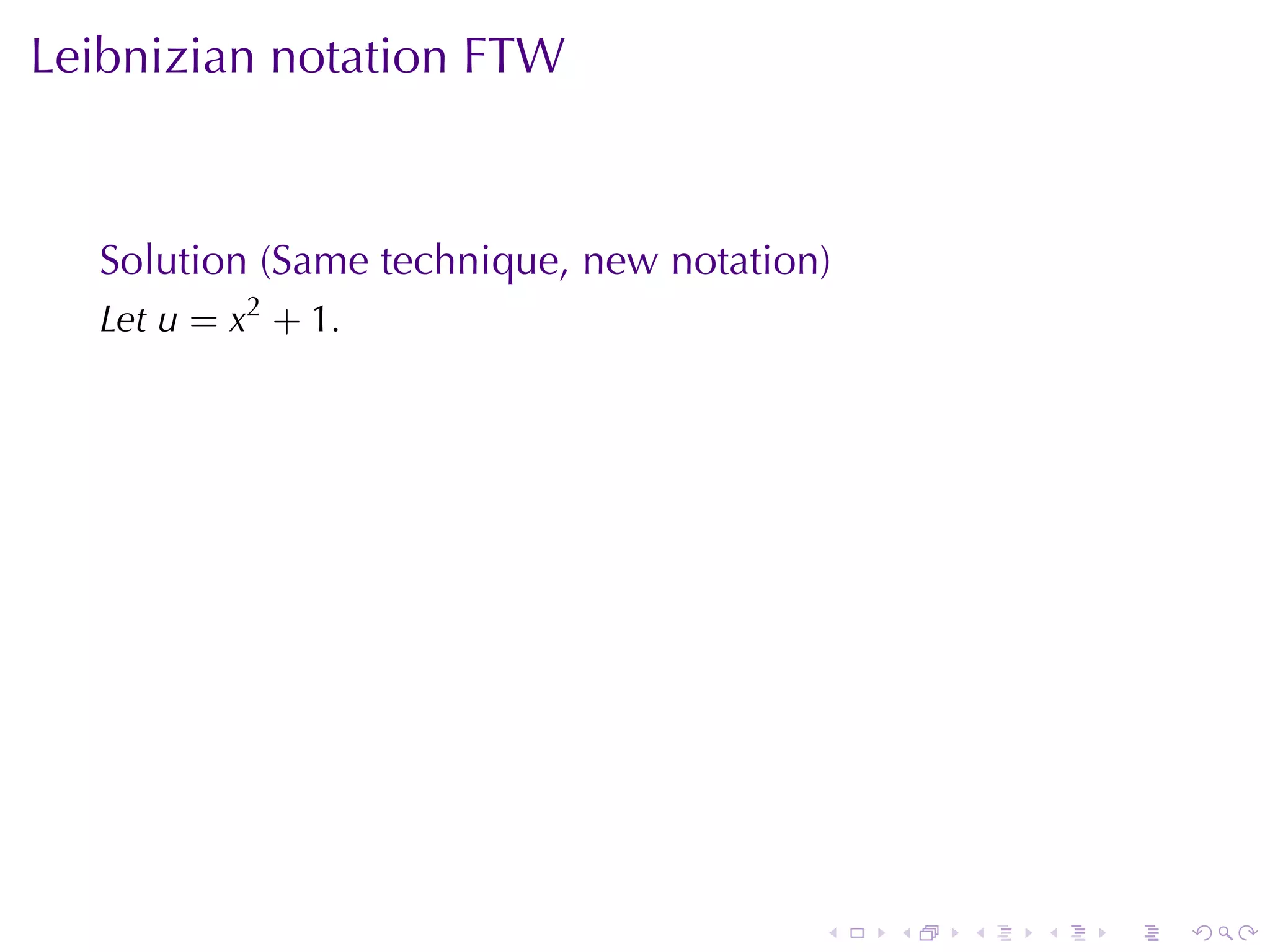
  Let u = x2 + 1.


                                        .   .   .   .   .   .
Leibnizian	notation	FTW


  Solution	(Same	technique, new	notation)
                                  √                    √
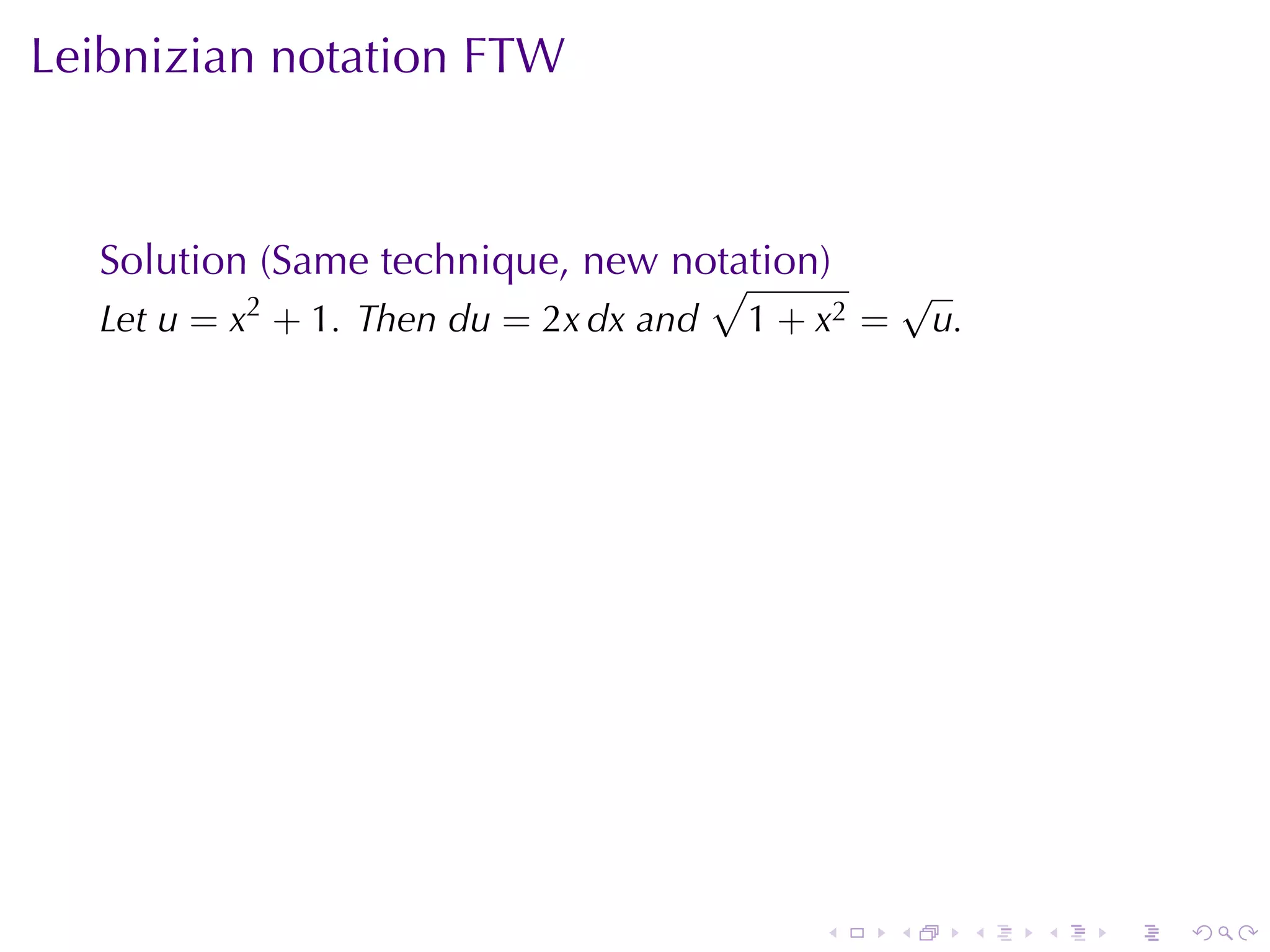
  Let u = x2 + 1. Then du = 2x dx and   1 + x2 =        u.


                                            .      .         .   .   .   .
Leibnizian	notation	FTW


  Solution	(Same	technique, new	notation)
                                  √                       √
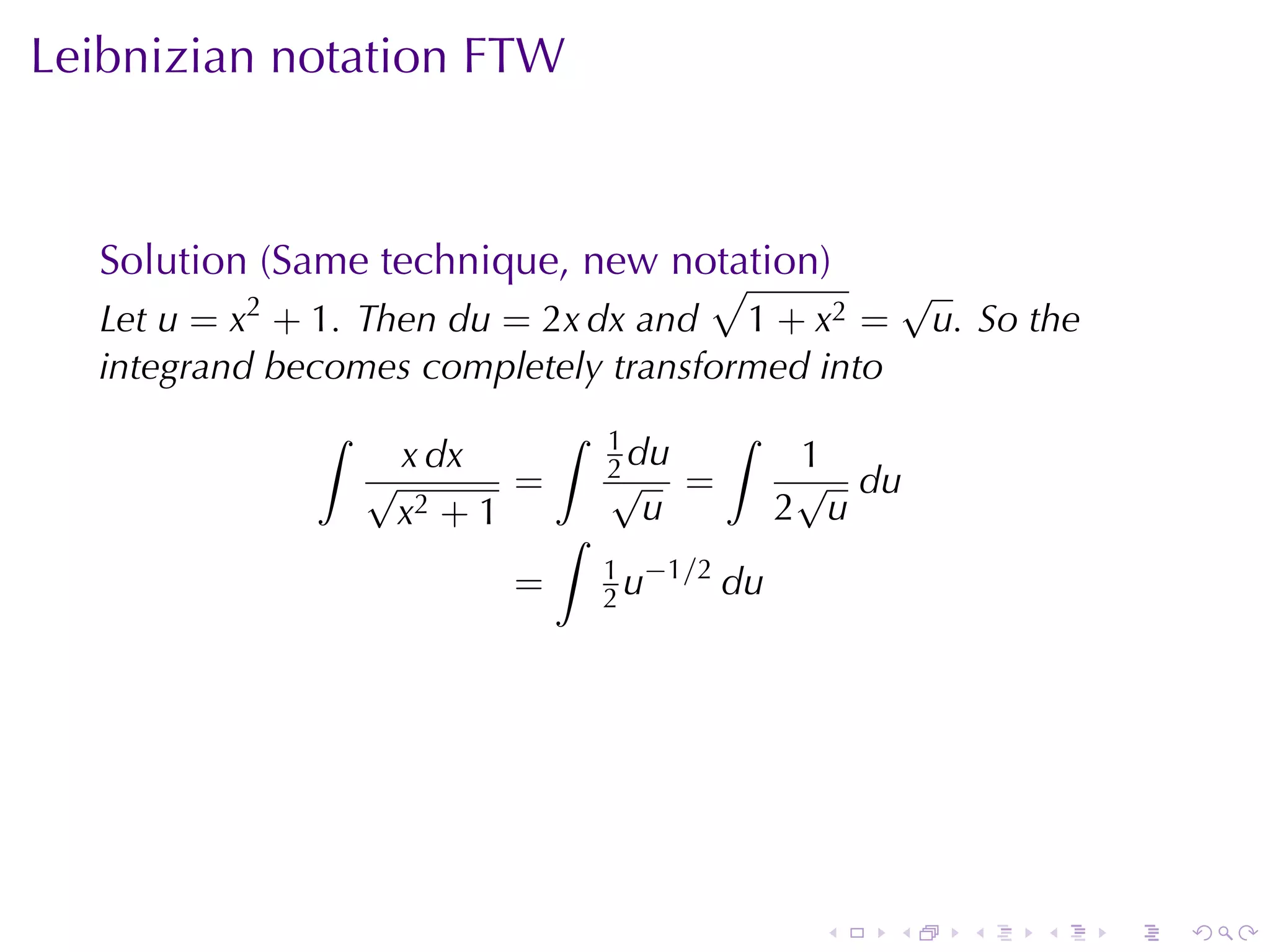
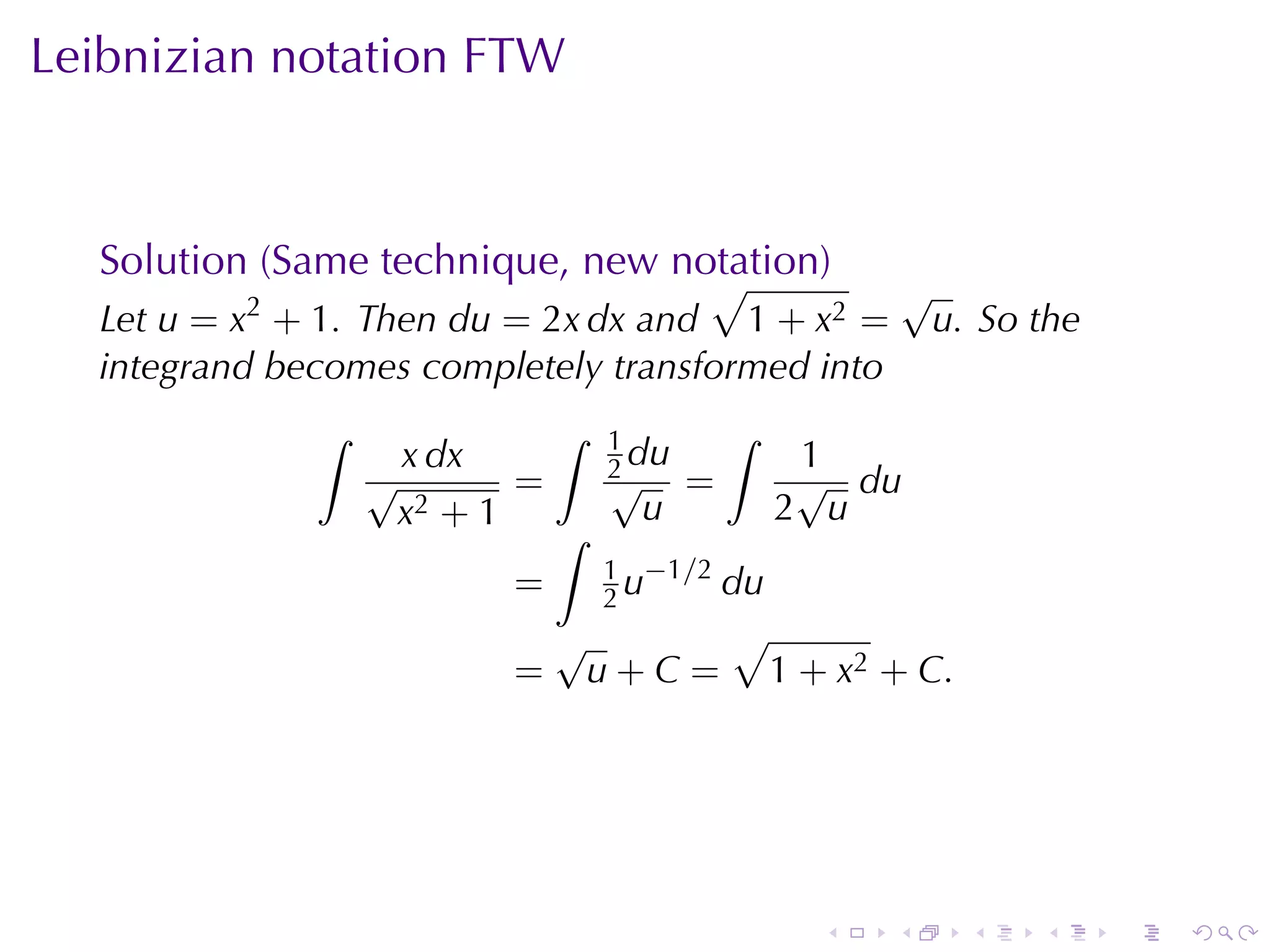
  Let u = x2 + 1. Then du = 2x dx and 1 + x2 =             u. So	the
  integrand	becomes	completely	transformed	into
              ∫               ∫   1          ∫
                  √
                   x dx           2 du
                                  √
                                                  1
                                                  √ du
                          =              =
                   x2 + 1           u            2 u


                                                  .   .      .   .     .   .
Leibnizian	notation	FTW


  Solution	(Same	technique, new	notation)
                                  √                    √
  Let u = x2 + 1. Then du = 2x dx and 1 + x2 =          u. So	the
  integrand	becomes	completely	transformed	into
              ∫            ∫   1          ∫
                  √
                   x dx        2 du
                               √
                                               1
                                               √ du
                         =            =
                   x2 + 1 ∫      u            2 u
                               1 −1/2
                         =     2u     du


                                               .   .      .   .     .   .
Leibnizian	notation	FTW


  Solution	(Same	technique, new	notation)
                                  √                       √
  Let u = x2 + 1. Then du = 2x dx and 1 + x2 =             u. So	the
  integrand	becomes	completely	transformed	into
              ∫               ∫   1          ∫
                  √
                   x dx           2 du
                                  √
                                                  1
                                                  √ du
                         =               =
                   x2 + 1 ∫         u            2 u
                                  1 −1/2
                         =        2u     du
                              √              √
                          =       u+C=        1 + x2 + C.


                                                  .   .      .   .     .   .
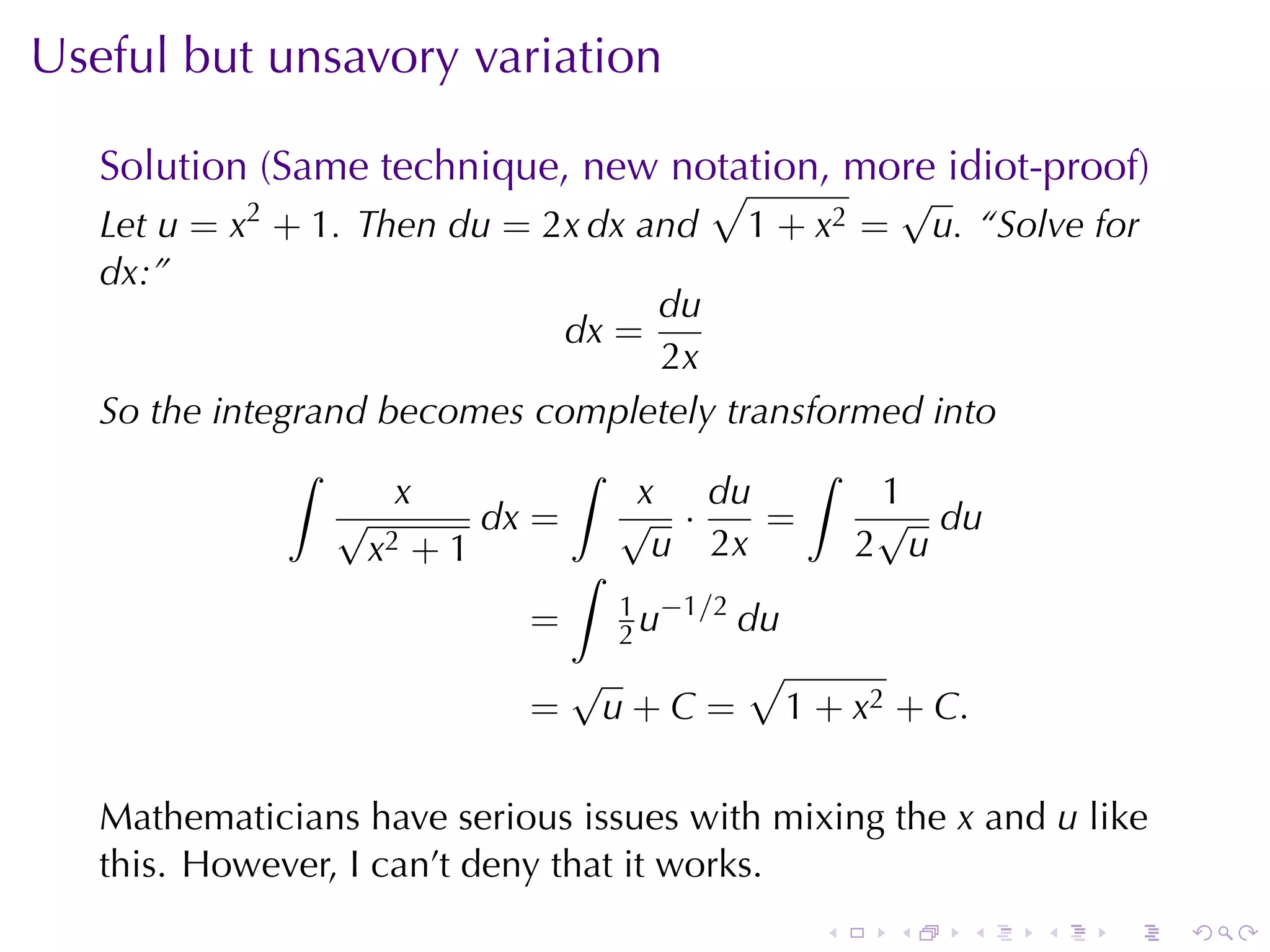
Useful	but	unsavory	variation

   Solution	(Same	technique, new	notation, more	idiot-proof)
                                   √             √
   Let u = x2 + 1. Then du = 2x dx and 1 + x2 = u. “Solve	for
   dx:”
                                     du
                                dx =
                                      2x
   So	the	integrand	becomes	completely	transformed	into
               ∫                ∫            ∫
                      x             x du        1
                  √        dx =    √ ·     =    √ du
                    x2 + 1           u 2x      2 u
                                ∫
                                   1 −1/2
                              =    2u     du
                                √         √
                              = u + C = 1 + x2 + C .

   Mathematicians	have	serious	issues	with	mixing	the x and u like
   this. However, I can’t	deny	that	it	works.
                                              .   .    .   .    .    .
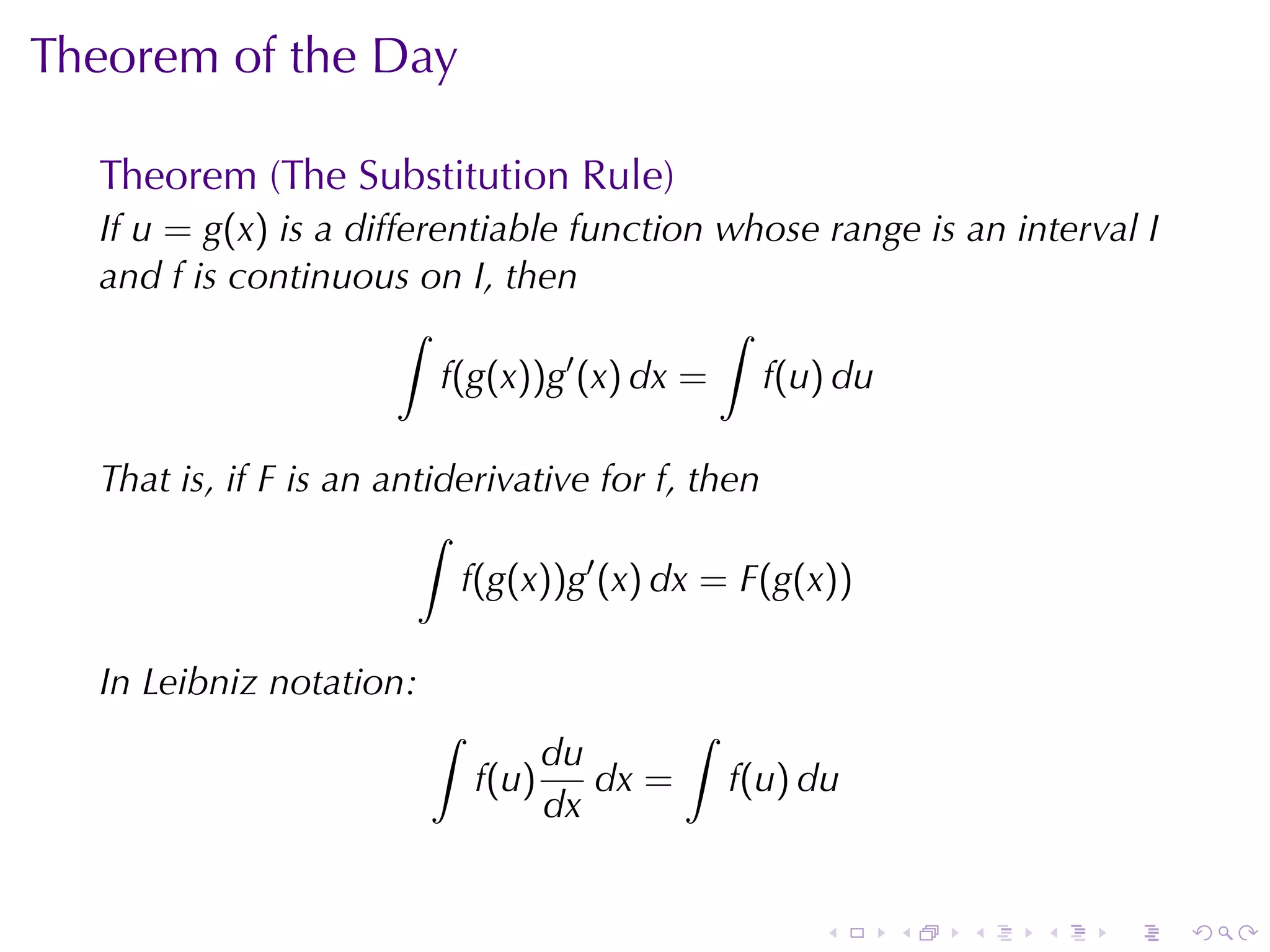
Theorem	of	the	Day

  Theorem	(The	Substitution	Rule)
  If u = g(x) is	a	differentiable	function	whose	range	is	an	interval I
  and f is	continuous	on I, then
                       ∫                    ∫
                          f(g(x))g′ (x) dx = f(u) du

  That	is, if F is	an	antiderivative	for f, then
                        ∫
                           f(g(x))g′ (x) dx = F(g(x))

  In	Leibniz	notation:
                         ∫                  ∫
                                  du
                             f(u)    dx =       f(u) du
                                  dx


                                                     .    .   .   .   .   .
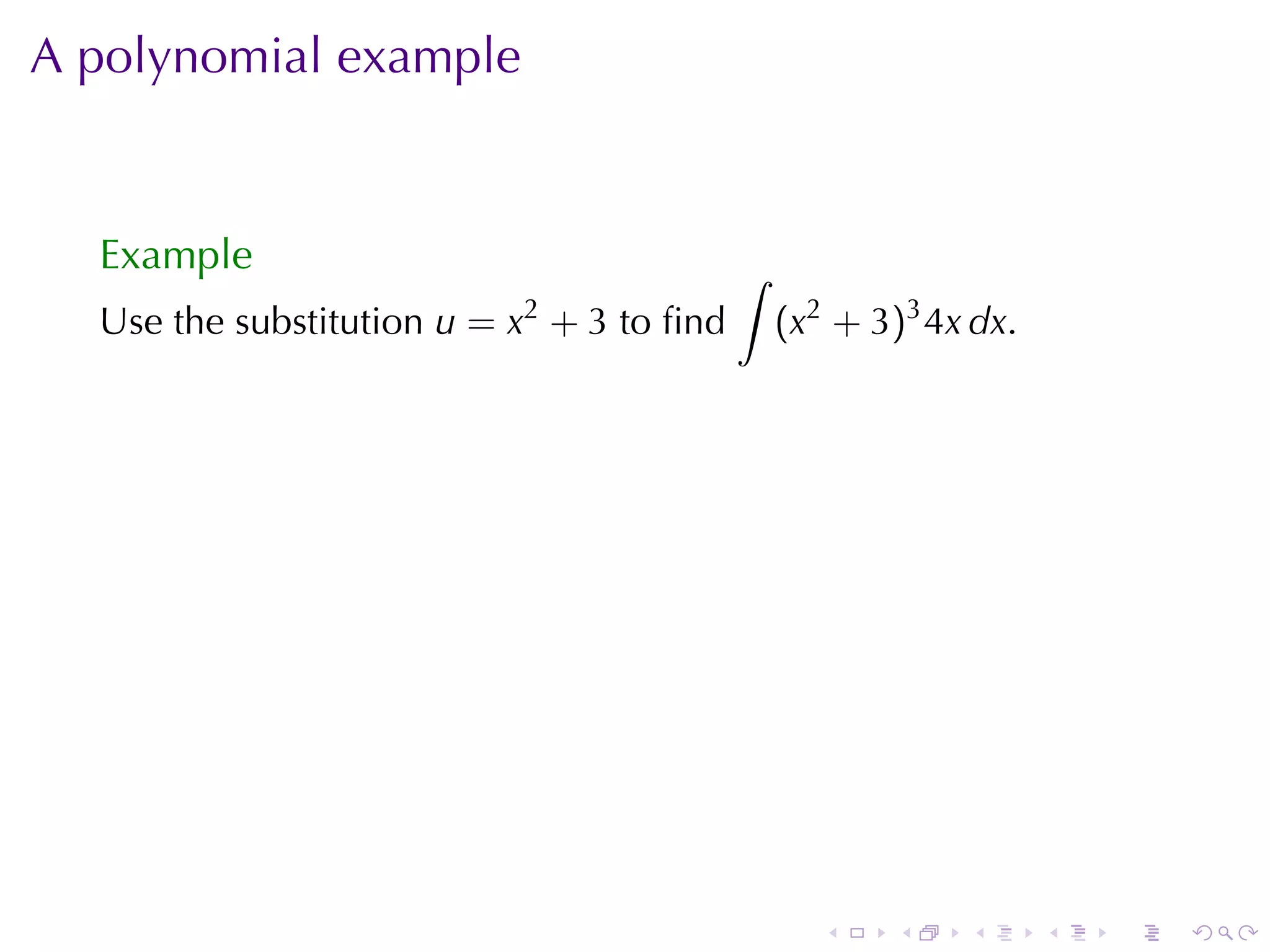
A polynomial	example


  Example                                  ∫
  Use	the	substitution u = x2 + 3 to	find       (x2 + 3)3 4x dx.


                                                  .   .    .      .   .   .
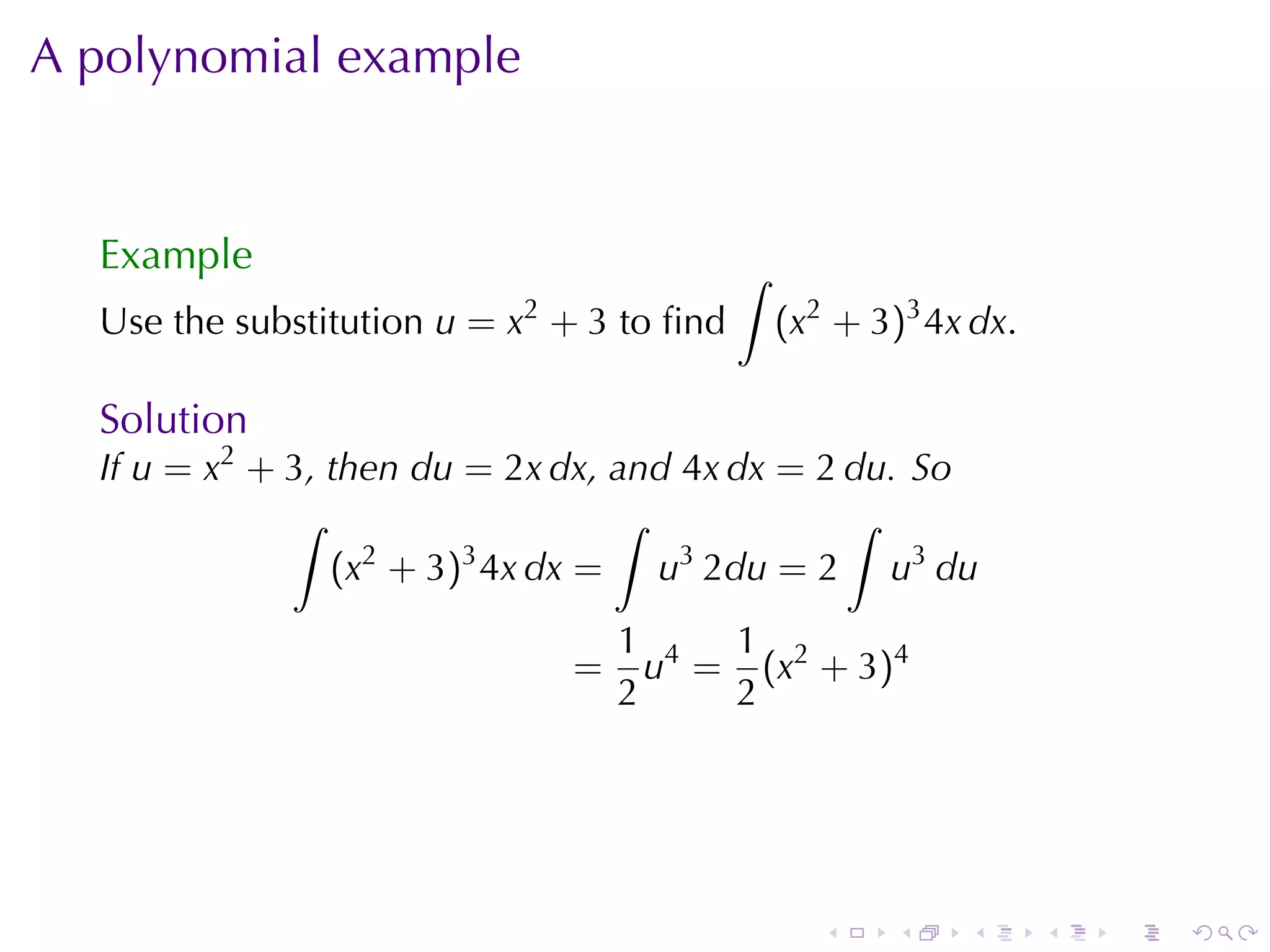
A polynomial	example


  Example                                  ∫
  Use	the	substitution u = x2 + 3 to	find       (x2 + 3)3 4x dx.

  Solution
  If u = x2 + 3, then du = 2x dx, and 4x dx = 2 du. So
              ∫                   ∫             ∫
                 (x + 3) 4x dx = u 2du = 2 u3 du
                   2     3            3


                                  1 4 1 2
                              =     u = (x + 3)4
                                  2    2


                                                  .   .    .      .   .   .
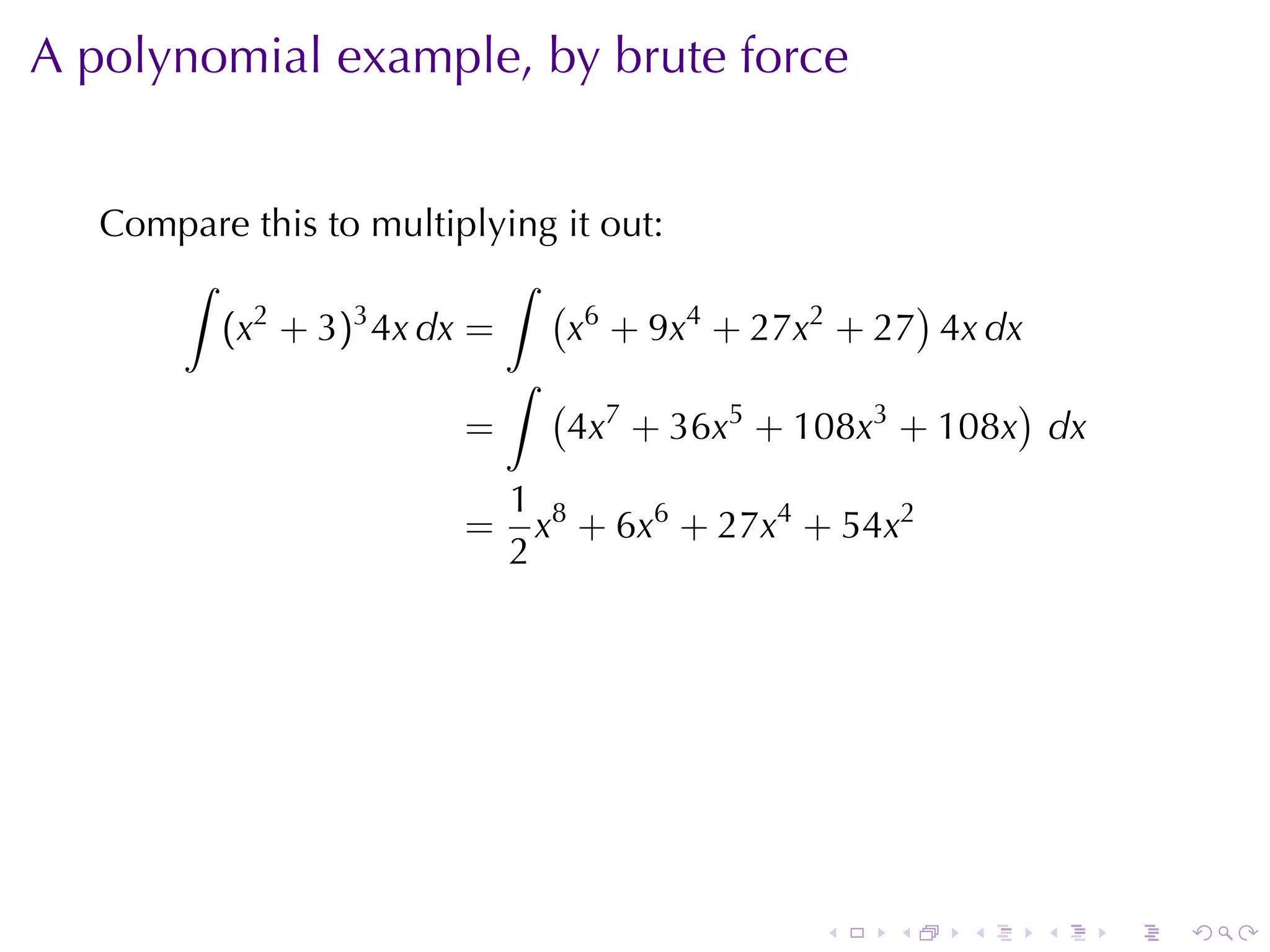
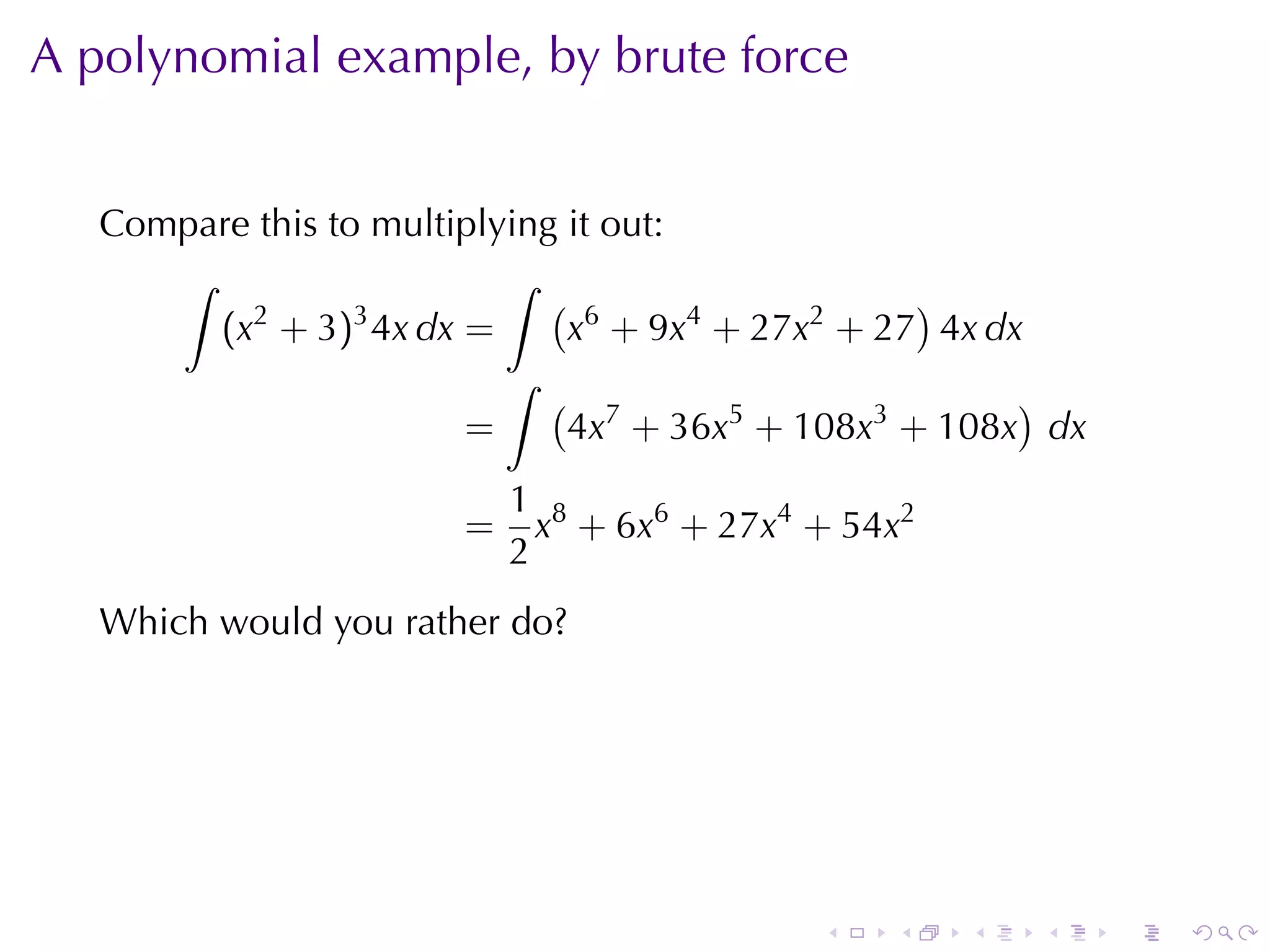
A polynomial	example, by	brute	force


   Compare	this	to	multiplying	it	out:
      ∫                    ∫
          2       3
                              ( 6                 )
        (x + 3) 4x dx =        x + 9x4 + 27x2 + 27 4x dx
                           ∫
                              ( 7                       )
                        =      4x + 36x5 + 108x3 + 108x dx
                           1 8
                       =     x + 6x6 + 27x4 + 54x2
                           2


                                            .   .    .   .   .   .
A polynomial	example, by	brute	force


   Compare	this	to	multiplying	it	out:
      ∫                    ∫
          2       3
                              ( 6                 )
        (x + 3) 4x dx =        x + 9x4 + 27x2 + 27 4x dx
                           ∫
                              ( 7                       )
                        =      4x + 36x5 + 108x3 + 108x dx
                           1 8
                       =     x + 6x6 + 27x4 + 54x2
                           2
   Which	would	you	rather	do?


                                            .   .    .   .   .   .
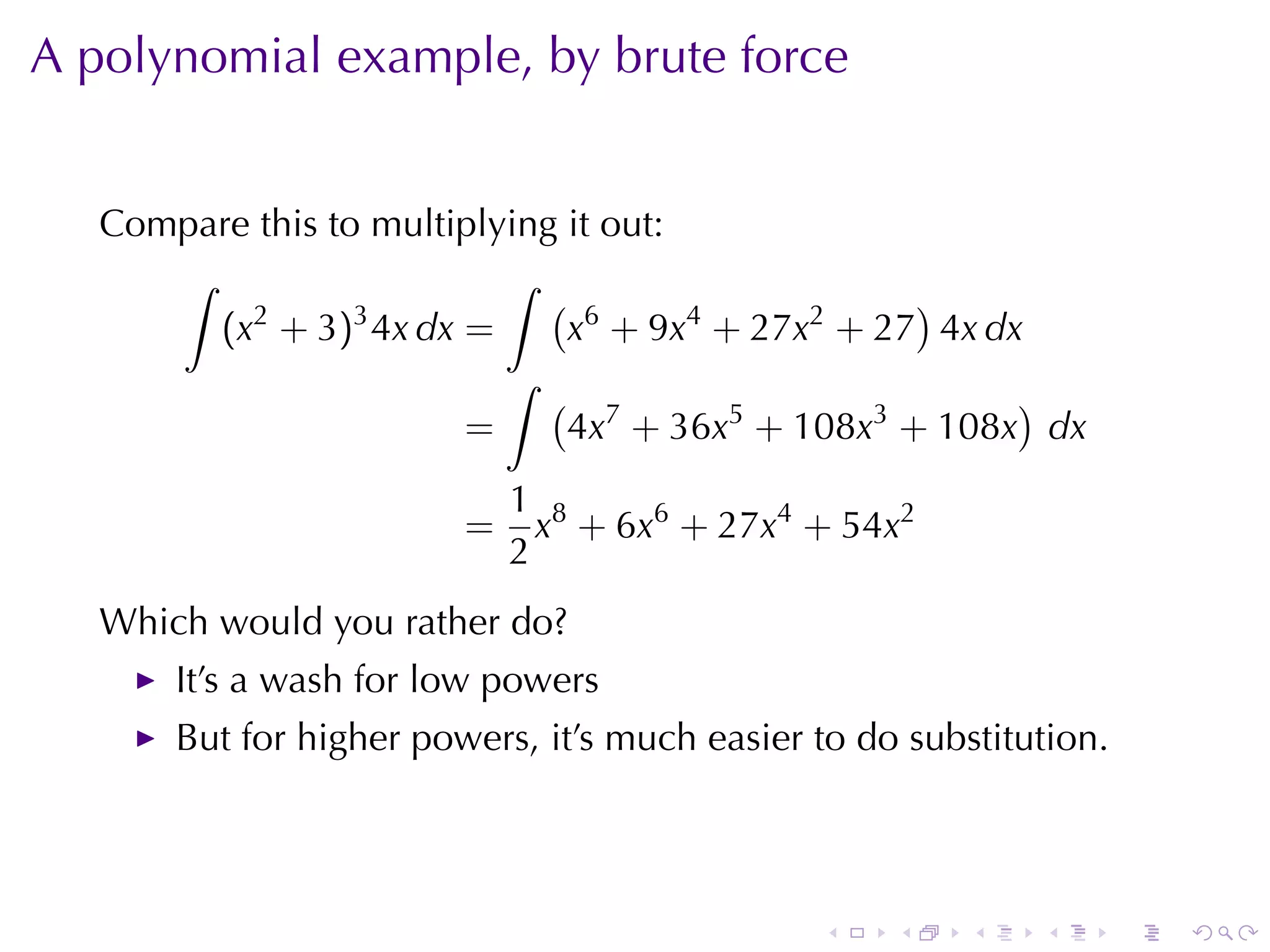
A polynomial	example, by	brute	force


   Compare	this	to	multiplying	it	out:
      ∫                    ∫
          2       3
                              ( 6                 )
        (x + 3) 4x dx =        x + 9x4 + 27x2 + 27 4x dx
                           ∫
                              ( 7                       )
                        =      4x + 36x5 + 108x3 + 108x dx
                             1 8
                         =     x + 6x6 + 27x4 + 54x2
                             2
   Which	would	you	rather	do?
       It’s	a	wash	for	low	powers
       But	for	higher	powers, it’s	much	easier	to	do	substitution.


                                               .    .    .   .       .   .
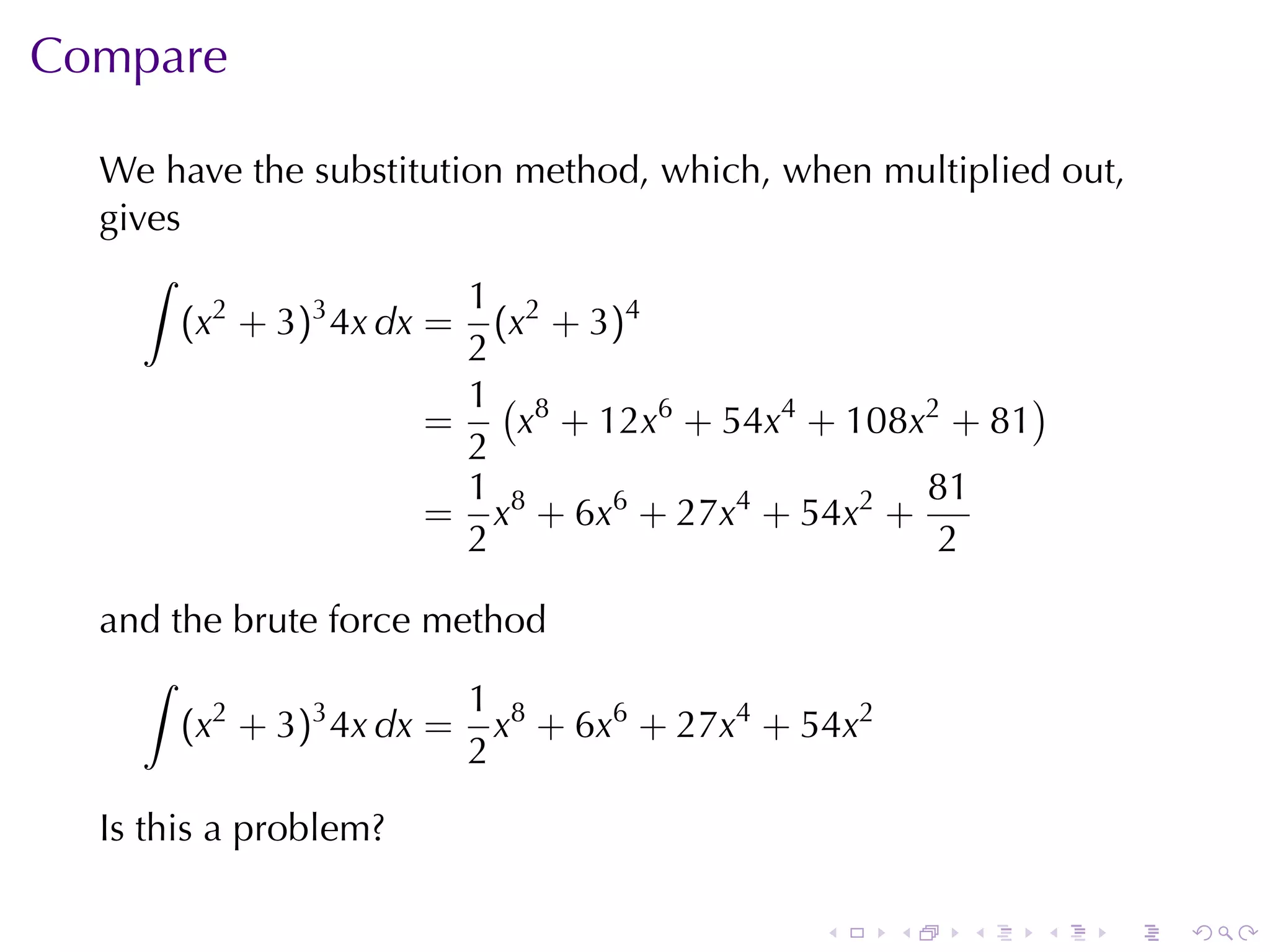
Compare

  We	have	the	substitution	method, which, when	multiplied	out,
  gives
     ∫
                         1
       (x2 + 3)3 4x dx = (x2 + 3)4
                         2
                         1( 8                           )
                       =   x + 12x6 + 54x4 + 108x2 + 81
                         2
                         1                        81
                       = x8 + 6x6 + 27x4 + 54x2 +
                         2                        2

  and	the	brute	force	method
    ∫
                        1
       (x2 + 3)3 4x dx = x8 + 6x6 + 27x4 + 54x2
                        2

  Is	this	a	problem?

                                            .     .   .   .   .   .
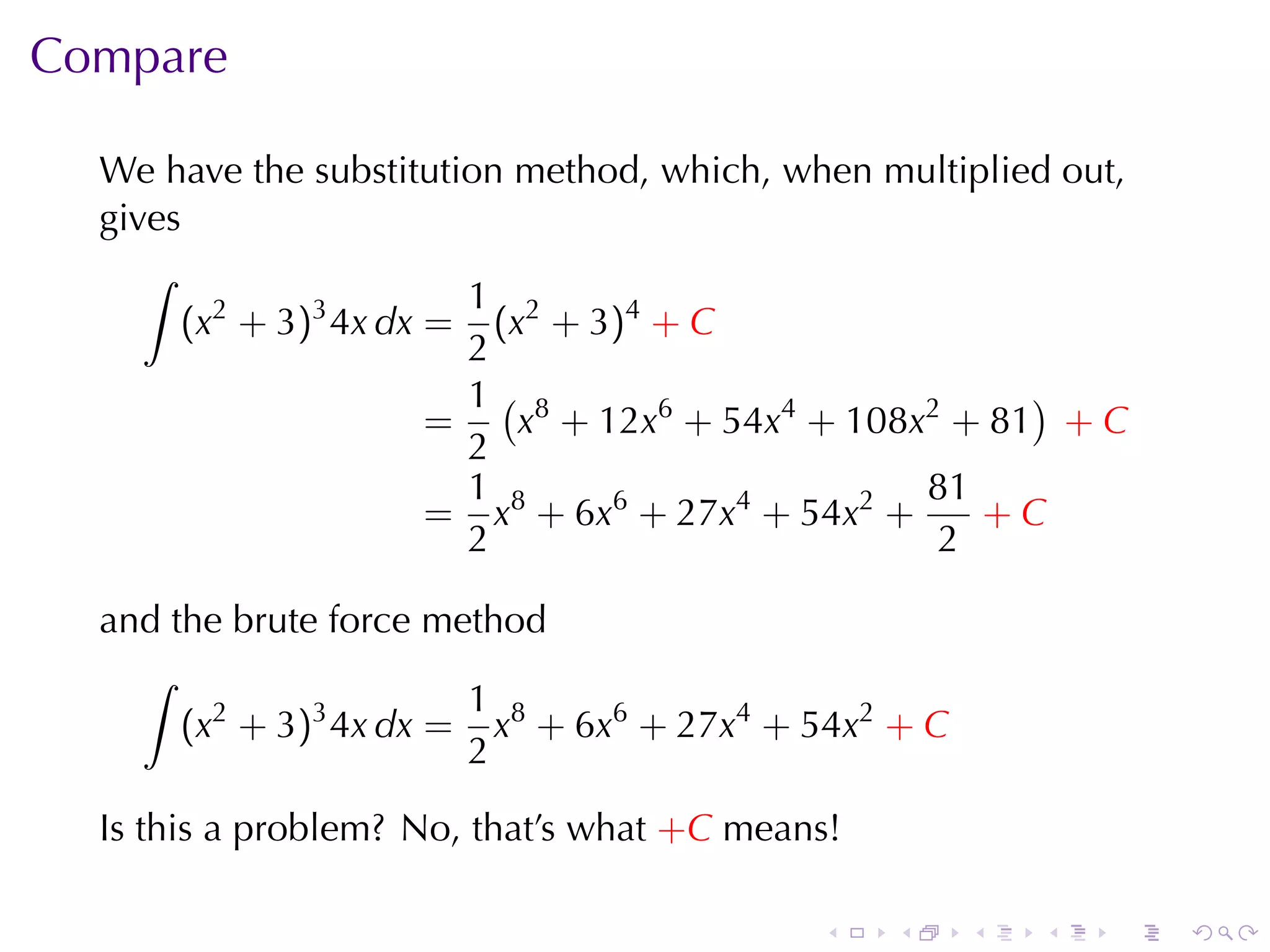
Compare

  We	have	the	substitution	method, which, when	multiplied	out,
  gives
     ∫
                         1
       (x2 + 3)3 4x dx = (x2 + 3)4 + C
                         2
                         1( 8                           )
                       =   x + 12x6 + 54x4 + 108x2 + 81 + C
                         2
                         1                        81
                       = x8 + 6x6 + 27x4 + 54x2 +    +C
                         2                        2

  and	the	brute	force	method
    ∫
                        1
       (x2 + 3)3 4x dx = x8 + 6x6 + 27x4 + 54x2 + C
                        2

  Is	this	a	problem? No, that’s	what +C means!

                                            .    .    .   .   .   .
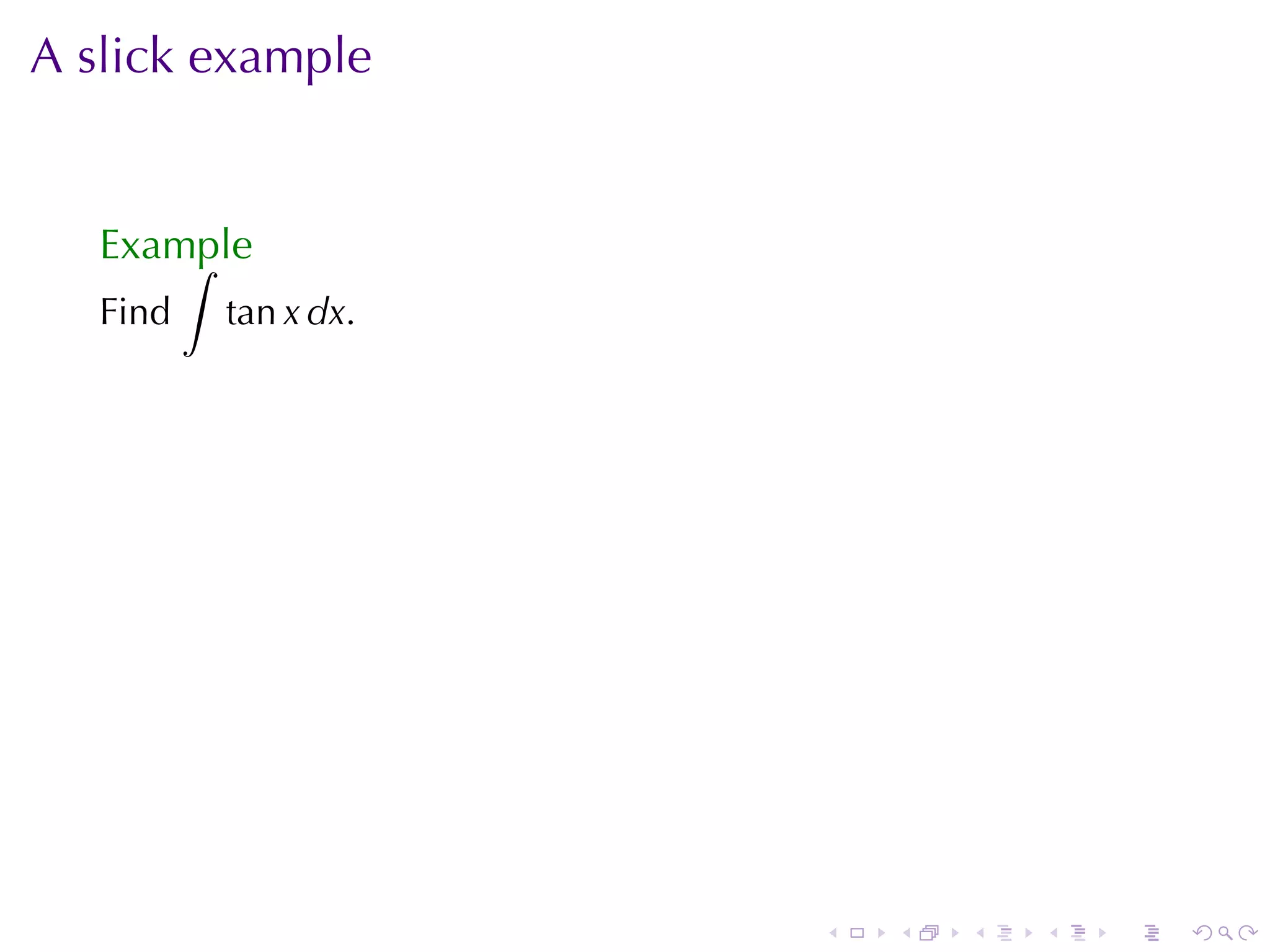
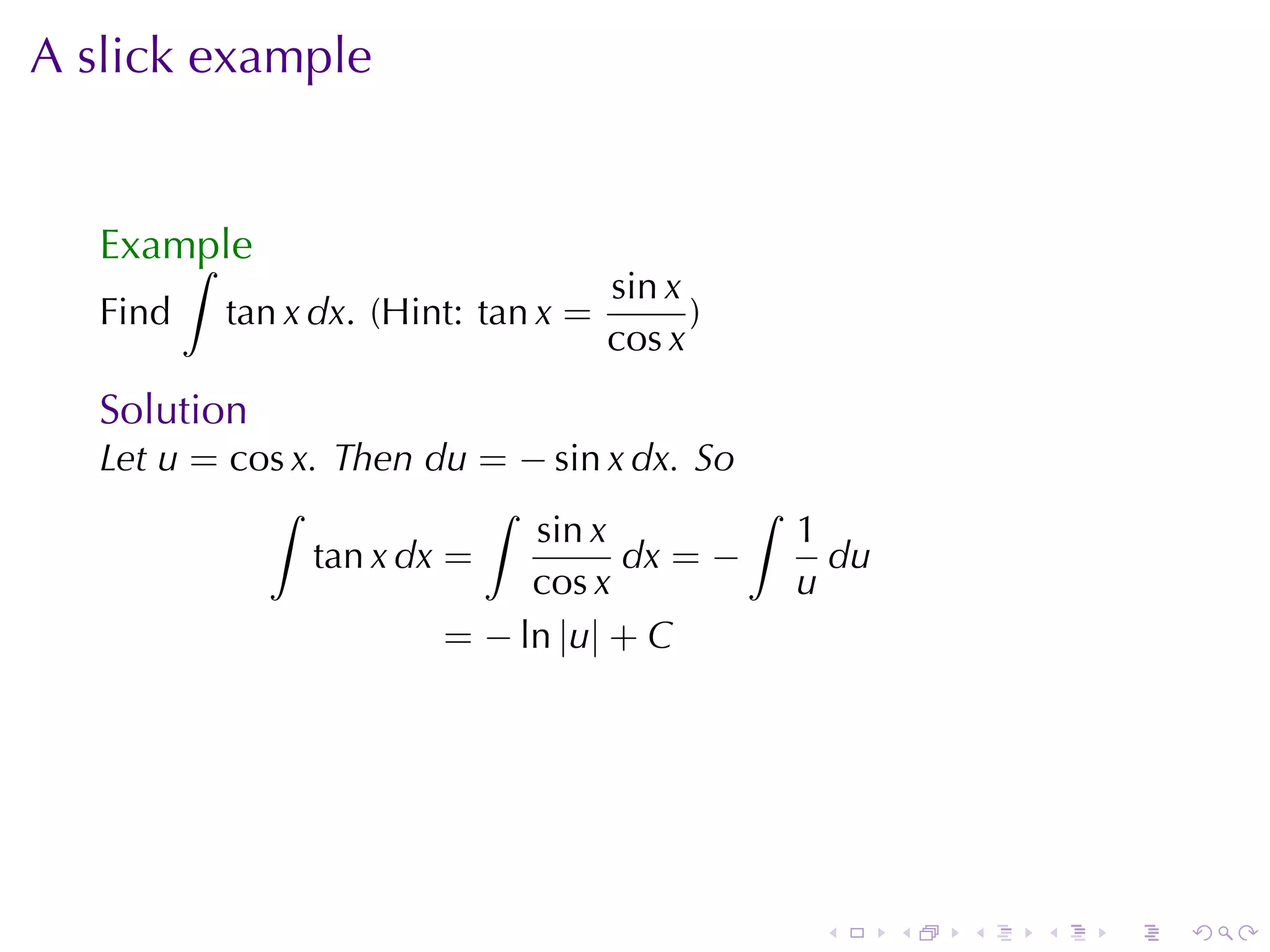
A slick	example


   Example
       ∫
   Find   tan x dx.


                      .   .   .   .   .   .
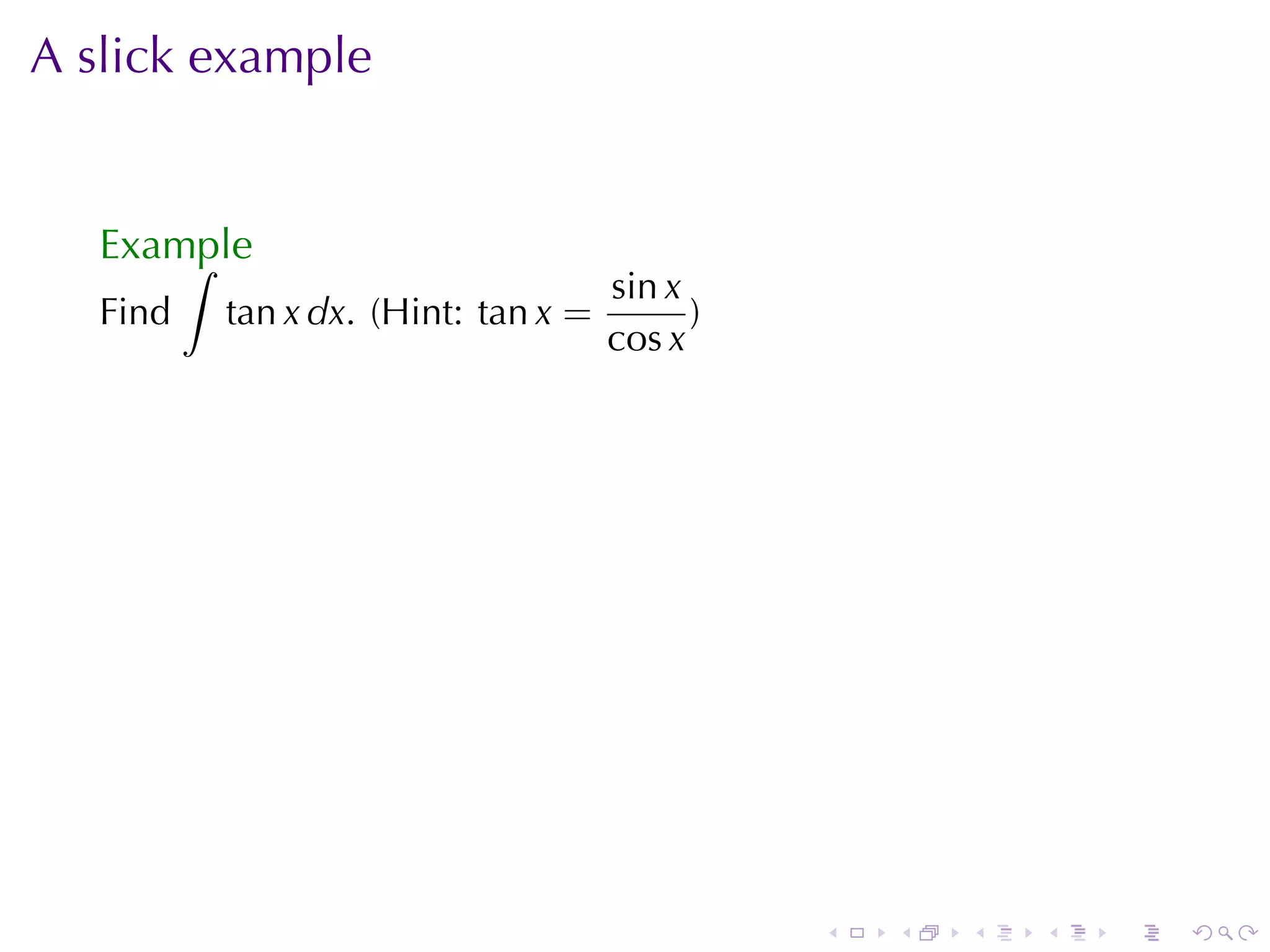
A slick	example


   Example
       ∫
                                     sin x
   Find   tan x dx. (Hint: tan x =         )
                                     cos x


                                               .   .   .   .   .   .
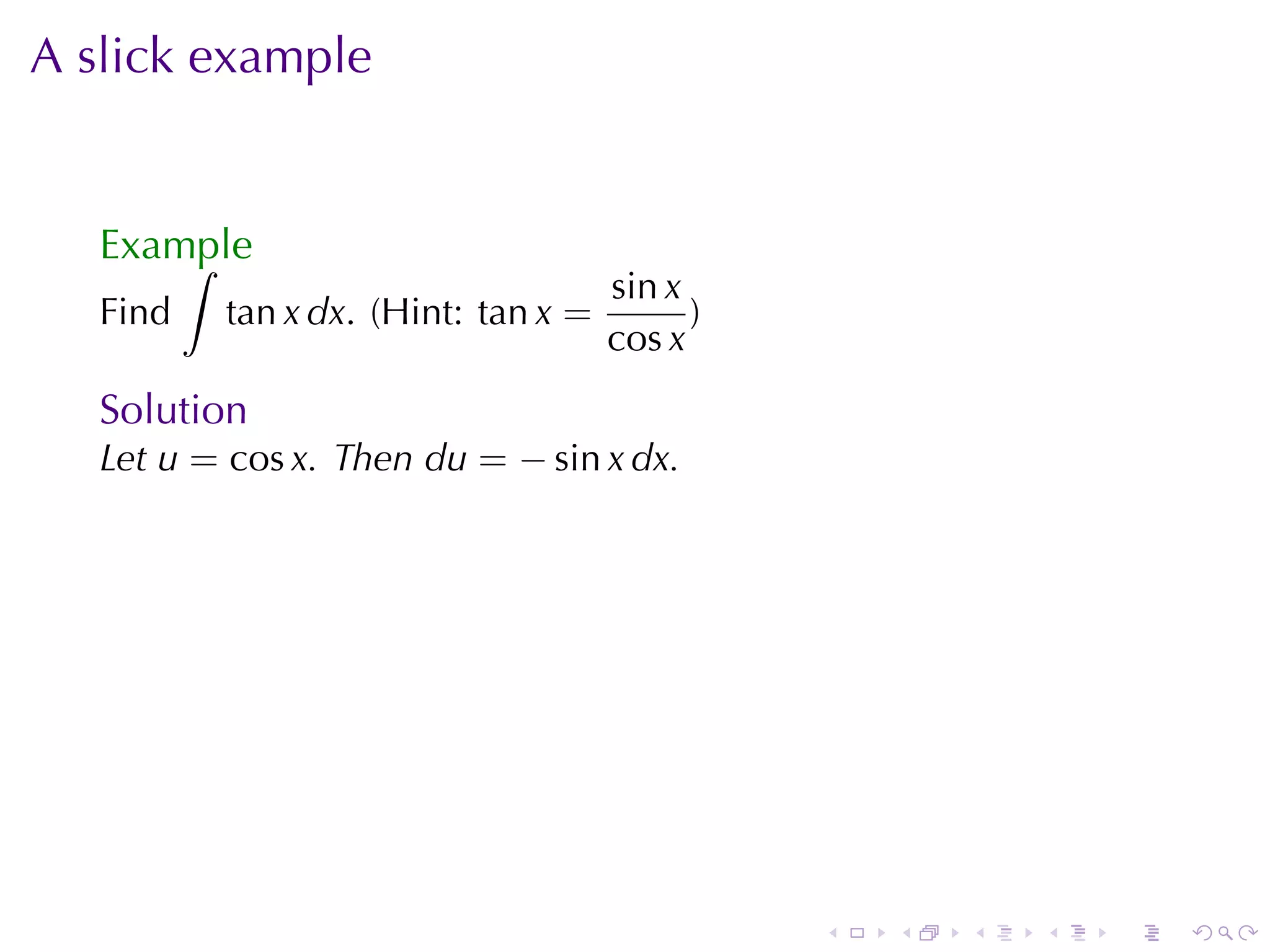
A slick	example


   Example
       ∫
                                     sin x
   Find   tan x dx. (Hint: tan x =         )
                                     cos x
   Solution
   Let u = cos x. Then du = − sin x dx.


                                               .   .   .   .   .   .
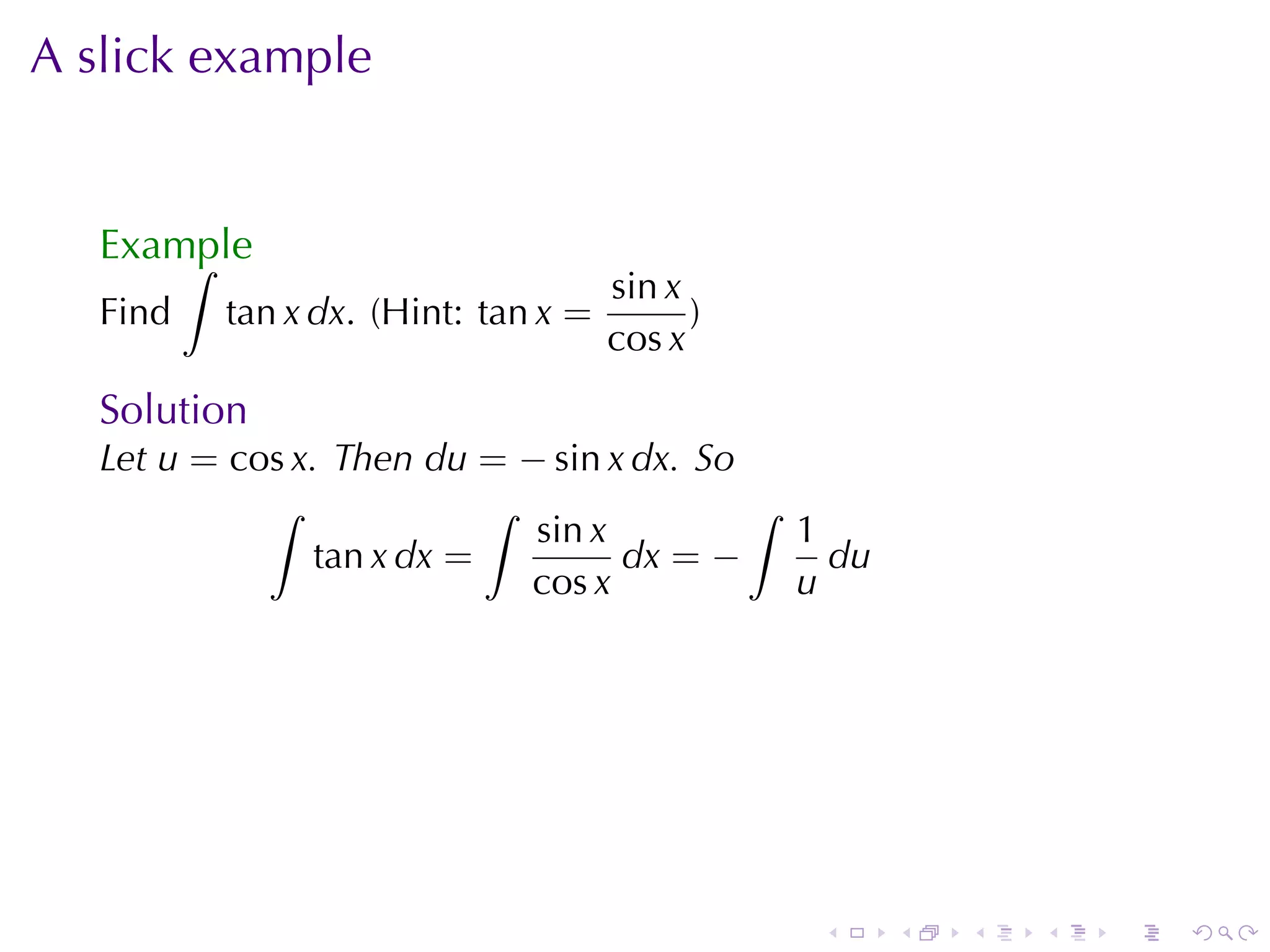
A slick	example


   Example
       ∫
                                     sin x
   Find   tan x dx. (Hint: tan x =         )
                                     cos x
   Solution
   Let u = cos x. Then du = − sin x dx. So
             ∫              ∫              ∫
                              sin x          1
                 tan x dx =         dx = −     du
                              cos x          u


                                               .    .   .   .   .   .
A slick	example


   Example
       ∫
                                     sin x
   Find   tan x dx. (Hint: tan x =         )
                                     cos x
   Solution
   Let u = cos x. Then du = − sin x dx. So
             ∫              ∫               ∫
                               sin x          1
                 tan x dx =          dx = −     du
                               cos x          u
                          = − ln |u| + C


                                               .     .   .   .   .   .
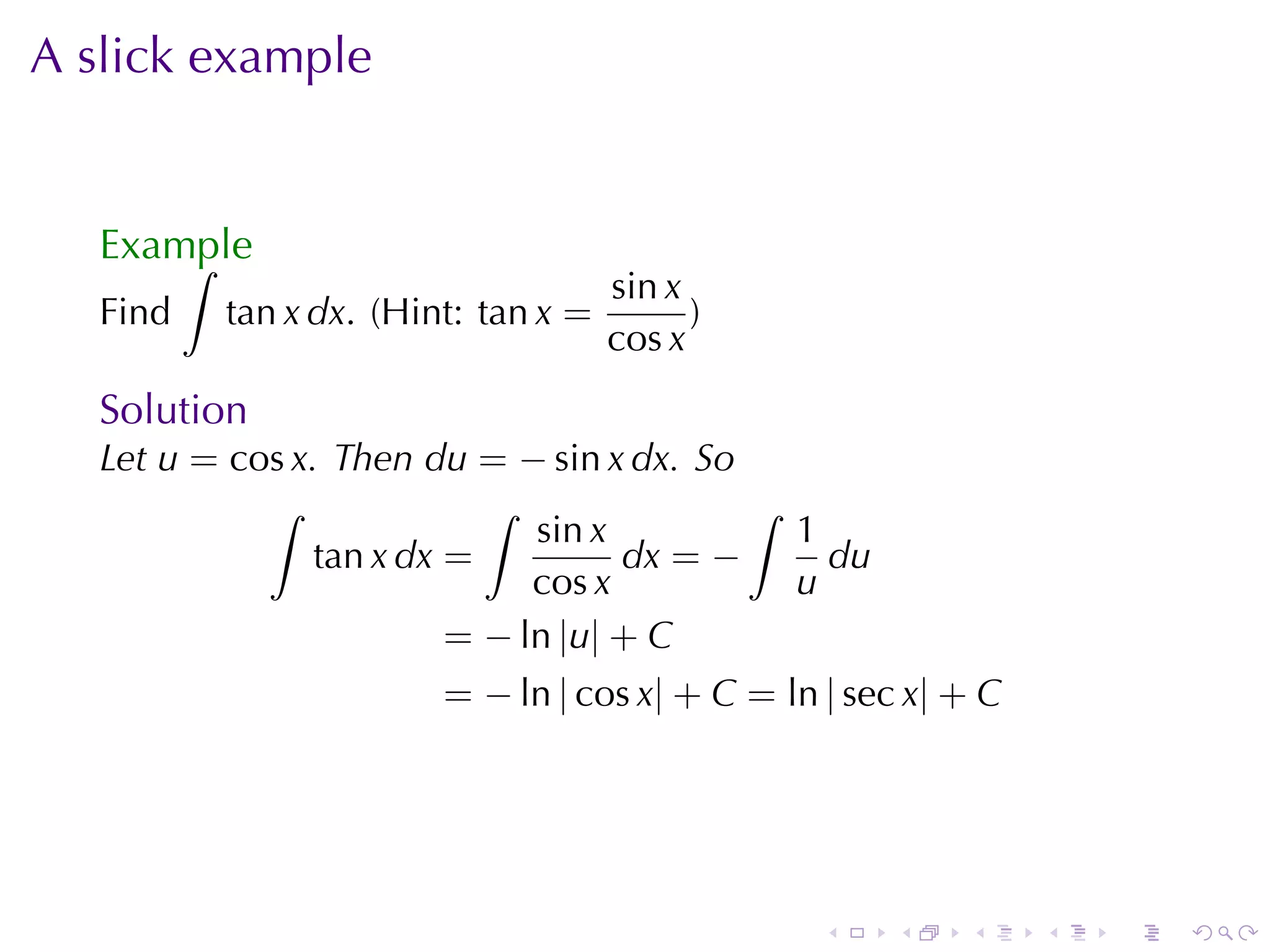
A slick	example


   Example
       ∫
                                     sin x
   Find   tan x dx. (Hint: tan x =         )
                                     cos x
   Solution
   Let u = cos x. Then du = − sin x dx. So
             ∫              ∫               ∫
                               sin x          1
                 tan x dx =          dx = −     du
                               cos x          u
                          = − ln |u| + C
                        = − ln | cos x| + C = ln | sec x| + C


                                                 .    .   .     .   .   .
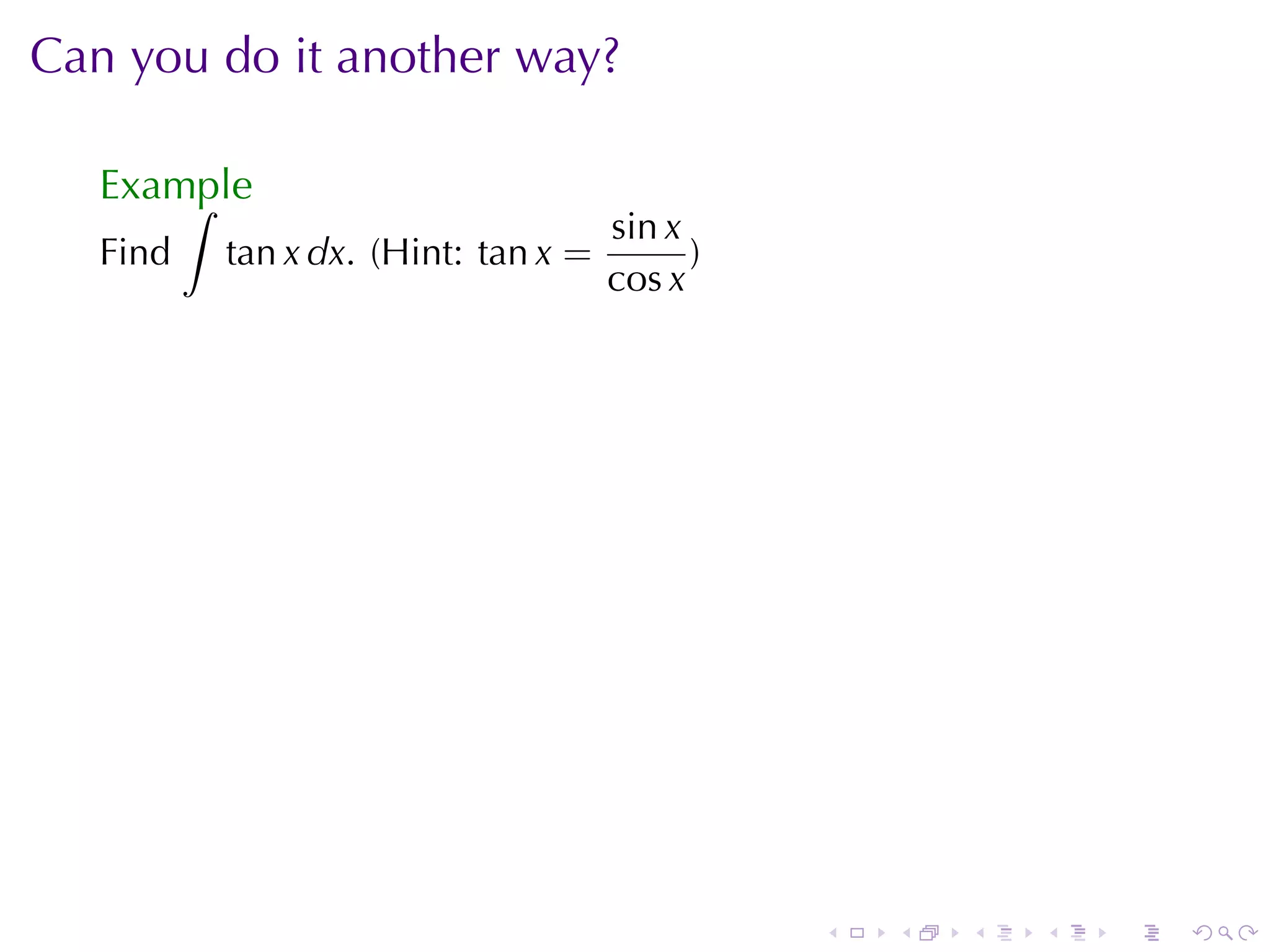
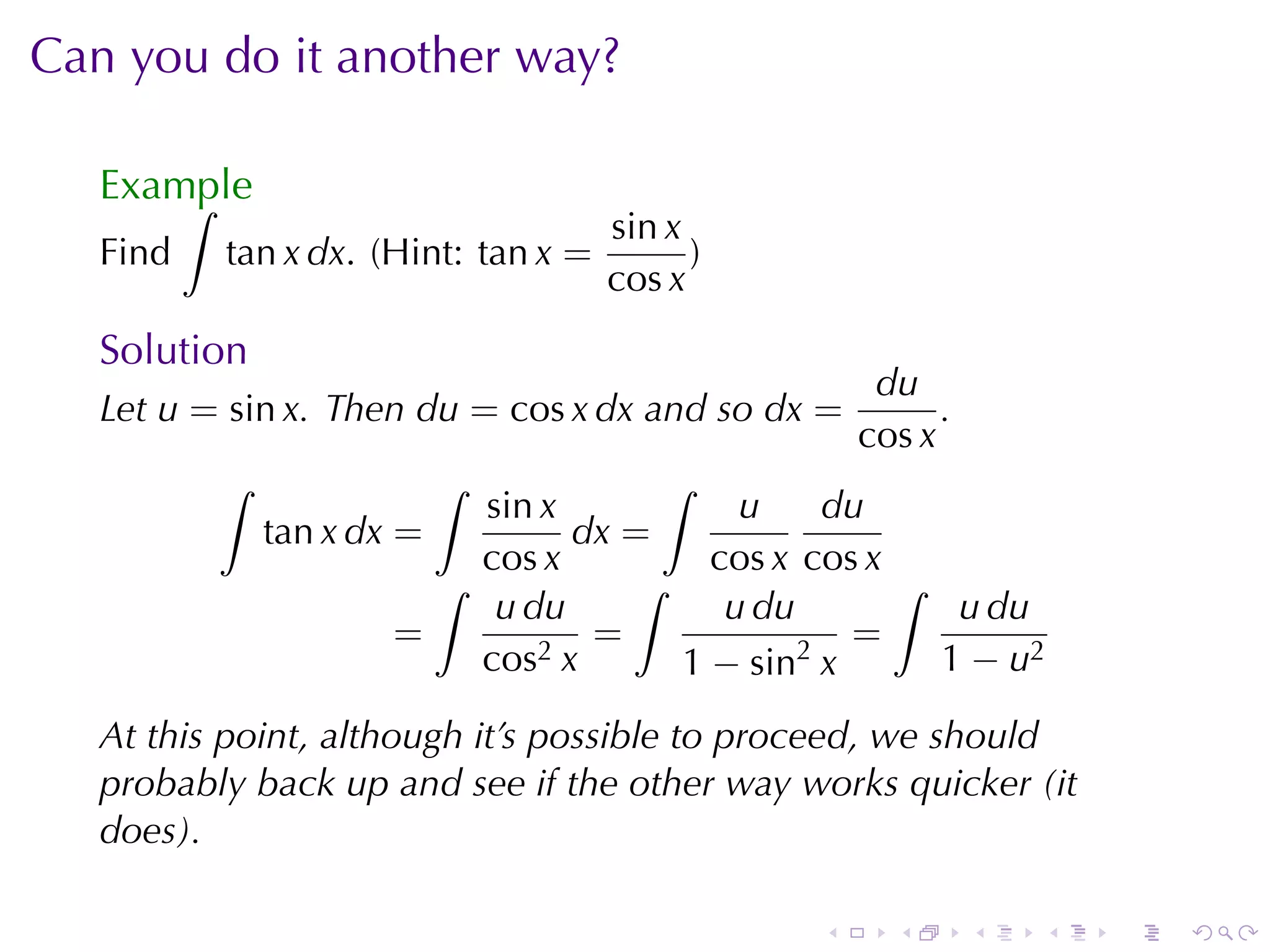
Can	you	do	it	another	way?

   Example
       ∫
                                     sin x
   Find   tan x dx. (Hint: tan x =         )
                                     cos x


                                               .   .   .   .   .   .
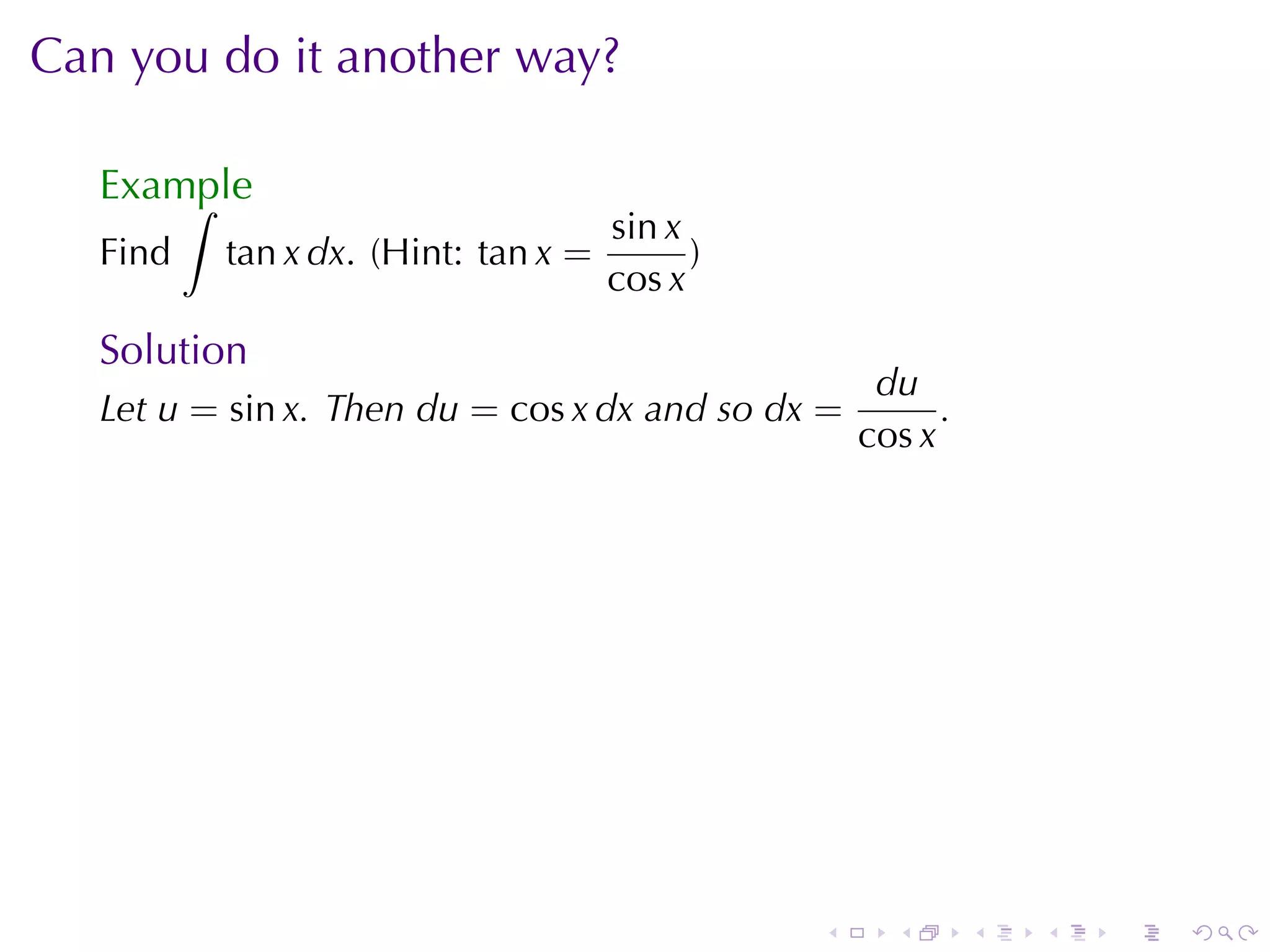
Can	you	do	it	another	way?

   Example
       ∫
                                     sin x
   Find   tan x dx. (Hint: tan x =         )
                                     cos x
   Solution
                                                    du
   Let u = sin x. Then du = cos x dx and	so dx =         .
                                                   cos x


                                               .     .       .   .   .   .
Can	you	do	it	another	way?

   Example
       ∫
                                     sin x
   Find   tan x dx. (Hint: tan x =         )
                                     cos x
   Solution
                                                    du
   Let u = sin x. Then du = cos x dx and	so dx =         .
                                                   cos x
          ∫                ∫         ∫
                          sin x           u     du
              tan x dx =        dx =
                          cos x         cos x cos x
                        ∫          ∫                ∫
                           u du          u du          u du
                      =          =            2
                                                 =
                          cos2 x      1 − sin x       1 − u2

   At	this	point, although	it’s	possible	to	proceed, we	should
   probably	back	up	and	see	if	the	other	way	works	quicker	(it
   does).

                                               .     .       .   .   .   .
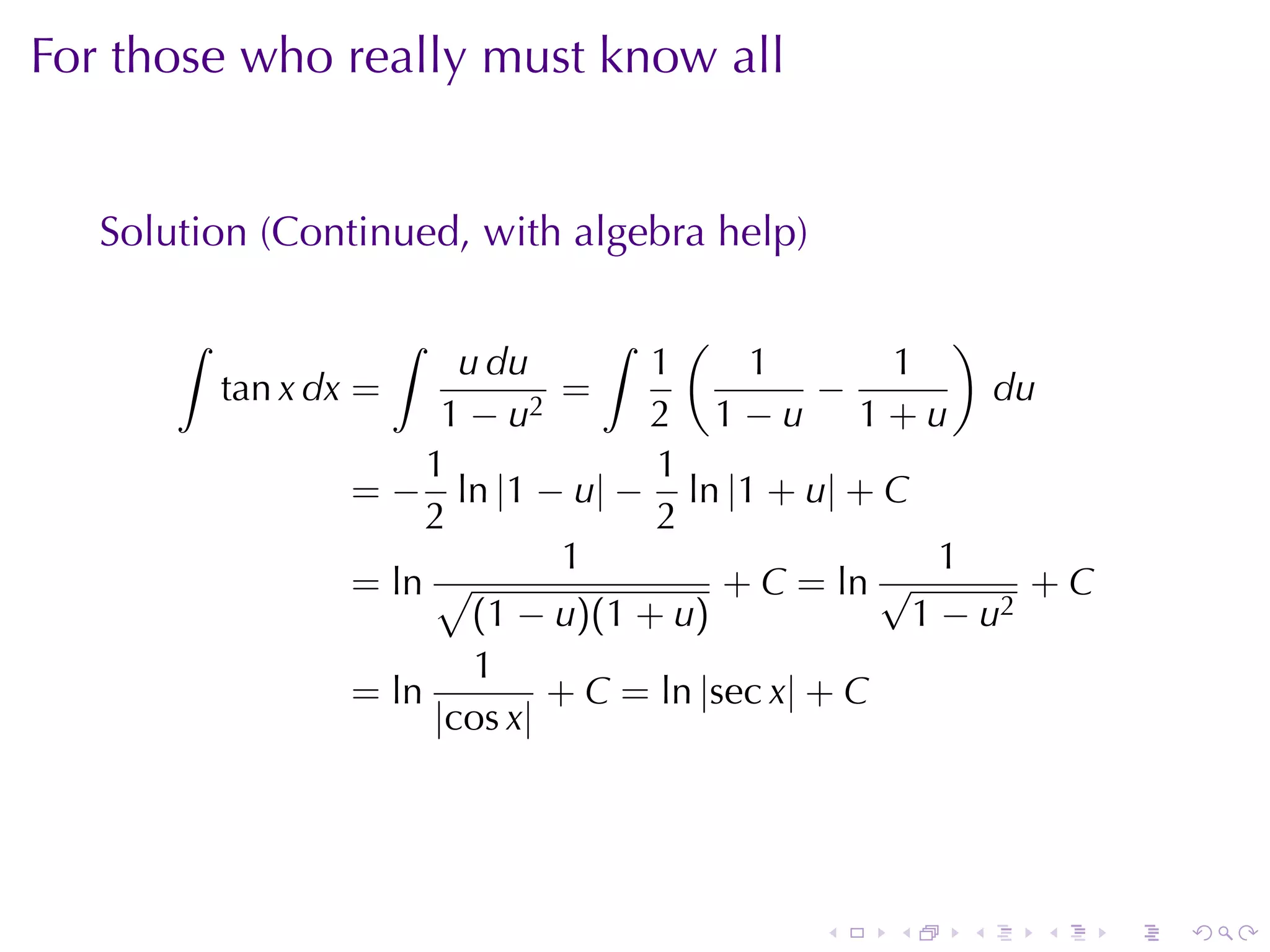
For	those	who	really	must	know	all


   Solution	(Continued, with	algebra	help)

       ∫             ∫              ∫    (                )
                           u du        1     1        1
           tan x dx =             =               −         du
                          1 − u2       2 1−u 1+u
                         1             1
                    = − ln |1 − u| − ln |1 + u| + C
                         2             2
                                  1                      1
                    = ln √                  + C = ln √        +C
                            (1 − u)(1 + u)             1 − u2
                            1
                    = ln         + C = ln |sec x| + C
                         |cos x|


                                               .   .    .   .      .   .
Outline


  Last	Time: The	Fundamental	Theorem(s)	of	Calculus


  Substitution	for	Indefinite	Integrals
     Theory
     Examples


  Substitution	for	Definite	Integrals
     Theory
     Examples


                                           .   .      .   .   .   .
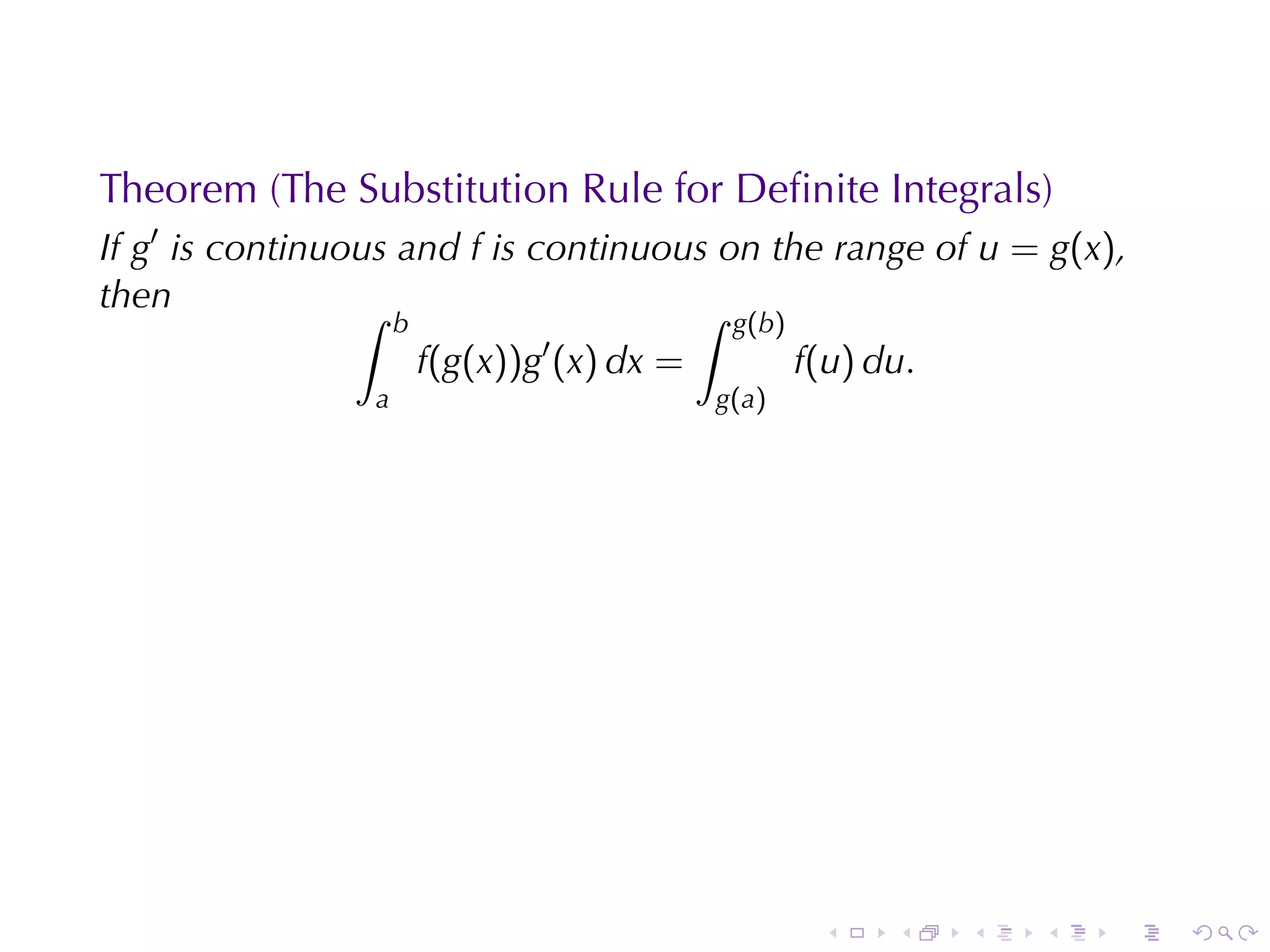
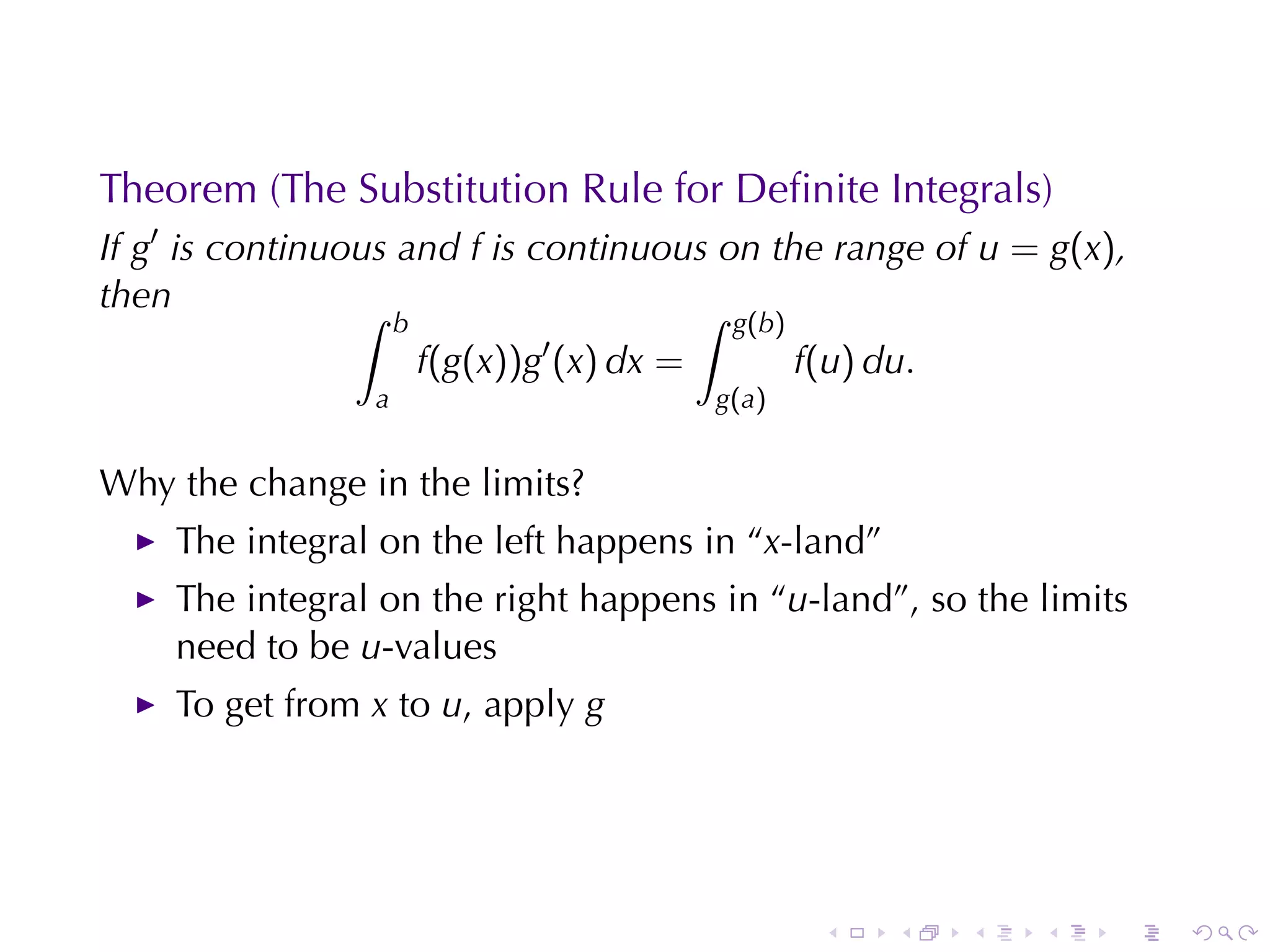
Theorem	(The	Substitution	Rule	for	Definite	Integrals)
If g′ is	continuous	and f is	continuous	on	the	range	of u = g(x),
then             ∫                    ∫
                     b                         g(b)
                         f(g(x))g′ (x) dx =            f(u) du.
                 a                            g (a )


                                                        .    .    .   .   .   .
Theorem	(The	Substitution	Rule	for	Definite	Integrals)
If g′ is	continuous	and f is	continuous	on	the	range	of u = g(x),
then             ∫                    ∫
                     b                         g(b)
                         f(g(x))g′ (x) dx =            f(u) du.
                 a                            g (a )


Why	the	change	in	the	limits?
    The	integral	on	the	left	happens	in	“x-land”
    The	integral	on	the	right	happens	in	“u-land”, so	the	limits
    need	to	be u-values
    To	get	from x to u, apply g


                                                        .    .    .   .   .   .
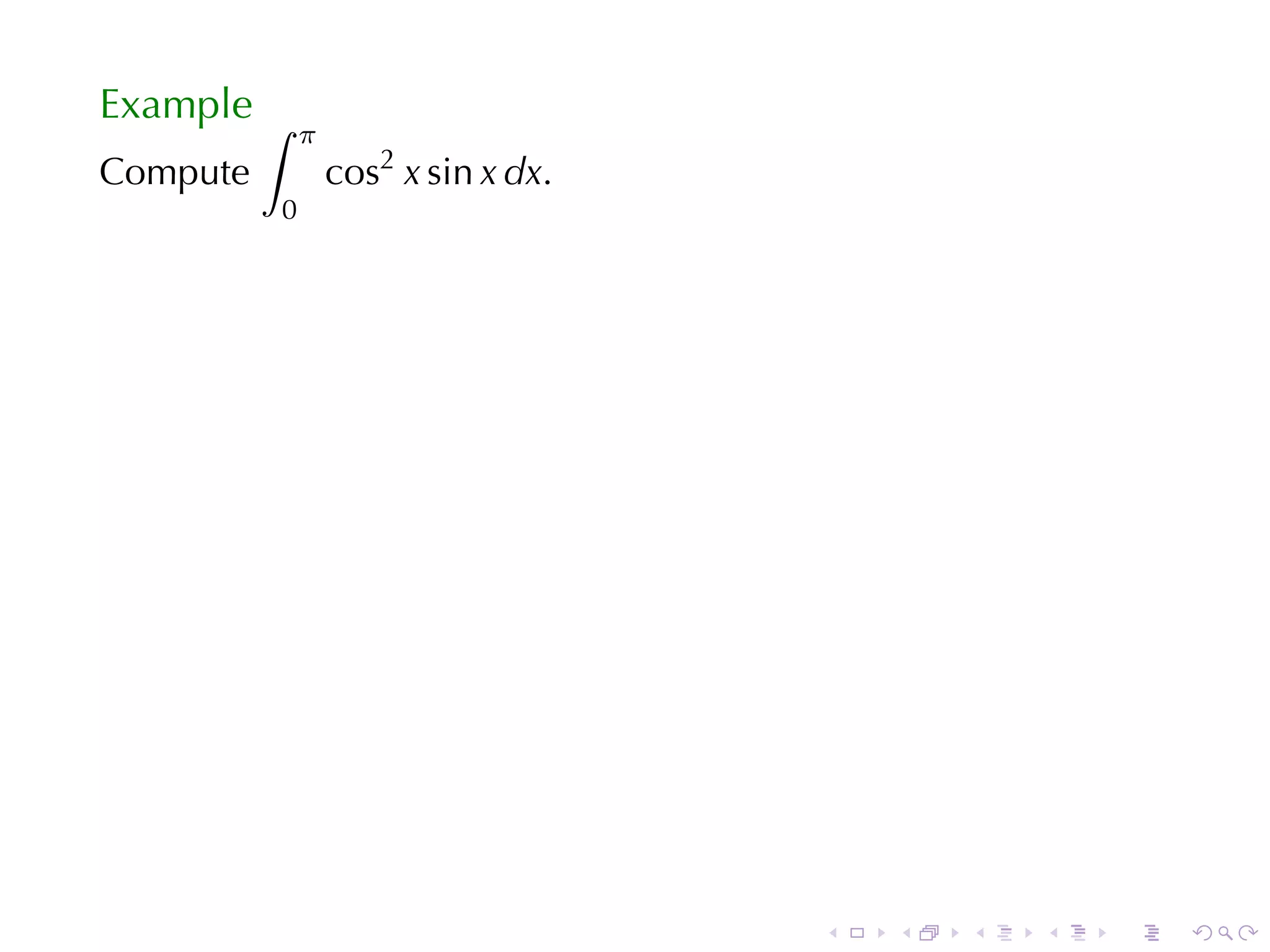
Example ∫
              π
Compute           cos2 x sin x dx.
          0


                                     .   .   .   .   .   .
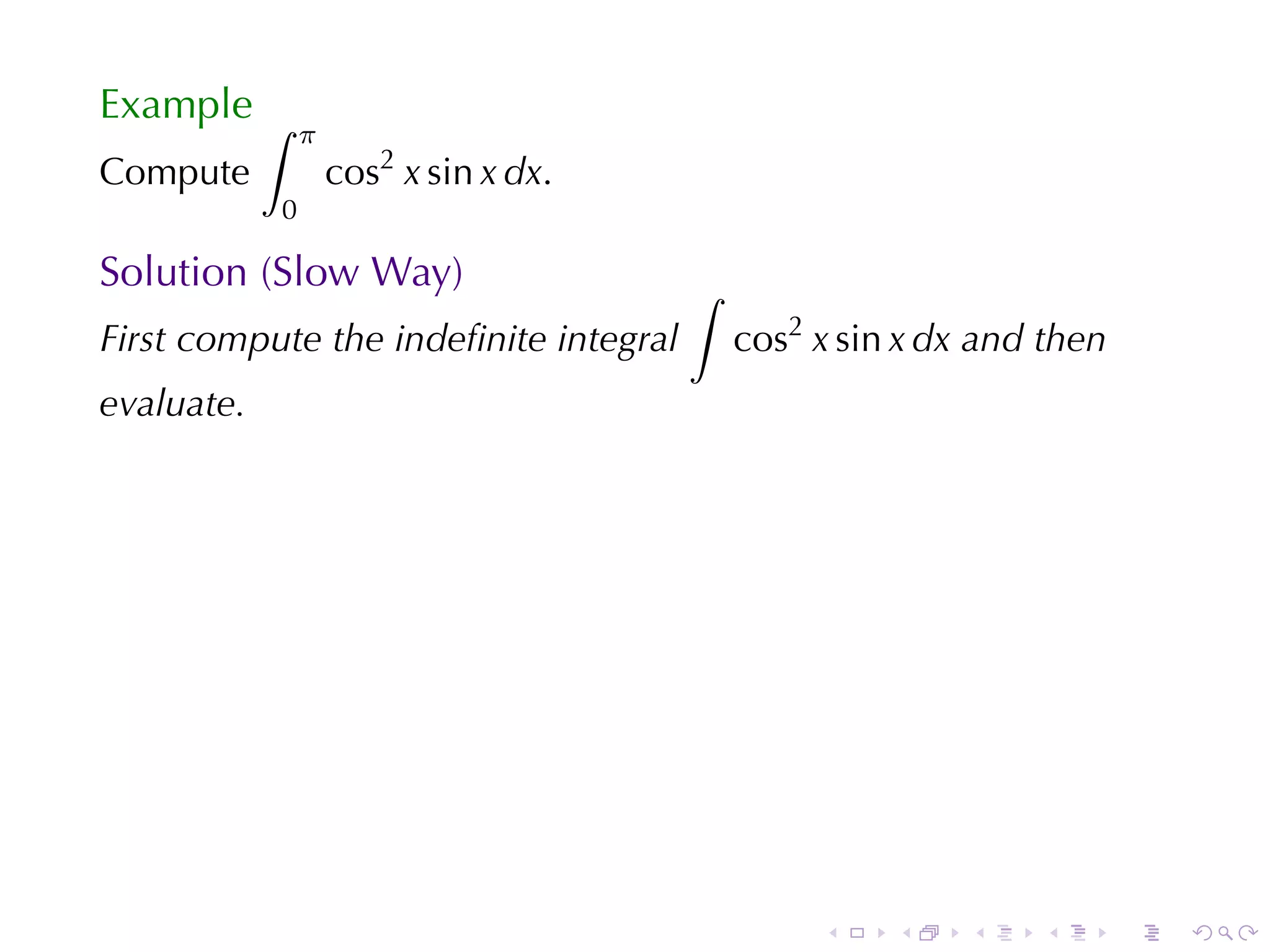
Example ∫
                π
Compute             cos2 x sin x dx.
            0

Solution	(Slow	Way)                    ∫
First	compute	the	indefinite	integral       cos2 x sin x dx and	then
evaluate.


                                                .    .    .   .       .   .
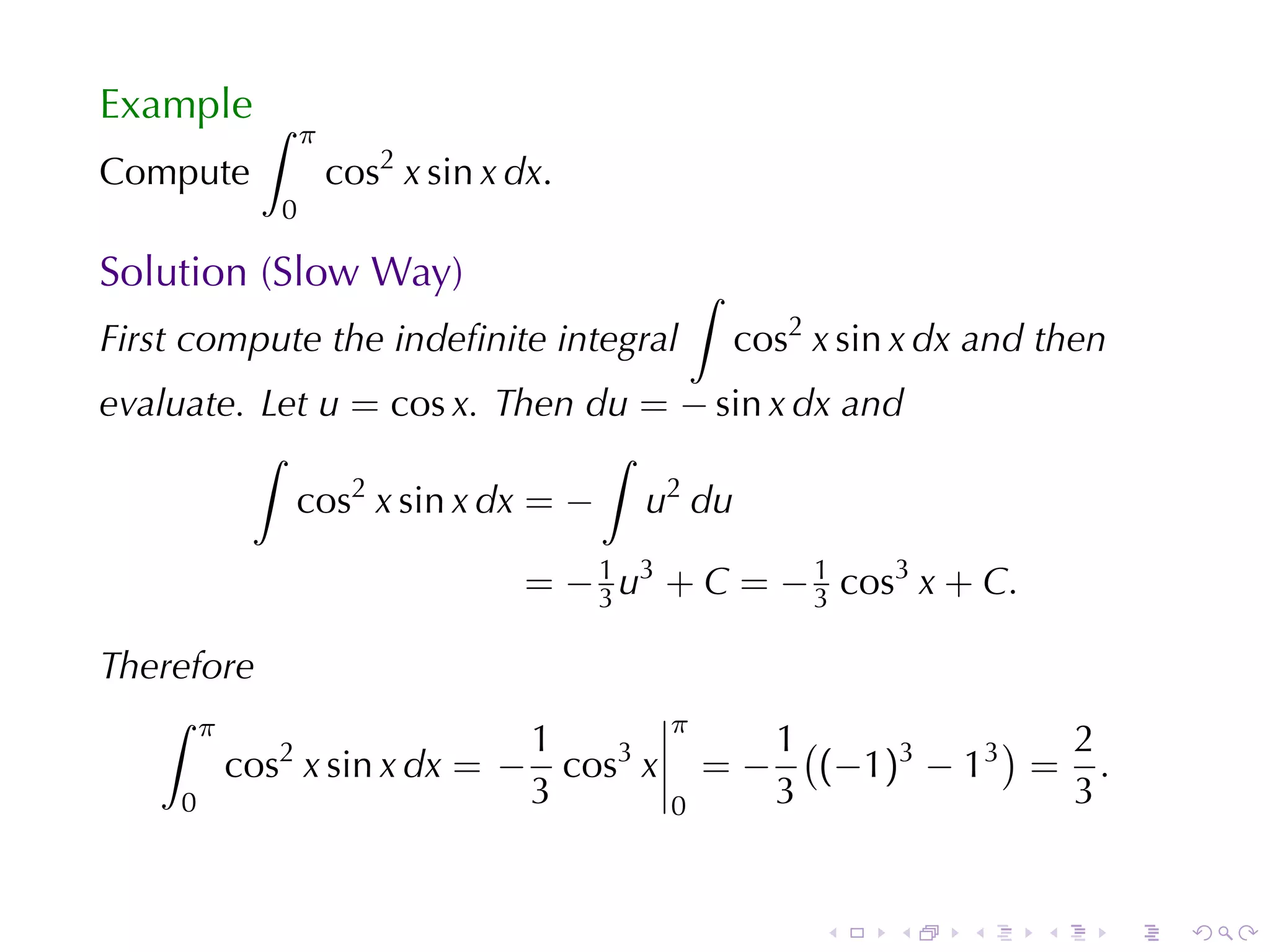
Example ∫
               π
Compute            cos2 x sin x dx.
           0

Solution	(Slow	Way)                          ∫
First	compute	the	indefinite	integral             cos2 x sin x dx and	then
evaluate. Let u = cos x. Then du = − sin x dx and
         ∫                     ∫
            cos x sin x dx = − u2 du
                2


                                 = − 1 u3 + C = − 1 cos3 x + C.
                                     3            3

Therefore
   ∫ π
                          1              π
                                                   1(           ) 2
       cos2 x sin x dx = − cos3 x            =−       (−1)3 − 13 = .
    0                     3              0         3              3


                                                      .    .    .   .       .   .
Solution	(Fast	Way)
Do	both	the	substitution	and	the	evaluation	at	the	same	time.


                                           .    .   .    .      .   .
Solution	(Fast	Way)
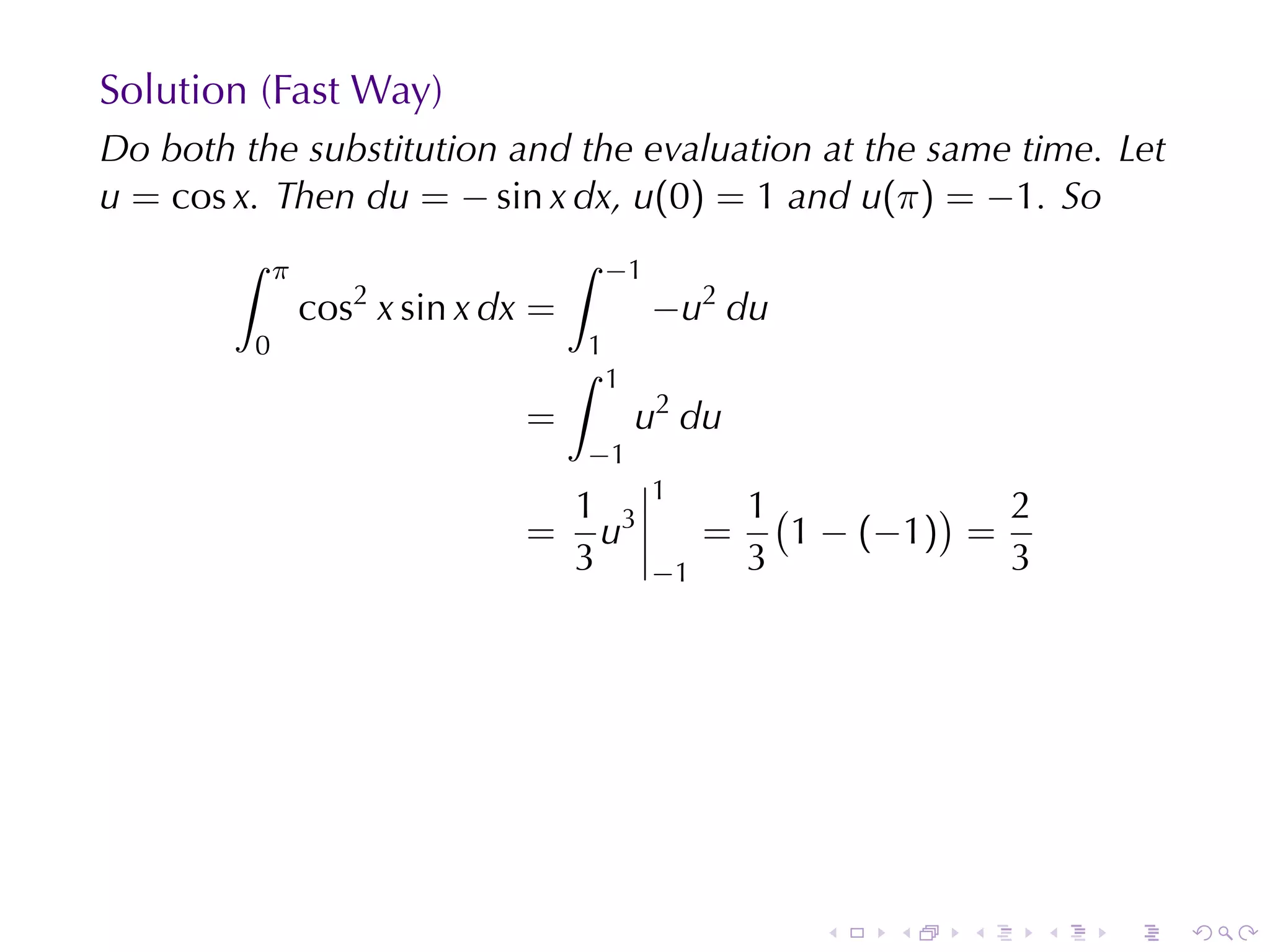
Do	both	the	substitution	and	the	evaluation	at	the	same	time. Let
u = cos x. Then du = − sin x dx, u(0) = 1 and u(π) = −1.


                                            .   .    .   .    .     .
Solution	(Fast	Way)
Do	both	the	substitution	and	the	evaluation	at	the	same	time. Let
u = cos x. Then du = − sin x dx, u(0) = 1 and u(π) = −1. So
        ∫    π                       ∫   −1
                 cos2 x sin x dx =            −u2 du
         0                           1
                                     ∫   1
                                =            u2 du
                                     −1
                                              1
                                 1                     1(         ) 2
                                = u3               =      1 − (−1) =
                                 3            −1       3             3


                                                          .   .   .      .   .   .
Solution	(Fast	Way)
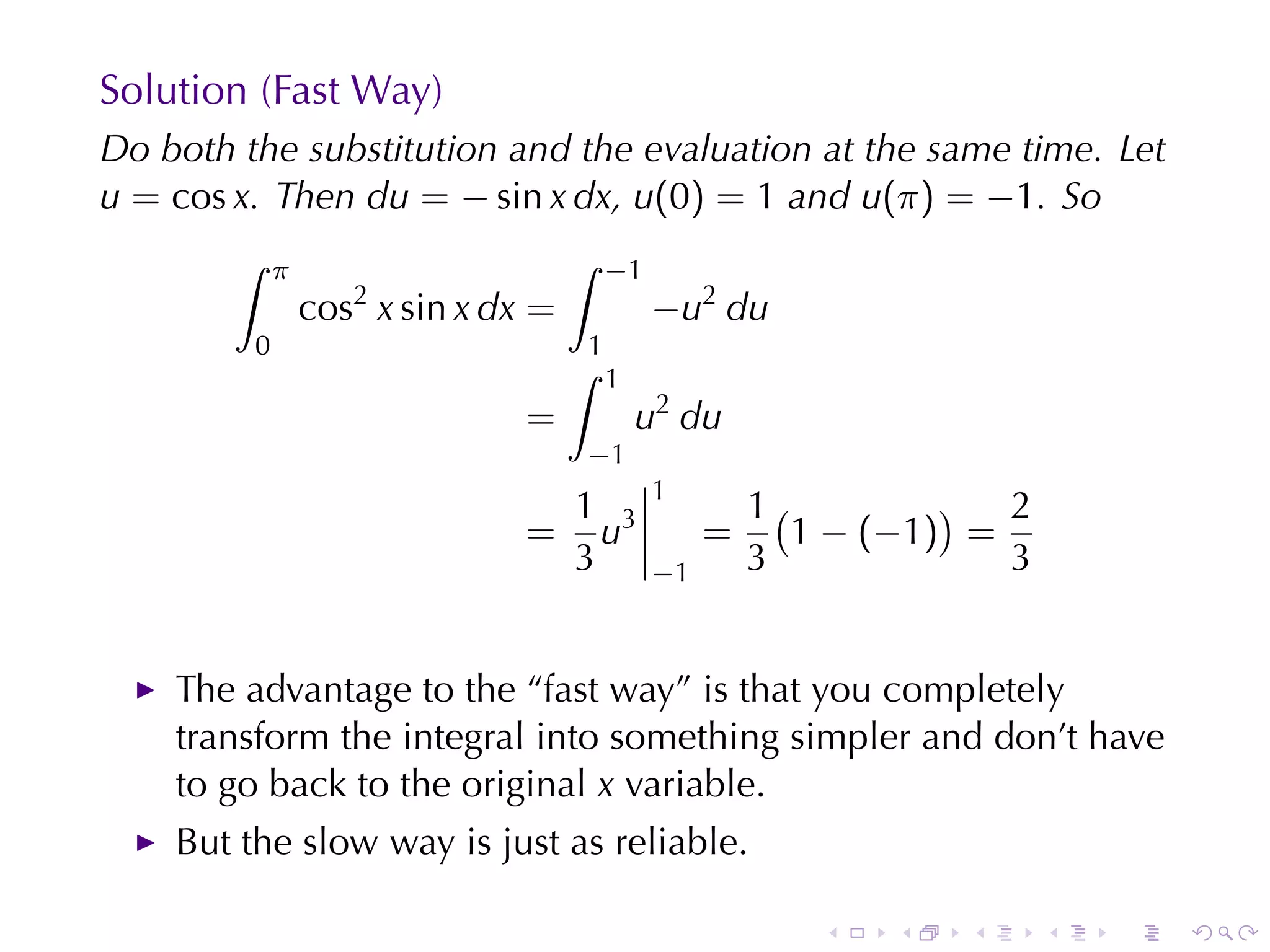
Do	both	the	substitution	and	the	evaluation	at	the	same	time. Let
u = cos x. Then du = − sin x dx, u(0) = 1 and u(π) = −1. So
        ∫    π                       ∫   −1
                 cos2 x sin x dx =            −u2 du
         0                           1
                                     ∫   1
                                =            u2 du
                                     −1
                                              1
                                 1                     1(         ) 2
                                = u3               =      1 − (−1) =
                                 3            −1       3             3


    The	advantage	to	the	“fast	way”	is	that	you	completely
    transform	the	integral	into	something	simpler	and	don’t	have
    to	go	back	to	the	original x variable.
    But	the	slow	way	is	just	as	reliable.

                                                          .   .   .      .   .   .
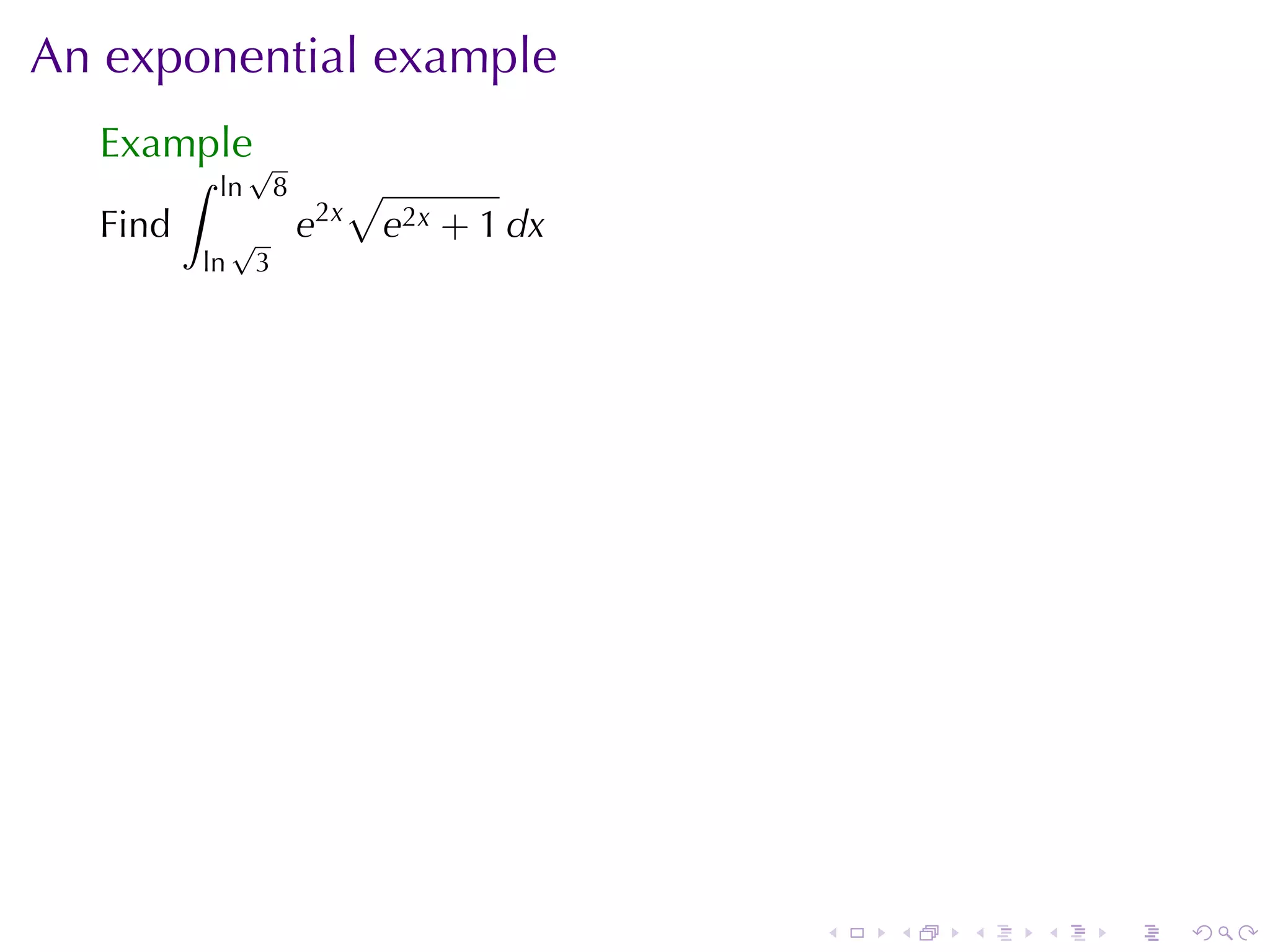
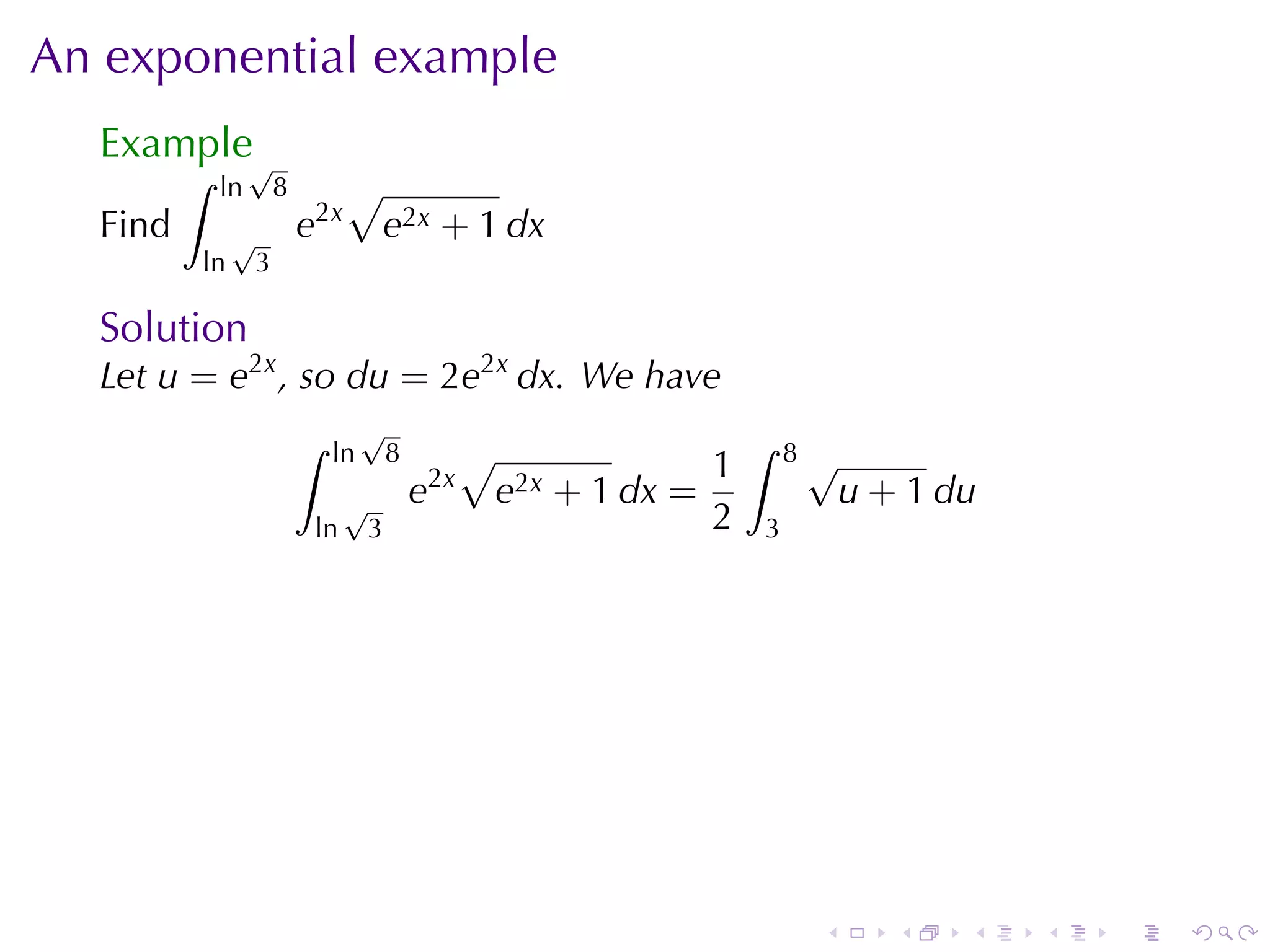
An	exponential	example
  Example√
         ∫   ln       8         √
  Find        √           e2x       e2x + 1 dx
         ln       3


                                                 .   .   .   .   .   .
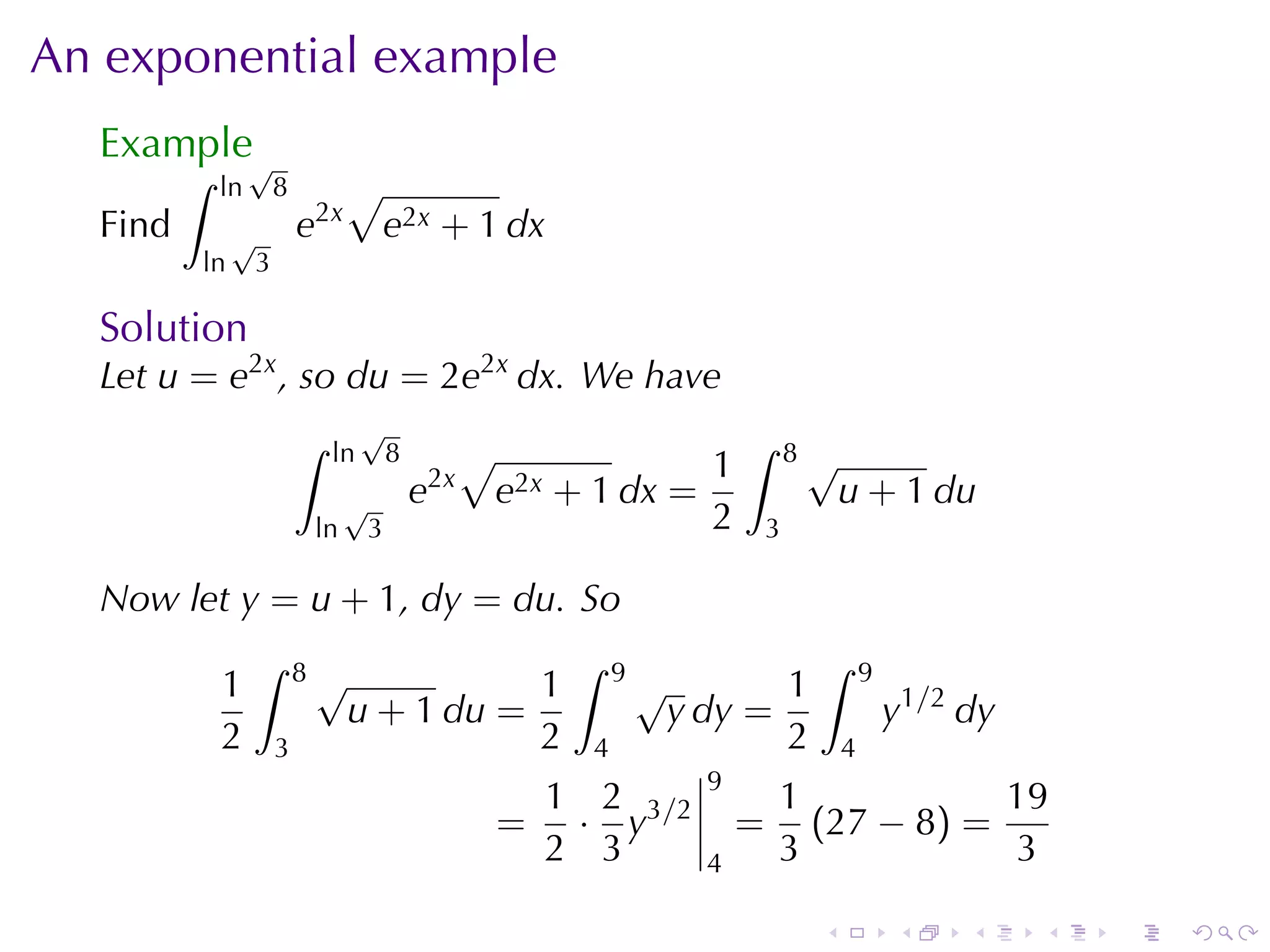
An	exponential	example
  Example√
         ∫   ln       8         √
  Find        √           e2x       e2x + 1 dx
         ln       3

  Solution
  Let u = e2x , so du = 2e2x dx. We	have
                          ∫        √                                     ∫
                              ln        8         √                  1       8√
                                √           e2x       e2x + 1 dx =                u + 1 du
                           ln       3                                2   3


                                                                              .      .   .   .   .   .
An	exponential	example
  Example√
         ∫   ln       8         √
  Find        √           e2x       e2x + 1 dx
         ln       3

  Solution
  Let u = e2x , so du = 2e2x dx. We	have
                          ∫        √                                       ∫
                              ln        8         √                    1        8√
                                √           e2x       e2x + 1 dx =                   u + 1 du
                           ln       3                                  2    3

  Now	let y = u + 1, dy = du. So
                  ∫       8√                              ∫    9                 ∫       9
             1                             1                       √       1
                                u + 1 du =                          y dy =                   y1/2 dy
             2        3                    2               4               2         4
                                                                      9
                                                       1 2                  1           19
                                                      = · y3/2             = (27 − 8) =
                                                       2 3            4     3           3

                                                                                 .           .    .    .   .   .
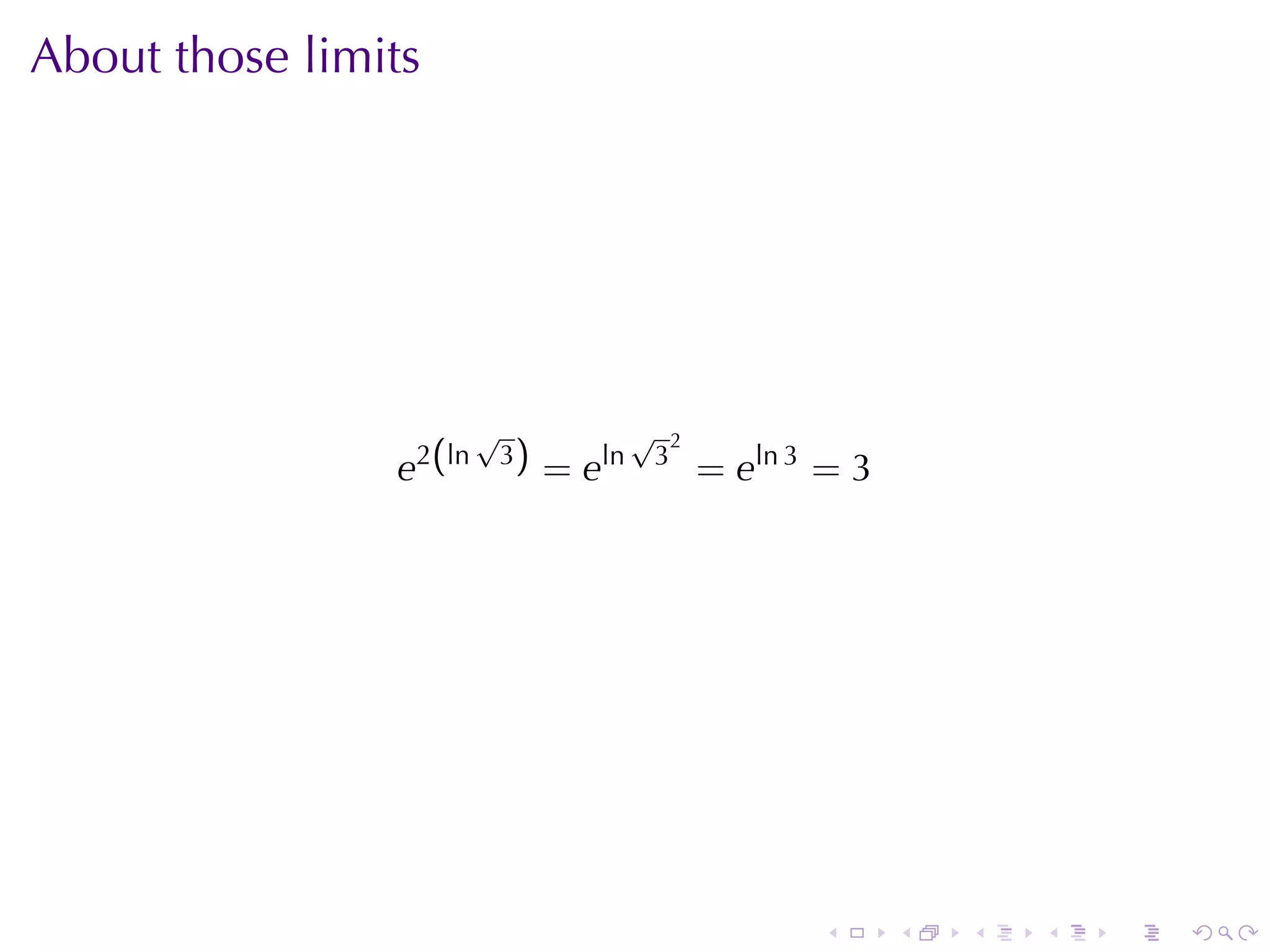
About	those	limits


                        √                √       2
                e2(ln       3)
                                 = eln       3
                                                     = eln 3 = 3


                                                            .      .   .   .   .   .
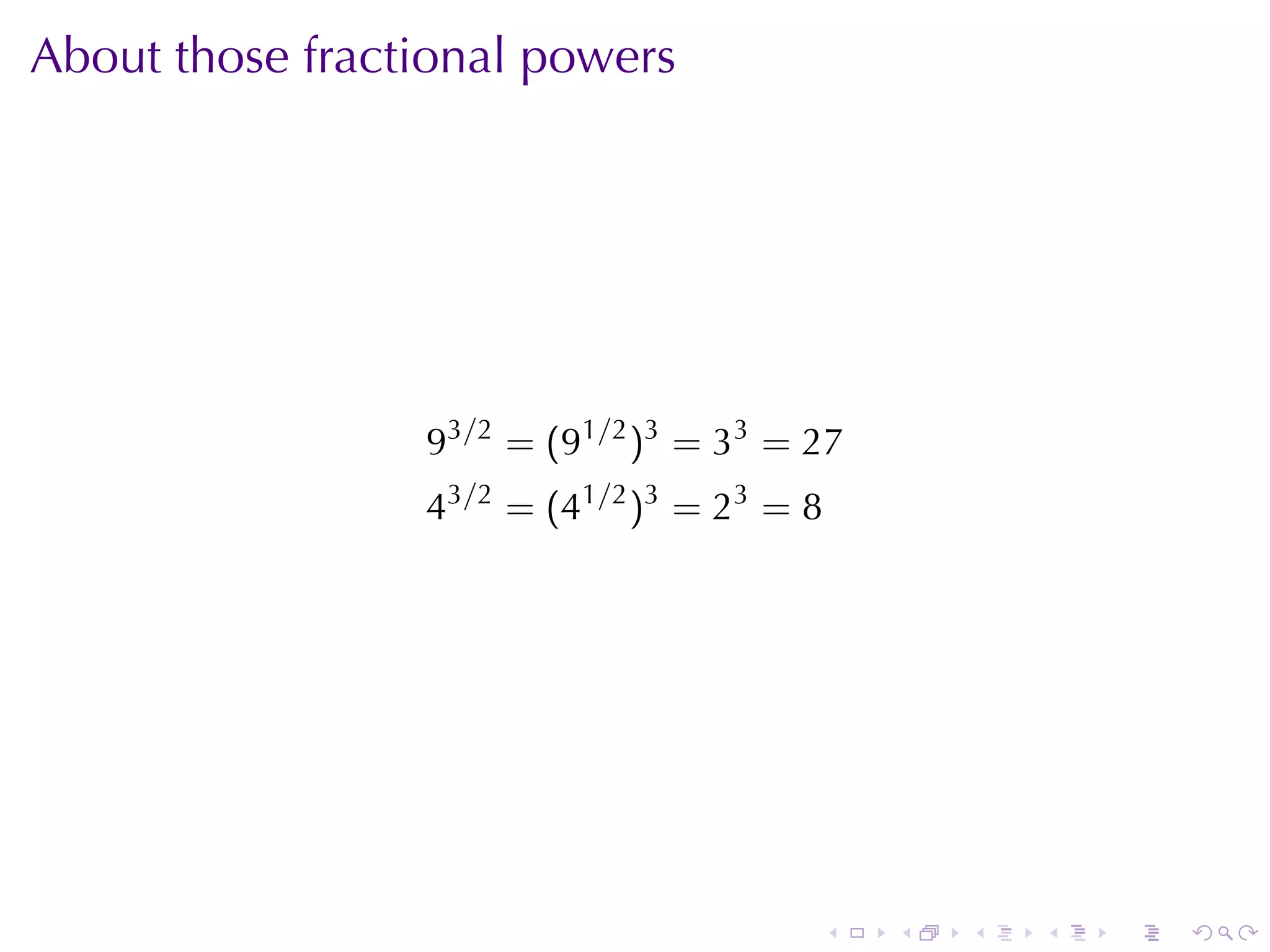
About	those	fractional	powers


                 93/2 = (91/2 )3 = 33 = 27
                 43/2 = (41/2 )3 = 23 = 8


                                        .    .   .   .   .   .
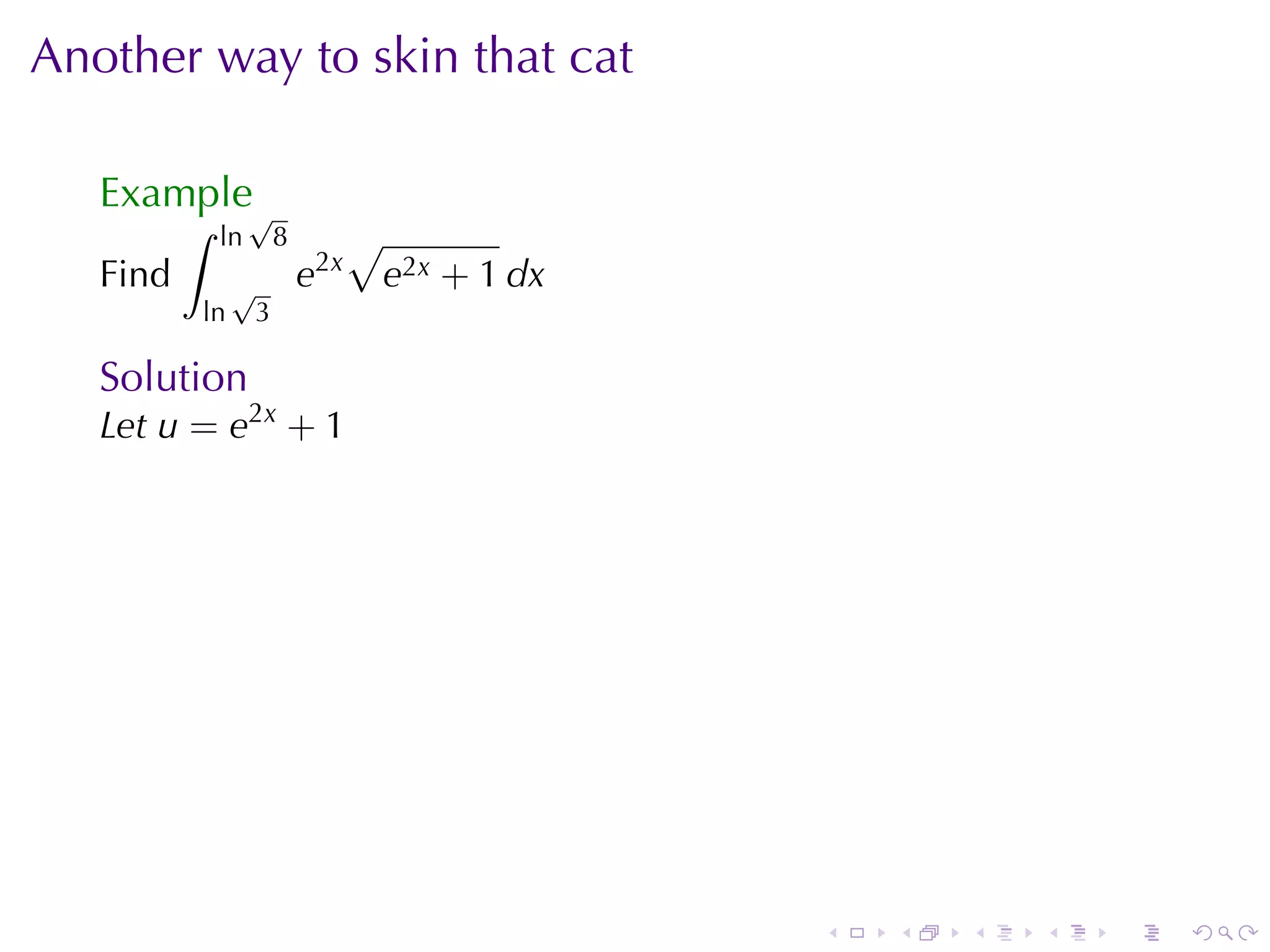
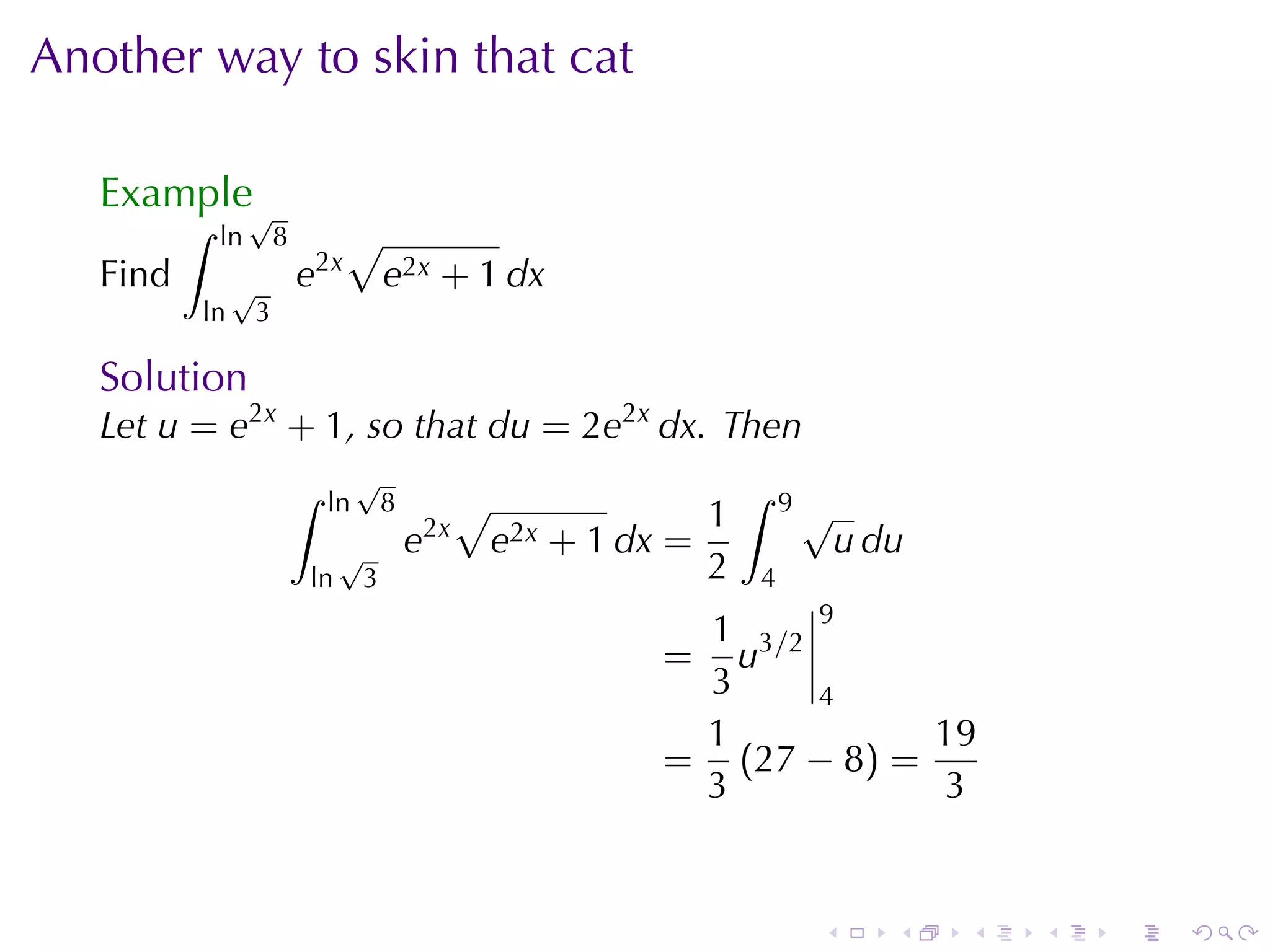
Another	way	to	skin	that	cat

   Example√
          ∫   ln       8         √
   Find        √           e2x       e2x + 1 dx
          ln       3

   Solution
   Let u = e2x + 1


                                                  .   .   .   .   .   .
Another	way	to	skin	that	cat

   Example√
          ∫   ln       8         √
   Find        √           e2x       e2x + 1 dx
          ln       3

   Solution
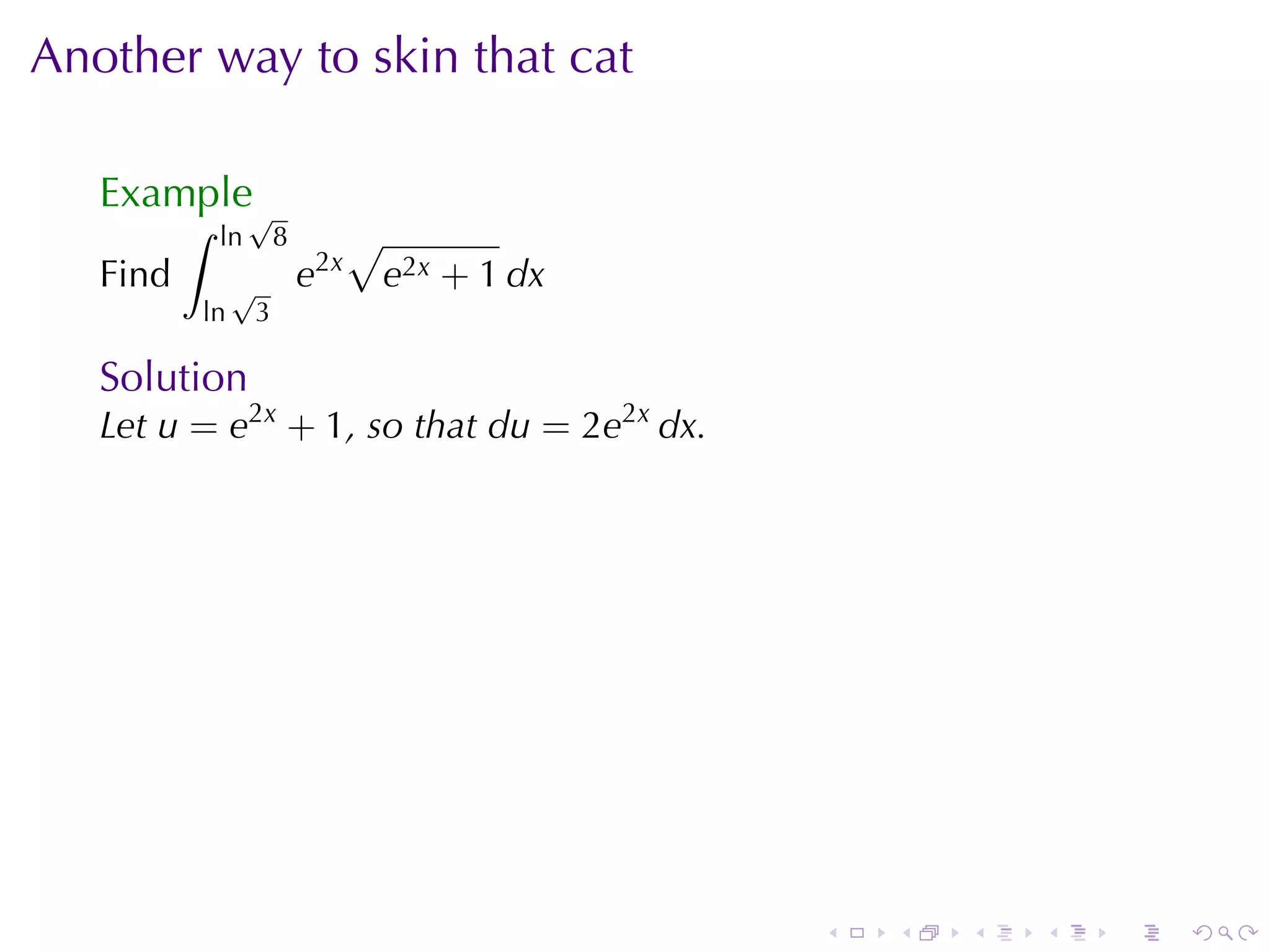
   Let u = e2x + 1, so	that du = 2e2x dx.


                                                  .   .   .   .   .   .
Another	way	to	skin	that	cat

   Example√
          ∫   ln       8         √
   Find        √           e2x          e2x + 1 dx
          ln       3

   Solution
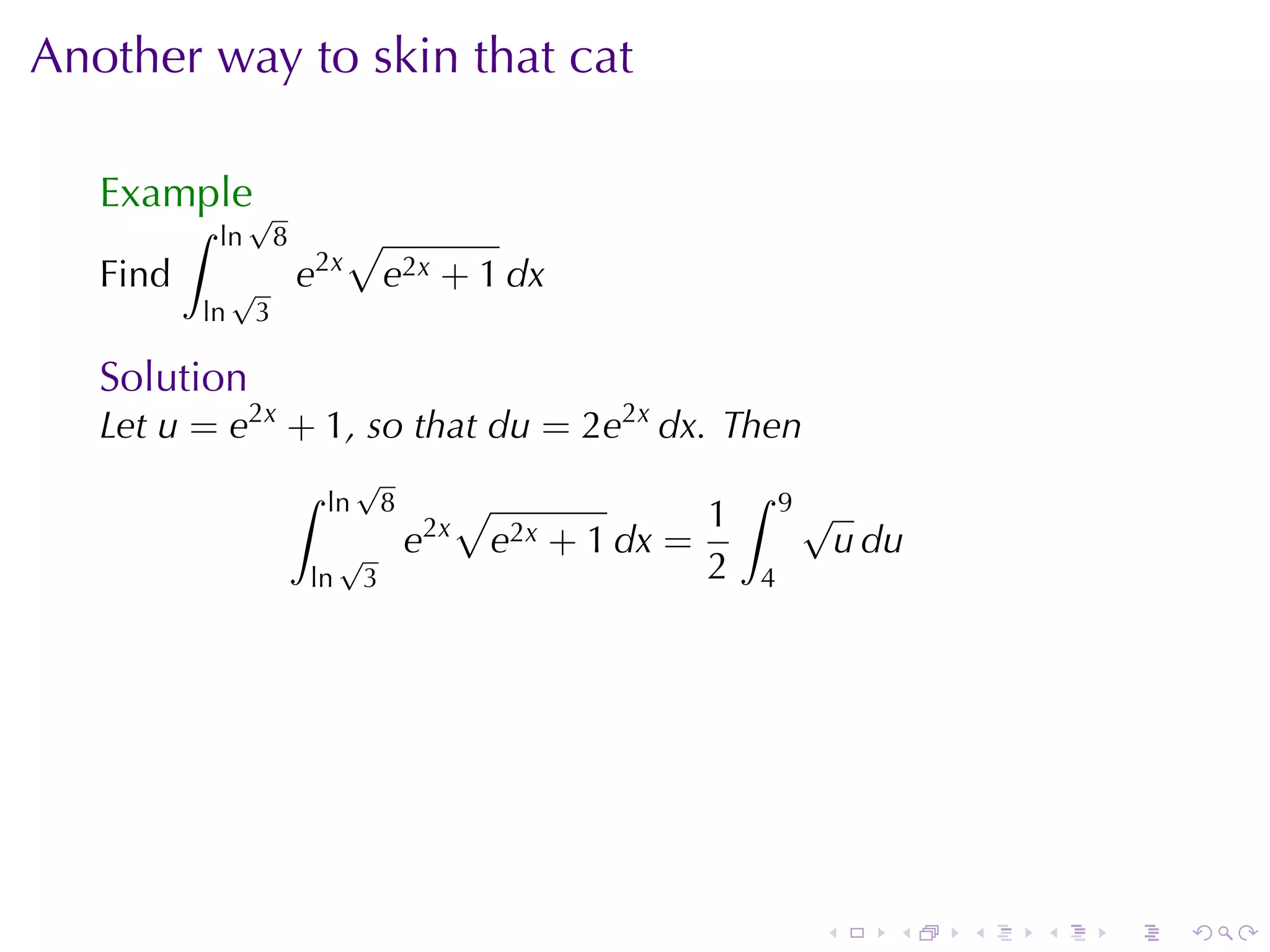
   Let u = e2x + 1, so	that du = 2e2x dx. Then
                           ∫        √                                       ∫
                               ln       8            √                  1       9√
                                                2x
                                √           e            e2x   + 1 dx =              u du
                           ln       3                                   2   4


                                                                                 .      .   .   .   .   .
Another	way	to	skin	that	cat

   Example√
          ∫   ln       8         √
   Find        √           e2x          e2x + 1 dx
          ln       3

   Solution
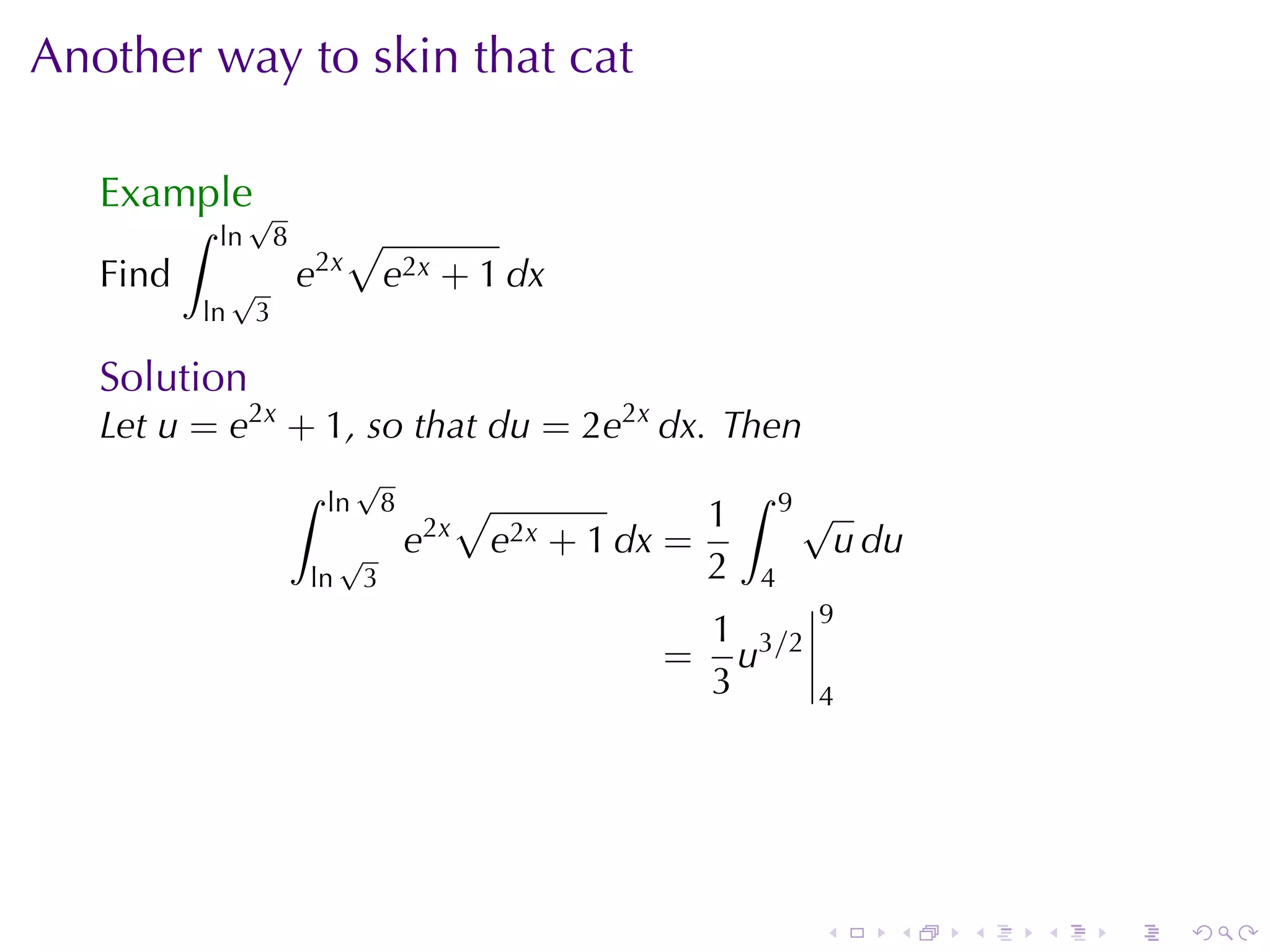
   Let u = e2x + 1, so	that du = 2e2x dx. Then
                           ∫        √                                       ∫
                               ln       8            √                  1       9√
                                                2x
                                √           e            e2x   + 1 dx =              u du
                           ln       3                                   2   4
                                                                                 9
                                                                         1 3/2
                                                                     =     u
                                                                         3       4


                                                                                 .      .   .   .   .   .
Another	way	to	skin	that	cat

   Example√
          ∫   ln       8         √
   Find        √           e2x          e2x + 1 dx
          ln       3

   Solution
   Let u = e2x + 1, so	that du = 2e2x dx. Then
                           ∫        √                                       ∫
                               ln       8            √                  1       9√
                                                2x
                                √           e            e2x   + 1 dx =              u du
                           ln       3                                   2   4
                                                                      1 3/2 9
                                                                     =  u
                                                                      3     4
                                                                      1           19
                                                                     = (27 − 8) =
                                                                      3            3


                                                                                 .      .   .   .   .   .
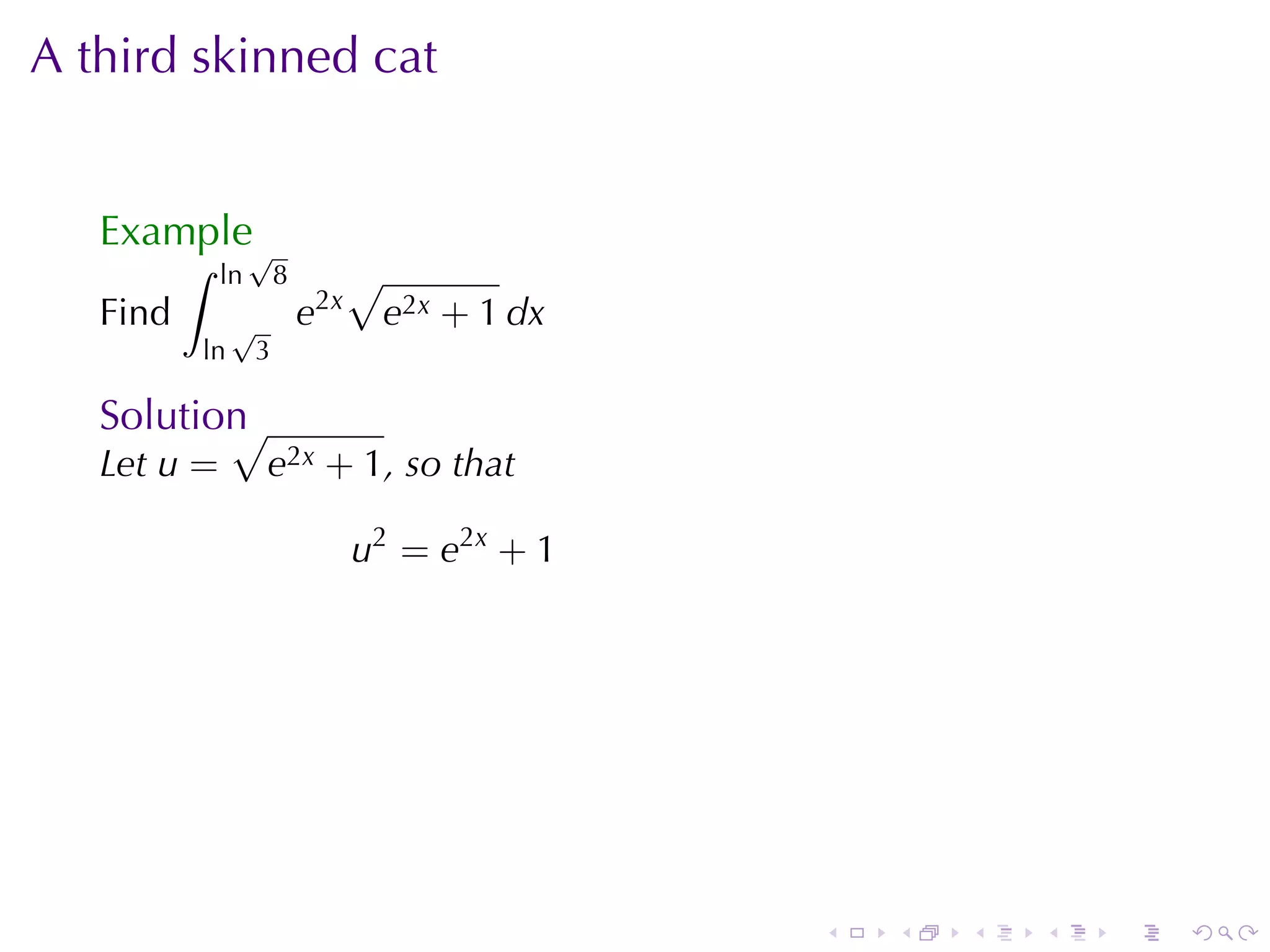
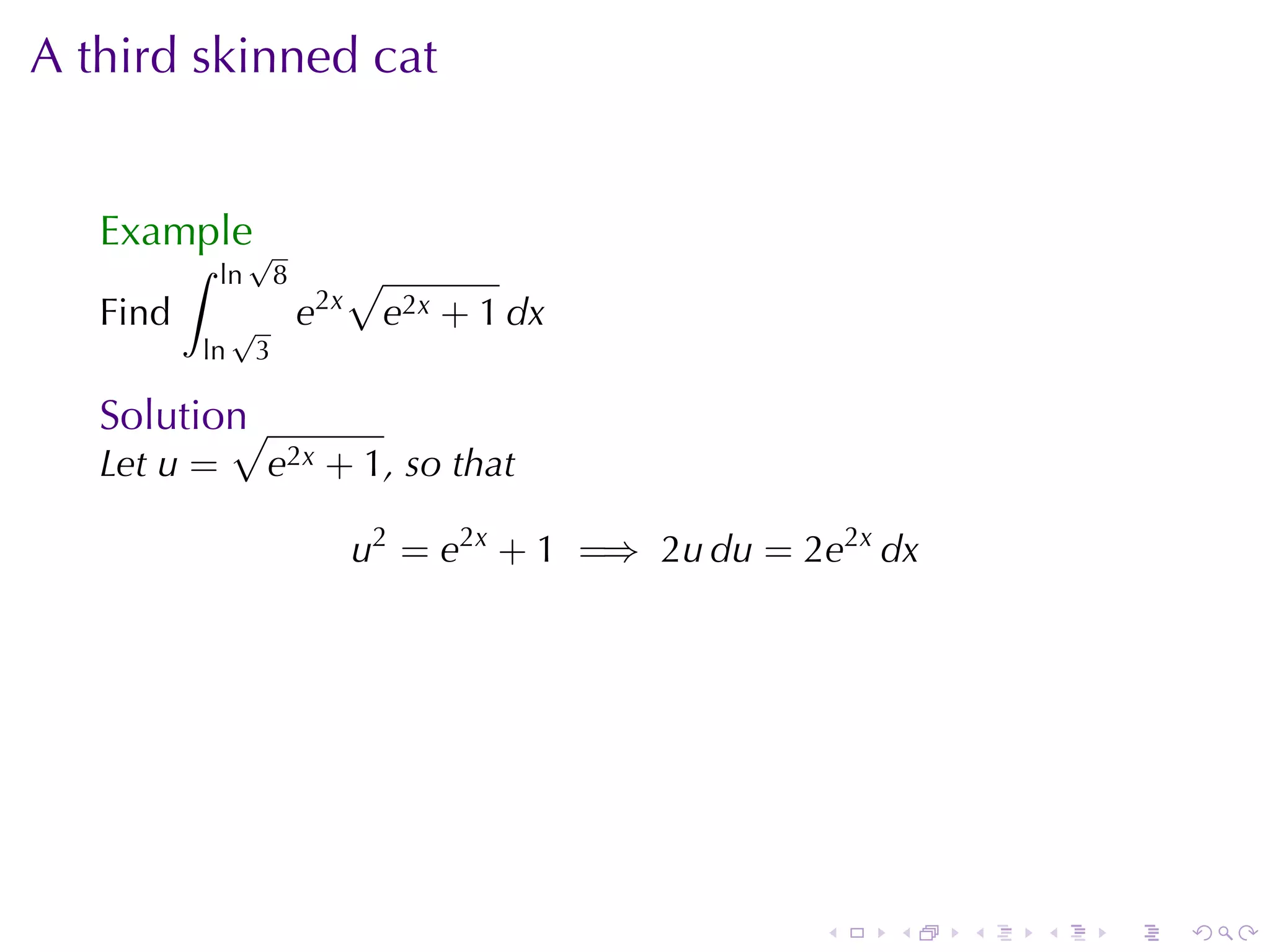
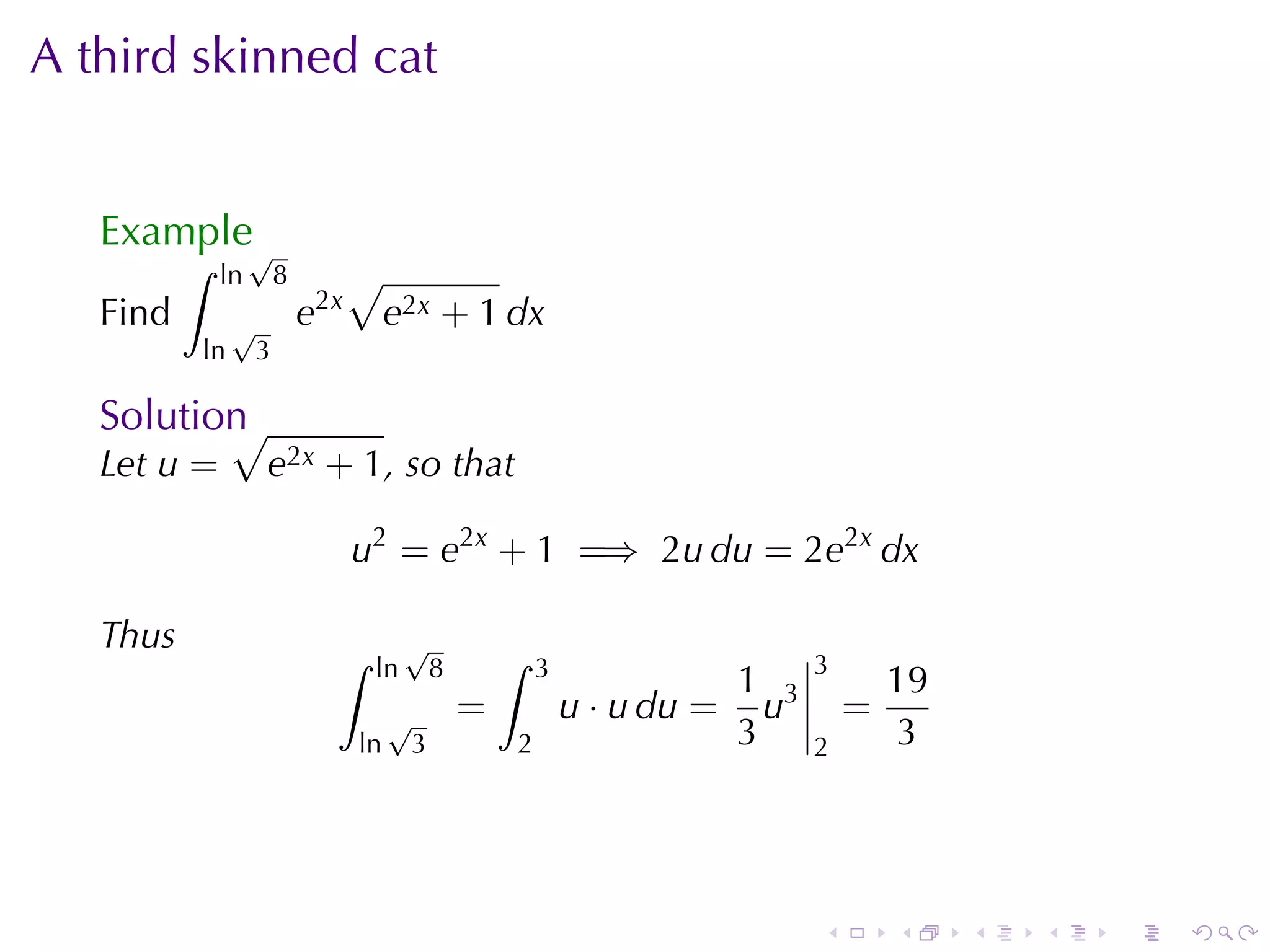
A third	skinned	cat


   Example√
          ∫   ln       8         √
   Find        √           e2x       e2x + 1 dx
          ln       3

   Solution
          √
   Let u =         e2x + 1, so	that

                                 u2 = e2x + 1


                                                  .   .   .   .   .   .
A third	skinned	cat


   Example√
          ∫   ln       8         √
   Find        √           e2x       e2x + 1 dx
          ln       3

   Solution
          √
   Let u =         e2x + 1, so	that

                                 u2 = e2x + 1 =⇒ 2u du = 2e2x dx


                                                          .   .    .   .   .   .
A third	skinned	cat


   Example√
          ∫   ln       8         √
   Find        √           e2x        e2x + 1 dx
          ln       3

   Solution
          √
   Let u =         e2x + 1, so	that

                                 u2 = e2x + 1 =⇒ 2u du = 2e2x dx

   Thus                      ∫         √          ∫
                                  ln    8             3                      3
                                                                       1 3           19
                                      √       =           u · u du =     u       =
                                 ln       3       2                    3     2       3


                                                                             .       .    .   .   .   .
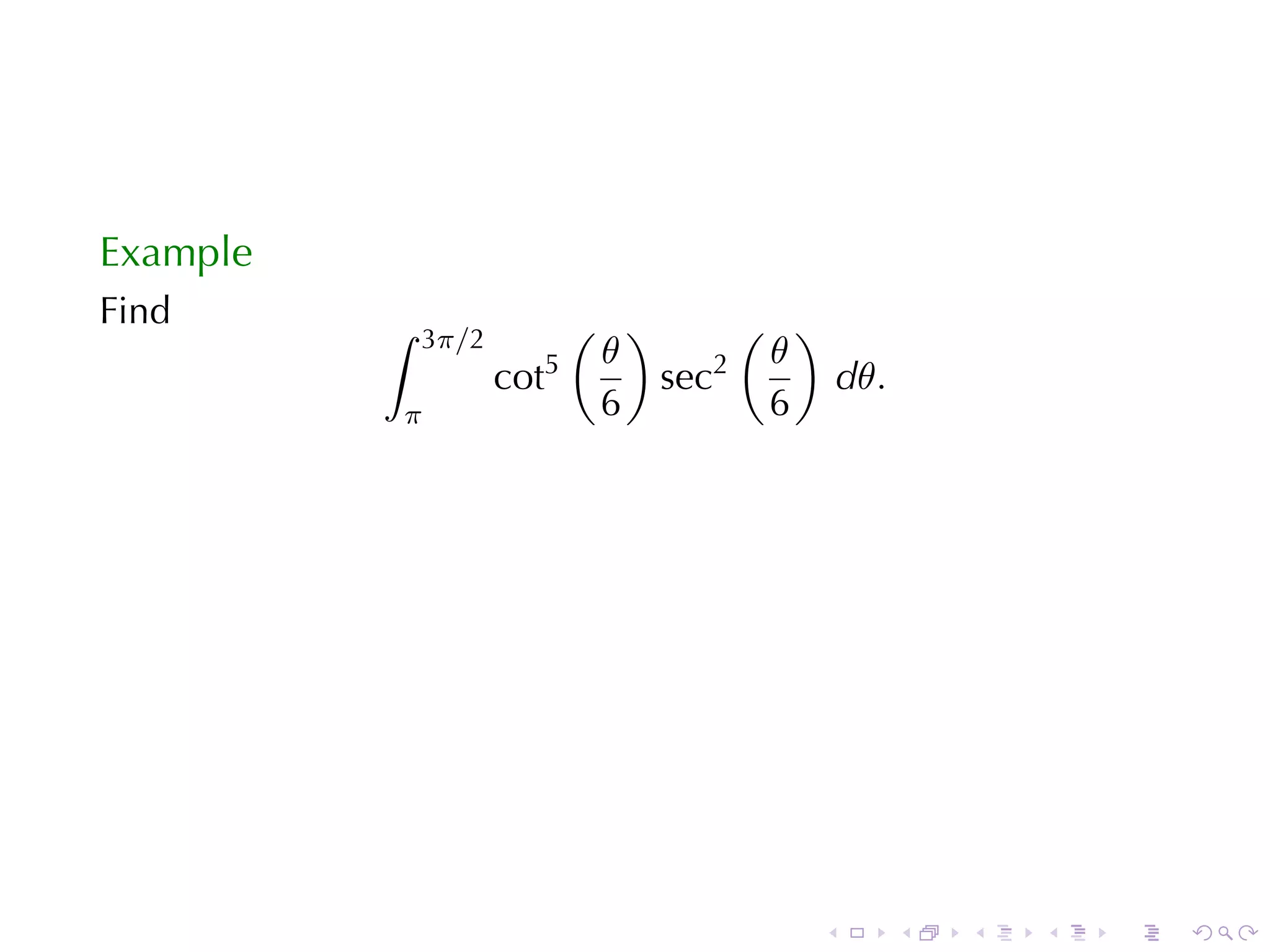
Example
Find      ∫              ( )      ( )
              3π/2
                       5  θ      2 θ
                     cot     sec      dθ.
          π               6        6


                                     .      .   .   .   .   .
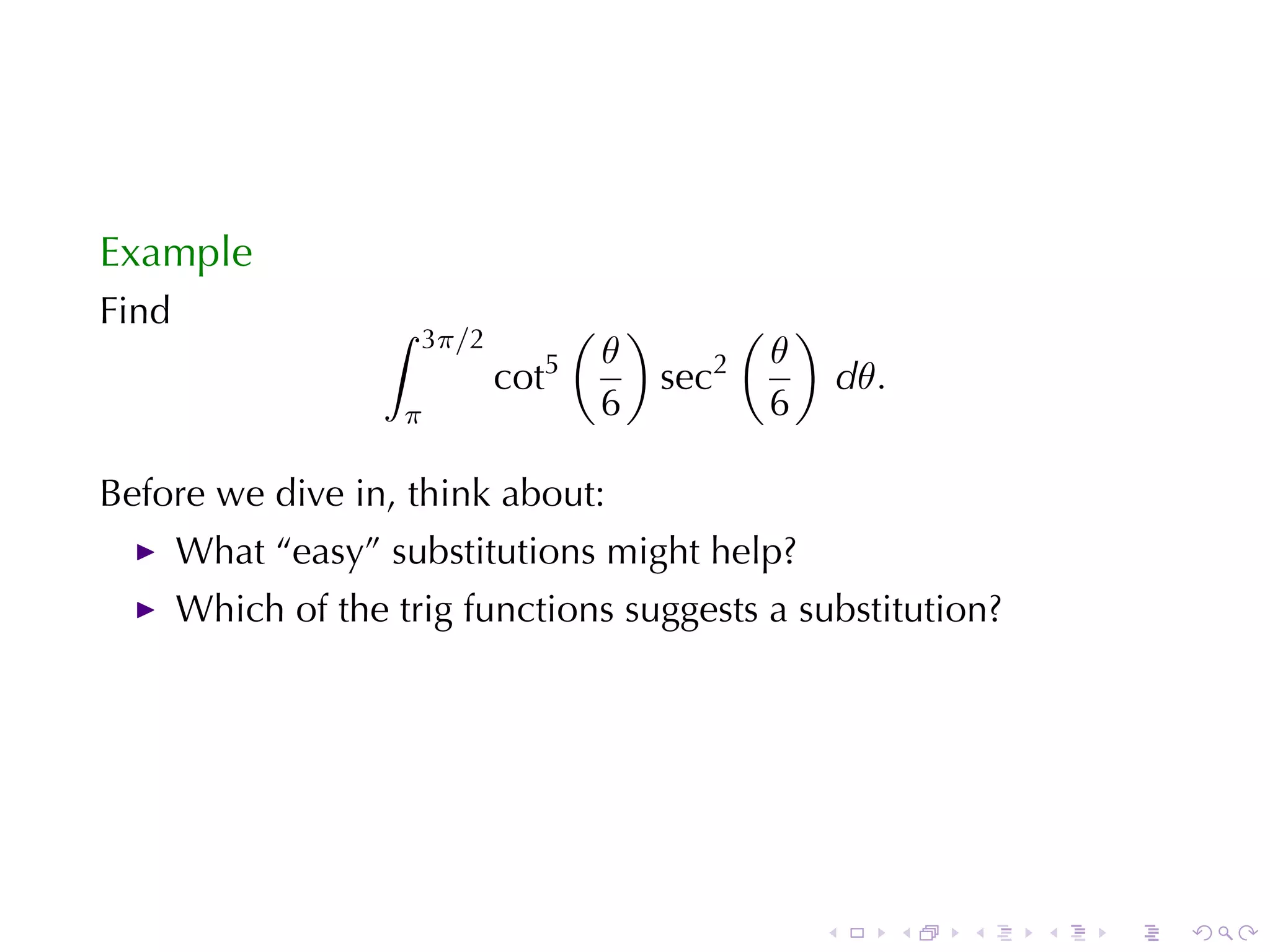
Example
Find                ∫              ( )      ( )
                        3π/2
                                 5  θ      2 θ
                               cot     sec      dθ.
                     π              6        6

Before	we	dive	in, think	about:
       What	“easy”	substitutions	might	help?
       Which	of	the	trig	functions	suggests	a	substitution?


                                               .      .   .   .   .   .
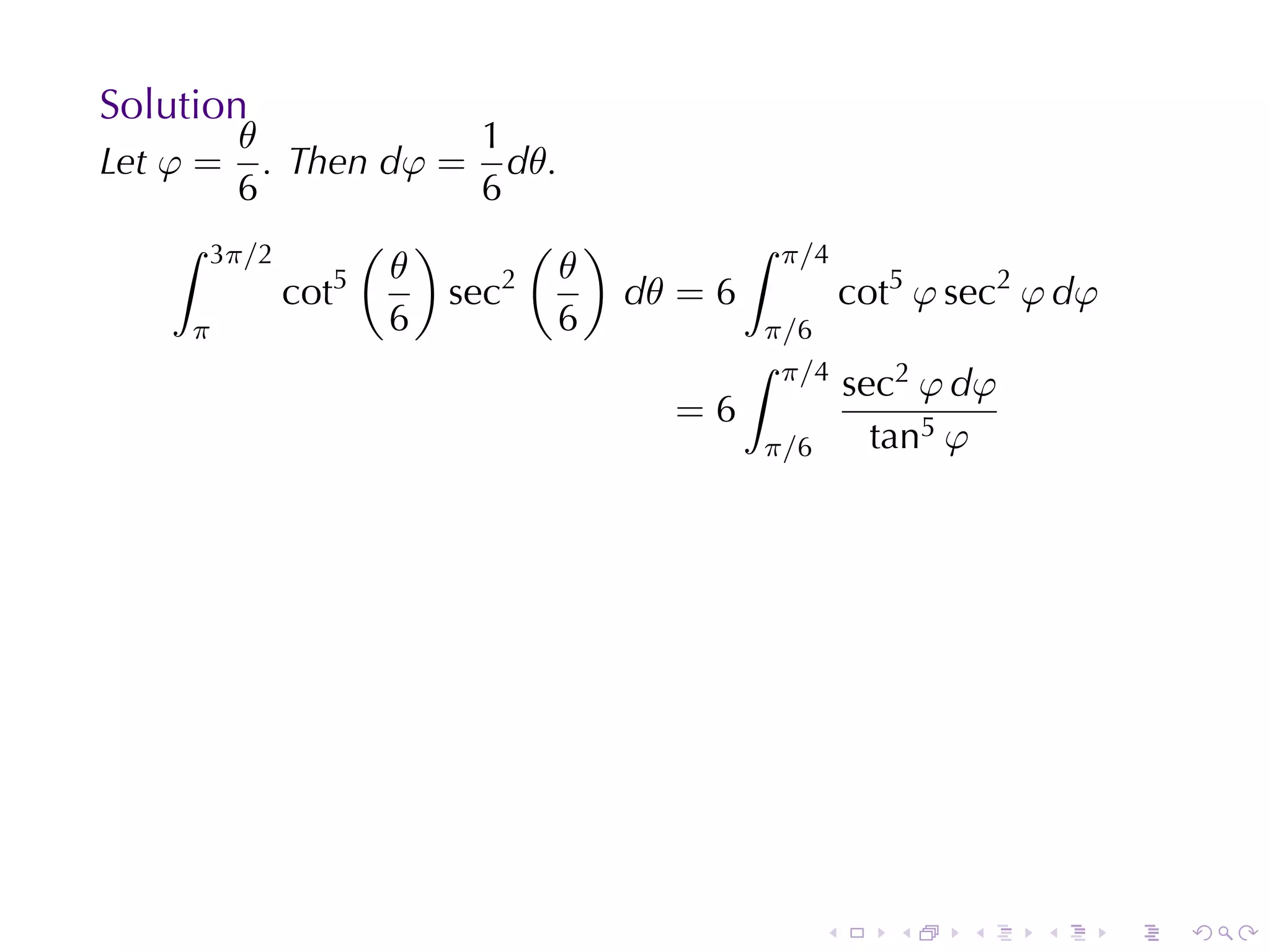
Solution
        θ              1
Let φ =   . Then dφ = dθ.
        6              6
    ∫ 3π/2       ( )      ( )        ∫ π/4
                5 θ      2 θ
            cot      sec      dθ = 6       cot5 φ sec2 φ dφ
     π            6        6          π/6
                                     ∫ π/4
                                           sec2 φ dφ
                                 =6
                                      π/6    tan5 φ


                                          .   .    .   .      .   .
Solution
        θ              1
Let φ =   . Then dφ = dθ.
        6              6
    ∫ 3π/2       ( )      ( )        ∫ π/4
                5 θ      2 θ
            cot      sec      dθ = 6       cot5 φ sec2 φ dφ
     π            6        6          π/6
                                     ∫ π/4
                                           sec2 φ dφ
                                 =6
                                      π/6    tan5 φ

Now	let u = tan φ. So du = sec2 φ dφ, and
        ∫   π/4                  ∫   1
                  sec2 φ dφ              −5
    6                       =6     √ u        du
        π/6         tan5 φ       1/ 3
                                 (      )      1
                                   1                      3
                          =6      − u−4          √
                                                      =     [9 − 1] = 12.
                                   4           1/ 3       2


                                                      .     .    .   .      .   .
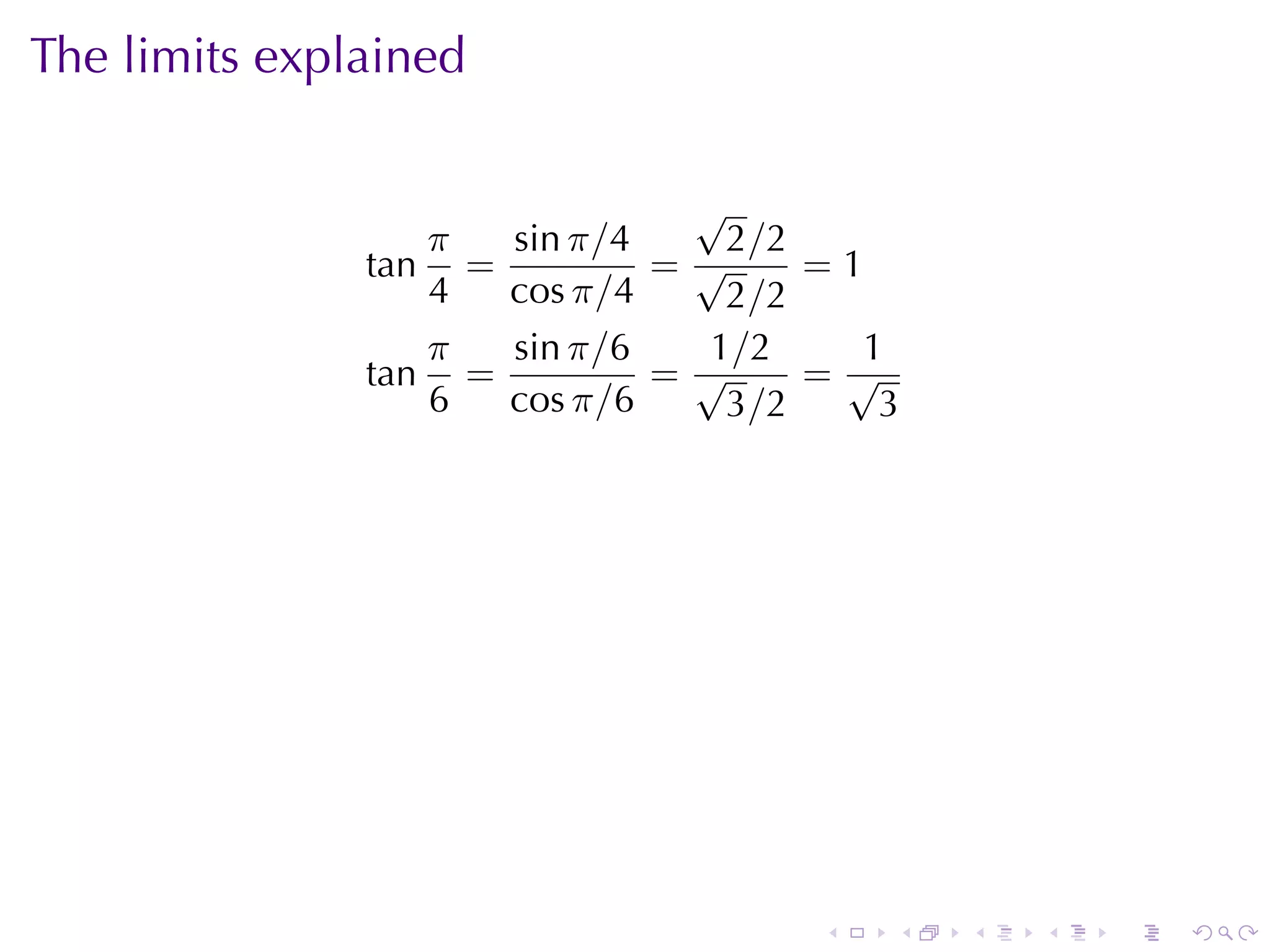
The	limits	explained

                              √
                  π  sin π/4   2 /2
               tan =         =√     =1
                  4  cos π/4   2 /2
                  π  sin π/6  1/2     1
               tan =         =√     =√
                  6  cos π/6   3 /2    3


                                    .   .   .   .   .   .
The	limits	explained

                              √
                  π  sin π/4   2 /2
               tan =         =√     =1
                  4  cos π/4   2 /2
                  π  sin π/6  1/2     1
               tan =         =√     =√
                  6  cos π/6   3 /2    3

         (      )   1                                 √
           1 −4              3 [ −4 ]1 √    3 [ −4 ]1/ 3
        6 − u         √
                           =    −u 1 / 3 =     u 1
           4        1/ 3     2              2
                             3 [ −1/2 −4             ]
                           =    (3   ) − (1−1/2 )−4
                             2
                             3           3
                           = [32 − 12 ] = (9 − 1) = 12
                             2           2


                                           .   .   .   .   .   .
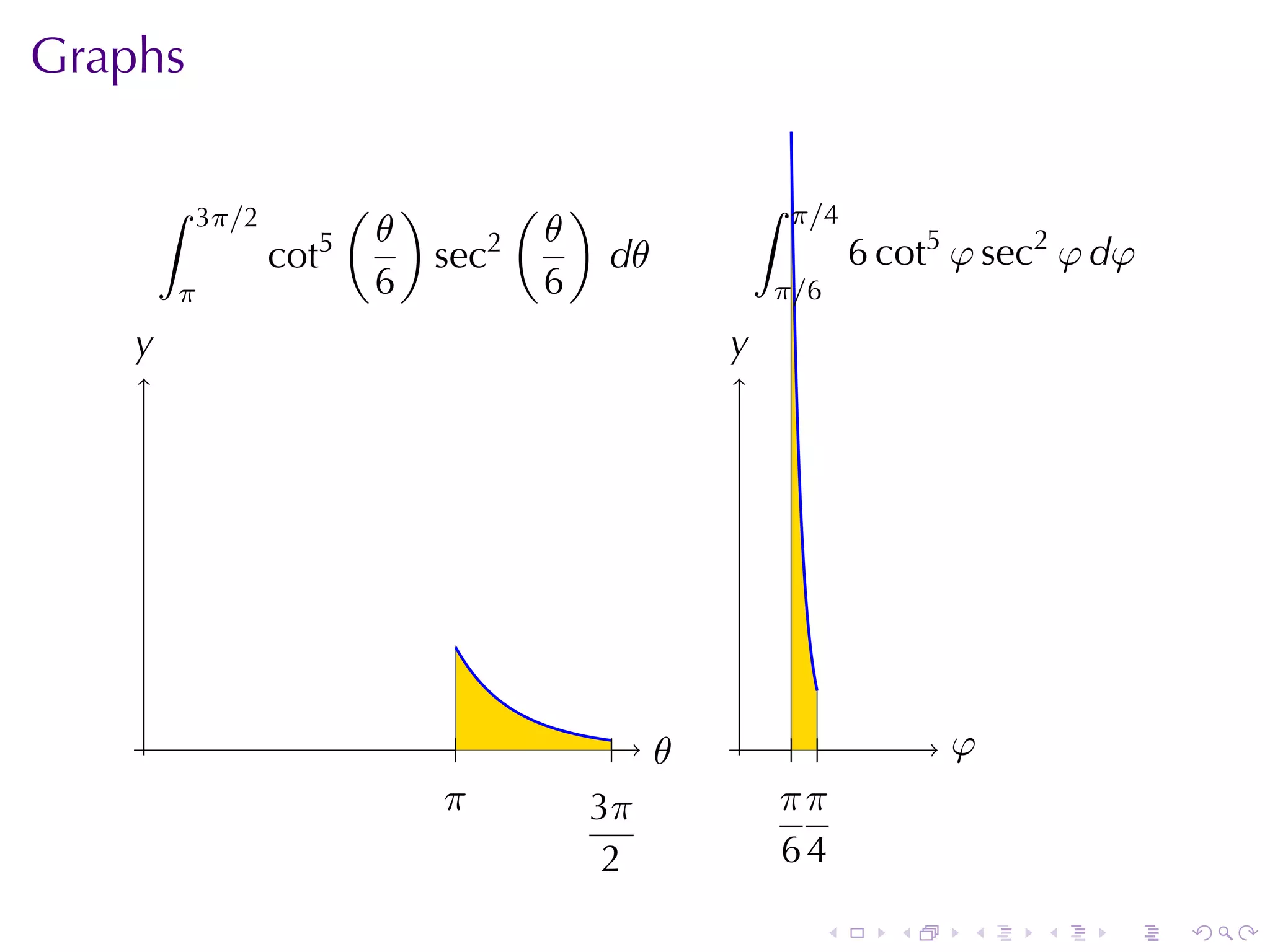
Graphs

        ∫   3π/2       ( )      ( )            ∫   π/4
                        θ      2 θ
        .            5
                   cot     sec      dθ         .         6 cot5 φ sec2 φ dφ
        π               6        6             π/6

    y
    .                                      y
                                           .


    .                       .        . .
                                       θ           . .          .
                                                                φ
                           .
                           π      3π               ππ
                                  .                . .
                                    2              64

                                                     .      .   .    .   .    .
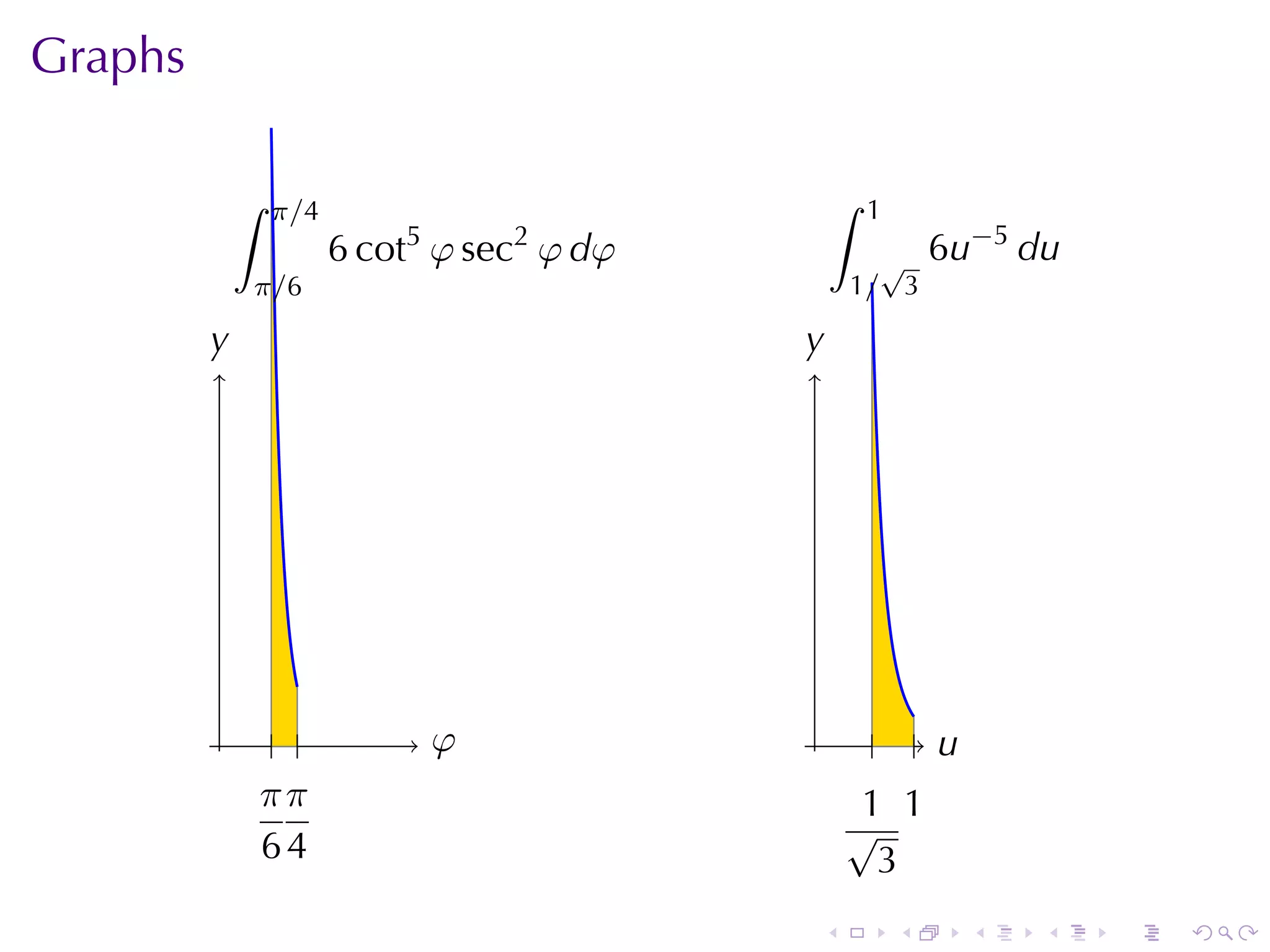
Graphs

             ∫   π/4                          ∫   1
             .             5       2
                       6 cot φ sec φ dφ       .   √       6u−5 du
             π/6                              1/ 3

         y
         .                                y
                                          .


         .       . .           .
                               φ                  . ..
                                                     u
                 ππ                            1 .1
                 . .                          .√
                 64                             3
                                          .           .     .   .   .   .
Final	Thoughts


      Antidifferentiation	is	a	“nonlinear”	problem	that	needs
      practice, intuition, and	perserverance
      Worksheet	in	recitation	(also	to	be	posted)
      The	whole	antidifferentiation	story	is	in	Chapter 6


                                              .     .   .   .   .   .

Lesson 29: Integration by Substition

  • 1.
    Section 5.5 Integration by Substitution V63.0121.027, Calculus I December 10, 2009 Announcements Final Exam: Friday 12/18, 2:00-3:50pm, Tisch UC50 Practice finals on the website. Solutions Friday . . . . . .
  • 2.
    Schedule for next week Tuesday, 8:00am: Review session for all students with 8:00 recitations (Tuesday or Thursday) in CIWW 109 Tuesday, 9:30am: Review session for all students with 9:30 recitations (Tuesday or Thursday) in CIWW 109 Office Hours continue Tuesday, class: review, evaluations, movie! Friday, 2:00pm: final in Tisch UC50 . . . . . .
  • 3.
    Resurrection Policy If your final score beats your midterm score, we will add 10% to its weight, and subtract 10% from the midterm weight. . . Image credit: Scott Beale / Laughing Squid . . . . . .
  • 4.
    Outline Last Time:The Fundamental Theorem(s) of Calculus Substitution for Indefinite Integrals Theory Examples Substitution for Definite Integrals Theory Examples . . . . . .
  • 5.
    Differentiation and Integration as reverse processes Theorem (The Fundamental Theorem of Calculus) 1. Let f be continuous on [a, b]. Then ∫ x d f(t) dt = f(x) dx a 2. Let f be continuous on [a, b] and f = F′ for some other function F. Then ∫ b f(x) dx = F(b) − F(a). a . . . . . .
  • 6.
    Techniques of antidifferentiation? So far we know only a few rules for antidifferentiation. Some are general, like ∫ ∫ ∫ [f(x) + g(x)] dx = f(x) dx + g(x) dx . . . . . .
  • 7.
    Techniques of antidifferentiation? So far we know only a few rules for antidifferentiation. Some are general, like ∫ ∫ ∫ [f(x) + g(x)] dx = f(x) dx + g(x) dx Some are pretty particular, like ∫ 1 √ dx = arcsec x + C. x x2 − 1 . . . . . .
  • 8.
    Techniques of antidifferentiation? So far we know only a few rules for antidifferentiation. Some are general, like ∫ ∫ ∫ [f(x) + g(x)] dx = f(x) dx + g(x) dx Some are pretty particular, like ∫ 1 √ dx = arcsec x + C. x x2 − 1 What are we supposed to do with that? . . . . . .
  • 9.
    So far we don’t have any way to find ∫ 2x √ dx x2 + 1 or ∫ tan x dx. . . . . . .
  • 10.
    So far we don’t have any way to find ∫ 2x √ dx x2 + 1 or ∫ tan x dx. Luckily, we can be smart and use the “anti” version of one of the most important rules of differentiation: the chain rule. . . . . . .
  • 11.
    Outline Last Time:The Fundamental Theorem(s) of Calculus Substitution for Indefinite Integrals Theory Examples Substitution for Definite Integrals Theory Examples . . . . . .
  • 12.
    Substitution for Indefinite Integrals Example Find ∫ x √ dx. x 2+1 . . . . . .
  • 13.
    Substitution for Indefinite Integrals Example Find ∫ x √ dx. x 2+1 Solution Stare at this long enough and you notice the the integrand is the √ derivative of the expression 1 + x2 . . . . . . .
  • 14.
    Say what? Solution (More slowly,now) Let g(x) = x2 + 1. . . . . . .
  • 15.
    Say what? Solution (More slowly,now) Let g(x) = x2 + 1. Then g′ (x) = 2x and so d√ 1 x g(x) = √ g′ (x) = √ dx 2 g(x) x2 + 1 . . . . . .
  • 16.
    Say what? Solution (More slowly,now) Let g(x) = x2 + 1. Then g′ (x) = 2x and so d√ 1 x g(x) = √ g′ (x) = √ dx 2 g(x) x2 + 1 Thus ∫ ∫ ( ) x d√ √ dx = g(x) dx x2 + 1 dx √ √ = g(x) + C = 1 + x2 + C. . . . . . .
  • 17.
    Leibnizian notation FTW Solution (Same technique,new notation) Let u = x2 + 1. . . . . . .
  • 18.
    Leibnizian notation FTW Solution (Same technique,new notation) √ √ Let u = x2 + 1. Then du = 2x dx and 1 + x2 = u. . . . . . .
  • 19.
    Leibnizian notation FTW Solution (Same technique,new notation) √ √ Let u = x2 + 1. Then du = 2x dx and 1 + x2 = u. So the integrand becomes completely transformed into ∫ ∫ 1 ∫ √ x dx 2 du √ 1 √ du = = x2 + 1 u 2 u . . . . . .
  • 20.
    Leibnizian notation FTW Solution (Same technique,new notation) √ √ Let u = x2 + 1. Then du = 2x dx and 1 + x2 = u. So the integrand becomes completely transformed into ∫ ∫ 1 ∫ √ x dx 2 du √ 1 √ du = = x2 + 1 ∫ u 2 u 1 −1/2 = 2u du . . . . . .
  • 21.
    Leibnizian notation FTW Solution (Same technique,new notation) √ √ Let u = x2 + 1. Then du = 2x dx and 1 + x2 = u. So the integrand becomes completely transformed into ∫ ∫ 1 ∫ √ x dx 2 du √ 1 √ du = = x2 + 1 ∫ u 2 u 1 −1/2 = 2u du √ √ = u+C= 1 + x2 + C. . . . . . .
  • 22.
    Useful but unsavory variation Solution (Same technique, new notation, more idiot-proof) √ √ Let u = x2 + 1. Then du = 2x dx and 1 + x2 = u. “Solve for dx:” du dx = 2x So the integrand becomes completely transformed into ∫ ∫ ∫ x x du 1 √ dx = √ · = √ du x2 + 1 u 2x 2 u ∫ 1 −1/2 = 2u du √ √ = u + C = 1 + x2 + C . Mathematicians have serious issues with mixing the x and u like this. However, I can’t deny that it works. . . . . . .
  • 23.
    Theorem of the Day Theorem (The Substitution Rule) If u = g(x) is a differentiable function whose range is an interval I and f is continuous on I, then ∫ ∫ f(g(x))g′ (x) dx = f(u) du That is, if F is an antiderivative for f, then ∫ f(g(x))g′ (x) dx = F(g(x)) In Leibniz notation: ∫ ∫ du f(u) dx = f(u) du dx . . . . . .
  • 24.
    A polynomial example Example ∫ Use the substitution u = x2 + 3 to find (x2 + 3)3 4x dx. . . . . . .
  • 25.
    A polynomial example Example ∫ Use the substitution u = x2 + 3 to find (x2 + 3)3 4x dx. Solution If u = x2 + 3, then du = 2x dx, and 4x dx = 2 du. So ∫ ∫ ∫ (x + 3) 4x dx = u 2du = 2 u3 du 2 3 3 1 4 1 2 = u = (x + 3)4 2 2 . . . . . .
  • 26.
    A polynomial example, by brute force Compare this to multiplying it out: ∫ ∫ 2 3 ( 6 ) (x + 3) 4x dx = x + 9x4 + 27x2 + 27 4x dx ∫ ( 7 ) = 4x + 36x5 + 108x3 + 108x dx 1 8 = x + 6x6 + 27x4 + 54x2 2 . . . . . .
  • 27.
    A polynomial example, by brute force Compare this to multiplying it out: ∫ ∫ 2 3 ( 6 ) (x + 3) 4x dx = x + 9x4 + 27x2 + 27 4x dx ∫ ( 7 ) = 4x + 36x5 + 108x3 + 108x dx 1 8 = x + 6x6 + 27x4 + 54x2 2 Which would you rather do? . . . . . .
  • 28.
    A polynomial example, by brute force Compare this to multiplying it out: ∫ ∫ 2 3 ( 6 ) (x + 3) 4x dx = x + 9x4 + 27x2 + 27 4x dx ∫ ( 7 ) = 4x + 36x5 + 108x3 + 108x dx 1 8 = x + 6x6 + 27x4 + 54x2 2 Which would you rather do? It’s a wash for low powers But for higher powers, it’s much easier to do substitution. . . . . . .
  • 29.
    Compare We have the substitution method,which, when multiplied out, gives ∫ 1 (x2 + 3)3 4x dx = (x2 + 3)4 2 1( 8 ) = x + 12x6 + 54x4 + 108x2 + 81 2 1 81 = x8 + 6x6 + 27x4 + 54x2 + 2 2 and the brute force method ∫ 1 (x2 + 3)3 4x dx = x8 + 6x6 + 27x4 + 54x2 2 Is this a problem? . . . . . .
  • 30.
    Compare We have the substitution method,which, when multiplied out, gives ∫ 1 (x2 + 3)3 4x dx = (x2 + 3)4 + C 2 1( 8 ) = x + 12x6 + 54x4 + 108x2 + 81 + C 2 1 81 = x8 + 6x6 + 27x4 + 54x2 + +C 2 2 and the brute force method ∫ 1 (x2 + 3)3 4x dx = x8 + 6x6 + 27x4 + 54x2 + C 2 Is this a problem? No, that’s what +C means! . . . . . .
  • 31.
    A slick example Example ∫ Find tan x dx. . . . . . .
  • 32.
    A slick example Example ∫ sin x Find tan x dx. (Hint: tan x = ) cos x . . . . . .
  • 33.
    A slick example Example ∫ sin x Find tan x dx. (Hint: tan x = ) cos x Solution Let u = cos x. Then du = − sin x dx. . . . . . .
  • 34.
    A slick example Example ∫ sin x Find tan x dx. (Hint: tan x = ) cos x Solution Let u = cos x. Then du = − sin x dx. So ∫ ∫ ∫ sin x 1 tan x dx = dx = − du cos x u . . . . . .
  • 35.
    A slick example Example ∫ sin x Find tan x dx. (Hint: tan x = ) cos x Solution Let u = cos x. Then du = − sin x dx. So ∫ ∫ ∫ sin x 1 tan x dx = dx = − du cos x u = − ln |u| + C . . . . . .
  • 36.
    A slick example Example ∫ sin x Find tan x dx. (Hint: tan x = ) cos x Solution Let u = cos x. Then du = − sin x dx. So ∫ ∫ ∫ sin x 1 tan x dx = dx = − du cos x u = − ln |u| + C = − ln | cos x| + C = ln | sec x| + C . . . . . .
  • 37.
    Can you do it another way? Example ∫ sin x Find tan x dx. (Hint: tan x = ) cos x . . . . . .
  • 38.
    Can you do it another way? Example ∫ sin x Find tan x dx. (Hint: tan x = ) cos x Solution du Let u = sin x. Then du = cos x dx and so dx = . cos x . . . . . .
  • 39.
    Can you do it another way? Example ∫ sin x Find tan x dx. (Hint: tan x = ) cos x Solution du Let u = sin x. Then du = cos x dx and so dx = . cos x ∫ ∫ ∫ sin x u du tan x dx = dx = cos x cos x cos x ∫ ∫ ∫ u du u du u du = = 2 = cos2 x 1 − sin x 1 − u2 At this point, although it’s possible to proceed, we should probably back up and see if the other way works quicker (it does). . . . . . .
  • 40.
    For those who really must know all Solution (Continued, with algebra help) ∫ ∫ ∫ ( ) u du 1 1 1 tan x dx = = − du 1 − u2 2 1−u 1+u 1 1 = − ln |1 − u| − ln |1 + u| + C 2 2 1 1 = ln √ + C = ln √ +C (1 − u)(1 + u) 1 − u2 1 = ln + C = ln |sec x| + C |cos x| . . . . . .
  • 41.
    Outline Last Time:The Fundamental Theorem(s) of Calculus Substitution for Indefinite Integrals Theory Examples Substitution for Definite Integrals Theory Examples . . . . . .
  • 42.
    Theorem (The Substitution Rule for Definite Integrals) If g′ is continuous andf is continuous on the range of u = g(x), then ∫ ∫ b g(b) f(g(x))g′ (x) dx = f(u) du. a g (a ) . . . . . .
  • 43.
    Theorem (The Substitution Rule for Definite Integrals) If g′ is continuous andf is continuous on the range of u = g(x), then ∫ ∫ b g(b) f(g(x))g′ (x) dx = f(u) du. a g (a ) Why the change in the limits? The integral on the left happens in “x-land” The integral on the right happens in “u-land”, so the limits need to be u-values To get from x to u, apply g . . . . . .
  • 44.
    Example ∫ π Compute cos2 x sin x dx. 0 . . . . . .
  • 45.
    Example ∫ π Compute cos2 x sin x dx. 0 Solution (Slow Way) ∫ First compute the indefinite integral cos2 x sin x dx and then evaluate. . . . . . .
  • 46.
    Example ∫ π Compute cos2 x sin x dx. 0 Solution (Slow Way) ∫ First compute the indefinite integral cos2 x sin x dx and then evaluate. Let u = cos x. Then du = − sin x dx and ∫ ∫ cos x sin x dx = − u2 du 2 = − 1 u3 + C = − 1 cos3 x + C. 3 3 Therefore ∫ π 1 π 1( ) 2 cos2 x sin x dx = − cos3 x =− (−1)3 − 13 = . 0 3 0 3 3 . . . . . .
  • 47.
  • 48.
    Solution (Fast Way) Do both the substitution and the evaluation at the same time. Let u =cos x. Then du = − sin x dx, u(0) = 1 and u(π) = −1. . . . . . .
  • 49.
    Solution (Fast Way) Do both the substitution and the evaluation at the same time. Let u =cos x. Then du = − sin x dx, u(0) = 1 and u(π) = −1. So ∫ π ∫ −1 cos2 x sin x dx = −u2 du 0 1 ∫ 1 = u2 du −1 1 1 1( ) 2 = u3 = 1 − (−1) = 3 −1 3 3 . . . . . .
  • 50.
    Solution (Fast Way) Do both the substitution and the evaluation at the same time. Let u =cos x. Then du = − sin x dx, u(0) = 1 and u(π) = −1. So ∫ π ∫ −1 cos2 x sin x dx = −u2 du 0 1 ∫ 1 = u2 du −1 1 1 1( ) 2 = u3 = 1 − (−1) = 3 −1 3 3 The advantage to the “fast way” is that you completely transform the integral into something simpler and don’t have to go back to the original x variable. But the slow way is just as reliable. . . . . . .
  • 51.
    An exponential example Example√ ∫ ln 8 √ Find √ e2x e2x + 1 dx ln 3 . . . . . .
  • 52.
    An exponential example Example√ ∫ ln 8 √ Find √ e2x e2x + 1 dx ln 3 Solution Let u = e2x , so du = 2e2x dx. We have ∫ √ ∫ ln 8 √ 1 8√ √ e2x e2x + 1 dx = u + 1 du ln 3 2 3 . . . . . .
  • 53.
    An exponential example Example√ ∫ ln 8 √ Find √ e2x e2x + 1 dx ln 3 Solution Let u = e2x , so du = 2e2x dx. We have ∫ √ ∫ ln 8 √ 1 8√ √ e2x e2x + 1 dx = u + 1 du ln 3 2 3 Now let y = u + 1, dy = du. So ∫ 8√ ∫ 9 ∫ 9 1 1 √ 1 u + 1 du = y dy = y1/2 dy 2 3 2 4 2 4 9 1 2 1 19 = · y3/2 = (27 − 8) = 2 3 4 3 3 . . . . . .
  • 54.
    About those limits √ √ 2 e2(ln 3) = eln 3 = eln 3 = 3 . . . . . .
  • 55.
    About those fractional powers 93/2 = (91/2 )3 = 33 = 27 43/2 = (41/2 )3 = 23 = 8 . . . . . .
  • 56.
    Another way to skin that cat Example√ ∫ ln 8 √ Find √ e2x e2x + 1 dx ln 3 Solution Let u = e2x + 1 . . . . . .
  • 57.
    Another way to skin that cat Example√ ∫ ln 8 √ Find √ e2x e2x + 1 dx ln 3 Solution Let u = e2x + 1, so that du = 2e2x dx. . . . . . .
  • 58.
    Another way to skin that cat Example√ ∫ ln 8 √ Find √ e2x e2x + 1 dx ln 3 Solution Let u = e2x + 1, so that du = 2e2x dx. Then ∫ √ ∫ ln 8 √ 1 9√ 2x √ e e2x + 1 dx = u du ln 3 2 4 . . . . . .
  • 59.
    Another way to skin that cat Example√ ∫ ln 8 √ Find √ e2x e2x + 1 dx ln 3 Solution Let u = e2x + 1, so that du = 2e2x dx. Then ∫ √ ∫ ln 8 √ 1 9√ 2x √ e e2x + 1 dx = u du ln 3 2 4 9 1 3/2 = u 3 4 . . . . . .
  • 60.
    Another way to skin that cat Example√ ∫ ln 8 √ Find √ e2x e2x + 1 dx ln 3 Solution Let u = e2x + 1, so that du = 2e2x dx. Then ∫ √ ∫ ln 8 √ 1 9√ 2x √ e e2x + 1 dx = u du ln 3 2 4 1 3/2 9 = u 3 4 1 19 = (27 − 8) = 3 3 . . . . . .
  • 61.
    A third skinned cat Example√ ∫ ln 8 √ Find √ e2x e2x + 1 dx ln 3 Solution √ Let u = e2x + 1, so that u2 = e2x + 1 . . . . . .
  • 62.
    A third skinned cat Example√ ∫ ln 8 √ Find √ e2x e2x + 1 dx ln 3 Solution √ Let u = e2x + 1, so that u2 = e2x + 1 =⇒ 2u du = 2e2x dx . . . . . .
  • 63.
    A third skinned cat Example√ ∫ ln 8 √ Find √ e2x e2x + 1 dx ln 3 Solution √ Let u = e2x + 1, so that u2 = e2x + 1 =⇒ 2u du = 2e2x dx Thus ∫ √ ∫ ln 8 3 3 1 3 19 √ = u · u du = u = ln 3 2 3 2 3 . . . . . .
  • 64.
    Example Find ∫ ( ) ( ) 3π/2 5 θ 2 θ cot sec dθ. π 6 6 . . . . . .
  • 65.
    Example Find ∫ ( ) ( ) 3π/2 5 θ 2 θ cot sec dθ. π 6 6 Before we dive in, think about: What “easy” substitutions might help? Which of the trig functions suggests a substitution? . . . . . .
  • 66.
    Solution θ 1 Let φ = . Then dφ = dθ. 6 6 ∫ 3π/2 ( ) ( ) ∫ π/4 5 θ 2 θ cot sec dθ = 6 cot5 φ sec2 φ dφ π 6 6 π/6 ∫ π/4 sec2 φ dφ =6 π/6 tan5 φ . . . . . .
  • 67.
    Solution θ 1 Let φ = . Then dφ = dθ. 6 6 ∫ 3π/2 ( ) ( ) ∫ π/4 5 θ 2 θ cot sec dθ = 6 cot5 φ sec2 φ dφ π 6 6 π/6 ∫ π/4 sec2 φ dφ =6 π/6 tan5 φ Now let u = tan φ. So du = sec2 φ dφ, and ∫ π/4 ∫ 1 sec2 φ dφ −5 6 =6 √ u du π/6 tan5 φ 1/ 3 ( ) 1 1 3 =6 − u−4 √ = [9 − 1] = 12. 4 1/ 3 2 . . . . . .
  • 68.
    The limits explained √ π sin π/4 2 /2 tan = =√ =1 4 cos π/4 2 /2 π sin π/6 1/2 1 tan = =√ =√ 6 cos π/6 3 /2 3 . . . . . .
  • 69.
    The limits explained √ π sin π/4 2 /2 tan = =√ =1 4 cos π/4 2 /2 π sin π/6 1/2 1 tan = =√ =√ 6 cos π/6 3 /2 3 ( ) 1 √ 1 −4 3 [ −4 ]1 √ 3 [ −4 ]1/ 3 6 − u √ = −u 1 / 3 = u 1 4 1/ 3 2 2 3 [ −1/2 −4 ] = (3 ) − (1−1/2 )−4 2 3 3 = [32 − 12 ] = (9 − 1) = 12 2 2 . . . . . .
  • 70.
    Graphs ∫ 3π/2 ( ) ( ) ∫ π/4 θ 2 θ . 5 cot sec dθ . 6 cot5 φ sec2 φ dφ π 6 6 π/6 y . y . . . . . θ . . . φ . π 3π ππ . . . 2 64 . . . . . .
  • 71.
    Graphs ∫ π/4 ∫ 1 . 5 2 6 cot φ sec φ dφ . √ 6u−5 du π/6 1/ 3 y . y . . . . . φ . .. u ππ 1 .1 . . .√ 64 3 . . . . . .
  • 72.
    Final Thoughts Antidifferentiation is a “nonlinear” problem that needs practice, intuition, and perserverance Worksheet in recitation (also to be posted) The whole antidifferentiation story is in Chapter 6 . . . . . .