D R . A M A N D E E P K A U R
TRACHOMA
• Chronic infectious disease of conjunctiva and cornea
• Caused by Chlamydia trachomatis
• May undergo spontaneous resolution or may progress to
conjunctival scarring
–Trichiasis
–Entropion
• Classified as – blinding or non-blinding
Corneal
ulceration
Scarring and
visual loss
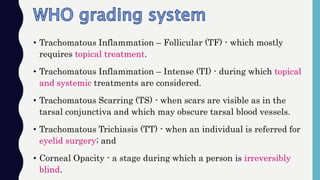
• Trachomatous Inflammation – Follicular (TF) - which mostly
requires topical treatment.
• Trachomatous Inflammation – Intense (TI) - during which topical
and systemic treatments are considered.
• Trachomatous Scarring (TS) - when scars are visible as in the
tarsal conjunctiva and which may obscure tarsal blood vessels.
• Trachomatous Trichiasis (TT) - when an individual is referred for
eyelid surgery; and
• Corneal Opacity - a stage during which a person is irreversibly
blind.
• Public health problem in 41 countries of Africa, Central and
South America, Asia, Australia and the Middle East
• Responsible for the irreversible blindness or visual
impairment of about 1.9 million people
• Causes about 1.4% of all blindness worldwide
• Economic cost from blindness and visual impairment is US$
2.9–5.3 billion annually, increasing to US$ 8 billion when
trichiasis is included
• Was most important cause of blindness in India in 1950s and over
50% population was affected in Gujarat, Rajasthan, Punjab, and
Uttar Pradesh.
• Estimated to be responsible for 0.2% of visual impairment and
blindness
• National Trachoma Survey Report (2014-17) - declared India free
from ‘infective trachoma’ - active trachoma infection eliminated
among children in all the survey districts with overall prevalence
of only 0.7%
• Disease pockets - north Indian states like Gujarat, Rajasthan,
Punjab, Haryana, Uttar Pradesh & Nicobar Islands
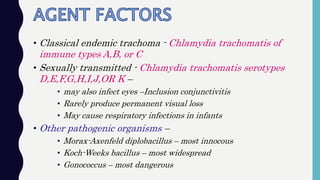
• Classical endemic trachoma - Chlamydia trachomatis of
immune types A,B, or C
• Sexually transmitted - Chlamydia trachomatis serotypes
D,E,F,G,H,I,J,OR K –
• may also infect eyes –Inclusion conjunctivitis
• Rarely produce permanent visual loss
• May cause respiratory infections in infants
• Other pathogenic organisms –
• Morax-Axenfeld diplobacillus – most innocous
• Koch-Weeks bacillus – most widespread
• Gonococcus – most dangerous
• Chlamydia trachomatis – obligatory intracellular bacteria
• Reservoir –
• children with active disease,
• chronically affected older children and adults
• Source of infection –
• ocular discharges of infected persons and
• fomites
• Communicability – low infectivity
• infective as long as active lesions are present in the conjunctiva
• AGE – children of 2-5 years are most
infected
–Endemic areas - children show
signs at age of only a few months
• SEX – prevalence equal in younger
age groups
–In older age groups – female
affected more
• Pre-disposing factors – direct
sunlight, dust, smoke, irritants like
kajal or surma
• Season – seasonal epidemics with more eye-seeking flies
–Higher temperature and rainfall favour increase in flies
–In India April – May and again during July – September
• Quality of Life – thrives in conditions of poverty, crowding,
ignorance, poor personal hygiene, illiteracy and poor housing
• Customs – applying kajal or surma
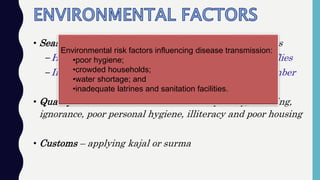
Environmental risk factors influencing disease transmission:
•poor hygiene;
•crowded households;
•water shortage; and
•inadequate latrines and sanitation facilities.
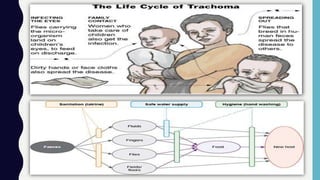
• In endemic communities – eye to eye transmission
–Direct or indirect contact with ocular discharges of
infected persons or fomites – fingers, towels, kajal, surma
–Mechanical transmission by eye-seeking flies - female
Musca sorbens / Musca domestica flies
• In areas with sporadic cases – venereal transmission
• Familial disease
• Incubation period - 5 to 12 days
• Assessment of problem
• Chemotherapy
–Mass treatment
–Selective treatment
• Surgical correction
• Surveillance
• Health education
• Evaluation
• Primary objective of programme for trachoma control is
prevention of blindness
• Focus on communities with high prevalence of ‘blinding
trachoma’ – indicated by –
• Corneal blindness
• Trachomatous trichiasis and entropion
• Moderate and severe Trachomatous inflammation
• Such communities have blindness rates of >0.5%
• Also required – information on local conditions and existing
resources
• Objective - reduce severity, lower incidence and thence
prevalence in long run
• Antibiotic of choice – 1% ophthalmic ointment or oily
suspension of tetracyclines
• Erythromycin and Rifampicin also used
• Treatment can be Mass or Selective
• Mass treatment
–Blanket treatment
–Prevalence of moderate or severe trachoma is >5% in
children under 10 years
–Application of 1% tetracycline ointment to all children
• Twice daily for 5 days each month for 6 consecutive
months, or
• Once daily for 10 days each month for 6 consecutive
months
–Erythromycin is alternative antibiotic
• Selective treatment
–In communities with low to medium prevalence
–Whole population at risk is screened – case finding
–Treatment is applied only to those with active problem
–Principles of treatment remaining same
• Individual with lid deformities –
–trichiasis and
–entropion
• Actively sought out
• Immediate impact in preventing blindness
• Once control of blinding trachoma is achieved
• Necessary for several years after active inflammatory
trachoma is controlled
• Whole family should be under surveillance
• Mothers of young children should be target
• Measures of personal and community hygiene
• Permanent change in behaviour patterns and in
environmental factors
• Final solution – improvement of living conditions and
quality of life
• Evaluated at frequent intervals
• Effect of intervention judged by –
–Age-specific rates of active trachoma
–Prevention of trichiasis and entropion
• WHO’s goal – eliminate trachoma as a public health problem
by the year 2020.
• Elimination of trachoma as a public-health problem is
defined as
–reduction in prevalence of trichiasis (TT) “unknown to the
health system” to less than 1 case per 1000 total
population
• (“known” cases are those in whom trichiasis has recurred after
surgery, those who refuse surgery, or those yet to undergo
surgery whose surgical date is set)
–reduction in the prevalence of the active trachoma sign
“TF” in children aged 1–9 years to less than 5%
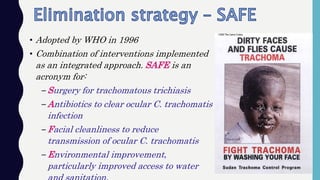
• Adopted by WHO in 1996
• Combination of interventions implemented
as an integrated approach. SAFE is an
acronym for:
– Surgery for trachomatous trichiasis
– Antibiotics to clear ocular C. trachomatis
infection
– Facial cleanliness to reduce
transmission of ocular C. trachomatis
– Environmental improvement,
particularly improved access to water
• In 1997, WHO launched the WHO Alliance for the Global
Elimination of Trachoma by the year 2020 – GET 2020
• Partnership which supports country implementation of the
SAFE strategy and the strengthening of national capacity
through epidemiological assessment, monitoring,
surveillance, project evaluation and resource mobilization
• ICTC- International Coalition of Trachoma Control
• NATIONAL TRACHOMA CONTROL PROGRAMME –
launched in 1963
• Incorporated with National Programme for Control of
Blindness in 1976
“Trachoma is no longer a public health problem in India. We have
met the goal of trachoma elimination as specified by the WHO
under its GET2020 programme. There is need for constant
surveillance by the states to report any fresh cases of trachoma and
trachoma sequelae and to treat them promptly to finally be
completely free of trachoma,”
J.P. Nadda, Union health minister
Trachoma

Trachoma

  • 1.
    D R .A M A N D E E P K A U R TRACHOMA
  • 2.
    • Chronic infectiousdisease of conjunctiva and cornea • Caused by Chlamydia trachomatis • May undergo spontaneous resolution or may progress to conjunctival scarring –Trichiasis –Entropion • Classified as – blinding or non-blinding Corneal ulceration Scarring and visual loss
  • 6.
    • Trachomatous Inflammation– Follicular (TF) - which mostly requires topical treatment. • Trachomatous Inflammation – Intense (TI) - during which topical and systemic treatments are considered. • Trachomatous Scarring (TS) - when scars are visible as in the tarsal conjunctiva and which may obscure tarsal blood vessels. • Trachomatous Trichiasis (TT) - when an individual is referred for eyelid surgery; and • Corneal Opacity - a stage during which a person is irreversibly blind.
  • 7.
    • Public healthproblem in 41 countries of Africa, Central and South America, Asia, Australia and the Middle East • Responsible for the irreversible blindness or visual impairment of about 1.9 million people • Causes about 1.4% of all blindness worldwide • Economic cost from blindness and visual impairment is US$ 2.9–5.3 billion annually, increasing to US$ 8 billion when trichiasis is included
  • 8.
    • Was mostimportant cause of blindness in India in 1950s and over 50% population was affected in Gujarat, Rajasthan, Punjab, and Uttar Pradesh. • Estimated to be responsible for 0.2% of visual impairment and blindness • National Trachoma Survey Report (2014-17) - declared India free from ‘infective trachoma’ - active trachoma infection eliminated among children in all the survey districts with overall prevalence of only 0.7% • Disease pockets - north Indian states like Gujarat, Rajasthan, Punjab, Haryana, Uttar Pradesh & Nicobar Islands
  • 10.
    • Classical endemictrachoma - Chlamydia trachomatis of immune types A,B, or C • Sexually transmitted - Chlamydia trachomatis serotypes D,E,F,G,H,I,J,OR K – • may also infect eyes –Inclusion conjunctivitis • Rarely produce permanent visual loss • May cause respiratory infections in infants • Other pathogenic organisms – • Morax-Axenfeld diplobacillus – most innocous • Koch-Weeks bacillus – most widespread • Gonococcus – most dangerous
  • 11.
    • Chlamydia trachomatis– obligatory intracellular bacteria • Reservoir – • children with active disease, • chronically affected older children and adults • Source of infection – • ocular discharges of infected persons and • fomites • Communicability – low infectivity • infective as long as active lesions are present in the conjunctiva
  • 12.
    • AGE –children of 2-5 years are most infected –Endemic areas - children show signs at age of only a few months • SEX – prevalence equal in younger age groups –In older age groups – female affected more • Pre-disposing factors – direct sunlight, dust, smoke, irritants like kajal or surma
  • 13.
    • Season –seasonal epidemics with more eye-seeking flies –Higher temperature and rainfall favour increase in flies –In India April – May and again during July – September • Quality of Life – thrives in conditions of poverty, crowding, ignorance, poor personal hygiene, illiteracy and poor housing • Customs – applying kajal or surma Environmental risk factors influencing disease transmission: •poor hygiene; •crowded households; •water shortage; and •inadequate latrines and sanitation facilities.
  • 14.
    • In endemiccommunities – eye to eye transmission –Direct or indirect contact with ocular discharges of infected persons or fomites – fingers, towels, kajal, surma –Mechanical transmission by eye-seeking flies - female Musca sorbens / Musca domestica flies • In areas with sporadic cases – venereal transmission • Familial disease • Incubation period - 5 to 12 days
  • 18.
    • Assessment ofproblem • Chemotherapy –Mass treatment –Selective treatment • Surgical correction • Surveillance • Health education • Evaluation
  • 19.
    • Primary objectiveof programme for trachoma control is prevention of blindness • Focus on communities with high prevalence of ‘blinding trachoma’ – indicated by – • Corneal blindness • Trachomatous trichiasis and entropion • Moderate and severe Trachomatous inflammation • Such communities have blindness rates of >0.5% • Also required – information on local conditions and existing resources
  • 20.
    • Objective -reduce severity, lower incidence and thence prevalence in long run • Antibiotic of choice – 1% ophthalmic ointment or oily suspension of tetracyclines • Erythromycin and Rifampicin also used • Treatment can be Mass or Selective
  • 21.
    • Mass treatment –Blankettreatment –Prevalence of moderate or severe trachoma is >5% in children under 10 years –Application of 1% tetracycline ointment to all children • Twice daily for 5 days each month for 6 consecutive months, or • Once daily for 10 days each month for 6 consecutive months –Erythromycin is alternative antibiotic
  • 22.
    • Selective treatment –Incommunities with low to medium prevalence –Whole population at risk is screened – case finding –Treatment is applied only to those with active problem –Principles of treatment remaining same
  • 23.
    • Individual withlid deformities – –trichiasis and –entropion • Actively sought out • Immediate impact in preventing blindness
  • 24.
    • Once controlof blinding trachoma is achieved • Necessary for several years after active inflammatory trachoma is controlled • Whole family should be under surveillance
  • 25.
    • Mothers ofyoung children should be target • Measures of personal and community hygiene • Permanent change in behaviour patterns and in environmental factors • Final solution – improvement of living conditions and quality of life
  • 26.
    • Evaluated atfrequent intervals • Effect of intervention judged by – –Age-specific rates of active trachoma –Prevention of trichiasis and entropion
  • 27.
    • WHO’s goal– eliminate trachoma as a public health problem by the year 2020. • Elimination of trachoma as a public-health problem is defined as –reduction in prevalence of trichiasis (TT) “unknown to the health system” to less than 1 case per 1000 total population • (“known” cases are those in whom trichiasis has recurred after surgery, those who refuse surgery, or those yet to undergo surgery whose surgical date is set) –reduction in the prevalence of the active trachoma sign “TF” in children aged 1–9 years to less than 5%
  • 28.
    • Adopted byWHO in 1996 • Combination of interventions implemented as an integrated approach. SAFE is an acronym for: – Surgery for trachomatous trichiasis – Antibiotics to clear ocular C. trachomatis infection – Facial cleanliness to reduce transmission of ocular C. trachomatis – Environmental improvement, particularly improved access to water
  • 30.
    • In 1997,WHO launched the WHO Alliance for the Global Elimination of Trachoma by the year 2020 – GET 2020 • Partnership which supports country implementation of the SAFE strategy and the strengthening of national capacity through epidemiological assessment, monitoring, surveillance, project evaluation and resource mobilization • ICTC- International Coalition of Trachoma Control
  • 31.
    • NATIONAL TRACHOMACONTROL PROGRAMME – launched in 1963 • Incorporated with National Programme for Control of Blindness in 1976 “Trachoma is no longer a public health problem in India. We have met the goal of trachoma elimination as specified by the WHO under its GET2020 programme. There is need for constant surveillance by the states to report any fresh cases of trachoma and trachoma sequelae and to treat them promptly to finally be completely free of trachoma,” J.P. Nadda, Union health minister

Editor's Notes

  • #8 Africa remains the most affected continent PREVENTABLE BLINDNESS
  • #9 It was the most important cause of corneal blindness in India, affecting young children WHO - active trachoma is considered eliminated if the prevalence of active infection among children below 10 yearsis less than 5%
  • #13 Females remain in contact with children more and are exposed to irritating factors like smoke more.
  • #15 female Musca sorbens flies, which are mechanical vectors of C. trachomatis, preferentially lay their eggs on human faeces left exposed on the soil Continuous feedback of infection partly as result of grandfathers, sisters, brothers tending small children
  • #22 Very difficult task Emphasis now on – active participation of community and utilization of primary health care workers – for wider coverage and greater efficacy of the programme
  • #28 TT – TRACHOMA AND TRACHOMA SEQUELAE TF -
  • #31 VISION 2020 - Target diseases: Cataract, Refractive Errors, Childhood Blindness, Glaucoma, Diabetic Retinopathy