Compressor is a machine used to compressed air or gas to a final pressure exceeding 241.25 KPa gage.
TYPES OF COMPRESSORS
 Centrifugal Compressors - For low pressure and high capacity application
 Rotary Compressors - For medium pressure and low capacity application
 Reciprocating Compressors - For high pressure and low capacity application
USES OF COMPRESSED AIR
 Operation of small engines
 Pneumatic tools
 Air hoists
 Industrial cleaning by air blast
 Tire inflation
 Paint Spraying
 Air lifting of liquids
 Manufacture of plastics and other industrial products
 To supply air in mine tunnels
 Other specialized industrial applications
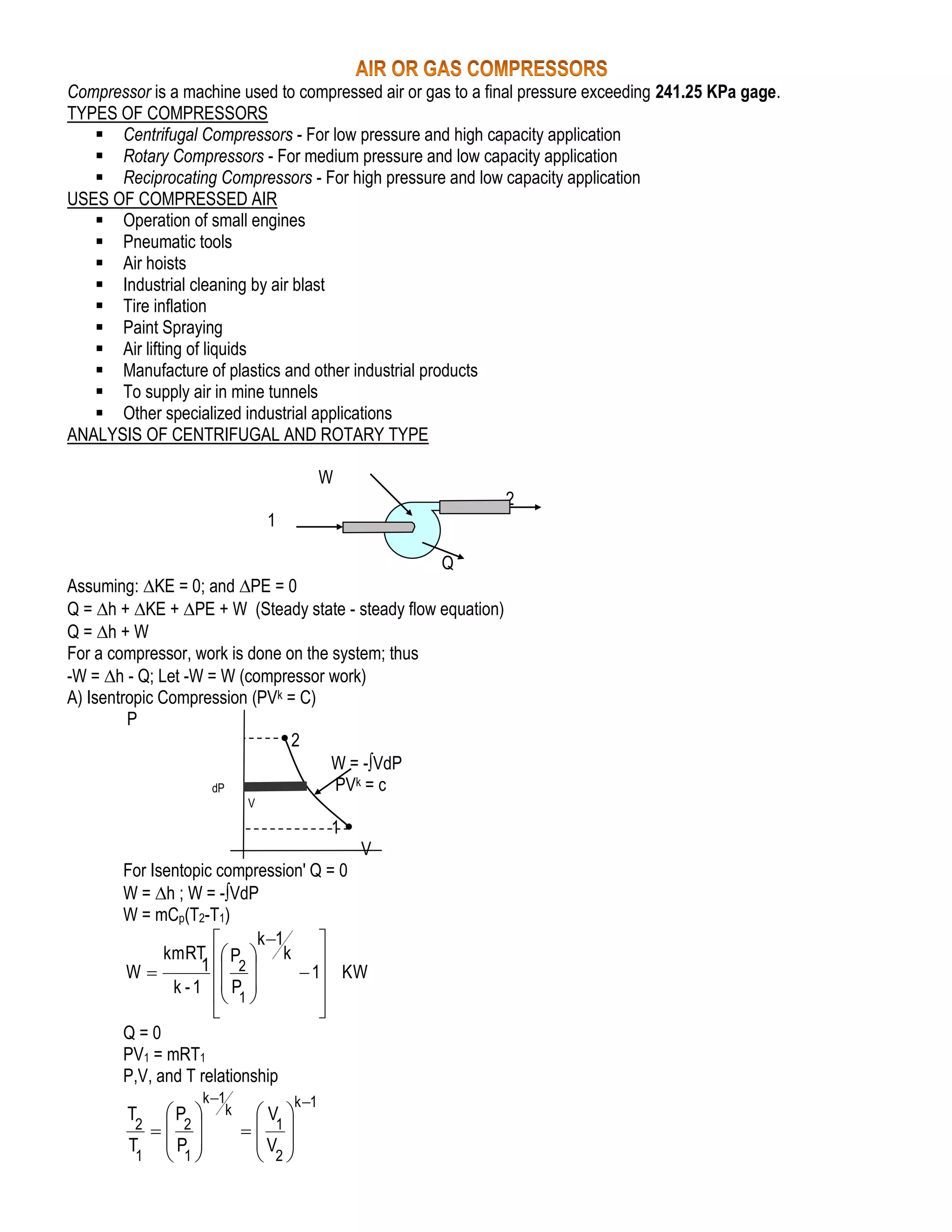
ANALYSIS OF CENTRIFUGAL AND ROTARY TYPE
W
2
1
Q
Assuming: KE = 0; and PE = 0
Q = h + KE + PE + W (Steady state - steady flow equation)
Q = h + W
For a compressor, work is done on the system; thus
-W = h - Q; Let -W = W (compressor work)
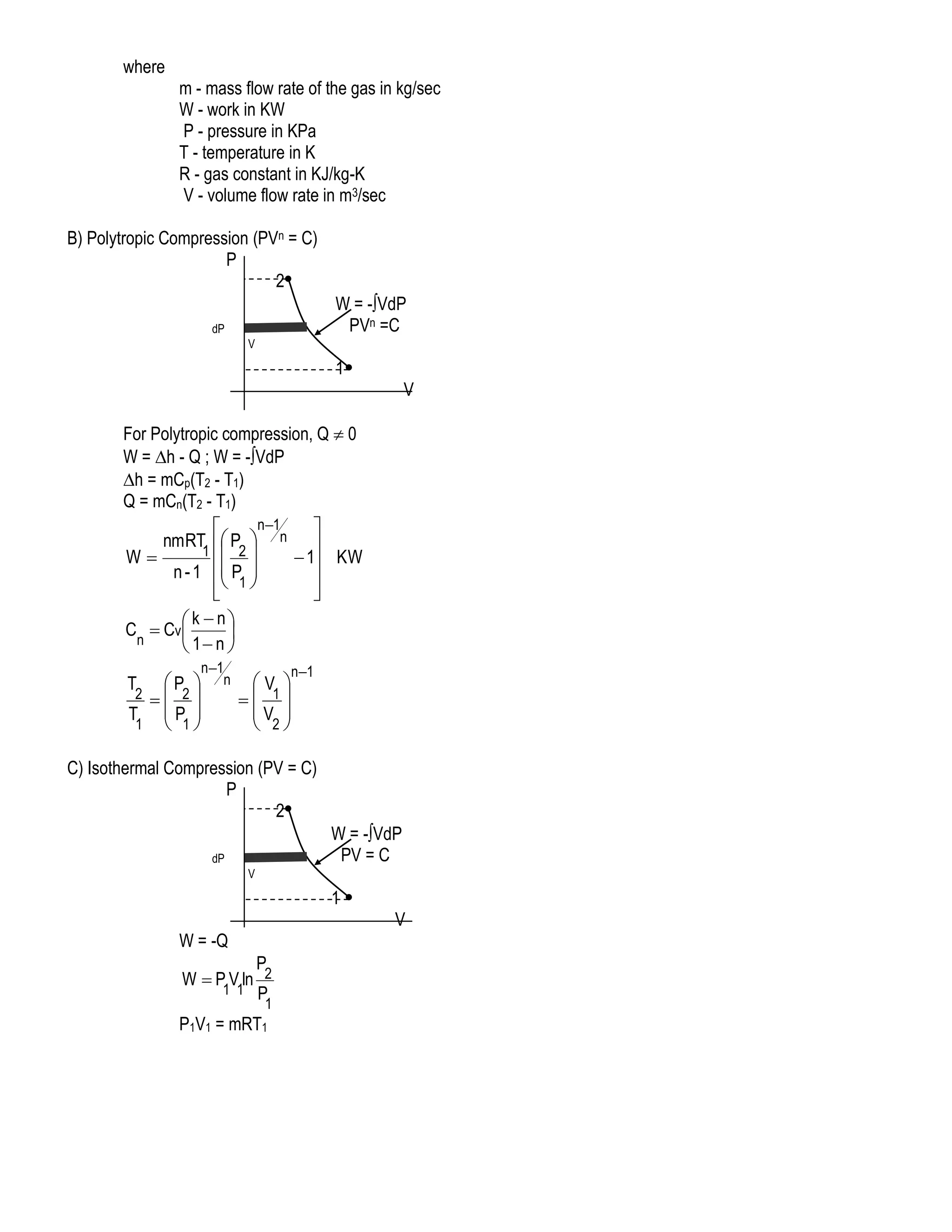
A) Isentropic Compression (PVk = C)
P
2
W = -VdP
PVk = c
dP
V

1
V
For Isentopic compression' Q = 0
W = h ; W = -VdP
W = mCp(T2-T1)
k 1


kmRT  P  k 
1  2
W
 1 KW

k - 1  P 

 1


Q=0
PV1 = mRT1
P,V, and T relationship
k 1
k

P 
2  2
T P 
1  1

T

k 1

V 
 1
V 
 2
where
m - mass flow rate of the gas in kg/sec
W - work in KW
P - pressure in KPa
T - temperature in K
R - gas constant in KJ/kg-K
V - volume flow rate in m3/sec
B) Polytropic Compression (PVn = C)
P
2
W = -VdP
PVn =C

dP
V

1
V
For Polytropic compression, Q  0
W = h - Q ; W = -VdP
h = mCp(T2 - T1)
Q = mCn(T2 - T1)
n1


nmRT  P  n 
1  2
W
 1 KW
n - 1  P 
 1 



 k  n
C  Cv

n
 1 n 
P 
2  2
T P 
1  1

T

n1
n

V 
 1
V 
 2

n1

C) Isothermal Compression (PV = C)
P
2
W = -VdP
PV = C

dP
V

1
V

W = -Q
P
W  P V ln 2
1 1 P

1

P1V1 = mRT1
valves

cylinder

piston

piston-rod
d

HE

P
P2
P1

CE

L
2

3

4

CVD

D

V1’

1
V

VD

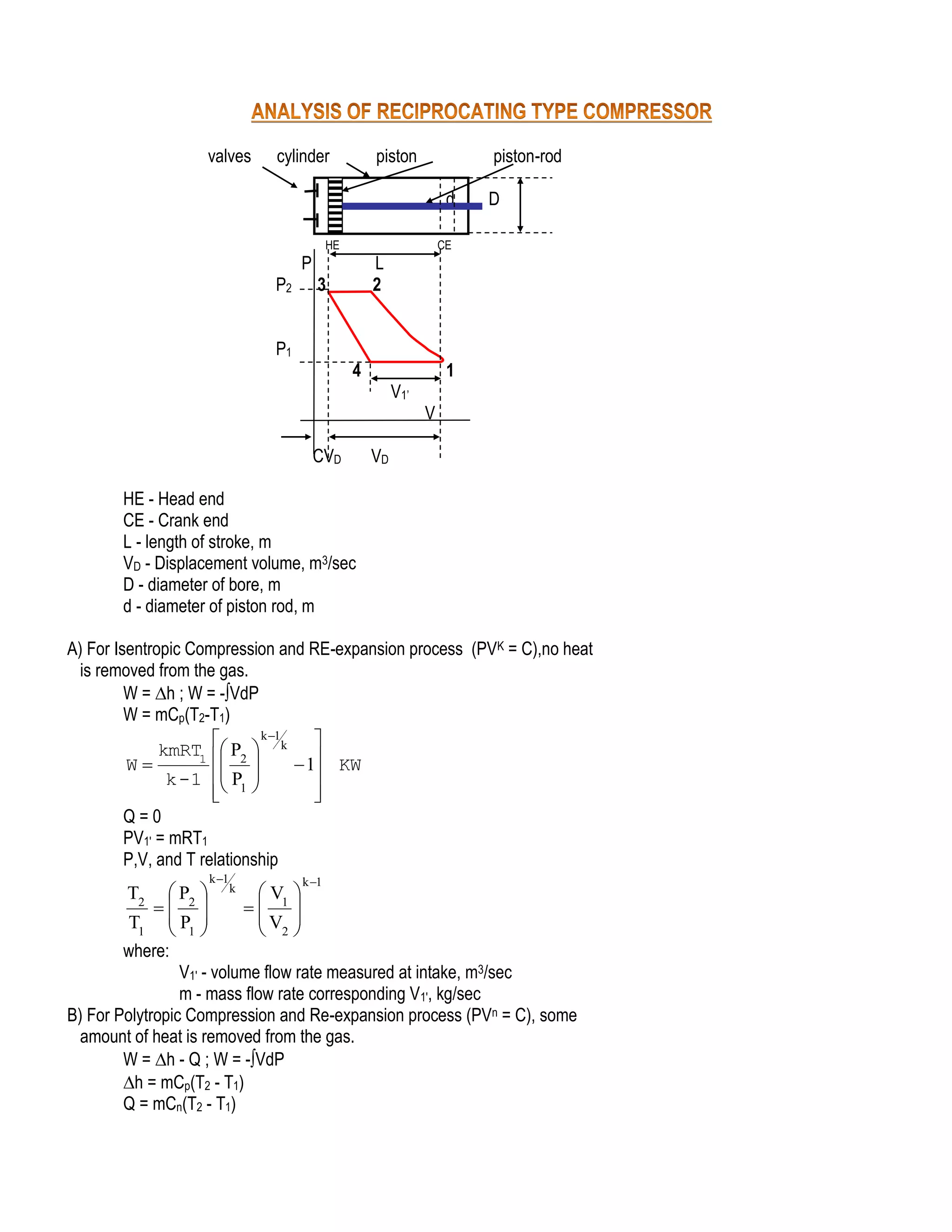
HE - Head end
CE - Crank end
L - length of stroke, m
VD - Displacement volume, m3/sec
D - diameter of bore, m
d - diameter of piston rod, m
A) For Isentropic Compression and RE-expansion process (PVK = C),no heat
is removed from the gas.
W = h ; W = -VdP
W = mCp(T2-T1)
k 1


kmRT1  P2  k 
 
W
 1 KW

k -1  P1 


 

Q=0
PV1' = mRT1
P,V, and T relationship
k 1

k 1

 P  k  V1 

 2 

V 
T1  P1 
 
 2
where:
V1' - volume flow rate measured at intake, m3/sec
m - mass flow rate corresponding V1', kg/sec
B) For Polytropic Compression and Re-expansion process (PVn = C), some
amount of heat is removed from the gas.
W = h - Q ; W = -VdP
h = mCp(T2 - T1)
Q = mCn(T2 - T1)
T2
n 1


nmRT1  P2  n 
 
W
 1 KW

n -1  P1 
 




P1V1' = mRT1
k  n 
Cn  Cv
 KJ/kg-K
1n 

n 1

n 1

 P  n  V1 

 2 

V 
T1  P1 
 
 2
C) For Isothermal compression and re-expansion process (PV = C), an
amount of heat equivalent to the compression work is removed from the
gas.
W = -Q
P
W  P1 V1'ln 2
P1
P1V1' = mRT1
T2

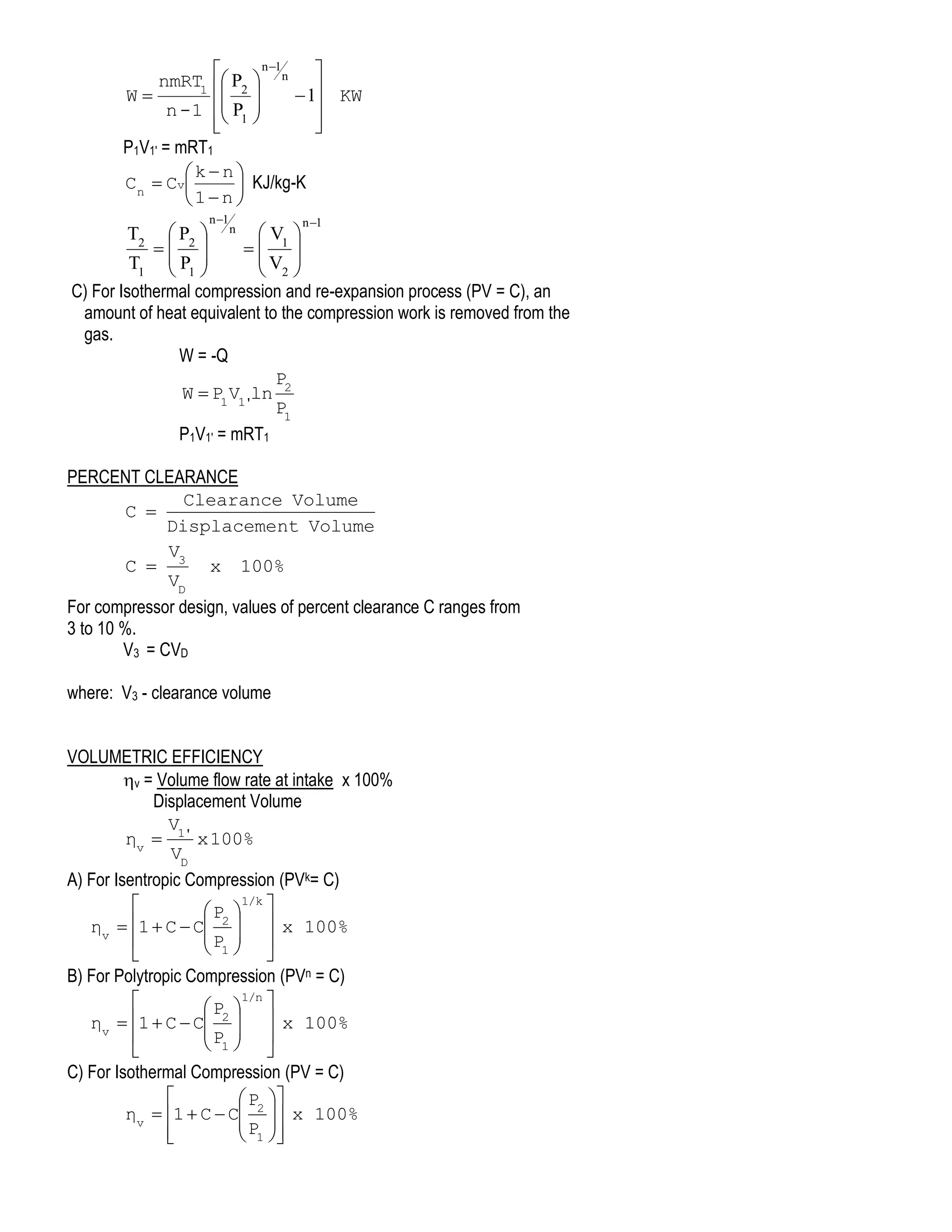
PERCENT CLEARANCE
Clearance Volume
C 
Displacement Volume
V
C  3 x 100%
VD
For compressor design, values of percent clearance C ranges from
3 to 10 %.
V3 = CVD
where: V3 - clearance volume
VOLUMETRIC EFFICIENCY
v = Volume flow rate at intake x 100%
Displacement Volume
V
ηv  1' x 100%
VD
A) For Isentropic Compression (PVk= C)
1/k

 P2  
ηv  1  C  C   x 100%
P  

 1 

B) For Polytropic Compression (PVn = C)
1/n

 P2  
ηv  1  C  C   x 100%
P  

 1 

C) For Isothermal Compression (PV = C)

 P 
ηv  1  C  C 2  x 100%
 P 

 1 

DISPLACEMENT VOLUME
A) For single acting
VD = LD2Nn' m3/sec
4(60)
B) For Double acting without considering the volume of piston rod
VD = 2LD2Nn' m3/sec
4(60)
C) For Double acting considering volume of piston rod
VD = LNn'[2D2 - d2] m3/sec
4(60)
where: L - length of stroke, m
D - diameter of bore, m
d - diameter of piston rod, m
n' - no. of cylinders
ACTUAL VOLUMETRIC EFFICIENCY
V
ηva  a x 100 %
VD
Va - actual volume of air or gas drawn in
MEAN EFFECTIVE PRESSURE
W
Pm 
KPa
VD
W in KJ, KJ/kg, KW
VD in m3, m3/kg, m3/sec
PISTON SPEED
PS = 2LN m/min
PS = 2LN m/sec
60
EFFICIENCY
A) COMPRESSION EFFICIENCY
cn = Ideal Work
x 100%
Indicated Work
B) MECHANICAL EFFICIENCY
m = Indicated Work x 100%
Brake Work
C) COMPRESSOR EFFICIENCY
c = cn = m = Ideal Work x 100%
Brake work
MULTISTAGE COMPRESSION
Multi staging is simply the compression of air or gas in two or more cylinders in place of a single cylinder compressor. It is
used in reciprocating compressors when pressure of 300 KPa and above are desired, in order to:
 Save power
 Limit the gas discharge temperature
 Limit the pressure differential per cylinder
 Prevent vaporization of lubricating oil and to prevent its ignition if the temperature becomes too high.
It is common practice for multi-staging to cool the air or gas between stages of compression in an intercooler, and it is this
cooling that affects considerable saving in power.
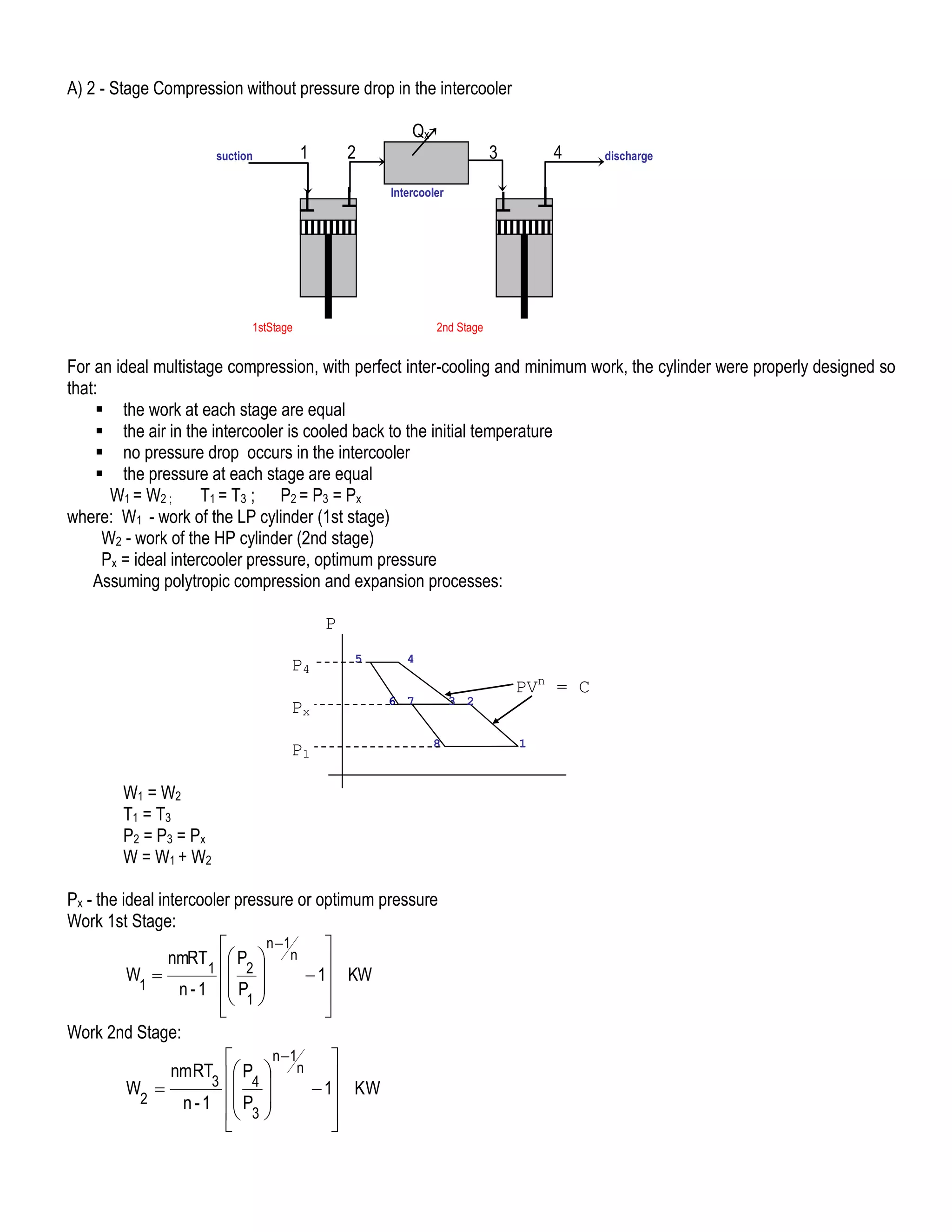
A) 2 - Stage Compression without pressure drop in the intercooler
1

suction

2

Qx

3

4

discharge

Intercooler

1stStage

2nd Stage

For an ideal multistage compression, with perfect inter-cooling and minimum work, the cylinder were properly designed so
that:
 the work at each stage are equal
 the air in the intercooler is cooled back to the initial temperature
 no pressure drop occurs in the intercooler
 the pressure at each stage are equal
W1 = W2 ;
T1 = T3 ; P2 = P3 = Px
where: W1 - work of the LP cylinder (1st stage)
W2 - work of the HP cylinder (2nd stage)
Px = ideal intercooler pressure, optimum pressure
Assuming polytropic compression and expansion processes:
P
P4
Px
P1

5

4
6 7

3 2
8

W1 = W2
T1 = T3
P2 = P3 = P x
W = W1 + W2
Px - the ideal intercooler pressure or optimum pressure
Work 1st Stage:
n 1


nmRT  P  n 
1  2
W 
 1 KW
1
n - 1  P 
 1 



Work 2nd Stage:
n 1


nmRT  P  n 
3  4
W 
 1 KW
2
n - 1  P 
 3 




PVn = C
1
Pressure Ratio:
P2 P4

P1 P3
but P2 = P3 = Px
Px P4

P1 Px
then
Px  P1P4

Since W1 =W2, the total work W is;
n1


2nmRT1  P2  n
 
W
 1
 P 

n -1  1 





KW

substituting Px to W, it follows that
n1


2nmRT1  P4  2n
 
W
 1
KW

n -1  P1 
 




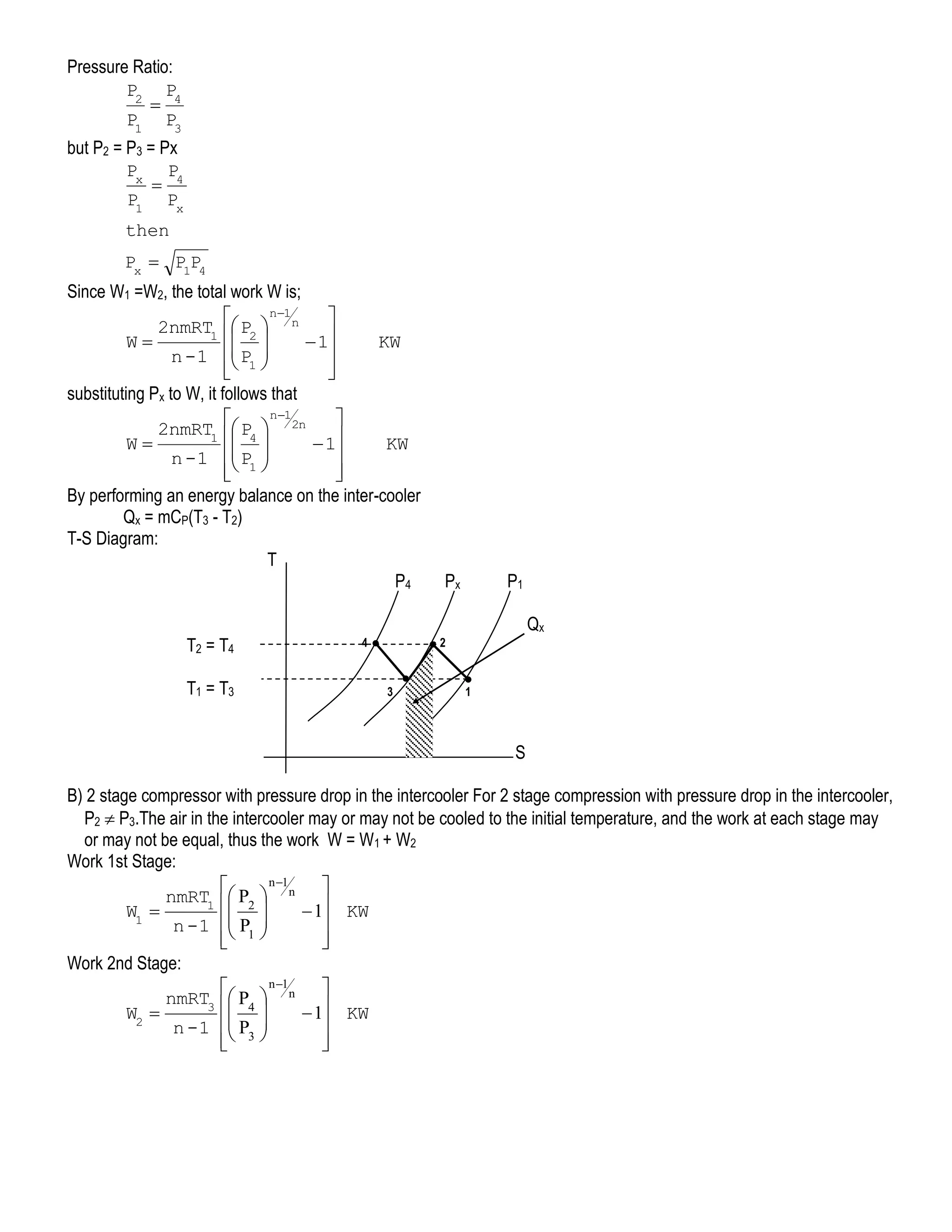
By performing an energy balance on the inter-cooler
Qx = mCP(T3 - T2)
T-S Diagram:
T
P4
T2 = T4
T1 = T3

Px

P1
Qx

4

2

3

1

S
B) 2 stage compressor with pressure drop in the intercooler For 2 stage compression with pressure drop in the intercooler,
P2  P3.The air in the intercooler may or may not be cooled to the initial temperature, and the work at each stage may
or may not be equal, thus the work W = W1 + W2
Work 1st Stage:
n 1


nmRT1  P2  n 
 
W1 
 1 KW

n -1  P1 
 




Work 2nd Stage:
n 1


nmRT3  P4  n 
 
W2 
 1 KW

n -1  P3 


 

The total work W is;
W = W1 + W2
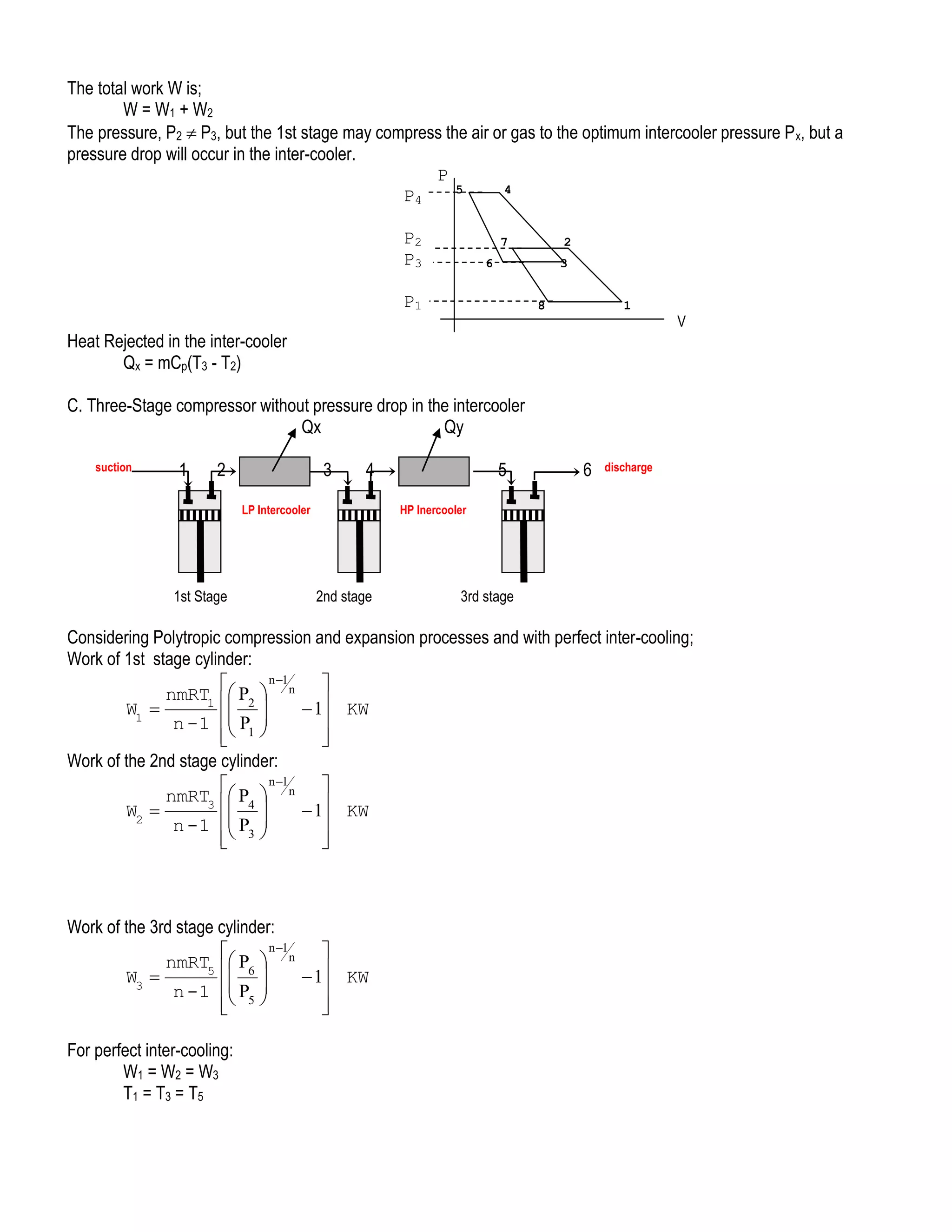
The pressure, P2  P3, but the 1st stage may compress the air or gas to the optimum intercooler pressure P x, but a
pressure drop will occur in the inter-cooler.
P
5
4
P4
P2
P3

7

2

6

3

P1

8

1

V

Heat Rejected in the inter-cooler
Qx = mCp(T3 - T2)
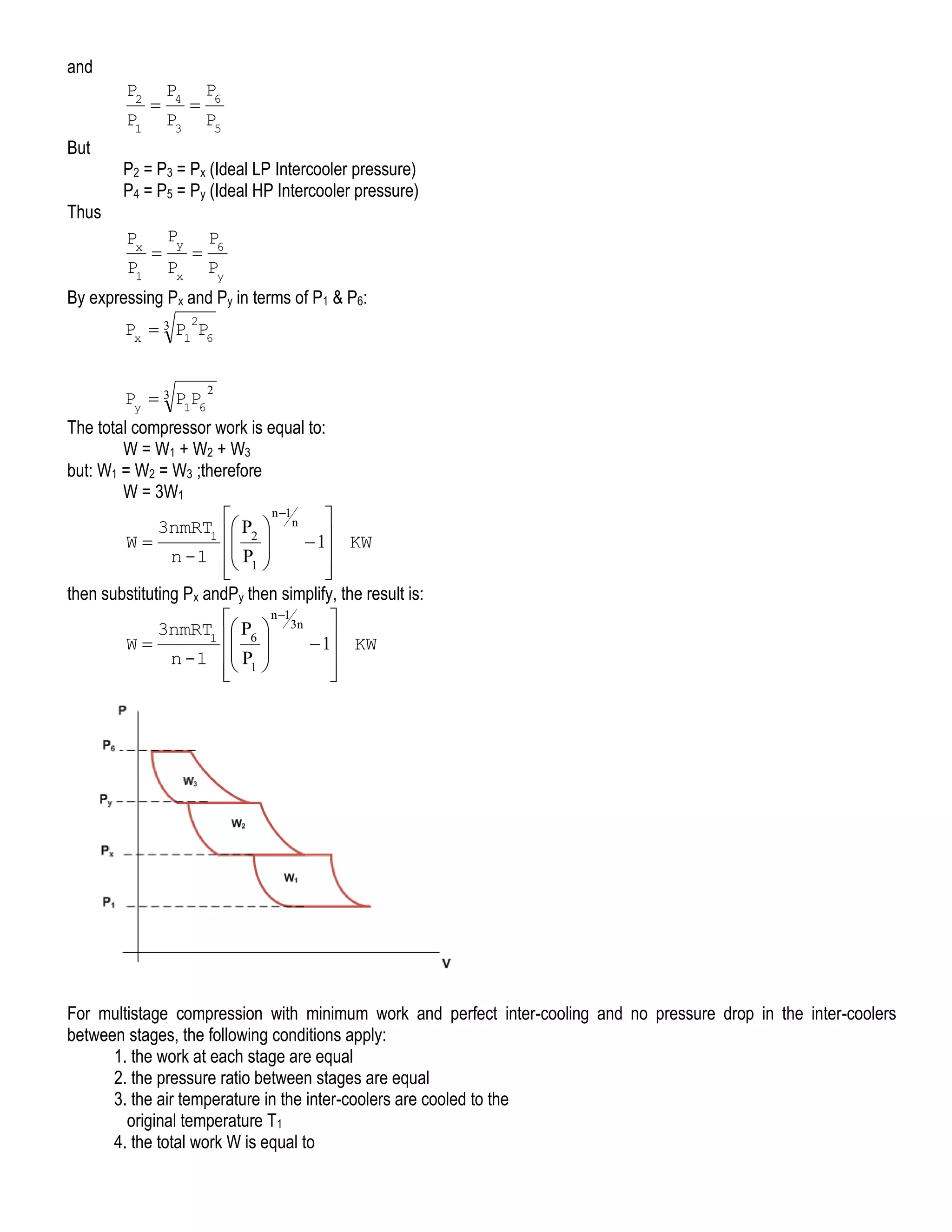
C. Three-Stage compressor without pressure drop in the intercooler
Qx
Qy
suction

1

2

3

4

LP Intercooler

1st Stage

5

6

discharge

HP Inercooler

2nd stage

3rd stage

Considering Polytropic compression and expansion processes and with perfect inter-cooling;
Work of 1st stage cylinder:
n 1


nmRT1  P2  n 
 
W1 
 1 KW

n -1  P1 


 

Work of the 2nd stage cylinder:
n 1


nmRT3  P4  n 
 
W2 
 1 KW

n -1  P3 
 





Work of the 3rd stage cylinder:
n 1


nmRT5  P6  n 
 
W3 
 1 KW

n - 1  P5 
 



For perfect inter-cooling:
W1 = W2 = W3
T1 = T3 = T5
and

P2
P1
But
Thus



P4
P3



P6
P5

P2 = P3 = Px (Ideal LP Intercooler pressure)
P4 = P5 = Py (Ideal HP Intercooler pressure)
Px
P1



Py
Px



P6
Py

By expressing Px and Py in terms of P1 & P6:
2

Px  3 P1 P6
Py  3 P1P6

2

The total compressor work is equal to:
W = W1 + W2 + W3
but: W1 = W2 = W3 ;therefore
W = 3W1
n 1


3nmRT1  P2  n 
 
W
 1 KW

n -1  P1 


 

then substituting Px andPy then simplify, the result is:
n 1


3nmRT1  P6  3n 
 
W
 1 KW

n -1  P1 
 





For multistage compression with minimum work and perfect inter-cooling and no pressure drop in the inter-coolers
between stages, the following conditions apply:
1. the work at each stage are equal
2. the pressure ratio between stages are equal
3. the air temperature in the inter-coolers are cooled to the
original temperature T1
4. the total work W is equal to
n 1


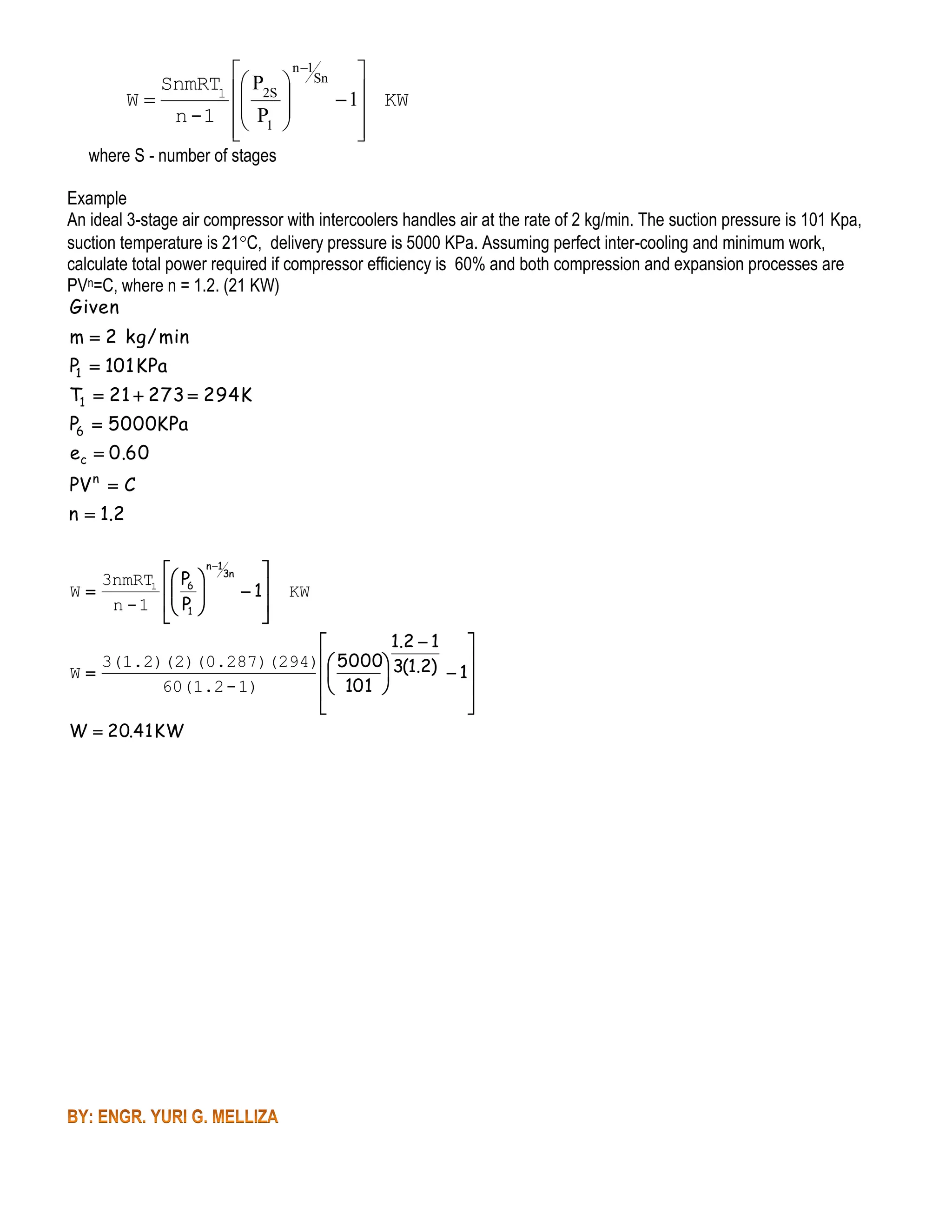
SnmRT1  P2S  Sn 


W
 1 KW

n -1  P1 







where S - number of stages

Example
An ideal 3-stage air compressor with intercoolers handles air at the rate of 2 kg/min. The suction pressure is 101 Kpa,
suction temperature is 21C, delivery pressure is 5000 KPa. Assuming perfect inter-cooling and minimum work,
calculate total power required if compressor efficiency is 60% and both compression and expansion processes are
PVn=C, where n = 1.2. (21 KW)
Given

m  2 kg / min
P1  101 KPa

T1  21  273  294 K
P6  5000KPa
ec  0.60

PV n  C
n  1 .2
3nmRT1
W
n -1

 P  n 13n

 6 
 1
 P1 

 


KW

1. 2  1



3(1.2)(2)(0.287)(294) 5000 3(1.2)
W
 1


60(1.2 - 1)
 101 



W  20.41 KW

LECTURE Notes on compressor

  • 1.
    Compressor is amachine used to compressed air or gas to a final pressure exceeding 241.25 KPa gage. TYPES OF COMPRESSORS  Centrifugal Compressors - For low pressure and high capacity application  Rotary Compressors - For medium pressure and low capacity application  Reciprocating Compressors - For high pressure and low capacity application USES OF COMPRESSED AIR  Operation of small engines  Pneumatic tools  Air hoists  Industrial cleaning by air blast  Tire inflation  Paint Spraying  Air lifting of liquids  Manufacture of plastics and other industrial products  To supply air in mine tunnels  Other specialized industrial applications ANALYSIS OF CENTRIFUGAL AND ROTARY TYPE W 2 1 Q Assuming: KE = 0; and PE = 0 Q = h + KE + PE + W (Steady state - steady flow equation) Q = h + W For a compressor, work is done on the system; thus -W = h - Q; Let -W = W (compressor work) A) Isentropic Compression (PVk = C) P 2 W = -VdP PVk = c dP V 1 V For Isentopic compression' Q = 0 W = h ; W = -VdP W = mCp(T2-T1) k 1   kmRT  P  k  1  2 W  1 KW  k - 1  P    1   Q=0 PV1 = mRT1 P,V, and T relationship k 1 k P  2  2 T P  1  1 T k 1 V   1 V   2
  • 2.
    where m - massflow rate of the gas in kg/sec W - work in KW P - pressure in KPa T - temperature in K R - gas constant in KJ/kg-K V - volume flow rate in m3/sec B) Polytropic Compression (PVn = C) P 2 W = -VdP PVn =C dP V 1 V For Polytropic compression, Q  0 W = h - Q ; W = -VdP h = mCp(T2 - T1) Q = mCn(T2 - T1) n1   nmRT  P  n  1  2 W  1 KW n - 1  P   1      k  n C  Cv  n  1 n  P  2  2 T P  1  1 T n1 n V   1 V   2 n1 C) Isothermal Compression (PV = C) P 2 W = -VdP PV = C dP V 1 V W = -Q P W  P V ln 2 1 1 P 1 P1V1 = mRT1
  • 3.
    valves cylinder piston piston-rod d HE P P2 P1 CE L 2 3 4 CVD D V1’ 1 V VD HE - Headend CE - Crank end L - length of stroke, m VD - Displacement volume, m3/sec D - diameter of bore, m d - diameter of piston rod, m A) For Isentropic Compression and RE-expansion process (PVK = C),no heat is removed from the gas. W = h ; W = -VdP W = mCp(T2-T1) k 1   kmRT1  P2  k    W  1 KW  k -1  P1       Q=0 PV1' = mRT1 P,V, and T relationship k 1 k 1  P  k  V1    2   V  T1  P1     2 where: V1' - volume flow rate measured at intake, m3/sec m - mass flow rate corresponding V1', kg/sec B) For Polytropic Compression and Re-expansion process (PVn = C), some amount of heat is removed from the gas. W = h - Q ; W = -VdP h = mCp(T2 - T1) Q = mCn(T2 - T1) T2
  • 4.
    n 1   nmRT1 P2  n    W  1 KW  n -1  P1        P1V1' = mRT1 k  n  Cn  Cv  KJ/kg-K 1n  n 1 n 1  P  n  V1    2   V  T1  P1     2 C) For Isothermal compression and re-expansion process (PV = C), an amount of heat equivalent to the compression work is removed from the gas. W = -Q P W  P1 V1'ln 2 P1 P1V1' = mRT1 T2 PERCENT CLEARANCE Clearance Volume C  Displacement Volume V C  3 x 100% VD For compressor design, values of percent clearance C ranges from 3 to 10 %. V3 = CVD where: V3 - clearance volume VOLUMETRIC EFFICIENCY v = Volume flow rate at intake x 100% Displacement Volume V ηv  1' x 100% VD A) For Isentropic Compression (PVk= C) 1/k   P2   ηv  1  C  C   x 100% P     1   B) For Polytropic Compression (PVn = C) 1/n   P2   ηv  1  C  C   x 100% P     1   C) For Isothermal Compression (PV = C)   P  ηv  1  C  C 2  x 100%  P    1  
  • 5.
    DISPLACEMENT VOLUME A) Forsingle acting VD = LD2Nn' m3/sec 4(60) B) For Double acting without considering the volume of piston rod VD = 2LD2Nn' m3/sec 4(60) C) For Double acting considering volume of piston rod VD = LNn'[2D2 - d2] m3/sec 4(60) where: L - length of stroke, m D - diameter of bore, m d - diameter of piston rod, m n' - no. of cylinders ACTUAL VOLUMETRIC EFFICIENCY V ηva  a x 100 % VD Va - actual volume of air or gas drawn in MEAN EFFECTIVE PRESSURE W Pm  KPa VD W in KJ, KJ/kg, KW VD in m3, m3/kg, m3/sec PISTON SPEED PS = 2LN m/min PS = 2LN m/sec 60 EFFICIENCY A) COMPRESSION EFFICIENCY cn = Ideal Work x 100% Indicated Work B) MECHANICAL EFFICIENCY m = Indicated Work x 100% Brake Work C) COMPRESSOR EFFICIENCY c = cn = m = Ideal Work x 100% Brake work MULTISTAGE COMPRESSION Multi staging is simply the compression of air or gas in two or more cylinders in place of a single cylinder compressor. It is used in reciprocating compressors when pressure of 300 KPa and above are desired, in order to:  Save power  Limit the gas discharge temperature  Limit the pressure differential per cylinder  Prevent vaporization of lubricating oil and to prevent its ignition if the temperature becomes too high. It is common practice for multi-staging to cool the air or gas between stages of compression in an intercooler, and it is this cooling that affects considerable saving in power.
  • 6.
    A) 2 -Stage Compression without pressure drop in the intercooler 1 suction 2 Qx 3 4 discharge Intercooler 1stStage 2nd Stage For an ideal multistage compression, with perfect inter-cooling and minimum work, the cylinder were properly designed so that:  the work at each stage are equal  the air in the intercooler is cooled back to the initial temperature  no pressure drop occurs in the intercooler  the pressure at each stage are equal W1 = W2 ; T1 = T3 ; P2 = P3 = Px where: W1 - work of the LP cylinder (1st stage) W2 - work of the HP cylinder (2nd stage) Px = ideal intercooler pressure, optimum pressure Assuming polytropic compression and expansion processes: P P4 Px P1 5 4 6 7 3 2 8 W1 = W2 T1 = T3 P2 = P3 = P x W = W1 + W2 Px - the ideal intercooler pressure or optimum pressure Work 1st Stage: n 1   nmRT  P  n  1  2 W   1 KW 1 n - 1  P   1     Work 2nd Stage: n 1   nmRT  P  n  3  4 W   1 KW 2 n - 1  P   3     PVn = C 1
  • 7.
    Pressure Ratio: P2 P4  P1P3 but P2 = P3 = Px Px P4  P1 Px then Px  P1P4 Since W1 =W2, the total work W is; n1   2nmRT1  P2  n   W  1  P   n -1  1      KW substituting Px to W, it follows that n1   2nmRT1  P4  2n   W  1 KW  n -1  P1        By performing an energy balance on the inter-cooler Qx = mCP(T3 - T2) T-S Diagram: T P4 T2 = T4 T1 = T3 Px P1 Qx 4 2 3 1 S B) 2 stage compressor with pressure drop in the intercooler For 2 stage compression with pressure drop in the intercooler, P2  P3.The air in the intercooler may or may not be cooled to the initial temperature, and the work at each stage may or may not be equal, thus the work W = W1 + W2 Work 1st Stage: n 1   nmRT1  P2  n    W1   1 KW  n -1  P1        Work 2nd Stage: n 1   nmRT3  P4  n    W2   1 KW  n -1  P3      
  • 8.
    The total workW is; W = W1 + W2 The pressure, P2  P3, but the 1st stage may compress the air or gas to the optimum intercooler pressure P x, but a pressure drop will occur in the inter-cooler. P 5 4 P4 P2 P3 7 2 6 3 P1 8 1 V Heat Rejected in the inter-cooler Qx = mCp(T3 - T2) C. Three-Stage compressor without pressure drop in the intercooler Qx Qy suction 1 2 3 4 LP Intercooler 1st Stage 5 6 discharge HP Inercooler 2nd stage 3rd stage Considering Polytropic compression and expansion processes and with perfect inter-cooling; Work of 1st stage cylinder: n 1   nmRT1  P2  n    W1   1 KW  n -1  P1       Work of the 2nd stage cylinder: n 1   nmRT3  P4  n    W2   1 KW  n -1  P3        Work of the 3rd stage cylinder: n 1   nmRT5  P6  n    W3   1 KW  n - 1  P5       For perfect inter-cooling: W1 = W2 = W3 T1 = T3 = T5
  • 9.
    and P2 P1 But Thus  P4 P3  P6 P5 P2 = P3= Px (Ideal LP Intercooler pressure) P4 = P5 = Py (Ideal HP Intercooler pressure) Px P1  Py Px  P6 Py By expressing Px and Py in terms of P1 & P6: 2 Px  3 P1 P6 Py  3 P1P6 2 The total compressor work is equal to: W = W1 + W2 + W3 but: W1 = W2 = W3 ;therefore W = 3W1 n 1   3nmRT1  P2  n    W  1 KW  n -1  P1       then substituting Px andPy then simplify, the result is: n 1   3nmRT1  P6  3n    W  1 KW  n -1  P1        For multistage compression with minimum work and perfect inter-cooling and no pressure drop in the inter-coolers between stages, the following conditions apply: 1. the work at each stage are equal 2. the pressure ratio between stages are equal 3. the air temperature in the inter-coolers are cooled to the original temperature T1 4. the total work W is equal to
  • 10.
    n 1   SnmRT1 P2S  Sn    W  1 KW  n -1  P1        where S - number of stages Example An ideal 3-stage air compressor with intercoolers handles air at the rate of 2 kg/min. The suction pressure is 101 Kpa, suction temperature is 21C, delivery pressure is 5000 KPa. Assuming perfect inter-cooling and minimum work, calculate total power required if compressor efficiency is 60% and both compression and expansion processes are PVn=C, where n = 1.2. (21 KW) Given m  2 kg / min P1  101 KPa T1  21  273  294 K P6  5000KPa ec  0.60 PV n  C n  1 .2 3nmRT1 W n -1  P  n 13n   6   1  P1      KW 1. 2  1    3(1.2)(2)(0.287)(294) 5000 3(1.2) W  1   60(1.2 - 1)  101     W  20.41 KW