LECTURE UNIT NO. 10
Compressors
Compressors are machines in which mechanical work is done on a flowing fluid, raising its pressure.
General Types of Gas Compressors
   1. Reciprocating Compressors – for high pressure and low volume flow rate.
   2. Rotative compressor – for low pressure and high volume flow rate.
          a. Centrifugal Compressor
          b. Rotary Compressor
Application of compressed air
   1. Driving and starting engines (diesel and gas turbines)
   2. Driving pneumatic tools
   3. Spraying paints
   4. Cleaning by air blast (Sandblasting)
   5. Operating air hoist
   6. Pump water by air lift
   7. Air supply/ventilation in mine tunnel
   8. Food processing
   9. Liquefying gases
   10. Conveying materials
   11. Refrigeration
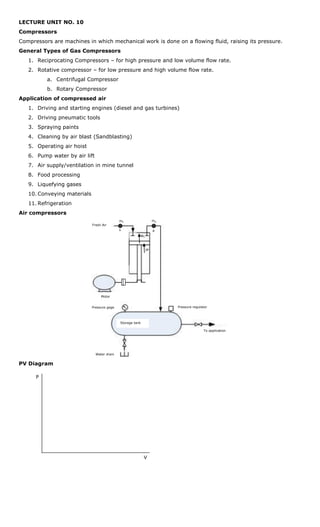
Air compressors
                                             ma                   ma
                             Fresh Air
                                             s                    d
                                                        Wc


                                                             IP


                                  Motor


                             Pressure gage                             Pressure regulator


                                             Storage tank

                                                                                      To application


                               Water drain


PV Diagram

      P


                                                            V
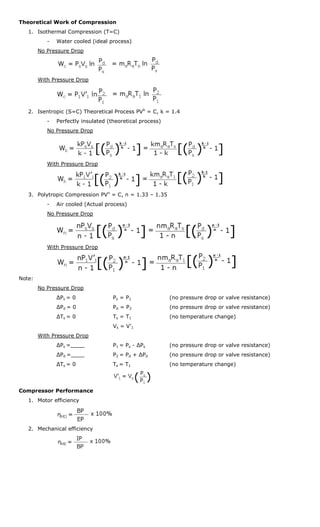
Theoretical Work of Compression
   1. Isothermal Compression (T=C)
           -   Water cooled (ideal process)
        No Pressure Drop


        With Pressure Drop


   2. Isentropic (S=C) Theoretical Process PVk = C, k = 1.4
           -   Perfectly insulated (theoretical process)
           No Pressure Drop


           With Pressure Drop


   3. Polytropic Compression PVn = C, n = 1.33 – 1.35
           -   Air cooled (Actual process)
           No Pressure Drop


           With Pressure Drop


Note:
        No Pressure Drop
               ΔPs = 0               Ps = P1               (no pressure drop or valve resistance)
               ΔPd = 0               Pd = P2               (no pressure drop or valve resistance)
               ΔTs = 0               Ts = T1               (no temperature change)
                                     Vs = V’1
        With Pressure Drop
               ΔPs =                 P1 = Ps - ΔPs         (no pressure drop or valve resistance)
               ΔPd =                 P2 = Pd + ΔPd         (no pressure drop or valve resistance)
               ΔTs = 0               Ts = T1               (no temperature change)


Compressor Performance
   1. Motor efficiency


   2. Mechanical efficiency
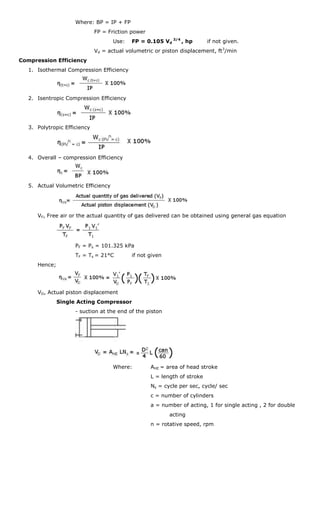
Where: BP = IP + FP
                              FP = Friction power
                                     Use:   FP = 0.105 Vd 3/4 , hp         if not given.
                              Vd = actual volumetric or piston displacement, ft3/min
Compression Efficiency
   1. Isothermal Compression Efficiency


   2. Isentropic Compression Efficiency


   3. Polytropic Efficiency


   4. Overall – compression Efficiency


   5. Actual Volumetric Efficiency


      VF, Free air or the actual quantity of gas delivered can be obtained using general gas equation


                     PF = Ps = 101.325 kPa
                     TF = Ts = 21°C         if not given
      Hence;


      VD, Actual piston displacement
               Single Acting Compressor
                     - suction at the end of the piston


                                     Where:         AHE = area of head stroke
                                                    L = length of stroke
                                                    Ns = cycle per sec, cycle/ sec
                                                    c = number of cylinders
                                                    a = number of acting, 1 for single acting , 2 for double
                                                           acting
                                                    n = rotative speed, rpm
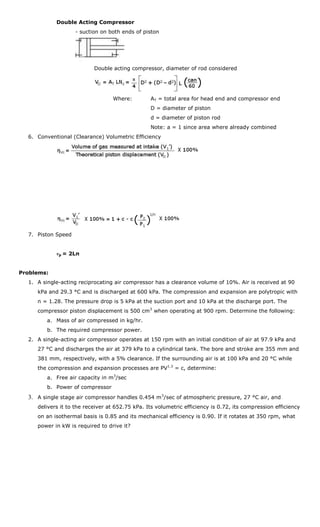
Double Acting Compressor
                    - suction on both ends of piston


                           Double acting compressor, diameter of rod considered


                                  Where:         AT = total area for head end and compressor end
                                                 D = diameter of piston
                                                 d = diameter of piston rod
                                                 Note: a = 1 since area where already combined
  6. Conventional (Clearance) Volumetric Efficiency


  7. Piston Speed


            vp = 2Ln


Problems:
  1. A single-acting reciprocating air compressor has a clearance volume of 10%. Air is received at 90
     kPa and 29.3 °C and is discharged at 600 kPa. The compression and expansion are polytropic with
     n = 1.28. The pressure drop is 5 kPa at the suction port and 10 kPa at the discharge port. The
     compressor piston displacement is 500 cm3 when operating at 900 rpm. Determine the following:
         a. Mass of air compressed in kg/hr.
         b. The required compressor power.
  2. A single-acting air compressor operates at 150 rpm with an initial condition of air at 97.9 kPa and
     27 °C and discharges the air at 379 kPa to a cylindrical tank. The bore and stroke are 355 mm and
     381 mm, respectively, with a 5% clearance. If the surrounding air is at 100 kPa and 20 °C while
     the compression and expansion processes are PV1.3 = c, determine:
         a. Free air capacity in m3/sec
         b. Power of compressor
  3. A single stage air compressor handles 0.454 m 3/sec of atmospheric pressure, 27 °C air, and
     delivers it to the receiver at 652.75 kPa. Its volumetric efficiency is 0.72, its compression efficiency
     on an isothermal basis is 0.85 and its mechanical efficiency is 0.90. If it rotates at 350 rpm, what
     power in kW is required to drive it?

010

  • 1.
    LECTURE UNIT NO.10 Compressors Compressors are machines in which mechanical work is done on a flowing fluid, raising its pressure. General Types of Gas Compressors 1. Reciprocating Compressors – for high pressure and low volume flow rate. 2. Rotative compressor – for low pressure and high volume flow rate. a. Centrifugal Compressor b. Rotary Compressor Application of compressed air 1. Driving and starting engines (diesel and gas turbines) 2. Driving pneumatic tools 3. Spraying paints 4. Cleaning by air blast (Sandblasting) 5. Operating air hoist 6. Pump water by air lift 7. Air supply/ventilation in mine tunnel 8. Food processing 9. Liquefying gases 10. Conveying materials 11. Refrigeration Air compressors ma ma Fresh Air s d Wc IP Motor Pressure gage Pressure regulator Storage tank To application Water drain PV Diagram P V
  • 2.
    Theoretical Work ofCompression 1. Isothermal Compression (T=C) - Water cooled (ideal process) No Pressure Drop With Pressure Drop 2. Isentropic (S=C) Theoretical Process PVk = C, k = 1.4 - Perfectly insulated (theoretical process) No Pressure Drop With Pressure Drop 3. Polytropic Compression PVn = C, n = 1.33 – 1.35 - Air cooled (Actual process) No Pressure Drop With Pressure Drop Note: No Pressure Drop ΔPs = 0 Ps = P1 (no pressure drop or valve resistance) ΔPd = 0 Pd = P2 (no pressure drop or valve resistance) ΔTs = 0 Ts = T1 (no temperature change) Vs = V’1 With Pressure Drop ΔPs = P1 = Ps - ΔPs (no pressure drop or valve resistance) ΔPd = P2 = Pd + ΔPd (no pressure drop or valve resistance) ΔTs = 0 Ts = T1 (no temperature change) Compressor Performance 1. Motor efficiency 2. Mechanical efficiency
  • 3.
    Where: BP =IP + FP FP = Friction power Use: FP = 0.105 Vd 3/4 , hp if not given. Vd = actual volumetric or piston displacement, ft3/min Compression Efficiency 1. Isothermal Compression Efficiency 2. Isentropic Compression Efficiency 3. Polytropic Efficiency 4. Overall – compression Efficiency 5. Actual Volumetric Efficiency VF, Free air or the actual quantity of gas delivered can be obtained using general gas equation PF = Ps = 101.325 kPa TF = Ts = 21°C if not given Hence; VD, Actual piston displacement Single Acting Compressor - suction at the end of the piston Where: AHE = area of head stroke L = length of stroke Ns = cycle per sec, cycle/ sec c = number of cylinders a = number of acting, 1 for single acting , 2 for double acting n = rotative speed, rpm
  • 4.
    Double Acting Compressor - suction on both ends of piston Double acting compressor, diameter of rod considered Where: AT = total area for head end and compressor end D = diameter of piston d = diameter of piston rod Note: a = 1 since area where already combined 6. Conventional (Clearance) Volumetric Efficiency 7. Piston Speed vp = 2Ln Problems: 1. A single-acting reciprocating air compressor has a clearance volume of 10%. Air is received at 90 kPa and 29.3 °C and is discharged at 600 kPa. The compression and expansion are polytropic with n = 1.28. The pressure drop is 5 kPa at the suction port and 10 kPa at the discharge port. The compressor piston displacement is 500 cm3 when operating at 900 rpm. Determine the following: a. Mass of air compressed in kg/hr. b. The required compressor power. 2. A single-acting air compressor operates at 150 rpm with an initial condition of air at 97.9 kPa and 27 °C and discharges the air at 379 kPa to a cylindrical tank. The bore and stroke are 355 mm and 381 mm, respectively, with a 5% clearance. If the surrounding air is at 100 kPa and 20 °C while the compression and expansion processes are PV1.3 = c, determine: a. Free air capacity in m3/sec b. Power of compressor 3. A single stage air compressor handles 0.454 m 3/sec of atmospheric pressure, 27 °C air, and delivers it to the receiver at 652.75 kPa. Its volumetric efficiency is 0.72, its compression efficiency on an isothermal basis is 0.85 and its mechanical efficiency is 0.90. If it rotates at 350 rpm, what power in kW is required to drive it?