Rankine Cycle.
A presentation by : PRAKHER SINGH
Working principle of vapour power
cycle.
Subject : Applied thermodynamics.
Roll no. : 10 (2011058)
Submitted to : Mechanical deptt.
Who was Rankine ?
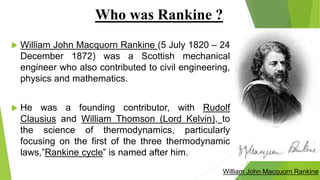
 William John Macquorn Rankine (5 July 1820 – 24
December 1872) was a Scottish mechanical
engineer who also contributed to civil engineering,
physics and mathematics.
 He was a founding contributor, with Rudolf
Clausius and William Thomson (Lord Kelvin), to
the science of thermodynamics, particularly
focusing on the first of the three thermodynamic
laws,”Rankine cycle” is named after him.
William John Macquorn Rankine
What is Rankine Cycle?
 The Rankine cycle is a model that is used to predict
the performance or efficiency of steam turbine
systems. It closely describes the process by which
steam-operated heat engines commonly found in
thermal power plants generate power. The heat is
supplied externally to a closed loop, which usually
uses water as the working fluid.
 It is the “ideal cycle” for vapour power plants and
does not involves any internal irreversibility.
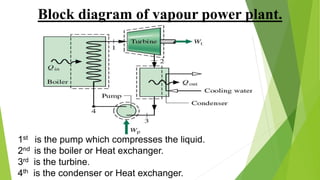
Block diagram of vapour power plant.
1st is the pump which compresses the liquid.
2nd is the boiler or Heat exchanger.
3rd is the turbine.
4th is the condenser or Heat exchanger.
Processes involved in Rankine cycle.
 Processes :-
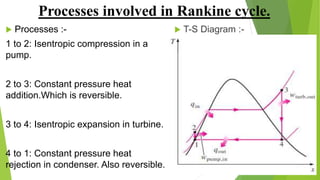
1 to 2: Isentropic compression in a
pump.
2 to 3: Constant pressure heat
addition.Which is reversible.
3 to 4: Isentropic expansion in turbine.
4 to 1: Constant pressure heat
rejection in condenser. Also reversible.
 T-S Diagram :-
 At state-1 water enters the pump as a saturated
liquid and is compressed isentropically to the
operating pressure of the boiler.
 At state-2 water enters the boiler as
compreesed liquid and leaves as a saturated
vapor at state-3.
 At state-4 superheated vapour enters the
turbine where it expands isentropically and
produces work by rotating the shaft connected
to an electric generator.
The pressure and temperature of steam drops
during this process to state-4,where it enters the
condenser.
 Steam is condensed at constant pressure in
condenser and leaves it as a saturated liquid.
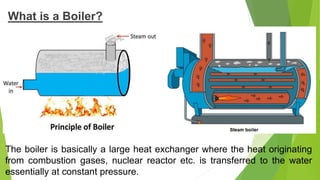
What is a Boiler?
The boiler is basically a large heat exchanger where the heat originating
from combustion gases, nuclear reactor etc. is transferred to the water
essentially at constant pressure.
Energy analysis of ideal Rankine cycle or
efficiency of Rankine cycle:-
 As all the four components with the Rankine cycle are
steady-flow devices, thus all four that make Rankine cycle
can be analyzed as steady flow process.
 The kinetic and potential energy changes of steam are
usually very small relative to heat and work terms
therefore they are neglected from steady flow equation.
 By the steady flow equation :
q-w = h
In process 1-2: Pump (q=0),
Wp = h2 - h1 = V(P2-P1)
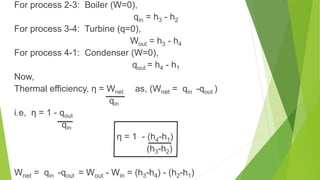
For process 2-3: Boiler (W=0),
qin = h3 - h2
For process 3-4: Turbine (q=0),
Wout = h3 - h4
For process 4-1: Condenser (W=0),
qout = h4 - h1
Now,
Thermal efficiency, η = Wnet as, (Wnet = qin -qout )
qin
i.e, η = 1 - qout
qin
η = 1 - (h4-h1)
(h3-h2)
Wnet = qin -qout = Wout - Win = (h3-h4) - (h2-h1)
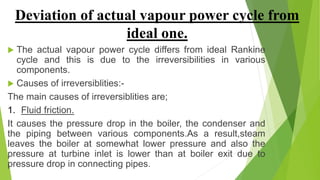
Deviation of actual vapour power cycle from
ideal one.
 The actual vapour power cycle differs from ideal Rankine
cycle and this is due to the irreversibilities in various
components.
 Causes of irreversiblities:-
The main causes of irreversiblities are;
1. Fluid friction.
It causes the pressure drop in the boiler, the condenser and
the piping between various components.As a result,steam
leaves the boiler at somewhat lower pressure and also the
pressure at turbine inlet is lower than at boiler exit due to
pressure drop in connecting pipes.
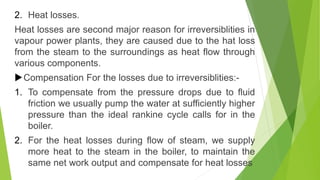
2. Heat losses.
Heat losses are second major reason for irreversiblities in
vapour power plants, they are caused due to the hat loss
from the steam to the surroundings as heat flow through
various components.
Compensation For the losses due to irreversiblities:-
1. To compensate from the pressure drops due to fluid
friction we usually pump the water at sufficiently higher
pressure than the ideal rankine cycle calls for in the
boiler.
2. For the heat losses during flow of steam, we supply
more heat to the steam in the boiler, to maintain the
same net work output and compensate for heat losses
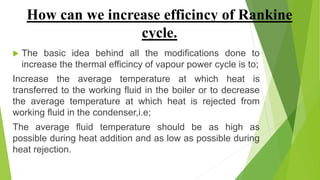
How can we increase efficincy of Rankine
cycle.
 The basic idea behind all the modifications done to
increase the thermal efficincy of vapour power cycle is to;
Increase the average temperature at which heat is
transferred to the working fluid in the boiler or to decrease
the average temperature at which heat is rejected from
working fluid in the condenser,i.e;
The average fluid temperature should be as high as
possible during heat addition and as low as possible during
heat rejection.
 Some methods to increase efficiency are:-
1. Lowering the condenser pressure:-
The lowering of operating pressure of condenser lowers the
temperature of steam and thus temperature at which heat is
rejected gets lowered.
2. Super heating the steam to high temperature:-
Super heating the steam increases the net work and heat
input as a result of which the steam the overall thermal
efficiency of cycle increases.
3. Increasing boiler pressure:-
The increase in boiler pressure rises the saturation
temperature of the working fluid which results increase in
the temperature at which heat is transferred to working
fluid.
Some other modifications to Rankine
cycle.
1. Reheating:-
The heating of steam in several or more than one stage is
called reheating in vapour power cycle.
Which gives generation to “Reheat Ideal Rankine cycle”.
2. Regeneration:-
Use regenerator to heat up the liquid (feedwater)leaving the
pump before sending it to the boiler, therefore, increase the
averaged temperature (efficiency as well) during heat
addition in the boiler.This is called the “Regenerative
Rankine vapour cycle“.
Thanks
for
watching .

ThermoDynamics (Working of steam power plant and rankine cyle)

  • 1.
    Rankine Cycle. A presentationby : PRAKHER SINGH Working principle of vapour power cycle. Subject : Applied thermodynamics. Roll no. : 10 (2011058) Submitted to : Mechanical deptt.
  • 2.
    Who was Rankine?  William John Macquorn Rankine (5 July 1820 – 24 December 1872) was a Scottish mechanical engineer who also contributed to civil engineering, physics and mathematics.  He was a founding contributor, with Rudolf Clausius and William Thomson (Lord Kelvin), to the science of thermodynamics, particularly focusing on the first of the three thermodynamic laws,”Rankine cycle” is named after him. William John Macquorn Rankine
  • 3.
    What is RankineCycle?  The Rankine cycle is a model that is used to predict the performance or efficiency of steam turbine systems. It closely describes the process by which steam-operated heat engines commonly found in thermal power plants generate power. The heat is supplied externally to a closed loop, which usually uses water as the working fluid.  It is the “ideal cycle” for vapour power plants and does not involves any internal irreversibility.
  • 4.
    Block diagram ofvapour power plant. 1st is the pump which compresses the liquid. 2nd is the boiler or Heat exchanger. 3rd is the turbine. 4th is the condenser or Heat exchanger.
  • 5.
    Processes involved inRankine cycle.  Processes :- 1 to 2: Isentropic compression in a pump. 2 to 3: Constant pressure heat addition.Which is reversible. 3 to 4: Isentropic expansion in turbine. 4 to 1: Constant pressure heat rejection in condenser. Also reversible.  T-S Diagram :-
  • 6.
     At state-1water enters the pump as a saturated liquid and is compressed isentropically to the operating pressure of the boiler.  At state-2 water enters the boiler as compreesed liquid and leaves as a saturated vapor at state-3.  At state-4 superheated vapour enters the turbine where it expands isentropically and produces work by rotating the shaft connected to an electric generator. The pressure and temperature of steam drops during this process to state-4,where it enters the condenser.  Steam is condensed at constant pressure in condenser and leaves it as a saturated liquid.
  • 7.
    What is aBoiler? The boiler is basically a large heat exchanger where the heat originating from combustion gases, nuclear reactor etc. is transferred to the water essentially at constant pressure.
  • 8.
    Energy analysis ofideal Rankine cycle or efficiency of Rankine cycle:-  As all the four components with the Rankine cycle are steady-flow devices, thus all four that make Rankine cycle can be analyzed as steady flow process.  The kinetic and potential energy changes of steam are usually very small relative to heat and work terms therefore they are neglected from steady flow equation.  By the steady flow equation : q-w = h In process 1-2: Pump (q=0), Wp = h2 - h1 = V(P2-P1)
  • 9.
    For process 2-3:Boiler (W=0), qin = h3 - h2 For process 3-4: Turbine (q=0), Wout = h3 - h4 For process 4-1: Condenser (W=0), qout = h4 - h1 Now, Thermal efficiency, η = Wnet as, (Wnet = qin -qout ) qin i.e, η = 1 - qout qin η = 1 - (h4-h1) (h3-h2) Wnet = qin -qout = Wout - Win = (h3-h4) - (h2-h1)
  • 10.
    Deviation of actualvapour power cycle from ideal one.  The actual vapour power cycle differs from ideal Rankine cycle and this is due to the irreversibilities in various components.  Causes of irreversiblities:- The main causes of irreversiblities are; 1. Fluid friction. It causes the pressure drop in the boiler, the condenser and the piping between various components.As a result,steam leaves the boiler at somewhat lower pressure and also the pressure at turbine inlet is lower than at boiler exit due to pressure drop in connecting pipes.
  • 11.
    2. Heat losses. Heatlosses are second major reason for irreversiblities in vapour power plants, they are caused due to the hat loss from the steam to the surroundings as heat flow through various components. Compensation For the losses due to irreversiblities:- 1. To compensate from the pressure drops due to fluid friction we usually pump the water at sufficiently higher pressure than the ideal rankine cycle calls for in the boiler. 2. For the heat losses during flow of steam, we supply more heat to the steam in the boiler, to maintain the same net work output and compensate for heat losses
  • 12.
    How can weincrease efficincy of Rankine cycle.  The basic idea behind all the modifications done to increase the thermal efficincy of vapour power cycle is to; Increase the average temperature at which heat is transferred to the working fluid in the boiler or to decrease the average temperature at which heat is rejected from working fluid in the condenser,i.e; The average fluid temperature should be as high as possible during heat addition and as low as possible during heat rejection.
  • 13.
     Some methodsto increase efficiency are:- 1. Lowering the condenser pressure:- The lowering of operating pressure of condenser lowers the temperature of steam and thus temperature at which heat is rejected gets lowered. 2. Super heating the steam to high temperature:- Super heating the steam increases the net work and heat input as a result of which the steam the overall thermal efficiency of cycle increases. 3. Increasing boiler pressure:- The increase in boiler pressure rises the saturation temperature of the working fluid which results increase in the temperature at which heat is transferred to working fluid.
  • 14.
    Some other modificationsto Rankine cycle. 1. Reheating:- The heating of steam in several or more than one stage is called reheating in vapour power cycle. Which gives generation to “Reheat Ideal Rankine cycle”. 2. Regeneration:- Use regenerator to heat up the liquid (feedwater)leaving the pump before sending it to the boiler, therefore, increase the averaged temperature (efficiency as well) during heat addition in the boiler.This is called the “Regenerative Rankine vapour cycle“.
  • 15.