12
PogitiveDisplacementMachines
The functionof a compressoris to takea definitequantityof fluid (usuallya
gas,and most oftenair) and deliverit at a requiredpressure.The mostefficient
machineisonewhichwill accomplishthiswith theminimuminput of mechanical
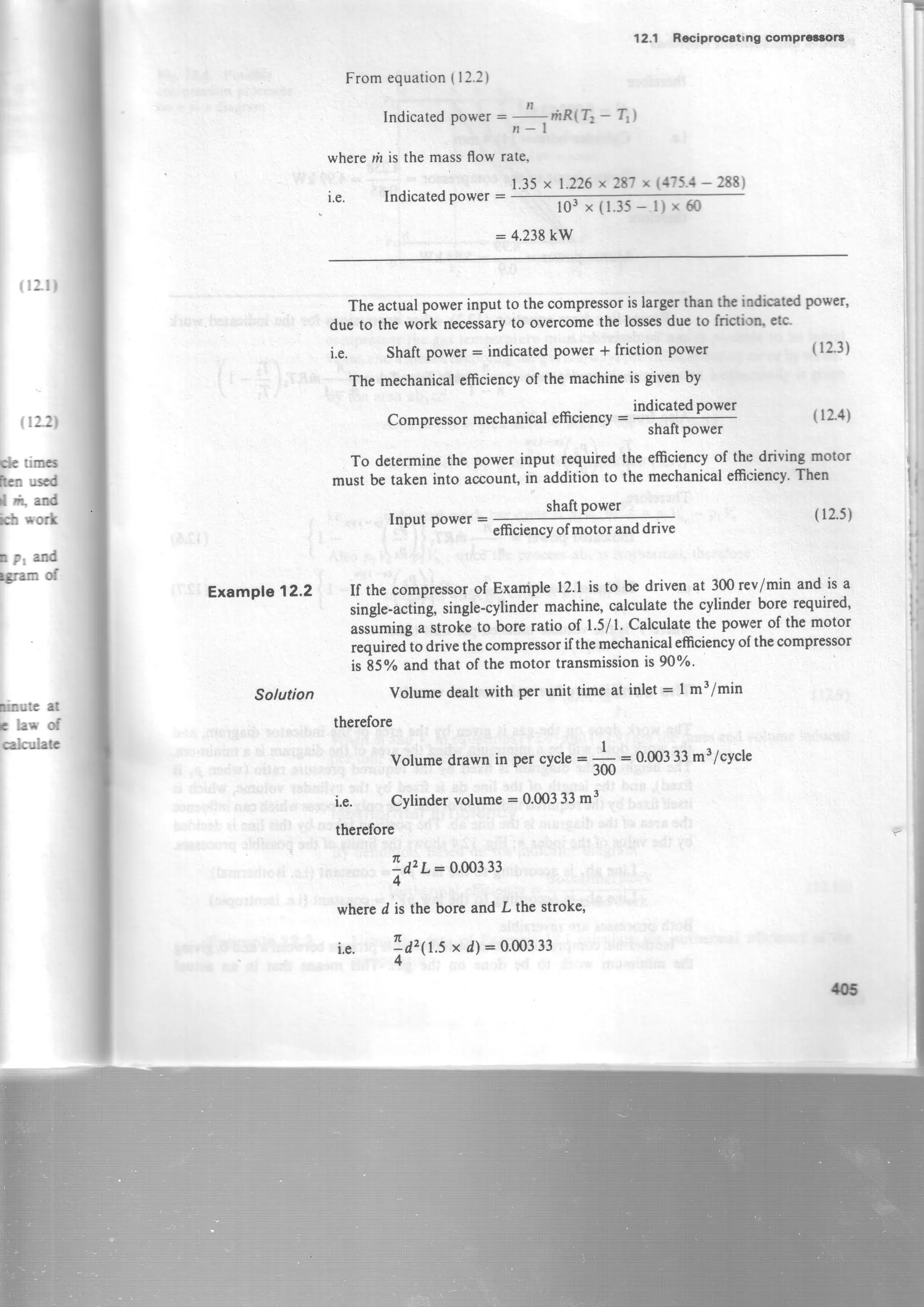
work. Both reciprocatingand rotary positivedisplacementmachinesare used
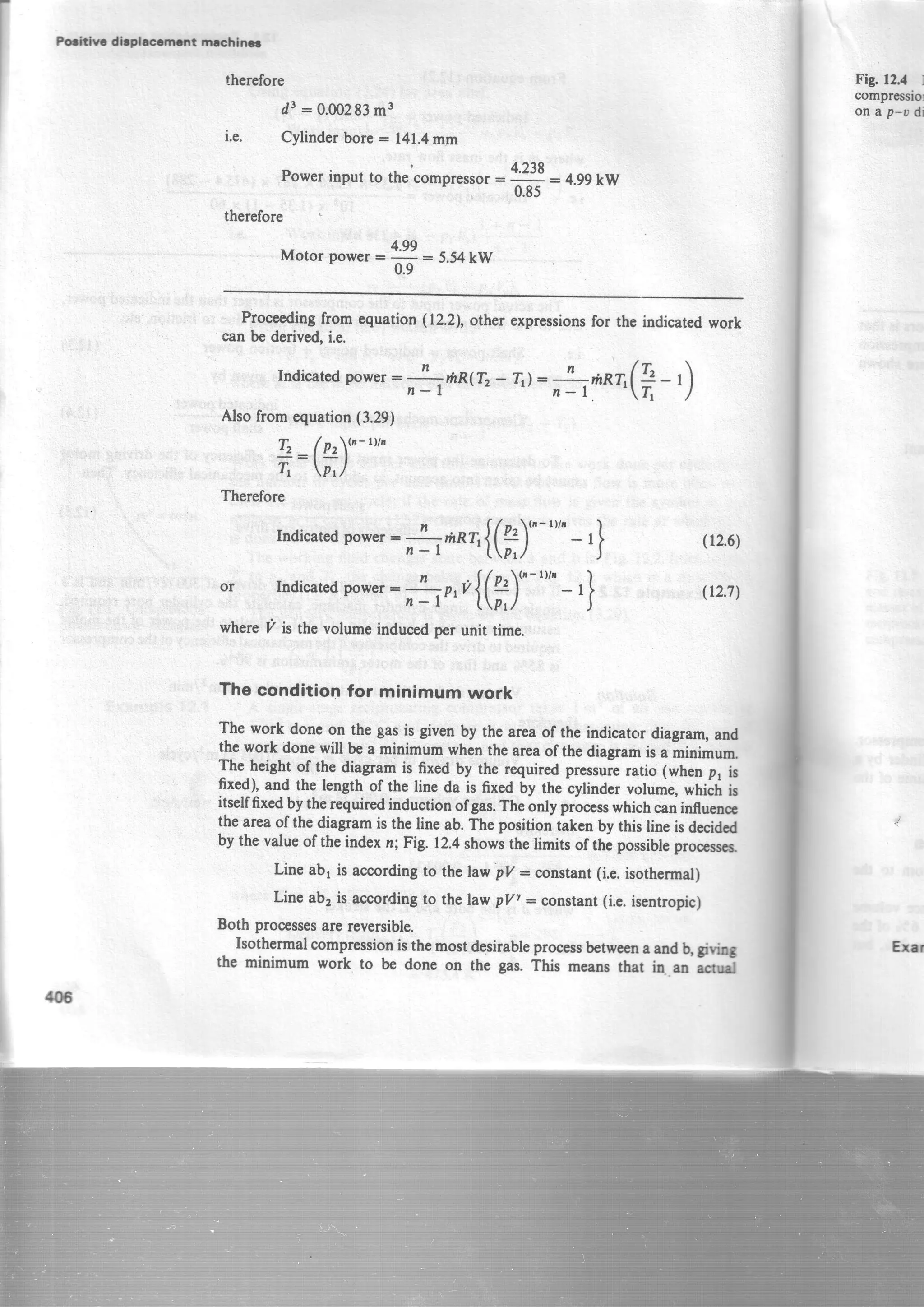
for a varietyof purposes.On the basisof performancea generaldistinctioncan
be madebetweenthe two typesby definingthe reciprocatingtype as having
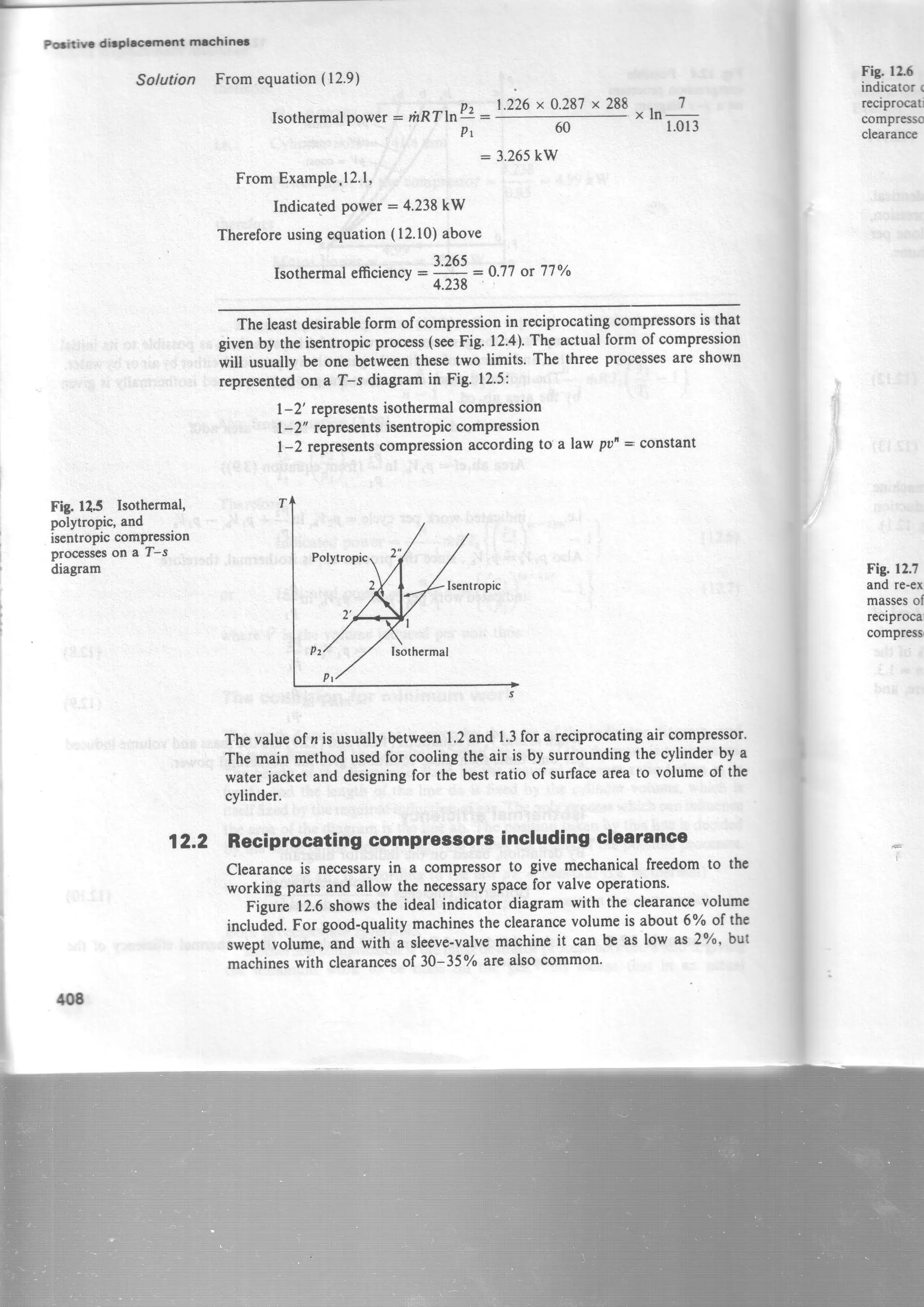
the characteristicsof a low massrateof flow and high-pressureratios,and the
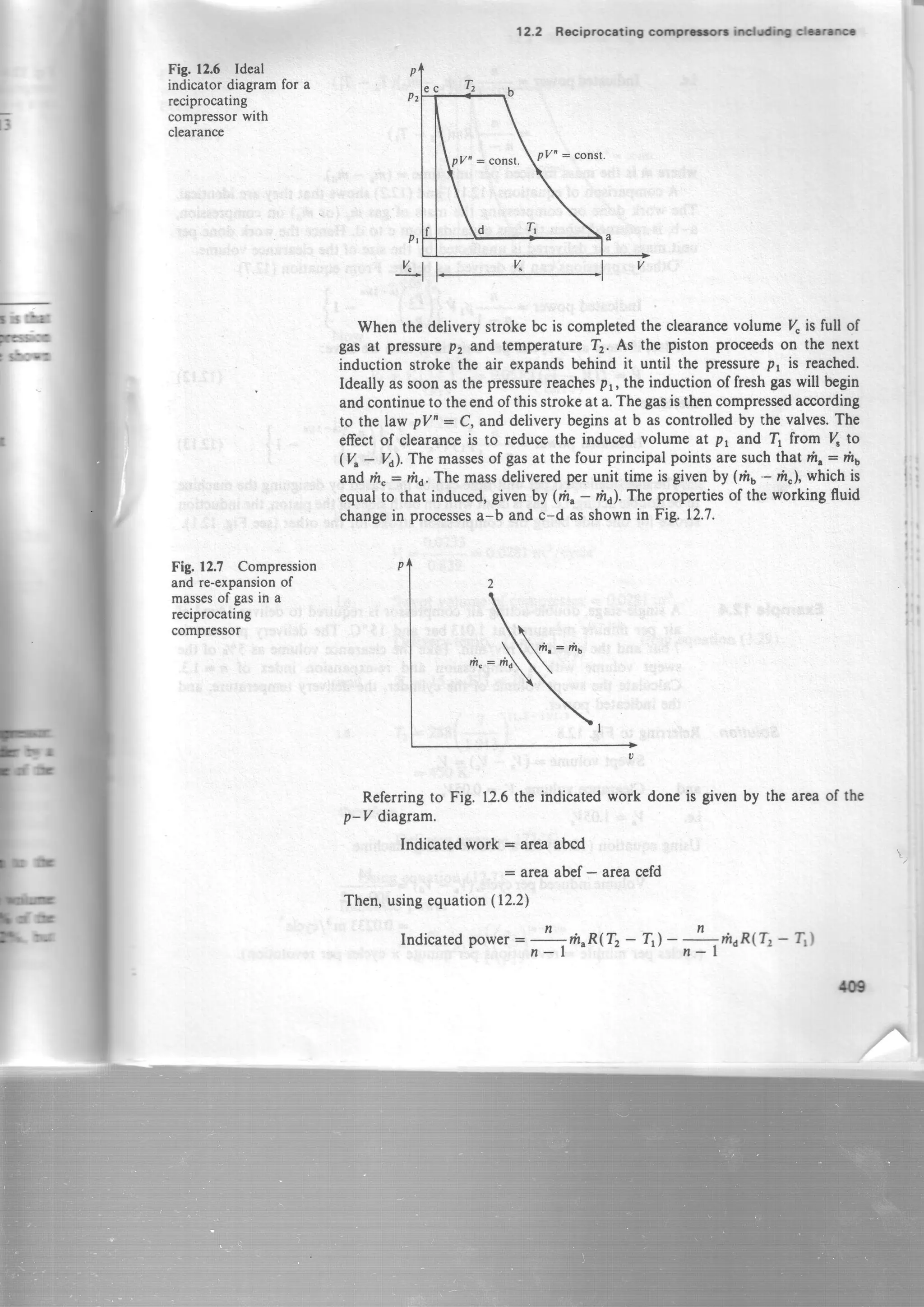
rotary type as having a high massrate of ffow and low-pressureratios. The
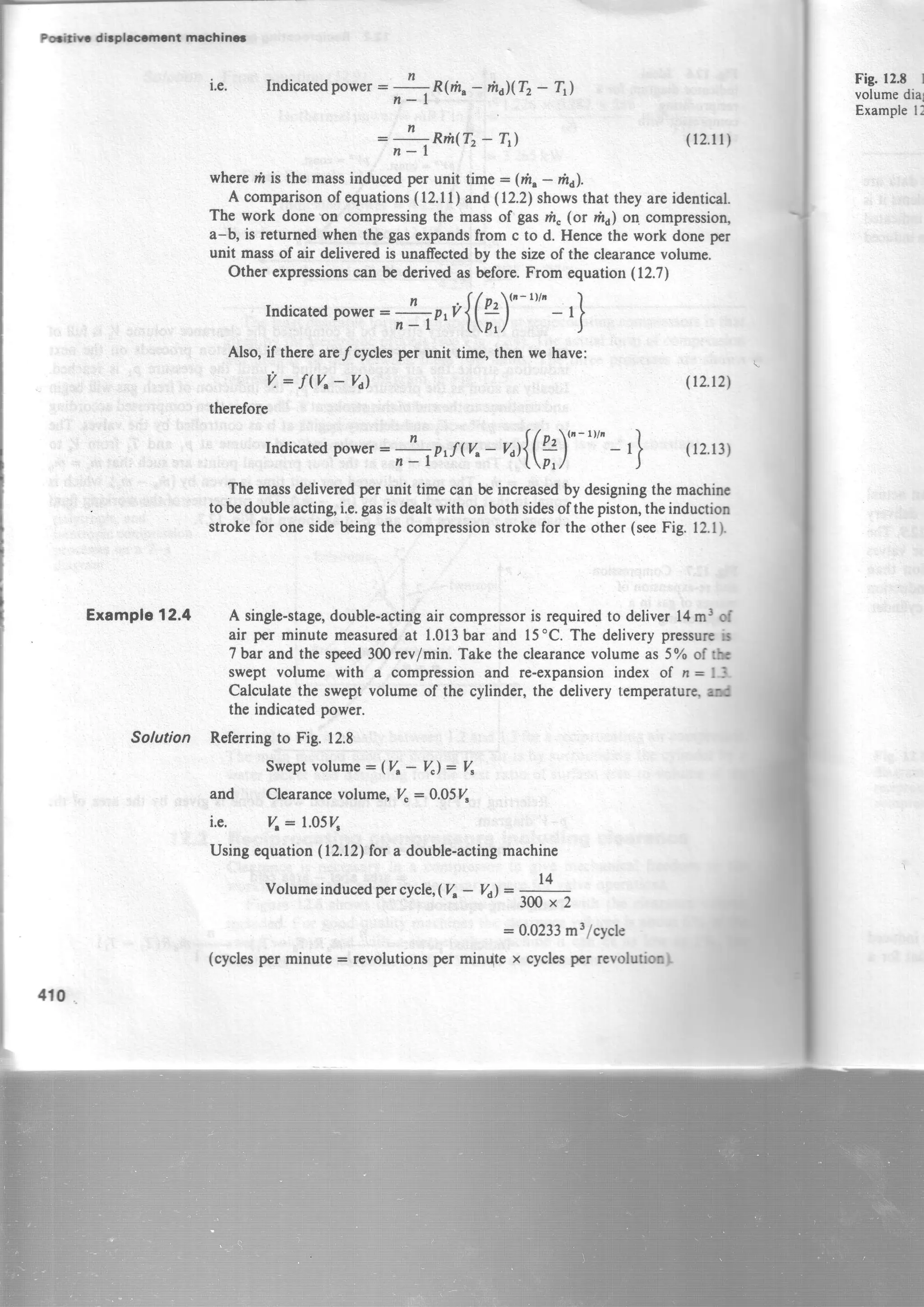
pressurerangeof atmosphericto about9 bar is commonto both types.
Somerotary machinesaresuitableonly for low-prcssureratio work, andare
applied to the scavengingand superchargingof engines,and the various
applicationsof exhaustingand vacuum pumping. For pressuresabove9 bar
the vane-typerotary machinecan be usedto supply boost pressures,but for
sustainedhigh-pressurework up to 500bar and above,for specialpurposes,
the reciprocatingtype is used.
Both basic types exist in many difrerent forms each having its own
characteristics.They may be singleor multistage,and haveeitherair or water
cooling.The reciprocatingmachineis pulsatingin action which limits the rate
at which fluid can bedelivered,but the rotary machineis continuousin action
and doesnot havethis disadvantage.The rotary machinesare smallerin size
for a given flow, lighter in weight and mechanicallysimpler than their
reciprocatingcounterparts.The treatmentand scopeof the following sections
is fundamental and is not exhaustive.Many compressorsare designedto
overcome the deficienciesof the basic machines and to satisfy spccid
requirements.For descriptionsof thesemachinestheexcellentliteraturesupplied
by the manufacturersconcernedshouldbe consulted.
For a compressorwhich operatesin a cyclic or pulsatingmanner,suchrs
a reciprocatingcompressor,the propertiesat inlet and outlet arc thc averiNgc
valuestaken over the cycle.Alternativelythe boundary of the control vslrrrrp
is chosensuchthat statesI and 2 areconstantwith time,the positioossdcrld
beingremotefrom the pulsatingdisturbance.
br*-drrltm*nrn-
rt l?-r
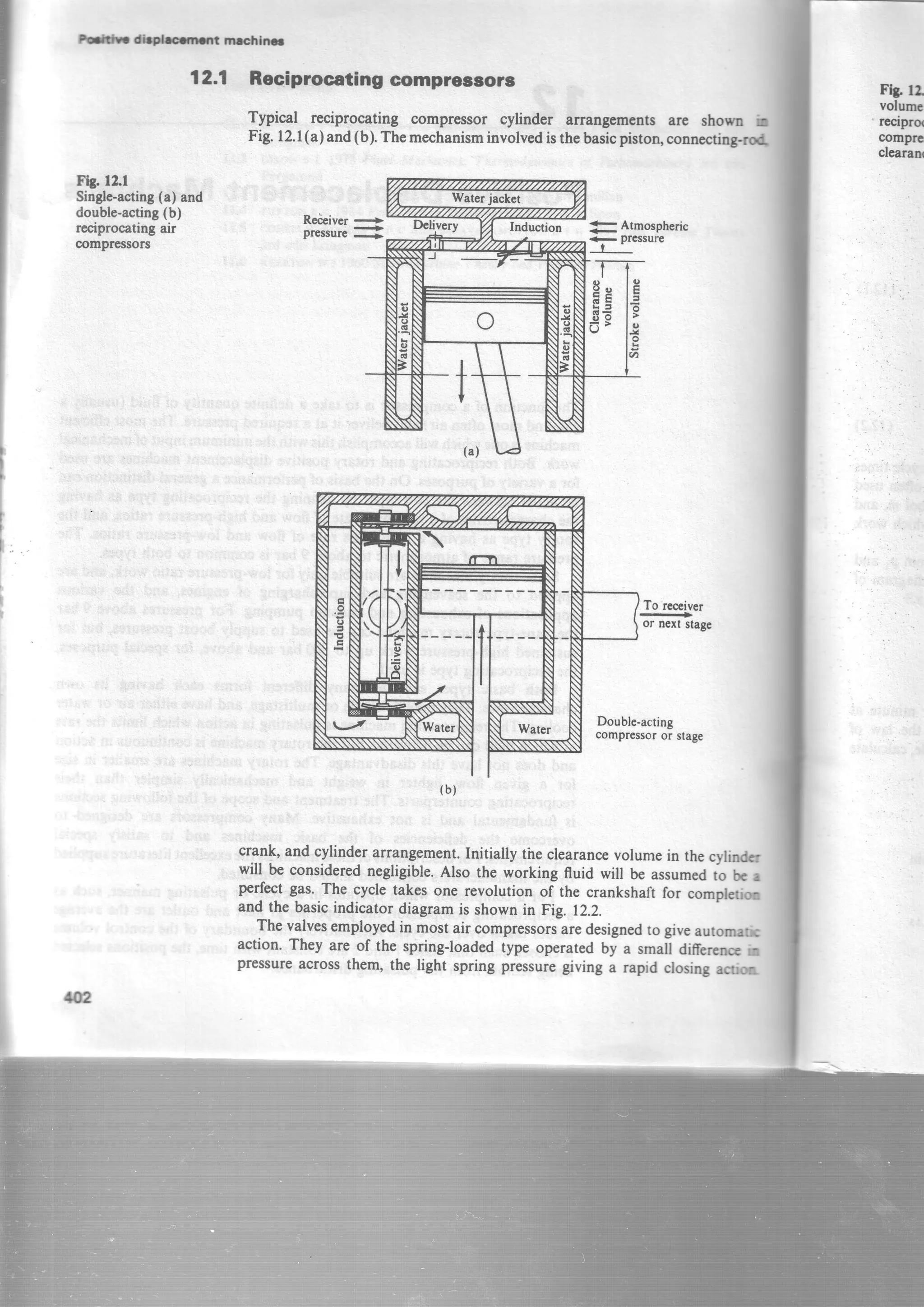
Singlc-acting(a) and
doublc-acting(b)
rcciprocating air
comprcssors
&
72.1 Reciprocating comprossors
Typical reciprocatingcompressorcylinder arrangem€ntsare shom i
Fig.I2.I (a)and(b).Themechanisminvolvedisthebasicpiston,connecting-m{,
FE IZ
volume
'rccipro
comprc
clearan
Rctiivcr...+-pressurc -;>
Induction E Atmospheric
+- pressurre
He8E
o'
To reccivcr
or next stage
Double-acting
compressoror stage
"tll!,,and
cylinderarrangement.Initially the clearancevolumein thecylindcr
will be considerednegligible.Also the working fluid wilt be assumedto bc e
perfectgas.The cycle takesone revolution of the crankshaftfor compkrir
and the basicindicatordiagramis shownin Fig. 12.2.
Thevalvesemployedin mostair compressorsaredesignedto giveautometb
action. They are of the spring-loadedtype operatedby a small differere i
pressureacrossthem, the light spring pressuregiving a rapid closingactir
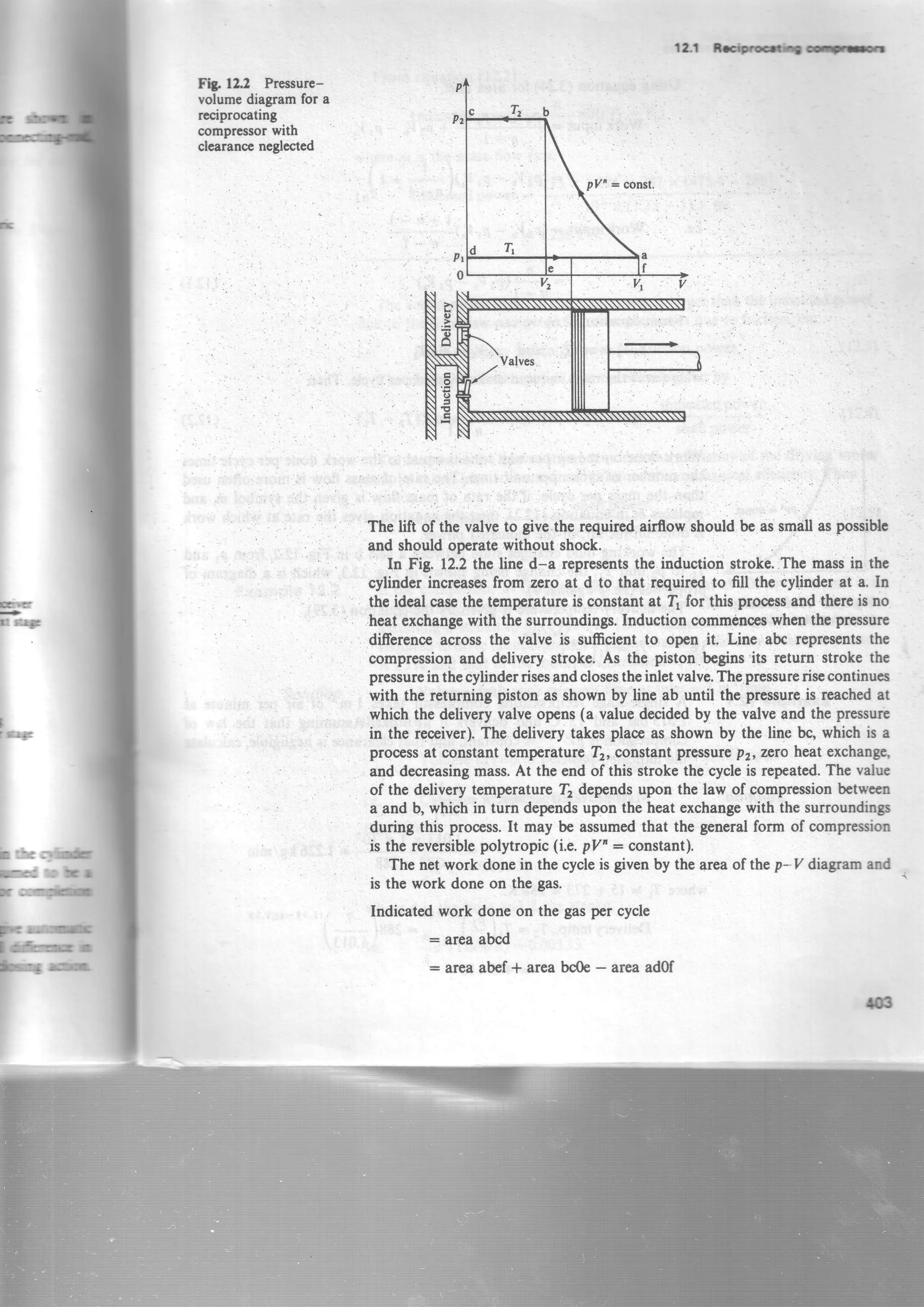
try-.lzz Pressurc-
volumediagramfor a
rcciprocating
compressorwith
clcaranceneglected
let frclrrtr;n
The lift of the valvg to give th€ required.air0ow should,be assmall aspossiblc
and shouldoperatewithout shock.
In Fig. 12.2the line d:-a representsthe induction stroke.The massin the
cylinder increasesfrom zero at d to that requiredto fill the cylinder at a. In
the idealcasethc tcmperatureis constantat T1for this processand thereis no
:heatexchangewith the surroundings.Induction commdnceswhcnthe pressure
differenceacoss the valve is sufficientto opcn it. Line abc representsthe
compressionand delivery stroke, As the piston begrns'its return stroke the
pressurein thecylinderrisesandclosestheinletvalve.Thepressurerisecontinues
with the returning piston as shownby line ab until the pressureis:reachedat
which the deliveryvalveopens(a valuedecidedby the valveand the pressure
in the receiver).The deliverytakesplaceas shown by the line bc, which is a
processat constanttemperatureT2,constantpressurep7, zQtoheatexchangg
and decreasingmass.At the end of this strokethe:cycleis repeated.The value
of the deliverytemperature?r dependsupon the law of compressionbetween
a and b, which in turn dependsupon the heatexchangewith the surroundings
during this process.It may be assumedthat the generalform of compression
is the reversiblepolytropic (i.e.pV' = constant).
The net work donein the cycleis givenby the4reaof thep-V diagramand
is the work done on the gas.
Indicatedwork done on the gasper cycle
: afeaabcd
: area abef* area bcOe- area ad0f
/El
F
tEnr
rr*
I
I *-r*i
h:-5c :fffi
rec ro bt
I
I
turir d-pLcrnfit mac{rincr
Le.
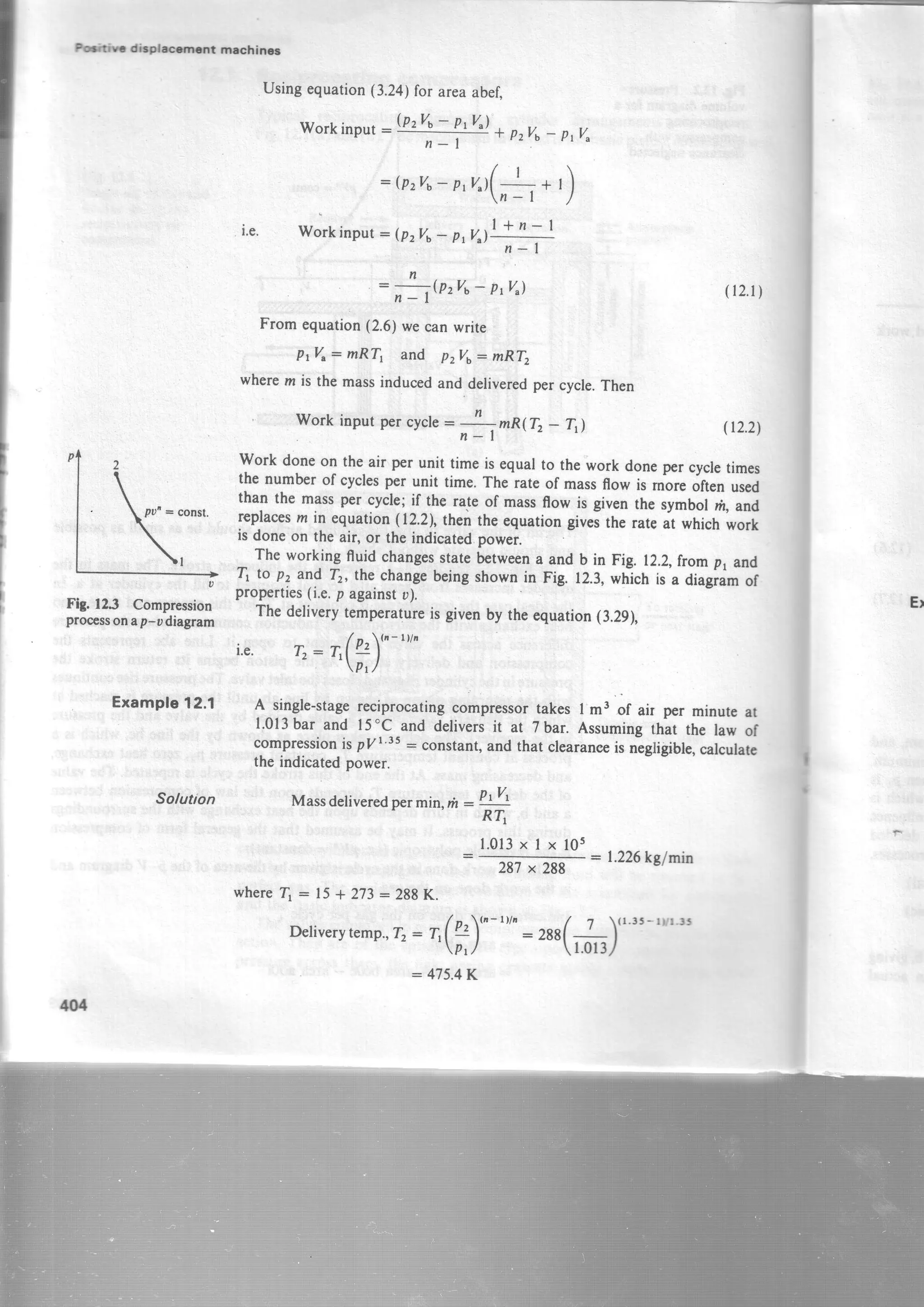
Fig.123 Compression
processonap-udiagram
Example12.1
Solution
M
Usingequation(3.24)for areaabef"
workinput:W#9 t pzva
: (pzvb-p,n 1(-1_ * , )
n-l /
Workinput:(pzvo- "' I +n- I
Prv")-
nlf-
=n .QzVa- Pr4)
From equation(2.6)we canwrite
plVr: mRT, and p.rVo= mRT2
wheren is the massinducedand deliveredpercycle.Then
Work input per cycle- n
: mR(T,- T,l
n-l
properties(i.e.p againstu).
l.0l3xlx105
Thedeliverytemperatureisgivenby theequation{3.29),
/ '  ( a - t Y a
i.e. T": TI2l- .p,/
A single-stagereciprocatingcompressortakes I m3 of air per minute at
l.0l3bar and l5'c and deliversit at 7 bar. Assumingthat the law of
compressionis pyr'ts : constant,and that clearaneeis nigli!;ible,calculate
the indicatedpower.
Massdeliveredpermin,n : P:!t
R?i
(12.1)
(r2.2)
work doneon theair per unit time is equarto the work doneper cycletimes
the numberof cyclesper unit time.The rateof massflow is moreoftenused
than the massper cycle;if the rate of massffow is given the symbor rh,and
replacesm in equation(12.2),then theequationgivei the rateit whichwork
is doneon the aiq or theindicated.po*ei.
The working ffuid changesstatebetweena and b in Fig. 12.2,fromp1and
Tt to pz and Tr, the changebeingshownin Fig. 12.3,which is a diagiamof
287x 288
:1.226kglrnin
whereT, : 15* 273:288K.
Detiverytemp.,rz : rr(f)" "'" : zas(#)(1'3'-rvr'!5
:475.4K
T
r l l l f
r12.2)
dc tirncs
lfcn uscd
lnad
ich qort
I p, aod
gmm of
jnute at
r lan of
calculatc
Theactualpowerinput to thecompressorislargerthanthc indicatcdpower,
due to the work necessaryto overcomethe lossesdue to friction' ac.
12.1 ReciprocetingcomprolaoF
Fromequation(12.2)
Indicatedpower: -
n-;p1
Tz- Ttl
n-l
wherem is themassflow rate,
1.35x 1.226x 787x (475.4- 28t)
l.e. Indicatedpow€r=
l03x(1.35-l)x6O
:4.238kW
i.e. Shaftpower= indicatedpower + friction power
The mechanicalefficiencyof the machineis givenby
CompressormechanicalefficiencY:
indicatedpower
shaftpower
Input power=
shaftpower
(12.5)
efficiencyofmotor anddrive
If the compressorof Exaniple12.1is to be drivenat 300rev/min and is a
single-acting,single-cylindermachine,calculatethe cylinder bore required,
assumingaitrot<i to boreratio of 1.5/1.Calculatethe powerof themotor
requiredlo drivethecompressorif themechanicalefficiencyof thecompressor
is gS9/.and that of the motor transmissionis 90%'
Volumedealtwith per unit timeat inlet: I m3/min
therefore
Volumedrawnin percycle=
*
: 0'00333m3/cycle
i.e. Cylindervolume: 0.00333m3
therefore
n
d'L = o.oo333
4
whered is the bore and Lthe stroke,
i.e. la'fij x d): o.oo333
4
{G
(r2.3)
(114)
To determinethe power input requiredthe efficiencyof the driving motor
must be takeninto account,in addition to the mechanicalefficiency.Then
Example12.2
Solution
Hthlr dbplcrmcrrt mecfrinc
therefore
d3:0.00283m3
i.e. Cylinderbore= 141.4mm
Powerinput to thecompresro,:
4,'.'l
= 4.ggkw'
0.85
therefore
4.gg
Motor power=
6:
5.54kW
Proceedingfromequation(lz.2l, otherexpressionsfor thcindicatedwork
canbederived,i.e.
Indicatedpower:
fi**1
Tz- Tr)=
fi*^rr(?
- t)
Alsofromequation(3.29)
T2 ( Pr{n-rttn
T: P'/
Therefore
Indicatedpower:-!-,;,p7r{(g)t"-t"'- ,} 1rr.uyn-l 'tptz
)
or Indicatedpower:
*o,o{(f)"-""
- ,} e2.7)
wheretzis thevolumeinducedperunit time.
Fig. 12.4 l
compressio
on a p-o di
Eral
The condition for minimum work
The work done on the gasis given by the areaof the indicator diagram,and
the work donewill bea minimum whenthe areaof thediagramis a minimum.
The_heightof the diagram is fixed by the requiredpt rrui. ratio (whenp, is
lrr{): and the length of the line da is fixed by the cylinder volume,which is
itselffixedby therequiredinductionofgas.Theonly prooesswhichcaninfluene
the areaof thediagramis the line ab.The positiontakenby this line is decidcd
by the valueof theindexn; Fig. r2.4showsthe limits of thi possiblcprooesscs.
Line abt is accordingto the law pll: constant(i.e.isothermar)
Line ab2is accordingto the law pyr = constant(i.e.isentropic)
Both processesare reversible.
-
Isothermalcompressionisthemostdesirableprocessbetweenaandb,giving
the minimum work to be done on the gas.ihis meansthat in an rcrnl
1{16
rork
Jra0i
[o',
I
Ld
F.
f : t r
!
Fg. 12.4 Possible
compressionprocesses
on a p-v diagram
Example12.3
indicatedworkpercycle: p2V6,lnPf,
= PrVrhA
Pt
: mRThU
(12"8)
(l2.e)
(lzt0)
isothermalemAaryd fu
12.1 RcciwocdilrO compr=.t
p
Pz
plz] = const.
pZ'= const.
pZ : const.
compressorthe gastemp€raturemust be kept ascloseaspossibleto its initial
value,andameansofcoolingthegasisalwaysprovided,eitherbyairor bywater.
The indicatedwork done when the gasis compressedisothermallyis givcn
by the areaablcd.
Area ablcd : ateaabref+ areabrc0e- areaad0f
Areaablef: pzVa,6& lfrom equation(3.9))'
Pr
i.e. indicatedwork perclcle= p2V6,ln!2* PtVt,- PrV"
P t
Alsop1Vr: p276,,sincethe processab1is isothermal,therefore
Pt
Whenm and %in equations(12.8)and(12.9)arethemassandvolumeinduccd
per unit time, then theseequationsgivethe isothermalpower.
lsothermal efficiency
By definition,basedon the indicator diagram
isothermalwork
,tv43
EI
Isothermalefficiency:
Using the data of Example
compressor.
indicatedwork
l2.l calculatethe
t3
Fig.125 Isothermal,
polytropic, and
iscntropiccomPression
processeson a T-s
diagram
Solution From equation(12.9)
Isothermalpower: rhRTlrr.U
P t
t.225x0.287x288
,,ln
7
1.01360
: 3.265kW
FromExample.l2.l,
Indicatgdpower:4.238 kW
Thereforeusingequation(12.10)above
Isothermalefficiencv:3.?91:0.77 ot 77oh'
4.238
Theleastdesirableformofcompressionin reciprocatingcompressorsisthat
givenby theisentropicprocess(seeFig.12.4).Theactualformofcompression
will usuallybe onebetweenthesetwo limits.Thethreeprocessesareshown
representedon a T-s diagramin Fig' 12.5:
1-2' representsisothermalcompression
I-2" representsisentropiccompression
1-2 representscompressionaccordingto a lawputr= constant
Thevalueof n is usuallybetween1.2and 1.3for a reciprocatingair compressor'
The main methodusedfor coolingtheair is by surroundingthe cylinderby a
waterjacket and designingfor the bestratio of surfaceareato volumeof the
cylinder.
12.2 Reciprocating comprossors including clearance
Clearanceis necessaryin a compressorto give mechanicalfreedomto ttrc
working parts and allow the necessaryspacefor valveoperations.
Figure 12.6showsthe ideal indicatordiagramwith the clearancevolumc
included.For good-qualitymachinestheclearancevolumeis about6% of the
sweptvolume,and with a sleeve-valvemachineit can be as low as2%, but
machineswith clearancesof 30-35Yoarealsocommon'
F!S. l2f
indicator r
reciprocati
comprEsg
clearance
Fig. 12.?
and re-cx
massesol
reciproca
compress
tm
)
I
3
Fig. f2.6 Ideal
indicator diagrarnfor a
reciprocating
compressorwith
clearance
Fig. 12.7 Compression
and re-expansionof
massesof gasin a
reciprocating
compressor
12.2 Reciprcceting corprrt -c|rfi -ro
When the deliverystroke bc is completedthe clearancevolume 7" is full of
gas at pressurep, and temperatureTz. As the piston proceedson the next
induction stroke the air expandsbehind it until the pressurept is reached.
Ideally assoonasthepressurereachespr, the induction offresh gaswill begin
andcontinueto theendof thisstrokeat a.Thegasisthencompressedaccording
to the law pV' : C, and deliverybeginsat b ascontrolled by the valves.The
effectof clearanceis to reducethe inducedvolume at p, and I from ( to
(V - Vi. The massesof gasat the four principal pointsaresuchthat m" : flt
andrh,: nra.The massdeliveredpef unit timeis givenby (mu'- fr"I, whichis
equalto that induced,givenby (n" - fri.The propertiesof the working fluid
changein processesa-b and c-d asshownin Fig. 12.7.
Referringto Fig. 12.6the indicatedwork done is given by the areaof the
p-V diagram.
Indicatedwork : areaabcd
= areaabef- areacefd
Then,usingequation(12.2)
Indicatedpower= -!-rrr^n(Tz - Tr)-
r,nrn(T,
- 1i)
,n I
/t?
Hin dbphcrncrt machincl
Example12.4
410
i.e. Indicatedpower:
;lR(m"
- rt,dl(T2- Ttl
:fr**1r,_r,) (r2.11)
wherem is the massinducedper unit time : Qh,- rhi.
A comparisonof equations(12.11) and(12.2)showsthat they areidentical.
The work doneon compressingthe massof gasn" (or mu)on compression"
a-b, is returnedwhen the gasexpandsfrom c to d. Hencethe work doneper
unit massof air deliveredis unafrectedby the sizeof the clearancevolume.
Other expressionscan be derivedas before.From equation(12.7)
Indicatedpower:
no,t{(f)"
"'" - ,}
Also, if therearelcycles per unit time, then we have:
Fig. l2t I
volumedia
Examplel!
V: f V"- Yal
therefore
Indicatedpower:
;o,f( %- n ){(
?)"
"'" - r}
(t2.12)
(12.13)
Themassdeliveredperunit timecanbeincreasedbydesigningthemachinc
toh doubleacting,i.e.gasisdealtwithonbothsidesofthepiiton,theinduction
strokefor onesidebeingthecompressionstrokefor theother(seeFig.12.1).
A single-stage,double-actingair compressoris requiredto deliver 14m3 of
air per minute measuredat 1.013barand 15"C. The deliverypressurcb
7 bar and the speed300rev/min. Take the clearancevolumeas 5% of tb
swept volume with a compressionand re-expansionindex of n = lJ.
Calculatethe sweptvolume of the cylinder,the delivery temperaturgrd
the indicatedpower.
Solution Referringto Fig.12.8
Sweptvolume* (V^- V"): V"
and Clearancevolume,V": 0.05V"
i.e. V,- 1.05V,
Usingequation(12.12)for a double-actingmachine
Volumeinducedpercycle,(V,- Yi =
300x2
- 0.0233m3/cycle
(cyclesper minute = revolutionsper min{te x cyclesper revolutioo}
t4
-
12.2 Rcciprocating comprur.on including clcaruncc
Fig. l2.E Pressure-
volumediagramfor
Example12.4
L l l t
icaf
rim.
r Psf
B
l-4-l
:o.osn(ft)""
therefore
(Y,- Y) = 1.05r,- 0.221V':0.0233m3/cycle
therefore
I'.:
oio=2=3=3= 0.0281m3/cycle'
0.829
i.e. Sweptvolumeof compressor= 0.0281m3
DeliverYteml - /P'{r-
t)h
)''T2: tlffi/ fromequation(3'29)
Tr: 15*273:288K
/ t  ( 1 ' 3 - l Y l . 3
T":2881 I'
 r.013/
-450K
V
L l l t ,^:*(?),,.
i.e. Va:0.221V,
Lll I
lio€
Doc
Ll'
tr of
lc rt
t thc
: ! - i
ihc
and
i.e.
therefore
Deliverytemp.= 177'C
Usingequation(12.7)
Indicatedpower
:ft',r{(f,)"","_,}
II
Pcritir Cieisnqn mactrinoc
1.3
=_x
0.3
1 . 0 1 3x 1 0 5x l 4 ( / 7  ( r . 3 -r l ir . 3 )
rot*o it,*"/
- rlkw
l.e. Indicatedpower: 57.6kW
The approachusedfor a particularproblemdependson how the dataare
statedand thequantitiesevaluatedduringthesoluiion.In someproblemsit is
betterto evaluatern and r, andthenuseequation(l2.ll) forihe indicated
Power;e.g.in Example12.4above,I hasbeencalculated,andthemassinduced
is givenby
l.0l3x14xl05
0.287x288x103
Then,usingequation(12.11)
= 17.16kglmin
Indicatedpower:
fr*^,Tz
- TJ
1.3x 17.16x 0.287(450-288)
0.3 x 60
: 57.6kW (asbefore)
The diagramspreviouslyshown(e.g.Fig. 12.8)areidealdiagrams.An actual
indicator diagramis similar to the ideal exceptfor the induction and delivery
processeswhich aremodifiedby a valveaction.This is shownin Fig. 12.9.Thc
wavinessof the lines d-a and b-c is due to valve bounce.Automatic valvcs
are in generaluse(seeFig. l2.l), and theseare lessdefinite in ssflsn rhen
cam-operatedvalves;they also give more throttling of the gas.The inductioo
stroked-a is a mixing process,theinducedair mixing with that in thecyliodcr_
Vofumetric efficiency, Iv
It hasbeenshownthat one of the efectsof clearanccis to rrb t *d
volume to a value lessthan that of the sweptvolumc,Tli n th h r
m=
Ftg; 12.9 Actual
indicator diagram for a
reciprocating
qomprssor
412
Fig. l2-t
diagram
reciproc
compres
t
lb
E
E
12.2 Rociprocating comprolsorr Includlng clcarlncc
requiredinductionthecylindersizemustbeincreasedoverthatcalculatedon
theassumptionofzeroclearance.Thevolumetricefficiencyisdefinedasfollows:
4, : themassofgasdelivered,dividedbythemassofgaswhichwould
fill the sweptvolumeat thefreeair conditionsof pressureand
tempcrature (t2.14')
or
4" : the volumeof gasdeliveredmeasuredat thefreeair pressureand
temperature,divided by the sweptvolumeof the cylinder(12.15)
The volumeof air dealt with per unit time by an air compressoris quotedas
the freeair delivery(FAD), and is the rate of volumeffow delivered,measured
at the pressureand temperatureof the atmospherein which the machineis
situated.
Equations(12.14)and (12.15)canbe shownto beidentical,i.e.if the FAD
per cycleis 14at p and T then the massdeliveredper cycleis
pV
m:-
RT
The massrequiredto fill the sweptvolume,V, al p and T is givenby
pU,
t'=rr
Thereforeby equation(12.14),
mpVRTV
n.:-=:-X-:-," ms RT pV" U,
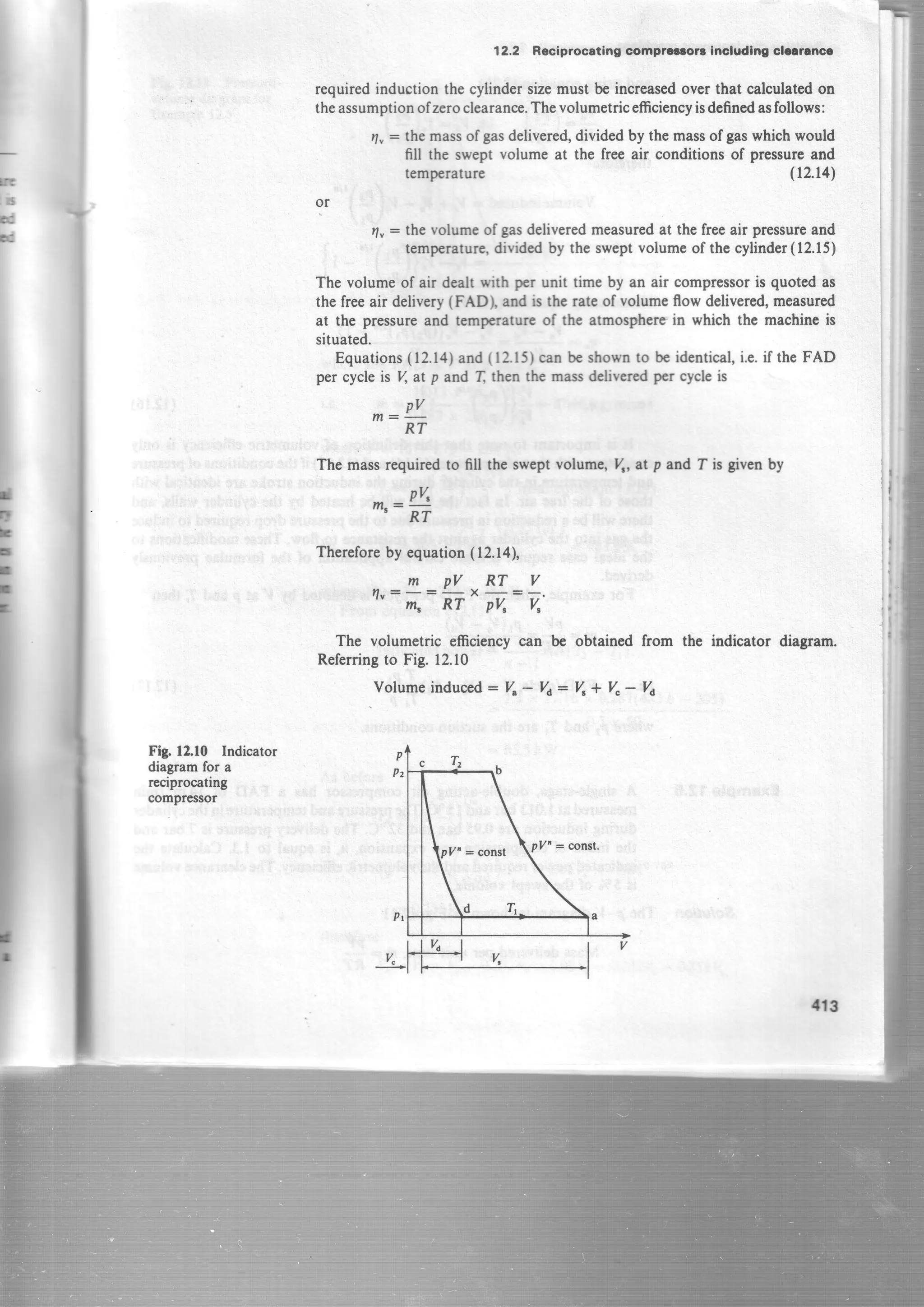
The volumetric efficiencycan be obtained from the indicator diagram.
Referringto Fig. 12.10
Volume induced: U,- Va: V"+ V"- Va
fl3
p
Pt
Fig. 12.10 Indicator
diagramfor a
reciprocating
comPressor
Pctthr dlrplaccmcnt mechlnc
Ftl
volu
Exan
andusingequation(3.25)
therefore
2:(?)'''ievo=r(r)"
:v3-""{(fi)''-'}
ie 4.:!_fr{&),,._,}
v"v,
(r2t6)
(rzr7l
r r./ ,, ( Prt'nVolumeinduced= I/,+ V.- r";)
Henceusingequation(12.15),
4 r :
V,- Vo_V,- V"{(prlp)tt,- r)
It is important to note that this definition of volumetricefficiencyii only
consistentwith that of equations(lz.l4) and(t2.15) if thecondition. of press.rr"
and temperaturein the cylinder during the induction strokeareidenticalvith
thoseof the freeair. In fact the gaswil be heatedby the cylinder wal| aod
thgrewill bea reductionin pressuredueto thepressuredrop iequiredto ind,.oe
the gasinto the cylinder againstthe resistanceto flow. Thise modificationsto
the.ideal caserequire a more careful application of the formulae prcno'oy
derived.
For example,when the FAD per cycleis denotedby v atp and T thca
^ = Pv=Pt(v:- vi :
. RT R?i
i.e. FAD/cycle,V=(V,- Vn++
I r P
wherep, and I are the suctionconditions.
A single-stagc,double-actingair compressorhas a FAD of t4 rr,,r
measuredat l.0l 3 barand I 5"c. Thepressureandtemperaturein rhcqr-
during induction are 0.95bar and li'c. the deliveryprcssurch 7 b d
the.index of compressionand expansion,n, is equai io 1.3.Crb t
i"lr:or{
powerrequiredandthevolumetribefficiency.Thcdt nc*
is SVoof the sweptvolume.
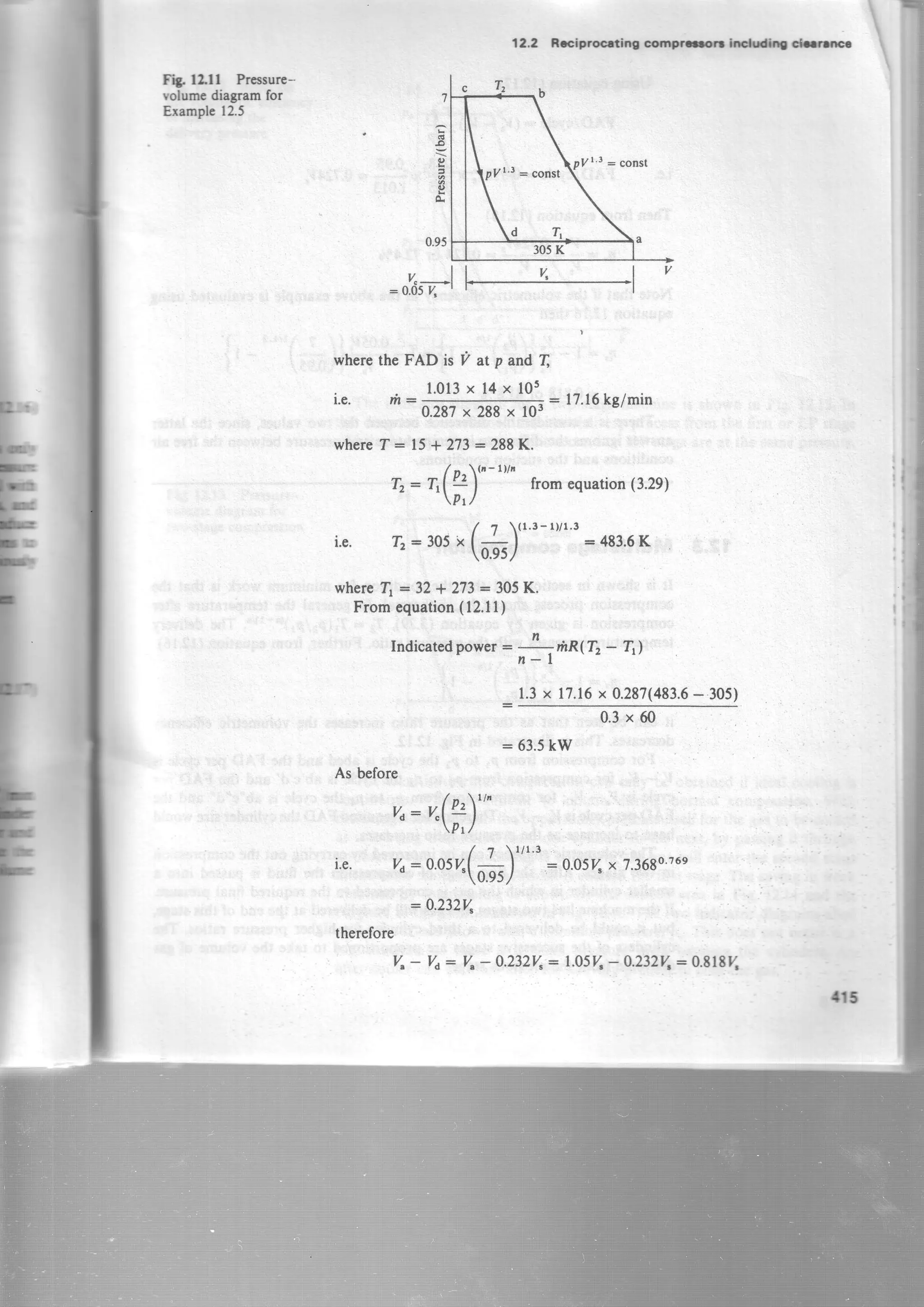
Thep V dragramis shownin Fig. 12.11
Massdeliveredper unit ti^", ,h : Pt
Rr
Example12.5
Solution
414
v.-ll u ,l v
:0.05y, ' | |
wherethe FAD is V at p and T
l,e. m:
1.013x 14x l0s
0.287x 288x
122 Brlprocdng coff,Frrr hffil -ns

I
fit, f2.f f Pncssure-
volumcdiagramfor
Erample12.5
T r b
,..ll/1 3 - const
305K
1
.o
o
g
0.95
l0I
: 17'16kglmin
whereT=15*273=288K.
Tr: Tr(!2"-t''" fromequation(3.2g)- 'prl
/ ?  ( 1 ' 3 - r Y r ' 3
i.e. Iz:305"1+l =483.6K
0.95l
whered :32 * 273: 305K.
Fromequation(12.11)
Indicatedpor".r=
;l
fiR(72- T)
1.3x 17.16x 0.287(483.6- 305)
0.3x 60
:63.5 kW
As before
/ r ^  l / '
vd=v"lv-2l|
pr /
/ 7  1 / 1 ' 3
i.e. ya:0.054(
_ | :0.054 x 7.3680'76e
1u'95/
:0,232V"
therefore
V.- Yo: Yt- A.232y..:LASY.- O.232V,:0.818y.
.n5
Po.ld[ dfrpbcrncm nec|rlnc
Usingequation(l2.l7)
FAD/cycle=(V,-"r;?
i.e. FAD/cycle= 0.8182,. 39
"
-995-
305 1.01t:
0'724V,
Thenfromequation(l2.l5)
'":f":ry: o'724ot72'4Yo
Notethat if thevolumetricefficiencyin theaboveexampleis evaluatedusing
equation12.16then
4"=|-3{P"'-,}:, -o'l:n,{(a)""-,}v"Ln/ ) v" [0.95l
'
J
:0.818 or 81.8%
There is a considerabledifferencebetweenthe two values,sincethe lattcr
answerignoresthe differencein temperatureand pressurebetweenthefrcc eir
conditionsand the suctionconditions.
| 2.3 Multistago compression
It is shownin section12.1that theconditionfor minimumwork is that tb
compressionprocessshouldbe isothermal.In generalthe temperaturerfu
compressionis givenby equation(3.29),Tz= Tr(pzlhf'-ry'. Theddir:ry
temperatureincreaseswith thepressureratio.Further,fromequation(lzl6i
F[. tl.l
the volu
of incrtr
delivery
Fig.l11
volume
two-sta
?":l
it can be seenthat as the pressureratio increasesthe volumetric
"tir:itdecreases.This is illustratedin Fig. 12.12.
For compressionfrom pr to pz the cycleis abcd and the FAD pcr ct*.
V"- Vaifor compressionfrom pt to pt the cycleis ab,c,d,and tb FAI) a,
cycleis v.* va'i for compressionfrom pt to p+ the cycleis ab'c.f dL
FAD percycleis Y.- Vr'. Thereforefor a requiredFAD thecy{i&-d
haveto increaseasthe pressureratio increases.
The volumetricefficiencycanbe improvedby carryirg oot rbq-r
in two stages.After the first stageof compressionthe n"a i Fa ar e
smallercylinder in which the gasis compressedto thc reqid H ;1j113"
If themachinehastwo stages,the gaswill bedeliveredlt t a drii -.1,"
but it could be deliveredto a third cylinder for highcr FrrG din Tb
cylinders of the successivestagesare proportioned to La t|c rot' hc of grc
deliveredfrom the previousstage.
-ft{&)"'-'}
416
Juernt
I hncr
lec r.n
lI
II
I
b tbc
I dtcr
blirwf
la16
Fig12.12 Effecton
the volumetricefficiency
of increasingthe
dclivery pressure
Fig.12.13 Pressure-
volumediagramfor
two-stagecompression
|2f ffirrt
!'*l | ', .l
The indicator diagram for a two-stagemachineis shown in Fig. 12.13.In
this diagramit is assumedthat the deliveryprocessfrom the first or LP stage
and the induction processof the secondor HP stageareat the samapressure.
The ideal isothermalcompressioncan only be obtainedif ideal cooling is
continuous. This is difficult to obtain during normal compression.With
multistagecompressionthe opportunity presentsitselffor the gasto be-eoolod
asit is beingtransferredfrom one cylinder to the next,by passingit through
an intercooler.If intercoolingis complete,the gaswill enterthe secondstrgp
at the sametemperatureat which it enteredthe first stage.The savingin wort
obtainedby intercoolingis shownby the shadedareain Fig. 12.14and thc
diagramof the plant is shownin Fig. 12,15.The two indicator diagramsabod
and a'b'c'd' are shownwith a commonpressure,p1.This doesnot oacurin I
real machine as there is a small pressuredrop betweenthe cylindcrs.An
after-coolercan be fitted after the deliveryprocessto cool the gas.
{17
!fdc s
)D r*'
F thc
||rould
lcssr;n
into a
Essure-
r stagc,
n Thc
rdgas
p
Pz
I
I
btiw dbplrecaut mrchincs
FL. l2.l{ Efrectof
intcrooolingon the
comprcssionwork
Fig. 12.15 Plan
showingintercooling
betweencompressor
stages
Fig. 12.16 T*s
diagramshowing
intercoolingand
aftercooling
418
Fis.
volu
shor
Exa
r(fr)"-"'"o=.(fr)'"-"'t,I
The deliverytemperaturesfrom the two stagesaregivenby
and Tz:
respectively.This assumesthat the gasis cooledin theintercoolerbackto the
inlettemperature,andiscalledcompleteintercooling.To calculatetheindicatcd
powertheequations(12.1l)or (12.13)canbeappliedto eachstagescpantcly
and the results added together. Two-stage compressionwith omplac
intercoolingand after-cooling,and equal pressureratios in each stagF,b
representedon a T-s diagramin Fig. 12.16.
d ' a ' b
First or
LP stage
cycleabc
Example12.6
Solution
Fig.12.17 Pressure-
volumediagram
showingbothstagesfor
Example12.7
12t Ht3rf-on
In a single-acting,two-stagereciprocatingair comprc$Ed'+5 rs d ri pcr
minute are compressedfrom 1.013bar and 15'C througb r prcrrc ntb
of 9 to I .Both stageshavethesamepressureratio,andthclar of crycdo
andexpansionin both stagesispV t'3 : constant.If intercoolingisoqLrc'
calculatethe indicated power and the cylinder swept volumcs 13quilGd'
Assumethat the clearancevolumesof both stagesare5o/oof thcir rcspAiw
sweptvolumesand that the compressorruns at 300rev/min'
The two indicatordiagramsare shownsuperimposedin Fig. 12.17.Thc LP
stagecycleis abcdand the HP cycleis a'b'c'd''
p
Pt
Now p, :9Pr, alsop1/p1= PzlPotherefore
P?: P,,Pr:9P?
therefore
pilpr: J9 : 3
Usingequation(3.29)
:: (+)t"-"'" thereforeT' :3tr'r-rvr'r
?i P' /
whereTl:15*273:2SsK,andfisthetemperatureoftheairenteringthc
intercooler,
i.e. 4: 288x 1.289: 371K
Now as n, th, andthe temperaturedifrerenceare the samefor both stageg
thenthework donein eachstageisthesame.Thereforeusingequation(I 2'l I )
Totalindicatedpower:2
" *ftR$t-
T)
2 x 1.3x 4.5x 0.287(37t- 288)
0.3x 60
: 15.5kW
419
back to thc
bc indicatcd
p separately
h complete
ch stage.is
Poritivo dirplaccorent machinea
'.-l l- ,' | ,
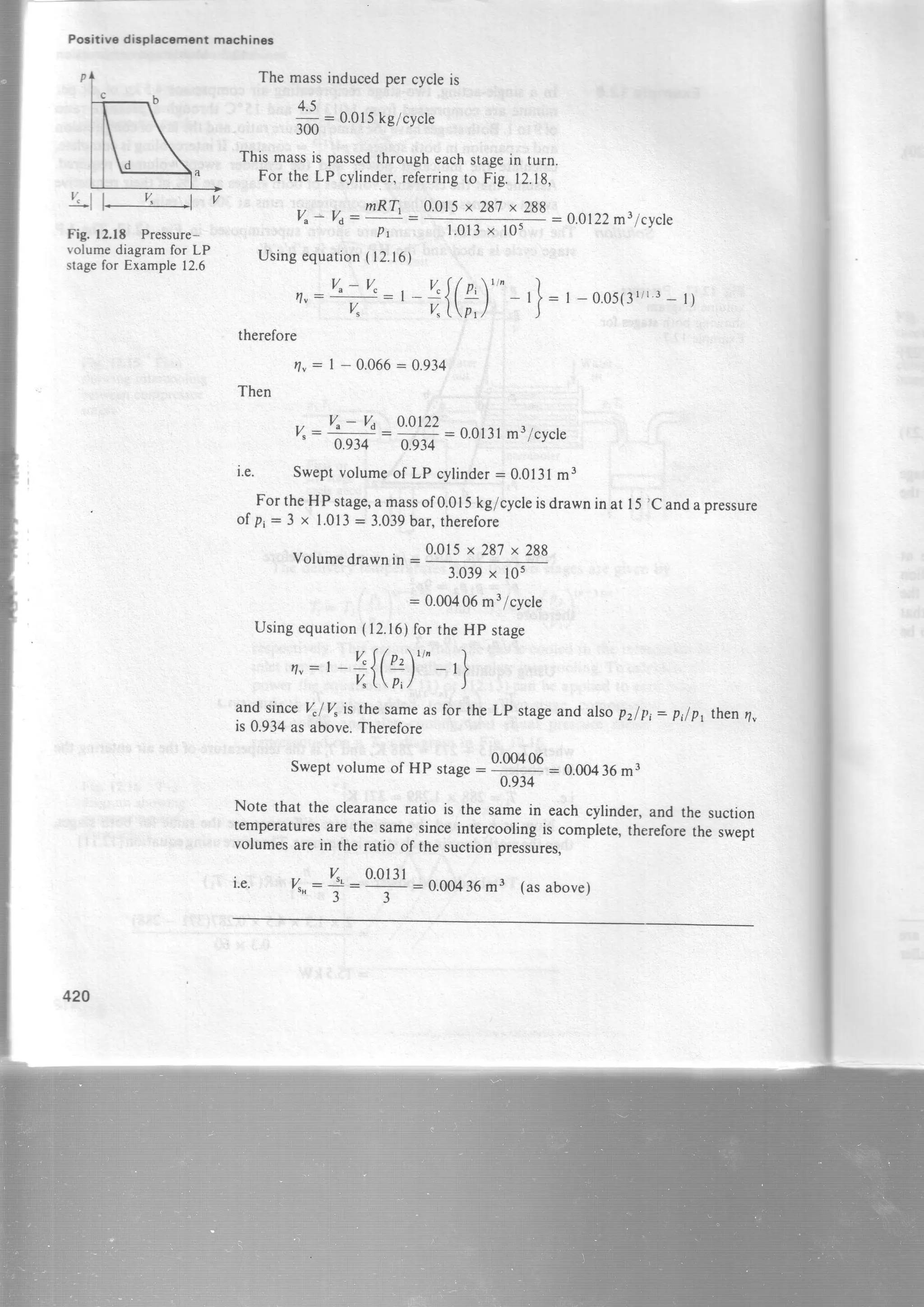
Fig. l2.IE Pressure-
volumediagramfor LP
stagefor Example12.6
The massinducedper cycleis
4.5
IOO
: 0.OtSkg/cycle
Thismassis passedthrougheachstagein turn.
For the LP cylinder,referringto Fig. l2.lg,
,, ,r mRT, 0.015x 287x 288
v^- vd:- :0.0122mtlcycle
pt 1.013x 10⁵
Usingequation( 12.t6)
V"-V^ V(/n,t'^ )
4,:#: l _ii{ a I * l l: I _0.05(3rirr_l)
v, l,.(p,) )
therefore
4,:1-0'066:0.934
Then
v^:
v'- va. 0'0122
'
0'934
=
0934
: o'0131m'/cYcle
i.e. Sweptvolumeof LP cylinder:0.0131m3
FortheHP stage,a massof0.015kg/cycleisdrawnin at l5 'c andapressure
of p,: 3 x 1.013: 3.039bar,therefore
vorumedrawn,n- o'015x 287x 288
3.039x 10⁵
: 0.00406m3/cycle
Usingequation(12.16)fortheHp stage
, , , r r rt,n
I
n.:t-!:l(-l _l>
4(p'/ )
andsinceY"lY"isthesameasfiortheLp stageandalsopzlI,i= p,lprthen4"
is 0.934asabove.Therefore
Sweptvolumeof Hp Stage:
0'00406
: 0.00436m3-
0.934
Note that the clearanceratio is the samein eachcylinder,and the suction
temperaturesare the samesinceintercoolingis complete,thereforethe swept
volumesarein the ratio of thesuctionpressures,
i.e. U":-
0'0131
:0.00436m3 (asabove)r H 3 s
t2.3 Hdthryrory-on
The ideal intermediate pressure
The value chosenfor the intermediatepressurep, influenccsthc rort to bc
doneon the gasand its distribution betweenthe stages.The onditirm for thc
work doneto bea minimum will beprovedfor two-stagecompressionbut catt
beextendedto any numberof stages.
Total work : LP stagework + HP stagework.
Thereforeusingequation(12.6)
Totalpower- J*,i,p7r{(q)'"- "" - t }n-t 'tp,/
)
(r2.18)
It is assumedthat intercooling is completeand thereforethe temperatureat
the startof eachstageis [.
i.e. Totarpower:-!=,i,p7,{(q)"-"'n-, *(&)'"-"'" - r} trr.rnln-t
'[p,/
p,/ J
lf pr, Tr, andp, arefixed,thenthe optimumvalueof p, whichmakesthe
power a minimum can be obtainedby equatingd (power)/(dp,)to zero,i.e.
optimum valueof p, when
d l( p,(r-r)/'
dp'it/
*;,nnr,{(fi)'""'"- ,}
i.e.when
+{(1)"- "''ol,-rt,+ pE,r"(t
1'"-"'"- r} : odp,(ptl p,/
-
)
therefore
,-r-rr,,(,
- l)01,,-ry,)-r
+ or-r,,,(l
- n)ol,r-"u"1-r
:0
 n /'  n J"
therefore
o-,"-,,,(';t)or',
= py-',,"(T)ou-2')/'
therefore
plztn- ltl tn - (p rp rtn
- ttta
therefore
p?= pflz {t120)
or Pi-Pz (lz2r)
Pt Pt
i.e. the pressure ratio is the same for each stage.
-(fi)'"-"'"-rl:o
lhen n,
Frctron
I sr'ept
Pooitive dispt.camslt rnachincc
Totalminimumpower:2 x (powerrequiredfor onestage)
:2 rrfrRr,i(A)'"-"'"- ,]
n-l tp'l )
or in termsoftheoverallpressureratiop,I p, ,wehave,usingequation(12.20|
p,_J;; _ la
P r P t V P t
therefore
rotalminimumpower:,,i*{(f)'"-""" -
This can be shownto extendto z stagesgiving in general,
rotalminimumpower= r-!-,antte)" "'""-'] tr2'22)
Pressureratioforeachstage:(fi)"'
'l
(12.23)
Hencethecondition for minimum work is that the pressureratio in eachstage
is the sameand that intercoolingis complete.(Note that in Example12.6the
information givenimpliesminimum work')
Example 12.7 A three-stage,single-actingair compressorrunning in an atmosphereat
t.0t3bar uiO tst tur a freeair deliveryof 2.83m3/min.The suction
pressureand temperatureare0.98bar and 32'C respectively.Calculatethe
indicatedpoweriequired,assumingcompleteintercooling n: 1.3,and that
the machineis designedfor minimum work. The deliverypressureis to be
70bar.
1.013x tos-I?'gt : i.47kg/minSolution Massof air delivercd- 1Y=:
RT
whereT=15*273:288K.
Thcnusingequation(12.221
TotalindicatedPower
287x288
=,{an"te)""'"-,}
=, *
H "
ry.9;ig{(#)"
rY(3x13}
- r}
=24.2kW
Besidesthe benefitsof multistagecompressionalreadydealt with thereare
also mechanicaladvantages.The higher pressuresare confinedto the smaller
422
F?
thrt
rcdt
ooE
intc
rz.t l{bt
cylinders and a multicylinder machine has lcss variation in mteritnl.rccd
and requiresa smallerflywheel.
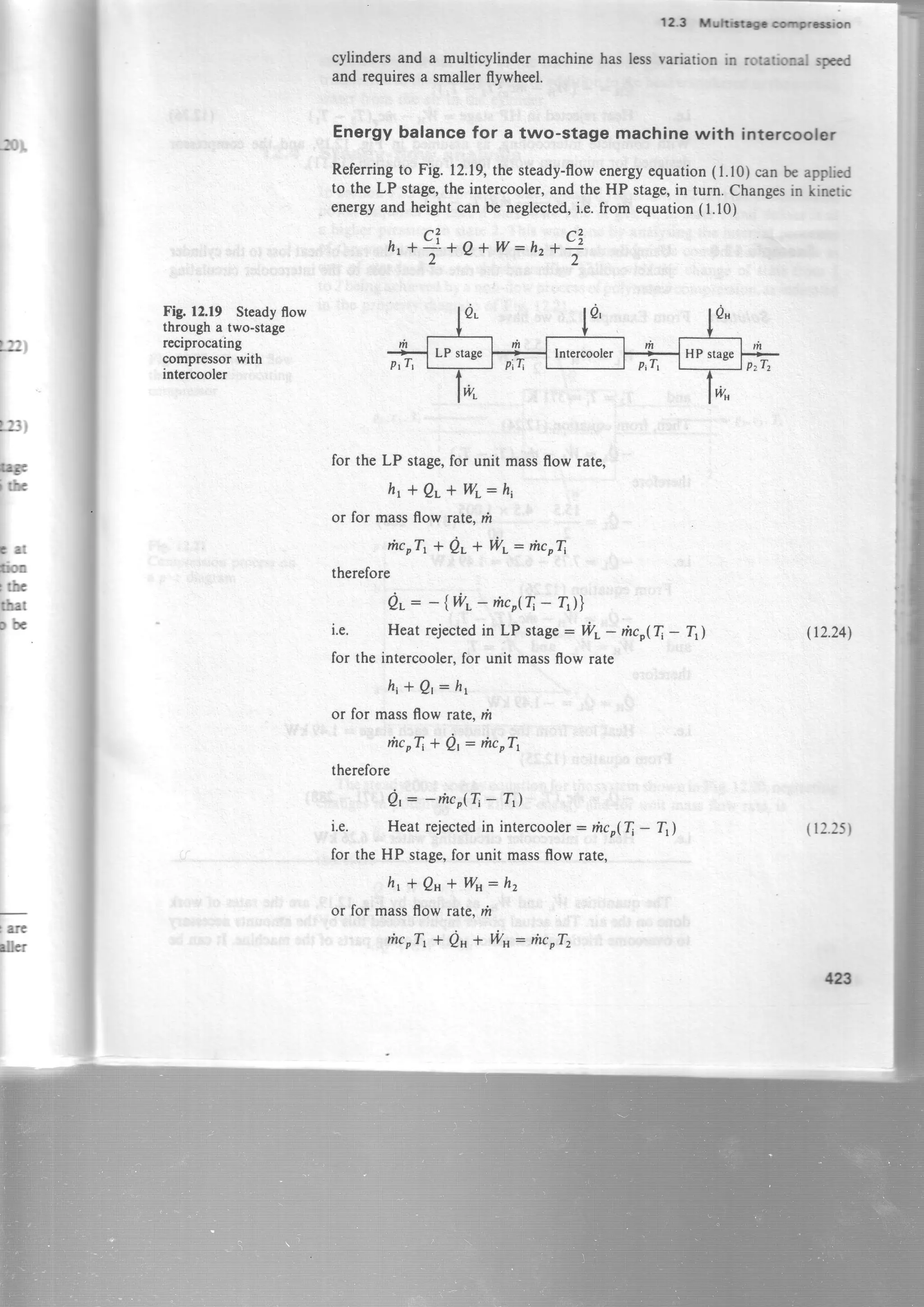
Energy balance tor a two-stage machine with intercoolcr
Referringto Fig. l2.l9,the steady-flowenergyequation(1.10)can be applicd
to the LP stage,the intercooler,and the HP stage,in turn. Changesin kiGic
energyand heightcanbe neglected,i.e.from equation(1.10)
J0r
L22l
tzil
FIB
lo
let
:iln
Irhc
tfrt
!bc
t are
rllcr
Fig. 12.19 Steadyflow
through a two-stage
reciprocating
compressorwith
intercooler
or*1-+e+w:hz++
for the LP stage,for unit massflow rate,
ht * Qt* W1,: ft,
or for massflow rate,nc
rhcrTr+Qt*Wu-rhcrTi
therefore
et: _ {frr_ *co(Tt_?i)}
i.e. Heat rejectedin LP stage: W, - rhco(T,- T)
for the intercooler,for unit massflow rate
h,+ Qr: ht
or for massflow rate.rlr
rhcoTr* Qr: rhcrTl
therefore
2r: -rhco(Tt- Tr)
i.e. Heat rejectedin intercooler= rhcp(T- Tr)
for the HP stage,for unit massflow rate,
ht * Qn* W11:h2
or for massffow rate,m
rhcrT,+ Q, t frr: rhcrT2
(r2.24)
{t2.zsl
tl'4,
Poaitivc dirplacomcnt mcchino
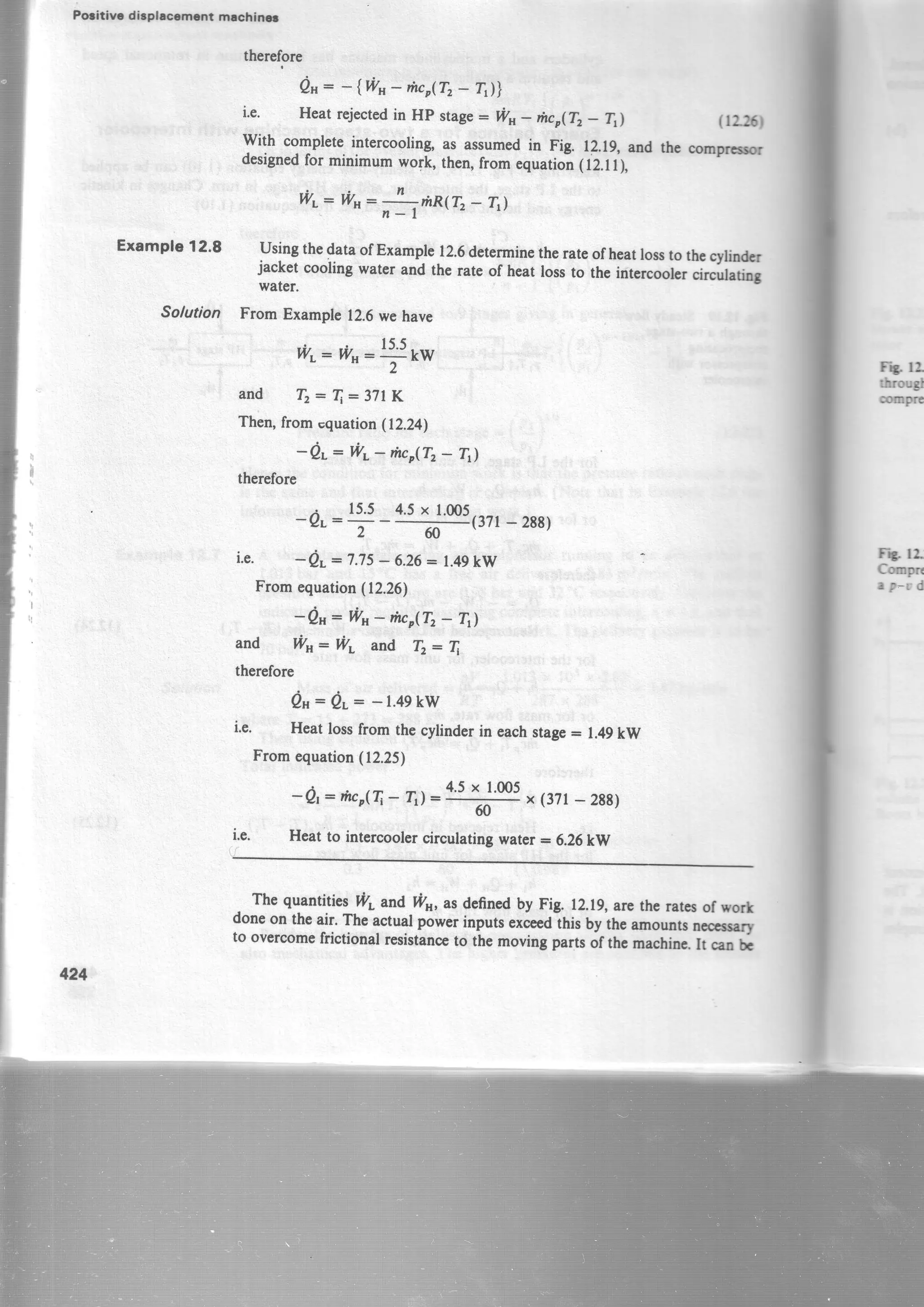
Example12.8
Solution
therefore
Aa: - {fr^ * rhcr(Tz_ ?i)}
i.e. Heatrejectedin Hp stage- W"_ nco(Tz_ Tt)
With completeintercoolingas assumedin Fig. 12.19,and thc
designedfor minimumwork,then,fromequation(iZ.ti),
tU.= Wr:;**1Tz * T,)
(l? 16)
comprct3r
Usingthedataof Example12.6determinetherateof heatlossto thecylindct
jacket cooling water and the rate of heatlossto the intercoolcrcircttating
water.
From Example 12.6we have
frr.: Wn: l5^'5
rw
2
and Tz: Tr:371 K
Then,from squation (12.24|
-Ot: ry- rhco(Ti-)
therefore
-o, : t5'5- 4'5x l'005,
71r- )
2
- --
60
-(371 - 288)
i.e. -8,. = 7.7s- 6.26:1.49 kw
'.
Fromequation(12.26)
-Au= W*- nco(Tz- T)
and lYu= Wr" and Tz: T
therefore
Qn: Qt': - l'49kW
i.e. Heatlossfromthecylinderin eachstage= 1.49kW
Fromequation(12.25)
-Qr = rhcr(T- ti) :
4'5x
-l'005x (371* 2gg)
60
i.e. Heatto intercoolercirculatingwater- 6.26kW
Fg.l?.
6rougl
@prc
F3la
Cmprr
ep-rd
. ThequantitiesWyandtr",.t definedby Fig. 12.19,aretheratesof wort
doneon theair.Theactualpowerinputsexceedthisbytheamountsnccaser,
to overcomefrictionalresistanceto themovingpartsof thcmachinc.It canbc
424
-
tL26l.
r€ssor
linder
lating
f work
o6sary
can bc
t2-a Hr-h#
assumedthat about 50% of the friction power gocsto incaasiry th u6r
transferredto thecoolingwater,in additionto thc heattransferrcdto th cotth3
waterfrom the air in the cylinder.
72.4 Steady-flow analysis
In section12.2an expressionwasobtained(equation(12.1I )) for theindicatcd
power requiredto take a massflow rate of gas,m,in state I and deliverit at
a higherpressurein state2. This wasdoneby analysingthe internalpr(rc€ss;
of the machine.Another approachis to considerthe compressionprocessas
one of steadyflow, as shownin Fig. 12.20,with the changeof statefrom I
to 2beingachievedbyanon-flowprocessofpolytropiccompression,asindicated
in the propertydiagramof Fig. 12.21.
Fig. 12.20 Steadyffow
througha reciprocating
compressor
Fig. 12.21
Compressionproccsson
a p-u diagram
+ pr,v2,Tz
Thesteady-flowenergyequationforthesystemshownin Fig.12.20,neglecting
changesin potentialand kineticenergyand for unit massflow rate,is
ht+Q+W:hz
therefore
Q+W:hz-hr
or for an elementalprocess
dQ+dW=dh ( a l
tlits
Poritivc dirplaccment machinec
426
dQ*du* pdo
Combining(a) and (b) gives
dh*du*pdu+dW
and, by definition, h: u * pu,
substituting
hencedi:dl* pdu* udp, therefore
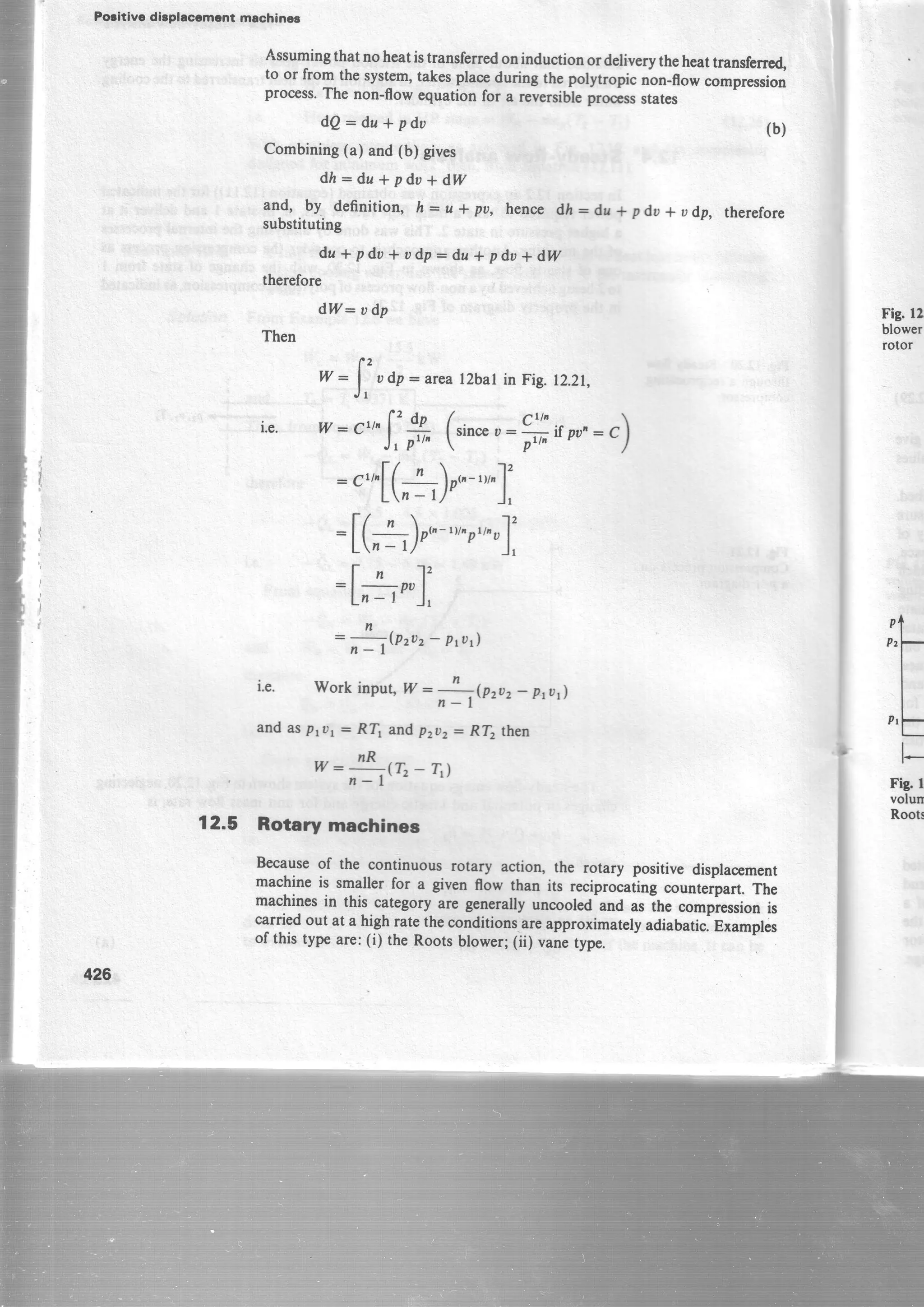
Assumingthat noheatistransferredoninductionordeliverytheheattransferrcd,
to or from thesystem,takesplaceduring the polytropic nbn-flowcompression
process.The non-ffow equationfor a reversibleproess states
(b)
du+pdu*udp:du*pdu+dW
therefore
d,W: udp
Then
* :
f' udp : arca ltbat inFig. 12.21,
J r
i.e. w-cr,fg (rin.", '''o 
Jtprt, 
':o*if ou':C)
crbf( ' "t"-,,,"1'" L, - t)0"
'"'
),
: [(-+) p"-tv,ptt^t)12
Ln- 1/' J,
t-n 12
L,J e'J,
=;to"z - Pflr)
i.e. Workinput,W ::t(pzuz _ prar)
and as ptur: R[ and pzDz: R[ then
__$ta_r,l
12.5 Rotary machines
Becauseof the
-continuous rotary action, the rotary positive displacement
machineis smaller for a given flow than its reciprocatingcounterpart.The
machinesin this categoryare generallyuncooledand asihe compiessionis
carriedout at a high ratetheconditions-areapproximatelyadiabatic.Examplis
of this type are:(i) the Rootsblower; 1ii; vanetype.
Fig. 12
blower
rotor
rf
Pr-
I
I,tf
l-
Fig r
volun
Roots
F:
r*rrE4
Fcs*E
lacement
parr-Th€
rssion is
Frernpl6
-----l
125 ncrffi
Roots blower
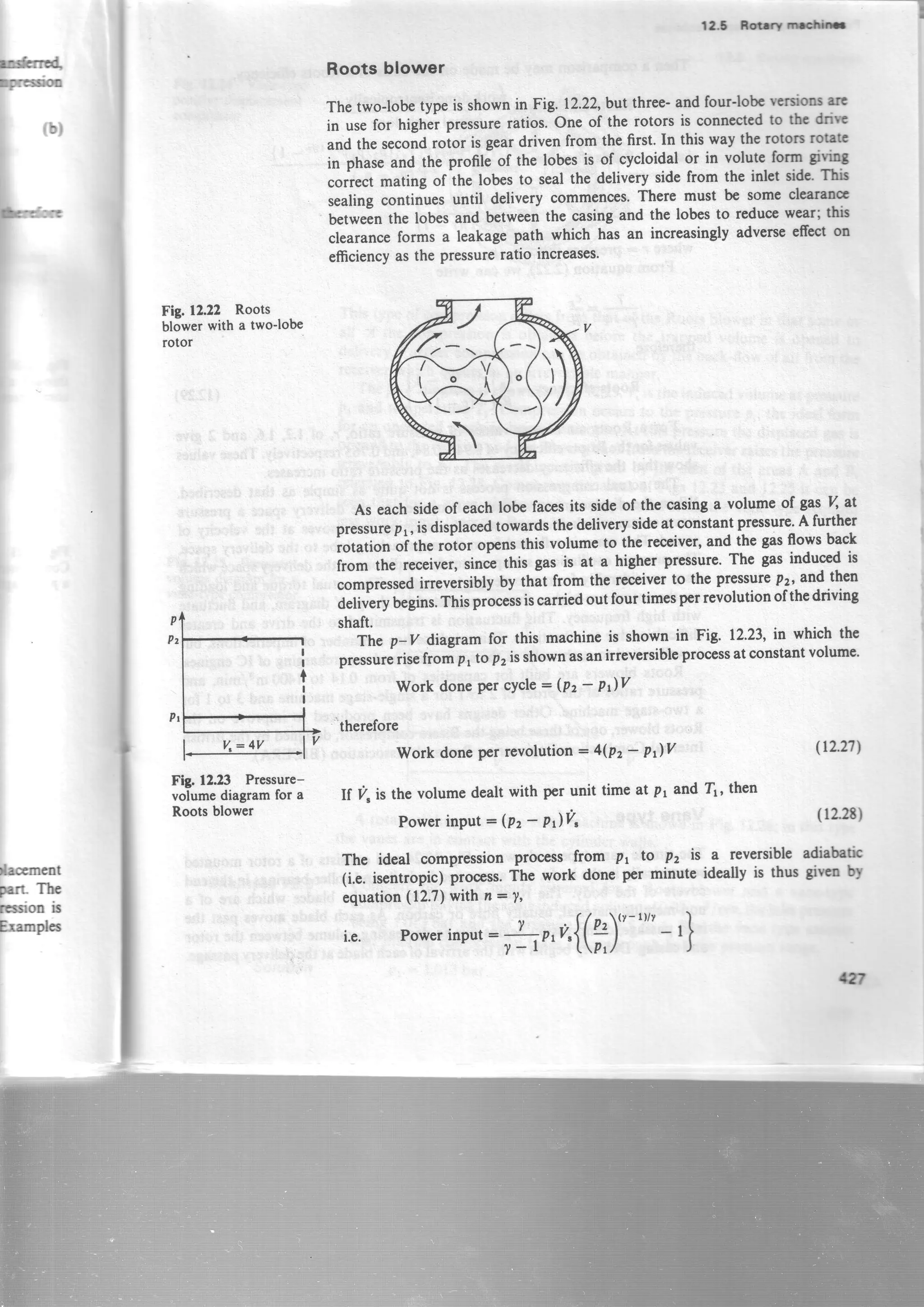
The two-lobetypeis shownin Fig. 12.22,bvtthree-and four-lobcwfsioc rlc
in usefor highei pressureratios. One of the rotors is connectedto tbc &irc
and the ..cond rotor is geardriven from the first. In this way the rotors robtc
in phaseand the profile of the lobesis of cycloidal or in volute forn giviDS
.oir..t mating of the lobesto sealthe delivery sidefrom the inlct sidc' Thb
sealingcontinluesuntil delivery commences.There must be somecl€aramc
betwein the lobesand betweenthe casingand the lobesto reducewear;thb
clearanceforms a leakagepath which has an increasinglyadverseeffecton
efficiencyasthe pressureratio increases.
As eachsideof eachlobe facesits sideof the casinga volume of gas % at
pressurepr, isdisplacedtowardsthedeliverysideat constantpressure.A further
rotation of the rotor opensthis volumeto the receiver,and the gasflowsback
from the receiver,sincethis gas is at a higher pressure.The gasinducedis
.orpr.$.a irreversiblyby that from thereceiverto the pressurep2,and th€n
deliverybegins.Thisprocessiscarriedout fourtimesperrevolutionof thedriving
shaft.
The p-v diagram for this machineis shown in Fig. 12.23,in which the
pressurerisefrom p, to p2isshownasanirreversibleprocessatconstantvolume'
Work donePercYcle- (P2- P)Y
'therefore
Fig.12.22 Roots
blowerwith a two-lobe
rotor
Fig.12.23 Pressure-
volumediagramfor a
Rootsblower
Work done Perrevolution : 4(Pz* P)V
If I/, is the volumedealt with per unit time at p1and Tr, then
PowerinPut = (P, - PrV"
The ideal compressionproc€ssfrom p, to Pz is a reversibleadiabetic
(i.e.isentropic)lrocess.The work doneperminuteidcallyis thusgwo bl
equation(12.7)withn:7'
i.e. Powerinput:J -,r,O{(fi)" "" - ,}
(tL27l
(lz2t)
tw
Pcitiyl di+|rrufi m.c.hino.
llt.e,
Then a comparisonmay be madeon the basisof a Rooe efficiency,
i.e. Rootsefficien", - work doneisentropicauy
actualwork done
Rootsefficien", ={vl0
- l)}pti"{(p.lprl'-"' -
v"(pz- pr)
_ ?,{r(r-rry- l}
(y-l)(r-l)
wherer = pr€ssur€ratio,prf pr.
From equation(2.22),we can write
T Co
: i
v-l R
therefore
Rootsefficien.n= 1l{i'': rl,-
R[ (r-l) J
(r2.2e)
For a Roots air blower valuesof pressureratio, r, of 1.2,1.6,and 2 g.vevaluesfor theRootsefficiencyof 0.945,b.g4,and0.76i respectinety.rrr"s" varuesshow that the efficiencydecreasesasthe piessureratio increases.
actual compressionprocessis not quite as simple u, inu, described.
when the displacementvolume z is openedto the aefiveryspacea pressure
wave enterswhich increaseswith the opening and moves'u,'tr,. vetocityofsound.This waveis reflectedfrom the upprou"ttinglobe to the Jelvery space.Thepressureoscillationssetup unsteadyconditioni in trreaeiiueiyspacewhichvary considerablyfrom one designto another.The actualtorqu. and roadingonthe.rotors are higher.thanisiuggestedby thep-v diagrai,and fluctuate
y.r:h ligh
frequency.This fluctuation ir transmittedto the drive and crearerdifficultiesdue to vibrations.This machinehasa numberoi i.p"rr*,iong butis well suitedto suchtasksasthe scavengingand superchargingofIC engincr
Roots blowersare built for_capacitie-sJf fro* d.t+ to
"-6lrTrniq
,ndpressureratios of the order of 2 to l for a single-stage,".rrin"-*o 3 to l fora two-stagemachine._otherdesignshave beenproducedto improve on thcRootsblower'oneof thesebeingthe Biceracompressor,designedby theBritishInternal combustion EngineeringResearchAssociationtnr"cBne l
vanetype
The simplevanetype is shown in Fig. 12.24andconsistsof a rotor mountcdeccentricallyin the body,and supporrcdby ba[- and rolrer-beaii* t thc codcoversof the body. The rotor is srottedto take the bradeswhich are of anon'metallic material,usually fibre or carbon.As eachbladc moveepo$ thcinlet passage,compressionbeginsdue to decreasingvolune betruro thc rotorandcasing.Deliverybeginswith thearrivarofeachbradcat tncoairrry poscagc.
428
Fig. ll
positir
comp
F[.12
volum
vane-t
lEi
' rt2lf
Irod]ai
Thtrr-
iroiH
l i l
dq
-
3pth
C
tur-l
rcT
pt ir &t
lir.*d
FE$r
i:r*r
hrl r
Fig 12.24 Vane-type
positivedisplacement
compressor
F.ry.12,25 Pressure-
volumediagramfor a
YAne-typecompressor
Example 12.9
Solution
12.6 nArr rn*r
IEl,
Krq
t n ,
This type of compressiondiffersfrom that of the Rootsblowerin that someor
all of the compressionis obtained beforethe trapped volume is openedto
delivery.Further compressioncanbeobtaineduy ttri back-flowof air from the
receiverwhich occursin an irreversiblemanner.
Thep-v diagramis shownin Fig. rz.2s.v"is theinducedvolumear pressure
pr and temperature[. compressionoccursto the pressurep,, thc idealform
for an uncooledmachinebeingisentropic.At this prissurethl'displacedgasis
openedto thereceiverandgasflowing backfrom thereceiverraisejtheprJrrur"
irr-eversiblyto pr. The work input is given by the sum of the areasA and B,
referringto Fig. 12.25.comparing the areasof Figs 12.23and 12.2sit can be
seenthat for a given airflow and given pressureratio the vanetyp€ requires
lesswork input than the Roots blower.
A rotary slidingvanetwo-stagemachineis shownin Fig. 12.26;inthis typc
the vanesare in contact with the cylinder walls.
compare the work inputs required for a Roots blower and a yane-typc
compressorhavingthesameinducedvolumeof 0.03m3/rev,theinlct prc rc
being 1.013bar and the pressureratio 1.5to l. For the vaoetypc ernc
that internal compressiontakesplacethrough half the pressurerrqla
Pr : 1.013bar
Hth,! dbplsmrnt machlncl
F1E",l?lS Rotary
sliding vanetwo-stage
positivc displacement
compr€ssor
430
therefore
Pz: 1.013x 1.5: l'520bar
For the Rootsblower,referringto Fig. 12.23
Work doneperrevolution: (pz- pt)V"
:(l.s2o-1.013)"
l%P
:1.52kJ/rev
For thevanetype
(1.5x 1.013)+1.013
h= *--**-T--
Referringto Fig. 12.25
= 1.266bar
Fi3I
podti
vrcuuWorkrequired: (areaA + areaB)
Nowusingequation(12.7)withn: Y
areaA:fir,*{(fi)" ""-,}
r.4 1.013x lOsx 0.03ff!g)"
-'''n
_ ,l nr/r.":
dJ
, ___
lo3 l!ot3/
,
J
^"
: 0.?0kJlrev
areaB:(pr- p)Yv
whereZ, is givenby equation{3.19),
i.e.
":
r(?)"': o.o,. (i#)"'
-
: 0.0256m3
i.e. areaB= (1.520- t.266')x 102x 0.0256kJ/rev
: 0.65kJ/rev
l2.l YUF
therefore
Workrequired:0.70 + 0.65: 1.35kJ/rev
(compared'withtheworkrequiredfor theRootsmachineof 1.52kJ/rw}
Rotary sliding vanecompressorsare usedwith freeair deliveriesof up to
150m3/min and pressureratios up to 8.5to 1. For specialapplicationsard
boosting,pressureratios of the order of 20 to I havebeenobtainedfrom thiq
type.The largermachinesare usuallywater-cooled.
Lubrication is important with vane'typemachinesand is accomplishedby
injectingoil to the vanetips in contactwith thecasing.Somemachines,having
carbonvanes,requireno lubrication.Anotherversionis designedto reducethe
friction betweenvaneand casing.This employsa ffoatingdrum which rotates
betweenthe rotor and casing,and doesnot allow the vanesto makecontact
with the casing.The only movementof the bladesrelativeto thefloatingdrum
is alongthe slots.SeeFig. 12.26.
12.6 Vaeuum pumps
Rotary positive displacementpumps are used to produce a vacuum or to
scavengea vessel.An exampleof this typeof pump is shownin Fig. 12.27.The
rotor is eccentricallymountedin thestator andcarriestwo bladeswhichsweep
thespacebetweentherotor andstator.Thegasbeingexhaustedentersthrough
{31
W,12.27 Rotary
positivedisplacement
Yacuum"pump
I
lrat
- - t l
--l l/--l*l l.-
-t
// //  l---
_:l /l //  l;
--l /t ;$*o,o.il l:
__l  /A -/t/l---
__l v
---'
,/ l_-:1
Pocitive dirplacement machines
432
thevacuumconnectionandiscompressedbeforedelirer.r-throughthedischarge
valve.Theefficiencyof suchpumpsis impairedby thepresenceof condensable
vapours,and meansmust be providedto deal with rheserf necessary.The
vapourstendto condensebeforedeliverythroughthedischargeralveandmix
with the sealingoil. The liquid eventuallyevaporatesinto rhe.,a;uums-y-stem
and lowers the vacuum obtainable,as well as impainng liie .eailng and
lubricatingpropertiesof the oil.
12.7 Air motors
Compressedair is usedin a widevarietyof applicationsin industry.For some
purposesair-operatedmotorsarethe mostsuitableformsof power,especially-
wheretherearesafetyrequirementsto bemet asin miningapplications.
Pneumaticbreakers,picks,spades,rammers,vibrators,riveters,etc.form a
rangeof handtoolswhichhavewideapplicationsin constructionalwork.The1.
are light in constructionand suitablefor operationin remotesituationsfor
which otherformsof powertoolsmay not be suitable.The actionrequiredof
such tools,with the associatedsimplicityand robustnessof construction,is
obtainedwith air-operateddesign.
Basicallythecyclein thereciprocatingexpanderis thereverseof that in the
reciprocatingcompressor.Air is suppliedto theair motor from an air receiver
in which the air is at approximatelyambienttemperature.Thereis a pressure
drop in theair linebetweenthereceiverandthemotor.Theair expandsin the
motor cylinderto atmosphericpressurein a mannerwhich is polytropic(i.e
theexpansionisinternallyreversibleandthelawofexpansionispun- eonstanl
wheren < y, and is usuallyabout 1.3).If the air is initiaiiy at ambienr
temperature,then this form of expansionwill bring alnut a reduction
in theair temperatureaslowerpressuresarereached.Thetemperaturesreached
may be sufficientlylow to be belowthe dew-pointof the moisturein the air
(seesection15.2);thismoisturemaybecondensed,andthewaterformedma1-
evenbecooledto itsfreezing-point.Thismayleadto theformationof icein the
cylinderwith theconsequenceof blockedvalves.To preventthisconditionir
may be necessa.ryto preheatthe air to an initial temperaturewhichis h;5r,
enoughto preventtheformationofice.Thisheatingoftheaircausesanincrease
in volumeat thesupplypressureandreducesthedemandfrom thecompressor.
Further,the temperatureat which the heattransferis requiredis low, and a
low-gradesupplyof heator 'wasteheat'may be utilizedlor thepurpose.
A hypotheticalindicatordiagramfor an air motor is shownin Fig. l2i:
In thiscasetheair expandsfrom I to thepressurep, at theendof thestroke
Thereis thena blow-downof air from 2 to 3.Air is exhaustedfrom3 to 4.and
at4 compressionof thetrappedor cushioncir begins.Air at thesupplypressure.
pu,is admittedto thecylinderat the point 5 whereit mixesirreversiblr*rrl
thecushionair.Thepressurein thecylinderis rapidlybroughtup ro therni.:
value,pu.The furthersupplyof air is madeat constantpressurebehindrhe
Fig. 12.28
volumedie
air motor
Ex
I
lr etc hc
ll rort-
situanc
m requird
Dnstructili,
!of that is tE
F eu rE(drlt
I * a pressrr
Feands in ft
follrropic (ia.
l'= constelt,
y at ambicc
I a ieduai<rr
rtures reachod
[rre in the air
r formedmay
n of icein thc
b conditionir
rhich is h;sir
Esan increasc
I Compressor.
b low. and a
Purpose.
in Fig. 12.28-
of thestroke.
m3to4.and
pply'pressurq'
crersiblywith
tp ro theinlet
re behindthe
Fig. 12.28 Pressure-
volumediagramfor an
atr motor
Example12,10
Solution
12.7 Airlnoton
movingpistonto the point of cut-offat l. The cut-offratio is givenby
cut-off ratio :
vt - va
Vt-Vu
Theeffectof thecushionair is to givea smoother-runningmotor.Theposition
of thepoint 5 dependson thepoint of initial compression4, andon thelaw of
compressionpYn= constant.The conditionsmay be suchthat the points5
and 6 coincide,
The analysisof sucha diagramis bestcarriedout from basicprinciples,as
illustratedin the followingexample.
Thecylinderof anair motorhasa boreof 63,5mm anda strokeof 114mm.
Thesupplypressureis6.3bar,thesupplytemperature24'C,and theexhaust
pressureis 1.013bar.Theclearancevolumeis 5% of thesweptvolumeand
the cut-offratio is 0.5.The air is compressedby the returningpistonafter
it has travelledthrough 0.95of its stroke.The law of compressionand
expansionis pVr'3 : constant.Calculate:
(i) the temperatureat theendof expansion;
(ii) the indicatedpowerof themotor whichrunsat 300rev/min;
(iii) the air suppliedperminute.
(i) Referringto thecycleof Fig. 12.28
Clearancevolume- Vo: Vs:0.054
Sincethe cut-offratio,( - y)l(V! - Izu),is 0.5,therefore
 : 054 + 0.05t/": 0.55Y"
Vz: 4't Vu: 1.954
Now
V, - Vu: 0.95(Vt - Vt) (given)
or Vn- Vt: 0.054
{s
rb
-
!-
I
Porhivs dirplaccment machinee
(ii) Now
( v o  ' / n |  r ' 3
,,:r,i) = ror3(oosa
)
:2.4e4bar
Workoutputpercycle: area1234561
workoutput: Pr(v, - vu)+ (p'vt
-
!.l,vt-
 n-l /
-P,(v,-v)-(ry#!)
therefore
Ve,= 0.054+ 0.05Y.: 0.1I/,
P t V  : p 2 V n
therefore
also
i.e.
- (1.013x 105x 0.361
105x0.361x10*3
o,:r,(2): u,(m)": 2ltlbar
rz:r,(2)'
'
:2e?(ffi)": 244.6K
Temperatureafterexpansion:244.6 - 273= -28.4"C
t '
and Sweptvolume:
nx63.52xll4
4xlOe
: 0 . 3 6 1 x l 0 - 3 m 3
therefore
Work output per cycle
: (6.3x lOsx 0.361x l0-3 x 0.5)
lOsx0.361xl0-3
*
O:
{(6.3x 0.55)- (2.718x 1.05)}
rb nD
Cherrtcr
mll yag
ntor: (e
F€!4 (b)
(c) eir cq
TGcd
x l0-3 x 0.95)
U2.4e4x 0.05)- (1.013x 0.1))
0.3
i.e. Workoutputpercycle: I 13.7+ 73.5* 34.7- 2.8
:149.7 Jlcycle
Powerdeveloped=
-I1*#
: 0.749kw
(iii) The massinducedper cycleis given by (n'r,- m+).It is necessaryto
determinethe temperatureof theair at 4,whichcanbetakenasequalto that
03
tt
3 0 2
I
.
ol
I
494
b
It
P: 7 bar
llt Abffirr
at3.It isassumedthattheairinthecylindcratthepoint2cxpandsircotropi(dt
to theexhaustpressur€.Therefore
t.e.
1.013x 105x 0.0361x l0-3
287x 184.5
6.3x105x0.55x0.361
:0.0691x 10⁻³kg
x l0-3
287 x 297
= 1.4675x l0-3 kg
therefore
Inducedmasspercycle: (1.467S x l0
- 3)_ (0.0691x l0
- 3)
: 1.398x 10⁻³kg
i.e. Massflow rateof air supplied: 1.39gx l0-3 x 300: 0.42kg/min
"
=
"(?)1'-"t'
- 144r(#)0'4lr'4 : 184.5K
^n=W,:
^, _PrVr _-
R?i
Air motorscanbe rotaryin actionandarethensimilarin form to their
com_pressorcounterparts,seesection12.5.Figure12.29(al,(b), and(c) show
theformsof theperformancecharacteristicsola small,0.tkw; vanetypeair
motorin termsof power/speed,torque/speed,andair consumpiion/speei.nn
air motorwhichreceivesair froma constintpressuresupplycanbecontrolled
to meettheloadrequirementsby fittinga restrictoreitlir beforeor afterthe
motor. It can be shownby a considerationof a simplifid p-v diagram,
neglectingclearance,thatfittingtherestrictorbeforethemotorrequiresalower
airffowthanfittingit after.Thereadershouldestablishthisforhimselfandalso
showthattheairflowraterequiredisapproximatelyproportionalto thesupply
pressureto themotorfor agivenduty.Figure12.30showstheresultsofatCt
on a smallair motorwhichgivesa Zsvoreductionin air requirementif the
restrictoris on theinletsideto themotor.
ju. rT,
Cheracteristicsof a
rrnrll ya6-1yp" 6t
Eotor: (a) power-
tpocd,(b) torque-spoed,
(c) air consumption-
Toed
2 4 6 8
Sp€ed/103(revlmin)
{ a)
2 4 6 8
Speed/103(revlmin)
(b)
2 4 6 8
Speed/103(revlmin)
(c)
3r
.E6
A <
t
e1o
o
. ! 3
0.3
tJ
b 0.2
'
A
435
Pcative displacement machines
Fig. 12$ Test results
for a vane-type air
motor with restrictor
control (no load)
43q
o t
100 r50 200
Speed/( rev/min )
Problems
12.1 Air is to becompressedin a single-stagereciprocatingcompressorfrom 1.013bar and
I 5"C to 7 bar.Calculatetheindicatedpowerrequiredforafreeairdeliveryof0.3m3
/min,
whenthe compressionprocessis asfollows:
(i) isentropic;
(ii) reversibleisothermal;
(iii) polytropic,with n = 1,25.
What will bethe deliverytgmpelalyr.e-ineachcase?
(1.31kW; 0.98kW; 1.20kW; 221.3"C:l5 "C; 150.9"C)
12.2 The compressorof Problem l2.l is to run at l0O0rev/min. If the compressoris
single-actingand hasa stroke/boreratio of 1.2/1,calculatethe boresizerequired.
(68.3mm)
12.3 A single-stage,single-actingair compressorrunning at 1000rev/min deliversair at
25bar.For thispurposetheinductionandfreeair conditionscanbetakenas 1.013bar
and 15'C, and the FAD as 0.25mr/min.The clearancevolumeis 3% of the swept
volumeandthestroke/boreratiois 1.2/1.Calculate:
(i) theboreandstroke;
(ii) the volumetricefficiency;
(iii) theindicatedpower;
(iv) theisothermalefficiency.
Take the indexof compressionand re-expansionas 1.3.
(73.2mm;87.8mm;67,1Voi2kW:67.7YoI
12.1 The compressorof Problem12.3hasactualinductionconditionsof I bar and 40"C,
and the delivery pressureis 25bar. Taking the bore and stroke as calculatedin
Problem12.3.calculatetheFAD referredto 1.013barandI 5'C andtheindicatedpower
required.Calculatealsothe volumetricefficiencyand compareit with that of Problem
l2'3'
{0.226mrlmiH;1.98kW;6t.Zoh;67.i%l
Restrictoron,inlet slde
)t3 x: atd
l-1nl mn
I
l: 15o.9'Cl
Dpressor b
quired.
r 6 8 3 m m f
hers air at
x I 0ll bar
f rhc swepr
t$i:.67-7%l
end tlo'C,
*:ulated in
leted power
of Problern
ttt.: 67.7oh
Frotbr
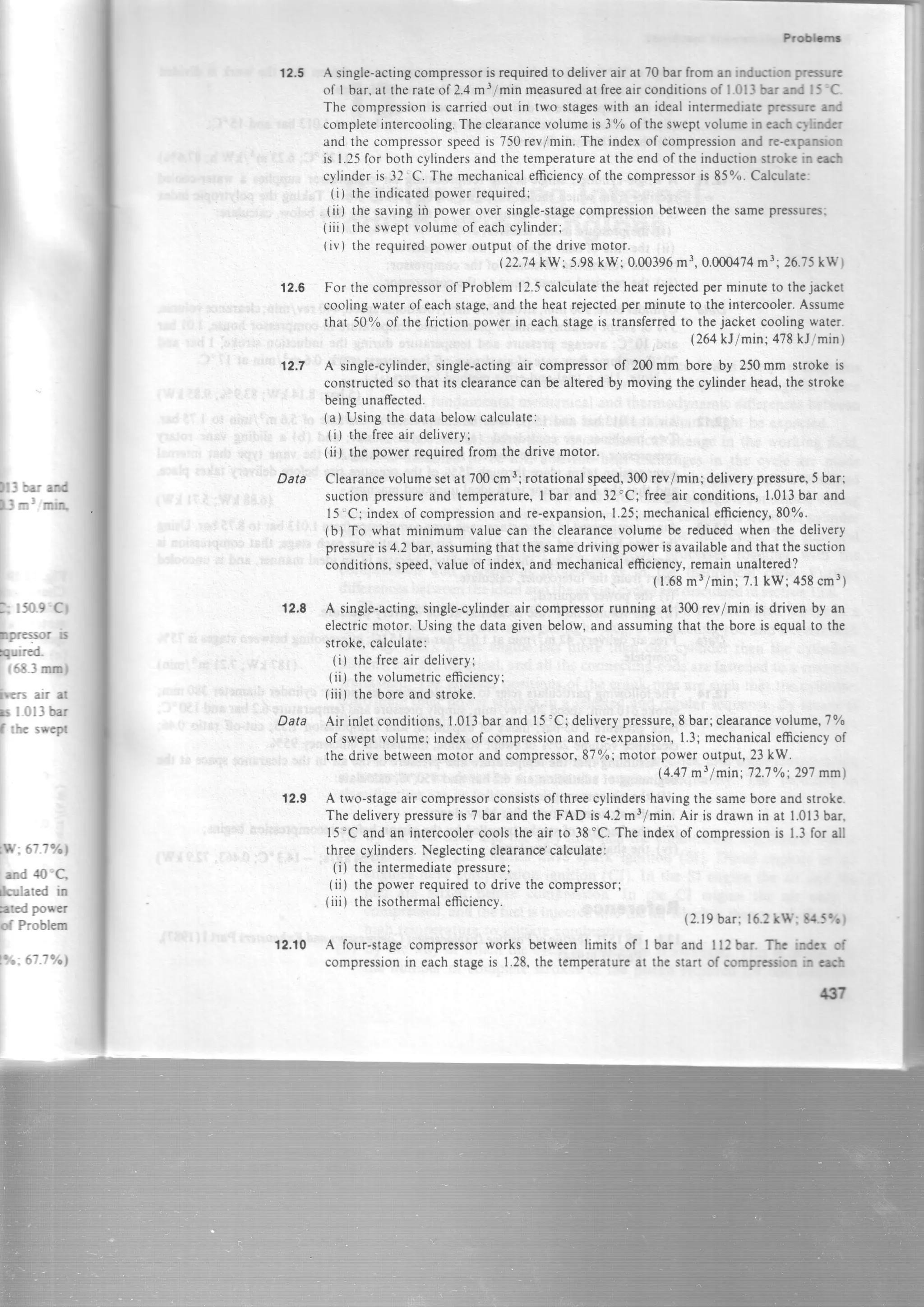
12.5 A single-actingcompressorisrequiredto deliverair at 70bar from anindlrctim prtsnrrc
of I bar,attherateof2.4mr/minmeasuredatfreeairconditionsofl.0l3berrDdt5'C-
The compressionis carried out in two stageswith an ideal intermcdiarcprcsure eld
completeintercooling.Theclearancevolumeis 3% of thesweptvolumein cact c1tlitrdct
and the compressorspeedis 750rev/min.The indexof compressionand re+rplrirn
is I.25for bothcylindersandthetemperatureat theendof theinductionslrolc itract
cylinderis 32'C. The mechanicalefficiencyof thecompressoris 857o.Cdcularc:
(i) theindicatedpowerrequired;
(ii) thesavingin powerovei single-stagecompressionbetweenthesamepressurcs;
(iii) thesweptvolumeof eachcylinder;
tiv) therequiredpoweroutputof thedrivemotor.
(22.74 kW;5.98kW; 0.00396m3,0.000474m3;26.75kW)
12.6 For thecompressorof Problem12.5calculatetheheatrejectedperminuteto thejacket
coolingwaterof eachstage,andtheheatrejectedperminuteto theintercooler.Assume
that 50% of the frictionpowerin eachstageis transferredto thejacketcoolingwater.
{264kJ/min;478kUmin)
.2.7 A single-cylinder,single-actingair compressorof 200mm bore by 250mm strokeis
constructedsothat itsclearancecanbealteredby movingthecylindcrhead,thestroke
beingunaffected.
(a) Usingthedatabelowcalculate:
(i) thefreeair delivery;
(ii) the powerrequiredfrom thedrivemotor.
Data Clearancevolumesetat 700cm3lrotationalspeed,300rev/min;deliverypressure.5 bar;
suctionpressur€and temperature,I bar and 32"C; freeair conditions,1.013bar and
l5'C; indexof compressionandre-expansion,1.25;mechanicalefficiency,8070.
(b) To what minimum valuecan the clearancevolumebe reducedwhenthe delivery
pressureis4.2bar,assumingthatthesamedrivingpowerisavailableandthatthesuction
conditions,speed,valueof index,and mechanicalefficiency,remainunaltered?
(1.68m3/min;7.1kW; 458cm3)
12.8 A single-acting,single-cylinderair compressorrunningat 300rev/minis drivenby an
electricmotor.Usingthedatagivenbelow,andassumingthattheboreis equalto the
stroke.calculate:
(i) thefreeair delivery;
(ii) thevolumetricefficiency;
(iii) theboreandstroke.
Data Air inletconditions,1.013barand15'C; deliverypressure,8 bar;clearancevolume,TTo
of sweptvolume; indexof compressionand re-expansion,1.3;mechanicaleffciencyof
thedrivebetweenmotorandcompressor,8770;motorpoweroutPut,23kW.
(4.47m3/min; 72.7%; 297mm)
12.9 A two-stageair compressorconsistsof threecylindershavingthesameboreandstroke.
Thedeliverypressureis 7 bar andthe FAD is 4.2m3/min.Air is drawnin at 1.013bar,
15"Candan intercoolercoolstheair to 38"C.Theindexof compressionis 1.3for all
threecylinders.Neglectingclearance'calculate:
(i) theintermediatepressure;
(ii) thepowerrequiredto drivethecompressor;
(iii) theisothermalefficiencv.
(2.19bar; 16.2kIY: tL5%)
12.f0 A four-stagecompressorworks betweenlimits of I bar and ll2bar. Thc indgr of
compressionin eachstageis 1.28,the temperatureat the start of comprereionin crh
4{r
Positive displacement machines
stageis 32'C, and the intermediatepressuresare so chosenthat the work is dividdl
equallyamongthe stages,Neglectingclearance,calculate:
(i) the temperatureat deliveryfrom eachstage;
(ii) the volumeof freeair deliveredper kilowatt-hourat 1.013bar and 15'c;
(iii) the isothermalefficiency.
(122'C;6.23m3/kWh; 87.6%)
'12.11 A single-cylinder,single-actingreciprocatingair compressorsuppliesa water-cooted
receiverfrom which the air is drawn off for processwork. Taking the polytropic indcr
of compressionand re-expaqsionas 1.3,and usingthe data below,calculate:
(i) the pressurein the receiver;
(ii) the rateofheat rejectionfrom the receiver;
(iii) the volumetricefficiencyof the compressor;
(iv) the requiredpower input to thc compressor.
Data Cylinderbore,200mm;stroke,250mm;rotationalspeed,440rev/min; clearanccvolumc,
57oof sweptvolume;ambientpressureand temperaturein compressorhouse,l.0l bar
and l0"C; averagepr€ssureand temperatureduring the induction stroke, lbar and
20'C; volumeflow rateof air drawn off for processwork, 0'6m3/min at 17"C.
Note: Usea trial-and-errormethodfor part (i).
(5 bar;8.14kW; 83.9%;9.85kW)
12.12 Air at l.0l3bar and 15'c is to be compressedat the rateof 5.6m3/minto l.75bar.
Two machinesare considered:(a) the Roots blower; and (b) a sliding vane rotary
compressor.Compare the powersrequired,assumingfor thc vane typ€ that internal
compressiontakesplacethrough 75% ol the pressurerisebeforedeliverytakesplacg
and that the compressoris an ideal uncooledmachine.
(6.ggkw; 5.71kw)
12.13 Air iscompressedin a two-stag€vane-typecompressorfrom 1.013bar to 8.75bar' Using
the data below,and assumingequal pressureratios in eachstage,that compressionis
completein eachstage,that the rnachineoperatesin an idealmanner,and is uncoolcd
apart from the intercooler,calculate:
(i) the powerrequirod;
(ii) the volumeffow rate measuredat the delivcrypr€ssure.
Data Freeair delivery,42m3/min at 1.013bar and l5'C; intercoolingbetweenstagesis 757.
comPlete. (lE? kw; z.2l m3/miD)
12.14 The following particularsreferto a single-actingair motor: cylinderdiameter380mm;
stroke610mm;speed200rev/min; supplypressureandtcmperatwe6.2bar and 150"C;
back pressure1.03bar; index of expansionand compression1'35;cut-off ratio 0.46;
clearancevolume 2Ao/oof sweptvolume;mechanicalefficiency95%'
Assumingthat the temperatureand pressureof thc air in the clcarancespaceat thc
beginningof admissionare6.2bar and 150"C,calculate:
(i) the air consumPtion;
(ii) the air tcmperatureaftcr blow-down;
(iii) the fraction of stroke travclledby the piston bcforerecomprcssionbegins;
(iv) the shaftpowerdevelopcd.
(0.54kg/s; _ 14.3"c; 0.463;72.9kw)
Reference
l2.l BS1571Testingol PositiveDisplacementCompressorsandExhaustersPartI (1987|
Part II (1984).
tt38

Applied thermodynamics by mc conkey (ed 5, ch-12)

  • 1.
    12 PogitiveDisplacementMachines The functionof acompressoris to takea definitequantityof fluid (usuallya gas,and most oftenair) and deliverit at a requiredpressure.The mostefficient machineisonewhichwill accomplishthiswith theminimuminput of mechanical work. Both reciprocatingand rotary positivedisplacementmachinesare used for a varietyof purposes.On the basisof performancea generaldistinctioncan be madebetweenthe two typesby definingthe reciprocatingtype as having the characteristicsof a low massrateof flow and high-pressureratios,and the rotary type as having a high massrate of ffow and low-pressureratios. The pressurerangeof atmosphericto about9 bar is commonto both types. Somerotary machinesaresuitableonly for low-prcssureratio work, andare applied to the scavengingand superchargingof engines,and the various applicationsof exhaustingand vacuum pumping. For pressuresabove9 bar the vane-typerotary machinecan be usedto supply boost pressures,but for sustainedhigh-pressurework up to 500bar and above,for specialpurposes, the reciprocatingtype is used. Both basic types exist in many difrerent forms each having its own characteristics.They may be singleor multistage,and haveeitherair or water cooling.The reciprocatingmachineis pulsatingin action which limits the rate at which fluid can bedelivered,but the rotary machineis continuousin action and doesnot havethis disadvantage.The rotary machinesare smallerin size for a given flow, lighter in weight and mechanicallysimpler than their reciprocatingcounterparts.The treatmentand scopeof the following sections is fundamental and is not exhaustive.Many compressorsare designedto overcome the deficienciesof the basic machines and to satisfy spccid requirements.For descriptionsof thesemachinestheexcellentliteraturesupplied by the manufacturersconcernedshouldbe consulted. For a compressorwhich operatesin a cyclic or pulsatingmanner,suchrs a reciprocatingcompressor,the propertiesat inlet and outlet arc thc averiNgc valuestaken over the cycle.Alternativelythe boundary of the control vslrrrrp is chosensuchthat statesI and 2 areconstantwith time,the positioossdcrld beingremotefrom the pulsatingdisturbance.
  • 2.
    br*-drrltm*nrn- rt l?-r Singlc-acting(a) and doublc-acting(b) rcciprocatingair comprcssors & 72.1 Reciprocating comprossors Typical reciprocatingcompressorcylinder arrangem€ntsare shom i Fig.I2.I (a)and(b).Themechanisminvolvedisthebasicpiston,connecting-m{, FE IZ volume 'rccipro comprc clearan Rctiivcr...+-pressurc -;> Induction E Atmospheric +- pressurre He8E o' To reccivcr or next stage Double-acting compressoror stage "tll!,,and cylinderarrangement.Initially the clearancevolumein thecylindcr will be considerednegligible.Also the working fluid wilt be assumedto bc e perfectgas.The cycle takesone revolution of the crankshaftfor compkrir and the basicindicatordiagramis shownin Fig. 12.2. Thevalvesemployedin mostair compressorsaredesignedto giveautometb action. They are of the spring-loadedtype operatedby a small differere i pressureacrossthem, the light spring pressuregiving a rapid closingactir
  • 3.
    try-.lzz Pressurc- volumediagramfor a rcciprocating compressorwith clcaranceneglected letfrclrrtr;n The lift of the valvg to give th€ required.air0ow should,be assmall aspossiblc and shouldoperatewithout shock. In Fig. 12.2the line d:-a representsthe induction stroke.The massin the cylinder increasesfrom zero at d to that requiredto fill the cylinder at a. In the idealcasethc tcmperatureis constantat T1for this processand thereis no :heatexchangewith the surroundings.Induction commdnceswhcnthe pressure differenceacoss the valve is sufficientto opcn it. Line abc representsthe compressionand delivery stroke, As the piston begrns'its return stroke the pressurein thecylinderrisesandclosestheinletvalve.Thepressurerisecontinues with the returning piston as shownby line ab until the pressureis:reachedat which the deliveryvalveopens(a valuedecidedby the valveand the pressure in the receiver).The deliverytakesplaceas shown by the line bc, which is a processat constanttemperatureT2,constantpressurep7, zQtoheatexchangg and decreasingmass.At the end of this strokethe:cycleis repeated.The value of the deliverytemperature?r dependsupon the law of compressionbetween a and b, which in turn dependsupon the heatexchangewith the surroundings during this process.It may be assumedthat the generalform of compression is the reversiblepolytropic (i.e.pV' = constant). The net work donein the cycleis givenby the4reaof thep-V diagramand is the work done on the gas. Indicatedwork done on the gasper cycle : afeaabcd : area abef* area bcOe- area ad0f /El F tEnr rr* I I *-r*i h:-5c :fffi rec ro bt
  • 4.
    I I turir d-pLcrnfit mac{rincr Le. Fig.123Compression processonap-udiagram Example12.1 Solution M Usingequation(3.24)for areaabef" workinput:W#9 t pzva : (pzvb-p,n 1(-1_ * , ) n-l / Workinput:(pzvo- "' I +n- I Prv")- nlf- =n .QzVa- Pr4) From equation(2.6)we canwrite plVr: mRT, and p.rVo= mRT2 wheren is the massinducedand deliveredpercycle.Then Work input per cycle- n : mR(T,- T,l n-l properties(i.e.p againstu). l.0l3xlx105 Thedeliverytemperatureisgivenby theequation{3.29), / ' ( a - t Y a i.e. T": TI2l- .p,/ A single-stagereciprocatingcompressortakes I m3 of air per minute at l.0l3bar and l5'c and deliversit at 7 bar. Assumingthat the law of compressionis pyr'ts : constant,and that clearaneeis nigli!;ible,calculate the indicatedpower. Massdeliveredpermin,n : P:!t R?i (12.1) (r2.2) work doneon theair per unit time is equarto the work doneper cycletimes the numberof cyclesper unit time.The rateof massflow is moreoftenused than the massper cycle;if the rate of massffow is given the symbor rh,and replacesm in equation(12.2),then theequationgivei the rateit whichwork is doneon the aiq or theindicated.po*ei. The working ffuid changesstatebetweena and b in Fig. 12.2,fromp1and Tt to pz and Tr, the changebeingshownin Fig. 12.3,which is a diagiamof 287x 288 :1.226kglrnin whereT, : 15* 273:288K. Detiverytemp.,rz : rr(f)" "'" : zas(#)(1'3'-rvr'!5 :475.4K
  • 5.
    T r l ll f r12.2) dc tirncs lfcn uscd lnad ich qort I p, aod gmm of jnute at r lan of calculatc Theactualpowerinput to thecompressorislargerthanthc indicatcdpower, due to the work necessaryto overcomethe lossesdue to friction' ac. 12.1 ReciprocetingcomprolaoF Fromequation(12.2) Indicatedpower: - n-;p1 Tz- Ttl n-l wherem is themassflow rate, 1.35x 1.226x 787x (475.4- 28t) l.e. Indicatedpow€r= l03x(1.35-l)x6O :4.238kW i.e. Shaftpower= indicatedpower + friction power The mechanicalefficiencyof the machineis givenby CompressormechanicalefficiencY: indicatedpower shaftpower Input power= shaftpower (12.5) efficiencyofmotor anddrive If the compressorof Exaniple12.1is to be drivenat 300rev/min and is a single-acting,single-cylindermachine,calculatethe cylinder bore required, assumingaitrot<i to boreratio of 1.5/1.Calculatethe powerof themotor requiredlo drivethecompressorif themechanicalefficiencyof thecompressor is gS9/.and that of the motor transmissionis 90%' Volumedealtwith per unit timeat inlet: I m3/min therefore Volumedrawnin percycle= * : 0'00333m3/cycle i.e. Cylindervolume: 0.00333m3 therefore n d'L = o.oo333 4 whered is the bore and Lthe stroke, i.e. la'fij x d): o.oo333 4 {G (r2.3) (114) To determinethe power input requiredthe efficiencyof the driving motor must be takeninto account,in addition to the mechanicalefficiency.Then Example12.2 Solution
  • 6.
    Hthlr dbplcrmcrrt mecfrinc therefore d3:0.00283m3 i.e.Cylinderbore= 141.4mm Powerinput to thecompresro,: 4,'.'l = 4.ggkw' 0.85 therefore 4.gg Motor power= 6: 5.54kW Proceedingfromequation(lz.2l, otherexpressionsfor thcindicatedwork canbederived,i.e. Indicatedpower: fi**1 Tz- Tr)= fi*^rr(? - t) Alsofromequation(3.29) T2 ( Pr{n-rttn T: P'/ Therefore Indicatedpower:-!-,;,p7r{(g)t"-t"'- ,} 1rr.uyn-l 'tptz ) or Indicatedpower: *o,o{(f)"-"" - ,} e2.7) wheretzis thevolumeinducedperunit time. Fig. 12.4 l compressio on a p-o di Eral The condition for minimum work The work done on the gasis given by the areaof the indicator diagram,and the work donewill bea minimum whenthe areaof thediagramis a minimum. The_heightof the diagram is fixed by the requiredpt rrui. ratio (whenp, is lrr{): and the length of the line da is fixed by the cylinder volume,which is itselffixedby therequiredinductionofgas.Theonly prooesswhichcaninfluene the areaof thediagramis the line ab.The positiontakenby this line is decidcd by the valueof theindexn; Fig. r2.4showsthe limits of thi possiblcprooesscs. Line abt is accordingto the law pll: constant(i.e.isothermar) Line ab2is accordingto the law pyr = constant(i.e.isentropic) Both processesare reversible. - Isothermalcompressionisthemostdesirableprocessbetweenaandb,giving the minimum work to be done on the gas.ihis meansthat in an rcrnl 1{16
  • 7.
    rork Jra0i [o', I Ld F. f : tr ! Fg. 12.4 Possible compressionprocesses on a p-v diagram Example12.3 indicatedworkpercycle: p2V6,lnPf, = PrVrhA Pt : mRThU (12"8) (l2.e) (lzt0) isothermalemAaryd fu 12.1 RcciwocdilrO compr=.t p Pz plz] = const. pZ'= const. pZ : const. compressorthe gastemp€raturemust be kept ascloseaspossibleto its initial value,andameansofcoolingthegasisalwaysprovided,eitherbyairor bywater. The indicatedwork done when the gasis compressedisothermallyis givcn by the areaablcd. Area ablcd : ateaabref+ areabrc0e- areaad0f Areaablef: pzVa,6& lfrom equation(3.9))' Pr i.e. indicatedwork perclcle= p2V6,ln!2* PtVt,- PrV" P t Alsop1Vr: p276,,sincethe processab1is isothermal,therefore Pt Whenm and %in equations(12.8)and(12.9)arethemassandvolumeinduccd per unit time, then theseequationsgivethe isothermalpower. lsothermal efficiency By definition,basedon the indicator diagram isothermalwork ,tv43 EI Isothermalefficiency: Using the data of Example compressor. indicatedwork l2.l calculatethe t3
  • 8.
    Fig.125 Isothermal, polytropic, and iscntropiccomPression processesona T-s diagram Solution From equation(12.9) Isothermalpower: rhRTlrr.U P t t.225x0.287x288 ,,ln 7 1.01360 : 3.265kW FromExample.l2.l, Indicatgdpower:4.238 kW Thereforeusingequation(12.10)above Isothermalefficiencv:3.?91:0.77 ot 77oh' 4.238 Theleastdesirableformofcompressionin reciprocatingcompressorsisthat givenby theisentropicprocess(seeFig.12.4).Theactualformofcompression will usuallybe onebetweenthesetwo limits.Thethreeprocessesareshown representedon a T-s diagramin Fig' 12.5: 1-2' representsisothermalcompression I-2" representsisentropiccompression 1-2 representscompressionaccordingto a lawputr= constant Thevalueof n is usuallybetween1.2and 1.3for a reciprocatingair compressor' The main methodusedfor coolingtheair is by surroundingthe cylinderby a waterjacket and designingfor the bestratio of surfaceareato volumeof the cylinder. 12.2 Reciprocating comprossors including clearance Clearanceis necessaryin a compressorto give mechanicalfreedomto ttrc working parts and allow the necessaryspacefor valveoperations. Figure 12.6showsthe ideal indicatordiagramwith the clearancevolumc included.For good-qualitymachinestheclearancevolumeis about6% of the sweptvolume,and with a sleeve-valvemachineit can be as low as2%, but machineswith clearancesof 30-35Yoarealsocommon' F!S. l2f indicator r reciprocati comprEsg clearance Fig. 12.? and re-cx massesol reciproca compress tm
  • 9.
    ) I 3 Fig. f2.6 Ideal indicatordiagrarnfor a reciprocating compressorwith clearance Fig. 12.7 Compression and re-expansionof massesof gasin a reciprocating compressor 12.2 Reciprcceting corprrt -c|rfi -ro When the deliverystroke bc is completedthe clearancevolume 7" is full of gas at pressurep, and temperatureTz. As the piston proceedson the next induction stroke the air expandsbehind it until the pressurept is reached. Ideally assoonasthepressurereachespr, the induction offresh gaswill begin andcontinueto theendof thisstrokeat a.Thegasisthencompressedaccording to the law pV' : C, and deliverybeginsat b ascontrolled by the valves.The effectof clearanceis to reducethe inducedvolume at p, and I from ( to (V - Vi. The massesof gasat the four principal pointsaresuchthat m" : flt andrh,: nra.The massdeliveredpef unit timeis givenby (mu'- fr"I, whichis equalto that induced,givenby (n" - fri.The propertiesof the working fluid changein processesa-b and c-d asshownin Fig. 12.7. Referringto Fig. 12.6the indicatedwork done is given by the areaof the p-V diagram. Indicatedwork : areaabcd = areaabef- areacefd Then,usingequation(12.2) Indicatedpower= -!-rrr^n(Tz - Tr)- r,nrn(T, - 1i) ,n I /t?
  • 10.
    Hin dbphcrncrt machincl Example12.4 410 i.e.Indicatedpower: ;lR(m" - rt,dl(T2- Ttl :fr**1r,_r,) (r2.11) wherem is the massinducedper unit time : Qh,- rhi. A comparisonof equations(12.11) and(12.2)showsthat they areidentical. The work doneon compressingthe massof gasn" (or mu)on compression" a-b, is returnedwhen the gasexpandsfrom c to d. Hencethe work doneper unit massof air deliveredis unafrectedby the sizeof the clearancevolume. Other expressionscan be derivedas before.From equation(12.7) Indicatedpower: no,t{(f)" "'" - ,} Also, if therearelcycles per unit time, then we have: Fig. l2t I volumedia Examplel! V: f V"- Yal therefore Indicatedpower: ;o,f( %- n ){( ?)" "'" - r} (t2.12) (12.13) Themassdeliveredperunit timecanbeincreasedbydesigningthemachinc toh doubleacting,i.e.gasisdealtwithonbothsidesofthepiiton,theinduction strokefor onesidebeingthecompressionstrokefor theother(seeFig.12.1). A single-stage,double-actingair compressoris requiredto deliver 14m3 of air per minute measuredat 1.013barand 15"C. The deliverypressurcb 7 bar and the speed300rev/min. Take the clearancevolumeas 5% of tb swept volume with a compressionand re-expansionindex of n = lJ. Calculatethe sweptvolume of the cylinder,the delivery temperaturgrd the indicatedpower. Solution Referringto Fig.12.8 Sweptvolume* (V^- V"): V" and Clearancevolume,V": 0.05V" i.e. V,- 1.05V, Usingequation(12.12)for a double-actingmachine Volumeinducedpercycle,(V,- Yi = 300x2 - 0.0233m3/cycle (cyclesper minute = revolutionsper min{te x cyclesper revolutioo} t4
  • 11.
    - 12.2 Rcciprocating comprur.onincluding clcaruncc Fig. l2.E Pressure- volumediagramfor Example12.4 L l l t icaf rim. r Psf B l-4-l :o.osn(ft)"" therefore (Y,- Y) = 1.05r,- 0.221V':0.0233m3/cycle therefore I'.: oio=2=3=3= 0.0281m3/cycle' 0.829 i.e. Sweptvolumeof compressor= 0.0281m3 DeliverYteml - /P'{r- t)h )''T2: tlffi/ fromequation(3'29) Tr: 15*273:288K / t ( 1 ' 3 - l Y l . 3 T":2881 I' r.013/ -450K V L l l t ,^:*(?),,. i.e. Va:0.221V, Lll I lio€ Doc Ll' tr of lc rt t thc : ! - i ihc and i.e. therefore Deliverytemp.= 177'C Usingequation(12.7) Indicatedpower :ft',r{(f,)"","_,}
  • 12.
    II Pcritir Cieisnqn mactrinoc 1.3 =_x 0.3 1. 0 1 3x 1 0 5x l 4 ( / 7 ( r . 3 -r l ir . 3 ) rot*o it,*"/ - rlkw l.e. Indicatedpower: 57.6kW The approachusedfor a particularproblemdependson how the dataare statedand thequantitiesevaluatedduringthesoluiion.In someproblemsit is betterto evaluatern and r, andthenuseequation(l2.ll) forihe indicated Power;e.g.in Example12.4above,I hasbeencalculated,andthemassinduced is givenby l.0l3x14xl05 0.287x288x103 Then,usingequation(12.11) = 17.16kglmin Indicatedpower: fr*^,Tz - TJ 1.3x 17.16x 0.287(450-288) 0.3 x 60 : 57.6kW (asbefore) The diagramspreviouslyshown(e.g.Fig. 12.8)areidealdiagrams.An actual indicator diagramis similar to the ideal exceptfor the induction and delivery processeswhich aremodifiedby a valveaction.This is shownin Fig. 12.9.Thc wavinessof the lines d-a and b-c is due to valve bounce.Automatic valvcs are in generaluse(seeFig. l2.l), and theseare lessdefinite in ssflsn rhen cam-operatedvalves;they also give more throttling of the gas.The inductioo stroked-a is a mixing process,theinducedair mixing with that in thecyliodcr_ Vofumetric efficiency, Iv It hasbeenshownthat one of the efectsof clearanccis to rrb t *d volume to a value lessthan that of the sweptvolumc,Tli n th h r m= Ftg; 12.9 Actual indicator diagram for a reciprocating qomprssor 412 Fig. l2-t diagram reciproc compres
  • 13.
    t lb E E 12.2 Rociprocating comprolsorrIncludlng clcarlncc requiredinductionthecylindersizemustbeincreasedoverthatcalculatedon theassumptionofzeroclearance.Thevolumetricefficiencyisdefinedasfollows: 4, : themassofgasdelivered,dividedbythemassofgaswhichwould fill the sweptvolumeat thefreeair conditionsof pressureand tempcrature (t2.14') or 4" : the volumeof gasdeliveredmeasuredat thefreeair pressureand temperature,divided by the sweptvolumeof the cylinder(12.15) The volumeof air dealt with per unit time by an air compressoris quotedas the freeair delivery(FAD), and is the rate of volumeffow delivered,measured at the pressureand temperatureof the atmospherein which the machineis situated. Equations(12.14)and (12.15)canbe shownto beidentical,i.e.if the FAD per cycleis 14at p and T then the massdeliveredper cycleis pV m:- RT The massrequiredto fill the sweptvolume,V, al p and T is givenby pU, t'=rr Thereforeby equation(12.14), mpVRTV n.:-=:-X-:-," ms RT pV" U, The volumetric efficiencycan be obtained from the indicator diagram. Referringto Fig. 12.10 Volume induced: U,- Va: V"+ V"- Va fl3 p Pt Fig. 12.10 Indicator diagramfor a reciprocating comPressor
  • 14.
    Pctthr dlrplaccmcnt mechlnc Ftl volu Exan andusingequation(3.25) therefore 2:(?)'''ievo=r(r)" :v3-""{(fi)''-'} ie4.:!_fr{&),,._,} v"v, (r2t6) (rzr7l r r./ ,, ( Prt'nVolumeinduced= I/,+ V.- r";) Henceusingequation(12.15), 4 r : V,- Vo_V,- V"{(prlp)tt,- r) It is important to note that this definition of volumetricefficiencyii only consistentwith that of equations(lz.l4) and(t2.15) if thecondition. of press.rr" and temperaturein the cylinder during the induction strokeareidenticalvith thoseof the freeair. In fact the gaswil be heatedby the cylinder wal| aod thgrewill bea reductionin pressuredueto thepressuredrop iequiredto ind,.oe the gasinto the cylinder againstthe resistanceto flow. Thise modificationsto the.ideal caserequire a more careful application of the formulae prcno'oy derived. For example,when the FAD per cycleis denotedby v atp and T thca ^ = Pv=Pt(v:- vi : . RT R?i i.e. FAD/cycle,V=(V,- Vn++ I r P wherep, and I are the suctionconditions. A single-stagc,double-actingair compressorhas a FAD of t4 rr,,r measuredat l.0l 3 barand I 5"c. Thepressureandtemperaturein rhcqr- during induction are 0.95bar and li'c. the deliveryprcssurch 7 b d the.index of compressionand expansion,n, is equai io 1.3.Crb t i"lr:or{ powerrequiredandthevolumetribefficiency.Thcdt nc* is SVoof the sweptvolume. Thep V dragramis shownin Fig. 12.11 Massdeliveredper unit ti^", ,h : Pt Rr Example12.5 Solution 414
  • 15.
    v.-ll u ,lv :0.05y, ' | | wherethe FAD is V at p and T l,e. m: 1.013x 14x l0s 0.287x 288x 122 Brlprocdng coff,Frrr hffil -ns I fit, f2.f f Pncssure- volumcdiagramfor Erample12.5 T r b ,..ll/1 3 - const 305K 1 .o o g 0.95 l0I : 17'16kglmin whereT=15*273=288K. Tr: Tr(!2"-t''" fromequation(3.2g)- 'prl / ? ( 1 ' 3 - r Y r ' 3 i.e. Iz:305"1+l =483.6K 0.95l whered :32 * 273: 305K. Fromequation(12.11) Indicatedpor".r= ;l fiR(72- T) 1.3x 17.16x 0.287(483.6- 305) 0.3x 60 :63.5 kW As before / r ^ l / ' vd=v"lv-2l| pr / / 7 1 / 1 ' 3 i.e. ya:0.054( _ | :0.054 x 7.3680'76e 1u'95/ :0,232V" therefore V.- Yo: Yt- A.232y..:LASY.- O.232V,:0.818y. .n5
  • 16.
    Po.ld[ dfrpbcrncm nec|rlnc Usingequation(l2.l7) FAD/cycle=(V,-"r;? i.e.FAD/cycle= 0.8182,. 39 " -995- 305 1.01t: 0'724V, Thenfromequation(l2.l5) '":f":ry: o'724ot72'4Yo Notethat if thevolumetricefficiencyin theaboveexampleis evaluatedusing equation12.16then 4"=|-3{P"'-,}:, -o'l:n,{(a)""-,}v"Ln/ ) v" [0.95l ' J :0.818 or 81.8% There is a considerabledifferencebetweenthe two values,sincethe lattcr answerignoresthe differencein temperatureand pressurebetweenthefrcc eir conditionsand the suctionconditions. | 2.3 Multistago compression It is shownin section12.1that theconditionfor minimumwork is that tb compressionprocessshouldbe isothermal.In generalthe temperaturerfu compressionis givenby equation(3.29),Tz= Tr(pzlhf'-ry'. Theddir:ry temperatureincreaseswith thepressureratio.Further,fromequation(lzl6i F[. tl.l the volu of incrtr delivery Fig.l11 volume two-sta ?":l it can be seenthat as the pressureratio increasesthe volumetric "tir:itdecreases.This is illustratedin Fig. 12.12. For compressionfrom pr to pz the cycleis abcd and the FAD pcr ct*. V"- Vaifor compressionfrom pt to pt the cycleis ab,c,d,and tb FAI) a, cycleis v.* va'i for compressionfrom pt to p+ the cycleis ab'c.f dL FAD percycleis Y.- Vr'. Thereforefor a requiredFAD thecy{i&-d haveto increaseasthe pressureratio increases. The volumetricefficiencycanbe improvedby carryirg oot rbq-r in two stages.After the first stageof compressionthe n"a i Fa ar e smallercylinder in which the gasis compressedto thc reqid H ;1j113" If themachinehastwo stages,the gaswill bedeliveredlt t a drii -.1," but it could be deliveredto a third cylinder for highcr FrrG din Tb cylinders of the successivestagesare proportioned to La t|c rot' hc of grc deliveredfrom the previousstage. -ft{&)"'-'} 416
  • 17.
    Juernt I hncr lec r.n lI II I btbc I dtcr blirwf la16 Fig12.12 Effecton the volumetricefficiency of increasingthe dclivery pressure Fig.12.13 Pressure- volumediagramfor two-stagecompression |2f ffirrt !'*l | ', .l The indicator diagram for a two-stagemachineis shown in Fig. 12.13.In this diagramit is assumedthat the deliveryprocessfrom the first or LP stage and the induction processof the secondor HP stageareat the samapressure. The ideal isothermalcompressioncan only be obtainedif ideal cooling is continuous. This is difficult to obtain during normal compression.With multistagecompressionthe opportunity presentsitselffor the gasto be-eoolod asit is beingtransferredfrom one cylinder to the next,by passingit through an intercooler.If intercoolingis complete,the gaswill enterthe secondstrgp at the sametemperatureat which it enteredthe first stage.The savingin wort obtainedby intercoolingis shownby the shadedareain Fig. 12.14and thc diagramof the plant is shownin Fig. 12,15.The two indicator diagramsabod and a'b'c'd' are shownwith a commonpressure,p1.This doesnot oacurin I real machine as there is a small pressuredrop betweenthe cylindcrs.An after-coolercan be fitted after the deliveryprocessto cool the gas. {17 !fdc s )D r*' F thc ||rould lcssr;n into a Essure- r stagc, n Thc rdgas
  • 18.
    p Pz I I btiw dbplrecaut mrchincs FL.l2.l{ Efrectof intcrooolingon the comprcssionwork Fig. 12.15 Plan showingintercooling betweencompressor stages Fig. 12.16 T*s diagramshowing intercoolingand aftercooling 418 Fis. volu shor Exa r(fr)"-"'"o=.(fr)'"-"'t,I The deliverytemperaturesfrom the two stagesaregivenby and Tz: respectively.This assumesthat the gasis cooledin theintercoolerbackto the inlettemperature,andiscalledcompleteintercooling.To calculatetheindicatcd powertheequations(12.1l)or (12.13)canbeappliedto eachstagescpantcly and the results added together. Two-stage compressionwith omplac intercoolingand after-cooling,and equal pressureratios in each stagF,b representedon a T-s diagramin Fig. 12.16. d ' a ' b First or LP stage cycleabc
  • 19.
    Example12.6 Solution Fig.12.17 Pressure- volumediagram showingbothstagesfor Example12.7 12t Ht3rf-on Ina single-acting,two-stagereciprocatingair comprc$Ed'+5 rs d ri pcr minute are compressedfrom 1.013bar and 15'C througb r prcrrc ntb of 9 to I .Both stageshavethesamepressureratio,andthclar of crycdo andexpansionin both stagesispV t'3 : constant.If intercoolingisoqLrc' calculatethe indicated power and the cylinder swept volumcs 13quilGd' Assumethat the clearancevolumesof both stagesare5o/oof thcir rcspAiw sweptvolumesand that the compressorruns at 300rev/min' The two indicatordiagramsare shownsuperimposedin Fig. 12.17.Thc LP stagecycleis abcdand the HP cycleis a'b'c'd'' p Pt Now p, :9Pr, alsop1/p1= PzlPotherefore P?: P,,Pr:9P? therefore pilpr: J9 : 3 Usingequation(3.29) :: (+)t"-"'" thereforeT' :3tr'r-rvr'r ?i P' / whereTl:15*273:2SsK,andfisthetemperatureoftheairenteringthc intercooler, i.e. 4: 288x 1.289: 371K Now as n, th, andthe temperaturedifrerenceare the samefor both stageg thenthework donein eachstageisthesame.Thereforeusingequation(I 2'l I ) Totalindicatedpower:2 " *ftR$t- T) 2 x 1.3x 4.5x 0.287(37t- 288) 0.3x 60 : 15.5kW 419 back to thc bc indicatcd p separately h complete ch stage.is
  • 20.
    Poritivo dirplaccorent machinea '.-ll- ,' | , Fig. l2.IE Pressure- volumediagramfor LP stagefor Example12.6 The massinducedper cycleis 4.5 IOO : 0.OtSkg/cycle Thismassis passedthrougheachstagein turn. For the LP cylinder,referringto Fig. l2.lg, ,, ,r mRT, 0.015x 287x 288 v^- vd:- :0.0122mtlcycle pt 1.013x 10⁵ Usingequation( 12.t6) V"-V^ V(/n,t'^ ) 4,:#: l _ii{ a I * l l: I _0.05(3rirr_l) v, l,.(p,) ) therefore 4,:1-0'066:0.934 Then v^: v'- va. 0'0122 ' 0'934 = 0934 : o'0131m'/cYcle i.e. Sweptvolumeof LP cylinder:0.0131m3 FortheHP stage,a massof0.015kg/cycleisdrawnin at l5 'c andapressure of p,: 3 x 1.013: 3.039bar,therefore vorumedrawn,n- o'015x 287x 288 3.039x 10⁵ : 0.00406m3/cycle Usingequation(12.16)fortheHp stage , , , r r rt,n I n.:t-!:l(-l _l> 4(p'/ ) andsinceY"lY"isthesameasfiortheLp stageandalsopzlI,i= p,lprthen4" is 0.934asabove.Therefore Sweptvolumeof Hp Stage: 0'00406 : 0.00436m3- 0.934 Note that the clearanceratio is the samein eachcylinder,and the suction temperaturesare the samesinceintercoolingis complete,thereforethe swept volumesarein the ratio of thesuctionpressures, i.e. U":- 0'0131 :0.00436m3 (asabove)r H 3 s
  • 21.
    t2.3 Hdthryrory-on The idealintermediate pressure The value chosenfor the intermediatepressurep, influenccsthc rort to bc doneon the gasand its distribution betweenthe stages.The onditirm for thc work doneto bea minimum will beprovedfor two-stagecompressionbut catt beextendedto any numberof stages. Total work : LP stagework + HP stagework. Thereforeusingequation(12.6) Totalpower- J*,i,p7r{(q)'"- "" - t }n-t 'tp,/ ) (r2.18) It is assumedthat intercooling is completeand thereforethe temperatureat the startof eachstageis [. i.e. Totarpower:-!=,i,p7,{(q)"-"'n-, *(&)'"-"'" - r} trr.rnln-t '[p,/ p,/ J lf pr, Tr, andp, arefixed,thenthe optimumvalueof p, whichmakesthe power a minimum can be obtainedby equatingd (power)/(dp,)to zero,i.e. optimum valueof p, when d l( p,(r-r)/' dp'it/ *;,nnr,{(fi)'""'"- ,} i.e.when +{(1)"- "''ol,-rt,+ pE,r"(t 1'"-"'"- r} : odp,(ptl p,/ - ) therefore ,-r-rr,,(, - l)01,,-ry,)-r + or-r,,,(l - n)ol,r-"u"1-r :0 n /' n J" therefore o-,"-,,,(';t)or', = py-',,"(T)ou-2')/' therefore plztn- ltl tn - (p rp rtn - ttta therefore p?= pflz {t120) or Pi-Pz (lz2r) Pt Pt i.e. the pressure ratio is the same for each stage. -(fi)'"-"'"-rl:o lhen n, Frctron I sr'ept
  • 22.
    Pooitive dispt.camslt rnachincc Totalminimumpower:2x (powerrequiredfor onestage) :2 rrfrRr,i(A)'"-"'"- ,] n-l tp'l ) or in termsoftheoverallpressureratiop,I p, ,wehave,usingequation(12.20| p,_J;; _ la P r P t V P t therefore rotalminimumpower:,,i*{(f)'"-""" - This can be shownto extendto z stagesgiving in general, rotalminimumpower= r-!-,antte)" "'""-'] tr2'22) Pressureratioforeachstage:(fi)"' 'l (12.23) Hencethecondition for minimum work is that the pressureratio in eachstage is the sameand that intercoolingis complete.(Note that in Example12.6the information givenimpliesminimum work') Example 12.7 A three-stage,single-actingair compressorrunning in an atmosphereat t.0t3bar uiO tst tur a freeair deliveryof 2.83m3/min.The suction pressureand temperatureare0.98bar and 32'C respectively.Calculatethe indicatedpoweriequired,assumingcompleteintercooling n: 1.3,and that the machineis designedfor minimum work. The deliverypressureis to be 70bar. 1.013x tos-I?'gt : i.47kg/minSolution Massof air delivercd- 1Y=: RT whereT=15*273:288K. Thcnusingequation(12.221 TotalindicatedPower 287x288 =,{an"te)""'"-,} =, * H " ry.9;ig{(#)" rY(3x13} - r} =24.2kW Besidesthe benefitsof multistagecompressionalreadydealt with thereare also mechanicaladvantages.The higher pressuresare confinedto the smaller 422 F? thrt rcdt ooE intc
  • 23.
    rz.t l{bt cylinders anda multicylinder machine has lcss variation in mteritnl.rccd and requiresa smallerflywheel. Energy balance tor a two-stage machine with intercoolcr Referringto Fig. l2.l9,the steady-flowenergyequation(1.10)can be applicd to the LP stage,the intercooler,and the HP stage,in turn. Changesin kiGic energyand heightcanbe neglected,i.e.from equation(1.10) J0r L22l tzil FIB lo let :iln Irhc tfrt !bc t are rllcr Fig. 12.19 Steadyflow through a two-stage reciprocating compressorwith intercooler or*1-+e+w:hz++ for the LP stage,for unit massflow rate, ht * Qt* W1,: ft, or for massflow rate,nc rhcrTr+Qt*Wu-rhcrTi therefore et: _ {frr_ *co(Tt_?i)} i.e. Heat rejectedin LP stage: W, - rhco(T,- T) for the intercooler,for unit massflow rate h,+ Qr: ht or for massflow rate.rlr rhcoTr* Qr: rhcrTl therefore 2r: -rhco(Tt- Tr) i.e. Heat rejectedin intercooler= rhcp(T- Tr) for the HP stage,for unit massflow rate, ht * Qn* W11:h2 or for massffow rate,m rhcrT,+ Q, t frr: rhcrT2 (r2.24) {t2.zsl tl'4,
  • 24.
    Poaitivc dirplacomcnt mcchino Example12.8 Solution therefore Aa:- {fr^ * rhcr(Tz_ ?i)} i.e. Heatrejectedin Hp stage- W"_ nco(Tz_ Tt) With completeintercoolingas assumedin Fig. 12.19,and thc designedfor minimumwork,then,fromequation(iZ.ti), tU.= Wr:;**1Tz * T,) (l? 16) comprct3r Usingthedataof Example12.6determinetherateof heatlossto thecylindct jacket cooling water and the rate of heatlossto the intercoolcrcircttating water. From Example 12.6we have frr.: Wn: l5^'5 rw 2 and Tz: Tr:371 K Then,from squation (12.24| -Ot: ry- rhco(Ti-) therefore -o, : t5'5- 4'5x l'005, 71r- ) 2 - -- 60 -(371 - 288) i.e. -8,. = 7.7s- 6.26:1.49 kw '. Fromequation(12.26) -Au= W*- nco(Tz- T) and lYu= Wr" and Tz: T therefore Qn: Qt': - l'49kW i.e. Heatlossfromthecylinderin eachstage= 1.49kW Fromequation(12.25) -Qr = rhcr(T- ti) : 4'5x -l'005x (371* 2gg) 60 i.e. Heatto intercoolercirculatingwater- 6.26kW Fg.l?. 6rougl @prc F3la Cmprr ep-rd . ThequantitiesWyandtr",.t definedby Fig. 12.19,aretheratesof wort doneon theair.Theactualpowerinputsexceedthisbytheamountsnccaser, to overcomefrictionalresistanceto themovingpartsof thcmachinc.It canbc 424
  • 25.
    - tL26l. r€ssor linder lating f work o6sary can bc t2-aHr-h# assumedthat about 50% of the friction power gocsto incaasiry th u6r transferredto thecoolingwater,in additionto thc heattransferrcdto th cotth3 waterfrom the air in the cylinder. 72.4 Steady-flow analysis In section12.2an expressionwasobtained(equation(12.1I )) for theindicatcd power requiredto take a massflow rate of gas,m,in state I and deliverit at a higherpressurein state2. This wasdoneby analysingthe internalpr(rc€ss; of the machine.Another approachis to considerthe compressionprocessas one of steadyflow, as shownin Fig. 12.20,with the changeof statefrom I to 2beingachievedbyanon-flowprocessofpolytropiccompression,asindicated in the propertydiagramof Fig. 12.21. Fig. 12.20 Steadyffow througha reciprocating compressor Fig. 12.21 Compressionproccsson a p-u diagram + pr,v2,Tz Thesteady-flowenergyequationforthesystemshownin Fig.12.20,neglecting changesin potentialand kineticenergyand for unit massflow rate,is ht+Q+W:hz therefore Q+W:hz-hr or for an elementalprocess dQ+dW=dh ( a l tlits
  • 26.
    Poritivc dirplaccment machinec 426 dQ*du*pdo Combining(a) and (b) gives dh*du*pdu+dW and, by definition, h: u * pu, substituting hencedi:dl* pdu* udp, therefore Assumingthat noheatistransferredoninductionordeliverytheheattransferrcd, to or from thesystem,takesplaceduring the polytropic nbn-flowcompression process.The non-ffow equationfor a reversibleproess states (b) du+pdu*udp:du*pdu+dW therefore d,W: udp Then * : f' udp : arca ltbat inFig. 12.21, J r i.e. w-cr,fg (rin.", '''o Jtprt, ':o*if ou':C) crbf( ' "t"-,,,"1'" L, - t)0" '"' ), : [(-+) p"-tv,ptt^t)12 Ln- 1/' J, t-n 12 L,J e'J, =;to"z - Pflr) i.e. Workinput,W ::t(pzuz _ prar) and as ptur: R[ and pzDz: R[ then __$ta_r,l 12.5 Rotary machines Becauseof the -continuous rotary action, the rotary positive displacement machineis smaller for a given flow than its reciprocatingcounterpart.The machinesin this categoryare generallyuncooledand asihe compiessionis carriedout at a high ratetheconditions-areapproximatelyadiabatic.Examplis of this type are:(i) the Rootsblower; 1ii; vanetype. Fig. 12 blower rotor rf Pr- I I,tf l- Fig r volun Roots
  • 27.
    F: r*rrE4 Fcs*E lacement parr-Th€ rssion is Frernpl6 -----l 125 ncrffi Rootsblower The two-lobetypeis shownin Fig. 12.22,bvtthree-and four-lobcwfsioc rlc in usefor highei pressureratios. One of the rotors is connectedto tbc &irc and the ..cond rotor is geardriven from the first. In this way the rotors robtc in phaseand the profile of the lobesis of cycloidal or in volute forn giviDS .oir..t mating of the lobesto sealthe delivery sidefrom the inlct sidc' Thb sealingcontinluesuntil delivery commences.There must be somecl€aramc betwein the lobesand betweenthe casingand the lobesto reducewear;thb clearanceforms a leakagepath which has an increasinglyadverseeffecton efficiencyasthe pressureratio increases. As eachsideof eachlobe facesits sideof the casinga volume of gas % at pressurepr, isdisplacedtowardsthedeliverysideat constantpressure.A further rotation of the rotor opensthis volumeto the receiver,and the gasflowsback from the receiver,sincethis gas is at a higher pressure.The gasinducedis .orpr.$.a irreversiblyby that from thereceiverto the pressurep2,and th€n deliverybegins.Thisprocessiscarriedout fourtimesperrevolutionof thedriving shaft. The p-v diagram for this machineis shown in Fig. 12.23,in which the pressurerisefrom p, to p2isshownasanirreversibleprocessatconstantvolume' Work donePercYcle- (P2- P)Y 'therefore Fig.12.22 Roots blowerwith a two-lobe rotor Fig.12.23 Pressure- volumediagramfor a Rootsblower Work done Perrevolution : 4(Pz* P)V If I/, is the volumedealt with per unit time at p1and Tr, then PowerinPut = (P, - PrV" The ideal compressionproc€ssfrom p, to Pz is a reversibleadiabetic (i.e.isentropic)lrocess.The work doneperminuteidcallyis thusgwo bl equation(12.7)withn:7' i.e. Powerinput:J -,r,O{(fi)" "" - ,} (tL27l (lz2t) tw
  • 28.
    Pcitiyl di+|rrufi m.c.hino. llt.e, Thena comparisonmay be madeon the basisof a Rooe efficiency, i.e. Rootsefficien", - work doneisentropicauy actualwork done Rootsefficien", ={vl0 - l)}pti"{(p.lprl'-"' - v"(pz- pr) _ ?,{r(r-rry- l} (y-l)(r-l) wherer = pr€ssur€ratio,prf pr. From equation(2.22),we can write T Co : i v-l R therefore Rootsefficien.n= 1l{i'': rl,- R[ (r-l) J (r2.2e) For a Roots air blower valuesof pressureratio, r, of 1.2,1.6,and 2 g.vevaluesfor theRootsefficiencyof 0.945,b.g4,and0.76i respectinety.rrr"s" varuesshow that the efficiencydecreasesasthe piessureratio increases. actual compressionprocessis not quite as simple u, inu, described. when the displacementvolume z is openedto the aefiveryspacea pressure wave enterswhich increaseswith the opening and moves'u,'tr,. vetocityofsound.This waveis reflectedfrom the upprou"ttinglobe to the Jelvery space.Thepressureoscillationssetup unsteadyconditioni in trreaeiiueiyspacewhichvary considerablyfrom one designto another.The actualtorqu. and roadingonthe.rotors are higher.thanisiuggestedby thep-v diagrai,and fluctuate y.r:h ligh frequency.This fluctuation ir transmittedto the drive and crearerdifficultiesdue to vibrations.This machinehasa numberoi i.p"rr*,iong butis well suitedto suchtasksasthe scavengingand superchargingofIC engincr Roots blowersare built for_capacitie-sJf fro* d.t+ to "-6lrTrniq ,ndpressureratios of the order of 2 to l for a single-stage,".rrin"-*o 3 to l fora two-stagemachine._otherdesignshave beenproducedto improve on thcRootsblower'oneof thesebeingthe Biceracompressor,designedby theBritishInternal combustion EngineeringResearchAssociationtnr"cBne l vanetype The simplevanetype is shown in Fig. 12.24andconsistsof a rotor mountcdeccentricallyin the body,and supporrcdby ba[- and rolrer-beaii* t thc codcoversof the body. The rotor is srottedto take the bradeswhich are of anon'metallic material,usually fibre or carbon.As eachbladc moveepo$ thcinlet passage,compressionbeginsdue to decreasingvolune betruro thc rotorandcasing.Deliverybeginswith thearrivarofeachbradcat tncoairrry poscagc. 428 Fig. ll positir comp F[.12 volum vane-t
  • 29.
    lEi ' rt2lf Irod]ai Thtrr- iroiH l il dq - 3pth C tur-l rcT pt ir &t lir.*d FE$r i:r*r hrl r Fig 12.24 Vane-type positivedisplacement compressor F.ry.12,25 Pressure- volumediagramfor a YAne-typecompressor Example 12.9 Solution 12.6 nArr rn*r IEl, Krq t n , This type of compressiondiffersfrom that of the Rootsblowerin that someor all of the compressionis obtained beforethe trapped volume is openedto delivery.Further compressioncanbeobtaineduy ttri back-flowof air from the receiverwhich occursin an irreversiblemanner. Thep-v diagramis shownin Fig. rz.2s.v"is theinducedvolumear pressure pr and temperature[. compressionoccursto the pressurep,, thc idealform for an uncooledmachinebeingisentropic.At this prissurethl'displacedgasis openedto thereceiverandgasflowing backfrom thereceiverraisejtheprJrrur" irr-eversiblyto pr. The work input is given by the sum of the areasA and B, referringto Fig. 12.25.comparing the areasof Figs 12.23and 12.2sit can be seenthat for a given airflow and given pressureratio the vanetyp€ requires lesswork input than the Roots blower. A rotary slidingvanetwo-stagemachineis shownin Fig. 12.26;inthis typc the vanesare in contact with the cylinder walls. compare the work inputs required for a Roots blower and a yane-typc compressorhavingthesameinducedvolumeof 0.03m3/rev,theinlct prc rc being 1.013bar and the pressureratio 1.5to l. For the vaoetypc ernc that internal compressiontakesplacethrough half the pressurerrqla Pr : 1.013bar
  • 30.
    Hth,! dbplsmrnt machlncl F1E",l?lSRotary sliding vanetwo-stage positivc displacement compr€ssor 430 therefore Pz: 1.013x 1.5: l'520bar For the Rootsblower,referringto Fig. 12.23 Work doneperrevolution: (pz- pt)V" :(l.s2o-1.013)" l%P :1.52kJ/rev For thevanetype (1.5x 1.013)+1.013 h= *--**-T-- Referringto Fig. 12.25 = 1.266bar Fi3I podti vrcuuWorkrequired: (areaA + areaB) Nowusingequation(12.7)withn: Y areaA:fir,*{(fi)" ""-,} r.4 1.013x lOsx 0.03ff!g)" -'''n _ ,l nr/r.": dJ , ___ lo3 l!ot3/ , J ^" : 0.?0kJlrev areaB:(pr- p)Yv whereZ, is givenby equation{3.19), i.e. ": r(?)"': o.o,. (i#)"' - : 0.0256m3 i.e. areaB= (1.520- t.266')x 102x 0.0256kJ/rev : 0.65kJ/rev
  • 31.
    l2.l YUF therefore Workrequired:0.70 +0.65: 1.35kJ/rev (compared'withtheworkrequiredfor theRootsmachineof 1.52kJ/rw} Rotary sliding vanecompressorsare usedwith freeair deliveriesof up to 150m3/min and pressureratios up to 8.5to 1. For specialapplicationsard boosting,pressureratios of the order of 20 to I havebeenobtainedfrom thiq type.The largermachinesare usuallywater-cooled. Lubrication is important with vane'typemachinesand is accomplishedby injectingoil to the vanetips in contactwith thecasing.Somemachines,having carbonvanes,requireno lubrication.Anotherversionis designedto reducethe friction betweenvaneand casing.This employsa ffoatingdrum which rotates betweenthe rotor and casing,and doesnot allow the vanesto makecontact with the casing.The only movementof the bladesrelativeto thefloatingdrum is alongthe slots.SeeFig. 12.26. 12.6 Vaeuum pumps Rotary positive displacementpumps are used to produce a vacuum or to scavengea vessel.An exampleof this typeof pump is shownin Fig. 12.27.The rotor is eccentricallymountedin thestator andcarriestwo bladeswhichsweep thespacebetweentherotor andstator.Thegasbeingexhaustedentersthrough {31 W,12.27 Rotary positivedisplacement Yacuum"pump I lrat - - t l --l l/--l*l l.- -t // // l--- _:l /l // l; --l /t ;$*o,o.il l: __l /A -/t/l--- __l v ---' ,/ l_-:1
  • 32.
    Pocitive dirplacement machines 432 thevacuumconnectionandiscompressedbeforedelirer.r-throughthedischarge valve.Theefficiencyofsuchpumpsis impairedby thepresenceof condensable vapours,and meansmust be providedto deal with rheserf necessary.The vapourstendto condensebeforedeliverythroughthedischargeralveandmix with the sealingoil. The liquid eventuallyevaporatesinto rhe.,a;uums-y-stem and lowers the vacuum obtainable,as well as impainng liie .eailng and lubricatingpropertiesof the oil. 12.7 Air motors Compressedair is usedin a widevarietyof applicationsin industry.For some purposesair-operatedmotorsarethe mostsuitableformsof power,especially- wheretherearesafetyrequirementsto bemet asin miningapplications. Pneumaticbreakers,picks,spades,rammers,vibrators,riveters,etc.form a rangeof handtoolswhichhavewideapplicationsin constructionalwork.The1. are light in constructionand suitablefor operationin remotesituationsfor which otherformsof powertoolsmay not be suitable.The actionrequiredof such tools,with the associatedsimplicityand robustnessof construction,is obtainedwith air-operateddesign. Basicallythecyclein thereciprocatingexpanderis thereverseof that in the reciprocatingcompressor.Air is suppliedto theair motor from an air receiver in which the air is at approximatelyambienttemperature.Thereis a pressure drop in theair linebetweenthereceiverandthemotor.Theair expandsin the motor cylinderto atmosphericpressurein a mannerwhich is polytropic(i.e theexpansionisinternallyreversibleandthelawofexpansionispun- eonstanl wheren < y, and is usuallyabout 1.3).If the air is initiaiiy at ambienr temperature,then this form of expansionwill bring alnut a reduction in theair temperatureaslowerpressuresarereached.Thetemperaturesreached may be sufficientlylow to be belowthe dew-pointof the moisturein the air (seesection15.2);thismoisturemaybecondensed,andthewaterformedma1- evenbecooledto itsfreezing-point.Thismayleadto theformationof icein the cylinderwith theconsequenceof blockedvalves.To preventthisconditionir may be necessa.ryto preheatthe air to an initial temperaturewhichis h;5r, enoughto preventtheformationofice.Thisheatingoftheaircausesanincrease in volumeat thesupplypressureandreducesthedemandfrom thecompressor. Further,the temperatureat which the heattransferis requiredis low, and a low-gradesupplyof heator 'wasteheat'may be utilizedlor thepurpose. A hypotheticalindicatordiagramfor an air motor is shownin Fig. l2i: In thiscasetheair expandsfrom I to thepressurep, at theendof thestroke Thereis thena blow-downof air from 2 to 3.Air is exhaustedfrom3 to 4.and at4 compressionof thetrappedor cushioncir begins.Air at thesupplypressure. pu,is admittedto thecylinderat the point 5 whereit mixesirreversiblr*rrl thecushionair.Thepressurein thecylinderis rapidlybroughtup ro therni.: value,pu.The furthersupplyof air is madeat constantpressurebehindrhe Fig. 12.28 volumedie air motor Ex
  • 33.
    I lr etc hc llrort- situanc m requird Dnstructili, !of that is tE F eu rE(drlt I * a pressrr Feands in ft follrropic (ia. l'= constelt, y at ambicc I a ieduai<rr rtures reachod [rre in the air r formedmay n of icein thc b conditionir rhich is h;sir Esan increasc I Compressor. b low. and a Purpose. in Fig. 12.28- of thestroke. m3to4.and pply'pressurq' crersiblywith tp ro theinlet re behindthe Fig. 12.28 Pressure- volumediagramfor an atr motor Example12,10 Solution 12.7 Airlnoton movingpistonto the point of cut-offat l. The cut-offratio is givenby cut-off ratio : vt - va Vt-Vu Theeffectof thecushionair is to givea smoother-runningmotor.Theposition of thepoint 5 dependson thepoint of initial compression4, andon thelaw of compressionpYn= constant.The conditionsmay be suchthat the points5 and 6 coincide, The analysisof sucha diagramis bestcarriedout from basicprinciples,as illustratedin the followingexample. Thecylinderof anair motorhasa boreof 63,5mm anda strokeof 114mm. Thesupplypressureis6.3bar,thesupplytemperature24'C,and theexhaust pressureis 1.013bar.Theclearancevolumeis 5% of thesweptvolumeand the cut-offratio is 0.5.The air is compressedby the returningpistonafter it has travelledthrough 0.95of its stroke.The law of compressionand expansionis pVr'3 : constant.Calculate: (i) the temperatureat theendof expansion; (ii) the indicatedpowerof themotor whichrunsat 300rev/min; (iii) the air suppliedperminute. (i) Referringto thecycleof Fig. 12.28 Clearancevolume- Vo: Vs:0.054 Sincethe cut-offratio,( - y)l(V! - Izu),is 0.5,therefore : 054 + 0.05t/": 0.55Y" Vz: 4't Vu: 1.954 Now V, - Vu: 0.95(Vt - Vt) (given) or Vn- Vt: 0.054 {s rb - !-
  • 34.
    I Porhivs dirplaccment machinee (ii)Now ( v o ' / n | r ' 3 ,,:r,i) = ror3(oosa ) :2.4e4bar Workoutputpercycle: area1234561 workoutput: Pr(v, - vu)+ (p'vt - !.l,vt- n-l / -P,(v,-v)-(ry#!) therefore Ve,= 0.054+ 0.05Y.: 0.1I/, P t V : p 2 V n therefore also i.e. - (1.013x 105x 0.361 105x0.361x10*3 o,:r,(2): u,(m)": 2ltlbar rz:r,(2)' ' :2e?(ffi)": 244.6K Temperatureafterexpansion:244.6 - 273= -28.4"C t ' and Sweptvolume: nx63.52xll4 4xlOe : 0 . 3 6 1 x l 0 - 3 m 3 therefore Work output per cycle : (6.3x lOsx 0.361x l0-3 x 0.5) lOsx0.361xl0-3 * O: {(6.3x 0.55)- (2.718x 1.05)} rb nD Cherrtcr mll yag ntor: (e F€!4 (b) (c) eir cq TGcd x l0-3 x 0.95) U2.4e4x 0.05)- (1.013x 0.1)) 0.3 i.e. Workoutputpercycle: I 13.7+ 73.5* 34.7- 2.8 :149.7 Jlcycle Powerdeveloped= -I1*# : 0.749kw (iii) The massinducedper cycleis given by (n'r,- m+).It is necessaryto determinethe temperatureof theair at 4,whichcanbetakenasequalto that 03 tt 3 0 2 I . ol I 494
  • 35.
    b It P: 7 bar lltAbffirr at3.It isassumedthattheairinthecylindcratthepoint2cxpandsircotropi(dt to theexhaustpressur€.Therefore t.e. 1.013x 105x 0.0361x l0-3 287x 184.5 6.3x105x0.55x0.361 :0.0691x 10⁻³kg x l0-3 287 x 297 = 1.4675x l0-3 kg therefore Inducedmasspercycle: (1.467S x l0 - 3)_ (0.0691x l0 - 3) : 1.398x 10⁻³kg i.e. Massflow rateof air supplied: 1.39gx l0-3 x 300: 0.42kg/min " = "(?)1'-"t' - 144r(#)0'4lr'4 : 184.5K ^n=W,: ^, _PrVr _- R?i Air motorscanbe rotaryin actionandarethensimilarin form to their com_pressorcounterparts,seesection12.5.Figure12.29(al,(b), and(c) show theformsof theperformancecharacteristicsola small,0.tkw; vanetypeair motorin termsof power/speed,torque/speed,andair consumpiion/speei.nn air motorwhichreceivesair froma constintpressuresupplycanbecontrolled to meettheloadrequirementsby fittinga restrictoreitlir beforeor afterthe motor. It can be shownby a considerationof a simplifid p-v diagram, neglectingclearance,thatfittingtherestrictorbeforethemotorrequiresalower airffowthanfittingit after.Thereadershouldestablishthisforhimselfandalso showthattheairflowraterequiredisapproximatelyproportionalto thesupply pressureto themotorfor agivenduty.Figure12.30showstheresultsofatCt on a smallair motorwhichgivesa Zsvoreductionin air requirementif the restrictoris on theinletsideto themotor. ju. rT, Cheracteristicsof a rrnrll ya6-1yp" 6t Eotor: (a) power- tpocd,(b) torque-spoed, (c) air consumption- Toed 2 4 6 8 Sp€ed/103(revlmin) { a) 2 4 6 8 Speed/103(revlmin) (b) 2 4 6 8 Speed/103(revlmin) (c) 3r .E6 A < t e1o o . ! 3 0.3 tJ b 0.2 ' A 435
  • 36.
    Pcative displacement machines Fig.12$ Test results for a vane-type air motor with restrictor control (no load) 43q o t 100 r50 200 Speed/( rev/min ) Problems 12.1 Air is to becompressedin a single-stagereciprocatingcompressorfrom 1.013bar and I 5"C to 7 bar.Calculatetheindicatedpowerrequiredforafreeairdeliveryof0.3m3 /min, whenthe compressionprocessis asfollows: (i) isentropic; (ii) reversibleisothermal; (iii) polytropic,with n = 1,25. What will bethe deliverytgmpelalyr.e-ineachcase? (1.31kW; 0.98kW; 1.20kW; 221.3"C:l5 "C; 150.9"C) 12.2 The compressorof Problem l2.l is to run at l0O0rev/min. If the compressoris single-actingand hasa stroke/boreratio of 1.2/1,calculatethe boresizerequired. (68.3mm) 12.3 A single-stage,single-actingair compressorrunning at 1000rev/min deliversair at 25bar.For thispurposetheinductionandfreeair conditionscanbetakenas 1.013bar and 15'C, and the FAD as 0.25mr/min.The clearancevolumeis 3% of the swept volumeandthestroke/boreratiois 1.2/1.Calculate: (i) theboreandstroke; (ii) the volumetricefficiency; (iii) theindicatedpower; (iv) theisothermalefficiency. Take the indexof compressionand re-expansionas 1.3. (73.2mm;87.8mm;67,1Voi2kW:67.7YoI 12.1 The compressorof Problem12.3hasactualinductionconditionsof I bar and 40"C, and the delivery pressureis 25bar. Taking the bore and stroke as calculatedin Problem12.3.calculatetheFAD referredto 1.013barandI 5'C andtheindicatedpower required.Calculatealsothe volumetricefficiencyand compareit with that of Problem l2'3' {0.226mrlmiH;1.98kW;6t.Zoh;67.i%l Restrictoron,inlet slde
  • 37.
    )t3 x: atd l-1nlmn I l: 15o.9'Cl Dpressor b quired. r 6 8 3 m m f hers air at x I 0ll bar f rhc swepr t$i:.67-7%l end tlo'C, *:ulated in leted power of Problern ttt.: 67.7oh Frotbr 12.5 A single-actingcompressorisrequiredto deliverair at 70bar from anindlrctim prtsnrrc of I bar,attherateof2.4mr/minmeasuredatfreeairconditionsofl.0l3berrDdt5'C- The compressionis carried out in two stageswith an ideal intermcdiarcprcsure eld completeintercooling.Theclearancevolumeis 3% of thesweptvolumein cact c1tlitrdct and the compressorspeedis 750rev/min.The indexof compressionand re+rplrirn is I.25for bothcylindersandthetemperatureat theendof theinductionslrolc itract cylinderis 32'C. The mechanicalefficiencyof thecompressoris 857o.Cdcularc: (i) theindicatedpowerrequired; (ii) thesavingin powerovei single-stagecompressionbetweenthesamepressurcs; (iii) thesweptvolumeof eachcylinder; tiv) therequiredpoweroutputof thedrivemotor. (22.74 kW;5.98kW; 0.00396m3,0.000474m3;26.75kW) 12.6 For thecompressorof Problem12.5calculatetheheatrejectedperminuteto thejacket coolingwaterof eachstage,andtheheatrejectedperminuteto theintercooler.Assume that 50% of the frictionpowerin eachstageis transferredto thejacketcoolingwater. {264kJ/min;478kUmin) .2.7 A single-cylinder,single-actingair compressorof 200mm bore by 250mm strokeis constructedsothat itsclearancecanbealteredby movingthecylindcrhead,thestroke beingunaffected. (a) Usingthedatabelowcalculate: (i) thefreeair delivery; (ii) the powerrequiredfrom thedrivemotor. Data Clearancevolumesetat 700cm3lrotationalspeed,300rev/min;deliverypressure.5 bar; suctionpressur€and temperature,I bar and 32"C; freeair conditions,1.013bar and l5'C; indexof compressionandre-expansion,1.25;mechanicalefficiency,8070. (b) To what minimum valuecan the clearancevolumebe reducedwhenthe delivery pressureis4.2bar,assumingthatthesamedrivingpowerisavailableandthatthesuction conditions,speed,valueof index,and mechanicalefficiency,remainunaltered? (1.68m3/min;7.1kW; 458cm3) 12.8 A single-acting,single-cylinderair compressorrunningat 300rev/minis drivenby an electricmotor.Usingthedatagivenbelow,andassumingthattheboreis equalto the stroke.calculate: (i) thefreeair delivery; (ii) thevolumetricefficiency; (iii) theboreandstroke. Data Air inletconditions,1.013barand15'C; deliverypressure,8 bar;clearancevolume,TTo of sweptvolume; indexof compressionand re-expansion,1.3;mechanicaleffciencyof thedrivebetweenmotorandcompressor,8770;motorpoweroutPut,23kW. (4.47m3/min; 72.7%; 297mm) 12.9 A two-stageair compressorconsistsof threecylindershavingthesameboreandstroke. Thedeliverypressureis 7 bar andthe FAD is 4.2m3/min.Air is drawnin at 1.013bar, 15"Candan intercoolercoolstheair to 38"C.Theindexof compressionis 1.3for all threecylinders.Neglectingclearance'calculate: (i) theintermediatepressure; (ii) thepowerrequiredto drivethecompressor; (iii) theisothermalefficiencv. (2.19bar; 16.2kIY: tL5%) 12.f0 A four-stagecompressorworks betweenlimits of I bar and ll2bar. Thc indgr of compressionin eachstageis 1.28,the temperatureat the start of comprereionin crh 4{r
  • 38.
    Positive displacement machines stageis32'C, and the intermediatepressuresare so chosenthat the work is dividdl equallyamongthe stages,Neglectingclearance,calculate: (i) the temperatureat deliveryfrom eachstage; (ii) the volumeof freeair deliveredper kilowatt-hourat 1.013bar and 15'c; (iii) the isothermalefficiency. (122'C;6.23m3/kWh; 87.6%) '12.11 A single-cylinder,single-actingreciprocatingair compressorsuppliesa water-cooted receiverfrom which the air is drawn off for processwork. Taking the polytropic indcr of compressionand re-expaqsionas 1.3,and usingthe data below,calculate: (i) the pressurein the receiver; (ii) the rateofheat rejectionfrom the receiver; (iii) the volumetricefficiencyof the compressor; (iv) the requiredpower input to thc compressor. Data Cylinderbore,200mm;stroke,250mm;rotationalspeed,440rev/min; clearanccvolumc, 57oof sweptvolume;ambientpressureand temperaturein compressorhouse,l.0l bar and l0"C; averagepr€ssureand temperatureduring the induction stroke, lbar and 20'C; volumeflow rateof air drawn off for processwork, 0'6m3/min at 17"C. Note: Usea trial-and-errormethodfor part (i). (5 bar;8.14kW; 83.9%;9.85kW) 12.12 Air at l.0l3bar and 15'c is to be compressedat the rateof 5.6m3/minto l.75bar. Two machinesare considered:(a) the Roots blower; and (b) a sliding vane rotary compressor.Compare the powersrequired,assumingfor thc vane typ€ that internal compressiontakesplacethrough 75% ol the pressurerisebeforedeliverytakesplacg and that the compressoris an ideal uncooledmachine. (6.ggkw; 5.71kw) 12.13 Air iscompressedin a two-stag€vane-typecompressorfrom 1.013bar to 8.75bar' Using the data below,and assumingequal pressureratios in eachstage,that compressionis completein eachstage,that the rnachineoperatesin an idealmanner,and is uncoolcd apart from the intercooler,calculate: (i) the powerrequirod; (ii) the volumeffow rate measuredat the delivcrypr€ssure. Data Freeair delivery,42m3/min at 1.013bar and l5'C; intercoolingbetweenstagesis 757. comPlete. (lE? kw; z.2l m3/miD) 12.14 The following particularsreferto a single-actingair motor: cylinderdiameter380mm; stroke610mm;speed200rev/min; supplypressureandtcmperatwe6.2bar and 150"C; back pressure1.03bar; index of expansionand compression1'35;cut-off ratio 0.46; clearancevolume 2Ao/oof sweptvolume;mechanicalefficiency95%' Assumingthat the temperatureand pressureof thc air in the clcarancespaceat thc beginningof admissionare6.2bar and 150"C,calculate: (i) the air consumPtion; (ii) the air tcmperatureaftcr blow-down; (iii) the fraction of stroke travclledby the piston bcforerecomprcssionbegins; (iv) the shaftpowerdevelopcd. (0.54kg/s; _ 14.3"c; 0.463;72.9kw) Reference l2.l BS1571Testingol PositiveDisplacementCompressorsandExhaustersPartI (1987| Part II (1984). tt38