Lecture on
Compressor
by
Dr. Shibayan Sarkar
Department of Mechanical Engg
Indian Institute of Technology (ISM), Dhanbad
What is Compressor ?
Compressor
Intermittent
flow / positive
displacement
(PD)
Rotary
Sliding Vane
Liquid Piston
Helical
Lobe
Screw
Reciprocating
Mechanical
Piston
Continuous flow
Dynamic
Radial /
Centrifugal
Mixed
Axial
Ejector
Compressor is a device which is
used to increase the pressure
of air from low pressure to high
pressure by using some
external energy
• For filling the air in tube of
vehicles
• In automobile service station
to clean vehicles.
• For spray painting in paint
industries.
• In vehicle to operate air
brakes.
• For cleaning workshop
machines.
• For supercharging of an IC
engines.
• For operation of pneumatic
tools i.e. rock drills, vibrators
etc.
PD: Operate by trapping a specific volume of
air and forcing it into a smaller volume.
Centrifugal: Operate by accelerating the air
and converting the energy to pressure
Artificially cooled,
pressure ratio more
than 1.15, fluid
medium - Gas
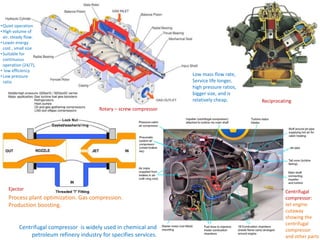
Reciprocating
Rotary – screw compressor
Centrifugal
compressor:
Jet engine
cutaway
showing the
centrifugal
compressor
and other parts
Process plant optimization. Gas compression.
Production boosting.
Ejector
•Quiet operation
•High volume of
air, steady flow.
•Lower energy
cost , small size
•Suitable for
continuous
operation (24/7),
• low efficiency
•Low pressure
ratio
Low mass flow rate,
Service life longer,
high pressure ratios,
bigger size, and is
relatively cheap.
Centrifugal compressor is widely used in chemical and
petroleum refinery industry for specifies services.
Definitions of Compressor
Compression ratio:- It is defined as the ratio of volume of air before compression to the
volume of air after compression.
Compressor capacity:- It is the quantity of air actually delivered by a compressor in m3/minute
or m3/sec.
Free air Delivered(FAD):- It is the volume of air delivered by compressor under the compressor
intake conditions ( i.e. temperature and pressure ).
Swept Volume:- The volume displaced or swept by piston when it moves between top dead
center and bottom dead center.
Clearance volume:- it is the difference between the total volume and the swept volume,
basically the gap that remains between the piston head and the cylinder head when at top
dead center.
Efficiencies:
Volumetric efficiency:-
It is the ratio of actual volume of the FAD at standard atmospheric condition in one delivery
stroke (Actual air intake) to the swept volume (theoretical air intake) by the piston during
the stroke.
Isothermal efficiency:-
It is defined as the ratio of isothermal power (Piso) (i.e. required input power at isothermal
process) done to the indicated power (IP) or actual work done.
Mechanical efficiency:-
It is the ratio of indicated power (IP) to the shaft(Brake) Power (Pshaft).
Overall efficiency:-
It is the ratio of isothermal power (Piso) to the shaft(Brake) Power (Pshaft).
• To calculate air pressure and temperature before
and after compression process
• To calculate indicated work/power
• To obtain compressor efficiency
• To calculate free air delivery rate (kg/s or m3/s)
The Analysis Objectives
The primary components of a
typical reciprocating compressor
system can be seen in Figures.
The compression cylinders, also
known as stages, of which a
particular design may have from
one to six or more, provide
confinement for the process gas
during compression. A piston is
driven in a reciprocating action
to compress the gas.
Arrangements may be of single-
or dual-acting design. (In the
dual-acting design, compression
occurs on both sides of the
piston during both the advancing
and retreating stroke.) Some
dual-acting cylinders in high-
pressure applications will have a
piston rod on both sides of the
piston to provide equal surface
area and balance loads.
Reciprocating Compressor
Tandem cylinder arrangements
help minimize dynamic loads by
locating cylinders in pairs,
connected to a common
crankshaft, so that the
movements of the pistons
oppose each other. Gas
pressure is sealed and wear of
expensive components is
minimized through the use of
disposable piston rings and
rider bands respectively. These
are formed from comparatively
soft metals relative to piston
and cylinder/liner metallurgy or
materials such as
polytetrafluoroethylene (PTFE).
Reciprocating Compressor
In a reciprocating compressor, a volume of air is
drawn into a cylinder, it is trapped, and compressed
by piston and then discharged into the discharge line.
The cylinder valves control the flow of air through the
cylinder; these valves act as check valves.
Single – Acting compressor
It is a compressor that has one discharge per
revolution of crankshaft.
Double – Acting Compressor
It is a compressor that completes two discharge
strokes per revolutions of crankshaft. Most heavy-
duty compressors are double acting.
Suction line
Head
Valve plate
Suction
valve
Connecting
Rod
Crankshaft
Piston
Rings
Discharge valve
Discharge line
Multi-staging :Reduction in power required to drive the
compressor.
 Better mechanical balance of the whole unit and
uniform torque.
 Increase in volumetric efficiency.
 Reduced leakage loss.
 Less difficulty in lubrication due to low working
temperature.
 Lighter cylinders can be used.
 Cheaper materials can be used for construction as
the operating temperature is lower.
P2
T2
T3
Intercooler
1st Stage
cylinder 2nd Stage cylinder Mechanical
dynamometer
Dial weight
Reading (Kg)
Thermo
meter
Safety Valve
P3
T1,
P1
Manometer
Reading
(orifice)
Water outlet
Drain Cock
Unloader
valve
Pressure
control
Switch Main Switch
Front Face View
Crank Case:
Splash type
Lubricating
Oil indicator
guard
Receiver
Tank
Motor (without
grouting i.e. Stand/
support)
Air Box
Motor (without grouting) to produce opposite torque for mechanical dynamometer.
Unloader valve: to keep the starting compressor operation in ambient pressure.
Silencer
cum filter
Compressor RPM
Motor RPM
Back Face View
Reciprocating Compressor
Assumptions
The working fluid is assumed as a perfect gas and P-v-T can be calculated by using simple equation of state.
Usually, these assumptions are used to calculate estimate pressure, P, volume, V, and temperature, T, of
the working fluid.
PV mRT
= 1
/
PV T K
= 2
n
PV K
=
 Compressor without clearance volume
 Compressor with clearance volume
 Multistage compressors
Compressor without clearance volume
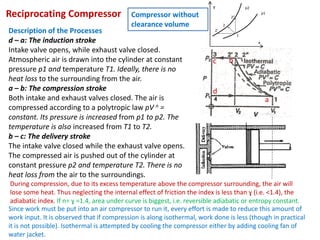
The Cycle of Operation
• The cycle of operation of a reciprocating
air-compressor is best shown on a
pressure-volume (p-V) diagram.
• It is known as an indicator diagram for
the compressor.
• The cycle comprises of three processes:
d - a: An induction stroke
a - b: A compression stroke
b - c: A delivery stroke
a
b
c
d
Reciprocating Compressor
a
b
c
d
During compression, due to its excess temperature above the compressor surrounding, the air will
lose some heat. Thus neglecting the internal effect of friction the index is less than ɣ (i.e. <1.4), the
adiabatic index. If n= ɣ =1.4, area under curve is biggest, i.e. reversible adiabatic or entropy constant.
Description of the Processes
d – a: The induction stroke
Intake valve opens, while exhaust valve closed.
Atmospheric air is drawn into the cylinder at constant
pressure p1 and temperature T1. Ideally, there is no
heat loss to the surrounding from the air.
a – b: The compression stroke
Both intake and exhaust valves closed. The air is
compressed according to a polytropic law pV n =
constant. Its pressure is increased from p1 to p2. The
temperature is also increased from T1 to T2.
b – c: The delivery stroke
The intake valve closed while the exhaust valve opens.
The compressed air is pushed out of the cylinder at
constant pressure p2 and temperature T2. There is no
heat loss from the air to the surroundings.
Since work must be put into an air compressor to run it, every effort is made to reduce this amount of
work input. It is observed that if compression is along isothermal, work done is less (though in practical
it is not possible). Isothermal is attempted by cooling the compressor either by adding cooling fan of
water jacket.
2’
2
2”
1
s
T
p1
p2
Compressor without
clearance volume
Reciprocating Compressor
a
b
c
d
Analysis of Cycle
Indicated work per cycle
The area under the p-V diagram represents the net or
indicated work done on the air per cycle.
Indicated work / cycle = area a-b-c-d = area 1-2-3-4-1
=area under 1-2+area under 2-3 – area under 4-1
Assuming the air as a perfect gas,
where m is the mass of air induced and delivered per
cycle, R is the universal gas constant, where R = 0.287
kJ/kgK.
Substituting,
Indicated work / cycle
( )
2 2 1 1
1
n
W p V p V
n
 
−
 
−
 
1 1 1
p V mRT
= 2 2 2
p V mRT
=
( )
2 1
1
n
W mR T T
n
 
= −
 
−
 
Compressor without
clearance volume
2 2 1 1
2 2 1 1
1
p V p V
p V p V
n
−
 
+ −
 
−
 
This work must
be done on
compressor
( )
( )
2
1 2 1
2
1 1
2 1
1
1 1
2 2 2 1 1 1
,
1
1
1
1
n
n n n
n n n n
W pdV pV C
C V dV CV CV
n
p V V p V V
n
−
− − −
− −
= =
= = −
−
= × − ×
−
∫
∫
Reciprocating Compressor
a
b
c
d
Analysis of Cycle
Other form of the equation for indicated work/ cycle is
1
2
1
1
1
1
n
n
p
n
W mRT
n p
−
 
 
   
−
 
   
−
   
 
 
1
2
1 1
1
1
1
n
n
p
n
W p V
n p
−
 
 
   
= −
 
   
−
   
 
 
Indicated Power (IP):
The indicated power (IP) is the work done on the air per unit
time. The mass flow per unit time ṁ is often used to compute
the work done/time or indicated power.
( )
2 1
1
n
IP mR T T
n
 
= −
 
−
 

Mechanical efficiency:-
It is the ratio of indicated power to the shaft Power.
Shaft power = indicated power + friction power
Shaft power is the power supplied by the electric motor to compressor.
Motor efficiency:-
It is the ratio of shaft power to the input Power.
Input power is the electric power supplied to the electric motor
For Polytropic process
1 1 2 2
1 2
p V p V
T T
=
1 1 2 2
n n
p V p V
=
1
1 2
2 1
n
V p
V p
 
 
 
 
=  
 
1
2 2
1 1
n
n
T p
T p
−
 
 
 
 
=  
 
( )
1
2 2
1 1
n
T V
T V
−
 
=  
 
Compressor without
clearance volume
Reciprocating Compressor Compressor without
clearance volume
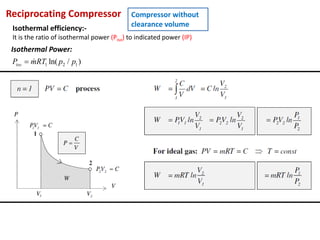
Isothermal Power:
1 2 1
ln( / )
iso
P mRT p p
= 
Isothermal efficiency:-
It is the ratio of isothermal power (Piso) to indicated power (IP)
Reciprocating Compressor
Analysis of Cycle
Compressor with
clearance volume
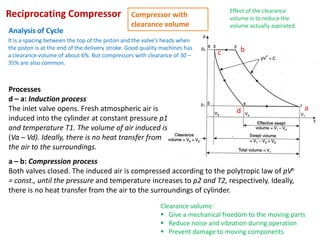
It is a spacing between the top of the piston and the valve’s heads when
the piston is at the end of the delivery stroke. Good quality machines has
a clearance volume of about 6%. But compressors with clearance of 30 –
35% are also common.
a
b
c
d
Effect of the clearance
volume is to reduce the
volume actually aspirated.
Clearance volume:
 Give a mechanical freedom to the moving parts
 Reduce noise and vibration during operation
 Prevent damage to moving components
Processes
d – a: Induction process
The inlet valve opens. Fresh atmospheric air is
induced into the cylinder at constant pressure p1
and temperature T1. The volume of air induced is
(Va – Vd). Ideally, there is no heat transfer from
the air to the surroundings.
a – b: Compression process
Both valves closed. The induced air is compressed according to the polytropic law of pVn
= const., until the pressure and temperature increases to p2 and T2, respectively. Ideally,
there is no heat transfer from the air to the surroundings of cylinder.
Reciprocating Compressor
Analysis of Cycle
Compressor with
clearance volume
It is a spacing between the top of the piston and the valve’s heads when
the piston is at the end of the delivery stroke. Good quality machines has
a clearance volume of about 6%. But compressors with clearance of 30 –
35% are also common.
Processes
a
b
c
d
b – c: Delivery process
The exhaust valve opens. The compressed air is
delivered out of the cylinder at constant pressure
p2 and temperature T2. Ideally, there is no heat
transfer from the air to the surroundings.
Note: At the end of the delivery stroke, the clearance volume Vc is filled with compressed air
at pressure p2 and temperature T2.
Volumetric efficiency= 1 4
1 3
V V
V V
−
−
Because of presence of clearance
volume , volumetric efficiency is
always less than unity, between 60%
to 85 %.
Deliver valve open,
compress gas starts
delivering from the
cylinder
As piston
begin intake
stroke,
residual gas
expand
according to
pvn=const
Vc, residual
gas
c – d: Expansion process
The piston begins the induction stroke. The compressed air occupying the clearance volume
Vc expands according to the polytropic law of pV n = const., until the pressure and
temperature fall to p1 and T1, respectively. Ideally, there is no heat transfer from the air to
the surroundings.
It is the ratio between FAD at standard atmospheric
condition in one delivery stroke (Actual air intake) to the
swept volume (theoretical air intake)
Reciprocating Compressor Compressor with
clearance volume
a
b
c
d
( )
1
2
1 1 4
1
1
1
n
n
p
n
W p V V
n p
−
 
 
   
= − −
 
   
−
   
 
 
Assuming polytropic index to be same
for both compression and clearance
expansion Indicated work / cycle =
1 1
3
2
1 1 4 4
1 4
1 1
1 1
n n
n n
p
p
n n
W p V p V
n p n p
− −
   
   
   
   
− − −
   
   
   
− −
   
   
   
   
But p4=p1, p3=p2 therefore
( ) [ ]
2 1
1
a d
n
W m m R T T
n
 
= − −
 
−
 
 
Volumetric efficiency =
1 4 1 4
1 3
1 2
1/
2 1
1/
3 4
1 ( / )
1 ( / )
1 ( / )
s
n
n
V V V V
V V V
k k V V
k k p p
k k p p
− −
=
−
= + −
= + −
= + −
Where, k=clearance ratio = V3/(V1-V3)=Vc/Vs
Ratio has a value 4% - 10 %
The greater is the clearance ratio
through a reciprocating
compressor, the greater will be the
effect of the clearance volume
since the clearance air will expand
through greater volume before
intake condition is reached.
Reciprocating Compressor
Actual p-V (indicator diagram for single stage compressor
a
b
c
d
At point 4, the clearance air actually reduced to atmospheric pressure.
The inlet valve in practice will not open. Reason : (i) inlet valve inertia (ii)
there must be a pressure difference across the inlet valve in order to
move it. Thus pressure drop away until the valve is forced off its seat.
Some valve bounce will then set in (wavy line) Therefore intake will
become near enough steady at some pressure below atmospheric
pressure. The negative pressure difference, i.e. intake depression settles
naturally.
Similar situation occurs at point 2. There is a constant pressure rise,
followed by valve bounce and the pressure then settles at some pressure
above external delivery pressure (i.e. Receiver tank pressure).
There are certain disadvantages to increase the delivery pressure to a high value.
When the delivery pressure is increased to p3, the volume of the fresh air induced is
reduced from (Va – Vd) to (Va – Vd’), and so on, whereas swept volume Vs is remains
constant. Since the volumetric efficiency is given by
ƞvol = (Va – Vd )/ Vs
the volumetric efficiency decreases with increasing delivery pressure.
Vs
Vc
This situation can be improved by performing
multistage compression process.
Other small effects at inlet and delivery
would be gas inertia and turbulence.
So, practical effects are responsible for
the addition of the two small ripple
negative work areas shown in figure.
Reciprocating Compressor
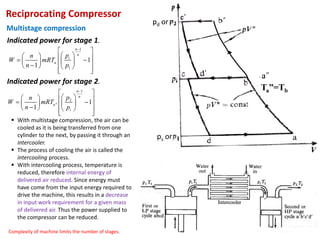
Multistage compression
(i) Single stage Compressor, for delivery pressure upto 5 bar.
(ii) Two stage Compressor, for delivery pressure between 5 to 35 bar
(iii) Three stage Compressor, for delivery pressure between 35 to 85 bar.
(iv) Four stage compressor, for delivery pressure more than 85 bar
Observation
After the first stage compression, the air is
passed into a smaller cylinder, in which it is
further compressed to desired final pressure.
The cycle assumes that the delivery process of
the first stage and the induction process of the
second stage take place at the same pressure pi.
Advantage
• Each cylinder works with lower pressure ratio.
Thus the operational safety of the compressor is
improved.
• The overall volumetric efficiency, ηv increases.
• Mass flow rate is increased , as clearance air
expansion is reduced and effective swept
volume of this cylinder is increased.
Reciprocating Compressor
Multistage compression
Indicated power for stage 1.
1
1
1
1
n
n
i
a
p
n
W mRT
n p
−
 
 
   
−
 
   
−
   
 
 
Indicated power for stage 2.
1
2
" 1
1
n
n
a
i
p
n
W mRT
n p
−
 
 
   
−
 
   
−
   
 
 
 With multistage compression, the air can be
cooled as it is being transferred from one
cylinder to the next, by passing it through an
intercooler.
 The process of cooling the air is called the
intercooling process.
 With intercooling process, temperature is
reduced, therefore internal energy of
delivered air reduced. Since energy must
have come from the input energy required to
drive the machine, this results in a decrease
in input work requirement for a given mass
of delivered air. Thus the power supplied to
the compressor can be reduced.
Complexity of machine limits the number of stages.
ps or
pd or
Ta”=Tb
Reciprocating Compressor
Multistage compression (Without Vc)
Single stage compressor: W=
Two stage compressor,
without intercooling: W=
Perfect intercooling:
after initial
compression in the L.P.
cylinder with the
consequent
temperature rise, the
air is cooled in an
intercooler back to its
original temperature,
i.e. T2=T1, where point
2 lies on isothermal
through point 1.
Without clearance volume
Considering clearance volume
6’
7’
7”
8’
Deliver temperature,
1
5
5 1
1
n
n
p
T T
p
−
 
=  
 
1 1
5
4
1 1 4 4
1 4
1 1
1 1
n n
n n
p
p
n n
p V p V
n p n p
− −
   
   
   
   
− + −
   
   
   
− −
   
   
   
   
Two stage compressor,
With perfect intercooling: W=
1 1
3
4
1 1 2 2
1 2
1 1
1 1
n n
n n
p
p
n n
p V p V
n p n p
− −
   
   
   
   
− + −
   
   
   
− −
   
   
   
   
Deliver temperature same as above……
Deliver temperature,
1 1
3 3
3 2 1 2 1
2 2
,
n n
n n
p p
T T T where T T
p p
− −
   
= = =
   
   
2 1 2 2 1 1 4 2
, ,
if T T p V p V p p
= = =
1 1
3
2
1 1
1 2
2
1
n n
n n
p
p
n
W p V
n p p
− −
 
   
   
= + −
   
   
−
     
 
2453 = Work savings occurs
1 1
5 5
1 1 1
1 1
1 1
1 1
n n
n n
p p
n n
p V mRT
n p n p
− −
   
   
   
   
−
= −
   
   
   
− −
   
   
   
   
Reciprocating Compressor
Multistage compression (Without Vc)
Condition for minimum work done:
Perfect intercooling:
after initial
compression in the L.P.
cylinder with the
consequent
temperature rise, the
air is cooled in an
intercooler back to its
original temperature,
i.e. T2=T1, where point
2 lies on isothermal
through point 1.
9 2
3
1
s
T
P1 or Ps
P2 or Pi
P3 or Pd
Ti or T2
= T3 or Td
4
5
Without clearance volume
Considering clearance volume
6’
7’
7”
8’
It is observed that an intermediate pressure p2
-->p1, then area 2453 --> 0. Also p2-->p3 , then
area 2453 --> 0. this means , therefore there
exists an intermediate pressure p2 which makes
area 2453 maximum and W minimum.
1 1
3
2
1 2
n n
n n
p
p
p p
− −
   
+
   
   
For minimum W : must
be minimum…….
1 1
3
2
1 2
2
0
n n
n n
p
p
d
p p
dp
− −
 
   
 
+
   
 
   
 
  =
i.e. 3
2
1 2
p
p
p p
=
1
1
3 1
2
1 1 1 1
1 1
2 2
1 1
1 1
n
n
n
n p p
p
n n
W p V p V
n p n p
−
−  
   
   
   
 
−
= −
 
 
     
   
− −
   
   
 
 
   
Where p(x+1)/p1 is the pressure ratio through compressor at x stage.
Isothermal power Piso = ,
Heat Transferred in intercooler =
3
1
1
ln
p
mRT
p
 
 
 
4 2 4 1
( ) ( )
p p
mc T T mc T T
− = −
Perfect
intercooling
1
1
2
( 1)
3
1 1 1 1
1 1
2
1 1 ,
1 1
n
n
xn
n
x
p
p
n xn
W p V or p V for x stage
n p n p
−
−
+
 
 
 
 
     
 
= − −
 
 
     
 
− −
   
   
 
 
   
Rotary Compressor:
PD type:
(i) Lobe type (Roots blower)
(ii) Vane
(iii) Screw
(iv) Etc.
Continuous Flow Compressor:
(i) Centrifugal
(ii) axial
Centrifugal Compressor
• Centrifugal compressors accelerates the velocity of the gases
(increases kinetic energy) which is then converted into pressure as
the air flow leaves the volute and enters the discharge pipe.
• Deliver much higher flow rates than positive displacement
compressors
• For low pressure ratios (< 4:1), if higher pressure ratio with larger unit
– prefer axial flow compressor
• Usually operate at speeds > 3,000 rpm.
• Smaller length, contaminated atmosphere doesn't affect the
performance
• Disadvantages- larger frontal area and lower maximum efficiency
Basic Components
• Impellers, Vanes, Volutes, Suction Eyes, Discharge lines, Diffuser
Plates, Seals, Shaft, Casing
• Suction Vane Tips = Part of the impeller vane that comes into contact with air first.
• Discharge Vane Tips = Part of the impeller vane that comes into contact with air last
Applications
Most well-known centrifugal compressor applications are gas turbines and
turbochargers.
Either or both axial and centrifugal compressors are used to provide
compressed air to Modern gas turbines which operate on the Brayton cycle. The
types of gas turbines that most often include centrifugal compressors include
turboshaft, turboprop, auxiliary power units, and micro-turbines.
Centrifugal compressors used in conjunction with reciprocating internal
combustion engines are known as turbochargers if driven by the engine’s exhaust
gas and turbo-superchargers if mechanically driven by the engine.
Centrifugal Compressor
Inlet
The inlet to a centrifugal compressor is typically a simple
pipe. It may include features such as a valve, stationary
vanes/airfoils (used to help swirl the flow) and both pressure
and temperature instrumentation. Figure 1.
Turbocharger
Construction and
Flow of Gases
Figure 3.
full
length
splitter
impeller
Figure 4.
shrouded
impeller
Figure 2.
open
impeller
Centrifugal impeller
The key component that makes a compressor centrifugal is the
centrifugal impeller. It is the impeller’s rotating set of vanes (or
blades) that gradually raises the energy of the working gas. This
is identical to an axial compressor with the exception that the
gases can reach higher velocities and energy levels through the
impeller’s increasing radius. In many modern high-efficiency
centrifugal compressors the gas exiting the impeller is traveling
near the speed of sound.
Impellers are designed in many
configurations including “open” (visible
blades), “covered or shrouded”, “with
splitters”. Most modern high efficiency
impellers use “backsweep” in the blade
shape. Euler’s pump and turbine
equation plays an important role in
understanding impeller performance.
Figure 5. backsweep impeller
Centrifugal Compressor
Diffuser
The next key component to the
simple centrifugal compressor is
the diffuser. Downstream of the
impeller in the flow path, it is the
diffuser’s responsibility to convert
the kinetic energy (high velocity) of
the gas into pressure by gradually
slowing (diffusing) the gas velocity.
Diffusers can be vane less, vaned or
an alternating combination.
Hybrid versions of vaned diffusers include: wedge, channel, and pipe diffusers. There are
turbocharger applications that benefit by incorporating no diffuser. Bernoulli’s fluid dynamic
principle plays an important role in understanding diffuser performance.
Collector / Casing
The collector of a centrifugal compressor can take many shapes and forms. When the diffuser
discharges into a large empty chamber, the collector may be termed a Plenum. When the
diffuser discharges into a device that looks somewhat like a snail shell, bull’s horn or a French
horn, the collector is likely to be termed a volute or scroll. As the name implies, a collector’s
purpose is to gather the flow from the diffuser discharge annulus and deliver this flow to a
downstream pipe. Either the collector or the pipe may also contain valves and
instrumentation to control the compressor.
Centrifugal Compressor (steady flow)
1
2
 Velocity encountered in the centrifugal compressor are very large, therefore total
head quantities should be considered while analyzing centrifugal compressor.
 Consider, a horizontal passage of varying area through which air is flowing. Applying
steady flow equation to the system we get
Q=0
W=0
2 2
1 2
1 1 1 2 2 2
2 2
V V
u p v u p v
+ + = + +
2 2
1 2
1 2
2 2
V V
h h
+ = +
2 2
1 2
1 2
2 2
p p
V V
c T c T
+ = +
2
2
p
V
c T const
+ =
 T is static temperature, measured by thermometer when the thermometer is moving at the air velocity. If moving
air is brought to rest under reversible condition, total KE of air is converted into ‘u’, further heat energy, increasing
the temperature and pressure of the air. This temperature and pressure of the air is known as “stagnation” or
“total head” temperature and pressure and it is denoted by ‘o’.
2
2
p p o
V
c T c T
+ =
2
2
o
p
V
T T
c
− =
2
2
o
V
h h
− =
1
o o
p T
p T
γ
γ −
 
=  
 
 Ideal reversible adiabatic process is called isentropic process (s=const).
But, during the adiabatic compression in a rotary compressor, there is
friction between molecules of air and between air and blade passages,
eddies formation and shocks at entry and exit. These factors cause
internal generation of heat and consequently the maximum temperature
reached would be more than that for adiabatic compression (T01--->T02).
This result in a progressive increase in entropy. Such a process through
adiabatic (no heat transfer) is not isentropic. Again, the heat generated
by friction etc., may be removed continuously with the result that the
process might not involve any entropy change (T01--->T02’). The process
would be isentropic but not adiabatic as heat has been transferred.
u = internal energy, v= volume, p = pressure, V = velocity, h =
enthalpy, cp= specific heat at constant pressure, Q=heat, W=work
2 2
1 2
1 1 1 1 1 2 2 2 2 2
2 2
V V
m u p v gz Q m u p v gz W
   
+ + + + = + + + +
   
   
z1 z2
m1
m2
P .v represents the displacement or flow energy.
V2 / 2 represents the kinetic energy.
g. Z represents the potential energy.
2
2 p
V
c
for 1 kg of air flow (assuming no external heat transfer and work done) the expression becomes…
Centrifugal Compressor (steady flow)
Isentropic efficiency – ratio of isentropic temperature rise to actual
temperature rise or ratio of isentropic to actual compression work.
( )
( )
'
' '
02 01
02 01 2 1
02 01 2 1 02 01
IsentropicWork
ActualWork
p
isen
p
c T T
T T T T
T T T T c T T
η
−
− −
= = = =
− − −
During compression, work has to be imparted to the impeller (i.e. -ve).
Then the energy balance equation around the impeller will be
2 2
1 2
1 2
2 2
p p
V V
c T c T W
+ = + −
2 2
01 02
01 02
2 2
p p
V V
c T c T W
+ = + −
( )
02 01
p
W c T T
= − Thus work input is the product of specific heat at constant pressure
and temperature rise (for both adiabatic and isentropic process).
Status of P & V during Working Process
Air enters at the eye of the impeller at a mean radius rm with low
velocity V1 and atmospheric pressure p1. Depending upon the
centrifugal action of the impeller, the air moves radial outwards and
during its movement it is guided by the impeller vanes. The impellers
transfers the energy of the drive to the air causing a rise both static
pressure p2 and temperature T2, and increase in velocity V2. The
work input equals the rise in total temperature. Air now enters the
diverging passage ‘diffuser’ where it is efficiently slow down V3. The
KE is converted into pressure energy with the result that there is a
further rise in static pressure p3. In practice nearly half of the total
pressure is achieved in impeller and remaining part in diffuser. A
pressure ratio 4 : 1 can be achieved with single stage centrifugal
compressor, for higher ratio multistage compressor is used.
inlet
at impeller
at diffuser
Centrifugal Compressor (Velocity Diagram)
Isentropic efficiency – ratio of isentropic temperature rise to actual
temperature rise or ratio of isentropic to actual compression work.
v1= absolute velocity of fluid at inlet
u1= Mean blade velocity at inlet
vr1 = relative velocity of fluid at inlet
vw1 = velocity of whirl (tangential) at inlet
vf1 = velocity of flow at inlet
u2= Mean blade velocity at outlet
vr2 = relative velocity of fluid at outlet
v2= absolute velocity of fluid at outlet
vw2 = velocity of whirl at outlet
vf2 = velocity of flow at outlet
α1 = exit angle from the guide vane or inlet angle
of the guide vane
β1 = inlet angle to the rotor or impeller or angle
between vr1 with the direction of motion of vane at
inlet
β2 = outlet angle to the rotor or impeller or angle
between vr2 with the direction of motion of vane at
inlet
α2 = inlet angle to diffuser
It assumes that entry of the air is ‘axial’ therefore the whirl Vw1 is zero, and V1=Vf1. To avoid shock at
entry and exit the blade must be parallel to the relative velocity of air at inlet or outlet and β1 and β2
are the impeller blade angle at inlet and outlet. The diffuser blade angle must be parallel to the absolute
velocity of air from the impeller (V2), therefore α2 is the diffuser blade angle at inlet and α3 will be the
diffuser blade angle at outlet. If the discharge from the diffuser is circumferential, then angle at outlet
(α3) should be as small as possible.
Centrifugal Compressor (Equations)
Work done by the impeller (Euler’s Work)
( )
2 2 1 1 02 01 02 01
w w p
W V u V u h h c T T
= − = − = − If working fluid enters radially , Vw1=0
Using inlet and outlet velocity triangle
2 2 2 2 2 2
2 1 1 2 2 1
2 2 2
term I term II term III
r r
V V V V u u
W
− − −
− − −
= + +
Term I= increase in KE of 1 kg of working fluid in impeller, that has converted into pressure
energy in the diffuser
Term II= pressure rise in the impeller due to ‘diffusion action’, as relative velocity
decreases from inlet to outlet
Term III= pressure rise in the impeller due to ‘centrifugal action’, as working fluid enters at
a lower diameter and comes out at a higher diameter
Power required per impeller for ṁ kg of
air flow in one second:
2 2
1000
w
mV u
P kW
=
 If the blade is radial (ideal case), Vw2=u2, and W= V2
2 Since the air cannot leave the impeller at a
velocity greater than the impeller tip velocity, the maximum work supplied per kg of air per second
is given by the above equation.
Considering the steady flow at the inlet and outlet of the impeller, assuming the heat transfer during the flow of air
through the impeller is zero i.e. adiabatic.
2 2
1 2
1 2
2 2
V V
h W h
+ + = + ( )
2 2 2 2
2 1 2 1
2 1 2 1 02 01
2 2 2 2
p p p
p p
V V V V
W h h c T c T c T T
c c
   
   
= + − + = + − + = −
   
       
       
1
1 1
1
02 02
02 01
01 01 2 1 01 01 0
2 1
01 01
1 1 1 1
p p p p p
T p
p p
W c T c T T T c T c T r
p p
T p
γ
γ γ
γ
γ
γ γ
γ
−
− −
−
 
   
   
     
 
= −
= −
= −
= −
 
   
     
   
   
 
   
   
   
rpo= pressure
ratio based on
stagnation pr.
In most of the practical problem V1=V2, therefore
1
1 1
p p
W c T r
γ
γ
−
 
−
 
 
 
1
2
2 2
1 1
1
2 p
p V
p c T
γ
γ
−
 
= +
 
 
 
Power input to the compressor depends upon:
(i) Mass flow of air through the compressor
(ii) Total temperature at the inlet of the compressor
(iii) Total pressure ratio of the compressor which depends upon the square
of the impeller tip velocity.
2
2
0
0
2 2
p p
V
V
c T cont c T
+ = = +
1
2
2 01 0 1
p p
W V c T r
γ
γ
−
 
= = −
 
 
 
rp= pressure ratio based on
static pr.
1
2 2
1 1
T p
T p
γ
γ
 
−
 
 
 
=  
 
Centrifugal Compressor (Equations)
Width of the blades of impeller and diffuser
1 1 1 1 1 1
1 1
2 2
Volume of the air flowing per second
Volume of 1 kg of air
f
rbV rbV
m
v v
π π
= =

ṁ = mass of air flowing per second
b1= width (or height) of impeller at inlet
r1= radius of impeller at inlet
V1=Vf1, as air trapped radially
2 2 2
2
2 f
r b V
m
v
π
=

2 d d fd
d
r b V
m
v
π
=

Similarly at outlet
Similarly at diffuser,
‘d’ for diffuser
If , n is number of blade in the impeller having ‘t’ thickness
1 1 1
1
(2 ) f
r nt bV
m
v
π −
=
 2 2 2
2
(2 ) f
r nt b V
m
v
π −
=

(2 )
d d fd
d
r nt b V
m
v
π −
=

Isentropic efficiency
( )
( )
( )
( )
02 01 2 1
02 01
02 01 02 01 2 1
IsentropicWork
ActualWork
p p
isen
p p
c T T c T T
T T
T T c T T c T T
η
′ ′
− −
′ −
= = =
− − −
If , V1=V2
( )( )
( )( )
1 /
2 1
2 1 2 1
1 /
2 1 2 1 2 1
1
1
,
1 1
isen n n
p p
T T T T
n
T T T T p p
γ γ
η γ
−
−
′ −
′− −
= = = >
− − −
Slip Factor (øs) – ratio of actual whirl component and the
ideal whirl component (radial exit)
2
2
w
s
V
u
φ =
2 2
w
slip u V
= −
Pressure Coefficient (øp) – ratio of isentropic work to Euler work
( )
02 01
2 2
p
p
w
c T T
u V
φ
′ −
= 2 2
w w
u V
φ =
Work factor or power input factor At radial exit 2 2
w
u V
=
Centrifugal Compressor (Equations)
Diffuser efficiency
( )
( )
2 1
2 2
1 2
2
d
p p
V V
g
η
ω
−
=
−
Suffix 1 and 2 represents
upstream and downstream
condition of diffuser, w=weight
density
Forward-
curved
blades
β2>90°
Radial-
curved
blades
β2=90°
Backward-
curved
blades
β2<90°
Pressure
ratio
or
head
Mass flow rate
Forward
Radial
Backward
1. Backward blades – High head or pressure ratio
2. Radial vane – high outlet velocity, manufactured easily, free
from complex bending stress, high pressure ratio
Losses in Centrifugal Compressor
1. Friction loss frictional losses are due to both skin friction and boundary layer separation. It is
proportional to both V2 and m2
2. Incidence loss – During the off-design conditions, the direction of relative velocity of fluid at inlet
does not match with the inlet blade angle and therefore fluid cannot enter the blade passage smoothly
by gliding along the blade surface. It is proportional to CDV2, where CD is drag coefficient.
Selection of Compressor geometries
1. Number of Blade in impeller: Can be chosen by experience corresponding to requirements. Usually
experiments shows that it varies from 18 to 22 for radial bladed diameter from 25 to 36 cm
2. Blade Angle- outlet angle influence the inlet angle, usually inlet angle varies from 30 to 35 degree.
3. Impeller diameter – after knowing the tip diameter, the inlet diameter is calculated from the
tip diameter ratio. Generally D2/D1 varies from 1.6 to 2.0
4. Impeller width - If b1 and b2 are the blade width at inlet and outlet of the impeller, then neglecting the
thickness of blades it is calculated by the equation.
5. Impeller Material – forged or die casted of low silicon aluminum alloy.
6. Vaneless diffuser – The function of vaneless diffuser or space is to stabilize the flow for shockless entry into a
bladed diffuser and to invert some portions of K.E. into pressure energy. The diameter ratio of vaneless to
impeller tip diameter (D3/D2) varies from 1/0.06 to 1.12
Since the flow in the vaneless diffuser is assumed to be logarithmic spiral, hence α2= α3. Generally b2=b3
= width of vaneless diffuser. In some cases b3>b2
2 2 / 60
u D N
π
=
1 1 1 1 2 2 2 2
f f
m d bV d b V
π ρ π ρ
= = 1 2
f f
V V
=
Generally
Centrifugal Compressor
Compressor Characteristics curve
Surging and Chocking
Suppose compressor is running in equilibrium condition at N, If flow is
restricted (i.e. low mass flow rate) by valve or by any means resistance of flow
is increased, the equilibrium point moves to M. If flow still reduces, operating
point moves left to L (max pr. ratio). If flow further reduced, pressure ratio will
reduce. At this moment, there is a higher pressure downstream system than
compressor delivery . So flow stops or may even reverse.
After a short duration,
compressor starts to
deliver fluid (say N).
Pressure starts to increase
and operating point
moves towards left from
right again, and after
point ‘L’ it cuts and the
cycle will be repeated
with high frequency. It is
called surging.
No
compressor
operation
Compressor
Performance
curve
At a constant rotor speed, the tangential
velocity component (Vw2) at the impeller tip
remains constant. With the increase in mass
flow the pressure ratio decreases and hence
the density is decreased. Consequently, the
radial velocity (Vr2) is increased considerably,
which increases the absolute velocity and
incidence angle at diffuser vane tip. Thus there
is a rapid progression towards choking state.
Beyond this compressor cannot be operated.
Inlet loss, friction, separation loss, losses in diffuser
Initial
equilibriu
m point
Axial Flow Compressor
Composed of a rotor that has rows of fanlike blades.
• In industry, axial compressors are used a lot high flows and pressures are needed.
• Air flow is moves along the shaft.
• Rotating blades attached to a shaft push air over stationary blades called stators.
• Stator blades are attached to the casing.
• As the air velocity is increased by the rotating blades, the stator blades slow it down. As
the air slows, kinetic energy is converted into pressure.
• air velocity increases as it moves from stage to stage until it reaches the discharge.
• Multi-Stage axial compressors can generate very high flow rates and discharge pressures.
• Axial compressors are usually limited to 16 stages (due to temperature/material
limitations)
• Pound for pound, axial compressors are lighter, more efficient, and smaller than
centrifugal compressors.

ProjectreportMMC_16101_compressor_01.pdf

  • 1.
    Lecture on Compressor by Dr. ShibayanSarkar Department of Mechanical Engg Indian Institute of Technology (ISM), Dhanbad
  • 2.
    What is Compressor? Compressor Intermittent flow / positive displacement (PD) Rotary Sliding Vane Liquid Piston Helical Lobe Screw Reciprocating Mechanical Piston Continuous flow Dynamic Radial / Centrifugal Mixed Axial Ejector Compressor is a device which is used to increase the pressure of air from low pressure to high pressure by using some external energy • For filling the air in tube of vehicles • In automobile service station to clean vehicles. • For spray painting in paint industries. • In vehicle to operate air brakes. • For cleaning workshop machines. • For supercharging of an IC engines. • For operation of pneumatic tools i.e. rock drills, vibrators etc. PD: Operate by trapping a specific volume of air and forcing it into a smaller volume. Centrifugal: Operate by accelerating the air and converting the energy to pressure Artificially cooled, pressure ratio more than 1.15, fluid medium - Gas
  • 3.
    Reciprocating Rotary – screwcompressor Centrifugal compressor: Jet engine cutaway showing the centrifugal compressor and other parts Process plant optimization. Gas compression. Production boosting. Ejector •Quiet operation •High volume of air, steady flow. •Lower energy cost , small size •Suitable for continuous operation (24/7), • low efficiency •Low pressure ratio Low mass flow rate, Service life longer, high pressure ratios, bigger size, and is relatively cheap. Centrifugal compressor is widely used in chemical and petroleum refinery industry for specifies services.
  • 4.
    Definitions of Compressor Compressionratio:- It is defined as the ratio of volume of air before compression to the volume of air after compression. Compressor capacity:- It is the quantity of air actually delivered by a compressor in m3/minute or m3/sec. Free air Delivered(FAD):- It is the volume of air delivered by compressor under the compressor intake conditions ( i.e. temperature and pressure ). Swept Volume:- The volume displaced or swept by piston when it moves between top dead center and bottom dead center. Clearance volume:- it is the difference between the total volume and the swept volume, basically the gap that remains between the piston head and the cylinder head when at top dead center. Efficiencies: Volumetric efficiency:- It is the ratio of actual volume of the FAD at standard atmospheric condition in one delivery stroke (Actual air intake) to the swept volume (theoretical air intake) by the piston during the stroke. Isothermal efficiency:- It is defined as the ratio of isothermal power (Piso) (i.e. required input power at isothermal process) done to the indicated power (IP) or actual work done. Mechanical efficiency:- It is the ratio of indicated power (IP) to the shaft(Brake) Power (Pshaft). Overall efficiency:- It is the ratio of isothermal power (Piso) to the shaft(Brake) Power (Pshaft).
  • 5.
    • To calculateair pressure and temperature before and after compression process • To calculate indicated work/power • To obtain compressor efficiency • To calculate free air delivery rate (kg/s or m3/s) The Analysis Objectives
  • 6.
    The primary componentsof a typical reciprocating compressor system can be seen in Figures. The compression cylinders, also known as stages, of which a particular design may have from one to six or more, provide confinement for the process gas during compression. A piston is driven in a reciprocating action to compress the gas. Arrangements may be of single- or dual-acting design. (In the dual-acting design, compression occurs on both sides of the piston during both the advancing and retreating stroke.) Some dual-acting cylinders in high- pressure applications will have a piston rod on both sides of the piston to provide equal surface area and balance loads. Reciprocating Compressor
  • 7.
    Tandem cylinder arrangements helpminimize dynamic loads by locating cylinders in pairs, connected to a common crankshaft, so that the movements of the pistons oppose each other. Gas pressure is sealed and wear of expensive components is minimized through the use of disposable piston rings and rider bands respectively. These are formed from comparatively soft metals relative to piston and cylinder/liner metallurgy or materials such as polytetrafluoroethylene (PTFE). Reciprocating Compressor
  • 8.
    Reciprocating Compressor In areciprocating compressor, a volume of air is drawn into a cylinder, it is trapped, and compressed by piston and then discharged into the discharge line. The cylinder valves control the flow of air through the cylinder; these valves act as check valves. Single – Acting compressor It is a compressor that has one discharge per revolution of crankshaft. Double – Acting Compressor It is a compressor that completes two discharge strokes per revolutions of crankshaft. Most heavy- duty compressors are double acting. Suction line Head Valve plate Suction valve Connecting Rod Crankshaft Piston Rings Discharge valve Discharge line Multi-staging :Reduction in power required to drive the compressor.  Better mechanical balance of the whole unit and uniform torque.  Increase in volumetric efficiency.  Reduced leakage loss.  Less difficulty in lubrication due to low working temperature.  Lighter cylinders can be used.  Cheaper materials can be used for construction as the operating temperature is lower.
  • 9.
    P2 T2 T3 Intercooler 1st Stage cylinder 2ndStage cylinder Mechanical dynamometer Dial weight Reading (Kg) Thermo meter Safety Valve P3 T1, P1 Manometer Reading (orifice) Water outlet Drain Cock Unloader valve Pressure control Switch Main Switch Front Face View Crank Case: Splash type Lubricating Oil indicator guard Receiver Tank Motor (without grouting i.e. Stand/ support) Air Box Motor (without grouting) to produce opposite torque for mechanical dynamometer. Unloader valve: to keep the starting compressor operation in ambient pressure. Silencer cum filter
  • 10.
  • 13.
    Reciprocating Compressor Assumptions The workingfluid is assumed as a perfect gas and P-v-T can be calculated by using simple equation of state. Usually, these assumptions are used to calculate estimate pressure, P, volume, V, and temperature, T, of the working fluid. PV mRT = 1 / PV T K = 2 n PV K =  Compressor without clearance volume  Compressor with clearance volume  Multistage compressors Compressor without clearance volume The Cycle of Operation • The cycle of operation of a reciprocating air-compressor is best shown on a pressure-volume (p-V) diagram. • It is known as an indicator diagram for the compressor. • The cycle comprises of three processes: d - a: An induction stroke a - b: A compression stroke b - c: A delivery stroke a b c d
  • 14.
    Reciprocating Compressor a b c d During compression,due to its excess temperature above the compressor surrounding, the air will lose some heat. Thus neglecting the internal effect of friction the index is less than ɣ (i.e. <1.4), the adiabatic index. If n= ɣ =1.4, area under curve is biggest, i.e. reversible adiabatic or entropy constant. Description of the Processes d – a: The induction stroke Intake valve opens, while exhaust valve closed. Atmospheric air is drawn into the cylinder at constant pressure p1 and temperature T1. Ideally, there is no heat loss to the surrounding from the air. a – b: The compression stroke Both intake and exhaust valves closed. The air is compressed according to a polytropic law pV n = constant. Its pressure is increased from p1 to p2. The temperature is also increased from T1 to T2. b – c: The delivery stroke The intake valve closed while the exhaust valve opens. The compressed air is pushed out of the cylinder at constant pressure p2 and temperature T2. There is no heat loss from the air to the surroundings. Since work must be put into an air compressor to run it, every effort is made to reduce this amount of work input. It is observed that if compression is along isothermal, work done is less (though in practical it is not possible). Isothermal is attempted by cooling the compressor either by adding cooling fan of water jacket. 2’ 2 2” 1 s T p1 p2 Compressor without clearance volume
  • 15.
    Reciprocating Compressor a b c d Analysis ofCycle Indicated work per cycle The area under the p-V diagram represents the net or indicated work done on the air per cycle. Indicated work / cycle = area a-b-c-d = area 1-2-3-4-1 =area under 1-2+area under 2-3 – area under 4-1 Assuming the air as a perfect gas, where m is the mass of air induced and delivered per cycle, R is the universal gas constant, where R = 0.287 kJ/kgK. Substituting, Indicated work / cycle ( ) 2 2 1 1 1 n W p V p V n   −   −   1 1 1 p V mRT = 2 2 2 p V mRT = ( ) 2 1 1 n W mR T T n   = −   −   Compressor without clearance volume 2 2 1 1 2 2 1 1 1 p V p V p V p V n −   + −   −   This work must be done on compressor ( ) ( ) 2 1 2 1 2 1 1 2 1 1 1 1 2 2 2 1 1 1 , 1 1 1 1 n n n n n n n n W pdV pV C C V dV CV CV n p V V p V V n − − − − − − = = = = − − = × − × − ∫ ∫
  • 16.
    Reciprocating Compressor a b c d Analysis ofCycle Other form of the equation for indicated work/ cycle is 1 2 1 1 1 1 n n p n W mRT n p −         −       −         1 2 1 1 1 1 1 n n p n W p V n p −         = −       −         Indicated Power (IP): The indicated power (IP) is the work done on the air per unit time. The mass flow per unit time ṁ is often used to compute the work done/time or indicated power. ( ) 2 1 1 n IP mR T T n   = −   −    Mechanical efficiency:- It is the ratio of indicated power to the shaft Power. Shaft power = indicated power + friction power Shaft power is the power supplied by the electric motor to compressor. Motor efficiency:- It is the ratio of shaft power to the input Power. Input power is the electric power supplied to the electric motor For Polytropic process 1 1 2 2 1 2 p V p V T T = 1 1 2 2 n n p V p V = 1 1 2 2 1 n V p V p         =     1 2 2 1 1 n n T p T p −         =     ( ) 1 2 2 1 1 n T V T V −   =     Compressor without clearance volume
  • 17.
    Reciprocating Compressor Compressorwithout clearance volume Isothermal Power: 1 2 1 ln( / ) iso P mRT p p =  Isothermal efficiency:- It is the ratio of isothermal power (Piso) to indicated power (IP)
  • 18.
    Reciprocating Compressor Analysis ofCycle Compressor with clearance volume It is a spacing between the top of the piston and the valve’s heads when the piston is at the end of the delivery stroke. Good quality machines has a clearance volume of about 6%. But compressors with clearance of 30 – 35% are also common. a b c d Effect of the clearance volume is to reduce the volume actually aspirated. Clearance volume:  Give a mechanical freedom to the moving parts  Reduce noise and vibration during operation  Prevent damage to moving components Processes d – a: Induction process The inlet valve opens. Fresh atmospheric air is induced into the cylinder at constant pressure p1 and temperature T1. The volume of air induced is (Va – Vd). Ideally, there is no heat transfer from the air to the surroundings. a – b: Compression process Both valves closed. The induced air is compressed according to the polytropic law of pVn = const., until the pressure and temperature increases to p2 and T2, respectively. Ideally, there is no heat transfer from the air to the surroundings of cylinder.
  • 19.
    Reciprocating Compressor Analysis ofCycle Compressor with clearance volume It is a spacing between the top of the piston and the valve’s heads when the piston is at the end of the delivery stroke. Good quality machines has a clearance volume of about 6%. But compressors with clearance of 30 – 35% are also common. Processes a b c d b – c: Delivery process The exhaust valve opens. The compressed air is delivered out of the cylinder at constant pressure p2 and temperature T2. Ideally, there is no heat transfer from the air to the surroundings. Note: At the end of the delivery stroke, the clearance volume Vc is filled with compressed air at pressure p2 and temperature T2. Volumetric efficiency= 1 4 1 3 V V V V − − Because of presence of clearance volume , volumetric efficiency is always less than unity, between 60% to 85 %. Deliver valve open, compress gas starts delivering from the cylinder As piston begin intake stroke, residual gas expand according to pvn=const Vc, residual gas c – d: Expansion process The piston begins the induction stroke. The compressed air occupying the clearance volume Vc expands according to the polytropic law of pV n = const., until the pressure and temperature fall to p1 and T1, respectively. Ideally, there is no heat transfer from the air to the surroundings. It is the ratio between FAD at standard atmospheric condition in one delivery stroke (Actual air intake) to the swept volume (theoretical air intake)
  • 20.
    Reciprocating Compressor Compressorwith clearance volume a b c d ( ) 1 2 1 1 4 1 1 1 n n p n W p V V n p −         = − −       −         Assuming polytropic index to be same for both compression and clearance expansion Indicated work / cycle = 1 1 3 2 1 1 4 4 1 4 1 1 1 1 n n n n p p n n W p V p V n p n p − −                 − − −             − −                 But p4=p1, p3=p2 therefore ( ) [ ] 2 1 1 a d n W m m R T T n   = − −   −     Volumetric efficiency = 1 4 1 4 1 3 1 2 1/ 2 1 1/ 3 4 1 ( / ) 1 ( / ) 1 ( / ) s n n V V V V V V V k k V V k k p p k k p p − − = − = + − = + − = + − Where, k=clearance ratio = V3/(V1-V3)=Vc/Vs Ratio has a value 4% - 10 % The greater is the clearance ratio through a reciprocating compressor, the greater will be the effect of the clearance volume since the clearance air will expand through greater volume before intake condition is reached.
  • 21.
    Reciprocating Compressor Actual p-V(indicator diagram for single stage compressor a b c d At point 4, the clearance air actually reduced to atmospheric pressure. The inlet valve in practice will not open. Reason : (i) inlet valve inertia (ii) there must be a pressure difference across the inlet valve in order to move it. Thus pressure drop away until the valve is forced off its seat. Some valve bounce will then set in (wavy line) Therefore intake will become near enough steady at some pressure below atmospheric pressure. The negative pressure difference, i.e. intake depression settles naturally. Similar situation occurs at point 2. There is a constant pressure rise, followed by valve bounce and the pressure then settles at some pressure above external delivery pressure (i.e. Receiver tank pressure). There are certain disadvantages to increase the delivery pressure to a high value. When the delivery pressure is increased to p3, the volume of the fresh air induced is reduced from (Va – Vd) to (Va – Vd’), and so on, whereas swept volume Vs is remains constant. Since the volumetric efficiency is given by ƞvol = (Va – Vd )/ Vs the volumetric efficiency decreases with increasing delivery pressure. Vs Vc This situation can be improved by performing multistage compression process. Other small effects at inlet and delivery would be gas inertia and turbulence. So, practical effects are responsible for the addition of the two small ripple negative work areas shown in figure.
  • 22.
    Reciprocating Compressor Multistage compression (i)Single stage Compressor, for delivery pressure upto 5 bar. (ii) Two stage Compressor, for delivery pressure between 5 to 35 bar (iii) Three stage Compressor, for delivery pressure between 35 to 85 bar. (iv) Four stage compressor, for delivery pressure more than 85 bar Observation After the first stage compression, the air is passed into a smaller cylinder, in which it is further compressed to desired final pressure. The cycle assumes that the delivery process of the first stage and the induction process of the second stage take place at the same pressure pi. Advantage • Each cylinder works with lower pressure ratio. Thus the operational safety of the compressor is improved. • The overall volumetric efficiency, ηv increases. • Mass flow rate is increased , as clearance air expansion is reduced and effective swept volume of this cylinder is increased.
  • 23.
    Reciprocating Compressor Multistage compression Indicatedpower for stage 1. 1 1 1 1 n n i a p n W mRT n p −         −       −         Indicated power for stage 2. 1 2 " 1 1 n n a i p n W mRT n p −         −       −          With multistage compression, the air can be cooled as it is being transferred from one cylinder to the next, by passing it through an intercooler.  The process of cooling the air is called the intercooling process.  With intercooling process, temperature is reduced, therefore internal energy of delivered air reduced. Since energy must have come from the input energy required to drive the machine, this results in a decrease in input work requirement for a given mass of delivered air. Thus the power supplied to the compressor can be reduced. Complexity of machine limits the number of stages. ps or pd or Ta”=Tb
  • 24.
    Reciprocating Compressor Multistage compression(Without Vc) Single stage compressor: W= Two stage compressor, without intercooling: W= Perfect intercooling: after initial compression in the L.P. cylinder with the consequent temperature rise, the air is cooled in an intercooler back to its original temperature, i.e. T2=T1, where point 2 lies on isothermal through point 1. Without clearance volume Considering clearance volume 6’ 7’ 7” 8’ Deliver temperature, 1 5 5 1 1 n n p T T p −   =     1 1 5 4 1 1 4 4 1 4 1 1 1 1 n n n n p p n n p V p V n p n p − −                 − + −             − −                 Two stage compressor, With perfect intercooling: W= 1 1 3 4 1 1 2 2 1 2 1 1 1 1 n n n n p p n n p V p V n p n p − −                 − + −             − −                 Deliver temperature same as above…… Deliver temperature, 1 1 3 3 3 2 1 2 1 2 2 , n n n n p p T T T where T T p p − −     = = =         2 1 2 2 1 1 4 2 , , if T T p V p V p p = = = 1 1 3 2 1 1 1 2 2 1 n n n n p p n W p V n p p − −           = + −         −         2453 = Work savings occurs 1 1 5 5 1 1 1 1 1 1 1 1 1 n n n n p p n n p V mRT n p n p − −                 − = −             − −                
  • 25.
    Reciprocating Compressor Multistage compression(Without Vc) Condition for minimum work done: Perfect intercooling: after initial compression in the L.P. cylinder with the consequent temperature rise, the air is cooled in an intercooler back to its original temperature, i.e. T2=T1, where point 2 lies on isothermal through point 1. 9 2 3 1 s T P1 or Ps P2 or Pi P3 or Pd Ti or T2 = T3 or Td 4 5 Without clearance volume Considering clearance volume 6’ 7’ 7” 8’ It is observed that an intermediate pressure p2 -->p1, then area 2453 --> 0. Also p2-->p3 , then area 2453 --> 0. this means , therefore there exists an intermediate pressure p2 which makes area 2453 maximum and W minimum. 1 1 3 2 1 2 n n n n p p p p − −     +         For minimum W : must be minimum……. 1 1 3 2 1 2 2 0 n n n n p p d p p dp − −         +               = i.e. 3 2 1 2 p p p p = 1 1 3 1 2 1 1 1 1 1 1 2 2 1 1 1 1 n n n n p p p n n W p V p V n p n p − −                 − = −               − −                 Where p(x+1)/p1 is the pressure ratio through compressor at x stage. Isothermal power Piso = , Heat Transferred in intercooler = 3 1 1 ln p mRT p       4 2 4 1 ( ) ( ) p p mc T T mc T T − = − Perfect intercooling 1 1 2 ( 1) 3 1 1 1 1 1 1 2 1 1 , 1 1 n n xn n x p p n xn W p V or p V for x stage n p n p − − +                 = − −             − −                
  • 26.
    Rotary Compressor: PD type: (i)Lobe type (Roots blower) (ii) Vane (iii) Screw (iv) Etc. Continuous Flow Compressor: (i) Centrifugal (ii) axial
  • 27.
    Centrifugal Compressor • Centrifugalcompressors accelerates the velocity of the gases (increases kinetic energy) which is then converted into pressure as the air flow leaves the volute and enters the discharge pipe. • Deliver much higher flow rates than positive displacement compressors • For low pressure ratios (< 4:1), if higher pressure ratio with larger unit – prefer axial flow compressor • Usually operate at speeds > 3,000 rpm. • Smaller length, contaminated atmosphere doesn't affect the performance • Disadvantages- larger frontal area and lower maximum efficiency Basic Components • Impellers, Vanes, Volutes, Suction Eyes, Discharge lines, Diffuser Plates, Seals, Shaft, Casing • Suction Vane Tips = Part of the impeller vane that comes into contact with air first. • Discharge Vane Tips = Part of the impeller vane that comes into contact with air last Applications Most well-known centrifugal compressor applications are gas turbines and turbochargers. Either or both axial and centrifugal compressors are used to provide compressed air to Modern gas turbines which operate on the Brayton cycle. The types of gas turbines that most often include centrifugal compressors include turboshaft, turboprop, auxiliary power units, and micro-turbines. Centrifugal compressors used in conjunction with reciprocating internal combustion engines are known as turbochargers if driven by the engine’s exhaust gas and turbo-superchargers if mechanically driven by the engine.
  • 28.
    Centrifugal Compressor Inlet The inletto a centrifugal compressor is typically a simple pipe. It may include features such as a valve, stationary vanes/airfoils (used to help swirl the flow) and both pressure and temperature instrumentation. Figure 1. Turbocharger Construction and Flow of Gases Figure 3. full length splitter impeller Figure 4. shrouded impeller Figure 2. open impeller Centrifugal impeller The key component that makes a compressor centrifugal is the centrifugal impeller. It is the impeller’s rotating set of vanes (or blades) that gradually raises the energy of the working gas. This is identical to an axial compressor with the exception that the gases can reach higher velocities and energy levels through the impeller’s increasing radius. In many modern high-efficiency centrifugal compressors the gas exiting the impeller is traveling near the speed of sound. Impellers are designed in many configurations including “open” (visible blades), “covered or shrouded”, “with splitters”. Most modern high efficiency impellers use “backsweep” in the blade shape. Euler’s pump and turbine equation plays an important role in understanding impeller performance. Figure 5. backsweep impeller
  • 29.
    Centrifugal Compressor Diffuser The nextkey component to the simple centrifugal compressor is the diffuser. Downstream of the impeller in the flow path, it is the diffuser’s responsibility to convert the kinetic energy (high velocity) of the gas into pressure by gradually slowing (diffusing) the gas velocity. Diffusers can be vane less, vaned or an alternating combination. Hybrid versions of vaned diffusers include: wedge, channel, and pipe diffusers. There are turbocharger applications that benefit by incorporating no diffuser. Bernoulli’s fluid dynamic principle plays an important role in understanding diffuser performance. Collector / Casing The collector of a centrifugal compressor can take many shapes and forms. When the diffuser discharges into a large empty chamber, the collector may be termed a Plenum. When the diffuser discharges into a device that looks somewhat like a snail shell, bull’s horn or a French horn, the collector is likely to be termed a volute or scroll. As the name implies, a collector’s purpose is to gather the flow from the diffuser discharge annulus and deliver this flow to a downstream pipe. Either the collector or the pipe may also contain valves and instrumentation to control the compressor.
  • 30.
    Centrifugal Compressor (steadyflow) 1 2  Velocity encountered in the centrifugal compressor are very large, therefore total head quantities should be considered while analyzing centrifugal compressor.  Consider, a horizontal passage of varying area through which air is flowing. Applying steady flow equation to the system we get Q=0 W=0 2 2 1 2 1 1 1 2 2 2 2 2 V V u p v u p v + + = + + 2 2 1 2 1 2 2 2 V V h h + = + 2 2 1 2 1 2 2 2 p p V V c T c T + = + 2 2 p V c T const + =  T is static temperature, measured by thermometer when the thermometer is moving at the air velocity. If moving air is brought to rest under reversible condition, total KE of air is converted into ‘u’, further heat energy, increasing the temperature and pressure of the air. This temperature and pressure of the air is known as “stagnation” or “total head” temperature and pressure and it is denoted by ‘o’. 2 2 p p o V c T c T + = 2 2 o p V T T c − = 2 2 o V h h − = 1 o o p T p T γ γ −   =      Ideal reversible adiabatic process is called isentropic process (s=const). But, during the adiabatic compression in a rotary compressor, there is friction between molecules of air and between air and blade passages, eddies formation and shocks at entry and exit. These factors cause internal generation of heat and consequently the maximum temperature reached would be more than that for adiabatic compression (T01--->T02). This result in a progressive increase in entropy. Such a process through adiabatic (no heat transfer) is not isentropic. Again, the heat generated by friction etc., may be removed continuously with the result that the process might not involve any entropy change (T01--->T02’). The process would be isentropic but not adiabatic as heat has been transferred. u = internal energy, v= volume, p = pressure, V = velocity, h = enthalpy, cp= specific heat at constant pressure, Q=heat, W=work 2 2 1 2 1 1 1 1 1 2 2 2 2 2 2 2 V V m u p v gz Q m u p v gz W     + + + + = + + + +         z1 z2 m1 m2 P .v represents the displacement or flow energy. V2 / 2 represents the kinetic energy. g. Z represents the potential energy. 2 2 p V c for 1 kg of air flow (assuming no external heat transfer and work done) the expression becomes…
  • 31.
    Centrifugal Compressor (steadyflow) Isentropic efficiency – ratio of isentropic temperature rise to actual temperature rise or ratio of isentropic to actual compression work. ( ) ( ) ' ' ' 02 01 02 01 2 1 02 01 2 1 02 01 IsentropicWork ActualWork p isen p c T T T T T T T T T T c T T η − − − = = = = − − − During compression, work has to be imparted to the impeller (i.e. -ve). Then the energy balance equation around the impeller will be 2 2 1 2 1 2 2 2 p p V V c T c T W + = + − 2 2 01 02 01 02 2 2 p p V V c T c T W + = + − ( ) 02 01 p W c T T = − Thus work input is the product of specific heat at constant pressure and temperature rise (for both adiabatic and isentropic process). Status of P & V during Working Process Air enters at the eye of the impeller at a mean radius rm with low velocity V1 and atmospheric pressure p1. Depending upon the centrifugal action of the impeller, the air moves radial outwards and during its movement it is guided by the impeller vanes. The impellers transfers the energy of the drive to the air causing a rise both static pressure p2 and temperature T2, and increase in velocity V2. The work input equals the rise in total temperature. Air now enters the diverging passage ‘diffuser’ where it is efficiently slow down V3. The KE is converted into pressure energy with the result that there is a further rise in static pressure p3. In practice nearly half of the total pressure is achieved in impeller and remaining part in diffuser. A pressure ratio 4 : 1 can be achieved with single stage centrifugal compressor, for higher ratio multistage compressor is used. inlet at impeller at diffuser
  • 32.
    Centrifugal Compressor (VelocityDiagram) Isentropic efficiency – ratio of isentropic temperature rise to actual temperature rise or ratio of isentropic to actual compression work. v1= absolute velocity of fluid at inlet u1= Mean blade velocity at inlet vr1 = relative velocity of fluid at inlet vw1 = velocity of whirl (tangential) at inlet vf1 = velocity of flow at inlet u2= Mean blade velocity at outlet vr2 = relative velocity of fluid at outlet v2= absolute velocity of fluid at outlet vw2 = velocity of whirl at outlet vf2 = velocity of flow at outlet α1 = exit angle from the guide vane or inlet angle of the guide vane β1 = inlet angle to the rotor or impeller or angle between vr1 with the direction of motion of vane at inlet β2 = outlet angle to the rotor or impeller or angle between vr2 with the direction of motion of vane at inlet α2 = inlet angle to diffuser It assumes that entry of the air is ‘axial’ therefore the whirl Vw1 is zero, and V1=Vf1. To avoid shock at entry and exit the blade must be parallel to the relative velocity of air at inlet or outlet and β1 and β2 are the impeller blade angle at inlet and outlet. The diffuser blade angle must be parallel to the absolute velocity of air from the impeller (V2), therefore α2 is the diffuser blade angle at inlet and α3 will be the diffuser blade angle at outlet. If the discharge from the diffuser is circumferential, then angle at outlet (α3) should be as small as possible.
  • 33.
    Centrifugal Compressor (Equations) Workdone by the impeller (Euler’s Work) ( ) 2 2 1 1 02 01 02 01 w w p W V u V u h h c T T = − = − = − If working fluid enters radially , Vw1=0 Using inlet and outlet velocity triangle 2 2 2 2 2 2 2 1 1 2 2 1 2 2 2 term I term II term III r r V V V V u u W − − − − − − = + + Term I= increase in KE of 1 kg of working fluid in impeller, that has converted into pressure energy in the diffuser Term II= pressure rise in the impeller due to ‘diffusion action’, as relative velocity decreases from inlet to outlet Term III= pressure rise in the impeller due to ‘centrifugal action’, as working fluid enters at a lower diameter and comes out at a higher diameter Power required per impeller for ṁ kg of air flow in one second: 2 2 1000 w mV u P kW =  If the blade is radial (ideal case), Vw2=u2, and W= V2 2 Since the air cannot leave the impeller at a velocity greater than the impeller tip velocity, the maximum work supplied per kg of air per second is given by the above equation. Considering the steady flow at the inlet and outlet of the impeller, assuming the heat transfer during the flow of air through the impeller is zero i.e. adiabatic. 2 2 1 2 1 2 2 2 V V h W h + + = + ( ) 2 2 2 2 2 1 2 1 2 1 2 1 02 01 2 2 2 2 p p p p p V V V V W h h c T c T c T T c c         = + − + = + − + = −                     1 1 1 1 02 02 02 01 01 01 2 1 01 01 0 2 1 01 01 1 1 1 1 p p p p p T p p p W c T c T T T c T c T r p p T p γ γ γ γ γ γ γ γ − − − −                   = − = − = − = −                                   rpo= pressure ratio based on stagnation pr. In most of the practical problem V1=V2, therefore 1 1 1 p p W c T r γ γ −   −       1 2 2 2 1 1 1 2 p p V p c T γ γ −   = +       Power input to the compressor depends upon: (i) Mass flow of air through the compressor (ii) Total temperature at the inlet of the compressor (iii) Total pressure ratio of the compressor which depends upon the square of the impeller tip velocity. 2 2 0 0 2 2 p p V V c T cont c T + = = + 1 2 2 01 0 1 p p W V c T r γ γ −   = = −       rp= pressure ratio based on static pr. 1 2 2 1 1 T p T p γ γ   −       =    
  • 34.
    Centrifugal Compressor (Equations) Widthof the blades of impeller and diffuser 1 1 1 1 1 1 1 1 2 2 Volume of the air flowing per second Volume of 1 kg of air f rbV rbV m v v π π = =  ṁ = mass of air flowing per second b1= width (or height) of impeller at inlet r1= radius of impeller at inlet V1=Vf1, as air trapped radially 2 2 2 2 2 f r b V m v π =  2 d d fd d r b V m v π =  Similarly at outlet Similarly at diffuser, ‘d’ for diffuser If , n is number of blade in the impeller having ‘t’ thickness 1 1 1 1 (2 ) f r nt bV m v π − =  2 2 2 2 (2 ) f r nt b V m v π − =  (2 ) d d fd d r nt b V m v π − =  Isentropic efficiency ( ) ( ) ( ) ( ) 02 01 2 1 02 01 02 01 02 01 2 1 IsentropicWork ActualWork p p isen p p c T T c T T T T T T c T T c T T η ′ ′ − − ′ − = = = − − − If , V1=V2 ( )( ) ( )( ) 1 / 2 1 2 1 2 1 1 / 2 1 2 1 2 1 1 1 , 1 1 isen n n p p T T T T n T T T T p p γ γ η γ − − ′ − ′− − = = = > − − − Slip Factor (øs) – ratio of actual whirl component and the ideal whirl component (radial exit) 2 2 w s V u φ = 2 2 w slip u V = − Pressure Coefficient (øp) – ratio of isentropic work to Euler work ( ) 02 01 2 2 p p w c T T u V φ ′ − = 2 2 w w u V φ = Work factor or power input factor At radial exit 2 2 w u V =
  • 35.
    Centrifugal Compressor (Equations) Diffuserefficiency ( ) ( ) 2 1 2 2 1 2 2 d p p V V g η ω − = − Suffix 1 and 2 represents upstream and downstream condition of diffuser, w=weight density Forward- curved blades β2>90° Radial- curved blades β2=90° Backward- curved blades β2<90° Pressure ratio or head Mass flow rate Forward Radial Backward 1. Backward blades – High head or pressure ratio 2. Radial vane – high outlet velocity, manufactured easily, free from complex bending stress, high pressure ratio Losses in Centrifugal Compressor 1. Friction loss frictional losses are due to both skin friction and boundary layer separation. It is proportional to both V2 and m2 2. Incidence loss – During the off-design conditions, the direction of relative velocity of fluid at inlet does not match with the inlet blade angle and therefore fluid cannot enter the blade passage smoothly by gliding along the blade surface. It is proportional to CDV2, where CD is drag coefficient. Selection of Compressor geometries 1. Number of Blade in impeller: Can be chosen by experience corresponding to requirements. Usually experiments shows that it varies from 18 to 22 for radial bladed diameter from 25 to 36 cm 2. Blade Angle- outlet angle influence the inlet angle, usually inlet angle varies from 30 to 35 degree. 3. Impeller diameter – after knowing the tip diameter, the inlet diameter is calculated from the tip diameter ratio. Generally D2/D1 varies from 1.6 to 2.0 4. Impeller width - If b1 and b2 are the blade width at inlet and outlet of the impeller, then neglecting the thickness of blades it is calculated by the equation. 5. Impeller Material – forged or die casted of low silicon aluminum alloy. 6. Vaneless diffuser – The function of vaneless diffuser or space is to stabilize the flow for shockless entry into a bladed diffuser and to invert some portions of K.E. into pressure energy. The diameter ratio of vaneless to impeller tip diameter (D3/D2) varies from 1/0.06 to 1.12 Since the flow in the vaneless diffuser is assumed to be logarithmic spiral, hence α2= α3. Generally b2=b3 = width of vaneless diffuser. In some cases b3>b2 2 2 / 60 u D N π = 1 1 1 1 2 2 2 2 f f m d bV d b V π ρ π ρ = = 1 2 f f V V = Generally
  • 36.
    Centrifugal Compressor Compressor Characteristicscurve Surging and Chocking Suppose compressor is running in equilibrium condition at N, If flow is restricted (i.e. low mass flow rate) by valve or by any means resistance of flow is increased, the equilibrium point moves to M. If flow still reduces, operating point moves left to L (max pr. ratio). If flow further reduced, pressure ratio will reduce. At this moment, there is a higher pressure downstream system than compressor delivery . So flow stops or may even reverse. After a short duration, compressor starts to deliver fluid (say N). Pressure starts to increase and operating point moves towards left from right again, and after point ‘L’ it cuts and the cycle will be repeated with high frequency. It is called surging. No compressor operation Compressor Performance curve At a constant rotor speed, the tangential velocity component (Vw2) at the impeller tip remains constant. With the increase in mass flow the pressure ratio decreases and hence the density is decreased. Consequently, the radial velocity (Vr2) is increased considerably, which increases the absolute velocity and incidence angle at diffuser vane tip. Thus there is a rapid progression towards choking state. Beyond this compressor cannot be operated. Inlet loss, friction, separation loss, losses in diffuser Initial equilibriu m point
  • 37.
    Axial Flow Compressor Composedof a rotor that has rows of fanlike blades. • In industry, axial compressors are used a lot high flows and pressures are needed. • Air flow is moves along the shaft. • Rotating blades attached to a shaft push air over stationary blades called stators. • Stator blades are attached to the casing. • As the air velocity is increased by the rotating blades, the stator blades slow it down. As the air slows, kinetic energy is converted into pressure. • air velocity increases as it moves from stage to stage until it reaches the discharge. • Multi-Stage axial compressors can generate very high flow rates and discharge pressures. • Axial compressors are usually limited to 16 stages (due to temperature/material limitations) • Pound for pound, axial compressors are lighter, more efficient, and smaller than centrifugal compressors.