PRODUCTION WITH TWO INPUTS


             1
Production: Two Variable Inputs
• Firm can produce output by combining
  different amounts of labor and capital


• In the long run, capital and labor are both
  variable


                        2
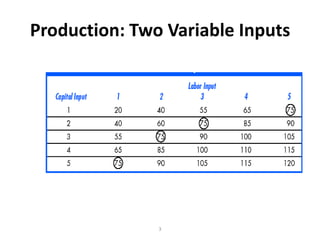
Production: Two Variable Inputs


               3
Production: Two Variable Inputs
• Isoquant


  – Curve showing all possible combinations of inputs
    that yield the same output


                          4
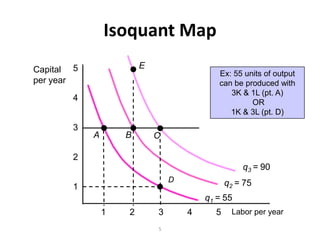
Isoquant Map
Capital 5               E
                                           Ex: 55 units of output
per year                                   can be produced with
                                              3K & 1L (pt. A)
        4                                           OR
                                              1K & 3L (pt. D)
        3
            A       B       C

        2
                                                  q3 = 90
                                D             q2 = 75
        1
                                        q1 = 55
                1   2       3       4     5    Labor per year

                            5
Production: Two Variable Inputs
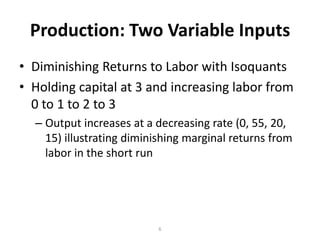
• Diminishing Returns to Labor with Isoquants
• Holding capital at 3 and increasing labor from
  0 to 1 to 2 to 3
  – Output increases at a decreasing rate (0, 55, 20,
    15) illustrating diminishing marginal returns from
    labor in the short run


                          6
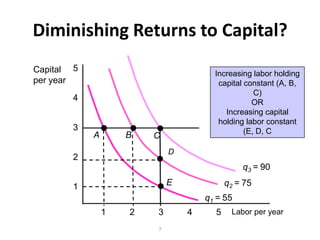
Diminishing Returns to Capital?
Capital 5                             Increasing labor holding
per year                               capital constant (A, B,
                                                  C)
        4                                        OR
                                         Increasing capital
                                       holding labor constant
        3                                      (E, D, C
            A       B   C
                            D
        2
                                              q3 = 90

        1                   E             q2 = 75
                                    q1 = 55
                1   2   3       4     5    Labor per year

                        7
Production: Two Variable Inputs
• Diminishing Returns to Capital with Isoquants


• Holding labor constant at 3 increasing capital
  from 0 to 1 to 2 to 3
  – Output increases at a decreasing rate (0, 55, 20,
    15) due to diminishing returns from capital in
    short run

                           8
ISOQUANTS
• Why are isoquant curve downward sloping?
Marginal Rate of Technical
           Substitution
– Slope of the isoquant shows how one input can be
  substituted for the other and keep the level of
  output the same

– The negative of the slope is the marginal rate of
  technical substitution (MRTS)
   • Amount by which the quantity of one input can be
     reduced when one extra unit of another input is used,
     so that output remains constant


                           10
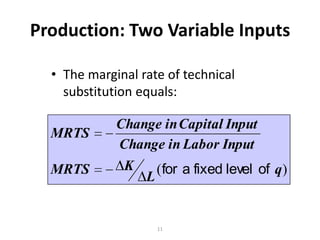
Production: Two Variable Inputs

  • The marginal rate of technical
    substitution equals:

             Change in Capital Input
  MRTS
             Change in Labor Input
  MRTS        K    (for a fixed level of q )
                 L


                    11
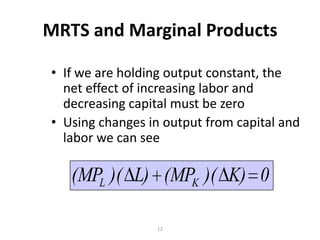
MRTS and Marginal Products

• If we are holding output constant, the
  net effect of increasing labor and
  decreasing capital must be zero
• Using changes in output from capital and
  labor we can see

   (MPL )( L) (MPK )( K) 0

                 12
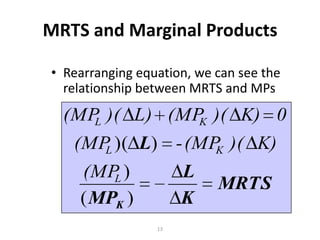
MRTS and Marginal Products

• Rearranging equation, we can see the
  relationship between MRTS and MPs
  (MP )( L) (MP )( K) 0
     L         K

   (MP )( L) - (MP )( K)
      L           K

    (MP )
        L             L
                           MRTS
    ( MPK )           K
                 13
ISOQUANT
• Why is isoquant convex to the origin?
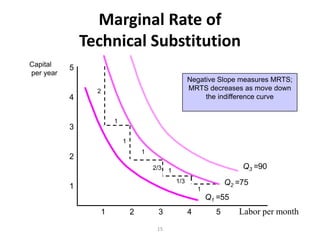
Marginal Rate of
               Technical Substitution
Capital    5
per year
                                                     Negative Slope measures MRTS;
                 2                                   MRTS decreases as move down
           4                                              the indifference curve


                     1
           3
                         1
                                 1
           2
                                     2/3   1
                                                                       Q3 =90
                                               1/3                 Q2 =75
           1                                             1
                                                             Q1 =55
                 1           2        3              4         5      Labor per month
                                      15
Production: Two Variable Inputs
• As labor increases to replace capital

  – Labor becomes relatively less productive
  – Capital becomes relatively more productive
  – Isoquant becomes flatter


                         16
Law of Diminishing MRTS
• Because of Law of Diminishing MP, MRTS is
  also diminishing.

• Hence, isoquant is convex.

• Why is MP curve inverted U shaped?


Chapter 6              17
SPECIAL ISOQUANTS


              18
Perfect Substitutes
1. Perfect substitutes

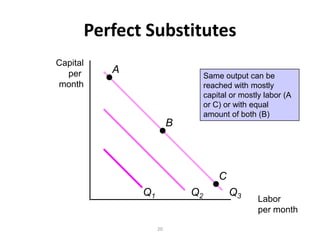
  – MRTS is constant at all points on isoquant

  – Same output can be produced with a lot of
    capital or a lot of labor or a balanced mix


                         19
Perfect Substitutes
Capital
  per     A
                                 Same output can be
month                            reached with mostly
                                 capital or mostly labor (A
                                 or C) or with equal
                                 amount of both (B)
                        B


                                     C
              Q1            Q2           Q3
                                                 Labor
                                                 per month

                   20
Perfect Substitutes
• Type of transportation

• Type of energy source

• Type of protein source
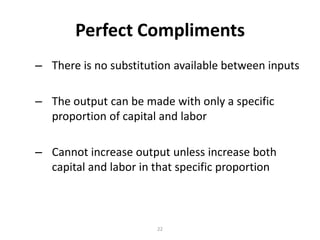
Perfect Compliments
– There is no substitution available between inputs

– The output can be made with only a specific
  proportion of capital and labor

– Cannot increase output unless increase both
  capital and labor in that specific proportion


                       22
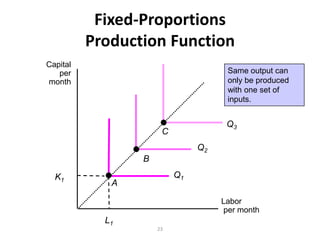
Fixed-Proportions
          Production Function
Capital
   per                               Same output can
month                                only be produced
                                     with one set of
                                     inputs.


                                     Q3
                      C
                               Q2
                 B

  K1                      Q1
             A

                                    Labor
                                    per month
            L1
                     23
Perfect Compliments
• Ingredients to prepare a recipe

• Parts to make a vehicle

• In reality there is no perfect substitute /
  compliments
• Ability to substitute one i/p for the other
  diminishes as one moves along Isoquant
MINIMIZING COST


Chapter 6        25
Cost Minimizing Input Choice
• How do we put all this together to select inputs to produce
  a given output at minimum cost?


• Assumptions
   – Two Inputs: Labor (L) and capital (K)
   – Price of labor: wage rate (w)
   – The price of capital


                                   26
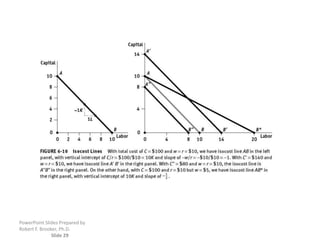
ISOCOST CURVE
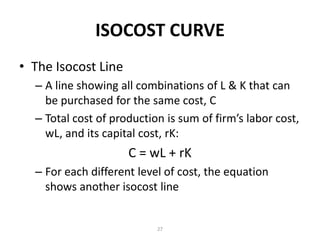
• The Isocost Line
  – A line showing all combinations of L & K that can
    be purchased for the same cost, C
  – Total cost of production is sum of firm’s labor cost,
    wL, and its capital cost, rK:
                     C = wL + rK
  – For each different level of cost, the equation
    shows another isocost line


                           27
ISOCOST CURVE
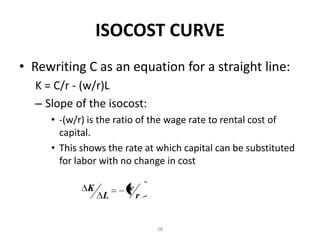
• Rewriting C as an equation for a straight line:
  K = C/r - (w/r)L
  – Slope of the isocost:
     • -(w/r) is the ratio of the wage rate to rental cost of
       capital.
     • This shows the rate at which capital can be substituted
       for labor with no change in cost

             K        w
                 L        r


                              28
PowerPoint Slides Prepared by
Robert F. Brooker, Ph.D.
               Slide 29
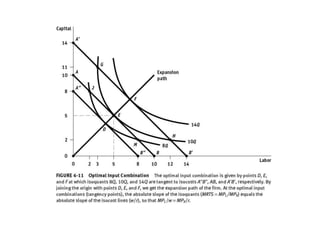
OPTIMAL INPUTS
• How to minimize cost for a given level of
  output by combining isocosts with isoquants
• We choose the output we wish to produce
  and then determine how to do that at
  minimum cost
  – Isoquant is the quantity we wish to produce
  – Isocost is the combination of K and L that gives a
    set cost


                          30
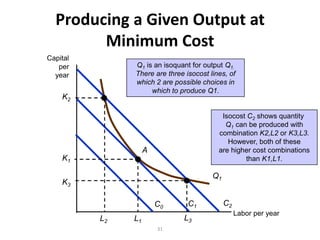
Producing a Given Output at
        Minimum Cost
Capital
   per         Q1 is an isoquant for output Q1.
  year         There are three isocost lines, of
               which 2 are possible choices in
                    which to produce Q1.
    K2

                                           Isocost C2 shows quantity
                                            Q1 can be produced with
                                          combination K2,L2 or K3,L3.
                                             However, both of these
                    A                     are higher cost combinations
    K1                                            than K1,L1.

                                        Q1
    K3

                        C0      C1           C2
                                                  Labor per year
          L2   L1              L3
                        31
Duality Problem
• Optimal inputs –K, L to produce output Q1 and
  minimize cost

• Optimal inputs –K,L with cost C1 and
  maximize output

• Both these problems would give the same
  optimal input combination

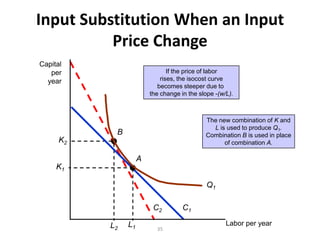
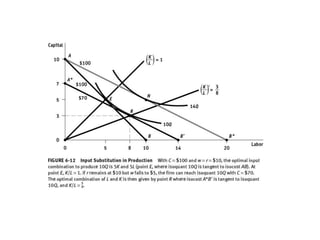
Input Substitution When an Input
             Price Change
• If the price of labor changes, then the slope of
  the isocost line changes, -(w/r)

• It now takes a new quantity of labor and
  capital to produce the output

• If price of labor increases relative to price of
  capital, and capital is substituted for labor
                         34
Input Substitution When an Input
          Price Change
Capital
   per                          If the price of labor
  year                       rises, the isocost curve
                            becomes steeper due to
                         the change in the slope -(w/L).


                                             The new combination of K and
                                               L is used to produce Q1.
            B                                Combination B is used in place
      K2                                           of combination A.

                     A
     K1

                                              Q1

                          C2         C1

           L2   L1                                   Labor per year
                           35
Optimal Inputs
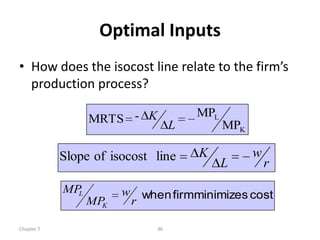
• How does the isocost line relate to the firm’s
  production process?

                  MRTS - K                 MPL
                                       L         MPK

            Slope of isocost line          K           w
                                                 L         r
            MPL         w       when firmminimizes cost
                  MPK       r

Chapter 7                         36
Optimal Inputs
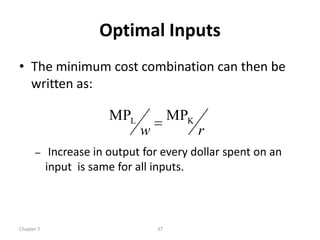
• The minimum cost combination can then be
  written as:

                        MPL             MPK
                               w              r
      –      Increase in output for every dollar spent on an
            input is same for all inputs.


Chapter 7                          37
OPTIMAL INPUTS
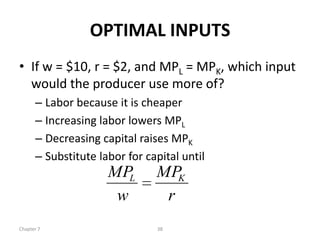
• If w = $10, r = $2, and MPL = MPK, which input
  would the producer use more of?
      – Labor because it is cheaper
      – Increasing labor lowers MPL
      – Decreasing capital raises MPK
      – Substitute labor for capital until
                     MPL       MPK
                      w         r
Chapter 7                      38
Cost in the Long Run
• Cost minimization with Varying Output Levels
      – For each level of output, we can find the cost
        minimizing inputs.
      – For each level of output, there is an isocost curve
        showing minimum cost for that output level
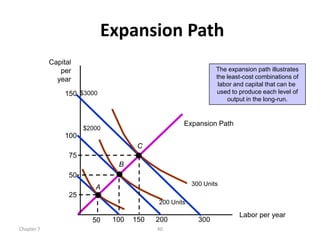
      – A firm’s expansion path shows the minimum cost
        combinations of labor and capital at each level of
        output
      – Slope equals K/ L

Chapter 7                     39
Expansion Path
            Capital
               per                                             The expansion path illustrates
              year                                             the least-cost combinations of
                                                                labor and capital that can be
                 150 $3000                                     used to produce each level of
                                                                   output in the long-run.


                                                   Expansion Path
                       $2000
                 100
                                      C
                  75
                                B
                  50
                                                       300 Units
                          A
                  25
                                           200 Units

                                                                       Labor per year
                         50    100   150   200           300
Chapter 7                                  40
Expansion Path
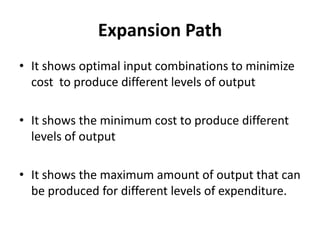
• It shows optimal input combinations to minimize
  cost to produce different levels of output

• It shows the minimum cost to produce different
  levels of output

• It shows the maximum amount of output that can
  be produced for different levels of expenditure.
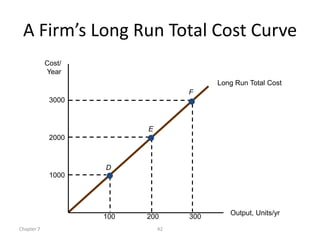
A Firm’s Long Run Total Cost Curve
            Cost/
            Year
                                         Long Run Total Cost
                                   F
             3000


                          E
             2000


                    D
             1000


                                            Output, Units/yr
                    100   200      300
Chapter 7                     42
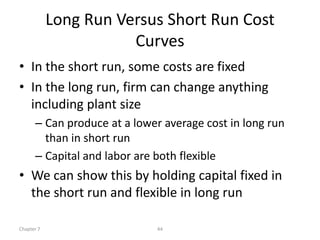
Long Run Versus Short Run Cost
                       Curves
• In the short run, some costs are fixed
• In the long run, firm can change anything
  including plant size
      – Can produce at a lower average cost in long run
        than in short run
      – Capital and labor are both flexible
• We can show this by holding capital fixed in
  the short run and flexible in long run

Chapter 7                    44
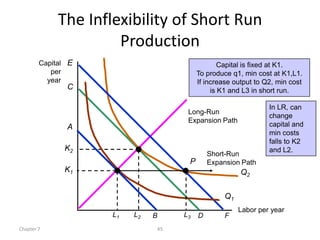
The Inflexibility of Short Run
                      Production
        Capital E                                Capital is fixed at K1.
           per                           To produce q1, min cost at K1,L1.
          year                           If increase output to Q2, min cost
               C                              is K1 and L3 in short run.

                                                                In LR, can
                                     Long-Run
                                                                change
                                     Expansion Path
               A                                                capital and
                                                                min costs
                                                                falls to K2
              K2                                                and L2.
                                             Short-Run
                                     P       Expansion Path
              K1                                       Q2


                                                  Q1
                                                       Labor per year
                     L1   L2   B    L3   D        F
Chapter 7                      45
RETURNS TO SCALE


              46
BIG CITIES
• Metropolis twice the size of one, number of
  gas stations, length of pipelines, infrastructure
  decreases by 15%

• Why?


                         47
Narayan
                Hridalaya
• Provide health care at full price
To patients from well to do background

• These patients subsidize `poor’ patients
• Run at a profit of 7.7%
• Why is Narayan Hridalaya able to do this?


                     48
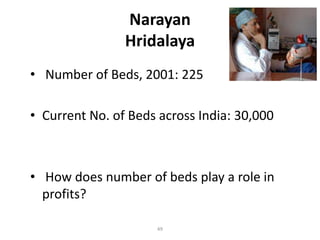
Narayan
                Hridalaya
• Number of Beds, 2001: 225

• Current No. of Beds across India: 30,000


• How does number of beds play a role in
  profits?

                     49
Returns to Scale
• Rate at which output increases as inputs are
  increased proportionately

  – Increasing returns to scale
  – Constant returns to scale
  – Decreasing returns to scale


                          50
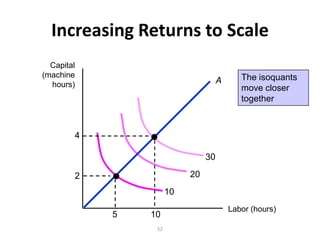
Returns to Scale
• Increasing returns to scale: output more than
  doubles when all inputs are doubled

  – What happens to the isoquants?


                        51
Increasing Returns to Scale
  Capital
(machine                                    The isoquants
  hours)                             A
                                            move closer
                                            together


        4

                                30

        2                  20
                      10
                                         Labor (hours)
            5   10
                 52
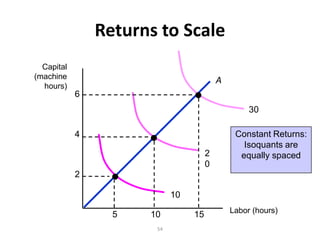
Returns to Scale
• Constant returns to scale: output doubles
  when all inputs are doubled


  –   Size does not affect productivity
  –   May have a large number of producers
  –   Isoquants are equidistant apart


                            53
Returns to Scale
  Capital
(machine
                                          A
  hours)
            6
                                                   30

            4                                  Constant Returns:
                                                 Isoquants are
                                      2         equally spaced
                                      0
            2

                            10
                                              Labor (hours)
                  5   10         15
                       54
Returns to Scale
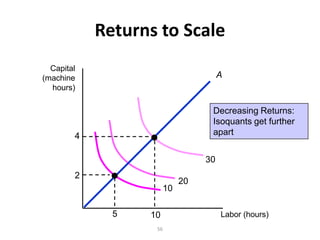
• Decreasing returns to scale: output less than
  doubles when all inputs are doubled


  –   Decreasing efficiency with large size
  –   Reduction of entrepreneurial abilities
  –   Isoquants become farther apart


                            55
Returns to Scale
  Capital
(machine                              A
  hours)

                                  Decreasing Returns:
                                  Isoquants get further
        4                         apart


                                 30
        2
                            20
                       10

              5   10                  Labor (hours)
                   56

Lecture 8 production, optimal inputs

  • 1.
  • 2.
    Production: Two VariableInputs • Firm can produce output by combining different amounts of labor and capital • In the long run, capital and labor are both variable 2
  • 3.
  • 4.
    Production: Two VariableInputs • Isoquant – Curve showing all possible combinations of inputs that yield the same output 4
  • 5.
    Isoquant Map Capital 5 E Ex: 55 units of output per year can be produced with 3K & 1L (pt. A) 4 OR 1K & 3L (pt. D) 3 A B C 2 q3 = 90 D q2 = 75 1 q1 = 55 1 2 3 4 5 Labor per year 5
  • 6.
    Production: Two VariableInputs • Diminishing Returns to Labor with Isoquants • Holding capital at 3 and increasing labor from 0 to 1 to 2 to 3 – Output increases at a decreasing rate (0, 55, 20, 15) illustrating diminishing marginal returns from labor in the short run 6
  • 7.
    Diminishing Returns toCapital? Capital 5 Increasing labor holding per year capital constant (A, B, C) 4 OR Increasing capital holding labor constant 3 (E, D, C A B C D 2 q3 = 90 1 E q2 = 75 q1 = 55 1 2 3 4 5 Labor per year 7
  • 8.
    Production: Two VariableInputs • Diminishing Returns to Capital with Isoquants • Holding labor constant at 3 increasing capital from 0 to 1 to 2 to 3 – Output increases at a decreasing rate (0, 55, 20, 15) due to diminishing returns from capital in short run 8
  • 9.
    ISOQUANTS • Why areisoquant curve downward sloping?
  • 10.
    Marginal Rate ofTechnical Substitution – Slope of the isoquant shows how one input can be substituted for the other and keep the level of output the same – The negative of the slope is the marginal rate of technical substitution (MRTS) • Amount by which the quantity of one input can be reduced when one extra unit of another input is used, so that output remains constant 10
  • 11.
    Production: Two VariableInputs • The marginal rate of technical substitution equals: Change in Capital Input MRTS Change in Labor Input MRTS K (for a fixed level of q ) L 11
  • 12.
    MRTS and MarginalProducts • If we are holding output constant, the net effect of increasing labor and decreasing capital must be zero • Using changes in output from capital and labor we can see (MPL )( L) (MPK )( K) 0 12
  • 13.
    MRTS and MarginalProducts • Rearranging equation, we can see the relationship between MRTS and MPs (MP )( L) (MP )( K) 0 L K (MP )( L) - (MP )( K) L K (MP ) L L MRTS ( MPK ) K 13
  • 14.
    ISOQUANT • Why isisoquant convex to the origin?
  • 15.
    Marginal Rate of Technical Substitution Capital 5 per year Negative Slope measures MRTS; 2 MRTS decreases as move down 4 the indifference curve 1 3 1 1 2 2/3 1 Q3 =90 1/3 Q2 =75 1 1 Q1 =55 1 2 3 4 5 Labor per month 15
  • 16.
    Production: Two VariableInputs • As labor increases to replace capital – Labor becomes relatively less productive – Capital becomes relatively more productive – Isoquant becomes flatter 16
  • 17.
    Law of DiminishingMRTS • Because of Law of Diminishing MP, MRTS is also diminishing. • Hence, isoquant is convex. • Why is MP curve inverted U shaped? Chapter 6 17
  • 18.
  • 19.
    Perfect Substitutes 1. Perfectsubstitutes – MRTS is constant at all points on isoquant – Same output can be produced with a lot of capital or a lot of labor or a balanced mix 19
  • 20.
    Perfect Substitutes Capital per A Same output can be month reached with mostly capital or mostly labor (A or C) or with equal amount of both (B) B C Q1 Q2 Q3 Labor per month 20
  • 21.
    Perfect Substitutes • Typeof transportation • Type of energy source • Type of protein source
  • 22.
    Perfect Compliments – Thereis no substitution available between inputs – The output can be made with only a specific proportion of capital and labor – Cannot increase output unless increase both capital and labor in that specific proportion 22
  • 23.
    Fixed-Proportions Production Function Capital per Same output can month only be produced with one set of inputs. Q3 C Q2 B K1 Q1 A Labor per month L1 23
  • 24.
    Perfect Compliments • Ingredientsto prepare a recipe • Parts to make a vehicle • In reality there is no perfect substitute / compliments • Ability to substitute one i/p for the other diminishes as one moves along Isoquant
  • 25.
  • 26.
    Cost Minimizing InputChoice • How do we put all this together to select inputs to produce a given output at minimum cost? • Assumptions – Two Inputs: Labor (L) and capital (K) – Price of labor: wage rate (w) – The price of capital 26
  • 27.
    ISOCOST CURVE • TheIsocost Line – A line showing all combinations of L & K that can be purchased for the same cost, C – Total cost of production is sum of firm’s labor cost, wL, and its capital cost, rK: C = wL + rK – For each different level of cost, the equation shows another isocost line 27
  • 28.
    ISOCOST CURVE • RewritingC as an equation for a straight line: K = C/r - (w/r)L – Slope of the isocost: • -(w/r) is the ratio of the wage rate to rental cost of capital. • This shows the rate at which capital can be substituted for labor with no change in cost K w L r 28
  • 29.
    PowerPoint Slides Preparedby Robert F. Brooker, Ph.D. Slide 29
  • 30.
    OPTIMAL INPUTS • Howto minimize cost for a given level of output by combining isocosts with isoquants • We choose the output we wish to produce and then determine how to do that at minimum cost – Isoquant is the quantity we wish to produce – Isocost is the combination of K and L that gives a set cost 30
  • 31.
    Producing a GivenOutput at Minimum Cost Capital per Q1 is an isoquant for output Q1. year There are three isocost lines, of which 2 are possible choices in which to produce Q1. K2 Isocost C2 shows quantity Q1 can be produced with combination K2,L2 or K3,L3. However, both of these A are higher cost combinations K1 than K1,L1. Q1 K3 C0 C1 C2 Labor per year L2 L1 L3 31
  • 32.
    Duality Problem • Optimalinputs –K, L to produce output Q1 and minimize cost • Optimal inputs –K,L with cost C1 and maximize output • Both these problems would give the same optimal input combination
  • 34.
    Input Substitution Whenan Input Price Change • If the price of labor changes, then the slope of the isocost line changes, -(w/r) • It now takes a new quantity of labor and capital to produce the output • If price of labor increases relative to price of capital, and capital is substituted for labor 34
  • 35.
    Input Substitution Whenan Input Price Change Capital per If the price of labor year rises, the isocost curve becomes steeper due to the change in the slope -(w/L). The new combination of K and L is used to produce Q1. B Combination B is used in place K2 of combination A. A K1 Q1 C2 C1 L2 L1 Labor per year 35
  • 36.
    Optimal Inputs • Howdoes the isocost line relate to the firm’s production process? MRTS - K MPL L MPK Slope of isocost line K w L r MPL w when firmminimizes cost MPK r Chapter 7 36
  • 37.
    Optimal Inputs • Theminimum cost combination can then be written as: MPL MPK w r – Increase in output for every dollar spent on an input is same for all inputs. Chapter 7 37
  • 38.
    OPTIMAL INPUTS • Ifw = $10, r = $2, and MPL = MPK, which input would the producer use more of? – Labor because it is cheaper – Increasing labor lowers MPL – Decreasing capital raises MPK – Substitute labor for capital until MPL MPK w r Chapter 7 38
  • 39.
    Cost in theLong Run • Cost minimization with Varying Output Levels – For each level of output, we can find the cost minimizing inputs. – For each level of output, there is an isocost curve showing minimum cost for that output level – A firm’s expansion path shows the minimum cost combinations of labor and capital at each level of output – Slope equals K/ L Chapter 7 39
  • 40.
    Expansion Path Capital per The expansion path illustrates year the least-cost combinations of labor and capital that can be 150 $3000 used to produce each level of output in the long-run. Expansion Path $2000 100 C 75 B 50 300 Units A 25 200 Units Labor per year 50 100 150 200 300 Chapter 7 40
  • 41.
    Expansion Path • Itshows optimal input combinations to minimize cost to produce different levels of output • It shows the minimum cost to produce different levels of output • It shows the maximum amount of output that can be produced for different levels of expenditure.
  • 42.
    A Firm’s LongRun Total Cost Curve Cost/ Year Long Run Total Cost F 3000 E 2000 D 1000 Output, Units/yr 100 200 300 Chapter 7 42
  • 44.
    Long Run VersusShort Run Cost Curves • In the short run, some costs are fixed • In the long run, firm can change anything including plant size – Can produce at a lower average cost in long run than in short run – Capital and labor are both flexible • We can show this by holding capital fixed in the short run and flexible in long run Chapter 7 44
  • 45.
    The Inflexibility ofShort Run Production Capital E Capital is fixed at K1. per To produce q1, min cost at K1,L1. year If increase output to Q2, min cost C is K1 and L3 in short run. In LR, can Long-Run change Expansion Path A capital and min costs falls to K2 K2 and L2. Short-Run P Expansion Path K1 Q2 Q1 Labor per year L1 L2 B L3 D F Chapter 7 45
  • 46.
  • 47.
    BIG CITIES • Metropolistwice the size of one, number of gas stations, length of pipelines, infrastructure decreases by 15% • Why? 47
  • 48.
    Narayan Hridalaya • Provide health care at full price To patients from well to do background • These patients subsidize `poor’ patients • Run at a profit of 7.7% • Why is Narayan Hridalaya able to do this? 48
  • 49.
    Narayan Hridalaya • Number of Beds, 2001: 225 • Current No. of Beds across India: 30,000 • How does number of beds play a role in profits? 49
  • 50.
    Returns to Scale •Rate at which output increases as inputs are increased proportionately – Increasing returns to scale – Constant returns to scale – Decreasing returns to scale 50
  • 51.
    Returns to Scale •Increasing returns to scale: output more than doubles when all inputs are doubled – What happens to the isoquants? 51
  • 52.
    Increasing Returns toScale Capital (machine The isoquants hours) A move closer together 4 30 2 20 10 Labor (hours) 5 10 52
  • 53.
    Returns to Scale •Constant returns to scale: output doubles when all inputs are doubled – Size does not affect productivity – May have a large number of producers – Isoquants are equidistant apart 53
  • 54.
    Returns to Scale Capital (machine A hours) 6 30 4 Constant Returns: Isoquants are 2 equally spaced 0 2 10 Labor (hours) 5 10 15 54
  • 55.
    Returns to Scale •Decreasing returns to scale: output less than doubles when all inputs are doubled – Decreasing efficiency with large size – Reduction of entrepreneurial abilities – Isoquants become farther apart 55
  • 56.
    Returns to Scale Capital (machine A hours) Decreasing Returns: Isoquants get further 4 apart 30 2 20 10 5 10 Labor (hours) 56

Editor's Notes

  • #48 What can you say about average cost?