Isocost Curve & Isoquant 
Done by: 
Hariharasudhan R 
Divya Jothi
What is isoquant? 
Isoquant is also called as equal product curve or 
production indifference curve or constant product curve. 
Isoquant indicates various combinations of two factors of 
production which give the same level of output per unit 
of time.
The significance of factors of productive resources is that, 
any two factors are substitutable e.g. labor is 
substitutable for capital and vice versa. No two factors 
are perfect substitutes. This indicates that one factor can 
be used a little more and other factor a little less, without 
changing the level of output.
Assumptions 
• There are two factor inputs labor and capital 
• The proportions of factor are variable. 
• Physical production conditions are given 
• The state of technology remains constant
Isocost line 
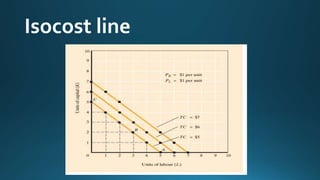
Isocost line shows various combinations of inputs that a 
firm can purchase or hire at a given cost. 
By the use of isocosts and isoquants, a firm can 
determine the optimal input combination to maximize 
profit.
It is a graphical representation of various combinations of 
inputs say Labor(L) and capital (K) which give an equal 
level of output per unit of time. Output produced by 
different combinations of L and K is say, Q, then Q=f (L, 
K). 
A higher isoquant refers to a larger output, while a lower 
isoquant refers to a smaller output.
Isocost line 
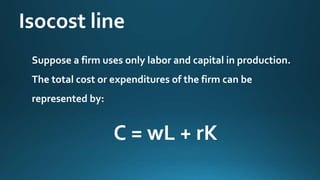
Suppose a firm uses only labor and capital in production. 
The total cost or expenditures of the firm can be 
represented by: 
C = wL + rK
Isocost line
• Slope of isoquant = - MPL / MPK 
• Slope of isocost = - PL / PK 
• For cost minimization we set these equal and rearrange to 
obtain: 
•
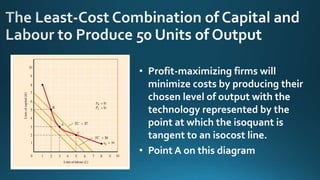
• Profit-maximizing firms will 
minimize costs by producing their 
chosen level of output with the 
technology represented by the 
point at which the isoquant is 
tangent to an isocost line. 
• Point A on this diagram
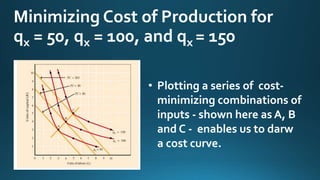
Minimizing Cost of Production for 
qx = 50, qx = 100, and qx = 150 
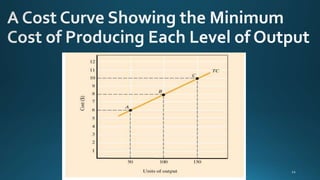
• Plotting a series of cost-minimizing 
combinations of 
inputs - shown here as A, B 
and C - enables us to darw 
a cost curve.
Isocost
Isocost

Isocost

  • 1.
    Isocost Curve &Isoquant Done by: Hariharasudhan R Divya Jothi
  • 2.
    What is isoquant? Isoquant is also called as equal product curve or production indifference curve or constant product curve. Isoquant indicates various combinations of two factors of production which give the same level of output per unit of time.
  • 3.
    The significance offactors of productive resources is that, any two factors are substitutable e.g. labor is substitutable for capital and vice versa. No two factors are perfect substitutes. This indicates that one factor can be used a little more and other factor a little less, without changing the level of output.
  • 4.
    Assumptions • Thereare two factor inputs labor and capital • The proportions of factor are variable. • Physical production conditions are given • The state of technology remains constant
  • 5.
    Isocost line Isocostline shows various combinations of inputs that a firm can purchase or hire at a given cost. By the use of isocosts and isoquants, a firm can determine the optimal input combination to maximize profit.
  • 6.
    It is agraphical representation of various combinations of inputs say Labor(L) and capital (K) which give an equal level of output per unit of time. Output produced by different combinations of L and K is say, Q, then Q=f (L, K). A higher isoquant refers to a larger output, while a lower isoquant refers to a smaller output.
  • 7.
    Isocost line Supposea firm uses only labor and capital in production. The total cost or expenditures of the firm can be represented by: C = wL + rK
  • 8.
  • 9.
    • Slope ofisoquant = - MPL / MPK • Slope of isocost = - PL / PK • For cost minimization we set these equal and rearrange to obtain: •
  • 10.
    • Profit-maximizing firmswill minimize costs by producing their chosen level of output with the technology represented by the point at which the isoquant is tangent to an isocost line. • Point A on this diagram
  • 11.
    Minimizing Cost ofProduction for qx = 50, qx = 100, and qx = 150 • Plotting a series of cost-minimizing combinations of inputs - shown here as A, B and C - enables us to darw a cost curve.