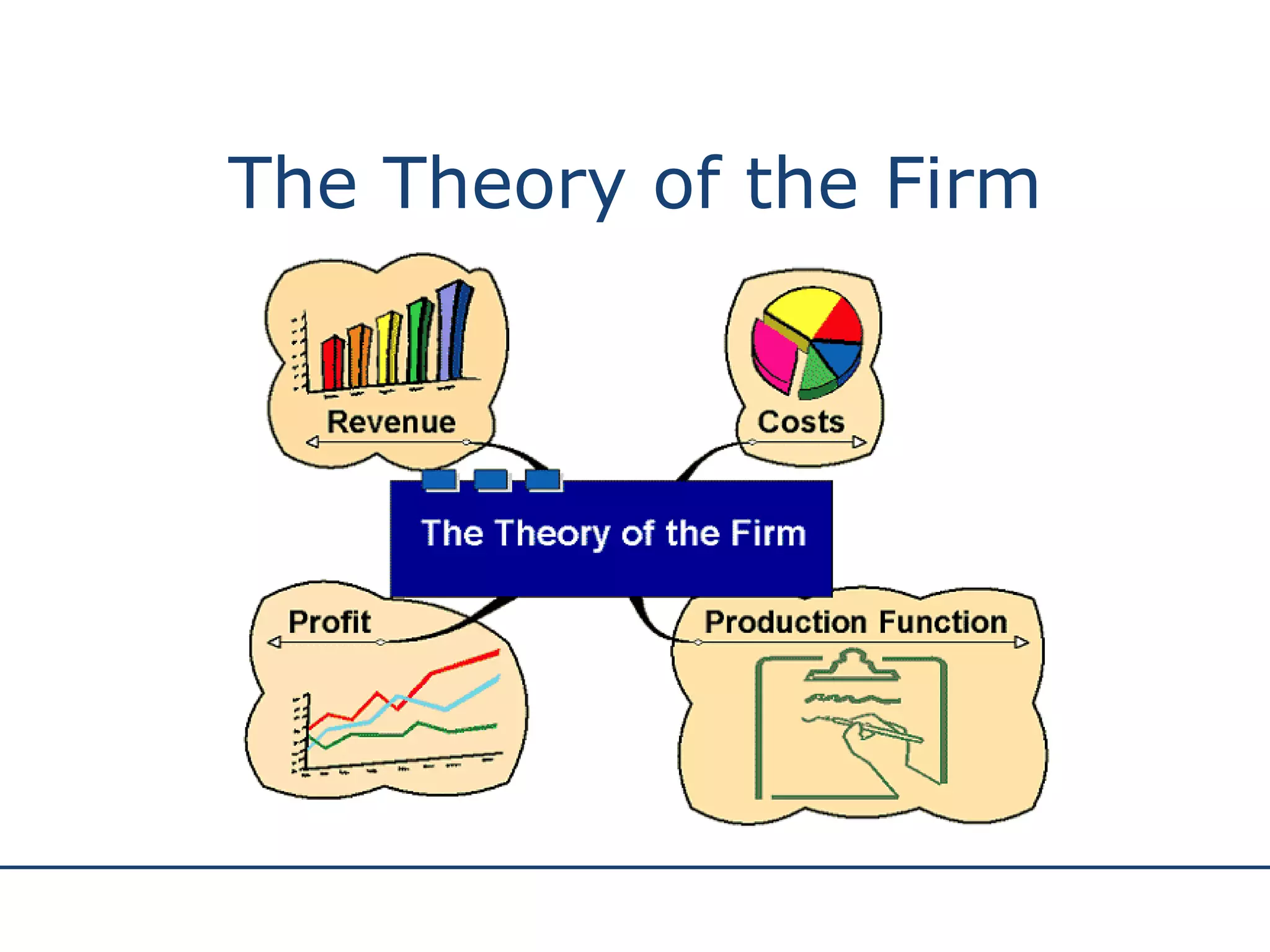
The Theory of the Firm
Production Function
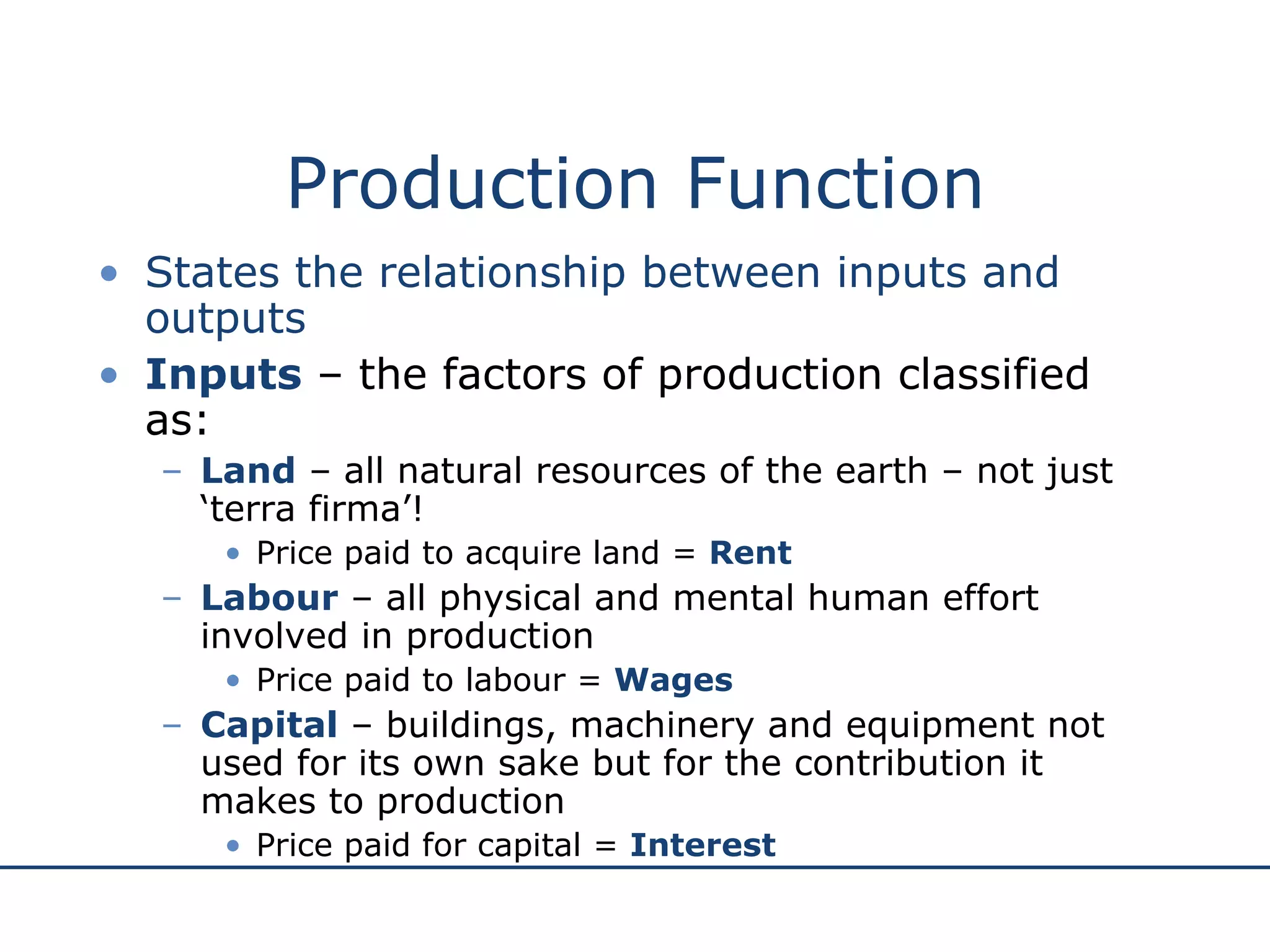
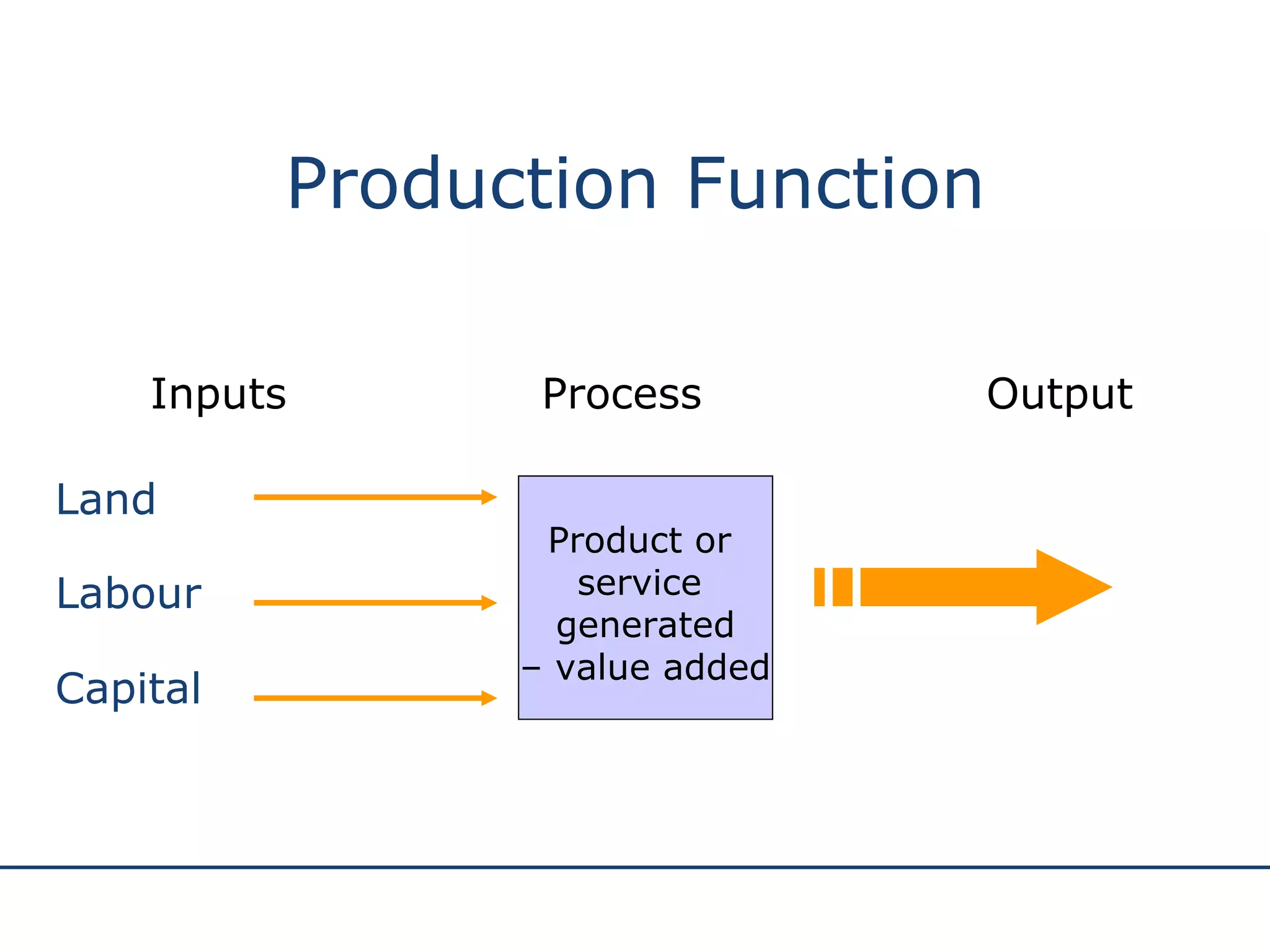
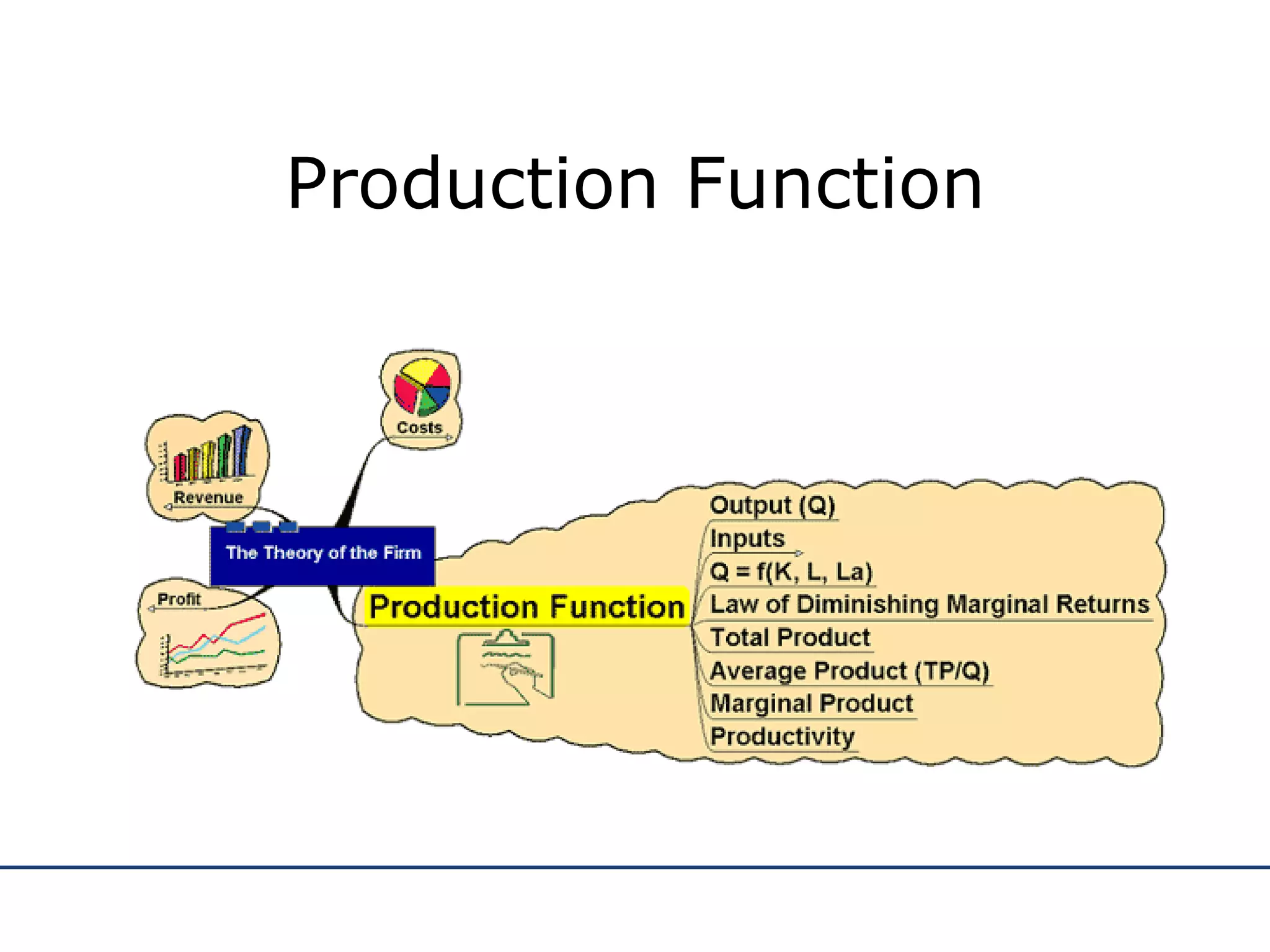
Production Function States the relationship between inputs and outputs Inputs  – the factors of production classified as: Land  – all natural resources of the earth – not just ‘terra firma’!  Price paid to acquire land =  Rent Labour  – all physical and mental human effort involved in production Price paid to labour =  Wages Capital  – buildings, machinery and equipment not used for its own sake but for the contribution it makes to production Price paid for capital =  Interest
Production Function Inputs Process Output Land Labour Capital Product or  service  generated –  value added
Analysis of Production Function: Short Run In the short run at least one factor fixed in supply but all other factors capable of being changed Reflects ways in which firms respond to changes in output (demand) Can increase or decrease output using more or less of some factors but some likely to be easier to change than others Increase in total capacity only possible in the long run
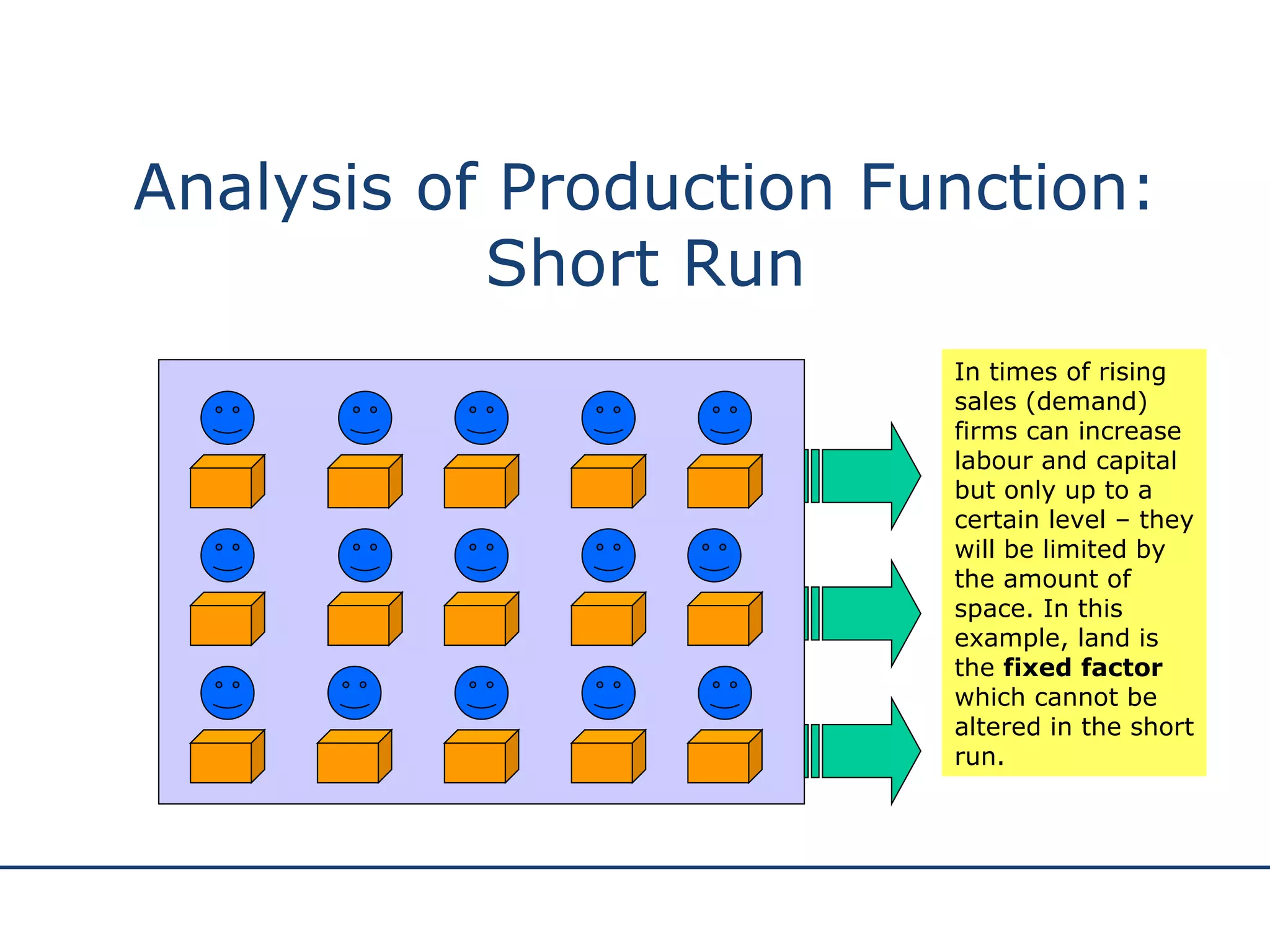
Analysis of Production Function: Short Run In times of rising sales (demand) firms can increase labour and capital but only up to a certain level – they will be limited by the amount of space. In this example, land is the  fixed factor  which cannot be altered in the short run.
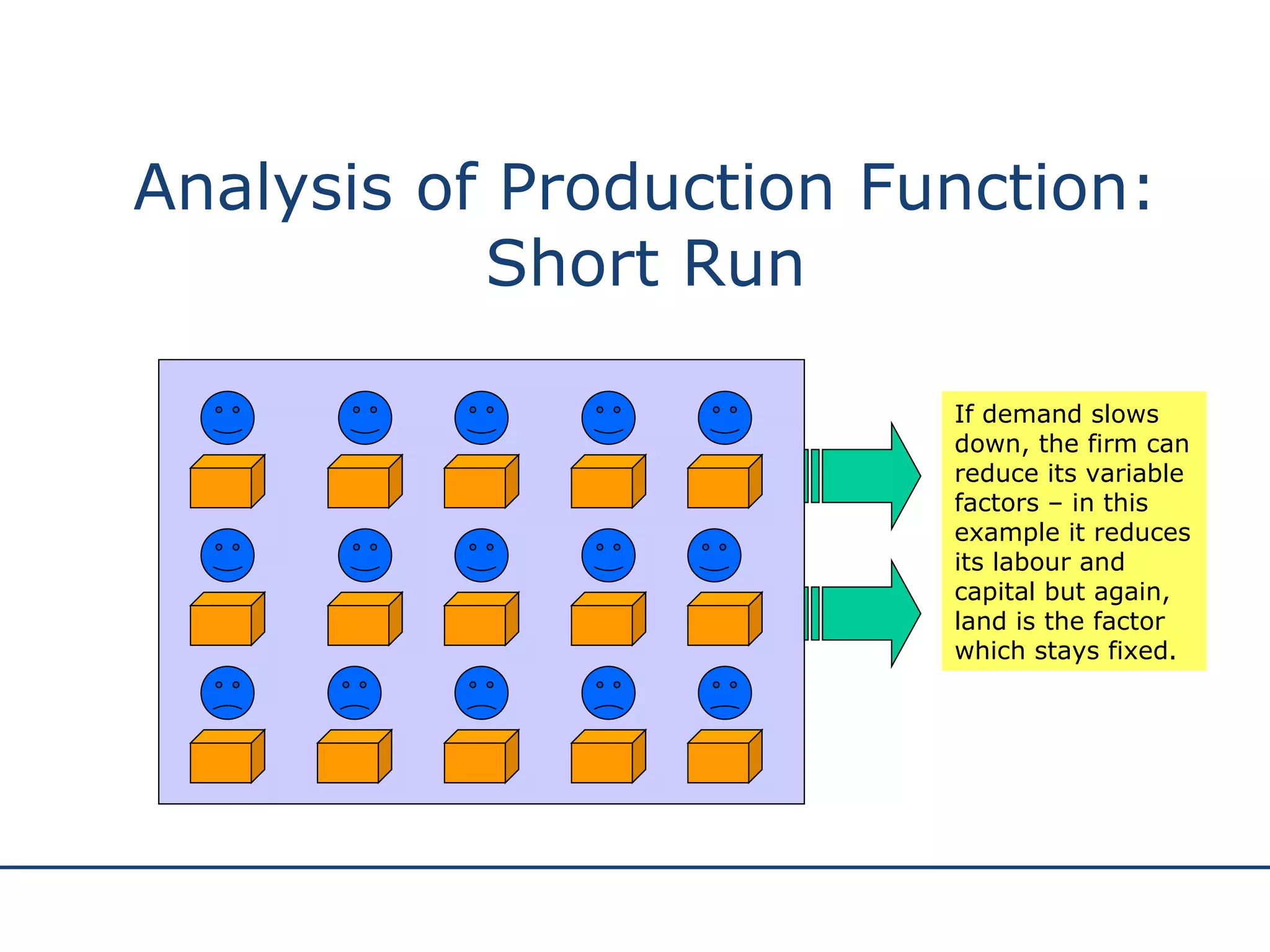
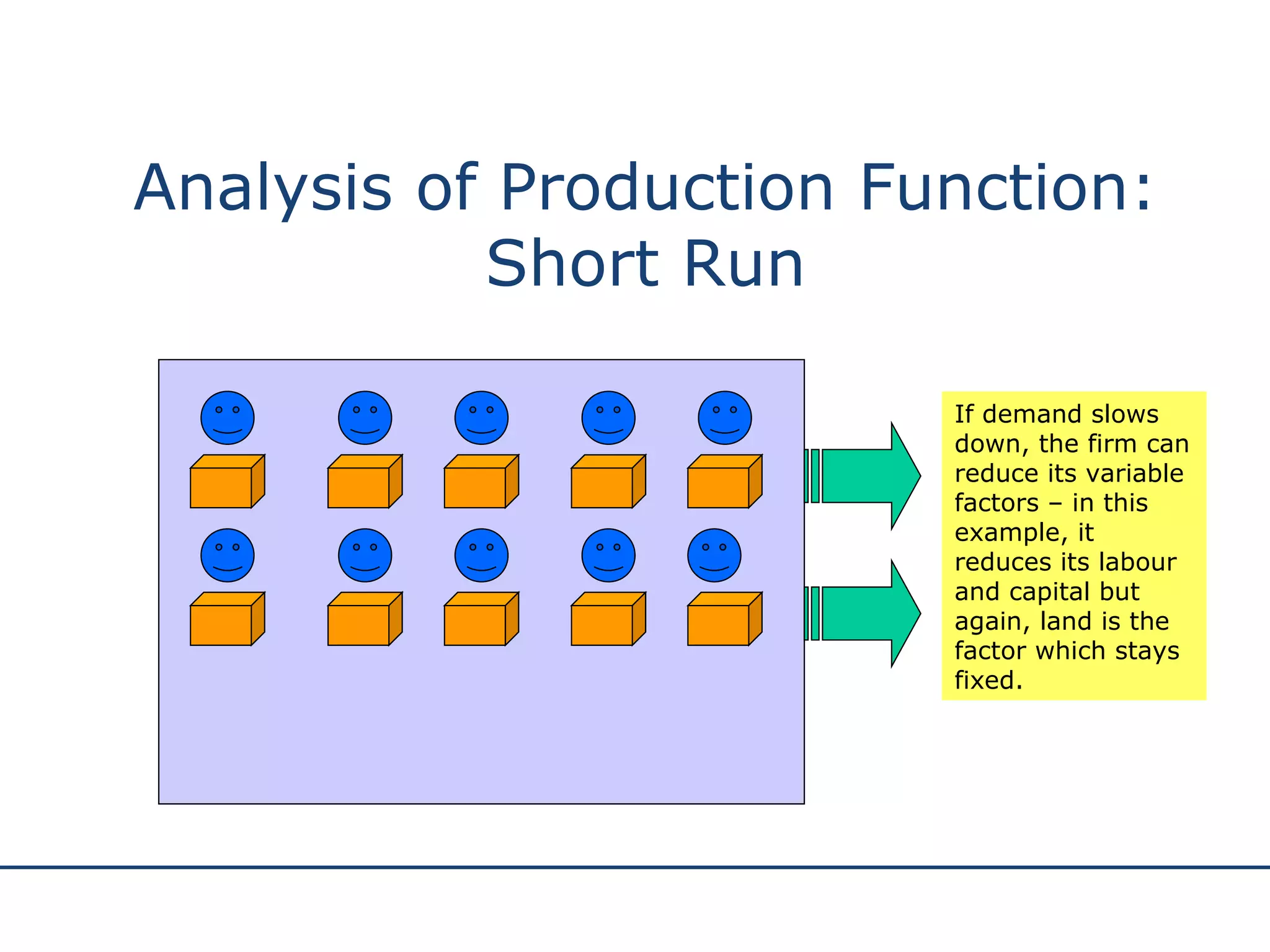
Analysis of Production Function: Short Run If demand slows down, the firm can reduce its variable factors – in this example it reduces its labour and capital but again, land is the factor which stays fixed.
Analysis of Production Function: Short Run If demand slows down, the firm can reduce its variable factors – in this example, it reduces its labour and capital but again, land is the factor which stays fixed.
Analysing the Production Function: Long Run The long run is defined as the period of time taken to vary all factors of production By doing this, the firm is able to increase its  total capacity  – not just short term capacity Associated with a change in the  scale of production The period of time varies according to the firm and the industry In electricity supply, the time taken to build new capacity could be many years; for a market stall holder, the ‘long run’ could be as little as a few weeks or months!
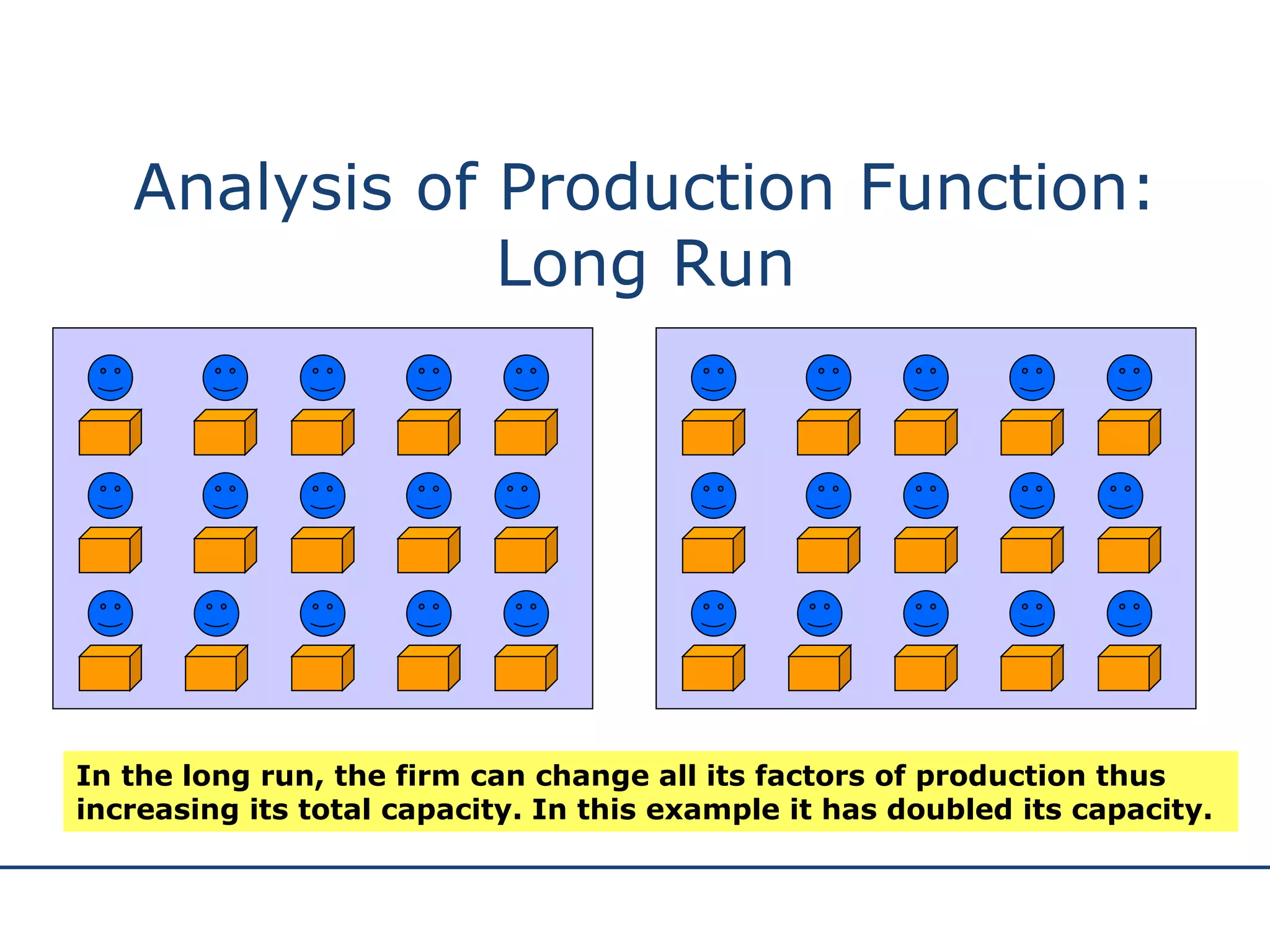
Analysis of Production Function: Long Run In the long run, the firm can change all its factors of production thus increasing its total capacity. In this example it has doubled its capacity.
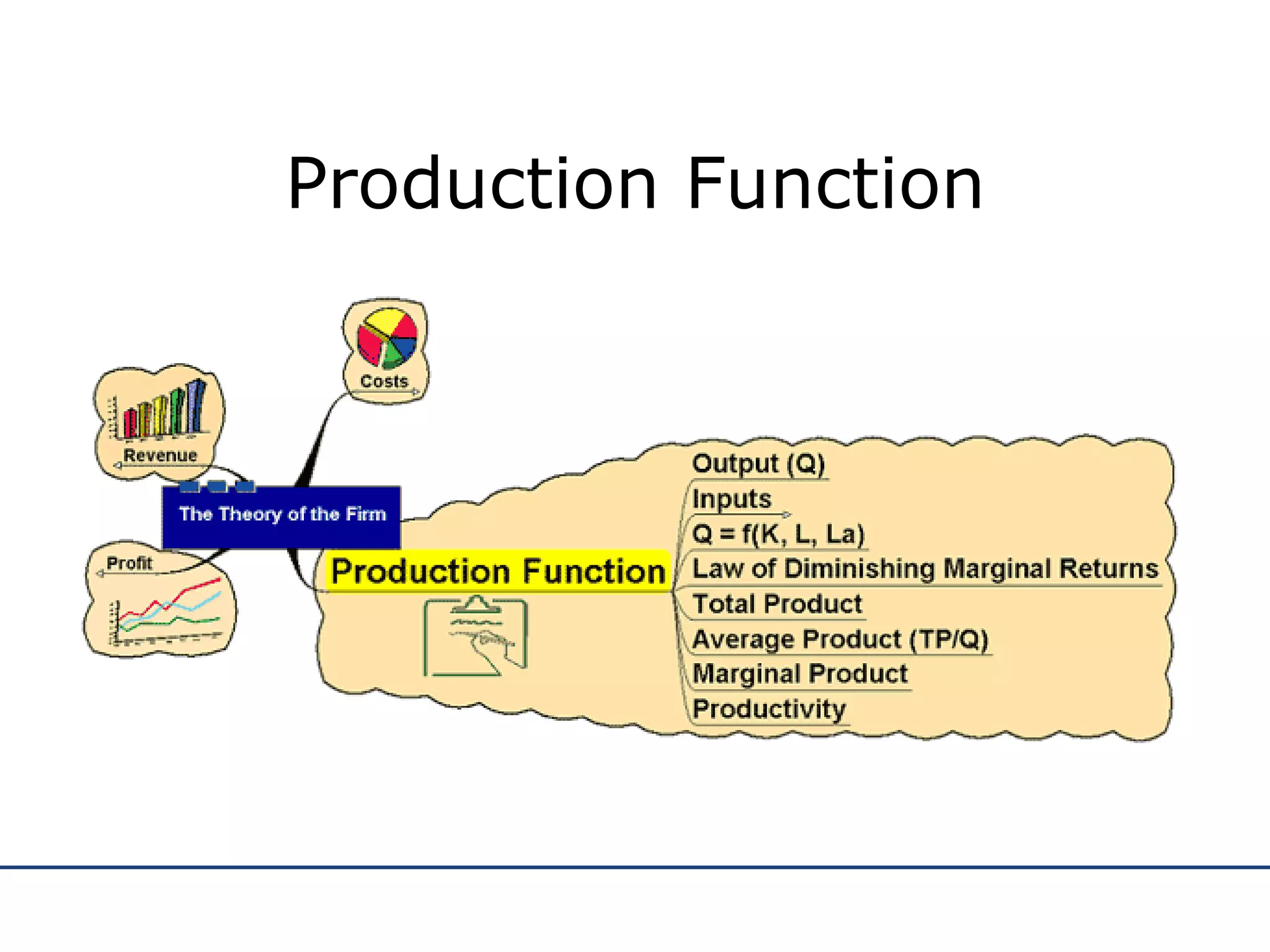
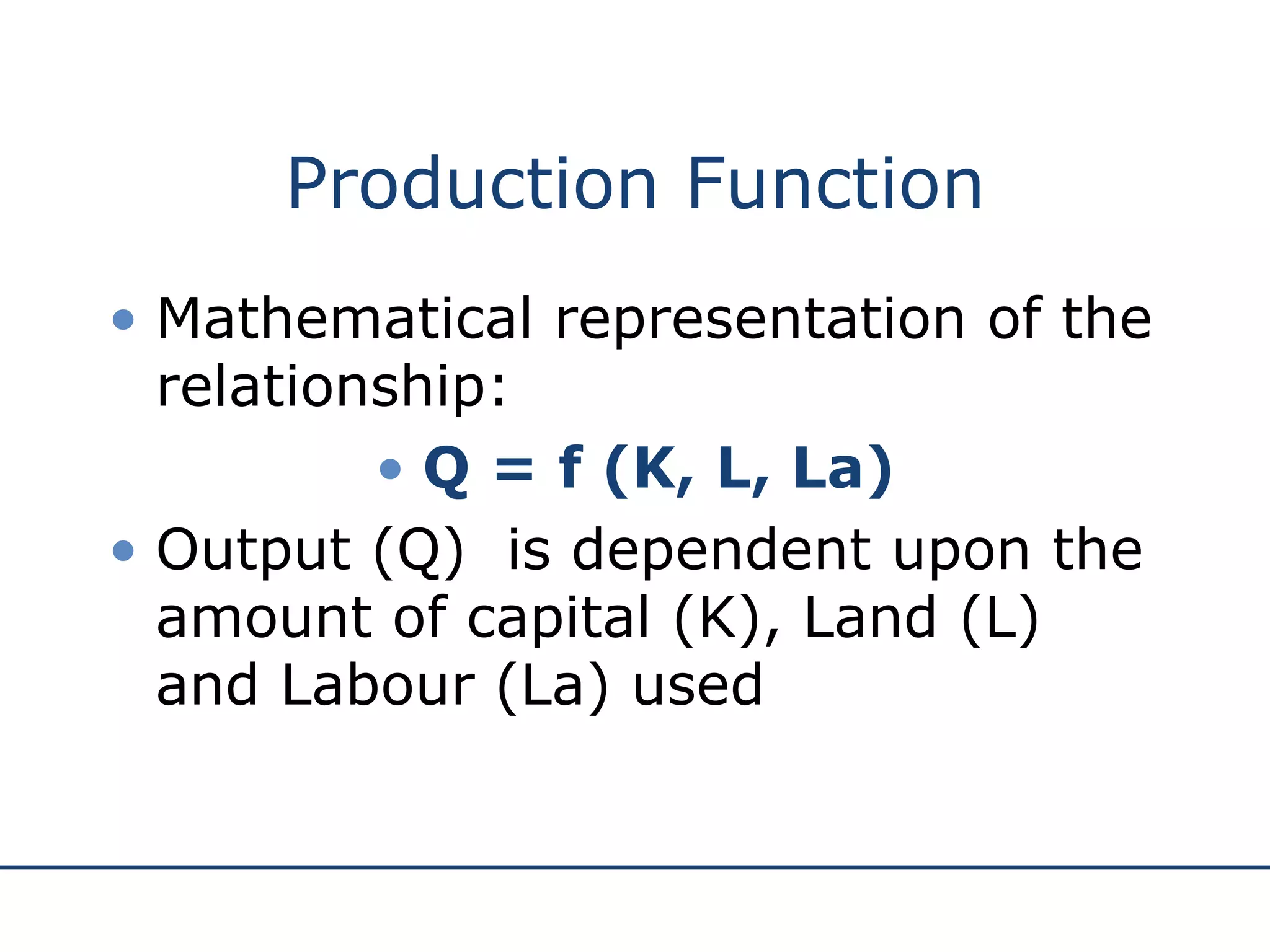
Production Function Mathematical representation of the relationship: Q = f (K, L, La) Output (Q)  is dependent upon the amount of capital (K), Land (L) and Labour (La) used
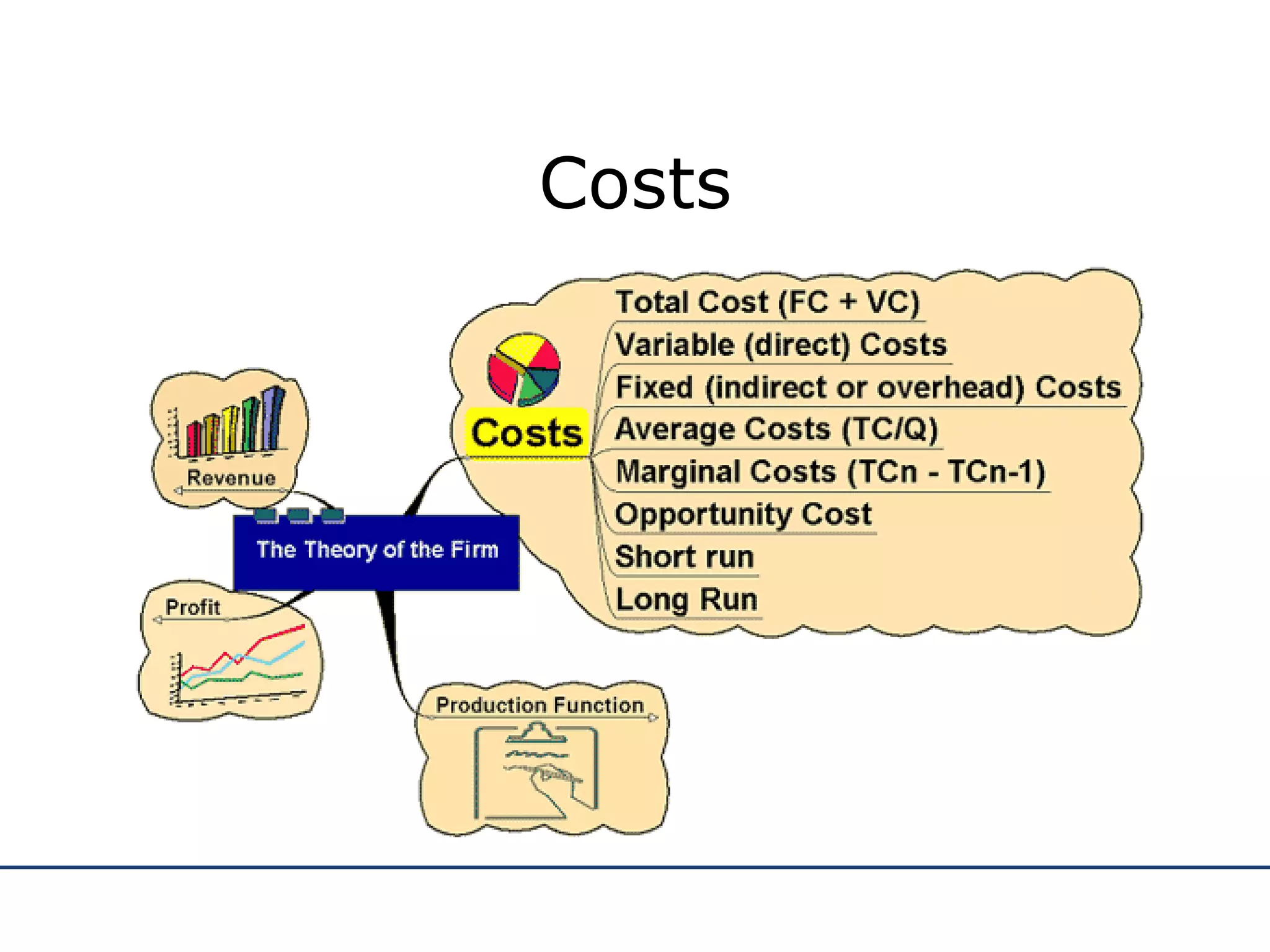
Costs
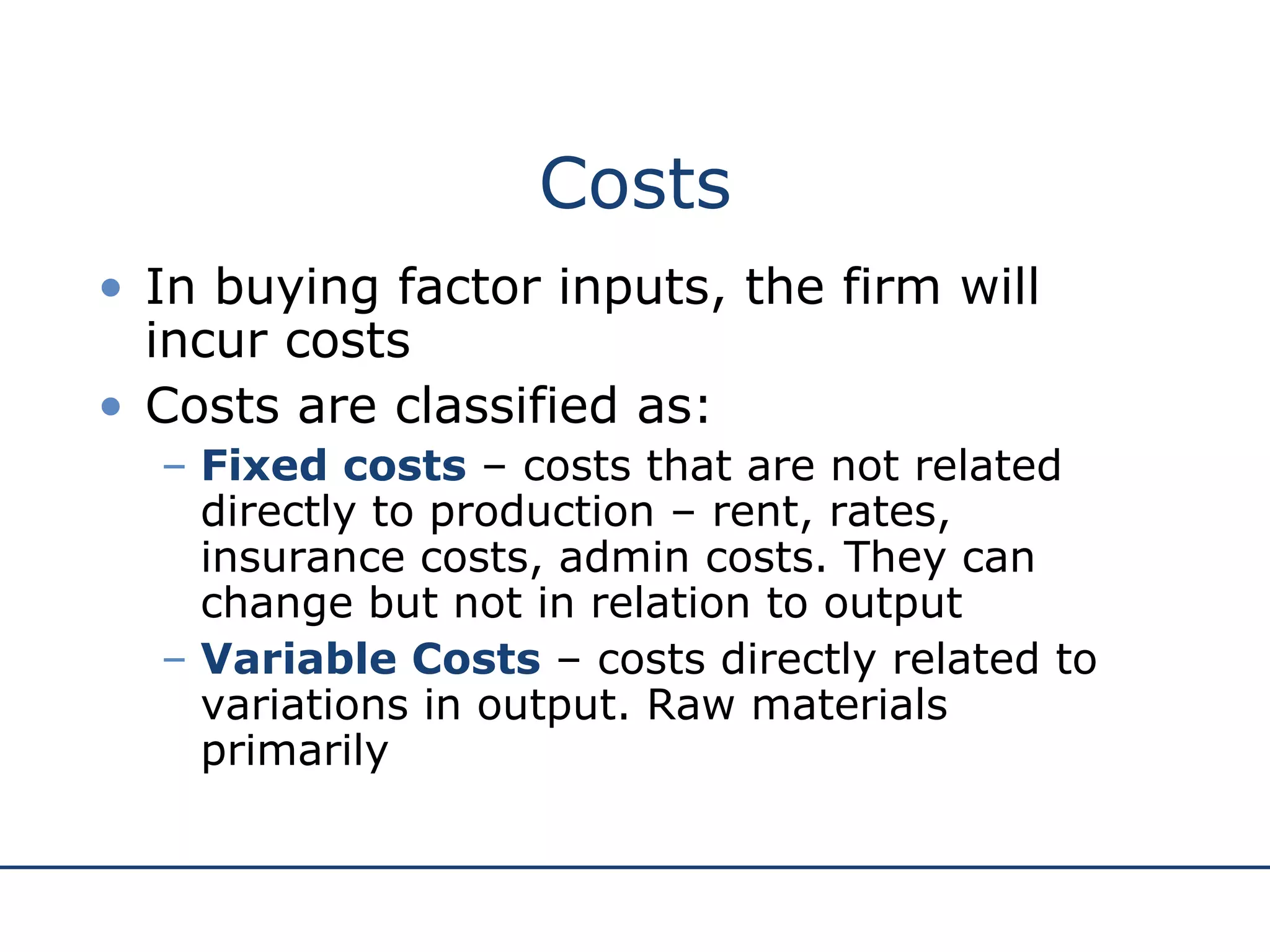
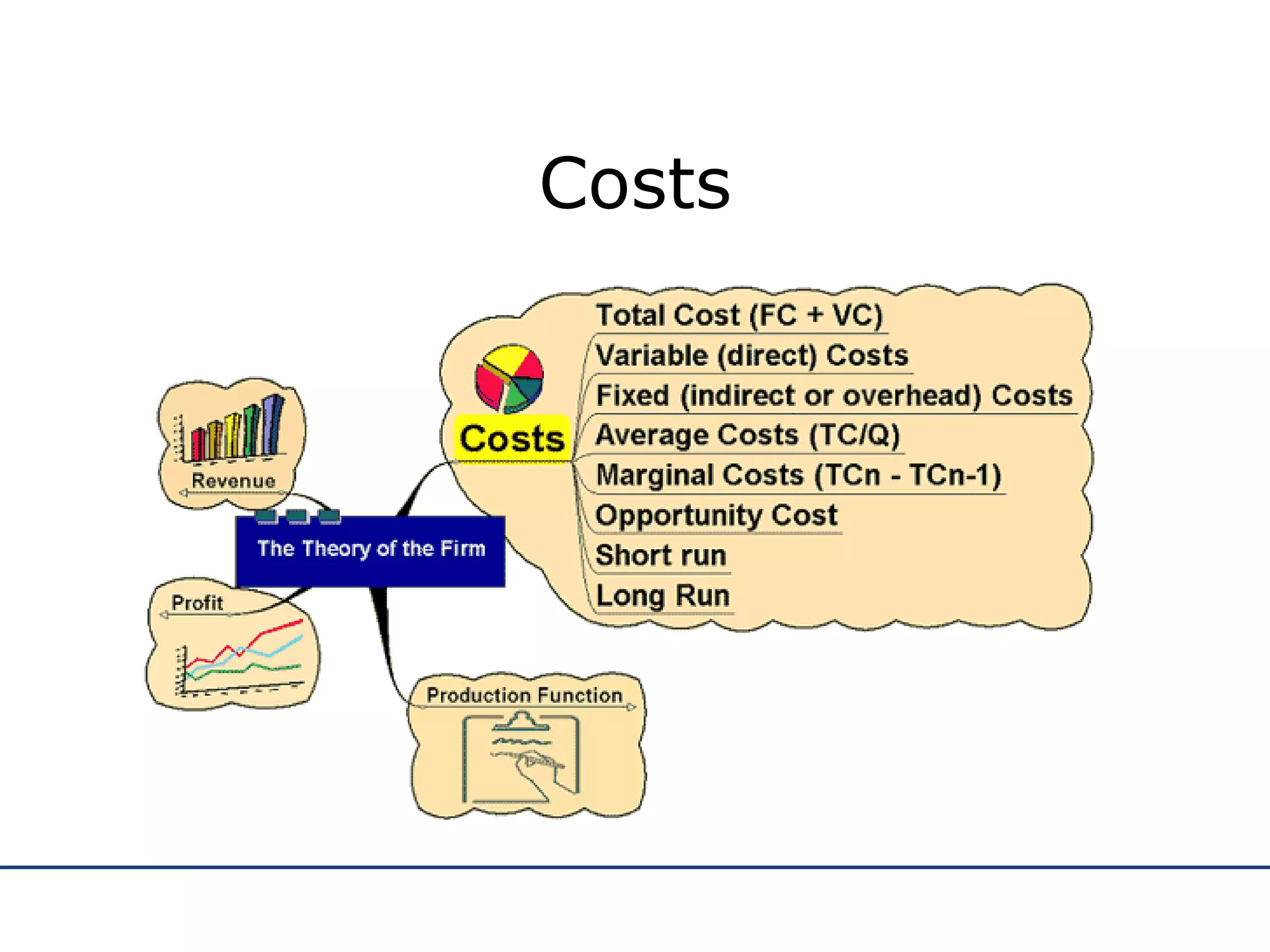
Costs In buying factor inputs, the firm will incur costs Costs are classified as: Fixed costs  – costs that are not related directly to production – rent, rates, insurance costs, admin costs. They can change but not in relation to output Variable Costs  – costs directly related to variations in output. Raw materials primarily
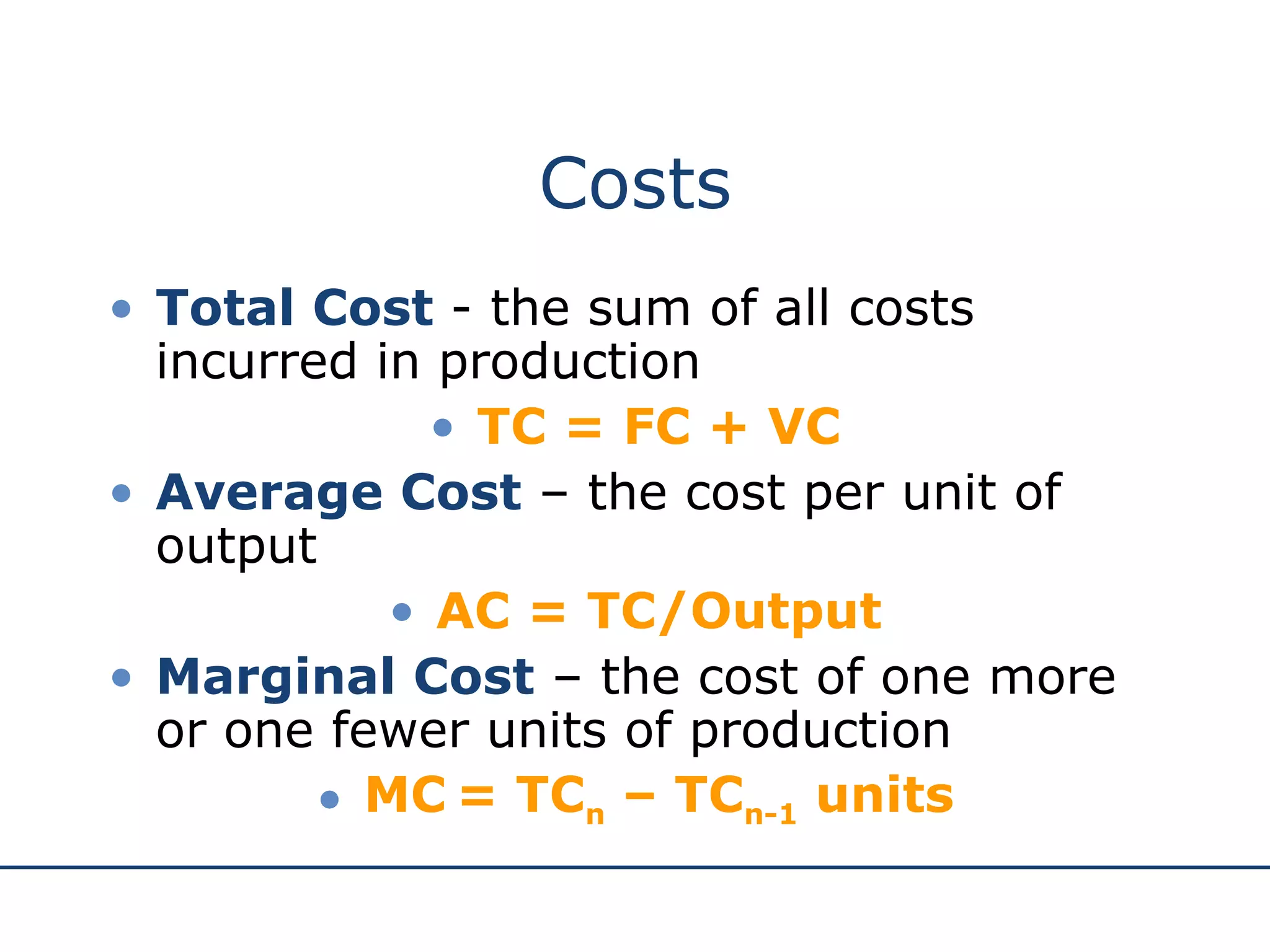
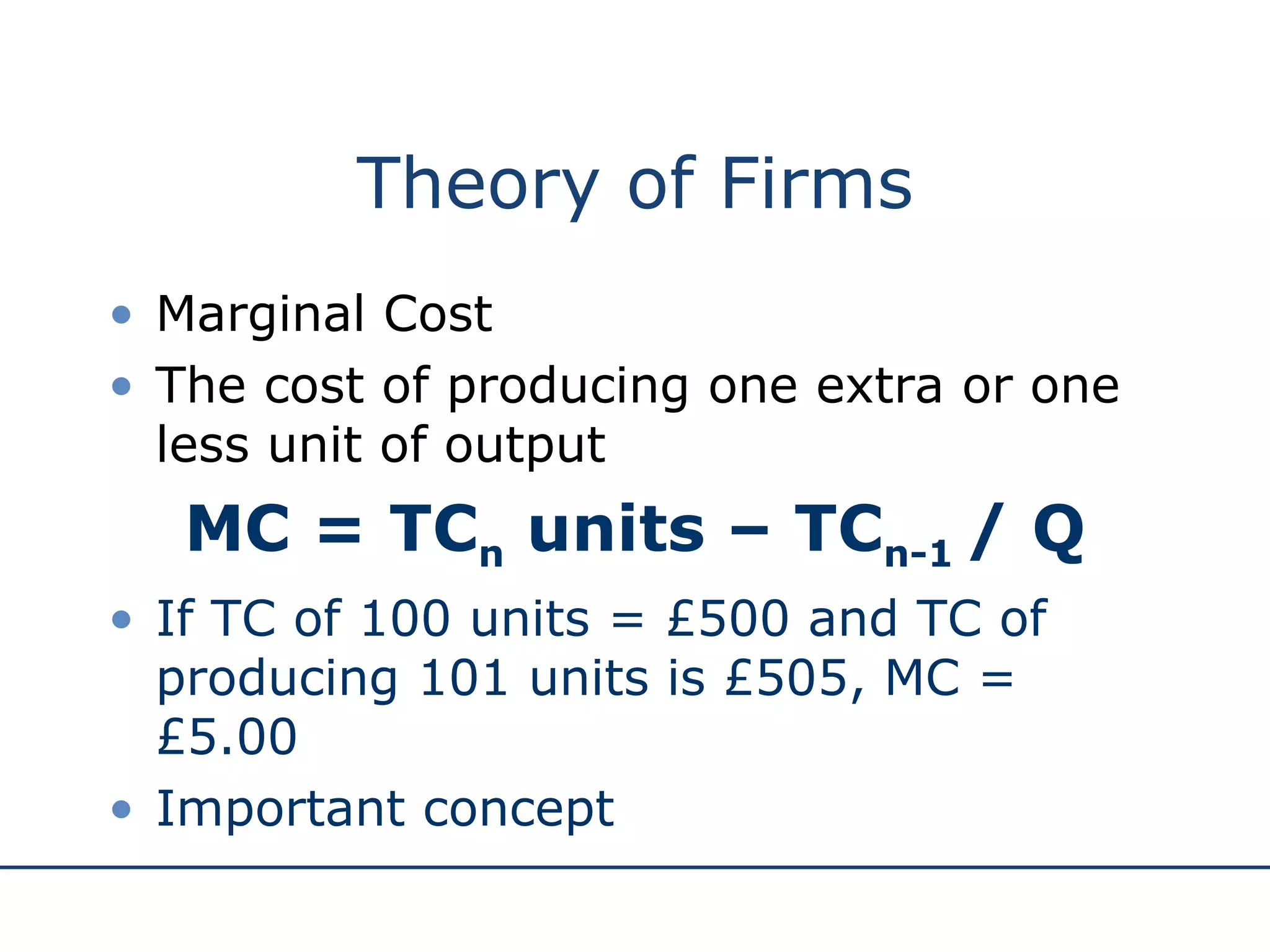
Costs Total Cost  -   the sum of all costs incurred in production TC = FC + VC Average Cost  – the cost per unit of output AC = TC/Output Marginal Cost  – the cost of one more or one fewer units of production MC   = TC n  – TC n-1  units
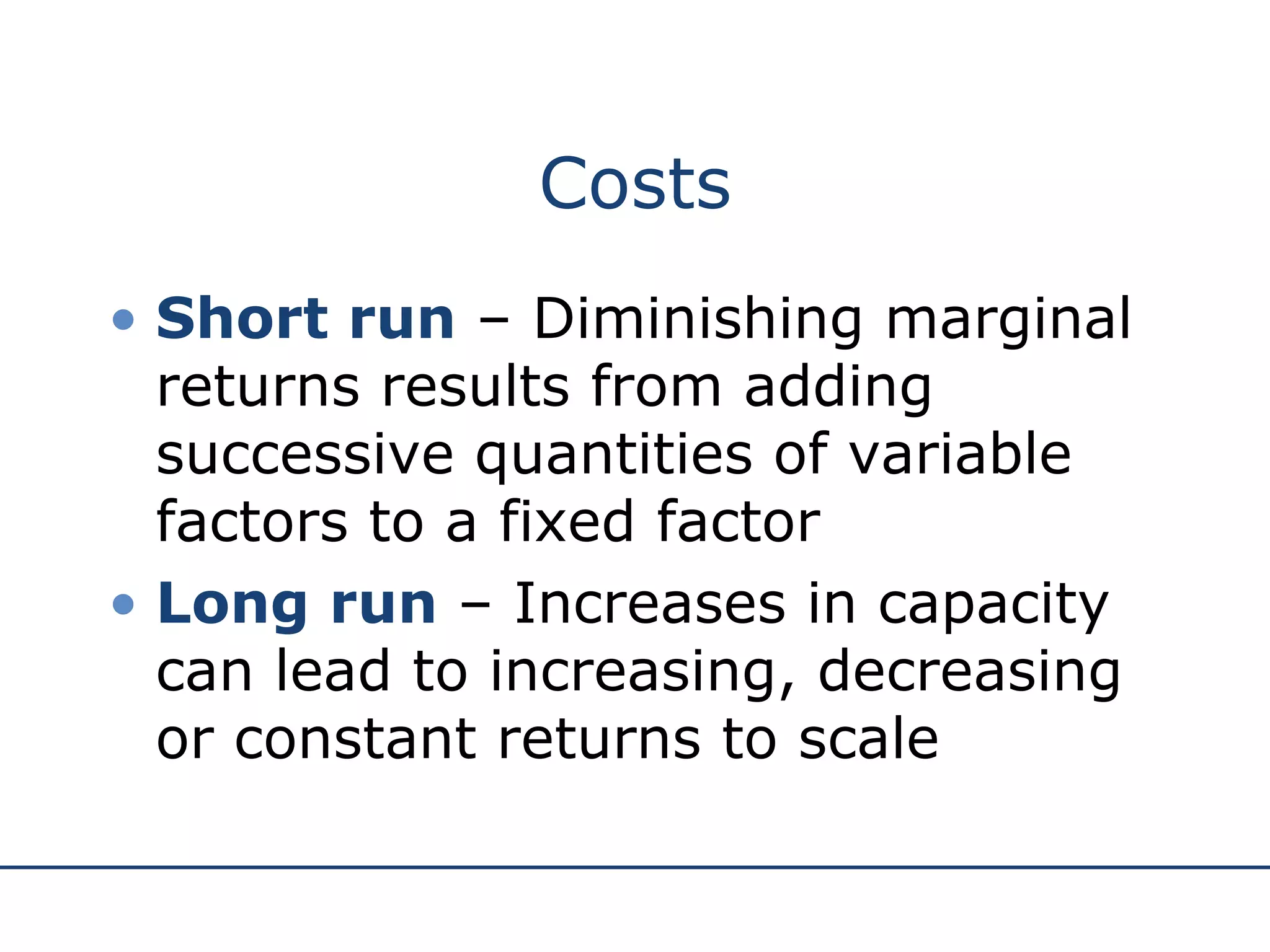
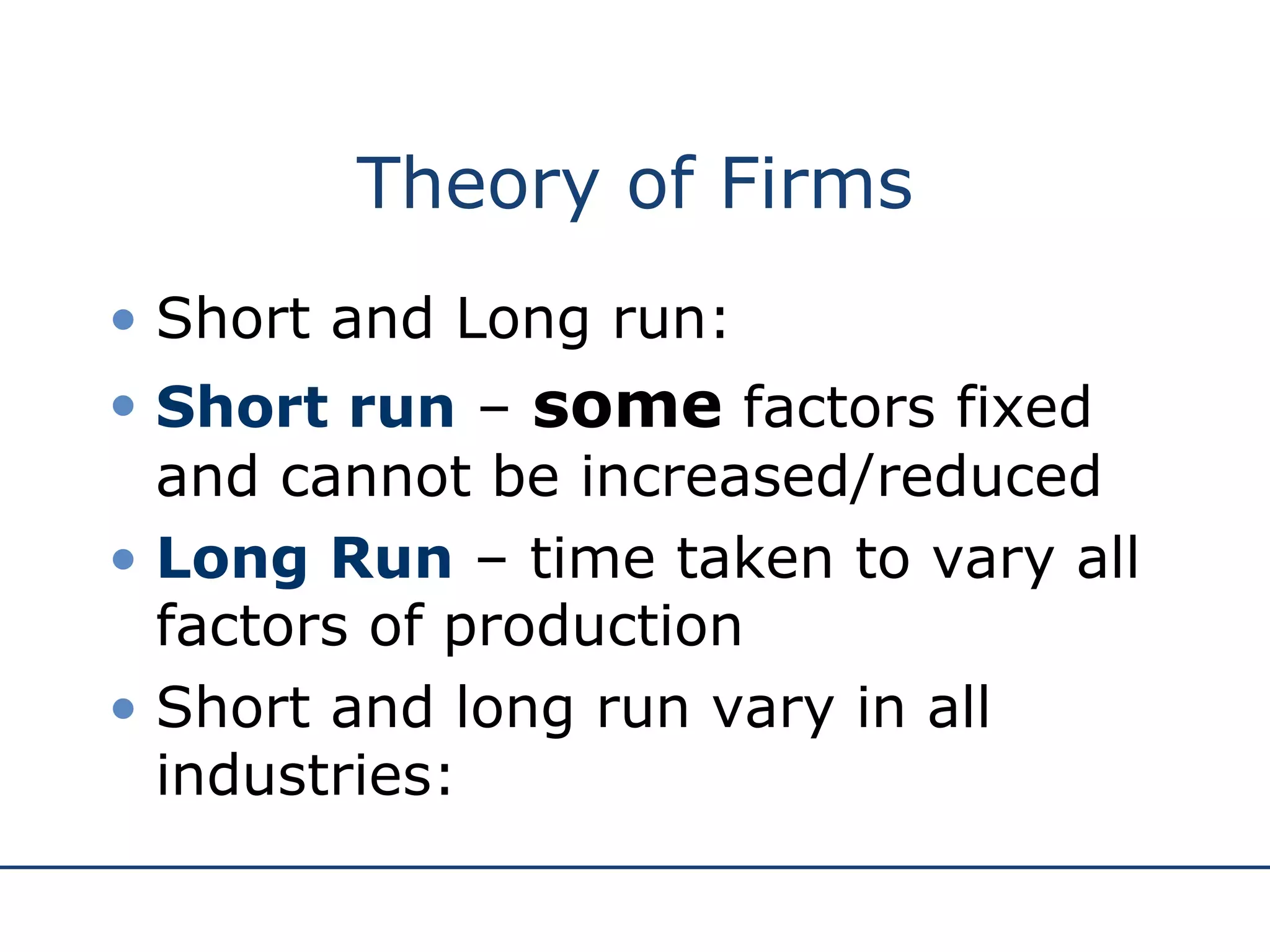
Costs Short run  – Diminishing marginal returns results from adding successive quantities of variable factors to a fixed factor Long run  – Increases in capacity can lead to increasing, decreasing or constant returns to scale
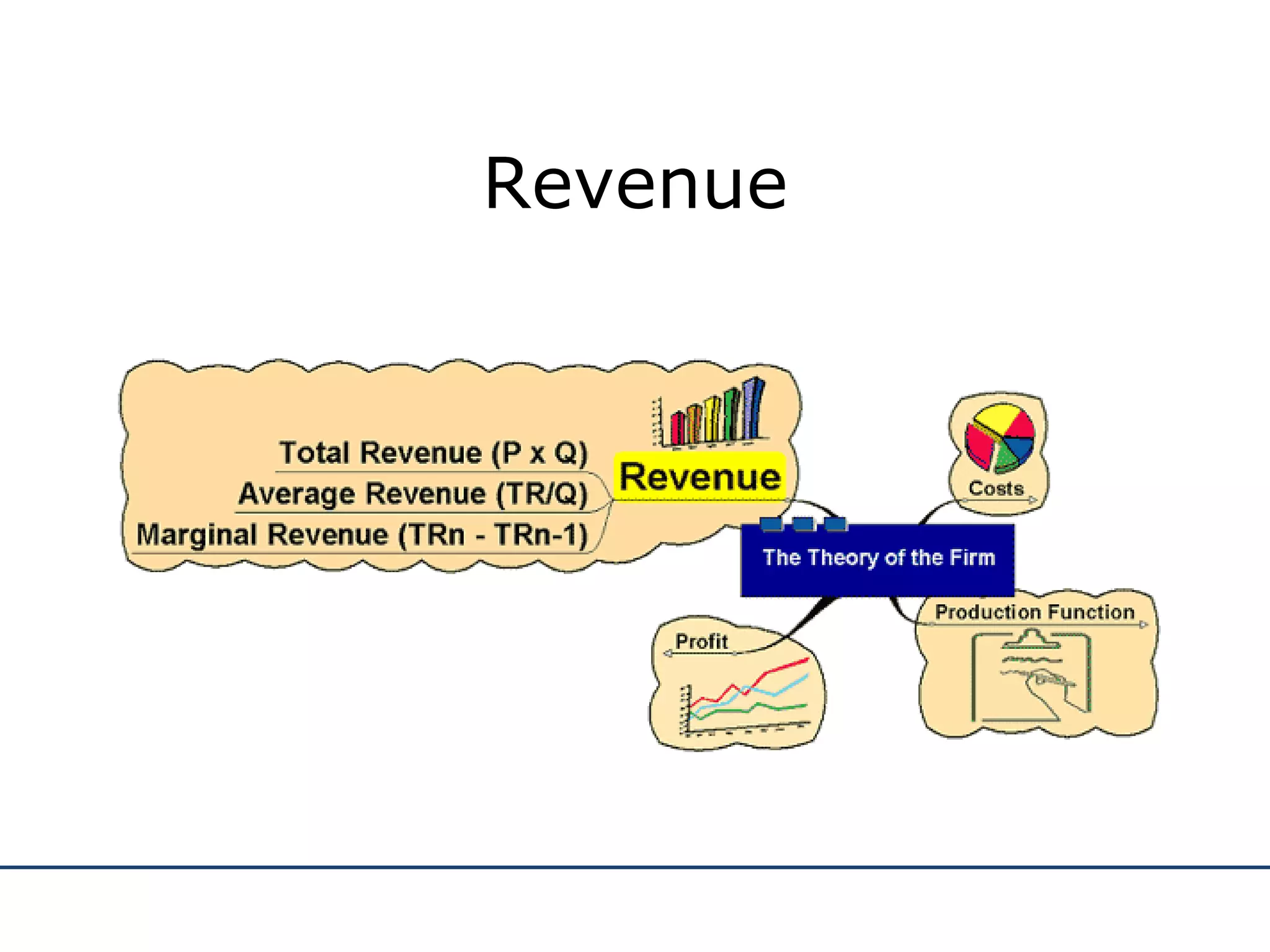
Revenue
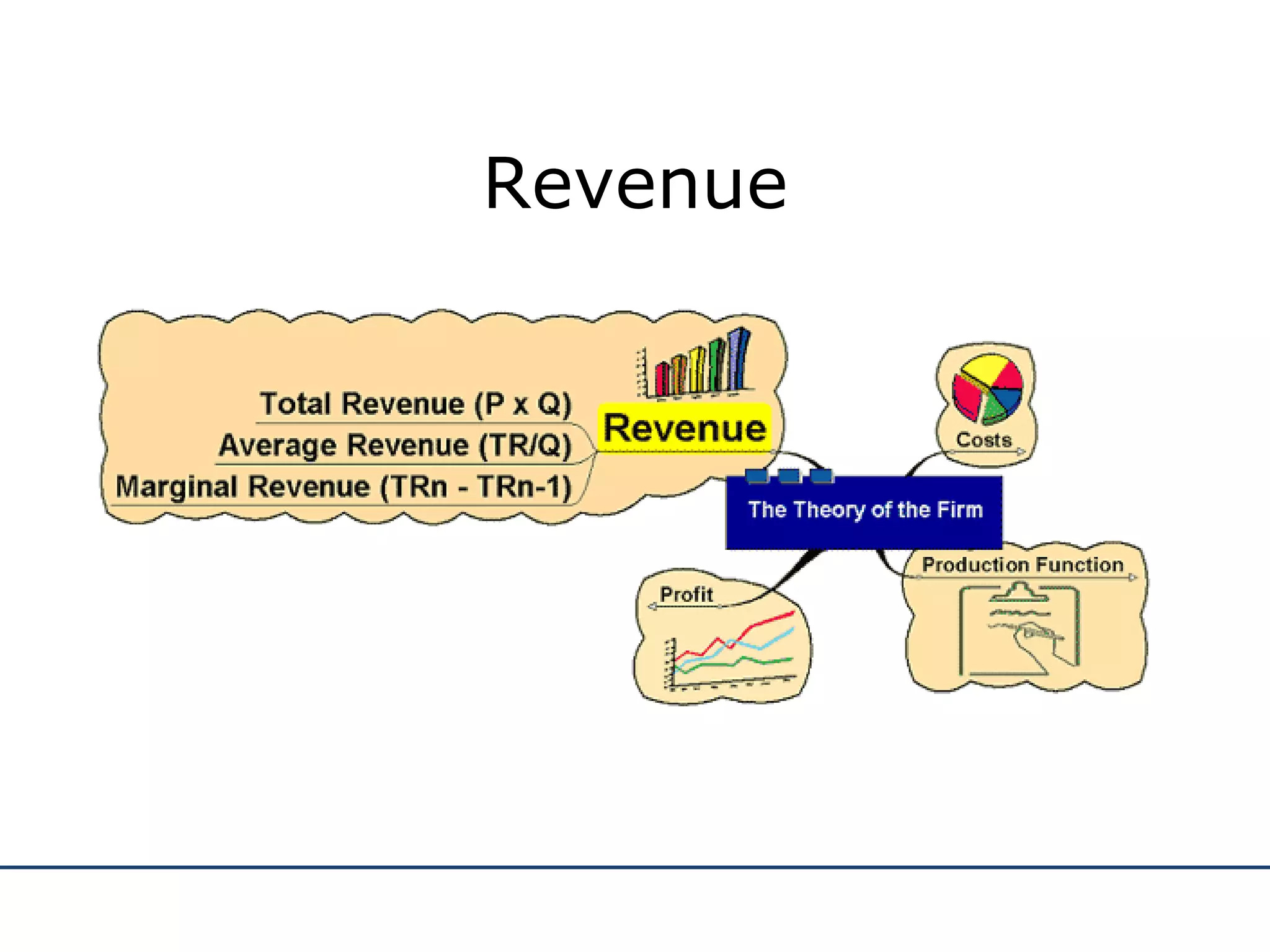
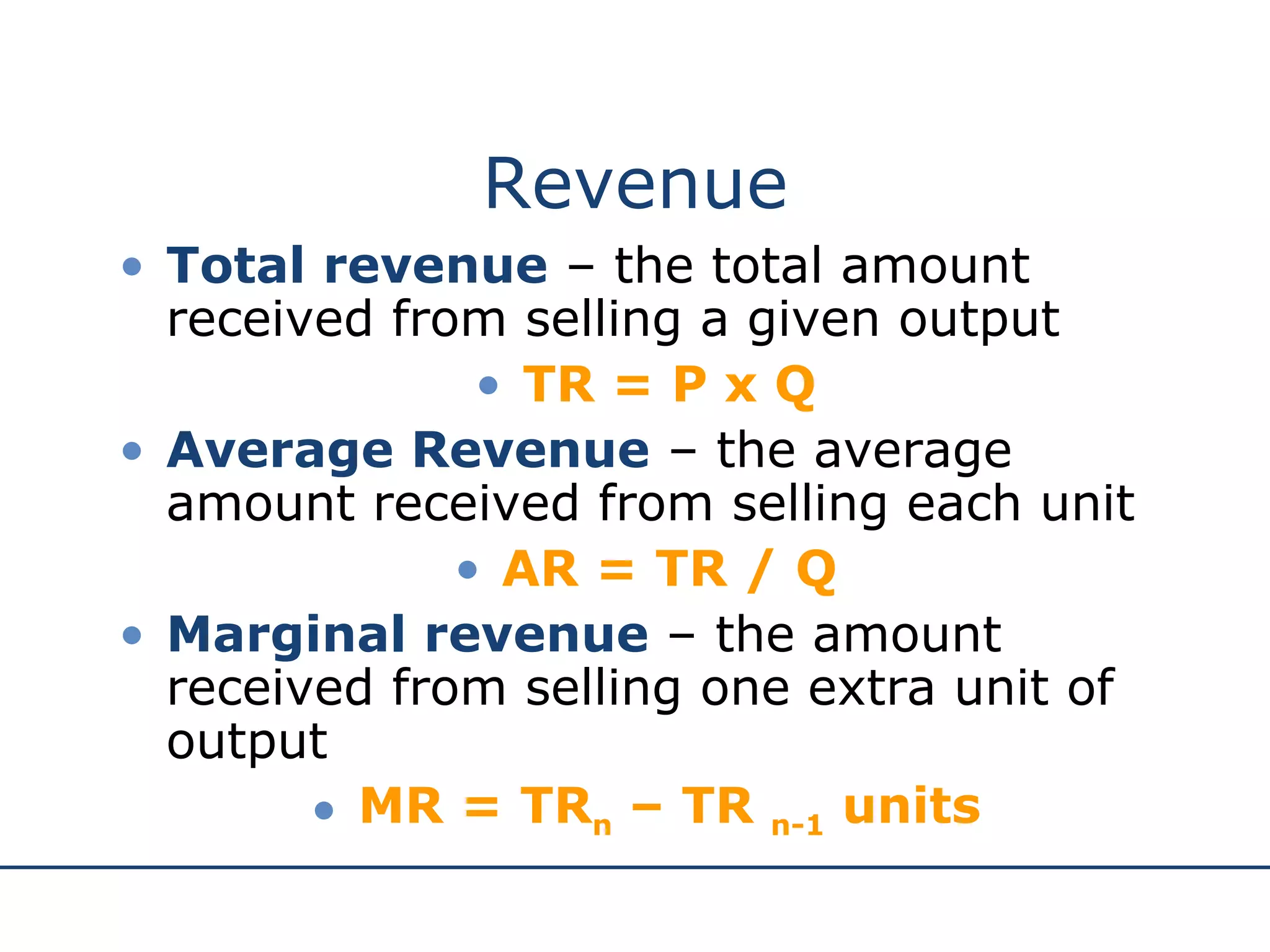
Revenue Total revenue  – the total amount received from selling a given output TR = P x Q Average Revenue  – the average amount received from selling each unit AR = TR / Q Marginal revenue  – the amount received from selling one extra unit of output MR = TR n  – TR  n-1  units
Profit
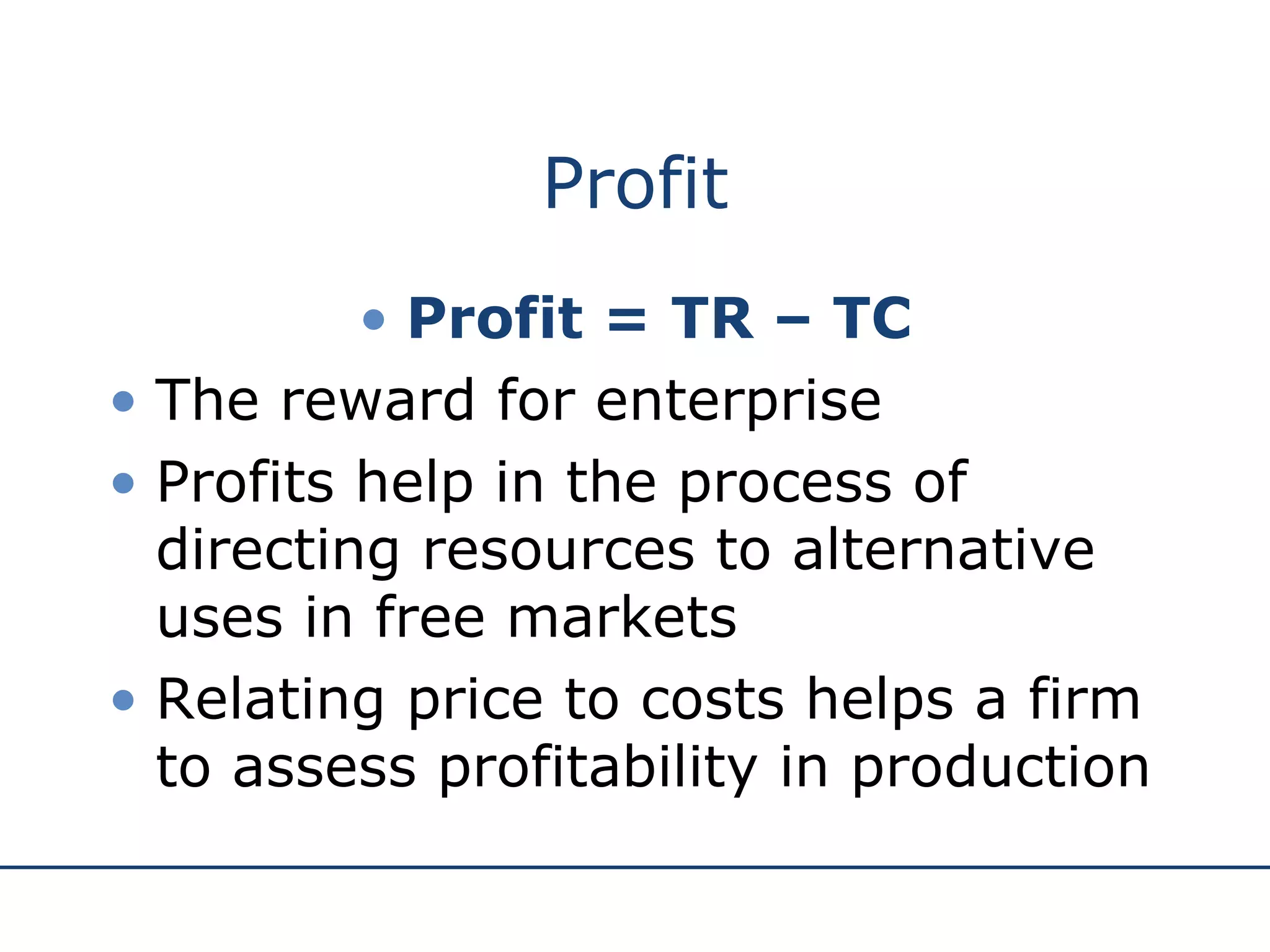
Profit Profit = TR – TC The reward for enterprise Profits help in the process of directing resources to alternative uses in free markets Relating price to costs helps a firm to assess profitability in production
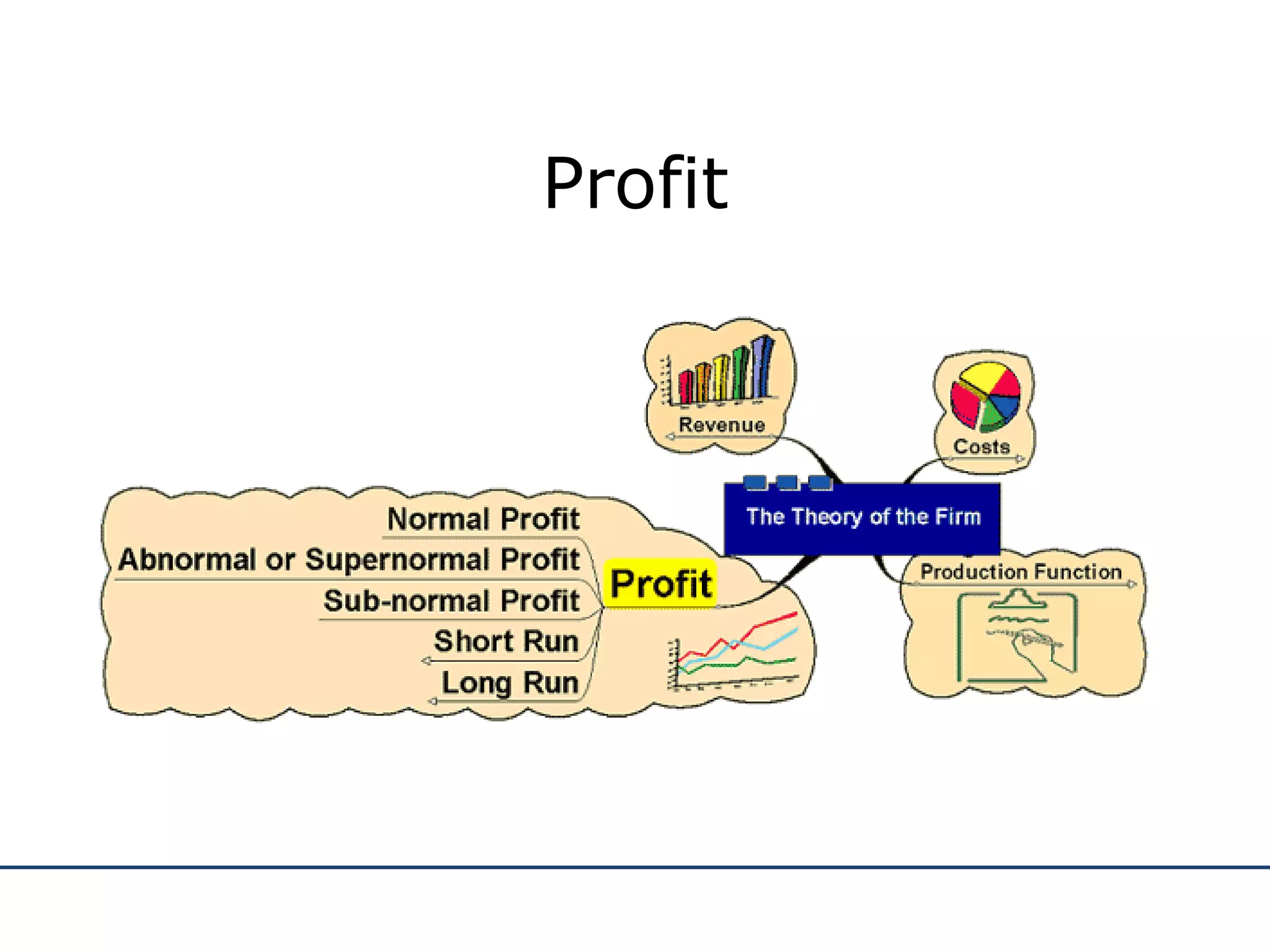
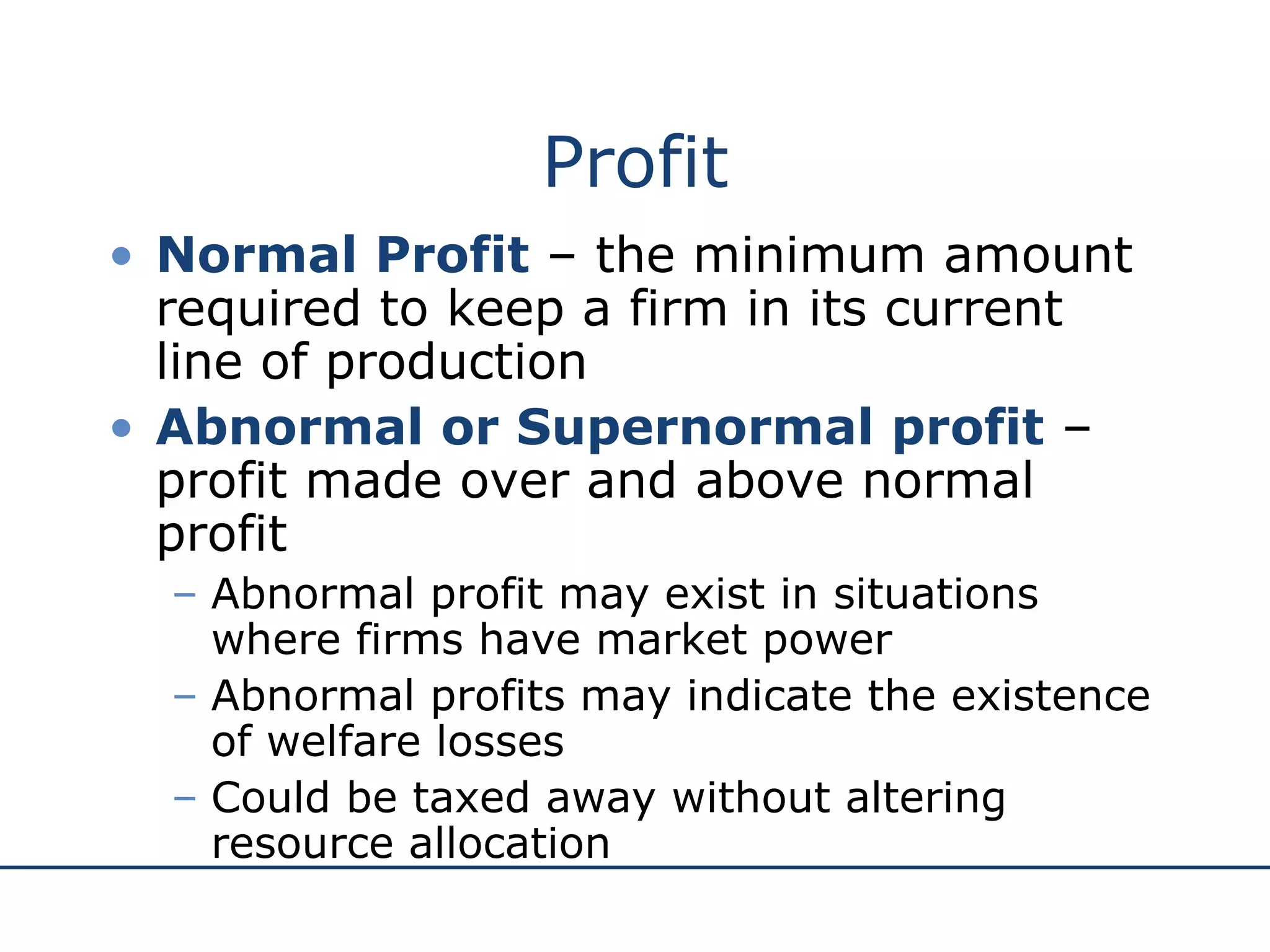
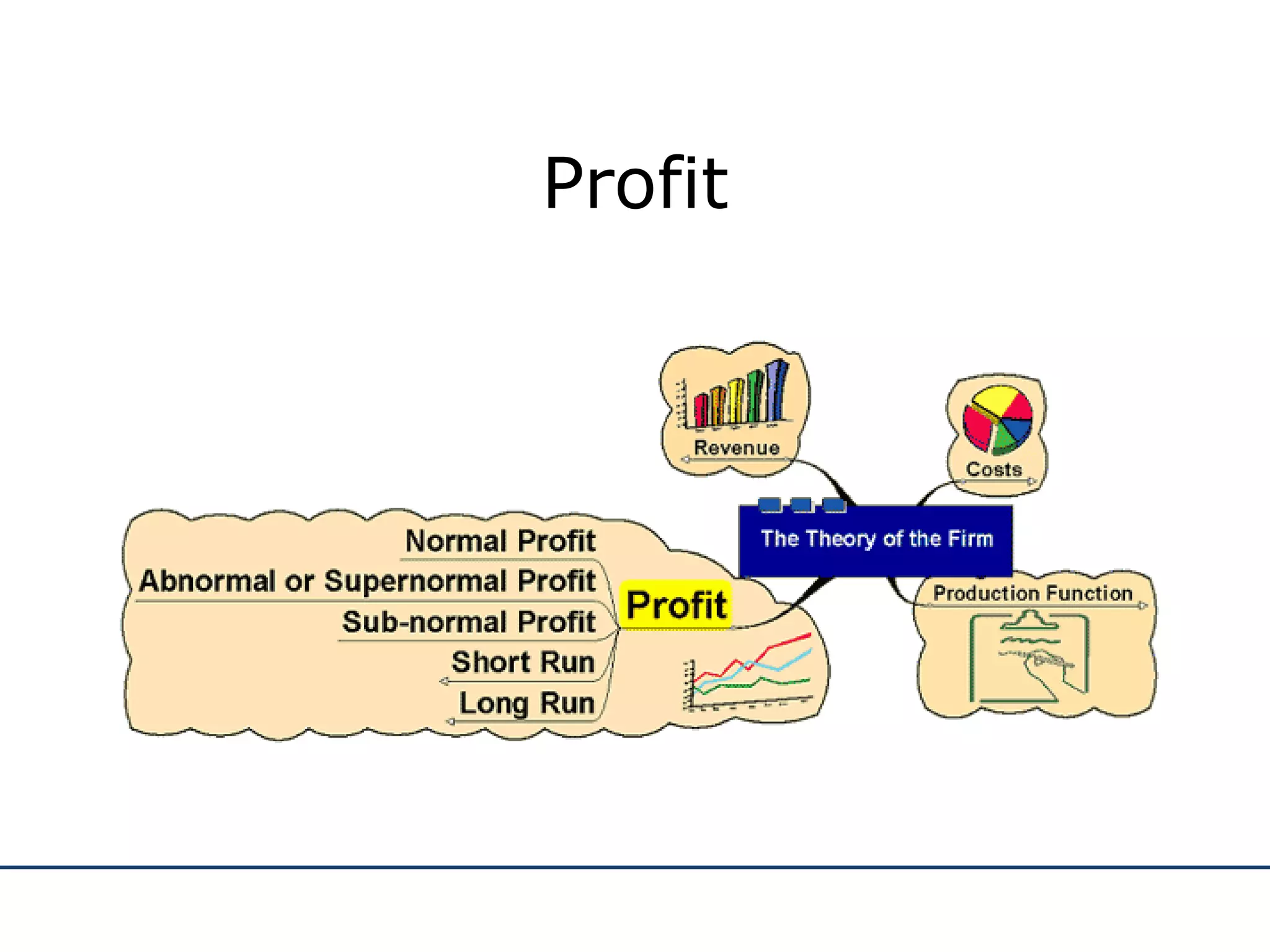
Profit Normal Profit  – the minimum amount required to keep a firm in its current line of production Abnormal or Supernormal profit  – profit made over and above normal profit Abnormal profit may exist in situations where firms have market power Abnormal profits may indicate the existence of welfare losses  Could be taxed away without altering resource allocation
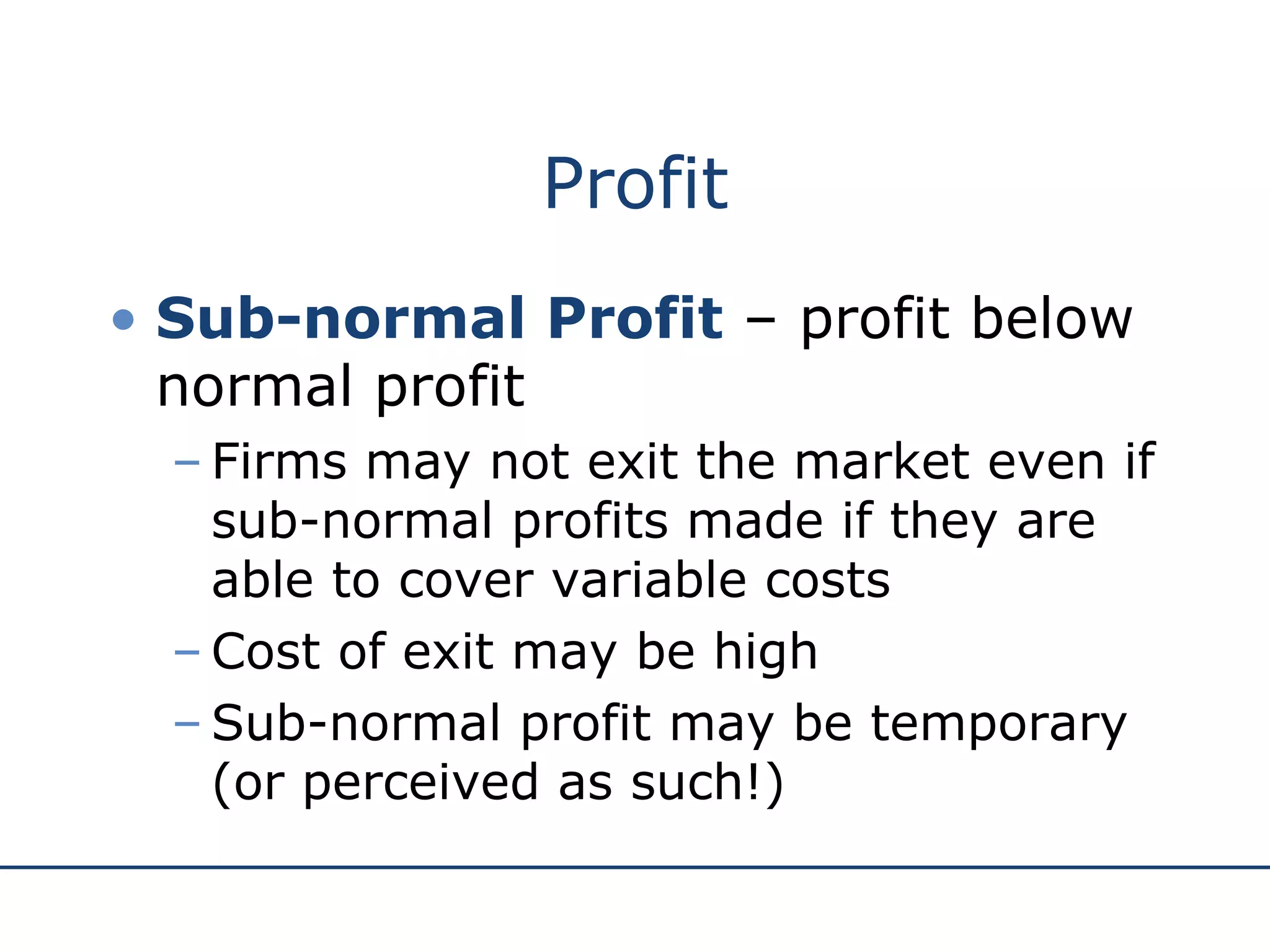
Profit Sub-normal Profit  – profit below normal profit Firms may not exit the market even if sub-normal profits made if they are able to cover variable costs Cost of exit may be high Sub-normal profit may be temporary (or perceived as such!)
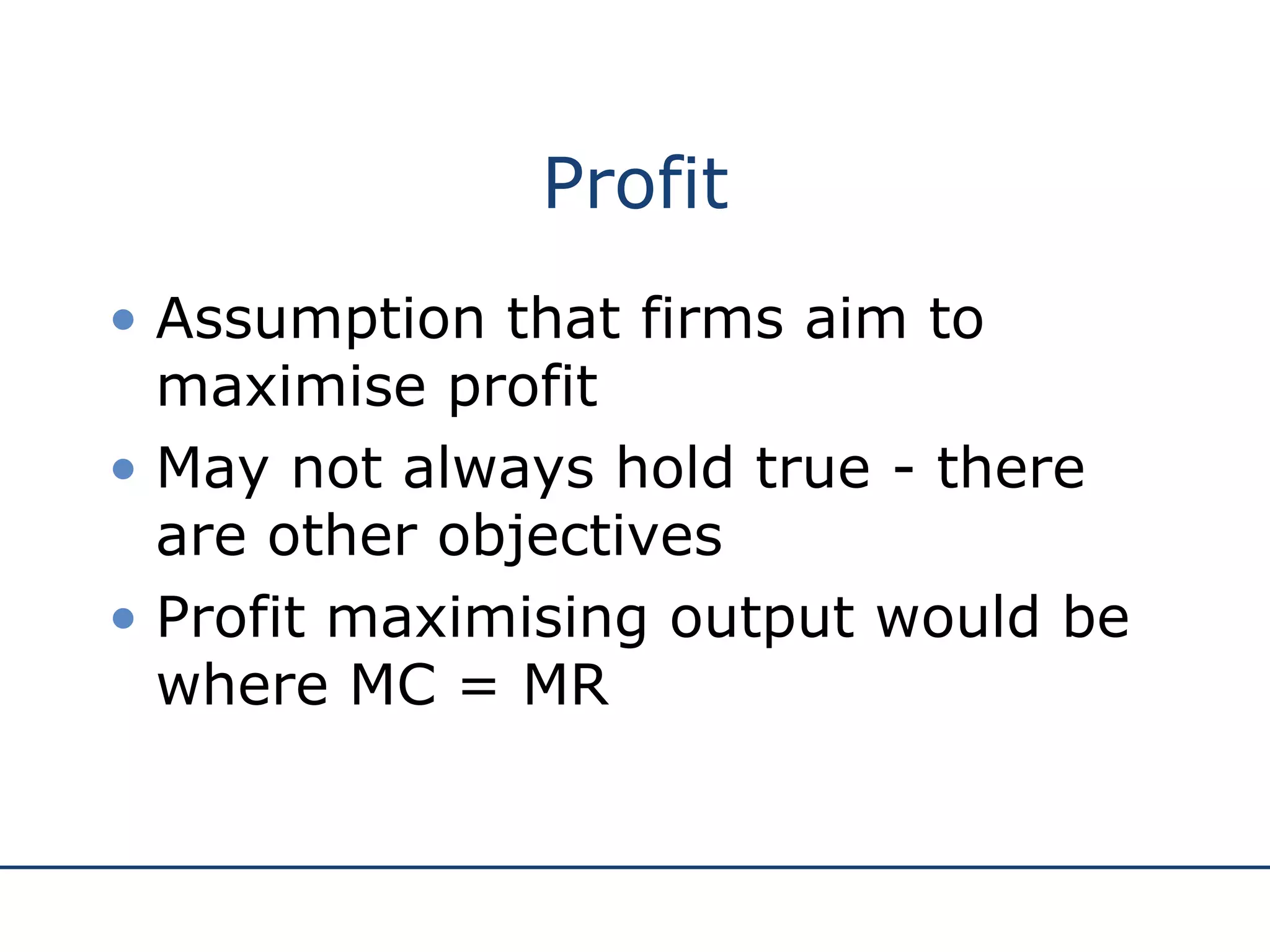
Profit Assumption that firms aim to maximise profit May not always hold true - there are other objectives Profit maximising output would be where MC = MR
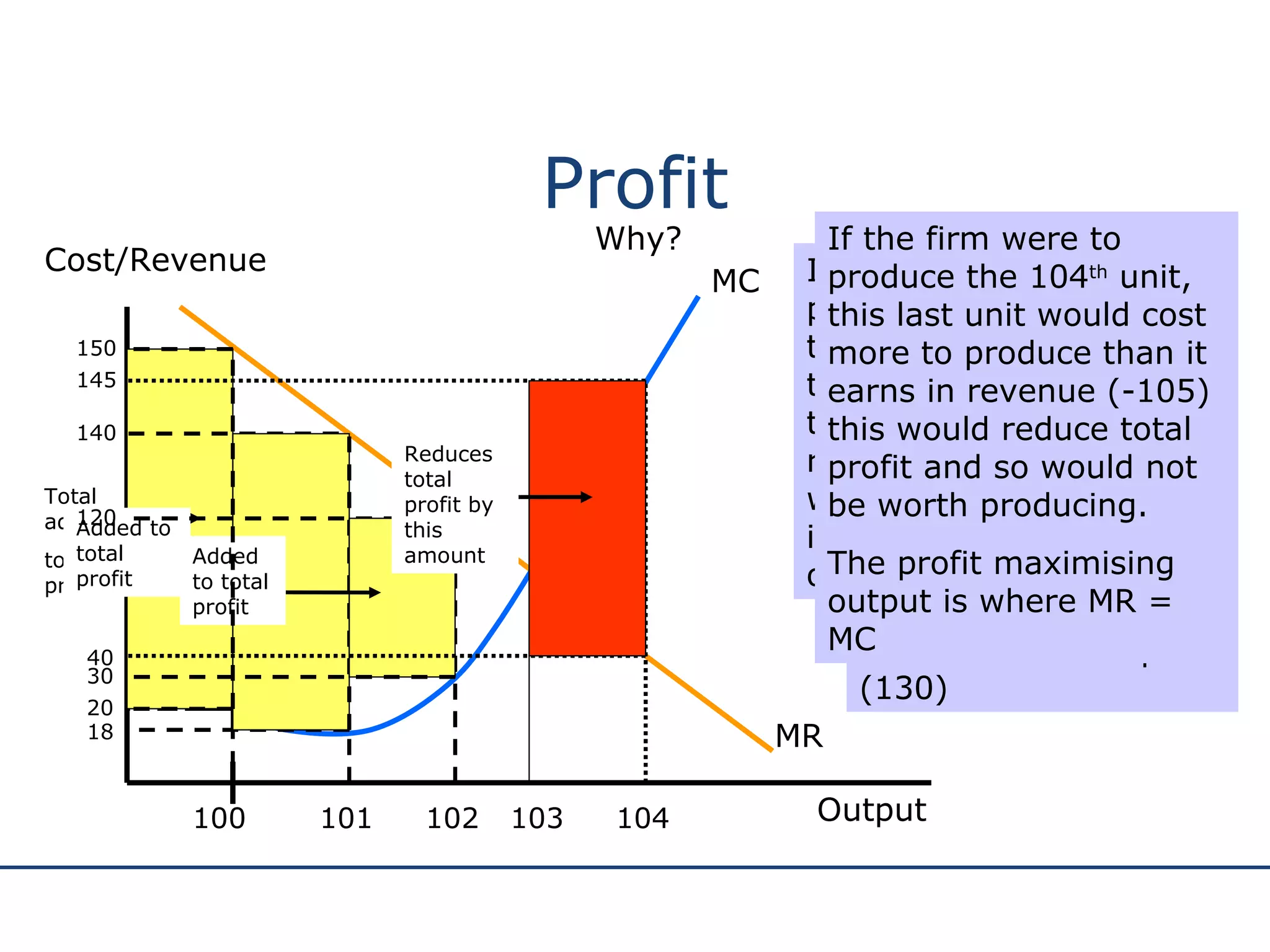
Profit Why? Cost/Revenue Output MR MR  – the addition to total revenue as a result of producing one more unit of output – the price received from selling that extra unit. MC MC – The cost of producing ONE extra unit of production 100 Assume output is at 100 units. The MC of producing the 100 th  unit is 20. The MR received from selling that 100 th  unit is 150. The firm can add the difference of the cost and the revenue received from that 100 th  unit to profit (130) 20 150 If the firm decides to produce one more unit – the 101 st  – the addition to total cost is now 18, the addition to total revenue is 140 – the firm will add 128 to profit. – it is worth expanding output. 101 18 140 30 120 The process continues for each successive unit produced. Provided the MC is less than the MR it will be worth expanding output as the difference between the two is ADDED to total profit 102 40 145 104 103 If the firm were to produce the 104 th  unit, this last unit would cost more to produce than it earns in revenue (-105) this would reduce total profit and so would not be worth producing. The profit maximising output is where MR = MC Total added  to profit Added to total profit Added to total profit Reduces total profit by this amount
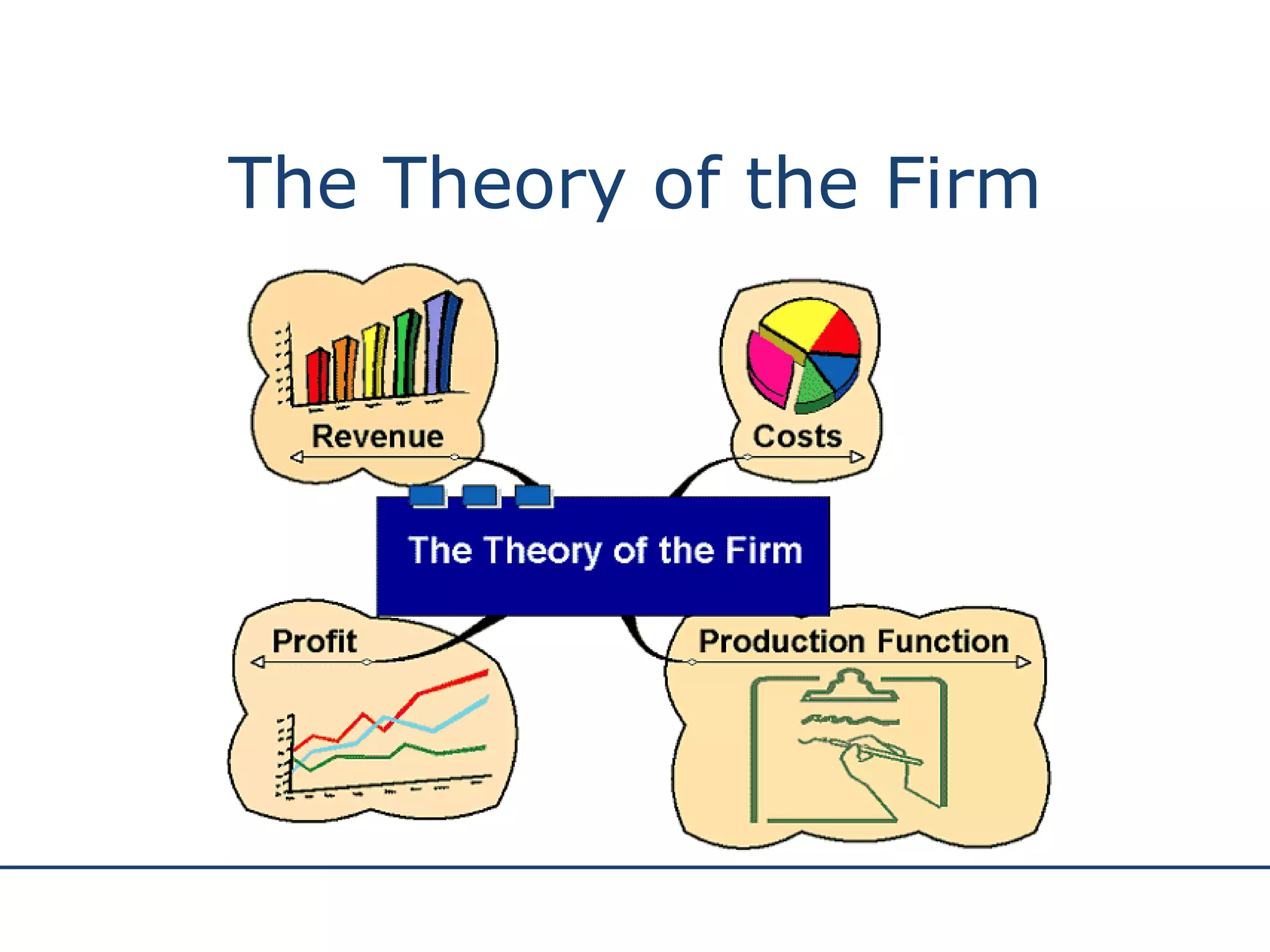
The Theory of the Firm
Costs
Production Function
Inputs  Capital (K) Land (L) Labour (La)
Profit
Short Run At least one factor fixed
Long Run All factors variable
Revenue
Theory of Firms Costs, Revenues and Objectives
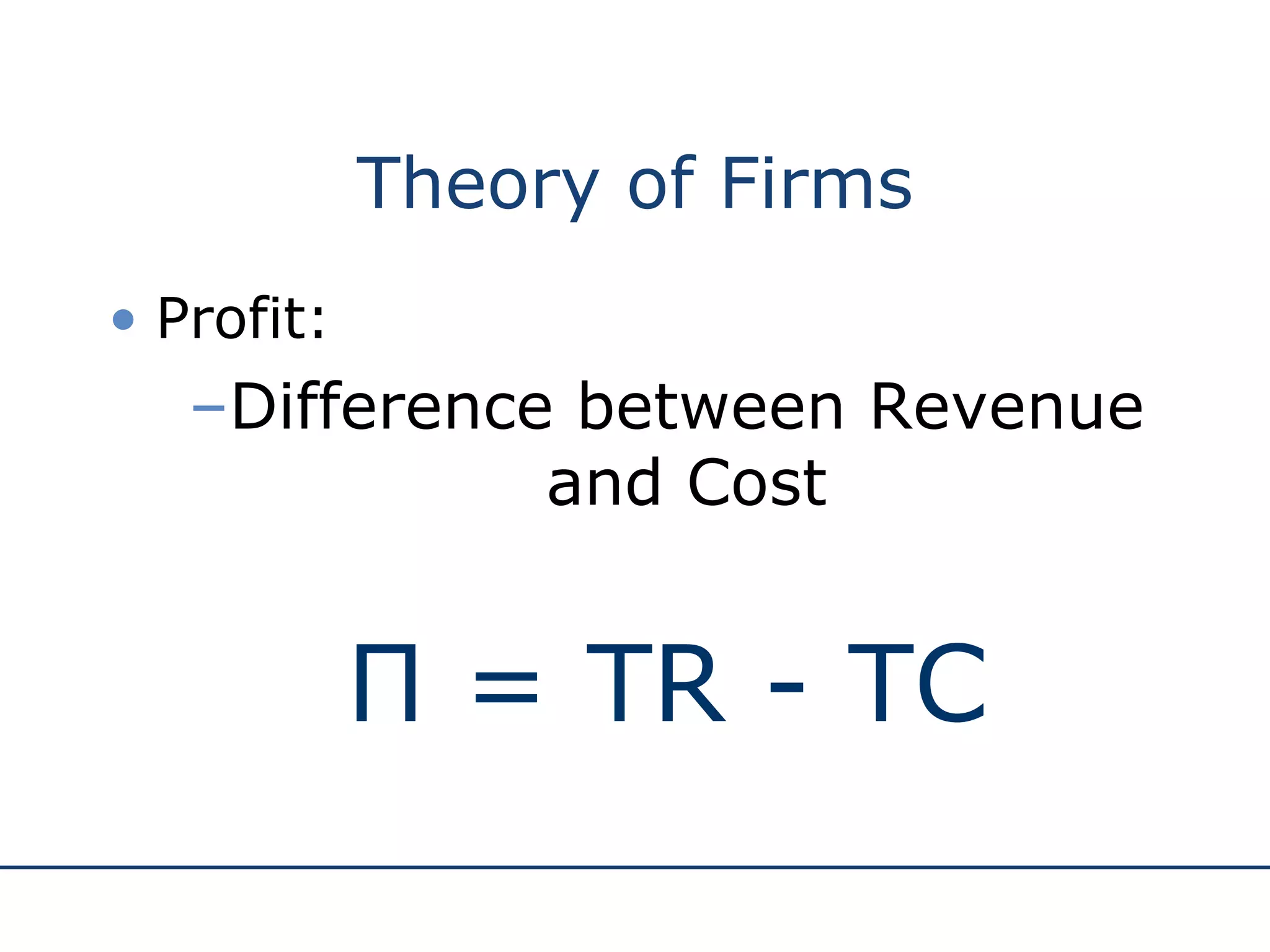
Theory of Firms Profit: Difference between Revenue and Cost Π = TR - TC
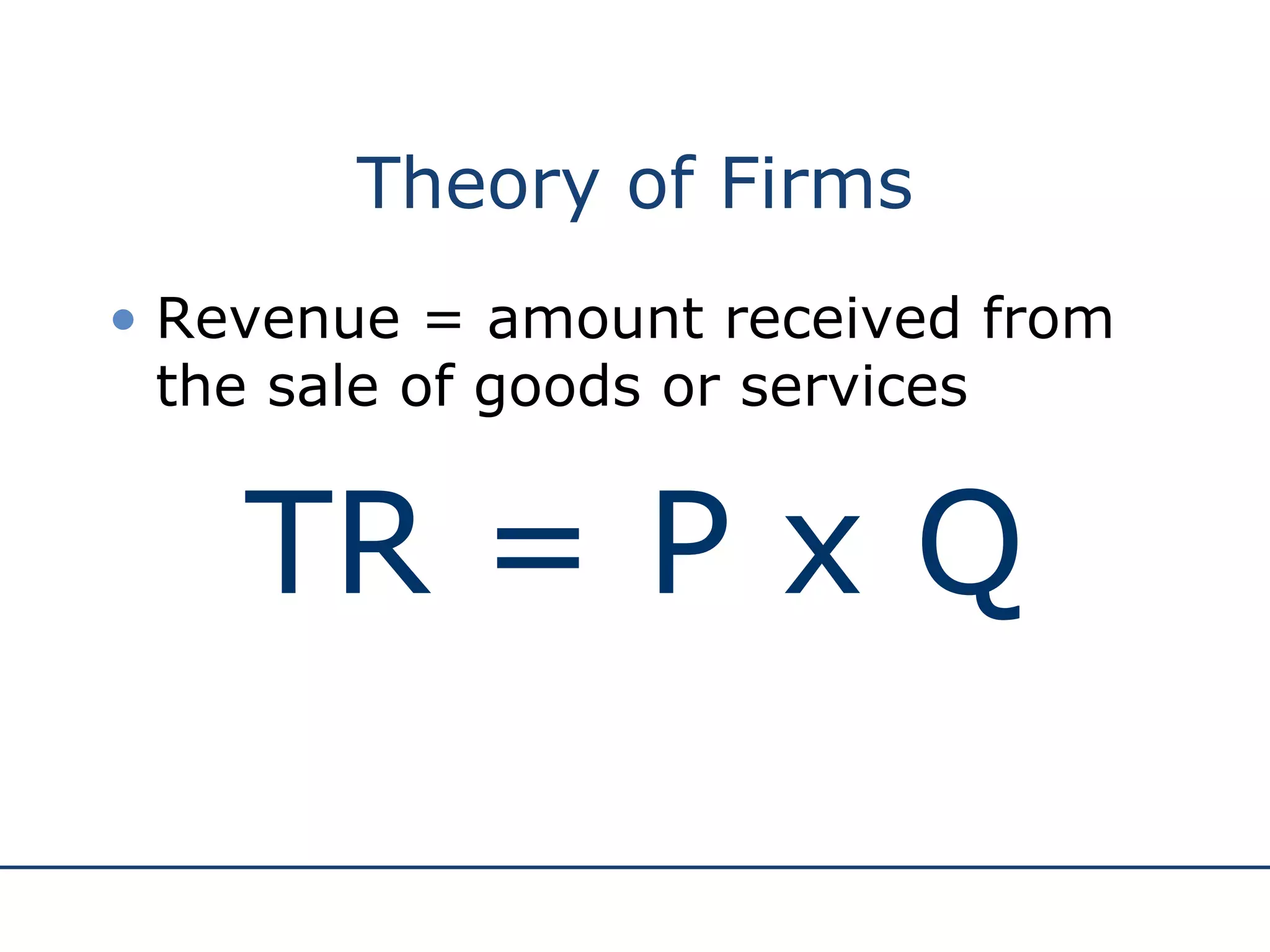
Theory of Firms Revenue = amount received from the sale of goods or services TR = P x Q
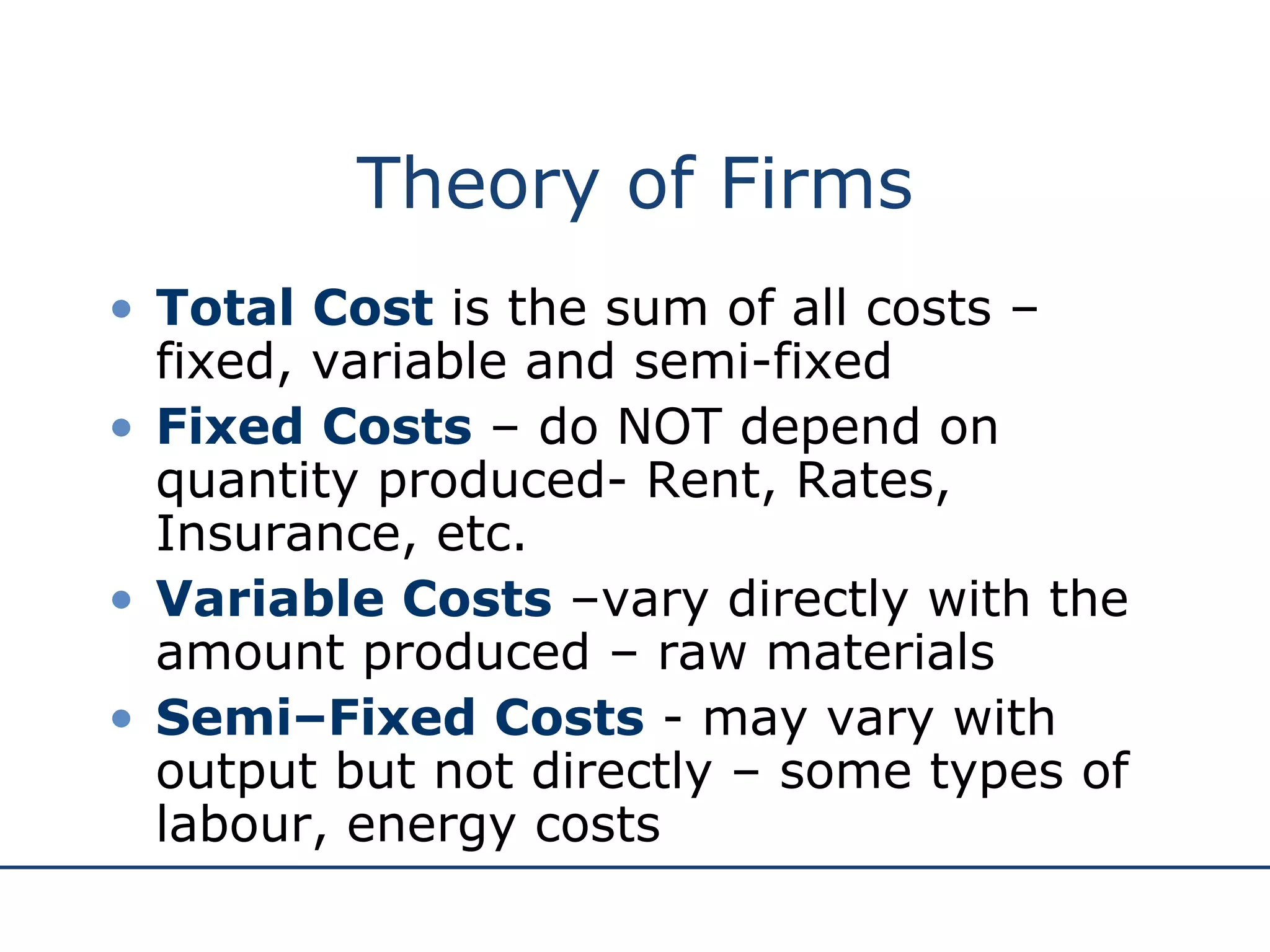
Theory of Firms Total Cost  is the sum of all costs – fixed, variable and semi-fixed Fixed Costs  – do NOT depend on quantity produced- Rent, Rates, Insurance, etc. Variable Costs  –vary directly with the amount produced – raw materials Semi–Fixed Costs  - may vary with output but not directly – some types of labour, energy costs
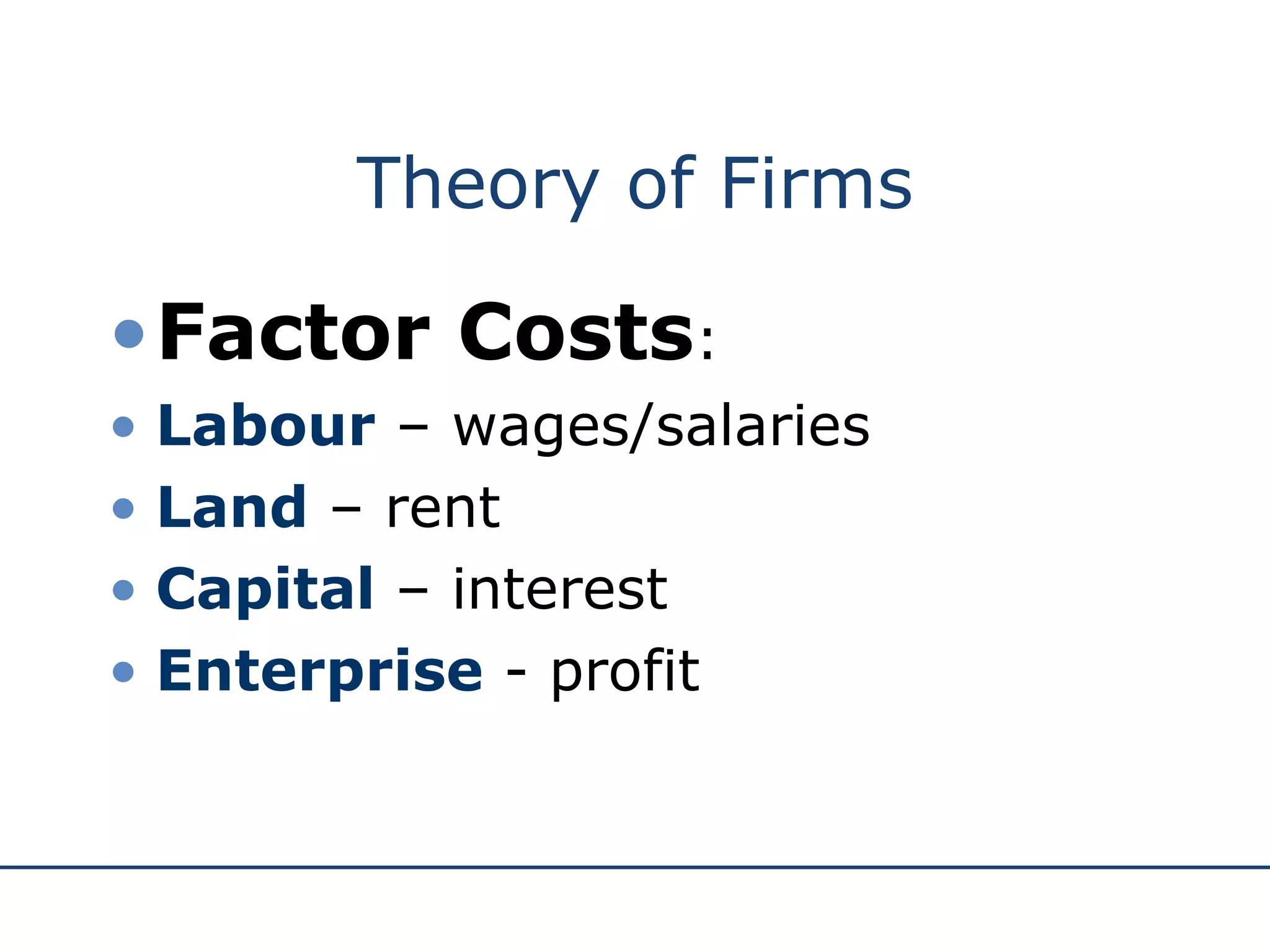
Theory of Firms Factor Costs : Labour  – wages/salaries Land  – rent Capital  – interest Enterprise  - profit
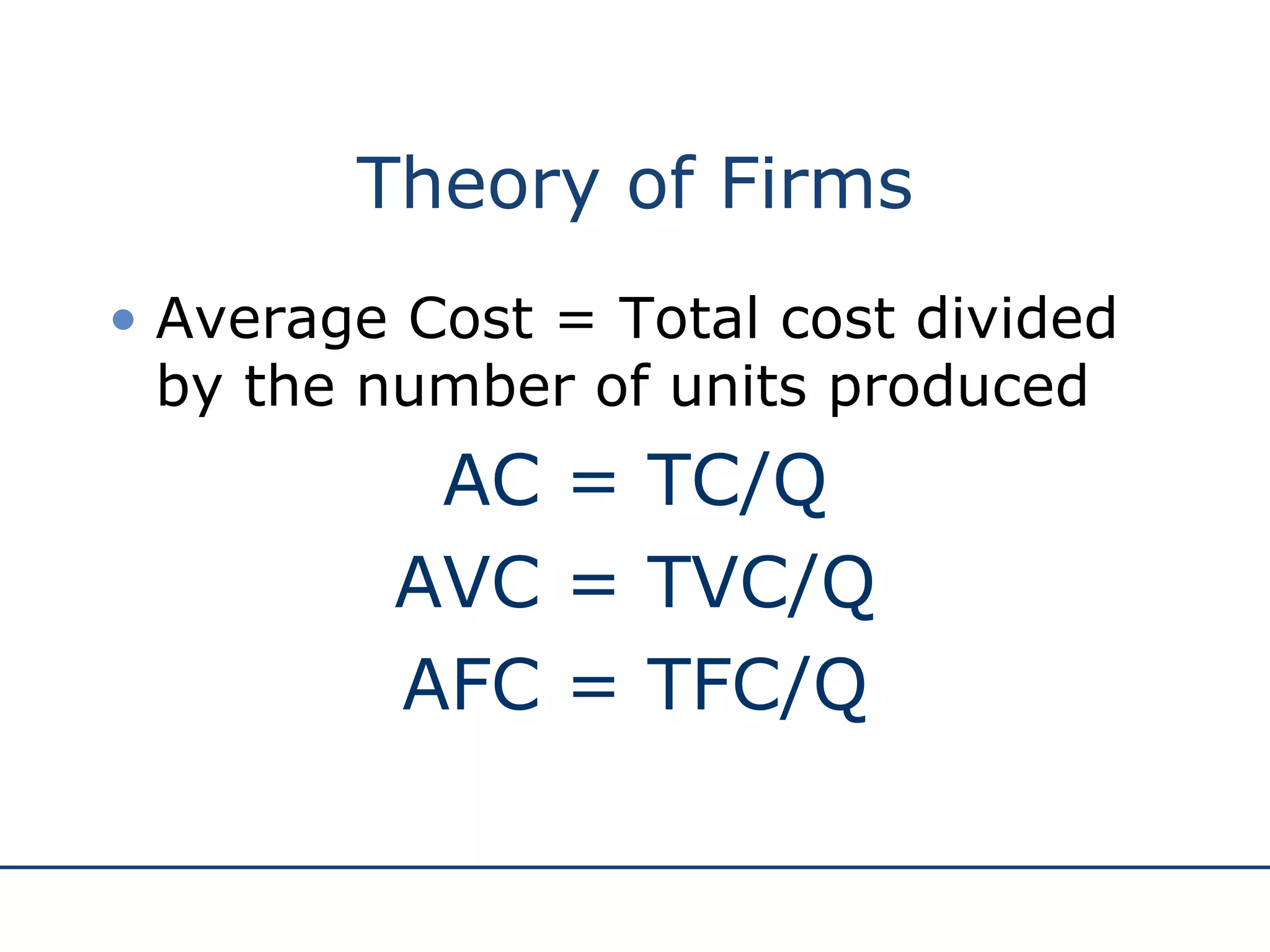
Theory of Firms Average Cost = Total cost divided by the number of units produced AC = TC/Q AVC = TVC/Q AFC = TFC/Q
Theory of Firms Marginal Cost The cost of producing one extra or one less unit of output MC = TC n  units – TC n-1  / Q If TC of 100 units = £500 and TC of producing 101 units is £505, MC = £5.00 Important concept
Theory of Firms Short and Long run: Short run  –  some  factors fixed and cannot be increased/reduced Long Run  – time taken to vary all factors of production Short and long run vary in all industries:
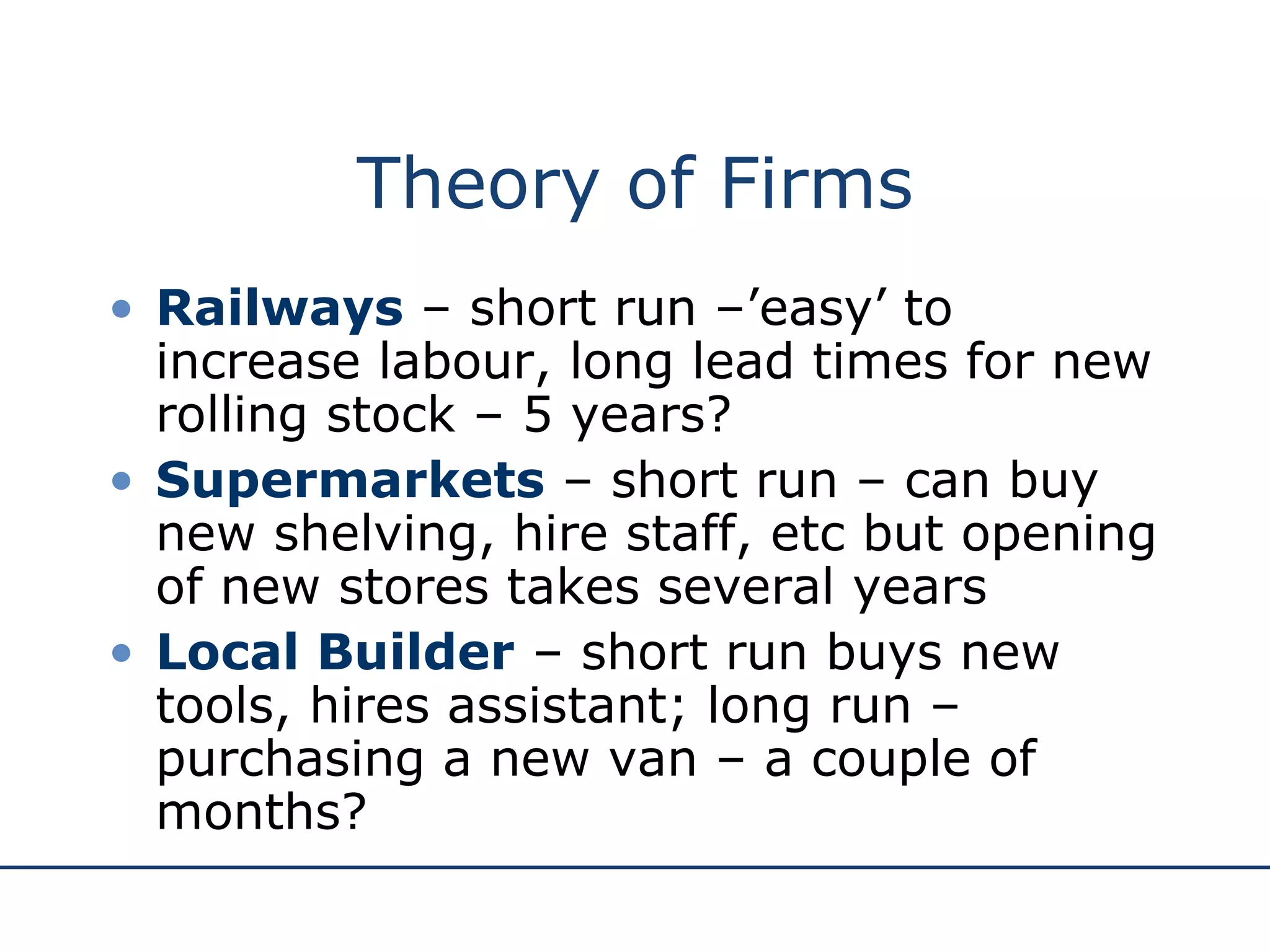
Theory of Firms Railways  – short run –’easy’ to increase labour, long lead times for new rolling stock – 5 years? Supermarkets  – short run – can buy new shelving, hire staff, etc but opening of new stores takes several years Local Builder  – short run buys new tools, hires assistant; long run – purchasing a new van – a couple of months?
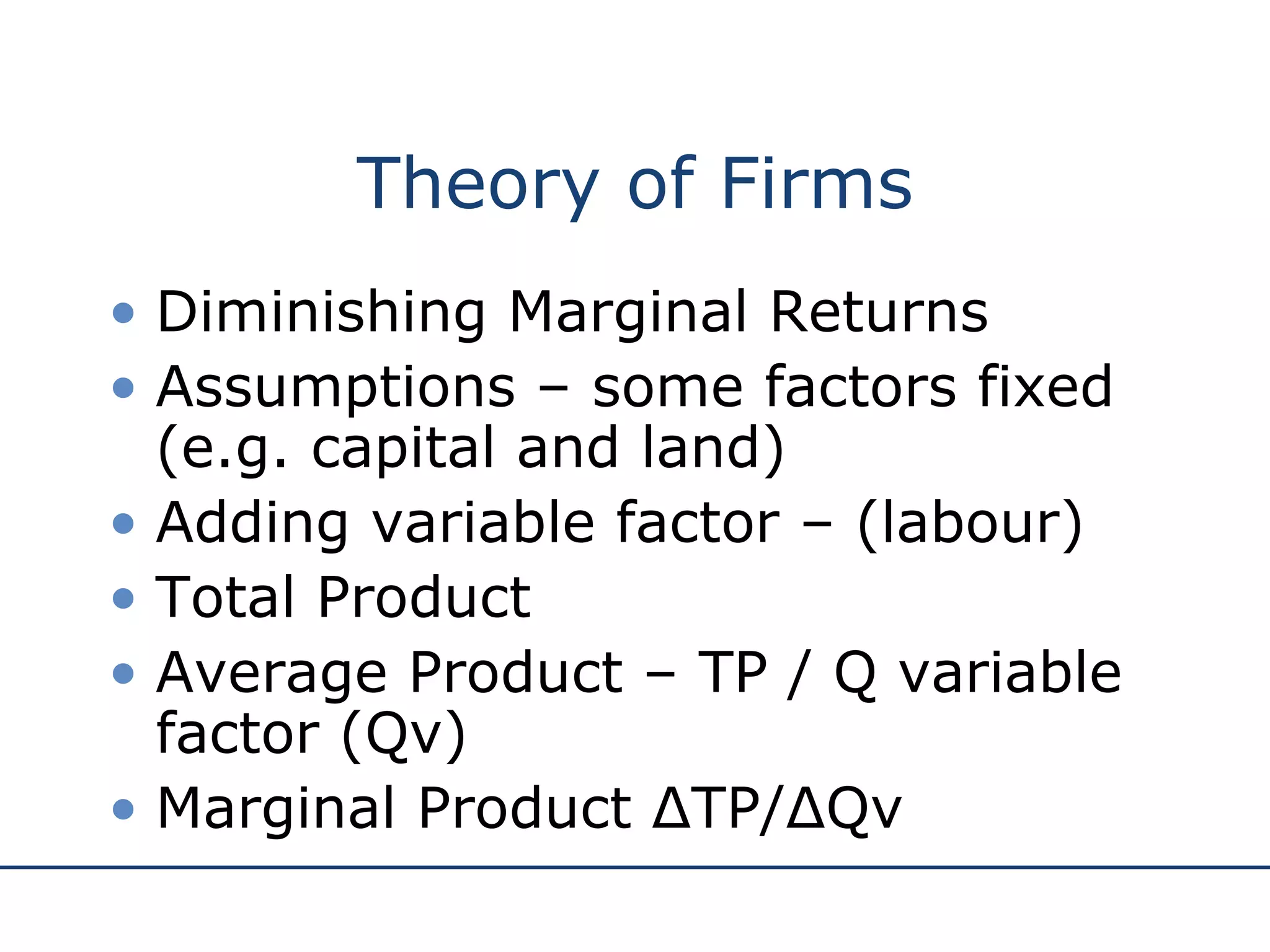
Theory of Firms Diminishing Marginal Returns Assumptions – some factors fixed (e.g. capital and land) Adding variable factor – (labour)  Total Product Average Product – TP / Q variable factor (Qv) Marginal Product ΔTP/ΔQv
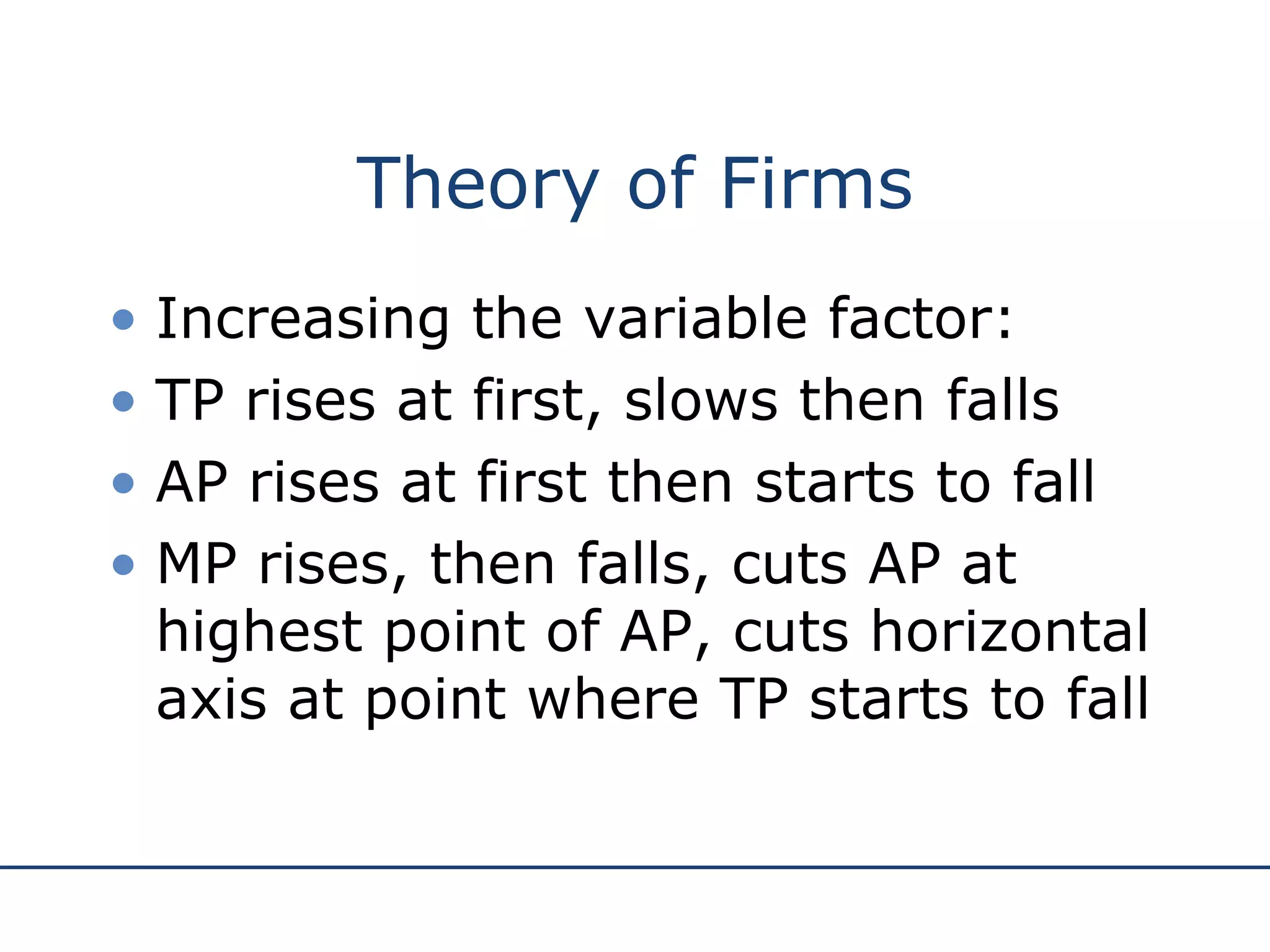
Theory of Firms Increasing the variable factor: TP rises at first, slows then falls AP rises at first then starts to fall MP rises, then falls, cuts AP at highest point of AP, cuts horizontal axis at point where TP starts to fall
Theory of Firms Objectives of firms: Profit maximisation  Profit satisficing Long term survival Share price maximisation Revenue maximisation Brand loyalty Expansion and market dominance

The Theory Of The Firm

  • 1.
    The Theory ofthe Firm
  • 2.
    The Theory ofthe Firm
  • 3.
  • 4.
    Production Function Statesthe relationship between inputs and outputs Inputs – the factors of production classified as: Land – all natural resources of the earth – not just ‘terra firma’! Price paid to acquire land = Rent Labour – all physical and mental human effort involved in production Price paid to labour = Wages Capital – buildings, machinery and equipment not used for its own sake but for the contribution it makes to production Price paid for capital = Interest
  • 5.
    Production Function InputsProcess Output Land Labour Capital Product or service generated – value added
  • 6.
    Analysis of ProductionFunction: Short Run In the short run at least one factor fixed in supply but all other factors capable of being changed Reflects ways in which firms respond to changes in output (demand) Can increase or decrease output using more or less of some factors but some likely to be easier to change than others Increase in total capacity only possible in the long run
  • 7.
    Analysis of ProductionFunction: Short Run In times of rising sales (demand) firms can increase labour and capital but only up to a certain level – they will be limited by the amount of space. In this example, land is the fixed factor which cannot be altered in the short run.
  • 8.
    Analysis of ProductionFunction: Short Run If demand slows down, the firm can reduce its variable factors – in this example it reduces its labour and capital but again, land is the factor which stays fixed.
  • 9.
    Analysis of ProductionFunction: Short Run If demand slows down, the firm can reduce its variable factors – in this example, it reduces its labour and capital but again, land is the factor which stays fixed.
  • 10.
    Analysing the ProductionFunction: Long Run The long run is defined as the period of time taken to vary all factors of production By doing this, the firm is able to increase its total capacity – not just short term capacity Associated with a change in the scale of production The period of time varies according to the firm and the industry In electricity supply, the time taken to build new capacity could be many years; for a market stall holder, the ‘long run’ could be as little as a few weeks or months!
  • 11.
    Analysis of ProductionFunction: Long Run In the long run, the firm can change all its factors of production thus increasing its total capacity. In this example it has doubled its capacity.
  • 12.
    Production Function Mathematicalrepresentation of the relationship: Q = f (K, L, La) Output (Q) is dependent upon the amount of capital (K), Land (L) and Labour (La) used
  • 13.
  • 14.
    Costs In buyingfactor inputs, the firm will incur costs Costs are classified as: Fixed costs – costs that are not related directly to production – rent, rates, insurance costs, admin costs. They can change but not in relation to output Variable Costs – costs directly related to variations in output. Raw materials primarily
  • 15.
    Costs Total Cost - the sum of all costs incurred in production TC = FC + VC Average Cost – the cost per unit of output AC = TC/Output Marginal Cost – the cost of one more or one fewer units of production MC = TC n – TC n-1 units
  • 16.
    Costs Short run – Diminishing marginal returns results from adding successive quantities of variable factors to a fixed factor Long run – Increases in capacity can lead to increasing, decreasing or constant returns to scale
  • 17.
  • 18.
    Revenue Total revenue – the total amount received from selling a given output TR = P x Q Average Revenue – the average amount received from selling each unit AR = TR / Q Marginal revenue – the amount received from selling one extra unit of output MR = TR n – TR n-1 units
  • 19.
  • 20.
    Profit Profit =TR – TC The reward for enterprise Profits help in the process of directing resources to alternative uses in free markets Relating price to costs helps a firm to assess profitability in production
  • 21.
    Profit Normal Profit – the minimum amount required to keep a firm in its current line of production Abnormal or Supernormal profit – profit made over and above normal profit Abnormal profit may exist in situations where firms have market power Abnormal profits may indicate the existence of welfare losses Could be taxed away without altering resource allocation
  • 22.
    Profit Sub-normal Profit – profit below normal profit Firms may not exit the market even if sub-normal profits made if they are able to cover variable costs Cost of exit may be high Sub-normal profit may be temporary (or perceived as such!)
  • 23.
    Profit Assumption thatfirms aim to maximise profit May not always hold true - there are other objectives Profit maximising output would be where MC = MR
  • 24.
    Profit Why? Cost/RevenueOutput MR MR – the addition to total revenue as a result of producing one more unit of output – the price received from selling that extra unit. MC MC – The cost of producing ONE extra unit of production 100 Assume output is at 100 units. The MC of producing the 100 th unit is 20. The MR received from selling that 100 th unit is 150. The firm can add the difference of the cost and the revenue received from that 100 th unit to profit (130) 20 150 If the firm decides to produce one more unit – the 101 st – the addition to total cost is now 18, the addition to total revenue is 140 – the firm will add 128 to profit. – it is worth expanding output. 101 18 140 30 120 The process continues for each successive unit produced. Provided the MC is less than the MR it will be worth expanding output as the difference between the two is ADDED to total profit 102 40 145 104 103 If the firm were to produce the 104 th unit, this last unit would cost more to produce than it earns in revenue (-105) this would reduce total profit and so would not be worth producing. The profit maximising output is where MR = MC Total added to profit Added to total profit Added to total profit Reduces total profit by this amount
  • 25.
    The Theory ofthe Firm
  • 26.
    The Theory ofthe Firm
  • 27.
  • 28.
  • 29.
    Inputs Capital(K) Land (L) Labour (La)
  • 30.
  • 31.
    Short Run Atleast one factor fixed
  • 32.
    Long Run Allfactors variable
  • 33.
  • 34.
    Theory of FirmsCosts, Revenues and Objectives
  • 35.
    Theory of FirmsProfit: Difference between Revenue and Cost Π = TR - TC
  • 36.
    Theory of FirmsRevenue = amount received from the sale of goods or services TR = P x Q
  • 37.
    Theory of FirmsTotal Cost is the sum of all costs – fixed, variable and semi-fixed Fixed Costs – do NOT depend on quantity produced- Rent, Rates, Insurance, etc. Variable Costs –vary directly with the amount produced – raw materials Semi–Fixed Costs - may vary with output but not directly – some types of labour, energy costs
  • 38.
    Theory of FirmsFactor Costs : Labour – wages/salaries Land – rent Capital – interest Enterprise - profit
  • 39.
    Theory of FirmsAverage Cost = Total cost divided by the number of units produced AC = TC/Q AVC = TVC/Q AFC = TFC/Q
  • 40.
    Theory of FirmsMarginal Cost The cost of producing one extra or one less unit of output MC = TC n units – TC n-1 / Q If TC of 100 units = £500 and TC of producing 101 units is £505, MC = £5.00 Important concept
  • 41.
    Theory of FirmsShort and Long run: Short run – some factors fixed and cannot be increased/reduced Long Run – time taken to vary all factors of production Short and long run vary in all industries:
  • 42.
    Theory of FirmsRailways – short run –’easy’ to increase labour, long lead times for new rolling stock – 5 years? Supermarkets – short run – can buy new shelving, hire staff, etc but opening of new stores takes several years Local Builder – short run buys new tools, hires assistant; long run – purchasing a new van – a couple of months?
  • 43.
    Theory of FirmsDiminishing Marginal Returns Assumptions – some factors fixed (e.g. capital and land) Adding variable factor – (labour) Total Product Average Product – TP / Q variable factor (Qv) Marginal Product ΔTP/ΔQv
  • 44.
    Theory of FirmsIncreasing the variable factor: TP rises at first, slows then falls AP rises at first then starts to fall MP rises, then falls, cuts AP at highest point of AP, cuts horizontal axis at point where TP starts to fall
  • 45.
    Theory of FirmsObjectives of firms: Profit maximisation Profit satisficing Long term survival Share price maximisation Revenue maximisation Brand loyalty Expansion and market dominance