1
Theory of Production
2
The Firm
A firm is an organisation, owned by one or jointly by a few or many
individuals which is engaged in productive activity of any kind for the
sake of profit or some other well-defined aim.
3
Production Function
• The relationship between the volume of physical inputs into production and the
number of units of output produced is known in economics as the ‘production
function’. It describes the technological relation:
q = quantity of output of good
f(*) summarises the rate at which conversion of inputs into output takes place,
everything being expressed as rates per period of time.
Simplifying,
• where q = quantity of output per period of time
•L = labour hours per period employed
•K = units of capital services (machine hours)
)
,....,
,
,
,
( n
x
x
x
x
x
f
q 4
3
2
1

)
,
( K
L
f
q 
4
Production Function
• There are different types of production function that has been empirically tested
and found their relevance. These are:
1. Cobb-Douglas production function
2. Constant Elasticity of Substitution (CES) production function
3. Trans Log production function
• The Cobb-Douglas production function is the most popular among these,
mainly because of various important properties that it exhibits and its simpler
form. It can be expressed as:
• constants, where A is the technological specification
• The production function defined above is technologically determined
physical relationship which puts outside influences on economic
analysis.
• A firm cannot go out of the technological alternatives specified by the
production function, but the one that it chooses is a matter of economic
consideration, mainly determined by factor prices.
,


K
AL
q 

 ,
5
Short run and Long run
Short Run (SR)
• The short run is defined as the period of time over which some inputs (at least
one input), called fixed input, cannot be varied. E.g. capital – plant & equipment,
land, services of management or supply of skilled labour, etc. This is not of fixed
duration in all industries and is influenced by technological considerations.
The Long Run (LR)
• The long run is defined as the period long enough for all inputs to be varied, but
not so long enough that the basic technology of production changes.
• This is not of specified period of time – it varies; e.g. planning to go into
business, or to expand/ contract the scale of operations.
The Very Long Run
• It is concerned with situations in which technological possibilities open to the
firm are subject to change, leading to new and improved products and new
methods of production, e.g. changes through R&D, etc.
6
Variable and Fixed Factor
• A variable factor is one whose quantity can be changed in a
relatively short period of time;
• While the fixed factors are held constant during this period.
E.g. factory size is fixed in short period, and labour, electricity are
variable.
7
Average & Marginal Product
8
Relation between AP and MP
• Total product initially increases until it reaches the maximum; thereafter
it diminishes. Marginal product is always positive when output is
increasing and negative when output is decreasing.
• When the marginal product is greater than the average product, the
average is increasing.
• Similarly, when the marginal product is less than the average product,
the average product is decreasing.
• Because the MP is above the AP when the average product is
increasing and below the average product when the AP is decreasing, it
follows that the MP must equal the AP when the average product
reaches its maximum.
E
MP=0
Marginal
Product
C
B
A
APmax
MPmax
Total Product
TPmax
TP
AP,
MP
Labour
per
month
Average
Product
Labour
per
month
Production with One Variable Input
10
Law of Diminishing Returns
• The law states that if increasing quantities of a variable input are applied to
a given quantity of a fixed input, the marginal product and the average
product of the variable input will eventually decrease.
• This law applies to a given production technology. Overtime, however,
inventions and other improvements in technology may allow the entire total
product curve to shift upward, so that more output can be produced with
same inputs.
11
Concept of Isoquant
• An Isoquant is a curve that shows all
the possible combinations of inputs
that yield the same output. Each
Isoquant is associated with a
specific level of output.
• An Isoquant map is a set of
isoquants, each of which shows the
maximum output that can be
achieved for any set of inputs. An
Isoquant map is a way of describing
a production function. The level of
output increases as we move up and
to the right of the Isoquant-map.
(L1,
K1)
(L2,
K2)
Labour
K1
K2
L1 L2
Isoquant
Q1
12
Concept of Isoquant
• With two inputs that can be varied, a manager would want to consider
substituting one input of the other.
• The slope of the Isoquant indicates how the quantity of one input can be
traded off against the quantity of the other, while keeping the output constant.
• When the negative sign is removed, the slope is called the Marginal Rate of
Technical Substitution (MRTS).
• The Marginal Technical Rate of Substitution is the amount by which the input
of capital can be reduced when on extra unit of labour is used, so that output
remains constant. .
output)
of
level
fixed
a
for
(
input
labour
in
Change
input
capital
in
Change
L
K
MRTS






13
Elasticity of Substitution
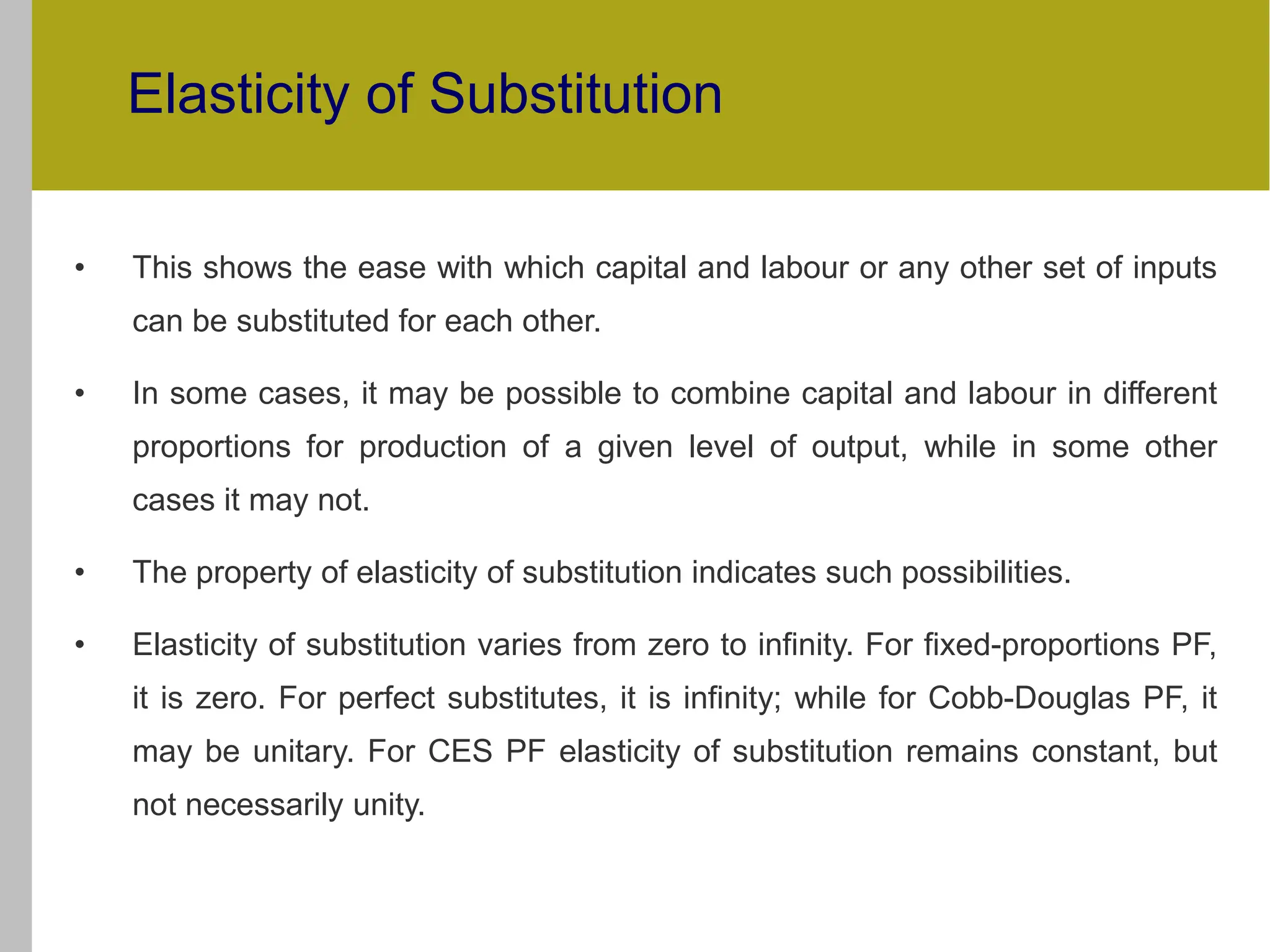
• This shows the ease with which capital and labour or any other set of inputs
can be substituted for each other.
• In some cases, it may be possible to combine capital and labour in different
proportions for production of a given level of output, while in some other
cases it may not.
• The property of elasticity of substitution indicates such possibilities.
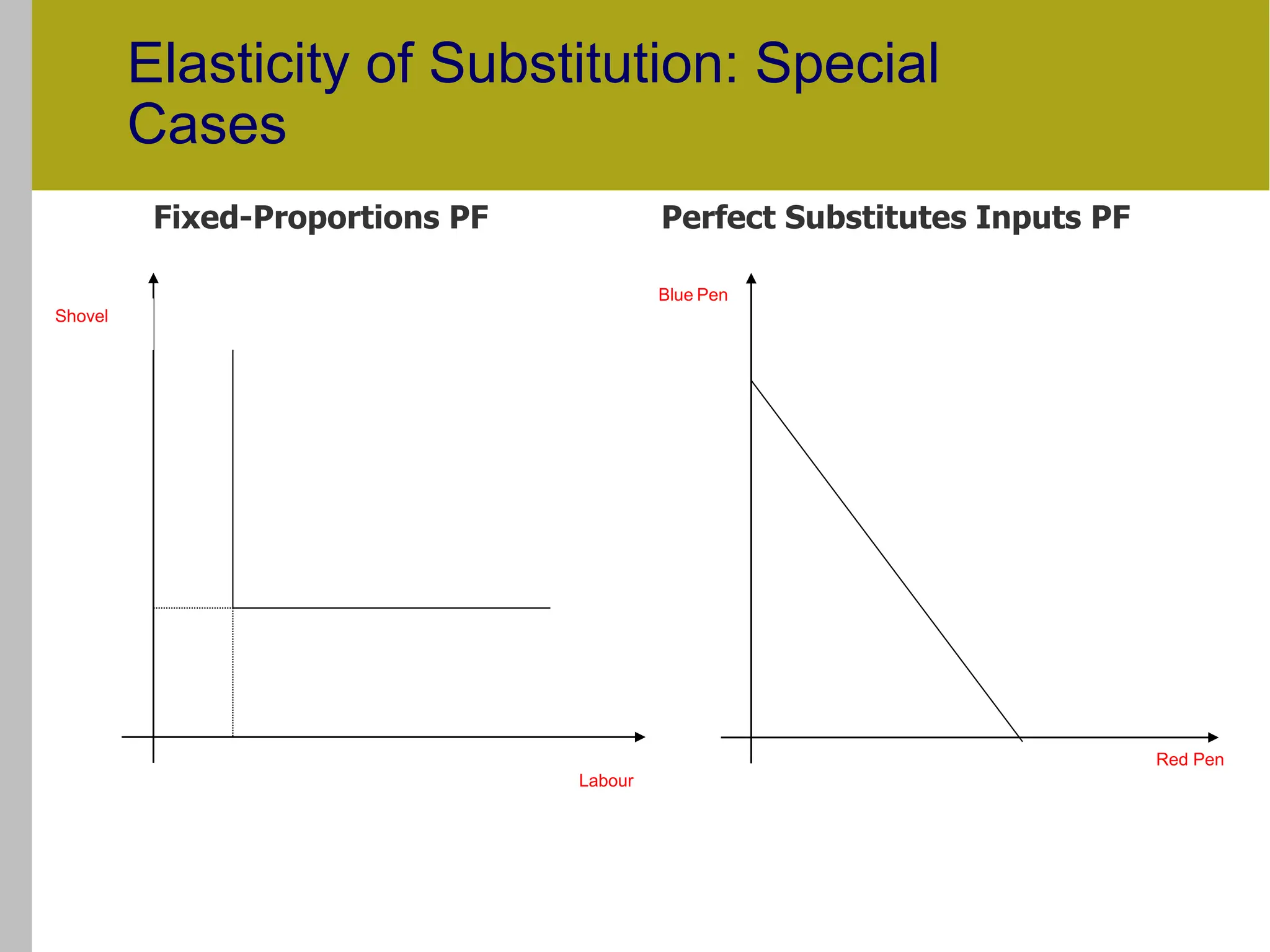
• Elasticity of substitution varies from zero to infinity. For fixed-proportions PF,
it is zero. For perfect substitutes, it is infinity; while for Cobb-Douglas PF, it
may be unitary. For CES PF elasticity of substitution remains constant, but
not necessarily unity.
14
Elasticity of Substitution: Special
Cases
Labour
Shovel
Red Pen
Blue Pen
Fixed-Proportions PF Perfect Substitutes Inputs PF
15
Concept of Returns to Scale
• To answer the question: “How does the output change as its inputs are
proportionately increased?” - we need the concept of returns to scale.
• It refers to the way that output changes as we change the scale of production. It
is essentially a long-run concept.
• If we scale all the inputs by some amount ‘t’ and output goes up by the same
factor, then we have constant returns to scale.
• If output scales up by more than ‘t’, we have increasing returns to scale; and
• If it scales up by less than ‘t’, we have deceasing returns to scale.
16
Significance Returns to Scale
• Returns to scale vary considerably across firms and industries. Other
things being equal, the greater the returns to scale, the larger firms in an
industry are likely to be.
• Manufacturing industries are likely to have increasing returns to scale
than service-oriented industries because manufacturing involves large
investments in capital equipment.
• Services are labour intensive and can usually be provided as efficiently
in small quantities as they can on a large scale.

Production.pptx economics for managers production

  • 1.
  • 2.
    2 The Firm A firmis an organisation, owned by one or jointly by a few or many individuals which is engaged in productive activity of any kind for the sake of profit or some other well-defined aim.
  • 3.
    3 Production Function • Therelationship between the volume of physical inputs into production and the number of units of output produced is known in economics as the ‘production function’. It describes the technological relation: q = quantity of output of good f(*) summarises the rate at which conversion of inputs into output takes place, everything being expressed as rates per period of time. Simplifying, • where q = quantity of output per period of time •L = labour hours per period employed •K = units of capital services (machine hours) ) ,...., , , , ( n x x x x x f q 4 3 2 1  ) , ( K L f q 
  • 4.
    4 Production Function • Thereare different types of production function that has been empirically tested and found their relevance. These are: 1. Cobb-Douglas production function 2. Constant Elasticity of Substitution (CES) production function 3. Trans Log production function • The Cobb-Douglas production function is the most popular among these, mainly because of various important properties that it exhibits and its simpler form. It can be expressed as: • constants, where A is the technological specification • The production function defined above is technologically determined physical relationship which puts outside influences on economic analysis. • A firm cannot go out of the technological alternatives specified by the production function, but the one that it chooses is a matter of economic consideration, mainly determined by factor prices. ,   K AL q    ,
  • 5.
    5 Short run andLong run Short Run (SR) • The short run is defined as the period of time over which some inputs (at least one input), called fixed input, cannot be varied. E.g. capital – plant & equipment, land, services of management or supply of skilled labour, etc. This is not of fixed duration in all industries and is influenced by technological considerations. The Long Run (LR) • The long run is defined as the period long enough for all inputs to be varied, but not so long enough that the basic technology of production changes. • This is not of specified period of time – it varies; e.g. planning to go into business, or to expand/ contract the scale of operations. The Very Long Run • It is concerned with situations in which technological possibilities open to the firm are subject to change, leading to new and improved products and new methods of production, e.g. changes through R&D, etc.
  • 6.
    6 Variable and FixedFactor • A variable factor is one whose quantity can be changed in a relatively short period of time; • While the fixed factors are held constant during this period. E.g. factory size is fixed in short period, and labour, electricity are variable.
  • 7.
  • 8.
    8 Relation between APand MP • Total product initially increases until it reaches the maximum; thereafter it diminishes. Marginal product is always positive when output is increasing and negative when output is decreasing. • When the marginal product is greater than the average product, the average is increasing. • Similarly, when the marginal product is less than the average product, the average product is decreasing. • Because the MP is above the AP when the average product is increasing and below the average product when the AP is decreasing, it follows that the MP must equal the AP when the average product reaches its maximum.
  • 9.
  • 10.
    10 Law of DiminishingReturns • The law states that if increasing quantities of a variable input are applied to a given quantity of a fixed input, the marginal product and the average product of the variable input will eventually decrease. • This law applies to a given production technology. Overtime, however, inventions and other improvements in technology may allow the entire total product curve to shift upward, so that more output can be produced with same inputs.
  • 11.
    11 Concept of Isoquant •An Isoquant is a curve that shows all the possible combinations of inputs that yield the same output. Each Isoquant is associated with a specific level of output. • An Isoquant map is a set of isoquants, each of which shows the maximum output that can be achieved for any set of inputs. An Isoquant map is a way of describing a production function. The level of output increases as we move up and to the right of the Isoquant-map. (L1, K1) (L2, K2) Labour K1 K2 L1 L2 Isoquant Q1
  • 12.
    12 Concept of Isoquant •With two inputs that can be varied, a manager would want to consider substituting one input of the other. • The slope of the Isoquant indicates how the quantity of one input can be traded off against the quantity of the other, while keeping the output constant. • When the negative sign is removed, the slope is called the Marginal Rate of Technical Substitution (MRTS). • The Marginal Technical Rate of Substitution is the amount by which the input of capital can be reduced when on extra unit of labour is used, so that output remains constant. . output) of level fixed a for ( input labour in Change input capital in Change L K MRTS      
  • 13.
    13 Elasticity of Substitution •This shows the ease with which capital and labour or any other set of inputs can be substituted for each other. • In some cases, it may be possible to combine capital and labour in different proportions for production of a given level of output, while in some other cases it may not. • The property of elasticity of substitution indicates such possibilities. • Elasticity of substitution varies from zero to infinity. For fixed-proportions PF, it is zero. For perfect substitutes, it is infinity; while for Cobb-Douglas PF, it may be unitary. For CES PF elasticity of substitution remains constant, but not necessarily unity.
  • 14.
    14 Elasticity of Substitution:Special Cases Labour Shovel Red Pen Blue Pen Fixed-Proportions PF Perfect Substitutes Inputs PF
  • 15.
    15 Concept of Returnsto Scale • To answer the question: “How does the output change as its inputs are proportionately increased?” - we need the concept of returns to scale. • It refers to the way that output changes as we change the scale of production. It is essentially a long-run concept. • If we scale all the inputs by some amount ‘t’ and output goes up by the same factor, then we have constant returns to scale. • If output scales up by more than ‘t’, we have increasing returns to scale; and • If it scales up by less than ‘t’, we have deceasing returns to scale.
  • 16.
    16 Significance Returns toScale • Returns to scale vary considerably across firms and industries. Other things being equal, the greater the returns to scale, the larger firms in an industry are likely to be. • Manufacturing industries are likely to have increasing returns to scale than service-oriented industries because manufacturing involves large investments in capital equipment. • Services are labour intensive and can usually be provided as efficiently in small quantities as they can on a large scale.