Assets and liabilities
• ASSETS
•CAPITAL
•LIABILITY
ASSET
• When you start business you convert your
  money or borrowed money into business
  assets.
Which is the first asset of a business?
• First asset of a business is cash.
ASSETS


•   Cash.
•   Land.
•   Building.
•   Machinery , etc……..
CAPITAL
• The money which an owner arranges for the
  business is called capital.
• If owners keeps money in his pocket ,it is money
  not capital.
• When money is put into a business activity, its
  name will be capital.
• When capital is converted into business activity, it
  is converted into assets.
When one starts business, he will become
 different entity from the business for
 accounting purpose.
      Owner of business.
      Business.
If one starts business with Rs.10 M of his own
money, how will he record it?
Business manager or accountant will
           record it in this way .


• What has come to him ?
• Where has it come?
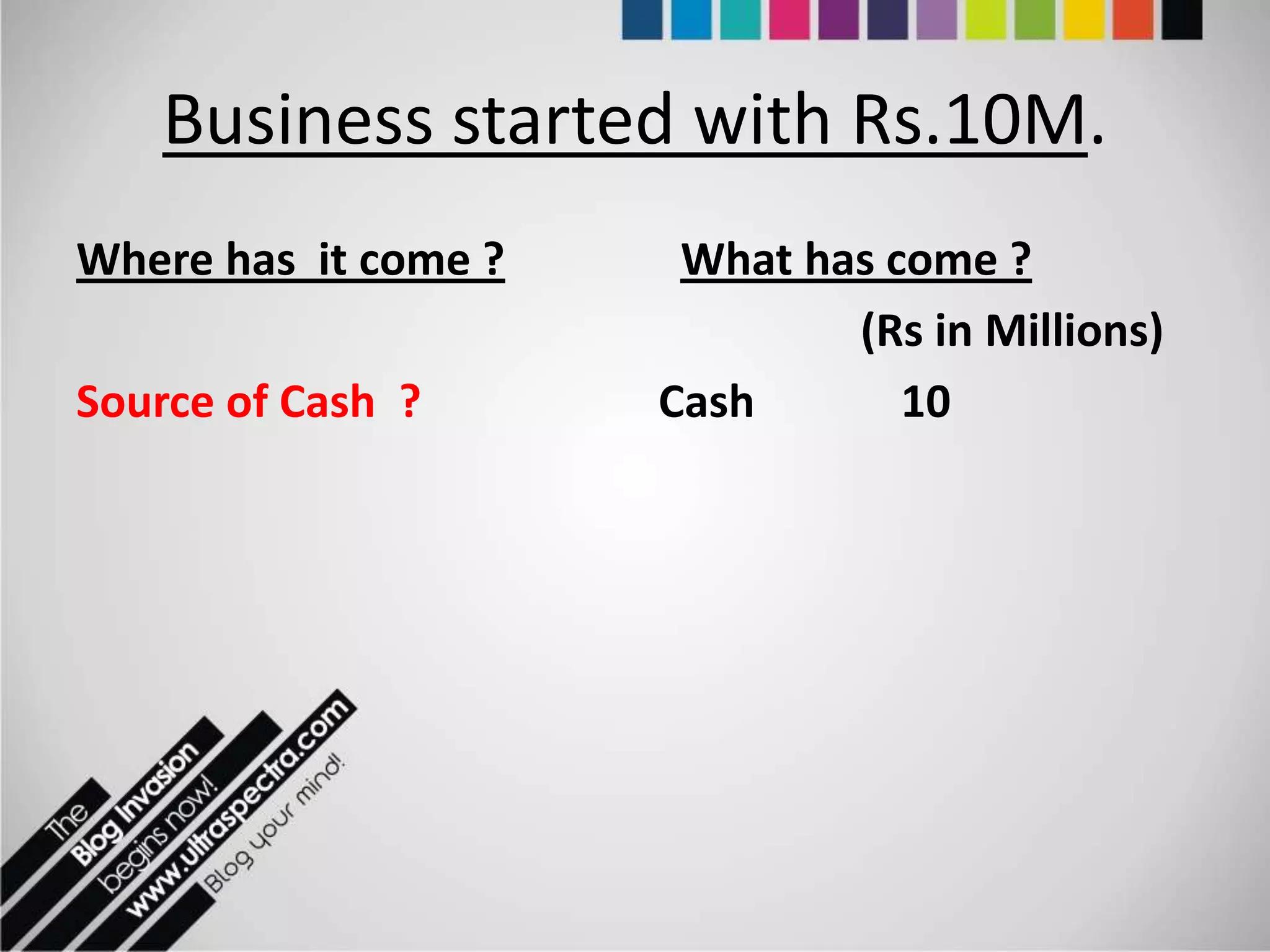
Business started with Rs.10M.
Where has it come ?    What has come ?
                              (Rs in Millions)
Source of Cash ?      Cash       10
ļ‚§    If the source of cash is owner.
ļ‚§     For accounting purpose, it is called Capital
    or Equity.
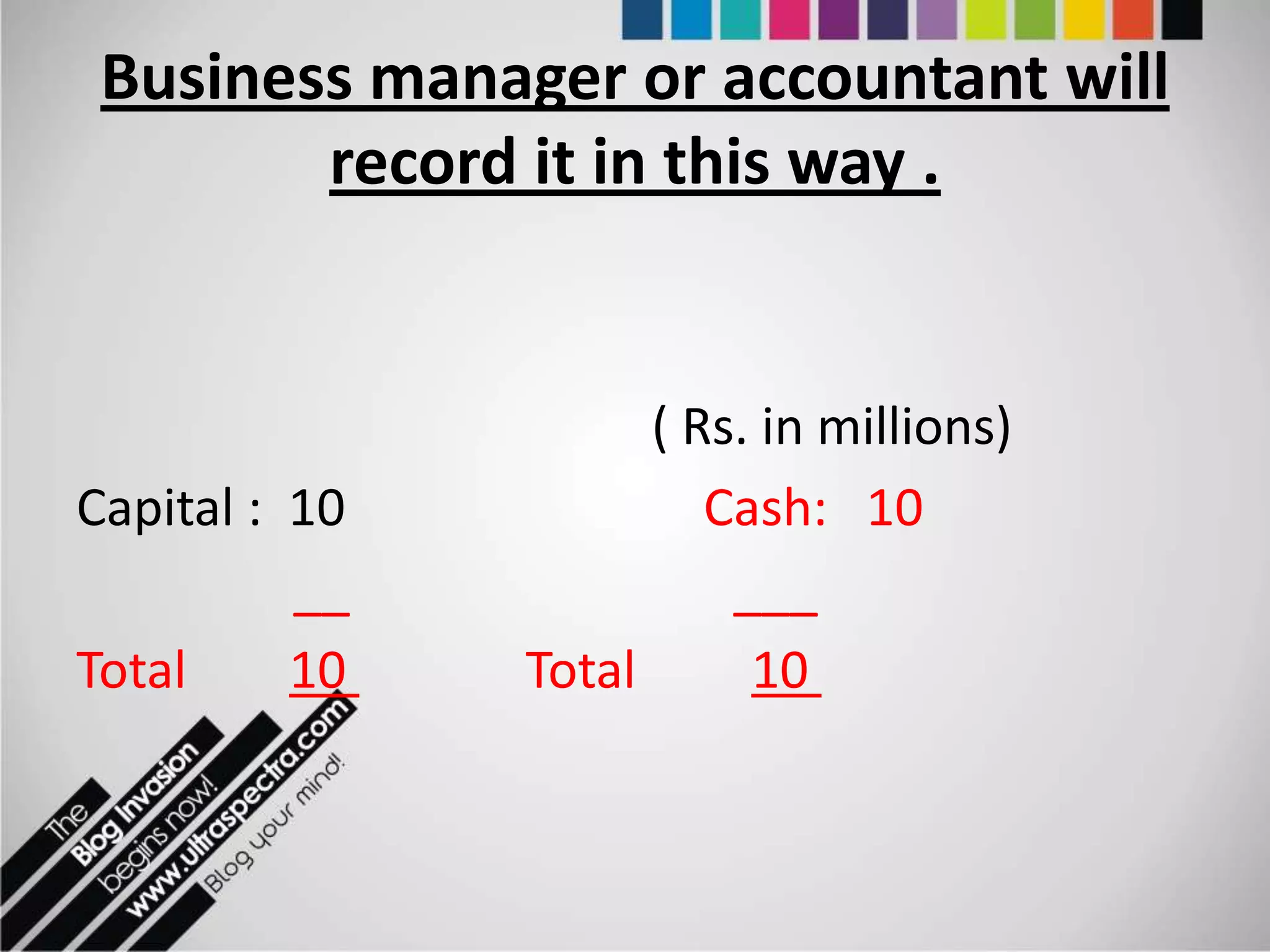
Business manager or accountant will
        record it in this way .


                     ( Rs. in millions)
Capital : 10            Cash: 10
          __             ___
Total     10   Total      10
With Rs.10M, business activity starts with
   buying of land for Rs.2M.
How will it be recorded ?
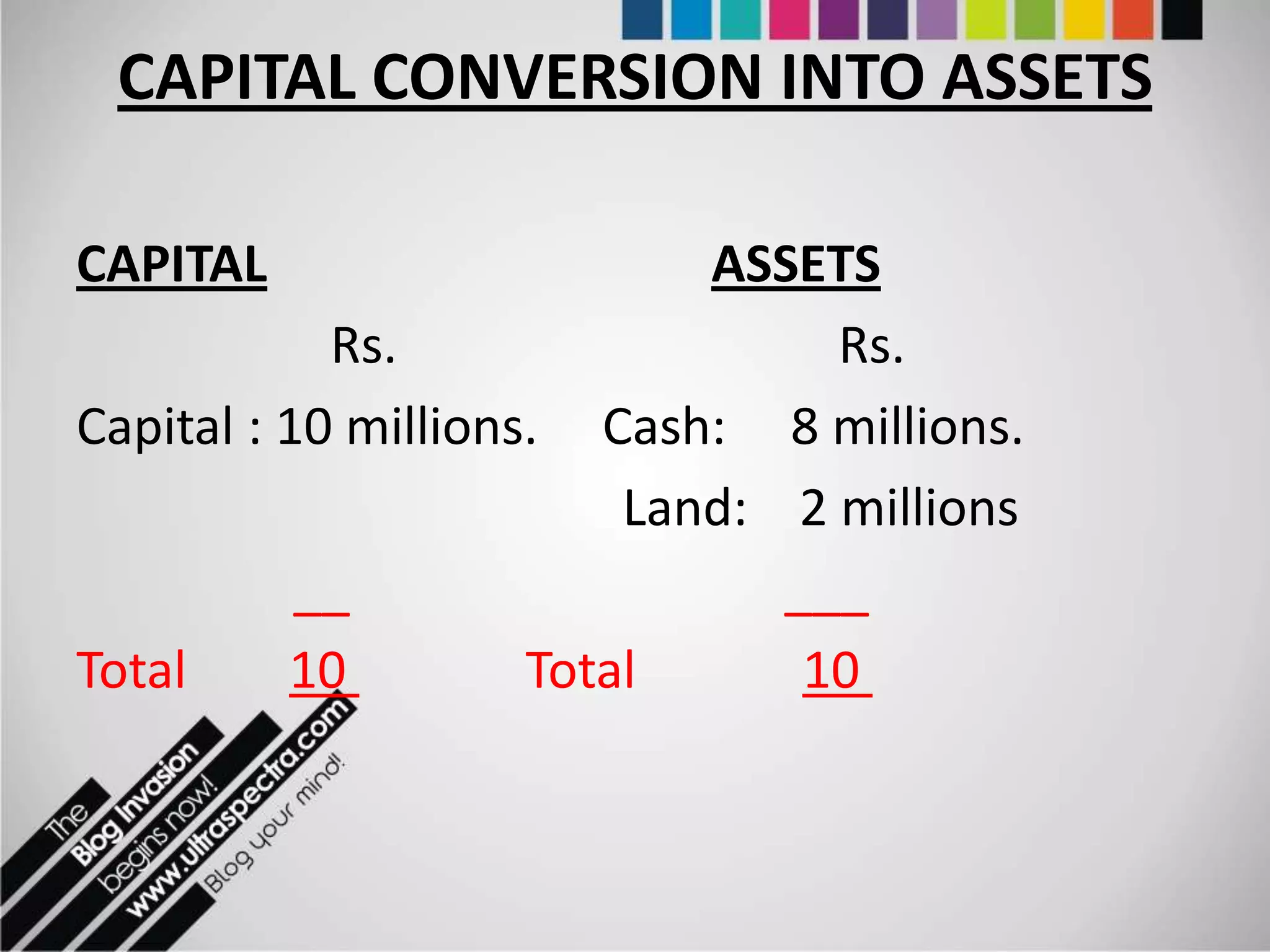
CAPITAL CONVERSION INTO ASSETS

CAPITAL                     ASSETS
            Rs.                  Rs.
Capital : 10 millions. Cash: 8 millions.
                         Land: 2 millions
           __                  ___
Total     10         Total      10
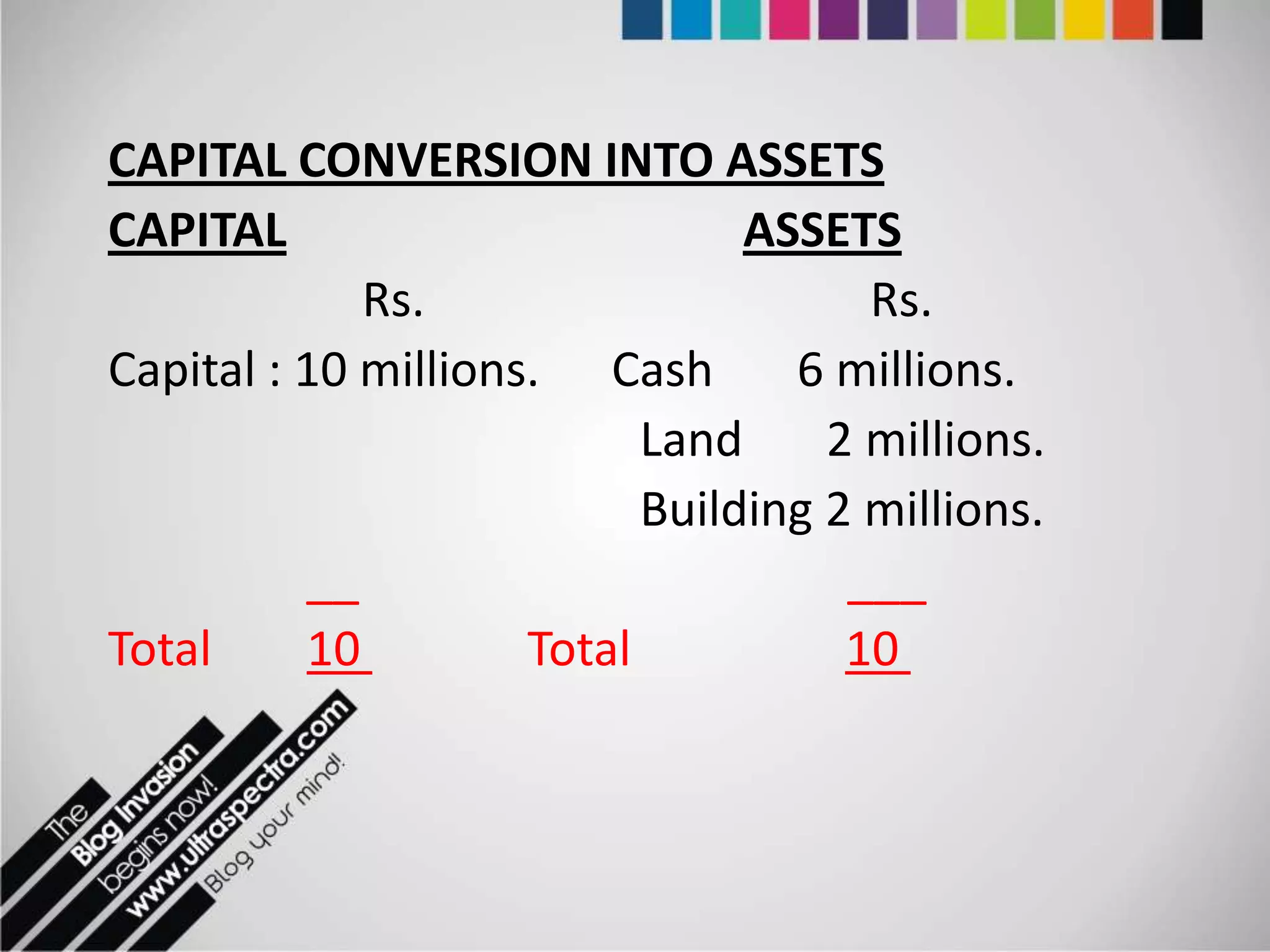
CAPITAL CONVERSION INTO ASSETS
CAPITAL                         ASSETS
             Rs.                      Rs.
Capital : 10 millions. Cash       6 millions.
                           Land     2 millions.
                           Building 2 millions.
          __                         ___
Total     10         Total           10
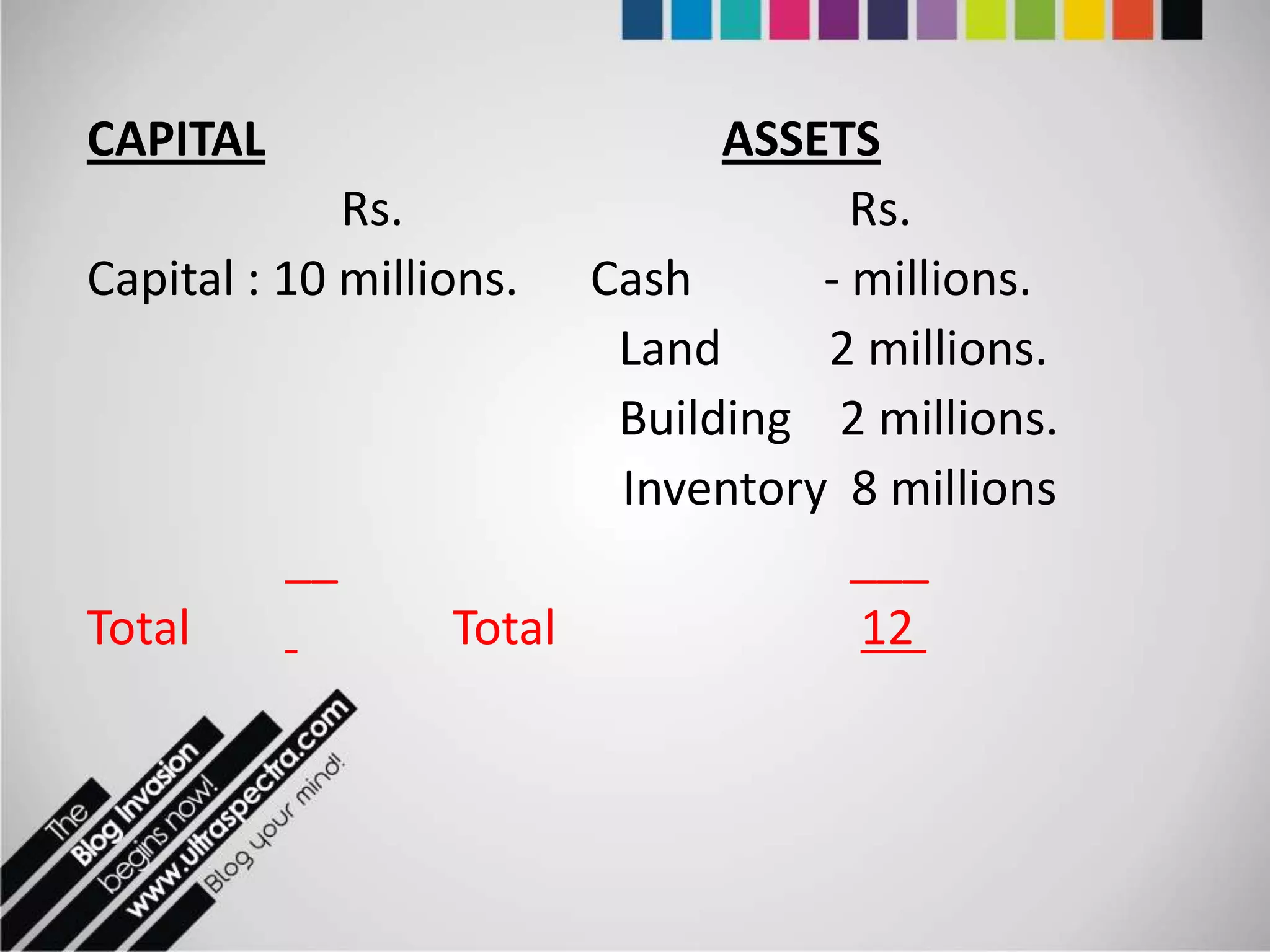
CAPITAL                       ASSETS
             Rs.                    Rs.
Capital : 10 millions. Cash       - millions.
                         Land     2 millions.
                         Building 2 millions.
                         Inventory 8 millions
          __                        ___
Total              Total            12
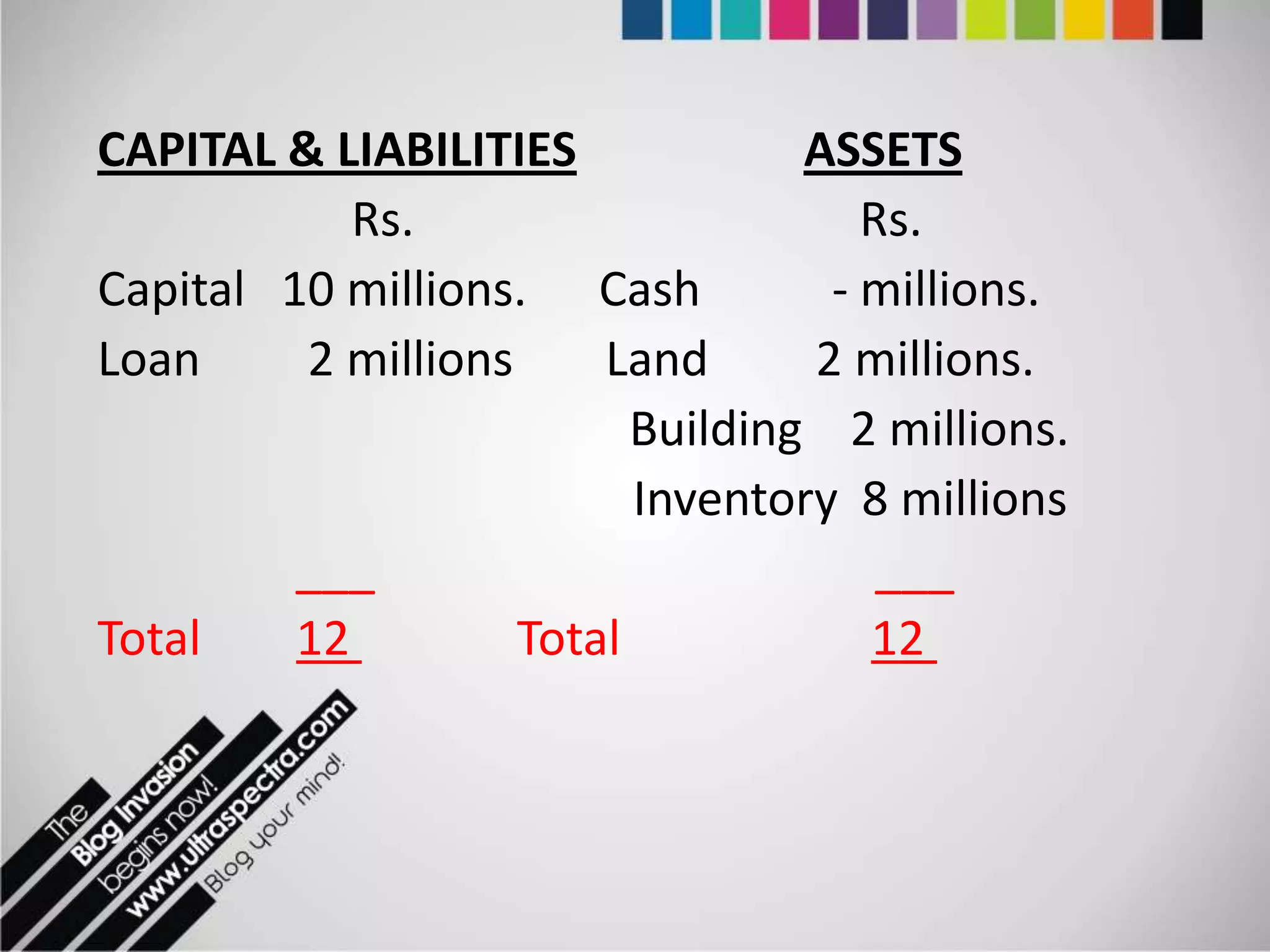
CAPITAL & LIABILITIES             ASSETS
            Rs.                      Rs.
Capital 10 millions. Cash          - millions.
Loan     2 millions     Land      2 millions.
                          Building 2 millions.
                          Inventory 8 millions
         ___                          ___
Total    12         Total            12
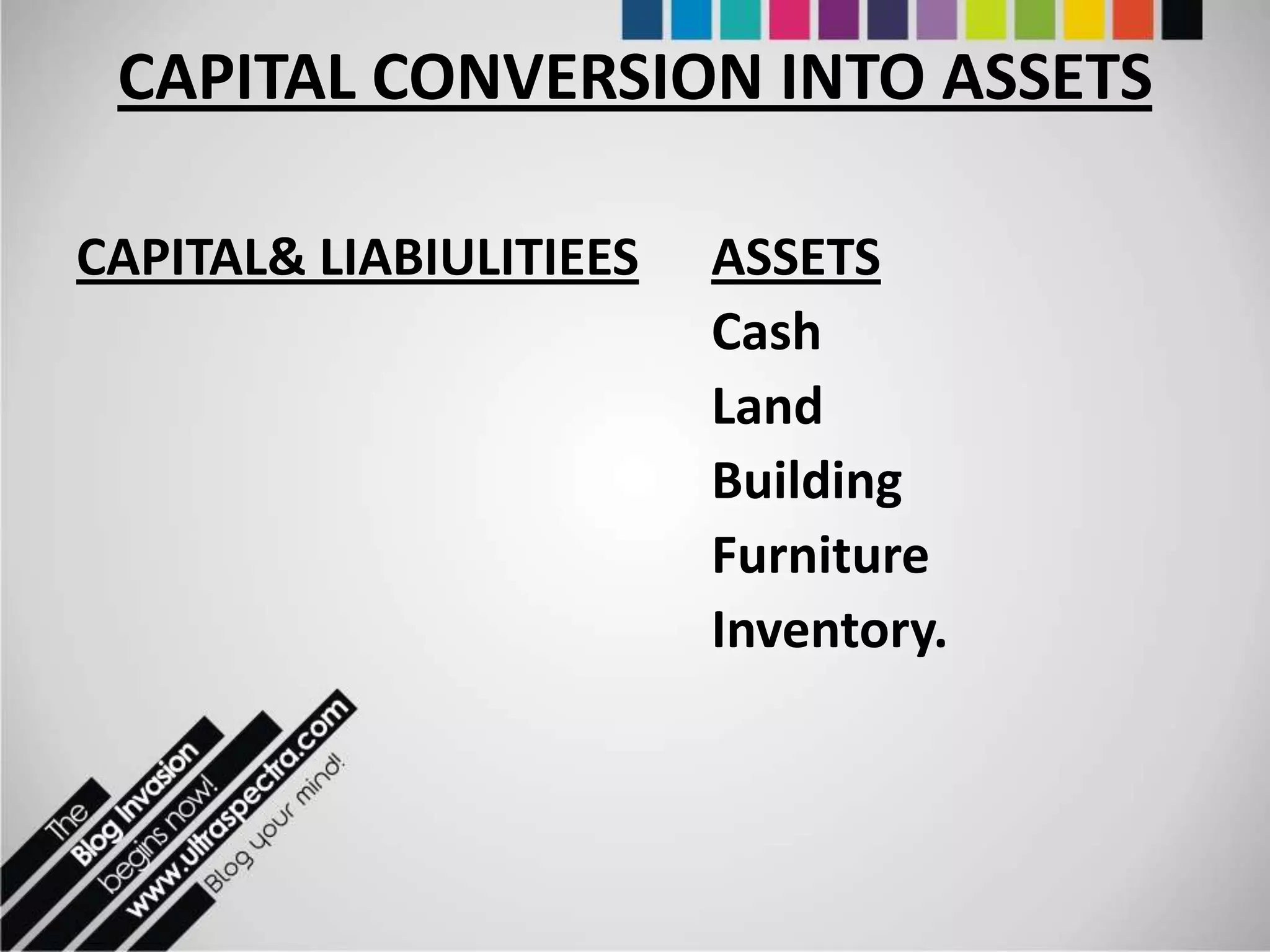
CAPITAL CONVERSION INTO ASSETS

CAPITAL& LIABIULITIEES   ASSETS
                         Cash
                         Land
                         Building
                         Furniture
                         Inventory.
ASSET
• Asset is every conversion of money which
  helps to earn lawful profit.
ASSETS
LONG TERM ASSETS/FIXED ASSETS.
CURRENT ASSETS.
OTHER ASSETS
TANGIBLE ASSETS.
INTANGIBLE ASSETS.
LONG TERM ASSETS/FIXED ASSET
• Such assets which life is long.
• Such assets are not consumed in a period of a
  year.
• Land , building , plant and machinery are fixed
  assets.
• Such assets can not easily be converted into
  cash.
CURRENT ASSETS
• The life of such assets is not more than a year.
• Such asset can easily be converted into cash.
• Cash, Account receivable , inventory,
  marketable securities.
ACCOUNTS RECEIVABLE
• Account receivable are also called debtors.
• Suppose you have sold some goods on credit in
  November.
• Money will be received after three months.
• Your accounts are closed in December.
• Such receivable money is called account
  receivable.
• If it is receivable from more persons, it is called
  accounts receivable.
INVENTORY
• Business raw material placed in the business
  wherehouse.
• Sometimes such purchases are made in bulk and
  are gradually used.
• The goods produced in a factory are also placed
  in the wherehouse.
• All material purchased and goods produced and
  placed in wherehouse and named as inventory.
• Work-in- process is also included in Inventory.
MARKETABLE SECURITIES
• Usually business buys shares, debentures of
  other companies or bonds issued by Govt. for
  earning profit.
• Such shares , debentures or bonds are
  marketable and can be sold at any time.
PREPAID EXPENSES
• Advance income tax paid.
• Advance sale tax paid.
• Payment made to a contractor but services
  yet to be acquired.
OTHER ASSETS
• Patent.
• Trade marks.
• Goodwill.
PATENTS
• Rights for exclusive use of your invention.
• Right for using your new recipe.
• It requires registration from registrar of
  patents.
TRADE MARK
• It is name of your product. It is symbol used
  on your product. It is any sign used by you for
  marketing your product.
• It requires registration from registrar Trade
  Mark.
GOOD WILL
• Good will is reputation of your business which
  you earn over the years.
• When you buy some reputed business, you
  pay goodwill.
TANGIBLE ASSETS
• The assets which can be touched.
• Land, building, cash,etc.
INTANGIBLE ASSETS
• Such assets can not be touched.
• Goodwill.
• Patent.
• Trademarks.
LIABILITIES
• Liability means borrowed money/ loan.
• Liability means material or services purchased
  on credit where money is yet to be paid.
• Bank loans, private loans, payment due for
  purchases, etc.
WHY DO YOU NEED LOAN?

WHY DO YOU BUY THINGS ON
CREDIT?
WHY LIABILITY?
• You may have potential or expertise but not
  money.
• Your goods have demand and you have
  capacity to produce but no money.
• Borrowed money or deferred payment helps
  you in such situation.
KINDS OF LIABILITY
• LONG TERMS LIABILITIES.
• MEDIAM TERMS LIABILITIES.
• CURRENT LIABILITIES.
LONG TERM LIABILITIES
• Such liabilities may be payable over the
  period of 5 to 25 years or more.
• Long term bank loans.
• Debentures.
DEBENTURES
• They are issued by limited companies and
  interest is paid against them.
• Companies issue debenture certificates against
  receipt of money.
• These are issued against over all assets of the
  company.
• Debentures are having different kinds.
• They may be traded like shares.
DIFFERENCE BETWEEN LOAN AND
           DEBENTURE
• Loans are securitized against particular
  assets.
• Mostly banks issue loans against mortgages
  and pledges.
• Debentures are issued not against a
  particular asset, they are issued on security
  of whole company.
MEDIAM TERMS LIABILITIES
• Such liabilities are payable between 01 to 05
  years.
CURRENT LIABILITIES
• Such liabilities are payable within 01 year.
• Short term loans.
• Accounts payable.
• Unpaid utility bills.
• Unpaid wages.
ACCOUNTS PAYABLE
• Suppose you have purchased raw material for
  your factory in November and is payable
  within 06 months.
• Your accounts are closed in December.
• Such payments are shown as Accounts
  payable.
CLASSIFY THE FOLLOWING ITEMS INTO
       LIABILITIES AND ASSETS
•   Motor vehicles.
•   Premises.
•   Accounts payable.
•   Inventory.
•   Accounts receivable.
•   Owing to bank.
•   Cash at bank.
•   Loan from A.
•   Loan to B.
•   Computer.
•   Outstanding fees of a consultant.
•   Patents.
•   Goodwill.
•   Capital.
Connect With Us

        ULTRASPECTRA                    OPEN Academy
Facebook.com/Ultraspectra       Facebook.com/openacademy.isb
Twitter.com/Ultraspectra        Twitter.com/openacademyisb
YouTube.com/user/ultraspectra   YouTube.com/user/openacademy
LinkedIn.com/in/Ultraspectra    LinkedIn.com/in/openacademy
Forum.ultraspectra.com

Fixed Assets And Liabilities

  • 1.
  • 2.
  • 3.
    ASSET • When youstart business you convert your money or borrowed money into business assets.
  • 4.
    Which is thefirst asset of a business?
  • 5.
    • First assetof a business is cash.
  • 6.
    ASSETS • Cash. • Land. • Building. • Machinery , etc……..
  • 7.
    CAPITAL • The moneywhich an owner arranges for the business is called capital. • If owners keeps money in his pocket ,it is money not capital. • When money is put into a business activity, its name will be capital. • When capital is converted into business activity, it is converted into assets.
  • 8.
    When one startsbusiness, he will become different entity from the business for accounting purpose.  Owner of business.  Business.
  • 9.
    If one startsbusiness with Rs.10 M of his own money, how will he record it?
  • 10.
    Business manager oraccountant will record it in this way . • What has come to him ? • Where has it come?
  • 11.
    Business started withRs.10M. Where has it come ? What has come ? (Rs in Millions) Source of Cash ? Cash 10
  • 12.
    ļ‚§ If the source of cash is owner. ļ‚§ For accounting purpose, it is called Capital or Equity.
  • 13.
    Business manager oraccountant will record it in this way . ( Rs. in millions) Capital : 10 Cash: 10 __ ___ Total 10 Total 10
  • 14.
    With Rs.10M, businessactivity starts with buying of land for Rs.2M. How will it be recorded ?
  • 15.
    CAPITAL CONVERSION INTOASSETS CAPITAL ASSETS Rs. Rs. Capital : 10 millions. Cash: 8 millions. Land: 2 millions __ ___ Total 10 Total 10
  • 16.
    CAPITAL CONVERSION INTOASSETS CAPITAL ASSETS Rs. Rs. Capital : 10 millions. Cash 6 millions. Land 2 millions. Building 2 millions. __ ___ Total 10 Total 10
  • 17.
    CAPITAL ASSETS Rs. Rs. Capital : 10 millions. Cash - millions. Land 2 millions. Building 2 millions. Inventory 8 millions __ ___ Total Total 12
  • 18.
    CAPITAL & LIABILITIES ASSETS Rs. Rs. Capital 10 millions. Cash - millions. Loan 2 millions Land 2 millions. Building 2 millions. Inventory 8 millions ___ ___ Total 12 Total 12
  • 19.
    CAPITAL CONVERSION INTOASSETS CAPITAL& LIABIULITIEES ASSETS Cash Land Building Furniture Inventory.
  • 20.
    ASSET • Asset isevery conversion of money which helps to earn lawful profit.
  • 21.
    ASSETS LONG TERM ASSETS/FIXEDASSETS. CURRENT ASSETS. OTHER ASSETS TANGIBLE ASSETS. INTANGIBLE ASSETS.
  • 22.
    LONG TERM ASSETS/FIXEDASSET • Such assets which life is long. • Such assets are not consumed in a period of a year. • Land , building , plant and machinery are fixed assets. • Such assets can not easily be converted into cash.
  • 23.
    CURRENT ASSETS • Thelife of such assets is not more than a year. • Such asset can easily be converted into cash. • Cash, Account receivable , inventory, marketable securities.
  • 24.
    ACCOUNTS RECEIVABLE • Accountreceivable are also called debtors. • Suppose you have sold some goods on credit in November. • Money will be received after three months. • Your accounts are closed in December. • Such receivable money is called account receivable. • If it is receivable from more persons, it is called accounts receivable.
  • 25.
    INVENTORY • Business rawmaterial placed in the business wherehouse. • Sometimes such purchases are made in bulk and are gradually used. • The goods produced in a factory are also placed in the wherehouse. • All material purchased and goods produced and placed in wherehouse and named as inventory. • Work-in- process is also included in Inventory.
  • 26.
    MARKETABLE SECURITIES • Usuallybusiness buys shares, debentures of other companies or bonds issued by Govt. for earning profit. • Such shares , debentures or bonds are marketable and can be sold at any time.
  • 27.
    PREPAID EXPENSES • Advanceincome tax paid. • Advance sale tax paid. • Payment made to a contractor but services yet to be acquired.
  • 28.
    OTHER ASSETS • Patent. •Trade marks. • Goodwill.
  • 29.
    PATENTS • Rights forexclusive use of your invention. • Right for using your new recipe. • It requires registration from registrar of patents.
  • 30.
    TRADE MARK • Itis name of your product. It is symbol used on your product. It is any sign used by you for marketing your product. • It requires registration from registrar Trade Mark.
  • 31.
    GOOD WILL • Goodwill is reputation of your business which you earn over the years. • When you buy some reputed business, you pay goodwill.
  • 32.
    TANGIBLE ASSETS • Theassets which can be touched. • Land, building, cash,etc.
  • 33.
    INTANGIBLE ASSETS • Suchassets can not be touched. • Goodwill. • Patent. • Trademarks.
  • 34.
    LIABILITIES • Liability meansborrowed money/ loan. • Liability means material or services purchased on credit where money is yet to be paid. • Bank loans, private loans, payment due for purchases, etc.
  • 35.
    WHY DO YOUNEED LOAN? WHY DO YOU BUY THINGS ON CREDIT?
  • 36.
    WHY LIABILITY? • Youmay have potential or expertise but not money. • Your goods have demand and you have capacity to produce but no money. • Borrowed money or deferred payment helps you in such situation.
  • 37.
    KINDS OF LIABILITY •LONG TERMS LIABILITIES. • MEDIAM TERMS LIABILITIES. • CURRENT LIABILITIES.
  • 38.
    LONG TERM LIABILITIES •Such liabilities may be payable over the period of 5 to 25 years or more. • Long term bank loans. • Debentures.
  • 39.
    DEBENTURES • They areissued by limited companies and interest is paid against them. • Companies issue debenture certificates against receipt of money. • These are issued against over all assets of the company. • Debentures are having different kinds. • They may be traded like shares.
  • 40.
    DIFFERENCE BETWEEN LOANAND DEBENTURE • Loans are securitized against particular assets. • Mostly banks issue loans against mortgages and pledges. • Debentures are issued not against a particular asset, they are issued on security of whole company.
  • 41.
    MEDIAM TERMS LIABILITIES •Such liabilities are payable between 01 to 05 years. CURRENT LIABILITIES • Such liabilities are payable within 01 year. • Short term loans. • Accounts payable. • Unpaid utility bills. • Unpaid wages.
  • 42.
    ACCOUNTS PAYABLE • Supposeyou have purchased raw material for your factory in November and is payable within 06 months. • Your accounts are closed in December. • Such payments are shown as Accounts payable.
  • 43.
    CLASSIFY THE FOLLOWINGITEMS INTO LIABILITIES AND ASSETS • Motor vehicles. • Premises. • Accounts payable. • Inventory. • Accounts receivable. • Owing to bank. • Cash at bank. • Loan from A. • Loan to B. • Computer. • Outstanding fees of a consultant. • Patents. • Goodwill. • Capital.
  • 44.
    Connect With Us ULTRASPECTRA OPEN Academy Facebook.com/Ultraspectra Facebook.com/openacademy.isb Twitter.com/Ultraspectra Twitter.com/openacademyisb YouTube.com/user/ultraspectra YouTube.com/user/openacademy LinkedIn.com/in/Ultraspectra LinkedIn.com/in/openacademy Forum.ultraspectra.com