MANAGING ORGANIZATIONS

            Session 3: Impact of Technology on Structure


                                               Sourav Mukherji
PGP 2012-14 Section C & E
                                               Associate Professor of Organization & Strategy
Term 1:June-September 2012                     Indian Institute of Management Bangalore, India
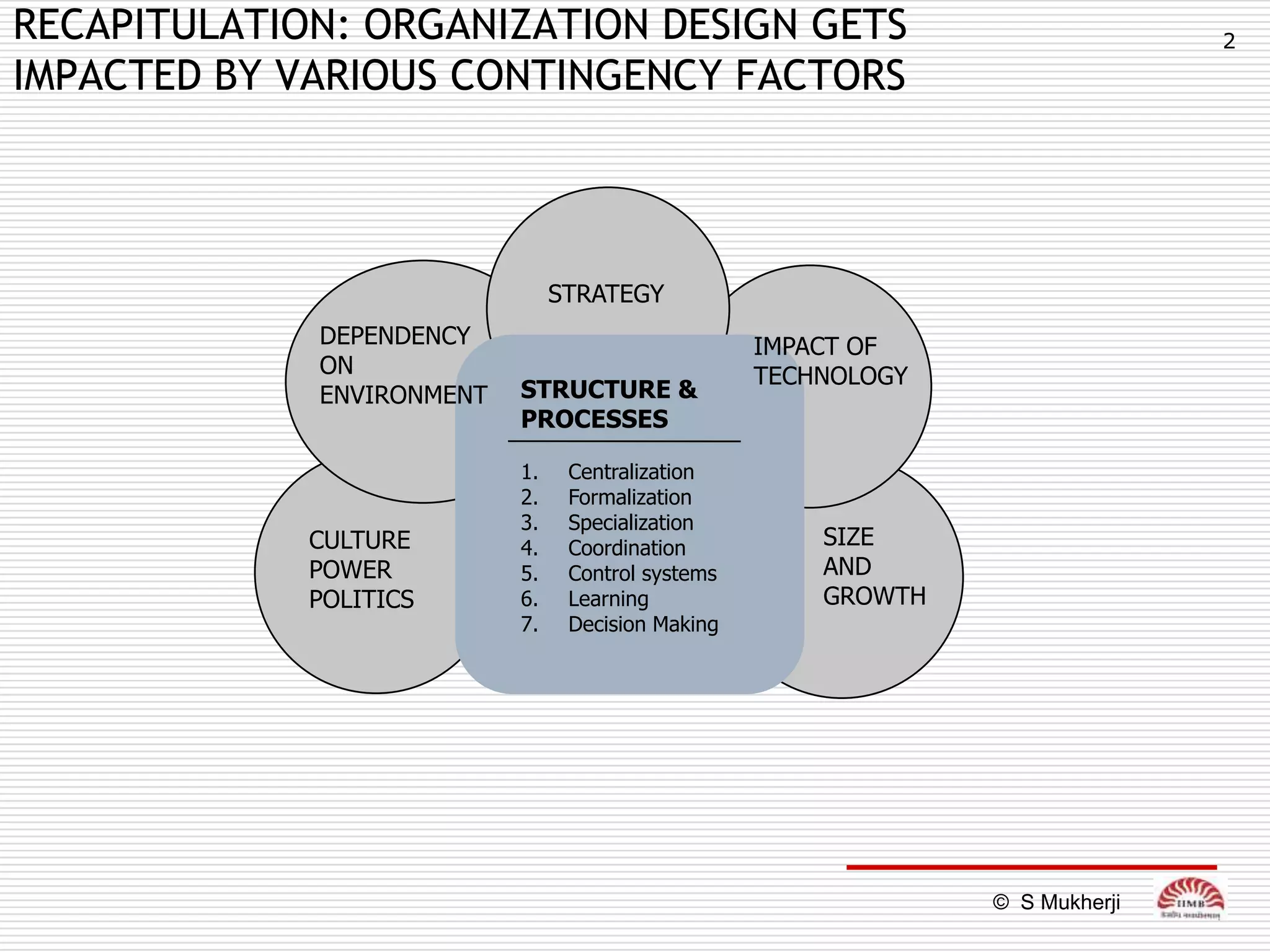
RECAPITULATION: ORGANIZATION DESIGN GETS                                       2
IMPACTED BY VARIOUS CONTINGENCY FACTORS


                                STRATEGY
             DEPENDENCY                            IMPACT OF
             ON                                    TECHNOLOGY
             ENVIRONMENT   STRUCTURE &
                           PROCESSES

                           1.    Centralization
                           2.    Formalization
                           3.    Specialization
             CULTURE       4.    Coordination          SIZE
             POWER         5.    Control systems       AND
             POLITICS      6.    Learning              GROWTH
                           7.    Decision Making


                                                                © S Mukherji
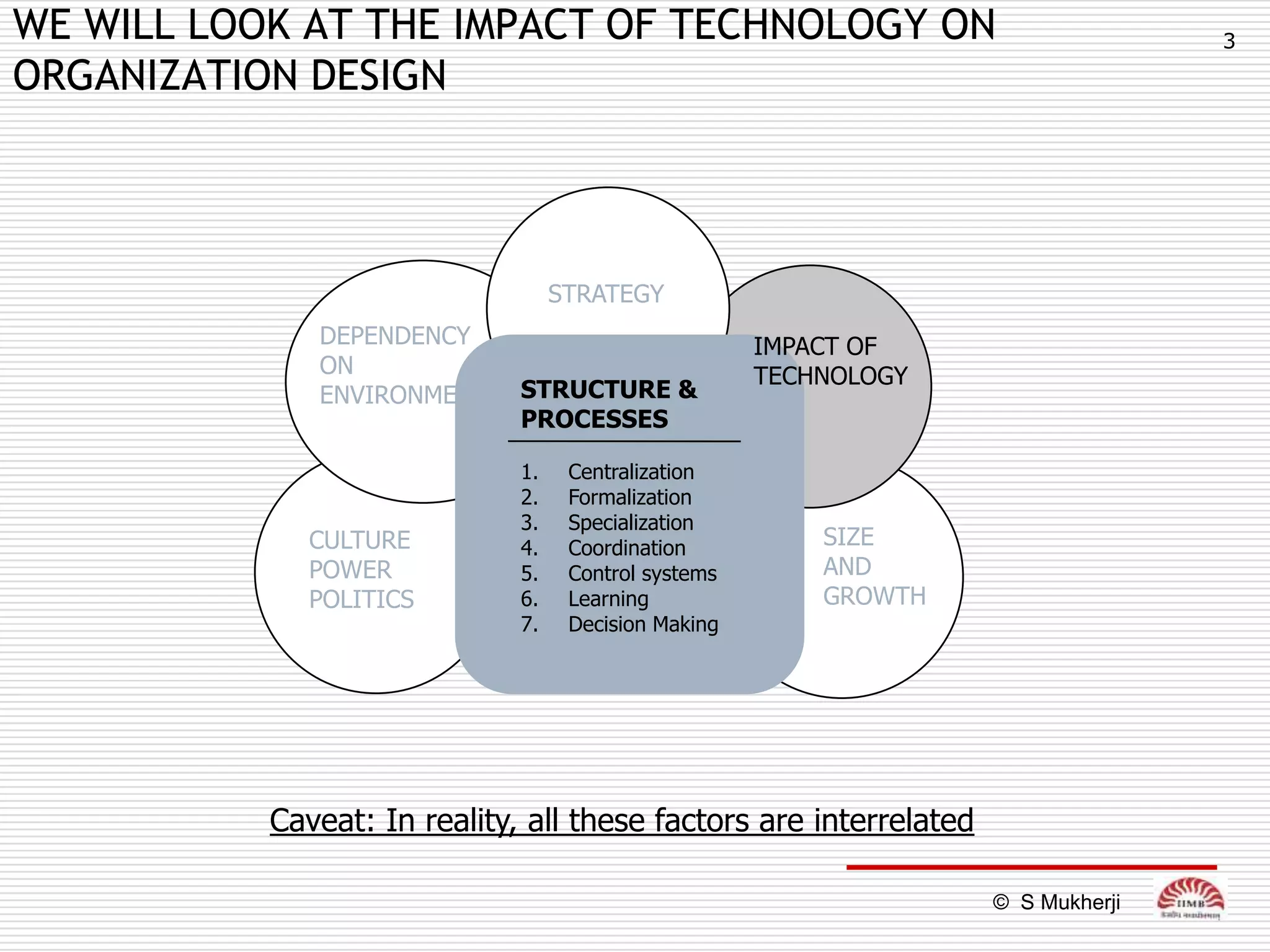
WE WILL LOOK AT THE IMPACT OF TECHNOLOGY ON                                        3
ORGANIZATION DESIGN


                                   STRATEGY
              DEPENDENCY                              IMPACT OF
              ON                                      TECHNOLOGY
              ENVIRONMENT     STRUCTURE &
                              PROCESSES

                              1.    Centralization
                              2.    Formalization
                              3.    Specialization
              CULTURE         4.    Coordination          SIZE
              POWER           5.    Control systems       AND
              POLITICS        6.    Learning              GROWTH
                              7.    Decision Making


           Caveat: In reality, all these factors are interrelated

                                                                    © S Mukherji
4
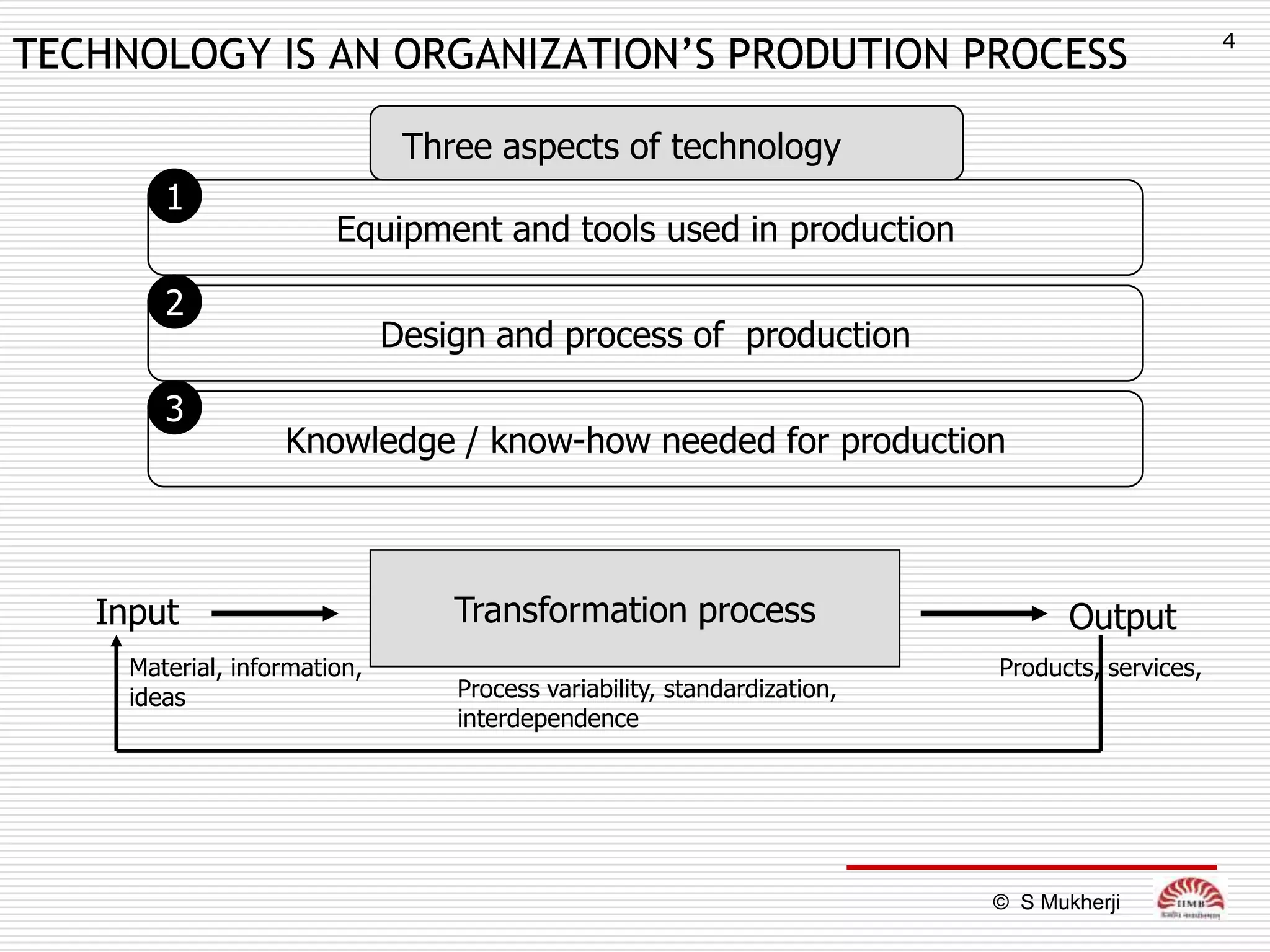
TECHNOLOGY IS AN ORGANIZATION’S PRODUTION PROCESS

                               Three aspects of technology
        1
                        Equipment and tools used in production

        2
                              Design and process of production

        3
                   Knowledge / know-how needed for production


   Input                          Transformation process                         Output
     Material, information,                                               Products, services,
     ideas                        Process variability, standardization,
                                  interdependence


                                                                          © S Mukherji
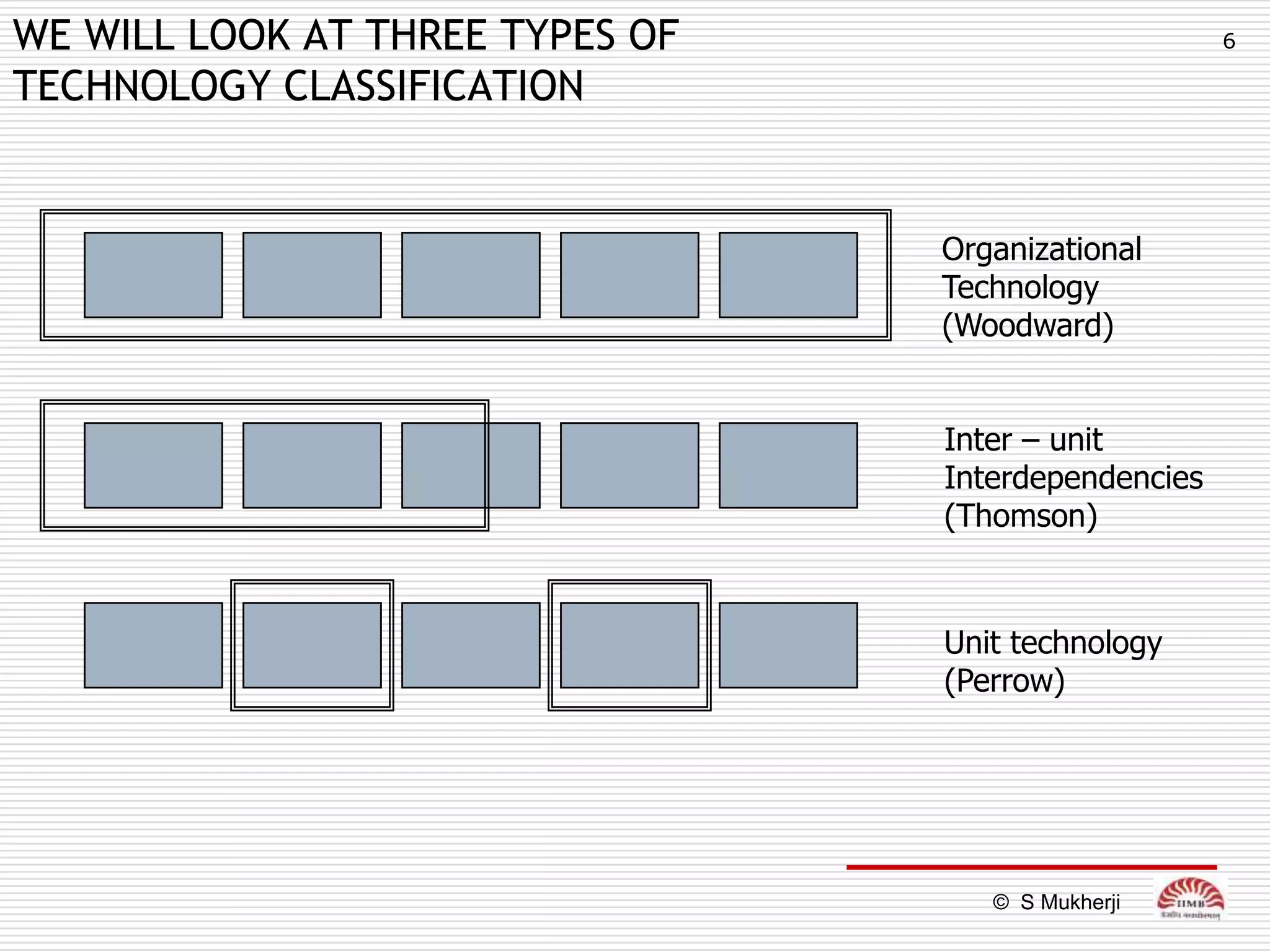
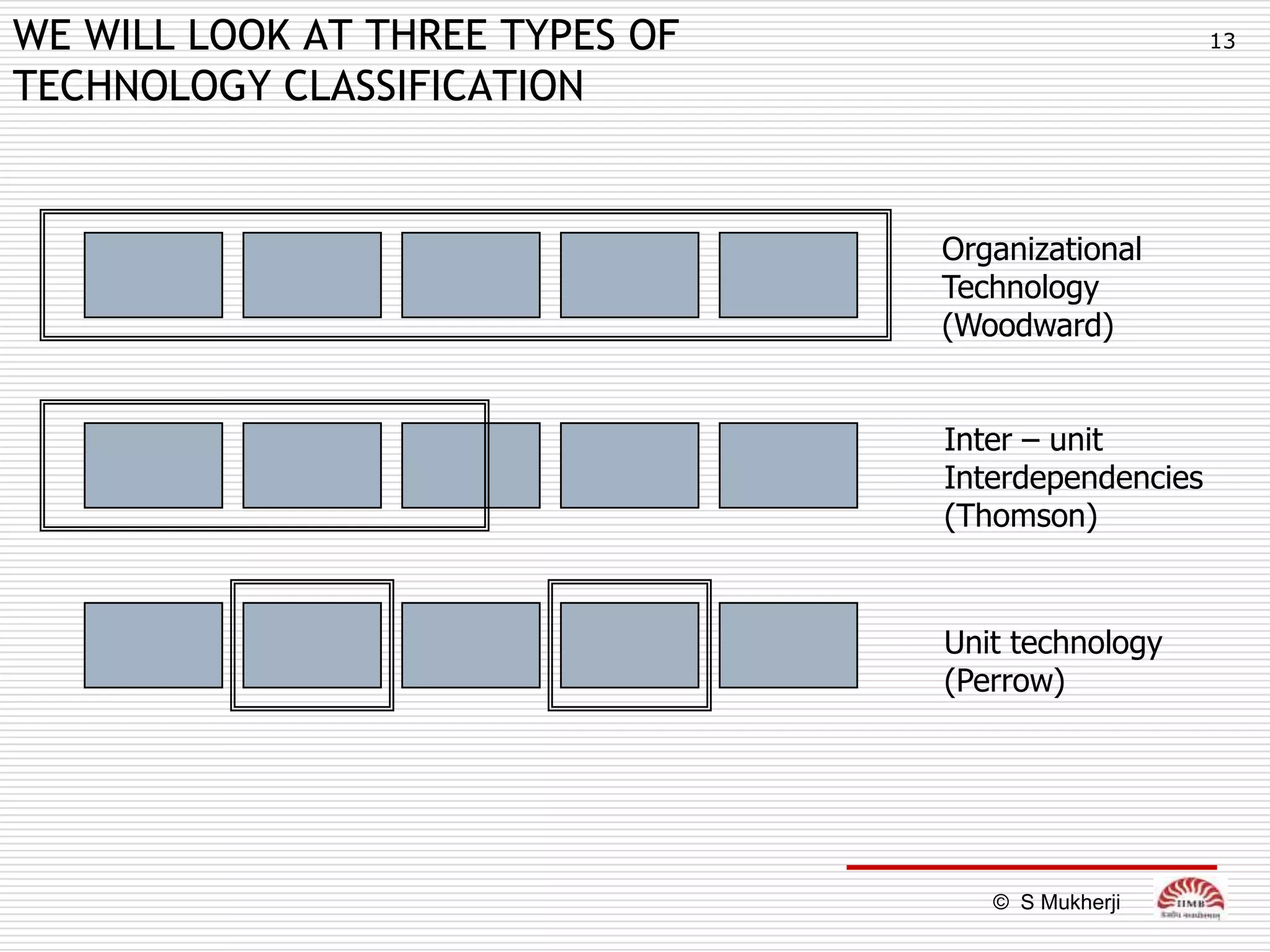
WE WILL LOOK AT THREE TYPES OF                       6

TECHNOLOGY CLASSIFICATION


                                 Organizational
                                 Technology
                                 (Woodward)


                                 Inter – unit
                                 Interdependencies
                                 (Thomson)


                                 Unit technology
                                 (Perrow)


                                    © S Mukherji
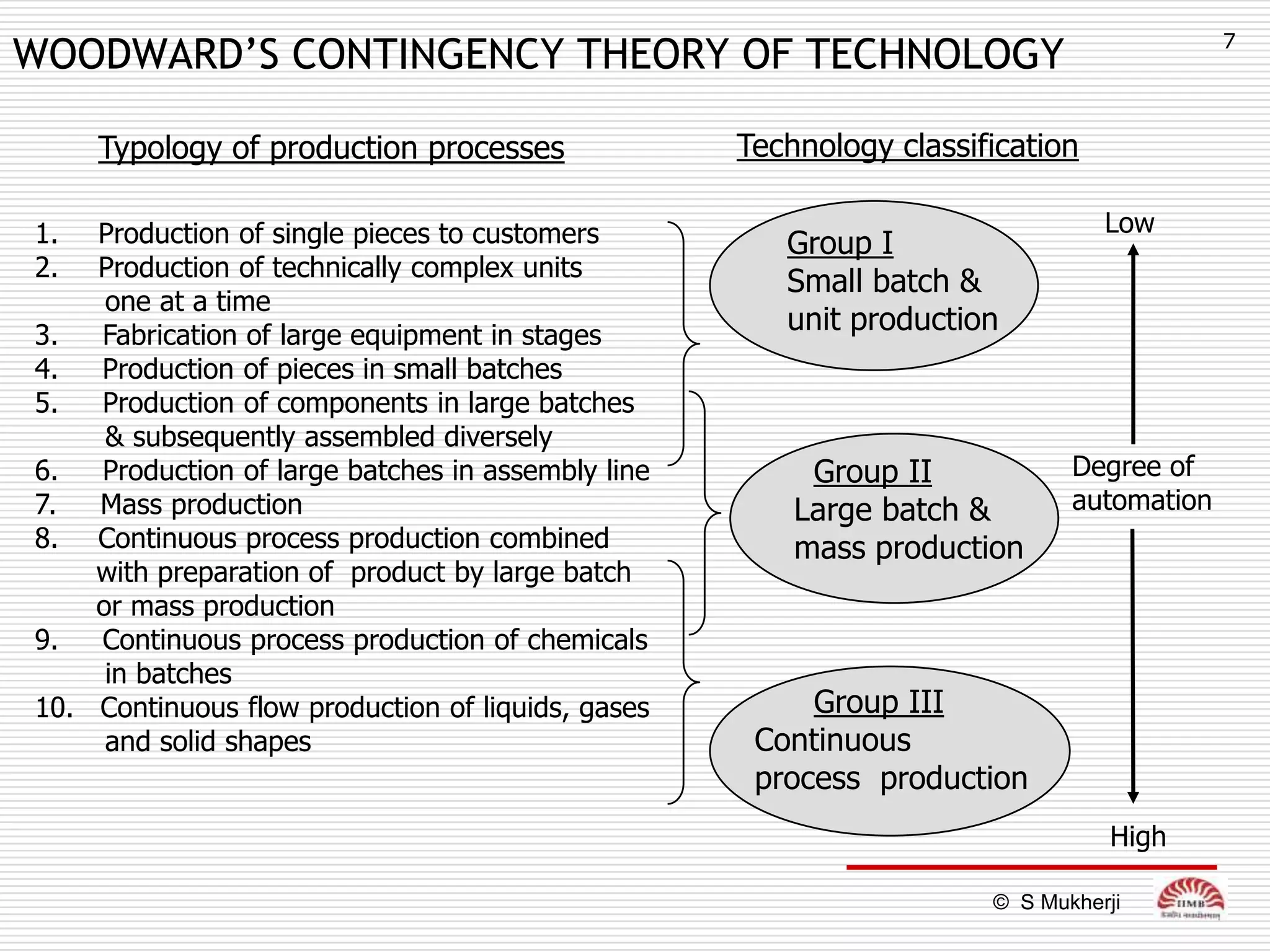
7
WOODWARD’S CONTINGENCY THEORY OF TECHNOLOGY

     Typology of production processes              Technology classification

1.  Production of single pieces to customers                                   Low
                                                      Group I
2.  Production of technically complex units
                                                      Small batch &
     one at a time
3.  Fabrication of large equipment in stages
                                                      unit production
4.  Production of pieces in small batches
5.  Production of components in large batches
     & subsequently assembled diversely
6.  Production of large batches in assembly line        Group II            Degree of
7.  Mass production                                    Large batch &        automation
8. Continuous process production combined              mass production
    with preparation of product by large batch
    or mass production
9.  Continuous process production of chemicals
     in batches
10. Continuous flow production of liquids, gases        Group III
     and solid shapes                               Continuous
                                                    process production
                                                                                High

                                                                     © S Mukherji
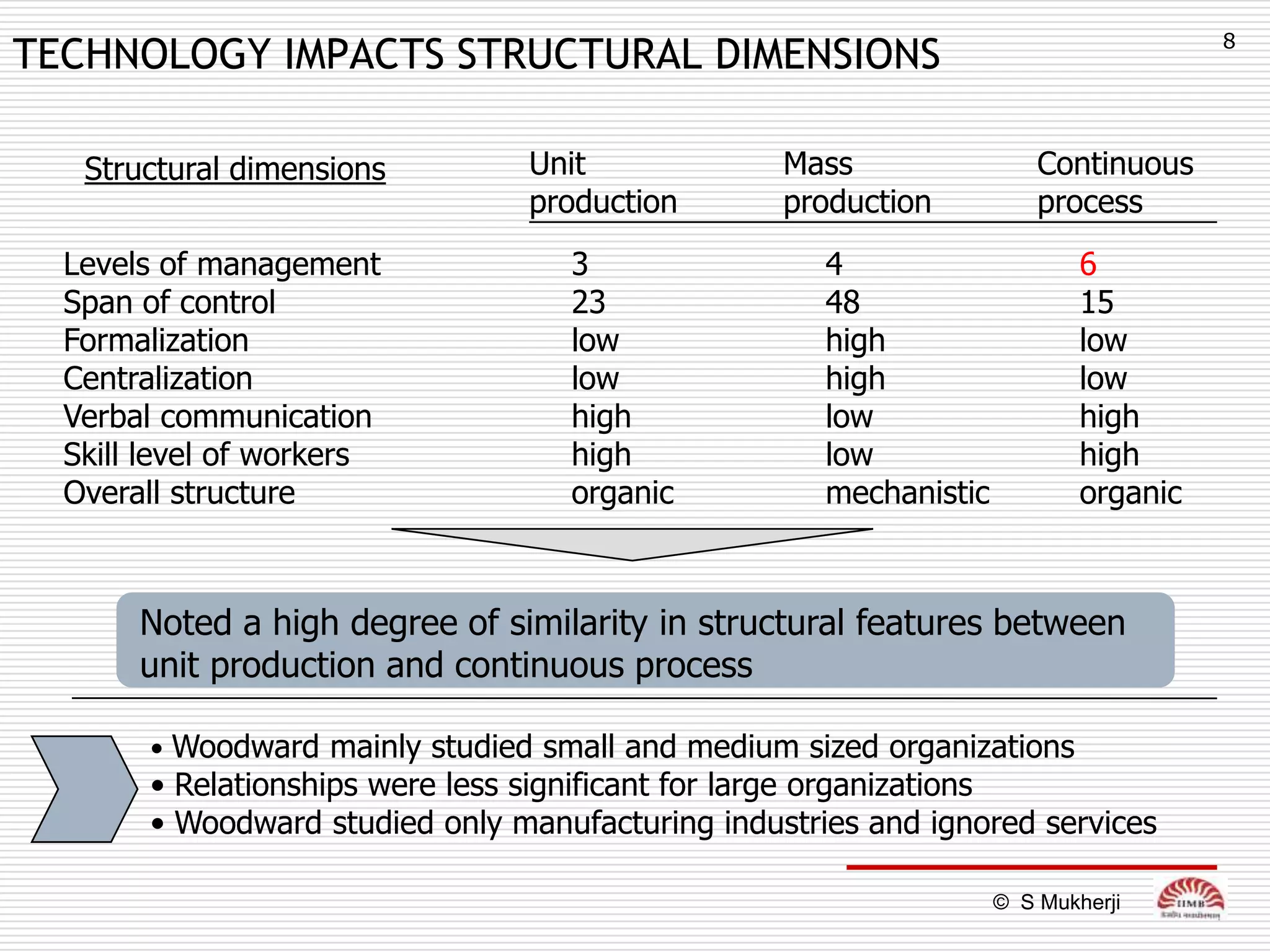
8
TECHNOLOGY IMPACTS STRUCTURAL DIMENSIONS

   Structural dimensions         Unit              Mass                 Continuous
                                 production        production           process
  Levels of management              3                 4                     6
  Span of control                   23                48                    15
  Formalization                     low               high                  low
  Centralization                    low               high                  low
  Verbal communication              high              low                   high
  Skill level of workers            high              low                   high
  Overall structure                 organic           mechanistic           organic


       Noted a high degree of similarity in structural features between
       unit production and continuous process

        • Woodward mainly studied small and medium sized organizations
        • Relationships were less significant for large organizations
        • Woodward studied only manufacturing industries and ignored services

                                                                    © S Mukherji
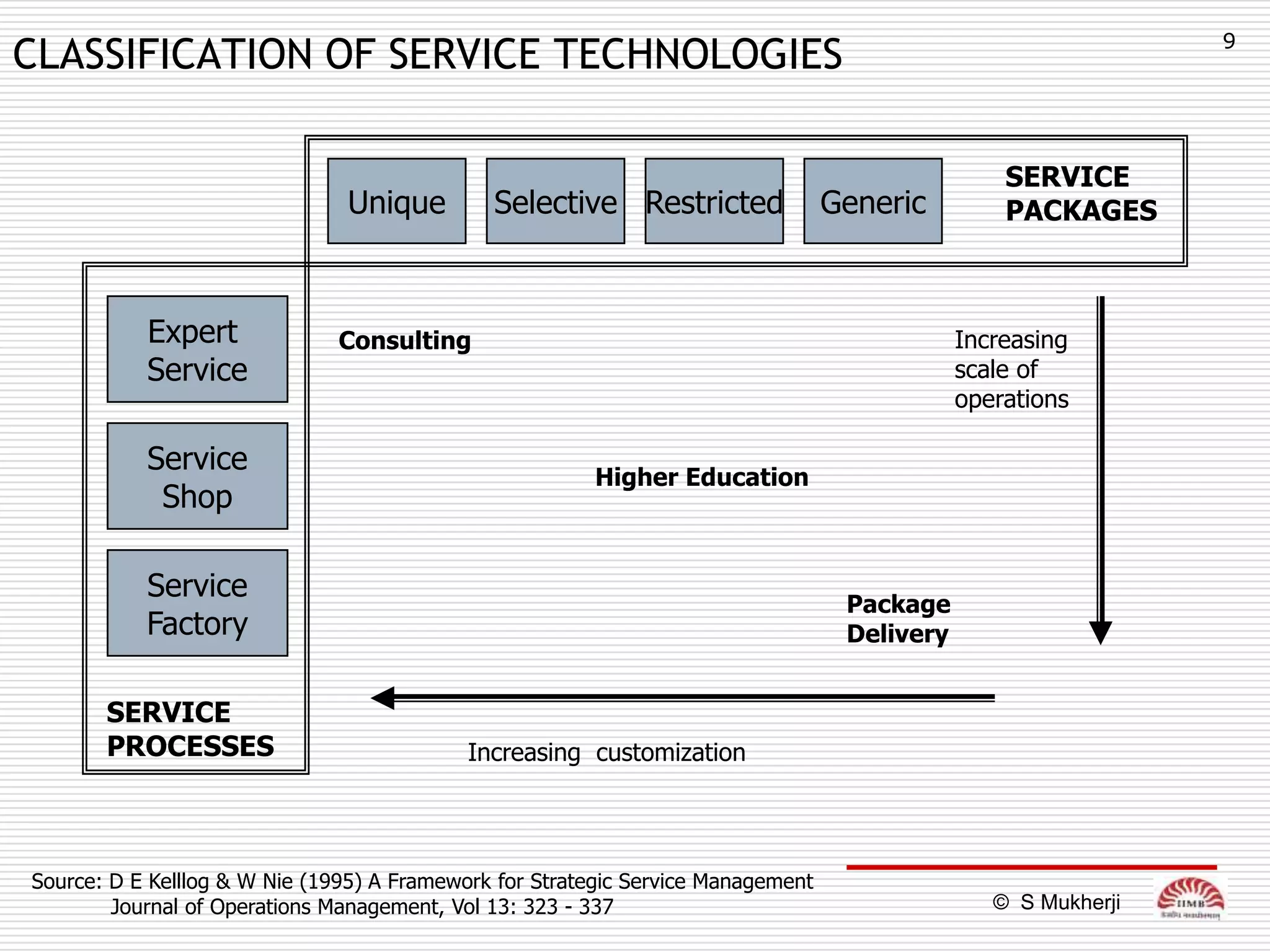
9
CLASSIFICATION OF SERVICE TECHNOLOGIES

                                                                                                  SERVICE
                               Unique         Selective Restricted                Generic         PACKAGES


           Expert              Consulting                                                     Increasing
           Service                                                                            scale of
                                                                                              operations

           Service
                                                        Higher Education
            Shop

           Service
                                                                                   Package
           Factory                                                                 Delivery


       SERVICE
       PROCESSES                            Increasing customization


Source: D E Kelllog & W Nie (1995) A Framework for Strategic Service Management
        Journal of Operations Management, Vol 13: 323 - 337                                      © S Mukherji
10
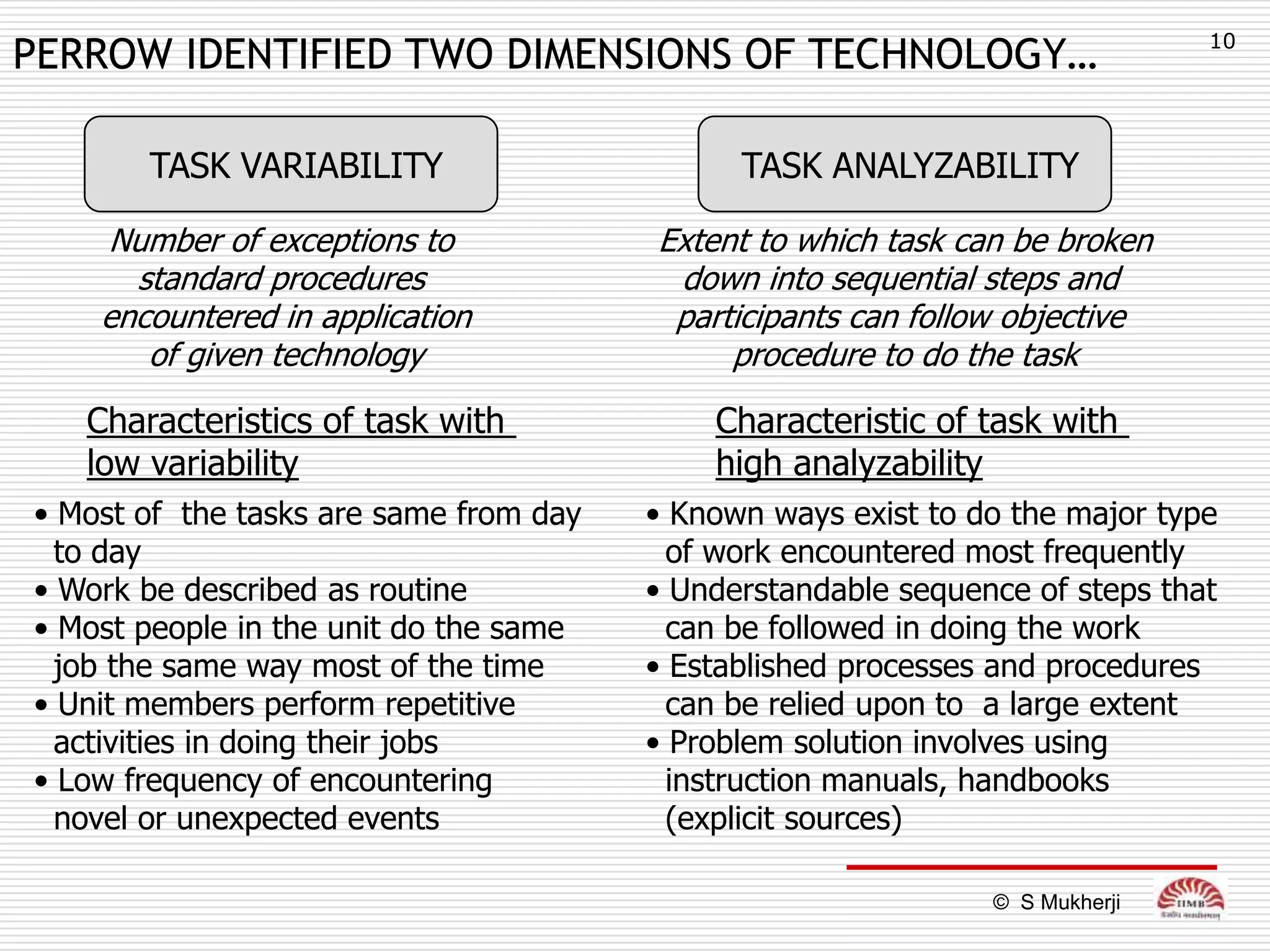
PERROW IDENTIFIED TWO DIMENSIONS OF TECHNOLOGY…

       TASK VARIABILITY                       TASK ANALYZABILITY

    Number of exceptions to             Extent to which task can be broken
      standard procedures                down into sequential steps and
    encountered in application           participants can follow objective
       of given technology                   procedure to do the task

   Characteristics of task with             Characteristic of task with
   low variability                          high analyzability
• Most of the tasks are same from day   • Known ways exist to do the major type
  to day                                  of work encountered most frequently
• Work be described as routine          • Understandable sequence of steps that
• Most people in the unit do the same     can be followed in doing the work
  job the same way most of the time     • Established processes and procedures
• Unit members perform repetitive         can be relied upon to a large extent
  activities in doing their jobs        • Problem solution involves using
• Low frequency of encountering           instruction manuals, handbooks
  novel or unexpected events              (explicit sources)

                                                               © S Mukherji
11
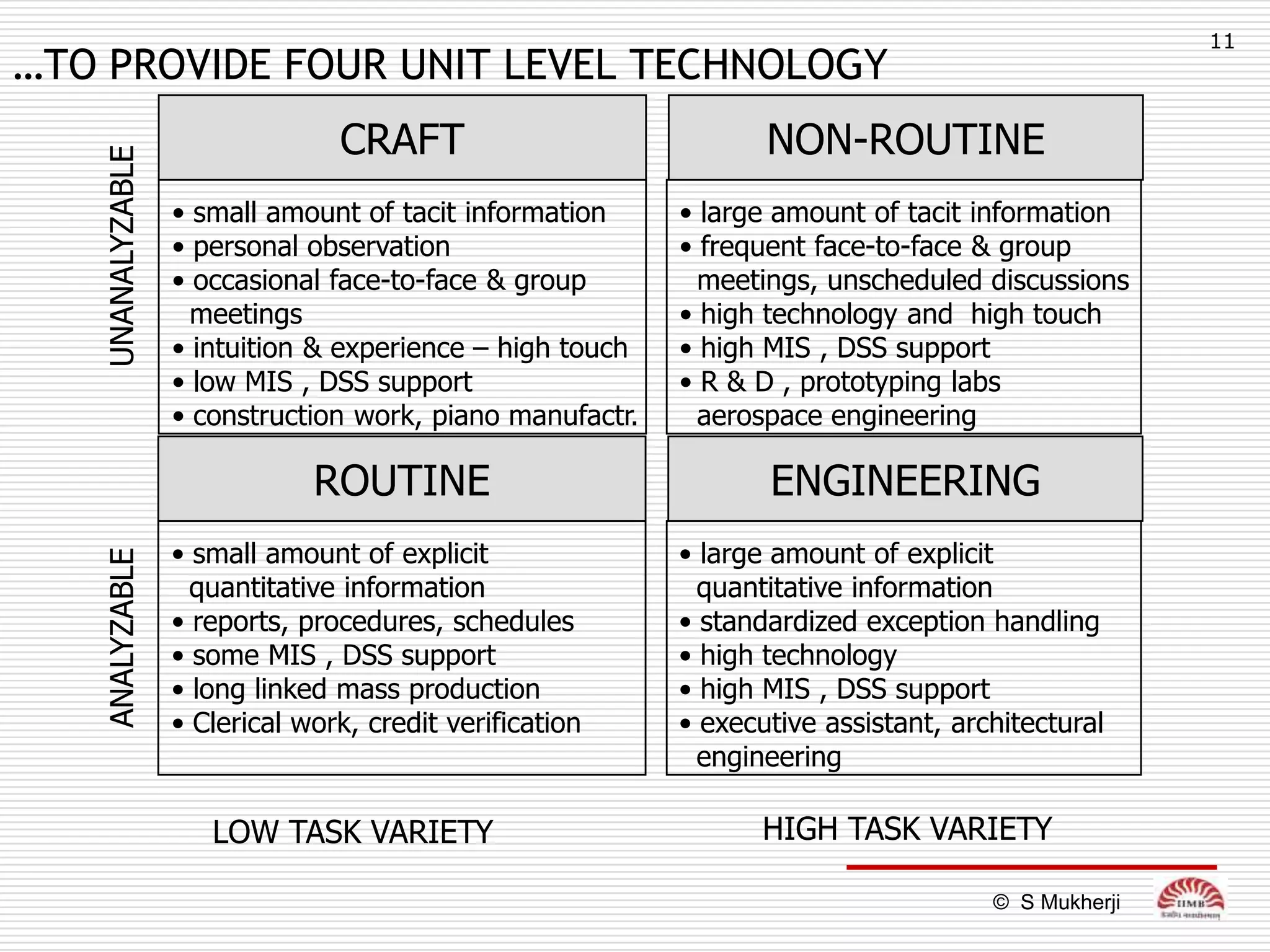
…TO PROVIDE FOUR UNIT LEVEL TECHNOLOGY
                                CRAFT                            NON-ROUTINE
   UNANALYZABLE

                  • small amount of tacit information     • large amount of tacit information
                  • personal observation                  • frequent face-to-face & group
                  • occasional face-to-face & group         meetings, unscheduled discussions
                    meetings                              • high technology and high touch
                  • intuition & experience – high touch   • high MIS , DSS support
                  • low MIS , DSS support                 • R & D , prototyping labs
                  • construction work, piano manufactr.     aerospace engineering

                              ROUTINE                            ENGINEERING
                  • small amount of explicit              • large amount of explicit
   ANALYZABLE


                    quantitative information                quantitative information
                  • reports, procedures, schedules        • standardized exception handling
                  • some MIS , DSS support                • high technology
                  • long linked mass production           • high MIS , DSS support
                  • Clerical work, credit verification    • executive assistant, architectural
                                                            engineering

                     LOW TASK VARIETY                            HIGH TASK VARIETY

                                                                                    © S Mukherji
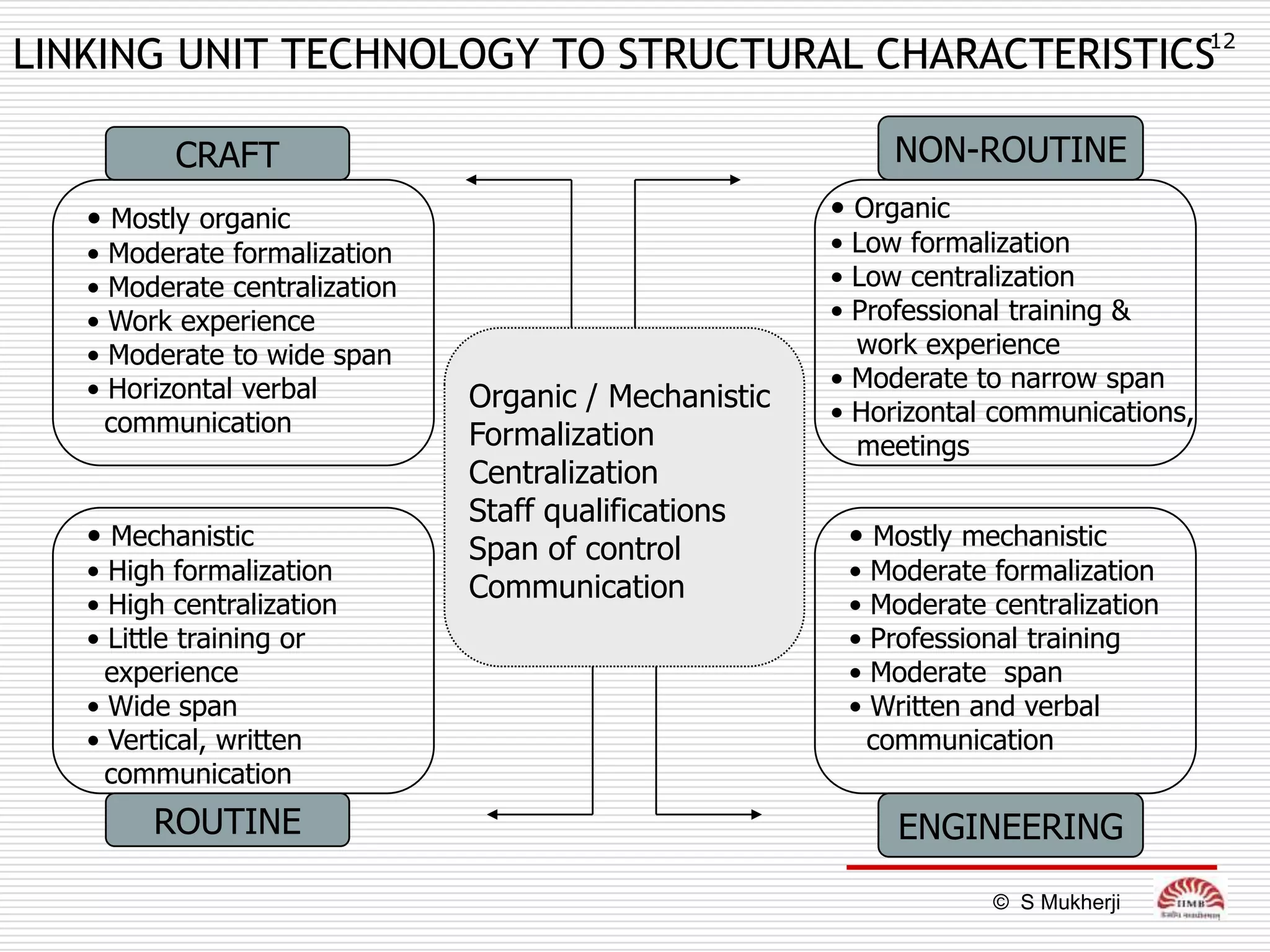
LINKING UNIT TECHNOLOGY TO STRUCTURAL CHARACTERISTICS12

            CRAFT                                               NON-ROUTINE
   • Mostly organic                                      • Organic
   •   Moderate formalization                            • Low formalization
   •   Moderate centralization                           • Low centralization
   •   Work experience                                   • Professional training &
   •   Moderate to wide span                               work experience
   •   Horizontal verbal                                 • Moderate to narrow span
                                 Organic / Mechanistic   • Horizontal communications,
       communication             Formalization             meetings
                                 Centralization
                                 Staff qualifications
   • Mechanistic                 Span of control          • Mostly mechanistic
   • High formalization                                   •   Moderate formalization
                                 Communication
   • High centralization                                  •   Moderate centralization
   • Little training or                                   •   Professional training
     experience                                           •   Moderate span
   • Wide span                                            •   Written and verbal
   • Vertical, written                                        communication
     communication
          ROUTINE                                               ENGINEERING
                                                                       © S Mukherji
WE WILL LOOK AT THREE TYPES OF                       13

TECHNOLOGY CLASSIFICATION


                                 Organizational
                                 Technology
                                 (Woodward)


                                 Inter – unit
                                 Interdependencies
                                 (Thomson)


                                 Unit technology
                                 (Perrow)


                                    © S Mukherji
14
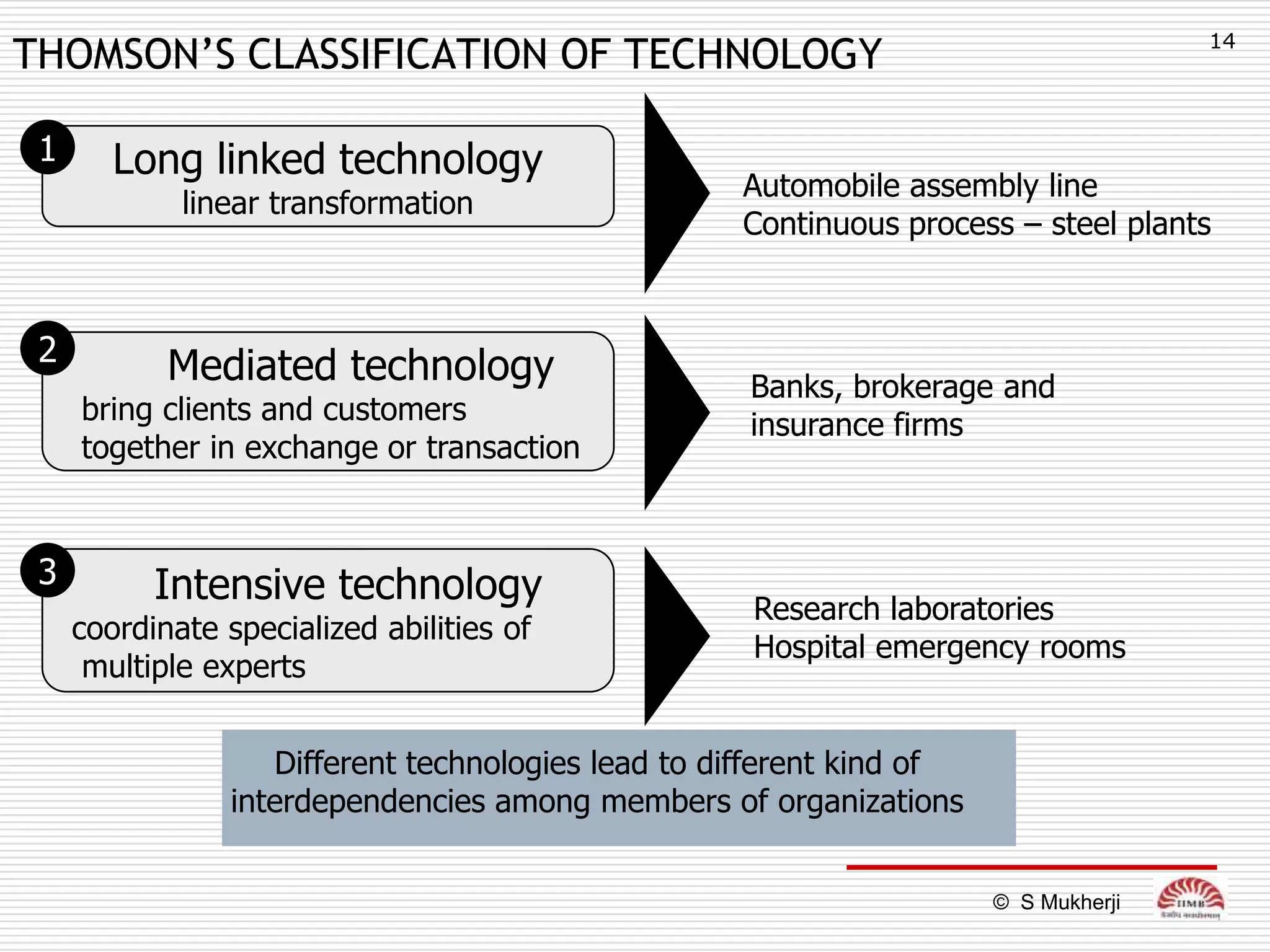
THOMSON’S CLASSIFICATION OF TECHNOLOGY

 1      Long linked technology
                                                    Automobile assembly line
             linear transformation
                                                    Continuous process – steel plants


 2
            Mediated technology                      Banks, brokerage and
     bring clients and customers                     insurance firms
     together in exchange or transaction


 3         Intensive technology                      Research laboratories
     coordinate specialized abilities of
                                                     Hospital emergency rooms
      multiple experts


                    Different technologies lead to different kind of
                 interdependencies among members of organizations


                                                                       © S Mukherji
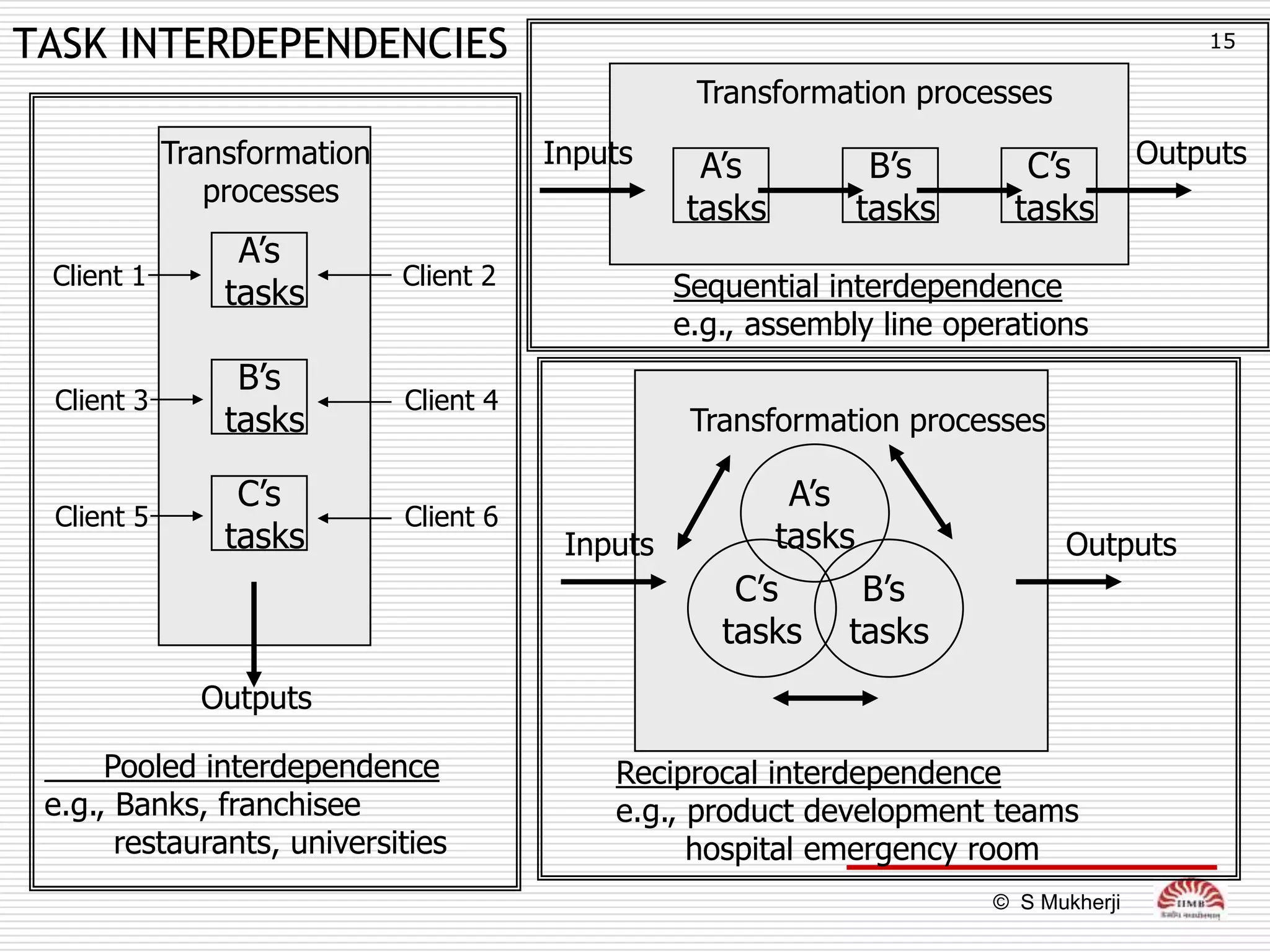
TASK INTERDEPENDENCIES                                                                      15

                                                   Transformation processes
            Transformation              Inputs     A’s          B’s         C’s         Outputs
               processes
                                                  tasks        tasks       tasks
                 A’s
 Client 1                    Client 2             Sequential interdependence
                tasks
                                                  e.g., assembly line operations
                 B’s
 Client 3                    Client 4
                tasks                              Transformation processes

                 C’s                                      A’s
 Client 5                    Client 6
                tasks                    Inputs          tasks                 Outputs
                                                      C’s      B’s
                                                     tasks tasks
              Outputs

      Pooled interdependence                Reciprocal interdependence
 e.g., Banks, franchisee                    e.g., product development teams
       restaurants, universities                  hospital emergency room
                                                                         © S Mukherji
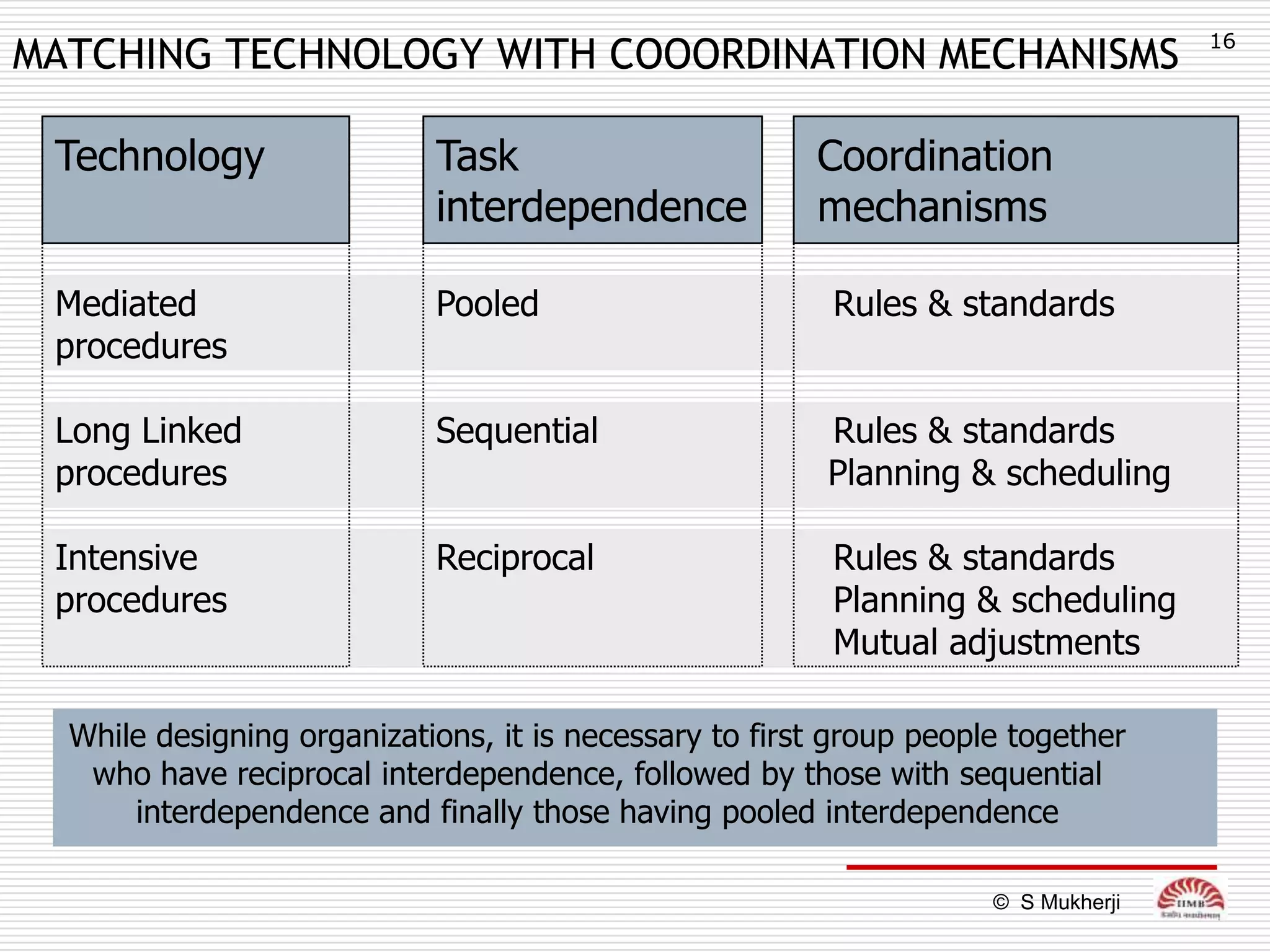
16
MATCHING TECHNOLOGY WITH COOORDINATION MECHANISMS

 Technology                 Task                        Coordination
                            interdependence             mechanisms

 Mediated                   Pooled                       Rules & standards
 procedures

 Long Linked                Sequential                   Rules & standards
 procedures                                              Planning & scheduling

 Intensive                  Reciprocal                   Rules & standards
 procedures                                              Planning & scheduling
                                                         Mutual adjustments

  While designing organizations, it is necessary to first group people together
   who have reciprocal interdependence, followed by those with sequential
      interdependence and finally those having pooled interdependence

                                                                     © S Mukherji
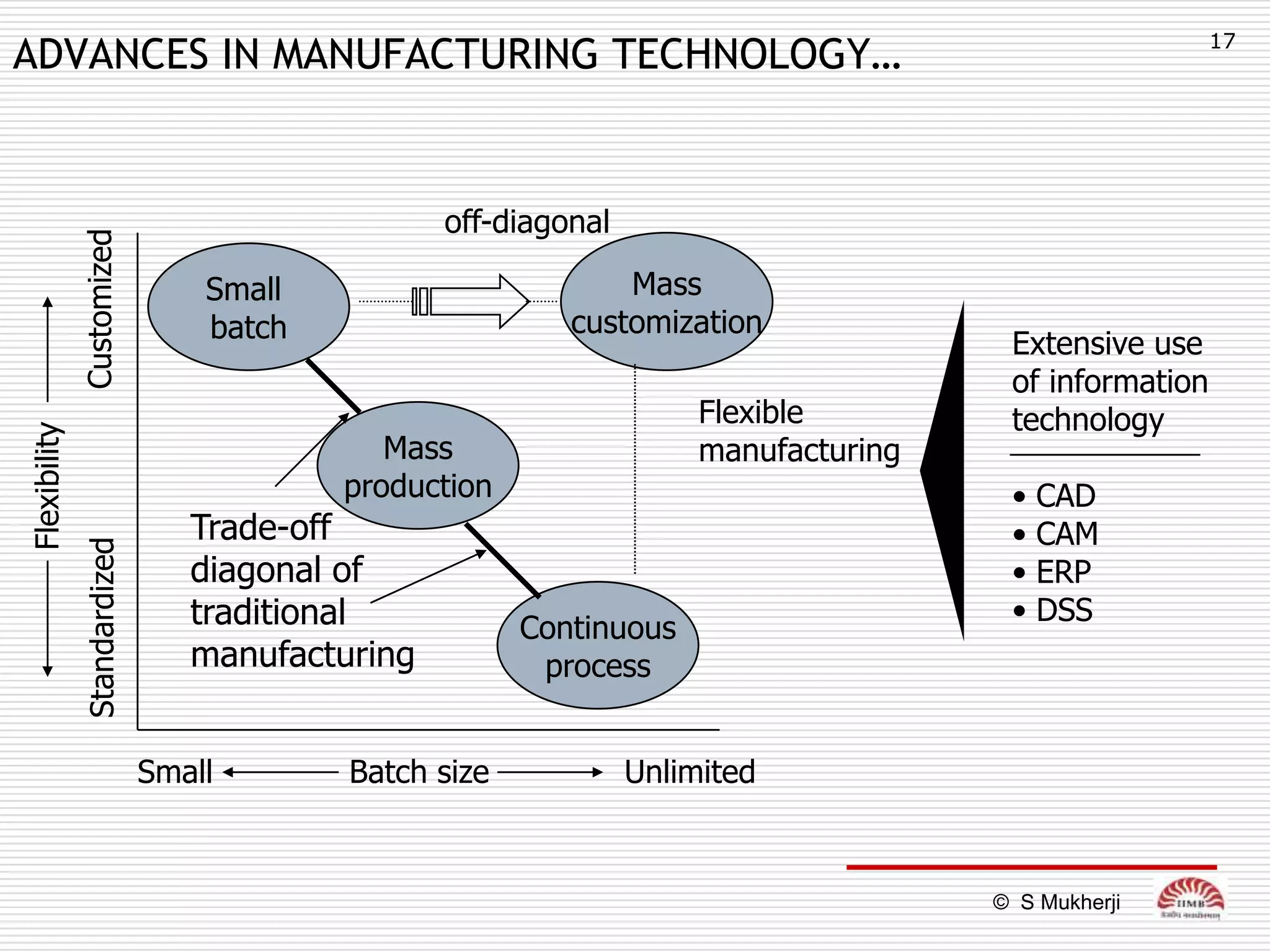
17
ADVANCES IN MANUFACTURING TECHNOLOGY…


                                                off-diagonal
              Customized


                                 Small                       Mass
                                 batch                   customization
                                                                                     Extensive use
                                                                                     of information
                                                                    Flexible         technology
Flexibility


                                            Mass                    manufacturing
                                         production                                  •   CAD
                                Trade-off                                            •   CAM
              Standardized


                                diagonal of                                          •   ERP
                                traditional           Continuous
                                                                                     •   DSS
                                manufacturing          process


                             Small       Batch size            Unlimited


                                                                                    © S Mukherji
18
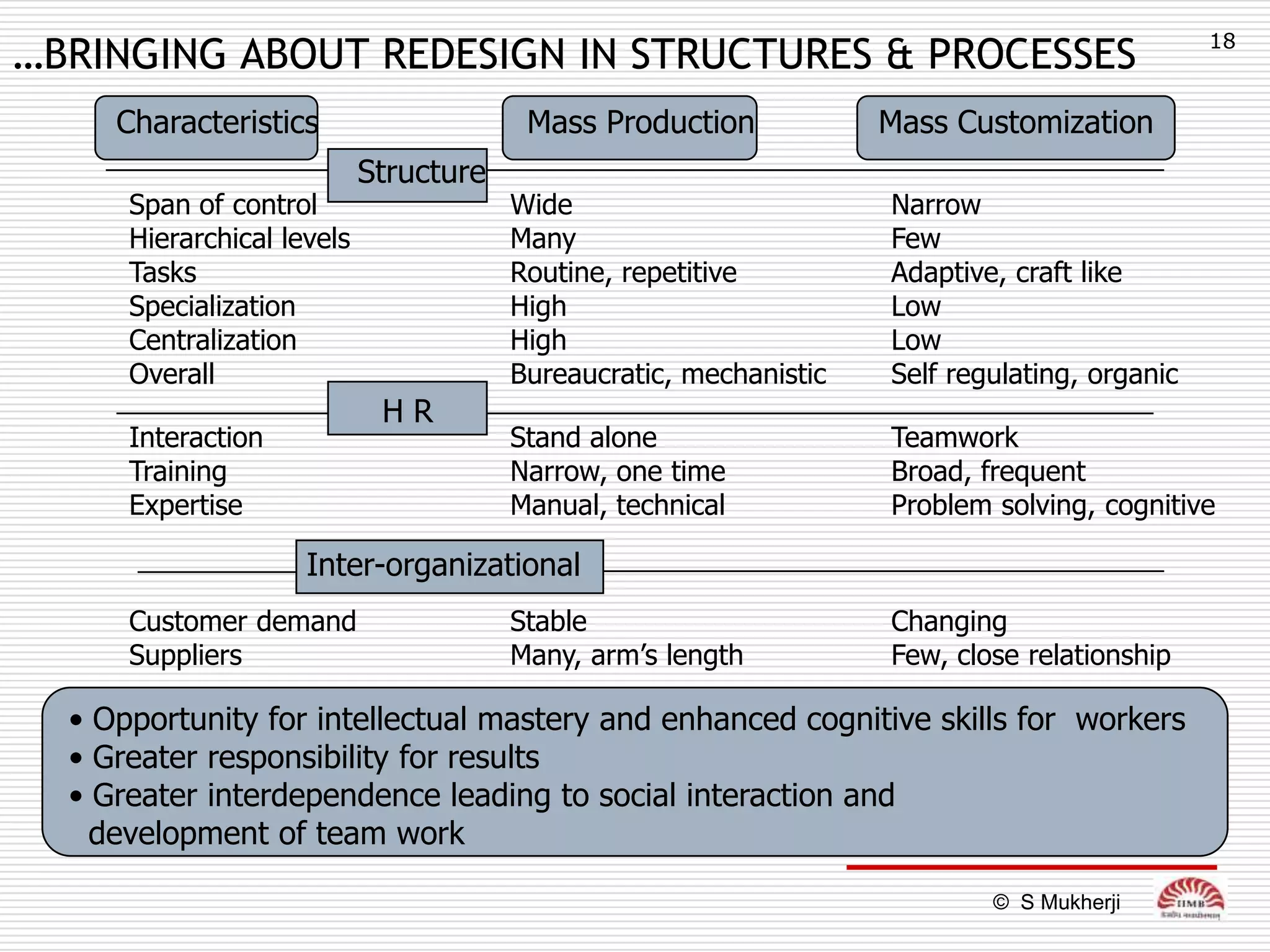
…BRINGING ABOUT REDESIGN IN STRUCTURES & PROCESSES
     Characteristics                     Mass Production            Mass Customization
                            Structure
      Span of control                   Wide                        Narrow
      Hierarchical levels               Many                        Few
      Tasks                             Routine, repetitive         Adaptive, craft like
      Specialization                    High                        Low
      Centralization                    High                        Low
      Overall                           Bureaucratic, mechanistic   Self regulating, organic
                             HR
      Interaction                       Stand alone                 Teamwork
      Training                          Narrow, one time            Broad, frequent
      Expertise                         Manual, technical           Problem solving, cognitive

                     Inter-organizational
      Customer demand                   Stable                      Changing
      Suppliers                         Many, arm’s length          Few, close relationship

  • Opportunity for intellectual mastery and enhanced cognitive skills for workers
  • Greater responsibility for results
  • Greater interdependence leading to social interaction and
    development of team work

                                                                            © S Mukherji

Man org session 3-org and technology_5th july 2012

  • 1.
    MANAGING ORGANIZATIONS Session 3: Impact of Technology on Structure Sourav Mukherji PGP 2012-14 Section C & E Associate Professor of Organization & Strategy Term 1:June-September 2012 Indian Institute of Management Bangalore, India
  • 2.
    RECAPITULATION: ORGANIZATION DESIGNGETS 2 IMPACTED BY VARIOUS CONTINGENCY FACTORS STRATEGY DEPENDENCY IMPACT OF ON TECHNOLOGY ENVIRONMENT STRUCTURE & PROCESSES 1. Centralization 2. Formalization 3. Specialization CULTURE 4. Coordination SIZE POWER 5. Control systems AND POLITICS 6. Learning GROWTH 7. Decision Making © S Mukherji
  • 3.
    WE WILL LOOKAT THE IMPACT OF TECHNOLOGY ON 3 ORGANIZATION DESIGN STRATEGY DEPENDENCY IMPACT OF ON TECHNOLOGY ENVIRONMENT STRUCTURE & PROCESSES 1. Centralization 2. Formalization 3. Specialization CULTURE 4. Coordination SIZE POWER 5. Control systems AND POLITICS 6. Learning GROWTH 7. Decision Making Caveat: In reality, all these factors are interrelated © S Mukherji
  • 4.
    4 TECHNOLOGY IS ANORGANIZATION’S PRODUTION PROCESS Three aspects of technology 1 Equipment and tools used in production 2 Design and process of production 3 Knowledge / know-how needed for production Input Transformation process Output Material, information, Products, services, ideas Process variability, standardization, interdependence © S Mukherji
  • 5.
    WE WILL LOOKAT THREE TYPES OF 6 TECHNOLOGY CLASSIFICATION Organizational Technology (Woodward) Inter – unit Interdependencies (Thomson) Unit technology (Perrow) © S Mukherji
  • 6.
    7 WOODWARD’S CONTINGENCY THEORYOF TECHNOLOGY Typology of production processes Technology classification 1. Production of single pieces to customers Low Group I 2. Production of technically complex units Small batch & one at a time 3. Fabrication of large equipment in stages unit production 4. Production of pieces in small batches 5. Production of components in large batches & subsequently assembled diversely 6. Production of large batches in assembly line Group II Degree of 7. Mass production Large batch & automation 8. Continuous process production combined mass production with preparation of product by large batch or mass production 9. Continuous process production of chemicals in batches 10. Continuous flow production of liquids, gases Group III and solid shapes Continuous process production High © S Mukherji
  • 7.
    8 TECHNOLOGY IMPACTS STRUCTURALDIMENSIONS Structural dimensions Unit Mass Continuous production production process Levels of management 3 4 6 Span of control 23 48 15 Formalization low high low Centralization low high low Verbal communication high low high Skill level of workers high low high Overall structure organic mechanistic organic Noted a high degree of similarity in structural features between unit production and continuous process • Woodward mainly studied small and medium sized organizations • Relationships were less significant for large organizations • Woodward studied only manufacturing industries and ignored services © S Mukherji
  • 8.
    9 CLASSIFICATION OF SERVICETECHNOLOGIES SERVICE Unique Selective Restricted Generic PACKAGES Expert Consulting Increasing Service scale of operations Service Higher Education Shop Service Package Factory Delivery SERVICE PROCESSES Increasing customization Source: D E Kelllog & W Nie (1995) A Framework for Strategic Service Management Journal of Operations Management, Vol 13: 323 - 337 © S Mukherji
  • 9.
    10 PERROW IDENTIFIED TWODIMENSIONS OF TECHNOLOGY… TASK VARIABILITY TASK ANALYZABILITY Number of exceptions to Extent to which task can be broken standard procedures down into sequential steps and encountered in application participants can follow objective of given technology procedure to do the task Characteristics of task with Characteristic of task with low variability high analyzability • Most of the tasks are same from day • Known ways exist to do the major type to day of work encountered most frequently • Work be described as routine • Understandable sequence of steps that • Most people in the unit do the same can be followed in doing the work job the same way most of the time • Established processes and procedures • Unit members perform repetitive can be relied upon to a large extent activities in doing their jobs • Problem solution involves using • Low frequency of encountering instruction manuals, handbooks novel or unexpected events (explicit sources) © S Mukherji
  • 10.
    11 …TO PROVIDE FOURUNIT LEVEL TECHNOLOGY CRAFT NON-ROUTINE UNANALYZABLE • small amount of tacit information • large amount of tacit information • personal observation • frequent face-to-face & group • occasional face-to-face & group meetings, unscheduled discussions meetings • high technology and high touch • intuition & experience – high touch • high MIS , DSS support • low MIS , DSS support • R & D , prototyping labs • construction work, piano manufactr. aerospace engineering ROUTINE ENGINEERING • small amount of explicit • large amount of explicit ANALYZABLE quantitative information quantitative information • reports, procedures, schedules • standardized exception handling • some MIS , DSS support • high technology • long linked mass production • high MIS , DSS support • Clerical work, credit verification • executive assistant, architectural engineering LOW TASK VARIETY HIGH TASK VARIETY © S Mukherji
  • 11.
    LINKING UNIT TECHNOLOGYTO STRUCTURAL CHARACTERISTICS12 CRAFT NON-ROUTINE • Mostly organic • Organic • Moderate formalization • Low formalization • Moderate centralization • Low centralization • Work experience • Professional training & • Moderate to wide span work experience • Horizontal verbal • Moderate to narrow span Organic / Mechanistic • Horizontal communications, communication Formalization meetings Centralization Staff qualifications • Mechanistic Span of control • Mostly mechanistic • High formalization • Moderate formalization Communication • High centralization • Moderate centralization • Little training or • Professional training experience • Moderate span • Wide span • Written and verbal • Vertical, written communication communication ROUTINE ENGINEERING © S Mukherji
  • 12.
    WE WILL LOOKAT THREE TYPES OF 13 TECHNOLOGY CLASSIFICATION Organizational Technology (Woodward) Inter – unit Interdependencies (Thomson) Unit technology (Perrow) © S Mukherji
  • 13.
    14 THOMSON’S CLASSIFICATION OFTECHNOLOGY 1 Long linked technology Automobile assembly line linear transformation Continuous process – steel plants 2 Mediated technology Banks, brokerage and bring clients and customers insurance firms together in exchange or transaction 3 Intensive technology Research laboratories coordinate specialized abilities of Hospital emergency rooms multiple experts Different technologies lead to different kind of interdependencies among members of organizations © S Mukherji
  • 14.
    TASK INTERDEPENDENCIES 15 Transformation processes Transformation Inputs A’s B’s C’s Outputs processes tasks tasks tasks A’s Client 1 Client 2 Sequential interdependence tasks e.g., assembly line operations B’s Client 3 Client 4 tasks Transformation processes C’s A’s Client 5 Client 6 tasks Inputs tasks Outputs C’s B’s tasks tasks Outputs Pooled interdependence Reciprocal interdependence e.g., Banks, franchisee e.g., product development teams restaurants, universities hospital emergency room © S Mukherji
  • 15.
    16 MATCHING TECHNOLOGY WITHCOOORDINATION MECHANISMS Technology Task Coordination interdependence mechanisms Mediated Pooled Rules & standards procedures Long Linked Sequential Rules & standards procedures Planning & scheduling Intensive Reciprocal Rules & standards procedures Planning & scheduling Mutual adjustments While designing organizations, it is necessary to first group people together who have reciprocal interdependence, followed by those with sequential interdependence and finally those having pooled interdependence © S Mukherji
  • 16.
    17 ADVANCES IN MANUFACTURINGTECHNOLOGY… off-diagonal Customized Small Mass batch customization Extensive use of information Flexible technology Flexibility Mass manufacturing production • CAD Trade-off • CAM Standardized diagonal of • ERP traditional Continuous • DSS manufacturing process Small Batch size Unlimited © S Mukherji
  • 17.
    18 …BRINGING ABOUT REDESIGNIN STRUCTURES & PROCESSES Characteristics Mass Production Mass Customization Structure Span of control Wide Narrow Hierarchical levels Many Few Tasks Routine, repetitive Adaptive, craft like Specialization High Low Centralization High Low Overall Bureaucratic, mechanistic Self regulating, organic HR Interaction Stand alone Teamwork Training Narrow, one time Broad, frequent Expertise Manual, technical Problem solving, cognitive Inter-organizational Customer demand Stable Changing Suppliers Many, arm’s length Few, close relationship • Opportunity for intellectual mastery and enhanced cognitive skills for workers • Greater responsibility for results • Greater interdependence leading to social interaction and development of team work © S Mukherji