Review of Basics of Digital Electronics 1 Lecture 1
CSE 211, Computer Organization and Architecture Harjeet Kaur, CSE/IT
Overview
Introduction
Logic Gates
Flip Flops
Registers
Counters
Multiplexer/ Demultiplexer
Decoder/ Encoder
Review of Basics of Digital Electronics 2 Lecture 1
CSE 211, Computer Organization and Architecture Harjeet Kaur, CSE/IT
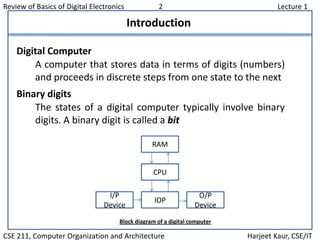
Introduction
Digital Computer
A computer that stores data in terms of digits (numbers)
and proceeds in discrete steps from one state to the next
Binary digits
The states of a digital computer typically involve binary
digits. A binary digit is called a bit
RAM
CPU
O/P
Device
I/P
Device
IOP
Block diagram of a digital computer
Review of Basics of Digital Electronics 3 Lecture 1
CSE 211, Computer Organization and Architecture Harjeet Kaur, CSE/IT
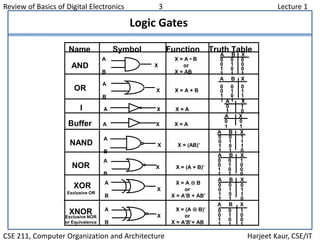
Logic Gates
A
X X = (A + B)’
B
Name Symbol Function Truth Table
AND
A X = A • B
X or
B X = AB
0 0 0
0 1 0
1 0 0
1 1 1
0 0 0
0 1 1
1 0 1
1 1 1
OR
A
X X = A + B
B
I A X X = A
0 1
1 0
Buffer A X X = A
A X
0 0
1 1
NAND
A
X X = (AB)’
B
0 0 1
0 1 1
1 0 1
1 1 0
NOR
0 0 1
0 1 0
1 0 0
1 1 0
XOR
Exclusive OR
A X = A  B
X or
B X = A’B + AB’
0 0 0
0 1 1
1 0 1
1 1 0
A X = (A  B)’
X or
B X = A’B’+ AB
0 0 1
0 1 0
1 0 0
1 1 1
XNOR
Exclusive NOR
or Equivalence
A B X
A B X
A X
A B X
A B X
A B X
A B X
Review of Basics of Digital Electronics 4 Lecture 1
CSE 211, Computer Organization and Architecture Harjeet Kaur, CSE/IT
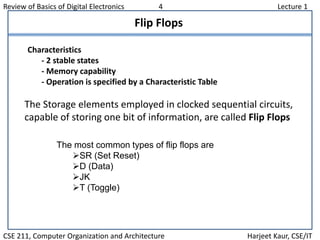
Flip Flops
Characteristics
- 2 stable states
- Memory capability
- Operation is specified by a Characteristic Table
The Storage elements employed in clocked sequential circuits,
capable of storing one bit of information, are called Flip Flops
The most common types of flip flops are
SR (Set Reset)
D (Data)
JK
T (Toggle)
Review of Basics of Digital Electronics 5 Lecture 1
CSE 211, Computer Organization and Architecture Harjeet Kaur, CSE/IT
Clocked Flip Flops
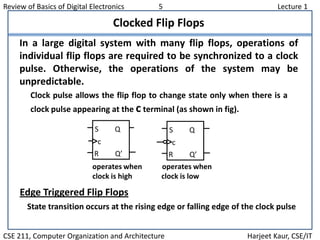
In a large digital system with many flip flops, operations of
individual flip flops are required to be synchronized to a clock
pulse. Otherwise, the operations of the system may be
unpredictable.
S Q
c
R Q’
S Q
c
R Q’
Clock pulse allows the flip flop to change state only when there is a
clock pulse appearing at the c terminal (as shown in fig).
Edge Triggered Flip Flops
operates when operates when
clock is high clock is low
State transition occurs at the rising edge or falling edge of the clock pulse
Review of Basics of Digital Electronics 6 Lecture 1
CSE 211, Computer Organization and Architecture Harjeet Kaur, CSE/IT
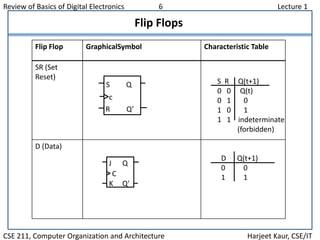
S Q
c
R Q’
S R Q(t+1)
0 0 Q(t)
0 1 0
1 0 1
1 1 indeterminate
(forbidden)
Flip Flop GraphicalSymbol Characteristic Table
SR (Set
Reset)
D (Data)
D Q(t+1)
0 0
1 1
J Q
C
K Q'
Flip Flops
Review of Basics of Digital Electronics 7 Lecture 1
CSE 211, Computer Organization and Architecture Harjeet Kaur, CSE/IT
J Q
c
R Q’
S R Q(t+1)
0 0 Q(t)
0 1 0
1 0 1
1 1 indeterminate
(forbidden)
Flip Flop GraphicalSymbol Characteristic Table
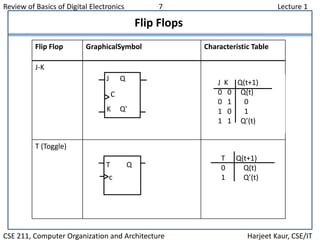
J-K
T (Toggle)
T Q
c
T Q(t+1)
0 Q(t)
1 Q’(t)
J Q
C
K Q'
J K Q(t+1)
0 0 Q(t)
0 1 0
1 0 1
1 1 Q’(t)
Flip Flops

Lecture 1

  • 1.
    Review of Basicsof Digital Electronics 1 Lecture 1 CSE 211, Computer Organization and Architecture Harjeet Kaur, CSE/IT Overview Introduction Logic Gates Flip Flops Registers Counters Multiplexer/ Demultiplexer Decoder/ Encoder
  • 2.
    Review of Basicsof Digital Electronics 2 Lecture 1 CSE 211, Computer Organization and Architecture Harjeet Kaur, CSE/IT Introduction Digital Computer A computer that stores data in terms of digits (numbers) and proceeds in discrete steps from one state to the next Binary digits The states of a digital computer typically involve binary digits. A binary digit is called a bit RAM CPU O/P Device I/P Device IOP Block diagram of a digital computer
  • 3.
    Review of Basicsof Digital Electronics 3 Lecture 1 CSE 211, Computer Organization and Architecture Harjeet Kaur, CSE/IT Logic Gates A X X = (A + B)’ B Name Symbol Function Truth Table AND A X = A • B X or B X = AB 0 0 0 0 1 0 1 0 0 1 1 1 0 0 0 0 1 1 1 0 1 1 1 1 OR A X X = A + B B I A X X = A 0 1 1 0 Buffer A X X = A A X 0 0 1 1 NAND A X X = (AB)’ B 0 0 1 0 1 1 1 0 1 1 1 0 NOR 0 0 1 0 1 0 1 0 0 1 1 0 XOR Exclusive OR A X = A  B X or B X = A’B + AB’ 0 0 0 0 1 1 1 0 1 1 1 0 A X = (A  B)’ X or B X = A’B’+ AB 0 0 1 0 1 0 1 0 0 1 1 1 XNOR Exclusive NOR or Equivalence A B X A B X A X A B X A B X A B X A B X
  • 4.
    Review of Basicsof Digital Electronics 4 Lecture 1 CSE 211, Computer Organization and Architecture Harjeet Kaur, CSE/IT Flip Flops Characteristics - 2 stable states - Memory capability - Operation is specified by a Characteristic Table The Storage elements employed in clocked sequential circuits, capable of storing one bit of information, are called Flip Flops The most common types of flip flops are SR (Set Reset) D (Data) JK T (Toggle)
  • 5.
    Review of Basicsof Digital Electronics 5 Lecture 1 CSE 211, Computer Organization and Architecture Harjeet Kaur, CSE/IT Clocked Flip Flops In a large digital system with many flip flops, operations of individual flip flops are required to be synchronized to a clock pulse. Otherwise, the operations of the system may be unpredictable. S Q c R Q’ S Q c R Q’ Clock pulse allows the flip flop to change state only when there is a clock pulse appearing at the c terminal (as shown in fig). Edge Triggered Flip Flops operates when operates when clock is high clock is low State transition occurs at the rising edge or falling edge of the clock pulse
  • 6.
    Review of Basicsof Digital Electronics 6 Lecture 1 CSE 211, Computer Organization and Architecture Harjeet Kaur, CSE/IT S Q c R Q’ S R Q(t+1) 0 0 Q(t) 0 1 0 1 0 1 1 1 indeterminate (forbidden) Flip Flop GraphicalSymbol Characteristic Table SR (Set Reset) D (Data) D Q(t+1) 0 0 1 1 J Q C K Q' Flip Flops
  • 7.
    Review of Basicsof Digital Electronics 7 Lecture 1 CSE 211, Computer Organization and Architecture Harjeet Kaur, CSE/IT J Q c R Q’ S R Q(t+1) 0 0 Q(t) 0 1 0 1 0 1 1 1 indeterminate (forbidden) Flip Flop GraphicalSymbol Characteristic Table J-K T (Toggle) T Q c T Q(t+1) 0 Q(t) 1 Q’(t) J Q C K Q' J K Q(t+1) 0 0 Q(t) 0 1 0 1 0 1 1 1 Q’(t) Flip Flops