Memory Organization 1 Lecture 42
CSE 211, Computer Organization and Architecture Harjeet Kaur, CSE/IT
Overview
 Memory Hierarchy
 Main Memory
 Auxiliary Memory
 Associative Memory
 Cache Memory
 Virtual Memory
 Memory Mgt Hardware
Memory Organization 2 Lecture 42
CSE 211, Computer Organization and Architecture Harjeet Kaur, CSE/IT
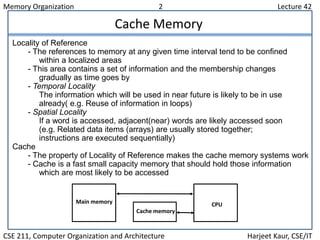
Cache Memory
Locality of Reference
- The references to memory at any given time interval tend to be confined
within a localized areas
- This area contains a set of information and the membership changes
gradually as time goes by
- Temporal Locality
The information which will be used in near future is likely to be in use
already( e.g. Reuse of information in loops)
- Spatial Locality
If a word is accessed, adjacent(near) words are likely accessed soon
(e.g. Related data items (arrays) are usually stored together;
instructions are executed sequentially)
Cache
- The property of Locality of Reference makes the cache memory systems work
- Cache is a fast small capacity memory that should hold those information
which are most likely to be accessed
Main memory
Cache memory
CPU
Memory Organization 3 Lecture 42
CSE 211, Computer Organization and Architecture Harjeet Kaur, CSE/IT
Performance of Cache
All the memory accesses are directed first to Cache
If the word is in Cache; Access cache to provide it to CPU
If the word is not in Cache; Bring a block (or a line) including
that word to replace a block now in Cache
- How can we know if the word that is required is there ?
- If a new block is to replace one of the old blocks, which one should we choose ?
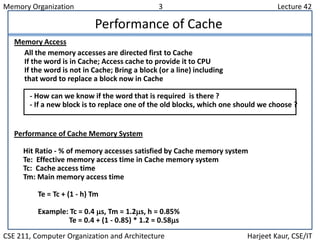
Memory Access
Performance of Cache Memory System
Hit Ratio - % of memory accesses satisfied by Cache memory system
Te: Effective memory access time in Cache memory system
Tc: Cache access time
Tm: Main memory access time
Te = Tc + (1 - h) Tm
Example: Tc = 0.4 s, Tm = 1.2s, h = 0.85%
Te = 0.4 + (1 - 0.85) * 1.2 = 0.58s
Memory Organization 4 Lecture 42
CSE 211, Computer Organization and Architecture Harjeet Kaur, CSE/IT
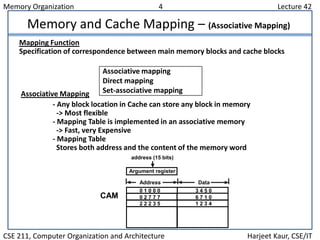
Memory and Cache Mapping – (Associative Mapping)
Associative mapping
Direct mapping
Set-associative mappingAssociative Mapping
Mapping Function
Specification of correspondence between main memory blocks and cache blocks
- Any block location in Cache can store any block in memory
-> Most flexible
- Mapping Table is implemented in an associative memory
-> Fast, very Expensive
- Mapping Table
Stores both address and the content of the memory word
address (15 bits)
Argument register
Address Data
0 1 0 0 0
0 2 7 7 7
2 2 2 3 5
3 4 5 0
6 7 1 0
1 2 3 4
CAM
Memory Organization 5 Lecture 42
CSE 211, Computer Organization and Architecture Harjeet Kaur, CSE/IT
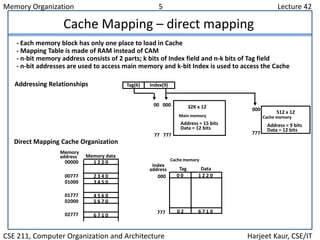
Cache Mapping – direct mapping
- Each memory block has only one place to load in Cache
- Mapping Table is made of RAM instead of CAM
- n-bit memory address consists of 2 parts; k bits of Index field and n-k bits of Tag field
- n-bit addresses are used to access main memory and k-bit Index is used to access the Cache
Addressing Relationships
Direct Mapping Cache Organization
Memory
address Memory data
00000 1 2 2 0
00777
01000
01777
02000
02777
2 3 4 0
3 4 5 0
4 5 6 0
5 6 7 0
6 7 1 0
Index
address Tag Data
000 0 0 1 2 2 0
0 2 6 7 1 0777
Cache memory
Tag(6) Index(9)
32K x 12
Main memory
Address = 15 bits
Data = 12 bits
512 x 12
Cache memory
Address = 9 bits
Data = 12 bits
00 000
77 777
000
777
Memory Organization 6 Lecture 42
CSE 211, Computer Organization and Architecture Harjeet Kaur, CSE/IT
Cache Mapping – direct mapping
Operation
- CPU generates a memory request with (TAG;INDEX)
- Access Cache using INDEX ; (tag; data)
Compare TAG and tag
- If matches -> Hit
Provide Cache[INDEX](data) to CPU
- If not match -> Miss
M[tag;INDEX] <- Cache[INDEX](data)
Cache[INDEX] <- (TAG;M[TAG; INDEX])
CPU <- Cache[INDEX](data)
Direct Mapping with block size of 8 words
000 0 1 3 4 5 0
007 0 1 6 5 7 8
010
017
770 0 2
777 0 2 6 7 1 0
Block 0
Block 1
Block 63
Tag Block Word
INDEX
Memory Organization 7 Lecture 42
CSE 211, Computer Organization and Architecture Harjeet Kaur, CSE/IT
Cache Mapping – Set Associative Mapping
Set Associative Mapping Cache with set size of two
- Each memory block has a set of locations in the Cache to load
Index Tag Data
000 0 1 3 4 5 0 0 2 5 6 7 0
Tag Data
777 0 2 6 7 1 0 0 0 2 3 4 0
Operation
- CPU generates a memory address(TAG; INDEX)
- Access Cache with INDEX, (Cache word = (tag 0, data 0); (tag 1, data 1))
- Compare TAG and tag 0 and then tag 1
- If tag i = TAG -> Hit, CPU <- data i
- If tag i  TAG -> Miss,
Replace either (tag 0, data 0) or (tag 1, data 1),
Assume (tag 0, data 0) is selected for replacement,
(Why (tag 0, data 0) instead of (tag 1, data 1) ?)
M[tag 0, INDEX] <- Cache[INDEX](data 0)
Cache[INDEX](tag 0, data 0) <- (TAG, M[TAG,INDEX]),
CPU <- Cache[INDEX](data 0)
Memory Organization 8 Lecture 42
CSE 211, Computer Organization and Architecture Harjeet Kaur, CSE/IT
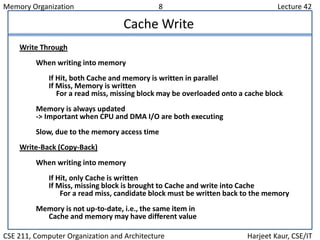
Cache Write
Write Through
When writing into memory
If Hit, both Cache and memory is written in parallel
If Miss, Memory is written
For a read miss, missing block may be overloaded onto a cache block
Memory is always updated
-> Important when CPU and DMA I/O are both executing
Slow, due to the memory access time
Write-Back (Copy-Back)
When writing into memory
If Hit, only Cache is written
If Miss, missing block is brought to Cache and write into Cache
For a read miss, candidate block must be written back to the memory
Memory is not up-to-date, i.e., the same item in
Cache and memory may have different value

Lecture 42

  • 1.
    Memory Organization 1Lecture 42 CSE 211, Computer Organization and Architecture Harjeet Kaur, CSE/IT Overview  Memory Hierarchy  Main Memory  Auxiliary Memory  Associative Memory  Cache Memory  Virtual Memory  Memory Mgt Hardware
  • 2.
    Memory Organization 2Lecture 42 CSE 211, Computer Organization and Architecture Harjeet Kaur, CSE/IT Cache Memory Locality of Reference - The references to memory at any given time interval tend to be confined within a localized areas - This area contains a set of information and the membership changes gradually as time goes by - Temporal Locality The information which will be used in near future is likely to be in use already( e.g. Reuse of information in loops) - Spatial Locality If a word is accessed, adjacent(near) words are likely accessed soon (e.g. Related data items (arrays) are usually stored together; instructions are executed sequentially) Cache - The property of Locality of Reference makes the cache memory systems work - Cache is a fast small capacity memory that should hold those information which are most likely to be accessed Main memory Cache memory CPU
  • 3.
    Memory Organization 3Lecture 42 CSE 211, Computer Organization and Architecture Harjeet Kaur, CSE/IT Performance of Cache All the memory accesses are directed first to Cache If the word is in Cache; Access cache to provide it to CPU If the word is not in Cache; Bring a block (or a line) including that word to replace a block now in Cache - How can we know if the word that is required is there ? - If a new block is to replace one of the old blocks, which one should we choose ? Memory Access Performance of Cache Memory System Hit Ratio - % of memory accesses satisfied by Cache memory system Te: Effective memory access time in Cache memory system Tc: Cache access time Tm: Main memory access time Te = Tc + (1 - h) Tm Example: Tc = 0.4 s, Tm = 1.2s, h = 0.85% Te = 0.4 + (1 - 0.85) * 1.2 = 0.58s
  • 4.
    Memory Organization 4Lecture 42 CSE 211, Computer Organization and Architecture Harjeet Kaur, CSE/IT Memory and Cache Mapping – (Associative Mapping) Associative mapping Direct mapping Set-associative mappingAssociative Mapping Mapping Function Specification of correspondence between main memory blocks and cache blocks - Any block location in Cache can store any block in memory -> Most flexible - Mapping Table is implemented in an associative memory -> Fast, very Expensive - Mapping Table Stores both address and the content of the memory word address (15 bits) Argument register Address Data 0 1 0 0 0 0 2 7 7 7 2 2 2 3 5 3 4 5 0 6 7 1 0 1 2 3 4 CAM
  • 5.
    Memory Organization 5Lecture 42 CSE 211, Computer Organization and Architecture Harjeet Kaur, CSE/IT Cache Mapping – direct mapping - Each memory block has only one place to load in Cache - Mapping Table is made of RAM instead of CAM - n-bit memory address consists of 2 parts; k bits of Index field and n-k bits of Tag field - n-bit addresses are used to access main memory and k-bit Index is used to access the Cache Addressing Relationships Direct Mapping Cache Organization Memory address Memory data 00000 1 2 2 0 00777 01000 01777 02000 02777 2 3 4 0 3 4 5 0 4 5 6 0 5 6 7 0 6 7 1 0 Index address Tag Data 000 0 0 1 2 2 0 0 2 6 7 1 0777 Cache memory Tag(6) Index(9) 32K x 12 Main memory Address = 15 bits Data = 12 bits 512 x 12 Cache memory Address = 9 bits Data = 12 bits 00 000 77 777 000 777
  • 6.
    Memory Organization 6Lecture 42 CSE 211, Computer Organization and Architecture Harjeet Kaur, CSE/IT Cache Mapping – direct mapping Operation - CPU generates a memory request with (TAG;INDEX) - Access Cache using INDEX ; (tag; data) Compare TAG and tag - If matches -> Hit Provide Cache[INDEX](data) to CPU - If not match -> Miss M[tag;INDEX] <- Cache[INDEX](data) Cache[INDEX] <- (TAG;M[TAG; INDEX]) CPU <- Cache[INDEX](data) Direct Mapping with block size of 8 words 000 0 1 3 4 5 0 007 0 1 6 5 7 8 010 017 770 0 2 777 0 2 6 7 1 0 Block 0 Block 1 Block 63 Tag Block Word INDEX
  • 7.
    Memory Organization 7Lecture 42 CSE 211, Computer Organization and Architecture Harjeet Kaur, CSE/IT Cache Mapping – Set Associative Mapping Set Associative Mapping Cache with set size of two - Each memory block has a set of locations in the Cache to load Index Tag Data 000 0 1 3 4 5 0 0 2 5 6 7 0 Tag Data 777 0 2 6 7 1 0 0 0 2 3 4 0 Operation - CPU generates a memory address(TAG; INDEX) - Access Cache with INDEX, (Cache word = (tag 0, data 0); (tag 1, data 1)) - Compare TAG and tag 0 and then tag 1 - If tag i = TAG -> Hit, CPU <- data i - If tag i  TAG -> Miss, Replace either (tag 0, data 0) or (tag 1, data 1), Assume (tag 0, data 0) is selected for replacement, (Why (tag 0, data 0) instead of (tag 1, data 1) ?) M[tag 0, INDEX] <- Cache[INDEX](data 0) Cache[INDEX](tag 0, data 0) <- (TAG, M[TAG,INDEX]), CPU <- Cache[INDEX](data 0)
  • 8.
    Memory Organization 8Lecture 42 CSE 211, Computer Organization and Architecture Harjeet Kaur, CSE/IT Cache Write Write Through When writing into memory If Hit, both Cache and memory is written in parallel If Miss, Memory is written For a read miss, missing block may be overloaded onto a cache block Memory is always updated -> Important when CPU and DMA I/O are both executing Slow, due to the memory access time Write-Back (Copy-Back) When writing into memory If Hit, only Cache is written If Miss, missing block is brought to Cache and write into Cache For a read miss, candidate block must be written back to the memory Memory is not up-to-date, i.e., the same item in Cache and memory may have different value