Rubella
History
1881 Rubella accepted as a distinct disease
1941 Associated with congenital disease
1961 Rubella virus first isolated
1967 Serological tests available
1969 Rubella vaccines available
Rubella Virus
• RNA enveloped virus
• Member of the togavirus family
• Spreads by respiratory droplets
• In the pre-vaccination era, 80% of women
were already infected by childbearing age
Clinical Features
• Rubella: Latin “little red”
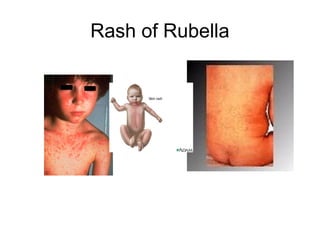
• Maculopapular rash
• Lymphadenopathy
• Fever
• Arthropathy (up to 60% of cases)
Rash of Rubella
Risks of Rubella Infection During
Pregnancy
Preconception Minimal risk
0-12 weeks 100% risk of fetus being congenitally infected
resulting in major congenital abnormalities.
Spontaneous abortion occurs in 20% of cases.
13-16 weeks Deafness and retinopathy 15%
After 16 weeks Normal development, slight risk of deafness
and retinopathy
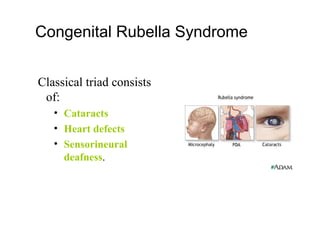
Congenital Rubella Syndrome
Classical triad consists
of:
• Cataracts
• Heart defects
• Sensorineural
deafness.
Transient
• Low birth weight, hepatosplenomegaly,
thrombocytopenic purpura, meningoencephalitis,
hepatitis, haemolytic anemia, pneumonia,
lymphadenopathy
Permanent
• Sensorineural deafness, Heart defects, Eye defects
(retinopathy, cataract, microopthalmia, glaucoma),
diabetes mellitis
Developmental
• Sensorineural deafness, Mental retardation
Congenital Rubella Syndrome
Outcome
• 1/3 rd will lead normal independent lives
• 1/3 rd will live with parents
• 1/3rd will be institutionalised
 The only effective way to prevent CRS is
to terminate the pregnancy
Laboratory Diagnosis
Diagnosis of acute infection
• Presence of rubella-specific IgM
• Rising titres of antibody (mainly IgG)
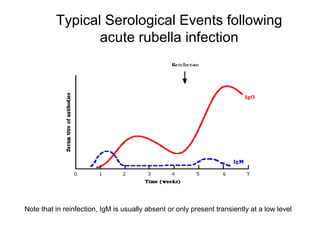
Typical Serological Events following
acute rubella infection
Note that in reinfection, IgM is usually absent or only present transiently at a low level
Prevention
Antenatal screening
• Screening of all pregnant women attending antenatal
clinics for immune status against rubella.
• Non-immune women are vaccinated in the immediate
post partum period.
Prevention
• Since 1968, a highly effective live attenuated
vaccine has been available with 95% efficacy
• Universal vaccination is now offered to all
infants as part of the MMR regimen in the
USA, UK and a number of other countries.
• Vaccination of schoolgirls before they reach
childbearing age.

Lect 6 b rubella rmc

  • 1.
    Rubella History 1881 Rubella acceptedas a distinct disease 1941 Associated with congenital disease 1961 Rubella virus first isolated 1967 Serological tests available 1969 Rubella vaccines available
  • 2.
    Rubella Virus • RNAenveloped virus • Member of the togavirus family • Spreads by respiratory droplets • In the pre-vaccination era, 80% of women were already infected by childbearing age
  • 3.
    Clinical Features • Rubella:Latin “little red” • Maculopapular rash • Lymphadenopathy • Fever • Arthropathy (up to 60% of cases)
  • 4.
  • 5.
    Risks of RubellaInfection During Pregnancy Preconception Minimal risk 0-12 weeks 100% risk of fetus being congenitally infected resulting in major congenital abnormalities. Spontaneous abortion occurs in 20% of cases. 13-16 weeks Deafness and retinopathy 15% After 16 weeks Normal development, slight risk of deafness and retinopathy
  • 6.
    Congenital Rubella Syndrome Classicaltriad consists of: • Cataracts • Heart defects • Sensorineural deafness.
  • 7.
    Transient • Low birthweight, hepatosplenomegaly, thrombocytopenic purpura, meningoencephalitis, hepatitis, haemolytic anemia, pneumonia, lymphadenopathy Permanent • Sensorineural deafness, Heart defects, Eye defects (retinopathy, cataract, microopthalmia, glaucoma), diabetes mellitis Developmental • Sensorineural deafness, Mental retardation Congenital Rubella Syndrome
  • 8.
    Outcome • 1/3 rdwill lead normal independent lives • 1/3 rd will live with parents • 1/3rd will be institutionalised  The only effective way to prevent CRS is to terminate the pregnancy
  • 9.
    Laboratory Diagnosis Diagnosis ofacute infection • Presence of rubella-specific IgM • Rising titres of antibody (mainly IgG)
  • 10.
    Typical Serological Eventsfollowing acute rubella infection Note that in reinfection, IgM is usually absent or only present transiently at a low level
  • 11.
    Prevention Antenatal screening • Screeningof all pregnant women attending antenatal clinics for immune status against rubella. • Non-immune women are vaccinated in the immediate post partum period.
  • 12.
    Prevention • Since 1968,a highly effective live attenuated vaccine has been available with 95% efficacy • Universal vaccination is now offered to all infants as part of the MMR regimen in the USA, UK and a number of other countries. • Vaccination of schoolgirls before they reach childbearing age.