AGING, DEATH AND
BEREAVEMENT
AGING
There are certain
physical,
neurological, cognitive,
and psychological
changes associated
with aging process.
 Physical changes
 Cerebral changes
 Cognitive changes
 Psychological changes
PSYCHOLOGICAL
ASPECTS OF AGING
Old age is a period of continued intellectual,
emotional and psychological growth which are
seen to affect people with advancing age.
There are people who deal constructively with
circumstances, others become unduly
dependent while some become increasingly
hostile.
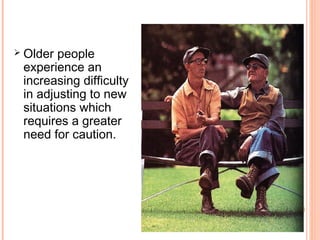
 Older people
experience an
increasing difficulty
in adjusting to new
situations which
requires a greater
need for caution.
 Their interests are narrowed, there is tendency
to be more self-centered and attitudes tend to
be governed by earlier experiences, the value of
old people for the society and their sense of
usefulness for the family.
DEATH AND DYING
 Death is universal and unavoidable.
 Death is considered the complete cessation of
vital functions of body and dying the process of
cessation of these functions.
 Death causes strong feelings of dread not only
in patients but also in relatives, and health
professionals.
 Death is often lonely. In very old people, death is
approached with tranquility. Most often the
patient suffers more in the conspiracy of silence
and thus feelings of isolation further add to the
distress of a dying person.
ATTITUDE TOWARD
DEATH
 Understanding of death in children is largely
dependent on their emotional and cognitive
development.
 Children under the age of 5 years sense the
death as a separation similar to sleep.
 Between the ages of 5 and 10 years children
develop sense of inevitable human mortality.
 By puberty children develop the sense like
adults and take death as universal and
irreversible.
 Adolescents take death as inevitable and
final.
 The major fears are loss of control, being
imperfect, being different and fears about
body image.
 Teenagers if made part of decision making
take death with courage, grace and dignity.
 Old adults often readily accept that their time
has come and some of them might have close
calls.
 Patients in old age can reconcile with the
outcome easily.
PSYCHOGENIC
DEATH
 Emotional stress as such can result in
sudden death in certain persons.
 Myocardial infraction and atrial fibrillation
may occur following psychological stress.
 Similarly death can occur due to a curse or
spell when the sufferer believes in the power
of the individual causing this curse.
LEGAL ASPECTS OF
DEATH
 Death certificate
 Post mortem examination
 Psychological autopsy
IMPENDING DEATH
 A Psychiatrist has made very valuable
contribution in defining and classifying
reactions to an impending death.
 Stage 1--- Shock and Denial
 Stage 2 --- Anger
 Stage 3 --- Bargaining
 Stage 4 --- Depression
 Stage 5--- Acceptance
NEEDS OF THE DYING
PATIENT
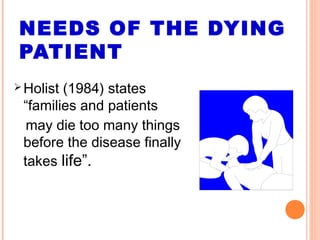
 Holist (1984) states
“families and patients
may die too many things
before the disease finally
takes life”.
 Optimism, spontaneity, holidays, long – range
planning, dreams, retirement, and
grandparenthood are but a few of the many
things that die as a person and her or his family
live with a terminal illness.
THE DYING PERSON’S
BILL
OF RIGHTS
Aging, death & bereavement

Aging, death & bereavement

  • 2.
  • 3.
    AGING There are certain physical, neurological,cognitive, and psychological changes associated with aging process.  Physical changes  Cerebral changes  Cognitive changes  Psychological changes
  • 4.
    PSYCHOLOGICAL ASPECTS OF AGING Oldage is a period of continued intellectual, emotional and psychological growth which are seen to affect people with advancing age. There are people who deal constructively with circumstances, others become unduly dependent while some become increasingly hostile.
  • 5.
     Older people experiencean increasing difficulty in adjusting to new situations which requires a greater need for caution.
  • 6.
     Their interestsare narrowed, there is tendency to be more self-centered and attitudes tend to be governed by earlier experiences, the value of old people for the society and their sense of usefulness for the family.
  • 7.
    DEATH AND DYING Death is universal and unavoidable.  Death is considered the complete cessation of vital functions of body and dying the process of cessation of these functions.  Death causes strong feelings of dread not only in patients but also in relatives, and health professionals.  Death is often lonely. In very old people, death is approached with tranquility. Most often the patient suffers more in the conspiracy of silence and thus feelings of isolation further add to the distress of a dying person.
  • 8.
    ATTITUDE TOWARD DEATH  Understandingof death in children is largely dependent on their emotional and cognitive development.  Children under the age of 5 years sense the death as a separation similar to sleep.  Between the ages of 5 and 10 years children develop sense of inevitable human mortality.
  • 9.
     By pubertychildren develop the sense like adults and take death as universal and irreversible.  Adolescents take death as inevitable and final.  The major fears are loss of control, being imperfect, being different and fears about body image.
  • 10.
     Teenagers ifmade part of decision making take death with courage, grace and dignity.  Old adults often readily accept that their time has come and some of them might have close calls.  Patients in old age can reconcile with the outcome easily.
  • 11.
    PSYCHOGENIC DEATH  Emotional stressas such can result in sudden death in certain persons.  Myocardial infraction and atrial fibrillation may occur following psychological stress.  Similarly death can occur due to a curse or spell when the sufferer believes in the power of the individual causing this curse.
  • 12.
    LEGAL ASPECTS OF DEATH Death certificate  Post mortem examination  Psychological autopsy
  • 13.
    IMPENDING DEATH  APsychiatrist has made very valuable contribution in defining and classifying reactions to an impending death.  Stage 1--- Shock and Denial  Stage 2 --- Anger  Stage 3 --- Bargaining  Stage 4 --- Depression  Stage 5--- Acceptance
  • 14.
    NEEDS OF THEDYING PATIENT  Holist (1984) states “families and patients may die too many things before the disease finally takes life”.
  • 15.
     Optimism, spontaneity,holidays, long – range planning, dreams, retirement, and grandparenthood are but a few of the many things that die as a person and her or his family live with a terminal illness.
  • 16.