Dr. Y. S. THAKARE
M.Sc. (CHE) Ph D, NET, SET
Assistant Professor in Chemistry,
Shri Shivaji Science College, Amravati
Email: yogitathakare_2007@rediffmail.com
B Sc- II Year
SEM-III
PAPER-III
PHYSICAL CHEMISTRY
UNIT- V -PHASE TRANSITION
03-October -20 1
03-October -20
Phase transition: is the transformation of a thermodynamic
system from one phase to another.
A phase of a thermodynamic system and the states of a
matter have uniform physical properties.
During a phase transition of a given medium certain
properties of the medium change, often discontinuously, as
a result of some external condition, such as temperature,
pressure and others. For example, a liquid may become gas
upon heating to the boiling point, resulting in an abrupt
change in volume. The measurement of the external
conditions at which the transition occurs is termed the
phase transition.
03-October -20
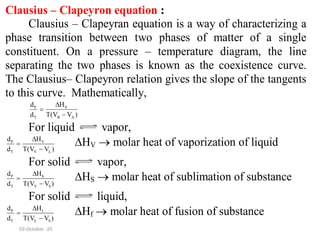
Clausius – Clapeyron equation :
Clausius – Clapeyran equation is a way of characterizing a
phase transition between two phases of matter of a single
constituent. On a pressure – temperature diagram, the line
separating the two phases is known as the coexistence curve.
The Clausius– Clapeyron relation gives the slope of the tangents
to this curve. Mathematically,
V
P
T B A
H
d
d T(V V )



For liquid vapor,
V
P
T V L
H
d
d T(V V )



HV  molar heat of vaporization of liquid
For solid vapor,
S
P
T V S
H
d
d T(V V )



HS  molar heat of sublimation of substance
For solid liquid,
P f
T L S
d H
d T(V V )



Hf  molar heat of fusion of substance
03-October -20
Partially miscible liquids
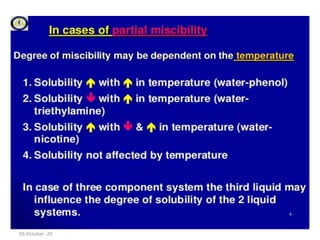
There are number of liquid pairs which are only
partially miscible with one another. Their miscibility varies
with temperature in a characteristic manner. Accordingly
three types are observed.
i) Phenol – water system
ii) Triethylamine – water system
iii) Nicotine – water system.
03-October -20
03-October -20
Phenol – water system
Phenol and water are only partially miscible at ordinary
temperatures. On shaking they form two layers. The upper layer is a
saturated solution of phenol in water and the lower layer is a
saturated solution of water in phenol. The mutual solubility of
phenol and water in one another increases with rise in temperature.
Therefore at certain higher temperature there is formation of
homogeneous one phase solution i.e. phenol and water becomes
completely miscible. This temperature is known as the critical or
consolute solution temperature (CST) or mutual solubility
temperature (MST). The MST can be defined as the temperature at
which a mixture of a definite composition becomes homogenous
and exists in a single layer. This CST is different for different
composition of phenol and water. There is one highest temperature
above which any composition remains completely miscible. This
temperature is known as Upper Critical Solution Temperature
(UCST). For phenol – water system the UCST is 68.1°C with a
composition of 34% phenol.
03-October -20
03-October -20
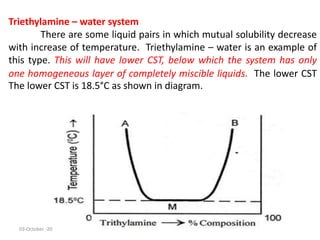
Triethylamine – water system
There are some liquid pairs in which mutual solubility decrease
with increase of temperature. Triethylamine – water is an example of
this type. This will have lower CST, below which the system has only
one homogeneous layer of completely miscible liquids. The lower CST
The lower CST is 18.5°C as shown in diagram.
03-October -20
03-October -20
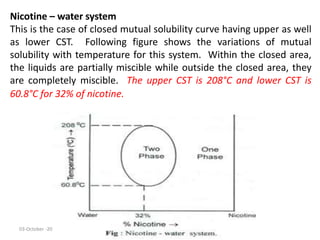
Nicotine – water system
This is the case of closed mutual solubility curve having upper as well
as lower CST. Following figure shows the variations of mutual
solubility with temperature for this system. Within the closed area,
the liquids are partially miscible while outside the closed area, they
are completely miscible. The upper CST is 208°C and lower CST is
60.8°C for 32% of nicotine.
03-October -20
03-October -20
Lect. 10. phase transition

Lect. 10. phase transition

  • 1.
    Dr. Y. S.THAKARE M.Sc. (CHE) Ph D, NET, SET Assistant Professor in Chemistry, Shri Shivaji Science College, Amravati Email: yogitathakare_2007@rediffmail.com B Sc- II Year SEM-III PAPER-III PHYSICAL CHEMISTRY UNIT- V -PHASE TRANSITION 03-October -20 1
  • 2.
  • 3.
    Phase transition: isthe transformation of a thermodynamic system from one phase to another. A phase of a thermodynamic system and the states of a matter have uniform physical properties. During a phase transition of a given medium certain properties of the medium change, often discontinuously, as a result of some external condition, such as temperature, pressure and others. For example, a liquid may become gas upon heating to the boiling point, resulting in an abrupt change in volume. The measurement of the external conditions at which the transition occurs is termed the phase transition. 03-October -20
  • 4.
    Clausius – Clapeyronequation : Clausius – Clapeyran equation is a way of characterizing a phase transition between two phases of matter of a single constituent. On a pressure – temperature diagram, the line separating the two phases is known as the coexistence curve. The Clausius– Clapeyron relation gives the slope of the tangents to this curve. Mathematically, V P T B A H d d T(V V )    For liquid vapor, V P T V L H d d T(V V )    HV  molar heat of vaporization of liquid For solid vapor, S P T V S H d d T(V V )    HS  molar heat of sublimation of substance For solid liquid, P f T L S d H d T(V V )    Hf  molar heat of fusion of substance 03-October -20
  • 5.
    Partially miscible liquids Thereare number of liquid pairs which are only partially miscible with one another. Their miscibility varies with temperature in a characteristic manner. Accordingly three types are observed. i) Phenol – water system ii) Triethylamine – water system iii) Nicotine – water system. 03-October -20
  • 6.
  • 7.
    Phenol – watersystem Phenol and water are only partially miscible at ordinary temperatures. On shaking they form two layers. The upper layer is a saturated solution of phenol in water and the lower layer is a saturated solution of water in phenol. The mutual solubility of phenol and water in one another increases with rise in temperature. Therefore at certain higher temperature there is formation of homogeneous one phase solution i.e. phenol and water becomes completely miscible. This temperature is known as the critical or consolute solution temperature (CST) or mutual solubility temperature (MST). The MST can be defined as the temperature at which a mixture of a definite composition becomes homogenous and exists in a single layer. This CST is different for different composition of phenol and water. There is one highest temperature above which any composition remains completely miscible. This temperature is known as Upper Critical Solution Temperature (UCST). For phenol – water system the UCST is 68.1°C with a composition of 34% phenol. 03-October -20
  • 8.
  • 9.
    Triethylamine – watersystem There are some liquid pairs in which mutual solubility decrease with increase of temperature. Triethylamine – water is an example of this type. This will have lower CST, below which the system has only one homogeneous layer of completely miscible liquids. The lower CST The lower CST is 18.5°C as shown in diagram. 03-October -20
  • 10.
  • 11.
    Nicotine – watersystem This is the case of closed mutual solubility curve having upper as well as lower CST. Following figure shows the variations of mutual solubility with temperature for this system. Within the closed area, the liquids are partially miscible while outside the closed area, they are completely miscible. The upper CST is 208°C and lower CST is 60.8°C for 32% of nicotine. 03-October -20
  • 12.