Psychology

PSYA2 – Social By Nicky Burt
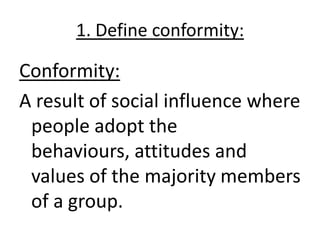
1. Define conformity:

Conformity:
A result of social influence where
 people adopt the
 behaviours, attitudes and
 values of the majority members
 of a group.
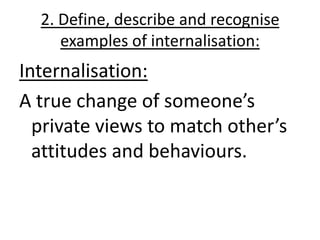
2. Define, describe and recognise
     examples of internalisation:
Internalisation:
A true change of someone’s
  private views to match other’s
  attitudes and behaviours.
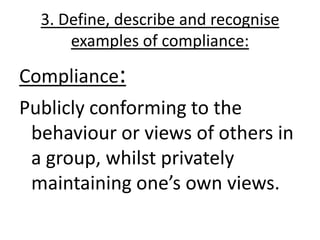
3. Define, describe and recognise
      examples of compliance:

Compliance:
Publicly conforming to the
 behaviour or views of others in
 a group, whilst privately
 maintaining one’s own views.
4. Explain the difference between
    compliance and internalisation:
If someone complies to other’s behaviour, then
   they are publically conforming to the groups
   views, whilst privately maintaining their own
   views. However, if someone internalises, then
   they make a true change of their private views
   to match the attitudes and behaviour’s of
   others.
5. Describe two reasons for conformity (Informational Social
Influence and Normative Social Influence) and the difference
                       between them

Normative Social Influence: Is based on our desire
  to be liked. We conform so other’s will accept us.
  So, publically, we go along with other peoples
  views, so we feel we have something in common.
  However privately, we retain our own views. (e.g.
  Calling a friend to see what to wear)
Informational Social Influence: Is based on our
  desire to be right. We look to other’s who we
  think will be correct. (Can lead to internalisation.)
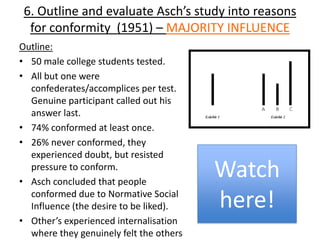
6. Outline and evaluate Asch’s study into reasons
  for conformity (1951) – MAJORITY INFLUENCE
Outline:
• 50 male college students tested.
• All but one were
  confederates/accomplices per test.
  Genuine participant called out his
  answer last.
• 74% conformed at least once.
• 26% never conformed, they
  experienced doubt, but resisted
  pressure to conform.
• Asch concluded that people
                                         Watch
  conformed due to Normative Social
  Influence (the desire to be liked).    here!
• Other’s experienced internalisation
  where they genuinely felt the others
Asch (1951)’s evaluation:
• All male participants = androcentric. Therefore may not be
  generalisable.
• 1950’s, USA, everyone was very conservative. People tried to fit in.
  This was called McCarthyism.
• Small sample size - only 50 students tested. May not be
  representative.
• Was all in the USA, therefore ethnocentric. Not generalisable.
• Lab study - loweredecologically valid.
• Desire to conform.
• All participants were debriefed.
• Lab study – easily replicable, and therefore may be reliable if
  repeated to produce similar results.
7. Outline and evaluate Moscovici’s (1969) study into
    reasons for conformity – MINORITY INFLUENCE.
OUTLINE:                                  EVALUATE:
•  6 Participants. 2 were accomplices.    • Lowered ecological validity –
•  Had 36 slides, all were varying
   shades of BLUE.                          done as a lab study.
• 2 conditions                            • All female participants –
   - inconsistent                           gynocentric. Can’t generalise.
   - consistent.
• Inconsistent – Two accomplices          • Culturally bias – endocentric.
   called the slides GREEN every time.      All in USA.
Participants called the slides green in
   8.4% of the trials.                    • Lab study, demand
32% of the participants called a slide      characteristics.
   green at least once.
                                          • Lab study, therefore increased
•  Consistent – Two accomplices             reliability if tested again to
   called the slides GREEN 24               produce similar results.
   times, andBLUE 12times.
Participants called the slides GREEN in   • Extraneous variables are more
   1.3% of the trials.                      controlled in a lab study.
8: Define the term ‘obedience’

An outcome of social influence where an
  individual acts according to others, usually
  from an authority figure. It is assumed that
  without such an order, the person would not
  have acted in this way.
9. Explain the difference between
       obedience and conformity
Obedience is obeying an order, often given by an
 authoritarian figure, whereas with conformity,
 no one tells you to do anything, you adopt
 behaviours, attitudes and belief’s of those
 around you.
10. Outline and evaluate Milgram’s
   (1963) study into obedience

Outline:
• 40 paid male volunteers.
• Given a ‘teacher’ role. Were separated from the
  learner. Learner was quizzed. Every time an answer was
  wrong, the ‘teacher’ had to ‘shock’ the learner.
• No shocks were actually administered.
• ‘Prods’ were given prompting the teacher to continue.
• Experiment continued until teacher refused or 450V
  were given four times.
• Participants were debriefed.
• All participants went to at least 300V
Milgram (1963) evaluation:
• No protection from psychological harm – could
  be long term!
• Little resemblance to a real life
  situation, therefore lacked ecological validity.
• The teacher may have shown signs of demand
  characteristics, acting in a certain way to please
  the experimenter.
• All male, therefore androcentric.
• Lack of informed consent.
• 84% said they were glad they were involved, and
  learnt something about themselves.
• Everyone was debriefed.
11. Milgram 1963 Variations:
Variation                      What happened                  Obedience going to 450V


Original experiment                                           65%


Venue moved to ‘seedy’         Obedience fell                 47.5%
offices

Teacher had to force learner’s Obedience fell further, when   30%
hand on plate to receive shock teachers physical force was
                               applied

Experimenter left the room,    Obedience fell when teacher    20.5%
and instructed teacher via     felt they were being less
phone                          closely observed

Teacher given support by two   Obedience fell when            10%
confederates                   participants conformed to
                               modelled disobedience
12. Explain at least two reasons people
 obey supported by studies (ieHofling and
        Rank and Jacobson, 1977):
Hoflinget al (1966) – Obedient nurses:
In this experiment. Nurses received a phone call from a doctor, telling
    them to administer 20mg of a drug (which would be double the
    max. dosage) to a patient.
21/22 participants began to give the medication – which was actually a
    placebo - before another nurse stopped them.
10/22 nurses noticed that it was over the maximum dose, but didn’t
    want to disobey doctors.
Field experiment – ecologically valid
Clear procedure – therefore repeatable.
If repeated to produce similar results, it would also be reliable.
Rank and Jacobson (1977) repeated, and got dissimilar results.
    Question reliability.
No informed consent, no right to withdraw.
Nurses could have been psychologically harmed due to it being
    something that could have harmed patients.
Rank and Jacobson (1977)
They then repeated the experiment with a
  more common drug (valium) and at 3 times
  the max dosage, but let the nurses ask other
  nurses what they would do. In this test, only
  2/18 nurses prepared the medicine. They
  concluded that the nurses only prepared in
  Hofling’s experiment because they weren’t
  allowed to seek advice, and they didn’t know
  about the drug.
13. Be able to give at least four explanations of why people obey
   (e.g. Gradual commitment, Agentic shift, Buffers, legitimate
                authority, authoritarian personality)

Gradual commitment:
People have difficulty refusing
  commands. They comply with a
  trivial request, but as the
  request gets more
  significant, the participants
  finds it harder to deny. They
  have a desire to seem
  consistent.
This theory links to Milgram
  (1963) as participants gradually
  increased the ‘electric shocks’
Agentic Shift:
A participant sees themselves as
   ‘agents’ of others, therefore no
   longer feeling responsible for
   their actions.
This theory links to Milgram (1963)
   as the learners didn’t feel as
   guilty, as they were just obeying
   the experimenters orders.
It also links to Hoflinget al (1966)
   as the nurses acted as agents for
   the doctors.
Contractual obligation:
When the participant makes
  a commitment, and they
  feel obliged to continue
  the experiment.
Links to Milgram (1963) as
  prompts made them feel
  as though they had to
  continue.
Buffers:
Protect people from
  having to confront the
  consequences of their
  actions.
  Links to Milgram
  (1963) research into
  obedience as the
  participants couldn’t
  see the learners, as
  they were in different
  rooms.
14. Outline and evaluate locus of control as an
individual difference affecting individual behaviour
                      (Rotter)
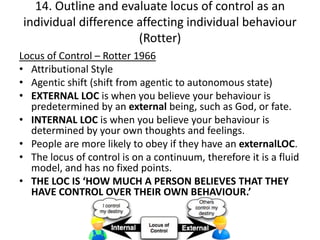
Locus of Control – Rotter 1966
• Attributional Style
• Agentic shift (shift from agentic to autonomous state)
• EXTERNAL LOC is when you believe your behaviour is
  predetermined by an external being, such as God, or fate.
• INTERNAL LOC is when you believe your behaviour is
  determined by your own thoughts and feelings.
• People are more likely to obey if they have an externalLOC.
• The locus of control is on a continuum, therefore it is a fluid
  model, and has no fixed points.
• THE LOC IS ‘HOW MUCH A PERSON BELIEVES THAT THEY
  HAVE CONTROL OVER THEIR OWN BEHAVIOUR.’
Evaluation of LOC
High internal – Neurotic/anxious/depressed
High external – Chilled/easy-going

+ Reliable methodology
+ Give quantitative results
- Simplistic explanation of a complex subject =
   reductionist
- Gender stereotype:
They say MEN are more INTERNAL.
And WOMEN are more EXTERNAL.
- This is socially sensitive, stating that women can’t work
   independently.
Attributional style:
• Some people blame themselves, therefore not
  fitting a category and not a positive
  attributional style.
• Situation may be most important.
• More complex than LOC, accounts for
  personality type.
• Heaven et al (2005) looked at consciences and
  rebellious students, and found negative
  attributional styles with rebellious students.
15. Explain at least two ways people can resist pressures to
  conform (role of allies, Asch; Presence of a dissenter, Asch; Prior
    commitment; personality including internal locus of control)

Resisting pressure to conform:
• Desire for individuation –
  Snyder and Fromkin (1980) led a group of American
  students to believe that their most important
  attitudes were different from 10,000 other students.
  They then told the second group that their most
  important attitudes were the same as the 10,000
  other students. After being stripped of their usual
  identities, they took part in a conformity study and
  THEY RESISTED PRESSURES TO CONFORM. Snyder
  argued he was trying to make them assert their
  individuality.
• Desire to maintain control:
We like to think that we can control events in our lives, this
   opposes the idea of yielding to social influence.
   However, BURGER (1992) demonstrated that people with a high
   need for personal control are more likely to resist conformity
   pressures than those with a lower need.
DAUBMAN (1993) researched this further, by using jigsaw puzzles.
   the participants took a Desirability test, and results were
   accumulated on a Desirability of a Control Scale. Those who
   scored lowly on the Desirability test welcomed hints on the
   puzzles, however, those who scored highly felt worse after it was
   offered.
This supports Burger’s contention that other people’s offers of
   advice or attempts at influence are seen as threats.
Prior commitment:
Once publicly committed to an idea, people are
  less likely to change their position than if their
  initial opinion was kept private.
Deutsch and Gerard (1955) did a study, where a
  naïve participant gave an idea, which was then
  followed by confederates giving different
  answers. When asked to reconsider, the
  participant declined due to his desire to seem
  consistent.
16. Explain at least two ways people can resist pressures to obey
   (eg the situation - Milgram in office block, attributional style,
                  locus of control, agentic shift, allies)

People can resist pressures to obey due to the situation. For example,
   in Milgram’s (1963) study into obedience, when the study was
   repeated in a shady office block – an area much less prestigious
   than the initial lab, the obedience rates decreased from 65% to
   47.5%.
Another way that people can resist pressures to obey could be their
   locus of control. If someone has an internal locus of control, they
   very much believe that what they do is up to them, and they are less
   likely to obey
A third reason that people can resist obeying could be the agentic shift.
   If a person believes that they will not be held responsible for doing
   something deemed ‘bad’ in a situation, they are more likely to do it.
   This links to HOFLING et al (1966) with his ‘obedient nurses’ study.
   The nurses obeyed as they are ‘agents’ for the doctor.
17. Evaluate resistance to obedience and conformity.
    Consider the research evidence and alternative
                      explanations

• People obey due to gradual commitment,
  agentic shift, contractual obligation, buffers,
  and legitimate authority. (All can link to
  Milgram 1963.)
• People conform due to Normative Social
  Influence (the desire to be liked) and
  Informational Social Influence (the desire to
  be right.) (Can link to Asch 1951.)
18. Discuss how findings from social influence research might have
implications for change in society (eg snowball effect; consistency;
       foot in the door; development of ethical guidelines). .

• Snowball effect (Van Avermaet 1996)
- What happens with minority influence.
- A few members of the majority move towards the
  minority influence.
- Then the influence of the minority gathers
  momentum as more people join the minority
  view.
• Gradual commitment
- Once people comply with a seemingly trival
  task, they find it more difficult to refuse to carry
  out more serious tasks.
19. Consider the role of minority influence in Social Change
  (consistency, flexible, not dogmatic, gradual commitment, role of a
dissenter and snowball effect). Moscovici can be used to support this.

• Snowball effect (Van Avermaet 1996)
- What happens with minority influence.
- A few members of the majority move towards the minority
  influence.
- Then the influence of the minority gathers momentum as
  more people join the minority view.
• Gradual commitment
- Once people comply with a seemingly trival task, they find
  it more difficult to refuse to carry out more serious tasks.

• Supported by Moscovici
- The BLUE slides. 2/6 were accomplices of the experimenter.
20. Outline and evaluate two of these implications for
     society (using study support and opposing
                    explanations)
• Snowball effect (Van Avermaet 1996)
- What happens with minority influence.
- A few members of the majority move towards the
  minority influence.
- Then the influence of the minority gathers
  momentum as more people join the minority
  view.
• Gradual commitment
- Once people comply with a seemingly trivial task,
  they find it more difficult to refuse to carry out
  more serious tasks.

PSYA2 - Social

  • 1.
  • 3.
    1. Define conformity: Conformity: Aresult of social influence where people adopt the behaviours, attitudes and values of the majority members of a group.
  • 4.
    2. Define, describeand recognise examples of internalisation: Internalisation: A true change of someone’s private views to match other’s attitudes and behaviours.
  • 5.
    3. Define, describeand recognise examples of compliance: Compliance: Publicly conforming to the behaviour or views of others in a group, whilst privately maintaining one’s own views.
  • 6.
    4. Explain thedifference between compliance and internalisation: If someone complies to other’s behaviour, then they are publically conforming to the groups views, whilst privately maintaining their own views. However, if someone internalises, then they make a true change of their private views to match the attitudes and behaviour’s of others.
  • 7.
    5. Describe tworeasons for conformity (Informational Social Influence and Normative Social Influence) and the difference between them Normative Social Influence: Is based on our desire to be liked. We conform so other’s will accept us. So, publically, we go along with other peoples views, so we feel we have something in common. However privately, we retain our own views. (e.g. Calling a friend to see what to wear) Informational Social Influence: Is based on our desire to be right. We look to other’s who we think will be correct. (Can lead to internalisation.)
  • 8.
    6. Outline andevaluate Asch’s study into reasons for conformity (1951) – MAJORITY INFLUENCE Outline: • 50 male college students tested. • All but one were confederates/accomplices per test. Genuine participant called out his answer last. • 74% conformed at least once. • 26% never conformed, they experienced doubt, but resisted pressure to conform. • Asch concluded that people Watch conformed due to Normative Social Influence (the desire to be liked). here! • Other’s experienced internalisation where they genuinely felt the others
  • 9.
    Asch (1951)’s evaluation: •All male participants = androcentric. Therefore may not be generalisable. • 1950’s, USA, everyone was very conservative. People tried to fit in. This was called McCarthyism. • Small sample size - only 50 students tested. May not be representative. • Was all in the USA, therefore ethnocentric. Not generalisable. • Lab study - loweredecologically valid. • Desire to conform. • All participants were debriefed. • Lab study – easily replicable, and therefore may be reliable if repeated to produce similar results.
  • 10.
    7. Outline andevaluate Moscovici’s (1969) study into reasons for conformity – MINORITY INFLUENCE. OUTLINE: EVALUATE: • 6 Participants. 2 were accomplices. • Lowered ecological validity – • Had 36 slides, all were varying shades of BLUE. done as a lab study. • 2 conditions • All female participants – - inconsistent gynocentric. Can’t generalise. - consistent. • Inconsistent – Two accomplices • Culturally bias – endocentric. called the slides GREEN every time. All in USA. Participants called the slides green in 8.4% of the trials. • Lab study, demand 32% of the participants called a slide characteristics. green at least once. • Lab study, therefore increased • Consistent – Two accomplices reliability if tested again to called the slides GREEN 24 produce similar results. times, andBLUE 12times. Participants called the slides GREEN in • Extraneous variables are more 1.3% of the trials. controlled in a lab study.
  • 11.
    8: Define theterm ‘obedience’ An outcome of social influence where an individual acts according to others, usually from an authority figure. It is assumed that without such an order, the person would not have acted in this way.
  • 12.
    9. Explain thedifference between obedience and conformity Obedience is obeying an order, often given by an authoritarian figure, whereas with conformity, no one tells you to do anything, you adopt behaviours, attitudes and belief’s of those around you.
  • 13.
    10. Outline andevaluate Milgram’s (1963) study into obedience Outline: • 40 paid male volunteers. • Given a ‘teacher’ role. Were separated from the learner. Learner was quizzed. Every time an answer was wrong, the ‘teacher’ had to ‘shock’ the learner. • No shocks were actually administered. • ‘Prods’ were given prompting the teacher to continue. • Experiment continued until teacher refused or 450V were given four times. • Participants were debriefed. • All participants went to at least 300V
  • 14.
    Milgram (1963) evaluation: •No protection from psychological harm – could be long term! • Little resemblance to a real life situation, therefore lacked ecological validity. • The teacher may have shown signs of demand characteristics, acting in a certain way to please the experimenter. • All male, therefore androcentric. • Lack of informed consent. • 84% said they were glad they were involved, and learnt something about themselves. • Everyone was debriefed.
  • 15.
    11. Milgram 1963Variations: Variation What happened Obedience going to 450V Original experiment 65% Venue moved to ‘seedy’ Obedience fell 47.5% offices Teacher had to force learner’s Obedience fell further, when 30% hand on plate to receive shock teachers physical force was applied Experimenter left the room, Obedience fell when teacher 20.5% and instructed teacher via felt they were being less phone closely observed Teacher given support by two Obedience fell when 10% confederates participants conformed to modelled disobedience
  • 16.
    12. Explain atleast two reasons people obey supported by studies (ieHofling and Rank and Jacobson, 1977): Hoflinget al (1966) – Obedient nurses: In this experiment. Nurses received a phone call from a doctor, telling them to administer 20mg of a drug (which would be double the max. dosage) to a patient. 21/22 participants began to give the medication – which was actually a placebo - before another nurse stopped them. 10/22 nurses noticed that it was over the maximum dose, but didn’t want to disobey doctors. Field experiment – ecologically valid Clear procedure – therefore repeatable. If repeated to produce similar results, it would also be reliable. Rank and Jacobson (1977) repeated, and got dissimilar results. Question reliability. No informed consent, no right to withdraw. Nurses could have been psychologically harmed due to it being something that could have harmed patients.
  • 17.
    Rank and Jacobson(1977) They then repeated the experiment with a more common drug (valium) and at 3 times the max dosage, but let the nurses ask other nurses what they would do. In this test, only 2/18 nurses prepared the medicine. They concluded that the nurses only prepared in Hofling’s experiment because they weren’t allowed to seek advice, and they didn’t know about the drug.
  • 18.
    13. Be ableto give at least four explanations of why people obey (e.g. Gradual commitment, Agentic shift, Buffers, legitimate authority, authoritarian personality) Gradual commitment: People have difficulty refusing commands. They comply with a trivial request, but as the request gets more significant, the participants finds it harder to deny. They have a desire to seem consistent. This theory links to Milgram (1963) as participants gradually increased the ‘electric shocks’
  • 19.
    Agentic Shift: A participantsees themselves as ‘agents’ of others, therefore no longer feeling responsible for their actions. This theory links to Milgram (1963) as the learners didn’t feel as guilty, as they were just obeying the experimenters orders. It also links to Hoflinget al (1966) as the nurses acted as agents for the doctors.
  • 20.
    Contractual obligation: When theparticipant makes a commitment, and they feel obliged to continue the experiment. Links to Milgram (1963) as prompts made them feel as though they had to continue.
  • 21.
    Buffers: Protect people from having to confront the consequences of their actions. Links to Milgram (1963) research into obedience as the participants couldn’t see the learners, as they were in different rooms.
  • 23.
    14. Outline andevaluate locus of control as an individual difference affecting individual behaviour (Rotter) Locus of Control – Rotter 1966 • Attributional Style • Agentic shift (shift from agentic to autonomous state) • EXTERNAL LOC is when you believe your behaviour is predetermined by an external being, such as God, or fate. • INTERNAL LOC is when you believe your behaviour is determined by your own thoughts and feelings. • People are more likely to obey if they have an externalLOC. • The locus of control is on a continuum, therefore it is a fluid model, and has no fixed points. • THE LOC IS ‘HOW MUCH A PERSON BELIEVES THAT THEY HAVE CONTROL OVER THEIR OWN BEHAVIOUR.’
  • 24.
    Evaluation of LOC Highinternal – Neurotic/anxious/depressed High external – Chilled/easy-going + Reliable methodology + Give quantitative results - Simplistic explanation of a complex subject = reductionist - Gender stereotype: They say MEN are more INTERNAL. And WOMEN are more EXTERNAL. - This is socially sensitive, stating that women can’t work independently.
  • 25.
    Attributional style: • Somepeople blame themselves, therefore not fitting a category and not a positive attributional style. • Situation may be most important. • More complex than LOC, accounts for personality type. • Heaven et al (2005) looked at consciences and rebellious students, and found negative attributional styles with rebellious students.
  • 26.
    15. Explain atleast two ways people can resist pressures to conform (role of allies, Asch; Presence of a dissenter, Asch; Prior commitment; personality including internal locus of control) Resisting pressure to conform: • Desire for individuation – Snyder and Fromkin (1980) led a group of American students to believe that their most important attitudes were different from 10,000 other students. They then told the second group that their most important attitudes were the same as the 10,000 other students. After being stripped of their usual identities, they took part in a conformity study and THEY RESISTED PRESSURES TO CONFORM. Snyder argued he was trying to make them assert their individuality.
  • 27.
    • Desire tomaintain control: We like to think that we can control events in our lives, this opposes the idea of yielding to social influence. However, BURGER (1992) demonstrated that people with a high need for personal control are more likely to resist conformity pressures than those with a lower need. DAUBMAN (1993) researched this further, by using jigsaw puzzles. the participants took a Desirability test, and results were accumulated on a Desirability of a Control Scale. Those who scored lowly on the Desirability test welcomed hints on the puzzles, however, those who scored highly felt worse after it was offered. This supports Burger’s contention that other people’s offers of advice or attempts at influence are seen as threats.
  • 28.
    Prior commitment: Once publiclycommitted to an idea, people are less likely to change their position than if their initial opinion was kept private. Deutsch and Gerard (1955) did a study, where a naïve participant gave an idea, which was then followed by confederates giving different answers. When asked to reconsider, the participant declined due to his desire to seem consistent.
  • 29.
    16. Explain atleast two ways people can resist pressures to obey (eg the situation - Milgram in office block, attributional style, locus of control, agentic shift, allies) People can resist pressures to obey due to the situation. For example, in Milgram’s (1963) study into obedience, when the study was repeated in a shady office block – an area much less prestigious than the initial lab, the obedience rates decreased from 65% to 47.5%. Another way that people can resist pressures to obey could be their locus of control. If someone has an internal locus of control, they very much believe that what they do is up to them, and they are less likely to obey A third reason that people can resist obeying could be the agentic shift. If a person believes that they will not be held responsible for doing something deemed ‘bad’ in a situation, they are more likely to do it. This links to HOFLING et al (1966) with his ‘obedient nurses’ study. The nurses obeyed as they are ‘agents’ for the doctor.
  • 30.
    17. Evaluate resistanceto obedience and conformity. Consider the research evidence and alternative explanations • People obey due to gradual commitment, agentic shift, contractual obligation, buffers, and legitimate authority. (All can link to Milgram 1963.) • People conform due to Normative Social Influence (the desire to be liked) and Informational Social Influence (the desire to be right.) (Can link to Asch 1951.)
  • 32.
    18. Discuss howfindings from social influence research might have implications for change in society (eg snowball effect; consistency; foot in the door; development of ethical guidelines). . • Snowball effect (Van Avermaet 1996) - What happens with minority influence. - A few members of the majority move towards the minority influence. - Then the influence of the minority gathers momentum as more people join the minority view. • Gradual commitment - Once people comply with a seemingly trival task, they find it more difficult to refuse to carry out more serious tasks.
  • 33.
    19. Consider therole of minority influence in Social Change (consistency, flexible, not dogmatic, gradual commitment, role of a dissenter and snowball effect). Moscovici can be used to support this. • Snowball effect (Van Avermaet 1996) - What happens with minority influence. - A few members of the majority move towards the minority influence. - Then the influence of the minority gathers momentum as more people join the minority view. • Gradual commitment - Once people comply with a seemingly trival task, they find it more difficult to refuse to carry out more serious tasks. • Supported by Moscovici - The BLUE slides. 2/6 were accomplices of the experimenter.
  • 34.
    20. Outline andevaluate two of these implications for society (using study support and opposing explanations) • Snowball effect (Van Avermaet 1996) - What happens with minority influence. - A few members of the majority move towards the minority influence. - Then the influence of the minority gathers momentum as more people join the minority view. • Gradual commitment - Once people comply with a seemingly trivial task, they find it more difficult to refuse to carry out more serious tasks.