SOCIAL IDENTITY THEORY
& STEREOTYPES
LEARNING OUTCOME
SC.2.C. Evaluate social identity theory, making
reference to relevant studies.
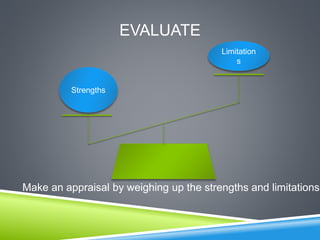
EVALUATE
Strengths
Limitation
s
Make an appraisal by weighing up the strengths and limitations.
TUALATIN & TIGARD WARM-UP
 From what you know about each school, create a list comparing
and contrasting the two high schools and their students.
 Which school do you think comes out ahead?
 How does this conclusion make you feel?
SOCIAL IDENTITY THEORY
 The part of one’s self-concept based on the knowledge
of membership in social groups.
 Individuals make comparisons between in-groups and out-groups
which impact their self-concept.
 The comparison can result in positive or negative feelings. We
generally want to be positive.
Social
Categorization
In-Groups
(Positive)
Social
Comparison
Out-groups
(Negative)
TAJFEL (1970)
 Aim: To investigate if grouping would lead to in-group favoritism
or out-group discrimination
 Method: Arbitrarily placed 64 boys into groups based on their
preference of a painting. Participants were brought into a
separate room and asked to distribute virtual money to other
participants. They were only aware of what group they belonged
to.
 Findings: Most participants awarded more money to participants
from their own group (in-group) than the other group (Out-Group).
 Conclusion: The participants adopted in-group favoritism.
 Critical Thinking: Ecological Validity? Sample size? Population?
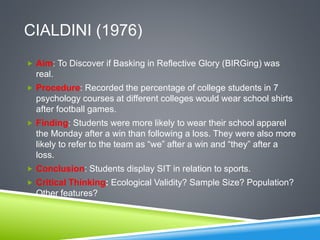
CIALDINI (1976)
 Aim: To Discover if Basking in Reflective Glory (BIRGing) was
real.
 Procedure: Recorded the percentage of college students in 7
psychology courses at different colleges would wear school shirts
after football games.
 Finding: Students were more likely to wear their school apparel
the Monday after a win than following a loss. They were also more
likely to refer to the team as “we” after a win and “they” after a
loss.
 Conclusion: Students display SIT in relation to sports.
 Critical Thinking: Ecological Validity? Sample Size? Population?
Other features?
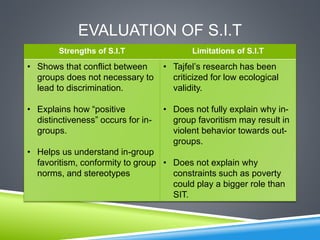
EVALUATION OF S.I.T
Strengths of S.I.T Limitations of S.I.T
• Shows that conflict between
groups does not necessary to
lead to discrimination.
• Explains how “positive
distinctiveness” occurs for in-
groups.
• Helps us understand in-group
favoritism, conformity to group
norms, and stereotypes
• Tajfel’s research has been
criticized for low ecological
validity.
• Does not fully explain why in-
group favoritism may result in
violent behavior towards out-
groups.
• Does not explain why
constraints such as poverty
could play a bigger role than
SIT.
CAN PREJUDICES EVER BE A GOOD
THING?
 What do the studies about stereotypes and prejudice that
Bloom highlights show about their nature?
 How do they relate with the question of Nature & Nurture?
 What argument does Bloom make through his examples of
Uncle Tom’s Cabin and Adam Smith (1000 deaths or your
pinky)?
 In what ways does this relate to the reactions of the Paris shootings
earlier this year?
 In what ways can stereotypes and prejudice help us in our
lives and in what ways can they be detrimental to it?
LEARNING OUTCOME
SC.2.D. Explain the formation of stereotypes
and their effect on behavior.
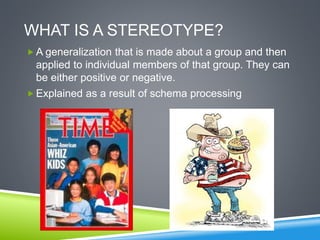
WHAT IS A STEREOTYPE?
 A generalization that is made about a group and then
applied to individual members of that group. They can
be either positive or negative.
 Explained as a result of schema processing
FORMATION OF STEREOTYPES
Read each explanation on the formation of
stereotypes and record your response to the
theory (strengths and limitations).
Explain how stereotypes about Americans
would have been created by each theory.
Explain which theory you most agree with
most.
THEORY #1:
SOCIAL CATEGORIZATION - TAJFEL
Based on his Social Identity Theory, Tajfel argues that
humans use Social Categorization to categorize
humans based on shared characteristics (race, age,
gender, religion, sexual orientation). This creates In-
Groups and Out-Groups. Tajfel would argue that
stereotypes form because people associate negative
traits to the Out-groups and positive traits to the In-
Groups. This helps us maintain a positive self-image.
THEORY #2: GRAIN OF TRUTH
HYPOTHESIS: CAMPBELL (1967)
Campbell argues that stereotypes have some basis in
reality. Specifically, Campbell believes that there are two
sources of stereotypes:
1. Our personal experiences and interactions with
members of a particular group.
2. Gatekeepers: The media, parents, and other
members of our culture.
From these experiences, Campbell created the Grain of
Truth Hypothesis, which argues that observations
about a group will be generalized to the group because
observers feel that even one confirmation is enough.
THEORY #3:
ILLUSIONARY CORRELATIONS:
HAMILTON & GIFFORD (1976)
 Hamilton and Gifford argue that stereotypes are the
result of Illusionary Correlations. This means that
humans see relationships between two variables
(women & poor mathematics) even when there is
none. Furthermore, Hamilton & Gifford argue that
humans use Confirmation Bias to defend their
stereotypes. This means that humans look for
evidence and examples that defend their beliefs and
ignore the evidence and examples that do not fit.
STEREOTYPE DISCUSSION
QUESTIONS
How do you think stereotypes impact
human behavior? Do you think you are
impacted by stereotypes (both positive
and negative) in your life? Who faces
positive and who faces negative
stereotypes ?
Can having stereotypes be avoided?
Should we care about avoiding
stereotypes? Why or why not?
DARLEY AND GROSS (1983)
(HOW OUR STEREOTYPES IMPACT OUR PERCEPTIONS OF OTHERS)
 Aim: To discover how schemas and stereotypes can impact
judgments of others.
 Method: Researchers showed one of two versions video of a girl
to participants.
 Video 1: The girl was playing in a poor environment (poor stereotype).
 Video 2: The girl was playing in a wealthy environment (wealthy stereotype).
 Then they were shown a video of the girl taking an intelligence test and judge
the girl’s likely success in the future.
 Findings :Those who saw the poor video ranked her as less
likely to succeed in life and those who saw the rich video
were more likely to rank her as more likely to succeed.
 Conclusions: Stereotypes about rich and poor children impacted the
perception of intelligence.
 Critical Thinking?
BARGH ET AL. (1997)
(HOW KNOWING ABOUT STEREOTYPES ABOUT US IMPACT OUR
BEHAVIOR)
 Aim: To investigate how being aware of stereotypes may impact
the behaviors of individuals.
 Method:
 College students performed word scramble activities that primed them either
in a rude, polite, or control condition.
 Participants were told to complete the task and bring it down the hall to meet
with a researcher. Upon seeing the researcher, a confederate student would
begin a conversation with the researcher, requiring the participant to wait.
 Finding: Participants who were primed in the rude condition were
more likely to intervene in the conversation and did so quicker.
 Conclusion: Activation of stereotypes can impact the behavior of
individuals.
 Critical Thinking?
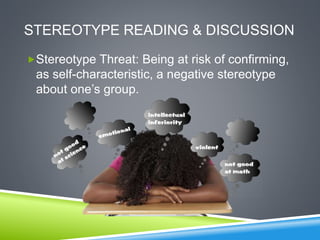
STEREOTYPE READING & DISCUSSION
Stereotype Threat: Being at risk of confirming,
as self-characteristic, a negative stereotype
about one’s group.
STEELE & ARONSON (1995)
(HOW KNOWING ABOUT STEREOTYPES ABOUT OUR GROUPS
CAN IMPACT US)
 Aim: To investigate the impact of stereotype threat on behavior.
 Method:
 Had white and black students take a verbal test (GRE).
 Control Condition: Participants told that the test was a problem solving exercise.
 Stereotype Condition: Participants told that the test would measure their underlying
intellectual abilities.
 Findings
 Control Condition: No difference between black & white students
 Stereotype Condition: Black participants performed worse and completed less
answers than their white peers.
 Conclusion: Stereotype Threat can negatively impact the behaviors
of those who face them.
 Critical Thinking?
STEREOTYPE READINGS &
DISCUSSION QUESTIONS
Article 1: Stereotype Threat
Article 2: When Talking About
Bias Backfire
 Who was impacted by
stereotype threat?
 In what ways can knowing
about a stereotype about
yourself impact your
behavior?
 In what ways can stereotype
be avoided?
 Do you agree with the advice
for changing our educational
system? Why or why not?
 What studies stand out to you
from this article? Why?
 In what ways can knowing
about a stereotype of others
impact behavior?
 How can we prevent
discussions about stereotypes
from backfiring?
 Do you think this trend would
spread to issues such as
racism?
Discussion Prep
As you read, work with a partner to create
three discussion questions. Write them all
on the flashcard. Circle/Highlight the one
you are most interesting in discussing.
RACISM AND
SOCIAL COGNITION
 “Racism doesn’t require the presence of malice, only the
presence of bias and ignorance, willful or otherwise.”
 “Racism is interpersonal and structural; it is current and
historical; it is explicit and implicit; it is articulated and
silent.”
~Charles W. Blow (NY Times Editorialist on 12/3/2014 )
1. Explain what Blow is communicating about racism in your
own words.
2. What does this type of racism look like? Can you think of
any examples?
3. Do you agree with Blow’s statement about racism?
4. How does this relate to social cognition?

Social Identity Theory & Stereotypes

  • 1.
  • 2.
    LEARNING OUTCOME SC.2.C. Evaluatesocial identity theory, making reference to relevant studies.
  • 3.
    EVALUATE Strengths Limitation s Make an appraisalby weighing up the strengths and limitations.
  • 4.
    TUALATIN & TIGARDWARM-UP  From what you know about each school, create a list comparing and contrasting the two high schools and their students.  Which school do you think comes out ahead?  How does this conclusion make you feel?
  • 5.
    SOCIAL IDENTITY THEORY The part of one’s self-concept based on the knowledge of membership in social groups.  Individuals make comparisons between in-groups and out-groups which impact their self-concept.  The comparison can result in positive or negative feelings. We generally want to be positive. Social Categorization In-Groups (Positive) Social Comparison Out-groups (Negative)
  • 6.
    TAJFEL (1970)  Aim:To investigate if grouping would lead to in-group favoritism or out-group discrimination  Method: Arbitrarily placed 64 boys into groups based on their preference of a painting. Participants were brought into a separate room and asked to distribute virtual money to other participants. They were only aware of what group they belonged to.  Findings: Most participants awarded more money to participants from their own group (in-group) than the other group (Out-Group).  Conclusion: The participants adopted in-group favoritism.  Critical Thinking: Ecological Validity? Sample size? Population?
  • 7.
    CIALDINI (1976)  Aim:To Discover if Basking in Reflective Glory (BIRGing) was real.  Procedure: Recorded the percentage of college students in 7 psychology courses at different colleges would wear school shirts after football games.  Finding: Students were more likely to wear their school apparel the Monday after a win than following a loss. They were also more likely to refer to the team as “we” after a win and “they” after a loss.  Conclusion: Students display SIT in relation to sports.  Critical Thinking: Ecological Validity? Sample Size? Population? Other features?
  • 8.
    EVALUATION OF S.I.T Strengthsof S.I.T Limitations of S.I.T • Shows that conflict between groups does not necessary to lead to discrimination. • Explains how “positive distinctiveness” occurs for in- groups. • Helps us understand in-group favoritism, conformity to group norms, and stereotypes • Tajfel’s research has been criticized for low ecological validity. • Does not fully explain why in- group favoritism may result in violent behavior towards out- groups. • Does not explain why constraints such as poverty could play a bigger role than SIT.
  • 9.
    CAN PREJUDICES EVERBE A GOOD THING?  What do the studies about stereotypes and prejudice that Bloom highlights show about their nature?  How do they relate with the question of Nature & Nurture?  What argument does Bloom make through his examples of Uncle Tom’s Cabin and Adam Smith (1000 deaths or your pinky)?  In what ways does this relate to the reactions of the Paris shootings earlier this year?  In what ways can stereotypes and prejudice help us in our lives and in what ways can they be detrimental to it?
  • 10.
    LEARNING OUTCOME SC.2.D. Explainthe formation of stereotypes and their effect on behavior.
  • 11.
    WHAT IS ASTEREOTYPE?  A generalization that is made about a group and then applied to individual members of that group. They can be either positive or negative.  Explained as a result of schema processing
  • 12.
    FORMATION OF STEREOTYPES Readeach explanation on the formation of stereotypes and record your response to the theory (strengths and limitations). Explain how stereotypes about Americans would have been created by each theory. Explain which theory you most agree with most.
  • 13.
    THEORY #1: SOCIAL CATEGORIZATION- TAJFEL Based on his Social Identity Theory, Tajfel argues that humans use Social Categorization to categorize humans based on shared characteristics (race, age, gender, religion, sexual orientation). This creates In- Groups and Out-Groups. Tajfel would argue that stereotypes form because people associate negative traits to the Out-groups and positive traits to the In- Groups. This helps us maintain a positive self-image.
  • 14.
    THEORY #2: GRAINOF TRUTH HYPOTHESIS: CAMPBELL (1967) Campbell argues that stereotypes have some basis in reality. Specifically, Campbell believes that there are two sources of stereotypes: 1. Our personal experiences and interactions with members of a particular group. 2. Gatekeepers: The media, parents, and other members of our culture. From these experiences, Campbell created the Grain of Truth Hypothesis, which argues that observations about a group will be generalized to the group because observers feel that even one confirmation is enough.
  • 15.
    THEORY #3: ILLUSIONARY CORRELATIONS: HAMILTON& GIFFORD (1976)  Hamilton and Gifford argue that stereotypes are the result of Illusionary Correlations. This means that humans see relationships between two variables (women & poor mathematics) even when there is none. Furthermore, Hamilton & Gifford argue that humans use Confirmation Bias to defend their stereotypes. This means that humans look for evidence and examples that defend their beliefs and ignore the evidence and examples that do not fit.
  • 16.
    STEREOTYPE DISCUSSION QUESTIONS How doyou think stereotypes impact human behavior? Do you think you are impacted by stereotypes (both positive and negative) in your life? Who faces positive and who faces negative stereotypes ? Can having stereotypes be avoided? Should we care about avoiding stereotypes? Why or why not?
  • 17.
    DARLEY AND GROSS(1983) (HOW OUR STEREOTYPES IMPACT OUR PERCEPTIONS OF OTHERS)  Aim: To discover how schemas and stereotypes can impact judgments of others.  Method: Researchers showed one of two versions video of a girl to participants.  Video 1: The girl was playing in a poor environment (poor stereotype).  Video 2: The girl was playing in a wealthy environment (wealthy stereotype).  Then they were shown a video of the girl taking an intelligence test and judge the girl’s likely success in the future.  Findings :Those who saw the poor video ranked her as less likely to succeed in life and those who saw the rich video were more likely to rank her as more likely to succeed.  Conclusions: Stereotypes about rich and poor children impacted the perception of intelligence.  Critical Thinking?
  • 18.
    BARGH ET AL.(1997) (HOW KNOWING ABOUT STEREOTYPES ABOUT US IMPACT OUR BEHAVIOR)  Aim: To investigate how being aware of stereotypes may impact the behaviors of individuals.  Method:  College students performed word scramble activities that primed them either in a rude, polite, or control condition.  Participants were told to complete the task and bring it down the hall to meet with a researcher. Upon seeing the researcher, a confederate student would begin a conversation with the researcher, requiring the participant to wait.  Finding: Participants who were primed in the rude condition were more likely to intervene in the conversation and did so quicker.  Conclusion: Activation of stereotypes can impact the behavior of individuals.  Critical Thinking?
  • 19.
    STEREOTYPE READING &DISCUSSION Stereotype Threat: Being at risk of confirming, as self-characteristic, a negative stereotype about one’s group.
  • 20.
    STEELE & ARONSON(1995) (HOW KNOWING ABOUT STEREOTYPES ABOUT OUR GROUPS CAN IMPACT US)  Aim: To investigate the impact of stereotype threat on behavior.  Method:  Had white and black students take a verbal test (GRE).  Control Condition: Participants told that the test was a problem solving exercise.  Stereotype Condition: Participants told that the test would measure their underlying intellectual abilities.  Findings  Control Condition: No difference between black & white students  Stereotype Condition: Black participants performed worse and completed less answers than their white peers.  Conclusion: Stereotype Threat can negatively impact the behaviors of those who face them.  Critical Thinking?
  • 21.
    STEREOTYPE READINGS & DISCUSSIONQUESTIONS Article 1: Stereotype Threat Article 2: When Talking About Bias Backfire  Who was impacted by stereotype threat?  In what ways can knowing about a stereotype about yourself impact your behavior?  In what ways can stereotype be avoided?  Do you agree with the advice for changing our educational system? Why or why not?  What studies stand out to you from this article? Why?  In what ways can knowing about a stereotype of others impact behavior?  How can we prevent discussions about stereotypes from backfiring?  Do you think this trend would spread to issues such as racism? Discussion Prep As you read, work with a partner to create three discussion questions. Write them all on the flashcard. Circle/Highlight the one you are most interesting in discussing.
  • 22.
    RACISM AND SOCIAL COGNITION “Racism doesn’t require the presence of malice, only the presence of bias and ignorance, willful or otherwise.”  “Racism is interpersonal and structural; it is current and historical; it is explicit and implicit; it is articulated and silent.” ~Charles W. Blow (NY Times Editorialist on 12/3/2014 ) 1. Explain what Blow is communicating about racism in your own words. 2. What does this type of racism look like? Can you think of any examples? 3. Do you agree with Blow’s statement about racism? 4. How does this relate to social cognition?