Writing and Refining Information Literacy Learning Outcomes.Chris Sweetcsweet@iwu.eduIllinois Wesleyan UniversityLOEX Annual Conference4/30/2010
Workshop OutcomesAfter this workshop participants will be able to:Articulate the importance of learning outcomes in higher education.Develop good learning outcomes for information literacy instruction in order to improve teaching and assessment.Advance information literacy initiatives on your campus through the use of learning outcomes.
Who loves writing learning outcomes?! (Or, what brings you here today?)Do you currently have info lit learning outcomes in place?What are your learning outcome needs? (Instructional, departmental, programmatic?)  Did you come with a specific session or class? What is your campus/library culture in regards to assessment?How many have written their own learning outcomes?
My Learning Outcomes Expertise?Info Lit LibrarianACRL ImmersionACRL Assessment WorkshopInfo Lit Outcomes for Campus Writing Program
IWU Writing Program Info Lit OutcomesStudents value research as a discovery process that requires both creativity and persistence.Students locate, evaluate and synthesize diverse information resources in order to develop a body of evidence that supports the project’s purpose.Students demonstrate critical thinking and sound reasoning in their writing through the integration of credible, authoritative sources. Students utilize systems of documentation and acknowledgement in order to use information in an appropriate legal and ethical manner.
Learning Outcomes as a ProcessGood learning outcomes are not something you research a bit and sit down at your desk and crank out.Identify the StakeholdersTeaching Faculty?Administrators?Librarians?Brainstorming and prioritizing sessions are essentialIdentify your audienceFreshman composition students?Teaching Faculty?
Outcomes or Objectives?“Learning Outcomes” is the more in-vogue term, but “Learning Objectives” is often used interchangeably. Simply put, a learning outcome answers the question: “What should a student be able to do after instruction?”Focus is on the learner and the desired end product.
Why?Move towards evidence-based learning and accountability.In other words: ASSESSMENT!Accreditation: http://www.learningoutcomeassessment.org/Accreditation1.htmBetter alignment with practices in instructional departments (walk the walk, talk the talk)Can be a tool for moving info lit initiatives forward.Can be used at the Info Lit program level, class, or single session instruction (we’re focusing on the last two).
Assessment of student learning is:Knowing what you are doing in the classroomKnowing why you are doing itKnowing what students are learning as a resultChanging because of the information-Debra Gilchrist: Information Literacy and Assessment: ACRL/TLT Group Online Seminar, 2009.
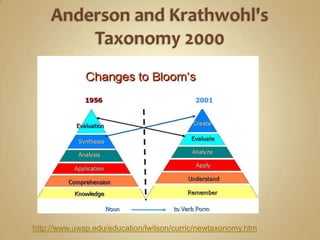
Fun and Games with Taxonomies!taxonomy  2.A classification of anything. -Oxford English DictionaryWhen writing learning outcomes you need to consider cognitive taxonomies (classifications/hierarchies of knowing).  The best-known of these is Benjamin Bloom’s Taxonomy of Educational Objectives (1956)
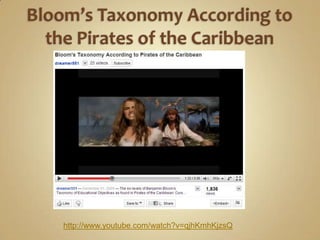
Bloom’s Taxonomy According to the Pirates of the Caribbeanhttp://www.youtube.com/watch?v=qjhKmhKjzsQ
Anderson and Krathwohl's Taxonomy 2000http://www.uwsp.edu/education/lwilson/curric/newtaxonomy.htm
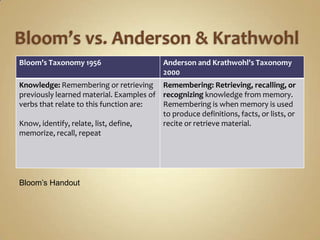
Bloom’s vs. Anderson & KrathwohlBloom’s Handout
Two Outcome “Formulas”Here are two formulas that can simplify writing learning outcomes:ACRL Immersion / Deb GilchristA-B-C-DHeinich, et. al. Instructional Media and Technologies for Learning. (2002)
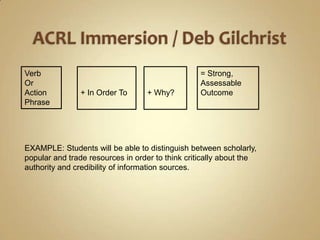
ACRL Immersion / Deb GilchristVerb Or Action Phrase+ In Order To+ Why?= Strong, Assessable OutcomeEXAMPLE: Students will be able to distinguish between scholarly, popular and trade resources in order to think critically about the authority and credibility of information sources.
A-B-C-D MethodAis for audience, the intended learnersB is for behavior, what you expect the learner to doC is for conditions, the circumstances under which the learning will occurD is for degree, or how much of the behavior needs to be performed and to what level. (Not always included)When writing outcomes using this formula you just need to include the elements, not necessarily in ABCD Order.
A-B-C-D ExampleThrough a group exercise to distinguish between scholarly, trade and peer reviewed publications, (Conditions) the majority (Degree) of students (Audience) will be able to correctly identify the item given to them (Behavior).
Good Learning OutcomesSMART (Drucker, 1954)S Specific – clear and definite terms describing expected abilities, knowledge, values, attitudes, and performanceM Measurable – it is feasible to get the data, data are accurate and reliable, issue can be assessed more than one wayA Aggressive but Attainable – consider stretch targets to improve programR Results-oriented – describe what standards are expected for studentsT Time-bound – describe where you would like to be within a specified period of time
Exercise: two different formulas, same class½ will use the ABCD method and the other ½ the “In order to” method.In groups, brainstorm a variety of possible learning outcomes for the following instruction scenario:A freshman composition instructor contacts you and says: “My students don’t understand how to identify a credible website.  They also don’t know how or why they should use citations.  Could you also show them the library’s citation management tool?”
Outcomes and the “One-Shot”Involve the teaching faculty:What do you expect your students to know and be able to do following instruction?What do you want your students to get out of this instruction session?You can guide this discussion towards higher-level info lit goals: Is the real outcome that students be able to search JSTOR or is the real goal to get students to think critically about their information sources?“RUTHLESS PRIORITIZATION”
Resources HandoutACRL Resources:Objectives for Information Literacy InstructionInformation Literacy Competency Standards for Higher Education Task Force on Academic Library Outcomes Assessment Report BooksArticles
ACRL: Objectives for Information Literacy Librarians.Objectives for Information Literacy Instruction: A Model Statement for Academic Librarians (2001)http://www.ala.org/ala/mgrps/divs/acrl/standards/objectivesinformation.cfmThe Competency Standards are the basis for the IS Objectives and it is recommended that the two documents be used together. The IS Objectives flesh out and make more specific the Standards, Performance Indicators, and Outcomes of the Competency Standards.
More Practice!Does anyone have a session or class that we can try to write outcomes for? (institutional context will be lacking).If not, work on this example in groups:You are asked to give a lunch hour presentation to faculty about preventing and detecting student plagiarism.  What are some possible learning outcomes?
Final Questions?Chris Sweetcsweet@iwu.edu

Writing and Refining Information Literacy Learning Outcomes

  • 1.
    Writing and RefiningInformation Literacy Learning Outcomes.Chris Sweetcsweet@iwu.eduIllinois Wesleyan UniversityLOEX Annual Conference4/30/2010
  • 2.
    Workshop OutcomesAfter thisworkshop participants will be able to:Articulate the importance of learning outcomes in higher education.Develop good learning outcomes for information literacy instruction in order to improve teaching and assessment.Advance information literacy initiatives on your campus through the use of learning outcomes.
  • 3.
    Who loves writinglearning outcomes?! (Or, what brings you here today?)Do you currently have info lit learning outcomes in place?What are your learning outcome needs? (Instructional, departmental, programmatic?) Did you come with a specific session or class? What is your campus/library culture in regards to assessment?How many have written their own learning outcomes?
  • 4.
    My Learning OutcomesExpertise?Info Lit LibrarianACRL ImmersionACRL Assessment WorkshopInfo Lit Outcomes for Campus Writing Program
  • 5.
    IWU Writing ProgramInfo Lit OutcomesStudents value research as a discovery process that requires both creativity and persistence.Students locate, evaluate and synthesize diverse information resources in order to develop a body of evidence that supports the project’s purpose.Students demonstrate critical thinking and sound reasoning in their writing through the integration of credible, authoritative sources. Students utilize systems of documentation and acknowledgement in order to use information in an appropriate legal and ethical manner.
  • 6.
    Learning Outcomes asa ProcessGood learning outcomes are not something you research a bit and sit down at your desk and crank out.Identify the StakeholdersTeaching Faculty?Administrators?Librarians?Brainstorming and prioritizing sessions are essentialIdentify your audienceFreshman composition students?Teaching Faculty?
  • 7.
    Outcomes or Objectives?“LearningOutcomes” is the more in-vogue term, but “Learning Objectives” is often used interchangeably. Simply put, a learning outcome answers the question: “What should a student be able to do after instruction?”Focus is on the learner and the desired end product.
  • 8.
    Why?Move towards evidence-basedlearning and accountability.In other words: ASSESSMENT!Accreditation: http://www.learningoutcomeassessment.org/Accreditation1.htmBetter alignment with practices in instructional departments (walk the walk, talk the talk)Can be a tool for moving info lit initiatives forward.Can be used at the Info Lit program level, class, or single session instruction (we’re focusing on the last two).
  • 9.
    Assessment of studentlearning is:Knowing what you are doing in the classroomKnowing why you are doing itKnowing what students are learning as a resultChanging because of the information-Debra Gilchrist: Information Literacy and Assessment: ACRL/TLT Group Online Seminar, 2009.
  • 10.
    Fun and Gameswith Taxonomies!taxonomy  2.A classification of anything. -Oxford English DictionaryWhen writing learning outcomes you need to consider cognitive taxonomies (classifications/hierarchies of knowing). The best-known of these is Benjamin Bloom’s Taxonomy of Educational Objectives (1956)
  • 11.
    Bloom’s Taxonomy Accordingto the Pirates of the Caribbeanhttp://www.youtube.com/watch?v=qjhKmhKjzsQ
  • 12.
    Anderson and Krathwohl'sTaxonomy 2000http://www.uwsp.edu/education/lwilson/curric/newtaxonomy.htm
  • 13.
    Bloom’s vs. Anderson& KrathwohlBloom’s Handout
  • 14.
    Two Outcome “Formulas”Hereare two formulas that can simplify writing learning outcomes:ACRL Immersion / Deb GilchristA-B-C-DHeinich, et. al. Instructional Media and Technologies for Learning. (2002)
  • 15.
    ACRL Immersion /Deb GilchristVerb Or Action Phrase+ In Order To+ Why?= Strong, Assessable OutcomeEXAMPLE: Students will be able to distinguish between scholarly, popular and trade resources in order to think critically about the authority and credibility of information sources.
  • 16.
    A-B-C-D MethodAis foraudience, the intended learnersB is for behavior, what you expect the learner to doC is for conditions, the circumstances under which the learning will occurD is for degree, or how much of the behavior needs to be performed and to what level. (Not always included)When writing outcomes using this formula you just need to include the elements, not necessarily in ABCD Order.
  • 17.
    A-B-C-D ExampleThrough agroup exercise to distinguish between scholarly, trade and peer reviewed publications, (Conditions) the majority (Degree) of students (Audience) will be able to correctly identify the item given to them (Behavior).
  • 18.
    Good Learning OutcomesSMART(Drucker, 1954)S Specific – clear and definite terms describing expected abilities, knowledge, values, attitudes, and performanceM Measurable – it is feasible to get the data, data are accurate and reliable, issue can be assessed more than one wayA Aggressive but Attainable – consider stretch targets to improve programR Results-oriented – describe what standards are expected for studentsT Time-bound – describe where you would like to be within a specified period of time
  • 19.
    Exercise: two differentformulas, same class½ will use the ABCD method and the other ½ the “In order to” method.In groups, brainstorm a variety of possible learning outcomes for the following instruction scenario:A freshman composition instructor contacts you and says: “My students don’t understand how to identify a credible website. They also don’t know how or why they should use citations. Could you also show them the library’s citation management tool?”
  • 20.
    Outcomes and the“One-Shot”Involve the teaching faculty:What do you expect your students to know and be able to do following instruction?What do you want your students to get out of this instruction session?You can guide this discussion towards higher-level info lit goals: Is the real outcome that students be able to search JSTOR or is the real goal to get students to think critically about their information sources?“RUTHLESS PRIORITIZATION”
  • 21.
    Resources HandoutACRL Resources:Objectivesfor Information Literacy InstructionInformation Literacy Competency Standards for Higher Education Task Force on Academic Library Outcomes Assessment Report BooksArticles
  • 22.
    ACRL: Objectives forInformation Literacy Librarians.Objectives for Information Literacy Instruction: A Model Statement for Academic Librarians (2001)http://www.ala.org/ala/mgrps/divs/acrl/standards/objectivesinformation.cfmThe Competency Standards are the basis for the IS Objectives and it is recommended that the two documents be used together. The IS Objectives flesh out and make more specific the Standards, Performance Indicators, and Outcomes of the Competency Standards.
  • 23.
    More Practice!Does anyonehave a session or class that we can try to write outcomes for? (institutional context will be lacking).If not, work on this example in groups:You are asked to give a lunch hour presentation to faculty about preventing and detecting student plagiarism. What are some possible learning outcomes?
  • 24.