Learning Objectives
and
Learning Outcomes
Ms.Poonam Sharma
Assistant Professor
BLMCE, New Delhi
Email Id: poonam.sharma@blmce.ac.in
Every learning should go into the imbibing of skills that will
help the individual perform tasks or take actions to lead a
productive and joyful life
Do you agree or disagree? Why?
Learning Objectives
● Learning Objectives are
statements that define the
expected goal(s) of an educational
activity.
● It describes intended state of a
teacher i.e. what you as a teacher
hope your students learn.
● Objectives are used to organize
specific topics or individual
learning activities to achieve the
overall learning outcome.
learn),
Learning Outcomes
➔ formal statements that tell us what
a student is able to do after
learning a given topic/concept.
➔ The learning described in
outcomes should encompass the
essential and significant knowledge
and skills students should develop
in a course.
➔ Students should generalise their
learning and integrate it with other
areas of their lives outside school.
➔ LOs should be observable and
measurable and clearly understood
by all stakeholders – students,
parents and teachers.
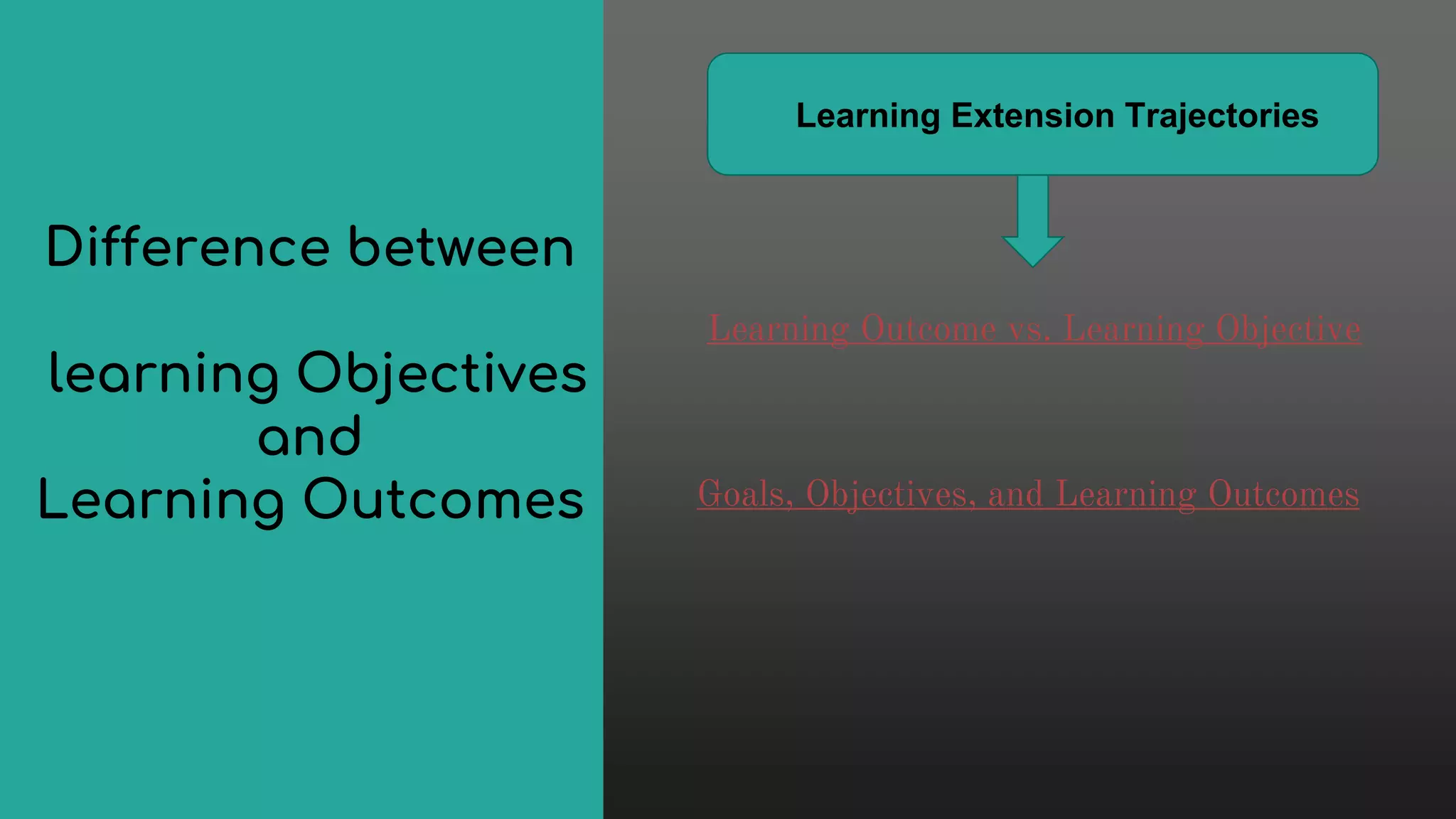
Difference between
learning Objectives
and
Learning Outcomes
Learning Outcome vs. Learning Objective
Goals, Objectives, and Learning Outcomes
Learning Extension Trajectories
Reflection
Spot
Students will be able to
differentiate between climate and
weather by illustrating the case of
their local city.
Action Verb Object of the verb
Condition
Rule of Thumb for writing a
learning outcome
● action verb/phrase
● object of the verb
● clause/phrase indicating level of achievement
● context or conditions if any.
Source: http://cbse.nic.in/newsite/attach/CBE_Circular15052020.pdf
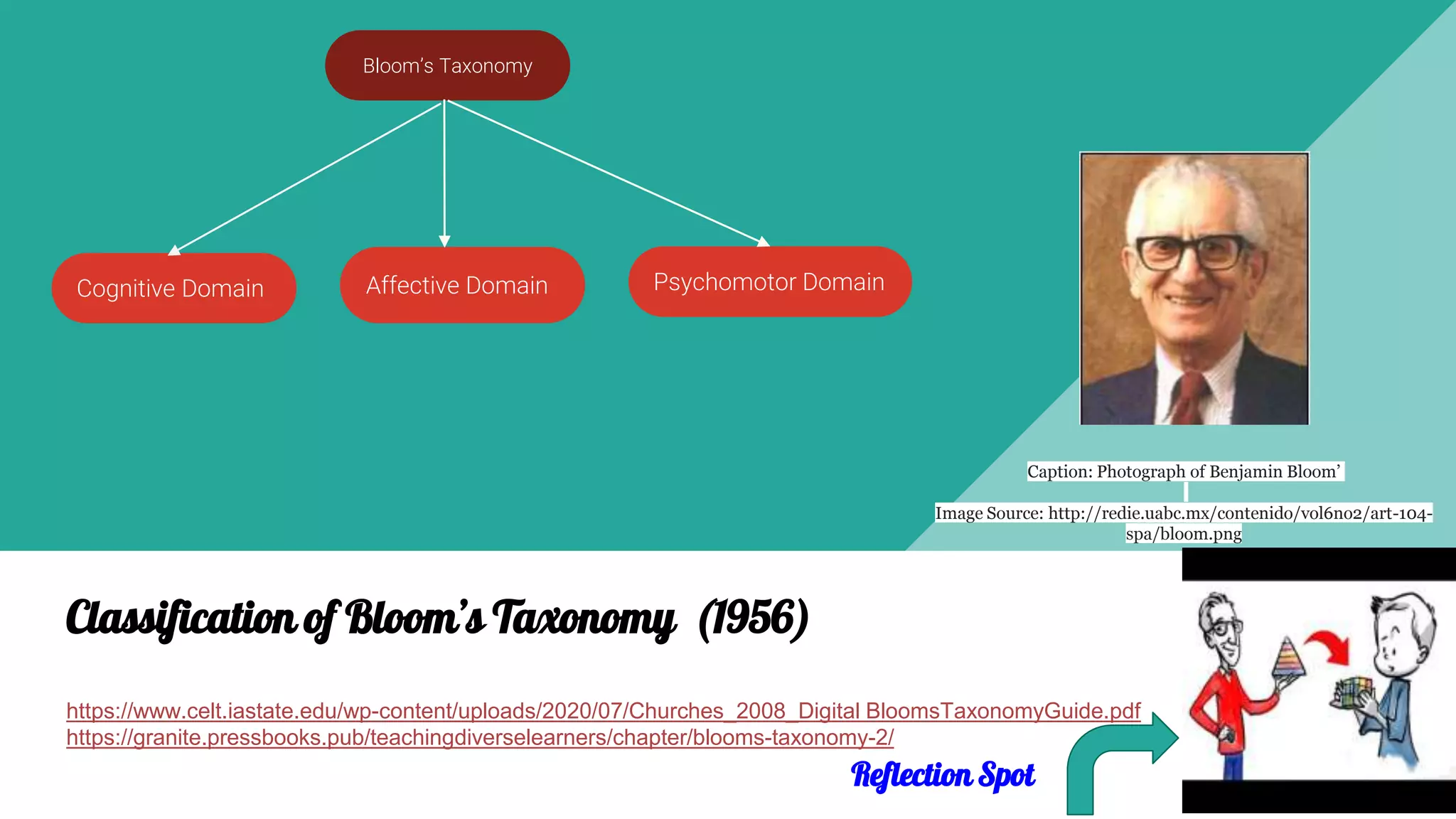
Bloom’s Taxonomy
(propounded by B.S.Bloom et.al.)
Writing objectives in behavioural terms
Classification of Bloom’s Taxonomy (1956)
https://www.celt.iastate.edu/wp-content/uploads/2020/07/Churches_2008_Digital BloomsTaxonomyGuide.pdf
https://granite.pressbooks.pub/teachingdiverselearners/chapter/blooms-taxonomy-2/
Caption: Photograph of Benjamin Bloom’
Image Source: http://redie.uabc.mx/contenido/vol6no2/art-104-
spa/bloom.png
Bloom’s Taxonomy
Cognitive Domain Psychomotor DomainAffective Domain
Reflection Spot
Old Version of Bloom’s Taxonomy
(Explained in Nouns)
New Version of Bloom’s Taxonomy
(Explained in Verbs)
Cognitive
Domain
Let’s Do Hands On
With
Nearpod Application
Affective Domain
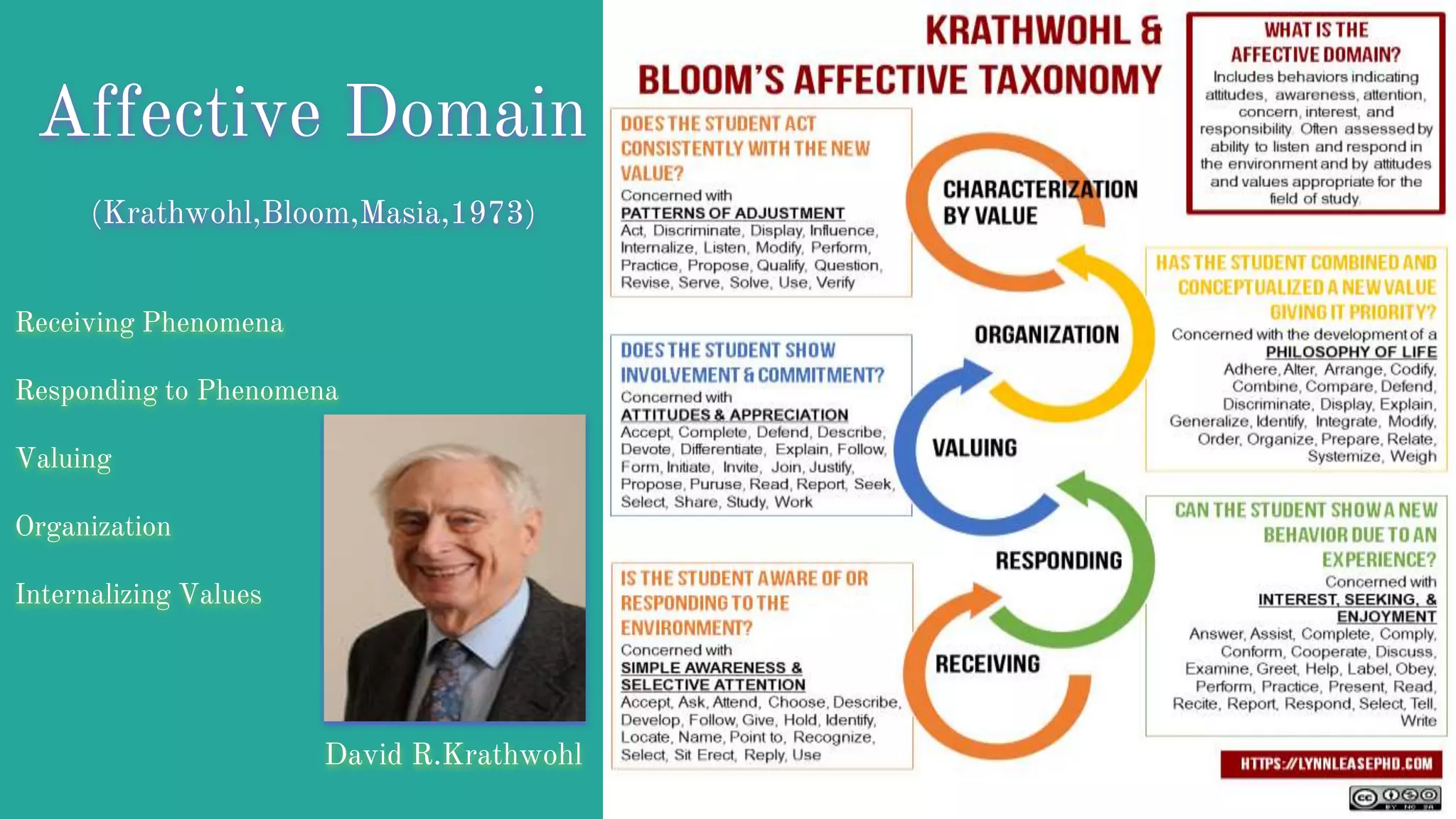
(Krathwohl,Bloom,Masia,1973)
Receiving Phenomena
Responding to Phenomena
Valuing
Organization
Internalizing Values
David R.Krathwohl
Sourcehttps://en.wikiversity.org/wiki/Instructional_design/Affective_behaviors/What_is_the_Affective_Domain%3F#:~:text=%22The%20affective%2
0domain%20describes%20the,%3A%20Taxonomy%20of%20Instructional%20Objectives).
Before continuing, you should visit the sneezing video and think about how a learner might demonstrate each stage.
Once you have done that, check yourself against the information below.
Receiving is being open to the information; you haven't yet made any decisions at this stage, but you've agreed to at least receive the
information. In our example, merely watching the video satisfies the receiving stage.
Responding is actively participating in the information. If the video had included tasks or an assessment and you had completed them, you
would be satisfying the requirements of responding.
Valuing is attaching worth to the ideas presented. In our video example, if you had believed that the technique offered was worth
considering and begun to think about implementing it in your everyday life, you have reached the valuing stage.
Organization is incorporating the new information into your existing schema. In the case of the video, this would include implementing the
technique presented in your daily life.
Characterization occurs when you truly become an advocate of the new information. In the video example, this may mean telling others
about the technique or finding some way to pass the information along to others.
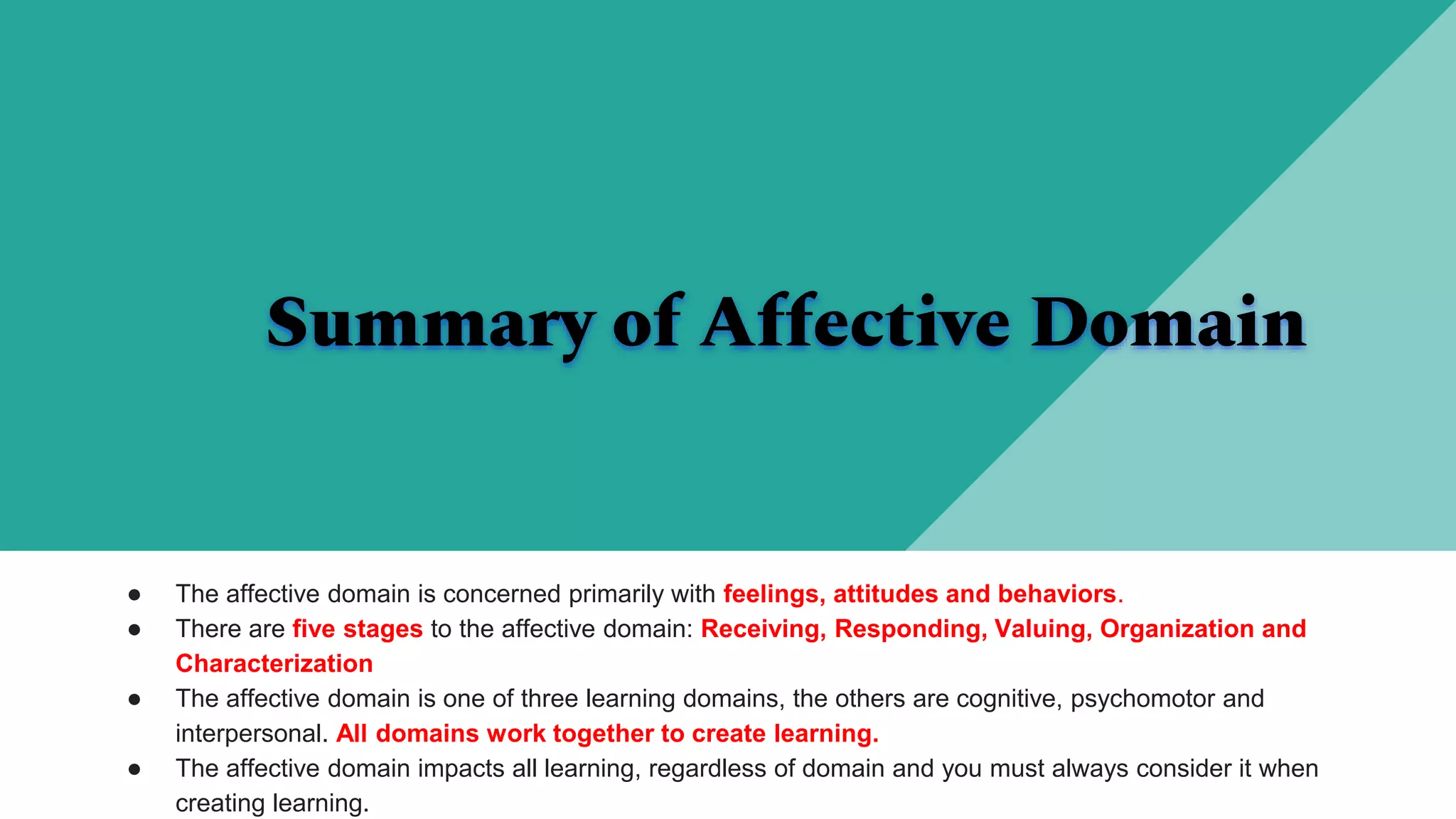
Summary of Affective Domain
● The affective domain is concerned primarily with feelings, attitudes and behaviors.
● There are five stages to the affective domain: Receiving, Responding, Valuing, Organization and
Characterization
● The affective domain is one of three learning domains, the others are cognitive, psychomotor and
interpersonal. All domains work together to create learning.
● The affective domain impacts all learning, regardless of domain and you must always consider it when
creating learning.
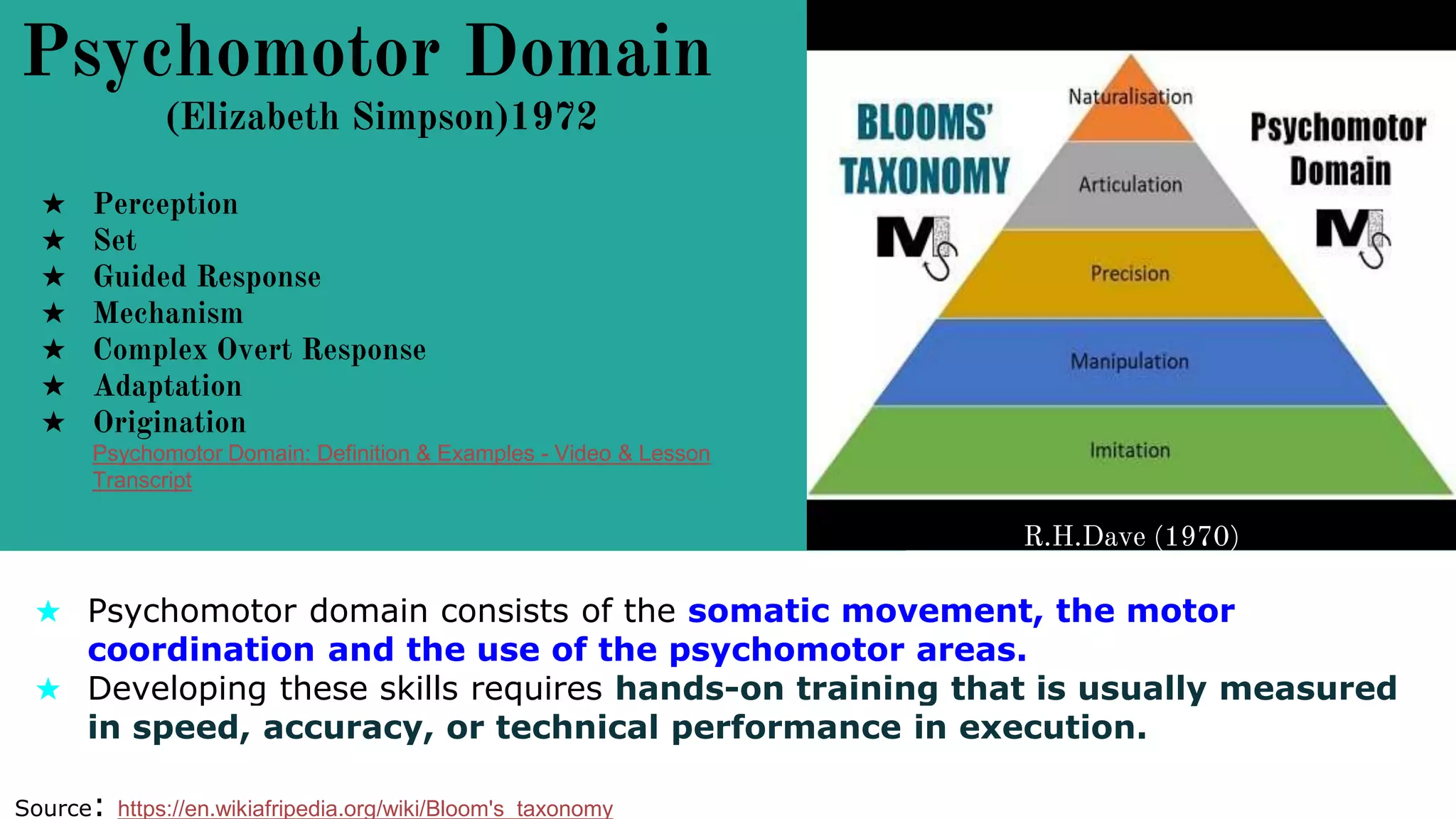
Psychomotor Domain
(Elizabeth Simpson)1972
★ Perception
★ Set
★ Guided Response
★ Mechanism
★ Complex Overt Response
★ Adaptation
★ Origination
Psychomotor Domain: Definition & Examples - Video & Lesson
Transcript
★ Psychomotor domain consists of the somatic movement, the motor
coordination and the use of the psychomotor areas.
★ Developing these skills requires hands-on training that is usually measured
in speed, accuracy, or technical performance in execution.
Source: https://en.wikiafripedia.org/wiki/Bloom's_taxonomy
R.H.Dave (1970)
Reflection Spot
Choose the correct specific objectives
Student will take notes from
a powerpoint lecture about
the stock market crash of
1929.
Upon completion of the lesson,
students will create a graphic
organizer showing causes and
effects of the stock market
crash of 1929.
Correct
Now it’s Your Turn

Learning objectives and learning outcomes

  • 1.
    Learning Objectives and Learning Outcomes Ms.PoonamSharma Assistant Professor BLMCE, New Delhi Email Id: poonam.sharma@blmce.ac.in
  • 2.
    Every learning shouldgo into the imbibing of skills that will help the individual perform tasks or take actions to lead a productive and joyful life Do you agree or disagree? Why?
  • 3.
    Learning Objectives ● LearningObjectives are statements that define the expected goal(s) of an educational activity. ● It describes intended state of a teacher i.e. what you as a teacher hope your students learn. ● Objectives are used to organize specific topics or individual learning activities to achieve the overall learning outcome. learn),
  • 4.
    Learning Outcomes ➔ formalstatements that tell us what a student is able to do after learning a given topic/concept. ➔ The learning described in outcomes should encompass the essential and significant knowledge and skills students should develop in a course. ➔ Students should generalise their learning and integrate it with other areas of their lives outside school. ➔ LOs should be observable and measurable and clearly understood by all stakeholders – students, parents and teachers.
  • 5.
    Difference between learning Objectives and LearningOutcomes Learning Outcome vs. Learning Objective Goals, Objectives, and Learning Outcomes Learning Extension Trajectories
  • 6.
    Reflection Spot Students will beable to differentiate between climate and weather by illustrating the case of their local city. Action Verb Object of the verb Condition
  • 7.
    Rule of Thumbfor writing a learning outcome ● action verb/phrase ● object of the verb ● clause/phrase indicating level of achievement ● context or conditions if any. Source: http://cbse.nic.in/newsite/attach/CBE_Circular15052020.pdf
  • 8.
    Bloom’s Taxonomy (propounded byB.S.Bloom et.al.) Writing objectives in behavioural terms
  • 9.
    Classification of Bloom’sTaxonomy (1956) https://www.celt.iastate.edu/wp-content/uploads/2020/07/Churches_2008_Digital BloomsTaxonomyGuide.pdf https://granite.pressbooks.pub/teachingdiverselearners/chapter/blooms-taxonomy-2/ Caption: Photograph of Benjamin Bloom’ Image Source: http://redie.uabc.mx/contenido/vol6no2/art-104- spa/bloom.png Bloom’s Taxonomy Cognitive Domain Psychomotor DomainAffective Domain Reflection Spot
  • 10.
    Old Version ofBloom’s Taxonomy (Explained in Nouns) New Version of Bloom’s Taxonomy (Explained in Verbs) Cognitive Domain
  • 11.
    Let’s Do HandsOn With Nearpod Application
  • 12.
    Affective Domain (Krathwohl,Bloom,Masia,1973) Receiving Phenomena Respondingto Phenomena Valuing Organization Internalizing Values David R.Krathwohl
  • 13.
    Sourcehttps://en.wikiversity.org/wiki/Instructional_design/Affective_behaviors/What_is_the_Affective_Domain%3F#:~:text=%22The%20affective%2 0domain%20describes%20the,%3A%20Taxonomy%20of%20Instructional%20Objectives). Before continuing, youshould visit the sneezing video and think about how a learner might demonstrate each stage. Once you have done that, check yourself against the information below. Receiving is being open to the information; you haven't yet made any decisions at this stage, but you've agreed to at least receive the information. In our example, merely watching the video satisfies the receiving stage. Responding is actively participating in the information. If the video had included tasks or an assessment and you had completed them, you would be satisfying the requirements of responding. Valuing is attaching worth to the ideas presented. In our video example, if you had believed that the technique offered was worth considering and begun to think about implementing it in your everyday life, you have reached the valuing stage. Organization is incorporating the new information into your existing schema. In the case of the video, this would include implementing the technique presented in your daily life. Characterization occurs when you truly become an advocate of the new information. In the video example, this may mean telling others about the technique or finding some way to pass the information along to others.
  • 14.
    Summary of AffectiveDomain ● The affective domain is concerned primarily with feelings, attitudes and behaviors. ● There are five stages to the affective domain: Receiving, Responding, Valuing, Organization and Characterization ● The affective domain is one of three learning domains, the others are cognitive, psychomotor and interpersonal. All domains work together to create learning. ● The affective domain impacts all learning, regardless of domain and you must always consider it when creating learning.
  • 15.
    Psychomotor Domain (Elizabeth Simpson)1972 ★Perception ★ Set ★ Guided Response ★ Mechanism ★ Complex Overt Response ★ Adaptation ★ Origination Psychomotor Domain: Definition & Examples - Video & Lesson Transcript ★ Psychomotor domain consists of the somatic movement, the motor coordination and the use of the psychomotor areas. ★ Developing these skills requires hands-on training that is usually measured in speed, accuracy, or technical performance in execution. Source: https://en.wikiafripedia.org/wiki/Bloom's_taxonomy R.H.Dave (1970)
  • 16.
    Reflection Spot Choose thecorrect specific objectives Student will take notes from a powerpoint lecture about the stock market crash of 1929. Upon completion of the lesson, students will create a graphic organizer showing causes and effects of the stock market crash of 1929. Correct
  • 17.