What do I want my students to learn, how can I express my goals to them and make these goals clear to my colleagues and myself?Learning OutcomesEducation Design Workshop #1.Lauren Kane, ANU College of Engineering and Computer ScienceJun 2010
AgendaIntroductionQuick review of theoryPractical applicationSharing with the group
Workshop OutcomesAt the end of this workshop, participants should be able to:Describe what is meant by the phrase ‘learning outcomes’Discuss the advantages for using learning outcomesIdentify the relationship between learning outcomes and Bloom’s TaxonomyApply Bloom’s Taxonomy to design or develop learning outcomesExplain why ‘understand’ is not a verb for a learning outcome
Why?Learning outcomes are important because....
Why?Identifying outcomes is an effective way to review curriculum and content. This leads to a more balanced and well sequenced curriculum.It is effective in designing appropriate assessment.Lecturers know exactly what students are expected to learn in their own unit as well as in previous units.Staff are easily able to evaluate the effectiveness of their teaching. Have the outcomes been achieved?An instructional shift from teaching to learning is facilitated. The focus is on the learner rather than the teacher.Students will know exactly what they are expected to learn for each unit. They know where they stand and the curriculum is more open to them.Students will know exactly how their learning will be assessed.Students begin to take more responsibility for their own learning when they know what they are expected to do and what standard they are expected to achieve.
What?A learning outcome is.....A learning outcome is a statement of what a learner is expected to know, understand or be able to do as a result of a learning process.
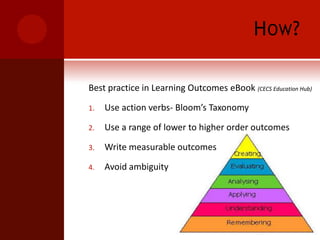
How?Best practice in Learning Outcomes eBook (CECS Education Hub)Use action verbs- Bloom’s TaxonomyUse a range of lower to higher order outcomesWrite measurable outcomesAvoid ambiguity
ConsiderationsWhat information or content do you want the students to learn from your unit?What do you want them to do with that information?What skills or competencies do you want them to learn or develop?What kinds of higher level thinking do you want them to engage in?How do you expect students to demonstrate what they have learned and how well they have learned it?At the very minimum, what should students know and be able to do when they finish your unit?How do you think they will be able to use the information and skills that they have developed?If someone asks the students what have they learned in your unit, how would you like them to answer?
Let’s Begin!Form groups and select a course(s) to work onOpen the Wiki in the CECS Education Hub and create your group’s page by clicking the [?] next to your group’s nameCopy in the course description and current learning outcomes Collaboratively create new learning outcomesStart with the statement: Upon completion of this course, students will have the knowledge and skills to:Present and share with the group
Workshop OutcomesAt the end of this workshop, participants should be able to:Describe what is meant by the phrase ‘learning outcomes’Discuss the advantages for using learning outcomesIdentify the relationship between learning outcomes and Bloom’s TaxonomyApply Bloom’s Taxonomy to design or develop learning outcomesExplain why ‘understand’ is not a verb for a learning outcome

Learning Outcomes Workshop

  • 1.
    What do Iwant my students to learn, how can I express my goals to them and make these goals clear to my colleagues and myself?Learning OutcomesEducation Design Workshop #1.Lauren Kane, ANU College of Engineering and Computer ScienceJun 2010
  • 2.
    AgendaIntroductionQuick review oftheoryPractical applicationSharing with the group
  • 3.
    Workshop OutcomesAt theend of this workshop, participants should be able to:Describe what is meant by the phrase ‘learning outcomes’Discuss the advantages for using learning outcomesIdentify the relationship between learning outcomes and Bloom’s TaxonomyApply Bloom’s Taxonomy to design or develop learning outcomesExplain why ‘understand’ is not a verb for a learning outcome
  • 4.
    Why?Learning outcomes areimportant because....
  • 5.
    Why?Identifying outcomes isan effective way to review curriculum and content. This leads to a more balanced and well sequenced curriculum.It is effective in designing appropriate assessment.Lecturers know exactly what students are expected to learn in their own unit as well as in previous units.Staff are easily able to evaluate the effectiveness of their teaching. Have the outcomes been achieved?An instructional shift from teaching to learning is facilitated. The focus is on the learner rather than the teacher.Students will know exactly what they are expected to learn for each unit. They know where they stand and the curriculum is more open to them.Students will know exactly how their learning will be assessed.Students begin to take more responsibility for their own learning when they know what they are expected to do and what standard they are expected to achieve.
  • 6.
    What?A learning outcomeis.....A learning outcome is a statement of what a learner is expected to know, understand or be able to do as a result of a learning process.
  • 7.
    How?Best practice inLearning Outcomes eBook (CECS Education Hub)Use action verbs- Bloom’s TaxonomyUse a range of lower to higher order outcomesWrite measurable outcomesAvoid ambiguity
  • 8.
    ConsiderationsWhat information orcontent do you want the students to learn from your unit?What do you want them to do with that information?What skills or competencies do you want them to learn or develop?What kinds of higher level thinking do you want them to engage in?How do you expect students to demonstrate what they have learned and how well they have learned it?At the very minimum, what should students know and be able to do when they finish your unit?How do you think they will be able to use the information and skills that they have developed?If someone asks the students what have they learned in your unit, how would you like them to answer?
  • 9.
    Let’s Begin!Form groupsand select a course(s) to work onOpen the Wiki in the CECS Education Hub and create your group’s page by clicking the [?] next to your group’s nameCopy in the course description and current learning outcomes Collaboratively create new learning outcomesStart with the statement: Upon completion of this course, students will have the knowledge and skills to:Present and share with the group
  • 10.
    Workshop OutcomesAt theend of this workshop, participants should be able to:Describe what is meant by the phrase ‘learning outcomes’Discuss the advantages for using learning outcomesIdentify the relationship between learning outcomes and Bloom’s TaxonomyApply Bloom’s Taxonomy to design or develop learning outcomesExplain why ‘understand’ is not a verb for a learning outcome