Assessing for Improvement


                Diane Harvey
                June 16, 2011


            1
Learning outcomes for today

At the end of this session, participants will be able to:

1. Describe the learning outcomes assessment process
   in libraries.
2. Write learning outcomes for an information literacy instruction
   session.
3. Choose appropriate assessment methods.
4. Define ways to work with assessment results.


                           2
Why assess student learning in libraries?
                           3


 Affirm commitment to student learning


 Improve effectiveness of instructional programs


 Align with campus, disciplinary, and higher ed efforts


 Be recognized on campus for contributions to
 student learning
What’s happening on campus?
                         4

SACS re-accreditation: required departments and
 programs to create and assess learning outcomes
 (SLOs/objectives/goals)

Undergraduate programs have done this; graduate
 programs are in the process

Every department and program website must post
 learning outcomes
Example: Classical Studies
                                                       5

Majors develop:

   Comprehensive knowledge of disciplinary fundamentals through study of Greek and Latin (CLLA),
    courses in both Greek and Roman history, and a variety of courses in literature, art and archaeology,
    history, philosophy (CLCIV), with ample scope in both domains for developing advanced-level
    proficiencies through more concentrated study.

   Proficiency in writing in the discipline of Classical Studies, enjoying opportunities to write research and
    analytical papers in in both CLLA and CLCIV courses. In addition, all majors take the Capstone
    Seminar.

   Research experience, through the Capstone seminar; majors are also encouraged to write a Senior
    Thesis.

   Expertise outside the classroom, including study abroad, excavation experience, summer abroad
    programs, and other varieties of hands-on experience, including other experiential learning
    opportunities.
Assessing for improvement
                 6


We don’t assess to prove…


            …but to improve.
                  D. Stufflebeam
What will we do in the library?
                           7

 Summer 2011: workshops on LOA and shared
 learning outcomes for WR20 library instruction.

 Fall 2011: begin assessing student learning in
 WR20 and subject specific instruction.

 Spring 2012: continue assessing, gather feedback
 from librarians
What is LOA: learning outcomes assessment?
                           8


 Systematic look at what students are learning


 Moving from “What am I going to teach today?” to
 “What do I want students to learn today?”
What LOA is NOT
                          9


 NOT evaluation of teaching


 NOT evaluation of program
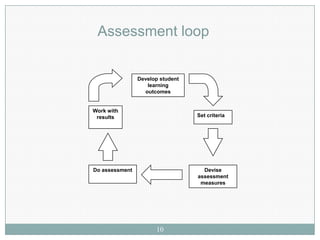
Assessment loop


                Develop student
                   learning
                  outcomes


Work with
 results                          Set criteria


Do assessment                       Devise
                                  assessment
                                   measures


                      10
Levels of assessment

 Institutional (University wide)


 Program (e.g. Department)


 Course


 Session (e.g. IL instruction)


                  11
LOA in libraries: constraints
                              12


 Lack of consistent, reliable access to students


 IL instruction: is it a “program”?


 Program assessment vs. session assessment


 Difficult to isolate effects of library instruction
Where will you assess student learning?
                             13


 On the instruction session level?


 In a for-credit library skills course?


 Across a series of library instruction sessions?


 Broadly across the student population?
Some simple approaches
                                   14


Develop learning outcomes for your instruction program, and look at
  where they are taught – “snapshots”

Focus on large programmatic efforts e.g. first year writing

Highlight specific academic departments

Assess individual library instruction sessions – develop shared
  learning outcomes, compare/contrast
What is a learning outcome?

A learning outcome is one sentence that
  indicates what students should represent,
  demonstrate or produce as a result of what
  they learn.

- source: Peggy Maki


                           15
Good learning outcomes:

 Focus on what students will learn/know/be
    able to do
   Describe actions or behaviors
   Are results oriented
   Are observable and measurable
   Include a time frame


                 16
ACRL Standards

 3 levels: standards, performance
  indicators, outcomes

 Can be used for LOA


 Examples: (1)Identifies keywords, synonyms and related
  terms for the information needed. (2) Selects an appropriate
  documentation style and uses it consistently to cite sources


                           17
Writing outcomes
                     18


Today, we’ll write learning outcomes for a
  library instruction session.
Exercise: What do you cover?

Think of an information literacy instruction
 session that you teach on a regular basis.

List what you would cover in that session.


                     19
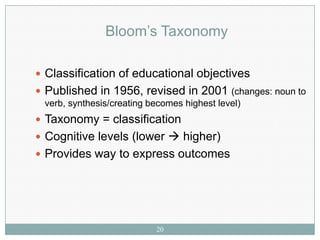
Bloom’s Taxonomy

 Classification of educational objectives
 Published in 1956, revised in 2001 (changes: noun to
 verb, synthesis/creating becomes highest level)
 Taxonomy = classification
 Cognitive levels (lower  higher)
 Provides way to express outcomes


                           20
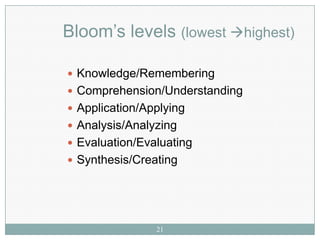
Bloom’s levels (lowest highest)

 Knowledge/Remembering
 Comprehension/Understanding
 Application/Applying
 Analysis/Analyzing
 Evaluation/Evaluating
 Synthesis/Creating


                21
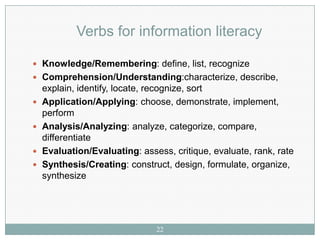
Verbs for information literacy

 Knowledge/Remembering: define, list, recognize
 Comprehension/Understanding:characterize, describe,
    explain, identify, locate, recognize, sort
   Application/Applying: choose, demonstrate, implement,
    perform
   Analysis/Analyzing: analyze, categorize, compare,
    differentiate
   Evaluation/Evaluating: assess, critique, evaluate, rank, rate
   Synthesis/Creating: construct, design, formulate, organize,
    synthesize


                               22
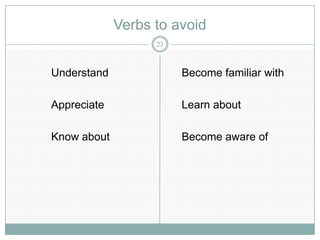
Verbs to avoid
                   23


Understand              Become familiar with

Appreciate              Learn about

Know about              Become aware of
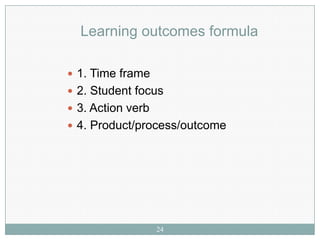
Learning outcomes formula

 1. Time frame
 2. Student focus
 3. Action verb
 4. Product/process/outcome


                   24
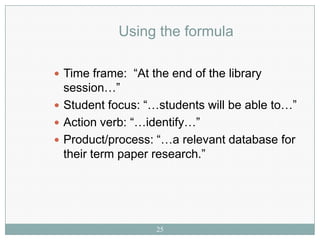
Using the formula

 Time frame: “At the end of the library
  session…”
 Student focus: “…students will be able to…”
 Action verb: “…identify…”
 Product/process: “…a relevant database for
  their term paper research.”


                   25
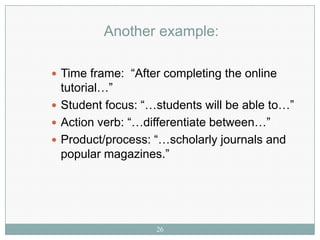
Another example:

 Time frame: “After completing the online
  tutorial…”
 Student focus: “…students will be able to…”
 Action verb: “…differentiate between…”
 Product/process: “…scholarly journals and
  popular magazines.”


                   26
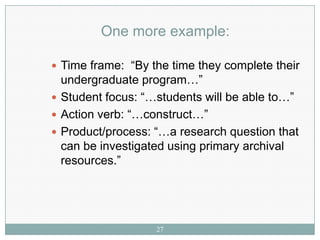
One more example:

 Time frame: “By the time they complete their
  undergraduate program…”
 Student focus: “…students will be able to…”
 Action verb: “…construct…”
 Product/process: “…a research question that
  can be investigated using primary archival
  resources.”


                   27
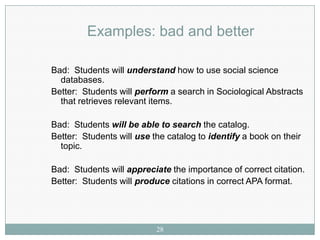
Examples: bad and better

Bad: Students will understand how to use social science
  databases.
Better: Students will perform a search in Sociological Abstracts
  that retrieves relevant items.

Bad: Students will be able to search the catalog.
Better: Students will use the catalog to identify a book on their
  topic.

Bad: Students will appreciate the importance of correct citation.
Better: Students will produce citations in correct APA format.


                           28
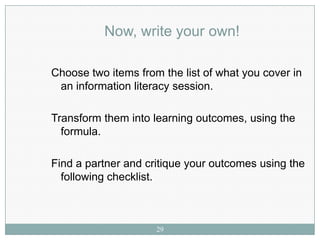
Now, write your own!

Choose two items from the list of what you cover in
 an information literacy session.

Transform them into learning outcomes, using the
  formula.

Find a partner and critique your outcomes using the
  following checklist.


                     29
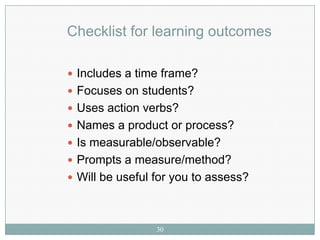
Checklist for learning outcomes

 Includes a time frame?
 Focuses on students?
 Uses action verbs?
 Names a product or process?
 Is measurable/observable?
 Prompts a measure/method?
 Will be useful for you to assess?


                 30
Setting Targets
        31


  Ask yourself

“What is success?”
Assessment Methods
         32


   Ask yourself

 “How will I know?”
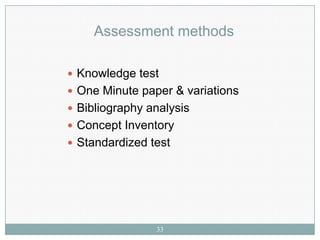
Assessment methods

 Knowledge test
 One Minute paper & variations
 Bibliography analysis
 Concept Inventory
 Standardized test


                33
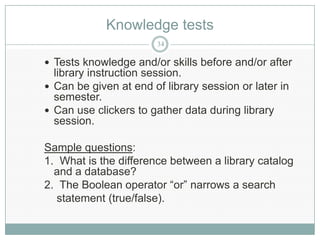
Knowledge tests
                       34

 Tests knowledge and/or skills before and/or after
  library instruction session.
 Can be given at end of library session or later in
  semester.
 Can use clickers to gather data during library
  session.

Sample questions:
1. What is the difference between a library catalog
  and a database?
2. The Boolean operator “or” narrows a search
   statement (true/false).
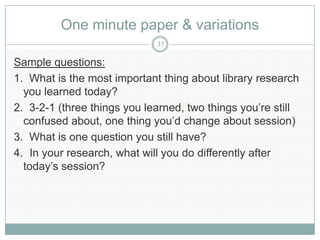
One minute paper & variations
                             35

Sample questions:
1. What is the most important thing about library research
  you learned today?
2. 3-2-1 (three things you learned, two things you’re still
  confused about, one thing you’d change about session)
3. What is one question you still have?
4. In your research, what will you do differently after
  today’s session?
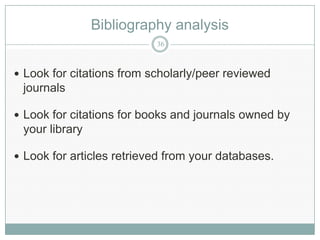
Bibliography analysis
                           36


 Look for citations from scholarly/peer reviewed
 journals

 Look for citations for books and journals owned by
 your library

 Look for articles retrieved from your databases.
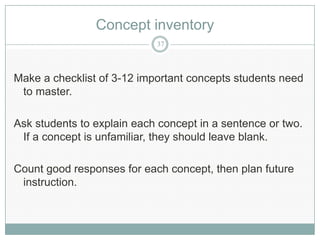
Concept inventory
                            37


Make a checklist of 3-12 important concepts students need
 to master.

Ask students to explain each concept in a sentence or two.
 If a concept is unfamiliar, they should leave blank.

Count good responses for each concept, then plan future
 instruction.
Standardized tests
                         38


 I-Skills


 ILAT (James Madison University)


 SAILS
Using assessment information

 Rewrite learning outcomes
 Change what you do/how you teach
 Work collaboratively with colleagues
  (librarians and faculty)
 Revise assessment measures
 Share the news in the library and on campus


                   39
Learning outcomes are:


 Fundamental components of a learning
  assessment program
 Focused on student learning
 Indicate what students will know/be able to do
 Measurable, observable, overt


                    40
Learning Outcomes Assessment
             41


  A tool to help librarians
 improve student learning
LOA resources

 Angelo, Thomas (1993). Classroom assessment techniques.
 Maki, Peggy (2004). Assessing for learning : building a
    sustainable commitment across the institution.
   Middle States Commission on Higher Education(2003).
    Developing research & communication skills: guidelines for
    information literacy in the curriculum
    http://msche.org/publications/devskill050208135642.pdf
   Neely, Teresa Y(2006). Information literacy assessment :
    standards-based tools and assignments.
   Radcliff, Carolyn et.al (2007). A practical guide to information
    literacy assessment for academic librarians.
   Student Learning Outcomes Assessment (University of
    Virginia)http://www.web.virginia.edu/iaas/assessment/outcom
    es.htm


                              42
Let’s assess this workshop!


            43
Thank you!


      Diane Harvey


            44

Assessing for Improvement: Workshop at Duke University Libraries

  • 1.
    Assessing for Improvement Diane Harvey June 16, 2011 1
  • 2.
    Learning outcomes fortoday At the end of this session, participants will be able to: 1. Describe the learning outcomes assessment process in libraries. 2. Write learning outcomes for an information literacy instruction session. 3. Choose appropriate assessment methods. 4. Define ways to work with assessment results. 2
  • 3.
    Why assess studentlearning in libraries? 3  Affirm commitment to student learning  Improve effectiveness of instructional programs  Align with campus, disciplinary, and higher ed efforts  Be recognized on campus for contributions to student learning
  • 4.
    What’s happening oncampus? 4 SACS re-accreditation: required departments and programs to create and assess learning outcomes (SLOs/objectives/goals) Undergraduate programs have done this; graduate programs are in the process Every department and program website must post learning outcomes
  • 5.
    Example: Classical Studies 5 Majors develop:  Comprehensive knowledge of disciplinary fundamentals through study of Greek and Latin (CLLA), courses in both Greek and Roman history, and a variety of courses in literature, art and archaeology, history, philosophy (CLCIV), with ample scope in both domains for developing advanced-level proficiencies through more concentrated study.  Proficiency in writing in the discipline of Classical Studies, enjoying opportunities to write research and analytical papers in in both CLLA and CLCIV courses. In addition, all majors take the Capstone Seminar.  Research experience, through the Capstone seminar; majors are also encouraged to write a Senior Thesis.  Expertise outside the classroom, including study abroad, excavation experience, summer abroad programs, and other varieties of hands-on experience, including other experiential learning opportunities.
  • 6.
    Assessing for improvement 6 We don’t assess to prove… …but to improve. D. Stufflebeam
  • 7.
    What will wedo in the library? 7  Summer 2011: workshops on LOA and shared learning outcomes for WR20 library instruction.  Fall 2011: begin assessing student learning in WR20 and subject specific instruction.  Spring 2012: continue assessing, gather feedback from librarians
  • 8.
    What is LOA:learning outcomes assessment? 8  Systematic look at what students are learning  Moving from “What am I going to teach today?” to “What do I want students to learn today?”
  • 9.
    What LOA isNOT 9  NOT evaluation of teaching  NOT evaluation of program
  • 10.
    Assessment loop Develop student learning outcomes Work with results Set criteria Do assessment Devise assessment measures 10
  • 11.
    Levels of assessment Institutional (University wide)  Program (e.g. Department)  Course  Session (e.g. IL instruction) 11
  • 12.
    LOA in libraries:constraints 12  Lack of consistent, reliable access to students  IL instruction: is it a “program”?  Program assessment vs. session assessment  Difficult to isolate effects of library instruction
  • 13.
    Where will youassess student learning? 13  On the instruction session level?  In a for-credit library skills course?  Across a series of library instruction sessions?  Broadly across the student population?
  • 14.
    Some simple approaches 14 Develop learning outcomes for your instruction program, and look at where they are taught – “snapshots” Focus on large programmatic efforts e.g. first year writing Highlight specific academic departments Assess individual library instruction sessions – develop shared learning outcomes, compare/contrast
  • 15.
    What is alearning outcome? A learning outcome is one sentence that indicates what students should represent, demonstrate or produce as a result of what they learn. - source: Peggy Maki 15
  • 16.
    Good learning outcomes: Focus on what students will learn/know/be able to do  Describe actions or behaviors  Are results oriented  Are observable and measurable  Include a time frame 16
  • 17.
    ACRL Standards  3levels: standards, performance indicators, outcomes  Can be used for LOA  Examples: (1)Identifies keywords, synonyms and related terms for the information needed. (2) Selects an appropriate documentation style and uses it consistently to cite sources 17
  • 18.
    Writing outcomes 18 Today, we’ll write learning outcomes for a library instruction session.
  • 19.
    Exercise: What doyou cover? Think of an information literacy instruction session that you teach on a regular basis. List what you would cover in that session. 19
  • 20.
    Bloom’s Taxonomy  Classificationof educational objectives  Published in 1956, revised in 2001 (changes: noun to verb, synthesis/creating becomes highest level)  Taxonomy = classification  Cognitive levels (lower  higher)  Provides way to express outcomes 20
  • 21.
    Bloom’s levels (lowesthighest)  Knowledge/Remembering  Comprehension/Understanding  Application/Applying  Analysis/Analyzing  Evaluation/Evaluating  Synthesis/Creating 21
  • 22.
    Verbs for informationliteracy  Knowledge/Remembering: define, list, recognize  Comprehension/Understanding:characterize, describe, explain, identify, locate, recognize, sort  Application/Applying: choose, demonstrate, implement, perform  Analysis/Analyzing: analyze, categorize, compare, differentiate  Evaluation/Evaluating: assess, critique, evaluate, rank, rate  Synthesis/Creating: construct, design, formulate, organize, synthesize 22
  • 23.
    Verbs to avoid 23 Understand Become familiar with Appreciate Learn about Know about Become aware of
  • 24.
    Learning outcomes formula 1. Time frame  2. Student focus  3. Action verb  4. Product/process/outcome 24
  • 25.
    Using the formula Time frame: “At the end of the library session…”  Student focus: “…students will be able to…”  Action verb: “…identify…”  Product/process: “…a relevant database for their term paper research.” 25
  • 26.
    Another example:  Timeframe: “After completing the online tutorial…”  Student focus: “…students will be able to…”  Action verb: “…differentiate between…”  Product/process: “…scholarly journals and popular magazines.” 26
  • 27.
    One more example: Time frame: “By the time they complete their undergraduate program…”  Student focus: “…students will be able to…”  Action verb: “…construct…”  Product/process: “…a research question that can be investigated using primary archival resources.” 27
  • 28.
    Examples: bad andbetter Bad: Students will understand how to use social science databases. Better: Students will perform a search in Sociological Abstracts that retrieves relevant items. Bad: Students will be able to search the catalog. Better: Students will use the catalog to identify a book on their topic. Bad: Students will appreciate the importance of correct citation. Better: Students will produce citations in correct APA format. 28
  • 29.
    Now, write yourown! Choose two items from the list of what you cover in an information literacy session. Transform them into learning outcomes, using the formula. Find a partner and critique your outcomes using the following checklist. 29
  • 30.
    Checklist for learningoutcomes  Includes a time frame?  Focuses on students?  Uses action verbs?  Names a product or process?  Is measurable/observable?  Prompts a measure/method?  Will be useful for you to assess? 30
  • 31.
    Setting Targets 31 Ask yourself “What is success?”
  • 32.
    Assessment Methods 32 Ask yourself “How will I know?”
  • 33.
    Assessment methods  Knowledgetest  One Minute paper & variations  Bibliography analysis  Concept Inventory  Standardized test 33
  • 34.
    Knowledge tests 34  Tests knowledge and/or skills before and/or after library instruction session.  Can be given at end of library session or later in semester.  Can use clickers to gather data during library session. Sample questions: 1. What is the difference between a library catalog and a database? 2. The Boolean operator “or” narrows a search statement (true/false).
  • 35.
    One minute paper& variations 35 Sample questions: 1. What is the most important thing about library research you learned today? 2. 3-2-1 (three things you learned, two things you’re still confused about, one thing you’d change about session) 3. What is one question you still have? 4. In your research, what will you do differently after today’s session?
  • 36.
    Bibliography analysis 36  Look for citations from scholarly/peer reviewed journals  Look for citations for books and journals owned by your library  Look for articles retrieved from your databases.
  • 37.
    Concept inventory 37 Make a checklist of 3-12 important concepts students need to master. Ask students to explain each concept in a sentence or two. If a concept is unfamiliar, they should leave blank. Count good responses for each concept, then plan future instruction.
  • 38.
    Standardized tests 38  I-Skills  ILAT (James Madison University)  SAILS
  • 39.
    Using assessment information Rewrite learning outcomes  Change what you do/how you teach  Work collaboratively with colleagues (librarians and faculty)  Revise assessment measures  Share the news in the library and on campus 39
  • 40.
    Learning outcomes are: Fundamental components of a learning assessment program  Focused on student learning  Indicate what students will know/be able to do  Measurable, observable, overt 40
  • 41.
    Learning Outcomes Assessment 41 A tool to help librarians improve student learning
  • 42.
    LOA resources  Angelo,Thomas (1993). Classroom assessment techniques.  Maki, Peggy (2004). Assessing for learning : building a sustainable commitment across the institution.  Middle States Commission on Higher Education(2003). Developing research & communication skills: guidelines for information literacy in the curriculum http://msche.org/publications/devskill050208135642.pdf  Neely, Teresa Y(2006). Information literacy assessment : standards-based tools and assignments.  Radcliff, Carolyn et.al (2007). A practical guide to information literacy assessment for academic librarians.  Student Learning Outcomes Assessment (University of Virginia)http://www.web.virginia.edu/iaas/assessment/outcom es.htm 42
  • 43.
  • 44.
    Thank you! Diane Harvey 44