LEARNER-CENTERED LEARNING
Introduction:
Learner-centered Learning places the focus of
attention on the quality of student learning . It is
based on the understanding that each learner has
different characteristics and these characteristics
should be employed to elevate both training and
learning.
This process is designed so that students can learn
how they learn best. Taking into consideration what
works for one may not work for another and at the
end of the day it’s not about what was taught but
what was learned.
WHY LEARNER CENTERED LEARNING
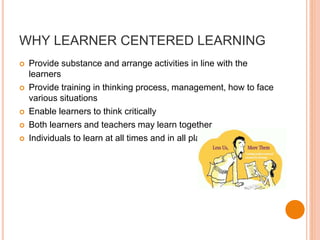
 Provide substance and arrange activities in line with the
learners
 Provide training in thinking process, management, how to face
various situations
 Enable learners to think critically
 Both learners and teachers may learn together
 Individuals to learn at all times and in all places
Learner-centered Learning Principles
 According to Jonassen et al. (1995), there are four distinct attributes of
learner-centered effective Learning courses:
 Context: Learning tasks should have a real world application that allows
learners to connect personally with what they are learning.
 Construction: Learners should be able to link their own experiences
and prior knowledge with new learning.
 Collaboration: A problem-solving scenario allows learners to develop,
test, and analyze their ideas while being exposed to others' opinions.
Each learner will arrive at an individual conclusion after collaboration is
completed.
 Conversation: Communication with and within learners is essential to
effective eLearning courses. Learners should spend time in
conversation while planning and make sense of new learning.
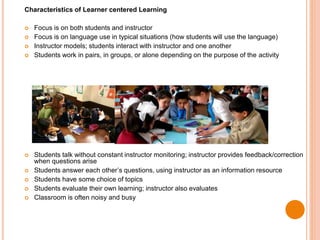
Characteristics of Learner centered Learning
 Focus is on both students and instructor
 Focus is on language use in typical situations (how students will use the language)
 Instructor models; students interact with instructor and one another
 Students work in pairs, in groups, or alone depending on the purpose of the activity
 Students talk without constant instructor monitoring; instructor provides feedback/correction
when questions arise
 Students answer each other’s questions, using instructor as an information resource
 Students have some choice of topics
 Students evaluate their own learning; instructor also evaluates
 Classroom is often noisy and busy
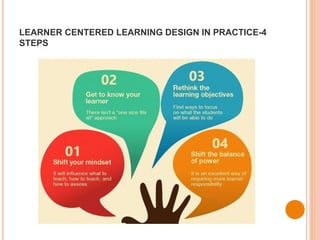
LEARNER CENTERED LEARNING DESIGN IN PRACTICE-4
STEPS
DISCIPLINES ARE APPROACHED IN SCHOOL
SUBJECTS
Meaning of Discipline
 The meaning of discipline refers to a branch of academic
study. For example, psychology, sociology, anthropology,
mathematics and philosophy are all disciplines. These can be
mostly be seen in higher educational institutions such as
universities.
Meaning of school subject:
 Subject refers to a branch of knowledge studied or taught.
Subject means something or someone that is a topic of a
discussion, writing, art piece or area of study. At school, each
lesson usually covers one subject only. Some of the most
common school subjects at school are English, History,
Mathematics, Physical Education, Religion, Music, Art,
Dancing, Health, etc.
 Characterized by
DISCIPLINES;
 A defined approach
 A label that is different from the subject of study/research
 A history as a human practice
 An associated profession
 Disciplines are taught in higher educational institutions such as
universities
 Examples include: Medicine and Dentistry; Linguistics: Physics,
Astronomy and Astrophysics
SCHOOL SUBJECTS:
 Being concepts independent of how they’ve been studied
 Being studied by multiple disciplines
 Having little or no overlap with adjacent subjects (i.e are defined in
contra-distinction)Examples includes: medicine, French language,
physics
 Subjects are taught in educational institutions such as schools
Disciplines are approached in school subjects:
 A discipline is a branch of learning or domain of knowledge
that is characterized by distinct objects, concepts principles,
theories, skills, tools and applications, it incorporates. These
disciplines are approached by school subjects in following
ways:
 Body of specialized knowledge
 Has theories and concepts
 Specific terminology
 Specific object of research
 Definite methodology of research
 Institutional manifestation in form of subjects taught ,
professional organizations
Subjects are generally classified under these discipline heads;
 Humanities (also called Arts and Humanities)
 Social Sciences
 Natural Sciences
 Mathematics
 Business
 Discuss all the five broad disciplines with
 Examples of subjects
 The main focus of the study of the discipline
 Methods used to expand disciplinary knowledge (eg Science uses scientific
inquiry, experimentation etc while Social sciences use Social critique ,
interpretative methods)
 Impact of these disciplines on our lives
 Professions and the disciplines
 Emergence of academic disciplines
 Language as a discipline
 History and Geography
 Science
 Mathematics
 Mathematics
 Relationship between academic disciplines and subjects
 Subjects within a disciplines have common features
 understanding of the disciplines helps to understand a subject better
 The subtle differences between disciplines and subjects
 Disciplines and subjects are like ground and figure
 Definite focus while teaching a subject
 Appreciate other subjects within one’s discipline
 More meaningful learning experiences can be arranged
 Clarity of concepts
 Teachers may need to give vocational and academic advice to
students
 Why do teachers need knowledge about disciplines and subjects?
 Creates interdisciplinary bent of mind
 Help in research work
 Community of practice benefit, better contribution to academic
bodies and journals
 Helps to face real world challenges
THANK YOU

LEARNING CENTERED LEARNING

  • 2.
    LEARNER-CENTERED LEARNING Introduction: Learner-centered Learningplaces the focus of attention on the quality of student learning . It is based on the understanding that each learner has different characteristics and these characteristics should be employed to elevate both training and learning. This process is designed so that students can learn how they learn best. Taking into consideration what works for one may not work for another and at the end of the day it’s not about what was taught but what was learned.
  • 3.
    WHY LEARNER CENTEREDLEARNING  Provide substance and arrange activities in line with the learners  Provide training in thinking process, management, how to face various situations  Enable learners to think critically  Both learners and teachers may learn together  Individuals to learn at all times and in all places
  • 4.
    Learner-centered Learning Principles According to Jonassen et al. (1995), there are four distinct attributes of learner-centered effective Learning courses:  Context: Learning tasks should have a real world application that allows learners to connect personally with what they are learning.  Construction: Learners should be able to link their own experiences and prior knowledge with new learning.  Collaboration: A problem-solving scenario allows learners to develop, test, and analyze their ideas while being exposed to others' opinions. Each learner will arrive at an individual conclusion after collaboration is completed.  Conversation: Communication with and within learners is essential to effective eLearning courses. Learners should spend time in conversation while planning and make sense of new learning.
  • 5.
    Characteristics of Learnercentered Learning  Focus is on both students and instructor  Focus is on language use in typical situations (how students will use the language)  Instructor models; students interact with instructor and one another  Students work in pairs, in groups, or alone depending on the purpose of the activity  Students talk without constant instructor monitoring; instructor provides feedback/correction when questions arise  Students answer each other’s questions, using instructor as an information resource  Students have some choice of topics  Students evaluate their own learning; instructor also evaluates  Classroom is often noisy and busy
  • 6.
    LEARNER CENTERED LEARNINGDESIGN IN PRACTICE-4 STEPS
  • 7.
    DISCIPLINES ARE APPROACHEDIN SCHOOL SUBJECTS Meaning of Discipline  The meaning of discipline refers to a branch of academic study. For example, psychology, sociology, anthropology, mathematics and philosophy are all disciplines. These can be mostly be seen in higher educational institutions such as universities. Meaning of school subject:  Subject refers to a branch of knowledge studied or taught. Subject means something or someone that is a topic of a discussion, writing, art piece or area of study. At school, each lesson usually covers one subject only. Some of the most common school subjects at school are English, History, Mathematics, Physical Education, Religion, Music, Art, Dancing, Health, etc.
  • 8.
     Characterized by DISCIPLINES; A defined approach  A label that is different from the subject of study/research  A history as a human practice  An associated profession  Disciplines are taught in higher educational institutions such as universities  Examples include: Medicine and Dentistry; Linguistics: Physics, Astronomy and Astrophysics SCHOOL SUBJECTS:  Being concepts independent of how they’ve been studied  Being studied by multiple disciplines  Having little or no overlap with adjacent subjects (i.e are defined in contra-distinction)Examples includes: medicine, French language, physics  Subjects are taught in educational institutions such as schools
  • 9.
    Disciplines are approachedin school subjects:  A discipline is a branch of learning or domain of knowledge that is characterized by distinct objects, concepts principles, theories, skills, tools and applications, it incorporates. These disciplines are approached by school subjects in following ways:  Body of specialized knowledge  Has theories and concepts  Specific terminology  Specific object of research  Definite methodology of research  Institutional manifestation in form of subjects taught , professional organizations
  • 10.
    Subjects are generallyclassified under these discipline heads;  Humanities (also called Arts and Humanities)  Social Sciences  Natural Sciences  Mathematics  Business  Discuss all the five broad disciplines with  Examples of subjects  The main focus of the study of the discipline  Methods used to expand disciplinary knowledge (eg Science uses scientific inquiry, experimentation etc while Social sciences use Social critique , interpretative methods)  Impact of these disciplines on our lives  Professions and the disciplines  Emergence of academic disciplines  Language as a discipline  History and Geography  Science  Mathematics
  • 11.
     Mathematics  Relationshipbetween academic disciplines and subjects  Subjects within a disciplines have common features  understanding of the disciplines helps to understand a subject better  The subtle differences between disciplines and subjects  Disciplines and subjects are like ground and figure  Definite focus while teaching a subject  Appreciate other subjects within one’s discipline  More meaningful learning experiences can be arranged  Clarity of concepts  Teachers may need to give vocational and academic advice to students  Why do teachers need knowledge about disciplines and subjects?  Creates interdisciplinary bent of mind  Help in research work  Community of practice benefit, better contribution to academic bodies and journals  Helps to face real world challenges
  • 12.