Curriculum MODEL DESIGNS
Reporter : ANNA MARIE M. SANCHEZ
Curriculum
Model Design
I N T R O D U C T I O N
As a TEACHER, one has to
be a:
– curriculum designer
– curriculum implementer
– curriculum evaluator
Ornstein and Hunkins (2009)
contend that curriculum development
encompasses how a ‘curriculum is
planned, implemented and evaluated,
as well as what people, processes and
procedures are involved..’. Curriculum
models help designers to systematically
and transparently map out the rationale
for the use of particular teaching,
learning and assessment approaches..
Ornstein and Hunkins (2009) suggest
that although curriculum development
models are technically useful, they often
overlook the human aspect such as the
personal attitudes, feelings, values involved
in curriculum making. Therefore they are not
a recipe and should not be a substitute for
using your professional and personal
judgement on what is a good approach to
enhancing student learning.
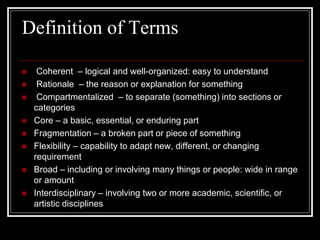
Definition of Terms
 Coherent – logical and well-organized: easy to understand
 Rationale – the reason or explanation for something
 Compartmentalized – to separate (something) into sections or
categories
 Core – a basic, essential, or enduring part
 Fragmentation – a broken part or piece of something
 Flexibility – capability to adapt new, different, or changing
requirement
 Broad – including or involving many things or people: wide in range
or amount
 Interdisciplinary – involving two or more academic, scientific, or
artistic disciplines
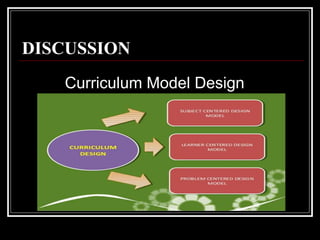
DISCUSSION
Curriculum Model Design
SUBJECT-CENTERED
Design Model
Subject-Centered Curriculum
o This model focuses on the content
of the curriculum.
o The subject centered design
corresponds mostly to the textbook
written for the specific subject.
Subject-Centered Curriculum
o A curriculum can also be organized around
a subject center by focusing on certain
processes, strategies, or life-skills, such as
problem solving, decision making, or
teamwork.
In the Philippines, our curricula in
any level is also divided in different
subjects or courses. Most of the
schools using this kind of structure
aim for excellence in the subject
matter content.
Subject-Centered Curriculum
Examples of Subject-centered curriculum:
a. Subject Design
o oldest and so far the most familiar design for
teachers, parents and laymen.
o The drawback of this design is that sometimes
learning is so compartmentalized.
o It stresses so much the content that it forgets
about students’ natural tendencies, interest and
experiences.
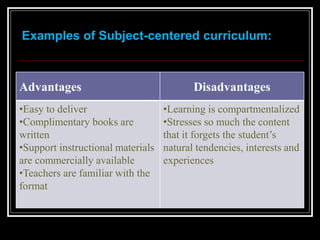
Advantages Disadvantages
•Easy to deliver
•Complimentary books are
written
•Support instructional materials
are commercially available
•Teachers are familiar with the
format
•Learning is compartmentalized
•Stresses so much the content
that it forgets the student’s
natural tendencies, interests and
experiences
Examples of Subject-centered curriculum:
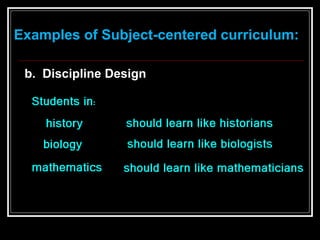
b. Discipline Design
o Focuses on academic disciplines
 DISCIPLINE – refers to specific
knowledge learned through a method
which the scholars use to study a specific
content of their field.
Examples of Subject-centered curriculum:
b. Discipline Design
o This comes from a core, correlated
curriculum design that links separate
subject designs in order to reduce
fragmentation.
o Subjects are related to one another but
each subject a maintains its identity.
c. Correlation Design
Examples of subject-centered curriculum:
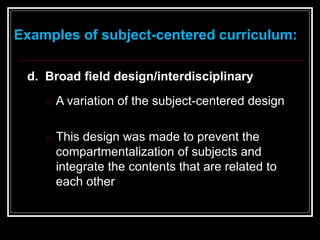
d. Broad field design/interdisciplinary
o A variation of the subject-centered design
o This design was made to prevent the
compartmentalization of subjects and
integrate the contents that are related to
each other
Examples of subject-centered curriculum:
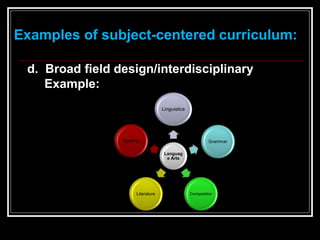
d. Broad field design/interdisciplinary
Example:
Languag
e Arts
Linguistics
Grammar
Composition
Literature
Spelling
LEARNER-CENTERED
Design Model
Learner-Centered Curriculum
“Learner is the
center of the
educative
process”
Learner-Centered Curriculum
centered on certain aspects of the learners
themselves.
may explore the learner’s own life or family
history or local environment.
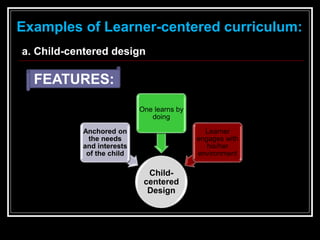
FEATURES:
Child-
centered
Design
Anchored on
the needs
and interests
of the child
One learns by
doing
Learner
engages with
his/her
environment
a. Child-centered design
Examples of Learner-centered curriculum:
JOHN
DEWEY
ROUSSEAU PESTALLOZI FROEBEL
 This design is often attributed to the influence of ;
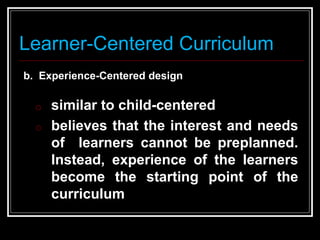
b. Experience-Centered design
o similar to child-centered
o believes that the interest and needs
of learners cannot be preplanned.
Instead, experience of the learners
become the starting point of the
curriculum
Learner-Centered Curriculum
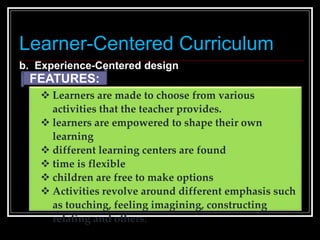
FEATURES:
 Learners are made to choose from various
activities that the teacher provides.
 learners are empowered to shape their own
learning
 different learning centers are found
 time is flexible
 children are free to make options
 Activities revolve around different emphasis such
as touching, feeling imagining, constructing
relating and others.
b. Experience-Centered design
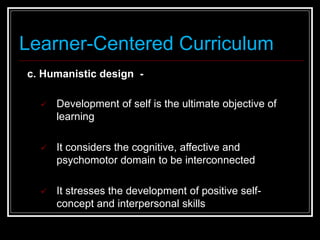
c. Humanistic design -
 Development of self is the ultimate objective of
learning
 It considers the cognitive, affective and
psychomotor domain to be interconnected
 It stresses the development of positive self-
concept and interpersonal skills
Learner-Centered Curriculum
Advantages:
 It gives power to the learners: they are
identified as the experts in knowing what
they need to know.
 The constructivist element of this approach
honors the social and cultural context of the
learner.
Advantages:
 It creates a direct link between in-class
work and learners' need for literacy outside
the classroom.
As a result, learners can more easily transfer new skills
to day-to-day use (Purcell-Gates, et al., 2001). The
immediacy of this transfer of skills at home, at work, and
in communities also encourages learner persistence.
Disadvantages:
 It often relies on the teacher's ability to create or select
materials appropriate to learners' expressed needs.
This requires skill on the part of the teacher, as well as
time and resources: at a minimum, texts brought in from
real life, a wide pool of commercially available materials
from which to draw, and a reliable photocopier. Given
the reality of teachers' professional preparation and
working conditions (Smith, et al., 2001), lack of skill,
time and resources makes creating curriculum with this
approach difficult.
Disadvantages:
 Teachers may also find it difficult to strike
an acceptable balance among the
competing needs and interests of students.
PROBLEM-CENTERED
Design Model
Problem-Centered Curriculum
o Problem-centered curriculum, or problem
based learning, organizes subject matter
around a problem, real or hypothetical,
that needs to be solved.
o Problem-centered curriculum is inherently
engaging and authentic, because the
students have a real purpose to their
inquiry -- solving the problem.
 Types of problems to be explored may include:
 Life situations involving real problems of practice
 Problems that revolve around life at a given
school
 Problems selected from local issues
 Philosophical or moral problems
Problem-Centered Curriculum
a. Life-situations design
 Contents are organized in ways that
allow students to view problem areas
clearly.
 It uses the past and present
experiences of learners as a means to
analyze the basic areas of living.
Problem-Centered Curriculum
Examples of Problem-centered curriculum:
b. Core design
o It centers on general education and the
problems are based on common human
activities.
o The central focus of the core design
includes common needs, problems,
concerns, of the learners.
Problem-Centered Curriculum
Examples of Problem-centered curriculum:
CONCLUSION:
No one model is ideal and no one
model may suit a full programme.
However, identifying and being
consistent with these models will help
support cohesion and clarity of
approaches in the programme.
CONCLUSION:
Exploring the views on these
different models and using them to
help design and deliver the programme
to obtain the best and most coherent
educational experience for both the
students and the staff who teach on
this programme.
IMPLICATION TO EDUCATION
Curriculum design is an aspect of the
education profession on developing curricula for
students. Students, as the major stakeholders of
the institution should be provided with
opportunities to choose what subject matter they
would like to learn and what type of curriculum
would be appropriate for them. They may come
from a wide variety of cultural and class
backgrounds, and curriculum design should not be
a one size that fits all approach.
IMPLICATION TO EDUCATION
Flexibility is an important aspect of
curriculum design. As classroom
teachers, we are working with students
of different levels of ability, and we
need to be able to adjust the
curriculum to keep all the students
engaged and learning.
End…

Advanced Curriculum Development Report.pptx

  • 1.
    Curriculum MODEL DESIGNS Reporter: ANNA MARIE M. SANCHEZ
  • 2.
  • 3.
    I N TR O D U C T I O N As a TEACHER, one has to be a: – curriculum designer – curriculum implementer – curriculum evaluator
  • 4.
    Ornstein and Hunkins(2009) contend that curriculum development encompasses how a ‘curriculum is planned, implemented and evaluated, as well as what people, processes and procedures are involved..’. Curriculum models help designers to systematically and transparently map out the rationale for the use of particular teaching, learning and assessment approaches..
  • 5.
    Ornstein and Hunkins(2009) suggest that although curriculum development models are technically useful, they often overlook the human aspect such as the personal attitudes, feelings, values involved in curriculum making. Therefore they are not a recipe and should not be a substitute for using your professional and personal judgement on what is a good approach to enhancing student learning.
  • 6.
    Definition of Terms Coherent – logical and well-organized: easy to understand  Rationale – the reason or explanation for something  Compartmentalized – to separate (something) into sections or categories  Core – a basic, essential, or enduring part  Fragmentation – a broken part or piece of something  Flexibility – capability to adapt new, different, or changing requirement  Broad – including or involving many things or people: wide in range or amount  Interdisciplinary – involving two or more academic, scientific, or artistic disciplines
  • 7.
  • 8.
  • 9.
    Subject-Centered Curriculum o Thismodel focuses on the content of the curriculum. o The subject centered design corresponds mostly to the textbook written for the specific subject.
  • 10.
    Subject-Centered Curriculum o Acurriculum can also be organized around a subject center by focusing on certain processes, strategies, or life-skills, such as problem solving, decision making, or teamwork.
  • 11.
    In the Philippines,our curricula in any level is also divided in different subjects or courses. Most of the schools using this kind of structure aim for excellence in the subject matter content. Subject-Centered Curriculum
  • 12.
    Examples of Subject-centeredcurriculum: a. Subject Design o oldest and so far the most familiar design for teachers, parents and laymen. o The drawback of this design is that sometimes learning is so compartmentalized. o It stresses so much the content that it forgets about students’ natural tendencies, interest and experiences.
  • 13.
    Advantages Disadvantages •Easy todeliver •Complimentary books are written •Support instructional materials are commercially available •Teachers are familiar with the format •Learning is compartmentalized •Stresses so much the content that it forgets the student’s natural tendencies, interests and experiences Examples of Subject-centered curriculum:
  • 14.
    Examples of Subject-centeredcurriculum: b. Discipline Design o Focuses on academic disciplines  DISCIPLINE – refers to specific knowledge learned through a method which the scholars use to study a specific content of their field.
  • 15.
    Examples of Subject-centeredcurriculum: b. Discipline Design
  • 16.
    o This comesfrom a core, correlated curriculum design that links separate subject designs in order to reduce fragmentation. o Subjects are related to one another but each subject a maintains its identity. c. Correlation Design Examples of subject-centered curriculum:
  • 17.
    Examples of subject-centeredcurriculum: d. Broad field design/interdisciplinary o A variation of the subject-centered design o This design was made to prevent the compartmentalization of subjects and integrate the contents that are related to each other
  • 18.
    Examples of subject-centeredcurriculum: d. Broad field design/interdisciplinary Example: Languag e Arts Linguistics Grammar Composition Literature Spelling
  • 19.
  • 20.
    Learner-Centered Curriculum “Learner isthe center of the educative process”
  • 21.
    Learner-Centered Curriculum centered oncertain aspects of the learners themselves. may explore the learner’s own life or family history or local environment.
  • 22.
    FEATURES: Child- centered Design Anchored on the needs andinterests of the child One learns by doing Learner engages with his/her environment a. Child-centered design Examples of Learner-centered curriculum:
  • 23.
    JOHN DEWEY ROUSSEAU PESTALLOZI FROEBEL This design is often attributed to the influence of ;
  • 24.
    b. Experience-Centered design osimilar to child-centered o believes that the interest and needs of learners cannot be preplanned. Instead, experience of the learners become the starting point of the curriculum Learner-Centered Curriculum
  • 25.
    Learner-Centered Curriculum FEATURES:  Learnersare made to choose from various activities that the teacher provides.  learners are empowered to shape their own learning  different learning centers are found  time is flexible  children are free to make options  Activities revolve around different emphasis such as touching, feeling imagining, constructing relating and others. b. Experience-Centered design
  • 26.
    c. Humanistic design-  Development of self is the ultimate objective of learning  It considers the cognitive, affective and psychomotor domain to be interconnected  It stresses the development of positive self- concept and interpersonal skills Learner-Centered Curriculum
  • 27.
    Advantages:  It givespower to the learners: they are identified as the experts in knowing what they need to know.  The constructivist element of this approach honors the social and cultural context of the learner.
  • 28.
    Advantages:  It createsa direct link between in-class work and learners' need for literacy outside the classroom. As a result, learners can more easily transfer new skills to day-to-day use (Purcell-Gates, et al., 2001). The immediacy of this transfer of skills at home, at work, and in communities also encourages learner persistence.
  • 29.
    Disadvantages:  It oftenrelies on the teacher's ability to create or select materials appropriate to learners' expressed needs. This requires skill on the part of the teacher, as well as time and resources: at a minimum, texts brought in from real life, a wide pool of commercially available materials from which to draw, and a reliable photocopier. Given the reality of teachers' professional preparation and working conditions (Smith, et al., 2001), lack of skill, time and resources makes creating curriculum with this approach difficult.
  • 30.
    Disadvantages:  Teachers mayalso find it difficult to strike an acceptable balance among the competing needs and interests of students.
  • 31.
  • 32.
    Problem-Centered Curriculum o Problem-centeredcurriculum, or problem based learning, organizes subject matter around a problem, real or hypothetical, that needs to be solved. o Problem-centered curriculum is inherently engaging and authentic, because the students have a real purpose to their inquiry -- solving the problem.
  • 33.
     Types ofproblems to be explored may include:  Life situations involving real problems of practice  Problems that revolve around life at a given school  Problems selected from local issues  Philosophical or moral problems Problem-Centered Curriculum
  • 34.
    a. Life-situations design Contents are organized in ways that allow students to view problem areas clearly.  It uses the past and present experiences of learners as a means to analyze the basic areas of living. Problem-Centered Curriculum Examples of Problem-centered curriculum:
  • 35.
    b. Core design oIt centers on general education and the problems are based on common human activities. o The central focus of the core design includes common needs, problems, concerns, of the learners. Problem-Centered Curriculum Examples of Problem-centered curriculum:
  • 36.
    CONCLUSION: No one modelis ideal and no one model may suit a full programme. However, identifying and being consistent with these models will help support cohesion and clarity of approaches in the programme.
  • 37.
    CONCLUSION: Exploring the viewson these different models and using them to help design and deliver the programme to obtain the best and most coherent educational experience for both the students and the staff who teach on this programme.
  • 38.
    IMPLICATION TO EDUCATION Curriculumdesign is an aspect of the education profession on developing curricula for students. Students, as the major stakeholders of the institution should be provided with opportunities to choose what subject matter they would like to learn and what type of curriculum would be appropriate for them. They may come from a wide variety of cultural and class backgrounds, and curriculum design should not be a one size that fits all approach.
  • 39.
    IMPLICATION TO EDUCATION Flexibilityis an important aspect of curriculum design. As classroom teachers, we are working with students of different levels of ability, and we need to be able to adjust the curriculum to keep all the students engaged and learning.
  • 40.