Nazareth
College of
Education for
Women,Avadi
Understanding Disciplines and Subjects
Designing Learner Centered Curriculum
Sujeetha.R
B.Ed –I Year
2018-2020
Learner Centered
Curriculum
Education is life ,and since life is changing ,there
could be no fixed curriculum. Curriculum is to be
built upon what the pupils are interested and the
development of the whole personality of the child.
Chinese Proverb
Kelly’s 1977
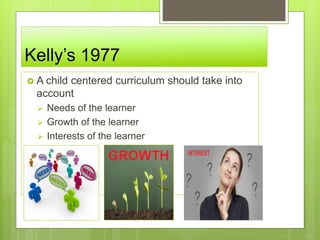
 A child centered curriculum should take into
account
 Needs of the learner
 Growth of the learner
 Interests of the learner
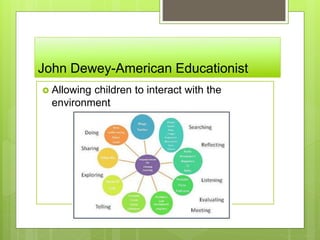
John Dewey-American Educationist
 Allowing children to interact with the
environment
John Dewey-American Educationist
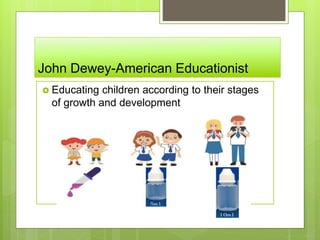
 Educating children according to their stages
of growth and development
John Dewey-American Educationist
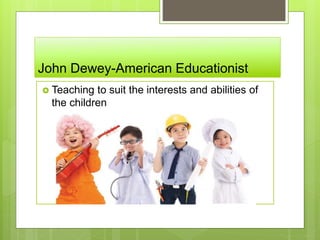
 Teaching to suit the interests and abilities of
the children
John Dewey-American Educationist
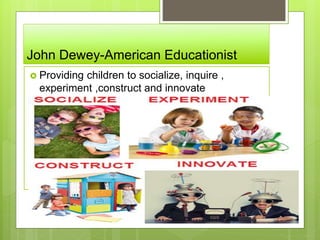
 Providing children to socialize, inquire ,
experiment ,construct and innovate
Student centered curriculum
refers to
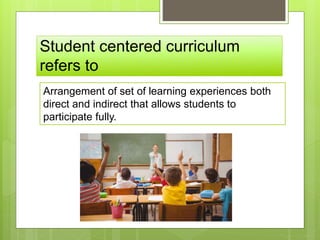
Arrangement of set of learning experiences both
direct and indirect that allows students to
participate fully.
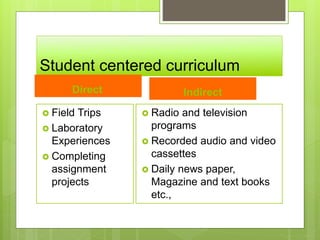
Student centered curriculum
Direct
 Field Trips
 Laboratory
Experiences
 Completing
assignment
projects
Indirect
 Radio and television
programs
 Recorded audio and video
cassettes
 Daily news paper,
Magazine and text books
etc.,
Important features of student
centered curriculum
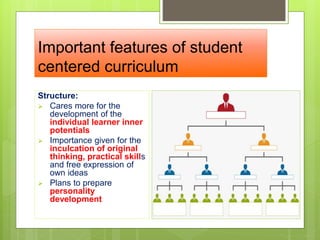
Structure:
 Cares more for the
development of the
individual learner inner
potentials
 Importance given for the
inculcation of original
thinking, practical skills
and free expression of
own ideas
 Plans to prepare
personality
development
Important features of student
centered curriculum
Objectives:
 Not planned in
advance
 Formulated on
the basis of the
student need ,
interest,
developmental
stage
 Highly flexible
Important features of student
centered curriculum
Contents:
 Selected basis of the student
need, ability to learn , age ,
aptitude and previous
experiences
 Lessons are written using words
familiar to the students
 Rote learning is not encouraged
 Direct experiences are insisted
to facilitate original thinking
Example
Difficult Exasperating
strenuous
Important features of student
centered curriculum
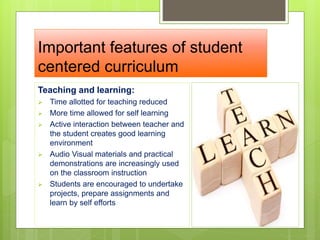
Teaching and learning:
 Time allotted for teaching reduced
 More time allowed for self learning
 Active interaction between teacher and
the student creates good learning
environment
 Audio Visual materials and practical
demonstrations are increasingly used
on the classroom instruction
 Students are encouraged to undertake
projects, prepare assignments and
learn by self efforts
Important features of student
centered curriculum
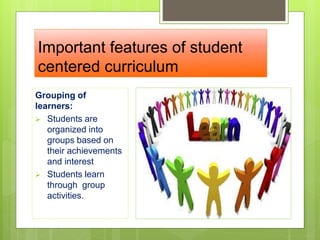
Grouping of
learners:
 Students are
organized into
groups based on
their achievements
and interest
 Students learn
through group
activities.
Important features of student
centered curriculum
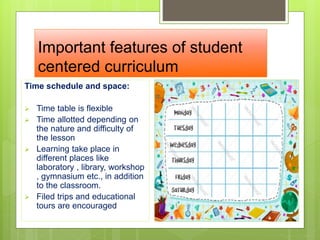
Time schedule and space:
 Time table is flexible
 Time allotted depending on
the nature and difficulty of
the lesson
 Learning take place in
different places like
laboratory , library, workshop
, gymnasium etc., in addition
to the classroom.
 Filed trips and educational
tours are encouraged
Important features of student
centered curriculum
Role of the teacher:
 Teacher is a facilitator
 Social distance between
the teacher and the
student will decrease.
 Teacher will not hesitate to
accept student’s ideas.
Important features of student
centered curriculum
Evaluation:
 Apart from teacher
evaluation ,self evaluation
will be there.
 Students are assessed
how they learn not merely
what they learn
Advantages of Student centered
Curriculum
 Students take responsibility
for their learning
 Actively involved
 Students encouraged to
asking questions and get
answered
 Seeking reasons for any thing
and everything
 Independently completing the
task
Advantages of Student centered
Curriculum
 Students participate directly in
learning activities.
 Students show more interest
and involvement in learning
 Helps the student to develop
multiple skills including physical
and practical
 Learning will not be memorizing
and retaining
 Students are helped to reflect
what they learn and how they
learn
Advantages of Student centered
Curriculum
 Students are themselves are
able to direct their learning
activities
 Motivation to learn increases
 Encourages the students to
work together and learn
 Students are self motivated
and get good achievement in
learning
 Helps students to get
functional learning
Advantages of Student centered
Curriculum
 Primarily based on growth
and development of the
student
 Helps to integrate and
learning experiences
 Joyful activity while
implementing learner
centered curriculum
Advantages of Student centered
Curriculum
 Gain meaningful knowledge
that will help them
throughout life
 help to build social skills
and self-esteem
 students gain more
emotional and cognitive
support from their peers
 Relationship between rights
and responsibilities is
learned
Advantages of Student centered
Curriculum
 Students discover that learning is
interesting and fun
 Teachers have less traditional work
to do
 Students are more attentive and
willing to participate in the class
 Complaints about irrelevance and
unfairness decrease
 Reports and papers generated by
students increase a teacher's
collection of useful information
Advantages of Student centered
Curriculum
 The pupil has more of an active role to
play in their learning
 Students can adapt the way they learn,
to make their studies more effective
 The ideal situation for this type group
work is that weaker students should be
placed with more able students to act
as scaffolding
 Students work on projects or problems
in teams with both personal and team
accountability for conceptual
understanding
Advantages of Student centered
Curriculum
 Students work together in achieving
goals by upholding the norms of the
group
 Students are actively helping and
motivating spirit to succeed together
 Active role as peer tutors to further
enhance the group’s success
 Interaction between students with
increasing their ability to argue
Limitations of learner centered
curriculum
 Take a long time for teachers so
that teachers in general do not
want to use cooperative
learning
 Essential contents to be learnt
values requires may not find a
place.
 Need of students widely vary
 Lack of Logical sequence may
leads to lack of continuity
Limitations of learner centered
curriculum
 Students at secondary level
are not mature enough to
know their future needs.
 They may also exaggerate
their abilities.
 Curriculum based on students
present needs and interests
may not meet their future
needs.
 It requires a longer time for
students so it is difficult to
achieve curriculum targets
Limitations of learner centered
curriculum
 In subject centered
curriculum ,instructional
materials and aids which are
available in the market can
be used, But in student
centered curriculum the
subject teacher has to
prepare them.
 Teachers need wider
scholarships and better
resourcefulness
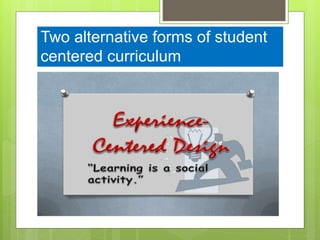
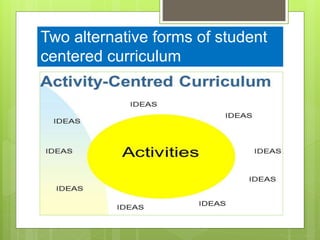
Two alternative forms of student
centered curriculum
Experience Centered Curriculum
 Also known as Experiential Curriculum
 Learns through direct experiences from life
situations.
 Helps to understand easily and acquires
lasting knowledge ,values and attitudes.
 Ability to know the nature and problems of the
real world and face them effectively.
Experience Centered Curriculum
 Activities like learning by doing undertaking
practical work properly getting involved in
social service and beautifying the school
campus ,taking part in filed trips and other co-
curricular activities with enthusiasm are the
curricular activities that helps to understand
the real world.
Experience Centered Curriculum
 Kothari commission recommendation:
 Work experience should be a necessary part
of the curriculum at all levels of education.
 Experience centered curriculum is not
interested in knowledge alone, it makes
students to get involved in skill development
also
Experience Centered Curriculum
 John Dewey who laid the foundation for the
project method learning says:
 When a child returns from school should not
tell its mother that I learned this or that (or
was taught this or that ) today ;but should say
today I had these new experiences .If it
describes that way, I will consider it as good
learning.
Two alternative forms of student
centered curriculum
Activity Centered Curriculum
 Acquires knowledge by carrying out different
activities.
 Learning by doing is the best form of learning.
 Activity Based Learning is followed in Primary
Schools in Tamil Nadu
 Activities done either by individual or by groups.
 Activities can be done either at Classrooms or in
their homes.
Activity Centered Curriculum
 Examples:
 Tending Plants
 Preparing handicrafts
 Participation in music,Drama,dance and other
cultural programs
 Conducting fairs and exhibitions
 Managing co operative societies in schools
 Taking part in educational games
The Progressive Education Commission on
Secondary Education, New York,1958
 Categorized the needs of the children under
the following four major groups.
 Needs of Personal living
 Needs for immediate personal social
relationship
 Needs related to social and civic relationship
 Needs related to economic relationships
Needs of personal living
 Need for personal health
 Need for self assurance
 Needs related to personal interest
 Aesthetic needs
Needs of Immediate Personal - Social
relationships
 Having cordial relationship with family members
 Having cordial relationship with neighbours
 Having mature relationship with peers of both
sexes.
Needs related to Social and Civic
Relationship
 Responsible participation in socially significant
activities
 Trying to get social recognition
Needs related to Economic Relationships
 Need for achieving economic independence
 Need for selecting an occupation for life and
developing vocational skills.
 Need for wise selection and use of goods and
services
 Need for finding solutions to basic economic
problems.
Humanistic Curriculum Design
 In addition to these two types of student
centered curriculum designs ,recently
humanistic curriculum has started receiving
the attention of the educators.
Humanistic Curriculum Design
 Importance given to refining students emotions
 According to Carl Rogers, by encouraging
students ,Self directed learning ,
 Helped to utilize the available resources properly
 Know about themselves objectively
 Develop desirable attitudes
 Self direct their behaviour
Syllabus
Syllabus is the part of curriculum forming its core
components. It is a document prescribing the
contents of each subject as topics to be taught. It
describes in detail what are to be learned by
students.
Differences
 Curriculum is the overall
academic content and
educational experiences
provided by an institute.
 Developed at the state,
district or institution
level.
 Cannot be modified.
Syllabus is the
descriptive list of
subjects that are to be
taught is a class.
Prepared by the teacher.
Could be adjusted
easily.
Differences
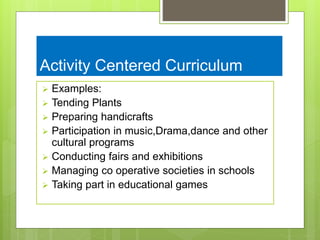
It is prescriptive.
It is not accessible
to students.
The focus is on all
round development
of the student
It is descriptive.
It is accessible to
students.
Focuses towards a
particular subject.
UD -designing learner centered curriculum