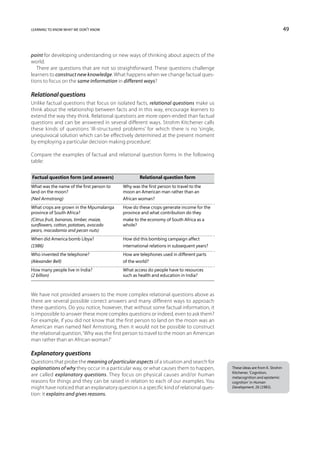
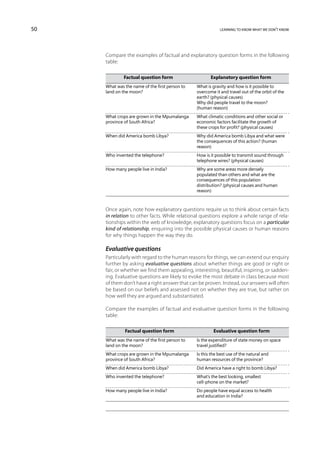
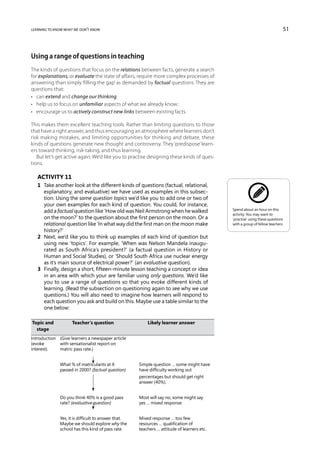
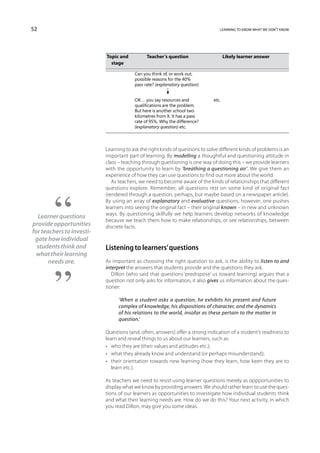
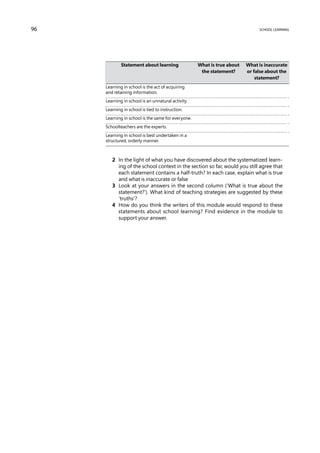
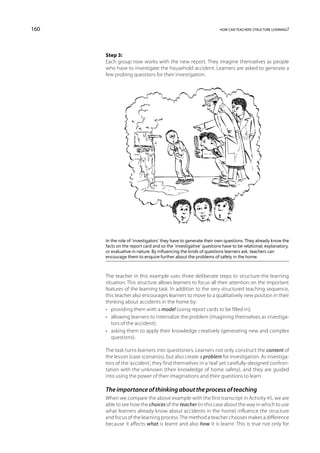
Learners
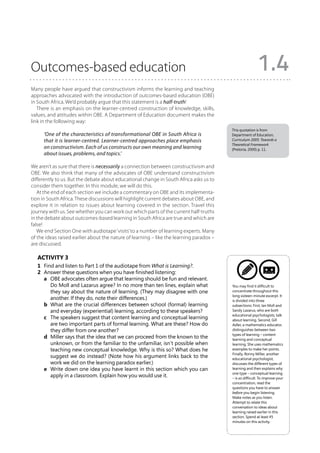
and Learning
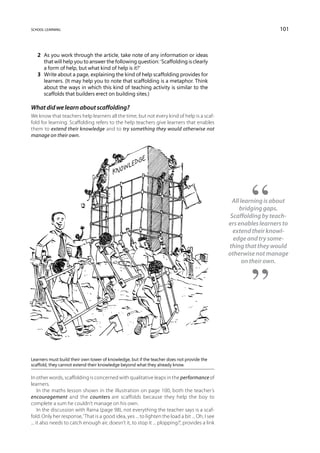
Writers | Ian Moll, Jill Bradbury, Gisela Winkler,
Maggie Tshule, Merlyn van Voore, Lynne Slonimsky
Editor | John Gultig


The SAIDE Teacher Education Series
Learners
and Learning

  Learning Guide
                  WRITERS
                Ian Moll
          Jill Bradbury
         Gisela Winkler
                     WITH

          Maggie Tshule
        Merlyn van Voore
        Lynne Slonimsky

             Series Editor
             John Gultig
Learners and Learning
ISBN 978 0 620 46731 5
© 2010 SAIDE
               This work, a digital version of the SAIDE/Oxford publication of 2002, is
               released under the Creative Commons Attribution 3.0 licence.


1ST EDITION SERIES EDITOR: John Gultig
1ST EDITION AUDIOTAPE: George Lekorotsoana (producer) and John Gultig (concept and script)
DESIGN FOR DIGITAL VERSION: Michelle Randell
ILLUSTRATIONS: Andre Plant

SAIDE	
PO Box 31822	
Braamfontein 2017	
T: (011) 403 2813	
F: (011) 403 2814	
www.saide.org.za; www.oerafrica.org
The first edition was funded by the WK Kellogg foundation. This digital
version has been funded through the International Association of
Digital Publications.
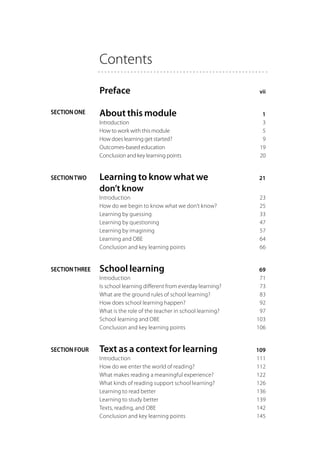
Contents

                Preface	                                                vii


SECTION ONE     About this module	                                       1
                Introduction	                                            3
                How to work with this module	                            5
                How does learning get started?	                          9
                Outcomes-based education	                               19
                Conclusion and key learning points	                     20


SECTION TWO     Learning to know what we 	                             21
                don’t know
                Introduction	                                           23
                How do we begin to know what we don’t know?	            25
                Learning by guessing	                                   33
                Learning by questioning	                                47
                Learning by imagining	                                  57
                Learning and OBE	                                       64
                Conclusion and key learning points	                     66


SECTION THREE   School learning	                                        69
                Introduction	                                           71
                Is school learning different from everday learning?	    73
                What are the ground rules of school learning?	          83
                How does school learning happen?	                       92
                What is the role of the teacher in school learning?	    97
                School learning and OBE	                               103
                Conclusion and key learning points	                    106


SECTION FOUR    Text as a context for learning	                        109
                Introduction	                                          111
                How do we enter the world of reading?	                 112
                What makes reading a meaningful experience?	           122
                What kinds of reading support school learning?	        126
                Learning to read better	                               136
                Learning to study better	                              139
                Texts, reading, and OBE	                               142
                Conclusion and key learning points	                    145
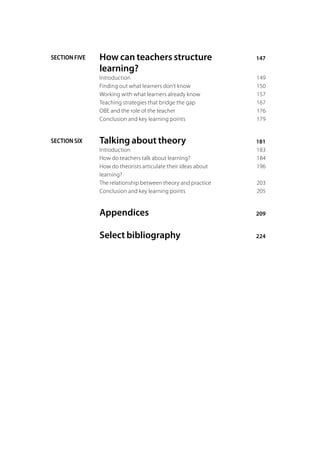
SECTION FIVE   How can teachers structure	                       147
               learning?
               Introduction	                                     149
               Finding out what learners don’t know	             150
               Working with what learners already know	          157
               Teaching strategies that bridge the gap	          167
               OBE and the role of the teacher	                  176
               Conclusion and key learning points	               179


SECTION SIX    Talking about theory	                             181
               Introduction	                                     183
               How do teachers talk about learning?	             184
               How do theorists articulate their ideas about 	   196
               learning?
               The relationship between theory and practice	     203
               Conclusion and key learning points	               205


               Appendices	                                       209


               Select bibliography	                              224
vii


Preface
The SAIDE Teacher Education Series
  Learners and Learning is one of the modules in the SAIDE Teacher Education Series developed
between 1998 and 2002.

This comprehensive multi-media series comprises:
•	 Learning Guides, which operate much as a teacher does in structuring learning, explaining
   concepts, exploring debates in the field, and direct readers to other parts of the module at
   appropriate times;
•	 Readings which function as a ‘mini-library’ of edited readings for further exploration of concepts,
   issues and debates raised in the Learning Guide;
•	 An audiotape which use interviews and classroom events to develop the issues raised in each
   of the modules (not for all modules)
•	 A video which bring issues and debates from the modules to life (not for all modules).

   Although designed to support the learning guides, the readings, as well as the audio and video
resources could also be used independently of the learning guides. Used creatively, they provide
valuable resources to support existing teacher education programmes.
   This set of learning guides with accompanying readers develop teachers’ abilities to use theory
in practice; and to understand, intervene in and improve their practice as teachers. The diagram
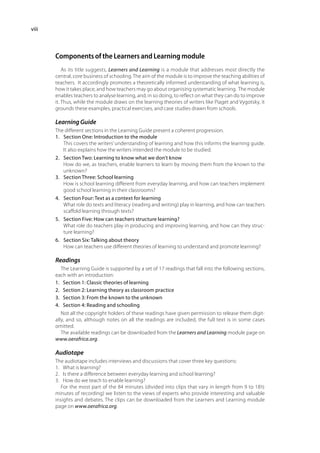
below shows the inter-relationships of the modules in terms of curriculum coverage.
   From within a framing context generated by Creating People-Centred Schools
   •	 Being a Teacher and Working in Classrooms cover the professional and classroom contexts
      within which teachers practise
   •	 Curriculum and Learners and Learning provide a theoretical understanding of resources or
      tools teachers may draw on
   •	 Getting Practical and Using Media draw on the above in guiding practice.
   Curriculum and Getting Practical are available in second editions from Oxford University Press.
      The other titles are available on www.oerafrica.org.


        Inter-Relationship of SAIDE Teacher Education Modules

                                Creating People-Centred Schools

           Being A Teacher                                           Working in Classrooms


            Curriculum                                                Learners and Learning


          Getting Practical                                                Using Media


                                              Goal
               Improve the Understanding and Practice of Teaching
viii


       Components of the Learners and Learning module
           As its title suggests, Learners and Learning is a module that addresses most directly the
       central, core business of schooling. The aim of the module is to improve the teaching abilities of
       teachers. It accordingly promotes a theoretically informed understanding of what learning is,
       how it takes place, and how teachers may go about organising systematic learning. The module
       enables teachers to analyse learning, and, in so doing, to reflect on what they can do to improve
       it. Thus, while the module draws on the learning theories of writers like Piaget and Vygotsky, it
       grounds these examples, practical exercises, and case studies drawn from schools.

       Learning Guide
       The different sections in the Learning Guide present a coherent progression.
       1.	 Section One: Introduction to the module	
           This covers the writers’ understanding of learning and how this informs the learning guide.
           It also explains how the writers intended the module to be studied.
       2.	 Section Two: Learning to know what we don’t know 	
           How do we, as teachers, enable learners to learn by moving them from the known to the
           unknown?
       3.	 Section Three: School learning	
           How is school learning different from everyday learning, and how can teachers implement
           good school learning in their classrooms?
       4.	 Section Four: Text as a context for learning	
           What role do texts and literacy (reading and writing) play in learning, and how can teachers
           scaffold learning through texts?
       5.	 Section Five: How can teachers structure learning?	
           What role do teachers play in producing and improving learning, and how can they struc-
           ture learning?
       6.	 Section Six: Talking about theory	
           How can teachers use different theories of learning to understand and promote learning?

       Readings
          The Learning Guide is supported by a set of 17 readings that fall into the following sections,
       each with an introduction:
       1.	 Section 1: Classic theories of learning
       2.	 Section 2: Learning theory as classroom practice
       3.	 Section 3: From the known to the unknown
       4.	 Section 4: Reading and schooling
          Not all the copyright holders of these readings have given permission to release them digit-
       ally, and so, although notes on all the readings are included, the full text is in some cases
       omitted.
          The available readings can be downloaded from the Learners and Learning module page on
       www.oerafrica.org.

       Audiotape
       The audiotape includes interviews and discussions that cover three key questions:
       1.	 What is learning?
       2.	 Is there a difference between everyday learning and school learning?
       3.	 How do we teach to enable learning?
          For the most part of the 84 minutes (divided into clips that vary in length from 9 to 18½
       minutes of recording) we listen to the views of experts who provide interesting and valuable
       insights and debates. The clips can be downloaded from the Learners and Learning module
       page on www.oerafrica.org.
ix


Acknowledgements
  Learners and Learning was developed through the Study of Education project managed by
the South African Institute for Distance Education (SAIDE) and funded by the WK Kellogg
Foundation. The series editor was John Gultig, and the module coordinator for Learners and
Learning was Ian Moll.
  The first edition was published by SAIDE/Oxford in 2001 under conventional ‘All rights
reserved’. This (slightly adapted) 2010 version is available digitally on www.oerafrica.org under a
Creative Commons Attribution 3.0 licence to facilitate updating and adaptation by users. The
processes involved in making the 2010 version available were managed by Ken Harley and Tessa
Welch, with funding from the International Association for Digital Publications.
section one


About this module


1.1	 Introduction . .........................................................................................   3
1.2	 How to work with this module ........................................................   5
1.3	 How does learning get started? ........................................................   9
1.4	 Outcomes-based education ............................................................  19
1.5	 Conclusion and key learning points ..............................................  20
Introduction                                                                                                   1.1
The problem with learning
It seems obvious that teachers should be interested in learning. Children go to
school to learn; teachers go to school to teach them how to learn. The introduction
of outcomes-based education has re-established the importance of learning by
                                                                                                           1
emphasizing learner-centredness and lifelong learning, and by highlighting the
importance of creating a culture of learning and teaching in our schools.
                                                                                              Week 1 begins.
   But learning doesn’t belong only in classrooms: learning new things is some-
thing that we all do, everywhere and throughout our lives. Long before children
get to school they learn about the world by inquisitively exploring their immediate
environments, responding to a multitude of colours and sounds, touching, grasp-
ing, and putting all kinds of things into their mouths. Perhaps most importantly of
all, young children learn to talk, to communicate with others, and to know the
world through the language of their mothers and others in their cultural context.
As a result, children arrive on the first day of ‘big’ school with their heads already full
of rich learning experiences.
   This everyday learning – learning outside of the classroom – continues through-
out our lives. Even as adults we continue to discover new things about our worlds
– through the newspapers we read, the TV we watch, and in our interactions with
others in the workplace and at home.


                                                                                                 The process of
                                                                                               learning seems so
                                                                                                 natural that we
                                                                                               often forget to ask
                                                                                              important questions
                                                                                                    about it.


None of us doubt that learning to understand the world is a central part of educa-
tion, but because learning is such an ordinary and everyday thing, we sometimes
take it for granted. We don’t give a second thought to how the people around us are
learning, or why they are able to remember all the new things they learn. The process
of learning seems so natural that we forget to ask important questions about it; we
often don’t bother to learn about learning.
   There is a danger in this oversight, particularly for teachers. Precisely because
learning is so common and so natural, we need to think about it carefully and under-
stand what it is, and why and how it happens. We need to understand why different
kinds of learning are important in different contexts. More significantly, we need to
understand why, and under what conditions, learning doesn’t happen when we
expected it to.
4                                                                            about this module


    What will you learn in this module?
    Not surprisingly, Learners and Learning aims to develop your understanding of
    learning. It seeks to assist you, as a teacher, to be able to analyse learning, and in so
    doing, to reflect on what you can do to improve it.
       We have divided the module into six sections. This first section:
    •	 introduces the module;
    •	 discusses how we’d like you to study;
    •	 explains how we understand learning;
    •	 begins to explore, at a simple level, how learning is initiated.

    Sections Two to Six each pose, and provide tools for answering, a critical question
    about learning:


    	 Section	                  Critical question about learning explored

    Section Two	 How do we, as teachers, 	                  This section explains how
    		           enable learners to learn?	                 learners move from the known
    			                                                     to the unknown.
    Section Three	      How is school learning 	            We explore how teachers can
    		                  different from everyday 	           implement good school learning
    		                  learning?	                          in classrooms.
    Section Four	       What role do texts and 	            We argue that reading and
    		                  literacy (reading and writing) 	    writing are crucial to good
    		                  play in learning?	                  school learning.
    Section Five	       What role do teachers play 	        In this section we consider
    		                  in producing and improving 	        this question in detail.
    		                  learning?
    Section Six	        How can teachers use 	              We examine a number of
    		                  different theories of learning 	    different cognitive theories and
    		                  to help them understand 	           consider the relationship
    		                  learning in their classrooms?	      between theory and practice.


    At the end of each section we consider how the ideas about learning discussed
    relate to the South African debate about outcomes-based education.
How to work with this module                                                                               1.2
The importance of active learning
As you work through the Learning Guide, you will see that we advocate the idea that
new understandings depend on, and arise out of, action. Because we firmly believe
this, we have designed this Guide to include many activities that we hope you, as
the teacher-learner, will complete. Like all good learning materials, the Guide will
work best if you engage systematically with the activities that are set out for you
here. If you don’t do the activities, you will miss out on the most important part of
the learning pathway we have developed for you.


Reading and writing activities
Most of the activities in the Guide are reading and writing activities. It is important
that you apply your mind to each one of them and answer the set questions in your
workbook.
  Follow the instructions given for each activity carefully. You may, for example, be     You will recognise these
asked to read an article from the Readings, to consider a set of issues raised in the     activities by this kind of icon in
                                                                                          the margin next to them. The
Guide from a particular perspective, or to listen to a specific part of the audiotape.    recommended time you should
Follow these instructions but also write down any other comments or thoughts that         spend on each activity is also
come to mind as you do each activity. In particular, think of how you can apply the       included.

new ideas in your teaching.
  The activities you are asked to do are designed primarily to help you to learn
something new, or to acquire a new understanding about something. As with the
readings, we will sometimes ask you to go back to an activity you have done in your
workbook and revise it in the light of the new understandings you have developed.
Don’t skip this step; it is a vitally important part of the learning process.


Thinking activities
At various points in the Learning Guide, we ask you to pause and take some time to
reflect on a particular issue. These thought pauses are designed to help you consol-
idate your understanding of a specific point before tackling the next section of the
Guide. They deliberately try and slow you down!                                           An icon like this will appear in
                                                                                          the margin when you need to
   One of the habits many of us develop through our involvement in a rote recall          stop reading and reflect on an
kind of learning is that we rush through things. Once we have read something, we          issue.
believe we know it. This isn’t true. While we may now recognize the idea, we proba-
bly don’t really understand it in any detail. Work through this Guide slowly and
thoughtfully. Reread and rethink. This is how we develop a depth of understanding
and become able to use the ideas we learn.
   Try to link the issue raised in each thought pause with what you have read, with
what you have already learnt about learning, with your own previous experience,
and so on. Think about the problem we have raised. You might want to jot down
your ideas in your workbook so that you can be reminded of them at a later stage.


Listening activities
The audiotape (available in 7 audio clips on www.oerafrica.org) contains interviews
with South African experts in the field of learning, interviews with teachers, and
short excerpts of teaching and learning experiences. The tape serves two key
purposes:                                                                                 An icon like this will appear in
                                                                                          the margin alongside all
•	 It provides learning variety in that it asks you to listen rather than read. It also   listening activities that require
   dramatizes learning events so that the interactions between teachers and learn-        you to listen to the audiotape.
6                                                                                                             about this module


                                         ers come alive. A learner who used a similar tape in another module said that it
                                         offered ‘light entertainment’ after the heavy reading he had done! This is a good
                                         response. Enjoy the tape.
                                      •	 It illustrates or magnifies ideas presented in the Guide by providing you with
                                         examples of how teacher-experts use these ideas in conversation. Listen to how
                                         they construct arguments, or how they use a concept or idea to analyse an inci-
                                         dent in a classroom.

                                      We refer you to the audiotape at specific points in the text and have tried not to use
                                      excerpts that are more than about twelve minutes long. You may find it difficult to
                                      concentrate at first. Your listening skills will improve, however, if you use the ques-
                                      tions in the activities to guide your listening, make notes while you listen, and listen
                                      to excerpts more than once. Feel free to listen to the tape ahead of time, but do so
                                      again when the Guide requests you to do so.


                                      How much time should you spend studying?
                 00
                                      It is impossible to estimate how long it will take hundreds of different kinds of learn-
    This time management icon will    ers to work through this module. We have written it so that an average, hard-work-
    help you to assess how well you   ing student who works consistently for six hours a week will finish this module in
    are using your time. We have      about twenty weeks (a university semester). In other words, you should set aside
    assumed that you will work
    with this Learning Guide over     about 120 hours of time to study.
    20 weeks, spending 6 hours            We expect that you will spend the 120 hours in the following way:
    studying each week. Try and
    make sure you begin sections in
                                      •	 Reading time: about sixty hours. This includes reading the Guide as well as read-
    the correct week.                     ings in the Reader.
                                      •	 Activity time: about forty hours. This includes the time it takes you to think about
                                          your readings, listen to your audiotape, and write your answers in your work-
                                          book.
                                      •	 Assignment writing time: about twenty hours. This is the time you will spend
                                          writing the assignments you submit to your tutors.

                                      As we have said, however, different learners learn in different ways and will take
                                      different lengths of time to complete this module. Be your own guide. Structure
                                      your learning so that it fits with your lifestyle. You could, for instance, complete this
                                      module:
                                      •	 in ten weeks if you are a full-time student and can spend twelve hours a week on
   Different students                    this module;
learn in different ways               •	 in a year (or about forty weeks) if you are very busy and can only spend three hours
    and at different                     a week studying.
  speeds. Assess your
 own capabilities and                 Of course you could also complete this module in a couple of days if you ignore all
structure your learning               the activities and simply read it from cover to cover. But this isn’t studying and you
   to fit your lifestyle.             will probably forget everything within days!
                                         We also know that different students work at different speeds, so you may well
                                      find that you need more (or slightly less) than the 120 hours we have estimated it
                                      will take learners to complete this module. Again, assess your own capabilities and
                                      spend more time on the module if you feel you need to do so.


                                      Assessing your learning
                                      We have designed this module so that it models an outcomes-based assessment
                                      style. This means that the book promotes an assessment process that:
                                      •	 is continuous and formative;
                                      •	 assesses your ability to relate ideas about learning to classroom realities and
                                         concerns;
                                      •	 contributes to your intellectual development.
about this module                                                                          7


While your institution may still require you to write a final exam, we believe that your
own assessment of your consistent engagement throughout the learning process is
just as important as any final ‘measurement’ of your ability.

So far, this section has set out the different learning media which make up the
module (a ‘teaching’ text, academic articles, and taped discussions which expand
and reflect on the text) and has explained what it is that we expect you to do in order
to acquire new understandings about learning. This explanation is descriptive in
two ways. In one, more obvious sense, it describes all the important components of
the module. In another, more abstract sense, it describes a conception of learning
(and thus of assessment) that is important for you to understand:
•	 Firstly, the module as a whole is a system of knowledge about learning. Not only
   do the various sections and parts of each component (Learning Guide, Reader,
   and audiotape) build on one another; each whole component also builds on and
   clarifies the ideas in the other components. This means that as you work through
   the whole module, you are building relationships within and between the differ-
   ent texts.
•	 Secondly, the section assumes that you need to do things in order to learn. It sets
   out the kinds of tasks or activities that you need to engage in in order to come to
   know this system, that is, to learn about learning. You need to engage in action to
   start to learn something new, and you need to continue with such action in order
   to gain and consolidate new understandings.

At the beginning of Sections Two to Six, your first action will be to consider a number
of contentious statements about learning. The aims of doing this are to:
•	 help you define what you already know about learning;
•	 establish what you think you may know (but which might be wrong);
•	 focus your thinking on the central issues of each section.


         Yes, it is true. Learning is the same               No, it isn’t true. Some
      for everyone. We are all God’s children.              people are born clever.


                               Well, it’s true and false. Some learners are bright, but
                               many others can become very clever through good
                                                teaching and learning.


Spend time considering whether or not you agree with each of the statements, and
  for what reasons. As you read through them, make notes on your initial response
  to each (we will ask you to reassess these first responses later). We have tried to
  formulate the statements so that they are neither obviously true nor false but
  rather represent half-truths about learning. This means that while they may offer
  important insights into learning, they tell only part of the story and can be
  misleading or incorrect in some important aspects.
  At the end of Sections Two to Six, your last action will be to go back to the state-
ments you considered at the beginning and think about them again in the light of
8                                                                       about this module


    what you have studied. When you do this, ask yourself:
    •	 How have my views or understandings changed?
    •	 Can I provide better reasons for why I agree or disagree with particular state-
       ments? If yes, what are these? If no, why not?
    •	 What are the strengths and weaknesses, or the half-truth, of each statement?

    These half-truth statements act as a special kind of learning outcome. They direct
    your attention to the key ideas in each section. By returning to them after studying
    a section, we are asking you to assess the degree to which your understanding of
    these key issues has changed. In other words, we are asking you to decide whether
    or not you achieved the desired learning outcome.
How does learning get started?                                                              1.3
What are half-truths?
In Reading 5, Dwyer argues that a whole range of common-sense statements about
learning made every day by teachers, are only half-truths. For example:
•	 He argues that the statement ‘learning is a somewhat unnatural activity’ is true to
   the extent that learning requires hard work, but false in that it is something all
   children do simply because they grow and develop.
•	 He suggests that the statement ‘learning is the same for everyone’ has some truth
   in it (because all children have a right to acquire the common body of knowledge
   that enables them to participate in a democratic society) but is false in another
   sense (because every child learns differently).


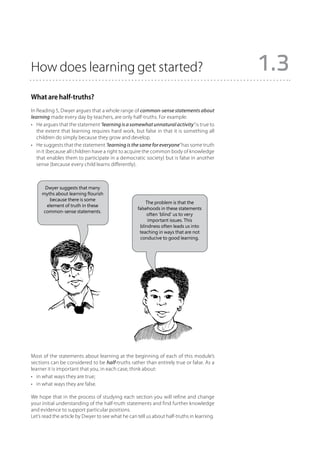
      Dwyer suggests that many
     myths about learning flourish
        because there is some
                                                       The problem is that the
       element of truth in these
                                                   falsehoods in these statements
     common-sense statements.
                                                        often ‘blind’ us to very
                                                        important issues. This
                                                    blindness often leads us into
                                                    teaching in ways that are not
                                                    conducive to good learning.


Most of the statements about learning at the beginning of each of this module’s
sections can be considered to be half-truths rather than entirely true or false. As a
learner it is important that you, in each case, think about:
•	 in what ways they are true;
•	 in what ways they are false.

We hope that in the process of studying each section you will refine and change
your initial understanding of the half-truth statements and find further knowledge
and evidence to support particular positions.
Let’s read the article by Dwyer to see what he can tell us about half-truths in learning.
10                                                                                                              about this module


                                     Activity 1
                                     1	 Glance through the table below. Then read the article by Dwyer ‘Some
                                        half-truths about learning’ (Reading 5). Use the statements in the first
                                        column of the table to guide your reading.
 You need about 45 minutes to        2	 When you have finished reading, and understand what Dwyer is arguing,
 do this activity. Read Dwyer           draw a table similar to the one below in your workbook and complete
 carefully and more than once.
 Do Activity 1 alone first and          it.
 discuss it with other teacher-
 learners when you have
 finished.                        	 Statement about learning	   What does Dwyer 	                        What does Dwyer
                                  		                           consider to be true 	                      consider to be
                                  		                          about the statement?	                     inaccurate or false
                                  			                                                                  about the statement?
                                  Learning is the act of acquiring
                                  and retaining information.
                                  Learning is a somewhat unnatural
                                  activity.
                                  Learning is best undertaken in a
                                  structured, orderly manner.
                                  Learning is tied to instruction.
                                  Learning is the same for everyone.
                                  Teachers are the experts.


                                  Starting to learn
                                  We won’t provide feedback on Activity 1 immediately. As you move through this
                                  module, you will work out what half-truths are and why they limit our understand-
                                  ing of learning through your own action by doing the half-truth activities regularly.
                                    Let’s continue by finding out how believing that we know the truth can stand in
                                  the way of real learning; of really finding the ‘truth’.

                                  An ancient story about learning
                                  There is an ancient and famous story about a slave boy who believed that when you
                                  doubled the area of a square, it followed that you doubled the length of its sides. He
                                  thought to himself:


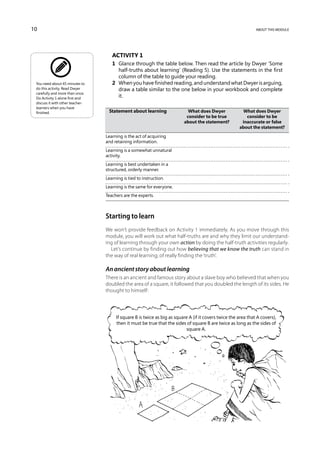
                                       If square B is twice as big as square A (if it covers twice the area that A covers),
                                       then it must be true that the sides of square B are twice as long as the sides of
                                                                            square A.
about this module                                                                                                           11


   Stop. Think.
   Read that again. Is this boy’s logic correct? If not, what’s wrong with
   his understanding of space? How would you, as a teacher, correct his think-
   ing?
                                                                                           Take some time to reflect on the
This reasoning seemed obvious to the boy. He couldn’t see that he was wrong. In            issue being raised here.

fact, as far as he was concerned, he was absolutely right, and stated the fact boldly
and confidently. As his teacher said at the time, the boy did not know, but he thought
that he knew. Because he believed he was right, he could not see that he was
wrong.
   In order to correct his thinking this teacher, the famous Greek philosopher
Socrates, asked the boy a series of questions about the two squares. By doing this he
led the boy to contradict himself. Suddenly, as he tried to answer the questions, the
boy realized that his answers didn’t make sense. He suddenly saw that he had been
wrong all along. This is sometimes called an ‘Aha!’ experience. The boy realized that
he had not understood and did not know after all, and he felt really uneasy. Socrates
called this feeling ‘perplexity’.
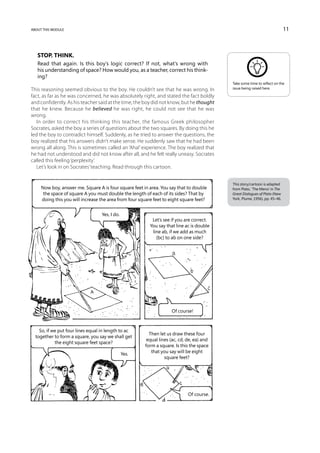
   Let’s look in on Socrates’ teaching. Read through this cartoon.


                                                                                           This story/cartoon is adapted
     Now boy, answer me. Square A is four square feet in area. You say that to double      from Plato, ‘The Meno’ in The
      the space of square A you must double the length of each of its sides? That by       Great Dialogues of Plato (New
     doing this you will increase the area from four square feet to eight square feet?     York, Plume, 1956), pp. 45–46.


                                   Yes, I do.
                                                           Let’s see if you are correct.
                                                          You say that line ac is double
                                                           line ab, if we add as much
                                                             (bc) to ab on one side?


                                                                    Of course!


    So, if we put four lines equal in length to ac
                                                         Then let us draw these four
  together to form a square, you say we shall get
                                                        equal lines (ac, cd, de, ea) and
            the eight square feet space?
                                                       form a square. Is this the space
                                                          that you say will be eight
                                                Yes.
                                                                 square feet?


                                                                             Of course.
12                                                                                                          about this module


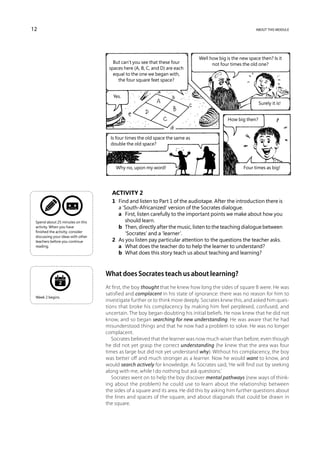
                                                                                Well how big is the new space then? Is it
                                       But can’t you see that these four              not four times the old one?
                                     spaces here (A, B, C, and D) are each
                                       equal to the one we began with,
                                         the four square feet space?


                                       Yes.
                                                                                                              Surely it is!


                                                                                              How big then?


                                      Is four times the old space the same as
                                      double the old space?


                                        Why no, upon my word!                                         Four times as big!


                                      Activity 2
                                      1	 Find and listen to Part 1 of the audiotape. After the introduction there is
                                         a ‘South-Africanized’ version of the Socrates dialogue.
                                      	 a	 First, listen carefully to the important points we make about how you
 Spend about 25 minutes on this             should learn.
 activity. When you have              	 b	 Then, directly after the music, listen to the teaching dialogue between
 finished the activity, consider
                                            ‘Socrates’ and a ‘learner’.
 discussing your ideas with other
 teachers before you continue         2	 As you listen pay particular attention to the questions the teacher asks.
 reading.                             	 a	 What does the teacher do to help the learner to understand?
                                      	 b	 What does this story teach us about teaching and learning?


                                    What does Socrates teach us about learning?
               2
                                    At first, the boy thought that he knew how long the sides of square B were. He was
                                    satisfied and complacent in his state of ignorance: there was no reason for him to
 Week 2 begins.
                                    investigate further or to think more deeply. Socrates knew this, and asked him ques-
                                    tions that broke his complacency by making him feel perplexed, confused, and
                                    uncertain. The boy began doubting his initial beliefs. He now knew that he did not
                                    know, and so began searching for new understanding. He was aware that he had
                                    misunderstood things and that he now had a problem to solve. He was no longer
                                    complacent.
                                       Socrates believed that the learner was now much wiser than before, even though
                                    he did not yet grasp the correct understanding (he knew that the area was four
                                    times as large but did not yet understand why). Without his complacency, the boy
                                    was better off and much stronger as a learner. Now he would want to know, and
                                    would search actively for knowledge. As Socrates said, ‘He will find out by seeking
                                    along with me, while I do nothing but ask questions.’
                                       Socrates went on to help the boy discover mental pathways (new ways of think-
                                    ing about the problem) he could use to learn about the relationship between
                                    the sides of a square and its area. He did this by asking him further questions about
                                    the lines and spaces of the square, and about diagonals that could be drawn in
                                    the square.
about this module                                                                                                         13


What role should learners play?
What you have just read is an example of a successful learning and teaching event,
but the success is the result of the learner and the teacher being prepared to play
particular roles. The boy – the learner – has to think about the problem actively:
•	 He guesses and by so doing reveals his understanding (or misunderstanding) of
   the problem.
•	 He makes mistakes and is prepared and encouraged to make mistakes.
•	 He then corrects them in the light of new information or feedback.
•	 He is prepared to listen to Socrates and learn from his teacher’s understanding,
   which is different from his own.
•	 He realizes the contradictions between his existing knowledge and the formal
   knowledge that others – like Socrates – have of geometry.

By being prepared to enter the learning situation with this kind of attitude, the boy
is able to actively come to know something that he did not know before.

What role should teachers play?
Much of this couldn’t have happened, however, without a good teacher and good
teaching. Let’s have a look at the kind of role that Socrates – the teacher – plays. He
deliberately teaches the boy new knowledge:
•	 He questions the boy and then identifies the mistakes that the boy is making.
•	 He is able to pinpoint what the boy needs to know and do in order to correct his
   mistakes because he knows more about geometry than the boy.
•	 He frames this new knowledge in a way that the boy can understand it and be
   challenged by it; he teaches well!
•	 He designs an activity which will allow the boy to engage in, and come to under-
   stand, the new knowledge and correct his own mistakes. He doesn’t simply tell
   the boy why he is wrong.
•	 He guides and, where necessary, provokes the boy through this activity. This
   ensures that the learner is interested and engaged, and doesn’t become too
   confused.

Another way of thinking about this famous event is to say that Socrates introduced
                                                                                          Don’t worry if you are not
the boy to a system of thinking (about geometry) and questioned him about the             absolutely sure what we mean
squares using the language and conceptual tools of this discipline.                       by ‘system of thinking’, or
   By answering the questions, the boy engaged in a new way of thinking about the         ‘conceptual tools of this
                                                                                          discipline’. These ideas are
square, and eventually completed the ‘Aha!’ experience. He arrived at a new under-        central to this module and we
standing by participating with Socrates in the activity of questioning even that          will teach you more about
which seemed obvious. He learnt to see a problem in geometry differently and              them as we move through
                                                                                          the sections.
correctly, and in the end, he knew and understood the principle of how to calculate
how much longer the sides of square B were than those of square A.
   Most importantly, he would now be able to apply this understanding to new
problems independently.


The learning paradox
The most interesting question that this story of a boy learning geometry provokes,
is one that has troubled psychologists and educators for a long time. It is a question
that every teacher asks in some form or another about every learner, every day in a
classroom:
Think carefully about the boy. In his initial state, he did not realize that his under-
standing was incorrect. He therefore did not realize that he needed to learn anything.
14                                                                                                          about this module


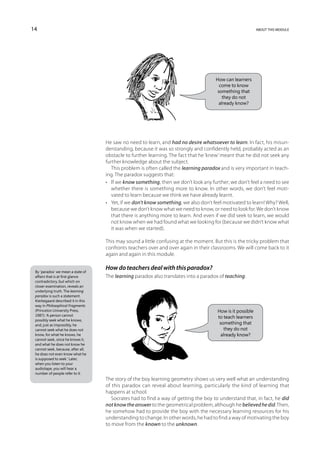
                                                                                       How can learners
                                                                                         come to know
                                                                                        something that
                                                                                          they do not
                                                                                         already know?


                                    He saw no need to learn, and had no desire whatsoever to learn. In fact, his misun-
                                    derstanding, because it was so strongly and confidently held, probably acted as an
                                    obstacle to further learning. The fact that he ‘knew’ meant that he did not seek any
                                    further knowledge about the subject.
                                       This problem is often called the learning paradox and is very important in teach-
                                    ing. The paradox suggests that:
                                    •	 If we know something, then we don’t look any further; we don’t feel a need to see
                                       whether there is something more to know. In other words, we don’t feel moti-
                                       vated to learn because we think we have already learnt.
                                    •	 Yet, if we don’t know something, we also don’t feel motivated to learn! Why? Well,
                                       because we don’t know what we need to know, or need to look for. We don’t know
                                       that there is anything more to learn. And even if we did seek to learn, we would
                                       not know when we had found what we looking for (because we didn’t know what
                                       it was when we started).

                                    This may sound a little confusing at the moment. But this is the tricky problem that
                                    confronts teachers over and over again in their classrooms. We will come back to it
                                    again and again in this module.

                                    How do teachers deal with this paradox?
 By ‘paradox’ we mean a state of
 affairs that is at first glance    The learning paradox also translates into a paradox of teaching:
 contradictory, but which on
 closer examination, reveals an
 underlying truth. The learning
 paradox is such a statement.
 Kierkegaard described it in this
 way in Philosophical Fragments
 (Princeton University Press,                                                          How is it possible
 1987): ‘A person cannot
                                                                                       to teach learners
 possibly seek what he knows,
 and, just as impossibly, he                                                            something that
 cannot seek what he does not                                                             they do not
 know, for what he knows, he                                                             already know?
 cannot seek, since he knows it,
 and what he does not know he
 cannot seek, because, after all,
 he does not even know what he
 is supposed to seek.’ Later,
 when you listen to your
 audiotape, you will hear a
 number of people refer to it.
                                    The story of the boy learning geometry shows us very well what an understanding
                                    of this paradox can reveal about learning, particularly the kind of learning that
                                    happens at school.
                                       Socrates had to find a way of getting the boy to understand that, in fact, he did
                                    not know the answer to the geometrical problem, although he believed he did. Then,
                                    he somehow had to provide the boy with the necessary learning resources for his
                                    understanding to change. In other words, he had to find a way of motivating the boy
                                    to move from the known to the unknown.
about this module                                                                                                     15


   As the teacher, Socrates was responsible for ensuring that some kind of activity
happened which would make it possible for the boy to learn something new.
Sometimes learners encounter the unknown with confusion and puzzlement
(perplexity) when they recognize that they do not understand it at all. Often,
however, they may think that they do understand it – just as the boy thought that
he understood the geometry of the area of a square.
   In either case, the learner is unable to use his or her previous understanding in
order to act in solving the problem:
•	 In the first case, the learner knows that his or her previous understanding is inad-
   equate and doesn’t know what to do.
•	 In the second case, the sense of understanding means that the learner will act
   inappropriately and be unable to solve the problem correctly.

This is the learning paradox – how can someone learn something new or different
either if they feel totally lost, as if they know nothing at all, or if they feel certain that
they understand things perfectly? This paradox cannot be resolved by focusing on
understanding alone.

      Rather, the key to learning lies in action.

This is a very important principle for you to understand: in order for children to learn,        In order for children to
they must engage in some kind of activity that provides pathways for them to move                    learn, they must
from the known to the unknown. In the Reader, you will find an article by Craig on               engage in some kind of
page 85 entitled ‘Education for all’. In it, Craig expresses this principle as follows:
                                                                                                  activity that provides
      ‘For someone to learn, she must first act, in order to discover the limits of               pathways for them to
      her knowledge and the demands of the task, before she can be explicitly                    move from the known
      taught about the task and ways of engaging it appropriately and                               to the unknown.
      successfully.’

Two kinds of learning activity
How will the learner know what kind of action to engage in? There are two impor-
tant sources of activity:
•	 The learner herself will spontaneously act to make sense of the world. People are
   naturally active, curious beings. Although these actions may sometimes be based
   on misunderstandings, new information from objects and events in the world in
   response to her actions may cause her to reflect on and change her understand-
   ing.
•	 A teacher or more experienced person may create opportunities for action that
   will take the individual beyond her own spontaneous activities and in the process,
   allow her to experience things in a new way.

Both of these sources of action are important for changing old understandings and
learning new things. This module will explore both to explain how the active
construction of learning is possible.
16                                                                            about this module


     The module’s key themes
     The central themes that you will find running through the whole module arise from
     this discussion of the learning paradox. We proceed from the insight that activities
     involving both self-generated action and engagement with the knowledge of others
     are necessary for learning to occur. Throughout, we emphasize that learning is only
     possible through action.


     	   Section	Key theme
     Section Two	 discuss the spontaneous mental action by which people create connec-
                  We
                  tions between ideas using their previous knowledge to understand new
                  information. We also explore the active strategies of guessing, questioning,
                  and imagining as ways to move from the known to the unknown.
     Section Three	 identify particular kinds of unknown that characterize the formal school-
                    We
                    ing context and demand new and different kinds of learning actions.
     Section Four	 explore the important role of reading in learning. Through reading we
                   We
                   gain access to the knowledge of others (and in particular, disciplinary
                   knowledge) which is probably the most important function of school learn-
                   ing.
     Section Five	 explain how teachers can guide and direct learners’ actions to effect
                   We
                   new understandings.
     Section Six	 explore different ways that important theorists have explained the
                  We
                  learning process.


     Our understanding of learning
     This module takes a broadly constructivist approach to teaching and learning. Earlier
     theories of learning tended to view learners as rather passive recipients of knowl-
     edge, but contemporary constructivist theories emphasize the active engagement
     of both learners and teachers. We revisit some of the earlier ideas in the module and
     redescribe them in theoretical terms. We also make suggestions as to how you as a
     teacher can use theories of learning.
        These ideas about learning having to do with acts of understanding are conten-
     tious. Ideas about teaching and learning have changed a lot in the past fifty years. In
     the context of schools, there has been a shift from the idea that good teaching is like
     banking (depositing knowledge in the learner in the same way as money is depos-
     ited in the bank) to the idea that teaching and learning are active processes of
     making meaning.

     The passive learner
     If you spoke to education department officials and theorists of learning around the
     world before the 1950s, you would probably have been told that children learn by
     having knowledge given to them. They would have argued about how this knowl-
     edge is given. Some would have said that it is given to the learner ‘from inside’ by
     different kinds of intelligence and aptitudes that children inherit at birth. Others
     would have said that knowledge is given to the child by ‘inputs from outside’, by the
     influence that the environment has on children’s upbringings. But they would not
     have argued very much about the ‘fact’ that knowledge is given to children.
         The reason for this general level of agreement is that we are, to a greater or lesser
     extent, teachers, learners, and thinkers within the dominant spirit of our times. The
     debate about learning and teaching that raged up to the end of the 1950s tended
     to be formulated as the ‘nature-nurture debate’.
about this module                                                                          17


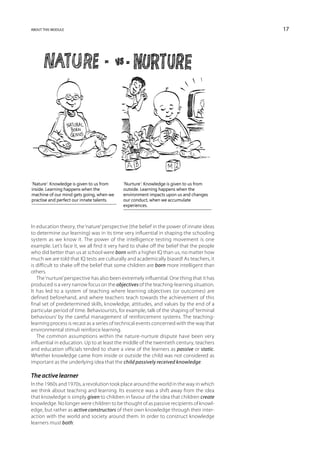
‘Nature’: Knowledge is given to us from     ‘Nurture’: Knowledge is given to us from
inside. Learning happens when the           outside. Learning happens when the
machine of our mind gets going, when we     environment impacts upon us and changes
practise and perfect our innate talents.    our conduct, when we accumulate
                                            experiences.


In education theory, the ‘nature’ perspective (the belief in the power of innate ideas
to determine our learning) was in its time very influential in shaping the schooling
system as we know it. The power of the intelligence testing movement is one
example. Let’s face it, we all find it very hard to shake off the belief that the people
who did better than us at school were born with a higher IQ than us, no matter how
much we are told that IQ tests are culturally and academically biased! As teachers, it
is difficult to shake off the belief that some children are born more intelligent than
others.
   The ‘nurture’ perspective has also been extremely influential. One thing that it has
produced is a very narrow focus on the objectives of the teaching-learning situation.
It has led to a system of teaching where learning objectives (or outcomes) are
defined beforehand, and where teachers teach towards the achievement of this
final set of predetermined skills, knowledge, attitudes, and values by the end of a
particular period of time. Behaviourists, for example, talk of the shaping of ‘terminal
behaviours’ by the careful management of reinforcement systems. The teaching-
learning process is recast as a series of technical events concerned with the way that
environmental stimuli reinforce learning.
   The common assumptions within the nature-nurture dispute have been very
influential in education. Up to at least the middle of the twentieth century, teachers
and education officials tended to share a view of the learners as passive or static.
Whether knowledge came from inside or outside the child was not considered as
important as the underlying idea that the child passively received knowledge.

The active learner
In the 1960s and 1970s, a revolution took place around the world in the way in which
we think about teaching and learning. Its essence was a shift away from the idea
that knowledge is simply given to children in favour of the idea that children create
knowledge. No longer were children to be thought of as passive recipients of knowl-
edge, but rather as active constructors of their own knowledge through their inter-
action with the world and society around them. In order to construct knowledge
learners must both:
18                                                                                about this module


     •	 develop their own novel ways of knowing;
     •	 acquire existing human knowledge (language, cultural wisdom, technical skills,
        school disciplines etc.).

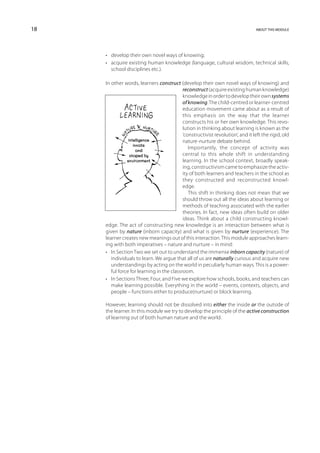
     In other words, learners construct (develop their own novel ways of knowing) and
                                            reconstruct (acquire existing human knowledge)
                                            knowledge in order to develop their own systems
                                            of knowing. The child-centred or learner-centred
                                            education movement came about as a result of
                                            this emphasis on the way that the learner
                                            constructs his or her own knowledge. This revo-
                                            lution in thinking about learning is known as the
                                            ‘constructivist revolution’, and it left the rigid, old
                                            nature-nurture debate behind.
                                               Importantly, the concept of activity was
                                            central to this whole shift in understanding
                                            learning. In the school context, broadly speak-
                                            ing, constructivism came to emphasize the activ-
                                            ity of both learners and teachers in the school as
                                            they constructed and reconstructed knowl-
                                            edge.
                                               This shift in thinking does not mean that we
                                            should throw out all the ideas about learning or
                                            methods of teaching associated with the earlier
                                            theories. In fact, new ideas often build on older
                                            ideas. Think about a child constructing knowl-
     edge. The act of constructing new knowledge is an interaction between what is
     given by nature (inborn capacity) and what is given by nurture (experience). The
     learner creates new meanings out of this interaction. This module approaches learn-
     ing with both imperatives – nature and nurture – in mind:
     •	 In Section Two we set out to understand the immense inborn capacity (nature) of
        individuals to learn. We argue that all of us are naturally curious and acquire new
        understandings by acting on the world in peculiarly human ways. This is a power-
        ful force for learning in the classroom.
     •	 In Sections Three, Four, and Five we explore how schools, books, and teachers can
        make learning possible. Everything in the world – events, contexts, objects, and
        people – functions either to produce(nurture) or block learning.

     However, learning should not be dissolved into either the inside or the outside of
     the learner. In this module we try to develop the principle of the active construction
     of learning out of both human nature and the world.
Outcomes-based education                                                                                  1.4
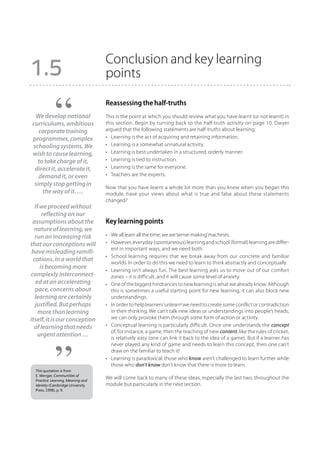
Many people have argued that constructivism informs the learning and teaching
approaches advocated with the introduction of outcomes-based education (OBE)
in South Africa. We’d probably argue that this statement is a half-truth!
   There is an emphasis on the learner-centred construction of knowledge, skills,
values, and attitudes within OBE. A Department of Education document makes the
link in the following way:
                                                                                         This quotation is from
      ‘One of the characteristics of transformational OBE in South Africa is             Department of Education,
      that it is learner-centred. Learner-centred approaches place emphasis              Curriculum 2005: Towards a
                                                                                         Theoretical Framework
      on constructivism. Each of us constructs our own meaning and learning              (Pretoria, 2000) p. 11.
      about issues, problems, and topics.’

We aren’t as sure that there is necessarily a connection between constructivism and
OBE. We also think that many of the advocates of OBE understand constructivism
differently to us. But the debate about educational change in South Africa asks us to
consider them together. In this module, we will do this.
   At the end of each section we include a commentary on OBE and its implementa-
tion in South Africa. These discussions will highlight current debates about OBE, and
explore it in relation to issues about learning covered in the section. Travel this
journey with us. See whether you can work out which parts of the current half-truths
in the debate about outcomes-based learning in South Africa are true and which are
false!
   We end Section One with audiotape ‘visits’ to a number of learning experts. Many
of the ideas raised earlier about the nature of learning – like the learning paradox –
are discussed.

   Activity 3
   1	 Find and listen to Part 1 of the audiotape from What is Learning?.
   2	 Answer these questions when you have finished listening:
   	 a	 OBE advocates often argue that learning should be fun and relevant.
         Do Moll and Lazarus agree? In no more than ten lines, explain what              You may find it difficult to
         they say about the nature of learning. (They may disagree with one              concentrate throughout this
                                                                                         long sixteen-minute excerpt. It
         another. If they do, note their differences.)                                   is divided into three
   	 b	 What are the crucial differences between school (formal) learning               subsections: First, Ian Moll and
         and everyday (experiential) learning, according to these speakers?              Sandy Lazarus, who are both
                                                                                         educational psychologists, talk
   	 c	 The speakers suggest that content learning and conceptual learning              about learning. Second, Gill
         are two important parts of formal learning. What are these? How do              Adler, a mathematics educator,
         they differ from one another?                                                   distinguishes between two
                                                                                         types of learning – content
   	 d	 Miller says that the idea that we can proceed from the known to the             learning and conceptual
         unknown, or from the familiar to the unfamiliar, isn’t possible when            learning. She uses mathematics
         teaching new conceptual knowledge. Why is this so? What does he                 examples to make her points.
                                                                                         Finally, Ronny Miller, another
         suggest we do instead? (Note how his argument links back to the                 educational psychologist,
         work we did on the learning paradox earlier.)                                   discusses the different types of
   	 e	 Write down one idea you have learnt in this section which you can               learning and then explains why
                                                                                         one type – conceptual learning
         apply in a classroom. Explain how you would use it.                             – is so difficult. To improve your
                                                                                         concentration, read the
                                                                                         questions you have to answer
                                                                                         before you begin listening.
                                                                                         Make notes as you listen.
                                                                                         Attempt to relate this
                                                                                         conversation to ideas about
                                                                                         learning raised earlier in this
                                                                                         section. Spend at least 45
                                                                                         minutes on this activity.
Conclusion and key learning
1.5                                 points

                                    Reassessing the half-truths
 We develop national                This is the point at which you should review what you have learnt (or not learnt) in
curriculums, ambitious              this section. Begin by turning back to the half-truth activity on page 10. Dwyer
   corporate training               argued that the following statements are half-truths about learning:
programmes, complex                 •	 Learning is the act of acquiring and retaining information.
schooling systems. We               •	 Learning is a somewhat unnatural activity.
wish to cause learning,             •	 Learning is best undertaken in a structured, orderly manner.
  to take charge of it,             •	 Learning is tied to instruction.
 direct it, accelerate it,          •	 Learning is the same for everyone.
   demand it, or even               •	 Teachers are the experts.
 simply stop getting in
                                    Now that you have learnt a whole lot more than you knew when you began this
    the way of it. …                module, have your views about what is true and false about these statements
                                    changed?
  If we proceed without
      reflecting on our
 assumptions about the              Key learning points
  nature of learning, we
  run an increasing risk            •	 We all learn all the time; we are ‘sense-making’ machines.
that our conceptions will           •	 However, everyday (spontaneous) learning and school (formal) learning are differ-
                                       ent in important ways, and we need both.
 have misleading ramifi-
                                    •	 School learning requires that we break away from our concrete and familiar
 cations. In a world that              worlds. In order to do this we need to learn to think abstractly and conceptually.
     is becoming more               •	 Learning isn’t always fun. The best learning asks us to move out of our comfort
complexly interconnect-                zones – it is difficult, and it will cause some level of anxiety.
   ed at an accelerating            •	 One of the biggest hindrances to new learning is what we already know. Although
  pace, concerns about                 this is sometimes a useful starting point for new learning, it can also block new
  learning are certainly               understandings.
  justified. But perhaps            •	 In order to help learners ‘unlearn’ we need to create some conflict or contradiction
    more than learning                 in their thinking. We can’t talk new ideas or understandings into people’s heads;
itself, it is our conception           we can only provoke them through some form of action or activity.
  of learning that needs            •	 Conceptual learning is particularly difficult. Once one understands the concept
                                       of, for instance, a game, then the teaching of new content, like the rules of cricket,
    urgent attention …                 is relatively easy (one can link it back to the idea of a game). But if a learner has
                                       never played any kind of game and needs to learn this concept, then one can’t
                                       draw on the familiar to teach it!
                                    •	 Learning is paradoxical: those who know aren’t challenged to learn further while
                                       those who don’t know don’t know that there is more to learn.
  This quotation is from
  E. Wenger, Communities of
  Practice: Learning, Meaning and
                                    We will come back to many of these ideas, especially the last two, throughout the
  Identity (Cambridge University    module but particularly in the next section.
  Press, 1998), p. 9.
section two


Learning to know
what we don’t know


2.1	 Introduction . .........................................................................................  23
2.2	 How do we begin to know what we don’t know? .....................  25
2.3	 Learning by guessing..........................................................................  33
2.4	 Learning by questioning ...................................................................  47
2.5	 Learning by imagining .......................................................................  57
2.6	 Learning and OBE ................................................................................  64
2.7	 Conclusion and key learning points ..............................................  66
Introduction                                                                                              2.1
In Section One we introduced you to some of the key questions about learning that
will be explored in this module. Can you remember what you learnt? Did your under-
standing of the half-truths change by the end of the section?


What will you learn in this section?
Section Two begins to focus on how we learn in greater detail. In particular, it                      3
explores the following question:
                                                                                         Week 3 begins.


            How is it possible for
          those who do not know
           something to come to
                 know it?


We tackle this question by exploring the ways in which human minds:
•	 construct connections between ideas;
•	 use what is known to understand new and unknown things;
•	 are challenged to change old misunderstandings by new and contradictory
   understandings.

We will also be looking at how teachers can use spontaneous learning actions –
those characteristics which learners naturally possess – to create mental pathways
between what learners already know and what we want them to know (the
unknown).
   We begin by investigating how we learn (Section 2.1). Then, based on this under-
standing, we explore how we can teach so that learning happens. The section
suggests three possible strategies to move learners from the known to the
unknown:
•	 First, by encouraging guessing – by taking risks and making mistakes. We examine
   how Piaget’s ideas of accommodation and assimilation can help us keep a
   balance between the risk of new, unfamiliar ideas and the stability of old, known
   ideas in teaching (Section 2.2).
•	 Second, by encouraging and using questioning – by listening to learner ques-
   tions and asking good teaching questions. We explore a variety of question types
   and how they can be used in lessons (Section 2.3).
•	 Third, by encouraging imagining – by using and escaping from the known, to
   imagine the unknown (Section 2.4).

Learners often use these strategies independently as they learn. But our task is to
find out how we, as teachers, can use these strategies. In order to do this we need to
understand how they both enable and constrain (block) learning.
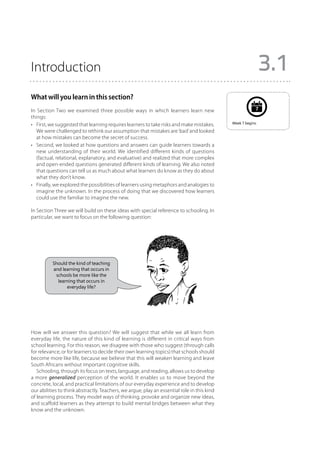
24                                                        learning to know what we don’t know


     More half-truths to guide your learning
     Before we begin we’d like to activate your minds again by asking you to consider
     these half-truths about learning:


     	 Statement about learning	 What is true about 	                 What is inaccurate
     		                           the statement?	                     or false about the
     			                                                                  statement?
     Learning involves acquiring, retaining,
     and reproducing information.
     As we become better at learning we
     should make less and less mistakes.
     For every question there is only one
     answer.
     A good teacher will be able to answer
     all questions raised in the classroom.
     The use of metaphors and analogies in
     teaching promotes understanding.
     Children are curious and active and
     therefore learn spontaneously.


     Approach this exercise in the same way as you did when you thought about the
     statements made by Dwyer in Section One (page 12). In each case, think about why
     the statement might be considered to be true, why false, and how you might chal-
     lenge and question each statement.
        It is important for you to note that the statements simply present possible under-
     standings of the issues under discussion. Sometimes, by working out why a particu-
     lar understanding is flawed, we can refine our understanding of a phenomenon and
     clarify our own position and our reasons for holding it.
        Remember, these statements should also focus your attention on the key issues
     to be dealt with in this section. In this sense they act as learning outcomes. At the
     end of the section we will reconsider our views on these issues.
How do we begin to know what
we don’t know?                                                                                      2.2
What do we know?
Ask yourself this question, ‘What do I know?’
  The short answer to this question is, ‘A lot!’ In fact, each of us knows so much
about all kinds of things that reporting this knowledge would be impossible.
  So, let’s refine the question and ask one that is more focused about your knowl-
edge in relation to something in particular, ‘What do you know about the game of
soccer?’

  Stop. Think.
  What do you know about soccer? Write down everything you know about
  the game in three minutes.

                                                                                     Take some time to reflect on the
                                                                                     issue being raised here.
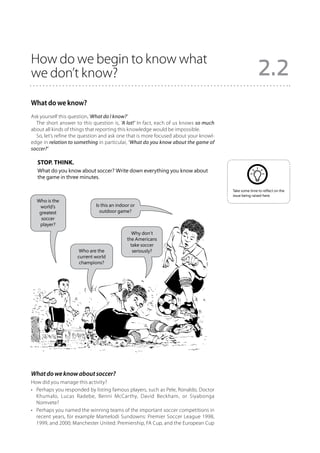
  Who is the
   world’s                   Is this an indoor or
   greatest                    outdoor game?
    soccer
   player?
                                               Why don’t
                                             the Americans
                                               take soccer
                     Who are the                seriously?
                    current world
                     champions?


What do we know about soccer?
How did you manage this activity?
•	 Perhaps you responded by listing famous players, such as Pele, Ronaldo, Doctor
   Khumalo, Lucas Radebe, Benni McCarthy, David Beckham, or Siyabonga
   Nomvete?
•	 Perhaps you named the winning teams of the important soccer competitions in
   recent years, for example Mamelodi Sundowns: Premier Soccer League 1998,
   1999, and 2000; Manchester United: Premiership, FA Cup, and the European Cup
26                                                                                        learning to know what we don’t know


                                       in 1999 (the treble); France: World Cup 1998 and Euro 2000?
                                    •	 Perhaps you started to describe the way in which the off-side rule is applied or
                                       under what conditions a corner is awarded?

                                    Regardless of what approach you took, or where you started, you probably found
                                    that one idea led to the next one. In the end, you more than likely wrote down many
                                    more things than you initially thought you would.
                                       If you are not a soccer fan, this activity might have been a lot more difficult (or
                                    even seemed pointless). You may only have been able to answer the question with
                                    a simple statement like, ‘It’s a game played by two teams that kick a ball towards the
                                    goals at either end of a field.’ You may even have responded with something like, ‘I
                                    know nothing at all about soccer.’ But this would not have been true.
                                       At the very least, all of us know that soccer is a game and that it is played with a
                                    round ball. If we proceed from this starting point, most of us would probably be able
                                    to produce a lot of other information about soccer: that you play the game on a field,
                                    that you kick the ball, that you win by scoring goals. And so we find that those who
                                    thought they knew ‘nothing at all’ about soccer, in fact know quite a few useful and
                                    correct facts – knowledge that is shared by many soccer fans – but these facts
                                    seemed so obvious that they were not recognised as knowledge.
                                       This activity illustrates a number of important points about learning and
                                    knowing:
                                    •	 First, it is difficult to describe what we know, because we tend to ‘forget’ that we
                                       know things that we have known for a long time. This knowledge is so natural to
                                       us that it no longer seems like knowledge, or like anything worth learning.
                                    •	 Second, we also ignore things we know if they don’t seem to fit in a particular
Shared knowledge is                    context of enquiry.
an important starting               The difficulty that confronts us as teachers is that things that we take for granted
 point for learning.                because we know them so well may not be shared by the learners whom we teach.
                                    For example, we know that Lucas Radebe is a defender, but we may not realise that
                                    people who don’t know the game of soccer will not know the difference between
                                    strikers and defenders! To them, all soccer players are the same.
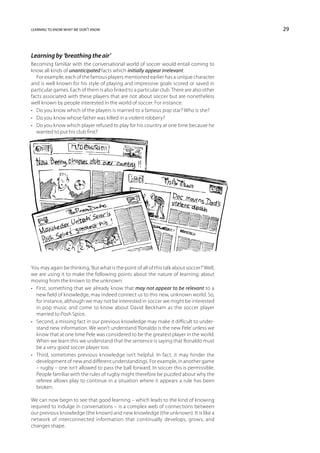
                                       Shared knowledge (like the understanding of the game of soccer that even the
                                    least knowledgeable amongst us may possess) is an important starting point for
                                    learning. If it isn’t recognized by either teachers or learners, then learners may feel
                                    that they are ignorant and incapable of learning and teachers may feel helpless,
                                    frustrated, and unable to get through to learners.
                                       The problem in teaching new knowledge is precisely that it is not shared. This
                                    presents the central problem of learning-teaching:
                                    •	 How do we find out whether the knowledge that is required for a learning task is
                                       shared by participants?
                                    •	 How can those who know (often the teacher) share that knowledge with others
                                       who don’t know?
                                    •	 How is it possible for those who do not know something, to come to know it?

                                       Stop. Think.
                                       Before you continue, stop and think about these questions. They are the
                                       kinds of questions that seem so natural to us as teachers that we don’t think
                                       they are important! You might want to make brief notes about your think-
 Take some time to reflect on the      ing in your workbook. We shall return to these questions later.
 issue being raised here.
learning to know what we don’t know                                                                                       27


Learning what we don’t know
Sharing knowledge may not sound like a very complicated problem. Surely, you
may think, if people do not know about soccer, they could simply ask someone who
does know to tell them about it! After all this is how we were taught.

   Stop. Think.
   Let’s think about it a bit more carefully. In fact, let’s do a little experiment.
   Without looking at the text, recall as many facts as possible about the game
   of soccer that we have mentioned in this section so far.
                                                                                           Take some time to reflect on the
                                                                                           issue being raised here.
How do we remember things?
If you already knew many things about soccer before you started reading this text,
you probably had no difficulty recalling the information. Even if you didn’t know
every one of the specific facts mentioned beforehand, you would quickly have taken
in any new fact by adding or linking it to your previous knowledge of soccer. This
points to an important idea in good learning:


          We learn more by building
          on what we already know.
          Knowing is about making
          relationships by adding to
           our existing networks of
                  knowledge.


If, however, you knew very little about soccer before reading this module you prob-
ably found that you ‘failed the test’. Maybe you didn’t even bother to try, thinking,
‘Why should I try? I am not trying to learn about soccer, it is of no interest to me and
will not help me in any way.’ Ironically your resistance to learning would have identi-
fied another important problem with any learning:


            Learners must experience
              a need to know about
              something and see the
            value of knowing it before
             they can begin learning.
28                                                                                         learning to know what we don’t know


                                      The old saying, ‘you can lead a horse to water but you can’t make it drink’ is power-
                                      fully accurate in any learning-teaching situation. Rothkopf puts it like this:

 This quote is from E. Z.                   ‘You can lead a horse to water but the only water that gets into his
 Rothkopf, ‘The concept of                  stomach is what he drinks. … The proposition is simple. In most (teach-
 mathemagenic activities’,
 Review of Educational Research,            ing) situations, what is learnt depends largely on the activities of the
 40 (1970), 325–336.                        student.’

                                      The importance of motivation
                                      Perhaps if you were told that knowing these facts about soccer would be important
                                      for the course examination, you would now go back and memorize them. You would
                                      now have a motivation – however controversial – to learn.
                                         But coming to know something requires more than:
                                      •	 already knowing something about the topic;
                                      •	 having a motivation to learn more.

                                      Think about this: having learnt these facts, do you think you would feel that you
                                      know all about soccer? Probably not. Although you may be able to reproduce these
                                      facts under examination conditions and in conversation amongst people who really
                                      know a lot about soccer, you might still feel foolish and perhaps bored, uncertain of
                                      where and how to insert these facts into the conversation, and unable to demon-
                                      strate that you know about soccer. In other words, you wouldn’t really be able to use
                                      your knowledge competently.
                                         Participating fully in conversations about the game would require that you have
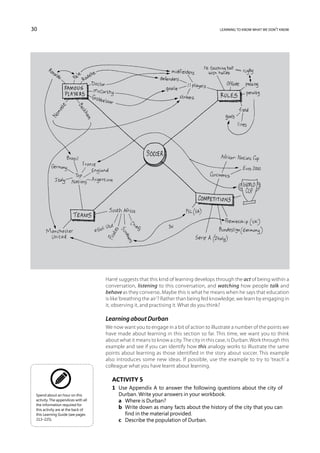
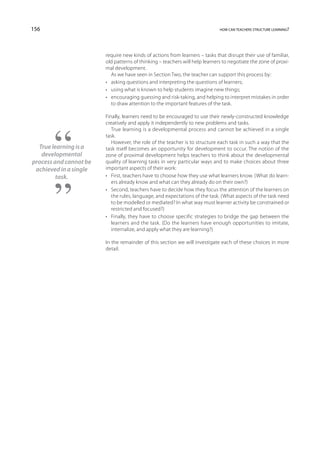
                                      a wide-ranging and deep knowledge about the world of soccer. And of course to
                                      play the game, requires a whole array of different skills.
                                         How can we develop understandings that are deep and allow us to enter conver-
                                      sations knowledgeably?

                                        Activity 4
                                        1	 Read the quotation about learning below and then answer the ques-
                                           tions that follow it.
                                               ‘The difference between traditional and personal psychology can be
 Spend about 40 minutes on this                illustrated by their respective (understandings) of education.
 activity. Think carefully about               According to the traditional (understandings), a teacher possesses a
 the analogies used. Try and link              large stock of knowledge, while a student has only a small amount
 them to your own experiences,
 and to what you have already                  of knowledge. Education consists of the teacher passing knowledge
 learnt in this module. The quote              from him/herself into his/her student. A traditional examination is
 is from R. Harré, in D. Clarke and            an attempt to discover how much each individual has acquired.
 N. de Carlo, Motives and
 Mechanisms: An Introduction to                    In our theory of education, however, the process is quite differ-
 the Psychology of Action                      ently conceived. There is a general conversation which takes place
 (London, Methuen, 1985),                      in institutions like the universities, and to which the academic staff
 pp. 71–72.
                                               contribute. It is from this conversation that students extract what
                                               they can.
                                                   Education, according to personal psychology, is like breathing in
                                               the surrounding air; it is not like being pumped up like the tyre of a
                                               bicycle.’
                                        	 a	  The writer argues that education is like participation in a conversa-
                                               tion. What does he mean? What kinds of things do we learn in conver-
                                               sations that are often not learnt in classroom instruction?
                                        	 b	  What does the writer mean by the analogy ‘education … is like breath-
                                               ing in the surrounding air, it is not like being pumped up like the tyre
                                               of a bicycle’? What does this suggest about ‘traditional’ views of the
                                               learning process?
                                        2	 Think of your own experience of learning at home, in classrooms, and in
                                           the environment of colleges and universities. How is learning different
                                           in these places? Can you think of any examples that could justify Harré’s
                                           views?
learning to know what we don’t know                                                          29


Learning by ‘breathing the air’
Becoming familiar with the conversational world of soccer would entail coming to
know all kinds of unanticipated facts which initially appear irrelevant.
   For example, each of the famous players mentioned earlier has a unique character
and is well known for his style of playing and impressive goals scored or saved in
particular games. Each of them is also linked to a particular club. There are also other
facts associated with these players that are not about soccer but are nonetheless
well known by people interested in the world of soccer. For instance:
•	 Do you know which of the players is married to a famous pop star? Who is she?
•	 Do you know whose father was killed in a violent robbery?
•	 Do you know which player refused to play for his country at one time because he
   wanted to put his club first?


You may again be thinking, ‘But what is the point of all of this talk about soccer?’ Well,
we are using it to make the following points about the nature of learning; about
moving from the known to the unknown:
•	 First, something that we already know that may not appear to be relevant to a
   new field of knowledge, may indeed connect us to this new, unknown world. So,
   for instance, although we may not be interested in soccer we might be interested
   in pop music and come to know about David Beckham as the soccer player
   married to Posh Spice.
•	 Second, a missing fact in our previous knowledge may make it difficult to under-
   stand new information. We won’t understand ‘Ronaldo is the new Pele’ unless we
   know that at one time Pele was considered to be the greatest player in the world.
   When we learn this we understand that the sentence is saying that Ronaldo must
   be a very good soccer player too.
•	 Third, sometimes previous knowledge isn’t helpful. In fact, it may hinder the
   development of new and different understandings. For example, in another game
   – rugby – one isn’t allowed to pass the ball forward. In soccer this is permissible.
   People familiar with the rules of rugby might therefore be puzzled about why the
   referee allows play to continue in a situation where it appears a rule has been
   broken.

We can now begin to see that good learning – which leads to the kind of knowing
required to indulge in conversations – is a complex web of connections between
our previous knowledge (the known) and new knowledge (the unknown). It is like a
network of interconnected information that continually develops, grows, and
changes shape.
30                                                                                         learning to know what we don’t know


                                     Harré suggests that this kind of learning develops through the act of being within a
                                     conversation, listening to this conversation, and watching how people talk and
                                     behave as they converse. Maybe this is what he means when he says that education
                                     is like ‘breathing the air’? Rather than being fed knowledge, we learn by engaging in
                                     it, observing it, and practising it. What do you think?

                                     Learning about Durban
                                     We now want you to engage in a bit of action to illustrate a number of the points we
                                     have made about learning in this section so far. This time, we want you to think
                                     about what it means to know a city. The city in this case, is Durban. Work through this
                                     example and see if you can identify how this analogy works to illustrate the same
                                     points about learning as those identified in the story about soccer. This example
                                     also introduces some new ideas. If possible, use the example to try to ‘teach’ a
                                     colleague what you have learnt about learning.

                                        Activity 5
                                        1	 Use Appendix A to answer the following questions about the city of
 Spend about an hour on this               Durban. Write your answers in your workbook.
 activity. The appendices with all      	 a	 Where is Durban?
 the information required for
 this activity are at the back of
                                        	 b	Write down as many facts about the history of the city that you can
 this Learning Guide (see pages              find in the material provided.
 213–225).                              	 c	 Describe the population of Durban.
learning to know what we don’t know                                                                                      31


   	 d	 Describe the political profile of Durban.
   	 e	What interesting things are there to do and see in Durban?
   2	 When you have answered the questions, try to connect the facts you
      have unearthed by drawing a mindmap (similar to the one on page 32
      on soccer) of the new knowledge you have acquired about Durban.
   3	 Now think about what this activity has taught you about how people
      move from the known to the unknown. For instance:
   	 a	How would we come to know a place like Durban if we had never
        been there before?
   	 b	How would our knowledge of other cities (and particularly of the
        place where we ourselves live) help us or hinder us in coming to know
        the city of Durban?
   	 c	How would we communicate our knowledge of our home town (or a
        place that we know very well) to someone who doesn’t know it at all?

What did we learn from this activity?
Which of the facts about Durban did you consider to be important? Which facts do
you think are essential to knowing Durban?
   Put yourself in a learner’s position. Think about what you would want to know
about a city and why. Discard the kind of knowing that is associated with recalling
information for an exam. Instead, think about what facts would be useful to a person
living in the city or visiting it as a holiday-maker.
   Would the facts that you have identified above help you to know:
•	 Where to buy cheap, fresh vegetables?
•	 Which are safe and unsafe places to go?
•	 Where there are interesting places to listen to music?
•	 Whether to go there on holiday?
•	 How to look for work there and whether it would be wise to move to the city to
   live there?
•	 Which school to send your children to?
•	 How to get from A to B, from the market taxi-rank to the beachfront for instance,
   or from the airport to Umlazi?

It is interesting that official documents about the city don’t help us very much at all
with developing this sort of knowledge about a place. But the people who live there
certainly have opinions about these things and talking to them and living among
them would enable us to find out this kind of information about the city. To simulate
this experience, we interviewed some Durbanites. Their stories about their home
town are included in Appendix B.

   Stop. Think.
   Turn to Appendix B and read what these Durban residents have to say. Do
   their personal experiences give you greater insight into the aspects of the
   city listed above? Do you notice that the kinds of writing supplied aren’t
   just factual? Instead, they create a kind of conversation about the city, about        Take some time to reflect on the
                                                                                          issue being raised here.
   the experience of living in the city.

These different kinds of knowledge about Durban raise important questions about
how we may go about learning new, previously unknown things about the city:
•	 Which sources of information (for example, the tourist bureau’s brochure, daily
   newspapers, people who live there) would we trust in trying to learn about these
   aspects of the city of Durban?
•	 Would everyone’s knowledge of the city be of the same kind?
•	 Would this make some knowledge of Durban right or wrong?
•	 How would we check or evaluate our own and others’ understandings of
   Durban?
32                                                                                            learning to know what we don’t know


                                        What have we learnt about learning new things?
                                        Think about what the soccer and Durban examples show us about the processes
                                        involved in learning anything new. What general conclusions can we draw that may
                                        apply not just to these examples, but to all processes of knowing and learning to
                                        know new things?
                                           If we assume that knowledge is a system of interrelated facts, we can see how the
                                        task of constructing a mindmap or a network can help us to represent what we think
                                        relationally. By drawing a mindmap we can capture the ideas and the relationships
                                        between them.


                                                                                             If knowledge is a web of
                                                                                           connections, then knowing
                                                                                         the relationship between facts
                                                                                           is as important as knowing
                                                                                                the facts themselves.


                                        This is an important point to remember for your own learning in this course. Simply
                                        collecting and repeating facts does not yet count as knowledge. An important part
                                        of knowing is the ability to connect facts into a complex network of ideas. This
                                        means that you must learn to identify and explain the relationships between facts
                                        or ideas.
                                           The activities in this section have shown you that the notion of a ‘network of
                                        knowledge’ is a useful way of explaining why we often discover that we know more
                                        than we thought. (Although, as we suggested earlier, we often need something to
                                        make us realize that we do in fact know these things). It also helps us to understand
                                        why it is easier to learn new facts about familiar topics than it is to learn new facts
                                        about completely unfamiliar topics. You will also have discovered that because
                                        knowledge is a network of connections, knowing the relationships between facts is
                                        as important as knowing the facts themselves.
                                           However, as we said earlier, there is a level at which knowing something involves
                                        more than a network of information or facts. Even those who may be able to talk
                                        quite competently about the game of soccer or about Durban, and can link into a
                                        wide range of facts in the network of knowledge about either, may not necessarily
                                        be able to actually play soccer or have been to Durban themselves!
                                           Coming to know something may also involve learning to do things, through
                                        repeated activity and disciplined practice or perhaps just through lived experi-
                                        ence.

                                           Stop. Think.
                                           At this point you may want to do a quick review of what you have learnt:
                                           •	 Page back to the introduction of this section (page 23). Check the
                                              description of what it was to cover. How much of this have you learnt?
     Take some time to reflect on the      •	 Check the half-truths on page 24. Has your opinion of any of them
     issue being raised here.                 changed?
                                           •	 Turn to page 68. Read the first two key points. Do you recognize that you
                                              have learnt these things?
Learning by guessing
                                                                                                               2.3
Our account of learning thus far suggests that the process of learning is both easier
and more difficult than we might have thought! It is easier, because all people
actively think about their worlds and all learners have some knowledge that can be
                                                                                                             4
used in the learning-teaching situation. It is harder, because coming to know about
something entails far more than acquiring and memorizing facts and therefore we
                                                                                              Week 4 begins.
can’t teach learners by simply telling them things. We now move on to suggest three
possible strategies to move from the known to the unknown:
•	 Guessing: learning by taking risks and making mistakes (Section 2.3).
•	 Questioning: listening to learner questions and asking good questions (Section
   2.4).
•	 Imagining: using metaphors and analogies to constitute the unknown (Section
   2.5).


How our fear of the new limits our learning
Learning is always about coming to know something new. This could mean finding
out new information, thinking in a new way, or doing something you have never
done before.
   This is most obvious in school where, for example, we learn new things like how
to do quadratic equations, draw contour maps, and analyse poems. However, living
effectively and independently in the world also involves a process of learning new
things. We learn how to operate a new appliance, to ride a bicycle, to bake a particu-
lar kind of cake, to care for a new-born baby, or to settle an argument between
members of a household.
   This quality of newness or strangeness may generate feelings of curiosity and
excitement, but it may also create a sense of fear about the difficulties and hard work
entailed in learning.
   As teachers, it is easy to forget that the things we now understand – that are easy
– were once strange and unfamiliar to us. As we ‘forget’ that we know things that we
have known for a long time, it becomes very hard to remember that learning them
involved taking risks or making mistakes. Bruner suggests that most of what we
know feels rather more like a well-known story than a list of distinct facts and proce-
dures:

      ‘We live in a sea of stories, and like fish who [according to the proverb]
                                                                                              This quote is from J. Bruner, The
      will be the last to discover water, we have our own difficulties grasping               Culture of Education
      what it is like to swim in stories. It is not that we lack competence [in               (Cambridge, Harvard University
                                                                                              Press, 1996), p. 147.
      doing this]. Far from it. We are, if anything, too expert. Our problem,
      rather, is achieving consciousness of what we so easily do automati-
      cally […]’

In other words, it is difficult to place ourselves in our learners’ shoes. We can’t imagine
the problems they may have with something that is completely familiar to us.
Because we have mastered the equations or the maps etc., we no longer have to
take risks when working with them. So it becomes hard to imagine the feelings of
helplessness or fear some learners experience when they are faced with what seem
to us to be simple tasks.
   But if we don’t begin to understand these feelings – which are very powerful and
can disrupt learning – we limit our abilities as teachers. Let’s begin to understand
these fears by reading through three excerpts describing fear in learning situa-
tions.
34                                                                                           learning to know what we don’t know


                                      Activity 6
                                      1	 Read the cartoon below and the extracts on page 35. They tell us about
                                         the experiences of people who remember feeling anxious in a learning
                                         situation. Try to find out why they felt uncertain, even afraid. Then
 Spend about an hour on this             answer the questions that follow the extracts.
 activity. You might want to talk
 to other teachers about the
 fears mentioned in these
                                    Experience 1: Njoroge
 excerpts. Make notes in your
 workbook. Experience 1 is from       It was in Standard IV that they began to learn English. Lucia, Mwihaki’s sister, taught
 a famous novel called Weep
                                      them. They all sat expectantly at their desks with eyes on the board. A knowledge of
 Not, Child, by Kenyan author,
 Ngugi wa Thiong’o (published                             English was the criterion of a man’s learning.
 by Heinemann, London in
 1964). Experience 2 is from a          What’s your name?           Njoroge.               Njoroge, stand up.
 novel called I Know Why the
 Caged Bird Sings, written by
 American author, Maya
 Angelou (published by Virago
 Press, London in 1984). The
 ‘Uncle Willie’ referred to is a
 teacher. Experience 3 was
 written by University of the
 Witwatersrand student, Mandla
 Maseko.


                                                                                         He stood up. Learning English was all
                                                                                         right but not when he stood up for all
                                                                                         eyes to watch and maybe make faces
                                                                                                        at him.


                                                                                          What are you doing?


                                                                                                       You are standing up.


                                       What are YOU doing?


                                                                  You are standing up.                            No! No! …

                                         Njoroge was very confused. Hands were raised up all around him. He felt very
                                               foolish so that in the end he gave up the very attempt to answer.
learning to know what we don’t know                                                           35


Experience 2: Maya
      ‘Uncle Willie used to sit like a giant black Z (he had been crippled as a child), and
      hear us testify to the Lafayette County Training School’s abilities. His face pulled
      down on the left side, as if a pulley had been attached to his lower teeth, and his
      left hand was only a mite bigger than Bailey’s. On the second mistake or on the
      third hesitation his big overgrown right hand would catch one of us behind the
      collar, and in the same moment would thrust the culprit toward the dull red
      heater, which throbbed like a toothache. We were never burned, although once
      I might have been when I was so terrified I tried to jump onto the stove to
      remove the possibility of it remaining a threat. Like most children, I thought if I
      could face the worst danger voluntarily, and triumph, I would forever have
      power over it. But in my case the effort was in vain. Uncle Willie held tight to my
      dress and I only got close enough to smell the clean dry scent of hot iron. We
      learnt the times tables without understanding their grand principle, simply
      because we had the capacity and no alternative.’

Experience 3: Mandla
      ‘In 1996, I received a letter that changed my life. It was an acceptance letter
      from Wits University. I could hardly believe it! For the next few days I was so
      excited I could hardly sleep. I had attended a rural school but had always
      dreamt of studying at an institution like Wits. My dream had come true!
          However, being accepted was just the first hurdle. As I began my studies I
      sometimes almost wished I hadn’t been accepted. For starters, it was the first
      time in my life I’d shared a learning area with students of other races, most of
      whom spoke English fluently. The new environment demanded that I speak
      English too. Yet I struggled to construct a sentence for the first few months!
      And asking a question in a lecture was nerve-racking and embarrassing
      because other students – schooled at multiracial or Model C schools – made
      fun of me as I stuttered and mumbled in English. A second problem was the
      library’s computerized catalogue: it looked so sophisticated that I thought I’d
      never be able to use it. I became extremely nervous and worried that I would
      not be able to get a degree and that my family and community would be
      disappointed.
          However, my success in getting in, and my desire to make my family proud,
      made me determined. Although I was still nervous about asking questions in
      class, I realized that doing so helped me learn. Similarly, once I plucked up the
      courage to ask a librarian for help, the computer system in the library proved
      quite easy and a real help in finding information for essays and assignments.
          Perhaps I would have been less anxious in a more comfortable environment
      where I wasn’t pushed to use English constantly and where the library was
      smaller and less imposing. But my excitement about being at Wits was all about
      the wonderful learning opportunity that it represented and so the anxiety
      spurred me on to make sure that I achieved. And so I did, graduating three years
      later, a fully-fledged member of the university community.’

   2	 Now answer these questions:
   	 a	 What makes the learners feel anxious in each experience?
   	 b	Compare the three stories. What is similar in the learners’ experi-
        ences? What is different about their individual experiences?
   	 c	Imagine that you were able to change the conditions of learning for
        these three learners. What would you do for each one?
   	 d	 it possible to remove all the things that made the learners feel
        Is
        anxious?
   	 e	 there any sense in which anxiety may benefit the learning process?
        Is
   	 f	 Can you make a general statement about fear and learning?

The fear of making mistakes
In each of the three experiences, learners report feelings of anxiety:
•	 in Experience 2 the fear is linked to harsh punishment;
•	 in the other two situations there is no such threat. In these instances, the anxiety
36                                                                                learning to know what we don’t know


                             associated with learning is due to a fear of failure or embarrassment.

                           Of course, in some situations, making a mistake may have life-threatening conse-
                           quences, for example, failing to stop at a red robot, putting one’s fingers in an elec-
                           tric socket, or misjudging the intentions of a stranger. Because of this we tell our
                           children, ‘Look left, look right, look left again’; ‘Don’t touch’; ‘Don’t talk to strangers’.
                           We try to ensure that they will avoid these dangerous mistakes, because we want
                           them to survive!
                              However, most mistakes are not of this kind. When we fail to understand a concept,
                           draw a graph incorrectly, or forget the steps in a dance sequence, our lives are not at
                           risk. Yet many of us are terrified of making mistakes. We treat the possibility of error
                           in these and other contexts of learning in the same serious way.
                              It seems that avoiding mistakes is the most important goal in learning. We believe
                           we are always learning to do something ‘right’. Teachers often have similar attitudes
                           to mistakes. They may interpret learners’ mistakes as a failure in their teaching or as
                           an indication that learners are lazy or have not done the necessary work.
                              Either way, mistakes often make teachers angry or frustrated. Here is another
                           extract from Weep Not, Child, Ngugi wa Thiong’o’s novel. It provides us with a good
                           example of how easily teachers can be angered by mistakes.
                              The story is set in colonial Kenya. In the extract, Lucia, the English teacher, has to
                           witness how her class makes mistakes in front of an English-speaking visitor. This
                           provokes very strong feelings in her.

                           The visitor
 Anxiety associated
with learning is often           ‘One day a European woman came to the school. As she was expected, the
due to a fear of failure         school had been cleaned up and put in good order. The children had been told
 or embarrassment.               and shown how to behave. … When she entered, the whole class stood up at
                                 attention. Some had already opened their mouths to answer the expected greet-
                                 ing.
                                     “Good afternoon, children.”
                                     “Good morning, Sir.”
                                     Lucia felt like crying. Had she not taught them the correct thing over and over
                                 again? She had been let down.
                                     The visitor was explaining that, since it was after lunch, after twelve o’clock,
                                 they should talk of “afternoon”, and since she was a woman, they should call her
                                 “Madam”.
                                     “All right?”
                                     “Yes Sir!”
                                     “Madam!” shouted Lucia almost hysterically. She could have killed
                                 someone.
                                     “Yes Madam.”
                                     “Good afternoon.”
                                     “Good afternoon, Madam.” But some still clung to “Sir”. It had come to be
                                 part of their way of greeting. Even when one pupil greeted another, “Sir” accom-
                                 panied the answer.
                                     When the European went away, the children regretted the incident. Lucia
                                 beat them to cool her rage and shame. In the future they were to know the
                                 difference between “a morning” and “an afternoon”, and between “a Sir” and “a
                                 Madam”.’
learning to know what we don’t know                                                                                      37


   Stop. Think.
   Do you notice how strongly Lucia’s fear is driven by her ego? She is terrified
   of being embarrassed by the learners. She is frightened she will be regard-
   ed as a failure. Have you experienced such feelings? Can you suggest better
   ways of responding to mistakes that learners make? How could these                      Take some time to reflect on the
   mistakes be used to support learning that will lead to understanding?                   issue being raised here.


Making mistakes: the secret of successful learning?
The philosopher Dennett makes the strong and unusual claim that attempting to
avoid mistakes is counterproductive to the learning process. He argues that ‘there
are times when making mistakes is the secret of success’. What do you think about
this assertion? Surely success is measured by the lack of mistakes? Let’s read and see
why Dennett says this.

   Activity 7
   1	 Turn to Reading 11. Read the first paragraph only of ‘How to make
      mistakes’ by Dennett. Then answer the following questions.
   	 a	What is Dennett saying that is different from the way you have
        thought about taking risks in learning new things?                                 Spend about an hour on this
   	 b	 Dennett suggesting that every mistake will necessarily be of value
        Is                                                                                 activity.
        for learning?
   	 	 •  What kinds of mistakes would be counterproductive?
   	 	 •  What kind of response to mistakes does Dennett propose as useful
           for learning?

   You will notice that all these questions can be answered, briefly, by reading
   just the first paragraph of the article. Dennett presents the core of his argu-
   ment in the first paragraph. In the rest of the article he establishes the
   reasons and evidence for his position.
      Many academic articles take this form and you can therefore usually use
   the first paragraph to get a general sense of what an article is about. It often
   helps to stop after reading the first paragraph and to try to establish this
   general sense for yourself. Orientating your mind in this way, getting in
   tune with the author, helps you to organize and structure the rest of what
   you read in relation to this general idea.

   2	 Now read the whole article by Dennett before answering the next set of
      questions.
   	 a	Read Dennett’s description of how to learn long division and note
        what he says about the value of guessing. Can you remember an
        example from your own experience where guessing was a valuable
        tool for learning?
   	 b	What, according to Dennett, is the significance of making mistakes in
        public?

A note about good reading and learning
Our questions focus your reading on important parts of the text. Although Dennett,
for instance, discusses the role of ‘mistakes’ in evolution and artificial intelligence,
you have not been asked any direct questions about these sections of the text. This
is because a full understanding of these parts of his argument require other knowl-
edge that you may not have.
   But it is possible to follow Dennett’s central argument about guessing and making
mistakes without grasping these details. Part of becoming a good reader involves
learning which parts of a text to focus on and which can be left for another reading
38                                                                                      learning to know what we don’t know


                                 or another context of learning. Identifying the central argument clearly as we did in
                                 the last activity is one reading strategy. You also need to become comfortable with
                                 skipping or moving quickly through parts of an article without worrying if all of it
                                 makes complete and immediate sense to you.
                                    However, imagine if we told those of you who have no idea what ‘artificial intelli-
                                 gence’ is that it is:

                                       ‘1.	A label for a relatively new interdisciplinary field combining research
                                            and theory from cognitive psychology and computer sciences,
                                            which is focused on the development of artificial systems that
                                            display human-like thinking or “intelligence”.
 This is from A. S. Reber, The         2.	Any manufactured intelligence, i.e. the goal of the field of study in 1.
 Penguin Dictionary of
                                           The work in AI [artificial intelligence] should be, although it often is
 Psychology (Harmondsworth,
 Penguin, 1995).                           not, distinguished from work in computer simulation, in which the
                                           intelligence is in the programmer of the computer and not the
                                           machine itself.’

                                 Once you have understood this definition, reread the sections in Dennett that deal
                                 with artificial intelligence. You will probably understand the references in the
                                 Dennett article that much better now. As we have said before, one way of expand-
                                 ing your existing network of knowledge about any subject is, of course, to read
                                 further on the subject. Then build the new links …


                                 Why is it important to take risks and make mistakes?
                                 Dennett suggests that the key to learning lies in a willingness to guess and take risks
                                 even when these risks lead to mistakes. He goes further to suggest that mistakes
                                 may be more productive for learning than correct guesses.
                                    He accepts that there are times when mistakes are dangerous and should be
                                 avoided, but goes on to argue that we are more afraid of mistakes than we need to
                                 be. In school learning guessing is nerve-racking and many learners prefer to remain
                                 silent and inactive rather than risk a mistake. But because classrooms are places
                                 where we learn new things, school tasks often put us in a situation where, as Dennett
                                 puts it:

                                       ‘the only way to come up with the answer is to take some creative leaps
                                       in the dark and be informed by the results’.

                                 Mistakes can be productive if we make educated guesses. These are guesses that
                                 build on what we already know. Once made, we need to look carefully at the results
                                 to establish whether they are correct or not. Dennett argues that:

                                       ‘we don’t usually have to risk life and limb in order to learn from our
                                       mistakes, but we do have to keep track and actually attend to them’.

                                 If we do not take our mistakes seriously and ‘attend to them’ – look carefully at what
                                 went wrong and why – we limit our opportunities for learning. Think back to Uncle
                                 Willie’s children (see page 38). They recited the times-tables without risking mistakes
                                 because they were afraid of the punishment they would get for ‘being wrong’.
                                 However, because they avoided mistakes, they avoided opportunities for true
                                 understanding. In the end they ‘learnt the times-tables without understanding their
                                 grand principle’.
                                    Most of us may be willing to contemplate the idea that we can learn from our
                                 mistakes as Dennett suggests. By reflecting on the unexpected results or negative
                                 consequences of our actions, we may come to a new understanding of what
                                 happened and why. However, most of us find it very difficult to attend to our mistakes
                                 in public. We prefer to see ‘learning from our mistakes’ as a private, individual experi-
                                 ence to be hidden from others to whom we pretend that we know much more than
learning to know what we don’t know                                                                                       39


we do. The following poem by Laing illustrates this attitude rather well.

      There is something I don’t know
      that I am supposed to know.
      I don’t know what it is I don’t know,
      and yet I am supposed to know,
      and I feel I look stupid
      if I seem both not to know it
      and not to know what it is I don’t know.
      Therefore I pretend I know it.
      This is nerve-racking
      since I don’t know what I must pretend to know.
      Therefore I pretend to know everything.
      I feel you know what I am supposed to know
      but you can’t tell me what it is
      because you don’t know that I don’t know what it is.
      You may know what I don’t know, but not
      that I don’t know it,
      and I can’t tell you.                                                              This poem is from R. D. Laing,
                                                                                         Knots (Random House, 1972).
      So you will have to tell me everything.


Becoming conscious of our mistakes
The all-too-familiar experience captured in Laing’s poem highlights a crucial
problem in the process of learning from mistakes: we often do not realize we have
made a mistake until others tell us so.
   Sometimes our actions may themselves produce negative results that enable us
to learn directly and independently from our mistakes. We can then learn lessons
and draw conclusions from the consequences of our actions that will allow us to do
things differently the next time around. As Dennett says:

      ‘We can actually think the thought, reflecting on what we have just done.
      And when we reflect, we confront directly the problem that must be
      solved by any mistake maker: What, exactly is that? What was it about
      what I just did that got me into all this trouble? The trick is to take advan-
      tage of the particular details of the mess you’ve made, so that your next
      attempt will be informed by it, and not just be another blind stab in the
      dark. In which direction should the next attempt be launched, given that
      this attempt failed?’

Our capacity to learn reflexively is a remarkable human characteristic. This means
that each new guess or creative leap in the dark, is seldom completely random or
undirected. We may feel as if we know nothing about a particular topic (such as
soccer, mathematics, or jazz) or about how to perform a particular task (play a piano,
drive a car, write a poem, make a table). However, our guesses about these things are
never completely uninformed. Rather, they always draw on our previous experi-
ences, and on a lifetime of reflecting on our actions and drawing conclusions. This
uniquely human intelligence is what helps people to deal with the uncertain future.
We use our past experiences and knowledge to guess about the future and antici-
pate likely outcomes of our actions. We can assume that this process of anticipating,
guessing, and moving ahead of what is already known occurs in all learners regard-
less of who they are and what they are trying to learn.

Using others to point out our mistakes
However, sometimes our learning actions may not produce an immediately obvious
negative consequence that tells us of our mistake, or may produce a consequence
that we cannot interpret or learn from. Often the best feedback about our mistakes
40                                                                                          learning to know what we don’t know


                                       comes in conversation with other people, who help us to see our actions in a new
                                       light.
                                          So, while reflection alone may have limited value, reflection with feedback offers
                                       powerful possibilities for changing and developing our understanding. The response
                                       of teachers to mistakes should therefore be to enhance the possibilities for learning
                                       from mistakes by providing feedback that will change understanding and allow for
                                       the integration of new knowledge. Equally, teachers should create situations where
                                       they can receive feedback on their teaching by, for instance, asking other teachers
                                       to sit in on their classes.


 Learner responses are a form of                OK class, does everyone                    OK class, does everyone
 feedback. But, like the teacher                     understand?                                understand?
 on the right in this cartoon,
 teachers should not simply
 accept a chorused ‘yes’                                       Yes sir.                                    Yes sir.
 response from learners. Always
 observe learners and probe for
 possible difficulties.                                         Good. Let’s                                 Simon, you
                                                                 move on                                       look
                                                                  then.                                    confused. Do
                                                                                                            you have a
                                                                                                             question?


                                          When we regard mistakes as the cornerstone of learning, we suddenly have to
                                       rethink a lot of common-sense ideas about teaching and learning:
                                       •	 Are teachers like Uncle Willie or Lucia not blocking learning because they punish
   When we regard                         children who make mistakes?
mistakes as the corner-                •	 Shouldn’t children like Njoroge, who make useful mistakes, be rewarded for their
 stone of learning, we                    active engagement in the process of learning, rather than punished for being
   suddenly have to                       wrong?
    rethink a lot of
common-sense ideas                     Simply by rethinking the experiences of these learners we can see how challenging
                                       Dennett’s ideas about risk-taking and mistakes really are to teachers and to
  about teaching and                   schools.
       learning.                          Yet, when we think of our own experience of learning, his ideas make perfect
                                       sense. For example, quite often, when we think back to the beginning of a new
                                       course, the things that worried us when we first started learning (and the mistakes
                                       that we were afraid of making) seem trivial in hindsight. Looking back, it seems that
                                       we were foolish not to see this at the time. As we attend to our mistakes, we learn,
                                       and as we learn, we reach a new sense of balance and certainty that allows us to
                                       assert, ‘I know about that!’
                                          Learning is an experience of taking risks, making mistakes, and changing our
                                       understanding as we move from the known to the unknown. This is why we ask you
                                       to answer the half-truth activities before we deal with these issues, and why we ask
                                       you to relook at them afterwards.


     Spend about 40 minutes on this
                                         Activity 8
     activity. Do it on your own at      1	 Take out your notes from the half-truth activity on page 24 at the begin-
     first and then share your ideas
     with other learners.
                                            ning of this section and read them again.
                                         	 a	 Has our discussion about the importance of taking risks and making
learning to know what we don’t know                                                          41


         mistakes changed your ideas about learning?
   	 b	 How would you now describe the path from the known to the
         unknown?
   2	 Do you remember the learning experience of Njoroge in Activity 6? He
      is made to feel foolish because he makes a mistake and therefore gives
      up his attempts to answer the teacher’s questions. Look at the transcript
      again (page 34).
   	 a	 What errors did Njoroge make?
   	 b	 What do they tell you about Njoroge’s understanding of pronouns?
   	 c	 Explain why you think Njoroge is making these mistakes.
   	 d	 How would you correct Njoroge’s mistakes?


Assimilation and accommodation in learning
The process of learning through guessing (and inevitably making mistakes) can be
compared to the experience of walking a tightrope. The tightrope walker takes
enormous risks. What makes it possible for him to do so?


•	 First, the tightrope walker makes his own progress across the high wire. He is in
   control of when and how to take the next step. Learners also need to have some
   sense of control over when it’s a good time to guess or take risks, and how to do
   so.
•	 Second, with each step, the tightrope walker adjusts his weight and finds a new
   sense of balance. Learners also need to find equilibrium. In their case it is a balance
   between their previous knowledge (the known and familiar) and the new things
   they are learning (the unknown and unfamiliar).
•	 Last, but by no means least, the tightrope walker can take risks because of the
   safety net below! He knows that even if he falls the consequences will not be fatal.
   The same applies to learning. Learners also need safety nets in the classroom.
   They must be encouraged to take the risks associated with guessing in learning.
   The safety net is teacher reassurance that mistakes will not have serious negative
   and irreversible consequences.
42                                                                                     learning to know what we don’t know


                                  There is another reason why the safety net is important for learning. Even when
                                  guessing takes place in the best possible way, giving the learner control and provid-
                                  ing support, there is no guarantee of immediate, complete, faultless understanding.
                                  New understandings may include new errors and new possibilities for mistakes. So
                                  learning is a continuous process of seeking a state of mental balance, integrating
                                  new knowledge with what we already know, and adjusting our previous under-
                                  standings in the light of new knowledge.
                                     The comparison between the tightrope walker and learning is a useful way of
                                  introducing the ideas of Piaget.


                                  What can we learn from Piaget?

 Jean Piaget (1896–1980)
                                  The importance of action
 developed a theory of            From Piaget’s perspective, all knowl-
 knowledge and of the cognitive
 processes whereby people
                                  edge is constructed through
 come to know the world. It is    our action in the world. He
 one of the most important        argued that we can only know
 psychological theories of the
 twentieth century.
                                  about things if we act on them.
                                  Very small babies, for instance,
                                  get to know the world around
                                  them by touching and tasting
                                  things (although exasperated
                                  mothers try and curb this guess-
                                  ing and acting behaviour). As
                                  children get older, they literally
                                  get to know their world by
                                  moving about in it: learning to
                                  crawl, then walk, and bumping
                                  into things. Through these
                                  actions babies learn what’s hard
                                  and what’s soft, what’s heavy,
                                  what’s painful, and what’s not.
                                     Piaget argues that action
                                  continues to be very important for all thinking throughout our lives, although its
                                  nature changes. Older children and adults also use physical actions – similar to those
                                  of the small child – to learn about the world. But the action increasingly happens in
                                  the mental realm; the act of thinking. This is how Piaget explained this point:

                                        ‘Logical relationships are, first and above all, operational structures.
                                        Although their most advanced forms are certainly expressed by
                                        language, their origins are found in the co-ordination of (a person’s)
                                        own actions. Even at the sensory-motor, pre-verbal level, a child is
                                        involved in activities that include uniting, ordering, introducing corre-
                                        spondences etc. These activities are the source of operations and logico-
                                        mathematical structures.’

                                  Equilibrium: accommodation plus assimilation
                                  Piaget first suggested that the development of knowledge occurs through the
                                  process by which we seek a state of equilibrium, or balance, between our previous
                                  knowledge and new things we encounter in the world. Like a tightrope walker
                                  adjusts his or her physical balance, we all mentally adjust and readjust our thinking
                                  in response to new objects and events. Piaget identified two mental processes that
                                  enable us to perform this balancing act: assimilation and accommodation. He
                                  argued:
learning to know what we don’t know                                                                                       43


      ‘Knowledge is not determined strictly by the knower, or by the objects
                                                                                          This quotation and the one on
      known, but by the exchanges or interactions between the knower and                  page 45 are taken from
      the objects (between organism and the environment). The fundamental                 J. Piaget, ‘A theory of
                                                                                          development’ in International
      relation is not one of simple association but of assimilation and accom-
                                                                                          Encyclopaedia of the Social
      modation. The knower assimilates objects to the structures of his                   Sciences (New York, McMillan,
      actions (or of his operations), and at the same time he accommodates                1968), pp. 140–141.
      these structures (by differentiating them) to the unforeseen aspects of
      the reality which he encounters.’

The process of coming to know things is not, in Piaget’s words, ‘having a static mental
copy of the object’. We become knowledgeable by ‘effecting transformations’ on
what we are trying to understand and, by so doing, ‘reaching some understanding
of the mechanisms of these transformations’.
   Piaget is an important educational theorist. Many of the ideas in this module have
been inspired by him. Let’s spend a little more time understanding his ideas and
what their importance is to teaching.


  Activity 9
   1	 Turn to Reading 3 and study Piaget’s article entitled ‘Development and
      learning’. Pay special attention to his notion of equilibration to extend
      what you have learnt thus far.
   2	 Answer the following questions when you have finished:                              You should spend at least an
   	 a	 According to Piaget, how does knowledge come from equilibra-                     hour on this activity. Read
         tion?                                                                            Piaget carefully. Use the good
                                                                                          reading ideas we have
   	 b	 Define in your own words the terms ‘assimilation’ and ‘accommoda-                suggested. And read the article
         tion’. Illustrate your definitions with examples from your teaching.             more than once. Try and link
   	 c	 Look at the labelled drawing of the tightrope walker above. Think                these ideas back to what we
                                                                                          have already learnt, and to your
         about the way in which assimilation and accommodation are repre-                 work as a teacher.
         sented. Then answer these questions:
   	 	 •  Why is assimilation linked to stability and continuity?
   	 	 •  Why is accommodation linked to novelty and change?
44                                                                                     learning to know what we don’t know


                                   What have we learnt about guessing and learning?
                                   Consider this story of a young child learning about snakes and lizards.

                                     1                                          2

                                           I know that! That is a lizard!             Another lizard? Must be! It’s
                                                                                     also a long thin animal resting
                                                                                               in the sun.


                                     3
                                                                                4   A snake is a strange creature. It has
                                            But where are the legs? A
                                              lizard without legs?                   a body and skin just like a lizard,
                                                                                             but it has no legs.


                                                                              Hmm. Could this
                                                                               be a snake?


                                     Stop. Think.
                                     Can you guess how Dennett and Piaget would explain this child’s learning?
                                     Spend a moment thinking. Then make some guesses!

Take some time to reflect on the   We think Dennett would say something like this:
issue being raised here.
                                   •	 When the child sees the snake (picture 2), she makes a guess based on her previ-
                                      ous experience of seeing and knowing a lizard (picture 1).
                                   •	 In doing this, she makes a mistake (picture 2).
                                   •	 The mistake presents her with an opportunity for learning (picture 3) and so she
                                      corrects herself with the help of outside feedback (picture 4).
                                   •	 In the end she has learnt something new.

                                   We think Piaget would explain the same process in the following way:
                                   •	 As the child sees the snake she focuses on what is familiar, and ‘assimilates’ her
                                      perception of the snake into her ‘schema’ of a lizard (pictures 1 and 2).
                                   •	 But then she notices the differences between what she knows about lizards and
                                      the actual snake in the picture. By noticing the differences, she begins to feel
                                      unsure and experiences a state of ‘disequilibrium’ (picture 3).
                                   •	 With the help of feedback from the environment – maybe a teacher, but based
                                      initially on her action of looking at the snake and noticing the absence of legs –
learning to know what we don’t know                                                                                       45


   she develops a new understanding (a new ‘schema’) of what a snake is (picture 4).
•	 This enables her to ‘accommodate’ the differences.

Without assimilating (using her previous knowledge to make sense of what she
sees), the child would be unable to understand the world. However, without accom-
modating the new and different information that she encounters, her knowledge
would remain static and unchanging. Both aspects of her thinking enable her to
achieve new and more complex states of mental equilibrium.

   Stop. Think.
   Read through these explanations again. Do you notice any similarities
   between these and the process of learning that Socrates took his learner
   through (Section One)? Do you remember the disequilibrium felt by the
   boy in that process?                                                                    Take some time to reflect on the
                                                                                           issue being raised here.

Piaget’s theory offers a formal explanation of the ideas that we have already explored
in the first part of this section (in the examples of learning about soccer and the city
of Durban). He offers us a way to answer our central question, ‘How does the unknown
become known?’
   We do so through a process of equilibration. This involves:
•	 connecting new information to what we already know (assimilation);
•	 noticing, through our action (which includes thinking about what we are doing
   or looking at), that our understanding doesn’t quite explain things (disequilibri-
   um/conflict);
•	 filling in missing gaps in our knowledge by identifying other facts that will help us
   interpret new information;
•	 recognizing novel and contradictory aspects of new knowledge that our previous
   understandings cannot account for, and accommodating these into our new and
   more advanced understanding.

   Activity 10
   1	 Listen to Part 2 of the audiotape. You will first hear Ronny Miller (whom
      you met in Part 1), then some music, and then the author of this section,
      Jill Bradbury. Miller and Bradbury discuss many of the ideas raised in this
      section so far. In particular, listen to how they explain the idea of action
      and experience in learning.                                                          Spend about an hour on this
                                                                                           activity. The audiotape runs for
   2	 Answer these questions when you have finished listening:                             about 9 minutes. Listen
   	 a	   How is their understanding of action and experience (which they call            carefully and take notes as you
           ‘spontaneous discovery learning’) different from what is commonly               listen. The activity is designed
                                                                                           to help you consolidate and
           practised in schools?                                                           apply many of the ideas you
   	 b	   What kinds of skills do teachers need to construct the kind of active           have learnt so far. If you are
           learning environment they suggest?                                              feeling uncertain about these
                                                                                           ideas, relisten to the
   3	 Before you continue we’d like you to do a quick recap of what you have               Introduction and Part 1 of your
      learnt so far. Page back to the introduction to this section. Read through           tape, and reread Sections One
      the half-truths again. Have you changed any of your opinions yet?                    and Two before continuing.
   4	 Choose one idea about learning that you have learnt (and which is new
      to you). Think of how you’d use this to improve your teaching. Explain
      your idea to another teacher and ask for feedback.
46   learning to know what we don’t know
Learning by questioning                                                                                     2.4
What function do questions play in learning?
Questioning is a critical part of both teaching and learning, second only to explana-                   5
tion in its use by teachers in classroom teaching. Unfortunately, however, question-
ing is too often used in a very limited way. Questions are usually:                        Week 5 begins.
•	 asked by teachers and answered by learners;
•	 used to test knowledge recall.

So, while questioning is a valuable and very important teaching tool, it is under-
used.
  Rather than simply assessing the product of learning, questions can and should
be used to drive the process of learning.


     Questioning                    Teachers can                    Listening to
    can be used to                   deepen and                    learner ques-
      predispose                   widen learners’                    tions can
      learners to                   criticality and               provide teach-
        learn. By                    thinking by                  ers with impor-         Although questioning
    asking intrigu-                 using a wide                    tant tools to
    ing questions                     variety of                     guide their
                                                                                          is a valuable and very
     we can make                   question types.                    teaching.             important teaching
    learners more                                                                          tool, it is under-used.
     receptive to
       teaching.


The roles of teacher-as-questioner and learner-as-answerer are sometimes reversed.
Teachers are often expected to possess an encyclopaedic knowledge because
learners frequently see the teacher as a person who will have answers to every ques-
tion. In turn, many teachers believe that their role is to provide the information that
learners seek.
   Playing this role has two key weaknesses:
•	 First, while teachers should know more than their students, it is impossible for
   teachers to know the answer to every question. This isn’t because they are inad-
   equately trained or haven’t studied enough (although sometimes this is the
   reason). It is simply due to the fact that networks of knowledge present us with a
   variety of possible linkages (and thus answers) to questions. As we suggested
   earlier, the more we know the more we know we don’t know!
•	 Second, not all kinds of questions can be answered by simply providing a specific
   piece of information. Sometimes the relationships between facts are very
   complex. It is therefore impossible for teachers to answer some questions by
   simply stating facts. By trying to do so teachers curtail learner motivation to
   enquire further. Do you remember Socrates’ student? He became complacent
   because he thought he knew. Providing answers rather than provoking questions
   can close down learning!
48                                                           learning to know what we don’t know


                                                      I wonder what that question tells me
            Who can tell me what the main            about Jenni’s understanding? Perhaps
             idea in today’s lesson was?                     I have not been clear.


                          Hmm ... I wonder
                         what the answer to                        Is it that we are
                        that is? I’m not sure I                      the same as
                        understand what she                             whales?
                                means.


             The feedback loop in questioning.


     Different kinds of questions
     Not all questions are equally valuable for learning and not all questions demand the
     same kind of answers. Learning to ask the right sort of question is an important
     teaching skill! Let’s begin by investigating different kinds of questions and the ways
     in which they lead us to explore new knowledge

     Factual questions
     We often think of a question as representing a gap or hole in a learner’s knowledge
     that must be filled or plugged by the teacher. Some questions are indeed like this.
     Let’s take the following examples of factual questions as the starting point for our
     investigation of how learning happens through questioning:

                                          When did America
                                            bomb Libya?
      What was the name of
                                                                         How many people
      the first person to land
                                                                           live in India?
           on the moon?


                                                  What crops are grown in the
                    Who invented the               Mpumalanga province of
                      telephone?                         South Africa?


     These questions have correct, factual answers about which there can be little debate.
     Even if you don’t know the answer to a factual question, there is no need to worry.
     These are the sort of questions to which we can find answers by looking in an ency-
     clopaedia or other reference source. Factual questions will direct learners in the
     process of gathering information but the answers provide little more than a starting
learning to know what we don’t know                                                                                          49


point for developing understanding or new ways of thinking about aspects of the
world.
   There are questions that are not so straightforward. These questions challenge
learners to construct new knowledge. What happens when we change factual ques-
tions to focus on the same information in different ways?

Relational questions
Unlike factual questions that focus on isolated facts, relational questions make us
think about the relationship between facts and in this way, encourage learners to
extend the way they think. Relational questions are more open-ended than factual
questions and can be answered in several different ways. Strohm Kitchener calls
these kinds of questions ‘ill-structured problems’ for which there is no ‘single,
unequivocal solution which can be effectively determined at the present moment
by employing a particular decision making procedure’.

Compare the examples of factual and relational question forms in the following
table:


	Factual question form (and answers)	                Relational question form
What was the name of the first person to 	   Why was the first person to travel to the
land on the moon?	                           moon an American man rather than an
(Neil Armstrong)	                            African woman?
What crops are grown in the Mpumalanga 	     How do these crops generate income for the
province of South Africa?	                   province and what contribution do they
(Citrus fruit, bananas, timber, maize, 	     make to the economy of South Africa as a
sunflowers, cotton, potatoes, avocado 	      whole?
pears, macadamia and pecan nuts)	
When did America bomb Libya?	                How did this bombing campaign affect
(1986)	                                      international relations in subsequent years?
Who invented the telephone?	                 How are telephones used in different parts
(Alexander Bell)	                            of the world?
How many people live in India?	              What access do people have to resources
(2 billion)	                                 such as health and education in India?


We have not provided answers to the more complex relational questions above as
there are several possible correct answers and many different ways to approach
these questions. Do you notice, however, that without some factual information, it
is impossible to answer these more complex questions or indeed, even to ask them?
For example, if you did not know that the first person to land on the moon was an
American man named Neil Armstrong, then it would not be possible to construct
the relational question, ‘Why was the first person to travel to the moon an American
man rather than an African woman?’

Explanatory questions
Questions that probe the meaning of particular aspects of a situation and search for
explanations of why they occur in a particular way, or what causes them to happen,          These ideas are from K. Strohm
                                                                                            Kitchener, ‘Cognition,
are called explanatory questions. They focus on physical causes and/or human                metacognition and epistemic
reasons for things and they can be raised in relation to each of our examples. You          cognition’ in Human
might have noticed that an explanatory question is a specific kind of relational ques-      Development, 26 (1983).
tion: it explains and gives reasons.
50                                                            learning to know what we don’t know


     Compare the examples of factual and explanatory question forms in the following
     table:

     	        Factual question form 	                    Explanatory question form
     What was the name of the first person to 	   What is gravity and how is it possible to
     land on the moon?	                           overcome it and travel out of the orbit of the
     		                                           earth? (physical causes)
     		                                           Why did people travel to the moon?
     		                                           (human reason)
     What crops are grown in the Mpumalanga 	     What climatic conditions and other social or
     province of South Africa?	                   economic factors facilitate the growth of
     		                                           these crops for profit? (physical causes)
     When did America bomb Libya?	                Why did America bomb Libya and what were
     		                                           the consequences of this action? (human
     		                                           reason)
     Who invented the telephone?	                 How is it possible to transmit sound through
     		                                           telephone wires? (physical causes)
     How many people live in India?	              Why are some areas more densely
     		                                           populated than others and what are the
     		                                           consequences of this population
     		                                           distribution? (physical causes and human
     		                                           reason)


     Once again, note how explanatory questions require us to think about certain facts
     in relation to other facts. While relational questions explore a whole range of rela-
     tionships within the web of knowledge, explanatory questions focus on a particular
     kind of relationship, enquiring into the possible physical causes or human reasons
     for why things happen the way they do.

     Evaluative questions
     Particularly with regard to the human reasons for things, we can extend our enquiry
     further by asking evaluative questions about whether things are good or right or
     fair, or whether we find them appealing, interesting, beautiful, inspiring, or sadden-
     ing. Evaluative questions are likely to evoke the most debate in class because most
     of them don’t have a right answer that can be proven. Instead, our answers will often
     be based on our beliefs and assessed not on whether they are true, but rather on
     how well they are argued and substantiated.

     Compare the examples of factual and evaluative question forms in the following
     table:

     	        Factual question form	                       Evaluative question form
     What was the name of the first person to 	   Is the expenditure of state money on space
     land on the moon?	                           travel justified?
     What crops are grown in the Mpumalanga 	     Is this the best use of the natural and
     province of South Africa?	                   human resources of the province?
     When did America bomb Libya?	                Did America have a right to bomb Libya?
     Who invented the telephone?	                 What’s the best looking, smallest
     	                                            cell-phone on the market?
     How many people live in India?	              Do people have equal access to health
     	                                            and education in India?
learning to know what we don’t know                                                                                           51


Using a range of questions in teaching
The kinds of questions that focus on the relations between facts, generate a search
for explanations, or evaluate the state of affairs, require more complex processes of
answering than simply ‘filling the gap’ as demanded by factual questions. They are
questions that:
•	 can extend and change our thinking;
•	 help us to focus on unfamiliar aspects of what we already know;
•	 encourage us to actively construct new links between existing facts.

This makes them excellent teaching tools. Rather than limiting questions to those
that have a right answer, and thus encouraging an atmosphere where learners don’t
risk making mistakes, and limiting opportunities for thinking and debate, these
kinds of questions generate new thought and controversy. They ‘predispose’ learn-
ers toward thinking, risk-taking, and thus learning.
   But let’s get active again. We’d like you to practise designing these kinds of ques-
tions.

    Activity 11
    1	 Take another look at the different kinds of questions (factual, relational,
       explanatory, and evaluative) we have used as examples in this subsec-
       tion. Using the same question topics we’d like you to add one or two of
       your own examples for each kind of question. You could, for instance,
                                                                                               Spend about an hour on this
       add a factual question like ‘How old was Neil Armstrong when he walked
                                                                                               activity. You may want to
       on the moon?’ to the question about the first person on the moon. Or a                  ‘practise’ using these questions
       relational question like ‘In what way did the first man on the moon make                with a group of fellow teachers.
       history?’
    2	 Next, we’d like you to think up examples of each kind of question but
       using new ‘topics’. For example, ‘When was Nelson Mandela inaugu-
       rated as South Africa’s president?’ (a factual question in History or
       Human and Social Studies), or ‘Should South Africa use nuclear energy
       as it’s main source of electrical power?’ (an evaluative question).
    3	 Finally, design a short, fifteen-minute lesson teaching a concept or idea
       in an area with which your are familiar using only questions. We’d like
       you to use a range of questions so that you evoke different kinds of
       learning. (Read the subsection on questioning again to see why we use
       questions.) You will also need to imagine how learners will respond to
       each question you ask and build on this. Maybe use a table similar to the
       one below:

	Topic and 	         Teacher’s question	                    Likely learner answer
	 stage
Introduction 	 (Give learners a newspaper article
(evoke 	       with sensationalist report on
interest).	    matric pass rate.)


	              What % of matriculants at X	             Simple question … some might have
	              passed in 2000? (factual question)	      have difficulty working out
		                                                      percentages but should get right
		                                                      answer (40%).


	              Do you think 40% is a good pass 	        Most will say no, some might say
	              rate? (evaluative question)	             yes … mixed response.


	              Yes, it is difficult to answer that. 	   Mixed response … too few
	              Maybe we should explore why the 	        resources … qualification of
	              school has this kind of pass rate. 	     teachers … attitude of learners etc.
52                                                                                learning to know what we don’t know


                           	Topic and 	         Teacher’s question	                   Likely learner answer
                           	 stage

                           	              Can you think of, or work out, 	
                           	              possible reasons for the 40%
                           	              pass rate? (explanatory question)	


                           	              OK … you say resources and 	         etc.
                           	              qualifications are the problem.
                           	              But here is another school two
                           	              kilometres from X. It has a pass
                           	              rate of 95%. Why the difference?
                           	              (explanatory question) etc.


                           Learning to ask the right kinds of questions to solve different kinds of problems is an
                           important part of learning. By modelling a thoughtful and questioning attitude in
                           class – teaching through questioning is one way of doing this – we provide learners
                           with the opportunity to learn by ‘breathing a questioning air’. We give them an
                           experience of how they can use questions to find out more about the world.
                              As teachers, we need to become aware of the kinds of relationships that different
                           questions explore. Remember, all questions rest on some kind of original fact
                           (rendered through a question, perhaps, but maybe based on a newspaper article).
                           By using an array of explanatory and evaluative questions, however, one pushes
                           learners into seeing the original fact – their original known – in new and unknown
                           ways. By questioning skilfully we help learners develop networks of knowledge
  Learner questions
                           because we teach them how to make relationships, or see relationships, between
provide opportunities      discrete facts.
for teachers to investi-
 gate how individual
  students think and       Listening to learners’ questions
  what their learning
       needs are.          As important as choosing the right question to ask, is the ability to listen to and
                           interpret the answers that students provide and the questions they ask.
                              Dillon (who said that questions ‘predispose’ us toward learning) argues that a
                           question not only asks for information, it also gives us information about the ques-
                           tioner:

                                 ‘When a student asks a question, he exhibits his present and future
                                 complex of knowledge, his dispositions of character, and the dynamics
                                 of his relations to the world, insofar as these pertain to the matter in
                                 question.’

                           Questions (and, often, answers) offer a strong indication of a student’s readiness to
                           learn and reveal things to us about our learners, such as:
                           •	 who they are (their values and attitudes etc.);
                           •	 what they already know and understand (or perhaps misunderstand);
                           •	 their orientation towards new learning (how they learn, how keen they are to
                              learn etc.).

                           As teachers we need to resist using learner questions merely as oppportunities to
                           display what we know by providing answers. We should rather learn to use the ques-
                           tions of our learners as opportunities to investigate how individual students think
                           and what their learning needs are. How do we do this? Your next activity, in which
                           you read Dillon, may give you some ideas.
learning to know what we don’t know                                                                                        53


   Activity 12
   1	 Turn to Reading 12, ‘Student questions and individual learning’ by Dillon.
      Start by scanning the whole article and reading the headings of each
      section. This will give you an idea of what the article is about.
   2	 Focus on Dillon’s ideas about how questions reveal learners’ ‘pre-under-            This is a reading activity and
      standing’. Then answer the following questions:                                     should take you no less than an
                                                                                          hour to complete. Use the good
   	 a	 What do the following questions tell us about what the questioner                reading tips we have already
         already knows:                                                                   taught you. If you’d like to
                                                                                          discuss the ideas in this reading,
   	 	 •  Do you think that dagga should be legalized?                                    do so only after you have
   	 	 •  Would you help me with this problem, I am very confused?                        answered the questions and
   	 	 •  Why are you being so difficult?                                                 thought carefully about the
                                                                                          ideas.
   	 	 •  Don’t you think this picture of a river is beautiful?
   	 b	 Look at each of the questions above again. What do they tell us about
         the questioner’s ‘dispositions’ (the kind of person she is, her attitudes
         towards the issue about which she is asking and towards the person
         whom she is asking)?
   3	 Now reread the first three paragraphs of the section in which Dillon
      deals with ‘the question sentence’. He argues here that a question may
      reveal a misunderstanding that needs correcting before any kind of
      answering can make sense. We can refer to the understanding implicit
      in a question as a kind of ‘preunderstanding’. It is the understanding that
      exists prior to the question and on the basis of which the question is
      formed.
   	 a	 Reread the question about the man who beats his wife and explain
         why this question cannot and should not be answered.
   4	 Finally, read the section called ‘The questioning act’. As you read, make
      a note of the positive and negative feelings that the act of questioning
      provokes.
   	 a	 Using your notes, how would you explain the observation that many
         learners do not like to ask questions in class? How would you encour-
         age questioning in the classroom?

What can we learn from Dillon?
Questions seem to demand answers and we often think that the quicker and more
certain the answer, the better it is.
   However, Dillon says that ‘to begin by answering the question may be a peda-
gogical blunder’. He suggests that, instead, we should treat a question like a doorway
that opens into a new room. Rather than simply closing the door as soon as it is
opened (by answering a question the moment it is asked), we should pay attention
to the question itself. This will allow us to enter into the space that it creates for
dialogue and discussion.
   For example, when learners ask questions that cannot be answered easily, we can
use them to trigger discussions that will focus the whole group’s learning in new
ways. Our teaching response to the questions of our students may very often take
the form of yet more questions rather than answers.
   You will have noticed that some questions reveal more about what a person
knows than others. Some questions tell us very little about the disposition (person-
ality or attitudes) of the questioner, whereas other questions reveal a lot. However,
all questions reveal something about the questioner – about what they know and
about who they are. For these reasons we should pay attention to the question
rather than just rushing to answer it. We need to pay attention to the partly-disguised
clues or hints in questions by ‘reading’ and interpreting their meanings more care-
fully. By doing this we will be able to respond to learners in more effective ways.
   Remember though that questions alone do not necessarily lead to learning. Also,
if we ask the wrong kinds of questions, we may block rather than facilitate learning.
The following activity will illustrate this point.
54                                                                                   learning to know what we don’t know


                                   Activity 13
                                   1	 Read the exchange below between a teacher and a group of learners.
                                      The teacher is using a question- and-answer method to introduce the
                                      learners to a new idea (in this case the notion of ‘homology’).
                                   2	 As you follow the lesson, pay particular attention to the questions the
                                      teacher asks. Consider:
                                   	 a	 Which questions block learning and which encourage learning?
 Spend about 30 minutes on this          Explain your answer.
 activity. When you have           	 b	 How would you judge the quality of the questions asked? Your
 finished, relisten to Part 2 of
 your tape. Do Miller and
                                         comment on the quality of the questions should make use of the
 Bradbury’s ideas about                  ideas we have discussed so far. For example:
 questioning provide you with      	 	 •  What kinds of questions are being asked?
 any new ways of thinking about
 this activity?
                                   	 	 •  Are they factual, relational, explanatory, or evaluative?
                                   	 	 •  What knowledge do these questions presuppose?
                                   	 	 •  What do the questions tell you about the disposition of the
                                           teacher?
                                   3	 Compare the kinds of questions in this activity with those you devised
                                      for your lesson in Activity 11. On reflection, do you think that some of
                                      your questions may block learning? Why?


                                      I am going to explain to you what a homology is and why it is an important
                                         concept in evolutionary theory. Who can tell me what a homology is?


                                                                         Homology means that we share the same
                                                                         structure of certain body parts with other
                                                                           animals. OK. Like for instance, my hand
                                                                          has five digits. A whale, unbelievably, has
                                                                           five digits too. OK. So what homologies
                                                                         show is that we share a common ancestor.
                                                                          Homologies show similar structures but
                                                                           different functions, OK? My hand has a
                                                                         similar structure to a whale’s flipper. Look
                                                                         at the diagram. But clearly the function or
                                                                              use of my hand is different isn’t it?


                                                                                                         Yes.


                                            I don’t use my hand for swimming. What does the whale use its flipper
                                                                           for?

                                                          Swimming.
learning to know what we don’t know                                                                                       55


   For swimming. OK. The whale is wonderfully adapted for being in water and I am
           not. However, we have the same structure. What do we have?

   The same structure.


                           OK. That’s homologies. If we have the same structures we can
                                   show that we come from the same ancestor.


What can we learn from this activity?
This teacher uses a lot of questions in a fairly short space of time. One might think
about this, ‘Good, she knows that questions are part of good teaching!’
   The problem is that her questions don’t lead students into the unknown. They
also don’t provoke learning. Notice that she gets two kinds of responses to her ques-
tions:
•	 Her first question is met with complete silence. Why? Because the students can’t
   possibly answer it! If they could answer it and knew what ‘homologies’ were, the
   lesson would be unnecessary. They know that this is not a ‘real’ question and so
   don’t respond. It serves right at the outset to establish the students’ ignorance
   and the teacher’s knowledge.
•	 Her other questions are answered enthusiastically. Why the difference in response?
   And does this signal a better use of questions? Learners answer these questions
   because they are safe questions. They are safe for the teacher because she knows
   learners can answer them and so she feels affirmed. They are safe for the learners
   because they know exactly what the teacher wants to hear. The problem is that
   these questions are not really questions that promote learning; they only serve to
   prompt the students to repeat the teacher’s story. It isn’t possible for us to tell
   from their answers whether the learners have understood the concept of homol-
   ogies or why it is important for evolutionary theory.

If the teacher asked her first question again at the end of the lesson, do you think the
students would now be able to answer it?
    We don’t think so!

   Stop. Think.
   We have come to the end of this subsection. Before you rush off, or move
   on to the next subsection, stop and think.
   •	 Try and organize what you have learnt so far. Make links, and think of
      practical applications.                                                              Take some time to reflect on the
                                                                                           issue being raised here.
   •	 Check whether you have understood the ideas well enough to use them
      in your teaching and learning. See if you can talk about them by talking
      to other teacher-learners.
   •	 Can you link the ideas together into a network of knowledge about
      learning?
   •	 Refer back to the half-truths (page 24). Have you changed, or added to,
      any of your earlier ideas?
56                                                        learning to know what we don’t know


     This is what we think we have covered so far
     We began our discussion on asking and answering questions by wondering how
     questions can help learners to bridge the gap between the known and the unknown.
     We then showed how different kinds of questions bridge this gap in different ways.
        Although our common sense tells us that good answers are more important for
     learning than good questions, Dillon’s article challenges us to turn this thinking on
     its head. The reading showed that questions can be more important than answers
     because they:
     •	 allow us to construct new relationships between facts;
     •	 reveal a lot of useful information about the learner.

     What happens before the answer (be it a question, a guess, or a mistake) is what
     really counts when we chart the path from the known to the unknown.
Learning by imagining                                                                                         2.5
The power of our imagination
A remarkable feature of human thinking is our capacity to imagine things.                                  6
We can create pictures in our minds about things we have never seen or events that
we have never personally experienced. We can compose stories that take place in              Week 6 begins.
other worlds, or in our world but which have characters that don’t exist (who are
invented by the author). The ability to imagine is one of the characteristics that
distinguish human beings from other living creatures.
   Yet although imagination is often spoken of as an important part of teaching and
learning, it is seldom used to its full potential. How can we use it to assist learners to
move from the familiar known, to the unknown?
   The unknown can be imagined or created in the mind’s eye if we, as teachers,
create the opportunity for learners to do this. Imagining is, if you think about it, a
kind of guessing. We guess, or imagine, what might happen if we do something (or
don’t do it). We guess about things that we don’t yet know and in so doing we create
possibilities for exploration and testing.
   However, the imagined world is seldom (if ever) created out of nothing. We draw
on what we already know to imagine what is possible. We create a path between the
known and the unknown. The closer the imagined possibility is to what we have
previously experienced and already know, the easier it is to learn. The further away
from our own experience we travel, the more room there is for ‘error’ in our imagined
reality and the greater the possibility for surprise.
   The power of imagination lies primarily in that it allows us to loosen our mental
grip on familiar things. By doing this we are able to think of new worlds that would
not be possible if we held tightly to the familiar. By opening up these new worlds,
we can also begin to change our understandings.
   Rather than tell you how to use imagination as a teaching tool, we’d like you to try
the following activity. Through action you will experience both:
•	 the power of imagination and surprise;
•	 how our ‘familiar’ shapes and constrains our ability to imagine.

   Activity 14
   1	 Imagine the people, objects, or events described below. In each case jot
      down a few words that describe what you imagine or, if you prefer, make
      a simple sketch.
   	 a	 woman who testified about the murder of her father at the Truth
         A                                                                                   Do this activity quickly. Spend
         and Reconciliation Commission.                                                      no more than 15 minutes on it.

   	 b	 A vast crowd of people.
   	 c	 A man jumping off a high bridge.
   	 d	 A child swimming in a large pool.
   	 e	 A powerful, democratic leader.
   	 f	 Landing on the moon.
   2	 Now look at the photographs in Appendix C on page 223. Compare the
      images with those that you imagined. Were there things about these
      images that surprised you?
58                                                                                          learning to know what we don’t know


                                     How does our imagination work?
                                     Did you imagine the woman who testified at the TRC as a black woman or a white
                                     woman? Given that most victims of apartheid were black, most readers probably
                                     imagined a black woman, possibly an older woman in a great deal of distress. (We
                                     would also have ‘learnt’ this from seeing clips from TRC hearings on television.)
 These extracts are taken from          Given that the photograph is of a young, white woman can you imagine who she
 an article by J. Turner published   is and what story she told? Maybe you said she had been bombed by ANC guerrillas?
 in the Mail  Guardian on 2
 September 1997.                     Maybe you thought she was asking for compensation from the ANC? Read this
                                     excerpt from a newspaper. It tells you who the woman is.


 Will somebody please just tell me who killed my father?
 Activist Rick Turner was gunned            The Truth and Reconciliation              1993. I had been filming in the house
 down at his door in 1978, one of the       Commission offered the first and          at Dalton Avenue. It was late at night,
 early victims of apartheid hit squads.     last hope that my father’s assassina-     the crew wrapped and piled outside
 For years his daughter, Jann Turner,       tion would be officially investigat-      into the car. They left me alone to
 has been trying to find the killer. This   ed. It was a real chance to break         close the place up. It’s very hard to
 is the moving story of her search ...      through the wall of silence surround-     articulate what happened next,
                                            ing Boss and the security police.         because what I felt was so intense
 ‘I began searching for my father’s
                                                                                      that I seemed to see it and hear it as
 killer in 1989. I was living in New        This week sources within the              well. As I walked around the house
 York City at the time. I read in the       commission told me that their inves-      locking up, I felt the house leaving
 paper that an investigative journalist     tigations have revealed a high-level      me. Each room; his bedroom, the
 called Jacques Pauw had blown the          cover up. But that is all. It seems       bathroom, the kitchen – the rooms
 lid on a place called Vlakplaas,           they’ve been thorough in checking         and I said our farewells to one
 South Africa’s death squad HQ.             out the police, but have they request-    another.
 Horror unfolded in the forms of            ed Boss and security police files?
 Almond Nofomela and Dirk Coetzee           Have they subpoenaed everyone I           Finally I stood on the place where
 and for the first time I pictured my       listed in my submission, everyone         my father died. I felt him leave the
 father’s murderer as a person, rather      with something to tell us about my        place on the floor, I saw him rise up
 than a state or a system. [...]            father’s murder? If not, why not?         from there and leave that dying-
                                                                                      place. I had this vision – I don’t know
 No one has applied for amnesty for         Alex Borraine, acting chair of the        what else to describe it as. It was a
 the murder of Dr Rick Turner. Over         commission, re-emphasized to me           vision of me and him in a place like a
 the years there have been a series of      this week that “the time we would         wind tunnel, but the wind was pulling
 leads, flutterings of hope when it         like to devote to individual incidents    us in different directions. We were
 seemed we might discover who               just isn’t available, there are so many   literally flying, but we were holding
 killed him and why, but we’ve              others to do”. It’s awful, but I do       onto each other by our fingertips and
 always ended up with the fantasies         understand. Truth commissioner            the effort of holding on was
 of cranks or hitting the wall of silence   Richard Lyster also pointed out to        enormous,the strain was unbearable.
 surrounding Boss (the Bureau of            me that “in Natal there are 12 inves-     Then suddenly Dad and I let go of
 State Security) and the security           tigators and 4 600 cases”. Perhaps        each other. We just flew away from
 police. This week I slammed into the       the commission’s investigation unit       each other, ripped apart by the oppos-
 very last cul de sac. I am tired of it,    was doomed from the start. Perhaps        ing forces in the tunnel. The relief
 tired of returning to the horror of the    it would have been more apt to have       was intense. I felt peace flooding
 night my dad was killed, tired of          named it the Verification and             through me. It rose up from the floor,
 pushing and pushing to get to the          Research Unit.                            through my feet and into my body.
 ever elusive truth about who killed                                                  When I walked out of that house,
                                            And yet – through the search for my
 him and why, tired of doing this                                                     down the steps to the van, it was in
                                            father’s killer, culminating in the
 alone. There is a chance – because                                                   the present that I did so, it was now.
                                            truth commission, I have found
 the cut off-date for receipt of appli-                                               My father didn’t live there any more.
                                            healing. Whatever I was looking for,
 cations is an ever-receding one – that                                               I had broken past the barrier of that
                                            I have found part of it.
 someone will confess. But it’s                                                       terrible night of his murder, past him
 unlikely. [...]                            The emotional closure began in            dying and beyond to him alive. I had
learning to know what we don’t know                                                                                            59


 to walk through a wall of grief to get   The wakes and memorials culmi-           Hegel. A man who was thinking
 there, but since then I have felt him    nated at the hearing in Durban.          about going for a walk on the beach
 alive in me, present to me in a way he   Going over all that old ground was       tomorrow with his daughters, if only
 was not before. [...]                    harder and more painful that I           the rain would let up. What do you
                                          expected, but after testifying I felt    think went through his mind in those
 The emotional closure was complet-
                                          lighter. I felt somehow unburdened.      20 long minutes after the bullet
 ed in October last year. My sister and
                                          To be heard out by officials of Nelson   ripped through him? Those 20
 mother and stepmother flew out
                                          Mandela’s government, to have our        minutes before he died? How much
 from Britain to testify with me before
                                          loss so publicly acknowledged – it       fear? How much regret? How much
 the Human Rights Violations
                                          was terribly important. [...]            love? How much forgetting? How
 Committee of the truth commission.
                                                                                   much forgiveness?
 Before testifying we spent a week        It is very, very hard for me to accept
 travelling around South Africa, visit-   that I may never know who killed         The truth is I’m depressed by this
 ing my grandmother and gathering         him and why. It is very hard to accept   process. I wish that anger would spur
 with friends of my father’s to remem-    that the truth will remain obscured.     me to action, but I know further
 ber and to celebrate him. At Natal       Somebody shot down this man who          action is pointless. I just feel dull and
 University we opened the Rick            spoke gently of reason and freedom,      low. The truth is I feel I have failed
 Turner Memorial Building and met         who swore violently at the failures      him. There are people out there who
 students and teachers in whom my         of his DIY projects, loved bad           do know the truth. Will someone
 father and his work are very much        English cooking and Elvis and            please just tell me?’
 alive.


Were you surprised? Maybe. Maybe not. The fact that many of us imagined that this
photograph would have been about a black woman tells us a lot about our ability to
imagine but also about how our imagination is constrained by our ‘known’. Our
imagination is strongly coloured by our experience, our reality.
   The second image is quite surprising, perhaps even shocking. While it is an image
of a large crowd, our guess is that none of you imagined the crowd to be a sea of
bridal couples! It is far more likely that you would have imagined a rally of some kind,
or a church congregation.
   Did you imagine the man jumping off a bridge to be suicidal, thus evoking feel-
ings of sadness? Were you surprised by the contrast: the delight of a young bungee-
jumper as he leaps daringly from a bridge?
   Even the ordinary experiences that are part of everyday life, such as swimming in
a pool, may be imagined in a range of different ways. These imaginings are strongly
shaped by your experiences and previous knowledge of these things: different
people will call to mind different sorts of swimming pool, or will have a different
experience of swimming ‘triggered’.
   The other photographs were probably not very surprising to you at all. Even if
your own personal images differed from these, they are so famous that they would
have been instantly recognizable to you. Some people and events are popularized                 Our imaginations are
by contemporary culture, recognized by millions, and represent memories of the                  strongly influenced by
past and hopes for the future that transcend cultural and other boundaries.
                                                                                                   our experiences.
   Our imaginations are amazingly powerful, creating people, places, and events
seemingly out of thin air! You remained seated and reading and even though you
didn’t change your activity, your imagination created new worlds.
   This is where the power of imagination for learning can be found. Learners can be
enticed down the path from the known to the unknown by the use of images that
draw on what they already know, but which simultaneously introduce new and
often surprising possibilities. By drawing on learner imaginations of the TRC (and
having a good idea of the likely imaginings they will come up with) and then present-
ing them with a very different imagination (an actual photograph), one creates a
disequilibrium in the learners’ heads. This state, you may remember, jolts learners
out of their complacency and forces them to look for explanations. Why did I assume
these things? What does it tell me about my thinking? etc.
60                                                                                        learning to know what we don’t know


                                    Using metaphors to evoke imagination
                                    Metaphors and analogies can also be used to evoke learners’ imaginations. These
                                    are generally powerful word images that force an association with something else.
                                    For example, we said earlier that ‘Ronaldo is the new Pele’. We associated Ronaldo
                                    with Pele, who many people regard as the best footballer ever.
                                       South African soccer fans do this regularly. Someone who is a very poor soccer
                                    player is called an ‘uyinkomo’ (in Zulu) or ‘ke kgomo’ (in Sotho). Yes, a ‘cow’! What
                                    image does this analogy conjure in your head? A big, clumsy animal that walks
                                    around grazing grass and periodically stamping the ground and kicking up the turf?
                                    This is exactly what the users of this metaphor want you to imagine. It refers to
                                    soccer players who spend their time wandering aimlessly around a soccer field and
                                    who miss the ball when it does come their way, kicking the ground instead!
                                       Many South African soccer players have metaphorical nicknames. A 1970s Chiefs
                                    goalkeeper was called ‘Banks’ Setlhodi. The association may have been with the
                                    English goalkeeper, Gordon Banks, who was regarded at that time as the best in the
                                    world. But a friend told us that it had another association: supporters knew that
                                    Setlhodi would invariably save kicks from strikers of opposing teams. His hands were
                                    as safe as a bank. This example demonstrates vividly how a metaphor (in this case a
                                    nickname) can help us to imagine the unknown (in this case the attributes of a
                                    player we may never have heard of ).

                                       Stop. Think.
                                       What associations do these other nicknames conjure up?
                                       •  ‘Spiderman’ Baloyi (the current Chiefs goalkeeper).
                                       •  ‘Yster’ Khomane (a Pirates defender from the past).
 Take some time to reflect on the      •  ‘Computer’ Lamula (a former Chiefs mid-field player).
 issue being raised here.              •  ‘Telephone Exchange’ Molatedi (another Chiefs mid-fielder).

                                    What did we think?
                                    Did you notice how the metaphors used allow even those of us who have never
                                    heard of these people to imagine something about their skills? In other words, the
                                    metaphor of a ‘telephone exchange’ allows the unknown – the kind of player
                                    Molatedi was – to become part of our known (because we understand something
                                    of what a telephone exchange does). Molatedi was a player in the late 1980s and
                                    early 1990s. He was nicknamed ‘telephone exchange’ because of his ball distribution
                                    skills and accurate passes. The ball was always passed to him in the centre of the park
                                    and he would make sure that it was distributed to Chiefs players all over the
                                    ground.
                                       By thinking of a new, unknown thing as ‘like’ something already known, we can
                                    imagine the thing we don’t yet know. The connections created between the known
                                    and the unknown, and the simultaneous sense of confidence and uncertainty that
                                    learners feel, make this process of imagination very productive for learning. Can you
                                    see how metaphors or analogies are like photographs or pictures? To learn more
                                    about how and why you should use these ideas in classrooms we’d like you to do
                                    some reading.

                                       Activity 15
                                       1	 Turn to Reading 10, ‘Learning to think metaphorically’ by Joyce et al.
 Spend about 30 minutes on this        2	 Before you start reading, look through the article and note the head-
 activity. Do the reading and             ings. You will see that it is a text written to assist teachers who would like
 then share your ideas with
                                          to encourage metaphorical thinking in class. Consider:
 other teachers. See if you can
 think of metaphors you can use        	 a	 How has the use of metaphors and analogies helped learners to think
 in class to assist learners to              about poems in a new way?
 understand something they
                                       	 b	 Can you link Joyce et al.’s suggestions about the use of metaphorical
 know nothing about.
                                             thinking in the classroom to Dennett’s arguments about risk-taking?
learning to know what we don’t know                                                                                        61


What did we learn from Joyce et al.?
Aha! So, after all of that we find that metaphors don’t always work. Sometimes they
may even block learning!
   This should not surprise you. Although photographs or images are a powerful
means of evoking imagination, they can also fail dismally if:
•	 learners are too familiar with the photograph (they stay in their known);
•	 the photograph contains images of something utterly unfamiliar (learners are
   unable to use their known to access the unknown, because there is no known in
   the photograph).

The trick in developing metaphors for learning and teaching lies in creating the
correct balance between the known and unknown components. If we assume that
something is familiar and known to our learners when it is not, the metaphor will fail
to provide an access route into the new information that we want them to learn. On
the other hand, if the image or metaphor is too familiar, learners may latch onto this
and be unable to ‘see’ what’s new.
Let’s examine these problems in more detail.
   An analogy cannot work unless something about it is familiar. For example, earlier
in this section we likened the process of learning to the progress of a tightrope
walker across a high wire. If you did not know what a tightrope walker is, the analogy
would not have helped you to understand how important equilibrium is for learn-
ing. The picture we included to ‘explain’ the analogy might have assisted you to
understand the association, but if you were unfamiliar with the analogy and the
image, it is likely that you skipped that bit of the module. The potential explanatory
power of the association would have been lost entirely. Even worse, the metaphori-
cal explanation may have confused you rather than helped you to imagine the more
abstract processes of mental equilibration.
   An important part of teaching therefore involves listening to your learners so that
you can enter and use their familiar worlds to make connections to the new ideas
that must be taught. Are you familiar with the television programmes your students         The trick in developing
watch? Do they have favourite music groups? Who are their role models and why do            metaphors for learn-
they admire these people? What about the family circumstances of your learners?            ing and teaching lies in
We need to be aware of the distances that may exist between us as teachers and our           creating the correct
learners. In the end, it is our responsibility to build bridges that help to close these
distances.
                                                                                            balance between the
   Being aware of our learners’ worlds and the things they value doesn’t mean that          known and unknown
we must necessarily agree with them. Adolescents in particular are highly sensitive             components.
to, and even resentful of, insincere attempts to identify with their worlds. However,
our knowledge of what is familiar to them will enable us to use what they know to
introduce them to ideas that they don’t yet know. In short, we cannot just assume
that things are familiar to students. We have to work at creating a shared world of
meaning and experience.

   Activity 16
   1	 ‘Education is like banking.’
   	 What does this statement bring to mind? Think about what pictures it
      evokes in your head.
   2	 Now read through the cartoon on page 62.
   	 Comment on the way in which the analogy goes wrong in the learning
      situation depicted. How could the teacher overcome this problem?
                                                                                             Spend about 30 minutes on this
                                                                                             activity, which is a good one to
Misreading metaphors                                                                         do with other teachers. Listen
                                                                                             to the different ways in which
This cartoon demonstrates a rather unexpected problem with using analogies in                they interpret these
class. New ideas may be blocked by:                                                          misunderstandings.
•	 ambiguities of language (one learner thinks of a riverbank instead of a money
   bank);
62                                                         learning to know what we don’t know


     •	 the learners knowing too much about the analogy.

     Knowing too much might seem like a strange problem, especially because we have
     already seen that analogies cannot work when meaning is not shared. However, if
     analogies are too well known, the familiar content may overwhelm the imaginative
     process leaving no room for the new ideas to develop.
        For example, the learner who imagines the teacher receiving money from a pupil,


       Imagine that learning is
            like banking.


     may immediately link the analogy very concretely to his own context in which
     concerns with the costs of education and the possibilities for corruption are pre-
     eminent. In the end, his detailed knowledge blocks his understanding because he
     cannot see the general point the teacher is trying to make by using the analogy.
        The cartoon also reminds us that we cannot simply assume that the worlds we
     imagine as teachers will be reproduced precisely in the minds of our learners.
     Sometimes what sits in our learners’ heads may prevent them from thinking of the
     new things we try to teach them.
        The Joyce reading contained an example which illustrated a different problem.
     Learners knew that a poem is not like a giraffe, but when they had to find similarities
     between the two, they made surprising connections and as a result they came to
     think about both giraffes and poems in a new and interesting way. This underlines
     an important point: new ideas may be continuous with our previous knowledge
     and build on it, or they may be entirely different from our previous understandings
     and even contradict what we already know. In both cases they assist us in learning.
        We must remember that although analogies or metaphors play on some element
     of similarity between two things, they need not be alike in every respect. In fact in
     some cases, the differences between things may be misleading at first (there are lots
     of things about giraffes that are very different to poems, and banking can be quite
     different to education). Part of the teacher’s task is to carefully elaborate how the
     familiar can be used to imagine the new. In order to avoid confusion, teachers might
     also need to point out the limits of the comparisons they are making.
learning to know what we don’t know                                                                                         63


  In other words, as teachers we must use analogies to create a world of shared
understanding. Despite the difficulties associated with the use of analogies and
metaphors, they remain exciting tools for challenging what we already know and for
suggesting new possibilities. By using symbolic representation, language, and
images we can create pathways into the unknown.
  Can you see that this idea of a pathway into the unknown is itself a metaphor,
repeated throughout this section? We have also constantly referred to worlds of
meaning that have to be shared (another metaphor).
  Before you move on to the next subsection, try the following activity. It will help
you to sum up what you have learnt about using the known to imagine the
unknown.

   Activity 17
   1	 A number of metaphors or analogies have been used in this section to
      create the possibilities for you to learn new things and to help you think
      about the process of learning in new ways. Read through the whole
      section again and list as many metaphors or analogies as you can. (There
      are lots – far more than ten!)
   2	 Which of these analogies work or do not work for you? Give reasons for            Spend about an hour on this
                                                                                        activity. Ideally, do it alone at
      your answers. Here are a few metaphorical questions to get you thinking:          first. Then get a group of
   	 •  How is learning like forgetting?                                                teachers (who have all also
   	 •  How is learning like knowing?                                                   done this activity on their own)
                                                                                        to share their ideas.
   	 •  How is learning like eating?
   	 •  How is learning like a giraffe?

   Stop. Listen. Think.
   At this point you might want to relisten to Part 2 of your audiotape. Refer
   back to the notes you made when you listened to it previously (page 45).
   Have any of your understandings changed or deepened? Why?
                                                                                        Take some time to reflect on the
                                                                                        issue being raised here.
2.6                                Learning and OBE
                                   What did Curriculum 2005 say about learner-centred educa-
                                   tion?
                                   Early on in the implementation of the new OBE curriculum in South African schools,
                                   the Department of Education called on teachers to develop ‘a new way of looking at
                                   learners’.
                                      Learners were not to be seen as empty vessels, as clever or stupid, or as being in
                                   competition with each other. Rather, every learner was to be considered unique and
                                   able to succeed in school. A more recent education policy discussion document has
                                   confirmed this principle. South African learners, it suggests, must be ‘viewed as
These quotations are from
Media in Education Trust for the   thinkers with emerging theories about the world’ and ‘not viewed as blank slates
National Department of             onto which information is etched by the teacher’.
Education (poster 5c),                The general idea is that what is learnt at school needs to be determined by, and
Curriculum 2005 Orientation
Programme (1997), and              relevant to, the needs and interests of learners, and not by a rigid syllabus. Teachers
Department of Education,           should ‘seek the learners’ points of view in order to understand learners’ present
Curriculum 2005: Towards a         conceptions for use in subsequent lessons’. This principle of learner-centredness,
Theoretical Framework
(Pretoria, 2000).                  and the related idea of relevance to the learner, has led to an important debate in
                                   school staffrooms:

                                   The one side of the debate
                                   Some teachers argue that learners must suggest the topics they want to learn. In
                                   other words, the syllabus should be constructed on the basis of learner interests.
                                   This is justified by the argument that learners bring with them rich, unique, personal
                                   experiences and knowledge and that out of this, topics relevant to them can be
                                   generated collectively. The proponents of this view argue that when learners don’t
                                   know all the details of a topic, they will learn these details by exposure to the collec-
                                   tive knowledge of their peers and to selected learning materials. Through this
                                   process, all learners will discover, or construct, new knowledge for themselves.

                                   The other side of the debate
                                   Other teachers argue that the relevance of any topic for the learners cannot be
                                   determined in advance, before the learning process begins. In other words, learners
                                   don’t arrive at the classroom door knowing about what they need to learn. It is very
                                   likely that they aren’t interested in, and so won’t choose to learn about, adjectives
                                   and adverbs, the laws of motion, the international date line, or historical conflicts in
                                   the Eastern Cape. These teachers suggest, though, that it is vital that learners learn
                                   about things that aren’t initially regarded by them as interesting or relevant. This
                                   argument holds that the initial lack of interest by learners can be overcome in the
                                   process of learning. As learners learn, they will begin to see the relevance of concepts
                                   or analytic processes that they did not anticipate before.

                                      Stop. Think.
                                      Does this debate ring any bells? Does the second argument remind you of
                                      the learning paradox in any way? You might want to reread Section 1.4.
                                      Much of Section Two also talks about how to get someone who doesn’t
Take some time to reflect on the      know to know that they don’t know. Given what you have learnt so far,
issue being raised here.
                                      which side of the debate would you vote for?
learning to know what we don’t know                                                                                    65


How has Section Two addressed this OBE debate?
In Section Two we have focused on the individual learner and on his or her sponta-
neous, natural ability to learn new things. We explored how different learners learn
and discussed the different pathways along which they move in order to get from
the known to the unknown:
•	 through guessing and making mistakes;
•	 by asking questions;
•	 by imagining new possibilities.

Piaget’s theory of equilibration helped us to understand that these acts by learners
are the ways in which they construct new knowledge for themselves. In this sense,
learners do generate their own learning.
   However, Piaget also warned us that the learning process is a balancing act
between the known and the unknown. His twin notions of assimilation and accom-
modation help us to understand that it is both the learners’ existing knowledge and
the nature of the learning task, in interaction with one another, that challenge the
learners and allow them to learn.
   The teaching challenge is, therefore, to maintain a relationship between the
known and the unknown. School learning isn’t something that learners construct
for themselves in splendid isolation. The different disciplines of knowledge, and the
history of ideas that has developed over time, challenge and enlarge individual
experience. They open up new worlds of knowledge for the learner. Importantly,                 The constant
teachers, other learners, and books all provide new opportunities for learning in that       challenge facing
they mediate the different ways in which different kinds of specialists (mathemati-      teachers is to maintain
cians, historians, psychologists etc.) think, reason, and argue.                         a relationship between
   If we understand learning as a balancing act – as a process which requires both          the known and the
learner action and imagination and learners who are willing and able to discipline
                                                                                                unknown.
themselves by learning existing knowledge – then the current debate in OBE doesn’t
help us to think meaningfully about learning. The first position emphasizes only the
existing knowledge of the learner; it over-balances on the side of learner action or
what Piaget would call assimilation. The second position over-emphasizes the
learning of accumulated school knowledge; it over-balances towards the unknown
knowledge of the task, or the action of accommodation.
   Our argument is that when learners construct their own knowledge, they must do
both; they must assimilate and accommodate.
   Nonetheless, in a broad sense, the OBE idea that learners construct their own
learning is an important one. As the national Department of Education has put it in
elaborating its conception of learner-centredness, OBE is about:

      •  helping learners to internalize and reshape, or transform, new informa-
          tion (transformation occurs through the creation of new understandings
          that result from the emergence in action of new cognitive structures or
          ways of knowing);
      •  learner intellectual activity such as questioning, investigating, problem
          generating and problem solving (it’s about constructing knowledge, not
          receiving it);
                                                                                          This quotation is from
      •  understanding and applying, not repeating back;                                  Department of Education,
      •  t hinking and analysing, not accumulating and memorizing informa-               Curriculum 2005: Towards a
                                                                                          Theoretical Framework
          tion;                                                                           (Pretoria, 2000).
      •  active, not passive learning.
Conclusion and key learning
2.7                                points

                                   Reassessing the half-truths
                                      Stop. Think.
                                      In order to conclude this section we’d like you to go back to the half-truths
                                      on page 24 and the notes that you made in response to them. Reconsider
Take some time to reflect on the
                                      the statements in the light of what you have learnt in this section. Have you
issue being raised here.              changed your opinions? How? Why? Note these changes in your work-
                                      book.

                                   We will now provide you with our response to these half-truths and explain how we
                                   have explored them in Section Two. Use this as an example to guide your thinking
                                   about the half-truth statements at the beginning and end of each of the sections
                                   that follow.

                                   Learning involves acquiring, retaining, and reproducing
                                   information
                                   This statement is partly true. Learning does involve gathering new facts, whether
                                   these be about soccer, or a city like Durban, or about Piaget’s theory of equilibration.
                                   Part of your task in studying this course on learning involves acquiring new facts, for
                                   example that assimilation is the process of understanding new information on the
                                   basis of what is already known. Or that accommodation is the process of changing
                                   previous knowledge in the light of new information.
                                      However, in another important way, this statement is incorrect or at least incom-
                                   plete. Learning involves far more than just acquiring isolated facts. Our discussion of
                                   the networks of knowledge (see pages 27–35) and of different kinds of questions
                                   (see pages 49–58) makes it clear that developing connections between ideas is as
                                   important as learning facts in the process of coming to know and understand new
                                   knowledge.
                                      For example, to understand Piaget’s theory fully, we need to understand the rela-
                                   tionship between the processes of assimilation and accommodation. We also need
                                   to understand Piaget’s theory in relation to other theories that you will encounter
                                   later in the course, like Vygotsky’s theory of learning (see page 95 in Section Three).

                                   As we become better at learning we should make fewer mistakes
                                   This statement is true from a common-sense point of view. As we come to know
                                   more about something, we will make less errors and are likely to reproduce our
                                   knowledge in a more factually accurate way. We will also make fewer mistakes in the
                                   procedures that must be followed, whether these be the physical actions required
                                   for baking a cake or playing a good game of soccer, or the mental actions required
                                   for reading or writing a good essay.
                                      However, in another important way this statement is very wrong. As we become
                                   better learners we become more willing to guess, to take risks, and therefore more
                                   likely to make mistakes! But, and this is important, we will know how to use our
                                   mistakes to learn new things. Our new mistakes will reveal new possibilities for
                                   knowledge and understanding. As Dennett (and others) have suggested:
                                         ‘The more we know, the more we know that we don’t know!’
learning to know what we don’t know                                                       67


For every question there is only one answer
You will now know that this statement is inaccurate. As we saw in this section, some
kinds of questions have many different possible answers. Relational, explanatory,
and evaluative questions can be answered in several different ways (see pages
51–52). Indeed, the tasks that you do in this course all require you to generate
answers that are uniquely your own. There is no single, correct, model answer.
   However, we also know that factual questions generally do only have one correct
answer. If we ask who developed the theory of equilibration, the answer is Piaget
and can be no other. It is also true that over time, and as we learn more about the
world (or about learning), our previously ‘correct’ facts may change. Also, while some
explanatory questions (for instance) may have the possibility of a number of answers,
one answer may be far more convincing (and thus more acceptable) than other
answers.
   Teachers and learners need to learn to differentiate between different kinds of
questions and the kinds of answers that they demand.

A good teacher will be able to answer all questions raised in the
classroom
This statement is wrong. It is impossible for even the most knowledgeable teacher
to know all there is to know about everything! An active class of enquiring children
will pose problems and questions that cannot be anticipated. Dillon also suggests
that answering a question immediately may stop or interrupt the learning process
rather than encourage and provoke it.
   Of course, teachers should prepare their lessons thoroughly and research the
topics that they are going to work on with their classes. The teacher’s own active
engagement with trying to find answers serves as a model for learners. A question
to which an answer cannot be given should be met with suggestions about how to
find an answer.

The use of metaphors and analogies in teaching promotes
understanding
This statement is true. Metaphors that link new ideas to that which is known and
familiar help learners to enter the unknown (see pages 59–65).
   However, sometimes metaphors may fail to promote understanding, and may
even hinder it. This happens both when the knowledge that we assume to be famil-
iar is not shared by learners, and when the metaphor is so strongly tied to the famil-
iar, known world that learners are unable to ascertain in what way the new idea is
different and unfamiliar (see Activity 16 on page 64). This means that although the
use of metaphor and analogy is a useful strategy for teaching and learning, the
elements of the known and unknown must be carefully balanced by the teacher.

Children are curious and active and therefore learn
spontaneously
We strongly agree with this statement. Piaget’s theory provides us with a model of
human thought that is highly active. Teachers that recognize and enhance this natu-
rally powerful capacity create classrooms that build the self-esteem of their learners
and enable them to reach their full potential.
   However, and this is important, some learning doesn’t occur spontaneously and
requires the intervention of a teacher or someone else to help us learn. Feedback
from others can help learners to change their understandings and correct mistakes
that they may otherwise be unaware of.
   This view, and the important role of the teacher in the learning process it implies,
is explored further in the rest of this module.
68                                                                                    learning to know what we don’t know


                                Key learning points
                                The aim of this section was to explore the question, ‘How is it possible for those who
                                do not know something to come to know it?’ Here is a summary of how we attempt-
                                ed to address it:

                                1.	 We suggested that the process of learning is both easier and more difficult than
                                    we think:
                                	 •  Easier, because all people actively think about their worlds and all learners
                                      have some knowledge that can be used in the learning-teaching situation.
                                	 •  Harder, because coming to know about something entails far more than
                                      acquiring and memorizing facts and therefore we can’t teach learners by
                                      simply telling them things.
                                	
                                2.	 found out that learning was a complex and contradictory process. For
                                    We
                                    instance:
                                	 •  Even when we think we know nothing at all, we may in fact know quite a lot
                                      (but because it is so familiar, we ‘forget’ that we know it)!
 The basic principle of         	 •  Knowing some facts about a topic often makes it easier to acquire new knowl-
    active education                  edge.
                                	 •  sometimes what we already know makes it more difficult to learn some-
                                      But
  methods … may be
                                      thing (the new knowledge contradicts our current understanding).
 expressed as follows:          	
   to understand is to          3.	 We looked at three possible paths that could lead learners from the known to
   discover, or recon-              the unknown:
  struct by discovery,          	 •  challenged the assumption that mistakes are ‘bad’ and looked at how
                                      We
  and such conditions                 guessing and mistake-making can become the secret of learning success.
                                	 •  looked at how questions and answers can guide learners towards a new
                                      We
must be complied with
                                      understanding of their world. We identified different kinds of questions
if in the future individ-             (factual, relational, explanatory, and evaluative) and realized that more complex
 uals are to be formed                and open-ended questions generated different kinds of learning. We also
  who are capable of                  noted that questions tell us as much about what learners know as they do
 production and crea-                 about what they don’t know.
 tivity and not simply          	 •  Finally, we explored the possibilities of using metaphors and analogies to
                                      imagine the unknown. In the process of doing that we discovered how learn-
        repetition.
                                      ers could use the familiar to imagine the new.

                                4.	 Piaget offered a formal explanation of how we learn. He called it equilibration
                                    and it involves:
                                	 •  connecting or assimilating new information into what we already know;
                                	 •  feeling that what we have doesn’t really fit, or answer, what we need to answer
                                      (this create a sense of disequilibrium which motivates us to search for new
                                      information);
 This quotation comes from J.   	 •  filling in these missing gaps in our knowledge by identifying other facts that
 Piaget, To Understand is to          will help us interpret new information;
 Invent (New York, Grossman,
 1978), p. 20.
                                	 •  recognizing and accommodating novel and contradictory aspects of new
                                      knowledge that our previous understandings cannot account for.
section three


School learning


3.1	 Introduction . ......................................................................................    71
3.2	 Is school learning different from everyday . .............................    73
	    learning?
3.3	 What are the ground rules of school learning? .......................    83
3.4	 How does school learning happen? ...........................................    92
3.5	 What is the role of the teacher in school ...................................    97
	    learning?
3.6	 School learning and OBE ................................................................   103
3.7	 Conclusion and key learning points ...........................................   106
Introduction                                                                                                  3.1
What will you learn in this section?
In Section Two we examined three possible ways in which learners learn new                                7
things:
•	 First, we suggested that learning requires learners to take risks and make mistakes.      Week 7 begins.

   We were challenged to rethink our assumption that mistakes are ‘bad’ and looked
   at how mistakes can become the secret of success.
•	 Second, we looked at how questions and answers can guide learners towards a
   new understanding of their world. We identified different kinds of questions
   (factual, relational, explanatory, and evaluative) and realized that more complex
   and open-ended questions generated different kinds of learning. We also noted
   that questions can tell us as much about what learners do know as they do about
   what they don’t know.
•	 Finally, we explored the possibilities of learners using metaphors and analogies to
   imagine the unknown. In the process of doing that we discovered how learners
   could use the familiar to imagine the new.

In Section Three we will build on these ideas with special reference to schooling. In
particular, we want to focus on the following question:


          Should the kind of teaching
          and learning that occurs in
           schools be more like the
            learning that occurs in
                everyday life?


How will we answer this question? We will suggest that while we all learn from
everyday life, the nature of this kind of learning is different in critical ways from
school learning. For this reason, we disagree with those who suggest (through calls
for relevance, or for learners to decide their own learning topics) that schools should
become more like life, because we believe that this will weaken learning and leave
South Africans without important cognitive skills.
   Schooling, through its focus on texts, language, and reading, allows us to develop
a more generalized perception of the world. It enables us to move beyond the
concrete, local, and practical limitations of our everyday experience and to develop
our abilities to think abstractly. Teachers, we argue, play an essential role in this kind
of learning process. They model ways of thinking, provoke and organize new ideas,
and scaffold learners as they attempt to build mental bridges between what they
know and the unknown.
72                                                                                school learning


     More half-truths to get you thinking
     Before we begin, here are some more half-truths to get you thinking. They also
     encapsulate ideas that this section will explore. Use them to guide your study.
        Think of them as half-truths of the kind that Dwyer discusses in Reading 5. Use the
     same format as in Section Two and make notes about how each statement seems
     true to you and in what ways it seems inaccurate or false.


     	 Statement about learning	 What is true about 	                   What is inaccurate or
     		                           the statement?	                         false about the
     			                                                                    statement?
     School learning is similar to other
     ways of learning.
     Learning cannot happen without
     explicit, formal instruction.
     School can change the way you think.
     Learning at school involves learning
     a new ‘language’ – new ways of
     talking and thinking about things.
     The teacher’s role is to tell learners
     what they don’t know.
     School learning is not useful or
     relevant to the problems of everyday
     life.


                                         Hmm … Can learning happen without explicit,
                                        formal instruction? Well, some kinds of learning
                                        can happen without teaching … but we probably
                                        couldn’t learn important mathematical concepts
                                           without reading … or being taught … so …
Is school learning different from
everyday learning?                                                                          3.2
Learning from everyday life
We all know that a teacher’s work is to care about learning. Making learning happen
is what teaching is all about.
   Yet many teachers find it difficult to explain exactly how their classes achieve their
learning outcomes or how students learn. When we asked a group of experienced
teachers in the Northern Cape to name ways in which learning happens at school,
they came up with a long list:
74                                                                                                            school learning


                                       Stop. Think.
                                       The ideas listed on page 75 include a variety of formal and informal learn-
                                       ing activities. Which of these activities would you do in everyday life as well
                                       as at school? Which activities would you do at school only? Write down a
 Take some time to reflect on the      few examples of each.
 issue being raised here.


                                    Exploring, discovering, learning
                                    Human beings are curious by nature. Just think of how small children begin to
                                    observe and explore the world. They are constantly active – looking, touching, and
                                    tasting. They also use language to help them understand what they are doing and
                                    how their activity relates to what is happening around them. They ask a thousand
                                    questions to make sense of their everyday experiences and to develop their person-
                                    al knowledge of the world.
                                       Our learners don’t arrive in our classrooms with ‘empty’ heads. No matter how
                                    young they are, learners are people who already have a great deal of personal and
                                    experiential knowledge of the world. We all actively and continuously construct our
                                    understanding of the world through the guesses and mistakes we make, the ques-
                                    tions we ask, and the possibilities we imagine.
                                       Our colleagues from the Northern Cape were aware of this continuity between
                                    everyday learning and school learning. Many of the learning activities that they
                                    listed, such as sharing ideas, playing games, and problem solving occur inside and
   We all actively and              outside schools. We all need everyday knowledge (or common sense) to guide us
                                    through life. We use it to make sense of our experiences and give meaning to the
continuously construct              work we do. We never stop developing and extending it, regardless of whether we
 our understanding of               are eight or eighty-eight years old. In this sense, everyday learning is a lifelong
 the world through the              process.
 guesses and mistakes                  How is it possible for ordinary people to continue to learn new things about the
   we make, the ques-               world even when they are not under the watchful eye of a teacher in a classroom?
  tions we ask, and the             Piaget’s theory (see Reading 3 and pages 39–42 in this Learning Guide) provides us
                                    with an explanation: through action.
     possibilities we                  We make sense of our environments through our actions (both physical actions
        imagine.                    like touching and kicking, and mental actions like comparing and categorizing) and
                                    the effects that these actions produce. The Northern Cape teachers described learn-
                                    ing as a range of activities or things that learners do, rather than things that they
                                    come to know. However, their list raises critical questions. There are some system-
                                    atic activities (like reading, writing, calculating, and summarizing) that children don’t
                                    spontaneously develop without going to school. So, we need to consider:
                                    •	 Is there a kind of learning that happens only through schooling and not in every-
                                       day life?
                                    •	 If there is, what is the connection between schooling and everyday life?
                                    •	 Is our common sense (or everyday knowledge) altered or changed by our learn-
                                       ing at school?

                                       Stop. Think.
                                       Discuss the following issues with fellow teachers and record your ideas in
                                       your workbook. Think about the way learning has happened in your own
                                       life:
 Take some time to reflect on the      • Can you remember any learning experiences that happened only at
 issue being raised here.                 school and not in everyday life?
                                       • Can you think of something that you learnt in the course of everyday life
                                          – something that you definitely did not learn at school?
                                       • Can you think of some way in which something you learnt at school was
                                          useful to you, or of relevance to a problem you encountered, outside of
                                          the classroom?
school learning                                                                                                    75


School-like learning
Although we have been talking about school learning (as opposed to everyday
learning), it is not only where it happens that makes school learning different from
everyday learning. To illustrate this point we will read about a context where there
were no school classrooms but where people nonetheless constructed opportuni-
ties for school-like learning. The following extract from Nelson Mandela’s autobiog-
raphy, Long Walk to Freedom, describes how Robben Island prisoners continued
their education despite restrictions placed on their daily activities:

Robben Island ‘University’
      ‘In the struggle, Robben Island was known as “the University”. This was not      This excerpt is from N.
      only because of what we learnt from books, or because prisoners studied          Mandela, Long Walk to Freedom
                                                                                       (London, Abacus, 1995),
      English, Afrikaans, art, geography, and mathematics, or because so many          Chapter 76, pp. 556–7.
      of our men like Billy Nair, Ahmed Kathrada, Mike Dingake, and Eddie Daniels
      earned multiple degrees. Robben Island was known as “the University”
      because of what we learnt from each other. We became our own faculty,
      with our own professors, our own curriculum, our own courses. We made a
      distinction between academic studies, which were official, and political
      studies, which were not.
         Our university grew up partly out of necessity. As young men came to the
      island, we realized that they knew very little about the history of the ANC.
      Walter, perhaps the greatest living historian of the ANC, began to tell them
      about the genesis of the organization and its early days. His teaching was
      wise and full of understanding. Gradually this informal history grew into a
      course of study, constructed by the High Organ, which became known as
      Syllabus A, involving two years of lectures on the ANC and the liberation
      struggle. Syllabus A also included a course taught by Kathy, A History of the
      Indian Struggle. Another comrade added a history of the Coloured people.
      Mac, who had studied in the German Democratic Republic, taught a course
      on Marxism.
         Teaching conditions were not ideal. Study groups would work together
      at the quarry and station themselves in a circle around the leader of the
      seminar. The style of teaching was Socratic in nature; ideas and theories
      were elucidated through the leaders asking and answering questions.
         It was Walter’s course that was at the heart of our education. Many of the
      young ANC members who came to the island had no idea that the organi-
      zation had even been in existence in the 1920s and 1930s. Walter guided
      them from the founding of the ANC in 1912, through to the present day. For
      many of these young men, it was the only political education they had ever
      received.
         As these courses became known in the general section, we began to get
      queries from our men on the other side. This started what became a kind of
      correspondence course with the prisoners in the general section. The teach-
      ers would smuggle lectures over to them and they would respond with
      questions and comments. This was beneficial for us as well as for them.
      These men had little formal education, but great knowledge of the hard-
      ships of the world. Their concerns tended to be practical rather than philo-
      sophical. If one of the lectures stated that the tenet of socialism is “From
      each according to his ability, to each according to his need”, we might
      receive a question back that said, “Yes, but what does that mean in prac-
      tice? If I have land and no money, and my friend has money but no land,
      which of us has the greater need?” Such questions were immensely valuable
      and forced us to think about our views.’
76                                                                                                             school learning


                                        Activity 18
                                        1	 Listen to all of Part 3 of your audiotape. Pay particular attention to the
                                           interview with Murphy Morobe as it adds further insight to the way in
                                           which Robben Island was like a ‘university’.
 Spend about 30 minutes on this         2	 Now look at the description on page 75 by Mandela again:
 activity. Part 3 begins with           	 a	 Underline all the words that lead you to think that ‘the University’ was
 teachers talking about how an
 environmental experience                     concerned with school-like learning and that people like Walter Sisulu
 helped them understand                       had a formal approach to teaching.
 environmental theory. Then             	 b	 How was learning through ‘the University’ different from everyday
 Morobe explains how learning
 political theory helped him                  learning?
 understand his experience as a
 South African political prisoner.   What did we learn from this activity?
 Finally, four academics – Ian
 Moll, Sandy Lazarus, Maggie         You will have noticed that we refer to ‘school-like learning’ in Activity 18. By implica-
 Tshule, and Gill Adler – talk       tion, we are interested here in what the difference is between learning in everyday
 about the differences and
 relationships between school-       life and learning that takes place in formal learning contexts like schools, colleges, or
 like (theoretical) learning and     universities. For convenience, from now on we will refer to this distinction as one
 spontaneous, experiential           between everyday learning and schooling (by which we mean a particular type of
 learning.
                                     learning).
                                         Included under this notion of schooling is the kind of learning you are engaged in
                                     as you work through this module. Regardless of whether or not you are being assist-
                                     ed by a teacher, or whether or not you are sitting in a classroom, the way in which
                                     you are consciously building up a systematic network of concepts about learning is
                                     a kind of schooling.
                                         Likewise, the systematic learning and reflection on politics that went on in the
                                     underground of Robben Island prison was a type of schooling. It is very easy for us
                                     as educated adults to lose sight of how this kind of learning differs significantly from
                                     the largely unconscious learning of everyday life.


                                     What is the nature of school learning?
                                     When we looked at the list made by the Northern Cape teachers at the beginning of
                                     this section, we could identify certain learning activities that happen mostly in the
                                     process of schooling. Examples of these include memorizing facts, drawing, repeat-
                                     ing, and summarizing information. For many learners in our country reading and
                                     writing are also learning experiences that are limited to the confines of the class-
                                     room. However, when we reflect on the way in which ‘the University’ on Robben
                                     Island was organized, we can identify a few more important features that make
                                     schooling different from everyday learning:

                                     Schooling extends everyday experience
                                     Schooling is not limited to our everyday experience. Rather, it extends it. In this sense
                                     it can take us beyond the ‘prison walls’ of our immediate situation. We are given an
                                     opportunity to interact with other people’s knowledge about the world; we can
                                     share their experiences.
                                        But this extended knowledge is also presented to us in an organized and system-
                                     atic way. We often find it in books as written text. For example, under the influence
                                     of Walter Sisulu, the informal history of the ANC (probably local and individual
                                     stories that prisoners told each other) ‘grew into a course of study … involving two
                                     years of lectures’. The information was structured into a formal syllabus. By doing
                                     this the prison ‘university’ made it possible to provide lectures that taught others a
                                     more general history that was no longer limited by the personal and local context in
                                     which parts of this history were first developed. It could be used, as Mandela says, as
                                     ‘a kind of correspondence course’ that could be taught to prisoners from the general
                                     section.
                                        Although the extract doesn’t provide details, we would assume that the perspec-
                                     tive of the course did not contradict the political ideals of the ANC. Even so, by
school learning                                                                                                  77


combining their personal experiences with the more organized and systematized
knowledge they found in books, learners were introduced to both:
•	 a wider world than their personal stories reflected;
•	 different perspectives on similar situations.

Formal study, in other words, provides us with the conceptual tools to both broaden
and deepen our understandings.
   The existence of written texts and knowledgeable teachers – two key character-
istics of most school-like learning – means that direct experience is no longer the
only way to learn. We can’t all have access to all the experiences in the world. In fact,
our own direct experience is very limited. Formal learning gives us indirect access to
a much wider array of experiences. These are often organized into more formal
knowledge.
   Even so, maintaining a balance between formal and everyday knowledge is
important. We use our everyday knowledge to help us make sense of any new ideas
we learn. For example, Nelson Mandela describes how ‘teachers would smuggle
lectures over to them [i.e. to prisoners in the general section] and they would
respond with questions and comments … These men had little formal education
but a great knowledge of the hardships of the world. Their concerns tended to be
practical rather than philosophical … such questions were immensely valuable and             Formal study provides
forced us to think hard about our views.’                                                   us with the conceptual
                                                                                             tools to both broaden
School-like knowledge is text-based                                                         and deepen our under-
Because formal school knowledge is often based on many other people’s ideas it                standings. It involves
tends, as we said earlier, to be written down. Consequently we engage in schooling                 working with
through the medium of spoken or written language.
                                                                                            language in particular
   School learning activities often involve learning new words to fit new ideas. Formal
study also requires that we work with language in particular ways. The formal courses        ways, and requires us
offered by the teachers of ‘the University’ helped other prisoners to understand the           to use concepts and
history of South Africa in systematic and theoretical ways. Knowing about the past            generalizations that
suddenly involved more than talking about personal or community memories. It                   take us beyond our
included theoretical ideas such as feudalism, capitalism, and socialism.                    immediate experience.
School-like knowledge allows us to generalize and think
conceptually
This theoretical knowledge about society allowed prisoners to see how their every-
day experience of being poor was part of a system designed to keep them poor.
They were able to move from their known (their individual experience of poverty
and oppression) to a new, generalized, and abstract knowledge of concepts like
socialism or liberty, for instance. These concepts not only enabled them to see that
their experiences were shared universally, but also allowed them to explain their
experiences. In turn, their everyday experience and knowledge of poverty allowed
them to come up with critical questions that deepened their understanding of the
system.
  We can see from the above discussion that theoretical knowledge requires learn-
ers to use concepts and generalizations that take them beyond their immediate
experience. Teaching conceptually is a crucial part of schooling.
  But what exactly is a concept? What is a generalization?
78                                                                                                              school learning


                                       Activity 19
                                       1	 Turn to Reading 13, ‘Teaching a concept-based course’ by Stuart. Read
                                          through the introduction to get a sense of what the extract is about. Pay
                                          particular attention to words such as ‘concepts’ and ‘generalizations’.
 This is another reading task.         	 a	 What do you expect to find out by reading this extract?
 Use the good reading tips you         2	 Now read the section called ‘Concepts’ and look at Figure 2. You might
 have learnt. As you read, think
 of how these ideas would work
                                          feel you need to read it two or three times before you have understood
 in your subject area. Spend at           the section well.
 least an hour on this activity.       	 a	 What kind of knowledge can learners construct with the help of
                                             concepts and generalizations?
                                       	 b	 How is this knowledge different from knowledge that comes from
                                             everyday experience?
                                       	 c	 Figure 2 has arrows for teachers and learners that run in opposite
                                             directions. Can you explain why?

                                    School-like knowledge is systematic
                                    Sometimes our everyday experience of the world seems to contradict the theoreti-
                                    cal knowledge we have of it. Why is this so? Here is one example:


                                        Look, the sun is rising!


                                      And yet I was taught at school that the sun doesn’t move in relation to the earth. It’s
                                                  the earth that rotates. So the sun only appears to be rising!


                                       Stop. Think.
                                       What does this cartoon show about the character of everyday learning?
                                       What does it show about the character of school learning? What would
                                       these two people need to know before they could begin to doubt that the
 Take some time to reflect on the      sun rises? (Some ideas from Section Two could be useful here.)
 issue being raised here.

                                    The cartoon reminds us that our everyday experience of the world can be very differ-
                                    ent from our theoretical knowledge about it. When we look at the sun ‘rising’, it
                                    certainly appears to be moving upwards. When we think and talk about the sun in
                                    our everyday lives, we think about it moving across the sky, creating longer and
                                    longer shadows as the afternoon wears on, and giving us some relief from the heat
                                    when it finally moves behind a mountain in the evening. This kind of knowledge
                                    about the sun may be adequate for our everyday lives. After all, do we really need to
                                    know that it is actually the earth that is moving?
                                      Scientists, however, who study weather patterns, or technicians who plan the fuel
school learning                                                                                                79


consumption and flight paths of intercontinental jet airliners, can’t rely on these
everyday explanations about the sun. Imagine if they did! These kinds of people
must have a systematic understanding of this phenomenon; it is crucial for them to
understand that the earth rotates in relation to a stationary sun in order for them to
be able to do their work properly. They can’t acquire this knowledge from their
everyday experience. In fact, as we have shown, everyday experience actually
contradicts it! They (and we) acquire this kind of knowledge through schooling and
tertiary education.
   The fact that people like scientists, engineers, doctors and so on acquire system-
atic knowledge, does impact on our ability to live comfortable lives! Having a
systematic understanding of the solar system also helps us in more trivial matters.
What time will I have to wake up to watch live TV coverage of amaBokke-Bokke
playing against New Zealand? Or how late will we have to stay awake at night to
watch Bafana Bafana when they play in Mexico? Although we might do so uncon-
sciously, we do draw on the systematic knowledge of the earth’s rotation in a solar
system in order to understand time zones. And we acquired this knowledge through
schooling.

School knowledge is networked
Did you notice in our previous discussion that we linked two phenomena that in
everyday experience might seem like entirely different phenomena – the rising and
setting of the sun, and the differences in times in different parts of the world? We
can only link these when we understand that they both have to do with the way in
which the solar system works. This concept cannot be seen or experienced (although
manifestations of parts of it can, like the sun rising). Instead, it becomes a system of
thought (a concept) through the combination of a number of smaller ‘facts’ (like the
rising and setting sun) into an abstract network of ideas. Once this is done, and the       Systematic thought,
concept is accepted, we can build new ideas off it.                                           abstraction, and
   The idea of a network holds true at other levels too. Let us briefly return to the      language are all vital
prisoners on Robben Island who challenged the ideas of their teachers with ques-           to advanced learning.
tions from their everyday experience. ‘These men had little formal education but a
great knowledge of the hardships of the world,’ says Mandela. Although they were
learning about abstract concepts such as capitalism, they managed to make mean-
ingful links between these theoretical ideas and their daily lives. This relationship
between theory and the everyday enabled them to change their thinking and
become ‘scholars’ of history and economics. They were able to see beyond their
experience and begin to recognize, describe, and explain features of their lives in
the new language of theory. In other words, the specific personal events of their
own lives were linked to the general explanations of economics and history.
   We have suggested that language is important in theoretical knowledge. We
have also suggested that theoretical knowledge is abstract. But what allows us all to
share an understanding of abstract concepts like time zones or capitalism? Think of
time zones. Although the idea is based on an understanding of how the solar system
works, it is ultimately a set of humanly-constructed rules about how we should talk
about time worldwide. In other words, our theoretical knowledge of the physical
world allowed us to develop a system called international time zones.
   We will return to the importance of systematic thought, abstraction, and language
in school learning later in this module. For the moment, hold onto the fact that they
are all vital to advanced learning, even if you don’t fully understand their signifi-
cance yet!
80                                                                                                           school learning


                                       Stop. Listen. Think.
                                       Go back to the notes you made in the thinking activity on page 80 about
                                       everyday and school learning. Do you still agree with what you have
                                       written? Do you want to make any changes? What new insights would you
 Take some time to reflect on the      like to add?
 issue being raised here. Relisten
 to Part 3 of your audiotape.
 Concentrate on the discussion
 that follows the Morobe             How is school knowledge different from everyday
 interview. Does it help you to
 rethink the half-truths?            knowledge?
                                     It is important for teachers to understand the differences between everyday knowledge
                                     and school knowledge as these differences influence the learning performance of
                                     children at school. The following extract, taken from the 1999 President’s Education
                                     Initiative in South Africa, will help you to understand this point:
                                          ‘The fundamental distinction between the formal knowledge of schooling
                                          and everyday knowledge is well illustrated by the following piece of
                                          research undertaken by Bernstein (1996).
                                              Two groups of seven-year-old children from the same school, one
                                          from middle-class homes and the other of working-class origin, were
                                          given a series of cards showing pictures of the food on offer for school
                                          lunch. After making sure that the children recognized the pictures, they
                                          were asked to group those pictures which they thought belonged together.
                                          They could use all or only some of the cards, and they could use any
                                          reason for grouping which they saw fit.
                                              Working-class children predominantly used criteria drawn from
                                          their own life context as a principle for classification (“I have this for
                                          breakfast”, “I cook this for my mum”). For these children the reason for
                                          grouping comes from their personal experience of food.
                                              Middle-class children, on the other hand, were far more likely to use
                                          as their principle for classification something the pictures have in
                                          common (“They come from the sea”, “They are vegetables”). For these
                                          children the reason for grouping is more abstract and learnt (they
                                          understand that “vegetables” are a category of things, for instance).
                                              The children were then asked to put the cards together in another
                                          way. This time a significant number of the middle-class children
                                          switched their classificatory principle to one based on local context
                                          and personal experience, while the working-class children merely
                                          used another reason based on personal experience.
                                              In short, middle-class children have access to two principles of
                                          classification:
                                          •  one formal and specialized (school knowledge);
                                          •  the other personal and localized (everyday knowledge).
                                          In the school context, where the research was conducted, the first principle
                                          was preferred by middle-class children. Working-class children only had
                                          access to informal and non-specialized principles of classification, based
                                          on their personal experience.
                                              The problem raised by this research is obvious: middle-class children,
                                          because of factors such as the kinds of conversations which occur
                                          in their homes and access to books, computers, travel, and other
                                          sources of information or experience, have ready entry to the principles
                                          which underlie school knowledge. Consequently education tends to
                                          reinforce codes, which these children bring to school, and it provides
 This extract is from N. Taylor
 and P. Vinjevold Getting
                                          more opportunities to the middle classes for success.
 Learning Right (Johannesburg,                While unequal distribution of material resources and quality teachers
 Joint Education Trust, 1999).            make an enormous difference to student learning, the greatest obstacle
 This is the report of the
 President’s Education Initiative.
                                          to equity in any schooling system is the differential access to formal
                                          knowledge open to children of different social classes.’
school learning                                                                                                           81


   Activity 20
   1	 Read the extract on page 80 again.
   2	 When you have finished, consider the following questions:
   	 a	Several factors that seem to help children to do well at school are
        mentioned. Can you list them?                                                      Spend about 30 minutes on this
   	 b	Think of your own education (at school or university), or think of the             activity. After reading, discuss
                                                                                           the questions in the activity
        school in which you teach. Does this excerpt reflect your experience               with fellow teacher-learners.
        at all? Can you think of examples of how, for instance, your (or another
        learner’s) education was limited by not having access to a variety of
        ‘codes’ or ‘principles’ for organizing knowledge?

Should school learning be more like everyday learning?
The extract on page 80 provides a challenging description of the power of school
knowledge. It also shows how the reliance on everyday experience can limit our
learning. The children who only had access to classification principles based on
personal experience were only able to complete the task in one way. They had less
choice and were less flexible in their thinking because they didn’t have the means to
move beyond their immediate experience. This influenced their performance at
school. Although they managed to do the task presented to them, they did not
excel in it.
   The middle-class children were able to access classification principles based on
their personal experience and other classification principles they had learnt through
communicating their ideas in school-like ways. As a consequence, their thinking was
more flexible (they were able to change the ways in which they organized informa-
tion when requested to do so). They could move beyond their personal experience,
and so they had much more choice.
   The excerpt suggests that middle-class children enter schools with a wider variety
of classificatory principles because of their home experiences. They have an intui-
tive understanding of the ground rules of school knowledge because they have
done things like read storybooks, listened to radio conversations, and engaged in
school-like conversations with their parents. Instead of just talking about what is
happening around them (which does happen in working-class families) they would
also talk about ideas they had heard or read about. They had developed an under-
standing that words and ideas can take us beyond the things we see and do. This
made them flexible in their approach to their tasks and as a result they did better at
school.
   These ideas are controversial. Some people have argued that they suggest that
working-class people are less intelligent than middle-class people. This isn’t a correct
interpretation. If you read the extract carefully, it says precisely the opposite:
•	 It argues that working-class children, for many reasons other than a lack of natural
   intelligence, don’t tend to learn school-like thinking at home. The reasons include
   the fact that many working-class parents were denied formal schooling them-
   selves. Because of this, and a lack of money, they don’t tend to buy books for
   home use. Many also don’t have time to spend talking at length with their chil-
   dren because they work from 6 a.m. to 6 p.m.! This lack of talk also impacts nega-
   tively on school learning which is so language-based.
•	 Consequently, schools (especially those that teach formal, systematic ways of
   thinking rather than everyday knowledge) become doubly important for work-
   ing-class children. If schools were to become more life-like, working-class chil-
   dren would lose out on the one place they have to learn formal ways of thinking.
   Middle-class children, on the other hand, would still learn to think in school-like
   ways at home.

Educational research that suggests that there should be a difference between
everyday learning and schooling is controversial in another way too. It challenges
an important, common-sense idea about teaching and learning, namely that
schools must build on, and be relevant to, learner experience. Some people argue
82                                                                                                            school learning


                                      that we can only learn if we build on what we already know through experience. We
                                      have suggested that things aren’t as simple as this and that learners must also be
                                      introduced to new and strange ideas and ways of thinking. Others have argued that
                                      school learning must offer a complete break with experience in order to be success-
                                      ful. What do you think? The following reading encourages you to explore this debate
                                      further.

                                         Activity 21
                                         1	 Turn to Reading 16 ‘Guided adventures in learning’ by Floden and
                                            Buchmann. Read the introduction and look at the subheadings to get a
                                            feel for the argument of the authors.
 You will need about an hour for         2	 Carefully read the section called ‘Why breaks with everyday experience
 this activity. Don’t forget to use         are necessary for everyone’. Then answer the following questions:
 the good reading tips we have
                                         	 a	 Why are breaks with everyday experience necessary for everyone?
 introduced you to.
                                         	 b	 In what way is ‘learning from experience’ limited?
                                         	 c	 Can you think of an example from your own life where you experi-
                                               enced the limitations of everyday learning?
                                         3	 Now read the next section called ‘Effecting breaks with everyday experi-
                                            ence’.
                                         	 a	 How do the ideas in this section compare with our common-sense
                                               understanding that ‘teachers must begin where learners are at’?

                                      What did we think of these ideas?
                                      Floden and Buchmann agree with Bernstein’s observation that many children strug-
                                      gle with the abstract, theoretical nature of schooling. But, contrary to our expecta-
                                      tions, they don’t blame schooling for the problem. They don’t say that because
                                      learners struggle with school knowledge it is therefore irrelevant to their lives. They
                                      also don’t suggest that schools should be changed to be more ‘relevant’.
                                         Instead, they present a surprising argument in favour of the ‘separateness’ of the
                                      school. They argue that ‘everyone lives in a particular restricted time and place, but
                                      [because] school and university are places apart, [learners are] emancipated from
                                      the limitations of [their] local circumstances.’ In other words they suggest that
                                      learner freedom is only possible because formal learning (at schools and university)
                                      is different to, and separate from, everyday life!
                                         Later on they suggest that ‘to have equal opportunities, children must imagine
                                      themselves in futures not determined by their immediate environments and local
                                      beliefs’.
 Did you notice that both in             They also argue strongly that learners first have to develop new concepts before
 their concern with the power of
 difference and with the power
                                      they integrate their everyday experience into their new generalized way of thinking
 of imagination, Floden and           about the world.
 Buchmann map the path from              So, say Floden and Buchmann, teaching should begin with topics and ideas that
 the known to the unknown in
 ways that should be familiar to
                                      aren’t related to the learners’ lives. Once learners understand new concepts, and
 you from Section Two?                once they can think ‘within the abstract conceptual system’, links to experience
                                      (everyday examples) can be made.

                                         Stop. Think.
                                         These ideas may well sound strange given the kinds of ideas about learning
                                         that are dominant within OBE. But take them seriously. Think about them.
                                         Think about your own experiences of learning. Do these ideas not have
 Take some time to reflect on the        some validity?
 issue being raised here.
What are the ground rules of
school learning?                                                                                               3.3
In the previous subsection we discovered that good schooling is quite distinct and
distanced from our everyday experience. We noticed that it:
•	 is theoretical;                                                                                         8
•	 is systematic;
•	 leads to a generalized perception of the world.                                            Week 8 begins.


We will now investigate what these ideas mean more carefully so that we can
discover the ground rules of schooling.


Developing a systematic use of language
Let us begin with the following dialogue between fifteen-year-old Rahilla, and her four-
year-old sister, Asiya. The two sisters are looking at a picture book and talking about it.


     What colour is the flower?

                                                     White and green.


  White and green. OK. What is beside the ...          The red thing. What’s that?
     um ... the girl? What is beside her?


                                                               Ladybird!
                                    The thing.
84                                                                                                             school learning


                                        What colour is the ladybird?             Oh, look, there’s a feather there!


 This dialogue comes from K.
 Norman (ed.), Thinking Voices:
 The Work of the National Oracy
                                                                                                       Yay! ... White!
 Project (London, Hodder 
 Stoughton, 1992), p. 77.                          Red and black.


                                       Stop. Think
                                       Read the dialogue again. Pay particular attention to what Rahilla is saying.
                                       Look out for examples of ‘school talk’ Rahilla might be using. Write them
                                       down.
 Take some time to reflect on the
 issue being raised here.
                                    What did we learn?
                                    This is what Rahilla said:
                                    •	 ‘What colour is the flower?’
                                    •	 ‘White and green. OK. What is beside the ... um ...the girl? What is beside her?’
                                    •	 ‘The red thing. What’s that?’
                                    •	 ‘What colour is the ladybird?’
                                    •	 ‘Oh, look, there’s a feather there!’

                                    Do you notice that Rahilla talks like a teacher? She asks a lot of questions and through
                                    her questions she approaches the pictures in the book systematically.
                                       In her mind Rahilla uses the system of colours to decide what to talk about in each
                                    picture. She points out colours to her little sister (‘the red thing’) and often asks her
                                    about the colours of things (‘What colour is the ladybird?’). This mental system can
                                    be called a frame of reference.
                                       By the final picture Asiya (the learner) has worked out that Rahilla (the teacher) is
                                    only interested in colours and so she happily volunteers information about the
                                    colour of the feather (‘Yay! ... White!’) before Rahilla even has a chance to ask. Asiya
                                    has understood the system behind her older sister’s interactions and has accepted
                                    her frame of reference for the duration of the reading task.
                                       Some of you might be thinking, ‘That is bad … she is giving the teacher what she
                                    wants … she isn’t really learning.’ If Asiya never moved to a point where she under-
                                    stood the classification rules, this criticism would be valid. But difficult and abstract
                                    concepts are built on sets of rules and assumptions. In order to understand (rather
                                    than simply recite) them, learners need to be inducted into these rules. In the above
                                    excerpt Asiya learns a new frame of reference – a new set of rules for classifying. This
                                    allows her to understand the world in new ways.
                                       You may remember that the extract about the difference between school and
                                    everyday knowledge (which you read earlier on page 82) suggested that children
                                    who grow up with books have entry into the principles that underlie school knowl-
                                    edge long before they even go to school. The above dialogue presents us with a
                                    good example of how this happens at home, in this case through the mediation of
                                    an older sister.
                                       Here is another example of a teacher using language to encourage Lizeka, a Grade
                                    1 learner, to think in a systematic way:
school learning                                                                            85


      Teacher:	 Look at the picture. How many rabbits are there?
      Lizeka:	    My uncle has baby chickens. They are ... um ... sooo tiny.
      Teacher:	That’s wonderful. Tell me, how many chicks are there at your
                uncle’s place?

Notice how the teacher refuses to be side-tracked by Lizeka’s story. But also notice
that she doesn’t ignore Lizeka’s contribution either. Instead, she builds on what
Lizeka brings to the class in a particular way. There are three points of enormous
teaching importance here:
•	 Don’t get distracted by the everyday knowledge that learners bring to class.
•	 Don’t ignore it either.
•	 Instead, use it to build more systematic ways of thinking and talking; use it to
   build school-like knowledge.

In the above example you can see how the teacher uses language as a tool to
‘systematize’ the little girl’s response. Without ignoring Lizeka’s immediate experi-
ence, the teacher shifts the attention of the class from ‘chicks’ back to ‘numbers’ and
in so doing, excludes any information that is not part of her lesson. Like Rahilla, this
teacher uses a particular frame of reference while she is teaching. But unlike Rahilla,
she has chosen a frame of reference that lies beyond the immediate lives of her
learners. Even though Lizeka talks of her everyday experience, the teacher responds
in a way that changes the meaning of Lizeka’s words. The teacher generalizes Lizeka’s
experience (the real story of the little chicks) from an everyday situation and turns it
into a number problem (school learning).

Learning an academic or school discourse
We have made frequent reference to the importance of language in school learning.
The examples have shown that one of the most important kinds of formal learning
is learning to use language in different and more systematic ways.


             We can use the term
       ‘discourse’ to describe the way
        in which people use language
           in a particular situation.
           Schooling is a particular
       situation that is quite different
         from any other and it has its
                own discourse.


The two dialogues illustrate the discourse of schooling. When Rahilla and Lizeka’s
teachers talk, they are not only communicating on the level of everyday experience.
Like the teachers on Robben Island, they are using questions and answers to draw
the learners into the world of organized knowledge. Because it is generalized knowl-
edge, it lies beyond the immediate reality of the learners.
   Another way of saying this is that these teachers introduce their learners to the
formal and literate discourse that operates at school. The most important thing to
remember about the discourse of schooling is that it organizes knowledge in a theo-
86                                                                                                           school learning


                                       retical way and follows similar rules regardless of where you are in the world. As
                                       learners become familiar with this discourse, they not only develop a new kind of
                                       knowledge, but also begin to have more choice about the way in which they
                                       approach and solve problems, both at school and in everyday life.
                                          Both Rahilla and the teacher demonstrate, through their teaching, that the
                                       discourse of schooling has certain rules. Here are three rules that seem to apply in
                                       their interactions with learners:
                                       •	 The teacher’s talk (or discourse) is usually based on a system of knowledge that
                                          lies beyond the everyday experiences of the learners.
                                       •	 The learners are expected to become familiar with, and operate within, the frame
                                          of reference of the subject the teacher is trying to introduce.
                                       •	 The learners are expected to extend their everyday understanding of the world
                                          and to make the discourse of schooling meaningful for themselves.


                                       Learning to classify
                                         Activity 22
                                         1	 Look at the photograph below of a teacher in class. Pay particular atten-
                                            tion to the words she has written on the board and how she has organ-
                                            ized these words. (We have reprinted the words next to the photograph,
  Spend about 30 minutes on this            so that they are easier to read.)
  activity. Do it on your own first,
  then share your ideas with
  other teacher-learners.


Electricity
Sources:
battery
dynamo
cell
accumulator

Uses:
light
heat
sound
movement
magnetism


                                             A class in Nyanga near Cape Town learning about electricity.


                                         2	 Answer the following questions:
                                         	 a	What do you notice about the way in which the teacher organizes
                                              information on the board?
                                         	 b	Can you describe the system that the teacher uses to organize the
                                              ideas the learners come up with?
                                         	 c	 Whose ideas about electricity are important?
                                         	 d	 How do the three rules for school discourse apply in this situation?
school learning                                                                                                         87


What did we think?
Before we give you any feedback, we’ll tell you what the learners, who had to write
their own explanation of the sources and uses of electricity, came up with:


   Stop. Think.
   Which of these three students do you think has best understood the lesson?
   How do you know?

OK. What did we think?                                                                   Take some time to reflect on the
                                                                                         issue being raised here.
   We think that the teacher wanted to encourage her learners to think about elec-
tricity in a systematic and generalized manner. To achieve this she chose ‘sources’
and ‘uses’ of electricity as headings on the board. These headings represent her clas-
sification system for the lesson.
   Obviously the teacher is interested in the ideas of the students, but as they
respond, she uses their ideas and classifies them under her own headings. You may
be thinking, ‘This teacher isn’t respecting learner ideas by doing this. She is saying
that her ideas about electricity are more important than the learners’ ideas.’
   We don’t think that the teacher is disrespecting learner ideas. Instead, we think
she is operating as a very good teacher. She uses learner ideas, but then ‘models’ to
learners ways in which their ideas can be organized systematically. Her headings
help learners to recognize and use a new system of thought.
   This process, however, takes time. The written explanations of the learners show
how strongly they rely on their immediate experience to make sense of the lesson.
Like the learners in Bernstein’s study (see page 80), these children don’t all use
abstract classification principles when they think about the uses and sources of
electricity. However, the more successful learners do begin to add a new layer of
understanding to their everyday knowledge of electricity and show some flexibility
in their thought.
88                                                                                                            school learning


                                    School discourse: formal, abstract, and regulated
                                    Activity 22 once again shows us how formal, abstract, and regulated school
                                    discourse really is.
                                       The teacher applies the first rule of school discourse (teacher’s talk is based on a
                                    system of knowledge that lies beyond the everyday experiences of the learners)
                                    when she presents her two headings and organizes learner information into a
                                    system of thought that is outside of their immediate experience. (Remember also
                                    that the learners are not doing anything with electricity in class. They are only talking
                                    about it.)
                                       In their homework, the learners are seen to apply the second rule (to become
                                    familiar with, and operate within, the frame of reference of the subject the teacher is
                                    trying to introduce). When they write about electricity they try to fit in with their
                                    teacher’s frame of reference.
                                       The picture doesn’t really give us enough information to judge whether the learn-
                                    ers are changing their everyday understanding of electricity. (The third rule of school
                                    discourse is that learners are expected to extend their everyday understanding of
                                    the world and to make the discourse of schooling meaningful for themselves.) The
                                    written answers, however, show that the level of understanding varies from student
                                    to student:
                                    •	 Learner 1 has copied the teacher’s notes, but has added no ideas of her own. So
                                       we are not sure if she has really understood what the lesson is about.
                                    •	 Learner 2 seems to be thinking carefully about electricity because she can apply
                                       the idea of sources and uses of electricity to her own life. Although she seems to
                                       have understood the lesson, she still struggles to write about electricity in a
                                       systematic way.
                                    •	 Learner 3 seems to be unsure of what the lesson is all about. He links ideas such as
                                       light and heat back to his immediate experience and does not shift to a more
                                       formal level at all. He turns his science answer into a story about his granny. As
                                       teachers, we can see how he will struggle at school because he has not yet under-
                                       stood the ground rules of school learning and begun to work with his ideas in a
                                       systematic way.

                                       Stop. Think.
                                       Go back to your initial response to this activity on page 88. Were your ideas
                                       similar to our ideas? How did they differ? Why? Has your understanding
 Take some time to reflect on the      changed now? Why?
 issue being raised here.


                                    How school learning develops thinking
                                    To conclude this section on the ground rules of schooling, we would like to present
                                    you with four thought-provoking observations about the effects that schooling has
                                    on the development of our thinking.

                                    Explicit, general rules are integral to the discourse of schooling
                                    Explicitly-formulated, general rules help learners to look beyond specific problems
                                    and to search for the pattern or rules on the basis of which many other problems of
                                    the same kind can be solved.
                                       By going to school, learners begin to see everyday situations as examples of
                                    general rules and their thinking becomes systematic.
                                       Think back to Rahila’s behaviour (pages 83–84). It is her school experience that
                                    makes her attend to the pictures in the storybook in the particular way that she
                                    does. Although she is surely aware that the book tells a story, she is also able to
                                    respond to the pictures in a more abstract way, thinking about the images in terms
                                    of the category of colour that distinguishes some objects from one another and
                                    forms a likeness between others. The way she involves her younger sister in such a
school learning                                                                            89


classification or categorization activity shows how her thinking has been shaped by
the schooling experience.

Language is the main tool for teaching and learning
Language is the main tool for teaching and learning because it is through language
that learning can happen outside everyday activities and without immediate prob-
lems that need to be solved.
    This means that learners begin to think about questions and problems as
language-based, theoretical tasks that extend beyond the limitations of everyday
life. In other words, they develop a theoretical discourse.
    Once again the experience of the prisoners on Robben Island is a good illustra-
tion of this point. As they studied secretly at ‘the University’, they engaged mainly in
a lot of talking and reading, and even some writing when they could copy and
distribute texts. Yet because of the kind of discourse that was used – they organized
individual experiences into a generalized history of South Africa, of apartheid, of
colonialism etc. – they developed a deeper theoretical understanding that extend-
ed and changed their practical, activist knowledge.
    By doing this they became more flexible thinkers and were able to read about
other struggles for liberation and understand the commonalities between their
own struggles and those in other countries.

Schools are organized to teach specific habits of learning
Schools are organized to teach specific habits of learning which affect the way learn-
ers use language or approach tasks. Over time, learners internalize these habits and
begin to adjust the way in which they approach the world. In doing this they begin
to develop concepts that allow them to move freely between the discourse of every-
day life and the discourse of schooling.
   If you think back to our observations on the work of Learner 2 (page 88) you will
remember that she was the only one who showed signs of shifting between the
discourse of everyday life and the discourse of schooling. Only when these shifts
happen, can we begin to see evidence that a development in thinking has
occurred.

Schools teach people to read and write
Schools teach people to read and write. This gives them access to systematic ideas
and knowledge that go beyond their immediate experience of time and space.
Schooling introduces learners to a literate discourse and leads them into unlimited
new worlds that exist only through a system of concepts captured by language.
Reading and writing also help learners to become more aware of their own thinking
and force them to be disciplined and systematic in the way that they share their
ideas.
  Think again of the Robben Island ‘University’. While learners there learnt a lot from
the experiences of fellow prisoners, they still felt the need to copy out ‘Das Kapital’
so that it could be read by a number of learners. Like these learners, we read in order
to extend our world by sharing in the experiences of other people. Reading and
writing also teach us the organizing concepts that enable us to see the similarities
between our situation and other situations.
90                                                                                                                school learning


                                      Introducing Vygotsky
                                      Many of these ideas about the importance of school learning stem from the work of
                                      the Russian psychologist Vygotsky. He was particularly interested in the develop-
                                      mental significance of schooling and argued strongly that there are important
                                      differences between everyday learning and learning in school contexts. Here is a
                                      summary of his ideas:

 We will learn more about             		                     Everyday knowledge 	                School knowledge
 Vygotsky’s important ideas later     		                        and concepts	                      and concepts
 (see pages 93–94 for further
 discussion of his work). This        Where do we 	       In the course of everyday 	     In the context of schools and
 table is constructed from ideas      learn them?	        activities.	                    other formal learning activities.
 in L. Vygotsky, Thought and
 Language (Cambridge, MIT             How do we learn 	   Spontaneously, in action.	      Via instruction, in lessons.
 Press, 1962), Chapter 6, and         them?	
 L. Vygotsky, ‘Thinking and
 speech’ in R. W. Rieber and          Why do we learn 	   Simply because we do the 	      Because we want to develop
 A. S. Carton (eds.), The Collected   them?	              activity – the learner and 	    knowledge and thinking – a teacher
 Works of                             		                  others are engaged together 	   deliberately develops the learner’s
 L. S. Vygotsky, Volume 1:            		                  in an everyday task.	           knowledge.
 Problems of General Psychology
 (New York, Plenum Press, 1987).      What is the 	   Unsystematic: we learn by 	         Systematic: we learn by drawing
                                      nature of the 	 trial and error in context.	        attention to salient features of a
                                      learning?		                                         system of knowledge. (We may
                                      			                                                 also use mistakes, but will do so
                                      			                                                 deliberately and consciously.)
                                      How aware are 	     We aren’t conscious of our 	    We are conscious of our learning.
                                      we of learning?	    learning. We can do it, but 	   We attend, can do things, and can
                                      		                  cannot say how.	                explain why and how we do things.


                                         Activity 23
                                         1	 Go back to your responses to the thinking activities on pages 74, 78, and
                                            80, and to Activities 18–22. Then take another look at the table above
                                            before you answer the following three questions:
 Spend about 45 minutes on this          	 a	 How has schooling changed the way in which you think and learn?
 activity.                               	 b	 What happened to your everyday knowledge as you progressed
                                               through school?
                                         	 c	 How has being able to read and write changed the way you learn?
                                         2	 Now listen to the interview with Murphy Morobe (Part 3 of the audio-
                                            tape) again and think about the way in which formal learning influenced
                                            the thinking of political prisoners on Robben Island.
                                         	 a	 What difference has schooling made in the lives of these men?

                                      What did we think?
                                      Although each person’s experience will in some ways be unique, it is possible to
                                      make a few general observations about the relationship between everyday knowl-
                                      edge and school learning.
                                         When asked to comment on their learning, many people will only talk about their
                                      formal education. In their minds, everyday learning does not really count as real
                                      learning and so they automatically separate everyday and school knowledge
                                      completely. This complete separation often devalues everyday learning, or it renders
                                      schooling meaningless. As we have seen in Section Two, we use the known to
                                      imagine and construct the unknown. Our everyday knowledge is part of the known
                                      that we must draw on when we learn at school.
                                         However, in order to be successful at schooling, we need to move beyond the
                                      known and enter the unknown world of systematized thought. We can’t do this
                                      unless we recognize the ways in which school learning is different from everyday
                                      learning.
                                         As Floden and Buchmann argued, it is often easier to understand these differ-
school learning                                                                          91


ences when teachers help learners to make a complete break with everyday experi-
ence. Once learners have developed a new ‘school-like’ way of thinking, they can go
back to their everyday experience and integrate it into the newly-acquired pattern
of thought.
   This going back from school knowledge to everyday knowledge is a very important
step in learning. For example, the two people looking at the rising sun in the cartoon
on page 78 make the link between school knowledge and everyday knowledge with
the comment that the sun ‘only appears to be rising’. If they had failed to understand
the relationship between the two ideas (‘the sun does not move in relation to the
earth’ and ‘the sun is rising’), then their everyday knowledge would have seemed
inadequate and their school learning meaningless.
   The real challenge for teachers is to enable learners to make a break with everyday
experience in order to recognize the specific demands of school knowledge. But
that is not enough. Teachers then have to encourage learners to move beyond the
separateness of everyday contexts and schooling (which the teachers have them-
selves created) and help them to reintegrate the two ways of thinking.


         Once learners begin to see that
           everyday learning and school
         learning provide them with two
           qualitatively different kinds of
         problem-solving skills, they will
           become more flexible in their
          thinking and develop a deeper
            understanding of the world.
How does school learning
3.4                              happen?
                                 Learners come to school and bring with them valuable experiences and insights
                                 that come from their everyday experience of the world.
              9                     The learners in the photograph on page 86 already have an everyday understand-
                                 ing of electricity, even if they have not studied it in a systematic way before. Many of
                                 them are thinking about electricity in a practical way while they are trying to respond
Week 9 begins.
                                 to the teacher who is thinking about electricity in a much more theoretical fashion.
                                 Unless the teacher is able to bridge the gap and link the two different ways of think-
                                 ing and talking about electricity, the learners will experience many misunderstand-
                                 ings and frustrations in class.
                                    In other words, if the teacher would like the learners to participate fully in class,
                                 she must lead them from the known to the unknown in a way that helps them to
                                 shift from their everyday discourse to a scientific discourse about electricity.
                                    How can teachers encourage this change in thinking to happen?


                                 Turning experience into thought
                                    Activity 24
                                    1	 Turn to Reading 6 ‘How children learn: implications for practice’ by
                                       Bennett and Dunne. The introductory section of the article will give you
                                       a good overview of what the authors are planning to say about how
Spend at least an hour on this         children learn. The last paragraph of each section will also give you a
activity. Read carefully and           good summary of the argument up to that point.
consciously link these ideas
back to what you have already       2	 Read the first section under the subheading ‘How children learn’. As you
learnt and to your own                 read the extract, write down a few notes to help you answer these three
experiences of teaching and            questions:
learning. Once you have done
your own thinking, you may          	 a	 How do Bennett and Dunne define learning?
want to share your ideas with       	 b	 How do they explain the process that makes children change their
other learners.                           thinking?
                                    	 c	 How do they see the role of language in learning?

                                 What can we learn from Bennett and Dunne?
                                 Did you notice that Bennett and Dunne describe learning in a way that builds on
                                 Piaget’s theory of equilibration? (If not, stop and think again.)
                                    They suggest that children come to school with existing knowledge that is organ-
                                 ized into cognitive schemata (ways of knowing).
                                    If the children learn something new, they have to reorganize or reconstruct what
                                 they know.
                                 •	 Sometimes they simply add more information to what they know and extend
                                    their schemata.
                                 •	 At other times they begin to understand things more deeply and realize that
                                    things are more complex than they thought. In this case they elaborate what they
                                    already know.
                                 •	 If the learning process forces children to change the way they think, they can be
                                    said to modify their cognitive schemata.
school learning                                                                                                             93


   Stop. Think.
   How would Piaget describe the process outlined at the bottom of page 94?
   What language would he use?

Like Piaget, Bennett and Dunne believe that children cannot learn without being          Take some time to reflect on the
active. They have to make their own links between what they know and what the            issue being raised here.

teacher is telling them. By making these links, they are constructing new meaning.
As we have seen, this view of learning is called constructivist because learners are
not receiving knowledge from the teacher. Instead learners are always actively
making links within their networks of knowledge and using these links to construct
their own understanding of the subject they are learning.
   However, unlike Piaget, the authors of this article stress the importance of chil-
dren learning together and sharing meaning with each other. They believe that
language is an important tool for developing new ways of thinking and it is most
powerfully used in a setting ‘where social interaction, particularly between a learner
and more knowledgeable others, is encouraged’. They suggest that ‘through speech
to themselves (inner speech) and others, children begin to organize their experi-
ences into thought’.
   Here Bennett and Dunne are drawing on the work of another great cognitive
development psychologist of the twentieth century, Vygotsky, whose ideas on the
difference between everyday and systematized concepts we encountered earlier in
this section.


Vygotsky’s theory of the Zone of Proximal Development (ZPD)
As we have already seen, Vygotsky was particularly interested in the developmental
significance of schooling. He argued
that the development of concepts in
school contains the key to the whole                                                     The Russian psychologist, Lev
                                                                                         Vygotsky (1896–1934),
history of a child’s mental develop-
                                                                                         developed a theory of the
ment.                                                                                    socio-historical construction of
   He contributed significantly to our                                                   knowledge and cognitive
                                                                                         processes. As in the case of
understanding of the teacher-learner
                                                                                         Piaget, his is one of the most
relationship in learning, and the kinds                                                  important psychological
of action the teacher should take in                                                     theories of the twentieth
                                                                                         century.
order for new learning to occur. We
can all remember teachers who made
a particularly important contribution
to our own learning and development,
and Vygotsky’s theory provides us with
a way of understanding exactly how
and why teaching is so important for
learning.
   Vygotsky introduced us to the
notion of teaching as mediation. A
teacher (and this teacher could be a
schoolteacher, an adult caregiver, or a
more experienced colleague or peer)
is seen to interpret and pass on to the
learner the knowledge that a community has built up over time. This passing on of
the knowledge built up by the community is called mediation.
   Vygotsky put forward the notion of the zone of proximal development to model
how it is that teachers mediate new understandings. For him, there are two levels of
development that exist simultaneously in a developing child:
•	 the actual level of development, which is manifest in what the child can do
   without help;
94                                                                                                           school learning


                                  •	 the potential level of development, which is manifest in the child’s abilities with
                                     optimal guidance from a teacher.

                                  The gap between these two levels of development is the zone of proximal develop-
                                  ment, or the learner’s potential for learning or developing.
                                    Vygotsky summarizes the importance of the teacher-learner relationship in devel-
                                  oping a learner’s understanding in the following way:

                                        ‘The essential difference in the case of the child [when compared with
                                        the way an animal learns] is that he can imitate a number of actions
                                        which go beyond the boundaries of his own potential […] . With the help
                                        of imitation in collective activity, under adult guidance, the child does
                                        much more than he can do with understanding, independently.
                                           The divergence between the level of performing tasks which are
                                        accessible under guidance with adult help, and the level of performing
                                        tasks which are accessible to independent activity, defines the zone of
                                        the child’s proximal development. Here is an example:
                                           We have before us two children with a mental age of seven. One
                                           [child], with a little help, can do tests that nine-year-olds [normally
                                           do] but the other can only do tests seven-and-a-half-year-olds
                                           do.
                                        Is the mental development of these two children equivalent? Their inde-
                                        pendent activity is equivalent but from the point of view of future
                                        potentiality for development the children differ radically. That which
                                        a child is in a position to do with adult help we call the zone of his prox-
                                        imal development.
                                            This … method allows us to measure not only the process of develop-
                                        ment up to the present (the stage already accomplished, the processes of
                                        maturation that have taken place), but also those processes which are in
                                        the course of becoming established, which are now only maturing,
 This quotation is from L.              developing.
 Vygotsky, ‘Learning and mental
 development at school age’ in
                                            What the child can do today with adult help he will be able to do inde-
 A. N. Leontiev and A. R. Luria         pendently tomorrow. The zone of proximal development allows us,
 (eds.), Selected Psychological         therefore, to determine the child’s next steps, the dynamics of his devel-
 Works (Moscow, Progress,
 1955), pp. 446–447.
                                        opment, to consider not only what development has been brought about
                                        but what will come about in the process of maturation.’


                                  Mediating learning
                                  Bennett and Dunne, and Vygotsky, teach us two important things about teaching:
                                  •	 First, they show that children construct their own learning but do so best when
                                     teachers put in place certain conditions. One of the most important conditions is
                                     to involve learners in some kind of action, in particular a mental action.
                                  •	 Second, another important condition for constructing learning is the mediating
                                     role played by a teacher. In particular, these experts show how important the
                                     discourse of ‘knowledgeable others’ is to draw the learner beyond the known into
                                     the unknown.

                                  For example, all the ‘paths into the unknown’ that we suggested in Section Two are
                                  approaches to learning which use language. By encouraging guessing and reflec-
                                  tion on mistakes, questioning and answering, and the use of metaphors and analo-
                                  gies, we engage learners in a discourse about the unknown. As learners participate
                                  in the discourse, they begin to follow its rules and use these rules to organize their
                                  own thought.
                                     Let us investigate what these principles mean in the context of your study of this
                                  module.
school learning                                                                                                                95


   Activity 25
   1	 You are a learner in this course. You are learning about learning. When
      you started reading this section, you did not come to it with an empty
      head. All your previous knowledge about learning (whether based on
      schooling or everyday experience) helped you to make sense of this                   Spend about 40 minutes on this
      section and to follow our argument so far.                                           activity.

   	 a	 Are any of the ideas we have discussed similar to what you already
         knew about learning before you began this course? (You may want to
         go back to your early notes on activities to remind yourself of your
         earlier thinking.)
   	 b	 Identify new conceptual terms you have learnt that enable you to
         describe and explain these ideas in formal academic discourse.
   	 c	 In what ways does the new language change your understanding?

What has our approach been to teaching and learning?
Each student’s learning experience of this course will be different, not least because
each student enters the learning process with different prior knowledge and experi-
ence and will therefore find different aspects of the course more or less difficult,
more or less interesting, and more or less familiar or new.
   To assist you in your reflection on your own learning, we will reveal our teaching
intentions for some of the activities that you have done.
   When we designed Activity 22 (page 86) the photograph was carefully selected
to illustrate an everyday experience of teaching and learning. Like Rahilla did in the
dialogue on pages 83–84, we followed a systematic and questioning approach to
the task. We asked questions to focus your attention on aspects of the photograph
that we believed would extend your everyday knowledge of learning and lead you
to think about the way school discourse works in a classroom setting. That is why all
our questions focused your attention on the classification exercise in the picture.
   After each activity we provide comment on the activity. This is, in our minds,
another opportunity for learning. By commenting on the photograph and student
tasks, for instance, we tried to elaborate and extend your understanding. Our aim
was to encourage you to think about school learning as characterized by a particu-
lar kind of discourse. While our comments cannot substitute for your own thinking
and writing in response to the tasks set, they should help you to reflect on your
response and guide you into another cycle of thinking.
   Of course, some of you may have skipped the activities and gone directly to our
comment. This is your choice but it is also likely that you will not develop your under-
standing of concepts by doing this. Remember the importance of action? The activ-
ities are this mental act. Our comments that follow each activity attempt to assist
you in accommodating and assimilating the new ideas evoked by the activity. This
is also why we often ask you to go back and rethink or reassess previous answers.
   Like the teachers from the Northern Cape, you will have had many everyday expe-
riences and many common-sense ideas about how learning happens at school. We
chose not to build on these ideas at all. Following Floden and Buchmann’s sugges-
tion, we began our discussion about how school learning happens with a complete
break from everyday experience. We introduced you to Bennett and Dunne’s discus-
sion of learning first and then encouraged you to use the general conceptual frame-
work of their article to reflect on your own experience.
   Before we move on to the next subsection on teaching, we would like to give you
an opportunity to reflect on some more powerful, common-sense ideas about
school learning that you will meet in your practice.

   Activity 26
   1	 Read the six statements about learning in the first column of the table              Spend about an hour on this
      below. These are the half-truth statements which Dwyer investigates in               activity. Think deeply. Don’t
      his article in Reading 5. Note that we have expressed each one as a state-           allow superficial feelings to get
                                                                                           in the way of your thinking.
      ment about school learning.
96                                                                         school learning


     	 Statement about learning	 What is true about 	 What is inaccurate
     		                           the statement?	     or false about the
     			                                                  statement?
     Learning in school is the act of acquiring
     and retaining information.
     Learning in school is an unnatural activity.
     Learning in school is tied to instruction.
     Learning in school is the same for everyone.
     Schoolteachers are the experts.
     Learning in school is best undertaken in a
     structured, orderly manner.


        2	 In the light of what you have discovered about the systematized learn-
           ing of the school context in the section so far, would you still agree that
           each statement contains a half-truth? In each case, explain what is true
           and what is inaccurate or false
        3	 Look at your answers in the second column (‘What is true about the
           statement?’). What kind of teaching strategies are suggested by these
           ‘truths’?
        4	 How do you think the writers of this module would respond to these
           statements about school learning? Find evidence in the module to
           support your answer.
What is the role of the teacher in
school learning?                                                                                            3.5
What do we know about learning?
Firstly, we know and can see why everyday knowledge is important for school learn-                        10
ing. If learners construct new knowledge by extending, elaborating, and modifying
their existing cognitive schemata, then the everyday learning of children is the             Week 10 begins.
foundation on which all other learning is built. Because everyday learning happens
every single day of our lives, we cannot think of it as something that ends when
school begins.
   However, we understand that everyday learning and school learning are two
different ways of learning that involve learners in different kinds of discourse. If our
aim is to enable children to live creative and full lives and to go on to be successful
adults in the workplace, we need to find ways in which to encourage learners to:
•	 develop their competence in both kinds of thinking;
•	 create fruitful links between school and the everyday world.

Secondly, we now know that language is extremely important in learning. We also
learnt that different contexts (for instance, school as opposed to everyday discus-
sions about soccer) and different subjects (history as opposed to science or maths)
have their own discourses with their own specific rules. It is therefore crucial that we
make learners aware of the ground rules of classroom (or school) discourse, as this
creates the framework for success at school.


Are teachers still important?
If learning is about learners actively constructing their own meaning, what is the
role of the teacher? Can’t learners learn by themselves? In the following activity we
will try to reflect more critically on the role of the teacher during a learning activity.

   Activity 27
   1	 Read the exchange between Raina and her teacher on page 100. The
      discussion takes place in a primary school class, where the learners have
      been building little models to show how plants disperse seeds. Raina has
      made a model parachute using paper, string, and a little stone to show
      how seeds get blown away by the wind and glide to the ground as if they                Spend at least 30 minutes on
                                                                                             this activity.
      are tiny parachutes. Unfortunately her model does not work very well.
      The discussion with the teacher begins after she has tried several times
      to make her model parachute glide.
   2	 As you read the words of the teacher and Raina, think about how you will
      answer the following questions:
   	 a	 What do you notice about the way the teacher talks?
   	 b	 How would you describe the role of the teacher in this learning situ-
         ation?
98                                                                                                                   school learning


                                   Teacher:	    How’s the experiment going then?
                                   Raina:	Well … it’s OK, but, well, … I can’t work out why this one isn’t working very
                                           well.


                                               You’re not entirely happy                          No, cos … it’s not right … it’s
                                                    with this one?                                     falling too much.


                                                                                   Right, well, … it looks OK, doesn’t it? I mean,
                                      Why don’t you tell me a bit more              … you know, it looks like it’d work … float
                                                 about it.                         down and that … but when you throw it up
                                                                                                 … eroooom plop.


                                   Teacher:	    Shall we try it ... oh yes, ... plop ... I see what you mean.
                                   Raina:	      Something needs changing.
                                   Teacher:	    Yes, you’re right ... have you had any thoughts?
                                   Raina:	      I thought maybe … to change the stone … use a bit smaller one.
                                   Teacher:	    That is a good idea, yes ... to lighten the load a bit.
                                   Raina:	Yeah, lighten the load, that’s first ... mmm … and then if that doesn’t do it …
                                           doesn’t work ...
                                   Teacher:	    We’d need to make changes somewhere else perhaps.
                                   Raina:	Well, all these … I might have too many strings … you know … if I had a few
                                           less strings.
                                   Teacher:	    To make it lighter, yes …
                                   Raina:	      And, yeah, and cos they’re pulling it in all too tight … too much.
                                   Teacher:	 I see ... it also needs to catch enough air, doesn’t it, to stop it ...
                                             Oh,
                                             plopping?
                                   Raina:	Yeah, to stop it doing a plop dive … that’s the main thing that is … catching
                                           … spreading out flat to catch the air … I think that’s the main problem, the
                                           strings are pulling the paper down too much … like too tight.
 This dialogue is from K.
 Norman, (ed.), Thinking Voices:   Teacher:	    I’m wondering what we can do about it.
 The Work of the National Oracy
 Project (London, Hodder          Raina:	Change the stone for a littler one … take some strings off, and then shall I
 Stoughton, 1992), p. 177. Note:           test it?
 the text has been adapted
 slightly.                         Teacher:	    Yes, give me a shout. I’ll come and watch.
school learning                                                                                                           99


The importance of teacher talk
Did you notice that the teacher doesn’t tell Raina what to do? All the questions or
comments have one common purpose: to help Raina clarify her own understanding
of what is happening with her parachute. Remarks like ‘Tell me about it’ or ‘Have you
had any thoughts?’ encourage Raina to identify the problem and to offer a solution
herself. In this way the teacher allows Raina the space and the time to construct her
own understanding of the experiment.
   Although the teacher doesn’t tell her what to do, she is fully involved in guiding
Raina’s thinking towards a solution. She mediates actively. We can recognize the
frame of reference of the teacher’s talk (or discourse) when she says, ‘That is a good
idea, yes … to lighten the load a bit’. She is thinking about aerodynamic laws when
she points out that Raina is right to lighten the load, and that the paper needs to
catch more air.                                                                              A teacher’s active
   So, although the teacher does not tell Raina what to think, the interaction between     interest and support
them is definitely influencing the direction Raina’s thoughts take. The remarks about       can make it easy for
lightening the load and later, about catching enough air also demonstrate how the
                                                                                             learners to make
teacher shifts the discourse to a more formal level. The teacher stimulates Raina’s
thinking process so that she herself can make sense of the way in which parachutes           mistakes and try
work.                                                                                             again.
   Lastly, it is useful to note that the teacher doesn’t say anything negative about the
parachute that fails to work. Raina isn’t blamed for doing something wrong. The
teacher is encouraging and interested and this gives Raina the feeling that her
teacher believes she can succeed and is really interested in her work. Her teacher’s
interest and support make it easy for Raina to make mistakes, and to try again.

   Stop. Think.
   Page back to the explanation of Vygotsky’s zone of proximal development
   (pages 93–94). Does it help us understand what this teacher is doing with
   Raina? Does this example help you understand Vygotsky’s ideas about
   learning?                                                                               Take some time to reflect on the
                                                                                           issue being raised here.

The dialogue on page 98 demonstrates the essential role teachers play in the learn-
ing process. They make deliberate and powerful interventions in the learning of
other people. These interventions affect learners in at least three ways:
•	 Teachers not only influence the content of what is being learnt, but their discourse
   affects the way in which learners think about the content and the task. Teachers
   can influence the content, direction, and form of thought of their learners.
•	 The way in which teachers design learning tasks has an influence on the time and
   space learners have to construct their own understanding of the work.
•	 The way in which teachers relate to learners during the learning activity influ-
   ences how learners feel about themselves.
100                                                                                                           school learning


                                     The importance of scaffolding
                                        Activity 28
                                        1	 Look at the two drawings below.
 Spend about 20 minutes on this
 activity. Do it with other
 teacher-learners. This cartoon is
 from G. Winkler, All Children
 Can Learn (Cape Town,
 Francolin Publishers, 1999),
 p. 13.


                                        2	 Think about the influence of the teacher on each learning situation.
                                           Then write down your responses to the following questions:
                                        	 a	 Which drawing shows the better learning environment? Why?
                                        	 b	How does the design of each task influence the experience of the
                                             learner?
                                        	 c	How does the relationship between the teacher and the learner influ-
                                             ence the feelings of the learner about his chances of success?

                                     What did we think?
                                     The cartoon illustrates very clearly that all learning is about bridging gaps. When it
                                     comes to school learning, teachers not only set up these gaps for the learners, but
                                     they also structure the learning task and choose the level of support the learners will
                                     receive.
                                        Some educators use the term scaffolding to describe the process through which
                                     a teacher can structure and support learning. The concept of scaffolding learning
                                     was put forward by Bruner and his colleagues and is an interpretation of Vygotsky’s
                                     zone of proximal development. The following reading will explain the concept of
                                     scaffolding in more detail.

                                        Activity 29
                                        1	 Turn to Reading 7 ‘“Scaffolding” learning in the classroom’ by Maybin et
                                           al. Note that:
                                        	 •  The first part of the reading explains the concept of scaffolding in a
 Spend at least an hour on this               theoretical and generalized way.
 reading. Again, think of how           	 •  the middle part, the authors try to show what this concept means in
                                              In
 these new ideas relate to other
 ideas you have learnt (like the
                                              a teaching context and provide classroom scenarios to illustrate their
 ZPD) and to your own                         point.
 experiences of learning.               	 •  Finally, in their conclusion, they list the factors that support the scaf-
                                              folding process.
school learning                                                                                                     101


   2	 As you work through the article, take note of any information or ideas
      that will help you to answer the following question: ‘Scaffolding is clearly
      a form of help, but what kind of help is it?’
   3	 Write about a page, explaining the kind of help scaffolding provides for
      learners. (It may help you to note that scaffolding is a metaphor. Think
      about the ways in which this kind of teaching activity is similar to the
      scaffolds that builders erect on building sites.)

What did we learn about scaffolding?
We know that teachers help learners all the time, but not every kind of help is a scaf-
fold for learning. Scaffolding refers to the help teachers give learners that enables
them to extend their knowledge and to try something they would otherwise not
manage on their own.


                                                                                                   All learning is about
                                                                                                      bridging gaps.
                                                                                                  Scaffolding by teach-
                                                                                                 ers enables learners to
                                                                                                   extend their knowl-
                                                                                                   edge and try some-
                                                                                                 thing that they would
                                                                                                 otherwise not manage
                                                                                                        on their own.


Learners must build their own tower of knowledge, but if the teacher does not provide the
scaffold, they cannot extend their knowledge beyond what they already know.

In other words, scaffolding is concerned with qualitative leaps in the performance of
learners.
     In the maths lesson shown in the illustration on page 100, both the teacher’s
encouragement and the counters are scaffolds because they help the boy to
complete a sum he couldn’t manage on his own.
     In the discussion with Raina (page 98), not everything the teacher says is a scaf-
fold. Only her response, ‘That is a good idea, yes ... to lighten the load a bit ... Oh, I see
... it also needs to catch enough air, doesn’t it, to stop it ... plopping?’, provides a link
102                                                                                                       school learning


                                     between Raina’s experiment and the aerodynamic laws that will help her to know
                                     how to improve her parachute.
                                        Scaffolding is particularly important when teachers introduce learners to new
                                     ideas or new ways of solving problems. The way teachers talk (their discourse), the
                                     kinds of conversations they encourage between learners (learner discourse), and
                                     the way school tasks are designed, are powerful opportunities for scaffolding.
                                        In addition, good scaffolding requires a particular kind of relationship between
                                     teachers and learners, and adequate time and space for completing learning tasks.
                                     The next activity will explore how we can implement these in practice.

                                       Activity 30
                                       1	 Turn to Reading 6 and take another look at ‘How children learn: implica-
                                          tions for practice’ by Bennett and Dunne.
                                       2	 Pay particular attention to the second part of the reading entitled
 Spend at least 40 minutes on             ‘Implications for practice’. Here the authors make several suggestions
 this task. The reading explains          about the ways in which teachers can scaffold learning.
 the implications a contsructivist
 view of learning holds for
                                       	 a	 What teaching practices are mentioned in the article that could be
 teaching. Think carefully about             helpful scaffolds for learning? Why do you say this?
 what this means for your              	 b	 Can you provide any other examples – drawn from your own experi-
 teaching! Maybe you’d like to
 talk to other teachers about
                                             ence – of teachers scaffolding learning? Explain how these actions
 these ideas?                                assist learning.
School learning and OBE                                                                             3.6
The following poem was published on a poster which hangs on the walls of a good
number of senior officials of the national and provincial education departments in
South Africa.


     You taught me the names of the
     cities in the world
     but I don’t know how to survive the
     streets in my own city;
     You taught me the minerals that are
     in earth
     but I do not know what to do to prevent
     my world’s destruction;
     You taught me all about reproduction
     in rats
     but I don’t know how to prevent
     pregnancy;
     You taught me how to solve maths
     problems
     but I still can’t solve my own
     problems …
     Why do I feel I have to leave school
     To learn about coping with life?
     (Author unknown)


The poem tells us a lot about the intentions of the planners of OBE. From the begin-
ning, OBE in South Africa was underpinned by a particular principle about learning,
namely that school learning should occur in a meaningful context and not be sepa-
rated from learning and knowledge that children develop in the real world. As one
of the policy papers at the time said:

     ‘[We take] a broad view of education and training, seeing it not only as          This quote comes from the
                                                                                       Reconstruction and
     something that happens in schools or colleges, but in all areas of our
                                                                                       Development Programme White
     society – homes, workplaces, public works programmes, youth                       Paper (September 1994).
     programmes, and in rural areas.’
104                                                                                                             school learning


                                      OBE planners were critical of an education system that separated contemplation
                                      and physical work. They argued that such a system is an unhappy one because it
                                      divides people into workers and thinkers whereas people are naturally capable of
                                      both action and critical thinking.
                                        By the time the White Paper on Education and Training was published in 1995,
                                      education policy was firmly committed to:

 This quote is from Government              ‘a view of learning which rejects a rigid division between “academic” and
 Gazette, 357:16312, (Parliament
 of the Republic of South Africa,
                                            “applied”, “theory” and “practice”, “knowledge” and “skills”, “head” and
 Cape Town, 15 March 1995).                 “hand”’.


                                      The great OBE debate
                                      This principle of the integration of learning across school and everyday life contexts
                                      has produced a very important debate amongst teachers. Again, we can discern
                                      two opposing positions in the debate, although the vast majority of teachers seem
                                      to sit somewhere on a continuum between the two. The poles of the discussion
                                      are:

                                      Position 1:
                                      Schools shouldn’t teach dry subject knowledge; instead, they should
                                      teach useful, real-life knowledge
                                      On the one hand, OBE is seen by many to herald the end of formal, disciplinary learn-
                                      ing in school. In order to set up learning experiences, teachers who hold this view
                                      seek to bring everyday-life situations directly into classrooms as the substantive
                                      content of learning. Alternatively, they take learners out on visits and excursions into
                                      community contexts. Where they ask questions from history or maths or whatever,
                                      they do so only in the context of real-life activities and not in the study of the disci-
                                      pline as such.
                                         In holding these views, such teachers take their inspiration from education theo-
                                      rists like Bill Spady, who believes that:
 This quote is from W. Spady, ‘It’s
 time to take a close look at
                                            ‘existing school curricula are based on irrelevant subject-based learn-
 outcome-based education’ in                ing. We should rather ask what learners need to be able to know and do
 Outcomes 11:2 (1992) 6–13.                 in later life, and design curricula backwards from there’.

                                      Position 2:
                                      Schools should teach subject knowledge and show learners how to
                                      use it to solve real-life problems
                                      On the other hand, another group argues that the main schooling problem is one of
                                      not being able to bring school knowledge to bear on the real-life contexts of learn-
                                      ers. Teachers who hold this view strongly affirm the importance of the disciplinary
                                      knowledge acquired in school as the basis of OBE. But they try to avoid teaching it in
                                      a way that leaves it divorced form the everyday lives of learners. The notion is that
                                      while learners benefit greatly from the systematic study of history or maths or what-
                                      ever, they only fully internalize new conceptual frameworks when they use them to
                                      interpret and solve problems in their own community contexts.
                                         Such teachers regard it as important to bring local knowledge under the scrutiny
                                      of the new, systematic insights that their learners acquire in school.
school learning                                                                                                             105


What position do we hold?
In this section, our focus has been on the distinctiveness of schooling as a mode of
learning. We saw that school learning is necessarily ‘formal, abstracted, and regu-
lated’. It isn’t bounded by everyday experience, but instead, aims to provide learners
with systematized thinking abilities and concepts.
   We also reflected on the role of the teacher in this context. In school, learning
activity takes place on the basis of someone else’s understanding (usually the teach-
er’s). It is this understanding which engages the prior understanding of learners. It
puts them in a position, by the end of the process, to be able to reorganize their own
thinking and prior knowledge. This enables them to move beyond their everyday
experience, but in the end to come back to their everyday-life worlds with new
understandings of how to solve problems.
   It should be obvious that we tend to support the second position. Schooling is a
particular way of knowing. By learning to know in this way, learners develop ever
more complex ways of engaging in their communities and life worlds. Without this
learning, learners are trapped in the immediacy of their communities. All problem-
solving tends to be of a trial and error kind rather than being based on some system-
atic understanding of the problem being tackled.

   Stop. Think.
   Read the poem on page 103 again. Now explain what you think it means.
   Do you agree with its sentiments? Why? Why not?                                             Take some time to reflect on the
                                                                                               issue being raised here.
A simplistic analysis – and we’d argue that position 1 is simplistic – may conclude
that this poem suggests we drop formal history teaching (‘you taught me the names
of the cities in the world’) and instead teach learners how to ‘survive the streets in
my own city’. Or that biology teaching be dropped (‘you taught me all about repro-
duction in rats’) in favour of short, practical, life-skills courses that will enable learn-
ers to ‘prevent pregnancy’. In other words, a simplistic analysis would conclude that
the poem advocates that school should teach us how to cope with the immediate
problems of life.
   We’d interpret the poem differently. We would agree that schooling should enable
people to live better lives. But we’d differ as to how we’d teach in order to achieve
this outcome.
   We would probably argue that to teach about the problems encountered by large
cities throughout the world (in other words, develop a generalized understanding
of concepts like urbanization) puts us in a better position to help learners to survive
the streets in their own city. Or that to know the technicalities of mining and mining
processes (have a deep, theoretical, and systematic understanding of mining) will
help learners to better know what to do to prevent the destruction of the world’s
natural resources (and how to do it). Or that to understand reproduction in human
beings and animals puts learners in a better position to make informed choices
about family planning and reproductive rights.
   There is certainly also room in school to learn to solve both maths problems and
personal life problems. The importance of learning in school is that it allows us to do
both, and to ensure that each adds learning value to the other.
Conclusion and key learning
3.7                                points

                                   Reassessing the half-truths
                                      Stop. Listen. Think.
                                      To check your learning we’d like you to go back to the six half-truth state-
                                      ments at the beginning of this section (page 72), and those on page 96.
                                      Decide if you still agree with your original responses.
Take some time to reflect on the      •	 Are there any statements that seem to have changed their meaning for
issue being raised here.                 you?
                                      •	 Are there any assumptions you now believe are wrong?
                                      •	 Why have these changes occurred?

                                      Relisten to Parts 1, 2, and 3 of your audiotape. See whether the conversa-
                                      tions make more sense now that you have learnt so much more. Remember
                                      the point made about learning in Section Two, that the more you know the
                                      more you realize you don’t know? How valid do you think this statement
                                      is?


                                   Key learning points
                                   We began this section by asking the general question, ‘What is school learning?’ In
                                   trying to answer this question we discovered that everyday learning is very different
                                   from schooling and so we tried to deepen our understanding of the specific nature
                                   of school learning.
                                      This led us into a discussion on the discourse of schooling and the importance of
                                   language as an instrument for learning. Through language, learners can develop a
                                   more generalized perception of the world that allows them to move beyond the
                                   limitations of their everyday experience.
                                      Throughout this section we built on our ideas from Section Two and used a
                                   constructivist view of learning to sharpen our understanding of how learning
                                   happens at school. We agreed with the view that learners actively construct their
                                   own knowledge, but then began to question the role of the teacher in this process.
                                      As we analysed different learning situations, we realized that teachers play an
                                   essential role in the learning process because they make deliberate and powerful
                                   interventions in the learning of their students. These interventions can be compared
                                   to scaffolds that learners can use to bridge the gap between the known and the
                                   unknown.

                                   Here is our summary of this section’s key points:
                                   •	 Schooling is not limited to everyday experiences or specific contexts.
                                   •	 School learning can change the way learners think, because teachers help them
                                      to develop new concepts and to generalize their perception of the world.
                                   •	 Once learners have developed a ‘schooled’ way of thinking, they still have to inte-
                                      grate their everyday experience into their new, generalized way of thinking about
                                      the world.
                                   •	 School learning is grounded in disciplines of learning and the rules of each disci-
                                      pline have to be learnt and respected.
                                   •	 Learners who understand the ground rules of schooling generally do well at
                                      school.
school learning                                                                                                       107


•	 Language is the main tool for teaching and learning.
•	 The discourse of schooling has an effect on the development of our thinking.
•	 Learners do not ‘receive’ knowledge from the teacher at school, but rather have to       A school teaches in
   make active links and construct their own understanding of the subject they are         three ways: by what it
   learning.                                                                                 teaches, by how it
•	 As learners participate in the discourse of schooling, they begin to follow its rules    teaches, and by the
   and use these rules to organize their own thought.                                        kind of place it is.
•	 Teachers play an essential role in the learning process, providing scaffolds for
   learners with which they can extend their knowledge and try something they
   would otherwise not manage on their own.
•	 An important form of scaffolding involves linking specific examples or experi-
   ences to general categories or explanatory principles. By providing learners with
   a new discourse or language with which to redescribe things in theoretical terms,
   teachers provide scaffolding for learners to enter the unknown worlds of expert
   knowledge.                                                                              This quotation comes from L.
                                                                                           Downey, The Secondary Phase
                                                                                           of Education (Boston, Ginn,
                                                                                           1967).
section four


Text as a context
for learning


4.1	 Introduction . ......................................................................................   111
4.2	 How do we enter the world of reading? ....................................   112
4.3	 What makes reading a meaningful experience? ....................   122
4.4	 What kinds of reading support school learning? ...................   126
4.5	 Learning to read better ...................................................................   136
4.6	 Learning to study better .................................................................   139
4.7	 Texts, reading, and OBE . .................................................................   142
4.8	 Conclusion and key learning points ...........................................   145
Introduction                                                                                                          4.1
What will you learn in this section?
As you have discovered, everyday learning is very different from schooling. One of                                  11
the features that distinguishes the two is the centrality of language as an instrument
for school learning. Language allows learners to develop a more generalized and
                                                                                                        Week 11 begins.
systematic understanding of the world.
   We have discussed how teachers make deliberate and powerful interventions in
learning and how these interventions assist learners to bridge the gap between
what they know and what they still need to learn.
   Texts are often used by teachers to evoke and scaffold learning. Texts organize
and systematize knowledge and so play an important role in teaching learners to
think in school-like ways. Because of this, reading is one of the most important
language acts in school learning. We will see that at school a text is often the context
for learning, and the use of school textbooks requires learners to be active and inde-
pendent readers.
   This section will explore the relationship between learners, text, and the world.
We will find out how textbooks are written, how learners read, and how teachers can
assist learners to read critically.


More half-truths to think through
Read through the following assumptions about reading and learning. As before,
make notes about your agreements and disagreements with these half-truths.


                                              These half-truth statements are quite tricky. They seem simple at first, but the
                                                  more you think about them, the more complex the issues become!


	 Statement about learning	 What is true about 	                         What is inaccurate
		                           the statement?	                               or false about
			                                                                       the statement?

Reading is difficult and boring.
All readers will understand the meaning
of a text in exactly the same way.
There is only one way to read.
Textbooks should be read differently to
storybooks.
Children learn to love or hate reading
because of their parents’ attitudes to books.
Reading is only useful for school learning.
Learning through reading is just the same
as learning through talking and listening.
How do we enter the world of
4.2                                reading?
                                   Have you ever noticed that many languages use similar words for ‘reading’, ‘studying’,
                                   or ‘learning’? In Zulu, for example, the word ‘-funda’ can mean all three:
                                   •	 reading a book;
                                   •	 studying at school;
                                   •	 learning how to ride a bicycle.

                                   Even in English, where separate words exist, our mental links between reading and
                                   school learning (studying) are so close that the words can be exchanged. Students
                                   are often described as ‘reading History’ when they study at a university, or as ‘study-
                                   ing a book’ when they read through a book.
                                      Reading seems such an obvious and integrated part of school learning that we
                                   often forget to mention it. For example, in the previous section on school learning,
                                   only a very brief comment is made about the fact that school learning usually
                                   requires us to be literate. Yet there is no subject at school that does not involve
                                   reading, and there isn’t a child who can succeed at school without learning to read.
                                      So all teachers need to understand how the reading process works in order to
                                   make it a meaningful and rewarding activity for their learners. The purpose of this
                                   section is to help you to do that. We will:
                                   •	 explore how learners can successfully enter the world of reading;
                                   •	 look at the power of the written word in influencing the way we think.


                                   Differences between the written and spoken word
                                      Activity 31
                                      1	 Here are a few open-ended sentences about the spoken and the written
                                         word. Complete each sentence in any way you like.
                                      	 a	 The written word mostly ...
Spend about 30 minutes on this        	 b	 The spoken word only ...
activity. The extract comes from      	 c	 Without spoken words ...
M. Donaldson, Children’s Minds
                                      	 d	 The written word can ...
(London, Fontana, 1978), pp.
86–95.                                	 e	 The biggest difference between spoken and written words is …
                                      2	 Now read what Margaret Donaldson says about the differences between
                                         written and spoken language:

                                            ‘As literate adults, we have become so accustomed to the written
                                            word that we seldom stop to think how dramatically it differs from
                                            the spoken one. The spoken word (unless it is recorded) exists for a
                                            brief moment as one element in a tangle of shifting events, […] and
                                            then it fades. The written word endures. It is there on the page,
                                            distinct, lasting. We may return to it tomorrow. […] We can pick it up
                                            and slip it into a pocket or briefcase. Once a child has begun to learn
                                            to read, he can bring his book home from school and read to his
                                            mother the same words which he read to his teacher in the class-
                                            room earlier in the day.
                                                So a child’s first encounter with books provides him with much
                                            more favourable opportunities for becoming aware of language in
                                            its own right than his earlier encounters with the spoken word are
                                            likely to have done. Of course in some homes awareness of the
                                            spoken word is greatly encouraged. Some parents talk about words
text as a context for learning                                                                               113


          to their children, play word games with them and so on. But most
          talk only with words. […]
             For many children the earliest encounter with the written word is
          indirect, arising in the situation where a story is read aloud by an
          adult. This is already in a sense language freed from context; but the
          experience of hearing a story is not so likely to enhance awareness
          [of language] as the direct grappling with words on a page is. […]
             It turns out that those very features of the written word which
          encourage awareness of language may also encourage awareness
          of one’s own thinking and thus be relevant to the development of
          intellectual self-control. This has important consequences for the
          development of the kinds of thinking which are characteristic of
          logic, mathematics, and the sciences.’

   3	 Answer the following questions:
   	 a	What, according to Donaldson, is the most important difference
        between spoken and written language?
   	 b	What do you think it means to become ‘aware of language in its own
        right’?
   	 c	What is the significance of the distinction between spoken and written
        language for learning? (In addition to the last paragraph of
        Donaldson’s extract, it may also help you to look again at the discus-
        sion of discourse in Section Three on pages 83–91.)
   	 d	Donaldson makes the strong claim that reading has ‘important
        consequences for the development of kinds of thinking’. What do
        you think the relationship between reading and thinking is? Make
        some notes in your workbook. We will return to this question again at                  Reading, like
        the end of the section.                                                            learning, begins with
                                                                                             the mystery of the
                                                                                                 unknown.
What did we think?
Donaldson draws our attention to the fact that written words (as opposed to spoken
ones) are made permanent on paper or in books. As a result, books take on a life of
their own where experiences exist in and through language alone. Only by paying
attention to the language can we begin to unravel the meaning of the written
words.
   Think, for instance, of those who can’t read. For them the words on a page are
simply dead little black marks. As a literate person you might have experienced
similar feelings when looking at a sheet of music, or some scientific formula.
Musicians hear music when they read the notes on a music sheet. A formula creates
a whole world, a whole new concept, for the mathematician. But for us? These nota-
tions are just dead little black marks!
   However, for those who can ‘crack the code’, each little mark will help to reveal the
world within the book. In this sense, reading is a more active process than listening,
and it relies on an understanding of an abstract code. Readers must be able to inter-
pret letters and understand how these are formed into words and sentences.
   Reading, like learning, begins with the mystery of the unknown. At first there is a
huge gap between the world of the reader and the world of the book. At school
these two worlds exist together in the same place, but they do not necessarily meet.
Since written words are completely separated from our lives, we can look at them
and not be part of the experience they present.
   So how can we enter the world of reading?
114                                                                                 text as a context for learning


                        What happens when we read a book?
                           Activity 32
                           1	 Look carefully at this picture of a woman reading a book.


Reading is a complex,
abstract process that
happens in the mind.       2	 Now read the statements below and decide for yourself if they are true
                              or false. Mark the statements where you are unsure about what to think.
                              We will return to this activity later and perhaps you will be able to make
                              a decision then.
                           	 a	 The woman is a good reader only if she carefully reads every word in
                                 the book.
                           	 b	 She is a good reader if she can predict from her own experience what
                                 will happen next in the book.
                           	 c	 The woman is not doing much while she is reading.
                           	 d	 Once the woman knows the words, she should be able to understand
                                 everything in the book without much further effort.
                           	 e	 When she reads she also has to think about what she is reading.
                           	 f	 When she reads she thinks about other books she has read.

                        What does this woman need to know in order to read?
                        Remember that reading happens in the mind; it is an abstract process. When we
                        read, we link the information on the page (written letters and words) with informa-
                        tion ‘in our heads’ to make meaning of the potentially meaningless squiggles on the
                        page.
                           This is a complex process. We need to activate and link a lot of different kinds of
                        information before we can begin to make sense of the little black marks our eyes see
                        on the page. What kinds of knowledge or information do we draw on when we
                        read?

                        Knowledge of the written code
                        First, we need knowledge about the written code. We need to know how the letters
                        on the page represent particular sounds and how they combine to communicate
                        meaning in the form of words.
text as a context for learning                                                                         115


  For example, we need to recognize that ‘d’ sounds like ‘duh’, and that if it is
combined with ‘o’ and ‘g’ we have a word ‘dog’ that describes an animal many of us
keep at home. (We should also know that if we reverse these letters – ‘g’ + ‘o’ + ‘d’ – we
have a word that means something very different!)

Knowledge of the language
Second, we need knowledge of the language in which we read. Even if we can sound
out words correctly, they will remain meaningless if we do not know the language
of which they are a part.
   So, for instance, our example of ‘dog’ is only meaningful for those who can speak
English. Likewise, an isiZulu word like ‘funda’ is easy enough to sound out (although
we would probably pronounce it with an English accent), but if we don’t know
isiZulu, we won’t know what the word means even though we recognize all the
letters.
   In South Africa many students do a lot of their reading in English, which is their
second language. This obviously creates additional barriers and difficulties in the
reading process.
   Becoming familiar with the language in spoken form is also important for the
reading process as it enables us to develop an ‘ear’ for the language. This gives us a
basis from which to guess the sounds and meanings of new, unfamiliar words
encountered in text.
   However, knowing the language in which we read doesn’t only entail knowing
English or Zulu or Spanish. It also involves becoming familiar with the terms and
special discourse of the learning area in which we are reading. Many of us might be
very fluent in English but unable to understand a scientific text because it uses
specialist terminology and often uses common words differently from the way in
which they are used in everyday language. You are now in the process of learning
the language of learning as you read this module.

Knowledge of the rules of writing
Third, we need knowledge about the rules of writing. Even if we can sound out words
and know what they mean, we must relate the words to each other in a meaningful
way.
   We must be able to link the words we read into a larger network or structure. The
meaning of a text is not only about the parts but also, importantly, about the whole.
The way in which words are combined in sentences, paragraphs, and perhaps
sections with headings, develops a particular meaning.
   Throughout this text we have emphasized the importance of understanding how
different ideas link together to create a network of ideas or a concept. For example,
at the simplest level, a sentence like ‘The ball is in the net’ tells us, firstly, about the
relationship between the ‘ball’ and the ‘net’ (it is ‘in’ the net, not ‘on’ it or ‘next to’ it). But
secondly, if we are soccer fans, then the relationship between the ‘ball’ and the ‘net’
takes on new significance. It means that a goal has been scored.
   This is a simple way of moving into the next point. We also need to recognize the
kind of text (or genre) that we are reading – a textbook, a story, a newspaper article
etc. – in order to make meaning of a sentence or network of sentences. The sentence
‘The ball is in the net’ on the news or soccer pages of a newspaper means that a goal
has been scored.
   Equally though, we would read a textbook on soccer (or anything else) differently
from a story or newspaper article on soccer. Different kinds of texts need to be read,
and are read or interpreted, in different ways.
116                                                                                                text as a context for learning


                                    Knowledge of the world and how it works
                                    Fourth, we need knowledge of the world and how it works. In written text, experi-
                                    ences exist in and through language alone, and so we need to make links actively
                                    between the language of experience and what we actually see, hear, and feel in the
                                    world.
                                      For example, when we read about children waiting for a bus on a warm day, we
                                    will only ‘live’ the experience of that waiting if we can imagine the situation by
                                    drawing on our own experiences or what we already know. (As South Africans, we
                                    will probably imagine a hot, sweaty, possibly dusty wait. Canadians, on the other
                                    hand, may imagine a cold, snowy wait!)

                                    To summarize
                                    •	 Becoming a good reader means learning to ‘crack the code’.
                                    •	 In order to do this, we must know the alphabet and the language in which the text
                                       is written and recognize what kind of text it is. We should be able to tell if we are
                                       reading a story, a letter, or part of a textbook and what we can expect from each
                                       kind of writing. (What can you expect from a story that you cannot expect from a
                                       textbook?)
                                    •	 Finally, we need knowledge of the world so that we can bring our own experi-
                                       ences to the text and make it come alive. The richer our own life experiences are,
                                       the more colourful and vibrant the world of books can become.


                                                                   Reading


                                         Information                                 Information
                                         on the page                                in your head


                                           Letters               Knowledge           Knowledge               Knowledge
                                             and                 about code            about                   about
                                            words               and language           writing                  the
                                                                 (English or        conventions                world
                                                                Tswana etc.)         and forms


                                    Towards a definition of reading.


                                       Stop. Think.
                                       Go back to Activity 32. We’d say that statements a), c), and d) in this activity
                                       are false or at least not entirely true. Use the above discussion of reading to
                                       explain how you think we’d justify why we think this.
 Take some time to reflect on the
 issue being raised here.
                                    How did we answer this?
                                    The statement ‘The woman is a good reader only if she carefully reads every word in
                                    the book’ is based, we believe, on a half-truth. A good reader will read the individual
                                    words, but will also use previous knowledge and reading experiences to predict
                                    what will happen next. She will be aware of the network of knowledge that she can
                                    draw on to construct meaning from the text. She will make guesses where she meets
                                    words she does not know and work out the meaning from the context, rather than
                                    from the individual word.
text as a context for learning                                                                                 117


   The statement ‘The woman is not doing much while she is reading’ is false. As we
found out earlier, reading is a complex activity of the mind that involves using many
different skills all at once. Although the woman is sitting quietly, her mind is very
active. She is relating the information on the page to her knowledge of the language,
and of the world, and of previous books she might have read in order to make
meaning of the text.
   Knowing the words is only a small part of reading so a statement like ‘Once the
woman knows the words, she should be able to understand everything in the book
at once’ is also false. If the words do not link up with a meaningful experience, the
woman can read the words off the page, but she might still not understand what the
book is about.
   Reading is an active process that can change from one sitting to the next. As the
interconnections and links we make between words (and also between the text and
our own lives and other texts that we have read) change, our understanding can
become more layered and complex each time we reread a book.

What do we do when we read?
In Section Two we discovered that knowledge is a network of interconnected infor-
mation and that the relationships between different facts are as important as the
facts themselves. We also realized that we can only bridge the gap between the
known and the unknown by using what we know to construct links for ourselves.              Reading is hard work
This process enables us to guess, question, and imagine the unknown.                      and can be exhausting,
   When we compare these insights to the discussion on reading above, we notice           especially if our experi-
many similarities:                                                                          ence of the world is
•	 First, reading is also about networking and making links between different kinds         very different to the
   of knowledge we already have. The relationships between headings, sentences,           world of the text we are
   or paragraphs are as important as the meaning of individual words.
                                                                                              reading about.
•	 Second, when we read we also have to construct the as yet unknown meaning of
   the text by using what we already know about books and the world. Reading
   presents us with a particular case of moving from the known to the unknown.


Why is reading so difficult?
Not all of us who read, however, enjoy the experience. Reading is hard work and can
be exhausting, especially if our experience of the world is very different to the world
of the text we are reading.
   Look at the following comment by a fifteen-year-old learner, Mike. He describes
what happened when he was supposed to read a book in class. As you read his story,
try to identify at least two reasons why Mike is not interacting with the book he is
supposed to be reading.
   We have represented his thoughts as a cartoon strip on the next two pages.
118                                                                 text as a context for learning


      I walk into the class, you know, and         The teacher is in a foul mood and has
         my heart sinks. I get this heavy           written all these instructions on the
               feeling right here.                board which we are supposed to follow
                                                          without saying a word.


                                                     Nobody is fooling around with the
                                                   teacher if he is in a mood like this, so I
                                                       find my book and try to read.


                               I really try, you know, but then I
                                start wondering if we are all in
                                 trouble. Why is the teacher in
                               such a bad mood? I try reading
                              again, but it doesn’t make sense.
                              I have forgotten what happened
                                       in the last chapter.


      So I ask my buddy for help and get shouted at           And then there are all these
       for talking. It’s a boring book anyway. Who             boring stuck up words, like
        wants to read about some old man in the               ‘ascend’ and ‘altitude’. Who
          mountains? I’ve never seen a mountain               talks like that? Not anyone I
                 around here. Have you?                                    know!
text as a context for learning                                                                                            119


                                                Two chapters of this boring stuff, all
                                              because the teacher is in a bad mood! I
                                               promised my old man I would take my
                                              education seriously this term, but really,
                                               give me a break. This is not education!


For many learners reading is a struggle.


   Stop. Think.
   •	 Think about your own experience of reading at school. Was it similar to
      Mike’s experience? What was different?
   •	 Did you ever experience reading as difficult, but worthwhile? If you
      answer yes, what made it worthwhile? If no, why do you think reading                  Take some time to reflect on the
                                                                                            issue being raised here.
      isn’t worthwhile?

Why is Mike struggling to read?
Mike’s difficulty is not that he is unable or unwilling to read, but that he is not sure
how to approach the reading task:
•	 He is not ready to read his book because he can see no real purpose for the task.
   He doesn’t feel like interacting with the text simply because the teacher is in a bad
   mood.
•	 He has no motivation for reading the book on his own because he doesn’t enjoy
   it. He finds it irrelevant and difficult to follow.
•	 He also has no strategy for dealing with the difficult sections of the book or for
   remembering what happens from one chapter to the next.
•	 The topic doesn’t interest him. He cannot relate it to his own life and so his atten-
   tion wanders to the things that really matter to him.
                                                                                           Our attitude to reading
Mike’s story illustrates that our attitude to reading is very important for the reading     is very important to
process. When a person begins to read, be it for pleasure, for work, or at school,          the reading process.
several factors influence how successful the interaction between the reader and the
text will be. The quality of the reading experience in turn influences what will be
understood and what will be remembered.

Important factors for a successful reading experience
•	 If learners find a reading task purposeful, they will have high expectations from
   their interaction with the text. If the main purpose is simply to get through the
   reading to please the teacher, the task will seem meaningless from the start. One
   of the problems we face with new readers who have no prior experience (through
   family, for instance) of how reading can be useful, is to get them to believe that
   reading can serve a purpose.
•	 If learners are interested in a topic, they will remember what they read about it.
   This is closely linked to purpose but it is possible to have a purpose that motivates
   without arousing much interest (for example, having to fix your car despite having       Do you notice how similar the
                                                                                            prerequisites for successful
   no interest in car mechanics).                                                           reading are to the prerequisites
•	 The motivation for reading will come from the purpose and the interest. But it can       for successful learning? What
                                                                                            does this tell you about the
   also be outside of the task. For example, a learner who wants to do well at school
                                                                                            relationship between reading
   will read with great care, even if the topic is not very interesting.                    and learning?
•	 Attention is another powerful factor that can influence reading. If a learner’s mind
120                                                                                                     text as a context for learning


                                         is on other things, it will be difficult to make sense of the reading even if the topic
                                         is interesting and the learner knows why it is important to read it (he or she has a
                                         purpose).
                                      •	 A good reading strategy (like asking questions or predicting) can help learners to
                                         focus their interest and attention on the reading, even if it is difficult. This is an
                                         important way of overcoming distractions.
                                      •	 Making meaningful links between the text and our existing knowledge will influ-
                                         ence how successful the reading experience will be. (This is why we have tried to
                                         use familiar analogies in this text but, more importantly, why we have asked you
                                         to constantly relate ideas to your lives and practices as teachers.)

                                      These factors, together with the knowledge we need to ‘crack the code’, determine
                                      our capacity for successful reading. They work together and influence how willingly
                                      learners, like Mike, will use books to help them learn. The relationship between the
                                      different factors is important because they all form part of a reading-learning cycle:


 This diagram has been adapted                                                   Information
 from N. Marshall, ‘The students:                                        Learners need knowledge
 who are they and how do I                                                of the world, the written         cr
 reach them?’ in D. Lapp, J.                                       s                                             ea
                                                              ct           code, and the rules of                   tes
 Flood, and N. Farnan (eds.),
                                                          sele            writing, before they can
 Content area reading and
                                                                          make a text come alive.
 learning, p. 82.


                                                   Attention                                                  Understanding
                                        Finally, on the basis of what                                 Depending on the purpose
                                         they have understood from                                     for reading, learners will
                                          the text, they will modify                                      direct their attention
                                        their previous understanding                                     differently to the text.
                                         of reading, as well as their                                      They might read it
                                             understanding of the                                       carefully word for word,
                                         subject matter of the text.                                  only glance at it, or avoid
                                                                                                               it altogether.
                                                    cts


                                                                                                                          mo
                                                dire


                                                                                                                            difi
                                                                                                                          es


                                                                Purpose
                                                      The attention they give                      Prior knowledge
                                                       to the text is crucial.                  Previous experiences
                                                      It will help them select                   of reading also play
                                                     information and with the                   an important part in
                                                      help of this information,                 generating a purpose
                                                         they construct their     generates
                                                                                                 for the reading task
                                                    understanding of the text.                          at hand.


                                      The reading-learning cycle.


                                         Activity 33
                                         1	 In the light of these factors, let us revisit Mike’s reading experience and
                                            try to investigate why he found reading such a difficult experience. Copy
                                            the learning cycle down. Then go back to Mike’s experience of reading
 Spend about 30 minutes on this
 activity. Do it on your own first,         and show at what points in the cycle the breakdown of Mike’s learning
 then discuss your ideas with               occurred.
 other teachers.                         2	 If Mike was in your class, how could you prevent this breakdown of learn-
                                            ing?
text as a context for learning                                                             121


What did we think?
We discussed earlier that reading is an activity of the mind.
    By plotting Mike’s reading experience on the learning cycle we can see clearly
how involved the learner must be. The real breakdown in Mike’s learning occurred at
the point where he could not be bothered to read and so the gap between him and
the text couldn’t be bridged. He didn’t read, so he didn’t understand and didn’t learn
anything new.
    Although, technically speaking, Mike is literate and at school, he isn’t reading and
he isn’t learning. Reading has become a meaningless experience for him (as it is for
many other South African learners). As teachers, we need to recognize that reading
is inherently difficult (think about your own struggles with various texts – perhaps
even this module text).


         We can only nurture a positive
         attitude towards reading if we
         create a learning environment
           in which reading connects
          with our learners’ worlds and
              where the new worlds
          revealed in text are exciting.
What makes reading a
4.3   meaningful experience?
      Not all learners approach a reading task with a positive attitude. Their interest, moti-
      vation, and skill will vary greatly, depending on their previous reading experiences.
      One factor, however, stands out as very important: The attitudes towards reading
      which learners bring to the classroom will have an important influence on how and
      what they will read in future.
        With support and guidance, most learners can experience how the books they
      read at school will open a new and exciting world of ideas and transport them far
      beyond the limited world of their everyday experience. In Activity 34 you will be
      working with the following poem that demonstrates this idea. It was written by a
      ten-year-old school boy in Cape Town.


         Books
         Books are wonderful things,
         things that can let you travel afar.
         They could turn you into a pirate,
         or a hero, or a star.
         The Bible teaches you about God and
             Jesus,
         encyclopaedias are full of knowledge.
         Recipe books tell you how to make food,
         such as cake, stew and porridge.
         There are books that tell you about
             sports,
         books that tell you how to play them.
         There are also books that tell you how to
             sew,
         how to make a shirt and how to fix a
             hem.
         They make you forget everything,
         they are lovely companions for a rainy
             day.
         They are also nice things to read
         while you are driving to a holiday.
         I love books!
         (Andrew Tiedt)
text as a context for learning                                                                                           123


As teachers, we should never take reading for granted:
•	 When learners come to class with a negative attitude, we have to take their strug-
   gle with reading seriously and help them experience reading as a meaningful
   activity.
•	 When learners have had good reading experiences, it is our responsibility to make
   sure that the reading experiences we give them in class continue to strengthen
   their positive attitude towards the written word.

   Activity 34
   1	 In his poem on page 122, Andrew describes many things that books can
      do for people who read them. Reread the poem. Pick out examples that
      will allow you to comment on his attitude to reading.
   2	 Now answer these questions:                                                        Spend about 30 minutes on this
                                                                                         activity. First read the poem.
   	 a	 How does Andrew’s attitude to books compare with Mike’s?                         Then listen to its spoken form
   	 b	 How could we go about generating or encouraging this love of books              on your audiotape. You will find
         where it doesn’t exist?                                                         it at the beginning of Part 4 of
                                                                                         your tape. Listen to all of Part 4.
   	 c	 How can we use this love of reading to teach that which is as yet               In it you will hear Ian Moll
         unknown and beyond the learners’ interest?                                      explain why reading is
   	 d	 Are there any differences between the written and spoken forms of               important in school learning,
                                                                                         and Yvonne Reed give us some
         this poem?                                                                      ideas about how we can teach
                                                                                         people to read. Use these ideas
                                                                                         to inform your answers to
                                                                                         question 2. The poem is taken
The ‘magic’ of books                                                                     from the Molo Songololo
                                                                                         magazine (Issue 86, July–
                                                                                         August, 1994), p.16.
Unlike Mike, Andrew has clearly experienced a supportive learning environment
that helped him to enter the world of reading and learn from it. He has experienced
books as useful and exciting things. Andrew understands how they can assist him to
learn, and how they can simply bring joy.
   The poem also illustrates that the ‘magic’ of books is an important factor that
helps children to experience reading as a meaningful activity. For Andrew, books are
like friends that can turn him into a pirate, or keep him company on a rainy day or on
a long journey. In their book, On Learning to Read, Bettelheim and Zelan claim:

       ‘What is required for a child to be eager to learn to read is not knowledge
       about reading’s usefulness, but a fervent belief that being able to read
       will open to him a world of wonderful experiences, permit him to shed
       ignorance, understand the world, and become a master of his fate.’

   Activity 35
   1	 Turn to Reading 15 and read the extract by Bettelheim and Zelan called
      ‘The magic of reading’. Before you read the extract, carefully think about
      your own experience of learning to read.
   	 a	 What motivated you to learn to read?                                            Spend about an hour on this
   	 b	 Did you experience reading as a magical thing?                                   activity. Read the extract on
                                                                                         your own first, then meet with
   	 c	 Who supported you? Where did you struggle?                                       fellow learners and discuss
   	 d	 What was the attitude of your parents to reading?                                Bettelheim and Zelan’s ideas.
   2	 Read the extract by Bettelheim and Zelan and make notes about the
      factors that motivate children to read.
   3	 Now use Bettelheim and Zelan’s language or discourse to redescribe
      your experience in these more formal terms.
124                                                                text as a context for learning


      What did we think?
      We have all had unique experiences in learning to read. You may remember a favour-
      ite book, or have a fond memory of a special relationship with a parent or teacher
      that centred on books, or recall a less pleasant experience of anxiety or boredom in
      your first classroom.
         While we have all had unique experiences, we have also all had some common
      experiences of reading. As we suggested earlier, we only learn to read if reading
      seems purposeful and meaningful. Reading must give children the feeling that new
      worlds are opening before them. Only then can it be seen as the key to unlimited
      knowledge.
         Bettelheim and Zelan argue that a positive attitude to reading grows out of a
      child’s experience of how adults enjoy books. Children who have never shared the
      enjoyment of books with anyone will not believe that reading is important. In the
      end, it is the ‘wish to penetrate […] the important secrets adults possess’ that helps
      children to persist in the struggle of learning to read. Without this desire, as Mike’s
      experience so clearly shows, the act of reading seems meaningless from the start.
         This has important implications for teaching reading in South Africa. Many learn-
      ers come from homes which have no books, and where parents have been denied
      (by our history) the joy of literacy. So they enter schools with no model of reading as
      a joyful and meaningful activity. At school, they often encounter teachers who also
      don’t read and don’t see any point in reading. Many studies have pointed to the fact
      that teachers don’t read enough and don’t encourage reading in schools. So, both at
      home and at school, reading isn’t ‘modelled’.


                                                     In order to teach reading, teachers
                                                     need to start by actively extending
                                                      their own reading activities. They
                                                   should read more, read different kinds
                                                    of things, and then communicate this
                                                     personal world of active reading to
                                                  learners. This will encourage children to
                                                       see reading as something that is
                                                     pleasurable and useful beyond the
                                                                classroom walls.


      Bettelheim and Zelan argue that the kind of encouragement teachers and parents
      often use with learners, namely that reading will help you get ahead in life, is a very
      weak persuasive tool. They say that ‘usefulness’ isn’t something that motivates young
      learners. Instead, they suggest, we read (and children, in particular, read) because
      we are promised trips to magical lands. It is the fantasy that reading brings – the
      imaginative stories that books carry – that motivates us to read. This is what teachers
      need to communicate to learners, both in words and in actions.
         Bettelheim has often been criticized for being too ‘psychological’ and ‘magical’ in
      his description of reading. For example, although he talks about the importance of
      reading parents, he does not elaborate the extent to which reading and writing are
      social activities beyond the rather private space of the family. The political and
      economic dynamics of the society we live in can have a powerful influence on our
      attitude to reading, on our opportunities for reading, and on the uses that we can
      make of reading in our everyday life.
         What do you think?
text as a context for learning                                                                                                           125


   Activity 36
   1	 Read this newspaper report on the first ‘All Africa Conference on
      Children’s Reading’. Do you recognize any of Bettelheim and Zelan’s
      argument in this report?                                                                                Spend about 45 minutes on this
                                                                                                              activity.


Literacy lovers needed
FIRST ALL AFRICA CONFERENCE ON CHILDREN’S READING FINDS TEACHERS LACKING


   Elinor Sisulu                            knowledge. If educators, who are                     teaching are not made available to


   ‘K
                                            expected to promote reading, do not                  them. They never had any pre-serv-
                   ader Asmal was a         read themselves, how can they teach                  ice training in reading and its teach-
                   Boer. He died in the     children to love reading? This                       ing, and in-service training and
                   Anglo-Boer War that      concern was echoed throughout the                    workshops are not provided to
                   took place in            conference, which brought together                   enhance their competencies and
   Bloemfontein in 1968.’ Many teach-       teachers, teacher trainers, librarians,              self-esteem.’
   ers would guess that this horren-        researchers, writers, publishers,                        Teachers also need to know more
   dously inaccurate statement was the      literacy experts and policy makers                   about the literature of their coun-
   response of a primary school child.      from all over Africa and the world.                  tries, and courses in children’s liter-
   This level of ignorance would not            In his opening address to the                    ature should be included in the
   even surprise some. After all, how       conference, the first of its kind,                   curricula of teacher training colleg-
   many school children know that           Asmal said that millions of African                  es. Onukaogu suggested national
   Kader Asmal is our minister of           children have been denied the right                  awards for the best reading teach-
   education, and that the Anglo-Boer       to basic education, of which literacy                ers: ‘If we respect the reading teach-
   War was fought 100 years ago?            is the core. ‘The lack of access to                  ers, if we enhance their well-being,
   What should shock teachers is that       education robs these children of                     so will they respect and enhance the
   this response came from a second-        their chance to develop their natural                well-being of our children. If we
   year library science student!            abilities of reasoning, problem                      ignore our reading teachers, we do
      The Kader Asmal response was          solving and creative thinking, and                   so at our own peril.’
   quoted by Dr Lulu Makhubela in her       thus lift themselves out of poverty                      ‘Every teacher is a storyteller,’
   presentation to the All Africa           and ensure a better life for their own               declared one of the delegates. The
   Conference on Children’s Reading         c h i l d r e n . ’ Te a c h e r - t r a i n i n g   significance of storytelling and oral
   held in Pretoria on August 6 to 9. At    programmes need to be upgraded so                    traditions was a recurring theme of
   the conference, a leading Ugandan        that teachers can take full advantage                the conference. Mzingizi Manzezulu,
   publisher, James Tumusilme, told of      of the new curriculum and ‘trans-                    a subject adviser in the Western
   a school in Nigeria where a student,     form their classrooms into sites of                  Cape Department of Education,
   when asked who wrote Macbeth,            genuine intellectual exploration and                 demonstrated ways of using story-
   replied ‘I do not know, but it was not   creativity.’                                         telling to teach science. Australian
   me!’ The teacher and principal also          The importance of training teach-                writer Mem Fox argued that when
   did not know who wrote Macbeth           ers to teach children how to read                    learning to read children need teach-
   but agreed that it was not their         was a key concern. Professor                         ers who will tell stories and read
   student!                                 Onukaogu of the University of                        aloud often, teachers who are
      Naturally these anecdotes evoked      Ile-Ife in Nigeria bemoaned the fact                 passionate.
   much laughter among the confer-          that far too often teachers in Africa                    The conference showed that there
   ence delegates, but there was an         are ill-motivated and ill-equipped to                is no shortage of people committed
   underlying grave concern that many       teach reading. He argued that teach-                 to achieving literacy for all in Africa
   teachers and librarians do not read      ers in Africa are underpaid and                      and turning African children into
   enough to acquire basic general          neglected. ‘Adequate facilities for                  independent, life-long readers.


   2	 The article asks, ‘If educators, who are expected to promote reading, do
      not read themselves, how can they teach children to love reading?’ and
      claims that ‘[…] often teachers in Africa are ill-motivated and ill-equipped
      to teach reading.’ Discuss these views in terms of Bettelheim and Zelan’s
      ideas about reading.
What kinds of reading support
4.4                    school learning?
                       The All Africa Conference on Children’s Reading (Activity 36 on page 127) suggested
                       that millions of African children have been denied the right to a basic education of
            12         which literacy is the core.
                         Literacy, however, is only the beginning of school reading. As learners progress
Week 12 begins.        through school, the act of reading should become more familiar to them. They
                       should be able to enter the world of text with ease by the time they are in Grade 5 in
                       order to use text books, reference books, and other reading material to help them
                       succeed at school.
                         In South Africa, as in many parts of the world, this isn’t happening. Learners are
                       moving through school without ever becoming comfortable readers. If texts and
                       reading are at the core of school learning, then this fact will impact negatively on all
                       their learning. They will struggle to solve maths problems, they will struggle to read
                       Human and Social Studies textbooks, they will struggle to develop arguments in
                       problem-solving activities, and they will struggle to pass exams.


                       Why do teachers use textbooks?
                       As learners progress through school, learning and teaching become (and must
                       become) more and more textbook and reading based. There are four assumptions
                       that can explain why teachers increase the use of textbooks in the later years of
                       school:
                       •	 Textbooks help teachers to teach.
                       •	 Learners use textbooks to learn course content.
                       •	 Textbooks present the content of a course correctly and coherently.
Literacy is only the
                       •	 Textbooks introduce learners to the discourse of academic learning.
beginning of school
     reading.          You may immediately object to some of these assumptions, thinking, ‘But textbooks
                       are biased, or boring, or not related to life.’ In some senses you will be correct, but
                       this doesn’t mean that we should reject the principle that textbooks are important
                       in learning! Let’s consider the four assumptions in more detail.

                       Textbooks help teachers to teach but must be used creatively
                       We’d agree with the first assumption, namely that textbooks are a very important
                       resource for teachers. However, we’d also agree that textbooks are often used very
                       uncreatively. Sometimes teachers simply use them to keep learners busy.
                          Textbooks are a very useful resource for teachers. They contain most of the critical
                       content learners need to learn, and they are often well-structured and written acces-
                       sibly. However, while they are a resource for the teacher, they cannot and should not
                       be regarded as the teacher. Teachers need to use them creatively and soundly in
                       their teaching.

                       Textbooks carry course content but can be inaccessible
                       This brings us to the second assumption. If learners can establish meaningful links
                       to the textbook, they can use it to help them learn. Many learners in African and
                       other developing countries have to use textbooks that are written in their second or
                       third language. As a consequence, learners find it difficult to read and understand
                       these books. Identification with textbooks is often made even more difficult by the
                       so-called ‘euro-centrism’ of many textbooks. Instead of teaching the required
                       content by using African examples, textbooks may only use examples that are
text as a context for learning                                                                                        127


appropriate to the United States or Britain.
  When learners cannot easily make sense of the language and structure of their
textbooks, they rely on what they hear in, and remember from, class. Textbooks then
become increasingly irrelevant to the learning process and may even present barri-
ers, rather than bridges, for learning.

Textbooks should present the content of a course correctly and coher-
ently
The third assumption is particularly problematic. Every textbook presents a particu-
lar version of the information that is available about a subject. In the past, for
example, many South African history textbooks only presented a racist version of
the development of our country and the rest of Africa. Although textbooks are being
revised, the new books will also not be neutral and ‘true’. They can’t be.
   Books are written by people, and all people construct their own version of the
‘truth’; their own understanding of the world. That is perhaps why the new South
African curriculum identifies the ability of learners to collect, analyse, organize, and
critically evaluate information as a critical learning outcome. In the light of this
outcome, textbooks, no matter how biased they are, can be used to introduce learn-
ers to the discourse of schooling. In other words, good teachers can still use poor
and biased textbooks to develop in learners a critical attitude towards learning and
towards texts of all kinds.

Textbooks introduce learners to the discourse of academic learning
The increased use of textbooks not only means that learners have to read more texts
as they move from one grade to the next, but that they also have to learn to read
different kinds of texts. As we suggested earlier, different text genres require differ-
ent approaches to reading. (We read fictional stories differently to the way we read
non-fiction texts designed for learning.)
   Indeed, as learners progress through school, the activities of reading and learning
become increasingly integrated to the point where very little learning occurs
without reading. Even activities such as debating, group discussion, or conducting
experiments rely on learners’ reading abilities because all of these activities should
be preceded by preparation through reading and followed up by reading.
   Those learners who struggle with reading will increasingly also struggle in all
other areas of the curriculum.


Different kinds of school reading
What kinds of reading do learners need to be able to do in order to succeed at
school?

   Activity 37
   1	 Look carefully at the diagram of ‘the Road to Reading Pleasure’ on the
      next page. Then answer the questions on page 129. The diagram is from
      G. Winkler, All children can learn (Cape Town, Francolin Publishers,
      1999), p. 89.                                                                        Spend about 30 minutes on this
                                                                                           activity.
128                        text as a context for learning


  As learners progress
     through school,
 reading and learning
 become increasingly
integrated to the point
where very little learn-
   ing occurs without
         reading.
text as a context for learning                                                                129


   2	 Now answer the following questions:
   	 a	Which reading skills (other than basic literacy) are demanded by
        school learning across the curriculum?
   	 b	According to the diagram, how can teachers help learners to acquire
        these skills and become confident readers?

Schooling is an activity centred on texts
At school the ‘text’ becomes the main context for learning. (Do you remember what
the title of this section is?)
   In Section Three we examined how schooling takes learning beyond the contexts
of everyday life. We have also seen that books are important vehicles through which
learners are transported beyond the contexts of everyday life. Books open up new
worlds of knowledge and take people to places they cannot possibly go in reality.
   We have also learnt that reading and writing assist in the cognitive development
of learners who learn to become more disciplined and systematic in their thinking.
At school, children study written texts ranging from highly formal discourse (such as
a mathematics theorem) to texts that aim primarily to convey and evoke emotional
responses (for example, the poem by ten-year-old Andrew on page 122, or the poem
by R. D. Laing on page 39). Learners also talk about texts, whether these be books,
worksheets, learning tasks, or their own writing.
   The main point is this: almost all schooling can be characterized as activity centred
on texts.

School reading is circular and reflexive rather than linear
The ‘Road to Reading Pleasure’ (Activity 37 on pages 127–129) shows how reading
becomes an increasingly complex activity as learners move through school. As they
get older and more experienced, they no longer read books only for the sake of
following a story. Learning through reading entails an active process of deconstruct-
ing parts of a text and reconstructing a new whole for oneself from the text.
   This kind of reading is not a linear process: it doesn’t simply begin at the begin-
ning and end at the end of the text. Instead, advanced reading is a much more
circular and reflexive process. It involves starting at the beginning of a book
(although not always), but instead of simply reading through it, we usually:
•	 skim the text quickly first, concentrating on the headings, and the beginnings and
   ends of paragraphs in order to get a general idea of what is in the text;
•	 use this information to decide whether we want to read the text, and where we
   will begin.

At times, our reading process may be directed at finding specific information. We
might then only read a particular chapter, for instance. If we were reading for deep
understanding, we would read and reread with careful attention to detail to ensure
understanding. Sometimes we might also memorize the information we have read
and understood. At other times we may be reading for pleasure, in which case we
would begin at the beginning of a novel, for instance, and read quickly and without
attention to detail until we get to the exciting conclusion.
   School learners tend to spend more and more time reading as they progress, and
teachers are thus able to rely more and more on reading to provide the context
within which learning takes place. For example, we don’t have to take learners to a
river physically in order for them to understand about river pollution. We could,
instead, get learners to read interesting and informative case studies and theoretical
explanations of this phenomenon in textbooks in order to create a context for learn-
ing. The advantage of this kind of context is that it isn’t limited to your local river; we
can present learners with examples of a whole variety of different kinds of rivers and
of pollution from around the world.
130                                                                                   text as a context for learning


                        School reading is done actively and independently
                        For this to happen, however, learners have to develop into active and independent
                        readers who can make meaning from what they read.
                           Active readers use many different strategies to help them make meaning from a
                        text. For example, they ask themselves questions before they read, while they read,
                        and when they have finished reading. Active readers also monitor themselves as
                        they read, taking on the role of being their own internal teachers, asking themselves
                        ‘Do I really know what this is all about?’ As we said earlier, developing a clear under-
                        standing will often involve going back, rereading, and trying to link different parts of
                        the text to each other by using the bit that one has understood to try and under-
                        stand those bits that just don’t make sense.
                           The structure that the author has imposed on the text will help in this process. It
                        is particularly useful to pay attention to the ways in which the connections between
                        ideas are marked and to note whether an idea follows on from or extends an earlier
                        less complex idea or whether it is a new and perhaps contrasting position.
                           For instance, words like ‘first’, ‘second’ etc. indicate a sequence, while a word like
                        ‘however’ suggests that the text will either provide an alternative explanation or a
                        qualification to what has already been said.
                           We make sense of text; the meaning of a text doesn’t simply reveal itself to us! The
                        world of reading and the meaning of a text do not exist unless we make them happen
                        ourselves. Active engagement will enable learners to read independently and with
                        purpose and enjoyment. They won’t need a teacher or parent to force them to
                        read.


                        Developing active and independent readers
 Active, independent
                        But active and independent readers aren’t born, they are made. And teachers play a
 readers aren’t born,
                        very important role in making these readers!
   they are made.          The following exercise will illustrate one way in which Intermediate Phase teach-
                        ers can develop young, active, and independent readers. The short story is taken
                        from a Grade 6 text that was developed to encourage learners to be active readers.
                        An eleven-year-old boy, Peter Mkhalipi, originally wrote this story. We have chosen
                        to use it here in order to illustrate how teachers can encourage learners to use their
                        own writing for learning.
                           Read through the story. Think about the effect the questions in the text have on
                        your reading.

                        The giraffe and the rabbit
                              When Peter Mkhalipi was in Grade 6, he wrote a story about two friends. His
                              story teaches us that a friend sometimes makes a mistake, but when this
                              friend says he is sorry, it is time to forgive him.
                              What do you think will happen in Peter’s story?
                              Once upon a time a giraffe was grazing in the veld. Suddenly a rabbit
                              jumped out of the bush and greeted the giraffe. The rabbit and the giraffe
                              became friends and they went to have a drink of water.
                              Who will make the mistake? The rabbit or the giraffe?
                              Just as the giraffe was bending over to drink, the rabbit pushed it. The giraffe
                              lost its balance and fell into the water. It went down the river shouting for
                              help. The rabbit was laughing. Then he saw another giraffe and also pushed
                              it into the river. Down the river the two giraffes went.
                                  They were heading for a waterfall and the rabbit suddenly realized the
                              danger. He realized his joke had gone wrong and he had to save them.
                              How did he try to save them?
                              He got a rope and threw it to the giraffes. They tied it around themselves.
text as a context for learning                                                                                           131


       The rabbit then called the elephant and together they pulled and pulled
                                                                                           This story comes from G.
       until the giraffes were safely on shore.                                            Winkler, (Cape Town, Shuter 
           The rabbit said he was sorry. The giraffes forgave him and they were            Shooter)
       friends again.

What effect did these questions have on our reading?
The insertion of questions into a text is an example of a teaching method called
Directed Reading and Thinking Activity (DR-TA). The method consists of four steps.

Step 1: Guess
Insert questions that encourage the learners to guess what will happen in the story
(‘What do you think will happen?’).
   This will probably direct readers to actively notice, for instance, the title of the
story because it is often from the title that our initial expectations develop. We learn
from the title that this is a story about a relationship between animals. This creates a
sense of anticipation and expectation in the reader. A question like this may also
work to activate the learner’s network of knowledge about texts and about the
world. In this case, if we are familiar with fables (stories which use animals as the
main characters but which are really about human personalities and relationships)
we would expect the rabbit to play a trick. We would also expect the story to have a
moral or a lesson for us.

Step 2: Predict
Insert questions throughout the text to encourage learners to predict what will
happen in the next section of the story (‘Who will make the mistake?’‘How did he try
to save them?’).
   These questions are like bridges between the known part of the story (what has
happened so far) and the unknown (what will happen next). They encourage the
readers to use the information they have to imagine and predict what is still
unknown. In this sense prediction becomes a core element of the meaning-making
process involved in reading. Another effect of the questions is that they create a
purpose for reading. We want to read the next part of the story to see if our predic-
tion was correct or not.

Step 3: Read
Encourage readers to read the text. This procedure is made easier by all the directed
thinking we have done about the story so far. The questions function to break up the
text into manageable sections, so we only have to read a little bit before we can stop
and think about it again. This ensures that ideas are understood and integrated.

Step 4: Revise
Pose a question at the end of the reading process to help learners confirm, revise, or
elaborate their predictions. While learners are doing this they are constructing the
meaning of the text. If they ‘made a mistake’ and predicted something that did not         Do you notice any elements of
                                                                                           this strategy in the way in which
happen, we have created an opportunity for learning. Their mistakes make them
                                                                                           this Learning Guide has been
revise and elaborate their existing understanding of stories and what they can             written? Although it is aimed at
expect from them.                                                                          learners with a better level of
                                                                                           literacy, is an academic rather
DR-TA’s essential steps – activating and discussing what learners already know, and
                                                                                           than story text, and the writers
predicting, reading, and discussing what happened and what was learnt – can be             didn’t deliberately use this
approached in many ways. The method can also be used for many different kinds of           method, we do think that some
                                                                                           of the assumptions about
texts and in different learning areas. It can be used in small groups or with a whole
                                                                                           reading that underlie the DR-TA
class.                                                                                     method are evident. DR-TA was
    You will already have recognized the use of questions, predictions or guesses,         developed by Stauffer in 1969.
                                                                                           It has been around for a long
imagination, and interpreting mistakes as the central elements of learning, as
                                                                                           time and has survived many
discussed in Section Two. The power of the method, no matter how you use it, is that       changes in the educational
it closely follows the natural process of learning:                                        world because it is a flexible
                                                                                           method.
    The method begins with what learners know (equilibrium) and they make predic-
132                                                                                               text as a context for learning


                                    tions on the basis of that knowledge (focus on the familiar rather than the unfamil-
                                    iar – assimilation). Once learners read the text and find that they ‘made a mistake’ in
                                    their predictions, they experience a state of disequilibrium. They can no longer
                                    simply assimilate the information into their existing schemata and have to focus
                                    their attention on the unfamiliar aspects of the text. By doing that they extend their
                                    schemata to accommodate the unexpected information or turn of events. The
                                    process of accommodation means they re-establish a sense of equilibrium and have
                                    learnt something new.


                                                                                              The DR-TA method
                                                                                         illustrates very clearly how
                                                                                          an active reading process
                                                                                         can become an experience
                                                                                                  of learning.


                                    When you worked through Peter’s story about the giraffe and the rabbit, did you
                                    notice that ‘understanding’ did not occur as the end result of the ‘mechanics’ of
                                    reading? In other words, understanding is not something that happens only after
                                    learners have finished reading. Rather, reading for meaning or understanding
                                    formed part of the reading process itself from the very beginning of the story. This is
                                    why the DR-TA questions in the text can be such powerful supports for the reading
                                    process. By teaching learners to internalize the questioning process and to predict
                                    the development of the text as they read it, we can help them to learn through
                                    reading.

                                       Activity 38
                                       1	 You have already studied Reading 12 by Dillon in the context of Section
                                          Two. You will notice a section in the Dillon reading titled ‘Reading and
                                          studying’. Read this carefully.
 Do you remember the reading           2	 Answer these questions when you have finished reading:
 by Dillon? You may well have          	 a	 What different kinds of questions does Dillon suggest should be part
 struggled with it. We’d like you
                                             of reading for learning?
 to now reread it using the new
 knowledge you have learnt             	 b	 Describe these different kinds of questions as part of the DR-TA
 about reading actively. You will            method.
 need about an hour for this
 activity.


                                    Different levels of reading
                                    Reading, clearly, isn’t a matter of passively receiving ready-made understanding from
                                    books. All reading, right from the start, is a highly active process.
                                       The kinds of texts that learners encounter in their later school years require several
                                    levels of interpretation or meaning. We have identified four levels, all of which
                                    combine to make meaning possible:
                                    •	 literal comprehension;
                                    •	 interpretation;
                                    •	 critical reading;
                                    •	 creative reading.

                                    We will briefly explain what reading and thinking skills are required for each one.
text as a context for learning                                                               133


Literal comprehension
The learner has to be able to understand the meanings of words, recognize the main
idea, understand the sequence in which things are happening, and be able to recog-
nize the cause-effect relationships in the text.

Interpretation
This involves going beyond the actual information presented in the text. Learners
must be able to make generalizations, predict outcomes, and construct relation-
ships between different ideas in the text. At the simplest level, the skill of interpreta-
tion may lead us to make a statement like this, ‘The writer’s strong belief in predeter-
mined learning objectives and her faith in standardized tests, like IQ tests, suggest
that she would describe herself as a behaviourist’. In other words, we use existing
information to predict and generalize.

Critical reading
At this level the reader is expected to make judgements about the quality, value, or
accuracy of the ideas in the text. This includes looking for bias or exaggeration in the
way that the language is used. Critical reading may result in the following kind of
statement being made, ‘While the writer’s description of learning is interesting, her
suggestion that teachers are able to determine the outcomes of learning fly in the
face of most contemporary research’. In other words, we assess the quality of an
argument and come to a judgment about it.

Creative reading
This involves the reader using the text to generate new ideas or develop new insights
about a topic. At this level of reading we understand the ideas, we are able to use
them to predict and generalize, and we have opinions about their validity. In addi-
tion, we can also use the ideas as a basis for developing new ones. Creative reading
may lead us to make the following kind of argument, ‘Both Vygotsky and Piaget are
correct, but neither can tell us … (X). Our research shows that by factoring in the
effects of … (Y), we can … (Z).’ In other words, we use existing ideas to develop new
ideas about learning, or about anything else we are studying.

The full possibilities for meaning in reading can only be realized through working at
all of these different levels. We know that books are meaningless unless they are
read. The act of reading is the act of creating meaning. So the meaning of a book is
not in the book itself. It is the result of an interaction between the reader and the
text. Since meaning is dependent on the activity of the reader’s mind, the nature of
the reader’s activity will influence the nature of the meaning that is created.
   The following activity will allow you to explore this point.
134                                                                                                text as a context for learning


                                     Activity 39
                                     1	 Look at the following illustration carefully. All four learners are making
                                        statements about the story of the giraffe and the rabbit.

 Spend about 30 minutes on this
 activity.                               Tell me about Peter’s story ...          I know, there was a giraffe and a rabbit,
                                                                                           and they were friends.


                                                                The rabbit did not save his friends, the
                                                              elephant did! That’s what I don’t like about
                                                             the story. The rabbit should have saved them
                                                                                himself.


                                       If I was the rabbit, I would have saved them. Like this. You take a net
                                       and throw it across the river, and then the giraffe comes and her
                                       long neck gets stuck.
                                                                                               The rabbit made a mistake,
                                                                                               but then he said sorry. We
                                                                                                should always say sorry
                                                                                                when we make mistakes.


                                     2	 Can you identify the different levels of meaning in the children’s respons-
                                        es to the story?
                                     3	 Which child do you think gives the ‘correct’ meaning of the story? Explain
                                        your answer.
                                     4	 Why do you think many teachers encourage learners to think that there
                                        is only one correct interpretation of a book?
                                     5	 If there is no meaning in the story as such, why should the children
                                        bother to read it?

                                  What did we think?
                                  The first learner reports on the literal content of the story while the second learner
                                  takes a more critical attitude. He identifies an issue in the story and makes a judge-
                                  ment about it. The third learner has a creative response. He thinks up new ways in
                                  which the animals could have been saved. The fourth learner interprets the story
                                  and looks for a moral or a lesson to be learnt from the story.
                                    All four learners understand what is happening in the story, but they engage with
                                  the text in different ways and so come up with very different responses. As a group,
                                  these children jointly construct the meaning of the story by each engaging at differ-
text as a context for learning                                                             135


ent levels. In order for the full meaning of the story to be developed, these levels are
all important: without the literal meaning of what happens in the story, the more
interpretative and critical responses would not be possible. And whereas a critical
response is more important in relation to textbooks than perhaps to a story like this
one, learners need to develop a critical approach not only to reading but also to all
aspects of life and learning.
   The levels of meaning that go beyond literal comprehension challenge many of
our preconceived ideas about books:
•	 They raise doubts about whether it is enough, or even necessary, to teach reading
   through comprehension exercises.
•	 Because they show us that so much of a book’s meaning lies in a learner’s head,
   they suggest that teachers should not emphasize memorizing what’s in a book.

The activity of the learner is now recognized as central. The outcomes that guide
South Africa’s new curriculum emphasize this active role for learners. For example,
the specific outcomes for the Languages, Literacy, and Communication learning
area encourage learners to:
•	 make and negotiate meaning and understanding;
•	 show critical awareness of language usage;
•	 respond to the aesthetic, affective, cultural, and social values in texts;
•	 access and use information from a variety of sources and situations;
•	 understand, know, and apply language structures and conventions in context;
•	 use language for learning;
•	 use appropriate communication strategies for specific purposes and situations.

Even though the National Curriculum Statements developed as part of the
Curriculum 2005 Review process describe the LLC outcomes in a slightly different
form and language, you will notice that they remain very similar to those above.


           These outcomes promote
           a critical approach to text
           and assert that reading is
            an interaction between
                 reader and text.
4.5   Learning to read better
      Earlier we looked at how textbooks are used for learning. We agreed that they are
      important sources of information and that learners need them to succeed at
      school.
         However, we also know that many teachers either don’t use textbooks in their
      teaching or they use them ineffectively, and many learners simply learn them off by
      heart. As the content and the demands of their courses become more complex,
      many learners feel stressed and anxious about reading books or using libraries to
      help them study. Even though learners may want to learn, the difficulty of textbook
      language makes reading tiring and, sometimes, almost impossible.
         We know that successful reading is about ‘cracking the code’. Let’s take a closer
      look at this code and find out how textbooks are written.


      How textbooks are structured
      In order to do this we will ‘study’ this Learning Guide and use examples from it to
      develop your understanding of the textbook code and the structure of text.
         The information in textbooks is usually organized and presented in carefully-
      designed patterns. Alvermann has identified five kinds of text structures or organ-
      izing patterns found in most textbooks, no matter what the subject content of the
      book might be. They are:
      •	 simple listings;
      •	 sequences;
      •	 comparisons;
      •	 cause-effect patterns;
      •	 problem solving.

      We will briefly explain each pattern before we work with them in greater depth.

      Simple listing
      This involves the presentation of information as a simple list of facts, often in order
      of importance. Sometimes lists are numbered or marked with bullet points. For
      example, what you are reading now is a simple listing. The purpose of a simple listing
      is to provide the reader with a short and clear overview of important information.

      Sequence
      A sequence describes events that happened in a particular order. The sequence can
      be presented as a story line, a time line, or a ‘before and after’ situation. The teaching
      purpose of a sequence is to draw the attention of the reader to the process or change
      involved in an event. For example, Mike’s description of his reading lesson on pages
      118–119 is a sequence with a story line.

      Compare and contrast
      This kind of text concentrates on differences and similarities between two or more
      things. Look at, for example, Donaldson’s discussion of the spoken and the written
      word on page 112. The purpose of writing and organizing a text in this way is to
      sharpen the reader’s understanding and definition of ideas.

      Cause and effect
      Cause-effect patterns look at events and their causes or consequences. The infor-
text as a context for learning                                                                                            137


mation can be organized in two ways. One way is to describe an event and then
identify the factors that caused it. Another possibility is to describe an event and
then trace the effect it had. The discussion of the learning potential of the DR-TA
method on pages 131–133, for example, uses this pattern. The teaching purpose
behind this kind of text is to help the reader see links between different events and
to find reasons for the way in which the links occur.

Problem-solution
This kind of text is similar to a cause-effect text, but concentrates specifically on
problem-solution relationships between different ideas. Such a text should always
clearly identify a problem that has to be solved. For example, our commentary after
Activity 32 (pages 114–116) is structured like this and sets out to solve the problem
‘Why are the above statements not true?’ This kind of text is often used to encourage
the reader to become a creative participant in finding a solution to a problem.
Exercises and activities in textbooks are commonly written as problem-solution           These ideas are from D. E.
                                                                                         Alvermann, Content Reading
text.                                                                                    and Literacy: Succeeding in
                                                                                         Today’s Diverse Classrooms
You can see from the above examples that this Learning Guide uses more than one          (Boston, Allyn  Bacon, 1998),
                                                                                         p. 208.
text structure. This is true of most textbooks in which you will find a combination of
patterns, depending on the content or purpose of the different chapters or sections
in the book.
   We now want you to work with these text structures in some detail. By paying
attention to the structure of a text, we can find clues to help us read and use text-
books meaningfully.
   Work through the following activity on text patterns. Although it requires you to
repeat a similar process each time, we encourage you to not skip any of the pattern
exercises as each one establishes a different kind of relationship between ideas in
the text. Once you have worked through the whole activity you will have deepened
your understanding about the way textbooks work. You will also have practised a
critical approach to reading text.

   Activity 40
   Sequence
   1	 Read our description of the DR-TA method again on pages 131–133 and
      then do the following:
   	 a	 Underline words in the text that signal that this passage is using a            This is a long activity. It will take
                                                                                         you at least 90 minutes to
         sequence structure.
                                                                                         complete. Take a break after the
   	 b	 the text is sequencing events, you should be able to pick out the
         As                                                                              first two exercises if you are
         following information:                                                          feeling tired.
   	 	 •  What is the first or initiating event?
                                                                                         Here are words that signal a
   	 	 •  What are the stages or steps?                                                  sequence or time order. Use
   	 	 •  How do they lead to one another?                                               them to guide you:
                                                                                         •  first, second, third;
   	 	 •  What is the final outcome?
                                                                                         •  next;
   	 c	 Draw a diagram of the sequence.                                                  •  initially;
                                                                                         •  finally;
                                                                                         •  before, after;
   Compare and contrast
                                                                                         •  when;
   2	 Read the discussion by Taylor and Vinjevold in Section Three (page 82)             •  now.
      and then do the following:
                                                                                         Here are words that signal a
   	 a	Underline words in the text that signal that this passage is using a
                                                                                         comparison or contrast. Use
        compare-and-contrast structure.                                                  them to guide you:
   	 b	 the text is comparing things, you should be able to pick out the
        If                                                                               •  on the other hand;
                                                                                         •  like, unlike;
        following information:
                                                                                         •  however;
   	 	 •  What things are being compared?                                                •  less than, least;
   	 	 •  How are they similar?                                                          •  more than, most;
                                                                                         •  other;
   	 	 •  How are they different?
                                                                                         •  differently, difference.
   	 c	Summarize the information of this section in a table like the one
        below.
138                                                                                         text as a context for learning


                               	                         reading readiness	                active reading
                               motivation
                               purpose
                               questions
                               attitude
                               interest
                               attention


                                   Cause and effect
                                   3	 Read our commentary on Activity 9 on pages 44–45.
                                   	 a	 Underline words in the text that signal its cause and effect structure.
                                   	 b	 What are the causes of mistakes?
                                   	 c	 What are the effects?
                                   	 d	 Summarize the information from the passage in the diagram below.
Here are words that signal
cause or effect. Use them to
guide you:
•  because;
•  since;
•  therefore;
•  if ... then;
•  as a result;
•  consequently;
•  nevertheless;
•  thus.


                               Why text structures are important
                               At the beginning of this section we quoted an extract by Donaldson that described
                               the nature of the written word. In the extract, she suggested that the written word
                               requires us to become ‘aware of language in its own right’ because ‘those very
                               features of the written word which encourage awareness of language may also
                               encourage awareness of one’s own thinking and be relevant to the development of
                               intellectual self-control’.
                                  Dillon proposed a similar strategy by suggesting the use of ‘questions about the
                               self’s process’ while engaged in reading and studying.
                                  Activity 40 required you to pay attention to signal words for particular text struc-
                               tures. In other words, following Donaldson’s argument, you had to pay attention to
                               a particular feature of the written word. The signal words, however, don’t only point
                               out (or signal) a certain kind of text. They also establish a relationship between the
                               ideas in the text. Consequently they affect the way in which we think.
                                  For example, by setting up learning as the effect of making a mistake, we are able
                               to think about mistakes as the cause rather than the absence of learning. The cause-
                               effect structure of the language has determined the structure of our thought.
                                  By understanding text structures we can begin to recognize the relationships
                               between parts of a text and become aware of our own thinking while we read.
                               This awareness is the essence of intellectual self-control and will help us to be
                               active and independent readers, able to use a text effectively in service of learning
                               and teaching.
Learning to study better                                                                                      4.6
Earlier we observed that many people use the words ‘reading’, ‘studying’, and ‘learn-
ing’ as if they all mean the same thing. We found out that although text-related
learning happens in both everyday life and at school, school learning in particular
                                                                                                           13
requires a lot of reading.
   Later we discovered some similarities between reading as a meaning-making
                                                                                            Week 13 begins.
process and learning. We also learnt why reading is such a powerful tool for learning.
Because it is so important to learning, we investigated different ways of reading and
showed how reading-for-learning can only happen when we become aware of the
nature of the written language and develop a critical attitude towards the text. As
the famous writer and educator, Paulo Freire, explains:

      ‘Studying is a difficult task that requires a systematic and critical atti-
      tude and intellectual discipline acquired only through practice.’                     This phrase is from Reading 14.
                                                                                            Paulo Freire was a Brazilian
                                                                                            educator who lived from 1921
                                                                                            to 1997. His ideas were very
                                                                                            influential in South Africa, first
                                                                                            in the radical Christian groups
                                                                                            and the black consciousness
               As teachers it is our                                                        movement and then in the
                                                                                            development of people’s
           responsibility to introduce
                                                                                            education in the late 1980s.
          learners to the practice and
         discipline of study. In order to
             do this well, we need to
          understand what the act of
        study really is and how it can be
                  encouraged.


In Activity 16 (Section Two, page 61) we thought about how learning is (and is not)
like banking. Paulo Freire used this metaphor to capture the old idea that learners
are passive recipients rather than active constructors of knowledge. In his book,
Pedagogy of the Oppressed, he made a distinction between banking education on
the one hand, and critical or dialogic education on the other. He urged that educa-
tors should stop thinking of teaching and learning as being like depositing money
in a bank, or depositing facts in the head of a learner, and rather think of it as an
active, critical process which can emancipate learners.
   In his article in the Reader, Freire takes this notion further in relation to the acts
(one might say activities and stress that they are active) of reading and studying.

   Activity 41
   1	 Turn to Reading 14 ‘The act of study’ from Freire’s book, The Politics of
      Education.
   2	 Compare ‘banking education’ to studying with a ‘critical vision’. (A hint:
      use what you learnt about the compare-and-contrast text structure to
      answer this question.)                                                                Spend about 90 minutes on this
                                                                                            activity. Read carefully. Use the
   3	 Would the DR-TA method of reading fit in with Freire’s ideas about                    ideas about reading and text
      study? If so, explain how. If not, explain why you don’t think so.                    structures you have learnt to
   4	 What does Freire say about the relationship between the learner and the               inform your reading. See
                                                                                            whether any of Freire’s ideas are
      world? In other words, what is the point of studying?                                 useful to your own ‘act’ of
                                                                                            study.
140                                                                 text as a context for learning


      Why do we study?
      Freire claims that the act of study is founded in a curious attitude towards the world.
      If learners are curious about the world, they will want to understand it and will use
      all kinds of resources to find out more about it.
          Reading and studying books are useful ways of finding out more information, but
      the information is not important on its own. It only becomes important if it is linked
      to real questions that emerge from our initial curiosity about the world. This is why
      he encourages us to take our own questions seriously, so that ‘we as good readers
      [can] concentrate on analysing the text, looking for a connection between the main
      idea and our own interest’.
          By using our own questions to guide us from the known to the unknown, we take
      on the role of the subject in the act of study. We are not studying in service of ‘educa-
      tion’ but are rather using education to develop our own thought. Studying is thus a
      way of making other people’s thoughts our own by ‘reinventing, re-creating, and
      rewriting’ them in the light of the real questions we ask about our world. Therefore
      the ‘one who studies should never stop being curious about other people and
      reality’.
          In other words, Freire believes that the relationship between the learner and the
      world gives purpose and meaning to the relationship between the learner and the
      text. Freire’s words are a great challenge to learners and teachers alike. He poses
      questions like:
      •	 How do we stay curious about the world when so much of our time as learners is
          spent feeling bored and frustrated in class?
      •	 How do we stay curious about the world when we spend years at school ‘absorb-
          ing’ other people’s ideas about the world rather than actively and creatively inter-
          acting with our own?

      But Freire doesn’t argue that we give up learning about other people’s ideas! Instead
      he says we cannot really study unless we actively make links between the texts we
      read and the context we live in.


                                                       The relationship between the
                                                       learner and the text not only
                                                      draws life from the relationship
                                                      of the learner to the world but
                                                            can also change this
                                                        relationship in quite radical
                                                                    ways.


      One way to keep the curiosity of learners alive is to allow them to spend time at
      school talking with others about the questions and ideas that truly interest them,
      and to make these questions the basis of a disciplined study that involves both the
      spoken and the written word. To study and learn actively, we need to talk about and
      debate the insights that we gain in reading in relation to our own contexts.
         In other words, we need to study the world and other people’s words, but we
      need to do so actively and dialogically. We mustn’t simply absorb these ideas uncrit-
      ically, as a bank ‘absorbs’ money!
         Freire allows us to understand how reading – the act of study – opens up new
      ways of understanding the world. It introduces the learner to the possibility of criti-
      cal, and even radical, change.
         This is why Freire argued that literacy, critical reading, and critical study are so
text as a context for learning                                                                                    141


important. Sometimes a text that may not initially appear to have much relevance
or interest for learners’ lives can offer significant new ways of describing, under-
standing, and explaining everyday events once it is understood.
   For example, look back at the discussion of ‘the University’ on Robben Island in
Section Three, pages 75–77. By reading books and talking about theoretical ideas
written many years ago by people from other countries, the prisoners of Robben
Island developed new political understandings and explanations of events within
their own experience; understandings which they would not otherwise have
gained.

   Activity 42
   1	 Turn to Reading 17 ‘Developing communities of reading and learning’
      by Brown and Campione. Carefully read the section entitled ‘Higher-
      order thinking skills in reading’.
   2	 What, according to the writers, is an ‘intelligent novice’? What skills does
      an intelligent novice need?                                                      Spend about 50 minutes on this
                                                                                       activity.
   3	 Do you think these authors would agree with Freire’s definition of the
      ‘act of study’? Give reasons for your answer.
   4	 Think of your own teaching. What more would you have to do to develop
      your learners as intelligent novices?
4.7                              Texts, reading, and OBE
                                 As we said earlier, the new South African curriculum suggests that learners should,
                                 by the end of their schooling, be able to:
                                 •	 make and negotiate meaning and understanding;
                                 •	 show a critical awareness of language usage;
                                 •	 respond to the aesthetic, affective, cultural, and social values in texts;
These are the seven language
outcomes listed in Department    •	 access and use information from a variety of sources and situations;
of Education, Report of the      •	 understand, know, and apply language structures and conventions in context;
Technical Committee to Assist
the Department of Education in   •	 use language for learning;
the Development of Standards
(Pretoria, 1997), pp. 28–41.
                                 •	 use appropriate communication strategies for specific purposes and situations.


                                 The role of reading in the new curriculum
                                 Reading and writing are not explicitly mentioned in these seven outcome state-
                                 ments. This omission has become a hotly-debated issue amongst teachers. Have
                                 OBE and Curriculum 2005 somehow forgotten about reading and writing?
                                    In the area of early literacy education, there has certainly been some hint of this.
                                 In 1998, the new outcomes-based curriculum was implemented in Grade 1 class-
                                 rooms. In preparing teachers for the change, many official guideline documents
                                 were issued. They fleshed out the specific outcomes – about making and negotiat-
                                 ing knowledge, about critical literacy, and about communication – into detailed
                                 guidelines for lesson planning.
                                    As a result many teachers moved towards more constructivist and integrated
                                 forms of teaching. However, very few of these guideline documents called for the
                                 deliberate teaching of reading. Reading and writing were relegated to two amongst
                                 a myriad of skills learners had to attain rather than as central processes in learning.
                                 The assumption was that if learners were presented with tasks involving reading
                                 and writing, they would construct the skills of reading and writing for themselves.
                                 Proponents of this view argued that their reading would be better than before,
                                 because they would learn it spontaneously in the course of interesting activities and
                                 not be turned off by boring reading instruction.
                                    The result was that some teachers started to believe that reading instruction
                                 would no longer be necessary, or even that it was ‘banned’ by the new curriculum.
                                 Here is an extreme example of this kind of thinking:
                                    A delegation of worried principals from a cluster of junior primary schools in
                                 western Soweto posed the following to their District Director as an agenda item for
                                 a meeting in October 1997: ‘the suspension of principals if we do not teach phonics/
                                 reading’. In the meeting they told their director that certain teachers, after attending
                                 a teachers’ union seminar on OBE, had informed them that phonics and reading
                                 programmes were part of the legacy of apartheid education, and that the new
                                 curriculum would no longer contain them. Obviously disturbed, the principals
                                 sought official reassurance on the matter from the department.
                                    Questions and debates about early reading in these terms have continued to
                                 trouble many teachers. In fact the confusion became so severe that by early 2000,
                                 the Department of Education found it necessary to intervene and assert (some
                                 might say reassert) its commitment to the fundamental importance of reading in
                                 the learning process.
                                    The new Director-General argued the following:

                                       ‘Reading, in its broadest sense, is key to the development and sustaina-
                                       bility of our fledgling democracy. The notion that the outcomes … do
text as a context for learning                                                                                         143


       not promote, expect, or ensure that learners will be able to read and
       write is a “myth”. The learning programme statement on literacy refers to
       a wider concept of literacy, including: language literacy, cultural literacy,      This quotation is from a paper
                                                                                          by Thami Mseleku, ‘Reading
       visual literacy; media literacy; numerical literacy; and computer literacy.’
                                                                                          and Tirisano – Government’s
                                                                                          Vision for Reading in the 21st
                                                                                          Century’ presented to the ERA
Why reading should be taught explicitly                                                   Working Conference on Reading
                                                                                          (28–29 February 2000).

Section Four has examined the central role of reading and writing in learning, in
schools, and throughout contemporary society. It examined how written texts
(books, journals, magazines, web sites etc.) provide the opportunity for learners to
develop an awareness of language and a concomitant awareness of their own think-
ing. We saw the importance of teaching good reading foundations in children’s
earliest encounters with the written word, and we examined the ongoing impor-
tance of literacy development throughout the educational process. Reading takes
us beyond our existing knowledge, and successful learners read more and more
texts of ever-increasing complexity as they progress through school.
   Our view is that reading and writing are fundamental to learning in educational
contexts. Not only must the teaching of reading be improved, but the practice of
reading and writing must appear explicitly as a critical learning outcome at all levels
as OBE matures.
   We would argue against the idea, found in much South African thinking and
writing about OBE, that children will construct the skills of reading and writing spon-
taneously. Our view is that good, explicit teaching of reading is essential to the
successful early acquisition of literacy. Here is a particular case of a young learner
which illustrates this point well:

       ‘In Grade 1, the teacher taught Ashok the alphabet. She made the
       students learn the sound of each letter for weeks. She made them write
       each letter.
           For the first two months, the chalkboard was covered with the alpha-
       bet. Children copied each letter several times. Ashok learnt all the letters.
       Teacher and children paid attention to the textbook which had a letter,
       word, and picture per page. Ashok learnt immediately the b of bird, the a
                                                                                          This is adapted from a paper by
       of apple, and the t of table. He failed to understand when the teacher             M. M. Clay, ‘How children learn
       added “ird” to b for bird. The teacher did not have time to notice or under-       to read: an international
       stand Ashok’s point of view.                                                       perspective’ presented to the
                                                                                          All Africa Conference on
           When Ashok went to Grade 2, he was asked to read a book. He said “b            Children’s Reading (Pretoria,
       of bird”, “a of apple”, “t of table”, reading letters off the page in this way.    August 1999).
       The teacher got annoyed with him and said, “Listen carefully to other
       children and read like them.” Ashok listened, but he couldn’t understand
       where he was making a mistake. He felt the others read just like him.
       Somehow he got through to Grade 3. Now he read by combining letters
       and vowel sounds. The teacher rarely asked him to read. Children sitting
       near him on the mat read the whole chapter. He didn’t feel bad about it.
       He memorized a whole poem and during a revision of lessons in the last
       weeks of Grade 3, he read the poem without opening at the right page.
       He was happy but the teacher was angry. The differences between his
       and his teacher’s points of view were becoming sharper.
           Grade 4 started. The first page of his new geography book, a new
       subject, said, “Our district is uneven and rocky … its construction is like a
       plateau.” Many children in the class had learnt to read fluently. They
       stood up and read, and then copied it into their notebooks. When Ashok
       tried to read slowly, the teacher would become impatient. The same situ-
       ation existed during science lessons. In a month the teacher got so fed up
       with Ashok that she stopped saying anything to him. Ashok felt that the
       teacher didn’t care any more. After the holidays, he didn’t go back to
       school.’
144                                                                                               text as a context for learning


                                       Stop. Think.
                                       Before you continue, think about this story. How does it illustrate the point
                                       that reading must be explicitly taught and isn’t spontaneously learnt?

 Take some time to reflect on the   How does the story end? Well, Ashok dropped out of school because he couldn’t
 issue being raised here.           learn how to read accurately for himself. In fact, as we saw, he constructed a ‘reading’
                                    practice of his own which remained trapped in his misunderstanding of what the
                                    task entailed. (Do you remember the discussions on misunderstanding and making
                                    mistakes in Sections One and Two?) He dropped out because the teacher failed to
                                    teach him new ways of reading. She failed to provide him with a pathway from the
                                    known to the unknown that would allow him to learn from, and overcome, his
                                    mistakes.
                                       Clay (the writer of this story) explains that the lesson to be learnt from Ashok’s
                                    story is that:

                                          ‘if children are confused [about reading], then expert teaching is needed
                                          to pull them out of it. … [the problem] will not sort itself out as the child
                                          gets older. On the contrary, the child will, willingly and with effort, build
                                          error upon error until there is a huge, seething ant-hill of error.’

                                    Many teachers, we believe, are wrong when they say that children construct their
                                    own knowledge of reading in the course of outcomes-based activity. They under-
                                    play the crucial role of reading instruction and, by doing this, limit the learners’
                                    reading abilities for life. Reading is critical to good learning and like all learning
                                    requires teaching and an active learning attitude by learners to be successful.
                                    Removing either makes good learning impossible.
Conclusion and key learning
points                                                                                                        4.8
Reassessing the half-truths
   Stop. Listen. Think.
   Relisten to Part 4 of your audiotape. Then go back to the half-truth state-
   ments at the beginning of this section on page 111 and decide if you still
   agree with your original responses:
   •	 Have any statements changed their meaning for you? In what way?
                                                                                              Take some time to reflect on the
   •	 Can you now see some truth in statements you initially thought were                     issue being raised here.
      incorrect?

Use what you have learnt in this section to develop your arguments both for and
against these different positions on reading. Use the half-truths as a checklist to
confirm what you now understand and what you are not yet certain about.


Key learning points
This section has investigated the relationship between learners, text, and the world.
  We have argued that the links between the reader and the text are critical for the
reading process, and that the knowledge the reader brings to the text is as impor-
tant as the information on the page. We also saw that at school, textbooks are often
the context for learning and that the use of school textbooks requires learners to be
active and independent readers. We then took a closer look at the way in which
textbooks are written, and explored how the structure of a text organizes and directs
the way we read it.
  We examined Freire’s critical view of reading as dependent on our curiosity about
the world and as a powerful force in changing our engagement with the world.
Building on his ideas, we suggested that schools need to develop ‘intelligent novices’
who are able to take on the questions of the world.
  Finally, we argued that teaching reading is an explicit and deliberate act. We
suggested that the dangerous half-truth emerging in South Africa – that reading
can be learnt spontaneously and therefore that teaching reading is outdated – could
doom millions of learners to be poor readers for life.

Here is our summary of this section’s key points:
•	 Reading is an activity of the mind requiring learners to ‘crack the code’ of the written
   text to generate meaning.
•	 Reading becomes meaningful when the reader can make links between his or her
   personal experience and the experience encoded in the text.
•	 Reading can be hard work and too many learners have a negative attitude towards
   it.
•	 Children are eager to learn to read when they believe that books are the key to a
   new world of experience.
•	 The attitude of adults towards reading influences the attitude of children towards
   books.
•	 Teachers need to read widely and actively themselves in order to establish a
   context of reading in the classroom.
•	 Learning through reading requires an active engagement at several different
   levels of meaning making.
146                                                                                                text as a context for learning


                                     •	 Different kinds of text require different approaches to reading, but all texts require
                                        active reading.
     The act of study                •	 Prediction and questioning are key reading skills.
       should not be                 •	 A critical approach to text is an essential skill for school learning.
     measured by the                 •	 All books follow certain text patterns that establish specific relationships between
                                        different parts of the text.
number of pages read
                                     •	 The structure of a text can influence the way we think about the ideas presented
   in one night or the
                                        in the text.
number of books read
                                     •	 Teachers need to introduce learners to the ‘discipline’ of study and encourage
in a semester. To study                 them in its practice.
    is not to consume                •	 The act of study is founded in a curious attitude towards the world.
  ideas, but to create               •	 Reading can produce further curiosity and a critical attitude to the familiar
  and recreate them.                    world.
                                     •	 The early skills of reading should be taught explicitly.


 This quotation comes from P.
 Freire, The Politics of Education
 (Masachusetts, Bergin  Garvey,
 1985).
section five


How can teachers
structure learning?


5.1	 Introduction . ......................................................................................   149
5.2	 Finding out what learners don’t know . .....................................   150
5.3	 Working with what learners already know . .............................   157
5.4	 Teaching strategies that bridge the gap ...................................   167
5.5	 OBE and the role of the teacher ...................................................   176
5.6	 Conclusion and key learning points ...........................................   179
Introduction                                                                                            5.1
What will you learn in this section?
In this module we have argued for a constructivist approach to teaching and learn-
ing. But in doing so, we have warned against an approach which suggests that
learners are capable of learning all they need to know completely naturally, and that                 14
schools or teachers are unnecessary.
   Instead, we have encouraged you to think about learning in a systematic and            Week 14 begins.
theoretical way.
•	 First, we introduced you to the learning paradox and the difficulty of becoming a
   learner.
•	 Section Two explored ways in which learners can construct their own knowledge
   as they journey from the known to the unknown.
•	 We then focused your attention on the particular nature of school learning in
   Section Three.
•	 In Section Four we discussed the great potential and specific demands of reading
   for learning.

Now it is time to shift our attention away from the activities of learners and focus
more directly on the role that teachers play in learning. We will investigate how
teachers can structure learning opportunities in such a way that learners can access
all their available resources to help them learn. We argue strongly that even in a
learner-centred curriculum it is the teachers’ responsibility to teach so that learners   You might want to relisten to
learn.                                                                                    the audiotape and note down
   In order to achieve this we have to construct learning activities in such a way that   in your workbook any ideas
                                                                                          speakers have given you about
we achieve the right balance between challenge and support.                               how to structure learning;
                                                                                          about how to teach. This
                                                                                          section builds on these ideas.
Some half-truths to guide your study
Before you begin, read and think about the following statements about how teach-
ers can structure and direct the learning process.

	Statement about learning	       What is true about the 	 What is inaccurate or false
		                                   statement?	           about the statement?
Teachers should avoid conflict
at all times as it blocks
learning.
Learners should be
encouraged to ask questions.
Learning is best undertaken in
a structured, orderly manner.
The learning process should
be designed to move learners
from the easiest and most
familiar tasks through to the
most difficult and least
familiar ones.	
The teacher’s role is best
understood as one that
facilitates learning, rather
than one that teaches.
Finding out what learners don’t
5.2   know
      As teachers we cannot learn for our students. We also can’t transmit what we know
      directly into their heads. We can only create conditions that are necessary for them
      to learn and construct their own understandings.
         But what sorts of conditions, what sorts of tasks and teaching strategies, enable
      good learning?
         Read through the following learning moment. This description of learning from a
      South African learner may draw your attention to strategies that teachers can use to
      intervene in the learning process and promote effective learning.

      Learning moment 1
           ‘Can I remember something that happened to me in class that changed my
           learning? Yes, there’s one thing that I remember very well. Even now, about
           six years later, I can remember it so clearly that it’s almost like it happened a
           few minutes ago.
               It was in my Std 6 History class. We were doing all that stuff that we had
           done over and over again almost every year since I was in primary school –
           the Great Trek and why the trekkers left the Cape and all that. It was so
           boring and I already knew all about how the Xhosa used to steal cattle from
           the boers and how the English taxed them too much. All the stuff you were
           supposed to know if you were a good white South African kid.
               And now we were doing it again. The eastern frontier problem, again.
           And even if it was boring, I still accepted it all: that the Xhosa were the bad
           guys and the boers were the good guys.
               Then the teacher said something, which kind of changed the way I
           thought. It really was an awesome event for me in my learning. We were
           looking at our textbook, which had a chapter called ‘The Eastern Frontier
           Problem’, and he said:

          Let me ask you this question. Maybe it wasn’t really an eastern frontier problem.
                   Maybe it was a western frontier problem. What do you think?
how can teachers structure learning?                                                                                   151


      He didn’t even make us answer the question. He just asked it slowly and
      then kept quiet for a while. I think, maybe he was too scared to do anything
      else because teachers could get into trouble for not sticking to the sylla-
      bus.
         Suddenly, I could see that History wasn’t just about facts, but it was about
      having different views of the past. I could see that when we learnt the
      ‘eastern frontier’ and the ‘Great Trek’ over and over again, it might have
      been just to teach us a lie. I think that a lot of my critical thinking about
      History started right there.
         It was only at University that I learnt about the Mfecane and things like
      that, but I already somehow knew that History was about different views of
      our past, even if I didn’t know all the right words to say it. It was my Std 6
      teacher who taught me that, just by asking one little question. I reckon I’ve
      got a lot to thank him for.’

   Stop. Think.
   What is the teacher doing to make learning happen? What moves is the
   learner making alone? What challenge does the teacher present to the
   learner? How does the learner meet the teacher’s challenge?
      Before you continue, reread ‘Learning moment 1’. Then see whether you               Take some time to reflect on the
                                                                                          issue being raised here.
   can answer these questions. Make notes in your workbook.


Using tasks to create learning gaps
This experience in a history classroom illustrates how important it is that learners
experience a gap between what they know and what they must get to know. It also
shows that these gaps don’t always occur naturally; they are carefully set up through
a challenge by the teacher.
   In everyday situations we usually experience a real gap in our knowledge when
we encounter practical problems that require immediate, practical solutions. These
problems present themselves unexpectedly in a spontaneous, unstructured way. In
school, however, the learning problems are very different. The gap between the
known and the unknown may be of no practical consequence to the learner. It is an
artificial gap, which the teacher sets up with the help of a carefully-structured task.
   This task – this gap – exists in and through language only; it occurs in the form of
words and isn’t a concrete reality. So, in order to solve it, learners must understand
the language being used.
   The quality of school learning is greatly influenced by how teachers design gaps
to create a conflict between what learners already know and can do with their
words and ideas, and what they should know and should be able to do soon. But
designing a learning task of this kind is difficult! Let’s read to see whether we can
find some ideas to guide us as we design these tasks.

   Activity 43
   1	 Turn to Reading 9 ‘Education for all’ by Craig. Read the introduction and
      the section called ‘Basic principles for cognitive change’. They will give
      you a good idea of what the whole article is about.
   2	 Once you have done this, carefully reread the first two principles of               Spend about 90 minutes on this
      cognitive change and the section entitled ‘Conflict’. Then answer these             activity.
      questions:
   	 a	 State these two principles clearly in your own words.
   	 b	 How do these two principles of cognitive change apply in ‘Learning
         moment 1’?
152                                                          how can teachers structure learning?


      Manipulating form and content in task design
      The content of the lesson in Learning moment 1 was very familiar to the learner. The
      teacher was probably aware of this and had thought about the boredom such famil-
      iarity would create. He needed to do something that would focus the attention of
      the learners on something new.
      •	 By rephrasing the problem of the ‘eastern frontier’ as a question about the ‘western
         frontier’ he introduced a gap in the learners’ understanding of history.
      •	 The content of the usual history story was questioned, or understood in a new
         way, by changing the perspective from which it was told. By shifting the perspec-
         tive, the teacher created an internal conflict for the learners.

      If their all-too-familiar understanding of the frontier wars suddenly became only
      one of many perspectives, how would they know which version of the story is really
      true? Learners were suddenly forced to think, both about this content and about
      how they would set about convincing people of the strength of their particular
      perspective.
          You can also imagine how, in the absence of this conflict, the thinking of these
      learners had remained static for many years. They probably thought they knew and
      understood all there was to know about this part of South African history. But as
      soon as the history task was designed in such a way that the familiar content was
      presented from an unfamiliar perspective, a whole new way of thinking about
      historical events became possible.
          The unfamiliar ‘form’ of thinking about history – history as several possible and
      often conflicting versions of events rather than a list of facts to memorize – is high-
      lighted for the learners. They experience a shift in thinking that ‘really was an
      awesome event for learning’.

      Creating learner uncertainty
      Learning moment 1 also illustrates the second principle of cognitive change, namely
      that learners have to discover the limits of their knowledge through their own
      actions before they can explicitly be taught about the task.
         Once the teacher had set up the conflict, he did not resolve it himself. As the
      learner recounts, ‘He didn’t even make us answer the question. He just asked it slowly
      and then kept quiet for a while.’ This silence meant that the learners had to act them-
      selves, not physically but mentally. They had to weigh up this new possibility of
      thinking about familiar facts in a very different way. They had to decide for them-
      selves if they stood on the eastern or the western frontier line.
         By acting upon the uncertainty that the teacher’s question created, the learner
      was introduced into the critical discourse of history. This introduction was so power-
      ful that years later he claims, ‘I think that a lot of my critical thinking about History
      started right there.’
         The above discussion of Learning moment 1 echoes our debate about everyday
      and school learning on pages 81–82, where Floden and Buchmann argued that
      teachers should not always start where learners are at, but that school learning can
      also begin with very unfamiliar material that has no apparent connections to learn-
      ers’ everyday lives.
         They argued that a deliberate break with everyday knowledge would create
      greater opportunities for learning. However, in the light of Craig’s discussion we can
      see that the quality of the break is very important. The gap between what learners
      know and don’t know will only encourage learning if it creates an internal conflict
      that learners want to, and feel able to, resolve.
         As teachers we have to deliberately create a gap between the learners and the
      intended learning outcomes, but it is also our responsibility to structure the gap in
      such a way that it is not too vast (and if it is, we need to provide resources to enable
      learners to construct bridges of learning).
      Here is another learning moment. Before you read it, scan the questions that follow
      the description on page 154. Use these to guide your reading.
how can teachers structure learning?                                                     153


           The gap must provoke
            action rather than a
              passive sense of
            complete confusion.


Learning moment 2
      ‘I was excited when our new teacher finally arrived. We had been without
      one for a while. I got on well with the teacher we had before. I did well in
      most subjects. The new teacher was, however, very different. I noticed that I
      was struggling to write creatively. I started being frightened of writing. The
      kind of writing this new teacher demanded was not familiar to us. Our
      writing for the previous teacher focused mainly on writing friendly and
      formal letters. We were always given a topic to write about, and the teach-
      er’s mark indicated that she considered grammar, spelling, and the logical
      flow of ideas to be important. These letters were easy. I did very well.
          The new teacher introduced something completely different. We had an
      exercise book called our “journal” in which we had to write our own poems
      or stories. We had to write at least two things every week. She took the jour-
      nals in and checked what we had written, but it was not for marks. I could
      not think of things to write, but I did not want to be exposed. So I used to
      copy from other books and magazines and pretended it was my original
      writing. There was a poem that I copied from the newspaper, about men
      digging in the street in Johannesburg. I remember some of it, “jackham-
      mers pound, muscles gleam, to aid our traffic’s angry stream”.
          My teacher must’ve known it was not mine, but she did not say anything.
      I also copied some stories from magazines and a poem from a birthday
      card. I tried to write my own but I could not do it. I used to be able to write.
      Our old teacher used to tell us what to write about. She gave us the form,
      and we had to fill in the details: beginning, middle, and end. We were given
      the topic and we knew what the correct language to use was and how many
      paragraphs to include. In essence, we just had to fill in our own sentences.
      We did not know how to write something completely new by ourselves.
          Then one day I observed something that changed my approach to
      writing. I noticed that this teacher had a particular way of organizing infor-
      mation when she was teaching. She did not speak to me about how to write,
      she did not even punish me for copying and cheating, it was just the way she
      taught. Every lesson she presented was organized in the same particular
      way. She introduced the topic as a debate. She gave views in favour of the
      topic, and views against it. Then she would look at the evidence. At the end,
      she would reach a conclusion and say where she stood in the debate. This
      observation helped me a lot. It was the first time I had an idea of how to
      write confidently. I started writing like that. Soon I could write my own
      essays and I could even add my own ideas. In matric, I wrote an essay on
      censorship in the examination and I got a good pass.’
154                                                                                       how can teachers structure learning?


                                       Stop. Think.
                                       •	   What is the teacher doing to make learning happen?
                                       •	   What moves is the learner making alone?
                                       •	   What challenge does the teacher present to the learner?
 Take some time to reflect on the      •	   How does the learner meet the teacher’s challenge?
 issue being raised here.              •	   Compare the nature of the challenge in Learning moments 1 and 2. Do
                                            you think the two teachers were equally effective?

                                    Creating gaps that don’t overwhelm learners
                                    Learning moment 1 was a good example of the power of conflict in learning.
                                    Learning moment 2, however, presents us with a learning experience that nearly
                                    went wrong. Initially the learner felt so overwhelmed by the task, that she began to
                                    cheat and copy rather than attempt any work of her own. In the end, however, she
                                    did learn to write in a new way. But what does her initial reaction mean? Did the gap
                                    the teacher constructed help or hinder learning?

                                       Activity 44
                                       1	 Reread Learning moment 2. Also read over your responses to Learning
                                          moment 1.
                                       2	 Answer the following questions when you have finished:
 Spend about an hour on this           	 a	Use the principles of cognitive change from Craig’s article ‘Education
 activity.                                  for all’ to explain how the learner in Learning moment 2 was able to
                                            change the way she was writing.
                                       	 b	 you think every learner in the class made similar observations
                                            Do
                                            about the teacher’s method? If not, what implications does this have
                                            for their learning?
                                       	 c	 you think it was good that the teacher did not say anything when
                                            Do
                                            the learner was cheating and copying?
                                       	 d	 you think the teacher offered enough support for the writing
                                            Do
                                            process? Explain your thoughts.

                                    This activity reveals another difficulty teachers face as they think about constructing
                                    the learning process. It is not enough to set up a conflict to generate an internal
                                    crisis for learners. Too much insecurity and conflict can result in learners avoiding
                                    the task by cheating or copying. Conflict has to be balanced by support.


                                    Scaffolding the gaps: supporting learners
                                    Gaps, as we know, are places into which one can fall! We need support to traverse
                                    them.
                                       The same is true in learning. Although creating a conflict in the learners’ minds, or
                                    a gap in their understanding, provokes them to look actively for new ideas, it can
                                    also demoralize learners if we provide no support. A good learning task has to be
                                    designed in such a way that it provides two things:
                                    •	 a sufficient gap between the known and the unknown to make learning neces-
                                       sary;
                                    •	 enough scaffolding to make learning possible.

                                    Wood described the dual responsibility of teachers to challenge and to support in
                                    terms of two rules of teaching:
how can teachers structure learning?                                                                                     155


      ‘The first [rule] dictates that any failure by a child to bring off an action
                                                                                          This quotation is from D. Wood,
      after a given level of help should be met by an immediate increase in               ‘Aspects of teaching and
      help or control. Thus, if the teacher, say, had provided the child with a           learning’ in P. Light, S. Sheldon,
      specific verbal instruction and then found that the child did not succeed           and M. Woodhead (eds.),
                                                                                          Learning to Think (London,
      in complying with it, the appropriate response is to give more help. […]            Routledge, 1991), p. 104.
          The second rule concerns what should happen when a child succeeds
      in complying with an instruction. This dictates that any subsequent
      instruction should offer less help [than before]. In other words, after
      success the teacher should give the child more space for success (and
      error). […]
          Stated simply and boldly, the rules of contingent teaching sound
      easy. However, […] it is difficult to teach all children contingently all the
      time. […] Effective teaching is as difficult as the learning it seeks to
      promote.’


     The idea that teachers have to play an
      active role in constructing the kind of
         gap between the known and the
       unknown that will support and not
     hinder learning, should by now be very
          familiar to you. But, as Woods
       indicates, doing this is no easy task.


Activities 29 and 30 in Section Three introduced you to the notion that teachers can
scaffold learning. At this point you might want to reread the article entitled
‘“Scaffolding” learning in the classroom’ (Reading 7). Also take another look at your
notes on Activity 30.
   Do you recall that scaffolding (like many other ideas in this module which focus
on the responsibility of teachers to support learning) builds on Vygotsky’s idea of
the zone of proximal development (ZPD)?
   The ZPD is the gap (or zone) in which learners can shift from solving problems
initially only with the help of the teacher (or more capable peers), to solving them on
their own. In other words, the ZPD represents the kind of gap between the known
and the unknown in which learning can take place. The idea of the zone of proximal
development is very important in conceptualizing the teacher’s role.
•	 It shows how important teachers are to the learning process, despite the fact that
   learners have to actively construct their own understanding of the task.
•	 Vygotsky argues that learners will not move from the known to the unknown
   unless they have a chance to actively observe and participate with their teacher
   (or peers) doing something they cannot yet do on their own.

In other words, while learners and teachers are busy on a task, the teacher can
encourage learning by modelling actions that will arrive at the solution. However,
imitation alone does not constitute learning. The learners still have to internalize
the model of the teacher by reconstructing it in their own minds.

Designing tasks that disrupt familiar thinking patterns
In addition to providing a model for imitation, teachers must create conditions and
opportunities for movement and change in learners’ actions. By designing tasks that
156                                                                          how can teachers structure learning?


                        require new kinds of actions from learners – tasks that disrupt their use of familiar,
                        old patterns of thinking – teachers will help learners to negotiate the zone of proxi-
                        mal development.
                           As we have seen in Section Two, the teacher can support this process by:
                        •	 asking questions and interpreting the questions of learners;
                        •	 using what is known to help students imagine new things;
                        •	 encouraging guessing and risk-taking, and helping to interpret mistakes in order
                           to draw attention to the important features of the task.

                        Finally, learners need to be encouraged to use their newly-constructed knowledge
                        creatively and apply it independently to new problems and tasks.
                           True learning is a developmental process and cannot be achieved in a single
                        task.
                           However, the role of the teacher is to structure each task in such a way that the
  True learning is a    task itself becomes an opportunity for development to occur. The notion of the
   developmental        zone of proximal development helps teachers to think about the developmental
process and cannot be   quality of learning tasks in very particular ways and to make choices about three
 achieved in a single   important aspects of their work:
         task.          •	 First, teachers have to choose how they use what learners know. (What do learn-
                           ers already know and what can they already do on their own?)
                        •	 Second, teachers have to decide how they focus the attention of the learners on
                           the rules, language, and expectations of the task. (What aspects of the task need
                           to be modelled or mediated? In what way must learner activity be constrained or
                           restricted and focused?)
                        •	 Finally, they have to choose specific strategies to bridge the gap between the
                           learners and the task. (Do the learners have enough opportunities to imitate,
                           internalize, and apply what they are learning?)

                        In the remainder of this section we will investigate each of these choices in more
                        detail.
Working with what learners
already know                                                                                           5.3
One requirement, if we are to use the idea of the zone of proximal development to
inform teaching practice, is that we have insight into what learners already know.
Teachers have many ways of probing their learners’ understanding, but most teach-
                                                                                                     15
ers use direct questions such as ‘Do you know?’, ‘Why do you say so?’, ‘Why did you do
that?’, or ‘How would you explain that?’.
   Probing alone, however, often leads to a dead end and fails to move learners          Week 15 begins.

beyond a certain level of explanation to a new way of thinking. Here is an example
of this:


     What makes things fall to the ground?                    When you let them go.


                 What is it about letting go that makes them fall to the ground?


                                   When you let them go they hit the
                                   ground. Sometimes the loud noise
                                    does it. The wind blows things to
                                              the ground too.


   Why do these things fall down
       instead of going up?


                                                           Because they can’t float?


In this dialogue both teacher and learner are stuck, because the teacher is only
using one kind of question (‘What makes things fall to the ground?’) to find out what
the learner knows about gravity. By rephrasing and repeating this one question over
and over again, the teacher gives the impression that he is looking for the correct
answer rather than for the learner’s ideas and understanding. In other words, he is
using the question to test the learner’s knowledge rather than to understand what
the learner knows and why he thinks about things in this way.
   This might be one reason that explains why the teacher fails to build on what the
learner knows and move him beyond his everyday understanding of gravity. What
do you think?
158                                                                                        how can teachers structure learning?


                                    Using questioning thoughtfully
                                    Here is another transcript from a lesson. In this case the lesson is on safety in the
                                    home, and the tutor is trying to build on what learners already know. Think about
                                    whether this teacher does it more successfully than the previous teacher.

                                       Activity 45
                                       1	 Carefully read the following transcript:
                                          Tutor:	 (Looking around the group.) Before we start, can anyone give
                                                   me any ideas of the kinds of accidents that might happen in
 Spend about 30 minutes on this
                                                   the home?
 activity. The transcript is from
 N. Mercer, The Guided                    Kay:	    Leaving toys on the stairs.
 Construction of Knowledge
 (London, Multilingual Matters,           Tutor:	  That’s good. Anyone else?
 1995), pp. 34–35.
                                          Steve:	  Trailing wires such as on an iron …
                                          Tutor:	  Fine.
                                          Steve:	  … where a little child can pull it down.
                                          Tutor:	  Pull it down. Yes, fine. Can you think of anything, Amanda?
                                          Amanda:	Just leaving things hanging around and everywhere, putting
                                                   pots away …
                                          Tutor:	  Mmm (nods).
                                          Amanda:	 … and things like that.
                                          Tutor:	  So being tidy is one of the main areas. I agree with you.
                                       2	 Reread the transcript, this time paying particular attention to the moves
                                          the teacher is making. Consider the following:
                                       	 a	 How is the tutor using what learners already know?
                                       	 b	 Will this help the tutor to understand what learners can or cannot do
                                             on their own?
                                       	 c	 Can you think of any other methods the tutor could have used to find
                                             out what the learners know about safety in the home?

                                    Teachers’ questions
                                    The teacher in Activity 45 uses a fairly traditional approach to her lesson. She tries to
                                    begin where learners ‘are at’ and then tries to find out what they know about safety
                                    in the home. She draws out their ideas by asking direct questions (‘Can you think of
                                    anything, Amanda?’), indirect questions (‘Anyone else?’), and by confirming what
                                    they say (‘That’s good.’).
                                       All her questions are factual questions and in the end, she reformulates what
                                    learners have said into a generalized point about home safety: ‘So being tidy is one
                                    of the main areas’. In other words, she uses what learners know to illustrate or exem-
                                    plify the general point she has chosen to teach.
                                       Although this teaching approach is popular (the lesson about electricity in Section
                                    Three, for example, has a similar structure), it has several shortcomings:
                                    •	 First, it concentrates on facts and does not explicitly challenge learners to draw on
                                       their network of knowledge in a relational way.
                                    •	 Second, it does not generate a conflict or problem that challenges learners to
                                       rethink their perceptions of safety in the home.
                                    •	 Third, the teacher (and not the learners) asks all the questions, so in the end it is
                                       difficult to know what the learners can or can’t do on their own and where they
                                       need help from the teacher.

                                    Are there any other ways in which we can use questions to evoke learning?
how can teachers structure learning?                                                           159


Teaching learners to question
As we showed in Section Two, learner questions are powerful tools for learning: we
found out that they can reveal what learners know as well as what they don’t know.
   Let’s see if we can redesign the task in Activity 45 to allow learners to ask ques-
tions and use what they already know about safety in the home to challenge and
extend the way they think. Here is one example:

Step 1:
The teacher hands out a short accident report card and asks the learners to work in
small groups and imagine an accident that happened in a home. They then use their
imagined accident to fill in the report card.


Learners actively use their knowledge and their imagination to produce a coherent,
meaningful scenario about the lack of safety in the home. They work in a group so that they
can collaborate and support each other in a potentially daunting task. The accident report
card constrains their activity and helps them to pay attention to the structure of the task.


Step 2:
The groups exchange their accident reports. They then read through the new report
they have received.


By exchanging the report cards, learners are suddenly confronted with unfamiliar ideas they
have to ‘explain’ (unfamiliar content, familiar form).
160                                                               how can teachers structure learning?


      Step 3:
      Each group now works with the new report. They imagine themselves as people
      who have to investigate the household accident. Learners are asked to generate a
      few probing questions for their investigation.


      In the role of ‘investigators’ they have to generate their own questions. They already know the
      facts on the report card and so the ‘investigative’ questions have to be relational, explanatory,
      or evaluative in nature. By influencing the kinds of questions learners ask, teachers can
      encourage them to enquire further about the problems of safety in the home.


      The teacher in this example uses three deliberate steps to structure the learning
      situation. This structure allows learners to focus all their attention on the important
      features of the learning task. In addition to the very structured teaching sequence,
      this teacher also encourages learners to move to a qualitatively new position in their
      thinking about accidents in the home by:
      •	 providing them with a model (using report cards to be filled in);
      •	 allowing learners to internalize the problem (imagining themselves as investiga-
         tors of the accident);
      •	 asking them to apply their knowledge creatively (generating new and complex
         questions).

      The task turns learners into questioners. Learners not only construct the content of
      the lesson (case scenarios), but also create a problem for investigation. As investiga-
      tors of the ‘accident’, they find themselves in a ‘real’ yet carefully-designed confron-
      tation with the unknown (their knowledge of home safety), and they are guided
      into using the power of their imaginations and their questions to learn.

      The importance of thinking about the process of teaching
      When we compare the above example with the first transcript in Activity 45, we are
      able to see how the choices of the teacher (in this case about the way in which to use
      what learners already know about accidents in the home) influence the structure
      and focus of the learning process. The method a teacher chooses makes a difference
      because it affects what is learnt and also how it is learnt. This is true not only for
how can teachers structure learning?                                                                                    161


individual lessons, but also for longer-term programmes.
  Turn to your Reader and read a little more about how the choice of teaching
method influences what and how learners learn.

   Activity 46
   1	 Turn to ‘Developing communities of reading and learning’ by Brown and
      Campione (Reading 17).
   2	 Look at the headings and subheadings before you begin to read. You
      have already studied a part of the article in Section Four. However, reread
                                                                                           Spend about an hour on this
      the first few pages to get a sense of what the Reciprocal Teaching                   activity. Once you have
      Programme is about.                                                                  completed the reading and
   3	 Now carefully study the section under the heading ‘Reciprocal teaching               answered these questions,
                                                                                           listen to Part 5 of your
      of coherent content’ and answer the questions below:                                 audiotape. First, Moll and
   	 a	 What problem or gap did the learners face?                                         Lazarus draw from theorists like
   	 b	 What methods do the facilitators of the programme use to bridge the               Vygotsky to explain what good
                                                                                           teaching is. Then Tshule and
         gap?                                                                              Adler use these ideas to provide
   	 c	 How did they structure student learning?                                           us with a number of practical
   	 d	 What do you think was the secret of their success?                                 teaching ideas. Does the tape
                                                                                           add anything to your
                                                                                           understanding of the Brown
All of the above examples illustrate how teachers are able to make choices about           and Campione reading?
how they use what learners know. They are choices about the process, rather than
the content, of the learning situations and have a powerful impact on the structure
of the learning task.


Teaching learners to analyse tasks
Craig makes it clear that it is important for learners to be able to focus on the rules,
language, and expectations of any learning task. In the previous section you had an
opportunity to work with signal words in a text. Your work illustrated how a specific
language feature of a text can influence the way in which we think.
   Awareness of language and how it works, according to Donaldson, is also an
important part of intellectual self-control, as it allows us to make choices about our
mental processes. This means that the language we use in a learning task (be it oral
or written) should not be incidental, and as teachers we need to become aware of
the choices we make in this regard.
   Language awareness for the teacher only, however, is not enough:

      ‘As we help students acquire information, ideas, skills, values, ways of             This quote comes from B.
      thinking, and means of expressing themselves, we are also teaching                   Joyce, E. Calhoun, and D.
                                                                                           Hopkins, Models of Learning -
      them how to learn. In fact the most important long-term outcome of                   Tools for Teaching (Buckingham,
      teaching may be the students’ increased capabilities to learn more easily            Open University Press, 1997).
      and effectively in the future, both because of the knowledge and skill
      they have acquired and because they have mastered the learning proc-
      esses.’

Understanding the demands of the task
Ultimately we want learners to become aware of their own thinking and so we need
to find ways of focusing their attention on the discourse of the learning task.
   Many learners are unaware of the way in which school discourse works and there-
fore struggle to understand exactly how they should use language to meet the
demands of a particular learning task. A common problem, for example, is the use of
new technical terms.
   In order to support learners, we therefore need to understand how we as teachers
can focus the attention of our learners on the more formal features of the task. Let us
once again begin by looking at how this is commonly done.
162                                                                                       how can teachers structure learning?


                                    Teacher:	     A string. Yes. In this case it’s a …?
                                    	             She holds up the pendant’s chain.
                                    Children:	    Chain.

 This comes from N. Mercer, The   Let’s have a closer look at this pendulum. Right. Now then. What
 Guided Construction of                   does a pendulum have to have to be a pendulum?
 Knowledge (London,
 Multilingual Matters, 1995),
 p. 36.


                                                                                              String.


                                    Teacher:	     Chain. So it has to be suspended doesn’t it?
                                    	             She raises and suspends the pendant by its chain.
                                    Anthony:	     A weight.
                                    Teacher:	 has to have a weight, doesn’t it? A mass at the end which this
                                              It
                                              one has.
                                    	             The discussion continues …
                                    Karen:	       It has to hang straight down.
                                    Teacher:	 has to hang straight down, Karen. There it is. So that’s right isn’t
                                              It
                                              it? So it has to hang from a fixed point. It has to be suspended
                                              from a string or chain or whatever and it has to have a mass at
                                              the end. Right.
                                    	Towards the end of the lesson the teacher checks that the
                                      children are able to use these terms themselves.
                                    Teacher:	     Now what did we say they had to have?
                                    Jonathan:	    A pendulum? A weight at the bottom.
                                    Teacher:	     Yes and yours has, OK? Yours is a washer.
                                    Jonathan:	    Hmm.
                                    Teacher: 	Right. David, what else does a pendulum have to have?
how can teachers structure learning?                                                                                163


      David:	        A mass.
      Teacher:	      Jonathan’s mentioned that.
      David:	        A string.
      Teacher:	 string or a chain or some means of hanging it down. Right. And
                A
                Anthony what was the third thing it had to have?
      Anthony:	      Suspended.
      Teacher:	      Right.
      Anthony:	      A fixed point.

   Activity 47
   1	 Take a critical look at the above classroom transcript. We have drawn
      your attention to the use of technical terms by printing them in bold.
   2	 Answer the following questions when you have finished:
   	 a	 How does the teacher focus the attention of the learners on the
         language requirements of the task?
   	 b	 Is she successful? How did you decide?
   	 c	 you think the learners are aware of the importance of using tech-
         Do                                                                              Spend about 30 minutes on this
                                                                                         activity.
         nical terms? Explain your answer.
   	 d	 Can you think of an additional task that would show you whether all
         learners are able to use the technical terms correctly?

The transcript of the science lesson shows how once again the teacher is asking all
the questions. This time she has chosen to draw the learners’ attention to the scien-
tific definition of a pendulum (a mass suspended from a fixed point) by providing the
technical terms and then expecting the learners to imitate her use of the words. This
strategy seems successful, as the learners are able to name and recall the terms at
the end of the lesson. Learning new terms by rote certainly is an important part of
learning something new.
    However, we can’t be certain that all the learners have understood the concepts
that these terms refer to. For example, David did not notice that mass and weight
refer to the same idea, namely that a pendulum needs ‘something heavy at the end’.
If we wanted to be sure that learners like David understand the idea (and not only
know the words), we would need to construct an additional task that allows them to
apply the new concepts without guidance from the teacher. Such a task would
present a real challenge (conflict) and in the process of application (action) the
teacher and learners would come to know the difference between the ideas the
learners can only apply with help, and the ideas they can already use on their own.
Here are some ideas for the additional task:
•	 The application could take the form of a model-building activity, where the learn-
    ers construct and label a pendulum.
•	 The task could also be structured as a problem-solving activity where the learners
    have to repair a pendulum that does not work and explain what needed to be
    fixed and why.
•	 A third possibility would be to ask the learners to find objects in the school that
    make use of the principle of the pendulum (a clock, a bell, a metronome etc.) and
    explain how they work.
164                                                                                     how can teachers structure learning?


                                  It is important to note that all three of these examples involve a level of explanation
                                  by the learners. In other words, it is not enough for them to build the model, fix the
                                  pendulum, or find the object. The real learning task lies in the explanation – learners
                                  have to use language to help them make explicit links between the words they use
                                  and the ideas they present.


                                  The importance of language support
                                  Language is important in all kinds of learning, both the language used by teachers
                                  and the language competence of learners.


                                                                                  But in South Africa this poses
                                                                                 a real difficulty. Many learners
                                                                                 study in a language that is not
                                                                                 their home language and this
                                                                                  limits their access to learning
                                                                                                tasks.


                                            In other words, the language
                                               itself can create a barrier
                                            between the learners and the
                                             task and make it impossible
                                                for learners to succeed.


                                  Before we can find solutions to this problem, we need to have a good understand-
                                  ing of the particular issues involved in language and education.

                                     Activity 48
                                     1	 Turn to Reading 8, ‘Eager to talk and learn and think’ by Macdonald. The
                                        article is based on research done in South Africa from 1985 to 1990,
                                        which investigated bilingual primary education and its effect on learn-
 Spend about 90 minutes on this         ing and thinking.
 activity.                           2	 Answer the following questions when you have finished reading:
                                     	 a	 Why does Macdonald suggest that children should first become liter-
                                           ate in their mother tongue? What reasons does she give?
                                     	 b	 Do you agree with her? Explain your answer.
                                     3	 Now carefully look at the table that shows a model of thinking skills for
                                        science learning.
                                     	 a	 what level of thinking are the learners engaging with the lesson
                                           At
                                           about the pendulum?
                                     	 b	 What would the learners need to do in order to show that they can
                                           apply the concept of a pendulum?
how can teachers structure learning?                                                                                       165


As Macdonald points out, it is vital that teachers be aware of how many South African
learners feel unsure about the language of learning and who will therefore struggle
to do the task. They will struggle to explain their thoughts or ideas. In such a situa-
tion the teacher has a dual responsibility towards learners:
•	 First, the learning tasks have to be constructed in such a way that they offer explic-
   it language support.
•	 Second, they must provide support for the thinking process that has to happen in
   and through the language of learning.

In Reading 9, ‘Education for all’, Craig refers to this dual responsibility as ‘consolida-
tion’. She argues that:

      ‘at best this involves … exposing the rules which constitute the task and
      which demand certain operations. This could be achieved through
      modelling mental processes, i.e. showing how one must operate to
      engage in the task appropriately and successfully. I think that this work
      is at best done through materials which bridge/support/scaffold learn-
      ers’ task engagement.’

Would the learning material below and on page 166 meet her criteria?


                                                                                             This learning material comes
                                                                                             from L. Marneweck etal.,
                                                                                             Making History 4 (Centaur
                                                                                             Publications, 1992), pp. 40–41.
166                                                                               how can teachers structure learning?


                                  Activity 49
                                  1	 What do you think of the way in which the above history task is construct-
                                     ed?
                                  2	 How does it challenge learners?
 Spend about 30 minutes on this   3	 How does it support them?
 activity.                        4	 How does the task use what learners already know?
                                  5	 How does it draw attention to the technical language needed for the
                                     task?
                                  6	 What aspects of the task coach the learners to use language in a particu-
                                     lar way?
                                  7	 Do you think this material shows learners how they must operate to
                                     engage in the task appropriately and successfully?
Teaching strategies that bridge
the gap                                                                                   5.4
At the beginning of this section we reminded ourselves that while we can’t learn for
our students, as teachers we play a major role in making sure learning does indeed
happen.                                                                                                  16
  Joyce et al. describe this responsibility in the following way:
                                                                                           Week 16 begins.
      ‘As we teach, we try to find out what learning has taken place in our
      classrooms and what readiness there is for new learning. But teachers
      cannot crawl inside students’ heads and look around – we have to infer
      what is inside from what we can see and hear. Our educated guesses are
      part of the substance of our profession as we try to construct in our minds
                                                                                           This is taken from B. Joyce, E.
      the pictures of what our students are experiencing. The never-ending                 Calhoun, and D. Hopkins,
      cycles of arranging environments, providing tasks, and building pictures             Models of Learning – Tools for
      of the minds of the students make up the character of teaching. […] The              Teaching, (Buckingham, Open
                                                                                           University Press, 1997).
      challenge of designing learning experiences is the central study of the
      substance of teaching.’

Over the years, teachers have developed a vast selection of teaching methods and
have chosen a variety of strategies to support learners as they move into the
unknown.
   We will look at some of the most popular and enduring approaches used by
teachers around the world and ask ourselves how these approaches enable learners
to do things they cannot do on their own. In other words, we will focus our attention
on those aspects of each strategy that allow learners to learn with the help of others,
rather than alone.


Questioning
In Section Two we investigated how learners can use questions as a powerful tool to
help them make their way from the known to the unknown. It is therefore not
surprising that questioning is also an important and popular strategy amongst               Not every question
teachers. Some researchers estimate that twenty percent of teacher talk involves           that teachers ask will
the use of questions.                                                                       achieve the correct
   As we have already seen in the transcripts in this section, not every question
                                                                                          balance between chal-
teachers ask will achieve the balance between challenge and support that leads to
learning. Let us therefore investigate the kinds of questions that seem to facilitate     lenge and support that
learning.                                                                                    leads to learning.
   In her book, The Teaching of Science, Harlen points out that teachers ask ques-
tions for many purposes:

      ‘for pupil control, for information, to check on or test recall, to provoke
      thinking, to prompt and lead in a certain direction, to reveal children’s
      ideas’.

Teachers need to think carefully about the consequences for learning different kinds
of questions have. In particular, says Harlen, ongoing reflection on the difference
between productive and unproductive questions will assist teachers greatly. As we
have seen in Section Two, questions should deliberately seek to provide pathways
from the known to the unknown for the learner. The content and nature of ques-
tions asked, as well as their timing, is crucial.
   Harlen cites the following anecdote to illustrate the difference between produc-
tive and unproductive questions:
      ‘I once asked a class of children, “Can you make your plant grow side-
168                                                         how can teachers structure learning?


            ways?” For a short time they had been studying plants growing in tins,
            pots, boxes, and other contraptions made of plastic bags. I was just a
            little too anxious and too hasty and, quite rightly, I got the answer, “No
            we can’t.”
                So we patiently continued with scores of “what happens if ...” experi-
            ments. Plants were placed in wet and dry conditions, in dark and in light
            corners, in big boxes and in cupboards, inside collars of white and black
            paper, upside down, on their sides, and in various combinations of these.
            In other words, the children really made it “difficult and confusing” for
            the plants. Their plants, however, never failed to respond in one way or
            another, and slowly the children began to realize that there was a rela-
            tionship between the plant and its environment, which they controlled.
                Noticing the ways in which the plants responded, the children became
            aware that they could somehow control the growth of plants in certain
            ways [...] When the question, “Can you find a way to make your plant
            grow sideways?” reappeared later, there was not only a confident reac-
            tion, there was also a good variety of attempts; all sensible, all based on
            newly-acquired experience, and all original.’ (Elstgeest, 1985, pp.
            39–40)

      Productive and unproductive questions
      Did you notice the crucial difference between the first time the question about
      growing plants sideways was asked and the second time?
      •	 At first, it was a question that already assumed understanding of a new concept,
         and was therefore unproductive. The learners were simply confused by the ques-
         tion, and it did not encourage learning. Or, in the terms that we used earlier when
         we discussed the learning paradox, the question simply reinforced the children’s
         existing understanding that plants did not grow sideways. This is a misunder-
         standing that was strongly and confidently held by the learners and so acted as
         an obstacle to further learning.
      •	 Only once the children got active (through systematic observation) did they
         acquire the means to develop a new understanding. When the question was
         asked the second time, it was a productive one.

      Later in her book, Harlen outlines a number of questions that she considers to be
      productive in the context of an extended classroom activity in which various plants
      are grown from seeds.
         Children planted a number of different types of seeds in soil in plant pots, watered
      them each day, and observed them closely. The teacher’s questions were designed
      by Harlen to encourage the children to use six key process skills related to the devel-
      opment of scientific concepts (more specifically, the development of an under-
      standing of the scientific method). The six key process skills are:
      •	 observing;
      •	 hypothesizing;
      •	 predicting;
      •	 investigating;
      •	 interpreting findings and drawing conclusions;
      •	 communicating.

      Carefully read Harlen’s ‘questions for developing process skills’ on the next page
      (these are from W. Harlen, The Teaching of Science (London, David Fulton Publishers,
      1992), pp. 109–116.)
how can teachers structure learning?                                                                                             169


Questions for developing process skills

                                                                                                     Productive predicting
 Productive observing                                                                                questions
 questions                                                                                           What do you think the seeds
                                       Productive hypothesizing questions                            will grow into?
 What do you notice is the
                                       Why do you think the seeds are not growing now?               What can we do to them to
 same about these seeds?
                                       What do you think will make them grow faster?                 make them grow faster?
 What differences do you
                                       Why would that make them grow faster?                         What do you think will
 notice between seeds of
                                       Why do you think the soil helps them to grow?                 happen if they aren’t in soil
 the same kind?
                                       and later when seeds have been planted and are                but get some water in
 Could you tell the
                                       growing                                                       another way?
 difference between them
                                       Why do you think these are growing taller than those?         and, in relation to growing
 with your eyes closed?
                                       What do you think has happened to the seed?                   plants
 What happens when you
                                       Where do you think these leaves have come from?               What do you think will
 look at them using the
 lens?                                                                                               happen if we give them more
                                                                                                     (or less) water/light/warmth?

                                                           hypothesize


                                                                                                                 predict
          observe


        communicate
                                                                                                         investigate


                                                         interpret
 Productive questions for
 communicating
 How are you going to keep                                                                 Productive investigating questions
 a record of what you did in                                                               What will you need to do to find out ...
                                       Productive questions for interpreting               (if the seeds need soil to grow)?
 the investigation and what
                                       findings and drawing conclusions                    How will you make it fair (i.e. make sure
 happened?
                                       Did you find any connection between ... (how        that it is the soil and not something else
 How can you explain to the
                                       fast the plant grew and the amount of water/        which is making the seed grow)?
 others what you did and
                                       light/warmth it had)?                               What equipment will you need?
 found?
                                       Is there any connection between the size of         What will you look for to find out the
 What kind of a chart/graph/
                                       the seed planted and the size of the plant?         result?
 drawing would be the best
                                       What did make a difference to how fast the
 way to show the results?
                                       seeds began to grow?
                                       Was soil necessary for the seeds to grow?
170                                                                                  how can teachers structure learning?


                                  Activity 50
                                  1	 Read through Harlen’s questions for developing process skills in the
                                     science classroom on page 169 again.
                                  2	 Use your knowledge about questions from Section Two to identify the
 Spend about an hour on this         relative power of each question used by the teacher to encourage the six
 activity.                           key process skills. In other words, consider:
                                  	 a	 Which questions are relational? Which are explanatory? Which are
                                        evaluative?
                                  	 b	 Which questions set up gaps and challenges?
                                  	 c	 Which questions allow for mistakes and encourage learners to take
                                        risks?
                                  	 d	 Which questions encourage the use of imagination or analogy?
                                  	 e	 Which questions encourage the learners to make links between
                                        everyday knowledge and school knowledge?
                                  	 f	 Which questions focus the attention of the learners on specific
                                        features of the task?

                               What did we think?
                               You should have noticed in the above activity how different questions encourage
                               different qualities of thinking.
                                  Questions by their very nature set up gaps between the known elements of the
                               question and the yet unknown answer. They also establish a learning relationship
                               between the one who asks and the one who answers. The developmental potential
                               of this learning relationship depends on two things:
                               •	 the nature of the questions asked;
                               •	 the quality of the feedback the teacher gives to the replies.

                               Teachers who only ask questions to get correct answers will tend to use unproduc-
                               tive, closed, and subject-centred questions. These kinds of questions will give them
                               very little insight into the thinking behind the learners’ responses, thus limiting the
                               constructive feedback they can give when learners make mistakes.
                                  By contrast, productive, open, and person-centred questions all have a relational
                               or explanatory focus and so encourage the teacher and learners to pay attention to
                               the learning process rather than the content of the question. That is why they are
                               better tools for teaching.
                                  Although Harlen’s examples concentrate on teacher questions that help learning,
                               we have illustrated with earlier activities that learner questions are equally powerful
                               tools for learning. Both teacher and learner questions have their place and can be an
                               effective strategy for promoting learning, provided they contain elements of chal-
                               lenge and support for the learning process. As teachers we cannot control learning,
                               but we can increase the probability that learning will occur through our use of well-
                               designed questions.


                               Group work
                               Group work is another common and, if used well, effective strategy used by teachers
                               to promote learning. It is particularly popular with teachers who share a constructiv-
                               ist view of learning. Group work limits the time the teacher talks in class, and so
                               allows learners more opportunity to be active, to clarify their thoughts, and to learn
                               from each other.
                                  Group learning, however, does not occur naturally. It is a complex strategy that
                               involves more than simply dividing learners into groups and presenting each group
                               with a task. Instead, teachers need to understand issues like:
                               •	 how talk and the sharing of ideas – key characteristics of group learning – help
                                  learners learn;
how can teachers structure learning?                                                                                     171


•	 how to manage group dynamics so that learning is maximized and conflict mini-
   mized;
•	 how to ensure that all learners are intellectually engaged and not just physically
   active.

Let’s explore some of these issues.

   Activity 51
   1	 Study this picture carefully. It shows a group of learners working togeth-
      er on a reading and writing task.
                                                                                          Spend at least 30 minutes on
                                                                                          this activity.


                                                                                          Group learning does
                                                                                          not occur naturally. It
   2	 Now think of your own experiences of group work and use them to                    is a complex teaching
      answer these questions. Write down your thoughts as you go along.                    strategy involving
   	 a	Can learners working in a group do exactly as they like, or do they                 more than simply
        have certain responsibilities in the group? What would these be?                  dividing learners into
   	 b	What attitude/s would help them to benefit from working in a                     groups and presenting
        group?
   	 c	What do you think would happen in a group if one learner had a
                                                                                            them with tasks.
        completely different understanding of the text to the rest of the
        group?
   	 d	What skills do learners need before they can truly help each other
        learn?

Facilitating good group learning
The fact that these learners are reading as a group gives the impression that they are
busy with collaborative learning. By talking to and questioning one another, the
learners experience a process of enquiry that allows them to link their own ques-
tions and ideas to the text in a truly open-ended way.
   Group work also creates opportunities for collective problem solving. The teacher
doesn’t provide the answer to the questions learners have asked of themselves.
Instead, learners are given the time to engage with the problem, make mistakes, talk
about their thoughts, and construct their own solutions.
   If learners bring misunderstandings or misconceptions to the task, other members
of the group can effectively challenge these, either by asking for an explanation or
172                                                         how can teachers structure learning?


      by providing an alternative view. The conversations that take place between the
      learners are usually more open and exploratory than the discourse of a class that is
      controlled by the teacher’s voice.
         But when learners work in a group they shouldn’t be able to do exactly as they
      please. They are part of a disciplined enquiry. It is only by working together and
      learning to share their knowledge and skills that the good of the whole group is
      served. But in order to work together successfully learners need certain skills and it
      is a teacher’s responsibility to ensure they have these. Some of the necessary skills
      are:
      •	 listening to each other;
      •	 waiting their turn to speak;
      •	 focusing their ideas and comments on the task;
      •	 being serious about the ideas shared by other members of the group.

      Some dangers of poor group work
      Many learners, however, don’t benefit from collaborative group work. Group work
      can also be an experience of wasting time and sharing ignorance.
         This sometimes occurs when one learner emerges as dominant and tells every-
      body else what to do and how to think. The problem with dominant members like
      this is that they block other people’s ideas by suggesting that they have the only
      correct solution for every problem. Less confident group members increasingly
      withdraw from the debates and so don’t really have a chance to develop their own
      understanding of the task.


                                                  Group work can also fail when there
                                                    is nobody in the group who can
                                                   contribute expertise or leadership.
                                                       These kinds of groups often
                                                     engender feelings of insecurity
                                                     among learners, who will then
                                                  struggle to move beyond what they
                                                              already know.


      Effective group work must be designed so that learning is supported. Teachers need
      to think carefully about how the individuals in a group are likely to relate, and what
      different strengths they bring to the group. Groups require what Vygotsky calls more
      capable peers who can guide the group as a whole. These learners are knowledge-
      able, but are also able to facilitate group discussion in a way that:
      •	 maximizes involvement by all learners; but
      •	 moves in a clear direction.

      In addition, it is important that the teacher structures clear and thought-provoking
      tasks for group discussion. Well-structured tasks can act as another group ‘facilitator’
      by guiding learners’ thinking and debate. Poor tasks – either those that only require
      simple recall answers (and so don’t provoke debate), or those that are complex and
      confused (and so overwhelm learners) – don’t provide the required support.

      The strengths of good group learning
      The power of collaborative learning lies in the fact that learners interact with each
      other on a task and pool their expertise, thereby constructing an understanding of
      their task that is far more complex than any work they would do on their own. As
      learners ask questions, listen, and talk to each other they can refine and extend their
how can teachers structure learning?                                                                                    173


ideas beyond their personal limits, and group work can have a supportive or scaf-
folding effect on their learning.
   Although group work allows for increased activity of the learner, teachers none-
theless play an important part in making collaborative learning a reality in their
classes. On the one hand, they need to stand back and allow learners the freedom to
take control of their own learning. On the other hand, they need to focus the task in
such a way that it supports the development of group skills and enquiry skills which
are necessary if group work opportunities are to be made truly collaborative learn-
ing experiences.
   Once again we need to point out that this will not happen naturally. Carefully-
designed learning tasks that train and practise efficient collaboration are needed.
Have a look at this example of a group task.


 Group 1
 Animal Talk
 Before you start, check that there are four members in your group. Decide
 on the following:
 •  Who will be the secretary and keep notes?
 • Who will make sure everybody has a chance to talk and keep order in the
    group?                                                                                Teachers play a vital
 •  Who will be the timekeeper?                                                          role in making collabo-
 •  Who will report to the class?                                                           rative learning a
 Once you have made these decisions you can begin your task.                               successful reality in
                                                                                               their classes.
 Your task:
 Step 1 (spend 5 minutes on this):
 Pretend that you are all animals attending a meeting. Every member of the
 group must say:
 •  what animal they would like to be;
 •  where they live;
 •  what they eat.

 Step 2 (spend about 10 minutes on this):
 You are all – as animals – meeting because you have a problem. The
 problem is that human beings have moved into your area and are making
 your life difficult. You must discuss this problem. Begin the discussion by
 allowing every animal to answer this question:
 How do human beings harm us?


   Stop. Think.
   Reread this task. Don’t rush to read our comments before you can explain
   to friends how this task scaffolds learning.
                                                                                           Take some time to reflect on the
This is a very simple example of a teacher scaffolding discussion through her instruc-     issue being raised here.
tions on a worksheet. You will notice that the teacher has not only focused on the
content of the lesson (how humans harm animals), but has also provided clear guid-
ance for the behaviour of the group. She has used the task to model effective group
learning behaviour.
   This has several powerful effects. Through this carefully-designed task, the
teacher:
174                                                           how can teachers structure learning?


      •	 introduces learners to the discourse and discipline of collaborative enquiry;
      •	 addresses a number of attitude and value questions by encouraging learner inde-
         pendence, modelling a respect for dignity for all, suggesting that social enquiry is
         a way of life, and developing interpersonal warmth and affiliation.

      If used well, group learning is a highly versatile and comprehensive model of learn-
      ing and teaching, as it blends the goals of academic enquiry, social integration, and
      social process learning. If used in an unconstrained and unfocused way, however,
      chaos erupts and no learning can take place.


      Peer coaching
      Teacher questioning and group work present two very different approaches to
      providing learner support. But as we have shown, both can be very effective ways of
      keeping the learners actively involved in the learning process, provided the teacher
      knows how to ensure that learners focus on the learning task.
         To conclude this section we would like to look briefly at peer coaching as a third
      strategy for helping learners in class. Peer coaching is commonly used by good
      teachers. These teachers realize that competent learners are often the best tutors of
      struggling learners.
         But the strategy is also popular among learners. In the following example two
      children, Kathy and Ryan, are working on the problem ‘What multiplied by three
      gives us eighteen?’
         The dialogue begins when Kathy has solved the problem and spontaneously
      proceeds to explain it to Ryan.


                                                    I tried sixes. What’s three plus three?


                                                                                           Six.


          What’s six plus six?        Okay, six plus six is twelve. Thirteen, fourteen, fifteen,
                                                   sixteen, seventeen, eighteen.
how can teachers structure learning?                                                                                       175


     See, it’s six. Three times six.                Yeah, but I’m supposed to do the
                                                            problem myself.


   Activity 52
   1	Carefully reread the exchange between Kathy and Ryan.
   2	Answer the following questions:
   	 a	 Is Kathy scaffolding Ryan’s learning? Why? Why not?
   	 b	What do you think about this kind of peer coaching? How effective is                   Spend about 30 minutes on this
        it? What are its limitations?                                                          activity. Do it with fellow
                                                                                               teachers. You may want to
   	 c	Use Vygotsky’s notions of mediation and internalization to explain                     reread Vygotsky’s ideas (in the
        this situation. Why is this good or bad teaching?                                      Learning Guide on pages 93–94
                                                                                               and in Reading 4) before you
                                                                                               tackle question 2c.
What did we think?
Kathy is clearly Ryan’s more capable peer and shows a clear intention to help Ryan
succeed. She shows Ryan how she solved the problem by guiding him through her
own thinking steps. This gives Ryan an opportunity to follow her thinking and imitate
her method.
   Ryan, however, is not entirely satisfied with this. He responds with ‘Yeah, but I’m
supposed to do the problem myself’. This shows that he feels Kathy did it for him and
that he has not internalized the problem-solving skill.
   Kathy and Ryan’s interaction reveals two significant limitations of the peer coach-
ing strategy:
•	 First, peer coaching often only offers opportunities for imitation, but not for inter-
   nalization. As a result it is difficult for teachers to tell if learners are meaningfully
   imitating a process (which can lead to internalization of a new skill) or merely
   copying the content mindlessly. This is important: imitation is an important step
   in internalizing new skills. We imitate when we learn a language, learn how to play
   soccer from a star, or when an expert shows us how to use a computer. But this is
   different from copying. Imitation ultimately must lead to the imitator being able
   to do these things independently.
•	 Second, a child like Kathy is not in a position to offer carefully-structured support
   and guidance. She can show Ryan what she has done, but does not draw his
   attention to the salient features of the task or make explicit links between the
   specific example she uses (why three plus three?) and the general principle of
   multiplication they present. These explicit links are critical for the internalization
   process. In order to understand and internalize we need to understand the under-
   lying principles of, for instance, mathematical concepts like multiplication. We
   must know more than simply the procedures involved in multiplying, and this is
   really all that Kathy can offer Ryan at this stage.

Thus peer coaching is a useful strategy for supporting learning, as long as the teacher
can ensure that learners also have enough opportunity to engage with the general
principles of the task. This usually requires some intervention by a knowledgeable
teacher.
5.5                                 OBE and the role of the teacher

                                    Teachers: facilitators not deliverers
See the National Department
                                    When the Department of Education called for a new way of looking at learners, it
of Education, Curriculum 2005       spoke simultaneously of ‘a new way of looking at teachers’ in the context of OBE.
Orientation Programme (Media        Traditionally, teachers had been considered to be deliverers of learning, whereas in
in Education Trust, poster 5d
and resource 3.1., 1997) for
                                    OBE teachers were facilitators of learning. According to the national Department of
more detail about this new          Education teachers should now be:
identity for teachers.

                                          ‘guides for the learning process, and not transmitters of knowledge’.

                                    This general idea of teaching has gained respectability all over the world. Learning
                                    is understood to be much more meaningful when learners are allowed to experi-
                                    ment and reconstruct on their own rather than merely listen to the teacher lectur-
                                    ing. It follows that the teacher should, in any learning situation:
                                    •	 assess the children’s present levels of understanding and their strengths and
                                       weaknesses;
                                    •	 design activities and learning tasks that give learners the opportunity to commu-
                                       nicate with each other, to argue and debate issues.

                                    In this framework, teaching is regarded as the work of presenting learners with inter-
                                    esting learning materials, evocative learning situations, and learning tasks that allow
                                    them to discover new knowledge for themselves. The teacher’s role during the
                                    learning process is that of guiding and managing the learning process.

                                    The debate about teachers-as-facilitators
                                    This notion of teaching as facilitation has led to an important debate amongst
                                    teachers in South African schools.
                                       On the one hand, many believe that outcomes-based education requires that
                                    learners be entirely free to learn in whatever way they choose. In this view, teaching
                                    becomes, to recall the words of Carl Rogers, a relatively unimportant and vastly
                                    overrated activity.
                                       The proponents of this view argue that formal instruction should no longer play
                                    a direct role in the learning process. It is also assumed that teacher talk always leads
                                    to passive learning. As a consequence, neither formal instruction nor teacher talk are
                                    regarded as acceptable by these educators. Teachers are no longer considered to
                                    have a central part to play in learning. Instead, they now play a background role of
                                    organizing and setting up appropriate learning environments. Self-motivated learn-
                                    ing, they argue, arises in activity-based learning, group work, content that links with
                                    everyday life, and through practical involvement with the community.
                                       On the other hand, others argue that teacher instruction and the active media-
                                    tion of knowledge by teachers remain part of good OBE practices. They argue that
                                    while the notion of ‘facilitation’ is important, it is only one facet of the work of a
                                    teacher. One teacher put it as follows:

                                          ‘To my mind, reducing the teacher to a facilitator greatly oversimplifies
                                          the complex roles that most teachers play every day – sometimes facili-
This quote is from E. Potenza,            tating, sometimes mediating, and sometimes doing a bit of good old
‘Outcomes-based education:
will it benefit our children?’ in
                                          teaching.’
Fairlady (21 January 1998),
p. 51.
how can teachers structure learning?                                                                                      177


Our understanding of teaching and the role of teachers
In this section, our focus has been on the role of the teacher in structuring learning
experiences for the classroom. We saw that the relationship between a teacher and
a learner is vital to the classroom. It creates the necessary condition for learning to
occur, namely the experience on the part of the learner of a gap between the known
and the unknown.
   Concepts like the zone of proximal development and scaffolding helped us to
understand how teachers challenge learners with new knowledge. We also saw the
important role of teacher questions in informing and supplementing learner ques-
tions. It became clear that while teachers cannot learn for their students, they play
an indispensable role in making sure that learning happens.
   From a broad constructivist point of view, teachers are actively and necessarily
involved in the kind of learning that is envisaged by OBE. In order to do this they will
play different roles, as Potenza suggests.
•	 Sometimes they will explain or question.
•	 At other times they will construct good activities or tasks that guide group discus-
   sion.
•	 And at other times they will work individually with learners to explain their learn-
   ing difficulties.

Common to all these actions by teachers, though, is the fact that the teacher under-
stands that learning must happen in the learners’ heads, and she or he acts so that
the learners’ minds are activated and this occurs.
   In the above debate, we come down firmly in favour of the latter position.


Misunderstanding constructivism
There is a common misunderstanding of constructivist views that suggests that the
teacher is not necessary to the learning process. Here is one sweeping version of
such a mistake:

      ‘Teacher lectures, demonstrations, audio-visual presentations, and
      programmed interactions are some of the teaching methods that do not
                                                                                             You will find this statement in
      fit in with Piaget’s ideas. Piaget believes in active discovery within a               Gauteng Department of
      learning environment – the schools. Children’s learning experiences                    Education, Theories of Teaching
      should be planned to facilitate assimilation and accommodation.                        and Learning Facilitator Guide
                                                                                             (Johannesburg, 1999), p. 15.
      Children should be allowed to explore, manipulate, experience, and
      question. Instruction should be individualized. Teachers should just
      facilitate [our emphasis].’

But as Piaget himself puts it when he discusses ‘active methods of education’:

      ‘[there is] the fear (and sometimes hope) that the teacher would have no
      role to play in these experiments and that their success would depend on
                                                                                             See J. Piaget, To Understand is
      leaving the students entirely free to work or play as they will. It is obvious         to Invent (New York, Grossman,
      that the teacher as organizer remains indispensable in order to create                 1978), p. 16.
      the situations and construct the initial devices which present useful
      problems to the child. Secondly, he is needed to provide counter-exam-
      ples that compel reflection and reconsideration of over-hasty solutions.
      What is desired is that the teacher cease being a lecturer, satisfied with
      transmitting ready-made solutions; his role should rather be that of a
      mentor stimulating initiative and research.’

If there is a sense in which Piaget can be said to view teachers as facilitators of knowl-
edge, then this is it. From the point of view of the theory of equilibration, teachers
have an important role to play in learning.
    When we bring Vygotsky’s ideas into play alongside those of Piaget, then it is clear
178                                                        how can teachers structure learning?


      that teachers are active participants with learners in constructing learning. They set
      up interesting tasks that encourage and facilitate learning, exactly as described on
      page 177 in relation to Piaget’s view of teaching, by creating conditions to provoke
      appropriate action.
         But Vygotsky’s notion of the zone of proximal development takes our thinking
      even further. Now we understand that teachers participate deliberately in learning
      activities with learners, and respond to their dilemmas and questions in the context
      of joint activity. They:
      •	 identify the gap between the known and the unknown which will best challenge
         learners to learn;
      •	 design appropriate learning tasks;
      •	 guide learners through the tasks, and mediate new knowledge to them as they
         need it.
Conclusion and key learning
points                                                                                                       5.6
Reassessing the half-truths
   Stop. Listen. Think.
   We have come to the end of another section. Before you proceed, we’d like
   you to go back to the five half-truth statements at the beginning of this
   section and decide if you still agree with your original responses to them.
   Are there any statements that seem to have changed their meaning for                      Take some time to reflect on the
                                                                                             issue being raised here. Relisten
   you? Why?                                                                                 to Part 5 of your audiotape
                                                                                             before you re-assess your initial
                                                                                             responses to the half-truths at
                                                                                             the beginning of this section.
Key learning points
The purpose of this section was to allow you to make explicit links between theo-
retical ideas about learning and the practice of teaching. We pointed out the choices
that teachers make when they translate theory into practice, and showed how these
                                                                                           We used to think about
choices affect the construction of learning tasks. We also discussed particular strate-
gies teachers use to promote effective learning.                                            slow learners and fast
   Ultimately it is our professional responsibility as teachers to teach for learning.        learners, intelligent
This means we have to construct learning activities in such a way that we achieve              and less intelligent
the right balance between challenge and support.                                               children. Today we
                                                                                            know that opportuni-
Here is our summary of this section’s key points:                                           ties to learn are more
•	 Teachers cannot guarantee learning, but they can design learning activities in such a     important than how
   way as to effectively promote it.                                                        bright you seem to be.
•	 Teachers can use the notion of the zone of proximal development to deliberately            Any teacher should
   create gaps between the known and the unknown.
                                                                                           think, “What opportu-
•	 Two important principles for cognitive change are conflict and activity.
                                                                                            nities to learn has this
•	 Learner questions may be more powerful tools for learning than teacher ques-
   tions.
                                                                                           child had so far?” If you
•	 The way teachers use what learners know influences the structure of the learning
                                                                                            do not ask that ques-
   task.                                                                                   tion you will invariably
•	 Teachers have to make choices about the process as well as the content of the           make false judgements
   learning situation.                                                                        about children and
•	 Teachers use language to help learners become aware of their own thinking.                 what teaching they
•	 In South Africa many learners have to study in a language that is different from                   need.
   their home language and this limits their access to learning tasks.
•	 Learning tasks have to be designed in such a way that they support the language
   and the thinking processes of the learners.
•	 Teachers cannot control all aspects of the learning process nor determine that
   learning will definitely happen. However, through well-designed tasks that focus
   learners’ attention in particular ways, they can increase the probability that learn-
   ing will occur.
                                                                                            This quote comes from M. M.
•	 Collaborative learning can support and challenge learners beyond their individu-         Clay, ‘How children learn to
   al limits.                                                                               read: an international
                                                                                            perspective’ a paper presented
•	 OBE tends to over-emphasize the learners’ potential and freedom and under-               to the All Africa Conference on
   emphasize the important role teachers have to play in structuring learning situa-        Children’s Reading (Pretoria,
                                                                                            August 1999).
   tions.
section six


Talking about
theory


6.1	 Introduction . ......................................................................................   183
6.2	 How do teachers talk about learning? .......................................   184
6.3	 How do theorists articulate their ideas about . .......................   196
	    learning?
6.4	 The relationship between theory and practice ......................   203
6.5	 Conclusion and key learning points ...........................................   205
Introduction                                                                                           6.1
What will you learn in this section?
So far in this module we have explored how people learn and then drawn some
lessons from this understanding about how we can teach to maximize learning. We
have deliberately not taken you through a series of famous educational theorists.                    17
Instead we have tried to use their ideas in action.
    In this section we will look more closely at how both famous theorists and teach-    Week 17 begins.
ers make sense of their ideas about learning. In other words, we will be examining
how they theorize their practices.
    We begin with a series of interviews in which teachers share ideas based on their
experience. We then look at four case studies that place different teachers’ experi-
ences into a systematic framework of ideas. This demands a more theoretical
response from us, so we introduce four influential twentieth-century theories of
learning. These ideas are highly abstract and concern themselves with the origin of
knowledge in human beings. Finally we illustrate how our own ideas about learning
fit into the broad framework of constructivist thought and the relationship between
theory and practice in the teaching profession.


More half-truths to think about
Read the following statements. What do you think about them? As you read through
the statements, once again record your responses.


	Statement about learning	        What is true about the 	 What is inaccurate or false
		                                    statement?	           about this statement?
Education theory can tell
teachers how to teach.
Teachers share ideas about
learning when they talk about
their work.
Teachers should develop their
own theories about learning.
There is no point in being all
‘theoretical’ about learning.
It is the practice that counts.
All theories of learning are
equally true: all one has to do
is choose one for oneself.
How do teachers talk about
6.2   learning?

      Why is theory useful?
      As we wrote this module and discussed it with various teachers and educational
      theorists they often asked us the question:


                                                       Yes, but what is your
                                                        theory of learning?
                                                       What is your theory of
                                                             teaching?


      Obviously we do have a theory of learning, or at least we all share a commitment to
      a broad family of learning theories. This allows us to talk to each other sensibly and
      to write about learning together without having to argue too much about the
      meaning of the concepts we use. We share basic assumptions about how children
      and adults learn in schools and other learning situations. We also share a similar set
      of words and images that we use to express our ideas about learning.
         This shared articulation of ideas and theories makes it possible to describe and
      explain learning in a new way.
         The writing process was a theoretical activity. As you have worked through the
      module, and completed the various activities, you too have engaged in theoretical
      activity. In other words, you have:
      •	 learnt to reflect on your own learning;
      •	 articulated ideas about how children learn;
      •	 applied these ideas to understanding the teaching process.

      We all think about learning – we theorize – but we don’t all describe the process in
      such formal academic language. Many of us actively resist getting involved in
      academic debates about education. We prefer to talk about teaching in terms of
      everyday experience. We like telling stories about actual events and behaviour in
      our classrooms, rather than sharing general principles about learning.
         But even in such situations (where teachers aren’t able to express their assump-
      tions about learning clearly), we still draw on theoretical ideas. These theoretical
      ideas, in turn, influence the choices we make about the ways in which we teach.
         The language of formal theories (an academic discourse) can, however, add to
      our understanding of our teaching. It enables us to describe classroom experiences
      in new and more generalized ways. We become able to analyse and explain how
      and why learning happens in many different situations. In other words we become
      more flexible thinkers and, ultimately, more flexible teachers.
         This ability is particularly useful when learning doesn’t happen! Theory that has
      been built up from many other similar experiences in many different places, may
      provide teachers with insights from broad human experience that will enable them
      to adapt their actions in their own classrooms.
talking about theory                                                                                                      185


   Activity 53
   1	 Find Part 6 of the audiotape. Listen to the interviews with South African
      teachers in which they articulate their ideas about learning. As you listen
      to the tape, jot down brief notes that will allow you to discuss the ways
      in which these teachers think about learning.                                         Spend at least 40 minutes on
                                                                                            this activity. Part 6 begins with
   2	 When you have finished listening, answer these questions:
                                                                                            Shawn talking about charts and
   	 a	 Can you identify a main, underlying idea about learning that each                  then arguing for a strong
         teacher holds? In other words, does each teacher have a clear theory               teacher role in classrooms.
         of learning in what he or she says?                                                Next, Margie responds with an
                                                                                            argument for learner-centred
   	 b	 any of the teachers contradict themselves in what they say? What
         Do                                                                                 classrooms, but also for
         do you think this means?                                                           structure. Finally Jackie talks
   	 c	 How theoretical is each teacher’s model of learning? (If you are not               about group work, and the
                                                                                            importance of working
         sure how to go about answering this question, go back to Activities                diagnostically. Do the activity
         19 and 20 to remind yourself of the features of theoretical thought.               alone at first, then discuss your
         Look also at the account of theory below.)                                         ideas with other teacher-
                                                                                            learners.
   	 d	 Write down, in about half a page, your own theory of learning.


What is theory?
Before we tell you what we learnt from these teachers we thought we’d try and
clarify what a theory is and how it is related to practice. We will come back to this
discussion throughout the section, so don’t be dismayed if you don’t quite under-
stand!
    Theory is sometimes described as a body of law-like generalizations that are logi-
cally linked to one another. It is used to explain empirical phenomena. But this defi-
nition has been criticized. Some scholars point out that most theories are not as
logically neat as this definition implies. They suggest that theory is more like a story:
it is a set of ideas, assumptions, and concepts that are ordered in a way that tells us
something about the world, about ourselves, or about an aspect of reality.
    We tend to distinguish between theory (what we think and know about some-
thing) and practice (what we actually do).
    In nursing examinations, for instance, a practical exam would probably involve
diagnosing a client’s condition and acting on the diagnosis (doing something). By
contrast, in a theoretical exam, students’ responses would largely be written (maybe
with some oral exams too) and their theoretical knowledge of nursing science and
its application would be tested.
    If you are thinking, ‘But practical exercises are guided by theory’, you would be
correct. Theories of diagnosis and pathology would be a prerequisite for the prac-
tice of diagnosis and nursing intervention. Imagine a nurse who knew nothing
about how the body worked diagnosing your injury!
    Exactly the same holds true for teaching. Yet so often we suggest that we don’t         We acknowledge A. Craig, H.
need theory, we simply need to practise! Theory is sometimes thought to contain             Griesel, and L. Witz, Conceptual
                                                                                            Dictionary (Cape Town, Juta,
the rules that tell us how to do something: we say that theory precedes practice            1994), p. 193 for these ideas
and, in this sense, drives practice. This means that we follow a method for doing           about theory.
something (practice) according to our theory of it.
186                                                                             talking about theory


      Teachers theorizing
      Each of the teachers you listened to on the tape provides us with a wide range of
      descriptions of what they do in the classroom:
      •	 Shawn takes us through his reasons for using charts to get learning going, his
         methods for group-work sessions, and his teaching of the ideas of lateral-thinking
         specialist, Edward de Bono.
      •	 Margie talks with conviction about the need for clear rules in discussions, the
         importance of children feeling confident, of experiential learning, and the impor-
         tance of prior knowledge in any learning activity.
      •	 Jackie talks about the weaknesses of group work and the interventions she makes
         to help learners overcome these limitations. She also explains what sparks a learn-
         er’s interest and how much children can know at different ages.

      Each teacher gives us an account of what has worked for them in their classrooms,
      and therefore of what they believe about learning. But did you notice that none of
      them link different observations to each other in any conscious and explicit way?
      None of them talk in terms of a unified ‘set of ideas, assumptions, and concepts,
      ordered in a way that tells us something’ about teaching and learning.
          Instead, they share their experiences about ‘what works’ and talk about teaching
      in an everyday discourse. Their reflections aren’t theoretical in the full sense of the
      word.
          This doesn’t mean that they aren’t important! Teachers articulate their ideas as
      shared experience all the time, and they learn a great deal from each other by doing
      so. However, the problem with this kind of talk about learning and teaching is that it
      remains very close to individual people’s immediate experiences, and is thus limited.
      It is difficult to generalize from immediate experience to other contexts that may be
      similar to it or different from it in important respects. This is why it is difficult to iden-
      tify a clear theory at the centre of what each of these teachers has to say.
          Although Jackie, Shawn, and Margie come across as different personalities, each
      with a range of ideas about teaching, they do not come across as teachers with
      clearly different (or clearly the same) views about learning. We don’t hear discussion
      of an underlying concept that links different observations about teaching to each
      other, or to the observations about learning that other teachers make, or to any
      wider, unified system of knowledge of learning.


                                                         This isn’t unusual. Teachers are
                                                          often so busy that they don’t
                                                           stand back and attempt to
                                                         reflect on (in a theoretical way)
                                                         what they are doing in practice.


      Formal theories about learning and teaching provide us with a distance from partic-
      ular experiences that allows us to develop general reasons and explanations for
      what we are doing. They provide the tool that allows us to stand back. This general
      level of analysis provides a more informed basis from which to interpret and respond
      to new problems encountered in our experience (and the experience of others).
         When teachers use theory to think about what they are doing, they distance
      themselves from their practices. Theory helps us to sharpen distinctions and there-
      fore critical understanding. When we articulate learning in theoretical terms, we
talking about theory                                                                                                  187


engage in a different kind of knowing to that which teachers engage in when they
talk about ‘what works’.

   Stop. Think.
   Reread the short description of what a theory is and what it does on
   page 185. Do you see how what the teachers on the tape say and do can’t
   achieve what a theory does? How would you work with these teachers to                 Take some time to reflect on the
   enable them to theorize their practices better?                                       issue being raised here.


Analysing the hidden theories in the practices of teachers
Consider these descriptions of four different teachers and the ideas they have about
learning and teaching:

                                             Miss van Oorsprong
                                              Miss van Oorsprong is a dedicated,
                                              hardworking teacher who has taught in
                                              all grades of primary school during her
                                              long career. She thinks about teaching
                                              as ‘opening up unique little boxes’ and
                                              often speaks about the pleasure she
                                              gets from watching children ‘come out
                                              of themselves through hard work and
                                              discipline’. When she teaches Grade 1
                                              learners to read and write, she places a
                                              lot of emphasis on ‘drilling the basics’
                                              and her class can often be heard recit-
                                              ing phonetic vowel sounds, ‘aay – eey
                                              – eye – ohh – you’. For Grades 3 and 4,
                                              she is a great believer in the value of
                                              learning the times-tables off by heart
                                              for future mathematics success. When
                                              children leave primary school at the
end of Grade 7, she strongly advises them to do Latin at high school because she
believes that the discipline of conjugating nouns and declining verbs brings out the
natural mental discipline that all children have.

Mr Ngaphandle
Mr Ngaphandle is a teacher who has always believed in
the importance of environmental stim-
ulation to support learning. He puts a
lot of thought into the ‘inputs’ he
prepares for his classroom, and he plans
his lessons carefully so that they turn
out as a set of steps that lead towards a
final objective. He also produces lots of
visual teaching aids such as wall charts
and overhead projector slides. He is
often accused of using the ‘chalk and
talk’ approach, but Mr Ngaphandle
knows that a good presentation stimu-
lates the learners, and that this in turn
leads to good learning.
   In recent years he has improved the
positive reward system he uses in his
classroom, and has instituted merit
awards that encourage every learner to
188                                                                      talking about theory


      work quickly and to move on to new work as soon as possible. Mr Ngaphandle’s
      ambition is to move to a classroom in which computer-based instruction is possible,
      because he believes that computers will help him to manage the learning environ-
      ment properly. He wants each child to be rewarded immediately and efficiently for
      all achievements and to develop optimally at his or her own pace.

      Mr Primechild
      Mr Primechild thinks of himself more as a facilitator of learning in a classroom than
      as a teacher. For him, the preparation of learning activities is the most important
      part of teaching. He puts a great deal of effort
      into setting up materials and tasks for chil-
      dren prior to the commencement of a
      lesson. He believes that it is very important
      that he understands the prior learning and
      development of his learners, so that the
      learning activities he sets up are appropri-
      ate to their needs. For him, the design of
      learning tasks is the key professional respon-
      sibility of the educator. Once children arrive
      for a lesson, he introduces them to the tasks,
      and then steps back to leave them to their
      own devices. He believes that they will
      generate their own understanding of the
      situation and that they will find things out
      by themselves.
         Part of Mr Primechild’s strategy as a facili-
      tator is based on group work. He tries to
      break his learners up into groups of similar
      ability before he presents them with tasks.
      This, he believes, helps them to generate new knowledge in natural interactions
      with others who are thinking and solving problems using similar strategies of
      thought.

      Ms Buthu
      Ms Buthu is a teacher who places great emphasis on critical dialogue in her class-
      room. She encourages her learners to ask questions, to argue, and to speak their
                                            minds on all issues under study. When she
                                             taught very young children in the past,
                                             she relied a lot on storytelling, and tried to
                                             get the little ones to express their ideas
              ??
                                             and feelings by identifying with, and
                                             playing the roles of, characters in stories.
                                             This year she is teaching Grade 7 learners
                                             and she consciously uses a questioning
                                             strategy in her classroom. This allows her
                                             to identify how children are thinking about
                                             any particular topic at any point in time,
                                             and also to provoke them to think about
                                             the topics in new ways.
                                                Part of what she does all the time is to
                                             introduce learners to new ways of think-
                                             ing about things, always in conversation
                                             with them and always within their current
                                             understandings of problems. She believes
                                             very strongly that learning is a social
                                             process in which the teacher has an impor-
                                            tant part to play as the organizer of frame-
talking about theory                                                                                                       189


works of knowledge for learners. Like her colleague Mr Primechild, she uses group-
work strategies, but she prefers to establish mixed-ability groups from time to time
in relation to particular problems or tasks, because she believes that the more skilled
children will help to teach the less skilled children to solve the problems and
complete the tasks.

   Activity 54
   1	 The four case studies you have just read also express the teachers’ ideas
      about learning. Read through them again.
   	 a	Take note of anything that gives you a clue as to how each particular
        teacher thinks about learning.                                                    Spend about 30 minutes on this
   	 b	Write these ideas down in your workbook.                                          activity. Do it alone at first, then
                                                                                          work with a partner and share
   2	 Answer the following questions when you have finished:                              ideas.
   	 a	 you know of any teachers who think like the four teachers you
        Do
        have just read about?
   	 b	 Do you agree with any of these views of learning?
   	 c	 any of the teachers contradict themselves in what they say? Explain
        Do
        your answer.
   	 d	 you think these case studies are more theoretical than the inter-
        Do
        views? Explain your answer and give examples to support your ideas.
        Use the definition of theory as ‘an underlying, ordered set of ideas,
        assumptions, and concepts’.

What did we think?
We wouldn’t be surprised to learn that you did know a teacher who operated and
thought in a way similar to one of these teachers. We know a number of teachers
who, over the years of their practice, have built up a clear (sometimes even dogmat-
ic) set of ideas about what counts as good teaching and learning. However, most
teachers don’t operate with such a strong and consistent body of ideas in mind. As
we saw earlier, they tend to be more practical and less theoretical in their approach-
es, and draw on a range of ideas about education to make decisions about their
teaching.
   For instance, when a teacher mentions the name of a theorist (like Piaget or de
Bono), it is usually to claim support for her or his own practical idea about learning.
Teachers usually think about learning in terms of questions like:
•	 ‘Would that activity work with my class?’;
•	 ‘How can I help them improve their spelling?’.

If an idea works for them, they don’t worry about where it comes from. As a result,
there are often contradictions or different points of view within what a teacher has
to say. You may remember Jackie (on the audiotape) describing her views on group
work. She has a sense from her teaching experience that children need to do things
on their own, and that working in groups prevents the ‘weaker ones’ from learning.
But, at the same time, she recounts an event in which a group working together
doing experiments with water provided all the children with an opportunity to
express themselves and to learn something significant. No doubt both accounts
have validity in the context of Jackie’s teaching, but in the way she describes them
they do not articulate easily with each other. They seem contradictory.
   You may have found it difficult to take a clear and consistent stand in your own
response to the teacher interviews or the case studies. There are pearls of wisdom in
bits of what all of them believe. This might lead you to agree with some parts of what
they say or do, and disagree with other parts. Notice that where you have agreed or
disagreed with a teacher, it is most likely on a particular point that has been made,
rather than because you agree or disagree with his or her overall model of learning
and teaching.
190                                                                                         talking about theory


                        The case studies are written in a more theoretical discourse
                        The case studies are different to the audiotaped interviews. The main difference is
                        that they articulate learning for teaching in a different way to the verbal comments
                        on tape: they are organized, written accounts as opposed to relatively random,
                        spoken responses to questions. Although Van Oorsprong, Ngaphandle, Primechild,
                        and Buthu are real teachers who use their practical knowledge in class, the descrip-
                        tions of the ways in which they think and teach are written theoretically. If they were
                        interviewed, they would probably not tell as tight a story about their ideas and work
                        as these written descriptions do.
                            You will notice that there is a great deal of consistency in each written descrip-
                        tion. There are very few points that contradict each other. We noticed that the lack
                        of contradiction has an important effect on the way we think. We were no longer
                        concerned with particular experiences, but started to think about the four teachers
                        in a more general, possibly even theoretical, way. Where we agreed or disagreed
                        with one or more of the ideas of one of the teachers in the case study, it tended to
                        be because we agree or disagree with the overall model of learning and teaching
                        that they present.
                            For example, we might agree with critics who think that Mr Ngaphandle’s deliber-
                        ate use of the chalkboard and lectures to convey facts and information to learners
                        – ‘chalk and talk’ – is wrong. But our disagreement does not simply stem from a sense
                        that the method ‘does not work in our experience’. Rather, it brings with it a broader
                        recognition that we are rejecting a system of ideas that Ngaphandle has about
                        learning. We might, for instance, argue that such a teaching method is not condu-
                        cive to optimum learning because it denies in principle the active discovery of
                        knowledge by children.
  Information that          Because the description of Ngaphandle is couched in more theoretical terms, it
     is structured      tends to make us think in a more systematic way about the learning and teaching
    systematically      methods that he espouses. The written descriptions of the four teachers articulate
   provides us with     learning in a different, more generalized way and so we tend to relate different
an opportunity to see   points to each other much more critically and directly. We are persuaded by the
                        discourse to think in a different way.
beyond our everyday         Do you remember Donaldson’s caution at the beginning of Section Four? She
      experience.       said:

                              ‘As literate adults, we have become so accustomed to the written word
                              that we seldom stop to think how dramatically it differs from the spoken
                              one.’

                        We discovered in Section Three that information that is structured systematically
                        provides us with opportunities of seeing beyond our common sense, beyond our
                        everyday experience. In Section Four we noticed that oral and written forms of
                        communication present us with very different possibilities for expressing our ideas.
                        We saw how written text can provide a special context for learning. This ‘context’
                        allows us to represent and express knowledge networks in ways that aren’t possible
                        in ordinary speech.
                           A theoretical text usually also provokes a theoretical response. For example, as
                        you tried to evaluate the teachers’ ideas in Activities 52 and 53, you were using your
                        own general ideas about learning to judge theirs. In other words, you were articu-
                        lating your own ideas on learning in relation to the ideas of these teachers, and you
                        were doing it in the context of this book. You were not trying to find a solution to a
                        practical problem, but you were rather creating text in response to text.
                           The way you compared ideas and expressed them in relation to each other can be
                        said to be a theoretical activity.
                           With the help of interviews, we showed how many teachers express their ideas
                        about learning through shared experiences and storytelling. The case studies moved
                        the discussion about learning to a different level of discourse. We no longer worked
                        in the context of everyday experience, but looked at how we as teachers can articu-
                        late our ideas about learning in more systematic and theoretical ways.
talking about theory                                                                                                      191


  An important feature of this theoretical activity is that we compare different ideas
about learning and begin to relate them to each other.

What is articulation?
Before we explore another level of theory let us take some time to understand the
concept of articulation. The concept will become a useful tool to help us deepen
our thinking about the ways in which teachers express their ideas about teaching
and learning.
   Articulation is a concept that allows us to understand what theory can do to help
us improve our knowledge of the world. It refers to the relationship between two
different entities where the links between them are smooth and efficient. You might
be rather confused by this explanation. To help you understand, look at the illustra-
tions below and on page 192. Then work through Activity 55.

   Activity 55
   1	 Look at the first two pictures below again. Then answer the following
      questions:
   	 a	 What would an unarticulated hip bone do?
   	 b	How does the process of articulation control the relationship between                  Spend about 30 minutes on this
        the truck and the trailer?                                                             activity.


Our hip bone articulates with our pelvic bone.   The trailer on an articulated truck moves
This means that it moves around smoothly         around smoothly when the truck takes a
and accommodates our skeleton to walking,        corner and a quick change of balance is
running, jumping, jiving, squatting etc.         necessary to keep the trailer safely on the
                                                 road.
192                                                                        talking about theory


         2	 Now look at the last two pictures again.
         	 a	Can you explain why the articulation of feelings and the articulation
              of ideas are not exactly the same process?


          Almal pik altyd op my: Is daar iets
        verkeerd met my? Hoekom het ek nie
                                                     Hmm, so my pendulum won’t swing
                     vriende nie?
                                                     unless it has a mass that is suspended
                                                                from a fixed point.’


      A young victim of bullying articulates his
      feelings very well when he is able to speak   A learner articulates new ideas as she
      to a school counsellor in his home            practises a new theoretical language in
      language, because then his feelings of        which they are expressed and brings them
      anger can be easily and directly expressed.   increasingly into connection with her own
                                                    thinking.


      What did we learn about articulation?
      The idea that knowledge is like a network of interconnected information should be
      familiar to you by now. If our connections or links between different areas of knowl-
      edge about learning are well articulated (in other words, if we can make links
      smoothly and efficiently), it is easy to share our ideas with others. (Notice how well-
      articulated joints make body parts work together well.)
          Naturally, it is also possible to express poorly-articulated ideas. We all know how
      it feels when we want to say something important, but the ideas come out unfin-
      ished and lifeless. The ideas may be very good, but because they are not articulated
      well, they somehow get lost. On the other hand, when we are articulate, we express
      the exact same ideas in a richly-connected and powerful way.
          Over time, as we become better at theoretical activity (the kind of thinking we did
      in Activity 53, for example), we usually also become better at articulating our ideas.
          The reason for this is very simple. Theory allows us to make links between experi-
      ences and to fit these experiences into a broader network of knowledge. Theory
      also equips us with new concepts with which to reflect on what these experiences
      might mean. It provides us with a frame of reference within which we can move
      beyond our everyday experience and relate ideas to each other in different and
      efficient ways.
          For example, we have seen in Section Four how cause-effect relationships
      between ideas are very different to sequences or to mere lists. All of this means that
      when we are articulating ideas about learning, we are doing more than simply
      saying what we think. We are actively establishing complex relationships between
      individual ideas or even whole systems of thought.

      Different levels of articulation
      In Activities 52 and 53 we considered two different levels at which teachers can
      articulate ideas about learning. There are others.
         An exploration of what the most important theorists of learning and development
      in psychology have to say about learning can greatly help teachers to reflect on their
      own practices. These theorists articulate their ideas at a highly abstract level. (By
talking about theory                                                                                                      193


abstract we mean highly generalized or highly theoretical.)
   The theorists we will consider here all seek to build a very complex ‘set of ideas,
assumptions, and concepts, ordered in a way that tells us something’ about learn-
ing. They all attempt to create distance from their own and other people’s everyday
experiences of learning in order to sharpen their critical insights into learning. The
theorists do not necessarily even mention teaching, or schooling, or classrooms, but
they certainly do reflect on learning in ways that can help teachers.
   Let’s dip into their ideas. Carefully read what the theorists on page 196 have to say
about learning. As you do so, make notes about how they speak to you as a teacher
in South Africa at the beginning of the new millennium. Only move on to Activity 56
when you have finished thinking about this.


The differences between theorizing and everyday reflections
    Activity 56                                                                                           18
    1	 Carefully reread the thoughts of the four theorists. Then read through
       the statements about how children develop in the first column of                     Week 18 begins.
       the table below. Decide if you think each statement is true for any of
       the theories on page 194. We have filled in the first statement as
       an example:


	                                                                        M	   S	P	V
When children are born they know and understand nothing.		                    ✔	   ✔	   ✔   Spend at least an hour on this
                                                                                            activity. Link new ideas from
The social environment has a strong influence on how children learn.                        each theorist back to what you
                                                                                            have already learnt. Search for
Children learn by responding to external stimuli in their environment.                      similarities and differences in
                                                                                            how the theorists understand
The language you use with children has a powerful influence on how
                                                                                            teaching and learning. Note
they learn.
                                                                                            that in the table, ‘M’ stands for
Learning arises from both our nature and our experience.                                    Montessori, ‘S’ for Skinner, ‘P’
                                                                                            for Piaget, and ‘V’ for Vygotsky.
Children learn only by experience.
Children will learn naturally, with or without teachers.
Teachers or other adults are key to the learning process.
Children learn to do something by doing it.


    2	 Now go back to the descriptions of the ideas of Mr Primechild and Mrs
       Buthu (pages 188–189). Both of them believe that the teaching environ-
       ment is very important and yet their theories of learning differ from one
       another.
    	 a	Which theorist would Mr Primechild be likely to identify with most
         strongly? Why?
    	 b	 With whom would Mrs Buthu find the most agreement? Why?
    	 c	 what sense are the quotations on page 194 more theoretical than
         In
         the descriptions of Primechild and Buthu? (Once again use the idea
         of theory as an underlying, ordered set of ideas, assumptions, and
         concepts.)
    	 d	Which theorist do you identify with? What, in your practice of teach-
         ing, could you use to illustrate that your understanding of teaching
         and learning coincides with a particular theorist.
194                                                                                                               talking about theory


 A child already possesses in its soul the faculty of speech even though its external organs are as yet incapable of giving it
 proper expression. The infant must be given the names of all things in his environment, not just ‘tree’, but ‘oak tree’ and
  ‘blue gum tree’ and so on. The child’s absorbent mind will learn these things naturally. The same can be said for all the
  various aspects of his mental life. In a child there is a creative instinct, an active potency for building up a psychological
   world at the expense of his environment. These are sensitive periods, special sensibilities that a creature acquires in its
 infantile state. We, in our schools, discovered that they are also to be found in children and can be used in teaching. We
                     must have infinite trust in the child’s natural powers to teach himself. [Montessori]


   Learning is a change in observable behaviour. Even more precisely, we may define learning as a change in
  the probability of a response, and to explain learning we must specify the environmental conditions under
  which it comes about. To do this, we must survey the stimulus variables of which probability of response is a
  function. The first step in designing school instruction is to define the terminal behaviour or response that
  we wish to bring about. What is the learner to do as a result of having been taught? Then we need to put in
    place arrangements which will strengthen the terminal behaviour through reinforcement. An educated
  person is perhaps better able to adapt to his environment or adjust to the social life of his group, but terms
       like ‘adapting’ or ‘adjusting’ do not describe forms of behaviour. They therefore do not belong to
  discussions on educational method. The ‘mind’ is an explanatory fiction: to make reference to thoughts or
      emotions or essential ideas defeats the business of good instructional design and practice. [Skinner]


                   We can only know about things if we act on them, and reach some understanding of the mechanisms of
                 these actions. The maturation of the organism by itself does not explain development, and hence learning.
                       For example, the sophisticated logic of a mature thinker is obviously not pre-formed in the brain.
                   Experience is essential to a person’s contact with the world, but it is inconceivable outside of its source in
                    action. Knowledge derived from experience is not a static mental copy of the objects in view, but arises
                 from the cognitive operations carried out on them. The child actively constructs its knowledge of the world
                    as part of its adaptation to the world. And learning follows development. The child can receive valuable
                   information via language or via education only if it is in a state where it can understand this information.
                    This is why you cannot teach higher mathematics to a five-year old. He does not yet have the structures
                                                      that enable him to understand. [Piaget]


       Social relationships, especially teacher-learner relationships, create new mental formations and develop the higher
       processes of mental life. Learning is a social process. A child’s thinking (an internal matter) is the internalization of a
        set of relationships in real activity between the child and more competent others (an external, social matter). The
           speech of adults around the child, with its constant and defined meanings, determines the pathways of the
         development of children’s thoughts and actions. The child finds her own mental complexes constructed in the
      process of coming to understand others’ speech. Teaching is the social activity within which meaning is mediated to
      the learner, eventually to become her own internal thought processes. Teaching and learning, which are inseparable,
              and which sometimes seem to wait upon development, are in fact its decisive motive force. [Vygotsky]
talking about theory                                                                                                            195


What did we think?                                                                               The quotes and paraphrases on
We have already mentioned that the written descriptions of the four teachers on                  page 196 are from
                                                                                                 M. Montessori, The Secret of
pages 187–188 are very different to the style of the audiotaped interviews you                   Childhood (New York,
listened to in Activity 52. The theories of learning on page 194 articulate ideas about          Ballantine, 1966), pp. 37–39; P.
knowledge and learning in yet another way: the articulation is at a very general or              Polk Lilliard, Montessori: a
                                                                                                 Modern Approach (New York,
abstract level. The theorists attempt to explain learning in general which makes the             Schocken Books, 1972), p. 122;
statements much more theoretical than the descriptions of Primechild, Buthu, Van                 B. F. Skinner, The Technology of
Oorsprong, and Ngaphandle. These teachers provided us with a theoretical frame-                  Teaching (New York, Appleton
                                                                                                 Century Crofts, 1968); B. F.
work for specific practices and not teaching and learning in general.                            Skinner, ‘Are theories of learning
   All four theorists on page 196 have similar departure points: they all want to                necessary?’ in The Psychological
explain how learning gets going. The cores of their theories therefore consist of                Review 57:4 (1950) pp. 199–200;
                                                                                                 J. Piaget, ‘Development and
strong statements about where knowledge originates and about how children                        learning’ in R. Ripple and V.
learn. These statements are made in very general terms and claim to be relevant in               Rockcastle (eds.), Piaget
all contexts.                                                                                    Rediscovered (Ithaca, Cornell
                                                                                                 University, 1964); J. Piaget,
   As we try to articulate learning for teaching, it is important to realize that theorists      ‘Piaget’s theory’ in P. H. Mussen
of learning do not proceed from considerations of teaching or education. The funda-              (ed.), Carmichael’s Manual of
mental question for them lies at a much deeper level; it is about the origins of knowl-          Child Psychology (New York,
                                                                                                 Wiley, 1970); L. Vygotsky, ‘The
edge in human beings.                                                                            genesis of higher mental
   Nonetheless, all theories of learning have consequences or implications for teach-            functions’ in J. V. Wertsch (ed.),
ing. We will now go on to investigate in more detail how these four theorists articu-            The Concept of Activity in Soviet
                                                                                                 Psychology (New York, Sharpe,
late their ideas so that we ourselves can use them to deepen our own thinking                    1979); A. N. Leontiev and A. R.
about learning. Before we do that, however, it is worth summarizing the elements                 Luria, ‘The psychological ideas
that distinguish theorizing learning from everyday discussions about learning.                   of
                                                                                                 L. S. Vygotskii’ in B. B. Wolman
                                                                                                 (ed.), Historical Roots of
                                                                                                 Contemporary Psychology (New
	                       Everyday discussion about 	               Theorizing learning            York, Harper  Row, 1968).
	                       learning amongst teachers
What is the nature 	 Shared experience, stories, and 	        Systematic, reliant on a central
of the discussion?	 anecdotes about daily events.	            network of ordered assumptions,
			                                                           concepts, and ideas.
		                   Provides reasons that are 	              Provides reasons that lie
		                   ‘obvious’ to all in a particular 	       ‘beneath the surface’ and can,
		                   context.	                                therefore, be generalized to
			                                                           other contexts.
What is the form of 	 Conversation.	                          Written texts and formal debate
the discussion?		                                             (therefore public and connected
		                    	                                       to the ideas of others).
		                    Phrased in personal and 	               Phrased in a conventional,
		                    idiosyncratic concepts.	                common system of concepts,
			                                                           words, and images.
What is the motive 	   Describing particular learning in 	    Explaining learning in general.
of the discussion?	    a classroom.	
		                     Identifying similar instances that 	   Identifying constraints within
		                     have occurred in other 	               which something works or that
		                     classrooms.	                           give rise to something.
How are claims 	       By reference to ‘what works’ in 	      Substantiated by means of
justified?	            a particular classroom.	               argument or evidence.


You will recognize this table as a version of the one that appeared in Section Three,
page 90, which summarized the difference between everyday learning and formal-
ized instruction in school. Theorizing, although very complex, involves adopting the
same kind of orientation in relation to our everyday cognition as we did when we
studied at school.
How do theorists articulate their
6.3                                ideas about learning?
                                   Why did we choose these theorists?
                                   One of the things you will quickly discover as you study to be a teacher is that there
                                   are far too many specific and detailed theories of learning for you to ever get to grips
                                   with in your lifetime. A visit to a library will reveal shelves and shelves full of books
                                   about teaching which draw in some way or another on models of learning. Very
                                   often you will choose books that deal with particular problems that you face in a
                                   classroom context, and even though you might find them useful, you will no doubt
                                   wonder at many of the theories of children, learning, and teaching that they
                                   support.
                                      The difficulties that we always face in the midst of such a wealth of information
                                   are:
                                   •	 How do we identify which are the most significant theories?
To understand theories             •	 How do all the theories relate to each other?
of learning, we need to            •	 Which books or articles do we choose to read in order to develop our knowledge
                                      of the field?
    understand the
                                   •	 How will they help us to be more effective teachers in the classroom?
  networks of knowl-
edge within which they             In short, to understand theories of learning we need to understand the networks of
        operate.                   knowledge within which they operate. We need to find our way into the systematic
                                   nature of theories of teaching and learning so that we can identify useful links
                                   between different ideas about learning. We also need to understand what theories
                                   of learning have to contribute to practising and improving teaching.
                                      In Activity 56 we chose to use the theories of Montessori, Skinner, Piaget, and
                                   Vygotsky. These four theorists are often put forward as the important formative
                                   theorists in the history of the psychology of learning. They are all important because
                                   their theories are the main ones that have originated or generated particular lines of
                                   thought about learning. They provide us with powerful concepts to articulate our
                                   experience in the field.
                                      As we will see later, considering the disputes between them has allowed us as
                                   authors to make critical choices amongst them. It might surprise you, however, that
                                   all four theories start with some version of a common question. It is the question of
                                   the learning paradox:


 You will have noticed that we                                                         How is it possible for
 also chose this question as our
                                                                                     those who do not know
 starting point in Sections One
 and Two, and we continued in                                                         something to come to
 other sections to explore how                                                              know it?
 schools, books, and teachers
 provide particular kinds of
 pathways to the unknown.


                                   Let us now look more deeply at how each theorist articulates his or her views of
                                   knowledge, learning, and teaching. Remember, in all cases they are trying to under-
                                   stand how knowledge originates in human beings. They want to know how it is
                                   possible for someone who doesn’t know to come to know something.
talking about theory                                                                                                         197


   Activity 57
   1	 Turn to Reading 1 by Montessori entitled ‘The secret of childhood’. As
      you read through it, make notes about the following:
   	 a	 What counts as ‘knowledge’?
   	 b	 What moves or motivates children to begin to learn?                                    Spend at least two hours on this
   	 c	 What does ‘teaching’ involve?                                                          activity. You might want to
                                                                                               break half-way. There is a lot of
   2	 Now find Skinner’s article, ‘The technology of teaching’, Reading 2. Once                reading to do. Keep in mind the
      again make notes that help you to understand the following:                              good reading tips we
   	 a	 What counts as ‘knowledge’?                                                            suggested earlier. As always, try
                                                                                               and think of how these ideas
   	 b	 What moves or motivates children to begin to learn?                                    impact on your practices as a
   	 c	 What does ‘teaching’ involve?                                                          teacher. After your reading and
   3	 On what questions do Montessori and Skinner agree? Where do they                         thinking, discuss these ideas
                                                                                               with fellow learners.
      disagree?


Montessori and Skinner
Montessori: we are born knowledgeable
Montessori’s answer to the problem of the origin of knowledge is very similar to that
given by Socrates.
   Socrates believed that the boy needed to be evoked to ‘remember’ certain universal
things about mathematics that he already knew from birth. This knowledge was                   Do you remember the story of
                                                                                               the slave boy in Section One? If
inborn (in other words, it existed at birth, prior to any kind of experience the boy had
                                                                                               not, turn back to page 10 and
of it). The questions that Socrates posed to the boy sought to bring these innate              reread it before you continue!
ideas to the surface.
   Look at the way Montessori emphasizes the importance of inborn knowledge.
She talks of an instinct to learn about our world that is ‘creative’ in the sense that it is
a power, inherited by us at birth. She believes that children are born with certain
universally-given ideas which she calls sensitive periods. Learning is the realization
of these innate ideas, and teaching (exposure to structured environments) triggers
off such learning.
   Montessori rejects the opposite view, namely that learning is based on impressions
we receive from the outside environment.

Skinner: we are made knowledgeable
Skinner clearly disagrees with Montessori. He quotes Socrates’ learning paradox
directly in his criticism of this view:

      ‘the slave boy echoed … a series of statements, and the … correctness of
      his behavior was mistaken … for “knowing the proof”. The mistake is
      easily made if one believes … such a proof is already known.’

Skinner clearly does not believe that we are born with ideas; that ideas are innate. He
believes that the teaching of knowledge involves bringing about a series of changes
in learner behaviour and that this is achieved through the reinforcement of desired
behaviours. This means that learning happens when teachers make careful use of
rewards, which they hand out to learners in the classroom.
   Skinner clearly believes that the origin of knowledge lies not in the mind, but in
the environment. Spontaneous behaviours can be evoked by environmental stimuli,
but very soon the reinforcing consequences of the environment take over and
strengthen them. In other words, there are consequences for good behaviour or
learning, and less desirable consequences for behaving inappropriately or not learn-
ing.

Similarities and differences
Both Montessori and Skinner would probably have told you that children learn by
198                                                                                                        talking about theory


                                    having knowledge given to them. But they would have argued about how this
                                    knowledge is given:
                                    •	 Montessori would have said that it is given to the learner ‘from inside’, by different
                                       kinds of intelligence and aptitudes that children inherit at birth.
                                    •	 Skinner would have said that knowledge is given to the child by ‘inputs from
                                       outside’, by the influence that the environment has on children’s upbringings.

                                    They would not have argued very much about their basic assumption that knowl-
                                    edge can be given to children. The reason is quite simple: we are all products of our
                                    time and we tend to think within the dominant spirit of our times. For both Skinner
                                    and Montessori, the idea that knowledge is passed on and given to children seemed
                                    completely acceptable during the times in which they lived, and so they did not
                                    question it.
                                       Each theorist pursues an important underlying idea and tries to build up a consist-
                                    ent web of concepts which stem from that central idea:
                                    •	 Montessori works from a notion of innate ideas, and all her main concepts seek
                                       consistency with it. For example, she refers to ‘sensitive periods’, ‘predispositions
                                       for acquiring language’, ‘internal vital impulses’ etc.
                                    •	 Skinner works from a notion that learning is only a matter of external, observable
                                       things – environmental stimuli and behavioural responses. He builds up a web of
                                       specialist terminology to support that idea. This terminology seeks to provide a
                                       consistent account of learning on the basis of the central idea of external forces.
                                       For example, he talks of ‘terminal behaviours’, ‘reinforcement’, ‘behavioural contin-
                                       gencies’ (by which he means precise connections in time and space between
                                       stimuli and responses), ‘topographies’ or ‘repertoires’ of behaviour (patterns of
                                       behaviour) etc.


                                                                                 It is in this constant building of a web
                                                                                   of consistent ideas about learning
                                                                                    that both Skinner and Montessori
                                                                                     can be seen to be articulating a
                                                                                             theory of learning.


                                       Stop. Think.
                                       Skinner’s ideas – the ideas of behaviourism – have enjoyed a resurgence
                                       recently. Behaviourists tend to deny the need for a concept of mind. Look,
                                       for example, at Skinner’s claims that speech, reading, and writing are ‘verbal
 Take some time to reflect on the      behaviours’ rather than thinking activities, or that ‘the experimental study
 issue being raised here.              of behaviour has no need for a concept of memory’. Consider some of
                                       OBE’s language. Do you think it is in any way influenced by behaviourism?

                                    Debate about learning and teaching was dominated up to the 1960s by the nature-
                                    nurture debate. Montessori and Skinner both did their important work as learning
                                    theorists and educational thinkers before 1960, so it is not surprising that each of
                                    them provides a sophisticated articulation of the different, opposing poles of the
                                    nature-nurture debate.
talking about theory                                                                                                         199

	Nature: Montessori	Nurture: Skinner

For Montessori, knowledge is part of our 	    Skinner believes that knowledge is the result
‘nature’. It is given from the inside and 	   of ‘nurture’. It is given from the outside and
learning happens when we practise and 	       therefore learning happens when the
perfect our innate talents.	                  environment influences us and changes our
		                                            behaviour.


Although we might disagree with both of them today, the ideas of Montessori and
Skinner continue to help us think about learning for teaching. In education theory,
the assumption that knowledge can be given to learners has been very influential in
shaping the schooling system as we know it. In Section One we suggested that IQ
testing was an influential example of innatist ideas, while the notion of teaching
towards terminal, educational objectives was an example of the opposite extreme
within the same doctrine.


Piaget and Vygotsky
Now let us look at the theorists who changed the idea that learners are passive
recipients of knowledge, Jean Piaget and Lev Vygotsky.

   Activity 58
   1	 Turn to Reading 3, ‘Development and learning’ by Piaget. As you read
      through the extract, make notes about the following:
   	 a	 What counts as ‘knowledge’?                                                            Spend at least two hours on this
   	 b	 What moves or motivates children to begin to learn?                                    activity. You might want to
   	 c	 What does ‘teaching’ involve?                                                          break half-way. There is a lot of
                                                                                               reading to do. Keep in mind the
   2	 Now read ‘The interaction between learning and development’ by                           good reading tips we
      Vygotsky (Reading 4). Once again, make notes that help you to under-                     suggested earlier. As always, try
      stand the following:                                                                     and think of how these ideas
                                                                                               impact on your practices as a
   	 a	 What counts as ‘knowledge’?                                                            teacher. After your reading and
   	 b	 What moves or motivates children to begin to learn?                                    thinking, discuss these ideas
   	 c	 What does ‘teaching’ involve?                                                          with fellow learners.

   3	 On what issues do Piaget and Vygotsky agree? Where do they disa-
      gree?

Piaget’s contribution to our understanding of learning
Piaget is adamant that:
                                                                                                             19
      ‘to know an object is to act on it
      … to know is to transform the                                                            Week 19 begins.
      object, and to understand the
      process of this transformation’.

What does he mean by this?
•	 First, Piaget rejects the beliefs of
   Montessori and Skinner that learn-
   ers are passive recipients of knowl-
   edge.
•	 Second, he doesn’t believe that
   learning is simply a reflection of
   the internal maturation of the
   nervous system (as Montessori
   thinks it is). In other words, he
   argues against the idea that we
   develop cognitively as we naturally
   age. Piaget argues that such an
200                                                                        talking about theory


        explanation must be inadequate by itself, since not all children develop cogni-
        tively at the same rate. But Piaget also disagrees with Skinner. He says that learn-
        ing isn’t simply a result of experiencing the physical properties of the external
        environment. In particular, he argues that a ‘stimulus-response schema is entirely
        incapable of explaining cognitive learning’ (as Skinner believes it can). Our knowl-
        edge is not a copy of an external reality, says Piaget. While he recognizes that
        experience of the environment is essential to learning, he argues that learners
        can only experience the environment through their mental engagement with it.
        In other words, they act on the world and learn by doing so. The world does not
        act on them.

      For Piaget, neither acquired experience (as the result of nurture), nor maturation
      and the exercise of intelligence (as part of our natural inheritance), are in them-
      selves sufficient to explain learning. He moves beyond the traditional nature-nurture
      debate and argues that something much deeper and more active must explain how
      knowledge is constructed. This deeper activity is what Piaget terms equilibration:
      the twin activities of assimilation and accommodation. The way the learner acts on
      objects is operative:

            ‘operational structures […] constitute the […] psychological reality, in
            terms of which we must understand the development of knowledge’.

      In other words, the child learns simply because it is alive and therefore always
      seeking to adapt to its environment. And this is the answer that Piaget gives to the
      dilemma posed by the learning paradox: the child acts on the unfamiliar by assimi-
      lating it into available knowledge and then accommodating itself to it. Action
      happens first, then understanding is internalized.
         How is Piaget building a web of theoretical concepts here? His ideas originate in
      the notion that learners operate on their environment. They build up thinking struc-
      tures by structuring reality. They change their environment in order to suit their
      needs, and they change themselves by learning new things in order to fit in with the
      environment.
         On the foundation of this theory of equilibration, Piaget develops his broader
      theory of learning and development. He emphasizes the dual functions of under-
      standing and inventing as the core of intelligence. This leads directly to the rejection
      of innatism and behaviourism, and answers detailed questions about how young
      learners, at different ages, construct knowledge in the course of development.
         The argument in the article you have read is structured in exactly this way. In the
      end, we have a systematic picture of learners who adapt themselves to their envi-
      ronment (which includes the environment of the school and its knowledge-disci-
      plines) by constructing new ways of knowing in order to survive within it.

      What can we learn from Vygotsky?
      Vygotsky’s answer to the learning paradox is different from Piaget’s. Vygotsky
      emphasizes the role of mediated activity in learning. He describes knowledge as:

            ‘mental functions that have been established as a result of already
            completed mental cycles’.

      The zone of proximal development is a notion Vygotsky uses to theorize how new
      learning can take place. He argues that existing knowledge consists of those mental
      functions (intellectual and practical tasks) which children can carry out on their
      own. What the children don’t know, they cannot do on their own.
         However, the unknown can be made available to them though ‘problem solving
      under adult guidance, or in collaboration with more capable peers’. In other words,
      Vygotsky argues that it is through engaging in joint, collaborative, task-related activ-
      ity with others who do know, that the learners eventually can come to know for
      themselves.
talking about theory                                                                                                 201


   Very much like Piaget, Vygotsky thinks
that activity happens first, and is followed
by understanding (the internalization of
activity). Vygotsky, however, places a
much stronger emphasis on the need to
use language and collaborative activity
for learning. It is through social activity
that the learners come to know that
which they do not know.
   Notice how Vygotsky also rejects both
innatism (he says this view suggests that
‘the processes of child development are
independent of learning’) and behav-
iourism (he suggests that Skinner’s ideas
reduce ‘development … to the accumu-
lation of all possible responses’) in
explaining and justifying his own social
constructivist theory of learning and
development.
   Vygotsky builds up his theory around
a central assumption about the social character of learning. In other words he argues
that:

      ‘what children can do with the assistance of others [is] even more indica-
      tive of their mental development than what they can do on their own’.

Once again, one can see the value of a strong, consistent network of ideas here. In
much the same way as we have seen that Montessori, Skinner, and Piaget do,
Vygotsky is able to achieve particular insights into learning because he has a strong
central idea with which to work.


The importance of emotions in learning
We have already made reference to the importance of emotions in learning:
•	 in Section Two we discussed resistance to learning and the terrible pressure that
   learners feel when they can’t understand something;
•	 in Section Four we looked at the emotional power or ‘magic’ of reading, and in the
   story of Ashok, we saw how poor teaching can create the emotional impetus for
   a young child to drop out of school.

Some people have accused Piaget and Vygotsky of ignoring the importance of
emotions in education. Skinner, of course, thinks that emotions are important only
to the extent that they are measurable behaviours. Montessori tends to make little
distinction between the emotional and cognitive life of the child, seeing the sensi-
tive periods as ‘psychic passions’.

   Stop. Think.
   What do you think? What role do you think emotions play in learning? Can
   you recall moments in your own learning (or teaching) where emotions
   either undermined learning or were used to develop learning. Write these
   down in your workbook.                                                               Take some time to reflect on the
                                                                                        issue being raised here.
202                                                                                                      talking about theory


                                     Activity 59
                                     1	 Turn to Reading 15, ‘The magic of reading’ by Bettelheim and Zelan. As
                                        you read through the extract, make notes about the following:
                                     	 a	 What counts as ‘knowledge’?
 Spend about 30 minutes on this      	 b	 What moves or motivates children to begin to learn?
 activity.                           	 c	 What does ‘teaching’ involve?

                                  What did we learn?
                                  Bettelheim and Zelan’s perspective on knowledge and learning differs from the four
                                  theorists we have studied so far in that they don’t see learning as a process prima-
                                  rily of thought and/or behaviour. Instead, they link learning directly to the emotions
                                  and the unconscious imagination of the child. Furthermore, they suggest that
                                  education should first and foremost appeal to these ‘most primordial aspects of the
                                  mind’.
                                     Bettelheim and Zelan’s concern with the internal, emotional world of children has
                                  important implications for teaching.


                                                                                As teachers we need to take the
                                                                                 emotional energy of children
                                                                              seriously (this energy is after all the
                                                                                 driving force for learning) and
                                                                                  transform it into a thirst for
                                                                               knowledge and a love of learning.


                                  Although Piaget and Vygotsky might have underplayed the role of emotions (or
                                  ‘affect’) in learning, they were both aware of its importance in motivating cognitive
                                  development and learning. Piaget spoke of affect as the ‘petrol’ of cognition. In
                                  other words, he saw it as the source of energy that drives us to learn and to develop
                                  our knowledge. Likewise, Vygotsky wrote a monograph in which he wrestled with
                                  how affective development relates to cognitive development when both are consid-
                                  ered as higher psychological processes. However, both of them primarily built theo-
                                  ries of cognitive development and learning, and it is perhaps to theories of affect,
                                  like psychoanalysis, that we must look for a well-rounded explanation of the
                                  emotions of learning.
                                     Although Bettelheim and Zelan’s theory was formulated within the discipline of
                                  psychoanalysis, there is an interesting link between their ideas and those of both
                                  Piaget and Vygotsky. They ask that teachers move beyond the idea that reading is
                                  merely a practical skill to be given to us by our schooling.
                                     By reducing it to a practical skill, teachers reduce the power of reading to that of
                                  ‘inoperative knowledge’ which cannot be used to imagine and think creatively. They
                                  also believe that active readers construct new knowledge, but their theory sees the
                                  emotional life of the child as the driving force for such learning.
The relationship between theory
and practice                                                                                             6.4
We have already commented on the libraries full of books about learning for teach-
ing that you will encounter during your career as a teacher. We suggested that their
diversity and sheer numbers will leave you somewhat bewildered, unless you have:
•	 an understanding of the field of learning theories;
•	 a strategy to read them.

The real issue, we suppose, is how we move from bewilderment to a productive
perplexity. Yes, productive perplexity! It is impossible to know everything and to be
sure about what we must do. As teachers we have our own learning paradox. So
how does a teacher make choices about which learning and teaching strategies to
adopt in the classroom?
  Just over 100 years ago, William James pointed out the biggest single trap that we
can fall into when we try to articulate our ideas about teaching theoretically. He
warned:

      ‘You make as great, a very great mistake, if you think that psychology,            This quotation comes from
      being the science of the mind’s laws, is something from which you can              William James, Talks to Teachers
      deduce definite programmes and schemes and methods of instruction                  (New York, Holt, 1898), p. 7.
      for immediate schoolroom use.’

His warning is as relevant for teachers today as it was in 1898. It captures another
paradox that we need to grasp here. Particular theories of learning lead to particular
ideas about how to teach. But we can’t derive teaching strategies and approaches
directly from theories. In other words, educational theories cannot be turned direct-
ly into a ‘recipe’ for teaching in a particular classroom.
   So, for example, when you worked through the theories of Montessori, Skinner,
Piaget, and Vygotsky, we asked you to think about the implications of each theory
for teaching. We did not ask you what teaching methods each theorist prescribes.
We did not even ask you the most common version of this latter question, which is,
‘How do we apply this particular theory to the classroom?’
   Why then have we not been ‘practical’ and asked you to apply these theories to
practice? We mentioned earlier that theories are helpful tools when we are trying to     Theories of learning
articulate our ideas about learning:                                                      have implications
•	 They allow us to think about our practices much more rigorously and critically.       rather than applica-
•	 They challenge many aspects of our practice and often allow us to see what is          tions for teaching
   wrong with what we are doing.                                                              practice.
But they seldom tell us what to do. The reason for this is that teaching practice is
specific to a particular context, whereas theories of learning are general. There are
always other factors that influence the decision a teacher makes about what teach-
ing method to use. In particular, teachers need to consider the resources they have
available, the learning histories and existing knowledge of their learners, and other
specific, contextual realities.
  This is why we believe that theories of learning have implications rather than
applications for teaching. To ask about applications of theory implies a belief on the
part of the questioner that, if teachers know or understand how learning happens,
then they will immediately know about efficient classroom practices. This is not so.
Theories of learning do not give us direct answers about practice. They provide us
with the tools for finding the most powerful questions to ask about what we should
do in class.
  This doesn’t mean we can’t write or think about particular teaching methods. It is
204                                                                                                      talking about theory


                                     simply to say that they don’t come to us directly from theorizing learning. This
                                     module’s companion module, Getting Practical, for instance, does suggest some
                                     teaching strategies that are consistent with (but not prescribed by) the ideas devel-
                                     oped here.
                                        It is worth noting that none of the theorists we have looked at in this section
                                     prescribe particular methods. The one amongst them who perhaps comes closest is
                                     Skinner, and this is understandable. He was closest amongst all of them to believing
                                     in the ‘technological’ ideal that we can predict and control learners’ behaviour. But
                                     even Skinner did not want to prescribe exact methods to teachers in a classroom
                                     context. This is well captured in his description of the two kinds of expertise that he
                                     believes teachers must embody:
 This quote is from B. F. Skinner,
 The Technology of Teaching                ‘the science of learning and the art of teaching’.
 (New York, Appleton Century
 Crofts, 1968), Chapter 1.
Conclusion and key learning
points                                                                                                    6.5
Reassessing the half-truths
                                                                                                        20
   Activity 60
   To check your learning, we’d suggest you do the following:
                                                                                          Week 20 begins.
   1	 Pull out all the half-truths in the various sections and write them down
      in one place. Then check the activities and/or your notes when you first
      thought about these ideas. See whether your thinking has changed, and
      in what ways, now that you have completed this module.
   2	 Rewind the audiotape and listen to it again. Concentrate on the overlaps
      between the ideas raised by the different speakers. Listen to how people
      construct arguments. Can you hear and understand more now than you                  Spend a few hours on this
                                                                                          revision activity. Use all the
      did earlier?                                                                        scaffolds you have available
   3	 Make notes of any half-truths or ideas in the Learning Guide or on the              (fellow learners, the Reader, the
      audiotape that you still have difficulty understanding. Then work on the            Learning Guide, the tape etc.)
                                                                                          to help you overcome any lack
      relevant sections in the Learning Guide and Reader until you do begin to            of understanding.
      understand these ideas.


Key learning points
Throughout this section we have used the notion of articulation to explore ways in
which we can make sense of our ideas about learning.
•	 We started with a series of interviews, where teachers shared ideas that were
   based on experience.
•	 We then looked at four case studies that placed teachers’ experiences into a
   systematic framework of ideas and therefore demanded a more theoretical
   response from us.
•	 The next step was to introduce four influential theories of learning that were very
   important in the twentieth century, and remain so. These ideas are highly abstract
   and concern themselves with the origin of knowledge in human beings.
•	 Finally we investigated the relationship between theory and practice in the teach-
   ing profession.

In the context of the introduction of the new OBE curriculum, government has
deliberately not prescribed teaching methods or strategies to be used in the class-
room. As we have suggested in this section, all teachers ultimately have to articulate
learning for teaching for themselves and animate learning in their classrooms
accordingly. However, we believe, along with Bennett and Dunne, that it is crucial
that teachers:

      ‘are informed by current theories, ideas, and research findings, particu-
      larly when the theories that underpin current practices are seriously
      being questioned’.

It is important that teachers reflect theoretically on their own practices in a context
of rapid change in education. Classrooms are incredibly complex places and chil-
dren are incredibly complex creatures, and thinking is therefore something that all
teachers must do a lot!
206                                                                                                      talking about theory


                                     Here is our summary of this section’s key points:
                                     •	 The shared articulation of ideas helps teachers to reflect about teaching and learn-
                                        ing.
                                     •	 Teachers express their ideas about learning, orally and in writing, by sharing expe-
                                        riences or theorizing their experience.
                                     •	 Articulating ideas about learning involves establishing complex relationships
                                        within our network of knowledge about education.
                                     •	 Many theorists of learning are not teachers and do not reflect on classroom activ-
                                        ities in particular.
                                     •	 Theories allow us to distance ourselves from the immediate concerns of the class-
                                        room, and to think about learning in a more fundamental way.
                                     •	 Skinner and Montessori present different sides of the nature-nurture debate.
                                     •	 From the 1970s onwards, children were generally thought of as active construc-
                                        tors of their knowledge.
                                     •	 For Piaget, this active construction is made possible by our biology, by the spon-
                                        taneous activities of our minds right from birth.
                                     •	 For Vygotsky, the knowledge and understanding of others can be the source of
                                        our action, directing us to think about the world in particular ways, particularly
                                        through language.
                                     •	 Theories should not be misunderstood as recipes for action.
                                     •	 Theories enable us to explain a particular event or situation in more general terms,
                                        linking our experience to the discourse and knowledge of others. This may provide
                                        us with a different perspective or new understanding.


                                     What is our theory of learning?
                                     We have now come to the end of this module. To complete your learning we’d like
                                     you to think about how we have used some of the theories in this module to answer
                                     our own questions about teaching and learning.
                                        Let us go back to the module’s central arguments and principles set up in Section
                                     One where we discussed the learning paradox. Our enduring argument has been
                                     that learning is a relationship between the known and the unknown. In order to
                                     move between the two we have argued that learning must be active.
                                        All our arguments are built on this assumption, namely learning and understand-
                                     ing are the outcomes of thoughtful actions. This would place us within the construc-
                                     tivist family of theories.

                                        Activity 61
                                        1	 You may have seen ‘proof’ of our constructivist beliefs throughout this
                                           text. Select five excerpts from this module which you could use to ‘prove’
                                           that the module is informed by constructivism. Write these down in your
 Spend at least an hour on this
 activity. It would be very useful
                                           workbook.
 to listen to Part 1 to 5 of your       2	 Are you able to say which of the four theorist’s ideas we have been
 tape again at this point. See             discussing helped us to articulate the key concepts in Sections One to
 whether you can recognize the
 theoretical assumptions that
                                           Five of this module? Draw a table similar to the one on page 207 in your
 underlie the arguments of the             workbook and fill it in, giving reasons for your choices.
 various speakers.
talking about theory                                                                                                        207


	Key ideas	                                       Which theorist do you think influenced
		                                                 the articulation of these ideas? Why?
Section One:
The learning paradox. How do we learn what
we do not know?
Section Two:
We move from the known to the unknown by
being active – taking risks, guessing,
interpreting our mistakes, asking questions,
and imagining new possibilities.
Section Three:
School learning is different from everyday
learning. The discourse of schooling helps us
to think in a more theoretical and systematic
way.
Section Four:
Reading is a powerful tool in the act of study.
It is an active construction of meaning.
Learning to read depends to some extent on
our desire to experience the magic of reading.                                                Thinking is sometimes
Section Five:                                                                                    easy, often difficult,
Teachers are responsible for the design of                                                      but at the same time
good learning activities. Teaching is not so
much about passing on knowledge, as it is                                                      thrilling. But when it’s
about scaffolding learning and supporting                                                     most important it’s just
learners when they are afraid of the unknown.
                                                                                                disagreeable, that is
                                                                                                when it threatens to
The theories of Piaget and Vygotsky provided the main theoretical insights that                  rob one of one’s pet
have generated the ideas in this module:                                                       notions and leave one
•	 Piaget is the main influence in Section Two. His central idea – that learners act on          all bewildered and
   the world and then internalize the results of those actions as new ways of knowing         with a feeling of worth-
   – is the main concept behind our discussions of how learners take risks, interpret         lessness. In these cases
   their mistakes, ask questions, and imagine new possibilities in order to know. In              I and others shrink
   other words, this section departs from the recognition that people are by nature
   active in relation to the world.
                                                                                                from thinking or can
•	 Vygotsky is the main influence in Sections Three, Four, and Five. We discussed the
                                                                                                only get ourselves to
   worlds of learning in which schools, books, and teachers provide the social rela-           think after a long sort
   tionships (and the scaffolding) which assist the learners to enter into new, formal          of struggle. I believe
   knowledge.                                                                                 that you too know this
                                                                                                 situation and I wish
While both Piaget and Vygotsky underpin the general constructivist orientation we                you lots of courage!
have adopted throughout this text, we have used other theorists to help us articu-
late our ideas about learning and teaching. We looked initially at Socrates to help us
set up our main question, ‘How can learners come to know something that they do
not already know?’ We also used texts which are not necessarily from the construc-
tivist theoretical tradition. For example, we used an extract by Bettelheim and Zelan,
who work within the psychoanalytic school of thought, because we also believe
that affect (the motives, desires, feelings, and wishes that drive us to learn in the first
place) is important.
   We also presented you with a variety of articles from all over the world in the             This quote is by
Reader. As authors, we have assumed that the debate about the active origins of                L. Wittgenstein, in a letter to
                                                                                               Rush Rhees, in R. Monk, Ludwig
knowledge is demarcated by the theories of Piaget and Vygotsky. We hope that all               Wittgenstein: The Duty of
the articles support a coherent train of thought about how and why learners begin              Genius (New York, Penguin,
to construct knowledge about their world.                                                      1990), p. 474.
appendices


Appendix A:	 The city of Durban ...........................................................   211
Appendix B:	 Interviews with Durban residents . ............................   220
Appendix C:	 Photographs......................................................................   223
                        .
211


Appendix A:  The city of Durban


Some basic facts
Location
The Durban Metropolitan Area is on South Africa’s east coast, in the province of
KwaZulu-Natal. It includes the cities of Durban and Pinetown, as well as centres such
as KwaMashu, Inanda, Tongaat, Verulam, and Umhlanga to the north; Amanzimtoti
and Umlazi to the south; and Westville, Kloof, and Cato Ridge to the west.
212                                                                               appendices


      Area of the Durban Metro Council
      The Durban Metro Council was established after South Africa’s first democratic local
      elections in 1996 and extends over an area of 1 366 square kilometres.

      Languages
      There are eleven official languages including Zulu, Xhosa, English, and Afrikaans.

      Climate
      A sub-tropical climate prevails almost throughout the year at the coast – ample
      reason for Durban to be known as ‘the sunshine city’. Humidity levels may be high in
      certain parts at particular times of the year. Inland areas are more temperate. The
      average winter temperature is about 18 degrees Celsius. Swimming in the sea can
      be enjoyed all year – the warm waters of the Indian Ocean rarely fall below 17
      degrees Celsius.


      Time differences
      Standard time is two hours ahead of Greenwich Mean Time, one hour ahead of
      Central European Winter Time, ten hours behind New Zealand Winter Time, and
      eight hours behind Eastern Australian Winter time.


      A general history
      Durban’s name
      Vasco da Gama named Natal in 1947 when he passed its shores on Christmas day. He
      named the area Natal in honour of the Lord’s Nativity. On 23 June 1835, Port Natal
      was renamed D’Urban in honour of Sir Benjamin D’Urban, then Governor of the
      Cape of Good Hope. D’Urban was subsequently changed to Durban by the excision
appendices                                                                     213


of the apostrophe. The Zulu name for Durban is eThekwini, meaning ‘The Place
Where the Earth and the Ocean Meet’.
214                                                                                 appendices


      Durban 100 years ago
      In 1900 Durban had a population of about 56 000. By 1911 the borough population
      was 71 000 comprising communities of diverse cultural and historical backgrounds.
      The white settlers included descendants of the early pioneers like Henry Fynn, as
      well as the Voortrekkers, the Byrne Settlers, and later arrivals from various corners of
      Europe. A large Zulu-speaking population also lived around Durban. Colonial
      conquest combined with drought and diseases had pushed many of them off their
      land, forcing them to seek a living through labour in the towns. Indentured Indians
      arrived between 1860 and 1911 to work on the sugar plantations. Many were also
      employed by the Natal Government Railways, Durban corporations, industries, and
      private households.
         Social positions were fairly clearly drawn by the turn of the century: Durban’s
      white colonists occupied the Berea and other breeze-cooled hillsides of Durban. By
      the 1870s they were already resisting the growing presence of Indian and African
      families in the city, and attempts were made to control them via ‘slum control’ meas-
      ures and the erection of migrant labourers’ barracks. As the number of Indians in
      Durban began to increase, colonists began seeing the indenture system as a threat.
      The Indian population increased from approximately 6 000 in 1894 to 16 000 in
      1904. In 1893 the Natal Government introduced a Bill to prevent Indian people from
      voting. As Indian businesses grew in size and importance, many white traders found
      the competition too fierce, and began to demand restrictions on Indian traders. This
      led to the introduction of the 1897 Dealers Licences Act, which resulted in Indian
      traders being squeezed out of Durban’s commercial heart into the Grey Street area.
      M. K. Gandhi arrived in Durban in May 1893 and was persuaded to remain in South
      Africa to help the Indian communities fight discriminatory laws and practices.


      Political profile of the Durban metropolitan area
      The Executive Committee
      The Metro Council’s Executive Committee (Exco) is composed of councillors from
      major political parties in the Metro. The Council takes no decisions of any impor-
      tance without these first being fully discussed by Exco. One can find top city busi-
      nessmen and poor informal settlement dwellers waiting their turn to plead their
      case before this influential group. In the 1999 elections, Durban voters elected coun-
      cillors from a range of different parties, among which were the African National
      Congress (398 719 votes), the Inkatha Freedom Party (122 475 votes), and the
      Minority Front (32 083 votes).

      Some members of the Executive Committee
                                           Nigel Gumede
                                           •  The African National Congress.
                                           • Chairs the Durban Metro Housing Committee
                                              and the Strollers Overnight Facilities Board,
                                              and is a board member of the Cato Manor
                                              Development Association.
                                           • Believes people should respect, support, and
                                              protect their facilities which they pay for.
appendices                                                                                215


Rev Cyril Pillay
•  The Inkatha Freedom Party.
•  Serves on the South Central Council.
• Would like to see a crime-free Durban, and
   residents who are ‘owners of their city’.


                                    Visvin Reddy
                                    •  The Minority Front.
                                    •  Chairman of Community Services.
                                    • Believes Council’s main role is to bring about
                                       positive change in people’s lives.


Councillor Margaret Winter
•  The African National Congress.
• Chairperson of the Metro Executive Council.
• Believes Durbanites have to work actively for
   a non-racial city.


The demographics of the Durban metropolitan area
Metropolitan population
The total metropolitan population is 3 million people.

Housing
Of the total households in the Durban metropolitan area in 1998, approximately
one-third were informal, semi-formal, and traditional dwellings. This constitutes just
over one-third of the population of the Durban metropolitan area, and over half of
the black population. There is a backlog of approximately 250 000 houses in the
Durban metropolitan area. While most projects target the lowest income house-
holds and provide a serviced site and starter house, Metro Housing is also involved
in the provision of rental or ‘rent-to-own’ housing through the establishment of the
First Metro Housing Company (FMHC).

Water
Durban Metro Water currently supplies 270 000 households with water. Working on
approximately five members per household, one can estimate that 1 350 000 of the
3 000 000 people in the area have direct access to water. Plans are on track to connect
an additional 20 000 households in the formerly disadvantaged areas, out of a
current backlog of 54 600.

Electricity
This rates high amongst the list of essential services not available to all households
with 25% not being serviced. Durban Metro Electricity supplies more than 475 000
households in an area of nearly 2 000 square kilometres. Working on approximately
five members per household, one can estimate that 2 375 000 of the 3 000 000
216                                                                                                            appendices


                                 people in the area have access to electricity. Due to the ‘Electricity for All’ develop-
                                 ment project, the customer base is currently growing at a rate of about 2 200 every
                                 month.

                                 Refuse disposal
                                 This is one of the less accessible services provided by local authorities, with 28% of
 The cover of a Durban tourist
 brochure.                       households presently not serviced.
appendices                                                                                        217


                     Durban’s positive tourism points
   •	 Durban’s key strengths include its                tive, yet down-to-earth destination.
      physical setting (coastal), vegeta-            •	 There is huge potential for Durban to
      tion (natural), good climate (all year            enhance its tourism portfolio.
      round), and cultural diversity (Africa         •	 There is a willingness among indus-
      meets East meets West).                           try players to focus on product and
   •	 Durban’s people are friendly and                  market development.
      good-natured and the city’s general-           •	 Durban’s multi-dimensional Arts
      ly free-spirited attitude to life is              and Culture heritage can be threaded
      reflected in its thriving cuisine,                through food, music, dance, theatre,
      music and arts scenes.                            literature, architecture, and lifestyle
   •	 Durban can compete with the best of               to strengthen the products.
      M a p u t o , Z a n z i b a r, L u a n d a ,   •	 Current market trends point to a
      Mombassa, Rio de Janeiro, New                     window of opportunity for Durban’s
      Orleans, and Jamaica. While these                 future target market.
      destinations are characterized by
                                                     •	 Durban has the potential to comple-
      different tempos, rhythms, and
                                                        ment other key South African cities,
      cultures, Durban also has an inherent
                                                        particularly Johannesburg and Cape
      ‘Africanness’ reflected in its herit-
                                                        Town.
      age and image.
                                                     •	 Durban’s climate is excellent for
   •	 Durban captures the spirit, atmos-
                                                        leisure and sporting activities, and
      phere, and ambience of Africa.
                                                        provides the opportunity to promote
   •	 It is a vibrant, young, dynamic, crea-            events and short breaks year round.


                   Exhibition brings message of hope
   ‘POSITIVE Lives: Positive Responses               tion of AIDS in Africa (entitled ‘A
   to HIV’ is an exhibition dedicated to             Broken Landscape’) forms part of the
   those living with AIDS, to those who              ‘Positive Lives’ exhibition, has received
   have lost their lives to AIDS and to those        numerous awards for his work, including
   who loved them, and to individuals and            a World Press Photo Award and the
   communities who continue to combat the            Eugene Smith Award for Humanistic
   impact of the disease.                            Photography.
      The photographic exhibition, a collab-            ‘Positive Lives’ at the Durban Art
   oration between the Terrence Higgins              Gallery marks the start of a tour of the
   Trust and Network Photographers,                  African region during which the exhibi-
   explores the impact of AIDS and the               tion will bring its message of hope to as
   positive responses of diverse communi-            many communities as possible.
   ties around the world.                               The exhibition will be at the Durban
      Gideon Mendel, whose documenta-                Art Gallery until Thursday, 27 July.
218                                                                                   appendices


                                Family fun at Easter
      There will be plenty of fun activities at    Prix star! The mini bikes have proved
      the Easter Affair, North Beach, from 22      very popular with children in the past
      April to 1 May. Retail cabins selling        and are sure to be a hit again this year.
      everything from clothing and CDs to          Nearby, energetic skateboarders will
      delicious food will line the promenade,      enthral watchers with fast, hi-tech,
      while local bands will fill the entertain-   heart-stopping manoeuvres.
      ment marquee. From hi-impact sport to
      clowns and jugglers, the Easter Affair       Tailball tennis
      has something for young and old.             A relatively new sport, tailball tennis is
         With Durban’s balmy weather and           fast increasing in popularity in Durban.
      laid-back holiday style, what better         From the makers of the original swing-
      way to spend the week than down at           ball tennis, the Dunlop Tailball is
      North Beach having fun in the sunshine       extremely versatile and can be used for
      city? There are not many cities where        volleyball, badminton, or tennis. It is
      you can enjoy summer fun in winter!          ideal for the beach as the brightly-
         Some of the more unusual attrac-          coloured ball has a stream of multi-
      tions include:                               coloured tails attached to it which serve
                                                   to slow down its flight so that you don’t
      The climbing wall                            have to run far to fetch the ball.
      A seven-and-a-half metre fibreglass
      climbing wall will provide the perfect       Jumping castle
      challenge to scale new heights. A first      The Teletubbies Gladiator Jumping
      in South Africa, this newly-modelled         Castle is sure to leave children squeal-
      climbing wall works with hydraulic           ing with glee! This colourful, nine
      cables and when climbers reach the           metre long attraction has a gladiator
      summit a buzzer sounds to announce           ramp, complete with a net. Children
      their success! The wall is open to           can be gladiators for a day, climb to the
      anyone four years and older and every        top and slide down into a ball pond
      climber wears a safety harness, with         filled with hundreds of brightly-
      strict supervision at all times. Four        coloured plastic balls, or enter into a
      people can climb the wall simultane-         large trampoline-like area and literally
      ously. The entry fee for a single climb      jump for joy!
      is R5 or better still, R10 for three
      climbs.                                      Funworld
                                                   There will be an assortment of rides at
      Go-karts, mini bikes, and skate-             Funworld. Little children can delight
      boarding                                     in taking a ride on a cute squirrel or
      Don’t miss out on the popular go-karts       elephant. Mini cars will also be availa-
      and mini bikes on the boardwalk, and         ble.
      find out who has the talent to be a Grand       Come and join in the fun!
appendices                                                                                   219


         Durban features in urban revival conference
   ‘WARWICK Avenue is not a way of               people trying to carve a niche for them-
   life – it is a social disaster. That is why   selves in an urban society.
   there is crime and lots of it,’ says local       She points to the notorious areas of
   Communications Director Fikile                Warwick Avenue, Albert Park, and
   Mnguni.                                       Point Road where the violence and
      But unlike many critics of urban           crime overshadow the creative and
   sprawl, Mnguni has innovative plans           skilled nature of the people living
   for the area.                                 there.
      She will present these ideas at the           Skills which could better the outly-
   Creative City Conference in                   ing rural areas of Durban become
   Huddersfield in the United Kingdom            redundant in the city atmosphere and it
   this month.                                   is these skills which Mnguni wants to
      From May 25–27, representatives            ‘give back’.
   from more than 30 countries will be              ‘So many of them are sitting waiting
   presenting ideas on how to revive their       for hand outs. This must stop. I want to
   inner cities.                                 show them that they are skilled and
      Mnguni believes one of Durban’s            have the ability to make a success for
   main problems is the number of rural          themselves and their communities.’


                  What’s on in Durban
         Featured events taking place in Durban and surrounding areas

 Mondays                                         Thursdays
 20:00 Live music at the DURBAN                  21:00 LIVE JAZZ featuring local artists
 FOLK CLUB, Tusk Inn, Sarnia Road.               and some out-of-town guests; pub meals
 (Syd 205-6951)                                  available. Rivets, Durban Hilton. (336-
                                                 8204)
 Tuesdays
 19:30 DRUM CIRCLE meets at the BAT              Fridays and Saturdays
 Center. (332-0451)                              17:00 Unwind from the workday week
                                                 with MUSIC ON THE DECK at the BAT
 Tuesdays and Thursdays
                                                 Center – sip a sundowner, watch the sun
 17:30–19:00 Evening DANCE
                                                 go down over the harbour and chill out to
 CLASSES in Rehearsal Room 410,
                                                 some great sounds. (332-0451)
 Playhouse Complex. (Tania 369-9467)
                                                 Sundays
 Wednesdays
                                                 15:30 Durban Arts Sunday BALLROOM
 13:00–14:00 Durban Arts free LUNCH-
                                                 CLUB at Playhouse Studio. (Patrick
 HOUR CONCERTS on City Hall steps.
                                                 312-1236)
 (Patrick 312-1236)
220


      Appendix B: 
                  Interviews with
                  some Durban
                  residents
      Mary Bancroft
      I have lived in Durban all my life. I grew up here,
      and got married and had my kids here. I used to
      be a teacher but I am now retired. I think Durban is
      a nice place to live but it feels far less safe than it
      did when I was young. Now it feels as if there is
      nowhere really safe in the city except perhaps your
      own home. One should never, ever go near Warwick
      Avenue or down Point Road at night as these are
      really dangerous areas. I also think that it’s quite
      a hard city to find one’s way around and so
      using taxis and public transport is preferable to
      walking.
         I do, however, think that Durban is a very good          spot for holidays as it has
      good weather and lots of things to do. It is also a very interesting city because there
      are lots of people of different cultures. I would think though that visitors would be
      relatively safe at venues like Mitchell Park, Sea World, Museums, or the Sharks Board.
      These are places that I know tourists like to go to and there is security provided. I
      don’t really go to these places myself. For entertainment I like to go to music concerts;
      the Philharmonic Orchestra in the City Hall on Thursdays, or the Botanical Gardens
      on Sunday afternoons for really pleasant outdoor concerts. I also like to shop for
      fresh things at the two markets, in particular, there is a farmers’ market held very
      early on Saturday mornings at the old drive-in site. You need to go by car and arrive
      really early – about 6.30 or 7 to get the best stuff.
         Durban is a city that I think offers good opportunities for people wanting to start
      a new career and good schools for young families with children. In my experience,
      schools such as Marists Stella, Gordon Goad, Clifton, DHS, or Crawford are very
      good.


      James Brown
      My name is James but my friends mostly call me J or
      sometimes ‘Better than’ from the song ‘I feel better
      than James Brown’. I have only lived in Durban for a
      few years; I come from a small town on the South
      Coast, went to school in Port Shepstone, and came
      to Durban to go to university. I live with friends in a
      ‘digs’ close to the university and am studying to
      become a lawyer. One of the big adjustments about
      student life has been learning to deal with house-
      hold stuff like shopping for groceries and cooking
      – we shop at the nearby supermarket Checkers
      because it’s cheapest and we are supposed to
      take turns cooking although I seem to land up
      doing more than my fair share – the other guys say its because my meals are better,
      but I think that’s just flattery to get out of work!
         I like living in a big city – there’s lots more to do than where I come from. On week-
      ends I like to spend time at the beach – I’m a surfer like most guys from the South
appendices                                                                                    221


Coast! I think the Durban beachfront is an excellent place for entertainment for all
kinds of people – families, kids, young people, and old. It’s very safe in the daytime
but at night I only go around in a group of other guys, not alone. The club scene is
very cool in Durban – just always make sure that you park your car where there is a
car guard on duty – otherwise it won’t be there when you come out! My friends and
I also like to listen to live jazz and there are a lot of good venues for this in Durban:
Rivets at the Hilton hotel on Thursdays, the Bat Centre on Friday evenings, and the
Jazz Centre at the university on a Wednesday. The big plus with these jazz perform-
ances is that they are either free or really cheap and they are great places to mix with
and meet people of all races.
   I wouldn’t really think that Durban is a nice place for a holiday although I like living
here and lots of tourists from Gauteng seem to see Durban as an excellent destina-
tion. I think that if you want a beach holiday its nicer to go somewhere a bit out of
the city – in fact, like down the south coast where my family live – although they
would kill me if they heard me say so as people in those small towns get really irri-
tated with the floods of tourists over Christmas time. But for employment obviously
the city is a much better option and I think I’ll be staying in Durban when I qualify. I
don’t want to go to Jo’burg or overseas like many of my friends. I’ll probably buy a
house in the suburbs, Pinetown, Westville, or Umhlanga and would also prefer to
work out there rather than in the city centre. I’ll use family contacts and perhaps also
the advice of one or two of the best lecturers at university to help me decide where
to work. I also think that it’s better to bring up kids in the suburbs as the schools are
better in these areas than in the centre of town.


Fatima Nair
My family has always lived in Durban – my grandparents
and even my great grandparents. So it’s my city, very
definitely. I will probably stay in Durban but I am
considering going to Cape Town to do further
study. I’ve been on holiday to Cape Town and I think
its really beautiful so maybe it would be nice to live
there. But I think my family would prefer me to stay
close to home. I’m really looking forward to finish-
ing my studies and getting a job. Although there is
high unemployment, I think I will find a job fairly
easily; I’ll look in the newspapers but also use my
family contacts – it really helps to know people.
   I am quite a religious person and so my leisure time
tends to revolve around family and community activ-
ities. As I am the oldest girl in the family I also have
quite a number of household responsibilities, like shop-
ping for groceries. I usually spend Saturday morning doing this – I always start at
Sunrise Fruitery in Brickfield Road as they have an excellent selection of really fresh
things and its close to our home. I also like getting fresh fish at Ganie’s but for general
household stuff I go to the big Hyperama by the sea or Macro because you can buy
things in bulk there.
   I don’t really socialize much and although I know that the other students in my
class go out jorling on the weekends, I don’t really know the places that they go to
because those things don’t interest me. Some people say that Durban is not a very
safe place but I think it is if you simply avoid certain places, like the beachfront, at
night. It is a good place for holidays and we have family members who live in
Johannesburg who come to Durban every year on holiday. There are really nice
things to do in places close to the city up and down the coast, like dolphin watch-
ing.
222                                                                                   appendices


      Ntombizodwa Mthembu
      I grew up in Durban and now I live here with my own
      family, my husband and two children, Vusi and
      Penelope. But the Durban that I lived in as a
      child was quite a different one to the one I live in
      now. I grew up in a squatter camp on the edge
      of Umlazi township. My mother was an informal
      trader … she used to sell fruit and chips outside
      the gates of the primary school in the township
      that my sisters and I attended. My older sister was
      ashamed of my mother and didn’t like to be seen
      talking to her during breaks and after school when the
      other kids came to buy from her. But it didn’t bother me
      as a kid and now, looking back, I am proud of my
      mother’s active fight to provide for her family. I have
      got where I am today because she always encour-
      aged me to do the best I could and never to feel
      inferior to others around me. My husband and I now live in one of the nicer suburbs
      of Durban, Glenwood, which is close to the centre of town where I work in a local
      building society, and close to the school where my husband teaches. Of course,
      before, even if my mother had had money enough to buy a house where we now
      live, she wouldn’t have been allowed to because of the Group Areas Act. It is some-
      times strange to me to think that that small shack where I grew up and the lovely
      house that we now live in are part of the same city.
          Because I live in the suburbs and work in town, I tend to shop in both places but
      for different things. I buy groceries at the supermarket near my house but shop for
      clothes in town in my lunch-hour. It’s definitely cheaper to buy things from the
      traders in Grey Street and so I do quite a lot of shopping there – you can pick up
      bargains and really unusual clothes. But it is not a very safe area and there are a lot of
      pickpockets. I am confident shopping there because I know the place and you just
      have to be sensible and keep your eyes open! My kids don’t often come into town.
      They go to a private school near where we live – we are lucky as my husband is a
      teacher and so we get discounts on the fees, which are really high. I think it’s worth
      it though as education is the key to a brighter future – I always tell them that. On the
      weekends we visit friends, quite a number of whom still live in Umlazi, or we arrange
      to meet at the beachfront so the kids can play, or perhaps on a Friday night, we
      might meet up at the Bat Centre for a few drinks and to listen to music. I like living in
      Durban and can’t really imagine living anywhere else.
223


Appendix C:  Photographs


A woman who testified about the
murder of her father at the Truth and
Reconciliation Commission.


                                        Landing on the moon.


A powerful, democratic leader.          A child swimming in a large pool.


A vast crowd of people.                                                     A man jumping off a high bridge.
224


      Select bibliography
      Case, R., 1991, The Mind’s Staircase: Exploring the Conceptual Underpinnings
      of Children’s Thought and Knowledge, Hillsdale, New Jersey: Lawrence Erlbaum
      Associates.
         The Mind’s Staircase presents a neo-Piagetian framework in an accessible form.
      Case pays particular attention to the influence of schooling on children’s concep-
      tual development. He examines the importance of schooling for the development
      of children’s understanding of number, their organization of two-dimensional space,
      and their ability to interpret literary, historical, and religious texts. Of particular inter-
      est for those involved in the assessment of learners who are not yet literate, is his use
      and analysis of children’s drawings.

      Flanagan, W., 1995, Reading and Writing in Junior Classes, Cape Town: MML.
         Reading and Writing in Junior Classes is another short and accessible book about
      reading and writing in South African classrooms. It serves as a practical guide to the
      issues raised in Section Four of the Learning Guide as it provides a clear overview of
      the different approaches to teaching reading and explores strategies to develop
      and monitor reading competency across the curriculum. There is also a useful
      chapter on developing written language as well as a chapter on language as a tool
      for learning.

      Labinowicz, E., 1980, The Piaget Primer: Thinking, Learning, Teaching,
      Addison-Wesley Pub. Co.
          The Piaget Primer is an accessible and thought-provoking introduction to Piaget’s
      theory, offering interesting analogies and explanations of key concepts. It provides
      a range of examples of children’s thinking, learning, and problem solving which
      illuminate the different ways in which they make sense of their experiences at each
      stage of development. Every page is illustrated with drawings that contribute to the
      book’s accessibility and help to maintain the reader’s interest.

      Macdonald, C., 1991, Eager to Talk and Learn and Think, Cape Town: MML.
         Eager to Talk and Learn and Think is a short and accessible book about the role of
      language development in learning. It is based on fascinating research done in South
      Africa’s Threshold Project and explores second language learning in the foundation
      and intermediate phases. It provides powerful insights into the role that the
      language of instruction plays in school learning, and also explores the language
      skills needed for learning and how these are developed in class.

      Moyles, J. (ed.), 1996, Beginning Teaching: Beginning Learning in Primary
      Education, Buckingham: Open University Press.
         Beginning Teaching is aimed at new teachers. It is a collection of essays that tackle
      some of the most common difficulties new teachers face. Part 1 deals with the issue
      ‘teaching to learn’, Part 2 with ‘learning to teach’ and Part 3 with ‘responsibilities,
      roles, and relationships in the classroom’. Although British in focus, the book is filled
      with classroom examples to illustrate the different aspects of effective teaching.

      Murphy, P. (ed.), 1999, Learners, Learning and Assessment, London: Paul
      Chapman Publishing in association with The Open University.
         Learners, Learning and Assessment provides a theoretical framework that relates
      different views of the mind and learning to ideas about outcomes-based learning
      and assessment. It includes a diverse collection of articles that explore controversial
      aspects of learning theory. The second half of the book looks at how views of class-
      room learning and curriculum (and particularly assessment practices) are derived
      from different theories of learning and knowledge.
select bibliography                                                                        225


Olson, D. R. and Torrance, N. (eds.), 1996, Modes of Thought: Explorations in
Culture and Cognition, Cambridge University Press.
  This edited text provides different perspectives on the plurality of thought and
ways of life that characterize human society. Our diversity is both puzzling and
deeply treasured by all. We all want to claim recognition for our unique ways of
being. Sixteen highly respected authors deal with topics ranging from the history of
thought to the specific educational implications of our diversity. Central to the
whole text is the influence of the context of our lives on our thought and being.

Piaget, J., 1978, To Understand is to Invent, New York: Grossman.
   To Understand is to Invent is a good introduction to Piaget’s ideas about learning
and teaching, and his advocacy of what he calls the ‘new methods of education’.
These are teaching methods that overcome the legacy of rote learning and teacher
sermons, and replace them with activity-based classroom methods. It provides a
useful overview of the history of different approaches to learning in education, and
explains why Piaget took such a strong constructivist stance in relation to them. It
also dispels some myths about Piaget, particularly that he believed that the teacher
is merely a ‘facilitator’ or that social influences have no part to play in learning.

Richardson, K., 1998, Models of Cognitive Development, Hove: Psychology
Press.
  Models of Cognitive Development provides a useful reflection on innatist and
behaviourist theories, both historically and in relation to their contemporary
versions. Richardson explores the legacies of Piaget and Vygotsky in these terms,
examining how constructivism and socio-cognitive theories relate to what we know
about children’s learning and development. Students will find this text invaluable in
deepening their knowledge of cognitive development and learning theory as a
specialist discipline within psychology.

Vygotsky, L., 1978, Mind in Society: The Development of Higher Psychological
Processes, Cole, M., John-Steiner, V., Scribner, S. and Souberman, E. (eds.), Cambridge,
Ma.: Harvard University Press.
   Mind in Society led to the explosion of Vygotskian thinking into the English-
language world, some forty years after it was developed in Russia. This translation
has been criticized for ‘cleansing’ Vygotsky but is a readable and exciting collection
of important parts of his work. Part 1 covers key theoretical concepts, including the
importance of spoken language to the learning and development of children, and
the idea that children learn by ‘internalizing’ cultural knowledge networks. Part 2
contains three papers that explore the educational implications of the theory,
dealing with such notions as the role of play in learning, the systematized nature of
school learning, and the importance of the teacher as an active organizer of the
frameworks of knowledge of the learner.

Learner and Learning Module

  • 1.
    Learners and Learning Writers |Ian Moll, Jill Bradbury, Gisela Winkler, Maggie Tshule, Merlyn van Voore, Lynne Slonimsky Editor | John Gultig The SAIDE Teacher Education Series
  • 3.
    Learners and Learning Learning Guide WRITERS Ian Moll Jill Bradbury Gisela Winkler WITH Maggie Tshule Merlyn van Voore Lynne Slonimsky Series Editor John Gultig
  • 4.
    Learners and Learning ISBN978 0 620 46731 5 © 2010 SAIDE This work, a digital version of the SAIDE/Oxford publication of 2002, is released under the Creative Commons Attribution 3.0 licence. 1ST EDITION SERIES EDITOR: John Gultig 1ST EDITION AUDIOTAPE: George Lekorotsoana (producer) and John Gultig (concept and script) DESIGN FOR DIGITAL VERSION: Michelle Randell ILLUSTRATIONS: Andre Plant SAIDE PO Box 31822 Braamfontein 2017 T: (011) 403 2813 F: (011) 403 2814 www.saide.org.za; www.oerafrica.org The first edition was funded by the WK Kellogg foundation. This digital version has been funded through the International Association of Digital Publications.
  • 5.
    Contents Preface vii SECTION ONE About this module 1 Introduction 3 How to work with this module 5 How does learning get started? 9 Outcomes-based education 19 Conclusion and key learning points 20 SECTION TWO Learning to know what we 21 don’t know Introduction 23 How do we begin to know what we don’t know? 25 Learning by guessing 33 Learning by questioning 47 Learning by imagining 57 Learning and OBE 64 Conclusion and key learning points 66 SECTION THREE School learning 69 Introduction 71 Is school learning different from everday learning? 73 What are the ground rules of school learning? 83 How does school learning happen? 92 What is the role of the teacher in school learning? 97 School learning and OBE 103 Conclusion and key learning points 106 SECTION FOUR Text as a context for learning 109 Introduction 111 How do we enter the world of reading? 112 What makes reading a meaningful experience? 122 What kinds of reading support school learning? 126 Learning to read better 136 Learning to study better 139 Texts, reading, and OBE 142 Conclusion and key learning points 145
  • 6.
    SECTION FIVE How can teachers structure 147 learning? Introduction 149 Finding out what learners don’t know 150 Working with what learners already know 157 Teaching strategies that bridge the gap 167 OBE and the role of the teacher 176 Conclusion and key learning points 179 SECTION SIX Talking about theory 181 Introduction 183 How do teachers talk about learning? 184 How do theorists articulate their ideas about 196 learning? The relationship between theory and practice 203 Conclusion and key learning points 205 Appendices 209 Select bibliography 224
  • 7.
    vii Preface The SAIDE TeacherEducation Series Learners and Learning is one of the modules in the SAIDE Teacher Education Series developed between 1998 and 2002. This comprehensive multi-media series comprises: • Learning Guides, which operate much as a teacher does in structuring learning, explaining concepts, exploring debates in the field, and direct readers to other parts of the module at appropriate times; • Readings which function as a ‘mini-library’ of edited readings for further exploration of concepts, issues and debates raised in the Learning Guide; • An audiotape which use interviews and classroom events to develop the issues raised in each of the modules (not for all modules) • A video which bring issues and debates from the modules to life (not for all modules). Although designed to support the learning guides, the readings, as well as the audio and video resources could also be used independently of the learning guides. Used creatively, they provide valuable resources to support existing teacher education programmes. This set of learning guides with accompanying readers develop teachers’ abilities to use theory in practice; and to understand, intervene in and improve their practice as teachers. The diagram below shows the inter-relationships of the modules in terms of curriculum coverage. From within a framing context generated by Creating People-Centred Schools • Being a Teacher and Working in Classrooms cover the professional and classroom contexts within which teachers practise • Curriculum and Learners and Learning provide a theoretical understanding of resources or tools teachers may draw on • Getting Practical and Using Media draw on the above in guiding practice. Curriculum and Getting Practical are available in second editions from Oxford University Press. The other titles are available on www.oerafrica.org. Inter-Relationship of SAIDE Teacher Education Modules Creating People-Centred Schools Being A Teacher Working in Classrooms Curriculum Learners and Learning Getting Practical Using Media Goal Improve the Understanding and Practice of Teaching
  • 8.
    viii Components of the Learners and Learning module As its title suggests, Learners and Learning is a module that addresses most directly the central, core business of schooling. The aim of the module is to improve the teaching abilities of teachers. It accordingly promotes a theoretically informed understanding of what learning is, how it takes place, and how teachers may go about organising systematic learning. The module enables teachers to analyse learning, and, in so doing, to reflect on what they can do to improve it. Thus, while the module draws on the learning theories of writers like Piaget and Vygotsky, it grounds these examples, practical exercises, and case studies drawn from schools. Learning Guide The different sections in the Learning Guide present a coherent progression. 1. Section One: Introduction to the module This covers the writers’ understanding of learning and how this informs the learning guide. It also explains how the writers intended the module to be studied. 2. Section Two: Learning to know what we don’t know How do we, as teachers, enable learners to learn by moving them from the known to the unknown? 3. Section Three: School learning How is school learning different from everyday learning, and how can teachers implement good school learning in their classrooms? 4. Section Four: Text as a context for learning What role do texts and literacy (reading and writing) play in learning, and how can teachers scaffold learning through texts? 5. Section Five: How can teachers structure learning? What role do teachers play in producing and improving learning, and how can they struc- ture learning? 6. Section Six: Talking about theory How can teachers use different theories of learning to understand and promote learning? Readings The Learning Guide is supported by a set of 17 readings that fall into the following sections, each with an introduction: 1. Section 1: Classic theories of learning 2. Section 2: Learning theory as classroom practice 3. Section 3: From the known to the unknown 4. Section 4: Reading and schooling Not all the copyright holders of these readings have given permission to release them digit- ally, and so, although notes on all the readings are included, the full text is in some cases omitted. The available readings can be downloaded from the Learners and Learning module page on www.oerafrica.org. Audiotape The audiotape includes interviews and discussions that cover three key questions: 1. What is learning? 2. Is there a difference between everyday learning and school learning? 3. How do we teach to enable learning? For the most part of the 84 minutes (divided into clips that vary in length from 9 to 18½ minutes of recording) we listen to the views of experts who provide interesting and valuable insights and debates. The clips can be downloaded from the Learners and Learning module page on www.oerafrica.org.
  • 9.
    ix Acknowledgements Learnersand Learning was developed through the Study of Education project managed by the South African Institute for Distance Education (SAIDE) and funded by the WK Kellogg Foundation. The series editor was John Gultig, and the module coordinator for Learners and Learning was Ian Moll. The first edition was published by SAIDE/Oxford in 2001 under conventional ‘All rights reserved’. This (slightly adapted) 2010 version is available digitally on www.oerafrica.org under a Creative Commons Attribution 3.0 licence to facilitate updating and adaptation by users. The processes involved in making the 2010 version available were managed by Ken Harley and Tessa Welch, with funding from the International Association for Digital Publications.
  • 11.
    section one About thismodule 1.1 Introduction . .........................................................................................   3 1.2 How to work with this module ........................................................   5 1.3 How does learning get started? ........................................................   9 1.4 Outcomes-based education ............................................................  19 1.5 Conclusion and key learning points ..............................................  20
  • 13.
    Introduction 1.1 The problem with learning It seems obvious that teachers should be interested in learning. Children go to school to learn; teachers go to school to teach them how to learn. The introduction of outcomes-based education has re-established the importance of learning by 1 emphasizing learner-centredness and lifelong learning, and by highlighting the importance of creating a culture of learning and teaching in our schools. Week 1 begins. But learning doesn’t belong only in classrooms: learning new things is some- thing that we all do, everywhere and throughout our lives. Long before children get to school they learn about the world by inquisitively exploring their immediate environments, responding to a multitude of colours and sounds, touching, grasp- ing, and putting all kinds of things into their mouths. Perhaps most importantly of all, young children learn to talk, to communicate with others, and to know the world through the language of their mothers and others in their cultural context. As a result, children arrive on the first day of ‘big’ school with their heads already full of rich learning experiences. This everyday learning – learning outside of the classroom – continues through- out our lives. Even as adults we continue to discover new things about our worlds – through the newspapers we read, the TV we watch, and in our interactions with others in the workplace and at home. The process of learning seems so natural that we often forget to ask important questions about it. None of us doubt that learning to understand the world is a central part of educa- tion, but because learning is such an ordinary and everyday thing, we sometimes take it for granted. We don’t give a second thought to how the people around us are learning, or why they are able to remember all the new things they learn. The process of learning seems so natural that we forget to ask important questions about it; we often don’t bother to learn about learning. There is a danger in this oversight, particularly for teachers. Precisely because learning is so common and so natural, we need to think about it carefully and under- stand what it is, and why and how it happens. We need to understand why different kinds of learning are important in different contexts. More significantly, we need to understand why, and under what conditions, learning doesn’t happen when we expected it to.
  • 14.
    4 about this module What will you learn in this module? Not surprisingly, Learners and Learning aims to develop your understanding of learning. It seeks to assist you, as a teacher, to be able to analyse learning, and in so doing, to reflect on what you can do to improve it. We have divided the module into six sections. This first section: • introduces the module; • discusses how we’d like you to study; • explains how we understand learning; • begins to explore, at a simple level, how learning is initiated. Sections Two to Six each pose, and provide tools for answering, a critical question about learning: Section Critical question about learning explored Section Two How do we, as teachers, This section explains how enable learners to learn? learners move from the known to the unknown. Section Three How is school learning We explore how teachers can different from everyday implement good school learning learning? in classrooms. Section Four What role do texts and We argue that reading and literacy (reading and writing) writing are crucial to good play in learning? school learning. Section Five What role do teachers play In this section we consider in producing and improving this question in detail. learning? Section Six How can teachers use We examine a number of different theories of learning different cognitive theories and to help them understand consider the relationship learning in their classrooms? between theory and practice. At the end of each section we consider how the ideas about learning discussed relate to the South African debate about outcomes-based education.
  • 15.
    How to workwith this module 1.2 The importance of active learning As you work through the Learning Guide, you will see that we advocate the idea that new understandings depend on, and arise out of, action. Because we firmly believe this, we have designed this Guide to include many activities that we hope you, as the teacher-learner, will complete. Like all good learning materials, the Guide will work best if you engage systematically with the activities that are set out for you here. If you don’t do the activities, you will miss out on the most important part of the learning pathway we have developed for you. Reading and writing activities Most of the activities in the Guide are reading and writing activities. It is important that you apply your mind to each one of them and answer the set questions in your workbook. Follow the instructions given for each activity carefully. You may, for example, be You will recognise these asked to read an article from the Readings, to consider a set of issues raised in the activities by this kind of icon in the margin next to them. The Guide from a particular perspective, or to listen to a specific part of the audiotape. recommended time you should Follow these instructions but also write down any other comments or thoughts that spend on each activity is also come to mind as you do each activity. In particular, think of how you can apply the included. new ideas in your teaching. The activities you are asked to do are designed primarily to help you to learn something new, or to acquire a new understanding about something. As with the readings, we will sometimes ask you to go back to an activity you have done in your workbook and revise it in the light of the new understandings you have developed. Don’t skip this step; it is a vitally important part of the learning process. Thinking activities At various points in the Learning Guide, we ask you to pause and take some time to reflect on a particular issue. These thought pauses are designed to help you consol- idate your understanding of a specific point before tackling the next section of the Guide. They deliberately try and slow you down! An icon like this will appear in the margin when you need to One of the habits many of us develop through our involvement in a rote recall stop reading and reflect on an kind of learning is that we rush through things. Once we have read something, we issue. believe we know it. This isn’t true. While we may now recognize the idea, we proba- bly don’t really understand it in any detail. Work through this Guide slowly and thoughtfully. Reread and rethink. This is how we develop a depth of understanding and become able to use the ideas we learn. Try to link the issue raised in each thought pause with what you have read, with what you have already learnt about learning, with your own previous experience, and so on. Think about the problem we have raised. You might want to jot down your ideas in your workbook so that you can be reminded of them at a later stage. Listening activities The audiotape (available in 7 audio clips on www.oerafrica.org) contains interviews with South African experts in the field of learning, interviews with teachers, and short excerpts of teaching and learning experiences. The tape serves two key purposes: An icon like this will appear in the margin alongside all • It provides learning variety in that it asks you to listen rather than read. It also listening activities that require dramatizes learning events so that the interactions between teachers and learn- you to listen to the audiotape.
  • 16.
    6 about this module ers come alive. A learner who used a similar tape in another module said that it offered ‘light entertainment’ after the heavy reading he had done! This is a good response. Enjoy the tape. • It illustrates or magnifies ideas presented in the Guide by providing you with examples of how teacher-experts use these ideas in conversation. Listen to how they construct arguments, or how they use a concept or idea to analyse an inci- dent in a classroom. We refer you to the audiotape at specific points in the text and have tried not to use excerpts that are more than about twelve minutes long. You may find it difficult to concentrate at first. Your listening skills will improve, however, if you use the ques- tions in the activities to guide your listening, make notes while you listen, and listen to excerpts more than once. Feel free to listen to the tape ahead of time, but do so again when the Guide requests you to do so. How much time should you spend studying? 00 It is impossible to estimate how long it will take hundreds of different kinds of learn- This time management icon will ers to work through this module. We have written it so that an average, hard-work- help you to assess how well you ing student who works consistently for six hours a week will finish this module in are using your time. We have about twenty weeks (a university semester). In other words, you should set aside assumed that you will work with this Learning Guide over about 120 hours of time to study. 20 weeks, spending 6 hours We expect that you will spend the 120 hours in the following way: studying each week. Try and make sure you begin sections in • Reading time: about sixty hours. This includes reading the Guide as well as read- the correct week. ings in the Reader. • Activity time: about forty hours. This includes the time it takes you to think about your readings, listen to your audiotape, and write your answers in your work- book. • Assignment writing time: about twenty hours. This is the time you will spend writing the assignments you submit to your tutors. As we have said, however, different learners learn in different ways and will take different lengths of time to complete this module. Be your own guide. Structure your learning so that it fits with your lifestyle. You could, for instance, complete this module: • in ten weeks if you are a full-time student and can spend twelve hours a week on Different students this module; learn in different ways • in a year (or about forty weeks) if you are very busy and can only spend three hours and at different a week studying. speeds. Assess your own capabilities and Of course you could also complete this module in a couple of days if you ignore all structure your learning the activities and simply read it from cover to cover. But this isn’t studying and you to fit your lifestyle. will probably forget everything within days! We also know that different students work at different speeds, so you may well find that you need more (or slightly less) than the 120 hours we have estimated it will take learners to complete this module. Again, assess your own capabilities and spend more time on the module if you feel you need to do so. Assessing your learning We have designed this module so that it models an outcomes-based assessment style. This means that the book promotes an assessment process that: • is continuous and formative; • assesses your ability to relate ideas about learning to classroom realities and concerns; • contributes to your intellectual development.
  • 17.
    about this module 7 While your institution may still require you to write a final exam, we believe that your own assessment of your consistent engagement throughout the learning process is just as important as any final ‘measurement’ of your ability. So far, this section has set out the different learning media which make up the module (a ‘teaching’ text, academic articles, and taped discussions which expand and reflect on the text) and has explained what it is that we expect you to do in order to acquire new understandings about learning. This explanation is descriptive in two ways. In one, more obvious sense, it describes all the important components of the module. In another, more abstract sense, it describes a conception of learning (and thus of assessment) that is important for you to understand: • Firstly, the module as a whole is a system of knowledge about learning. Not only do the various sections and parts of each component (Learning Guide, Reader, and audiotape) build on one another; each whole component also builds on and clarifies the ideas in the other components. This means that as you work through the whole module, you are building relationships within and between the differ- ent texts. • Secondly, the section assumes that you need to do things in order to learn. It sets out the kinds of tasks or activities that you need to engage in in order to come to know this system, that is, to learn about learning. You need to engage in action to start to learn something new, and you need to continue with such action in order to gain and consolidate new understandings. At the beginning of Sections Two to Six, your first action will be to consider a number of contentious statements about learning. The aims of doing this are to: • help you define what you already know about learning; • establish what you think you may know (but which might be wrong); • focus your thinking on the central issues of each section. Yes, it is true. Learning is the same No, it isn’t true. Some for everyone. We are all God’s children. people are born clever. Well, it’s true and false. Some learners are bright, but many others can become very clever through good teaching and learning. Spend time considering whether or not you agree with each of the statements, and for what reasons. As you read through them, make notes on your initial response to each (we will ask you to reassess these first responses later). We have tried to formulate the statements so that they are neither obviously true nor false but rather represent half-truths about learning. This means that while they may offer important insights into learning, they tell only part of the story and can be misleading or incorrect in some important aspects. At the end of Sections Two to Six, your last action will be to go back to the state- ments you considered at the beginning and think about them again in the light of
  • 18.
    8 about this module what you have studied. When you do this, ask yourself: • How have my views or understandings changed? • Can I provide better reasons for why I agree or disagree with particular state- ments? If yes, what are these? If no, why not? • What are the strengths and weaknesses, or the half-truth, of each statement? These half-truth statements act as a special kind of learning outcome. They direct your attention to the key ideas in each section. By returning to them after studying a section, we are asking you to assess the degree to which your understanding of these key issues has changed. In other words, we are asking you to decide whether or not you achieved the desired learning outcome.
  • 19.
    How does learningget started? 1.3 What are half-truths? In Reading 5, Dwyer argues that a whole range of common-sense statements about learning made every day by teachers, are only half-truths. For example: • He argues that the statement ‘learning is a somewhat unnatural activity’ is true to the extent that learning requires hard work, but false in that it is something all children do simply because they grow and develop. • He suggests that the statement ‘learning is the same for everyone’ has some truth in it (because all children have a right to acquire the common body of knowledge that enables them to participate in a democratic society) but is false in another sense (because every child learns differently). Dwyer suggests that many myths about learning flourish because there is some The problem is that the element of truth in these falsehoods in these statements common-sense statements. often ‘blind’ us to very important issues. This blindness often leads us into teaching in ways that are not conducive to good learning. Most of the statements about learning at the beginning of each of this module’s sections can be considered to be half-truths rather than entirely true or false. As a learner it is important that you, in each case, think about: • in what ways they are true; • in what ways they are false. We hope that in the process of studying each section you will refine and change your initial understanding of the half-truth statements and find further knowledge and evidence to support particular positions. Let’s read the article by Dwyer to see what he can tell us about half-truths in learning.
  • 20.
    10 about this module Activity 1 1 Glance through the table below. Then read the article by Dwyer ‘Some half-truths about learning’ (Reading 5). Use the statements in the first column of the table to guide your reading. You need about 45 minutes to 2 When you have finished reading, and understand what Dwyer is arguing, do this activity. Read Dwyer draw a table similar to the one below in your workbook and complete carefully and more than once. Do Activity 1 alone first and it. discuss it with other teacher- learners when you have finished. Statement about learning What does Dwyer What does Dwyer consider to be true consider to be about the statement? inaccurate or false about the statement? Learning is the act of acquiring and retaining information. Learning is a somewhat unnatural activity. Learning is best undertaken in a structured, orderly manner. Learning is tied to instruction. Learning is the same for everyone. Teachers are the experts. Starting to learn We won’t provide feedback on Activity 1 immediately. As you move through this module, you will work out what half-truths are and why they limit our understand- ing of learning through your own action by doing the half-truth activities regularly. Let’s continue by finding out how believing that we know the truth can stand in the way of real learning; of really finding the ‘truth’. An ancient story about learning There is an ancient and famous story about a slave boy who believed that when you doubled the area of a square, it followed that you doubled the length of its sides. He thought to himself: If square B is twice as big as square A (if it covers twice the area that A covers), then it must be true that the sides of square B are twice as long as the sides of square A.
  • 21.
    about this module 11 Stop. Think. Read that again. Is this boy’s logic correct? If not, what’s wrong with his understanding of space? How would you, as a teacher, correct his think- ing? Take some time to reflect on the This reasoning seemed obvious to the boy. He couldn’t see that he was wrong. In issue being raised here. fact, as far as he was concerned, he was absolutely right, and stated the fact boldly and confidently. As his teacher said at the time, the boy did not know, but he thought that he knew. Because he believed he was right, he could not see that he was wrong. In order to correct his thinking this teacher, the famous Greek philosopher Socrates, asked the boy a series of questions about the two squares. By doing this he led the boy to contradict himself. Suddenly, as he tried to answer the questions, the boy realized that his answers didn’t make sense. He suddenly saw that he had been wrong all along. This is sometimes called an ‘Aha!’ experience. The boy realized that he had not understood and did not know after all, and he felt really uneasy. Socrates called this feeling ‘perplexity’. Let’s look in on Socrates’ teaching. Read through this cartoon. This story/cartoon is adapted Now boy, answer me. Square A is four square feet in area. You say that to double from Plato, ‘The Meno’ in The the space of square A you must double the length of each of its sides? That by Great Dialogues of Plato (New doing this you will increase the area from four square feet to eight square feet? York, Plume, 1956), pp. 45–46. Yes, I do. Let’s see if you are correct. You say that line ac is double line ab, if we add as much (bc) to ab on one side? Of course! So, if we put four lines equal in length to ac Then let us draw these four together to form a square, you say we shall get equal lines (ac, cd, de, ea) and the eight square feet space? form a square. Is this the space that you say will be eight Yes. square feet? Of course.
  • 22.
    12 about this module Well how big is the new space then? Is it But can’t you see that these four not four times the old one? spaces here (A, B, C, and D) are each equal to the one we began with, the four square feet space? Yes. Surely it is! How big then? Is four times the old space the same as double the old space? Why no, upon my word! Four times as big! Activity 2 1 Find and listen to Part 1 of the audiotape. After the introduction there is a ‘South-Africanized’ version of the Socrates dialogue. a First, listen carefully to the important points we make about how you Spend about 25 minutes on this should learn. activity. When you have b Then, directly after the music, listen to the teaching dialogue between finished the activity, consider ‘Socrates’ and a ‘learner’. discussing your ideas with other teachers before you continue 2 As you listen pay particular attention to the questions the teacher asks. reading. a What does the teacher do to help the learner to understand? b What does this story teach us about teaching and learning? What does Socrates teach us about learning? 2 At first, the boy thought that he knew how long the sides of square B were. He was satisfied and complacent in his state of ignorance: there was no reason for him to Week 2 begins. investigate further or to think more deeply. Socrates knew this, and asked him ques- tions that broke his complacency by making him feel perplexed, confused, and uncertain. The boy began doubting his initial beliefs. He now knew that he did not know, and so began searching for new understanding. He was aware that he had misunderstood things and that he now had a problem to solve. He was no longer complacent. Socrates believed that the learner was now much wiser than before, even though he did not yet grasp the correct understanding (he knew that the area was four times as large but did not yet understand why). Without his complacency, the boy was better off and much stronger as a learner. Now he would want to know, and would search actively for knowledge. As Socrates said, ‘He will find out by seeking along with me, while I do nothing but ask questions.’ Socrates went on to help the boy discover mental pathways (new ways of think- ing about the problem) he could use to learn about the relationship between the sides of a square and its area. He did this by asking him further questions about the lines and spaces of the square, and about diagonals that could be drawn in the square.
  • 23.
    about this module 13 What role should learners play? What you have just read is an example of a successful learning and teaching event, but the success is the result of the learner and the teacher being prepared to play particular roles. The boy – the learner – has to think about the problem actively: • He guesses and by so doing reveals his understanding (or misunderstanding) of the problem. • He makes mistakes and is prepared and encouraged to make mistakes. • He then corrects them in the light of new information or feedback. • He is prepared to listen to Socrates and learn from his teacher’s understanding, which is different from his own. • He realizes the contradictions between his existing knowledge and the formal knowledge that others – like Socrates – have of geometry. By being prepared to enter the learning situation with this kind of attitude, the boy is able to actively come to know something that he did not know before. What role should teachers play? Much of this couldn’t have happened, however, without a good teacher and good teaching. Let’s have a look at the kind of role that Socrates – the teacher – plays. He deliberately teaches the boy new knowledge: • He questions the boy and then identifies the mistakes that the boy is making. • He is able to pinpoint what the boy needs to know and do in order to correct his mistakes because he knows more about geometry than the boy. • He frames this new knowledge in a way that the boy can understand it and be challenged by it; he teaches well! • He designs an activity which will allow the boy to engage in, and come to under- stand, the new knowledge and correct his own mistakes. He doesn’t simply tell the boy why he is wrong. • He guides and, where necessary, provokes the boy through this activity. This ensures that the learner is interested and engaged, and doesn’t become too confused. Another way of thinking about this famous event is to say that Socrates introduced Don’t worry if you are not the boy to a system of thinking (about geometry) and questioned him about the absolutely sure what we mean squares using the language and conceptual tools of this discipline. by ‘system of thinking’, or By answering the questions, the boy engaged in a new way of thinking about the ‘conceptual tools of this discipline’. These ideas are square, and eventually completed the ‘Aha!’ experience. He arrived at a new under- central to this module and we standing by participating with Socrates in the activity of questioning even that will teach you more about which seemed obvious. He learnt to see a problem in geometry differently and them as we move through the sections. correctly, and in the end, he knew and understood the principle of how to calculate how much longer the sides of square B were than those of square A. Most importantly, he would now be able to apply this understanding to new problems independently. The learning paradox The most interesting question that this story of a boy learning geometry provokes, is one that has troubled psychologists and educators for a long time. It is a question that every teacher asks in some form or another about every learner, every day in a classroom: Think carefully about the boy. In his initial state, he did not realize that his under- standing was incorrect. He therefore did not realize that he needed to learn anything.
  • 24.
    14 about this module How can learners come to know something that they do not already know? He saw no need to learn, and had no desire whatsoever to learn. In fact, his misun- derstanding, because it was so strongly and confidently held, probably acted as an obstacle to further learning. The fact that he ‘knew’ meant that he did not seek any further knowledge about the subject. This problem is often called the learning paradox and is very important in teach- ing. The paradox suggests that: • If we know something, then we don’t look any further; we don’t feel a need to see whether there is something more to know. In other words, we don’t feel moti- vated to learn because we think we have already learnt. • Yet, if we don’t know something, we also don’t feel motivated to learn! Why? Well, because we don’t know what we need to know, or need to look for. We don’t know that there is anything more to learn. And even if we did seek to learn, we would not know when we had found what we looking for (because we didn’t know what it was when we started). This may sound a little confusing at the moment. But this is the tricky problem that confronts teachers over and over again in their classrooms. We will come back to it again and again in this module. How do teachers deal with this paradox? By ‘paradox’ we mean a state of affairs that is at first glance The learning paradox also translates into a paradox of teaching: contradictory, but which on closer examination, reveals an underlying truth. The learning paradox is such a statement. Kierkegaard described it in this way in Philosophical Fragments (Princeton University Press, How is it possible 1987): ‘A person cannot to teach learners possibly seek what he knows, and, just as impossibly, he something that cannot seek what he does not they do not know, for what he knows, he already know? cannot seek, since he knows it, and what he does not know he cannot seek, because, after all, he does not even know what he is supposed to seek.’ Later, when you listen to your audiotape, you will hear a number of people refer to it. The story of the boy learning geometry shows us very well what an understanding of this paradox can reveal about learning, particularly the kind of learning that happens at school. Socrates had to find a way of getting the boy to understand that, in fact, he did not know the answer to the geometrical problem, although he believed he did. Then, he somehow had to provide the boy with the necessary learning resources for his understanding to change. In other words, he had to find a way of motivating the boy to move from the known to the unknown.
  • 25.
    about this module 15 As the teacher, Socrates was responsible for ensuring that some kind of activity happened which would make it possible for the boy to learn something new. Sometimes learners encounter the unknown with confusion and puzzlement (perplexity) when they recognize that they do not understand it at all. Often, however, they may think that they do understand it – just as the boy thought that he understood the geometry of the area of a square. In either case, the learner is unable to use his or her previous understanding in order to act in solving the problem: • In the first case, the learner knows that his or her previous understanding is inad- equate and doesn’t know what to do. • In the second case, the sense of understanding means that the learner will act inappropriately and be unable to solve the problem correctly. This is the learning paradox – how can someone learn something new or different either if they feel totally lost, as if they know nothing at all, or if they feel certain that they understand things perfectly? This paradox cannot be resolved by focusing on understanding alone. Rather, the key to learning lies in action. This is a very important principle for you to understand: in order for children to learn, In order for children to they must engage in some kind of activity that provides pathways for them to move learn, they must from the known to the unknown. In the Reader, you will find an article by Craig on engage in some kind of page 85 entitled ‘Education for all’. In it, Craig expresses this principle as follows: activity that provides ‘For someone to learn, she must first act, in order to discover the limits of pathways for them to her knowledge and the demands of the task, before she can be explicitly move from the known taught about the task and ways of engaging it appropriately and to the unknown. successfully.’ Two kinds of learning activity How will the learner know what kind of action to engage in? There are two impor- tant sources of activity: • The learner herself will spontaneously act to make sense of the world. People are naturally active, curious beings. Although these actions may sometimes be based on misunderstandings, new information from objects and events in the world in response to her actions may cause her to reflect on and change her understand- ing. • A teacher or more experienced person may create opportunities for action that will take the individual beyond her own spontaneous activities and in the process, allow her to experience things in a new way. Both of these sources of action are important for changing old understandings and learning new things. This module will explore both to explain how the active construction of learning is possible.
  • 26.
    16 about this module The module’s key themes The central themes that you will find running through the whole module arise from this discussion of the learning paradox. We proceed from the insight that activities involving both self-generated action and engagement with the knowledge of others are necessary for learning to occur. Throughout, we emphasize that learning is only possible through action. Section Key theme Section Two discuss the spontaneous mental action by which people create connec- We tions between ideas using their previous knowledge to understand new information. We also explore the active strategies of guessing, questioning, and imagining as ways to move from the known to the unknown. Section Three identify particular kinds of unknown that characterize the formal school- We ing context and demand new and different kinds of learning actions. Section Four explore the important role of reading in learning. Through reading we We gain access to the knowledge of others (and in particular, disciplinary knowledge) which is probably the most important function of school learn- ing. Section Five explain how teachers can guide and direct learners’ actions to effect We new understandings. Section Six explore different ways that important theorists have explained the We learning process. Our understanding of learning This module takes a broadly constructivist approach to teaching and learning. Earlier theories of learning tended to view learners as rather passive recipients of knowl- edge, but contemporary constructivist theories emphasize the active engagement of both learners and teachers. We revisit some of the earlier ideas in the module and redescribe them in theoretical terms. We also make suggestions as to how you as a teacher can use theories of learning. These ideas about learning having to do with acts of understanding are conten- tious. Ideas about teaching and learning have changed a lot in the past fifty years. In the context of schools, there has been a shift from the idea that good teaching is like banking (depositing knowledge in the learner in the same way as money is depos- ited in the bank) to the idea that teaching and learning are active processes of making meaning. The passive learner If you spoke to education department officials and theorists of learning around the world before the 1950s, you would probably have been told that children learn by having knowledge given to them. They would have argued about how this knowl- edge is given. Some would have said that it is given to the learner ‘from inside’ by different kinds of intelligence and aptitudes that children inherit at birth. Others would have said that knowledge is given to the child by ‘inputs from outside’, by the influence that the environment has on children’s upbringings. But they would not have argued very much about the ‘fact’ that knowledge is given to children. The reason for this general level of agreement is that we are, to a greater or lesser extent, teachers, learners, and thinkers within the dominant spirit of our times. The debate about learning and teaching that raged up to the end of the 1950s tended to be formulated as the ‘nature-nurture debate’.
  • 27.
    about this module 17 ‘Nature’: Knowledge is given to us from ‘Nurture’: Knowledge is given to us from inside. Learning happens when the outside. Learning happens when the machine of our mind gets going, when we environment impacts upon us and changes practise and perfect our innate talents. our conduct, when we accumulate experiences. In education theory, the ‘nature’ perspective (the belief in the power of innate ideas to determine our learning) was in its time very influential in shaping the schooling system as we know it. The power of the intelligence testing movement is one example. Let’s face it, we all find it very hard to shake off the belief that the people who did better than us at school were born with a higher IQ than us, no matter how much we are told that IQ tests are culturally and academically biased! As teachers, it is difficult to shake off the belief that some children are born more intelligent than others. The ‘nurture’ perspective has also been extremely influential. One thing that it has produced is a very narrow focus on the objectives of the teaching-learning situation. It has led to a system of teaching where learning objectives (or outcomes) are defined beforehand, and where teachers teach towards the achievement of this final set of predetermined skills, knowledge, attitudes, and values by the end of a particular period of time. Behaviourists, for example, talk of the shaping of ‘terminal behaviours’ by the careful management of reinforcement systems. The teaching- learning process is recast as a series of technical events concerned with the way that environmental stimuli reinforce learning. The common assumptions within the nature-nurture dispute have been very influential in education. Up to at least the middle of the twentieth century, teachers and education officials tended to share a view of the learners as passive or static. Whether knowledge came from inside or outside the child was not considered as important as the underlying idea that the child passively received knowledge. The active learner In the 1960s and 1970s, a revolution took place around the world in the way in which we think about teaching and learning. Its essence was a shift away from the idea that knowledge is simply given to children in favour of the idea that children create knowledge. No longer were children to be thought of as passive recipients of knowl- edge, but rather as active constructors of their own knowledge through their inter- action with the world and society around them. In order to construct knowledge learners must both:
  • 28.
    18 about this module • develop their own novel ways of knowing; • acquire existing human knowledge (language, cultural wisdom, technical skills, school disciplines etc.). In other words, learners construct (develop their own novel ways of knowing) and reconstruct (acquire existing human knowledge) knowledge in order to develop their own systems of knowing. The child-centred or learner-centred education movement came about as a result of this emphasis on the way that the learner constructs his or her own knowledge. This revo- lution in thinking about learning is known as the ‘constructivist revolution’, and it left the rigid, old nature-nurture debate behind. Importantly, the concept of activity was central to this whole shift in understanding learning. In the school context, broadly speak- ing, constructivism came to emphasize the activ- ity of both learners and teachers in the school as they constructed and reconstructed knowl- edge. This shift in thinking does not mean that we should throw out all the ideas about learning or methods of teaching associated with the earlier theories. In fact, new ideas often build on older ideas. Think about a child constructing knowl- edge. The act of constructing new knowledge is an interaction between what is given by nature (inborn capacity) and what is given by nurture (experience). The learner creates new meanings out of this interaction. This module approaches learn- ing with both imperatives – nature and nurture – in mind: • In Section Two we set out to understand the immense inborn capacity (nature) of individuals to learn. We argue that all of us are naturally curious and acquire new understandings by acting on the world in peculiarly human ways. This is a power- ful force for learning in the classroom. • In Sections Three, Four, and Five we explore how schools, books, and teachers can make learning possible. Everything in the world – events, contexts, objects, and people – functions either to produce(nurture) or block learning. However, learning should not be dissolved into either the inside or the outside of the learner. In this module we try to develop the principle of the active construction of learning out of both human nature and the world.
  • 29.
    Outcomes-based education 1.4 Many people have argued that constructivism informs the learning and teaching approaches advocated with the introduction of outcomes-based education (OBE) in South Africa. We’d probably argue that this statement is a half-truth! There is an emphasis on the learner-centred construction of knowledge, skills, values, and attitudes within OBE. A Department of Education document makes the link in the following way: This quotation is from ‘One of the characteristics of transformational OBE in South Africa is Department of Education, that it is learner-centred. Learner-centred approaches place emphasis Curriculum 2005: Towards a Theoretical Framework on constructivism. Each of us constructs our own meaning and learning (Pretoria, 2000) p. 11. about issues, problems, and topics.’ We aren’t as sure that there is necessarily a connection between constructivism and OBE. We also think that many of the advocates of OBE understand constructivism differently to us. But the debate about educational change in South Africa asks us to consider them together. In this module, we will do this. At the end of each section we include a commentary on OBE and its implementa- tion in South Africa. These discussions will highlight current debates about OBE, and explore it in relation to issues about learning covered in the section. Travel this journey with us. See whether you can work out which parts of the current half-truths in the debate about outcomes-based learning in South Africa are true and which are false! We end Section One with audiotape ‘visits’ to a number of learning experts. Many of the ideas raised earlier about the nature of learning – like the learning paradox – are discussed. Activity 3 1 Find and listen to Part 1 of the audiotape from What is Learning?. 2 Answer these questions when you have finished listening: a OBE advocates often argue that learning should be fun and relevant. Do Moll and Lazarus agree? In no more than ten lines, explain what You may find it difficult to they say about the nature of learning. (They may disagree with one concentrate throughout this long sixteen-minute excerpt. It another. If they do, note their differences.) is divided into three b What are the crucial differences between school (formal) learning subsections: First, Ian Moll and and everyday (experiential) learning, according to these speakers? Sandy Lazarus, who are both educational psychologists, talk c The speakers suggest that content learning and conceptual learning about learning. Second, Gill are two important parts of formal learning. What are these? How do Adler, a mathematics educator, they differ from one another? distinguishes between two types of learning – content d Miller says that the idea that we can proceed from the known to the learning and conceptual unknown, or from the familiar to the unfamiliar, isn’t possible when learning. She uses mathematics teaching new conceptual knowledge. Why is this so? What does he examples to make her points. Finally, Ronny Miller, another suggest we do instead? (Note how his argument links back to the educational psychologist, work we did on the learning paradox earlier.) discusses the different types of e Write down one idea you have learnt in this section which you can learning and then explains why one type – conceptual learning apply in a classroom. Explain how you would use it. – is so difficult. To improve your concentration, read the questions you have to answer before you begin listening. Make notes as you listen. Attempt to relate this conversation to ideas about learning raised earlier in this section. Spend at least 45 minutes on this activity.
  • 30.
    Conclusion and keylearning 1.5 points Reassessing the half-truths We develop national This is the point at which you should review what you have learnt (or not learnt) in curriculums, ambitious this section. Begin by turning back to the half-truth activity on page 10. Dwyer corporate training argued that the following statements are half-truths about learning: programmes, complex • Learning is the act of acquiring and retaining information. schooling systems. We • Learning is a somewhat unnatural activity. wish to cause learning, • Learning is best undertaken in a structured, orderly manner. to take charge of it, • Learning is tied to instruction. direct it, accelerate it, • Learning is the same for everyone. demand it, or even • Teachers are the experts. simply stop getting in Now that you have learnt a whole lot more than you knew when you began this the way of it. … module, have your views about what is true and false about these statements changed? If we proceed without reflecting on our assumptions about the Key learning points nature of learning, we run an increasing risk • We all learn all the time; we are ‘sense-making’ machines. that our conceptions will • However, everyday (spontaneous) learning and school (formal) learning are differ- ent in important ways, and we need both. have misleading ramifi- • School learning requires that we break away from our concrete and familiar cations. In a world that worlds. In order to do this we need to learn to think abstractly and conceptually. is becoming more • Learning isn’t always fun. The best learning asks us to move out of our comfort complexly interconnect- zones – it is difficult, and it will cause some level of anxiety. ed at an accelerating • One of the biggest hindrances to new learning is what we already know. Although pace, concerns about this is sometimes a useful starting point for new learning, it can also block new learning are certainly understandings. justified. But perhaps • In order to help learners ‘unlearn’ we need to create some conflict or contradiction more than learning in their thinking. We can’t talk new ideas or understandings into people’s heads; itself, it is our conception we can only provoke them through some form of action or activity. of learning that needs • Conceptual learning is particularly difficult. Once one understands the concept of, for instance, a game, then the teaching of new content, like the rules of cricket, urgent attention … is relatively easy (one can link it back to the idea of a game). But if a learner has never played any kind of game and needs to learn this concept, then one can’t draw on the familiar to teach it! • Learning is paradoxical: those who know aren’t challenged to learn further while those who don’t know don’t know that there is more to learn. This quotation is from E. Wenger, Communities of Practice: Learning, Meaning and We will come back to many of these ideas, especially the last two, throughout the Identity (Cambridge University module but particularly in the next section. Press, 1998), p. 9.
  • 31.
    section two Learning toknow what we don’t know 2.1 Introduction . .........................................................................................  23 2.2 How do we begin to know what we don’t know? .....................  25 2.3 Learning by guessing..........................................................................  33 2.4 Learning by questioning ...................................................................  47 2.5 Learning by imagining .......................................................................  57 2.6 Learning and OBE ................................................................................  64 2.7 Conclusion and key learning points ..............................................  66
  • 33.
    Introduction 2.1 In Section One we introduced you to some of the key questions about learning that will be explored in this module. Can you remember what you learnt? Did your under- standing of the half-truths change by the end of the section? What will you learn in this section? Section Two begins to focus on how we learn in greater detail. In particular, it 3 explores the following question: Week 3 begins. How is it possible for those who do not know something to come to know it? We tackle this question by exploring the ways in which human minds: • construct connections between ideas; • use what is known to understand new and unknown things; • are challenged to change old misunderstandings by new and contradictory understandings. We will also be looking at how teachers can use spontaneous learning actions – those characteristics which learners naturally possess – to create mental pathways between what learners already know and what we want them to know (the unknown). We begin by investigating how we learn (Section 2.1). Then, based on this under- standing, we explore how we can teach so that learning happens. The section suggests three possible strategies to move learners from the known to the unknown: • First, by encouraging guessing – by taking risks and making mistakes. We examine how Piaget’s ideas of accommodation and assimilation can help us keep a balance between the risk of new, unfamiliar ideas and the stability of old, known ideas in teaching (Section 2.2). • Second, by encouraging and using questioning – by listening to learner ques- tions and asking good teaching questions. We explore a variety of question types and how they can be used in lessons (Section 2.3). • Third, by encouraging imagining – by using and escaping from the known, to imagine the unknown (Section 2.4). Learners often use these strategies independently as they learn. But our task is to find out how we, as teachers, can use these strategies. In order to do this we need to understand how they both enable and constrain (block) learning.
  • 34.
    24 learning to know what we don’t know More half-truths to guide your learning Before we begin we’d like to activate your minds again by asking you to consider these half-truths about learning: Statement about learning What is true about What is inaccurate the statement? or false about the statement? Learning involves acquiring, retaining, and reproducing information. As we become better at learning we should make less and less mistakes. For every question there is only one answer. A good teacher will be able to answer all questions raised in the classroom. The use of metaphors and analogies in teaching promotes understanding. Children are curious and active and therefore learn spontaneously. Approach this exercise in the same way as you did when you thought about the statements made by Dwyer in Section One (page 12). In each case, think about why the statement might be considered to be true, why false, and how you might chal- lenge and question each statement. It is important for you to note that the statements simply present possible under- standings of the issues under discussion. Sometimes, by working out why a particu- lar understanding is flawed, we can refine our understanding of a phenomenon and clarify our own position and our reasons for holding it. Remember, these statements should also focus your attention on the key issues to be dealt with in this section. In this sense they act as learning outcomes. At the end of the section we will reconsider our views on these issues.
  • 35.
    How do webegin to know what we don’t know? 2.2 What do we know? Ask yourself this question, ‘What do I know?’ The short answer to this question is, ‘A lot!’ In fact, each of us knows so much about all kinds of things that reporting this knowledge would be impossible. So, let’s refine the question and ask one that is more focused about your knowl- edge in relation to something in particular, ‘What do you know about the game of soccer?’ Stop. Think. What do you know about soccer? Write down everything you know about the game in three minutes. Take some time to reflect on the issue being raised here. Who is the world’s Is this an indoor or greatest outdoor game? soccer player? Why don’t the Americans take soccer Who are the seriously? current world champions? What do we know about soccer? How did you manage this activity? • Perhaps you responded by listing famous players, such as Pele, Ronaldo, Doctor Khumalo, Lucas Radebe, Benni McCarthy, David Beckham, or Siyabonga Nomvete? • Perhaps you named the winning teams of the important soccer competitions in recent years, for example Mamelodi Sundowns: Premier Soccer League 1998, 1999, and 2000; Manchester United: Premiership, FA Cup, and the European Cup
  • 36.
    26 learning to know what we don’t know in 1999 (the treble); France: World Cup 1998 and Euro 2000? • Perhaps you started to describe the way in which the off-side rule is applied or under what conditions a corner is awarded? Regardless of what approach you took, or where you started, you probably found that one idea led to the next one. In the end, you more than likely wrote down many more things than you initially thought you would. If you are not a soccer fan, this activity might have been a lot more difficult (or even seemed pointless). You may only have been able to answer the question with a simple statement like, ‘It’s a game played by two teams that kick a ball towards the goals at either end of a field.’ You may even have responded with something like, ‘I know nothing at all about soccer.’ But this would not have been true. At the very least, all of us know that soccer is a game and that it is played with a round ball. If we proceed from this starting point, most of us would probably be able to produce a lot of other information about soccer: that you play the game on a field, that you kick the ball, that you win by scoring goals. And so we find that those who thought they knew ‘nothing at all’ about soccer, in fact know quite a few useful and correct facts – knowledge that is shared by many soccer fans – but these facts seemed so obvious that they were not recognised as knowledge. This activity illustrates a number of important points about learning and knowing: • First, it is difficult to describe what we know, because we tend to ‘forget’ that we know things that we have known for a long time. This knowledge is so natural to us that it no longer seems like knowledge, or like anything worth learning. • Second, we also ignore things we know if they don’t seem to fit in a particular Shared knowledge is context of enquiry. an important starting The difficulty that confronts us as teachers is that things that we take for granted point for learning. because we know them so well may not be shared by the learners whom we teach. For example, we know that Lucas Radebe is a defender, but we may not realise that people who don’t know the game of soccer will not know the difference between strikers and defenders! To them, all soccer players are the same. Shared knowledge (like the understanding of the game of soccer that even the least knowledgeable amongst us may possess) is an important starting point for learning. If it isn’t recognized by either teachers or learners, then learners may feel that they are ignorant and incapable of learning and teachers may feel helpless, frustrated, and unable to get through to learners. The problem in teaching new knowledge is precisely that it is not shared. This presents the central problem of learning-teaching: • How do we find out whether the knowledge that is required for a learning task is shared by participants? • How can those who know (often the teacher) share that knowledge with others who don’t know? • How is it possible for those who do not know something, to come to know it? Stop. Think. Before you continue, stop and think about these questions. They are the kinds of questions that seem so natural to us as teachers that we don’t think they are important! You might want to make brief notes about your think- Take some time to reflect on the ing in your workbook. We shall return to these questions later. issue being raised here.
  • 37.
    learning to knowwhat we don’t know 27 Learning what we don’t know Sharing knowledge may not sound like a very complicated problem. Surely, you may think, if people do not know about soccer, they could simply ask someone who does know to tell them about it! After all this is how we were taught. Stop. Think. Let’s think about it a bit more carefully. In fact, let’s do a little experiment. Without looking at the text, recall as many facts as possible about the game of soccer that we have mentioned in this section so far. Take some time to reflect on the issue being raised here. How do we remember things? If you already knew many things about soccer before you started reading this text, you probably had no difficulty recalling the information. Even if you didn’t know every one of the specific facts mentioned beforehand, you would quickly have taken in any new fact by adding or linking it to your previous knowledge of soccer. This points to an important idea in good learning: We learn more by building on what we already know. Knowing is about making relationships by adding to our existing networks of knowledge. If, however, you knew very little about soccer before reading this module you prob- ably found that you ‘failed the test’. Maybe you didn’t even bother to try, thinking, ‘Why should I try? I am not trying to learn about soccer, it is of no interest to me and will not help me in any way.’ Ironically your resistance to learning would have identi- fied another important problem with any learning: Learners must experience a need to know about something and see the value of knowing it before they can begin learning.
  • 38.
    28 learning to know what we don’t know The old saying, ‘you can lead a horse to water but you can’t make it drink’ is power- fully accurate in any learning-teaching situation. Rothkopf puts it like this: This quote is from E. Z. ‘You can lead a horse to water but the only water that gets into his Rothkopf, ‘The concept of stomach is what he drinks. … The proposition is simple. In most (teach- mathemagenic activities’, Review of Educational Research, ing) situations, what is learnt depends largely on the activities of the 40 (1970), 325–336. student.’ The importance of motivation Perhaps if you were told that knowing these facts about soccer would be important for the course examination, you would now go back and memorize them. You would now have a motivation – however controversial – to learn. But coming to know something requires more than: • already knowing something about the topic; • having a motivation to learn more. Think about this: having learnt these facts, do you think you would feel that you know all about soccer? Probably not. Although you may be able to reproduce these facts under examination conditions and in conversation amongst people who really know a lot about soccer, you might still feel foolish and perhaps bored, uncertain of where and how to insert these facts into the conversation, and unable to demon- strate that you know about soccer. In other words, you wouldn’t really be able to use your knowledge competently. Participating fully in conversations about the game would require that you have a wide-ranging and deep knowledge about the world of soccer. And of course to play the game, requires a whole array of different skills. How can we develop understandings that are deep and allow us to enter conver- sations knowledgeably? Activity 4 1 Read the quotation about learning below and then answer the ques- tions that follow it. ‘The difference between traditional and personal psychology can be Spend about 40 minutes on this illustrated by their respective (understandings) of education. activity. Think carefully about According to the traditional (understandings), a teacher possesses a the analogies used. Try and link large stock of knowledge, while a student has only a small amount them to your own experiences, and to what you have already of knowledge. Education consists of the teacher passing knowledge learnt in this module. The quote from him/herself into his/her student. A traditional examination is is from R. Harré, in D. Clarke and an attempt to discover how much each individual has acquired. N. de Carlo, Motives and Mechanisms: An Introduction to In our theory of education, however, the process is quite differ- the Psychology of Action ently conceived. There is a general conversation which takes place (London, Methuen, 1985), in institutions like the universities, and to which the academic staff pp. 71–72. contribute. It is from this conversation that students extract what they can. Education, according to personal psychology, is like breathing in the surrounding air; it is not like being pumped up like the tyre of a bicycle.’ a The writer argues that education is like participation in a conversa- tion. What does he mean? What kinds of things do we learn in conver- sations that are often not learnt in classroom instruction? b What does the writer mean by the analogy ‘education … is like breath- ing in the surrounding air, it is not like being pumped up like the tyre of a bicycle’? What does this suggest about ‘traditional’ views of the learning process? 2 Think of your own experience of learning at home, in classrooms, and in the environment of colleges and universities. How is learning different in these places? Can you think of any examples that could justify Harré’s views?
  • 39.
    learning to knowwhat we don’t know 29 Learning by ‘breathing the air’ Becoming familiar with the conversational world of soccer would entail coming to know all kinds of unanticipated facts which initially appear irrelevant. For example, each of the famous players mentioned earlier has a unique character and is well known for his style of playing and impressive goals scored or saved in particular games. Each of them is also linked to a particular club. There are also other facts associated with these players that are not about soccer but are nonetheless well known by people interested in the world of soccer. For instance: • Do you know which of the players is married to a famous pop star? Who is she? • Do you know whose father was killed in a violent robbery? • Do you know which player refused to play for his country at one time because he wanted to put his club first? You may again be thinking, ‘But what is the point of all of this talk about soccer?’ Well, we are using it to make the following points about the nature of learning; about moving from the known to the unknown: • First, something that we already know that may not appear to be relevant to a new field of knowledge, may indeed connect us to this new, unknown world. So, for instance, although we may not be interested in soccer we might be interested in pop music and come to know about David Beckham as the soccer player married to Posh Spice. • Second, a missing fact in our previous knowledge may make it difficult to under- stand new information. We won’t understand ‘Ronaldo is the new Pele’ unless we know that at one time Pele was considered to be the greatest player in the world. When we learn this we understand that the sentence is saying that Ronaldo must be a very good soccer player too. • Third, sometimes previous knowledge isn’t helpful. In fact, it may hinder the development of new and different understandings. For example, in another game – rugby – one isn’t allowed to pass the ball forward. In soccer this is permissible. People familiar with the rules of rugby might therefore be puzzled about why the referee allows play to continue in a situation where it appears a rule has been broken. We can now begin to see that good learning – which leads to the kind of knowing required to indulge in conversations – is a complex web of connections between our previous knowledge (the known) and new knowledge (the unknown). It is like a network of interconnected information that continually develops, grows, and changes shape.
  • 40.
    30 learning to know what we don’t know Harré suggests that this kind of learning develops through the act of being within a conversation, listening to this conversation, and watching how people talk and behave as they converse. Maybe this is what he means when he says that education is like ‘breathing the air’? Rather than being fed knowledge, we learn by engaging in it, observing it, and practising it. What do you think? Learning about Durban We now want you to engage in a bit of action to illustrate a number of the points we have made about learning in this section so far. This time, we want you to think about what it means to know a city. The city in this case, is Durban. Work through this example and see if you can identify how this analogy works to illustrate the same points about learning as those identified in the story about soccer. This example also introduces some new ideas. If possible, use the example to try to ‘teach’ a colleague what you have learnt about learning. Activity 5 1 Use Appendix A to answer the following questions about the city of Spend about an hour on this Durban. Write your answers in your workbook. activity. The appendices with all a Where is Durban? the information required for this activity are at the back of b Write down as many facts about the history of the city that you can this Learning Guide (see pages find in the material provided. 213–225). c Describe the population of Durban.
  • 41.
    learning to knowwhat we don’t know 31 d Describe the political profile of Durban. e What interesting things are there to do and see in Durban? 2 When you have answered the questions, try to connect the facts you have unearthed by drawing a mindmap (similar to the one on page 32 on soccer) of the new knowledge you have acquired about Durban. 3 Now think about what this activity has taught you about how people move from the known to the unknown. For instance: a How would we come to know a place like Durban if we had never been there before? b How would our knowledge of other cities (and particularly of the place where we ourselves live) help us or hinder us in coming to know the city of Durban? c How would we communicate our knowledge of our home town (or a place that we know very well) to someone who doesn’t know it at all? What did we learn from this activity? Which of the facts about Durban did you consider to be important? Which facts do you think are essential to knowing Durban? Put yourself in a learner’s position. Think about what you would want to know about a city and why. Discard the kind of knowing that is associated with recalling information for an exam. Instead, think about what facts would be useful to a person living in the city or visiting it as a holiday-maker. Would the facts that you have identified above help you to know: • Where to buy cheap, fresh vegetables? • Which are safe and unsafe places to go? • Where there are interesting places to listen to music? • Whether to go there on holiday? • How to look for work there and whether it would be wise to move to the city to live there? • Which school to send your children to? • How to get from A to B, from the market taxi-rank to the beachfront for instance, or from the airport to Umlazi? It is interesting that official documents about the city don’t help us very much at all with developing this sort of knowledge about a place. But the people who live there certainly have opinions about these things and talking to them and living among them would enable us to find out this kind of information about the city. To simulate this experience, we interviewed some Durbanites. Their stories about their home town are included in Appendix B. Stop. Think. Turn to Appendix B and read what these Durban residents have to say. Do their personal experiences give you greater insight into the aspects of the city listed above? Do you notice that the kinds of writing supplied aren’t just factual? Instead, they create a kind of conversation about the city, about Take some time to reflect on the issue being raised here. the experience of living in the city. These different kinds of knowledge about Durban raise important questions about how we may go about learning new, previously unknown things about the city: • Which sources of information (for example, the tourist bureau’s brochure, daily newspapers, people who live there) would we trust in trying to learn about these aspects of the city of Durban? • Would everyone’s knowledge of the city be of the same kind? • Would this make some knowledge of Durban right or wrong? • How would we check or evaluate our own and others’ understandings of Durban?
  • 42.
    32 learning to know what we don’t know What have we learnt about learning new things? Think about what the soccer and Durban examples show us about the processes involved in learning anything new. What general conclusions can we draw that may apply not just to these examples, but to all processes of knowing and learning to know new things? If we assume that knowledge is a system of interrelated facts, we can see how the task of constructing a mindmap or a network can help us to represent what we think relationally. By drawing a mindmap we can capture the ideas and the relationships between them. If knowledge is a web of connections, then knowing the relationship between facts is as important as knowing the facts themselves. This is an important point to remember for your own learning in this course. Simply collecting and repeating facts does not yet count as knowledge. An important part of knowing is the ability to connect facts into a complex network of ideas. This means that you must learn to identify and explain the relationships between facts or ideas. The activities in this section have shown you that the notion of a ‘network of knowledge’ is a useful way of explaining why we often discover that we know more than we thought. (Although, as we suggested earlier, we often need something to make us realize that we do in fact know these things). It also helps us to understand why it is easier to learn new facts about familiar topics than it is to learn new facts about completely unfamiliar topics. You will also have discovered that because knowledge is a network of connections, knowing the relationships between facts is as important as knowing the facts themselves. However, as we said earlier, there is a level at which knowing something involves more than a network of information or facts. Even those who may be able to talk quite competently about the game of soccer or about Durban, and can link into a wide range of facts in the network of knowledge about either, may not necessarily be able to actually play soccer or have been to Durban themselves! Coming to know something may also involve learning to do things, through repeated activity and disciplined practice or perhaps just through lived experi- ence. Stop. Think. At this point you may want to do a quick review of what you have learnt: • Page back to the introduction of this section (page 23). Check the description of what it was to cover. How much of this have you learnt? Take some time to reflect on the • Check the half-truths on page 24. Has your opinion of any of them issue being raised here. changed? • Turn to page 68. Read the first two key points. Do you recognize that you have learnt these things?
  • 43.
    Learning by guessing 2.3 Our account of learning thus far suggests that the process of learning is both easier and more difficult than we might have thought! It is easier, because all people actively think about their worlds and all learners have some knowledge that can be 4 used in the learning-teaching situation. It is harder, because coming to know about something entails far more than acquiring and memorizing facts and therefore we Week 4 begins. can’t teach learners by simply telling them things. We now move on to suggest three possible strategies to move from the known to the unknown: • Guessing: learning by taking risks and making mistakes (Section 2.3). • Questioning: listening to learner questions and asking good questions (Section 2.4). • Imagining: using metaphors and analogies to constitute the unknown (Section 2.5). How our fear of the new limits our learning Learning is always about coming to know something new. This could mean finding out new information, thinking in a new way, or doing something you have never done before. This is most obvious in school where, for example, we learn new things like how to do quadratic equations, draw contour maps, and analyse poems. However, living effectively and independently in the world also involves a process of learning new things. We learn how to operate a new appliance, to ride a bicycle, to bake a particu- lar kind of cake, to care for a new-born baby, or to settle an argument between members of a household. This quality of newness or strangeness may generate feelings of curiosity and excitement, but it may also create a sense of fear about the difficulties and hard work entailed in learning. As teachers, it is easy to forget that the things we now understand – that are easy – were once strange and unfamiliar to us. As we ‘forget’ that we know things that we have known for a long time, it becomes very hard to remember that learning them involved taking risks or making mistakes. Bruner suggests that most of what we know feels rather more like a well-known story than a list of distinct facts and proce- dures: ‘We live in a sea of stories, and like fish who [according to the proverb] This quote is from J. Bruner, The will be the last to discover water, we have our own difficulties grasping Culture of Education what it is like to swim in stories. It is not that we lack competence [in (Cambridge, Harvard University Press, 1996), p. 147. doing this]. Far from it. We are, if anything, too expert. Our problem, rather, is achieving consciousness of what we so easily do automati- cally […]’ In other words, it is difficult to place ourselves in our learners’ shoes. We can’t imagine the problems they may have with something that is completely familiar to us. Because we have mastered the equations or the maps etc., we no longer have to take risks when working with them. So it becomes hard to imagine the feelings of helplessness or fear some learners experience when they are faced with what seem to us to be simple tasks. But if we don’t begin to understand these feelings – which are very powerful and can disrupt learning – we limit our abilities as teachers. Let’s begin to understand these fears by reading through three excerpts describing fear in learning situa- tions.
  • 44.
    34 learning to know what we don’t know Activity 6 1 Read the cartoon below and the extracts on page 35. They tell us about the experiences of people who remember feeling anxious in a learning situation. Try to find out why they felt uncertain, even afraid. Then Spend about an hour on this answer the questions that follow the extracts. activity. You might want to talk to other teachers about the fears mentioned in these Experience 1: Njoroge excerpts. Make notes in your workbook. Experience 1 is from It was in Standard IV that they began to learn English. Lucia, Mwihaki’s sister, taught a famous novel called Weep them. They all sat expectantly at their desks with eyes on the board. A knowledge of Not, Child, by Kenyan author, Ngugi wa Thiong’o (published English was the criterion of a man’s learning. by Heinemann, London in 1964). Experience 2 is from a What’s your name? Njoroge. Njoroge, stand up. novel called I Know Why the Caged Bird Sings, written by American author, Maya Angelou (published by Virago Press, London in 1984). The ‘Uncle Willie’ referred to is a teacher. Experience 3 was written by University of the Witwatersrand student, Mandla Maseko. He stood up. Learning English was all right but not when he stood up for all eyes to watch and maybe make faces at him. What are you doing? You are standing up. What are YOU doing? You are standing up. No! No! … Njoroge was very confused. Hands were raised up all around him. He felt very foolish so that in the end he gave up the very attempt to answer.
  • 45.
    learning to knowwhat we don’t know 35 Experience 2: Maya ‘Uncle Willie used to sit like a giant black Z (he had been crippled as a child), and hear us testify to the Lafayette County Training School’s abilities. His face pulled down on the left side, as if a pulley had been attached to his lower teeth, and his left hand was only a mite bigger than Bailey’s. On the second mistake or on the third hesitation his big overgrown right hand would catch one of us behind the collar, and in the same moment would thrust the culprit toward the dull red heater, which throbbed like a toothache. We were never burned, although once I might have been when I was so terrified I tried to jump onto the stove to remove the possibility of it remaining a threat. Like most children, I thought if I could face the worst danger voluntarily, and triumph, I would forever have power over it. But in my case the effort was in vain. Uncle Willie held tight to my dress and I only got close enough to smell the clean dry scent of hot iron. We learnt the times tables without understanding their grand principle, simply because we had the capacity and no alternative.’ Experience 3: Mandla ‘In 1996, I received a letter that changed my life. It was an acceptance letter from Wits University. I could hardly believe it! For the next few days I was so excited I could hardly sleep. I had attended a rural school but had always dreamt of studying at an institution like Wits. My dream had come true! However, being accepted was just the first hurdle. As I began my studies I sometimes almost wished I hadn’t been accepted. For starters, it was the first time in my life I’d shared a learning area with students of other races, most of whom spoke English fluently. The new environment demanded that I speak English too. Yet I struggled to construct a sentence for the first few months! And asking a question in a lecture was nerve-racking and embarrassing because other students – schooled at multiracial or Model C schools – made fun of me as I stuttered and mumbled in English. A second problem was the library’s computerized catalogue: it looked so sophisticated that I thought I’d never be able to use it. I became extremely nervous and worried that I would not be able to get a degree and that my family and community would be disappointed. However, my success in getting in, and my desire to make my family proud, made me determined. Although I was still nervous about asking questions in class, I realized that doing so helped me learn. Similarly, once I plucked up the courage to ask a librarian for help, the computer system in the library proved quite easy and a real help in finding information for essays and assignments. Perhaps I would have been less anxious in a more comfortable environment where I wasn’t pushed to use English constantly and where the library was smaller and less imposing. But my excitement about being at Wits was all about the wonderful learning opportunity that it represented and so the anxiety spurred me on to make sure that I achieved. And so I did, graduating three years later, a fully-fledged member of the university community.’ 2 Now answer these questions: a What makes the learners feel anxious in each experience? b Compare the three stories. What is similar in the learners’ experi- ences? What is different about their individual experiences? c Imagine that you were able to change the conditions of learning for these three learners. What would you do for each one? d it possible to remove all the things that made the learners feel Is anxious? e there any sense in which anxiety may benefit the learning process? Is f Can you make a general statement about fear and learning? The fear of making mistakes In each of the three experiences, learners report feelings of anxiety: • in Experience 2 the fear is linked to harsh punishment; • in the other two situations there is no such threat. In these instances, the anxiety
  • 46.
    36 learning to know what we don’t know associated with learning is due to a fear of failure or embarrassment. Of course, in some situations, making a mistake may have life-threatening conse- quences, for example, failing to stop at a red robot, putting one’s fingers in an elec- tric socket, or misjudging the intentions of a stranger. Because of this we tell our children, ‘Look left, look right, look left again’; ‘Don’t touch’; ‘Don’t talk to strangers’. We try to ensure that they will avoid these dangerous mistakes, because we want them to survive! However, most mistakes are not of this kind. When we fail to understand a concept, draw a graph incorrectly, or forget the steps in a dance sequence, our lives are not at risk. Yet many of us are terrified of making mistakes. We treat the possibility of error in these and other contexts of learning in the same serious way. It seems that avoiding mistakes is the most important goal in learning. We believe we are always learning to do something ‘right’. Teachers often have similar attitudes to mistakes. They may interpret learners’ mistakes as a failure in their teaching or as an indication that learners are lazy or have not done the necessary work. Either way, mistakes often make teachers angry or frustrated. Here is another extract from Weep Not, Child, Ngugi wa Thiong’o’s novel. It provides us with a good example of how easily teachers can be angered by mistakes. The story is set in colonial Kenya. In the extract, Lucia, the English teacher, has to witness how her class makes mistakes in front of an English-speaking visitor. This provokes very strong feelings in her. The visitor Anxiety associated with learning is often ‘One day a European woman came to the school. As she was expected, the due to a fear of failure school had been cleaned up and put in good order. The children had been told or embarrassment. and shown how to behave. … When she entered, the whole class stood up at attention. Some had already opened their mouths to answer the expected greet- ing. “Good afternoon, children.” “Good morning, Sir.” Lucia felt like crying. Had she not taught them the correct thing over and over again? She had been let down. The visitor was explaining that, since it was after lunch, after twelve o’clock, they should talk of “afternoon”, and since she was a woman, they should call her “Madam”. “All right?” “Yes Sir!” “Madam!” shouted Lucia almost hysterically. She could have killed someone. “Yes Madam.” “Good afternoon.” “Good afternoon, Madam.” But some still clung to “Sir”. It had come to be part of their way of greeting. Even when one pupil greeted another, “Sir” accom- panied the answer. When the European went away, the children regretted the incident. Lucia beat them to cool her rage and shame. In the future they were to know the difference between “a morning” and “an afternoon”, and between “a Sir” and “a Madam”.’
  • 47.
    learning to knowwhat we don’t know 37 Stop. Think. Do you notice how strongly Lucia’s fear is driven by her ego? She is terrified of being embarrassed by the learners. She is frightened she will be regard- ed as a failure. Have you experienced such feelings? Can you suggest better ways of responding to mistakes that learners make? How could these Take some time to reflect on the mistakes be used to support learning that will lead to understanding? issue being raised here. Making mistakes: the secret of successful learning? The philosopher Dennett makes the strong and unusual claim that attempting to avoid mistakes is counterproductive to the learning process. He argues that ‘there are times when making mistakes is the secret of success’. What do you think about this assertion? Surely success is measured by the lack of mistakes? Let’s read and see why Dennett says this. Activity 7 1 Turn to Reading 11. Read the first paragraph only of ‘How to make mistakes’ by Dennett. Then answer the following questions. a What is Dennett saying that is different from the way you have thought about taking risks in learning new things? Spend about an hour on this b Dennett suggesting that every mistake will necessarily be of value Is activity. for learning? •  What kinds of mistakes would be counterproductive? •  What kind of response to mistakes does Dennett propose as useful for learning? You will notice that all these questions can be answered, briefly, by reading just the first paragraph of the article. Dennett presents the core of his argu- ment in the first paragraph. In the rest of the article he establishes the reasons and evidence for his position. Many academic articles take this form and you can therefore usually use the first paragraph to get a general sense of what an article is about. It often helps to stop after reading the first paragraph and to try to establish this general sense for yourself. Orientating your mind in this way, getting in tune with the author, helps you to organize and structure the rest of what you read in relation to this general idea. 2 Now read the whole article by Dennett before answering the next set of questions. a Read Dennett’s description of how to learn long division and note what he says about the value of guessing. Can you remember an example from your own experience where guessing was a valuable tool for learning? b What, according to Dennett, is the significance of making mistakes in public? A note about good reading and learning Our questions focus your reading on important parts of the text. Although Dennett, for instance, discusses the role of ‘mistakes’ in evolution and artificial intelligence, you have not been asked any direct questions about these sections of the text. This is because a full understanding of these parts of his argument require other knowl- edge that you may not have. But it is possible to follow Dennett’s central argument about guessing and making mistakes without grasping these details. Part of becoming a good reader involves learning which parts of a text to focus on and which can be left for another reading
  • 48.
    38 learning to know what we don’t know or another context of learning. Identifying the central argument clearly as we did in the last activity is one reading strategy. You also need to become comfortable with skipping or moving quickly through parts of an article without worrying if all of it makes complete and immediate sense to you. However, imagine if we told those of you who have no idea what ‘artificial intelli- gence’ is that it is: ‘1. A label for a relatively new interdisciplinary field combining research and theory from cognitive psychology and computer sciences, which is focused on the development of artificial systems that display human-like thinking or “intelligence”. This is from A. S. Reber, The 2. Any manufactured intelligence, i.e. the goal of the field of study in 1. Penguin Dictionary of The work in AI [artificial intelligence] should be, although it often is Psychology (Harmondsworth, Penguin, 1995). not, distinguished from work in computer simulation, in which the intelligence is in the programmer of the computer and not the machine itself.’ Once you have understood this definition, reread the sections in Dennett that deal with artificial intelligence. You will probably understand the references in the Dennett article that much better now. As we have said before, one way of expand- ing your existing network of knowledge about any subject is, of course, to read further on the subject. Then build the new links … Why is it important to take risks and make mistakes? Dennett suggests that the key to learning lies in a willingness to guess and take risks even when these risks lead to mistakes. He goes further to suggest that mistakes may be more productive for learning than correct guesses. He accepts that there are times when mistakes are dangerous and should be avoided, but goes on to argue that we are more afraid of mistakes than we need to be. In school learning guessing is nerve-racking and many learners prefer to remain silent and inactive rather than risk a mistake. But because classrooms are places where we learn new things, school tasks often put us in a situation where, as Dennett puts it: ‘the only way to come up with the answer is to take some creative leaps in the dark and be informed by the results’. Mistakes can be productive if we make educated guesses. These are guesses that build on what we already know. Once made, we need to look carefully at the results to establish whether they are correct or not. Dennett argues that: ‘we don’t usually have to risk life and limb in order to learn from our mistakes, but we do have to keep track and actually attend to them’. If we do not take our mistakes seriously and ‘attend to them’ – look carefully at what went wrong and why – we limit our opportunities for learning. Think back to Uncle Willie’s children (see page 38). They recited the times-tables without risking mistakes because they were afraid of the punishment they would get for ‘being wrong’. However, because they avoided mistakes, they avoided opportunities for true understanding. In the end they ‘learnt the times-tables without understanding their grand principle’. Most of us may be willing to contemplate the idea that we can learn from our mistakes as Dennett suggests. By reflecting on the unexpected results or negative consequences of our actions, we may come to a new understanding of what happened and why. However, most of us find it very difficult to attend to our mistakes in public. We prefer to see ‘learning from our mistakes’ as a private, individual experi- ence to be hidden from others to whom we pretend that we know much more than
  • 49.
    learning to knowwhat we don’t know 39 we do. The following poem by Laing illustrates this attitude rather well. There is something I don’t know that I am supposed to know. I don’t know what it is I don’t know, and yet I am supposed to know, and I feel I look stupid if I seem both not to know it and not to know what it is I don’t know. Therefore I pretend I know it. This is nerve-racking since I don’t know what I must pretend to know. Therefore I pretend to know everything. I feel you know what I am supposed to know but you can’t tell me what it is because you don’t know that I don’t know what it is. You may know what I don’t know, but not that I don’t know it, and I can’t tell you. This poem is from R. D. Laing, Knots (Random House, 1972). So you will have to tell me everything. Becoming conscious of our mistakes The all-too-familiar experience captured in Laing’s poem highlights a crucial problem in the process of learning from mistakes: we often do not realize we have made a mistake until others tell us so. Sometimes our actions may themselves produce negative results that enable us to learn directly and independently from our mistakes. We can then learn lessons and draw conclusions from the consequences of our actions that will allow us to do things differently the next time around. As Dennett says: ‘We can actually think the thought, reflecting on what we have just done. And when we reflect, we confront directly the problem that must be solved by any mistake maker: What, exactly is that? What was it about what I just did that got me into all this trouble? The trick is to take advan- tage of the particular details of the mess you’ve made, so that your next attempt will be informed by it, and not just be another blind stab in the dark. In which direction should the next attempt be launched, given that this attempt failed?’ Our capacity to learn reflexively is a remarkable human characteristic. This means that each new guess or creative leap in the dark, is seldom completely random or undirected. We may feel as if we know nothing about a particular topic (such as soccer, mathematics, or jazz) or about how to perform a particular task (play a piano, drive a car, write a poem, make a table). However, our guesses about these things are never completely uninformed. Rather, they always draw on our previous experi- ences, and on a lifetime of reflecting on our actions and drawing conclusions. This uniquely human intelligence is what helps people to deal with the uncertain future. We use our past experiences and knowledge to guess about the future and antici- pate likely outcomes of our actions. We can assume that this process of anticipating, guessing, and moving ahead of what is already known occurs in all learners regard- less of who they are and what they are trying to learn. Using others to point out our mistakes However, sometimes our learning actions may not produce an immediately obvious negative consequence that tells us of our mistake, or may produce a consequence that we cannot interpret or learn from. Often the best feedback about our mistakes
  • 50.
    40 learning to know what we don’t know comes in conversation with other people, who help us to see our actions in a new light. So, while reflection alone may have limited value, reflection with feedback offers powerful possibilities for changing and developing our understanding. The response of teachers to mistakes should therefore be to enhance the possibilities for learning from mistakes by providing feedback that will change understanding and allow for the integration of new knowledge. Equally, teachers should create situations where they can receive feedback on their teaching by, for instance, asking other teachers to sit in on their classes. Learner responses are a form of OK class, does everyone OK class, does everyone feedback. But, like the teacher understand? understand? on the right in this cartoon, teachers should not simply accept a chorused ‘yes’ Yes sir. Yes sir. response from learners. Always observe learners and probe for possible difficulties. Good. Let’s Simon, you move on look then. confused. Do you have a question? When we regard mistakes as the cornerstone of learning, we suddenly have to rethink a lot of common-sense ideas about teaching and learning: • Are teachers like Uncle Willie or Lucia not blocking learning because they punish When we regard children who make mistakes? mistakes as the corner- • Shouldn’t children like Njoroge, who make useful mistakes, be rewarded for their stone of learning, we active engagement in the process of learning, rather than punished for being suddenly have to wrong? rethink a lot of common-sense ideas Simply by rethinking the experiences of these learners we can see how challenging Dennett’s ideas about risk-taking and mistakes really are to teachers and to about teaching and schools. learning. Yet, when we think of our own experience of learning, his ideas make perfect sense. For example, quite often, when we think back to the beginning of a new course, the things that worried us when we first started learning (and the mistakes that we were afraid of making) seem trivial in hindsight. Looking back, it seems that we were foolish not to see this at the time. As we attend to our mistakes, we learn, and as we learn, we reach a new sense of balance and certainty that allows us to assert, ‘I know about that!’ Learning is an experience of taking risks, making mistakes, and changing our understanding as we move from the known to the unknown. This is why we ask you to answer the half-truth activities before we deal with these issues, and why we ask you to relook at them afterwards. Spend about 40 minutes on this Activity 8 activity. Do it on your own at 1 Take out your notes from the half-truth activity on page 24 at the begin- first and then share your ideas with other learners. ning of this section and read them again. a Has our discussion about the importance of taking risks and making
  • 51.
    learning to knowwhat we don’t know 41 mistakes changed your ideas about learning? b How would you now describe the path from the known to the unknown? 2 Do you remember the learning experience of Njoroge in Activity 6? He is made to feel foolish because he makes a mistake and therefore gives up his attempts to answer the teacher’s questions. Look at the transcript again (page 34). a What errors did Njoroge make? b What do they tell you about Njoroge’s understanding of pronouns? c Explain why you think Njoroge is making these mistakes. d How would you correct Njoroge’s mistakes? Assimilation and accommodation in learning The process of learning through guessing (and inevitably making mistakes) can be compared to the experience of walking a tightrope. The tightrope walker takes enormous risks. What makes it possible for him to do so? • First, the tightrope walker makes his own progress across the high wire. He is in control of when and how to take the next step. Learners also need to have some sense of control over when it’s a good time to guess or take risks, and how to do so. • Second, with each step, the tightrope walker adjusts his weight and finds a new sense of balance. Learners also need to find equilibrium. In their case it is a balance between their previous knowledge (the known and familiar) and the new things they are learning (the unknown and unfamiliar). • Last, but by no means least, the tightrope walker can take risks because of the safety net below! He knows that even if he falls the consequences will not be fatal. The same applies to learning. Learners also need safety nets in the classroom. They must be encouraged to take the risks associated with guessing in learning. The safety net is teacher reassurance that mistakes will not have serious negative and irreversible consequences.
  • 52.
    42 learning to know what we don’t know There is another reason why the safety net is important for learning. Even when guessing takes place in the best possible way, giving the learner control and provid- ing support, there is no guarantee of immediate, complete, faultless understanding. New understandings may include new errors and new possibilities for mistakes. So learning is a continuous process of seeking a state of mental balance, integrating new knowledge with what we already know, and adjusting our previous under- standings in the light of new knowledge. The comparison between the tightrope walker and learning is a useful way of introducing the ideas of Piaget. What can we learn from Piaget? Jean Piaget (1896–1980) The importance of action developed a theory of From Piaget’s perspective, all knowl- knowledge and of the cognitive processes whereby people edge is constructed through come to know the world. It is our action in the world. He one of the most important argued that we can only know psychological theories of the twentieth century. about things if we act on them. Very small babies, for instance, get to know the world around them by touching and tasting things (although exasperated mothers try and curb this guess- ing and acting behaviour). As children get older, they literally get to know their world by moving about in it: learning to crawl, then walk, and bumping into things. Through these actions babies learn what’s hard and what’s soft, what’s heavy, what’s painful, and what’s not. Piaget argues that action continues to be very important for all thinking throughout our lives, although its nature changes. Older children and adults also use physical actions – similar to those of the small child – to learn about the world. But the action increasingly happens in the mental realm; the act of thinking. This is how Piaget explained this point: ‘Logical relationships are, first and above all, operational structures. Although their most advanced forms are certainly expressed by language, their origins are found in the co-ordination of (a person’s) own actions. Even at the sensory-motor, pre-verbal level, a child is involved in activities that include uniting, ordering, introducing corre- spondences etc. These activities are the source of operations and logico- mathematical structures.’ Equilibrium: accommodation plus assimilation Piaget first suggested that the development of knowledge occurs through the process by which we seek a state of equilibrium, or balance, between our previous knowledge and new things we encounter in the world. Like a tightrope walker adjusts his or her physical balance, we all mentally adjust and readjust our thinking in response to new objects and events. Piaget identified two mental processes that enable us to perform this balancing act: assimilation and accommodation. He argued:
  • 53.
    learning to knowwhat we don’t know 43 ‘Knowledge is not determined strictly by the knower, or by the objects This quotation and the one on known, but by the exchanges or interactions between the knower and page 45 are taken from the objects (between organism and the environment). The fundamental J. Piaget, ‘A theory of development’ in International relation is not one of simple association but of assimilation and accom- Encyclopaedia of the Social modation. The knower assimilates objects to the structures of his Sciences (New York, McMillan, actions (or of his operations), and at the same time he accommodates 1968), pp. 140–141. these structures (by differentiating them) to the unforeseen aspects of the reality which he encounters.’ The process of coming to know things is not, in Piaget’s words, ‘having a static mental copy of the object’. We become knowledgeable by ‘effecting transformations’ on what we are trying to understand and, by so doing, ‘reaching some understanding of the mechanisms of these transformations’. Piaget is an important educational theorist. Many of the ideas in this module have been inspired by him. Let’s spend a little more time understanding his ideas and what their importance is to teaching. Activity 9 1 Turn to Reading 3 and study Piaget’s article entitled ‘Development and learning’. Pay special attention to his notion of equilibration to extend what you have learnt thus far. 2 Answer the following questions when you have finished: You should spend at least an a According to Piaget, how does knowledge come from equilibra- hour on this activity. Read tion? Piaget carefully. Use the good reading ideas we have b Define in your own words the terms ‘assimilation’ and ‘accommoda- suggested. And read the article tion’. Illustrate your definitions with examples from your teaching. more than once. Try and link c Look at the labelled drawing of the tightrope walker above. Think these ideas back to what we have already learnt, and to your about the way in which assimilation and accommodation are repre- work as a teacher. sented. Then answer these questions: •  Why is assimilation linked to stability and continuity? •  Why is accommodation linked to novelty and change?
  • 54.
    44 learning to know what we don’t know What have we learnt about guessing and learning? Consider this story of a young child learning about snakes and lizards. 1 2 I know that! That is a lizard! Another lizard? Must be! It’s also a long thin animal resting in the sun. 3 4 A snake is a strange creature. It has But where are the legs? A lizard without legs? a body and skin just like a lizard, but it has no legs. Hmm. Could this be a snake? Stop. Think. Can you guess how Dennett and Piaget would explain this child’s learning? Spend a moment thinking. Then make some guesses! Take some time to reflect on the We think Dennett would say something like this: issue being raised here. • When the child sees the snake (picture 2), she makes a guess based on her previ- ous experience of seeing and knowing a lizard (picture 1). • In doing this, she makes a mistake (picture 2). • The mistake presents her with an opportunity for learning (picture 3) and so she corrects herself with the help of outside feedback (picture 4). • In the end she has learnt something new. We think Piaget would explain the same process in the following way: • As the child sees the snake she focuses on what is familiar, and ‘assimilates’ her perception of the snake into her ‘schema’ of a lizard (pictures 1 and 2). • But then she notices the differences between what she knows about lizards and the actual snake in the picture. By noticing the differences, she begins to feel unsure and experiences a state of ‘disequilibrium’ (picture 3). • With the help of feedback from the environment – maybe a teacher, but based initially on her action of looking at the snake and noticing the absence of legs –
  • 55.
    learning to knowwhat we don’t know 45 she develops a new understanding (a new ‘schema’) of what a snake is (picture 4). • This enables her to ‘accommodate’ the differences. Without assimilating (using her previous knowledge to make sense of what she sees), the child would be unable to understand the world. However, without accom- modating the new and different information that she encounters, her knowledge would remain static and unchanging. Both aspects of her thinking enable her to achieve new and more complex states of mental equilibrium. Stop. Think. Read through these explanations again. Do you notice any similarities between these and the process of learning that Socrates took his learner through (Section One)? Do you remember the disequilibrium felt by the boy in that process? Take some time to reflect on the issue being raised here. Piaget’s theory offers a formal explanation of the ideas that we have already explored in the first part of this section (in the examples of learning about soccer and the city of Durban). He offers us a way to answer our central question, ‘How does the unknown become known?’ We do so through a process of equilibration. This involves: • connecting new information to what we already know (assimilation); • noticing, through our action (which includes thinking about what we are doing or looking at), that our understanding doesn’t quite explain things (disequilibri- um/conflict); • filling in missing gaps in our knowledge by identifying other facts that will help us interpret new information; • recognizing novel and contradictory aspects of new knowledge that our previous understandings cannot account for, and accommodating these into our new and more advanced understanding. Activity 10 1 Listen to Part 2 of the audiotape. You will first hear Ronny Miller (whom you met in Part 1), then some music, and then the author of this section, Jill Bradbury. Miller and Bradbury discuss many of the ideas raised in this section so far. In particular, listen to how they explain the idea of action and experience in learning. Spend about an hour on this activity. The audiotape runs for 2 Answer these questions when you have finished listening: about 9 minutes. Listen a How is their understanding of action and experience (which they call carefully and take notes as you ‘spontaneous discovery learning’) different from what is commonly listen. The activity is designed to help you consolidate and practised in schools? apply many of the ideas you b What kinds of skills do teachers need to construct the kind of active have learnt so far. If you are learning environment they suggest? feeling uncertain about these ideas, relisten to the 3 Before you continue we’d like you to do a quick recap of what you have Introduction and Part 1 of your learnt so far. Page back to the introduction to this section. Read through tape, and reread Sections One the half-truths again. Have you changed any of your opinions yet? and Two before continuing. 4 Choose one idea about learning that you have learnt (and which is new to you). Think of how you’d use this to improve your teaching. Explain your idea to another teacher and ask for feedback.
  • 56.
    46 learning to know what we don’t know
  • 57.
    Learning by questioning 2.4 What function do questions play in learning? Questioning is a critical part of both teaching and learning, second only to explana- 5 tion in its use by teachers in classroom teaching. Unfortunately, however, question- ing is too often used in a very limited way. Questions are usually: Week 5 begins. • asked by teachers and answered by learners; • used to test knowledge recall. So, while questioning is a valuable and very important teaching tool, it is under- used. Rather than simply assessing the product of learning, questions can and should be used to drive the process of learning. Questioning Teachers can Listening to can be used to deepen and learner ques- predispose widen learners’ tions can learners to criticality and provide teach- learn. By thinking by ers with impor- Although questioning asking intrigu- using a wide tant tools to ing questions variety of guide their is a valuable and very we can make question types. teaching. important teaching learners more tool, it is under-used. receptive to teaching. The roles of teacher-as-questioner and learner-as-answerer are sometimes reversed. Teachers are often expected to possess an encyclopaedic knowledge because learners frequently see the teacher as a person who will have answers to every ques- tion. In turn, many teachers believe that their role is to provide the information that learners seek. Playing this role has two key weaknesses: • First, while teachers should know more than their students, it is impossible for teachers to know the answer to every question. This isn’t because they are inad- equately trained or haven’t studied enough (although sometimes this is the reason). It is simply due to the fact that networks of knowledge present us with a variety of possible linkages (and thus answers) to questions. As we suggested earlier, the more we know the more we know we don’t know! • Second, not all kinds of questions can be answered by simply providing a specific piece of information. Sometimes the relationships between facts are very complex. It is therefore impossible for teachers to answer some questions by simply stating facts. By trying to do so teachers curtail learner motivation to enquire further. Do you remember Socrates’ student? He became complacent because he thought he knew. Providing answers rather than provoking questions can close down learning!
  • 58.
    48 learning to know what we don’t know I wonder what that question tells me Who can tell me what the main about Jenni’s understanding? Perhaps idea in today’s lesson was? I have not been clear. Hmm ... I wonder what the answer to Is it that we are that is? I’m not sure I the same as understand what she whales? means. The feedback loop in questioning. Different kinds of questions Not all questions are equally valuable for learning and not all questions demand the same kind of answers. Learning to ask the right sort of question is an important teaching skill! Let’s begin by investigating different kinds of questions and the ways in which they lead us to explore new knowledge Factual questions We often think of a question as representing a gap or hole in a learner’s knowledge that must be filled or plugged by the teacher. Some questions are indeed like this. Let’s take the following examples of factual questions as the starting point for our investigation of how learning happens through questioning: When did America bomb Libya? What was the name of How many people the first person to land live in India? on the moon? What crops are grown in the Who invented the Mpumalanga province of telephone? South Africa? These questions have correct, factual answers about which there can be little debate. Even if you don’t know the answer to a factual question, there is no need to worry. These are the sort of questions to which we can find answers by looking in an ency- clopaedia or other reference source. Factual questions will direct learners in the process of gathering information but the answers provide little more than a starting
  • 59.
    learning to knowwhat we don’t know 49 point for developing understanding or new ways of thinking about aspects of the world. There are questions that are not so straightforward. These questions challenge learners to construct new knowledge. What happens when we change factual ques- tions to focus on the same information in different ways? Relational questions Unlike factual questions that focus on isolated facts, relational questions make us think about the relationship between facts and in this way, encourage learners to extend the way they think. Relational questions are more open-ended than factual questions and can be answered in several different ways. Strohm Kitchener calls these kinds of questions ‘ill-structured problems’ for which there is no ‘single, unequivocal solution which can be effectively determined at the present moment by employing a particular decision making procedure’. Compare the examples of factual and relational question forms in the following table: Factual question form (and answers) Relational question form What was the name of the first person to Why was the first person to travel to the land on the moon? moon an American man rather than an (Neil Armstrong) African woman? What crops are grown in the Mpumalanga How do these crops generate income for the province of South Africa? province and what contribution do they (Citrus fruit, bananas, timber, maize, make to the economy of South Africa as a sunflowers, cotton, potatoes, avocado whole? pears, macadamia and pecan nuts) When did America bomb Libya? How did this bombing campaign affect (1986) international relations in subsequent years? Who invented the telephone? How are telephones used in different parts (Alexander Bell) of the world? How many people live in India? What access do people have to resources (2 billion) such as health and education in India? We have not provided answers to the more complex relational questions above as there are several possible correct answers and many different ways to approach these questions. Do you notice, however, that without some factual information, it is impossible to answer these more complex questions or indeed, even to ask them? For example, if you did not know that the first person to land on the moon was an American man named Neil Armstrong, then it would not be possible to construct the relational question, ‘Why was the first person to travel to the moon an American man rather than an African woman?’ Explanatory questions Questions that probe the meaning of particular aspects of a situation and search for explanations of why they occur in a particular way, or what causes them to happen, These ideas are from K. Strohm Kitchener, ‘Cognition, are called explanatory questions. They focus on physical causes and/or human metacognition and epistemic reasons for things and they can be raised in relation to each of our examples. You cognition’ in Human might have noticed that an explanatory question is a specific kind of relational ques- Development, 26 (1983). tion: it explains and gives reasons.
  • 60.
    50 learning to know what we don’t know Compare the examples of factual and explanatory question forms in the following table: Factual question form Explanatory question form What was the name of the first person to What is gravity and how is it possible to land on the moon? overcome it and travel out of the orbit of the earth? (physical causes) Why did people travel to the moon? (human reason) What crops are grown in the Mpumalanga What climatic conditions and other social or province of South Africa? economic factors facilitate the growth of these crops for profit? (physical causes) When did America bomb Libya? Why did America bomb Libya and what were the consequences of this action? (human reason) Who invented the telephone? How is it possible to transmit sound through telephone wires? (physical causes) How many people live in India? Why are some areas more densely populated than others and what are the consequences of this population distribution? (physical causes and human reason) Once again, note how explanatory questions require us to think about certain facts in relation to other facts. While relational questions explore a whole range of rela- tionships within the web of knowledge, explanatory questions focus on a particular kind of relationship, enquiring into the possible physical causes or human reasons for why things happen the way they do. Evaluative questions Particularly with regard to the human reasons for things, we can extend our enquiry further by asking evaluative questions about whether things are good or right or fair, or whether we find them appealing, interesting, beautiful, inspiring, or sadden- ing. Evaluative questions are likely to evoke the most debate in class because most of them don’t have a right answer that can be proven. Instead, our answers will often be based on our beliefs and assessed not on whether they are true, but rather on how well they are argued and substantiated. Compare the examples of factual and evaluative question forms in the following table: Factual question form Evaluative question form What was the name of the first person to Is the expenditure of state money on space land on the moon? travel justified? What crops are grown in the Mpumalanga Is this the best use of the natural and province of South Africa? human resources of the province? When did America bomb Libya? Did America have a right to bomb Libya? Who invented the telephone? What’s the best looking, smallest cell-phone on the market? How many people live in India? Do people have equal access to health and education in India?
  • 61.
    learning to knowwhat we don’t know 51 Using a range of questions in teaching The kinds of questions that focus on the relations between facts, generate a search for explanations, or evaluate the state of affairs, require more complex processes of answering than simply ‘filling the gap’ as demanded by factual questions. They are questions that: • can extend and change our thinking; • help us to focus on unfamiliar aspects of what we already know; • encourage us to actively construct new links between existing facts. This makes them excellent teaching tools. Rather than limiting questions to those that have a right answer, and thus encouraging an atmosphere where learners don’t risk making mistakes, and limiting opportunities for thinking and debate, these kinds of questions generate new thought and controversy. They ‘predispose’ learn- ers toward thinking, risk-taking, and thus learning. But let’s get active again. We’d like you to practise designing these kinds of ques- tions. Activity 11 1 Take another look at the different kinds of questions (factual, relational, explanatory, and evaluative) we have used as examples in this subsec- tion. Using the same question topics we’d like you to add one or two of your own examples for each kind of question. You could, for instance, Spend about an hour on this add a factual question like ‘How old was Neil Armstrong when he walked activity. You may want to on the moon?’ to the question about the first person on the moon. Or a ‘practise’ using these questions relational question like ‘In what way did the first man on the moon make with a group of fellow teachers. history?’ 2 Next, we’d like you to think up examples of each kind of question but using new ‘topics’. For example, ‘When was Nelson Mandela inaugu- rated as South Africa’s president?’ (a factual question in History or Human and Social Studies), or ‘Should South Africa use nuclear energy as it’s main source of electrical power?’ (an evaluative question). 3 Finally, design a short, fifteen-minute lesson teaching a concept or idea in an area with which your are familiar using only questions. We’d like you to use a range of questions so that you evoke different kinds of learning. (Read the subsection on questioning again to see why we use questions.) You will also need to imagine how learners will respond to each question you ask and build on this. Maybe use a table similar to the one below: Topic and Teacher’s question Likely learner answer stage Introduction (Give learners a newspaper article (evoke with sensationalist report on interest). matric pass rate.) What % of matriculants at X Simple question … some might have passed in 2000? (factual question) have difficulty working out percentages but should get right answer (40%). Do you think 40% is a good pass Most will say no, some might say rate? (evaluative question) yes … mixed response. Yes, it is difficult to answer that. Mixed response … too few Maybe we should explore why the resources … qualification of school has this kind of pass rate. teachers … attitude of learners etc.
  • 62.
    52 learning to know what we don’t know Topic and Teacher’s question Likely learner answer stage Can you think of, or work out, possible reasons for the 40% pass rate? (explanatory question) OK … you say resources and etc. qualifications are the problem. But here is another school two kilometres from X. It has a pass rate of 95%. Why the difference? (explanatory question) etc. Learning to ask the right kinds of questions to solve different kinds of problems is an important part of learning. By modelling a thoughtful and questioning attitude in class – teaching through questioning is one way of doing this – we provide learners with the opportunity to learn by ‘breathing a questioning air’. We give them an experience of how they can use questions to find out more about the world. As teachers, we need to become aware of the kinds of relationships that different questions explore. Remember, all questions rest on some kind of original fact (rendered through a question, perhaps, but maybe based on a newspaper article). By using an array of explanatory and evaluative questions, however, one pushes learners into seeing the original fact – their original known – in new and unknown ways. By questioning skilfully we help learners develop networks of knowledge Learner questions because we teach them how to make relationships, or see relationships, between provide opportunities discrete facts. for teachers to investi- gate how individual students think and Listening to learners’ questions what their learning needs are. As important as choosing the right question to ask, is the ability to listen to and interpret the answers that students provide and the questions they ask. Dillon (who said that questions ‘predispose’ us toward learning) argues that a question not only asks for information, it also gives us information about the ques- tioner: ‘When a student asks a question, he exhibits his present and future complex of knowledge, his dispositions of character, and the dynamics of his relations to the world, insofar as these pertain to the matter in question.’ Questions (and, often, answers) offer a strong indication of a student’s readiness to learn and reveal things to us about our learners, such as: • who they are (their values and attitudes etc.); • what they already know and understand (or perhaps misunderstand); • their orientation towards new learning (how they learn, how keen they are to learn etc.). As teachers we need to resist using learner questions merely as oppportunities to display what we know by providing answers. We should rather learn to use the ques- tions of our learners as opportunities to investigate how individual students think and what their learning needs are. How do we do this? Your next activity, in which you read Dillon, may give you some ideas.
  • 63.
    learning to knowwhat we don’t know 53 Activity 12 1 Turn to Reading 12, ‘Student questions and individual learning’ by Dillon. Start by scanning the whole article and reading the headings of each section. This will give you an idea of what the article is about. 2 Focus on Dillon’s ideas about how questions reveal learners’ ‘pre-under- This is a reading activity and standing’. Then answer the following questions: should take you no less than an hour to complete. Use the good a What do the following questions tell us about what the questioner reading tips we have already already knows: taught you. If you’d like to discuss the ideas in this reading, •  Do you think that dagga should be legalized? do so only after you have •  Would you help me with this problem, I am very confused? answered the questions and •  Why are you being so difficult? thought carefully about the ideas. •  Don’t you think this picture of a river is beautiful? b Look at each of the questions above again. What do they tell us about the questioner’s ‘dispositions’ (the kind of person she is, her attitudes towards the issue about which she is asking and towards the person whom she is asking)? 3 Now reread the first three paragraphs of the section in which Dillon deals with ‘the question sentence’. He argues here that a question may reveal a misunderstanding that needs correcting before any kind of answering can make sense. We can refer to the understanding implicit in a question as a kind of ‘preunderstanding’. It is the understanding that exists prior to the question and on the basis of which the question is formed. a Reread the question about the man who beats his wife and explain why this question cannot and should not be answered. 4 Finally, read the section called ‘The questioning act’. As you read, make a note of the positive and negative feelings that the act of questioning provokes. a Using your notes, how would you explain the observation that many learners do not like to ask questions in class? How would you encour- age questioning in the classroom? What can we learn from Dillon? Questions seem to demand answers and we often think that the quicker and more certain the answer, the better it is. However, Dillon says that ‘to begin by answering the question may be a peda- gogical blunder’. He suggests that, instead, we should treat a question like a doorway that opens into a new room. Rather than simply closing the door as soon as it is opened (by answering a question the moment it is asked), we should pay attention to the question itself. This will allow us to enter into the space that it creates for dialogue and discussion. For example, when learners ask questions that cannot be answered easily, we can use them to trigger discussions that will focus the whole group’s learning in new ways. Our teaching response to the questions of our students may very often take the form of yet more questions rather than answers. You will have noticed that some questions reveal more about what a person knows than others. Some questions tell us very little about the disposition (person- ality or attitudes) of the questioner, whereas other questions reveal a lot. However, all questions reveal something about the questioner – about what they know and about who they are. For these reasons we should pay attention to the question rather than just rushing to answer it. We need to pay attention to the partly-disguised clues or hints in questions by ‘reading’ and interpreting their meanings more care- fully. By doing this we will be able to respond to learners in more effective ways. Remember though that questions alone do not necessarily lead to learning. Also, if we ask the wrong kinds of questions, we may block rather than facilitate learning. The following activity will illustrate this point.
  • 64.
    54 learning to know what we don’t know Activity 13 1 Read the exchange below between a teacher and a group of learners. The teacher is using a question- and-answer method to introduce the learners to a new idea (in this case the notion of ‘homology’). 2 As you follow the lesson, pay particular attention to the questions the teacher asks. Consider: a Which questions block learning and which encourage learning? Spend about 30 minutes on this Explain your answer. activity. When you have b How would you judge the quality of the questions asked? Your finished, relisten to Part 2 of your tape. Do Miller and comment on the quality of the questions should make use of the Bradbury’s ideas about ideas we have discussed so far. For example: questioning provide you with •  What kinds of questions are being asked? any new ways of thinking about this activity? •  Are they factual, relational, explanatory, or evaluative? •  What knowledge do these questions presuppose? •  What do the questions tell you about the disposition of the teacher? 3 Compare the kinds of questions in this activity with those you devised for your lesson in Activity 11. On reflection, do you think that some of your questions may block learning? Why? I am going to explain to you what a homology is and why it is an important concept in evolutionary theory. Who can tell me what a homology is? Homology means that we share the same structure of certain body parts with other animals. OK. Like for instance, my hand has five digits. A whale, unbelievably, has five digits too. OK. So what homologies show is that we share a common ancestor. Homologies show similar structures but different functions, OK? My hand has a similar structure to a whale’s flipper. Look at the diagram. But clearly the function or use of my hand is different isn’t it? Yes. I don’t use my hand for swimming. What does the whale use its flipper for? Swimming.
  • 65.
    learning to knowwhat we don’t know 55 For swimming. OK. The whale is wonderfully adapted for being in water and I am not. However, we have the same structure. What do we have? The same structure. OK. That’s homologies. If we have the same structures we can show that we come from the same ancestor. What can we learn from this activity? This teacher uses a lot of questions in a fairly short space of time. One might think about this, ‘Good, she knows that questions are part of good teaching!’ The problem is that her questions don’t lead students into the unknown. They also don’t provoke learning. Notice that she gets two kinds of responses to her ques- tions: • Her first question is met with complete silence. Why? Because the students can’t possibly answer it! If they could answer it and knew what ‘homologies’ were, the lesson would be unnecessary. They know that this is not a ‘real’ question and so don’t respond. It serves right at the outset to establish the students’ ignorance and the teacher’s knowledge. • Her other questions are answered enthusiastically. Why the difference in response? And does this signal a better use of questions? Learners answer these questions because they are safe questions. They are safe for the teacher because she knows learners can answer them and so she feels affirmed. They are safe for the learners because they know exactly what the teacher wants to hear. The problem is that these questions are not really questions that promote learning; they only serve to prompt the students to repeat the teacher’s story. It isn’t possible for us to tell from their answers whether the learners have understood the concept of homol- ogies or why it is important for evolutionary theory. If the teacher asked her first question again at the end of the lesson, do you think the students would now be able to answer it? We don’t think so! Stop. Think. We have come to the end of this subsection. Before you rush off, or move on to the next subsection, stop and think. • Try and organize what you have learnt so far. Make links, and think of practical applications. Take some time to reflect on the issue being raised here. • Check whether you have understood the ideas well enough to use them in your teaching and learning. See if you can talk about them by talking to other teacher-learners. • Can you link the ideas together into a network of knowledge about learning? • Refer back to the half-truths (page 24). Have you changed, or added to, any of your earlier ideas?
  • 66.
    56 learning to know what we don’t know This is what we think we have covered so far We began our discussion on asking and answering questions by wondering how questions can help learners to bridge the gap between the known and the unknown. We then showed how different kinds of questions bridge this gap in different ways. Although our common sense tells us that good answers are more important for learning than good questions, Dillon’s article challenges us to turn this thinking on its head. The reading showed that questions can be more important than answers because they: • allow us to construct new relationships between facts; • reveal a lot of useful information about the learner. What happens before the answer (be it a question, a guess, or a mistake) is what really counts when we chart the path from the known to the unknown.
  • 67.
    Learning by imagining 2.5 The power of our imagination A remarkable feature of human thinking is our capacity to imagine things. 6 We can create pictures in our minds about things we have never seen or events that we have never personally experienced. We can compose stories that take place in Week 6 begins. other worlds, or in our world but which have characters that don’t exist (who are invented by the author). The ability to imagine is one of the characteristics that distinguish human beings from other living creatures. Yet although imagination is often spoken of as an important part of teaching and learning, it is seldom used to its full potential. How can we use it to assist learners to move from the familiar known, to the unknown? The unknown can be imagined or created in the mind’s eye if we, as teachers, create the opportunity for learners to do this. Imagining is, if you think about it, a kind of guessing. We guess, or imagine, what might happen if we do something (or don’t do it). We guess about things that we don’t yet know and in so doing we create possibilities for exploration and testing. However, the imagined world is seldom (if ever) created out of nothing. We draw on what we already know to imagine what is possible. We create a path between the known and the unknown. The closer the imagined possibility is to what we have previously experienced and already know, the easier it is to learn. The further away from our own experience we travel, the more room there is for ‘error’ in our imagined reality and the greater the possibility for surprise. The power of imagination lies primarily in that it allows us to loosen our mental grip on familiar things. By doing this we are able to think of new worlds that would not be possible if we held tightly to the familiar. By opening up these new worlds, we can also begin to change our understandings. Rather than tell you how to use imagination as a teaching tool, we’d like you to try the following activity. Through action you will experience both: • the power of imagination and surprise; • how our ‘familiar’ shapes and constrains our ability to imagine. Activity 14 1 Imagine the people, objects, or events described below. In each case jot down a few words that describe what you imagine or, if you prefer, make a simple sketch. a woman who testified about the murder of her father at the Truth A Do this activity quickly. Spend and Reconciliation Commission. no more than 15 minutes on it. b A vast crowd of people. c A man jumping off a high bridge. d A child swimming in a large pool. e A powerful, democratic leader. f Landing on the moon. 2 Now look at the photographs in Appendix C on page 223. Compare the images with those that you imagined. Were there things about these images that surprised you?
  • 68.
    58 learning to know what we don’t know How does our imagination work? Did you imagine the woman who testified at the TRC as a black woman or a white woman? Given that most victims of apartheid were black, most readers probably imagined a black woman, possibly an older woman in a great deal of distress. (We would also have ‘learnt’ this from seeing clips from TRC hearings on television.) These extracts are taken from Given that the photograph is of a young, white woman can you imagine who she an article by J. Turner published is and what story she told? Maybe you said she had been bombed by ANC guerrillas? in the Mail Guardian on 2 September 1997. Maybe you thought she was asking for compensation from the ANC? Read this excerpt from a newspaper. It tells you who the woman is. Will somebody please just tell me who killed my father? Activist Rick Turner was gunned The Truth and Reconciliation 1993. I had been filming in the house down at his door in 1978, one of the Commission offered the first and at Dalton Avenue. It was late at night, early victims of apartheid hit squads. last hope that my father’s assassina- the crew wrapped and piled outside For years his daughter, Jann Turner, tion would be officially investigat- into the car. They left me alone to has been trying to find the killer. This ed. It was a real chance to break close the place up. It’s very hard to is the moving story of her search ... through the wall of silence surround- articulate what happened next, ing Boss and the security police. because what I felt was so intense ‘I began searching for my father’s that I seemed to see it and hear it as killer in 1989. I was living in New This week sources within the well. As I walked around the house York City at the time. I read in the commission told me that their inves- locking up, I felt the house leaving paper that an investigative journalist tigations have revealed a high-level me. Each room; his bedroom, the called Jacques Pauw had blown the cover up. But that is all. It seems bathroom, the kitchen – the rooms lid on a place called Vlakplaas, they’ve been thorough in checking and I said our farewells to one South Africa’s death squad HQ. out the police, but have they request- another. Horror unfolded in the forms of ed Boss and security police files? Almond Nofomela and Dirk Coetzee Have they subpoenaed everyone I Finally I stood on the place where and for the first time I pictured my listed in my submission, everyone my father died. I felt him leave the father’s murderer as a person, rather with something to tell us about my place on the floor, I saw him rise up than a state or a system. [...] father’s murder? If not, why not? from there and leave that dying- place. I had this vision – I don’t know No one has applied for amnesty for Alex Borraine, acting chair of the what else to describe it as. It was a the murder of Dr Rick Turner. Over commission, re-emphasized to me vision of me and him in a place like a the years there have been a series of this week that “the time we would wind tunnel, but the wind was pulling leads, flutterings of hope when it like to devote to individual incidents us in different directions. We were seemed we might discover who just isn’t available, there are so many literally flying, but we were holding killed him and why, but we’ve others to do”. It’s awful, but I do onto each other by our fingertips and always ended up with the fantasies understand. Truth commissioner the effort of holding on was of cranks or hitting the wall of silence Richard Lyster also pointed out to enormous,the strain was unbearable. surrounding Boss (the Bureau of me that “in Natal there are 12 inves- Then suddenly Dad and I let go of State Security) and the security tigators and 4 600 cases”. Perhaps each other. We just flew away from police. This week I slammed into the the commission’s investigation unit each other, ripped apart by the oppos- very last cul de sac. I am tired of it, was doomed from the start. Perhaps ing forces in the tunnel. The relief tired of returning to the horror of the it would have been more apt to have was intense. I felt peace flooding night my dad was killed, tired of named it the Verification and through me. It rose up from the floor, pushing and pushing to get to the Research Unit. through my feet and into my body. ever elusive truth about who killed When I walked out of that house, And yet – through the search for my him and why, tired of doing this down the steps to the van, it was in father’s killer, culminating in the alone. There is a chance – because the present that I did so, it was now. truth commission, I have found the cut off-date for receipt of appli- My father didn’t live there any more. healing. Whatever I was looking for, cations is an ever-receding one – that I had broken past the barrier of that I have found part of it. someone will confess. But it’s terrible night of his murder, past him unlikely. [...] The emotional closure began in dying and beyond to him alive. I had
  • 69.
    learning to knowwhat we don’t know 59 to walk through a wall of grief to get The wakes and memorials culmi- Hegel. A man who was thinking there, but since then I have felt him nated at the hearing in Durban. about going for a walk on the beach alive in me, present to me in a way he Going over all that old ground was tomorrow with his daughters, if only was not before. [...] harder and more painful that I the rain would let up. What do you expected, but after testifying I felt think went through his mind in those The emotional closure was complet- lighter. I felt somehow unburdened. 20 long minutes after the bullet ed in October last year. My sister and To be heard out by officials of Nelson ripped through him? Those 20 mother and stepmother flew out Mandela’s government, to have our minutes before he died? How much from Britain to testify with me before loss so publicly acknowledged – it fear? How much regret? How much the Human Rights Violations was terribly important. [...] love? How much forgetting? How Committee of the truth commission. much forgiveness? Before testifying we spent a week It is very, very hard for me to accept travelling around South Africa, visit- that I may never know who killed The truth is I’m depressed by this ing my grandmother and gathering him and why. It is very hard to accept process. I wish that anger would spur with friends of my father’s to remem- that the truth will remain obscured. me to action, but I know further ber and to celebrate him. At Natal Somebody shot down this man who action is pointless. I just feel dull and University we opened the Rick spoke gently of reason and freedom, low. The truth is I feel I have failed Turner Memorial Building and met who swore violently at the failures him. There are people out there who students and teachers in whom my of his DIY projects, loved bad do know the truth. Will someone father and his work are very much English cooking and Elvis and please just tell me?’ alive. Were you surprised? Maybe. Maybe not. The fact that many of us imagined that this photograph would have been about a black woman tells us a lot about our ability to imagine but also about how our imagination is constrained by our ‘known’. Our imagination is strongly coloured by our experience, our reality. The second image is quite surprising, perhaps even shocking. While it is an image of a large crowd, our guess is that none of you imagined the crowd to be a sea of bridal couples! It is far more likely that you would have imagined a rally of some kind, or a church congregation. Did you imagine the man jumping off a bridge to be suicidal, thus evoking feel- ings of sadness? Were you surprised by the contrast: the delight of a young bungee- jumper as he leaps daringly from a bridge? Even the ordinary experiences that are part of everyday life, such as swimming in a pool, may be imagined in a range of different ways. These imaginings are strongly shaped by your experiences and previous knowledge of these things: different people will call to mind different sorts of swimming pool, or will have a different experience of swimming ‘triggered’. The other photographs were probably not very surprising to you at all. Even if your own personal images differed from these, they are so famous that they would have been instantly recognizable to you. Some people and events are popularized Our imaginations are by contemporary culture, recognized by millions, and represent memories of the strongly influenced by past and hopes for the future that transcend cultural and other boundaries. our experiences. Our imaginations are amazingly powerful, creating people, places, and events seemingly out of thin air! You remained seated and reading and even though you didn’t change your activity, your imagination created new worlds. This is where the power of imagination for learning can be found. Learners can be enticed down the path from the known to the unknown by the use of images that draw on what they already know, but which simultaneously introduce new and often surprising possibilities. By drawing on learner imaginations of the TRC (and having a good idea of the likely imaginings they will come up with) and then present- ing them with a very different imagination (an actual photograph), one creates a disequilibrium in the learners’ heads. This state, you may remember, jolts learners out of their complacency and forces them to look for explanations. Why did I assume these things? What does it tell me about my thinking? etc.
  • 70.
    60 learning to know what we don’t know Using metaphors to evoke imagination Metaphors and analogies can also be used to evoke learners’ imaginations. These are generally powerful word images that force an association with something else. For example, we said earlier that ‘Ronaldo is the new Pele’. We associated Ronaldo with Pele, who many people regard as the best footballer ever. South African soccer fans do this regularly. Someone who is a very poor soccer player is called an ‘uyinkomo’ (in Zulu) or ‘ke kgomo’ (in Sotho). Yes, a ‘cow’! What image does this analogy conjure in your head? A big, clumsy animal that walks around grazing grass and periodically stamping the ground and kicking up the turf? This is exactly what the users of this metaphor want you to imagine. It refers to soccer players who spend their time wandering aimlessly around a soccer field and who miss the ball when it does come their way, kicking the ground instead! Many South African soccer players have metaphorical nicknames. A 1970s Chiefs goalkeeper was called ‘Banks’ Setlhodi. The association may have been with the English goalkeeper, Gordon Banks, who was regarded at that time as the best in the world. But a friend told us that it had another association: supporters knew that Setlhodi would invariably save kicks from strikers of opposing teams. His hands were as safe as a bank. This example demonstrates vividly how a metaphor (in this case a nickname) can help us to imagine the unknown (in this case the attributes of a player we may never have heard of ). Stop. Think. What associations do these other nicknames conjure up? •  ‘Spiderman’ Baloyi (the current Chiefs goalkeeper). •  ‘Yster’ Khomane (a Pirates defender from the past). Take some time to reflect on the •  ‘Computer’ Lamula (a former Chiefs mid-field player). issue being raised here. •  ‘Telephone Exchange’ Molatedi (another Chiefs mid-fielder). What did we think? Did you notice how the metaphors used allow even those of us who have never heard of these people to imagine something about their skills? In other words, the metaphor of a ‘telephone exchange’ allows the unknown – the kind of player Molatedi was – to become part of our known (because we understand something of what a telephone exchange does). Molatedi was a player in the late 1980s and early 1990s. He was nicknamed ‘telephone exchange’ because of his ball distribution skills and accurate passes. The ball was always passed to him in the centre of the park and he would make sure that it was distributed to Chiefs players all over the ground. By thinking of a new, unknown thing as ‘like’ something already known, we can imagine the thing we don’t yet know. The connections created between the known and the unknown, and the simultaneous sense of confidence and uncertainty that learners feel, make this process of imagination very productive for learning. Can you see how metaphors or analogies are like photographs or pictures? To learn more about how and why you should use these ideas in classrooms we’d like you to do some reading. Activity 15 1 Turn to Reading 10, ‘Learning to think metaphorically’ by Joyce et al. Spend about 30 minutes on this 2 Before you start reading, look through the article and note the head- activity. Do the reading and ings. You will see that it is a text written to assist teachers who would like then share your ideas with to encourage metaphorical thinking in class. Consider: other teachers. See if you can think of metaphors you can use a How has the use of metaphors and analogies helped learners to think in class to assist learners to about poems in a new way? understand something they b Can you link Joyce et al.’s suggestions about the use of metaphorical know nothing about. thinking in the classroom to Dennett’s arguments about risk-taking?
  • 71.
    learning to knowwhat we don’t know 61 What did we learn from Joyce et al.? Aha! So, after all of that we find that metaphors don’t always work. Sometimes they may even block learning! This should not surprise you. Although photographs or images are a powerful means of evoking imagination, they can also fail dismally if: • learners are too familiar with the photograph (they stay in their known); • the photograph contains images of something utterly unfamiliar (learners are unable to use their known to access the unknown, because there is no known in the photograph). The trick in developing metaphors for learning and teaching lies in creating the correct balance between the known and unknown components. If we assume that something is familiar and known to our learners when it is not, the metaphor will fail to provide an access route into the new information that we want them to learn. On the other hand, if the image or metaphor is too familiar, learners may latch onto this and be unable to ‘see’ what’s new. Let’s examine these problems in more detail. An analogy cannot work unless something about it is familiar. For example, earlier in this section we likened the process of learning to the progress of a tightrope walker across a high wire. If you did not know what a tightrope walker is, the analogy would not have helped you to understand how important equilibrium is for learn- ing. The picture we included to ‘explain’ the analogy might have assisted you to understand the association, but if you were unfamiliar with the analogy and the image, it is likely that you skipped that bit of the module. The potential explanatory power of the association would have been lost entirely. Even worse, the metaphori- cal explanation may have confused you rather than helped you to imagine the more abstract processes of mental equilibration. An important part of teaching therefore involves listening to your learners so that you can enter and use their familiar worlds to make connections to the new ideas that must be taught. Are you familiar with the television programmes your students The trick in developing watch? Do they have favourite music groups? Who are their role models and why do metaphors for learn- they admire these people? What about the family circumstances of your learners? ing and teaching lies in We need to be aware of the distances that may exist between us as teachers and our creating the correct learners. In the end, it is our responsibility to build bridges that help to close these distances. balance between the Being aware of our learners’ worlds and the things they value doesn’t mean that known and unknown we must necessarily agree with them. Adolescents in particular are highly sensitive components. to, and even resentful of, insincere attempts to identify with their worlds. However, our knowledge of what is familiar to them will enable us to use what they know to introduce them to ideas that they don’t yet know. In short, we cannot just assume that things are familiar to students. We have to work at creating a shared world of meaning and experience. Activity 16 1 ‘Education is like banking.’ What does this statement bring to mind? Think about what pictures it evokes in your head. 2 Now read through the cartoon on page 62. Comment on the way in which the analogy goes wrong in the learning situation depicted. How could the teacher overcome this problem? Spend about 30 minutes on this activity, which is a good one to Misreading metaphors do with other teachers. Listen to the different ways in which This cartoon demonstrates a rather unexpected problem with using analogies in they interpret these class. New ideas may be blocked by: misunderstandings. • ambiguities of language (one learner thinks of a riverbank instead of a money bank);
  • 72.
    62 learning to know what we don’t know • the learners knowing too much about the analogy. Knowing too much might seem like a strange problem, especially because we have already seen that analogies cannot work when meaning is not shared. However, if analogies are too well known, the familiar content may overwhelm the imaginative process leaving no room for the new ideas to develop. For example, the learner who imagines the teacher receiving money from a pupil, Imagine that learning is like banking. may immediately link the analogy very concretely to his own context in which concerns with the costs of education and the possibilities for corruption are pre- eminent. In the end, his detailed knowledge blocks his understanding because he cannot see the general point the teacher is trying to make by using the analogy. The cartoon also reminds us that we cannot simply assume that the worlds we imagine as teachers will be reproduced precisely in the minds of our learners. Sometimes what sits in our learners’ heads may prevent them from thinking of the new things we try to teach them. The Joyce reading contained an example which illustrated a different problem. Learners knew that a poem is not like a giraffe, but when they had to find similarities between the two, they made surprising connections and as a result they came to think about both giraffes and poems in a new and interesting way. This underlines an important point: new ideas may be continuous with our previous knowledge and build on it, or they may be entirely different from our previous understandings and even contradict what we already know. In both cases they assist us in learning. We must remember that although analogies or metaphors play on some element of similarity between two things, they need not be alike in every respect. In fact in some cases, the differences between things may be misleading at first (there are lots of things about giraffes that are very different to poems, and banking can be quite different to education). Part of the teacher’s task is to carefully elaborate how the familiar can be used to imagine the new. In order to avoid confusion, teachers might also need to point out the limits of the comparisons they are making.
  • 73.
    learning to knowwhat we don’t know 63 In other words, as teachers we must use analogies to create a world of shared understanding. Despite the difficulties associated with the use of analogies and metaphors, they remain exciting tools for challenging what we already know and for suggesting new possibilities. By using symbolic representation, language, and images we can create pathways into the unknown. Can you see that this idea of a pathway into the unknown is itself a metaphor, repeated throughout this section? We have also constantly referred to worlds of meaning that have to be shared (another metaphor). Before you move on to the next subsection, try the following activity. It will help you to sum up what you have learnt about using the known to imagine the unknown. Activity 17 1 A number of metaphors or analogies have been used in this section to create the possibilities for you to learn new things and to help you think about the process of learning in new ways. Read through the whole section again and list as many metaphors or analogies as you can. (There are lots – far more than ten!) 2 Which of these analogies work or do not work for you? Give reasons for Spend about an hour on this activity. Ideally, do it alone at your answers. Here are a few metaphorical questions to get you thinking: first. Then get a group of •  How is learning like forgetting? teachers (who have all also •  How is learning like knowing? done this activity on their own) to share their ideas. •  How is learning like eating? •  How is learning like a giraffe? Stop. Listen. Think. At this point you might want to relisten to Part 2 of your audiotape. Refer back to the notes you made when you listened to it previously (page 45). Have any of your understandings changed or deepened? Why? Take some time to reflect on the issue being raised here.
  • 74.
    2.6 Learning and OBE What did Curriculum 2005 say about learner-centred educa- tion? Early on in the implementation of the new OBE curriculum in South African schools, the Department of Education called on teachers to develop ‘a new way of looking at learners’. Learners were not to be seen as empty vessels, as clever or stupid, or as being in competition with each other. Rather, every learner was to be considered unique and able to succeed in school. A more recent education policy discussion document has confirmed this principle. South African learners, it suggests, must be ‘viewed as These quotations are from Media in Education Trust for the thinkers with emerging theories about the world’ and ‘not viewed as blank slates National Department of onto which information is etched by the teacher’. Education (poster 5c), The general idea is that what is learnt at school needs to be determined by, and Curriculum 2005 Orientation Programme (1997), and relevant to, the needs and interests of learners, and not by a rigid syllabus. Teachers Department of Education, should ‘seek the learners’ points of view in order to understand learners’ present Curriculum 2005: Towards a conceptions for use in subsequent lessons’. This principle of learner-centredness, Theoretical Framework (Pretoria, 2000). and the related idea of relevance to the learner, has led to an important debate in school staffrooms: The one side of the debate Some teachers argue that learners must suggest the topics they want to learn. In other words, the syllabus should be constructed on the basis of learner interests. This is justified by the argument that learners bring with them rich, unique, personal experiences and knowledge and that out of this, topics relevant to them can be generated collectively. The proponents of this view argue that when learners don’t know all the details of a topic, they will learn these details by exposure to the collec- tive knowledge of their peers and to selected learning materials. Through this process, all learners will discover, or construct, new knowledge for themselves. The other side of the debate Other teachers argue that the relevance of any topic for the learners cannot be determined in advance, before the learning process begins. In other words, learners don’t arrive at the classroom door knowing about what they need to learn. It is very likely that they aren’t interested in, and so won’t choose to learn about, adjectives and adverbs, the laws of motion, the international date line, or historical conflicts in the Eastern Cape. These teachers suggest, though, that it is vital that learners learn about things that aren’t initially regarded by them as interesting or relevant. This argument holds that the initial lack of interest by learners can be overcome in the process of learning. As learners learn, they will begin to see the relevance of concepts or analytic processes that they did not anticipate before. Stop. Think. Does this debate ring any bells? Does the second argument remind you of the learning paradox in any way? You might want to reread Section 1.4. Much of Section Two also talks about how to get someone who doesn’t Take some time to reflect on the know to know that they don’t know. Given what you have learnt so far, issue being raised here. which side of the debate would you vote for?
  • 75.
    learning to knowwhat we don’t know 65 How has Section Two addressed this OBE debate? In Section Two we have focused on the individual learner and on his or her sponta- neous, natural ability to learn new things. We explored how different learners learn and discussed the different pathways along which they move in order to get from the known to the unknown: • through guessing and making mistakes; • by asking questions; • by imagining new possibilities. Piaget’s theory of equilibration helped us to understand that these acts by learners are the ways in which they construct new knowledge for themselves. In this sense, learners do generate their own learning. However, Piaget also warned us that the learning process is a balancing act between the known and the unknown. His twin notions of assimilation and accom- modation help us to understand that it is both the learners’ existing knowledge and the nature of the learning task, in interaction with one another, that challenge the learners and allow them to learn. The teaching challenge is, therefore, to maintain a relationship between the known and the unknown. School learning isn’t something that learners construct for themselves in splendid isolation. The different disciplines of knowledge, and the history of ideas that has developed over time, challenge and enlarge individual experience. They open up new worlds of knowledge for the learner. Importantly, The constant teachers, other learners, and books all provide new opportunities for learning in that challenge facing they mediate the different ways in which different kinds of specialists (mathemati- teachers is to maintain cians, historians, psychologists etc.) think, reason, and argue. a relationship between If we understand learning as a balancing act – as a process which requires both the known and the learner action and imagination and learners who are willing and able to discipline unknown. themselves by learning existing knowledge – then the current debate in OBE doesn’t help us to think meaningfully about learning. The first position emphasizes only the existing knowledge of the learner; it over-balances on the side of learner action or what Piaget would call assimilation. The second position over-emphasizes the learning of accumulated school knowledge; it over-balances towards the unknown knowledge of the task, or the action of accommodation. Our argument is that when learners construct their own knowledge, they must do both; they must assimilate and accommodate. Nonetheless, in a broad sense, the OBE idea that learners construct their own learning is an important one. As the national Department of Education has put it in elaborating its conception of learner-centredness, OBE is about: •  helping learners to internalize and reshape, or transform, new informa- tion (transformation occurs through the creation of new understandings that result from the emergence in action of new cognitive structures or ways of knowing); •  learner intellectual activity such as questioning, investigating, problem generating and problem solving (it’s about constructing knowledge, not receiving it); This quotation is from •  understanding and applying, not repeating back; Department of Education, •  t hinking and analysing, not accumulating and memorizing informa- Curriculum 2005: Towards a Theoretical Framework tion; (Pretoria, 2000). •  active, not passive learning.
  • 76.
    Conclusion and keylearning 2.7 points Reassessing the half-truths Stop. Think. In order to conclude this section we’d like you to go back to the half-truths on page 24 and the notes that you made in response to them. Reconsider Take some time to reflect on the the statements in the light of what you have learnt in this section. Have you issue being raised here. changed your opinions? How? Why? Note these changes in your work- book. We will now provide you with our response to these half-truths and explain how we have explored them in Section Two. Use this as an example to guide your thinking about the half-truth statements at the beginning and end of each of the sections that follow. Learning involves acquiring, retaining, and reproducing information This statement is partly true. Learning does involve gathering new facts, whether these be about soccer, or a city like Durban, or about Piaget’s theory of equilibration. Part of your task in studying this course on learning involves acquiring new facts, for example that assimilation is the process of understanding new information on the basis of what is already known. Or that accommodation is the process of changing previous knowledge in the light of new information. However, in another important way, this statement is incorrect or at least incom- plete. Learning involves far more than just acquiring isolated facts. Our discussion of the networks of knowledge (see pages 27–35) and of different kinds of questions (see pages 49–58) makes it clear that developing connections between ideas is as important as learning facts in the process of coming to know and understand new knowledge. For example, to understand Piaget’s theory fully, we need to understand the rela- tionship between the processes of assimilation and accommodation. We also need to understand Piaget’s theory in relation to other theories that you will encounter later in the course, like Vygotsky’s theory of learning (see page 95 in Section Three). As we become better at learning we should make fewer mistakes This statement is true from a common-sense point of view. As we come to know more about something, we will make less errors and are likely to reproduce our knowledge in a more factually accurate way. We will also make fewer mistakes in the procedures that must be followed, whether these be the physical actions required for baking a cake or playing a good game of soccer, or the mental actions required for reading or writing a good essay. However, in another important way this statement is very wrong. As we become better learners we become more willing to guess, to take risks, and therefore more likely to make mistakes! But, and this is important, we will know how to use our mistakes to learn new things. Our new mistakes will reveal new possibilities for knowledge and understanding. As Dennett (and others) have suggested: ‘The more we know, the more we know that we don’t know!’
  • 77.
    learning to knowwhat we don’t know 67 For every question there is only one answer You will now know that this statement is inaccurate. As we saw in this section, some kinds of questions have many different possible answers. Relational, explanatory, and evaluative questions can be answered in several different ways (see pages 51–52). Indeed, the tasks that you do in this course all require you to generate answers that are uniquely your own. There is no single, correct, model answer. However, we also know that factual questions generally do only have one correct answer. If we ask who developed the theory of equilibration, the answer is Piaget and can be no other. It is also true that over time, and as we learn more about the world (or about learning), our previously ‘correct’ facts may change. Also, while some explanatory questions (for instance) may have the possibility of a number of answers, one answer may be far more convincing (and thus more acceptable) than other answers. Teachers and learners need to learn to differentiate between different kinds of questions and the kinds of answers that they demand. A good teacher will be able to answer all questions raised in the classroom This statement is wrong. It is impossible for even the most knowledgeable teacher to know all there is to know about everything! An active class of enquiring children will pose problems and questions that cannot be anticipated. Dillon also suggests that answering a question immediately may stop or interrupt the learning process rather than encourage and provoke it. Of course, teachers should prepare their lessons thoroughly and research the topics that they are going to work on with their classes. The teacher’s own active engagement with trying to find answers serves as a model for learners. A question to which an answer cannot be given should be met with suggestions about how to find an answer. The use of metaphors and analogies in teaching promotes understanding This statement is true. Metaphors that link new ideas to that which is known and familiar help learners to enter the unknown (see pages 59–65). However, sometimes metaphors may fail to promote understanding, and may even hinder it. This happens both when the knowledge that we assume to be famil- iar is not shared by learners, and when the metaphor is so strongly tied to the famil- iar, known world that learners are unable to ascertain in what way the new idea is different and unfamiliar (see Activity 16 on page 64). This means that although the use of metaphor and analogy is a useful strategy for teaching and learning, the elements of the known and unknown must be carefully balanced by the teacher. Children are curious and active and therefore learn spontaneously We strongly agree with this statement. Piaget’s theory provides us with a model of human thought that is highly active. Teachers that recognize and enhance this natu- rally powerful capacity create classrooms that build the self-esteem of their learners and enable them to reach their full potential. However, and this is important, some learning doesn’t occur spontaneously and requires the intervention of a teacher or someone else to help us learn. Feedback from others can help learners to change their understandings and correct mistakes that they may otherwise be unaware of. This view, and the important role of the teacher in the learning process it implies, is explored further in the rest of this module.
  • 78.
    68 learning to know what we don’t know Key learning points The aim of this section was to explore the question, ‘How is it possible for those who do not know something to come to know it?’ Here is a summary of how we attempt- ed to address it: 1. We suggested that the process of learning is both easier and more difficult than we think: •  Easier, because all people actively think about their worlds and all learners have some knowledge that can be used in the learning-teaching situation. •  Harder, because coming to know about something entails far more than acquiring and memorizing facts and therefore we can’t teach learners by simply telling them things. 2. found out that learning was a complex and contradictory process. For We instance: •  Even when we think we know nothing at all, we may in fact know quite a lot (but because it is so familiar, we ‘forget’ that we know it)! The basic principle of •  Knowing some facts about a topic often makes it easier to acquire new knowl- active education edge. •  sometimes what we already know makes it more difficult to learn some- But methods … may be thing (the new knowledge contradicts our current understanding). expressed as follows: to understand is to 3. We looked at three possible paths that could lead learners from the known to discover, or recon- the unknown: struct by discovery, •  challenged the assumption that mistakes are ‘bad’ and looked at how We and such conditions guessing and mistake-making can become the secret of learning success. •  looked at how questions and answers can guide learners towards a new We must be complied with understanding of their world. We identified different kinds of questions if in the future individ- (factual, relational, explanatory, and evaluative) and realized that more complex uals are to be formed and open-ended questions generated different kinds of learning. We also who are capable of noted that questions tell us as much about what learners know as they do production and crea- about what they don’t know. tivity and not simply •  Finally, we explored the possibilities of using metaphors and analogies to imagine the unknown. In the process of doing that we discovered how learn- repetition. ers could use the familiar to imagine the new. 4. Piaget offered a formal explanation of how we learn. He called it equilibration and it involves: •  connecting or assimilating new information into what we already know; •  feeling that what we have doesn’t really fit, or answer, what we need to answer (this create a sense of disequilibrium which motivates us to search for new information); This quotation comes from J. •  filling in these missing gaps in our knowledge by identifying other facts that Piaget, To Understand is to will help us interpret new information; Invent (New York, Grossman, 1978), p. 20. •  recognizing and accommodating novel and contradictory aspects of new knowledge that our previous understandings cannot account for.
  • 79.
    section three School learning 3.1 Introduction . ......................................................................................    71 3.2 Is school learning different from everyday . .............................    73 learning? 3.3 What are the ground rules of school learning? .......................    83 3.4 How does school learning happen? ...........................................    92 3.5 What is the role of the teacher in school ...................................    97 learning? 3.6 School learning and OBE ................................................................   103 3.7 Conclusion and key learning points ...........................................   106
  • 81.
    Introduction 3.1 What will you learn in this section? In Section Two we examined three possible ways in which learners learn new 7 things: • First, we suggested that learning requires learners to take risks and make mistakes. Week 7 begins. We were challenged to rethink our assumption that mistakes are ‘bad’ and looked at how mistakes can become the secret of success. • Second, we looked at how questions and answers can guide learners towards a new understanding of their world. We identified different kinds of questions (factual, relational, explanatory, and evaluative) and realized that more complex and open-ended questions generated different kinds of learning. We also noted that questions can tell us as much about what learners do know as they do about what they don’t know. • Finally, we explored the possibilities of learners using metaphors and analogies to imagine the unknown. In the process of doing that we discovered how learners could use the familiar to imagine the new. In Section Three we will build on these ideas with special reference to schooling. In particular, we want to focus on the following question: Should the kind of teaching and learning that occurs in schools be more like the learning that occurs in everyday life? How will we answer this question? We will suggest that while we all learn from everyday life, the nature of this kind of learning is different in critical ways from school learning. For this reason, we disagree with those who suggest (through calls for relevance, or for learners to decide their own learning topics) that schools should become more like life, because we believe that this will weaken learning and leave South Africans without important cognitive skills. Schooling, through its focus on texts, language, and reading, allows us to develop a more generalized perception of the world. It enables us to move beyond the concrete, local, and practical limitations of our everyday experience and to develop our abilities to think abstractly. Teachers, we argue, play an essential role in this kind of learning process. They model ways of thinking, provoke and organize new ideas, and scaffold learners as they attempt to build mental bridges between what they know and the unknown.
  • 82.
    72 school learning More half-truths to get you thinking Before we begin, here are some more half-truths to get you thinking. They also encapsulate ideas that this section will explore. Use them to guide your study. Think of them as half-truths of the kind that Dwyer discusses in Reading 5. Use the same format as in Section Two and make notes about how each statement seems true to you and in what ways it seems inaccurate or false. Statement about learning What is true about What is inaccurate or the statement? false about the statement? School learning is similar to other ways of learning. Learning cannot happen without explicit, formal instruction. School can change the way you think. Learning at school involves learning a new ‘language’ – new ways of talking and thinking about things. The teacher’s role is to tell learners what they don’t know. School learning is not useful or relevant to the problems of everyday life. Hmm … Can learning happen without explicit, formal instruction? Well, some kinds of learning can happen without teaching … but we probably couldn’t learn important mathematical concepts without reading … or being taught … so …
  • 83.
    Is school learningdifferent from everyday learning? 3.2 Learning from everyday life We all know that a teacher’s work is to care about learning. Making learning happen is what teaching is all about. Yet many teachers find it difficult to explain exactly how their classes achieve their learning outcomes or how students learn. When we asked a group of experienced teachers in the Northern Cape to name ways in which learning happens at school, they came up with a long list:
  • 84.
    74 school learning Stop. Think. The ideas listed on page 75 include a variety of formal and informal learn- ing activities. Which of these activities would you do in everyday life as well as at school? Which activities would you do at school only? Write down a Take some time to reflect on the few examples of each. issue being raised here. Exploring, discovering, learning Human beings are curious by nature. Just think of how small children begin to observe and explore the world. They are constantly active – looking, touching, and tasting. They also use language to help them understand what they are doing and how their activity relates to what is happening around them. They ask a thousand questions to make sense of their everyday experiences and to develop their person- al knowledge of the world. Our learners don’t arrive in our classrooms with ‘empty’ heads. No matter how young they are, learners are people who already have a great deal of personal and experiential knowledge of the world. We all actively and continuously construct our understanding of the world through the guesses and mistakes we make, the ques- tions we ask, and the possibilities we imagine. Our colleagues from the Northern Cape were aware of this continuity between everyday learning and school learning. Many of the learning activities that they listed, such as sharing ideas, playing games, and problem solving occur inside and We all actively and outside schools. We all need everyday knowledge (or common sense) to guide us through life. We use it to make sense of our experiences and give meaning to the continuously construct work we do. We never stop developing and extending it, regardless of whether we our understanding of are eight or eighty-eight years old. In this sense, everyday learning is a lifelong the world through the process. guesses and mistakes How is it possible for ordinary people to continue to learn new things about the we make, the ques- world even when they are not under the watchful eye of a teacher in a classroom? tions we ask, and the Piaget’s theory (see Reading 3 and pages 39–42 in this Learning Guide) provides us with an explanation: through action. possibilities we We make sense of our environments through our actions (both physical actions imagine. like touching and kicking, and mental actions like comparing and categorizing) and the effects that these actions produce. The Northern Cape teachers described learn- ing as a range of activities or things that learners do, rather than things that they come to know. However, their list raises critical questions. There are some system- atic activities (like reading, writing, calculating, and summarizing) that children don’t spontaneously develop without going to school. So, we need to consider: • Is there a kind of learning that happens only through schooling and not in every- day life? • If there is, what is the connection between schooling and everyday life? • Is our common sense (or everyday knowledge) altered or changed by our learn- ing at school? Stop. Think. Discuss the following issues with fellow teachers and record your ideas in your workbook. Think about the way learning has happened in your own life: Take some time to reflect on the • Can you remember any learning experiences that happened only at issue being raised here. school and not in everyday life? • Can you think of something that you learnt in the course of everyday life – something that you definitely did not learn at school? • Can you think of some way in which something you learnt at school was useful to you, or of relevance to a problem you encountered, outside of the classroom?
  • 85.
    school learning 75 School-like learning Although we have been talking about school learning (as opposed to everyday learning), it is not only where it happens that makes school learning different from everyday learning. To illustrate this point we will read about a context where there were no school classrooms but where people nonetheless constructed opportuni- ties for school-like learning. The following extract from Nelson Mandela’s autobiog- raphy, Long Walk to Freedom, describes how Robben Island prisoners continued their education despite restrictions placed on their daily activities: Robben Island ‘University’ ‘In the struggle, Robben Island was known as “the University”. This was not This excerpt is from N. only because of what we learnt from books, or because prisoners studied Mandela, Long Walk to Freedom (London, Abacus, 1995), English, Afrikaans, art, geography, and mathematics, or because so many Chapter 76, pp. 556–7. of our men like Billy Nair, Ahmed Kathrada, Mike Dingake, and Eddie Daniels earned multiple degrees. Robben Island was known as “the University” because of what we learnt from each other. We became our own faculty, with our own professors, our own curriculum, our own courses. We made a distinction between academic studies, which were official, and political studies, which were not. Our university grew up partly out of necessity. As young men came to the island, we realized that they knew very little about the history of the ANC. Walter, perhaps the greatest living historian of the ANC, began to tell them about the genesis of the organization and its early days. His teaching was wise and full of understanding. Gradually this informal history grew into a course of study, constructed by the High Organ, which became known as Syllabus A, involving two years of lectures on the ANC and the liberation struggle. Syllabus A also included a course taught by Kathy, A History of the Indian Struggle. Another comrade added a history of the Coloured people. Mac, who had studied in the German Democratic Republic, taught a course on Marxism. Teaching conditions were not ideal. Study groups would work together at the quarry and station themselves in a circle around the leader of the seminar. The style of teaching was Socratic in nature; ideas and theories were elucidated through the leaders asking and answering questions. It was Walter’s course that was at the heart of our education. Many of the young ANC members who came to the island had no idea that the organi- zation had even been in existence in the 1920s and 1930s. Walter guided them from the founding of the ANC in 1912, through to the present day. For many of these young men, it was the only political education they had ever received. As these courses became known in the general section, we began to get queries from our men on the other side. This started what became a kind of correspondence course with the prisoners in the general section. The teach- ers would smuggle lectures over to them and they would respond with questions and comments. This was beneficial for us as well as for them. These men had little formal education, but great knowledge of the hard- ships of the world. Their concerns tended to be practical rather than philo- sophical. If one of the lectures stated that the tenet of socialism is “From each according to his ability, to each according to his need”, we might receive a question back that said, “Yes, but what does that mean in prac- tice? If I have land and no money, and my friend has money but no land, which of us has the greater need?” Such questions were immensely valuable and forced us to think about our views.’
  • 86.
    76 school learning Activity 18 1 Listen to all of Part 3 of your audiotape. Pay particular attention to the interview with Murphy Morobe as it adds further insight to the way in which Robben Island was like a ‘university’. Spend about 30 minutes on this 2 Now look at the description on page 75 by Mandela again: activity. Part 3 begins with a Underline all the words that lead you to think that ‘the University’ was teachers talking about how an environmental experience concerned with school-like learning and that people like Walter Sisulu helped them understand had a formal approach to teaching. environmental theory. Then b How was learning through ‘the University’ different from everyday Morobe explains how learning political theory helped him learning? understand his experience as a South African political prisoner. What did we learn from this activity? Finally, four academics – Ian Moll, Sandy Lazarus, Maggie You will have noticed that we refer to ‘school-like learning’ in Activity 18. By implica- Tshule, and Gill Adler – talk tion, we are interested here in what the difference is between learning in everyday about the differences and relationships between school- life and learning that takes place in formal learning contexts like schools, colleges, or like (theoretical) learning and universities. For convenience, from now on we will refer to this distinction as one spontaneous, experiential between everyday learning and schooling (by which we mean a particular type of learning. learning). Included under this notion of schooling is the kind of learning you are engaged in as you work through this module. Regardless of whether or not you are being assist- ed by a teacher, or whether or not you are sitting in a classroom, the way in which you are consciously building up a systematic network of concepts about learning is a kind of schooling. Likewise, the systematic learning and reflection on politics that went on in the underground of Robben Island prison was a type of schooling. It is very easy for us as educated adults to lose sight of how this kind of learning differs significantly from the largely unconscious learning of everyday life. What is the nature of school learning? When we looked at the list made by the Northern Cape teachers at the beginning of this section, we could identify certain learning activities that happen mostly in the process of schooling. Examples of these include memorizing facts, drawing, repeat- ing, and summarizing information. For many learners in our country reading and writing are also learning experiences that are limited to the confines of the class- room. However, when we reflect on the way in which ‘the University’ on Robben Island was organized, we can identify a few more important features that make schooling different from everyday learning: Schooling extends everyday experience Schooling is not limited to our everyday experience. Rather, it extends it. In this sense it can take us beyond the ‘prison walls’ of our immediate situation. We are given an opportunity to interact with other people’s knowledge about the world; we can share their experiences. But this extended knowledge is also presented to us in an organized and system- atic way. We often find it in books as written text. For example, under the influence of Walter Sisulu, the informal history of the ANC (probably local and individual stories that prisoners told each other) ‘grew into a course of study … involving two years of lectures’. The information was structured into a formal syllabus. By doing this the prison ‘university’ made it possible to provide lectures that taught others a more general history that was no longer limited by the personal and local context in which parts of this history were first developed. It could be used, as Mandela says, as ‘a kind of correspondence course’ that could be taught to prisoners from the general section. Although the extract doesn’t provide details, we would assume that the perspec- tive of the course did not contradict the political ideals of the ANC. Even so, by
  • 87.
    school learning 77 combining their personal experiences with the more organized and systematized knowledge they found in books, learners were introduced to both: • a wider world than their personal stories reflected; • different perspectives on similar situations. Formal study, in other words, provides us with the conceptual tools to both broaden and deepen our understandings. The existence of written texts and knowledgeable teachers – two key character- istics of most school-like learning – means that direct experience is no longer the only way to learn. We can’t all have access to all the experiences in the world. In fact, our own direct experience is very limited. Formal learning gives us indirect access to a much wider array of experiences. These are often organized into more formal knowledge. Even so, maintaining a balance between formal and everyday knowledge is important. We use our everyday knowledge to help us make sense of any new ideas we learn. For example, Nelson Mandela describes how ‘teachers would smuggle lectures over to them [i.e. to prisoners in the general section] and they would respond with questions and comments … These men had little formal education but a great knowledge of the hardships of the world. Their concerns tended to be practical rather than philosophical … such questions were immensely valuable and Formal study provides forced us to think hard about our views.’ us with the conceptual tools to both broaden School-like knowledge is text-based and deepen our under- Because formal school knowledge is often based on many other people’s ideas it standings. It involves tends, as we said earlier, to be written down. Consequently we engage in schooling working with through the medium of spoken or written language. language in particular School learning activities often involve learning new words to fit new ideas. Formal study also requires that we work with language in particular ways. The formal courses ways, and requires us offered by the teachers of ‘the University’ helped other prisoners to understand the to use concepts and history of South Africa in systematic and theoretical ways. Knowing about the past generalizations that suddenly involved more than talking about personal or community memories. It take us beyond our included theoretical ideas such as feudalism, capitalism, and socialism. immediate experience. School-like knowledge allows us to generalize and think conceptually This theoretical knowledge about society allowed prisoners to see how their every- day experience of being poor was part of a system designed to keep them poor. They were able to move from their known (their individual experience of poverty and oppression) to a new, generalized, and abstract knowledge of concepts like socialism or liberty, for instance. These concepts not only enabled them to see that their experiences were shared universally, but also allowed them to explain their experiences. In turn, their everyday experience and knowledge of poverty allowed them to come up with critical questions that deepened their understanding of the system. We can see from the above discussion that theoretical knowledge requires learn- ers to use concepts and generalizations that take them beyond their immediate experience. Teaching conceptually is a crucial part of schooling. But what exactly is a concept? What is a generalization?
  • 88.
    78 school learning Activity 19 1 Turn to Reading 13, ‘Teaching a concept-based course’ by Stuart. Read through the introduction to get a sense of what the extract is about. Pay particular attention to words such as ‘concepts’ and ‘generalizations’. This is another reading task. a What do you expect to find out by reading this extract? Use the good reading tips you 2 Now read the section called ‘Concepts’ and look at Figure 2. You might have learnt. As you read, think of how these ideas would work feel you need to read it two or three times before you have understood in your subject area. Spend at the section well. least an hour on this activity. a What kind of knowledge can learners construct with the help of concepts and generalizations? b How is this knowledge different from knowledge that comes from everyday experience? c Figure 2 has arrows for teachers and learners that run in opposite directions. Can you explain why? School-like knowledge is systematic Sometimes our everyday experience of the world seems to contradict the theoreti- cal knowledge we have of it. Why is this so? Here is one example: Look, the sun is rising! And yet I was taught at school that the sun doesn’t move in relation to the earth. It’s the earth that rotates. So the sun only appears to be rising! Stop. Think. What does this cartoon show about the character of everyday learning? What does it show about the character of school learning? What would these two people need to know before they could begin to doubt that the Take some time to reflect on the sun rises? (Some ideas from Section Two could be useful here.) issue being raised here. The cartoon reminds us that our everyday experience of the world can be very differ- ent from our theoretical knowledge about it. When we look at the sun ‘rising’, it certainly appears to be moving upwards. When we think and talk about the sun in our everyday lives, we think about it moving across the sky, creating longer and longer shadows as the afternoon wears on, and giving us some relief from the heat when it finally moves behind a mountain in the evening. This kind of knowledge about the sun may be adequate for our everyday lives. After all, do we really need to know that it is actually the earth that is moving? Scientists, however, who study weather patterns, or technicians who plan the fuel
  • 89.
    school learning 79 consumption and flight paths of intercontinental jet airliners, can’t rely on these everyday explanations about the sun. Imagine if they did! These kinds of people must have a systematic understanding of this phenomenon; it is crucial for them to understand that the earth rotates in relation to a stationary sun in order for them to be able to do their work properly. They can’t acquire this knowledge from their everyday experience. In fact, as we have shown, everyday experience actually contradicts it! They (and we) acquire this kind of knowledge through schooling and tertiary education. The fact that people like scientists, engineers, doctors and so on acquire system- atic knowledge, does impact on our ability to live comfortable lives! Having a systematic understanding of the solar system also helps us in more trivial matters. What time will I have to wake up to watch live TV coverage of amaBokke-Bokke playing against New Zealand? Or how late will we have to stay awake at night to watch Bafana Bafana when they play in Mexico? Although we might do so uncon- sciously, we do draw on the systematic knowledge of the earth’s rotation in a solar system in order to understand time zones. And we acquired this knowledge through schooling. School knowledge is networked Did you notice in our previous discussion that we linked two phenomena that in everyday experience might seem like entirely different phenomena – the rising and setting of the sun, and the differences in times in different parts of the world? We can only link these when we understand that they both have to do with the way in which the solar system works. This concept cannot be seen or experienced (although manifestations of parts of it can, like the sun rising). Instead, it becomes a system of thought (a concept) through the combination of a number of smaller ‘facts’ (like the rising and setting sun) into an abstract network of ideas. Once this is done, and the Systematic thought, concept is accepted, we can build new ideas off it. abstraction, and The idea of a network holds true at other levels too. Let us briefly return to the language are all vital prisoners on Robben Island who challenged the ideas of their teachers with ques- to advanced learning. tions from their everyday experience. ‘These men had little formal education but a great knowledge of the hardships of the world,’ says Mandela. Although they were learning about abstract concepts such as capitalism, they managed to make mean- ingful links between these theoretical ideas and their daily lives. This relationship between theory and the everyday enabled them to change their thinking and become ‘scholars’ of history and economics. They were able to see beyond their experience and begin to recognize, describe, and explain features of their lives in the new language of theory. In other words, the specific personal events of their own lives were linked to the general explanations of economics and history. We have suggested that language is important in theoretical knowledge. We have also suggested that theoretical knowledge is abstract. But what allows us all to share an understanding of abstract concepts like time zones or capitalism? Think of time zones. Although the idea is based on an understanding of how the solar system works, it is ultimately a set of humanly-constructed rules about how we should talk about time worldwide. In other words, our theoretical knowledge of the physical world allowed us to develop a system called international time zones. We will return to the importance of systematic thought, abstraction, and language in school learning later in this module. For the moment, hold onto the fact that they are all vital to advanced learning, even if you don’t fully understand their signifi- cance yet!
  • 90.
    80 school learning Stop. Listen. Think. Go back to the notes you made in the thinking activity on page 80 about everyday and school learning. Do you still agree with what you have written? Do you want to make any changes? What new insights would you Take some time to reflect on the like to add? issue being raised here. Relisten to Part 3 of your audiotape. Concentrate on the discussion that follows the Morobe How is school knowledge different from everyday interview. Does it help you to rethink the half-truths? knowledge? It is important for teachers to understand the differences between everyday knowledge and school knowledge as these differences influence the learning performance of children at school. The following extract, taken from the 1999 President’s Education Initiative in South Africa, will help you to understand this point: ‘The fundamental distinction between the formal knowledge of schooling and everyday knowledge is well illustrated by the following piece of research undertaken by Bernstein (1996). Two groups of seven-year-old children from the same school, one from middle-class homes and the other of working-class origin, were given a series of cards showing pictures of the food on offer for school lunch. After making sure that the children recognized the pictures, they were asked to group those pictures which they thought belonged together. They could use all or only some of the cards, and they could use any reason for grouping which they saw fit. Working-class children predominantly used criteria drawn from their own life context as a principle for classification (“I have this for breakfast”, “I cook this for my mum”). For these children the reason for grouping comes from their personal experience of food. Middle-class children, on the other hand, were far more likely to use as their principle for classification something the pictures have in common (“They come from the sea”, “They are vegetables”). For these children the reason for grouping is more abstract and learnt (they understand that “vegetables” are a category of things, for instance). The children were then asked to put the cards together in another way. This time a significant number of the middle-class children switched their classificatory principle to one based on local context and personal experience, while the working-class children merely used another reason based on personal experience. In short, middle-class children have access to two principles of classification: •  one formal and specialized (school knowledge); •  the other personal and localized (everyday knowledge). In the school context, where the research was conducted, the first principle was preferred by middle-class children. Working-class children only had access to informal and non-specialized principles of classification, based on their personal experience. The problem raised by this research is obvious: middle-class children, because of factors such as the kinds of conversations which occur in their homes and access to books, computers, travel, and other sources of information or experience, have ready entry to the principles which underlie school knowledge. Consequently education tends to reinforce codes, which these children bring to school, and it provides This extract is from N. Taylor and P. Vinjevold Getting more opportunities to the middle classes for success. Learning Right (Johannesburg, While unequal distribution of material resources and quality teachers Joint Education Trust, 1999). make an enormous difference to student learning, the greatest obstacle This is the report of the President’s Education Initiative. to equity in any schooling system is the differential access to formal knowledge open to children of different social classes.’
  • 91.
    school learning 81 Activity 20 1 Read the extract on page 80 again. 2 When you have finished, consider the following questions: a Several factors that seem to help children to do well at school are mentioned. Can you list them? Spend about 30 minutes on this b Think of your own education (at school or university), or think of the activity. After reading, discuss the questions in the activity school in which you teach. Does this excerpt reflect your experience with fellow teacher-learners. at all? Can you think of examples of how, for instance, your (or another learner’s) education was limited by not having access to a variety of ‘codes’ or ‘principles’ for organizing knowledge? Should school learning be more like everyday learning? The extract on page 80 provides a challenging description of the power of school knowledge. It also shows how the reliance on everyday experience can limit our learning. The children who only had access to classification principles based on personal experience were only able to complete the task in one way. They had less choice and were less flexible in their thinking because they didn’t have the means to move beyond their immediate experience. This influenced their performance at school. Although they managed to do the task presented to them, they did not excel in it. The middle-class children were able to access classification principles based on their personal experience and other classification principles they had learnt through communicating their ideas in school-like ways. As a consequence, their thinking was more flexible (they were able to change the ways in which they organized informa- tion when requested to do so). They could move beyond their personal experience, and so they had much more choice. The excerpt suggests that middle-class children enter schools with a wider variety of classificatory principles because of their home experiences. They have an intui- tive understanding of the ground rules of school knowledge because they have done things like read storybooks, listened to radio conversations, and engaged in school-like conversations with their parents. Instead of just talking about what is happening around them (which does happen in working-class families) they would also talk about ideas they had heard or read about. They had developed an under- standing that words and ideas can take us beyond the things we see and do. This made them flexible in their approach to their tasks and as a result they did better at school. These ideas are controversial. Some people have argued that they suggest that working-class people are less intelligent than middle-class people. This isn’t a correct interpretation. If you read the extract carefully, it says precisely the opposite: • It argues that working-class children, for many reasons other than a lack of natural intelligence, don’t tend to learn school-like thinking at home. The reasons include the fact that many working-class parents were denied formal schooling them- selves. Because of this, and a lack of money, they don’t tend to buy books for home use. Many also don’t have time to spend talking at length with their chil- dren because they work from 6 a.m. to 6 p.m.! This lack of talk also impacts nega- tively on school learning which is so language-based. • Consequently, schools (especially those that teach formal, systematic ways of thinking rather than everyday knowledge) become doubly important for work- ing-class children. If schools were to become more life-like, working-class chil- dren would lose out on the one place they have to learn formal ways of thinking. Middle-class children, on the other hand, would still learn to think in school-like ways at home. Educational research that suggests that there should be a difference between everyday learning and schooling is controversial in another way too. It challenges an important, common-sense idea about teaching and learning, namely that schools must build on, and be relevant to, learner experience. Some people argue
  • 92.
    82 school learning that we can only learn if we build on what we already know through experience. We have suggested that things aren’t as simple as this and that learners must also be introduced to new and strange ideas and ways of thinking. Others have argued that school learning must offer a complete break with experience in order to be success- ful. What do you think? The following reading encourages you to explore this debate further. Activity 21 1 Turn to Reading 16 ‘Guided adventures in learning’ by Floden and Buchmann. Read the introduction and look at the subheadings to get a feel for the argument of the authors. You will need about an hour for 2 Carefully read the section called ‘Why breaks with everyday experience this activity. Don’t forget to use are necessary for everyone’. Then answer the following questions: the good reading tips we have a Why are breaks with everyday experience necessary for everyone? introduced you to. b In what way is ‘learning from experience’ limited? c Can you think of an example from your own life where you experi- enced the limitations of everyday learning? 3 Now read the next section called ‘Effecting breaks with everyday experi- ence’. a How do the ideas in this section compare with our common-sense understanding that ‘teachers must begin where learners are at’? What did we think of these ideas? Floden and Buchmann agree with Bernstein’s observation that many children strug- gle with the abstract, theoretical nature of schooling. But, contrary to our expecta- tions, they don’t blame schooling for the problem. They don’t say that because learners struggle with school knowledge it is therefore irrelevant to their lives. They also don’t suggest that schools should be changed to be more ‘relevant’. Instead, they present a surprising argument in favour of the ‘separateness’ of the school. They argue that ‘everyone lives in a particular restricted time and place, but [because] school and university are places apart, [learners are] emancipated from the limitations of [their] local circumstances.’ In other words they suggest that learner freedom is only possible because formal learning (at schools and university) is different to, and separate from, everyday life! Later on they suggest that ‘to have equal opportunities, children must imagine themselves in futures not determined by their immediate environments and local beliefs’. Did you notice that both in They also argue strongly that learners first have to develop new concepts before their concern with the power of difference and with the power they integrate their everyday experience into their new generalized way of thinking of imagination, Floden and about the world. Buchmann map the path from So, say Floden and Buchmann, teaching should begin with topics and ideas that the known to the unknown in ways that should be familiar to aren’t related to the learners’ lives. Once learners understand new concepts, and you from Section Two? once they can think ‘within the abstract conceptual system’, links to experience (everyday examples) can be made. Stop. Think. These ideas may well sound strange given the kinds of ideas about learning that are dominant within OBE. But take them seriously. Think about them. Think about your own experiences of learning. Do these ideas not have Take some time to reflect on the some validity? issue being raised here.
  • 93.
    What are theground rules of school learning? 3.3 In the previous subsection we discovered that good schooling is quite distinct and distanced from our everyday experience. We noticed that it: • is theoretical; 8 • is systematic; • leads to a generalized perception of the world. Week 8 begins. We will now investigate what these ideas mean more carefully so that we can discover the ground rules of schooling. Developing a systematic use of language Let us begin with the following dialogue between fifteen-year-old Rahilla, and her four- year-old sister, Asiya. The two sisters are looking at a picture book and talking about it. What colour is the flower? White and green. White and green. OK. What is beside the ... The red thing. What’s that? um ... the girl? What is beside her? Ladybird! The thing.
  • 94.
    84 school learning What colour is the ladybird? Oh, look, there’s a feather there! This dialogue comes from K. Norman (ed.), Thinking Voices: The Work of the National Oracy Yay! ... White! Project (London, Hodder Stoughton, 1992), p. 77. Red and black. Stop. Think Read the dialogue again. Pay particular attention to what Rahilla is saying. Look out for examples of ‘school talk’ Rahilla might be using. Write them down. Take some time to reflect on the issue being raised here. What did we learn? This is what Rahilla said: • ‘What colour is the flower?’ • ‘White and green. OK. What is beside the ... um ...the girl? What is beside her?’ • ‘The red thing. What’s that?’ • ‘What colour is the ladybird?’ • ‘Oh, look, there’s a feather there!’ Do you notice that Rahilla talks like a teacher? She asks a lot of questions and through her questions she approaches the pictures in the book systematically. In her mind Rahilla uses the system of colours to decide what to talk about in each picture. She points out colours to her little sister (‘the red thing’) and often asks her about the colours of things (‘What colour is the ladybird?’). This mental system can be called a frame of reference. By the final picture Asiya (the learner) has worked out that Rahilla (the teacher) is only interested in colours and so she happily volunteers information about the colour of the feather (‘Yay! ... White!’) before Rahilla even has a chance to ask. Asiya has understood the system behind her older sister’s interactions and has accepted her frame of reference for the duration of the reading task. Some of you might be thinking, ‘That is bad … she is giving the teacher what she wants … she isn’t really learning.’ If Asiya never moved to a point where she under- stood the classification rules, this criticism would be valid. But difficult and abstract concepts are built on sets of rules and assumptions. In order to understand (rather than simply recite) them, learners need to be inducted into these rules. In the above excerpt Asiya learns a new frame of reference – a new set of rules for classifying. This allows her to understand the world in new ways. You may remember that the extract about the difference between school and everyday knowledge (which you read earlier on page 82) suggested that children who grow up with books have entry into the principles that underlie school knowl- edge long before they even go to school. The above dialogue presents us with a good example of how this happens at home, in this case through the mediation of an older sister. Here is another example of a teacher using language to encourage Lizeka, a Grade 1 learner, to think in a systematic way:
  • 95.
    school learning 85 Teacher: Look at the picture. How many rabbits are there? Lizeka: My uncle has baby chickens. They are ... um ... sooo tiny. Teacher: That’s wonderful. Tell me, how many chicks are there at your uncle’s place? Notice how the teacher refuses to be side-tracked by Lizeka’s story. But also notice that she doesn’t ignore Lizeka’s contribution either. Instead, she builds on what Lizeka brings to the class in a particular way. There are three points of enormous teaching importance here: • Don’t get distracted by the everyday knowledge that learners bring to class. • Don’t ignore it either. • Instead, use it to build more systematic ways of thinking and talking; use it to build school-like knowledge. In the above example you can see how the teacher uses language as a tool to ‘systematize’ the little girl’s response. Without ignoring Lizeka’s immediate experi- ence, the teacher shifts the attention of the class from ‘chicks’ back to ‘numbers’ and in so doing, excludes any information that is not part of her lesson. Like Rahilla, this teacher uses a particular frame of reference while she is teaching. But unlike Rahilla, she has chosen a frame of reference that lies beyond the immediate lives of her learners. Even though Lizeka talks of her everyday experience, the teacher responds in a way that changes the meaning of Lizeka’s words. The teacher generalizes Lizeka’s experience (the real story of the little chicks) from an everyday situation and turns it into a number problem (school learning). Learning an academic or school discourse We have made frequent reference to the importance of language in school learning. The examples have shown that one of the most important kinds of formal learning is learning to use language in different and more systematic ways. We can use the term ‘discourse’ to describe the way in which people use language in a particular situation. Schooling is a particular situation that is quite different from any other and it has its own discourse. The two dialogues illustrate the discourse of schooling. When Rahilla and Lizeka’s teachers talk, they are not only communicating on the level of everyday experience. Like the teachers on Robben Island, they are using questions and answers to draw the learners into the world of organized knowledge. Because it is generalized knowl- edge, it lies beyond the immediate reality of the learners. Another way of saying this is that these teachers introduce their learners to the formal and literate discourse that operates at school. The most important thing to remember about the discourse of schooling is that it organizes knowledge in a theo-
  • 96.
    86 school learning retical way and follows similar rules regardless of where you are in the world. As learners become familiar with this discourse, they not only develop a new kind of knowledge, but also begin to have more choice about the way in which they approach and solve problems, both at school and in everyday life. Both Rahilla and the teacher demonstrate, through their teaching, that the discourse of schooling has certain rules. Here are three rules that seem to apply in their interactions with learners: • The teacher’s talk (or discourse) is usually based on a system of knowledge that lies beyond the everyday experiences of the learners. • The learners are expected to become familiar with, and operate within, the frame of reference of the subject the teacher is trying to introduce. • The learners are expected to extend their everyday understanding of the world and to make the discourse of schooling meaningful for themselves. Learning to classify Activity 22 1 Look at the photograph below of a teacher in class. Pay particular atten- tion to the words she has written on the board and how she has organ- ized these words. (We have reprinted the words next to the photograph, Spend about 30 minutes on this so that they are easier to read.) activity. Do it on your own first, then share your ideas with other teacher-learners. Electricity Sources: battery dynamo cell accumulator Uses: light heat sound movement magnetism A class in Nyanga near Cape Town learning about electricity. 2 Answer the following questions: a What do you notice about the way in which the teacher organizes information on the board? b Can you describe the system that the teacher uses to organize the ideas the learners come up with? c Whose ideas about electricity are important? d How do the three rules for school discourse apply in this situation?
  • 97.
    school learning 87 What did we think? Before we give you any feedback, we’ll tell you what the learners, who had to write their own explanation of the sources and uses of electricity, came up with: Stop. Think. Which of these three students do you think has best understood the lesson? How do you know? OK. What did we think? Take some time to reflect on the issue being raised here. We think that the teacher wanted to encourage her learners to think about elec- tricity in a systematic and generalized manner. To achieve this she chose ‘sources’ and ‘uses’ of electricity as headings on the board. These headings represent her clas- sification system for the lesson. Obviously the teacher is interested in the ideas of the students, but as they respond, she uses their ideas and classifies them under her own headings. You may be thinking, ‘This teacher isn’t respecting learner ideas by doing this. She is saying that her ideas about electricity are more important than the learners’ ideas.’ We don’t think that the teacher is disrespecting learner ideas. Instead, we think she is operating as a very good teacher. She uses learner ideas, but then ‘models’ to learners ways in which their ideas can be organized systematically. Her headings help learners to recognize and use a new system of thought. This process, however, takes time. The written explanations of the learners show how strongly they rely on their immediate experience to make sense of the lesson. Like the learners in Bernstein’s study (see page 80), these children don’t all use abstract classification principles when they think about the uses and sources of electricity. However, the more successful learners do begin to add a new layer of understanding to their everyday knowledge of electricity and show some flexibility in their thought.
  • 98.
    88 school learning School discourse: formal, abstract, and regulated Activity 22 once again shows us how formal, abstract, and regulated school discourse really is. The teacher applies the first rule of school discourse (teacher’s talk is based on a system of knowledge that lies beyond the everyday experiences of the learners) when she presents her two headings and organizes learner information into a system of thought that is outside of their immediate experience. (Remember also that the learners are not doing anything with electricity in class. They are only talking about it.) In their homework, the learners are seen to apply the second rule (to become familiar with, and operate within, the frame of reference of the subject the teacher is trying to introduce). When they write about electricity they try to fit in with their teacher’s frame of reference. The picture doesn’t really give us enough information to judge whether the learn- ers are changing their everyday understanding of electricity. (The third rule of school discourse is that learners are expected to extend their everyday understanding of the world and to make the discourse of schooling meaningful for themselves.) The written answers, however, show that the level of understanding varies from student to student: • Learner 1 has copied the teacher’s notes, but has added no ideas of her own. So we are not sure if she has really understood what the lesson is about. • Learner 2 seems to be thinking carefully about electricity because she can apply the idea of sources and uses of electricity to her own life. Although she seems to have understood the lesson, she still struggles to write about electricity in a systematic way. • Learner 3 seems to be unsure of what the lesson is all about. He links ideas such as light and heat back to his immediate experience and does not shift to a more formal level at all. He turns his science answer into a story about his granny. As teachers, we can see how he will struggle at school because he has not yet under- stood the ground rules of school learning and begun to work with his ideas in a systematic way. Stop. Think. Go back to your initial response to this activity on page 88. Were your ideas similar to our ideas? How did they differ? Why? Has your understanding Take some time to reflect on the changed now? Why? issue being raised here. How school learning develops thinking To conclude this section on the ground rules of schooling, we would like to present you with four thought-provoking observations about the effects that schooling has on the development of our thinking. Explicit, general rules are integral to the discourse of schooling Explicitly-formulated, general rules help learners to look beyond specific problems and to search for the pattern or rules on the basis of which many other problems of the same kind can be solved. By going to school, learners begin to see everyday situations as examples of general rules and their thinking becomes systematic. Think back to Rahila’s behaviour (pages 83–84). It is her school experience that makes her attend to the pictures in the storybook in the particular way that she does. Although she is surely aware that the book tells a story, she is also able to respond to the pictures in a more abstract way, thinking about the images in terms of the category of colour that distinguishes some objects from one another and forms a likeness between others. The way she involves her younger sister in such a
  • 99.
    school learning 89 classification or categorization activity shows how her thinking has been shaped by the schooling experience. Language is the main tool for teaching and learning Language is the main tool for teaching and learning because it is through language that learning can happen outside everyday activities and without immediate prob- lems that need to be solved. This means that learners begin to think about questions and problems as language-based, theoretical tasks that extend beyond the limitations of everyday life. In other words, they develop a theoretical discourse. Once again the experience of the prisoners on Robben Island is a good illustra- tion of this point. As they studied secretly at ‘the University’, they engaged mainly in a lot of talking and reading, and even some writing when they could copy and distribute texts. Yet because of the kind of discourse that was used – they organized individual experiences into a generalized history of South Africa, of apartheid, of colonialism etc. – they developed a deeper theoretical understanding that extend- ed and changed their practical, activist knowledge. By doing this they became more flexible thinkers and were able to read about other struggles for liberation and understand the commonalities between their own struggles and those in other countries. Schools are organized to teach specific habits of learning Schools are organized to teach specific habits of learning which affect the way learn- ers use language or approach tasks. Over time, learners internalize these habits and begin to adjust the way in which they approach the world. In doing this they begin to develop concepts that allow them to move freely between the discourse of every- day life and the discourse of schooling. If you think back to our observations on the work of Learner 2 (page 88) you will remember that she was the only one who showed signs of shifting between the discourse of everyday life and the discourse of schooling. Only when these shifts happen, can we begin to see evidence that a development in thinking has occurred. Schools teach people to read and write Schools teach people to read and write. This gives them access to systematic ideas and knowledge that go beyond their immediate experience of time and space. Schooling introduces learners to a literate discourse and leads them into unlimited new worlds that exist only through a system of concepts captured by language. Reading and writing also help learners to become more aware of their own thinking and force them to be disciplined and systematic in the way that they share their ideas. Think again of the Robben Island ‘University’. While learners there learnt a lot from the experiences of fellow prisoners, they still felt the need to copy out ‘Das Kapital’ so that it could be read by a number of learners. Like these learners, we read in order to extend our world by sharing in the experiences of other people. Reading and writing also teach us the organizing concepts that enable us to see the similarities between our situation and other situations.
  • 100.
    90 school learning Introducing Vygotsky Many of these ideas about the importance of school learning stem from the work of the Russian psychologist Vygotsky. He was particularly interested in the develop- mental significance of schooling and argued strongly that there are important differences between everyday learning and learning in school contexts. Here is a summary of his ideas: We will learn more about Everyday knowledge School knowledge Vygotsky’s important ideas later and concepts and concepts (see pages 93–94 for further discussion of his work). This Where do we In the course of everyday In the context of schools and table is constructed from ideas learn them? activities. other formal learning activities. in L. Vygotsky, Thought and Language (Cambridge, MIT How do we learn Spontaneously, in action. Via instruction, in lessons. Press, 1962), Chapter 6, and them? L. Vygotsky, ‘Thinking and speech’ in R. W. Rieber and Why do we learn Simply because we do the Because we want to develop A. S. Carton (eds.), The Collected them? activity – the learner and knowledge and thinking – a teacher Works of others are engaged together deliberately develops the learner’s L. S. Vygotsky, Volume 1: in an everyday task. knowledge. Problems of General Psychology (New York, Plenum Press, 1987). What is the Unsystematic: we learn by Systematic: we learn by drawing nature of the trial and error in context. attention to salient features of a learning? system of knowledge. (We may also use mistakes, but will do so deliberately and consciously.) How aware are We aren’t conscious of our We are conscious of our learning. we of learning? learning. We can do it, but We attend, can do things, and can cannot say how. explain why and how we do things. Activity 23 1 Go back to your responses to the thinking activities on pages 74, 78, and 80, and to Activities 18–22. Then take another look at the table above before you answer the following three questions: Spend about 45 minutes on this a How has schooling changed the way in which you think and learn? activity. b What happened to your everyday knowledge as you progressed through school? c How has being able to read and write changed the way you learn? 2 Now listen to the interview with Murphy Morobe (Part 3 of the audio- tape) again and think about the way in which formal learning influenced the thinking of political prisoners on Robben Island. a What difference has schooling made in the lives of these men? What did we think? Although each person’s experience will in some ways be unique, it is possible to make a few general observations about the relationship between everyday knowl- edge and school learning. When asked to comment on their learning, many people will only talk about their formal education. In their minds, everyday learning does not really count as real learning and so they automatically separate everyday and school knowledge completely. This complete separation often devalues everyday learning, or it renders schooling meaningless. As we have seen in Section Two, we use the known to imagine and construct the unknown. Our everyday knowledge is part of the known that we must draw on when we learn at school. However, in order to be successful at schooling, we need to move beyond the known and enter the unknown world of systematized thought. We can’t do this unless we recognize the ways in which school learning is different from everyday learning. As Floden and Buchmann argued, it is often easier to understand these differ-
  • 101.
    school learning 91 ences when teachers help learners to make a complete break with everyday experi- ence. Once learners have developed a new ‘school-like’ way of thinking, they can go back to their everyday experience and integrate it into the newly-acquired pattern of thought. This going back from school knowledge to everyday knowledge is a very important step in learning. For example, the two people looking at the rising sun in the cartoon on page 78 make the link between school knowledge and everyday knowledge with the comment that the sun ‘only appears to be rising’. If they had failed to understand the relationship between the two ideas (‘the sun does not move in relation to the earth’ and ‘the sun is rising’), then their everyday knowledge would have seemed inadequate and their school learning meaningless. The real challenge for teachers is to enable learners to make a break with everyday experience in order to recognize the specific demands of school knowledge. But that is not enough. Teachers then have to encourage learners to move beyond the separateness of everyday contexts and schooling (which the teachers have them- selves created) and help them to reintegrate the two ways of thinking. Once learners begin to see that everyday learning and school learning provide them with two qualitatively different kinds of problem-solving skills, they will become more flexible in their thinking and develop a deeper understanding of the world.
  • 102.
    How does schoollearning 3.4 happen? Learners come to school and bring with them valuable experiences and insights that come from their everyday experience of the world. 9 The learners in the photograph on page 86 already have an everyday understand- ing of electricity, even if they have not studied it in a systematic way before. Many of them are thinking about electricity in a practical way while they are trying to respond Week 9 begins. to the teacher who is thinking about electricity in a much more theoretical fashion. Unless the teacher is able to bridge the gap and link the two different ways of think- ing and talking about electricity, the learners will experience many misunderstand- ings and frustrations in class. In other words, if the teacher would like the learners to participate fully in class, she must lead them from the known to the unknown in a way that helps them to shift from their everyday discourse to a scientific discourse about electricity. How can teachers encourage this change in thinking to happen? Turning experience into thought Activity 24 1 Turn to Reading 6 ‘How children learn: implications for practice’ by Bennett and Dunne. The introductory section of the article will give you a good overview of what the authors are planning to say about how Spend at least an hour on this children learn. The last paragraph of each section will also give you a activity. Read carefully and good summary of the argument up to that point. consciously link these ideas back to what you have already 2 Read the first section under the subheading ‘How children learn’. As you learnt and to your own read the extract, write down a few notes to help you answer these three experiences of teaching and questions: learning. Once you have done your own thinking, you may a How do Bennett and Dunne define learning? want to share your ideas with b How do they explain the process that makes children change their other learners. thinking? c How do they see the role of language in learning? What can we learn from Bennett and Dunne? Did you notice that Bennett and Dunne describe learning in a way that builds on Piaget’s theory of equilibration? (If not, stop and think again.) They suggest that children come to school with existing knowledge that is organ- ized into cognitive schemata (ways of knowing). If the children learn something new, they have to reorganize or reconstruct what they know. • Sometimes they simply add more information to what they know and extend their schemata. • At other times they begin to understand things more deeply and realize that things are more complex than they thought. In this case they elaborate what they already know. • If the learning process forces children to change the way they think, they can be said to modify their cognitive schemata.
  • 103.
    school learning 93 Stop. Think. How would Piaget describe the process outlined at the bottom of page 94? What language would he use? Like Piaget, Bennett and Dunne believe that children cannot learn without being Take some time to reflect on the active. They have to make their own links between what they know and what the issue being raised here. teacher is telling them. By making these links, they are constructing new meaning. As we have seen, this view of learning is called constructivist because learners are not receiving knowledge from the teacher. Instead learners are always actively making links within their networks of knowledge and using these links to construct their own understanding of the subject they are learning. However, unlike Piaget, the authors of this article stress the importance of chil- dren learning together and sharing meaning with each other. They believe that language is an important tool for developing new ways of thinking and it is most powerfully used in a setting ‘where social interaction, particularly between a learner and more knowledgeable others, is encouraged’. They suggest that ‘through speech to themselves (inner speech) and others, children begin to organize their experi- ences into thought’. Here Bennett and Dunne are drawing on the work of another great cognitive development psychologist of the twentieth century, Vygotsky, whose ideas on the difference between everyday and systematized concepts we encountered earlier in this section. Vygotsky’s theory of the Zone of Proximal Development (ZPD) As we have already seen, Vygotsky was particularly interested in the developmental significance of schooling. He argued that the development of concepts in school contains the key to the whole The Russian psychologist, Lev Vygotsky (1896–1934), history of a child’s mental develop- developed a theory of the ment. socio-historical construction of He contributed significantly to our knowledge and cognitive processes. As in the case of understanding of the teacher-learner Piaget, his is one of the most relationship in learning, and the kinds important psychological of action the teacher should take in theories of the twentieth century. order for new learning to occur. We can all remember teachers who made a particularly important contribution to our own learning and development, and Vygotsky’s theory provides us with a way of understanding exactly how and why teaching is so important for learning. Vygotsky introduced us to the notion of teaching as mediation. A teacher (and this teacher could be a schoolteacher, an adult caregiver, or a more experienced colleague or peer) is seen to interpret and pass on to the learner the knowledge that a community has built up over time. This passing on of the knowledge built up by the community is called mediation. Vygotsky put forward the notion of the zone of proximal development to model how it is that teachers mediate new understandings. For him, there are two levels of development that exist simultaneously in a developing child: • the actual level of development, which is manifest in what the child can do without help;
  • 104.
    94 school learning • the potential level of development, which is manifest in the child’s abilities with optimal guidance from a teacher. The gap between these two levels of development is the zone of proximal develop- ment, or the learner’s potential for learning or developing. Vygotsky summarizes the importance of the teacher-learner relationship in devel- oping a learner’s understanding in the following way: ‘The essential difference in the case of the child [when compared with the way an animal learns] is that he can imitate a number of actions which go beyond the boundaries of his own potential […] . With the help of imitation in collective activity, under adult guidance, the child does much more than he can do with understanding, independently. The divergence between the level of performing tasks which are accessible under guidance with adult help, and the level of performing tasks which are accessible to independent activity, defines the zone of the child’s proximal development. Here is an example: We have before us two children with a mental age of seven. One [child], with a little help, can do tests that nine-year-olds [normally do] but the other can only do tests seven-and-a-half-year-olds do. Is the mental development of these two children equivalent? Their inde- pendent activity is equivalent but from the point of view of future potentiality for development the children differ radically. That which a child is in a position to do with adult help we call the zone of his prox- imal development. This … method allows us to measure not only the process of develop- ment up to the present (the stage already accomplished, the processes of maturation that have taken place), but also those processes which are in the course of becoming established, which are now only maturing, This quotation is from L. developing. Vygotsky, ‘Learning and mental development at school age’ in What the child can do today with adult help he will be able to do inde- A. N. Leontiev and A. R. Luria pendently tomorrow. The zone of proximal development allows us, (eds.), Selected Psychological therefore, to determine the child’s next steps, the dynamics of his devel- Works (Moscow, Progress, 1955), pp. 446–447. opment, to consider not only what development has been brought about but what will come about in the process of maturation.’ Mediating learning Bennett and Dunne, and Vygotsky, teach us two important things about teaching: • First, they show that children construct their own learning but do so best when teachers put in place certain conditions. One of the most important conditions is to involve learners in some kind of action, in particular a mental action. • Second, another important condition for constructing learning is the mediating role played by a teacher. In particular, these experts show how important the discourse of ‘knowledgeable others’ is to draw the learner beyond the known into the unknown. For example, all the ‘paths into the unknown’ that we suggested in Section Two are approaches to learning which use language. By encouraging guessing and reflec- tion on mistakes, questioning and answering, and the use of metaphors and analo- gies, we engage learners in a discourse about the unknown. As learners participate in the discourse, they begin to follow its rules and use these rules to organize their own thought. Let us investigate what these principles mean in the context of your study of this module.
  • 105.
    school learning 95 Activity 25 1 You are a learner in this course. You are learning about learning. When you started reading this section, you did not come to it with an empty head. All your previous knowledge about learning (whether based on schooling or everyday experience) helped you to make sense of this Spend about 40 minutes on this section and to follow our argument so far. activity. a Are any of the ideas we have discussed similar to what you already knew about learning before you began this course? (You may want to go back to your early notes on activities to remind yourself of your earlier thinking.) b Identify new conceptual terms you have learnt that enable you to describe and explain these ideas in formal academic discourse. c In what ways does the new language change your understanding? What has our approach been to teaching and learning? Each student’s learning experience of this course will be different, not least because each student enters the learning process with different prior knowledge and experi- ence and will therefore find different aspects of the course more or less difficult, more or less interesting, and more or less familiar or new. To assist you in your reflection on your own learning, we will reveal our teaching intentions for some of the activities that you have done. When we designed Activity 22 (page 86) the photograph was carefully selected to illustrate an everyday experience of teaching and learning. Like Rahilla did in the dialogue on pages 83–84, we followed a systematic and questioning approach to the task. We asked questions to focus your attention on aspects of the photograph that we believed would extend your everyday knowledge of learning and lead you to think about the way school discourse works in a classroom setting. That is why all our questions focused your attention on the classification exercise in the picture. After each activity we provide comment on the activity. This is, in our minds, another opportunity for learning. By commenting on the photograph and student tasks, for instance, we tried to elaborate and extend your understanding. Our aim was to encourage you to think about school learning as characterized by a particu- lar kind of discourse. While our comments cannot substitute for your own thinking and writing in response to the tasks set, they should help you to reflect on your response and guide you into another cycle of thinking. Of course, some of you may have skipped the activities and gone directly to our comment. This is your choice but it is also likely that you will not develop your under- standing of concepts by doing this. Remember the importance of action? The activ- ities are this mental act. Our comments that follow each activity attempt to assist you in accommodating and assimilating the new ideas evoked by the activity. This is also why we often ask you to go back and rethink or reassess previous answers. Like the teachers from the Northern Cape, you will have had many everyday expe- riences and many common-sense ideas about how learning happens at school. We chose not to build on these ideas at all. Following Floden and Buchmann’s sugges- tion, we began our discussion about how school learning happens with a complete break from everyday experience. We introduced you to Bennett and Dunne’s discus- sion of learning first and then encouraged you to use the general conceptual frame- work of their article to reflect on your own experience. Before we move on to the next subsection on teaching, we would like to give you an opportunity to reflect on some more powerful, common-sense ideas about school learning that you will meet in your practice. Activity 26 1 Read the six statements about learning in the first column of the table Spend about an hour on this below. These are the half-truth statements which Dwyer investigates in activity. Think deeply. Don’t his article in Reading 5. Note that we have expressed each one as a state- allow superficial feelings to get in the way of your thinking. ment about school learning.
  • 106.
    96 school learning Statement about learning What is true about What is inaccurate the statement? or false about the statement? Learning in school is the act of acquiring and retaining information. Learning in school is an unnatural activity. Learning in school is tied to instruction. Learning in school is the same for everyone. Schoolteachers are the experts. Learning in school is best undertaken in a structured, orderly manner. 2 In the light of what you have discovered about the systematized learn- ing of the school context in the section so far, would you still agree that each statement contains a half-truth? In each case, explain what is true and what is inaccurate or false 3 Look at your answers in the second column (‘What is true about the statement?’). What kind of teaching strategies are suggested by these ‘truths’? 4 How do you think the writers of this module would respond to these statements about school learning? Find evidence in the module to support your answer.
  • 107.
    What is therole of the teacher in school learning? 3.5 What do we know about learning? Firstly, we know and can see why everyday knowledge is important for school learn- 10 ing. If learners construct new knowledge by extending, elaborating, and modifying their existing cognitive schemata, then the everyday learning of children is the Week 10 begins. foundation on which all other learning is built. Because everyday learning happens every single day of our lives, we cannot think of it as something that ends when school begins. However, we understand that everyday learning and school learning are two different ways of learning that involve learners in different kinds of discourse. If our aim is to enable children to live creative and full lives and to go on to be successful adults in the workplace, we need to find ways in which to encourage learners to: • develop their competence in both kinds of thinking; • create fruitful links between school and the everyday world. Secondly, we now know that language is extremely important in learning. We also learnt that different contexts (for instance, school as opposed to everyday discus- sions about soccer) and different subjects (history as opposed to science or maths) have their own discourses with their own specific rules. It is therefore crucial that we make learners aware of the ground rules of classroom (or school) discourse, as this creates the framework for success at school. Are teachers still important? If learning is about learners actively constructing their own meaning, what is the role of the teacher? Can’t learners learn by themselves? In the following activity we will try to reflect more critically on the role of the teacher during a learning activity. Activity 27 1 Read the exchange between Raina and her teacher on page 100. The discussion takes place in a primary school class, where the learners have been building little models to show how plants disperse seeds. Raina has made a model parachute using paper, string, and a little stone to show how seeds get blown away by the wind and glide to the ground as if they Spend at least 30 minutes on this activity. are tiny parachutes. Unfortunately her model does not work very well. The discussion with the teacher begins after she has tried several times to make her model parachute glide. 2 As you read the words of the teacher and Raina, think about how you will answer the following questions: a What do you notice about the way the teacher talks? b How would you describe the role of the teacher in this learning situ- ation?
  • 108.
    98 school learning Teacher: How’s the experiment going then? Raina: Well … it’s OK, but, well, … I can’t work out why this one isn’t working very well. You’re not entirely happy No, cos … it’s not right … it’s with this one? falling too much. Right, well, … it looks OK, doesn’t it? I mean, Why don’t you tell me a bit more … you know, it looks like it’d work … float about it. down and that … but when you throw it up … eroooom plop. Teacher: Shall we try it ... oh yes, ... plop ... I see what you mean. Raina: Something needs changing. Teacher: Yes, you’re right ... have you had any thoughts? Raina: I thought maybe … to change the stone … use a bit smaller one. Teacher: That is a good idea, yes ... to lighten the load a bit. Raina: Yeah, lighten the load, that’s first ... mmm … and then if that doesn’t do it … doesn’t work ... Teacher: We’d need to make changes somewhere else perhaps. Raina: Well, all these … I might have too many strings … you know … if I had a few less strings. Teacher: To make it lighter, yes … Raina: And, yeah, and cos they’re pulling it in all too tight … too much. Teacher: I see ... it also needs to catch enough air, doesn’t it, to stop it ... Oh, plopping? Raina: Yeah, to stop it doing a plop dive … that’s the main thing that is … catching … spreading out flat to catch the air … I think that’s the main problem, the strings are pulling the paper down too much … like too tight. This dialogue is from K. Norman, (ed.), Thinking Voices: Teacher: I’m wondering what we can do about it. The Work of the National Oracy Project (London, Hodder Raina: Change the stone for a littler one … take some strings off, and then shall I Stoughton, 1992), p. 177. Note: test it? the text has been adapted slightly. Teacher: Yes, give me a shout. I’ll come and watch.
  • 109.
    school learning 99 The importance of teacher talk Did you notice that the teacher doesn’t tell Raina what to do? All the questions or comments have one common purpose: to help Raina clarify her own understanding of what is happening with her parachute. Remarks like ‘Tell me about it’ or ‘Have you had any thoughts?’ encourage Raina to identify the problem and to offer a solution herself. In this way the teacher allows Raina the space and the time to construct her own understanding of the experiment. Although the teacher doesn’t tell her what to do, she is fully involved in guiding Raina’s thinking towards a solution. She mediates actively. We can recognize the frame of reference of the teacher’s talk (or discourse) when she says, ‘That is a good idea, yes … to lighten the load a bit’. She is thinking about aerodynamic laws when she points out that Raina is right to lighten the load, and that the paper needs to catch more air. A teacher’s active So, although the teacher does not tell Raina what to think, the interaction between interest and support them is definitely influencing the direction Raina’s thoughts take. The remarks about can make it easy for lightening the load and later, about catching enough air also demonstrate how the learners to make teacher shifts the discourse to a more formal level. The teacher stimulates Raina’s thinking process so that she herself can make sense of the way in which parachutes mistakes and try work. again. Lastly, it is useful to note that the teacher doesn’t say anything negative about the parachute that fails to work. Raina isn’t blamed for doing something wrong. The teacher is encouraging and interested and this gives Raina the feeling that her teacher believes she can succeed and is really interested in her work. Her teacher’s interest and support make it easy for Raina to make mistakes, and to try again. Stop. Think. Page back to the explanation of Vygotsky’s zone of proximal development (pages 93–94). Does it help us understand what this teacher is doing with Raina? Does this example help you understand Vygotsky’s ideas about learning? Take some time to reflect on the issue being raised here. The dialogue on page 98 demonstrates the essential role teachers play in the learn- ing process. They make deliberate and powerful interventions in the learning of other people. These interventions affect learners in at least three ways: • Teachers not only influence the content of what is being learnt, but their discourse affects the way in which learners think about the content and the task. Teachers can influence the content, direction, and form of thought of their learners. • The way in which teachers design learning tasks has an influence on the time and space learners have to construct their own understanding of the work. • The way in which teachers relate to learners during the learning activity influ- ences how learners feel about themselves.
  • 110.
    100 school learning The importance of scaffolding Activity 28 1 Look at the two drawings below. Spend about 20 minutes on this activity. Do it with other teacher-learners. This cartoon is from G. Winkler, All Children Can Learn (Cape Town, Francolin Publishers, 1999), p. 13. 2 Think about the influence of the teacher on each learning situation. Then write down your responses to the following questions: a Which drawing shows the better learning environment? Why? b How does the design of each task influence the experience of the learner? c How does the relationship between the teacher and the learner influ- ence the feelings of the learner about his chances of success? What did we think? The cartoon illustrates very clearly that all learning is about bridging gaps. When it comes to school learning, teachers not only set up these gaps for the learners, but they also structure the learning task and choose the level of support the learners will receive. Some educators use the term scaffolding to describe the process through which a teacher can structure and support learning. The concept of scaffolding learning was put forward by Bruner and his colleagues and is an interpretation of Vygotsky’s zone of proximal development. The following reading will explain the concept of scaffolding in more detail. Activity 29 1 Turn to Reading 7 ‘“Scaffolding” learning in the classroom’ by Maybin et al. Note that: •  The first part of the reading explains the concept of scaffolding in a Spend at least an hour on this theoretical and generalized way. reading. Again, think of how •  the middle part, the authors try to show what this concept means in In these new ideas relate to other ideas you have learnt (like the a teaching context and provide classroom scenarios to illustrate their ZPD) and to your own point. experiences of learning. •  Finally, in their conclusion, they list the factors that support the scaf- folding process.
  • 111.
    school learning 101 2 As you work through the article, take note of any information or ideas that will help you to answer the following question: ‘Scaffolding is clearly a form of help, but what kind of help is it?’ 3 Write about a page, explaining the kind of help scaffolding provides for learners. (It may help you to note that scaffolding is a metaphor. Think about the ways in which this kind of teaching activity is similar to the scaffolds that builders erect on building sites.) What did we learn about scaffolding? We know that teachers help learners all the time, but not every kind of help is a scaf- fold for learning. Scaffolding refers to the help teachers give learners that enables them to extend their knowledge and to try something they would otherwise not manage on their own. All learning is about bridging gaps. Scaffolding by teach- ers enables learners to extend their knowl- edge and try some- thing that they would otherwise not manage on their own. Learners must build their own tower of knowledge, but if the teacher does not provide the scaffold, they cannot extend their knowledge beyond what they already know. In other words, scaffolding is concerned with qualitative leaps in the performance of learners. In the maths lesson shown in the illustration on page 100, both the teacher’s encouragement and the counters are scaffolds because they help the boy to complete a sum he couldn’t manage on his own. In the discussion with Raina (page 98), not everything the teacher says is a scaf- fold. Only her response, ‘That is a good idea, yes ... to lighten the load a bit ... Oh, I see ... it also needs to catch enough air, doesn’t it, to stop it ... plopping?’, provides a link
  • 112.
    102 school learning between Raina’s experiment and the aerodynamic laws that will help her to know how to improve her parachute. Scaffolding is particularly important when teachers introduce learners to new ideas or new ways of solving problems. The way teachers talk (their discourse), the kinds of conversations they encourage between learners (learner discourse), and the way school tasks are designed, are powerful opportunities for scaffolding. In addition, good scaffolding requires a particular kind of relationship between teachers and learners, and adequate time and space for completing learning tasks. The next activity will explore how we can implement these in practice. Activity 30 1 Turn to Reading 6 and take another look at ‘How children learn: implica- tions for practice’ by Bennett and Dunne. 2 Pay particular attention to the second part of the reading entitled Spend at least 40 minutes on ‘Implications for practice’. Here the authors make several suggestions this task. The reading explains about the ways in which teachers can scaffold learning. the implications a contsructivist view of learning holds for a What teaching practices are mentioned in the article that could be teaching. Think carefully about helpful scaffolds for learning? Why do you say this? what this means for your b Can you provide any other examples – drawn from your own experi- teaching! Maybe you’d like to talk to other teachers about ence – of teachers scaffolding learning? Explain how these actions these ideas? assist learning.
  • 113.
    School learning andOBE 3.6 The following poem was published on a poster which hangs on the walls of a good number of senior officials of the national and provincial education departments in South Africa. You taught me the names of the cities in the world but I don’t know how to survive the streets in my own city; You taught me the minerals that are in earth but I do not know what to do to prevent my world’s destruction; You taught me all about reproduction in rats but I don’t know how to prevent pregnancy; You taught me how to solve maths problems but I still can’t solve my own problems … Why do I feel I have to leave school To learn about coping with life? (Author unknown) The poem tells us a lot about the intentions of the planners of OBE. From the begin- ning, OBE in South Africa was underpinned by a particular principle about learning, namely that school learning should occur in a meaningful context and not be sepa- rated from learning and knowledge that children develop in the real world. As one of the policy papers at the time said: ‘[We take] a broad view of education and training, seeing it not only as This quote comes from the Reconstruction and something that happens in schools or colleges, but in all areas of our Development Programme White society – homes, workplaces, public works programmes, youth Paper (September 1994). programmes, and in rural areas.’
  • 114.
    104 school learning OBE planners were critical of an education system that separated contemplation and physical work. They argued that such a system is an unhappy one because it divides people into workers and thinkers whereas people are naturally capable of both action and critical thinking. By the time the White Paper on Education and Training was published in 1995, education policy was firmly committed to: This quote is from Government ‘a view of learning which rejects a rigid division between “academic” and Gazette, 357:16312, (Parliament of the Republic of South Africa, “applied”, “theory” and “practice”, “knowledge” and “skills”, “head” and Cape Town, 15 March 1995). “hand”’. The great OBE debate This principle of the integration of learning across school and everyday life contexts has produced a very important debate amongst teachers. Again, we can discern two opposing positions in the debate, although the vast majority of teachers seem to sit somewhere on a continuum between the two. The poles of the discussion are: Position 1: Schools shouldn’t teach dry subject knowledge; instead, they should teach useful, real-life knowledge On the one hand, OBE is seen by many to herald the end of formal, disciplinary learn- ing in school. In order to set up learning experiences, teachers who hold this view seek to bring everyday-life situations directly into classrooms as the substantive content of learning. Alternatively, they take learners out on visits and excursions into community contexts. Where they ask questions from history or maths or whatever, they do so only in the context of real-life activities and not in the study of the disci- pline as such. In holding these views, such teachers take their inspiration from education theo- rists like Bill Spady, who believes that: This quote is from W. Spady, ‘It’s time to take a close look at ‘existing school curricula are based on irrelevant subject-based learn- outcome-based education’ in ing. We should rather ask what learners need to be able to know and do Outcomes 11:2 (1992) 6–13. in later life, and design curricula backwards from there’. Position 2: Schools should teach subject knowledge and show learners how to use it to solve real-life problems On the other hand, another group argues that the main schooling problem is one of not being able to bring school knowledge to bear on the real-life contexts of learn- ers. Teachers who hold this view strongly affirm the importance of the disciplinary knowledge acquired in school as the basis of OBE. But they try to avoid teaching it in a way that leaves it divorced form the everyday lives of learners. The notion is that while learners benefit greatly from the systematic study of history or maths or what- ever, they only fully internalize new conceptual frameworks when they use them to interpret and solve problems in their own community contexts. Such teachers regard it as important to bring local knowledge under the scrutiny of the new, systematic insights that their learners acquire in school.
  • 115.
    school learning 105 What position do we hold? In this section, our focus has been on the distinctiveness of schooling as a mode of learning. We saw that school learning is necessarily ‘formal, abstracted, and regu- lated’. It isn’t bounded by everyday experience, but instead, aims to provide learners with systematized thinking abilities and concepts. We also reflected on the role of the teacher in this context. In school, learning activity takes place on the basis of someone else’s understanding (usually the teach- er’s). It is this understanding which engages the prior understanding of learners. It puts them in a position, by the end of the process, to be able to reorganize their own thinking and prior knowledge. This enables them to move beyond their everyday experience, but in the end to come back to their everyday-life worlds with new understandings of how to solve problems. It should be obvious that we tend to support the second position. Schooling is a particular way of knowing. By learning to know in this way, learners develop ever more complex ways of engaging in their communities and life worlds. Without this learning, learners are trapped in the immediacy of their communities. All problem- solving tends to be of a trial and error kind rather than being based on some system- atic understanding of the problem being tackled. Stop. Think. Read the poem on page 103 again. Now explain what you think it means. Do you agree with its sentiments? Why? Why not? Take some time to reflect on the issue being raised here. A simplistic analysis – and we’d argue that position 1 is simplistic – may conclude that this poem suggests we drop formal history teaching (‘you taught me the names of the cities in the world’) and instead teach learners how to ‘survive the streets in my own city’. Or that biology teaching be dropped (‘you taught me all about repro- duction in rats’) in favour of short, practical, life-skills courses that will enable learn- ers to ‘prevent pregnancy’. In other words, a simplistic analysis would conclude that the poem advocates that school should teach us how to cope with the immediate problems of life. We’d interpret the poem differently. We would agree that schooling should enable people to live better lives. But we’d differ as to how we’d teach in order to achieve this outcome. We would probably argue that to teach about the problems encountered by large cities throughout the world (in other words, develop a generalized understanding of concepts like urbanization) puts us in a better position to help learners to survive the streets in their own city. Or that to know the technicalities of mining and mining processes (have a deep, theoretical, and systematic understanding of mining) will help learners to better know what to do to prevent the destruction of the world’s natural resources (and how to do it). Or that to understand reproduction in human beings and animals puts learners in a better position to make informed choices about family planning and reproductive rights. There is certainly also room in school to learn to solve both maths problems and personal life problems. The importance of learning in school is that it allows us to do both, and to ensure that each adds learning value to the other.
  • 116.
    Conclusion and keylearning 3.7 points Reassessing the half-truths Stop. Listen. Think. To check your learning we’d like you to go back to the six half-truth state- ments at the beginning of this section (page 72), and those on page 96. Decide if you still agree with your original responses. Take some time to reflect on the • Are there any statements that seem to have changed their meaning for issue being raised here. you? • Are there any assumptions you now believe are wrong? • Why have these changes occurred? Relisten to Parts 1, 2, and 3 of your audiotape. See whether the conversa- tions make more sense now that you have learnt so much more. Remember the point made about learning in Section Two, that the more you know the more you realize you don’t know? How valid do you think this statement is? Key learning points We began this section by asking the general question, ‘What is school learning?’ In trying to answer this question we discovered that everyday learning is very different from schooling and so we tried to deepen our understanding of the specific nature of school learning. This led us into a discussion on the discourse of schooling and the importance of language as an instrument for learning. Through language, learners can develop a more generalized perception of the world that allows them to move beyond the limitations of their everyday experience. Throughout this section we built on our ideas from Section Two and used a constructivist view of learning to sharpen our understanding of how learning happens at school. We agreed with the view that learners actively construct their own knowledge, but then began to question the role of the teacher in this process. As we analysed different learning situations, we realized that teachers play an essential role in the learning process because they make deliberate and powerful interventions in the learning of their students. These interventions can be compared to scaffolds that learners can use to bridge the gap between the known and the unknown. Here is our summary of this section’s key points: • Schooling is not limited to everyday experiences or specific contexts. • School learning can change the way learners think, because teachers help them to develop new concepts and to generalize their perception of the world. • Once learners have developed a ‘schooled’ way of thinking, they still have to inte- grate their everyday experience into their new, generalized way of thinking about the world. • School learning is grounded in disciplines of learning and the rules of each disci- pline have to be learnt and respected. • Learners who understand the ground rules of schooling generally do well at school.
  • 117.
    school learning 107 • Language is the main tool for teaching and learning. • The discourse of schooling has an effect on the development of our thinking. • Learners do not ‘receive’ knowledge from the teacher at school, but rather have to A school teaches in make active links and construct their own understanding of the subject they are three ways: by what it learning. teaches, by how it • As learners participate in the discourse of schooling, they begin to follow its rules teaches, and by the and use these rules to organize their own thought. kind of place it is. • Teachers play an essential role in the learning process, providing scaffolds for learners with which they can extend their knowledge and try something they would otherwise not manage on their own. • An important form of scaffolding involves linking specific examples or experi- ences to general categories or explanatory principles. By providing learners with a new discourse or language with which to redescribe things in theoretical terms, teachers provide scaffolding for learners to enter the unknown worlds of expert knowledge. This quotation comes from L. Downey, The Secondary Phase of Education (Boston, Ginn, 1967).
  • 119.
    section four Text asa context for learning 4.1 Introduction . ......................................................................................   111 4.2 How do we enter the world of reading? ....................................   112 4.3 What makes reading a meaningful experience? ....................   122 4.4 What kinds of reading support school learning? ...................   126 4.5 Learning to read better ...................................................................   136 4.6 Learning to study better .................................................................   139 4.7 Texts, reading, and OBE . .................................................................   142 4.8 Conclusion and key learning points ...........................................   145
  • 121.
    Introduction 4.1 What will you learn in this section? As you have discovered, everyday learning is very different from schooling. One of 11 the features that distinguishes the two is the centrality of language as an instrument for school learning. Language allows learners to develop a more generalized and Week 11 begins. systematic understanding of the world. We have discussed how teachers make deliberate and powerful interventions in learning and how these interventions assist learners to bridge the gap between what they know and what they still need to learn. Texts are often used by teachers to evoke and scaffold learning. Texts organize and systematize knowledge and so play an important role in teaching learners to think in school-like ways. Because of this, reading is one of the most important language acts in school learning. We will see that at school a text is often the context for learning, and the use of school textbooks requires learners to be active and inde- pendent readers. This section will explore the relationship between learners, text, and the world. We will find out how textbooks are written, how learners read, and how teachers can assist learners to read critically. More half-truths to think through Read through the following assumptions about reading and learning. As before, make notes about your agreements and disagreements with these half-truths. These half-truth statements are quite tricky. They seem simple at first, but the more you think about them, the more complex the issues become! Statement about learning What is true about What is inaccurate the statement? or false about the statement? Reading is difficult and boring. All readers will understand the meaning of a text in exactly the same way. There is only one way to read. Textbooks should be read differently to storybooks. Children learn to love or hate reading because of their parents’ attitudes to books. Reading is only useful for school learning. Learning through reading is just the same as learning through talking and listening.
  • 122.
    How do weenter the world of 4.2 reading? Have you ever noticed that many languages use similar words for ‘reading’, ‘studying’, or ‘learning’? In Zulu, for example, the word ‘-funda’ can mean all three: • reading a book; • studying at school; • learning how to ride a bicycle. Even in English, where separate words exist, our mental links between reading and school learning (studying) are so close that the words can be exchanged. Students are often described as ‘reading History’ when they study at a university, or as ‘study- ing a book’ when they read through a book. Reading seems such an obvious and integrated part of school learning that we often forget to mention it. For example, in the previous section on school learning, only a very brief comment is made about the fact that school learning usually requires us to be literate. Yet there is no subject at school that does not involve reading, and there isn’t a child who can succeed at school without learning to read. So all teachers need to understand how the reading process works in order to make it a meaningful and rewarding activity for their learners. The purpose of this section is to help you to do that. We will: • explore how learners can successfully enter the world of reading; • look at the power of the written word in influencing the way we think. Differences between the written and spoken word Activity 31 1 Here are a few open-ended sentences about the spoken and the written word. Complete each sentence in any way you like. a The written word mostly ... Spend about 30 minutes on this b The spoken word only ... activity. The extract comes from c Without spoken words ... M. Donaldson, Children’s Minds d The written word can ... (London, Fontana, 1978), pp. 86–95. e The biggest difference between spoken and written words is … 2 Now read what Margaret Donaldson says about the differences between written and spoken language: ‘As literate adults, we have become so accustomed to the written word that we seldom stop to think how dramatically it differs from the spoken one. The spoken word (unless it is recorded) exists for a brief moment as one element in a tangle of shifting events, […] and then it fades. The written word endures. It is there on the page, distinct, lasting. We may return to it tomorrow. […] We can pick it up and slip it into a pocket or briefcase. Once a child has begun to learn to read, he can bring his book home from school and read to his mother the same words which he read to his teacher in the class- room earlier in the day. So a child’s first encounter with books provides him with much more favourable opportunities for becoming aware of language in its own right than his earlier encounters with the spoken word are likely to have done. Of course in some homes awareness of the spoken word is greatly encouraged. Some parents talk about words
  • 123.
    text as acontext for learning 113 to their children, play word games with them and so on. But most talk only with words. […] For many children the earliest encounter with the written word is indirect, arising in the situation where a story is read aloud by an adult. This is already in a sense language freed from context; but the experience of hearing a story is not so likely to enhance awareness [of language] as the direct grappling with words on a page is. […] It turns out that those very features of the written word which encourage awareness of language may also encourage awareness of one’s own thinking and thus be relevant to the development of intellectual self-control. This has important consequences for the development of the kinds of thinking which are characteristic of logic, mathematics, and the sciences.’ 3 Answer the following questions: a What, according to Donaldson, is the most important difference between spoken and written language? b What do you think it means to become ‘aware of language in its own right’? c What is the significance of the distinction between spoken and written language for learning? (In addition to the last paragraph of Donaldson’s extract, it may also help you to look again at the discus- sion of discourse in Section Three on pages 83–91.) d Donaldson makes the strong claim that reading has ‘important consequences for the development of kinds of thinking’. What do you think the relationship between reading and thinking is? Make some notes in your workbook. We will return to this question again at Reading, like the end of the section. learning, begins with the mystery of the unknown. What did we think? Donaldson draws our attention to the fact that written words (as opposed to spoken ones) are made permanent on paper or in books. As a result, books take on a life of their own where experiences exist in and through language alone. Only by paying attention to the language can we begin to unravel the meaning of the written words. Think, for instance, of those who can’t read. For them the words on a page are simply dead little black marks. As a literate person you might have experienced similar feelings when looking at a sheet of music, or some scientific formula. Musicians hear music when they read the notes on a music sheet. A formula creates a whole world, a whole new concept, for the mathematician. But for us? These nota- tions are just dead little black marks! However, for those who can ‘crack the code’, each little mark will help to reveal the world within the book. In this sense, reading is a more active process than listening, and it relies on an understanding of an abstract code. Readers must be able to inter- pret letters and understand how these are formed into words and sentences. Reading, like learning, begins with the mystery of the unknown. At first there is a huge gap between the world of the reader and the world of the book. At school these two worlds exist together in the same place, but they do not necessarily meet. Since written words are completely separated from our lives, we can look at them and not be part of the experience they present. So how can we enter the world of reading?
  • 124.
    114 text as a context for learning What happens when we read a book? Activity 32 1 Look carefully at this picture of a woman reading a book. Reading is a complex, abstract process that happens in the mind. 2 Now read the statements below and decide for yourself if they are true or false. Mark the statements where you are unsure about what to think. We will return to this activity later and perhaps you will be able to make a decision then. a The woman is a good reader only if she carefully reads every word in the book. b She is a good reader if she can predict from her own experience what will happen next in the book. c The woman is not doing much while she is reading. d Once the woman knows the words, she should be able to understand everything in the book without much further effort. e When she reads she also has to think about what she is reading. f When she reads she thinks about other books she has read. What does this woman need to know in order to read? Remember that reading happens in the mind; it is an abstract process. When we read, we link the information on the page (written letters and words) with informa- tion ‘in our heads’ to make meaning of the potentially meaningless squiggles on the page. This is a complex process. We need to activate and link a lot of different kinds of information before we can begin to make sense of the little black marks our eyes see on the page. What kinds of knowledge or information do we draw on when we read? Knowledge of the written code First, we need knowledge about the written code. We need to know how the letters on the page represent particular sounds and how they combine to communicate meaning in the form of words.
  • 125.
    text as acontext for learning 115 For example, we need to recognize that ‘d’ sounds like ‘duh’, and that if it is combined with ‘o’ and ‘g’ we have a word ‘dog’ that describes an animal many of us keep at home. (We should also know that if we reverse these letters – ‘g’ + ‘o’ + ‘d’ – we have a word that means something very different!) Knowledge of the language Second, we need knowledge of the language in which we read. Even if we can sound out words correctly, they will remain meaningless if we do not know the language of which they are a part. So, for instance, our example of ‘dog’ is only meaningful for those who can speak English. Likewise, an isiZulu word like ‘funda’ is easy enough to sound out (although we would probably pronounce it with an English accent), but if we don’t know isiZulu, we won’t know what the word means even though we recognize all the letters. In South Africa many students do a lot of their reading in English, which is their second language. This obviously creates additional barriers and difficulties in the reading process. Becoming familiar with the language in spoken form is also important for the reading process as it enables us to develop an ‘ear’ for the language. This gives us a basis from which to guess the sounds and meanings of new, unfamiliar words encountered in text. However, knowing the language in which we read doesn’t only entail knowing English or Zulu or Spanish. It also involves becoming familiar with the terms and special discourse of the learning area in which we are reading. Many of us might be very fluent in English but unable to understand a scientific text because it uses specialist terminology and often uses common words differently from the way in which they are used in everyday language. You are now in the process of learning the language of learning as you read this module. Knowledge of the rules of writing Third, we need knowledge about the rules of writing. Even if we can sound out words and know what they mean, we must relate the words to each other in a meaningful way. We must be able to link the words we read into a larger network or structure. The meaning of a text is not only about the parts but also, importantly, about the whole. The way in which words are combined in sentences, paragraphs, and perhaps sections with headings, develops a particular meaning. Throughout this text we have emphasized the importance of understanding how different ideas link together to create a network of ideas or a concept. For example, at the simplest level, a sentence like ‘The ball is in the net’ tells us, firstly, about the relationship between the ‘ball’ and the ‘net’ (it is ‘in’ the net, not ‘on’ it or ‘next to’ it). But secondly, if we are soccer fans, then the relationship between the ‘ball’ and the ‘net’ takes on new significance. It means that a goal has been scored. This is a simple way of moving into the next point. We also need to recognize the kind of text (or genre) that we are reading – a textbook, a story, a newspaper article etc. – in order to make meaning of a sentence or network of sentences. The sentence ‘The ball is in the net’ on the news or soccer pages of a newspaper means that a goal has been scored. Equally though, we would read a textbook on soccer (or anything else) differently from a story or newspaper article on soccer. Different kinds of texts need to be read, and are read or interpreted, in different ways.
  • 126.
    116 text as a context for learning Knowledge of the world and how it works Fourth, we need knowledge of the world and how it works. In written text, experi- ences exist in and through language alone, and so we need to make links actively between the language of experience and what we actually see, hear, and feel in the world. For example, when we read about children waiting for a bus on a warm day, we will only ‘live’ the experience of that waiting if we can imagine the situation by drawing on our own experiences or what we already know. (As South Africans, we will probably imagine a hot, sweaty, possibly dusty wait. Canadians, on the other hand, may imagine a cold, snowy wait!) To summarize • Becoming a good reader means learning to ‘crack the code’. • In order to do this, we must know the alphabet and the language in which the text is written and recognize what kind of text it is. We should be able to tell if we are reading a story, a letter, or part of a textbook and what we can expect from each kind of writing. (What can you expect from a story that you cannot expect from a textbook?) • Finally, we need knowledge of the world so that we can bring our own experi- ences to the text and make it come alive. The richer our own life experiences are, the more colourful and vibrant the world of books can become. Reading Information Information on the page in your head Letters Knowledge Knowledge Knowledge and about code about about words and language writing the (English or conventions world Tswana etc.) and forms Towards a definition of reading. Stop. Think. Go back to Activity 32. We’d say that statements a), c), and d) in this activity are false or at least not entirely true. Use the above discussion of reading to explain how you think we’d justify why we think this. Take some time to reflect on the issue being raised here. How did we answer this? The statement ‘The woman is a good reader only if she carefully reads every word in the book’ is based, we believe, on a half-truth. A good reader will read the individual words, but will also use previous knowledge and reading experiences to predict what will happen next. She will be aware of the network of knowledge that she can draw on to construct meaning from the text. She will make guesses where she meets words she does not know and work out the meaning from the context, rather than from the individual word.
  • 127.
    text as acontext for learning 117 The statement ‘The woman is not doing much while she is reading’ is false. As we found out earlier, reading is a complex activity of the mind that involves using many different skills all at once. Although the woman is sitting quietly, her mind is very active. She is relating the information on the page to her knowledge of the language, and of the world, and of previous books she might have read in order to make meaning of the text. Knowing the words is only a small part of reading so a statement like ‘Once the woman knows the words, she should be able to understand everything in the book at once’ is also false. If the words do not link up with a meaningful experience, the woman can read the words off the page, but she might still not understand what the book is about. Reading is an active process that can change from one sitting to the next. As the interconnections and links we make between words (and also between the text and our own lives and other texts that we have read) change, our understanding can become more layered and complex each time we reread a book. What do we do when we read? In Section Two we discovered that knowledge is a network of interconnected infor- mation and that the relationships between different facts are as important as the facts themselves. We also realized that we can only bridge the gap between the known and the unknown by using what we know to construct links for ourselves. Reading is hard work This process enables us to guess, question, and imagine the unknown. and can be exhausting, When we compare these insights to the discussion on reading above, we notice especially if our experi- many similarities: ence of the world is • First, reading is also about networking and making links between different kinds very different to the of knowledge we already have. The relationships between headings, sentences, world of the text we are or paragraphs are as important as the meaning of individual words. reading about. • Second, when we read we also have to construct the as yet unknown meaning of the text by using what we already know about books and the world. Reading presents us with a particular case of moving from the known to the unknown. Why is reading so difficult? Not all of us who read, however, enjoy the experience. Reading is hard work and can be exhausting, especially if our experience of the world is very different to the world of the text we are reading. Look at the following comment by a fifteen-year-old learner, Mike. He describes what happened when he was supposed to read a book in class. As you read his story, try to identify at least two reasons why Mike is not interacting with the book he is supposed to be reading. We have represented his thoughts as a cartoon strip on the next two pages.
  • 128.
    118 text as a context for learning I walk into the class, you know, and The teacher is in a foul mood and has my heart sinks. I get this heavy written all these instructions on the feeling right here. board which we are supposed to follow without saying a word. Nobody is fooling around with the teacher if he is in a mood like this, so I find my book and try to read. I really try, you know, but then I start wondering if we are all in trouble. Why is the teacher in such a bad mood? I try reading again, but it doesn’t make sense. I have forgotten what happened in the last chapter. So I ask my buddy for help and get shouted at And then there are all these for talking. It’s a boring book anyway. Who boring stuck up words, like wants to read about some old man in the ‘ascend’ and ‘altitude’. Who mountains? I’ve never seen a mountain talks like that? Not anyone I around here. Have you? know!
  • 129.
    text as acontext for learning 119 Two chapters of this boring stuff, all because the teacher is in a bad mood! I promised my old man I would take my education seriously this term, but really, give me a break. This is not education! For many learners reading is a struggle. Stop. Think. • Think about your own experience of reading at school. Was it similar to Mike’s experience? What was different? • Did you ever experience reading as difficult, but worthwhile? If you answer yes, what made it worthwhile? If no, why do you think reading Take some time to reflect on the issue being raised here. isn’t worthwhile? Why is Mike struggling to read? Mike’s difficulty is not that he is unable or unwilling to read, but that he is not sure how to approach the reading task: • He is not ready to read his book because he can see no real purpose for the task. He doesn’t feel like interacting with the text simply because the teacher is in a bad mood. • He has no motivation for reading the book on his own because he doesn’t enjoy it. He finds it irrelevant and difficult to follow. • He also has no strategy for dealing with the difficult sections of the book or for remembering what happens from one chapter to the next. • The topic doesn’t interest him. He cannot relate it to his own life and so his atten- tion wanders to the things that really matter to him. Our attitude to reading Mike’s story illustrates that our attitude to reading is very important for the reading is very important to process. When a person begins to read, be it for pleasure, for work, or at school, the reading process. several factors influence how successful the interaction between the reader and the text will be. The quality of the reading experience in turn influences what will be understood and what will be remembered. Important factors for a successful reading experience • If learners find a reading task purposeful, they will have high expectations from their interaction with the text. If the main purpose is simply to get through the reading to please the teacher, the task will seem meaningless from the start. One of the problems we face with new readers who have no prior experience (through family, for instance) of how reading can be useful, is to get them to believe that reading can serve a purpose. • If learners are interested in a topic, they will remember what they read about it. This is closely linked to purpose but it is possible to have a purpose that motivates without arousing much interest (for example, having to fix your car despite having Do you notice how similar the prerequisites for successful no interest in car mechanics). reading are to the prerequisites • The motivation for reading will come from the purpose and the interest. But it can for successful learning? What does this tell you about the also be outside of the task. For example, a learner who wants to do well at school relationship between reading will read with great care, even if the topic is not very interesting. and learning? • Attention is another powerful factor that can influence reading. If a learner’s mind
  • 130.
    120 text as a context for learning is on other things, it will be difficult to make sense of the reading even if the topic is interesting and the learner knows why it is important to read it (he or she has a purpose). • A good reading strategy (like asking questions or predicting) can help learners to focus their interest and attention on the reading, even if it is difficult. This is an important way of overcoming distractions. • Making meaningful links between the text and our existing knowledge will influ- ence how successful the reading experience will be. (This is why we have tried to use familiar analogies in this text but, more importantly, why we have asked you to constantly relate ideas to your lives and practices as teachers.) These factors, together with the knowledge we need to ‘crack the code’, determine our capacity for successful reading. They work together and influence how willingly learners, like Mike, will use books to help them learn. The relationship between the different factors is important because they all form part of a reading-learning cycle: This diagram has been adapted Information from N. Marshall, ‘The students: Learners need knowledge who are they and how do I of the world, the written cr reach them?’ in D. Lapp, J. s ea ct code, and the rules of tes Flood, and N. Farnan (eds.), sele writing, before they can Content area reading and make a text come alive. learning, p. 82. Attention Understanding Finally, on the basis of what Depending on the purpose they have understood from for reading, learners will the text, they will modify direct their attention their previous understanding differently to the text. of reading, as well as their They might read it understanding of the carefully word for word, subject matter of the text. only glance at it, or avoid it altogether. cts mo dire difi es Purpose The attention they give Prior knowledge to the text is crucial. Previous experiences It will help them select of reading also play information and with the an important part in help of this information, generating a purpose they construct their generates for the reading task understanding of the text. at hand. The reading-learning cycle. Activity 33 1 In the light of these factors, let us revisit Mike’s reading experience and try to investigate why he found reading such a difficult experience. Copy the learning cycle down. Then go back to Mike’s experience of reading Spend about 30 minutes on this activity. Do it on your own first, and show at what points in the cycle the breakdown of Mike’s learning then discuss your ideas with occurred. other teachers. 2 If Mike was in your class, how could you prevent this breakdown of learn- ing?
  • 131.
    text as acontext for learning 121 What did we think? We discussed earlier that reading is an activity of the mind. By plotting Mike’s reading experience on the learning cycle we can see clearly how involved the learner must be. The real breakdown in Mike’s learning occurred at the point where he could not be bothered to read and so the gap between him and the text couldn’t be bridged. He didn’t read, so he didn’t understand and didn’t learn anything new. Although, technically speaking, Mike is literate and at school, he isn’t reading and he isn’t learning. Reading has become a meaningless experience for him (as it is for many other South African learners). As teachers, we need to recognize that reading is inherently difficult (think about your own struggles with various texts – perhaps even this module text). We can only nurture a positive attitude towards reading if we create a learning environment in which reading connects with our learners’ worlds and where the new worlds revealed in text are exciting.
  • 132.
    What makes readinga 4.3 meaningful experience? Not all learners approach a reading task with a positive attitude. Their interest, moti- vation, and skill will vary greatly, depending on their previous reading experiences. One factor, however, stands out as very important: The attitudes towards reading which learners bring to the classroom will have an important influence on how and what they will read in future. With support and guidance, most learners can experience how the books they read at school will open a new and exciting world of ideas and transport them far beyond the limited world of their everyday experience. In Activity 34 you will be working with the following poem that demonstrates this idea. It was written by a ten-year-old school boy in Cape Town. Books Books are wonderful things, things that can let you travel afar. They could turn you into a pirate, or a hero, or a star. The Bible teaches you about God and Jesus, encyclopaedias are full of knowledge. Recipe books tell you how to make food, such as cake, stew and porridge. There are books that tell you about sports, books that tell you how to play them. There are also books that tell you how to sew, how to make a shirt and how to fix a hem. They make you forget everything, they are lovely companions for a rainy day. They are also nice things to read while you are driving to a holiday. I love books! (Andrew Tiedt)
  • 133.
    text as acontext for learning 123 As teachers, we should never take reading for granted: • When learners come to class with a negative attitude, we have to take their strug- gle with reading seriously and help them experience reading as a meaningful activity. • When learners have had good reading experiences, it is our responsibility to make sure that the reading experiences we give them in class continue to strengthen their positive attitude towards the written word. Activity 34 1 In his poem on page 122, Andrew describes many things that books can do for people who read them. Reread the poem. Pick out examples that will allow you to comment on his attitude to reading. 2 Now answer these questions: Spend about 30 minutes on this activity. First read the poem. a How does Andrew’s attitude to books compare with Mike’s? Then listen to its spoken form b How could we go about generating or encouraging this love of books on your audiotape. You will find where it doesn’t exist? it at the beginning of Part 4 of your tape. Listen to all of Part 4. c How can we use this love of reading to teach that which is as yet In it you will hear Ian Moll unknown and beyond the learners’ interest? explain why reading is d Are there any differences between the written and spoken forms of important in school learning, and Yvonne Reed give us some this poem? ideas about how we can teach people to read. Use these ideas to inform your answers to question 2. The poem is taken The ‘magic’ of books from the Molo Songololo magazine (Issue 86, July– August, 1994), p.16. Unlike Mike, Andrew has clearly experienced a supportive learning environment that helped him to enter the world of reading and learn from it. He has experienced books as useful and exciting things. Andrew understands how they can assist him to learn, and how they can simply bring joy. The poem also illustrates that the ‘magic’ of books is an important factor that helps children to experience reading as a meaningful activity. For Andrew, books are like friends that can turn him into a pirate, or keep him company on a rainy day or on a long journey. In their book, On Learning to Read, Bettelheim and Zelan claim: ‘What is required for a child to be eager to learn to read is not knowledge about reading’s usefulness, but a fervent belief that being able to read will open to him a world of wonderful experiences, permit him to shed ignorance, understand the world, and become a master of his fate.’ Activity 35 1 Turn to Reading 15 and read the extract by Bettelheim and Zelan called ‘The magic of reading’. Before you read the extract, carefully think about your own experience of learning to read. a What motivated you to learn to read? Spend about an hour on this b Did you experience reading as a magical thing? activity. Read the extract on your own first, then meet with c Who supported you? Where did you struggle? fellow learners and discuss d What was the attitude of your parents to reading? Bettelheim and Zelan’s ideas. 2 Read the extract by Bettelheim and Zelan and make notes about the factors that motivate children to read. 3 Now use Bettelheim and Zelan’s language or discourse to redescribe your experience in these more formal terms.
  • 134.
    124 text as a context for learning What did we think? We have all had unique experiences in learning to read. You may remember a favour- ite book, or have a fond memory of a special relationship with a parent or teacher that centred on books, or recall a less pleasant experience of anxiety or boredom in your first classroom. While we have all had unique experiences, we have also all had some common experiences of reading. As we suggested earlier, we only learn to read if reading seems purposeful and meaningful. Reading must give children the feeling that new worlds are opening before them. Only then can it be seen as the key to unlimited knowledge. Bettelheim and Zelan argue that a positive attitude to reading grows out of a child’s experience of how adults enjoy books. Children who have never shared the enjoyment of books with anyone will not believe that reading is important. In the end, it is the ‘wish to penetrate […] the important secrets adults possess’ that helps children to persist in the struggle of learning to read. Without this desire, as Mike’s experience so clearly shows, the act of reading seems meaningless from the start. This has important implications for teaching reading in South Africa. Many learn- ers come from homes which have no books, and where parents have been denied (by our history) the joy of literacy. So they enter schools with no model of reading as a joyful and meaningful activity. At school, they often encounter teachers who also don’t read and don’t see any point in reading. Many studies have pointed to the fact that teachers don’t read enough and don’t encourage reading in schools. So, both at home and at school, reading isn’t ‘modelled’. In order to teach reading, teachers need to start by actively extending their own reading activities. They should read more, read different kinds of things, and then communicate this personal world of active reading to learners. This will encourage children to see reading as something that is pleasurable and useful beyond the classroom walls. Bettelheim and Zelan argue that the kind of encouragement teachers and parents often use with learners, namely that reading will help you get ahead in life, is a very weak persuasive tool. They say that ‘usefulness’ isn’t something that motivates young learners. Instead, they suggest, we read (and children, in particular, read) because we are promised trips to magical lands. It is the fantasy that reading brings – the imaginative stories that books carry – that motivates us to read. This is what teachers need to communicate to learners, both in words and in actions. Bettelheim has often been criticized for being too ‘psychological’ and ‘magical’ in his description of reading. For example, although he talks about the importance of reading parents, he does not elaborate the extent to which reading and writing are social activities beyond the rather private space of the family. The political and economic dynamics of the society we live in can have a powerful influence on our attitude to reading, on our opportunities for reading, and on the uses that we can make of reading in our everyday life. What do you think?
  • 135.
    text as acontext for learning 125 Activity 36 1 Read this newspaper report on the first ‘All Africa Conference on Children’s Reading’. Do you recognize any of Bettelheim and Zelan’s argument in this report? Spend about 45 minutes on this activity. Literacy lovers needed FIRST ALL AFRICA CONFERENCE ON CHILDREN’S READING FINDS TEACHERS LACKING Elinor Sisulu knowledge. If educators, who are teaching are not made available to ‘K expected to promote reading, do not them. They never had any pre-serv- ader Asmal was a read themselves, how can they teach ice training in reading and its teach- Boer. He died in the children to love reading? This ing, and in-service training and Anglo-Boer War that concern was echoed throughout the workshops are not provided to took place in conference, which brought together enhance their competencies and Bloemfontein in 1968.’ Many teach- teachers, teacher trainers, librarians, self-esteem.’ ers would guess that this horren- researchers, writers, publishers, Teachers also need to know more dously inaccurate statement was the literacy experts and policy makers about the literature of their coun- response of a primary school child. from all over Africa and the world. tries, and courses in children’s liter- This level of ignorance would not In his opening address to the ature should be included in the even surprise some. After all, how conference, the first of its kind, curricula of teacher training colleg- many school children know that Asmal said that millions of African es. Onukaogu suggested national Kader Asmal is our minister of children have been denied the right awards for the best reading teach- education, and that the Anglo-Boer to basic education, of which literacy ers: ‘If we respect the reading teach- War was fought 100 years ago? is the core. ‘The lack of access to ers, if we enhance their well-being, What should shock teachers is that education robs these children of so will they respect and enhance the this response came from a second- their chance to develop their natural well-being of our children. If we year library science student! abilities of reasoning, problem ignore our reading teachers, we do The Kader Asmal response was solving and creative thinking, and so at our own peril.’ quoted by Dr Lulu Makhubela in her thus lift themselves out of poverty ‘Every teacher is a storyteller,’ presentation to the All Africa and ensure a better life for their own declared one of the delegates. The Conference on Children’s Reading c h i l d r e n . ’ Te a c h e r - t r a i n i n g significance of storytelling and oral held in Pretoria on August 6 to 9. At programmes need to be upgraded so traditions was a recurring theme of the conference, a leading Ugandan that teachers can take full advantage the conference. Mzingizi Manzezulu, publisher, James Tumusilme, told of of the new curriculum and ‘trans- a subject adviser in the Western a school in Nigeria where a student, form their classrooms into sites of Cape Department of Education, when asked who wrote Macbeth, genuine intellectual exploration and demonstrated ways of using story- replied ‘I do not know, but it was not creativity.’ telling to teach science. Australian me!’ The teacher and principal also The importance of training teach- writer Mem Fox argued that when did not know who wrote Macbeth ers to teach children how to read learning to read children need teach- but agreed that it was not their was a key concern. Professor ers who will tell stories and read student! Onukaogu of the University of aloud often, teachers who are Naturally these anecdotes evoked Ile-Ife in Nigeria bemoaned the fact passionate. much laughter among the confer- that far too often teachers in Africa The conference showed that there ence delegates, but there was an are ill-motivated and ill-equipped to is no shortage of people committed underlying grave concern that many teach reading. He argued that teach- to achieving literacy for all in Africa teachers and librarians do not read ers in Africa are underpaid and and turning African children into enough to acquire basic general neglected. ‘Adequate facilities for independent, life-long readers. 2 The article asks, ‘If educators, who are expected to promote reading, do not read themselves, how can they teach children to love reading?’ and claims that ‘[…] often teachers in Africa are ill-motivated and ill-equipped to teach reading.’ Discuss these views in terms of Bettelheim and Zelan’s ideas about reading.
  • 136.
    What kinds ofreading support 4.4 school learning? The All Africa Conference on Children’s Reading (Activity 36 on page 127) suggested that millions of African children have been denied the right to a basic education of 12 which literacy is the core. Literacy, however, is only the beginning of school reading. As learners progress Week 12 begins. through school, the act of reading should become more familiar to them. They should be able to enter the world of text with ease by the time they are in Grade 5 in order to use text books, reference books, and other reading material to help them succeed at school. In South Africa, as in many parts of the world, this isn’t happening. Learners are moving through school without ever becoming comfortable readers. If texts and reading are at the core of school learning, then this fact will impact negatively on all their learning. They will struggle to solve maths problems, they will struggle to read Human and Social Studies textbooks, they will struggle to develop arguments in problem-solving activities, and they will struggle to pass exams. Why do teachers use textbooks? As learners progress through school, learning and teaching become (and must become) more and more textbook and reading based. There are four assumptions that can explain why teachers increase the use of textbooks in the later years of school: • Textbooks help teachers to teach. • Learners use textbooks to learn course content. • Textbooks present the content of a course correctly and coherently. Literacy is only the • Textbooks introduce learners to the discourse of academic learning. beginning of school reading. You may immediately object to some of these assumptions, thinking, ‘But textbooks are biased, or boring, or not related to life.’ In some senses you will be correct, but this doesn’t mean that we should reject the principle that textbooks are important in learning! Let’s consider the four assumptions in more detail. Textbooks help teachers to teach but must be used creatively We’d agree with the first assumption, namely that textbooks are a very important resource for teachers. However, we’d also agree that textbooks are often used very uncreatively. Sometimes teachers simply use them to keep learners busy. Textbooks are a very useful resource for teachers. They contain most of the critical content learners need to learn, and they are often well-structured and written acces- sibly. However, while they are a resource for the teacher, they cannot and should not be regarded as the teacher. Teachers need to use them creatively and soundly in their teaching. Textbooks carry course content but can be inaccessible This brings us to the second assumption. If learners can establish meaningful links to the textbook, they can use it to help them learn. Many learners in African and other developing countries have to use textbooks that are written in their second or third language. As a consequence, learners find it difficult to read and understand these books. Identification with textbooks is often made even more difficult by the so-called ‘euro-centrism’ of many textbooks. Instead of teaching the required content by using African examples, textbooks may only use examples that are
  • 137.
    text as acontext for learning 127 appropriate to the United States or Britain. When learners cannot easily make sense of the language and structure of their textbooks, they rely on what they hear in, and remember from, class. Textbooks then become increasingly irrelevant to the learning process and may even present barri- ers, rather than bridges, for learning. Textbooks should present the content of a course correctly and coher- ently The third assumption is particularly problematic. Every textbook presents a particu- lar version of the information that is available about a subject. In the past, for example, many South African history textbooks only presented a racist version of the development of our country and the rest of Africa. Although textbooks are being revised, the new books will also not be neutral and ‘true’. They can’t be. Books are written by people, and all people construct their own version of the ‘truth’; their own understanding of the world. That is perhaps why the new South African curriculum identifies the ability of learners to collect, analyse, organize, and critically evaluate information as a critical learning outcome. In the light of this outcome, textbooks, no matter how biased they are, can be used to introduce learn- ers to the discourse of schooling. In other words, good teachers can still use poor and biased textbooks to develop in learners a critical attitude towards learning and towards texts of all kinds. Textbooks introduce learners to the discourse of academic learning The increased use of textbooks not only means that learners have to read more texts as they move from one grade to the next, but that they also have to learn to read different kinds of texts. As we suggested earlier, different text genres require differ- ent approaches to reading. (We read fictional stories differently to the way we read non-fiction texts designed for learning.) Indeed, as learners progress through school, the activities of reading and learning become increasingly integrated to the point where very little learning occurs without reading. Even activities such as debating, group discussion, or conducting experiments rely on learners’ reading abilities because all of these activities should be preceded by preparation through reading and followed up by reading. Those learners who struggle with reading will increasingly also struggle in all other areas of the curriculum. Different kinds of school reading What kinds of reading do learners need to be able to do in order to succeed at school? Activity 37 1 Look carefully at the diagram of ‘the Road to Reading Pleasure’ on the next page. Then answer the questions on page 129. The diagram is from G. Winkler, All children can learn (Cape Town, Francolin Publishers, 1999), p. 89. Spend about 30 minutes on this activity.
  • 138.
    128 text as a context for learning As learners progress through school, reading and learning become increasingly integrated to the point where very little learn- ing occurs without reading.
  • 139.
    text as acontext for learning 129 2 Now answer the following questions: a Which reading skills (other than basic literacy) are demanded by school learning across the curriculum? b According to the diagram, how can teachers help learners to acquire these skills and become confident readers? Schooling is an activity centred on texts At school the ‘text’ becomes the main context for learning. (Do you remember what the title of this section is?) In Section Three we examined how schooling takes learning beyond the contexts of everyday life. We have also seen that books are important vehicles through which learners are transported beyond the contexts of everyday life. Books open up new worlds of knowledge and take people to places they cannot possibly go in reality. We have also learnt that reading and writing assist in the cognitive development of learners who learn to become more disciplined and systematic in their thinking. At school, children study written texts ranging from highly formal discourse (such as a mathematics theorem) to texts that aim primarily to convey and evoke emotional responses (for example, the poem by ten-year-old Andrew on page 122, or the poem by R. D. Laing on page 39). Learners also talk about texts, whether these be books, worksheets, learning tasks, or their own writing. The main point is this: almost all schooling can be characterized as activity centred on texts. School reading is circular and reflexive rather than linear The ‘Road to Reading Pleasure’ (Activity 37 on pages 127–129) shows how reading becomes an increasingly complex activity as learners move through school. As they get older and more experienced, they no longer read books only for the sake of following a story. Learning through reading entails an active process of deconstruct- ing parts of a text and reconstructing a new whole for oneself from the text. This kind of reading is not a linear process: it doesn’t simply begin at the begin- ning and end at the end of the text. Instead, advanced reading is a much more circular and reflexive process. It involves starting at the beginning of a book (although not always), but instead of simply reading through it, we usually: • skim the text quickly first, concentrating on the headings, and the beginnings and ends of paragraphs in order to get a general idea of what is in the text; • use this information to decide whether we want to read the text, and where we will begin. At times, our reading process may be directed at finding specific information. We might then only read a particular chapter, for instance. If we were reading for deep understanding, we would read and reread with careful attention to detail to ensure understanding. Sometimes we might also memorize the information we have read and understood. At other times we may be reading for pleasure, in which case we would begin at the beginning of a novel, for instance, and read quickly and without attention to detail until we get to the exciting conclusion. School learners tend to spend more and more time reading as they progress, and teachers are thus able to rely more and more on reading to provide the context within which learning takes place. For example, we don’t have to take learners to a river physically in order for them to understand about river pollution. We could, instead, get learners to read interesting and informative case studies and theoretical explanations of this phenomenon in textbooks in order to create a context for learn- ing. The advantage of this kind of context is that it isn’t limited to your local river; we can present learners with examples of a whole variety of different kinds of rivers and of pollution from around the world.
  • 140.
    130 text as a context for learning School reading is done actively and independently For this to happen, however, learners have to develop into active and independent readers who can make meaning from what they read. Active readers use many different strategies to help them make meaning from a text. For example, they ask themselves questions before they read, while they read, and when they have finished reading. Active readers also monitor themselves as they read, taking on the role of being their own internal teachers, asking themselves ‘Do I really know what this is all about?’ As we said earlier, developing a clear under- standing will often involve going back, rereading, and trying to link different parts of the text to each other by using the bit that one has understood to try and under- stand those bits that just don’t make sense. The structure that the author has imposed on the text will help in this process. It is particularly useful to pay attention to the ways in which the connections between ideas are marked and to note whether an idea follows on from or extends an earlier less complex idea or whether it is a new and perhaps contrasting position. For instance, words like ‘first’, ‘second’ etc. indicate a sequence, while a word like ‘however’ suggests that the text will either provide an alternative explanation or a qualification to what has already been said. We make sense of text; the meaning of a text doesn’t simply reveal itself to us! The world of reading and the meaning of a text do not exist unless we make them happen ourselves. Active engagement will enable learners to read independently and with purpose and enjoyment. They won’t need a teacher or parent to force them to read. Developing active and independent readers Active, independent But active and independent readers aren’t born, they are made. And teachers play a readers aren’t born, very important role in making these readers! they are made. The following exercise will illustrate one way in which Intermediate Phase teach- ers can develop young, active, and independent readers. The short story is taken from a Grade 6 text that was developed to encourage learners to be active readers. An eleven-year-old boy, Peter Mkhalipi, originally wrote this story. We have chosen to use it here in order to illustrate how teachers can encourage learners to use their own writing for learning. Read through the story. Think about the effect the questions in the text have on your reading. The giraffe and the rabbit When Peter Mkhalipi was in Grade 6, he wrote a story about two friends. His story teaches us that a friend sometimes makes a mistake, but when this friend says he is sorry, it is time to forgive him. What do you think will happen in Peter’s story? Once upon a time a giraffe was grazing in the veld. Suddenly a rabbit jumped out of the bush and greeted the giraffe. The rabbit and the giraffe became friends and they went to have a drink of water. Who will make the mistake? The rabbit or the giraffe? Just as the giraffe was bending over to drink, the rabbit pushed it. The giraffe lost its balance and fell into the water. It went down the river shouting for help. The rabbit was laughing. Then he saw another giraffe and also pushed it into the river. Down the river the two giraffes went. They were heading for a waterfall and the rabbit suddenly realized the danger. He realized his joke had gone wrong and he had to save them. How did he try to save them? He got a rope and threw it to the giraffes. They tied it around themselves.
  • 141.
    text as acontext for learning 131 The rabbit then called the elephant and together they pulled and pulled This story comes from G. until the giraffes were safely on shore. Winkler, (Cape Town, Shuter The rabbit said he was sorry. The giraffes forgave him and they were Shooter) friends again. What effect did these questions have on our reading? The insertion of questions into a text is an example of a teaching method called Directed Reading and Thinking Activity (DR-TA). The method consists of four steps. Step 1: Guess Insert questions that encourage the learners to guess what will happen in the story (‘What do you think will happen?’). This will probably direct readers to actively notice, for instance, the title of the story because it is often from the title that our initial expectations develop. We learn from the title that this is a story about a relationship between animals. This creates a sense of anticipation and expectation in the reader. A question like this may also work to activate the learner’s network of knowledge about texts and about the world. In this case, if we are familiar with fables (stories which use animals as the main characters but which are really about human personalities and relationships) we would expect the rabbit to play a trick. We would also expect the story to have a moral or a lesson for us. Step 2: Predict Insert questions throughout the text to encourage learners to predict what will happen in the next section of the story (‘Who will make the mistake?’‘How did he try to save them?’). These questions are like bridges between the known part of the story (what has happened so far) and the unknown (what will happen next). They encourage the readers to use the information they have to imagine and predict what is still unknown. In this sense prediction becomes a core element of the meaning-making process involved in reading. Another effect of the questions is that they create a purpose for reading. We want to read the next part of the story to see if our predic- tion was correct or not. Step 3: Read Encourage readers to read the text. This procedure is made easier by all the directed thinking we have done about the story so far. The questions function to break up the text into manageable sections, so we only have to read a little bit before we can stop and think about it again. This ensures that ideas are understood and integrated. Step 4: Revise Pose a question at the end of the reading process to help learners confirm, revise, or elaborate their predictions. While learners are doing this they are constructing the meaning of the text. If they ‘made a mistake’ and predicted something that did not Do you notice any elements of this strategy in the way in which happen, we have created an opportunity for learning. Their mistakes make them this Learning Guide has been revise and elaborate their existing understanding of stories and what they can written? Although it is aimed at expect from them. learners with a better level of literacy, is an academic rather DR-TA’s essential steps – activating and discussing what learners already know, and than story text, and the writers predicting, reading, and discussing what happened and what was learnt – can be didn’t deliberately use this approached in many ways. The method can also be used for many different kinds of method, we do think that some of the assumptions about texts and in different learning areas. It can be used in small groups or with a whole reading that underlie the DR-TA class. method are evident. DR-TA was You will already have recognized the use of questions, predictions or guesses, developed by Stauffer in 1969. It has been around for a long imagination, and interpreting mistakes as the central elements of learning, as time and has survived many discussed in Section Two. The power of the method, no matter how you use it, is that changes in the educational it closely follows the natural process of learning: world because it is a flexible method. The method begins with what learners know (equilibrium) and they make predic-
  • 142.
    132 text as a context for learning tions on the basis of that knowledge (focus on the familiar rather than the unfamil- iar – assimilation). Once learners read the text and find that they ‘made a mistake’ in their predictions, they experience a state of disequilibrium. They can no longer simply assimilate the information into their existing schemata and have to focus their attention on the unfamiliar aspects of the text. By doing that they extend their schemata to accommodate the unexpected information or turn of events. The process of accommodation means they re-establish a sense of equilibrium and have learnt something new. The DR-TA method illustrates very clearly how an active reading process can become an experience of learning. When you worked through Peter’s story about the giraffe and the rabbit, did you notice that ‘understanding’ did not occur as the end result of the ‘mechanics’ of reading? In other words, understanding is not something that happens only after learners have finished reading. Rather, reading for meaning or understanding formed part of the reading process itself from the very beginning of the story. This is why the DR-TA questions in the text can be such powerful supports for the reading process. By teaching learners to internalize the questioning process and to predict the development of the text as they read it, we can help them to learn through reading. Activity 38 1 You have already studied Reading 12 by Dillon in the context of Section Two. You will notice a section in the Dillon reading titled ‘Reading and studying’. Read this carefully. Do you remember the reading 2 Answer these questions when you have finished reading: by Dillon? You may well have a What different kinds of questions does Dillon suggest should be part struggled with it. We’d like you of reading for learning? to now reread it using the new knowledge you have learnt b Describe these different kinds of questions as part of the DR-TA about reading actively. You will method. need about an hour for this activity. Different levels of reading Reading, clearly, isn’t a matter of passively receiving ready-made understanding from books. All reading, right from the start, is a highly active process. The kinds of texts that learners encounter in their later school years require several levels of interpretation or meaning. We have identified four levels, all of which combine to make meaning possible: • literal comprehension; • interpretation; • critical reading; • creative reading. We will briefly explain what reading and thinking skills are required for each one.
  • 143.
    text as acontext for learning 133 Literal comprehension The learner has to be able to understand the meanings of words, recognize the main idea, understand the sequence in which things are happening, and be able to recog- nize the cause-effect relationships in the text. Interpretation This involves going beyond the actual information presented in the text. Learners must be able to make generalizations, predict outcomes, and construct relation- ships between different ideas in the text. At the simplest level, the skill of interpreta- tion may lead us to make a statement like this, ‘The writer’s strong belief in predeter- mined learning objectives and her faith in standardized tests, like IQ tests, suggest that she would describe herself as a behaviourist’. In other words, we use existing information to predict and generalize. Critical reading At this level the reader is expected to make judgements about the quality, value, or accuracy of the ideas in the text. This includes looking for bias or exaggeration in the way that the language is used. Critical reading may result in the following kind of statement being made, ‘While the writer’s description of learning is interesting, her suggestion that teachers are able to determine the outcomes of learning fly in the face of most contemporary research’. In other words, we assess the quality of an argument and come to a judgment about it. Creative reading This involves the reader using the text to generate new ideas or develop new insights about a topic. At this level of reading we understand the ideas, we are able to use them to predict and generalize, and we have opinions about their validity. In addi- tion, we can also use the ideas as a basis for developing new ones. Creative reading may lead us to make the following kind of argument, ‘Both Vygotsky and Piaget are correct, but neither can tell us … (X). Our research shows that by factoring in the effects of … (Y), we can … (Z).’ In other words, we use existing ideas to develop new ideas about learning, or about anything else we are studying. The full possibilities for meaning in reading can only be realized through working at all of these different levels. We know that books are meaningless unless they are read. The act of reading is the act of creating meaning. So the meaning of a book is not in the book itself. It is the result of an interaction between the reader and the text. Since meaning is dependent on the activity of the reader’s mind, the nature of the reader’s activity will influence the nature of the meaning that is created. The following activity will allow you to explore this point.
  • 144.
    134 text as a context for learning Activity 39 1 Look at the following illustration carefully. All four learners are making statements about the story of the giraffe and the rabbit. Spend about 30 minutes on this activity. Tell me about Peter’s story ... I know, there was a giraffe and a rabbit, and they were friends. The rabbit did not save his friends, the elephant did! That’s what I don’t like about the story. The rabbit should have saved them himself. If I was the rabbit, I would have saved them. Like this. You take a net and throw it across the river, and then the giraffe comes and her long neck gets stuck. The rabbit made a mistake, but then he said sorry. We should always say sorry when we make mistakes. 2 Can you identify the different levels of meaning in the children’s respons- es to the story? 3 Which child do you think gives the ‘correct’ meaning of the story? Explain your answer. 4 Why do you think many teachers encourage learners to think that there is only one correct interpretation of a book? 5 If there is no meaning in the story as such, why should the children bother to read it? What did we think? The first learner reports on the literal content of the story while the second learner takes a more critical attitude. He identifies an issue in the story and makes a judge- ment about it. The third learner has a creative response. He thinks up new ways in which the animals could have been saved. The fourth learner interprets the story and looks for a moral or a lesson to be learnt from the story. All four learners understand what is happening in the story, but they engage with the text in different ways and so come up with very different responses. As a group, these children jointly construct the meaning of the story by each engaging at differ-
  • 145.
    text as acontext for learning 135 ent levels. In order for the full meaning of the story to be developed, these levels are all important: without the literal meaning of what happens in the story, the more interpretative and critical responses would not be possible. And whereas a critical response is more important in relation to textbooks than perhaps to a story like this one, learners need to develop a critical approach not only to reading but also to all aspects of life and learning. The levels of meaning that go beyond literal comprehension challenge many of our preconceived ideas about books: • They raise doubts about whether it is enough, or even necessary, to teach reading through comprehension exercises. • Because they show us that so much of a book’s meaning lies in a learner’s head, they suggest that teachers should not emphasize memorizing what’s in a book. The activity of the learner is now recognized as central. The outcomes that guide South Africa’s new curriculum emphasize this active role for learners. For example, the specific outcomes for the Languages, Literacy, and Communication learning area encourage learners to: • make and negotiate meaning and understanding; • show critical awareness of language usage; • respond to the aesthetic, affective, cultural, and social values in texts; • access and use information from a variety of sources and situations; • understand, know, and apply language structures and conventions in context; • use language for learning; • use appropriate communication strategies for specific purposes and situations. Even though the National Curriculum Statements developed as part of the Curriculum 2005 Review process describe the LLC outcomes in a slightly different form and language, you will notice that they remain very similar to those above. These outcomes promote a critical approach to text and assert that reading is an interaction between reader and text.
  • 146.
    4.5 Learning to read better Earlier we looked at how textbooks are used for learning. We agreed that they are important sources of information and that learners need them to succeed at school. However, we also know that many teachers either don’t use textbooks in their teaching or they use them ineffectively, and many learners simply learn them off by heart. As the content and the demands of their courses become more complex, many learners feel stressed and anxious about reading books or using libraries to help them study. Even though learners may want to learn, the difficulty of textbook language makes reading tiring and, sometimes, almost impossible. We know that successful reading is about ‘cracking the code’. Let’s take a closer look at this code and find out how textbooks are written. How textbooks are structured In order to do this we will ‘study’ this Learning Guide and use examples from it to develop your understanding of the textbook code and the structure of text. The information in textbooks is usually organized and presented in carefully- designed patterns. Alvermann has identified five kinds of text structures or organ- izing patterns found in most textbooks, no matter what the subject content of the book might be. They are: • simple listings; • sequences; • comparisons; • cause-effect patterns; • problem solving. We will briefly explain each pattern before we work with them in greater depth. Simple listing This involves the presentation of information as a simple list of facts, often in order of importance. Sometimes lists are numbered or marked with bullet points. For example, what you are reading now is a simple listing. The purpose of a simple listing is to provide the reader with a short and clear overview of important information. Sequence A sequence describes events that happened in a particular order. The sequence can be presented as a story line, a time line, or a ‘before and after’ situation. The teaching purpose of a sequence is to draw the attention of the reader to the process or change involved in an event. For example, Mike’s description of his reading lesson on pages 118–119 is a sequence with a story line. Compare and contrast This kind of text concentrates on differences and similarities between two or more things. Look at, for example, Donaldson’s discussion of the spoken and the written word on page 112. The purpose of writing and organizing a text in this way is to sharpen the reader’s understanding and definition of ideas. Cause and effect Cause-effect patterns look at events and their causes or consequences. The infor-
  • 147.
    text as acontext for learning 137 mation can be organized in two ways. One way is to describe an event and then identify the factors that caused it. Another possibility is to describe an event and then trace the effect it had. The discussion of the learning potential of the DR-TA method on pages 131–133, for example, uses this pattern. The teaching purpose behind this kind of text is to help the reader see links between different events and to find reasons for the way in which the links occur. Problem-solution This kind of text is similar to a cause-effect text, but concentrates specifically on problem-solution relationships between different ideas. Such a text should always clearly identify a problem that has to be solved. For example, our commentary after Activity 32 (pages 114–116) is structured like this and sets out to solve the problem ‘Why are the above statements not true?’ This kind of text is often used to encourage the reader to become a creative participant in finding a solution to a problem. Exercises and activities in textbooks are commonly written as problem-solution These ideas are from D. E. Alvermann, Content Reading text. and Literacy: Succeeding in Today’s Diverse Classrooms You can see from the above examples that this Learning Guide uses more than one (Boston, Allyn Bacon, 1998), p. 208. text structure. This is true of most textbooks in which you will find a combination of patterns, depending on the content or purpose of the different chapters or sections in the book. We now want you to work with these text structures in some detail. By paying attention to the structure of a text, we can find clues to help us read and use text- books meaningfully. Work through the following activity on text patterns. Although it requires you to repeat a similar process each time, we encourage you to not skip any of the pattern exercises as each one establishes a different kind of relationship between ideas in the text. Once you have worked through the whole activity you will have deepened your understanding about the way textbooks work. You will also have practised a critical approach to reading text. Activity 40 Sequence 1 Read our description of the DR-TA method again on pages 131–133 and then do the following: a Underline words in the text that signal that this passage is using a This is a long activity. It will take you at least 90 minutes to sequence structure. complete. Take a break after the b the text is sequencing events, you should be able to pick out the As first two exercises if you are following information: feeling tired. •  What is the first or initiating event? Here are words that signal a •  What are the stages or steps? sequence or time order. Use •  How do they lead to one another? them to guide you: •  first, second, third; •  What is the final outcome? •  next; c Draw a diagram of the sequence. •  initially; •  finally; •  before, after; Compare and contrast •  when; 2 Read the discussion by Taylor and Vinjevold in Section Three (page 82) •  now. and then do the following: Here are words that signal a a Underline words in the text that signal that this passage is using a comparison or contrast. Use compare-and-contrast structure. them to guide you: b the text is comparing things, you should be able to pick out the If •  on the other hand; •  like, unlike; following information: •  however; •  What things are being compared? •  less than, least; •  How are they similar? •  more than, most; •  other; •  How are they different? •  differently, difference. c Summarize the information of this section in a table like the one below.
  • 148.
    138 text as a context for learning reading readiness active reading motivation purpose questions attitude interest attention Cause and effect 3 Read our commentary on Activity 9 on pages 44–45. a Underline words in the text that signal its cause and effect structure. b What are the causes of mistakes? c What are the effects? d Summarize the information from the passage in the diagram below. Here are words that signal cause or effect. Use them to guide you: •  because; •  since; •  therefore; •  if ... then; •  as a result; •  consequently; •  nevertheless; •  thus. Why text structures are important At the beginning of this section we quoted an extract by Donaldson that described the nature of the written word. In the extract, she suggested that the written word requires us to become ‘aware of language in its own right’ because ‘those very features of the written word which encourage awareness of language may also encourage awareness of one’s own thinking and be relevant to the development of intellectual self-control’. Dillon proposed a similar strategy by suggesting the use of ‘questions about the self’s process’ while engaged in reading and studying. Activity 40 required you to pay attention to signal words for particular text struc- tures. In other words, following Donaldson’s argument, you had to pay attention to a particular feature of the written word. The signal words, however, don’t only point out (or signal) a certain kind of text. They also establish a relationship between the ideas in the text. Consequently they affect the way in which we think. For example, by setting up learning as the effect of making a mistake, we are able to think about mistakes as the cause rather than the absence of learning. The cause- effect structure of the language has determined the structure of our thought. By understanding text structures we can begin to recognize the relationships between parts of a text and become aware of our own thinking while we read. This awareness is the essence of intellectual self-control and will help us to be active and independent readers, able to use a text effectively in service of learning and teaching.
  • 149.
    Learning to studybetter 4.6 Earlier we observed that many people use the words ‘reading’, ‘studying’, and ‘learn- ing’ as if they all mean the same thing. We found out that although text-related learning happens in both everyday life and at school, school learning in particular 13 requires a lot of reading. Later we discovered some similarities between reading as a meaning-making Week 13 begins. process and learning. We also learnt why reading is such a powerful tool for learning. Because it is so important to learning, we investigated different ways of reading and showed how reading-for-learning can only happen when we become aware of the nature of the written language and develop a critical attitude towards the text. As the famous writer and educator, Paulo Freire, explains: ‘Studying is a difficult task that requires a systematic and critical atti- tude and intellectual discipline acquired only through practice.’ This phrase is from Reading 14. Paulo Freire was a Brazilian educator who lived from 1921 to 1997. His ideas were very influential in South Africa, first in the radical Christian groups and the black consciousness As teachers it is our movement and then in the development of people’s responsibility to introduce education in the late 1980s. learners to the practice and discipline of study. In order to do this well, we need to understand what the act of study really is and how it can be encouraged. In Activity 16 (Section Two, page 61) we thought about how learning is (and is not) like banking. Paulo Freire used this metaphor to capture the old idea that learners are passive recipients rather than active constructors of knowledge. In his book, Pedagogy of the Oppressed, he made a distinction between banking education on the one hand, and critical or dialogic education on the other. He urged that educa- tors should stop thinking of teaching and learning as being like depositing money in a bank, or depositing facts in the head of a learner, and rather think of it as an active, critical process which can emancipate learners. In his article in the Reader, Freire takes this notion further in relation to the acts (one might say activities and stress that they are active) of reading and studying. Activity 41 1 Turn to Reading 14 ‘The act of study’ from Freire’s book, The Politics of Education. 2 Compare ‘banking education’ to studying with a ‘critical vision’. (A hint: use what you learnt about the compare-and-contrast text structure to answer this question.) Spend about 90 minutes on this activity. Read carefully. Use the 3 Would the DR-TA method of reading fit in with Freire’s ideas about ideas about reading and text study? If so, explain how. If not, explain why you don’t think so. structures you have learnt to 4 What does Freire say about the relationship between the learner and the inform your reading. See whether any of Freire’s ideas are world? In other words, what is the point of studying? useful to your own ‘act’ of study.
  • 150.
    140 text as a context for learning Why do we study? Freire claims that the act of study is founded in a curious attitude towards the world. If learners are curious about the world, they will want to understand it and will use all kinds of resources to find out more about it. Reading and studying books are useful ways of finding out more information, but the information is not important on its own. It only becomes important if it is linked to real questions that emerge from our initial curiosity about the world. This is why he encourages us to take our own questions seriously, so that ‘we as good readers [can] concentrate on analysing the text, looking for a connection between the main idea and our own interest’. By using our own questions to guide us from the known to the unknown, we take on the role of the subject in the act of study. We are not studying in service of ‘educa- tion’ but are rather using education to develop our own thought. Studying is thus a way of making other people’s thoughts our own by ‘reinventing, re-creating, and rewriting’ them in the light of the real questions we ask about our world. Therefore the ‘one who studies should never stop being curious about other people and reality’. In other words, Freire believes that the relationship between the learner and the world gives purpose and meaning to the relationship between the learner and the text. Freire’s words are a great challenge to learners and teachers alike. He poses questions like: • How do we stay curious about the world when so much of our time as learners is spent feeling bored and frustrated in class? • How do we stay curious about the world when we spend years at school ‘absorb- ing’ other people’s ideas about the world rather than actively and creatively inter- acting with our own? But Freire doesn’t argue that we give up learning about other people’s ideas! Instead he says we cannot really study unless we actively make links between the texts we read and the context we live in. The relationship between the learner and the text not only draws life from the relationship of the learner to the world but can also change this relationship in quite radical ways. One way to keep the curiosity of learners alive is to allow them to spend time at school talking with others about the questions and ideas that truly interest them, and to make these questions the basis of a disciplined study that involves both the spoken and the written word. To study and learn actively, we need to talk about and debate the insights that we gain in reading in relation to our own contexts. In other words, we need to study the world and other people’s words, but we need to do so actively and dialogically. We mustn’t simply absorb these ideas uncrit- ically, as a bank ‘absorbs’ money! Freire allows us to understand how reading – the act of study – opens up new ways of understanding the world. It introduces the learner to the possibility of criti- cal, and even radical, change. This is why Freire argued that literacy, critical reading, and critical study are so
  • 151.
    text as acontext for learning 141 important. Sometimes a text that may not initially appear to have much relevance or interest for learners’ lives can offer significant new ways of describing, under- standing, and explaining everyday events once it is understood. For example, look back at the discussion of ‘the University’ on Robben Island in Section Three, pages 75–77. By reading books and talking about theoretical ideas written many years ago by people from other countries, the prisoners of Robben Island developed new political understandings and explanations of events within their own experience; understandings which they would not otherwise have gained. Activity 42 1 Turn to Reading 17 ‘Developing communities of reading and learning’ by Brown and Campione. Carefully read the section entitled ‘Higher- order thinking skills in reading’. 2 What, according to the writers, is an ‘intelligent novice’? What skills does an intelligent novice need? Spend about 50 minutes on this activity. 3 Do you think these authors would agree with Freire’s definition of the ‘act of study’? Give reasons for your answer. 4 Think of your own teaching. What more would you have to do to develop your learners as intelligent novices?
  • 152.
    4.7 Texts, reading, and OBE As we said earlier, the new South African curriculum suggests that learners should, by the end of their schooling, be able to: • make and negotiate meaning and understanding; • show a critical awareness of language usage; • respond to the aesthetic, affective, cultural, and social values in texts; These are the seven language outcomes listed in Department • access and use information from a variety of sources and situations; of Education, Report of the • understand, know, and apply language structures and conventions in context; Technical Committee to Assist the Department of Education in • use language for learning; the Development of Standards (Pretoria, 1997), pp. 28–41. • use appropriate communication strategies for specific purposes and situations. The role of reading in the new curriculum Reading and writing are not explicitly mentioned in these seven outcome state- ments. This omission has become a hotly-debated issue amongst teachers. Have OBE and Curriculum 2005 somehow forgotten about reading and writing? In the area of early literacy education, there has certainly been some hint of this. In 1998, the new outcomes-based curriculum was implemented in Grade 1 class- rooms. In preparing teachers for the change, many official guideline documents were issued. They fleshed out the specific outcomes – about making and negotiat- ing knowledge, about critical literacy, and about communication – into detailed guidelines for lesson planning. As a result many teachers moved towards more constructivist and integrated forms of teaching. However, very few of these guideline documents called for the deliberate teaching of reading. Reading and writing were relegated to two amongst a myriad of skills learners had to attain rather than as central processes in learning. The assumption was that if learners were presented with tasks involving reading and writing, they would construct the skills of reading and writing for themselves. Proponents of this view argued that their reading would be better than before, because they would learn it spontaneously in the course of interesting activities and not be turned off by boring reading instruction. The result was that some teachers started to believe that reading instruction would no longer be necessary, or even that it was ‘banned’ by the new curriculum. Here is an extreme example of this kind of thinking: A delegation of worried principals from a cluster of junior primary schools in western Soweto posed the following to their District Director as an agenda item for a meeting in October 1997: ‘the suspension of principals if we do not teach phonics/ reading’. In the meeting they told their director that certain teachers, after attending a teachers’ union seminar on OBE, had informed them that phonics and reading programmes were part of the legacy of apartheid education, and that the new curriculum would no longer contain them. Obviously disturbed, the principals sought official reassurance on the matter from the department. Questions and debates about early reading in these terms have continued to trouble many teachers. In fact the confusion became so severe that by early 2000, the Department of Education found it necessary to intervene and assert (some might say reassert) its commitment to the fundamental importance of reading in the learning process. The new Director-General argued the following: ‘Reading, in its broadest sense, is key to the development and sustaina- bility of our fledgling democracy. The notion that the outcomes … do
  • 153.
    text as acontext for learning 143 not promote, expect, or ensure that learners will be able to read and write is a “myth”. The learning programme statement on literacy refers to a wider concept of literacy, including: language literacy, cultural literacy, This quotation is from a paper by Thami Mseleku, ‘Reading visual literacy; media literacy; numerical literacy; and computer literacy.’ and Tirisano – Government’s Vision for Reading in the 21st Century’ presented to the ERA Why reading should be taught explicitly Working Conference on Reading (28–29 February 2000). Section Four has examined the central role of reading and writing in learning, in schools, and throughout contemporary society. It examined how written texts (books, journals, magazines, web sites etc.) provide the opportunity for learners to develop an awareness of language and a concomitant awareness of their own think- ing. We saw the importance of teaching good reading foundations in children’s earliest encounters with the written word, and we examined the ongoing impor- tance of literacy development throughout the educational process. Reading takes us beyond our existing knowledge, and successful learners read more and more texts of ever-increasing complexity as they progress through school. Our view is that reading and writing are fundamental to learning in educational contexts. Not only must the teaching of reading be improved, but the practice of reading and writing must appear explicitly as a critical learning outcome at all levels as OBE matures. We would argue against the idea, found in much South African thinking and writing about OBE, that children will construct the skills of reading and writing spon- taneously. Our view is that good, explicit teaching of reading is essential to the successful early acquisition of literacy. Here is a particular case of a young learner which illustrates this point well: ‘In Grade 1, the teacher taught Ashok the alphabet. She made the students learn the sound of each letter for weeks. She made them write each letter. For the first two months, the chalkboard was covered with the alpha- bet. Children copied each letter several times. Ashok learnt all the letters. Teacher and children paid attention to the textbook which had a letter, word, and picture per page. Ashok learnt immediately the b of bird, the a This is adapted from a paper by of apple, and the t of table. He failed to understand when the teacher M. M. Clay, ‘How children learn added “ird” to b for bird. The teacher did not have time to notice or under- to read: an international stand Ashok’s point of view. perspective’ presented to the All Africa Conference on When Ashok went to Grade 2, he was asked to read a book. He said “b Children’s Reading (Pretoria, of bird”, “a of apple”, “t of table”, reading letters off the page in this way. August 1999). The teacher got annoyed with him and said, “Listen carefully to other children and read like them.” Ashok listened, but he couldn’t understand where he was making a mistake. He felt the others read just like him. Somehow he got through to Grade 3. Now he read by combining letters and vowel sounds. The teacher rarely asked him to read. Children sitting near him on the mat read the whole chapter. He didn’t feel bad about it. He memorized a whole poem and during a revision of lessons in the last weeks of Grade 3, he read the poem without opening at the right page. He was happy but the teacher was angry. The differences between his and his teacher’s points of view were becoming sharper. Grade 4 started. The first page of his new geography book, a new subject, said, “Our district is uneven and rocky … its construction is like a plateau.” Many children in the class had learnt to read fluently. They stood up and read, and then copied it into their notebooks. When Ashok tried to read slowly, the teacher would become impatient. The same situ- ation existed during science lessons. In a month the teacher got so fed up with Ashok that she stopped saying anything to him. Ashok felt that the teacher didn’t care any more. After the holidays, he didn’t go back to school.’
  • 154.
    144 text as a context for learning Stop. Think. Before you continue, think about this story. How does it illustrate the point that reading must be explicitly taught and isn’t spontaneously learnt? Take some time to reflect on the How does the story end? Well, Ashok dropped out of school because he couldn’t issue being raised here. learn how to read accurately for himself. In fact, as we saw, he constructed a ‘reading’ practice of his own which remained trapped in his misunderstanding of what the task entailed. (Do you remember the discussions on misunderstanding and making mistakes in Sections One and Two?) He dropped out because the teacher failed to teach him new ways of reading. She failed to provide him with a pathway from the known to the unknown that would allow him to learn from, and overcome, his mistakes. Clay (the writer of this story) explains that the lesson to be learnt from Ashok’s story is that: ‘if children are confused [about reading], then expert teaching is needed to pull them out of it. … [the problem] will not sort itself out as the child gets older. On the contrary, the child will, willingly and with effort, build error upon error until there is a huge, seething ant-hill of error.’ Many teachers, we believe, are wrong when they say that children construct their own knowledge of reading in the course of outcomes-based activity. They under- play the crucial role of reading instruction and, by doing this, limit the learners’ reading abilities for life. Reading is critical to good learning and like all learning requires teaching and an active learning attitude by learners to be successful. Removing either makes good learning impossible.
  • 155.
    Conclusion and keylearning points 4.8 Reassessing the half-truths Stop. Listen. Think. Relisten to Part 4 of your audiotape. Then go back to the half-truth state- ments at the beginning of this section on page 111 and decide if you still agree with your original responses: • Have any statements changed their meaning for you? In what way? Take some time to reflect on the • Can you now see some truth in statements you initially thought were issue being raised here. incorrect? Use what you have learnt in this section to develop your arguments both for and against these different positions on reading. Use the half-truths as a checklist to confirm what you now understand and what you are not yet certain about. Key learning points This section has investigated the relationship between learners, text, and the world. We have argued that the links between the reader and the text are critical for the reading process, and that the knowledge the reader brings to the text is as impor- tant as the information on the page. We also saw that at school, textbooks are often the context for learning and that the use of school textbooks requires learners to be active and independent readers. We then took a closer look at the way in which textbooks are written, and explored how the structure of a text organizes and directs the way we read it. We examined Freire’s critical view of reading as dependent on our curiosity about the world and as a powerful force in changing our engagement with the world. Building on his ideas, we suggested that schools need to develop ‘intelligent novices’ who are able to take on the questions of the world. Finally, we argued that teaching reading is an explicit and deliberate act. We suggested that the dangerous half-truth emerging in South Africa – that reading can be learnt spontaneously and therefore that teaching reading is outdated – could doom millions of learners to be poor readers for life. Here is our summary of this section’s key points: • Reading is an activity of the mind requiring learners to ‘crack the code’ of the written text to generate meaning. • Reading becomes meaningful when the reader can make links between his or her personal experience and the experience encoded in the text. • Reading can be hard work and too many learners have a negative attitude towards it. • Children are eager to learn to read when they believe that books are the key to a new world of experience. • The attitude of adults towards reading influences the attitude of children towards books. • Teachers need to read widely and actively themselves in order to establish a context of reading in the classroom. • Learning through reading requires an active engagement at several different levels of meaning making.
  • 156.
    146 text as a context for learning • Different kinds of text require different approaches to reading, but all texts require active reading. The act of study • Prediction and questioning are key reading skills. should not be • A critical approach to text is an essential skill for school learning. measured by the • All books follow certain text patterns that establish specific relationships between different parts of the text. number of pages read • The structure of a text can influence the way we think about the ideas presented in one night or the in the text. number of books read • Teachers need to introduce learners to the ‘discipline’ of study and encourage in a semester. To study them in its practice. is not to consume • The act of study is founded in a curious attitude towards the world. ideas, but to create • Reading can produce further curiosity and a critical attitude to the familiar and recreate them. world. • The early skills of reading should be taught explicitly. This quotation comes from P. Freire, The Politics of Education (Masachusetts, Bergin Garvey, 1985).
  • 157.
    section five How canteachers structure learning? 5.1 Introduction . ......................................................................................   149 5.2 Finding out what learners don’t know . .....................................   150 5.3 Working with what learners already know . .............................   157 5.4 Teaching strategies that bridge the gap ...................................   167 5.5 OBE and the role of the teacher ...................................................   176 5.6 Conclusion and key learning points ...........................................   179
  • 159.
    Introduction 5.1 What will you learn in this section? In this module we have argued for a constructivist approach to teaching and learn- ing. But in doing so, we have warned against an approach which suggests that learners are capable of learning all they need to know completely naturally, and that 14 schools or teachers are unnecessary. Instead, we have encouraged you to think about learning in a systematic and Week 14 begins. theoretical way. • First, we introduced you to the learning paradox and the difficulty of becoming a learner. • Section Two explored ways in which learners can construct their own knowledge as they journey from the known to the unknown. • We then focused your attention on the particular nature of school learning in Section Three. • In Section Four we discussed the great potential and specific demands of reading for learning. Now it is time to shift our attention away from the activities of learners and focus more directly on the role that teachers play in learning. We will investigate how teachers can structure learning opportunities in such a way that learners can access all their available resources to help them learn. We argue strongly that even in a learner-centred curriculum it is the teachers’ responsibility to teach so that learners You might want to relisten to learn. the audiotape and note down In order to achieve this we have to construct learning activities in such a way that in your workbook any ideas speakers have given you about we achieve the right balance between challenge and support. how to structure learning; about how to teach. This section builds on these ideas. Some half-truths to guide your study Before you begin, read and think about the following statements about how teach- ers can structure and direct the learning process. Statement about learning What is true about the What is inaccurate or false statement? about the statement? Teachers should avoid conflict at all times as it blocks learning. Learners should be encouraged to ask questions. Learning is best undertaken in a structured, orderly manner. The learning process should be designed to move learners from the easiest and most familiar tasks through to the most difficult and least familiar ones. The teacher’s role is best understood as one that facilitates learning, rather than one that teaches.
  • 160.
    Finding out whatlearners don’t 5.2 know As teachers we cannot learn for our students. We also can’t transmit what we know directly into their heads. We can only create conditions that are necessary for them to learn and construct their own understandings. But what sorts of conditions, what sorts of tasks and teaching strategies, enable good learning? Read through the following learning moment. This description of learning from a South African learner may draw your attention to strategies that teachers can use to intervene in the learning process and promote effective learning. Learning moment 1 ‘Can I remember something that happened to me in class that changed my learning? Yes, there’s one thing that I remember very well. Even now, about six years later, I can remember it so clearly that it’s almost like it happened a few minutes ago. It was in my Std 6 History class. We were doing all that stuff that we had done over and over again almost every year since I was in primary school – the Great Trek and why the trekkers left the Cape and all that. It was so boring and I already knew all about how the Xhosa used to steal cattle from the boers and how the English taxed them too much. All the stuff you were supposed to know if you were a good white South African kid. And now we were doing it again. The eastern frontier problem, again. And even if it was boring, I still accepted it all: that the Xhosa were the bad guys and the boers were the good guys. Then the teacher said something, which kind of changed the way I thought. It really was an awesome event for me in my learning. We were looking at our textbook, which had a chapter called ‘The Eastern Frontier Problem’, and he said: Let me ask you this question. Maybe it wasn’t really an eastern frontier problem. Maybe it was a western frontier problem. What do you think?
  • 161.
    how can teachersstructure learning? 151 He didn’t even make us answer the question. He just asked it slowly and then kept quiet for a while. I think, maybe he was too scared to do anything else because teachers could get into trouble for not sticking to the sylla- bus. Suddenly, I could see that History wasn’t just about facts, but it was about having different views of the past. I could see that when we learnt the ‘eastern frontier’ and the ‘Great Trek’ over and over again, it might have been just to teach us a lie. I think that a lot of my critical thinking about History started right there. It was only at University that I learnt about the Mfecane and things like that, but I already somehow knew that History was about different views of our past, even if I didn’t know all the right words to say it. It was my Std 6 teacher who taught me that, just by asking one little question. I reckon I’ve got a lot to thank him for.’ Stop. Think. What is the teacher doing to make learning happen? What moves is the learner making alone? What challenge does the teacher present to the learner? How does the learner meet the teacher’s challenge? Before you continue, reread ‘Learning moment 1’. Then see whether you Take some time to reflect on the issue being raised here. can answer these questions. Make notes in your workbook. Using tasks to create learning gaps This experience in a history classroom illustrates how important it is that learners experience a gap between what they know and what they must get to know. It also shows that these gaps don’t always occur naturally; they are carefully set up through a challenge by the teacher. In everyday situations we usually experience a real gap in our knowledge when we encounter practical problems that require immediate, practical solutions. These problems present themselves unexpectedly in a spontaneous, unstructured way. In school, however, the learning problems are very different. The gap between the known and the unknown may be of no practical consequence to the learner. It is an artificial gap, which the teacher sets up with the help of a carefully-structured task. This task – this gap – exists in and through language only; it occurs in the form of words and isn’t a concrete reality. So, in order to solve it, learners must understand the language being used. The quality of school learning is greatly influenced by how teachers design gaps to create a conflict between what learners already know and can do with their words and ideas, and what they should know and should be able to do soon. But designing a learning task of this kind is difficult! Let’s read to see whether we can find some ideas to guide us as we design these tasks. Activity 43 1 Turn to Reading 9 ‘Education for all’ by Craig. Read the introduction and the section called ‘Basic principles for cognitive change’. They will give you a good idea of what the whole article is about. 2 Once you have done this, carefully reread the first two principles of Spend about 90 minutes on this cognitive change and the section entitled ‘Conflict’. Then answer these activity. questions: a State these two principles clearly in your own words. b How do these two principles of cognitive change apply in ‘Learning moment 1’?
  • 162.
    152 how can teachers structure learning? Manipulating form and content in task design The content of the lesson in Learning moment 1 was very familiar to the learner. The teacher was probably aware of this and had thought about the boredom such famil- iarity would create. He needed to do something that would focus the attention of the learners on something new. • By rephrasing the problem of the ‘eastern frontier’ as a question about the ‘western frontier’ he introduced a gap in the learners’ understanding of history. • The content of the usual history story was questioned, or understood in a new way, by changing the perspective from which it was told. By shifting the perspec- tive, the teacher created an internal conflict for the learners. If their all-too-familiar understanding of the frontier wars suddenly became only one of many perspectives, how would they know which version of the story is really true? Learners were suddenly forced to think, both about this content and about how they would set about convincing people of the strength of their particular perspective. You can also imagine how, in the absence of this conflict, the thinking of these learners had remained static for many years. They probably thought they knew and understood all there was to know about this part of South African history. But as soon as the history task was designed in such a way that the familiar content was presented from an unfamiliar perspective, a whole new way of thinking about historical events became possible. The unfamiliar ‘form’ of thinking about history – history as several possible and often conflicting versions of events rather than a list of facts to memorize – is high- lighted for the learners. They experience a shift in thinking that ‘really was an awesome event for learning’. Creating learner uncertainty Learning moment 1 also illustrates the second principle of cognitive change, namely that learners have to discover the limits of their knowledge through their own actions before they can explicitly be taught about the task. Once the teacher had set up the conflict, he did not resolve it himself. As the learner recounts, ‘He didn’t even make us answer the question. He just asked it slowly and then kept quiet for a while.’ This silence meant that the learners had to act them- selves, not physically but mentally. They had to weigh up this new possibility of thinking about familiar facts in a very different way. They had to decide for them- selves if they stood on the eastern or the western frontier line. By acting upon the uncertainty that the teacher’s question created, the learner was introduced into the critical discourse of history. This introduction was so power- ful that years later he claims, ‘I think that a lot of my critical thinking about History started right there.’ The above discussion of Learning moment 1 echoes our debate about everyday and school learning on pages 81–82, where Floden and Buchmann argued that teachers should not always start where learners are at, but that school learning can also begin with very unfamiliar material that has no apparent connections to learn- ers’ everyday lives. They argued that a deliberate break with everyday knowledge would create greater opportunities for learning. However, in the light of Craig’s discussion we can see that the quality of the break is very important. The gap between what learners know and don’t know will only encourage learning if it creates an internal conflict that learners want to, and feel able to, resolve. As teachers we have to deliberately create a gap between the learners and the intended learning outcomes, but it is also our responsibility to structure the gap in such a way that it is not too vast (and if it is, we need to provide resources to enable learners to construct bridges of learning). Here is another learning moment. Before you read it, scan the questions that follow the description on page 154. Use these to guide your reading.
  • 163.
    how can teachersstructure learning? 153 The gap must provoke action rather than a passive sense of complete confusion. Learning moment 2 ‘I was excited when our new teacher finally arrived. We had been without one for a while. I got on well with the teacher we had before. I did well in most subjects. The new teacher was, however, very different. I noticed that I was struggling to write creatively. I started being frightened of writing. The kind of writing this new teacher demanded was not familiar to us. Our writing for the previous teacher focused mainly on writing friendly and formal letters. We were always given a topic to write about, and the teach- er’s mark indicated that she considered grammar, spelling, and the logical flow of ideas to be important. These letters were easy. I did very well. The new teacher introduced something completely different. We had an exercise book called our “journal” in which we had to write our own poems or stories. We had to write at least two things every week. She took the jour- nals in and checked what we had written, but it was not for marks. I could not think of things to write, but I did not want to be exposed. So I used to copy from other books and magazines and pretended it was my original writing. There was a poem that I copied from the newspaper, about men digging in the street in Johannesburg. I remember some of it, “jackham- mers pound, muscles gleam, to aid our traffic’s angry stream”. My teacher must’ve known it was not mine, but she did not say anything. I also copied some stories from magazines and a poem from a birthday card. I tried to write my own but I could not do it. I used to be able to write. Our old teacher used to tell us what to write about. She gave us the form, and we had to fill in the details: beginning, middle, and end. We were given the topic and we knew what the correct language to use was and how many paragraphs to include. In essence, we just had to fill in our own sentences. We did not know how to write something completely new by ourselves. Then one day I observed something that changed my approach to writing. I noticed that this teacher had a particular way of organizing infor- mation when she was teaching. She did not speak to me about how to write, she did not even punish me for copying and cheating, it was just the way she taught. Every lesson she presented was organized in the same particular way. She introduced the topic as a debate. She gave views in favour of the topic, and views against it. Then she would look at the evidence. At the end, she would reach a conclusion and say where she stood in the debate. This observation helped me a lot. It was the first time I had an idea of how to write confidently. I started writing like that. Soon I could write my own essays and I could even add my own ideas. In matric, I wrote an essay on censorship in the examination and I got a good pass.’
  • 164.
    154 how can teachers structure learning? Stop. Think. • What is the teacher doing to make learning happen? • What moves is the learner making alone? • What challenge does the teacher present to the learner? Take some time to reflect on the • How does the learner meet the teacher’s challenge? issue being raised here. • Compare the nature of the challenge in Learning moments 1 and 2. Do you think the two teachers were equally effective? Creating gaps that don’t overwhelm learners Learning moment 1 was a good example of the power of conflict in learning. Learning moment 2, however, presents us with a learning experience that nearly went wrong. Initially the learner felt so overwhelmed by the task, that she began to cheat and copy rather than attempt any work of her own. In the end, however, she did learn to write in a new way. But what does her initial reaction mean? Did the gap the teacher constructed help or hinder learning? Activity 44 1 Reread Learning moment 2. Also read over your responses to Learning moment 1. 2 Answer the following questions when you have finished: Spend about an hour on this a Use the principles of cognitive change from Craig’s article ‘Education activity. for all’ to explain how the learner in Learning moment 2 was able to change the way she was writing. b you think every learner in the class made similar observations Do about the teacher’s method? If not, what implications does this have for their learning? c you think it was good that the teacher did not say anything when Do the learner was cheating and copying? d you think the teacher offered enough support for the writing Do process? Explain your thoughts. This activity reveals another difficulty teachers face as they think about constructing the learning process. It is not enough to set up a conflict to generate an internal crisis for learners. Too much insecurity and conflict can result in learners avoiding the task by cheating or copying. Conflict has to be balanced by support. Scaffolding the gaps: supporting learners Gaps, as we know, are places into which one can fall! We need support to traverse them. The same is true in learning. Although creating a conflict in the learners’ minds, or a gap in their understanding, provokes them to look actively for new ideas, it can also demoralize learners if we provide no support. A good learning task has to be designed in such a way that it provides two things: • a sufficient gap between the known and the unknown to make learning neces- sary; • enough scaffolding to make learning possible. Wood described the dual responsibility of teachers to challenge and to support in terms of two rules of teaching:
  • 165.
    how can teachersstructure learning? 155 ‘The first [rule] dictates that any failure by a child to bring off an action This quotation is from D. Wood, after a given level of help should be met by an immediate increase in ‘Aspects of teaching and help or control. Thus, if the teacher, say, had provided the child with a learning’ in P. Light, S. Sheldon, specific verbal instruction and then found that the child did not succeed and M. Woodhead (eds.), Learning to Think (London, in complying with it, the appropriate response is to give more help. […] Routledge, 1991), p. 104. The second rule concerns what should happen when a child succeeds in complying with an instruction. This dictates that any subsequent instruction should offer less help [than before]. In other words, after success the teacher should give the child more space for success (and error). […] Stated simply and boldly, the rules of contingent teaching sound easy. However, […] it is difficult to teach all children contingently all the time. […] Effective teaching is as difficult as the learning it seeks to promote.’ The idea that teachers have to play an active role in constructing the kind of gap between the known and the unknown that will support and not hinder learning, should by now be very familiar to you. But, as Woods indicates, doing this is no easy task. Activities 29 and 30 in Section Three introduced you to the notion that teachers can scaffold learning. At this point you might want to reread the article entitled ‘“Scaffolding” learning in the classroom’ (Reading 7). Also take another look at your notes on Activity 30. Do you recall that scaffolding (like many other ideas in this module which focus on the responsibility of teachers to support learning) builds on Vygotsky’s idea of the zone of proximal development (ZPD)? The ZPD is the gap (or zone) in which learners can shift from solving problems initially only with the help of the teacher (or more capable peers), to solving them on their own. In other words, the ZPD represents the kind of gap between the known and the unknown in which learning can take place. The idea of the zone of proximal development is very important in conceptualizing the teacher’s role. • It shows how important teachers are to the learning process, despite the fact that learners have to actively construct their own understanding of the task. • Vygotsky argues that learners will not move from the known to the unknown unless they have a chance to actively observe and participate with their teacher (or peers) doing something they cannot yet do on their own. In other words, while learners and teachers are busy on a task, the teacher can encourage learning by modelling actions that will arrive at the solution. However, imitation alone does not constitute learning. The learners still have to internalize the model of the teacher by reconstructing it in their own minds. Designing tasks that disrupt familiar thinking patterns In addition to providing a model for imitation, teachers must create conditions and opportunities for movement and change in learners’ actions. By designing tasks that
  • 166.
    156 how can teachers structure learning? require new kinds of actions from learners – tasks that disrupt their use of familiar, old patterns of thinking – teachers will help learners to negotiate the zone of proxi- mal development. As we have seen in Section Two, the teacher can support this process by: • asking questions and interpreting the questions of learners; • using what is known to help students imagine new things; • encouraging guessing and risk-taking, and helping to interpret mistakes in order to draw attention to the important features of the task. Finally, learners need to be encouraged to use their newly-constructed knowledge creatively and apply it independently to new problems and tasks. True learning is a developmental process and cannot be achieved in a single task. However, the role of the teacher is to structure each task in such a way that the True learning is a task itself becomes an opportunity for development to occur. The notion of the developmental zone of proximal development helps teachers to think about the developmental process and cannot be quality of learning tasks in very particular ways and to make choices about three achieved in a single important aspects of their work: task. • First, teachers have to choose how they use what learners know. (What do learn- ers already know and what can they already do on their own?) • Second, teachers have to decide how they focus the attention of the learners on the rules, language, and expectations of the task. (What aspects of the task need to be modelled or mediated? In what way must learner activity be constrained or restricted and focused?) • Finally, they have to choose specific strategies to bridge the gap between the learners and the task. (Do the learners have enough opportunities to imitate, internalize, and apply what they are learning?) In the remainder of this section we will investigate each of these choices in more detail.
  • 167.
    Working with whatlearners already know 5.3 One requirement, if we are to use the idea of the zone of proximal development to inform teaching practice, is that we have insight into what learners already know. Teachers have many ways of probing their learners’ understanding, but most teach- 15 ers use direct questions such as ‘Do you know?’, ‘Why do you say so?’, ‘Why did you do that?’, or ‘How would you explain that?’. Probing alone, however, often leads to a dead end and fails to move learners Week 15 begins. beyond a certain level of explanation to a new way of thinking. Here is an example of this: What makes things fall to the ground? When you let them go. What is it about letting go that makes them fall to the ground? When you let them go they hit the ground. Sometimes the loud noise does it. The wind blows things to the ground too. Why do these things fall down instead of going up? Because they can’t float? In this dialogue both teacher and learner are stuck, because the teacher is only using one kind of question (‘What makes things fall to the ground?’) to find out what the learner knows about gravity. By rephrasing and repeating this one question over and over again, the teacher gives the impression that he is looking for the correct answer rather than for the learner’s ideas and understanding. In other words, he is using the question to test the learner’s knowledge rather than to understand what the learner knows and why he thinks about things in this way. This might be one reason that explains why the teacher fails to build on what the learner knows and move him beyond his everyday understanding of gravity. What do you think?
  • 168.
    158 how can teachers structure learning? Using questioning thoughtfully Here is another transcript from a lesson. In this case the lesson is on safety in the home, and the tutor is trying to build on what learners already know. Think about whether this teacher does it more successfully than the previous teacher. Activity 45 1 Carefully read the following transcript: Tutor: (Looking around the group.) Before we start, can anyone give me any ideas of the kinds of accidents that might happen in Spend about 30 minutes on this the home? activity. The transcript is from N. Mercer, The Guided Kay: Leaving toys on the stairs. Construction of Knowledge (London, Multilingual Matters, Tutor: That’s good. Anyone else? 1995), pp. 34–35. Steve: Trailing wires such as on an iron … Tutor: Fine. Steve: … where a little child can pull it down. Tutor: Pull it down. Yes, fine. Can you think of anything, Amanda? Amanda: Just leaving things hanging around and everywhere, putting pots away … Tutor: Mmm (nods). Amanda: … and things like that. Tutor: So being tidy is one of the main areas. I agree with you. 2 Reread the transcript, this time paying particular attention to the moves the teacher is making. Consider the following: a How is the tutor using what learners already know? b Will this help the tutor to understand what learners can or cannot do on their own? c Can you think of any other methods the tutor could have used to find out what the learners know about safety in the home? Teachers’ questions The teacher in Activity 45 uses a fairly traditional approach to her lesson. She tries to begin where learners ‘are at’ and then tries to find out what they know about safety in the home. She draws out their ideas by asking direct questions (‘Can you think of anything, Amanda?’), indirect questions (‘Anyone else?’), and by confirming what they say (‘That’s good.’). All her questions are factual questions and in the end, she reformulates what learners have said into a generalized point about home safety: ‘So being tidy is one of the main areas’. In other words, she uses what learners know to illustrate or exem- plify the general point she has chosen to teach. Although this teaching approach is popular (the lesson about electricity in Section Three, for example, has a similar structure), it has several shortcomings: • First, it concentrates on facts and does not explicitly challenge learners to draw on their network of knowledge in a relational way. • Second, it does not generate a conflict or problem that challenges learners to rethink their perceptions of safety in the home. • Third, the teacher (and not the learners) asks all the questions, so in the end it is difficult to know what the learners can or can’t do on their own and where they need help from the teacher. Are there any other ways in which we can use questions to evoke learning?
  • 169.
    how can teachersstructure learning? 159 Teaching learners to question As we showed in Section Two, learner questions are powerful tools for learning: we found out that they can reveal what learners know as well as what they don’t know. Let’s see if we can redesign the task in Activity 45 to allow learners to ask ques- tions and use what they already know about safety in the home to challenge and extend the way they think. Here is one example: Step 1: The teacher hands out a short accident report card and asks the learners to work in small groups and imagine an accident that happened in a home. They then use their imagined accident to fill in the report card. Learners actively use their knowledge and their imagination to produce a coherent, meaningful scenario about the lack of safety in the home. They work in a group so that they can collaborate and support each other in a potentially daunting task. The accident report card constrains their activity and helps them to pay attention to the structure of the task. Step 2: The groups exchange their accident reports. They then read through the new report they have received. By exchanging the report cards, learners are suddenly confronted with unfamiliar ideas they have to ‘explain’ (unfamiliar content, familiar form).
  • 170.
    160 how can teachers structure learning? Step 3: Each group now works with the new report. They imagine themselves as people who have to investigate the household accident. Learners are asked to generate a few probing questions for their investigation. In the role of ‘investigators’ they have to generate their own questions. They already know the facts on the report card and so the ‘investigative’ questions have to be relational, explanatory, or evaluative in nature. By influencing the kinds of questions learners ask, teachers can encourage them to enquire further about the problems of safety in the home. The teacher in this example uses three deliberate steps to structure the learning situation. This structure allows learners to focus all their attention on the important features of the learning task. In addition to the very structured teaching sequence, this teacher also encourages learners to move to a qualitatively new position in their thinking about accidents in the home by: • providing them with a model (using report cards to be filled in); • allowing learners to internalize the problem (imagining themselves as investiga- tors of the accident); • asking them to apply their knowledge creatively (generating new and complex questions). The task turns learners into questioners. Learners not only construct the content of the lesson (case scenarios), but also create a problem for investigation. As investiga- tors of the ‘accident’, they find themselves in a ‘real’ yet carefully-designed confron- tation with the unknown (their knowledge of home safety), and they are guided into using the power of their imaginations and their questions to learn. The importance of thinking about the process of teaching When we compare the above example with the first transcript in Activity 45, we are able to see how the choices of the teacher (in this case about the way in which to use what learners already know about accidents in the home) influence the structure and focus of the learning process. The method a teacher chooses makes a difference because it affects what is learnt and also how it is learnt. This is true not only for
  • 171.
    how can teachersstructure learning? 161 individual lessons, but also for longer-term programmes. Turn to your Reader and read a little more about how the choice of teaching method influences what and how learners learn. Activity 46 1 Turn to ‘Developing communities of reading and learning’ by Brown and Campione (Reading 17). 2 Look at the headings and subheadings before you begin to read. You have already studied a part of the article in Section Four. However, reread Spend about an hour on this the first few pages to get a sense of what the Reciprocal Teaching activity. Once you have Programme is about. completed the reading and 3 Now carefully study the section under the heading ‘Reciprocal teaching answered these questions, listen to Part 5 of your of coherent content’ and answer the questions below: audiotape. First, Moll and a What problem or gap did the learners face? Lazarus draw from theorists like b What methods do the facilitators of the programme use to bridge the Vygotsky to explain what good teaching is. Then Tshule and gap? Adler use these ideas to provide c How did they structure student learning? us with a number of practical d What do you think was the secret of their success? teaching ideas. Does the tape add anything to your understanding of the Brown All of the above examples illustrate how teachers are able to make choices about and Campione reading? how they use what learners know. They are choices about the process, rather than the content, of the learning situations and have a powerful impact on the structure of the learning task. Teaching learners to analyse tasks Craig makes it clear that it is important for learners to be able to focus on the rules, language, and expectations of any learning task. In the previous section you had an opportunity to work with signal words in a text. Your work illustrated how a specific language feature of a text can influence the way in which we think. Awareness of language and how it works, according to Donaldson, is also an important part of intellectual self-control, as it allows us to make choices about our mental processes. This means that the language we use in a learning task (be it oral or written) should not be incidental, and as teachers we need to become aware of the choices we make in this regard. Language awareness for the teacher only, however, is not enough: ‘As we help students acquire information, ideas, skills, values, ways of This quote comes from B. thinking, and means of expressing themselves, we are also teaching Joyce, E. Calhoun, and D. Hopkins, Models of Learning - them how to learn. In fact the most important long-term outcome of Tools for Teaching (Buckingham, teaching may be the students’ increased capabilities to learn more easily Open University Press, 1997). and effectively in the future, both because of the knowledge and skill they have acquired and because they have mastered the learning proc- esses.’ Understanding the demands of the task Ultimately we want learners to become aware of their own thinking and so we need to find ways of focusing their attention on the discourse of the learning task. Many learners are unaware of the way in which school discourse works and there- fore struggle to understand exactly how they should use language to meet the demands of a particular learning task. A common problem, for example, is the use of new technical terms. In order to support learners, we therefore need to understand how we as teachers can focus the attention of our learners on the more formal features of the task. Let us once again begin by looking at how this is commonly done.
  • 172.
    162 how can teachers structure learning? Teacher: A string. Yes. In this case it’s a …? She holds up the pendant’s chain. Children: Chain. This comes from N. Mercer, The Let’s have a closer look at this pendulum. Right. Now then. What Guided Construction of does a pendulum have to have to be a pendulum? Knowledge (London, Multilingual Matters, 1995), p. 36. String. Teacher: Chain. So it has to be suspended doesn’t it? She raises and suspends the pendant by its chain. Anthony: A weight. Teacher: has to have a weight, doesn’t it? A mass at the end which this It one has. The discussion continues … Karen: It has to hang straight down. Teacher: has to hang straight down, Karen. There it is. So that’s right isn’t It it? So it has to hang from a fixed point. It has to be suspended from a string or chain or whatever and it has to have a mass at the end. Right. Towards the end of the lesson the teacher checks that the children are able to use these terms themselves. Teacher: Now what did we say they had to have? Jonathan: A pendulum? A weight at the bottom. Teacher: Yes and yours has, OK? Yours is a washer. Jonathan: Hmm. Teacher: Right. David, what else does a pendulum have to have?
  • 173.
    how can teachersstructure learning? 163 David: A mass. Teacher: Jonathan’s mentioned that. David: A string. Teacher: string or a chain or some means of hanging it down. Right. And A Anthony what was the third thing it had to have? Anthony: Suspended. Teacher: Right. Anthony: A fixed point. Activity 47 1 Take a critical look at the above classroom transcript. We have drawn your attention to the use of technical terms by printing them in bold. 2 Answer the following questions when you have finished: a How does the teacher focus the attention of the learners on the language requirements of the task? b Is she successful? How did you decide? c you think the learners are aware of the importance of using tech- Do Spend about 30 minutes on this activity. nical terms? Explain your answer. d Can you think of an additional task that would show you whether all learners are able to use the technical terms correctly? The transcript of the science lesson shows how once again the teacher is asking all the questions. This time she has chosen to draw the learners’ attention to the scien- tific definition of a pendulum (a mass suspended from a fixed point) by providing the technical terms and then expecting the learners to imitate her use of the words. This strategy seems successful, as the learners are able to name and recall the terms at the end of the lesson. Learning new terms by rote certainly is an important part of learning something new. However, we can’t be certain that all the learners have understood the concepts that these terms refer to. For example, David did not notice that mass and weight refer to the same idea, namely that a pendulum needs ‘something heavy at the end’. If we wanted to be sure that learners like David understand the idea (and not only know the words), we would need to construct an additional task that allows them to apply the new concepts without guidance from the teacher. Such a task would present a real challenge (conflict) and in the process of application (action) the teacher and learners would come to know the difference between the ideas the learners can only apply with help, and the ideas they can already use on their own. Here are some ideas for the additional task: • The application could take the form of a model-building activity, where the learn- ers construct and label a pendulum. • The task could also be structured as a problem-solving activity where the learners have to repair a pendulum that does not work and explain what needed to be fixed and why. • A third possibility would be to ask the learners to find objects in the school that make use of the principle of the pendulum (a clock, a bell, a metronome etc.) and explain how they work.
  • 174.
    164 how can teachers structure learning? It is important to note that all three of these examples involve a level of explanation by the learners. In other words, it is not enough for them to build the model, fix the pendulum, or find the object. The real learning task lies in the explanation – learners have to use language to help them make explicit links between the words they use and the ideas they present. The importance of language support Language is important in all kinds of learning, both the language used by teachers and the language competence of learners. But in South Africa this poses a real difficulty. Many learners study in a language that is not their home language and this limits their access to learning tasks. In other words, the language itself can create a barrier between the learners and the task and make it impossible for learners to succeed. Before we can find solutions to this problem, we need to have a good understand- ing of the particular issues involved in language and education. Activity 48 1 Turn to Reading 8, ‘Eager to talk and learn and think’ by Macdonald. The article is based on research done in South Africa from 1985 to 1990, which investigated bilingual primary education and its effect on learn- Spend about 90 minutes on this ing and thinking. activity. 2 Answer the following questions when you have finished reading: a Why does Macdonald suggest that children should first become liter- ate in their mother tongue? What reasons does she give? b Do you agree with her? Explain your answer. 3 Now carefully look at the table that shows a model of thinking skills for science learning. a what level of thinking are the learners engaging with the lesson At about the pendulum? b What would the learners need to do in order to show that they can apply the concept of a pendulum?
  • 175.
    how can teachersstructure learning? 165 As Macdonald points out, it is vital that teachers be aware of how many South African learners feel unsure about the language of learning and who will therefore struggle to do the task. They will struggle to explain their thoughts or ideas. In such a situa- tion the teacher has a dual responsibility towards learners: • First, the learning tasks have to be constructed in such a way that they offer explic- it language support. • Second, they must provide support for the thinking process that has to happen in and through the language of learning. In Reading 9, ‘Education for all’, Craig refers to this dual responsibility as ‘consolida- tion’. She argues that: ‘at best this involves … exposing the rules which constitute the task and which demand certain operations. This could be achieved through modelling mental processes, i.e. showing how one must operate to engage in the task appropriately and successfully. I think that this work is at best done through materials which bridge/support/scaffold learn- ers’ task engagement.’ Would the learning material below and on page 166 meet her criteria? This learning material comes from L. Marneweck etal., Making History 4 (Centaur Publications, 1992), pp. 40–41.
  • 176.
    166 how can teachers structure learning? Activity 49 1 What do you think of the way in which the above history task is construct- ed? 2 How does it challenge learners? Spend about 30 minutes on this 3 How does it support them? activity. 4 How does the task use what learners already know? 5 How does it draw attention to the technical language needed for the task? 6 What aspects of the task coach the learners to use language in a particu- lar way? 7 Do you think this material shows learners how they must operate to engage in the task appropriately and successfully?
  • 177.
    Teaching strategies thatbridge the gap 5.4 At the beginning of this section we reminded ourselves that while we can’t learn for our students, as teachers we play a major role in making sure learning does indeed happen. 16 Joyce et al. describe this responsibility in the following way: Week 16 begins. ‘As we teach, we try to find out what learning has taken place in our classrooms and what readiness there is for new learning. But teachers cannot crawl inside students’ heads and look around – we have to infer what is inside from what we can see and hear. Our educated guesses are part of the substance of our profession as we try to construct in our minds This is taken from B. Joyce, E. the pictures of what our students are experiencing. The never-ending Calhoun, and D. Hopkins, cycles of arranging environments, providing tasks, and building pictures Models of Learning – Tools for of the minds of the students make up the character of teaching. […] The Teaching, (Buckingham, Open University Press, 1997). challenge of designing learning experiences is the central study of the substance of teaching.’ Over the years, teachers have developed a vast selection of teaching methods and have chosen a variety of strategies to support learners as they move into the unknown. We will look at some of the most popular and enduring approaches used by teachers around the world and ask ourselves how these approaches enable learners to do things they cannot do on their own. In other words, we will focus our attention on those aspects of each strategy that allow learners to learn with the help of others, rather than alone. Questioning In Section Two we investigated how learners can use questions as a powerful tool to help them make their way from the known to the unknown. It is therefore not surprising that questioning is also an important and popular strategy amongst Not every question teachers. Some researchers estimate that twenty percent of teacher talk involves that teachers ask will the use of questions. achieve the correct As we have already seen in the transcripts in this section, not every question balance between chal- teachers ask will achieve the balance between challenge and support that leads to learning. Let us therefore investigate the kinds of questions that seem to facilitate lenge and support that learning. leads to learning. In her book, The Teaching of Science, Harlen points out that teachers ask ques- tions for many purposes: ‘for pupil control, for information, to check on or test recall, to provoke thinking, to prompt and lead in a certain direction, to reveal children’s ideas’. Teachers need to think carefully about the consequences for learning different kinds of questions have. In particular, says Harlen, ongoing reflection on the difference between productive and unproductive questions will assist teachers greatly. As we have seen in Section Two, questions should deliberately seek to provide pathways from the known to the unknown for the learner. The content and nature of ques- tions asked, as well as their timing, is crucial. Harlen cites the following anecdote to illustrate the difference between produc- tive and unproductive questions: ‘I once asked a class of children, “Can you make your plant grow side-
  • 178.
    168 how can teachers structure learning? ways?” For a short time they had been studying plants growing in tins, pots, boxes, and other contraptions made of plastic bags. I was just a little too anxious and too hasty and, quite rightly, I got the answer, “No we can’t.” So we patiently continued with scores of “what happens if ...” experi- ments. Plants were placed in wet and dry conditions, in dark and in light corners, in big boxes and in cupboards, inside collars of white and black paper, upside down, on their sides, and in various combinations of these. In other words, the children really made it “difficult and confusing” for the plants. Their plants, however, never failed to respond in one way or another, and slowly the children began to realize that there was a rela- tionship between the plant and its environment, which they controlled. Noticing the ways in which the plants responded, the children became aware that they could somehow control the growth of plants in certain ways [...] When the question, “Can you find a way to make your plant grow sideways?” reappeared later, there was not only a confident reac- tion, there was also a good variety of attempts; all sensible, all based on newly-acquired experience, and all original.’ (Elstgeest, 1985, pp. 39–40) Productive and unproductive questions Did you notice the crucial difference between the first time the question about growing plants sideways was asked and the second time? • At first, it was a question that already assumed understanding of a new concept, and was therefore unproductive. The learners were simply confused by the ques- tion, and it did not encourage learning. Or, in the terms that we used earlier when we discussed the learning paradox, the question simply reinforced the children’s existing understanding that plants did not grow sideways. This is a misunder- standing that was strongly and confidently held by the learners and so acted as an obstacle to further learning. • Only once the children got active (through systematic observation) did they acquire the means to develop a new understanding. When the question was asked the second time, it was a productive one. Later in her book, Harlen outlines a number of questions that she considers to be productive in the context of an extended classroom activity in which various plants are grown from seeds. Children planted a number of different types of seeds in soil in plant pots, watered them each day, and observed them closely. The teacher’s questions were designed by Harlen to encourage the children to use six key process skills related to the devel- opment of scientific concepts (more specifically, the development of an under- standing of the scientific method). The six key process skills are: • observing; • hypothesizing; • predicting; • investigating; • interpreting findings and drawing conclusions; • communicating. Carefully read Harlen’s ‘questions for developing process skills’ on the next page (these are from W. Harlen, The Teaching of Science (London, David Fulton Publishers, 1992), pp. 109–116.)
  • 179.
    how can teachersstructure learning? 169 Questions for developing process skills Productive predicting Productive observing questions questions What do you think the seeds Productive hypothesizing questions will grow into? What do you notice is the Why do you think the seeds are not growing now? What can we do to them to same about these seeds? What do you think will make them grow faster? make them grow faster? What differences do you Why would that make them grow faster? What do you think will notice between seeds of Why do you think the soil helps them to grow? happen if they aren’t in soil the same kind? and later when seeds have been planted and are but get some water in Could you tell the growing another way? difference between them Why do you think these are growing taller than those? and, in relation to growing with your eyes closed? What do you think has happened to the seed? plants What happens when you Where do you think these leaves have come from? What do you think will look at them using the lens? happen if we give them more (or less) water/light/warmth? hypothesize predict observe communicate investigate interpret Productive questions for communicating How are you going to keep Productive investigating questions a record of what you did in What will you need to do to find out ... Productive questions for interpreting (if the seeds need soil to grow)? the investigation and what findings and drawing conclusions How will you make it fair (i.e. make sure happened? Did you find any connection between ... (how that it is the soil and not something else How can you explain to the fast the plant grew and the amount of water/ which is making the seed grow)? others what you did and light/warmth it had)? What equipment will you need? found? Is there any connection between the size of What will you look for to find out the What kind of a chart/graph/ the seed planted and the size of the plant? result? drawing would be the best What did make a difference to how fast the way to show the results? seeds began to grow? Was soil necessary for the seeds to grow?
  • 180.
    170 how can teachers structure learning? Activity 50 1 Read through Harlen’s questions for developing process skills in the science classroom on page 169 again. 2 Use your knowledge about questions from Section Two to identify the Spend about an hour on this relative power of each question used by the teacher to encourage the six activity. key process skills. In other words, consider: a Which questions are relational? Which are explanatory? Which are evaluative? b Which questions set up gaps and challenges? c Which questions allow for mistakes and encourage learners to take risks? d Which questions encourage the use of imagination or analogy? e Which questions encourage the learners to make links between everyday knowledge and school knowledge? f Which questions focus the attention of the learners on specific features of the task? What did we think? You should have noticed in the above activity how different questions encourage different qualities of thinking. Questions by their very nature set up gaps between the known elements of the question and the yet unknown answer. They also establish a learning relationship between the one who asks and the one who answers. The developmental potential of this learning relationship depends on two things: • the nature of the questions asked; • the quality of the feedback the teacher gives to the replies. Teachers who only ask questions to get correct answers will tend to use unproduc- tive, closed, and subject-centred questions. These kinds of questions will give them very little insight into the thinking behind the learners’ responses, thus limiting the constructive feedback they can give when learners make mistakes. By contrast, productive, open, and person-centred questions all have a relational or explanatory focus and so encourage the teacher and learners to pay attention to the learning process rather than the content of the question. That is why they are better tools for teaching. Although Harlen’s examples concentrate on teacher questions that help learning, we have illustrated with earlier activities that learner questions are equally powerful tools for learning. Both teacher and learner questions have their place and can be an effective strategy for promoting learning, provided they contain elements of chal- lenge and support for the learning process. As teachers we cannot control learning, but we can increase the probability that learning will occur through our use of well- designed questions. Group work Group work is another common and, if used well, effective strategy used by teachers to promote learning. It is particularly popular with teachers who share a constructiv- ist view of learning. Group work limits the time the teacher talks in class, and so allows learners more opportunity to be active, to clarify their thoughts, and to learn from each other. Group learning, however, does not occur naturally. It is a complex strategy that involves more than simply dividing learners into groups and presenting each group with a task. Instead, teachers need to understand issues like: • how talk and the sharing of ideas – key characteristics of group learning – help learners learn;
  • 181.
    how can teachersstructure learning? 171 • how to manage group dynamics so that learning is maximized and conflict mini- mized; • how to ensure that all learners are intellectually engaged and not just physically active. Let’s explore some of these issues. Activity 51 1 Study this picture carefully. It shows a group of learners working togeth- er on a reading and writing task. Spend at least 30 minutes on this activity. Group learning does not occur naturally. It 2 Now think of your own experiences of group work and use them to is a complex teaching answer these questions. Write down your thoughts as you go along. strategy involving a Can learners working in a group do exactly as they like, or do they more than simply have certain responsibilities in the group? What would these be? dividing learners into b What attitude/s would help them to benefit from working in a groups and presenting group? c What do you think would happen in a group if one learner had a them with tasks. completely different understanding of the text to the rest of the group? d What skills do learners need before they can truly help each other learn? Facilitating good group learning The fact that these learners are reading as a group gives the impression that they are busy with collaborative learning. By talking to and questioning one another, the learners experience a process of enquiry that allows them to link their own ques- tions and ideas to the text in a truly open-ended way. Group work also creates opportunities for collective problem solving. The teacher doesn’t provide the answer to the questions learners have asked of themselves. Instead, learners are given the time to engage with the problem, make mistakes, talk about their thoughts, and construct their own solutions. If learners bring misunderstandings or misconceptions to the task, other members of the group can effectively challenge these, either by asking for an explanation or
  • 182.
    172 how can teachers structure learning? by providing an alternative view. The conversations that take place between the learners are usually more open and exploratory than the discourse of a class that is controlled by the teacher’s voice. But when learners work in a group they shouldn’t be able to do exactly as they please. They are part of a disciplined enquiry. It is only by working together and learning to share their knowledge and skills that the good of the whole group is served. But in order to work together successfully learners need certain skills and it is a teacher’s responsibility to ensure they have these. Some of the necessary skills are: • listening to each other; • waiting their turn to speak; • focusing their ideas and comments on the task; • being serious about the ideas shared by other members of the group. Some dangers of poor group work Many learners, however, don’t benefit from collaborative group work. Group work can also be an experience of wasting time and sharing ignorance. This sometimes occurs when one learner emerges as dominant and tells every- body else what to do and how to think. The problem with dominant members like this is that they block other people’s ideas by suggesting that they have the only correct solution for every problem. Less confident group members increasingly withdraw from the debates and so don’t really have a chance to develop their own understanding of the task. Group work can also fail when there is nobody in the group who can contribute expertise or leadership. These kinds of groups often engender feelings of insecurity among learners, who will then struggle to move beyond what they already know. Effective group work must be designed so that learning is supported. Teachers need to think carefully about how the individuals in a group are likely to relate, and what different strengths they bring to the group. Groups require what Vygotsky calls more capable peers who can guide the group as a whole. These learners are knowledge- able, but are also able to facilitate group discussion in a way that: • maximizes involvement by all learners; but • moves in a clear direction. In addition, it is important that the teacher structures clear and thought-provoking tasks for group discussion. Well-structured tasks can act as another group ‘facilitator’ by guiding learners’ thinking and debate. Poor tasks – either those that only require simple recall answers (and so don’t provoke debate), or those that are complex and confused (and so overwhelm learners) – don’t provide the required support. The strengths of good group learning The power of collaborative learning lies in the fact that learners interact with each other on a task and pool their expertise, thereby constructing an understanding of their task that is far more complex than any work they would do on their own. As learners ask questions, listen, and talk to each other they can refine and extend their
  • 183.
    how can teachersstructure learning? 173 ideas beyond their personal limits, and group work can have a supportive or scaf- folding effect on their learning. Although group work allows for increased activity of the learner, teachers none- theless play an important part in making collaborative learning a reality in their classes. On the one hand, they need to stand back and allow learners the freedom to take control of their own learning. On the other hand, they need to focus the task in such a way that it supports the development of group skills and enquiry skills which are necessary if group work opportunities are to be made truly collaborative learn- ing experiences. Once again we need to point out that this will not happen naturally. Carefully- designed learning tasks that train and practise efficient collaboration are needed. Have a look at this example of a group task. Group 1 Animal Talk Before you start, check that there are four members in your group. Decide on the following: •  Who will be the secretary and keep notes? • Who will make sure everybody has a chance to talk and keep order in the group? Teachers play a vital •  Who will be the timekeeper? role in making collabo- •  Who will report to the class? rative learning a Once you have made these decisions you can begin your task. successful reality in their classes. Your task: Step 1 (spend 5 minutes on this): Pretend that you are all animals attending a meeting. Every member of the group must say: •  what animal they would like to be; •  where they live; •  what they eat. Step 2 (spend about 10 minutes on this): You are all – as animals – meeting because you have a problem. The problem is that human beings have moved into your area and are making your life difficult. You must discuss this problem. Begin the discussion by allowing every animal to answer this question: How do human beings harm us? Stop. Think. Reread this task. Don’t rush to read our comments before you can explain to friends how this task scaffolds learning. Take some time to reflect on the This is a very simple example of a teacher scaffolding discussion through her instruc- issue being raised here. tions on a worksheet. You will notice that the teacher has not only focused on the content of the lesson (how humans harm animals), but has also provided clear guid- ance for the behaviour of the group. She has used the task to model effective group learning behaviour. This has several powerful effects. Through this carefully-designed task, the teacher:
  • 184.
    174 how can teachers structure learning? • introduces learners to the discourse and discipline of collaborative enquiry; • addresses a number of attitude and value questions by encouraging learner inde- pendence, modelling a respect for dignity for all, suggesting that social enquiry is a way of life, and developing interpersonal warmth and affiliation. If used well, group learning is a highly versatile and comprehensive model of learn- ing and teaching, as it blends the goals of academic enquiry, social integration, and social process learning. If used in an unconstrained and unfocused way, however, chaos erupts and no learning can take place. Peer coaching Teacher questioning and group work present two very different approaches to providing learner support. But as we have shown, both can be very effective ways of keeping the learners actively involved in the learning process, provided the teacher knows how to ensure that learners focus on the learning task. To conclude this section we would like to look briefly at peer coaching as a third strategy for helping learners in class. Peer coaching is commonly used by good teachers. These teachers realize that competent learners are often the best tutors of struggling learners. But the strategy is also popular among learners. In the following example two children, Kathy and Ryan, are working on the problem ‘What multiplied by three gives us eighteen?’ The dialogue begins when Kathy has solved the problem and spontaneously proceeds to explain it to Ryan. I tried sixes. What’s three plus three? Six. What’s six plus six? Okay, six plus six is twelve. Thirteen, fourteen, fifteen, sixteen, seventeen, eighteen.
  • 185.
    how can teachersstructure learning? 175 See, it’s six. Three times six. Yeah, but I’m supposed to do the problem myself. Activity 52 1 Carefully reread the exchange between Kathy and Ryan. 2 Answer the following questions: a Is Kathy scaffolding Ryan’s learning? Why? Why not? b What do you think about this kind of peer coaching? How effective is Spend about 30 minutes on this it? What are its limitations? activity. Do it with fellow teachers. You may want to c Use Vygotsky’s notions of mediation and internalization to explain reread Vygotsky’s ideas (in the this situation. Why is this good or bad teaching? Learning Guide on pages 93–94 and in Reading 4) before you tackle question 2c. What did we think? Kathy is clearly Ryan’s more capable peer and shows a clear intention to help Ryan succeed. She shows Ryan how she solved the problem by guiding him through her own thinking steps. This gives Ryan an opportunity to follow her thinking and imitate her method. Ryan, however, is not entirely satisfied with this. He responds with ‘Yeah, but I’m supposed to do the problem myself’. This shows that he feels Kathy did it for him and that he has not internalized the problem-solving skill. Kathy and Ryan’s interaction reveals two significant limitations of the peer coach- ing strategy: • First, peer coaching often only offers opportunities for imitation, but not for inter- nalization. As a result it is difficult for teachers to tell if learners are meaningfully imitating a process (which can lead to internalization of a new skill) or merely copying the content mindlessly. This is important: imitation is an important step in internalizing new skills. We imitate when we learn a language, learn how to play soccer from a star, or when an expert shows us how to use a computer. But this is different from copying. Imitation ultimately must lead to the imitator being able to do these things independently. • Second, a child like Kathy is not in a position to offer carefully-structured support and guidance. She can show Ryan what she has done, but does not draw his attention to the salient features of the task or make explicit links between the specific example she uses (why three plus three?) and the general principle of multiplication they present. These explicit links are critical for the internalization process. In order to understand and internalize we need to understand the under- lying principles of, for instance, mathematical concepts like multiplication. We must know more than simply the procedures involved in multiplying, and this is really all that Kathy can offer Ryan at this stage. Thus peer coaching is a useful strategy for supporting learning, as long as the teacher can ensure that learners also have enough opportunity to engage with the general principles of the task. This usually requires some intervention by a knowledgeable teacher.
  • 186.
    5.5 OBE and the role of the teacher Teachers: facilitators not deliverers See the National Department When the Department of Education called for a new way of looking at learners, it of Education, Curriculum 2005 spoke simultaneously of ‘a new way of looking at teachers’ in the context of OBE. Orientation Programme (Media Traditionally, teachers had been considered to be deliverers of learning, whereas in in Education Trust, poster 5d and resource 3.1., 1997) for OBE teachers were facilitators of learning. According to the national Department of more detail about this new Education teachers should now be: identity for teachers. ‘guides for the learning process, and not transmitters of knowledge’. This general idea of teaching has gained respectability all over the world. Learning is understood to be much more meaningful when learners are allowed to experi- ment and reconstruct on their own rather than merely listen to the teacher lectur- ing. It follows that the teacher should, in any learning situation: • assess the children’s present levels of understanding and their strengths and weaknesses; • design activities and learning tasks that give learners the opportunity to commu- nicate with each other, to argue and debate issues. In this framework, teaching is regarded as the work of presenting learners with inter- esting learning materials, evocative learning situations, and learning tasks that allow them to discover new knowledge for themselves. The teacher’s role during the learning process is that of guiding and managing the learning process. The debate about teachers-as-facilitators This notion of teaching as facilitation has led to an important debate amongst teachers in South African schools. On the one hand, many believe that outcomes-based education requires that learners be entirely free to learn in whatever way they choose. In this view, teaching becomes, to recall the words of Carl Rogers, a relatively unimportant and vastly overrated activity. The proponents of this view argue that formal instruction should no longer play a direct role in the learning process. It is also assumed that teacher talk always leads to passive learning. As a consequence, neither formal instruction nor teacher talk are regarded as acceptable by these educators. Teachers are no longer considered to have a central part to play in learning. Instead, they now play a background role of organizing and setting up appropriate learning environments. Self-motivated learn- ing, they argue, arises in activity-based learning, group work, content that links with everyday life, and through practical involvement with the community. On the other hand, others argue that teacher instruction and the active media- tion of knowledge by teachers remain part of good OBE practices. They argue that while the notion of ‘facilitation’ is important, it is only one facet of the work of a teacher. One teacher put it as follows: ‘To my mind, reducing the teacher to a facilitator greatly oversimplifies the complex roles that most teachers play every day – sometimes facili- This quote is from E. Potenza, tating, sometimes mediating, and sometimes doing a bit of good old ‘Outcomes-based education: will it benefit our children?’ in teaching.’ Fairlady (21 January 1998), p. 51.
  • 187.
    how can teachersstructure learning? 177 Our understanding of teaching and the role of teachers In this section, our focus has been on the role of the teacher in structuring learning experiences for the classroom. We saw that the relationship between a teacher and a learner is vital to the classroom. It creates the necessary condition for learning to occur, namely the experience on the part of the learner of a gap between the known and the unknown. Concepts like the zone of proximal development and scaffolding helped us to understand how teachers challenge learners with new knowledge. We also saw the important role of teacher questions in informing and supplementing learner ques- tions. It became clear that while teachers cannot learn for their students, they play an indispensable role in making sure that learning happens. From a broad constructivist point of view, teachers are actively and necessarily involved in the kind of learning that is envisaged by OBE. In order to do this they will play different roles, as Potenza suggests. • Sometimes they will explain or question. • At other times they will construct good activities or tasks that guide group discus- sion. • And at other times they will work individually with learners to explain their learn- ing difficulties. Common to all these actions by teachers, though, is the fact that the teacher under- stands that learning must happen in the learners’ heads, and she or he acts so that the learners’ minds are activated and this occurs. In the above debate, we come down firmly in favour of the latter position. Misunderstanding constructivism There is a common misunderstanding of constructivist views that suggests that the teacher is not necessary to the learning process. Here is one sweeping version of such a mistake: ‘Teacher lectures, demonstrations, audio-visual presentations, and programmed interactions are some of the teaching methods that do not You will find this statement in fit in with Piaget’s ideas. Piaget believes in active discovery within a Gauteng Department of learning environment – the schools. Children’s learning experiences Education, Theories of Teaching should be planned to facilitate assimilation and accommodation. and Learning Facilitator Guide (Johannesburg, 1999), p. 15. Children should be allowed to explore, manipulate, experience, and question. Instruction should be individualized. Teachers should just facilitate [our emphasis].’ But as Piaget himself puts it when he discusses ‘active methods of education’: ‘[there is] the fear (and sometimes hope) that the teacher would have no role to play in these experiments and that their success would depend on See J. Piaget, To Understand is leaving the students entirely free to work or play as they will. It is obvious to Invent (New York, Grossman, that the teacher as organizer remains indispensable in order to create 1978), p. 16. the situations and construct the initial devices which present useful problems to the child. Secondly, he is needed to provide counter-exam- ples that compel reflection and reconsideration of over-hasty solutions. What is desired is that the teacher cease being a lecturer, satisfied with transmitting ready-made solutions; his role should rather be that of a mentor stimulating initiative and research.’ If there is a sense in which Piaget can be said to view teachers as facilitators of knowl- edge, then this is it. From the point of view of the theory of equilibration, teachers have an important role to play in learning. When we bring Vygotsky’s ideas into play alongside those of Piaget, then it is clear
  • 188.
    178 how can teachers structure learning? that teachers are active participants with learners in constructing learning. They set up interesting tasks that encourage and facilitate learning, exactly as described on page 177 in relation to Piaget’s view of teaching, by creating conditions to provoke appropriate action. But Vygotsky’s notion of the zone of proximal development takes our thinking even further. Now we understand that teachers participate deliberately in learning activities with learners, and respond to their dilemmas and questions in the context of joint activity. They: • identify the gap between the known and the unknown which will best challenge learners to learn; • design appropriate learning tasks; • guide learners through the tasks, and mediate new knowledge to them as they need it.
  • 189.
    Conclusion and keylearning points 5.6 Reassessing the half-truths Stop. Listen. Think. We have come to the end of another section. Before you proceed, we’d like you to go back to the five half-truth statements at the beginning of this section and decide if you still agree with your original responses to them. Are there any statements that seem to have changed their meaning for Take some time to reflect on the issue being raised here. Relisten you? Why? to Part 5 of your audiotape before you re-assess your initial responses to the half-truths at the beginning of this section. Key learning points The purpose of this section was to allow you to make explicit links between theo- retical ideas about learning and the practice of teaching. We pointed out the choices that teachers make when they translate theory into practice, and showed how these We used to think about choices affect the construction of learning tasks. We also discussed particular strate- gies teachers use to promote effective learning. slow learners and fast Ultimately it is our professional responsibility as teachers to teach for learning. learners, intelligent This means we have to construct learning activities in such a way that we achieve and less intelligent the right balance between challenge and support. children. Today we know that opportuni- Here is our summary of this section’s key points: ties to learn are more • Teachers cannot guarantee learning, but they can design learning activities in such a important than how way as to effectively promote it. bright you seem to be. • Teachers can use the notion of the zone of proximal development to deliberately Any teacher should create gaps between the known and the unknown. think, “What opportu- • Two important principles for cognitive change are conflict and activity. nities to learn has this • Learner questions may be more powerful tools for learning than teacher ques- tions. child had so far?” If you • The way teachers use what learners know influences the structure of the learning do not ask that ques- task. tion you will invariably • Teachers have to make choices about the process as well as the content of the make false judgements learning situation. about children and • Teachers use language to help learners become aware of their own thinking. what teaching they • In South Africa many learners have to study in a language that is different from need. their home language and this limits their access to learning tasks. • Learning tasks have to be designed in such a way that they support the language and the thinking processes of the learners. • Teachers cannot control all aspects of the learning process nor determine that learning will definitely happen. However, through well-designed tasks that focus learners’ attention in particular ways, they can increase the probability that learn- ing will occur. This quote comes from M. M. • Collaborative learning can support and challenge learners beyond their individu- Clay, ‘How children learn to al limits. read: an international perspective’ a paper presented • OBE tends to over-emphasize the learners’ potential and freedom and under- to the All Africa Conference on emphasize the important role teachers have to play in structuring learning situa- Children’s Reading (Pretoria, August 1999). tions.
  • 191.
    section six Talking about theory 6.1 Introduction . ......................................................................................   183 6.2 How do teachers talk about learning? .......................................   184 6.3 How do theorists articulate their ideas about . .......................   196 learning? 6.4 The relationship between theory and practice ......................   203 6.5 Conclusion and key learning points ...........................................   205
  • 193.
    Introduction 6.1 What will you learn in this section? So far in this module we have explored how people learn and then drawn some lessons from this understanding about how we can teach to maximize learning. We have deliberately not taken you through a series of famous educational theorists. 17 Instead we have tried to use their ideas in action. In this section we will look more closely at how both famous theorists and teach- Week 17 begins. ers make sense of their ideas about learning. In other words, we will be examining how they theorize their practices. We begin with a series of interviews in which teachers share ideas based on their experience. We then look at four case studies that place different teachers’ experi- ences into a systematic framework of ideas. This demands a more theoretical response from us, so we introduce four influential twentieth-century theories of learning. These ideas are highly abstract and concern themselves with the origin of knowledge in human beings. Finally we illustrate how our own ideas about learning fit into the broad framework of constructivist thought and the relationship between theory and practice in the teaching profession. More half-truths to think about Read the following statements. What do you think about them? As you read through the statements, once again record your responses. Statement about learning What is true about the What is inaccurate or false statement? about this statement? Education theory can tell teachers how to teach. Teachers share ideas about learning when they talk about their work. Teachers should develop their own theories about learning. There is no point in being all ‘theoretical’ about learning. It is the practice that counts. All theories of learning are equally true: all one has to do is choose one for oneself.
  • 194.
    How do teacherstalk about 6.2 learning? Why is theory useful? As we wrote this module and discussed it with various teachers and educational theorists they often asked us the question: Yes, but what is your theory of learning? What is your theory of teaching? Obviously we do have a theory of learning, or at least we all share a commitment to a broad family of learning theories. This allows us to talk to each other sensibly and to write about learning together without having to argue too much about the meaning of the concepts we use. We share basic assumptions about how children and adults learn in schools and other learning situations. We also share a similar set of words and images that we use to express our ideas about learning. This shared articulation of ideas and theories makes it possible to describe and explain learning in a new way. The writing process was a theoretical activity. As you have worked through the module, and completed the various activities, you too have engaged in theoretical activity. In other words, you have: • learnt to reflect on your own learning; • articulated ideas about how children learn; • applied these ideas to understanding the teaching process. We all think about learning – we theorize – but we don’t all describe the process in such formal academic language. Many of us actively resist getting involved in academic debates about education. We prefer to talk about teaching in terms of everyday experience. We like telling stories about actual events and behaviour in our classrooms, rather than sharing general principles about learning. But even in such situations (where teachers aren’t able to express their assump- tions about learning clearly), we still draw on theoretical ideas. These theoretical ideas, in turn, influence the choices we make about the ways in which we teach. The language of formal theories (an academic discourse) can, however, add to our understanding of our teaching. It enables us to describe classroom experiences in new and more generalized ways. We become able to analyse and explain how and why learning happens in many different situations. In other words we become more flexible thinkers and, ultimately, more flexible teachers. This ability is particularly useful when learning doesn’t happen! Theory that has been built up from many other similar experiences in many different places, may provide teachers with insights from broad human experience that will enable them to adapt their actions in their own classrooms.
  • 195.
    talking about theory 185 Activity 53 1 Find Part 6 of the audiotape. Listen to the interviews with South African teachers in which they articulate their ideas about learning. As you listen to the tape, jot down brief notes that will allow you to discuss the ways in which these teachers think about learning. Spend at least 40 minutes on this activity. Part 6 begins with 2 When you have finished listening, answer these questions: Shawn talking about charts and a Can you identify a main, underlying idea about learning that each then arguing for a strong teacher holds? In other words, does each teacher have a clear theory teacher role in classrooms. of learning in what he or she says? Next, Margie responds with an argument for learner-centred b any of the teachers contradict themselves in what they say? What Do classrooms, but also for do you think this means? structure. Finally Jackie talks c How theoretical is each teacher’s model of learning? (If you are not about group work, and the importance of working sure how to go about answering this question, go back to Activities diagnostically. Do the activity 19 and 20 to remind yourself of the features of theoretical thought. alone at first, then discuss your Look also at the account of theory below.) ideas with other teacher- learners. d Write down, in about half a page, your own theory of learning. What is theory? Before we tell you what we learnt from these teachers we thought we’d try and clarify what a theory is and how it is related to practice. We will come back to this discussion throughout the section, so don’t be dismayed if you don’t quite under- stand! Theory is sometimes described as a body of law-like generalizations that are logi- cally linked to one another. It is used to explain empirical phenomena. But this defi- nition has been criticized. Some scholars point out that most theories are not as logically neat as this definition implies. They suggest that theory is more like a story: it is a set of ideas, assumptions, and concepts that are ordered in a way that tells us something about the world, about ourselves, or about an aspect of reality. We tend to distinguish between theory (what we think and know about some- thing) and practice (what we actually do). In nursing examinations, for instance, a practical exam would probably involve diagnosing a client’s condition and acting on the diagnosis (doing something). By contrast, in a theoretical exam, students’ responses would largely be written (maybe with some oral exams too) and their theoretical knowledge of nursing science and its application would be tested. If you are thinking, ‘But practical exercises are guided by theory’, you would be correct. Theories of diagnosis and pathology would be a prerequisite for the prac- tice of diagnosis and nursing intervention. Imagine a nurse who knew nothing about how the body worked diagnosing your injury! Exactly the same holds true for teaching. Yet so often we suggest that we don’t We acknowledge A. Craig, H. need theory, we simply need to practise! Theory is sometimes thought to contain Griesel, and L. Witz, Conceptual Dictionary (Cape Town, Juta, the rules that tell us how to do something: we say that theory precedes practice 1994), p. 193 for these ideas and, in this sense, drives practice. This means that we follow a method for doing about theory. something (practice) according to our theory of it.
  • 196.
    186 talking about theory Teachers theorizing Each of the teachers you listened to on the tape provides us with a wide range of descriptions of what they do in the classroom: • Shawn takes us through his reasons for using charts to get learning going, his methods for group-work sessions, and his teaching of the ideas of lateral-thinking specialist, Edward de Bono. • Margie talks with conviction about the need for clear rules in discussions, the importance of children feeling confident, of experiential learning, and the impor- tance of prior knowledge in any learning activity. • Jackie talks about the weaknesses of group work and the interventions she makes to help learners overcome these limitations. She also explains what sparks a learn- er’s interest and how much children can know at different ages. Each teacher gives us an account of what has worked for them in their classrooms, and therefore of what they believe about learning. But did you notice that none of them link different observations to each other in any conscious and explicit way? None of them talk in terms of a unified ‘set of ideas, assumptions, and concepts, ordered in a way that tells us something’ about teaching and learning. Instead, they share their experiences about ‘what works’ and talk about teaching in an everyday discourse. Their reflections aren’t theoretical in the full sense of the word. This doesn’t mean that they aren’t important! Teachers articulate their ideas as shared experience all the time, and they learn a great deal from each other by doing so. However, the problem with this kind of talk about learning and teaching is that it remains very close to individual people’s immediate experiences, and is thus limited. It is difficult to generalize from immediate experience to other contexts that may be similar to it or different from it in important respects. This is why it is difficult to iden- tify a clear theory at the centre of what each of these teachers has to say. Although Jackie, Shawn, and Margie come across as different personalities, each with a range of ideas about teaching, they do not come across as teachers with clearly different (or clearly the same) views about learning. We don’t hear discussion of an underlying concept that links different observations about teaching to each other, or to the observations about learning that other teachers make, or to any wider, unified system of knowledge of learning. This isn’t unusual. Teachers are often so busy that they don’t stand back and attempt to reflect on (in a theoretical way) what they are doing in practice. Formal theories about learning and teaching provide us with a distance from partic- ular experiences that allows us to develop general reasons and explanations for what we are doing. They provide the tool that allows us to stand back. This general level of analysis provides a more informed basis from which to interpret and respond to new problems encountered in our experience (and the experience of others). When teachers use theory to think about what they are doing, they distance themselves from their practices. Theory helps us to sharpen distinctions and there- fore critical understanding. When we articulate learning in theoretical terms, we
  • 197.
    talking about theory 187 engage in a different kind of knowing to that which teachers engage in when they talk about ‘what works’. Stop. Think. Reread the short description of what a theory is and what it does on page 185. Do you see how what the teachers on the tape say and do can’t achieve what a theory does? How would you work with these teachers to Take some time to reflect on the enable them to theorize their practices better? issue being raised here. Analysing the hidden theories in the practices of teachers Consider these descriptions of four different teachers and the ideas they have about learning and teaching: Miss van Oorsprong Miss van Oorsprong is a dedicated, hardworking teacher who has taught in all grades of primary school during her long career. She thinks about teaching as ‘opening up unique little boxes’ and often speaks about the pleasure she gets from watching children ‘come out of themselves through hard work and discipline’. When she teaches Grade 1 learners to read and write, she places a lot of emphasis on ‘drilling the basics’ and her class can often be heard recit- ing phonetic vowel sounds, ‘aay – eey – eye – ohh – you’. For Grades 3 and 4, she is a great believer in the value of learning the times-tables off by heart for future mathematics success. When children leave primary school at the end of Grade 7, she strongly advises them to do Latin at high school because she believes that the discipline of conjugating nouns and declining verbs brings out the natural mental discipline that all children have. Mr Ngaphandle Mr Ngaphandle is a teacher who has always believed in the importance of environmental stim- ulation to support learning. He puts a lot of thought into the ‘inputs’ he prepares for his classroom, and he plans his lessons carefully so that they turn out as a set of steps that lead towards a final objective. He also produces lots of visual teaching aids such as wall charts and overhead projector slides. He is often accused of using the ‘chalk and talk’ approach, but Mr Ngaphandle knows that a good presentation stimu- lates the learners, and that this in turn leads to good learning. In recent years he has improved the positive reward system he uses in his classroom, and has instituted merit awards that encourage every learner to
  • 198.
    188 talking about theory work quickly and to move on to new work as soon as possible. Mr Ngaphandle’s ambition is to move to a classroom in which computer-based instruction is possible, because he believes that computers will help him to manage the learning environ- ment properly. He wants each child to be rewarded immediately and efficiently for all achievements and to develop optimally at his or her own pace. Mr Primechild Mr Primechild thinks of himself more as a facilitator of learning in a classroom than as a teacher. For him, the preparation of learning activities is the most important part of teaching. He puts a great deal of effort into setting up materials and tasks for chil- dren prior to the commencement of a lesson. He believes that it is very important that he understands the prior learning and development of his learners, so that the learning activities he sets up are appropri- ate to their needs. For him, the design of learning tasks is the key professional respon- sibility of the educator. Once children arrive for a lesson, he introduces them to the tasks, and then steps back to leave them to their own devices. He believes that they will generate their own understanding of the situation and that they will find things out by themselves. Part of Mr Primechild’s strategy as a facili- tator is based on group work. He tries to break his learners up into groups of similar ability before he presents them with tasks. This, he believes, helps them to generate new knowledge in natural interactions with others who are thinking and solving problems using similar strategies of thought. Ms Buthu Ms Buthu is a teacher who places great emphasis on critical dialogue in her class- room. She encourages her learners to ask questions, to argue, and to speak their minds on all issues under study. When she taught very young children in the past, she relied a lot on storytelling, and tried to get the little ones to express their ideas ?? and feelings by identifying with, and playing the roles of, characters in stories. This year she is teaching Grade 7 learners and she consciously uses a questioning strategy in her classroom. This allows her to identify how children are thinking about any particular topic at any point in time, and also to provoke them to think about the topics in new ways. Part of what she does all the time is to introduce learners to new ways of think- ing about things, always in conversation with them and always within their current understandings of problems. She believes very strongly that learning is a social process in which the teacher has an impor- tant part to play as the organizer of frame-
  • 199.
    talking about theory 189 works of knowledge for learners. Like her colleague Mr Primechild, she uses group- work strategies, but she prefers to establish mixed-ability groups from time to time in relation to particular problems or tasks, because she believes that the more skilled children will help to teach the less skilled children to solve the problems and complete the tasks. Activity 54 1 The four case studies you have just read also express the teachers’ ideas about learning. Read through them again. a Take note of anything that gives you a clue as to how each particular teacher thinks about learning. Spend about 30 minutes on this b Write these ideas down in your workbook. activity. Do it alone at first, then work with a partner and share 2 Answer the following questions when you have finished: ideas. a you know of any teachers who think like the four teachers you Do have just read about? b Do you agree with any of these views of learning? c any of the teachers contradict themselves in what they say? Explain Do your answer. d you think these case studies are more theoretical than the inter- Do views? Explain your answer and give examples to support your ideas. Use the definition of theory as ‘an underlying, ordered set of ideas, assumptions, and concepts’. What did we think? We wouldn’t be surprised to learn that you did know a teacher who operated and thought in a way similar to one of these teachers. We know a number of teachers who, over the years of their practice, have built up a clear (sometimes even dogmat- ic) set of ideas about what counts as good teaching and learning. However, most teachers don’t operate with such a strong and consistent body of ideas in mind. As we saw earlier, they tend to be more practical and less theoretical in their approach- es, and draw on a range of ideas about education to make decisions about their teaching. For instance, when a teacher mentions the name of a theorist (like Piaget or de Bono), it is usually to claim support for her or his own practical idea about learning. Teachers usually think about learning in terms of questions like: • ‘Would that activity work with my class?’; • ‘How can I help them improve their spelling?’. If an idea works for them, they don’t worry about where it comes from. As a result, there are often contradictions or different points of view within what a teacher has to say. You may remember Jackie (on the audiotape) describing her views on group work. She has a sense from her teaching experience that children need to do things on their own, and that working in groups prevents the ‘weaker ones’ from learning. But, at the same time, she recounts an event in which a group working together doing experiments with water provided all the children with an opportunity to express themselves and to learn something significant. No doubt both accounts have validity in the context of Jackie’s teaching, but in the way she describes them they do not articulate easily with each other. They seem contradictory. You may have found it difficult to take a clear and consistent stand in your own response to the teacher interviews or the case studies. There are pearls of wisdom in bits of what all of them believe. This might lead you to agree with some parts of what they say or do, and disagree with other parts. Notice that where you have agreed or disagreed with a teacher, it is most likely on a particular point that has been made, rather than because you agree or disagree with his or her overall model of learning and teaching.
  • 200.
    190 talking about theory The case studies are written in a more theoretical discourse The case studies are different to the audiotaped interviews. The main difference is that they articulate learning for teaching in a different way to the verbal comments on tape: they are organized, written accounts as opposed to relatively random, spoken responses to questions. Although Van Oorsprong, Ngaphandle, Primechild, and Buthu are real teachers who use their practical knowledge in class, the descrip- tions of the ways in which they think and teach are written theoretically. If they were interviewed, they would probably not tell as tight a story about their ideas and work as these written descriptions do. You will notice that there is a great deal of consistency in each written descrip- tion. There are very few points that contradict each other. We noticed that the lack of contradiction has an important effect on the way we think. We were no longer concerned with particular experiences, but started to think about the four teachers in a more general, possibly even theoretical, way. Where we agreed or disagreed with one or more of the ideas of one of the teachers in the case study, it tended to be because we agree or disagree with the overall model of learning and teaching that they present. For example, we might agree with critics who think that Mr Ngaphandle’s deliber- ate use of the chalkboard and lectures to convey facts and information to learners – ‘chalk and talk’ – is wrong. But our disagreement does not simply stem from a sense that the method ‘does not work in our experience’. Rather, it brings with it a broader recognition that we are rejecting a system of ideas that Ngaphandle has about learning. We might, for instance, argue that such a teaching method is not condu- cive to optimum learning because it denies in principle the active discovery of knowledge by children. Information that Because the description of Ngaphandle is couched in more theoretical terms, it is structured tends to make us think in a more systematic way about the learning and teaching systematically methods that he espouses. The written descriptions of the four teachers articulate provides us with learning in a different, more generalized way and so we tend to relate different an opportunity to see points to each other much more critically and directly. We are persuaded by the discourse to think in a different way. beyond our everyday Do you remember Donaldson’s caution at the beginning of Section Four? She experience. said: ‘As literate adults, we have become so accustomed to the written word that we seldom stop to think how dramatically it differs from the spoken one.’ We discovered in Section Three that information that is structured systematically provides us with opportunities of seeing beyond our common sense, beyond our everyday experience. In Section Four we noticed that oral and written forms of communication present us with very different possibilities for expressing our ideas. We saw how written text can provide a special context for learning. This ‘context’ allows us to represent and express knowledge networks in ways that aren’t possible in ordinary speech. A theoretical text usually also provokes a theoretical response. For example, as you tried to evaluate the teachers’ ideas in Activities 52 and 53, you were using your own general ideas about learning to judge theirs. In other words, you were articu- lating your own ideas on learning in relation to the ideas of these teachers, and you were doing it in the context of this book. You were not trying to find a solution to a practical problem, but you were rather creating text in response to text. The way you compared ideas and expressed them in relation to each other can be said to be a theoretical activity. With the help of interviews, we showed how many teachers express their ideas about learning through shared experiences and storytelling. The case studies moved the discussion about learning to a different level of discourse. We no longer worked in the context of everyday experience, but looked at how we as teachers can articu- late our ideas about learning in more systematic and theoretical ways.
  • 201.
    talking about theory 191 An important feature of this theoretical activity is that we compare different ideas about learning and begin to relate them to each other. What is articulation? Before we explore another level of theory let us take some time to understand the concept of articulation. The concept will become a useful tool to help us deepen our thinking about the ways in which teachers express their ideas about teaching and learning. Articulation is a concept that allows us to understand what theory can do to help us improve our knowledge of the world. It refers to the relationship between two different entities where the links between them are smooth and efficient. You might be rather confused by this explanation. To help you understand, look at the illustra- tions below and on page 192. Then work through Activity 55. Activity 55 1 Look at the first two pictures below again. Then answer the following questions: a What would an unarticulated hip bone do? b How does the process of articulation control the relationship between Spend about 30 minutes on this the truck and the trailer? activity. Our hip bone articulates with our pelvic bone. The trailer on an articulated truck moves This means that it moves around smoothly around smoothly when the truck takes a and accommodates our skeleton to walking, corner and a quick change of balance is running, jumping, jiving, squatting etc. necessary to keep the trailer safely on the road.
  • 202.
    192 talking about theory 2 Now look at the last two pictures again. a Can you explain why the articulation of feelings and the articulation of ideas are not exactly the same process? Almal pik altyd op my: Is daar iets verkeerd met my? Hoekom het ek nie Hmm, so my pendulum won’t swing vriende nie? unless it has a mass that is suspended from a fixed point.’ A young victim of bullying articulates his feelings very well when he is able to speak A learner articulates new ideas as she to a school counsellor in his home practises a new theoretical language in language, because then his feelings of which they are expressed and brings them anger can be easily and directly expressed. increasingly into connection with her own thinking. What did we learn about articulation? The idea that knowledge is like a network of interconnected information should be familiar to you by now. If our connections or links between different areas of knowl- edge about learning are well articulated (in other words, if we can make links smoothly and efficiently), it is easy to share our ideas with others. (Notice how well- articulated joints make body parts work together well.) Naturally, it is also possible to express poorly-articulated ideas. We all know how it feels when we want to say something important, but the ideas come out unfin- ished and lifeless. The ideas may be very good, but because they are not articulated well, they somehow get lost. On the other hand, when we are articulate, we express the exact same ideas in a richly-connected and powerful way. Over time, as we become better at theoretical activity (the kind of thinking we did in Activity 53, for example), we usually also become better at articulating our ideas. The reason for this is very simple. Theory allows us to make links between experi- ences and to fit these experiences into a broader network of knowledge. Theory also equips us with new concepts with which to reflect on what these experiences might mean. It provides us with a frame of reference within which we can move beyond our everyday experience and relate ideas to each other in different and efficient ways. For example, we have seen in Section Four how cause-effect relationships between ideas are very different to sequences or to mere lists. All of this means that when we are articulating ideas about learning, we are doing more than simply saying what we think. We are actively establishing complex relationships between individual ideas or even whole systems of thought. Different levels of articulation In Activities 52 and 53 we considered two different levels at which teachers can articulate ideas about learning. There are others. An exploration of what the most important theorists of learning and development in psychology have to say about learning can greatly help teachers to reflect on their own practices. These theorists articulate their ideas at a highly abstract level. (By
  • 203.
    talking about theory 193 abstract we mean highly generalized or highly theoretical.) The theorists we will consider here all seek to build a very complex ‘set of ideas, assumptions, and concepts, ordered in a way that tells us something’ about learn- ing. They all attempt to create distance from their own and other people’s everyday experiences of learning in order to sharpen their critical insights into learning. The theorists do not necessarily even mention teaching, or schooling, or classrooms, but they certainly do reflect on learning in ways that can help teachers. Let’s dip into their ideas. Carefully read what the theorists on page 196 have to say about learning. As you do so, make notes about how they speak to you as a teacher in South Africa at the beginning of the new millennium. Only move on to Activity 56 when you have finished thinking about this. The differences between theorizing and everyday reflections Activity 56 18 1 Carefully reread the thoughts of the four theorists. Then read through the statements about how children develop in the first column of Week 18 begins. the table below. Decide if you think each statement is true for any of the theories on page 194. We have filled in the first statement as an example: M S P V When children are born they know and understand nothing. ✔ ✔ ✔ Spend at least an hour on this activity. Link new ideas from The social environment has a strong influence on how children learn. each theorist back to what you have already learnt. Search for Children learn by responding to external stimuli in their environment. similarities and differences in how the theorists understand The language you use with children has a powerful influence on how teaching and learning. Note they learn. that in the table, ‘M’ stands for Learning arises from both our nature and our experience. Montessori, ‘S’ for Skinner, ‘P’ for Piaget, and ‘V’ for Vygotsky. Children learn only by experience. Children will learn naturally, with or without teachers. Teachers or other adults are key to the learning process. Children learn to do something by doing it. 2 Now go back to the descriptions of the ideas of Mr Primechild and Mrs Buthu (pages 188–189). Both of them believe that the teaching environ- ment is very important and yet their theories of learning differ from one another. a Which theorist would Mr Primechild be likely to identify with most strongly? Why? b With whom would Mrs Buthu find the most agreement? Why? c what sense are the quotations on page 194 more theoretical than In the descriptions of Primechild and Buthu? (Once again use the idea of theory as an underlying, ordered set of ideas, assumptions, and concepts.) d Which theorist do you identify with? What, in your practice of teach- ing, could you use to illustrate that your understanding of teaching and learning coincides with a particular theorist.
  • 204.
    194 talking about theory A child already possesses in its soul the faculty of speech even though its external organs are as yet incapable of giving it proper expression. The infant must be given the names of all things in his environment, not just ‘tree’, but ‘oak tree’ and ‘blue gum tree’ and so on. The child’s absorbent mind will learn these things naturally. The same can be said for all the various aspects of his mental life. In a child there is a creative instinct, an active potency for building up a psychological world at the expense of his environment. These are sensitive periods, special sensibilities that a creature acquires in its infantile state. We, in our schools, discovered that they are also to be found in children and can be used in teaching. We must have infinite trust in the child’s natural powers to teach himself. [Montessori] Learning is a change in observable behaviour. Even more precisely, we may define learning as a change in the probability of a response, and to explain learning we must specify the environmental conditions under which it comes about. To do this, we must survey the stimulus variables of which probability of response is a function. The first step in designing school instruction is to define the terminal behaviour or response that we wish to bring about. What is the learner to do as a result of having been taught? Then we need to put in place arrangements which will strengthen the terminal behaviour through reinforcement. An educated person is perhaps better able to adapt to his environment or adjust to the social life of his group, but terms like ‘adapting’ or ‘adjusting’ do not describe forms of behaviour. They therefore do not belong to discussions on educational method. The ‘mind’ is an explanatory fiction: to make reference to thoughts or emotions or essential ideas defeats the business of good instructional design and practice. [Skinner] We can only know about things if we act on them, and reach some understanding of the mechanisms of these actions. The maturation of the organism by itself does not explain development, and hence learning. For example, the sophisticated logic of a mature thinker is obviously not pre-formed in the brain. Experience is essential to a person’s contact with the world, but it is inconceivable outside of its source in action. Knowledge derived from experience is not a static mental copy of the objects in view, but arises from the cognitive operations carried out on them. The child actively constructs its knowledge of the world as part of its adaptation to the world. And learning follows development. The child can receive valuable information via language or via education only if it is in a state where it can understand this information. This is why you cannot teach higher mathematics to a five-year old. He does not yet have the structures that enable him to understand. [Piaget] Social relationships, especially teacher-learner relationships, create new mental formations and develop the higher processes of mental life. Learning is a social process. A child’s thinking (an internal matter) is the internalization of a set of relationships in real activity between the child and more competent others (an external, social matter). The speech of adults around the child, with its constant and defined meanings, determines the pathways of the development of children’s thoughts and actions. The child finds her own mental complexes constructed in the process of coming to understand others’ speech. Teaching is the social activity within which meaning is mediated to the learner, eventually to become her own internal thought processes. Teaching and learning, which are inseparable, and which sometimes seem to wait upon development, are in fact its decisive motive force. [Vygotsky]
  • 205.
    talking about theory 195 What did we think? The quotes and paraphrases on We have already mentioned that the written descriptions of the four teachers on page 196 are from M. Montessori, The Secret of pages 187–188 are very different to the style of the audiotaped interviews you Childhood (New York, listened to in Activity 52. The theories of learning on page 194 articulate ideas about Ballantine, 1966), pp. 37–39; P. knowledge and learning in yet another way: the articulation is at a very general or Polk Lilliard, Montessori: a Modern Approach (New York, abstract level. The theorists attempt to explain learning in general which makes the Schocken Books, 1972), p. 122; statements much more theoretical than the descriptions of Primechild, Buthu, Van B. F. Skinner, The Technology of Oorsprong, and Ngaphandle. These teachers provided us with a theoretical frame- Teaching (New York, Appleton Century Crofts, 1968); B. F. work for specific practices and not teaching and learning in general. Skinner, ‘Are theories of learning All four theorists on page 196 have similar departure points: they all want to necessary?’ in The Psychological explain how learning gets going. The cores of their theories therefore consist of Review 57:4 (1950) pp. 199–200; J. Piaget, ‘Development and strong statements about where knowledge originates and about how children learning’ in R. Ripple and V. learn. These statements are made in very general terms and claim to be relevant in Rockcastle (eds.), Piaget all contexts. Rediscovered (Ithaca, Cornell University, 1964); J. Piaget, As we try to articulate learning for teaching, it is important to realize that theorists ‘Piaget’s theory’ in P. H. Mussen of learning do not proceed from considerations of teaching or education. The funda- (ed.), Carmichael’s Manual of mental question for them lies at a much deeper level; it is about the origins of knowl- Child Psychology (New York, Wiley, 1970); L. Vygotsky, ‘The edge in human beings. genesis of higher mental Nonetheless, all theories of learning have consequences or implications for teach- functions’ in J. V. Wertsch (ed.), ing. We will now go on to investigate in more detail how these four theorists articu- The Concept of Activity in Soviet Psychology (New York, Sharpe, late their ideas so that we ourselves can use them to deepen our own thinking 1979); A. N. Leontiev and A. R. about learning. Before we do that, however, it is worth summarizing the elements Luria, ‘The psychological ideas that distinguish theorizing learning from everyday discussions about learning. of L. S. Vygotskii’ in B. B. Wolman (ed.), Historical Roots of Contemporary Psychology (New Everyday discussion about Theorizing learning York, Harper Row, 1968). learning amongst teachers What is the nature Shared experience, stories, and Systematic, reliant on a central of the discussion? anecdotes about daily events. network of ordered assumptions, concepts, and ideas. Provides reasons that are Provides reasons that lie ‘obvious’ to all in a particular ‘beneath the surface’ and can, context. therefore, be generalized to other contexts. What is the form of Conversation. Written texts and formal debate the discussion? (therefore public and connected to the ideas of others). Phrased in personal and Phrased in a conventional, idiosyncratic concepts. common system of concepts, words, and images. What is the motive Describing particular learning in Explaining learning in general. of the discussion? a classroom. Identifying similar instances that Identifying constraints within have occurred in other which something works or that classrooms. give rise to something. How are claims By reference to ‘what works’ in Substantiated by means of justified? a particular classroom. argument or evidence. You will recognize this table as a version of the one that appeared in Section Three, page 90, which summarized the difference between everyday learning and formal- ized instruction in school. Theorizing, although very complex, involves adopting the same kind of orientation in relation to our everyday cognition as we did when we studied at school.
  • 206.
    How do theoristsarticulate their 6.3 ideas about learning? Why did we choose these theorists? One of the things you will quickly discover as you study to be a teacher is that there are far too many specific and detailed theories of learning for you to ever get to grips with in your lifetime. A visit to a library will reveal shelves and shelves full of books about teaching which draw in some way or another on models of learning. Very often you will choose books that deal with particular problems that you face in a classroom context, and even though you might find them useful, you will no doubt wonder at many of the theories of children, learning, and teaching that they support. The difficulties that we always face in the midst of such a wealth of information are: • How do we identify which are the most significant theories? To understand theories • How do all the theories relate to each other? of learning, we need to • Which books or articles do we choose to read in order to develop our knowledge of the field? understand the • How will they help us to be more effective teachers in the classroom? networks of knowl- edge within which they In short, to understand theories of learning we need to understand the networks of operate. knowledge within which they operate. We need to find our way into the systematic nature of theories of teaching and learning so that we can identify useful links between different ideas about learning. We also need to understand what theories of learning have to contribute to practising and improving teaching. In Activity 56 we chose to use the theories of Montessori, Skinner, Piaget, and Vygotsky. These four theorists are often put forward as the important formative theorists in the history of the psychology of learning. They are all important because their theories are the main ones that have originated or generated particular lines of thought about learning. They provide us with powerful concepts to articulate our experience in the field. As we will see later, considering the disputes between them has allowed us as authors to make critical choices amongst them. It might surprise you, however, that all four theories start with some version of a common question. It is the question of the learning paradox: You will have noticed that we How is it possible for also chose this question as our those who do not know starting point in Sections One and Two, and we continued in something to come to other sections to explore how know it? schools, books, and teachers provide particular kinds of pathways to the unknown. Let us now look more deeply at how each theorist articulates his or her views of knowledge, learning, and teaching. Remember, in all cases they are trying to under- stand how knowledge originates in human beings. They want to know how it is possible for someone who doesn’t know to come to know something.
  • 207.
    talking about theory 197 Activity 57 1 Turn to Reading 1 by Montessori entitled ‘The secret of childhood’. As you read through it, make notes about the following: a What counts as ‘knowledge’? b What moves or motivates children to begin to learn? Spend at least two hours on this c What does ‘teaching’ involve? activity. You might want to break half-way. There is a lot of 2 Now find Skinner’s article, ‘The technology of teaching’, Reading 2. Once reading to do. Keep in mind the again make notes that help you to understand the following: good reading tips we a What counts as ‘knowledge’? suggested earlier. As always, try and think of how these ideas b What moves or motivates children to begin to learn? impact on your practices as a c What does ‘teaching’ involve? teacher. After your reading and 3 On what questions do Montessori and Skinner agree? Where do they thinking, discuss these ideas with fellow learners. disagree? Montessori and Skinner Montessori: we are born knowledgeable Montessori’s answer to the problem of the origin of knowledge is very similar to that given by Socrates. Socrates believed that the boy needed to be evoked to ‘remember’ certain universal things about mathematics that he already knew from birth. This knowledge was Do you remember the story of the slave boy in Section One? If inborn (in other words, it existed at birth, prior to any kind of experience the boy had not, turn back to page 10 and of it). The questions that Socrates posed to the boy sought to bring these innate reread it before you continue! ideas to the surface. Look at the way Montessori emphasizes the importance of inborn knowledge. She talks of an instinct to learn about our world that is ‘creative’ in the sense that it is a power, inherited by us at birth. She believes that children are born with certain universally-given ideas which she calls sensitive periods. Learning is the realization of these innate ideas, and teaching (exposure to structured environments) triggers off such learning. Montessori rejects the opposite view, namely that learning is based on impressions we receive from the outside environment. Skinner: we are made knowledgeable Skinner clearly disagrees with Montessori. He quotes Socrates’ learning paradox directly in his criticism of this view: ‘the slave boy echoed … a series of statements, and the … correctness of his behavior was mistaken … for “knowing the proof”. The mistake is easily made if one believes … such a proof is already known.’ Skinner clearly does not believe that we are born with ideas; that ideas are innate. He believes that the teaching of knowledge involves bringing about a series of changes in learner behaviour and that this is achieved through the reinforcement of desired behaviours. This means that learning happens when teachers make careful use of rewards, which they hand out to learners in the classroom. Skinner clearly believes that the origin of knowledge lies not in the mind, but in the environment. Spontaneous behaviours can be evoked by environmental stimuli, but very soon the reinforcing consequences of the environment take over and strengthen them. In other words, there are consequences for good behaviour or learning, and less desirable consequences for behaving inappropriately or not learn- ing. Similarities and differences Both Montessori and Skinner would probably have told you that children learn by
  • 208.
    198 talking about theory having knowledge given to them. But they would have argued about how this knowledge is given: • Montessori would have said that it is given to the learner ‘from inside’, by different kinds of intelligence and aptitudes that children inherit at birth. • Skinner would have said that knowledge is given to the child by ‘inputs from outside’, by the influence that the environment has on children’s upbringings. They would not have argued very much about their basic assumption that knowl- edge can be given to children. The reason is quite simple: we are all products of our time and we tend to think within the dominant spirit of our times. For both Skinner and Montessori, the idea that knowledge is passed on and given to children seemed completely acceptable during the times in which they lived, and so they did not question it. Each theorist pursues an important underlying idea and tries to build up a consist- ent web of concepts which stem from that central idea: • Montessori works from a notion of innate ideas, and all her main concepts seek consistency with it. For example, she refers to ‘sensitive periods’, ‘predispositions for acquiring language’, ‘internal vital impulses’ etc. • Skinner works from a notion that learning is only a matter of external, observable things – environmental stimuli and behavioural responses. He builds up a web of specialist terminology to support that idea. This terminology seeks to provide a consistent account of learning on the basis of the central idea of external forces. For example, he talks of ‘terminal behaviours’, ‘reinforcement’, ‘behavioural contin- gencies’ (by which he means precise connections in time and space between stimuli and responses), ‘topographies’ or ‘repertoires’ of behaviour (patterns of behaviour) etc. It is in this constant building of a web of consistent ideas about learning that both Skinner and Montessori can be seen to be articulating a theory of learning. Stop. Think. Skinner’s ideas – the ideas of behaviourism – have enjoyed a resurgence recently. Behaviourists tend to deny the need for a concept of mind. Look, for example, at Skinner’s claims that speech, reading, and writing are ‘verbal Take some time to reflect on the behaviours’ rather than thinking activities, or that ‘the experimental study issue being raised here. of behaviour has no need for a concept of memory’. Consider some of OBE’s language. Do you think it is in any way influenced by behaviourism? Debate about learning and teaching was dominated up to the 1960s by the nature- nurture debate. Montessori and Skinner both did their important work as learning theorists and educational thinkers before 1960, so it is not surprising that each of them provides a sophisticated articulation of the different, opposing poles of the nature-nurture debate.
  • 209.
    talking about theory 199 Nature: Montessori Nurture: Skinner For Montessori, knowledge is part of our Skinner believes that knowledge is the result ‘nature’. It is given from the inside and of ‘nurture’. It is given from the outside and learning happens when we practise and therefore learning happens when the perfect our innate talents. environment influences us and changes our behaviour. Although we might disagree with both of them today, the ideas of Montessori and Skinner continue to help us think about learning for teaching. In education theory, the assumption that knowledge can be given to learners has been very influential in shaping the schooling system as we know it. In Section One we suggested that IQ testing was an influential example of innatist ideas, while the notion of teaching towards terminal, educational objectives was an example of the opposite extreme within the same doctrine. Piaget and Vygotsky Now let us look at the theorists who changed the idea that learners are passive recipients of knowledge, Jean Piaget and Lev Vygotsky. Activity 58 1 Turn to Reading 3, ‘Development and learning’ by Piaget. As you read through the extract, make notes about the following: a What counts as ‘knowledge’? Spend at least two hours on this b What moves or motivates children to begin to learn? activity. You might want to c What does ‘teaching’ involve? break half-way. There is a lot of reading to do. Keep in mind the 2 Now read ‘The interaction between learning and development’ by good reading tips we Vygotsky (Reading 4). Once again, make notes that help you to under- suggested earlier. As always, try stand the following: and think of how these ideas impact on your practices as a a What counts as ‘knowledge’? teacher. After your reading and b What moves or motivates children to begin to learn? thinking, discuss these ideas c What does ‘teaching’ involve? with fellow learners. 3 On what issues do Piaget and Vygotsky agree? Where do they disa- gree? Piaget’s contribution to our understanding of learning Piaget is adamant that: 19 ‘to know an object is to act on it … to know is to transform the Week 19 begins. object, and to understand the process of this transformation’. What does he mean by this? • First, Piaget rejects the beliefs of Montessori and Skinner that learn- ers are passive recipients of knowl- edge. • Second, he doesn’t believe that learning is simply a reflection of the internal maturation of the nervous system (as Montessori thinks it is). In other words, he argues against the idea that we develop cognitively as we naturally age. Piaget argues that such an
  • 210.
    200 talking about theory explanation must be inadequate by itself, since not all children develop cogni- tively at the same rate. But Piaget also disagrees with Skinner. He says that learn- ing isn’t simply a result of experiencing the physical properties of the external environment. In particular, he argues that a ‘stimulus-response schema is entirely incapable of explaining cognitive learning’ (as Skinner believes it can). Our knowl- edge is not a copy of an external reality, says Piaget. While he recognizes that experience of the environment is essential to learning, he argues that learners can only experience the environment through their mental engagement with it. In other words, they act on the world and learn by doing so. The world does not act on them. For Piaget, neither acquired experience (as the result of nurture), nor maturation and the exercise of intelligence (as part of our natural inheritance), are in them- selves sufficient to explain learning. He moves beyond the traditional nature-nurture debate and argues that something much deeper and more active must explain how knowledge is constructed. This deeper activity is what Piaget terms equilibration: the twin activities of assimilation and accommodation. The way the learner acts on objects is operative: ‘operational structures […] constitute the […] psychological reality, in terms of which we must understand the development of knowledge’. In other words, the child learns simply because it is alive and therefore always seeking to adapt to its environment. And this is the answer that Piaget gives to the dilemma posed by the learning paradox: the child acts on the unfamiliar by assimi- lating it into available knowledge and then accommodating itself to it. Action happens first, then understanding is internalized. How is Piaget building a web of theoretical concepts here? His ideas originate in the notion that learners operate on their environment. They build up thinking struc- tures by structuring reality. They change their environment in order to suit their needs, and they change themselves by learning new things in order to fit in with the environment. On the foundation of this theory of equilibration, Piaget develops his broader theory of learning and development. He emphasizes the dual functions of under- standing and inventing as the core of intelligence. This leads directly to the rejection of innatism and behaviourism, and answers detailed questions about how young learners, at different ages, construct knowledge in the course of development. The argument in the article you have read is structured in exactly this way. In the end, we have a systematic picture of learners who adapt themselves to their envi- ronment (which includes the environment of the school and its knowledge-disci- plines) by constructing new ways of knowing in order to survive within it. What can we learn from Vygotsky? Vygotsky’s answer to the learning paradox is different from Piaget’s. Vygotsky emphasizes the role of mediated activity in learning. He describes knowledge as: ‘mental functions that have been established as a result of already completed mental cycles’. The zone of proximal development is a notion Vygotsky uses to theorize how new learning can take place. He argues that existing knowledge consists of those mental functions (intellectual and practical tasks) which children can carry out on their own. What the children don’t know, they cannot do on their own. However, the unknown can be made available to them though ‘problem solving under adult guidance, or in collaboration with more capable peers’. In other words, Vygotsky argues that it is through engaging in joint, collaborative, task-related activ- ity with others who do know, that the learners eventually can come to know for themselves.
  • 211.
    talking about theory 201 Very much like Piaget, Vygotsky thinks that activity happens first, and is followed by understanding (the internalization of activity). Vygotsky, however, places a much stronger emphasis on the need to use language and collaborative activity for learning. It is through social activity that the learners come to know that which they do not know. Notice how Vygotsky also rejects both innatism (he says this view suggests that ‘the processes of child development are independent of learning’) and behav- iourism (he suggests that Skinner’s ideas reduce ‘development … to the accumu- lation of all possible responses’) in explaining and justifying his own social constructivist theory of learning and development. Vygotsky builds up his theory around a central assumption about the social character of learning. In other words he argues that: ‘what children can do with the assistance of others [is] even more indica- tive of their mental development than what they can do on their own’. Once again, one can see the value of a strong, consistent network of ideas here. In much the same way as we have seen that Montessori, Skinner, and Piaget do, Vygotsky is able to achieve particular insights into learning because he has a strong central idea with which to work. The importance of emotions in learning We have already made reference to the importance of emotions in learning: • in Section Two we discussed resistance to learning and the terrible pressure that learners feel when they can’t understand something; • in Section Four we looked at the emotional power or ‘magic’ of reading, and in the story of Ashok, we saw how poor teaching can create the emotional impetus for a young child to drop out of school. Some people have accused Piaget and Vygotsky of ignoring the importance of emotions in education. Skinner, of course, thinks that emotions are important only to the extent that they are measurable behaviours. Montessori tends to make little distinction between the emotional and cognitive life of the child, seeing the sensi- tive periods as ‘psychic passions’. Stop. Think. What do you think? What role do you think emotions play in learning? Can you recall moments in your own learning (or teaching) where emotions either undermined learning or were used to develop learning. Write these down in your workbook. Take some time to reflect on the issue being raised here.
  • 212.
    202 talking about theory Activity 59 1 Turn to Reading 15, ‘The magic of reading’ by Bettelheim and Zelan. As you read through the extract, make notes about the following: a What counts as ‘knowledge’? Spend about 30 minutes on this b What moves or motivates children to begin to learn? activity. c What does ‘teaching’ involve? What did we learn? Bettelheim and Zelan’s perspective on knowledge and learning differs from the four theorists we have studied so far in that they don’t see learning as a process prima- rily of thought and/or behaviour. Instead, they link learning directly to the emotions and the unconscious imagination of the child. Furthermore, they suggest that education should first and foremost appeal to these ‘most primordial aspects of the mind’. Bettelheim and Zelan’s concern with the internal, emotional world of children has important implications for teaching. As teachers we need to take the emotional energy of children seriously (this energy is after all the driving force for learning) and transform it into a thirst for knowledge and a love of learning. Although Piaget and Vygotsky might have underplayed the role of emotions (or ‘affect’) in learning, they were both aware of its importance in motivating cognitive development and learning. Piaget spoke of affect as the ‘petrol’ of cognition. In other words, he saw it as the source of energy that drives us to learn and to develop our knowledge. Likewise, Vygotsky wrote a monograph in which he wrestled with how affective development relates to cognitive development when both are consid- ered as higher psychological processes. However, both of them primarily built theo- ries of cognitive development and learning, and it is perhaps to theories of affect, like psychoanalysis, that we must look for a well-rounded explanation of the emotions of learning. Although Bettelheim and Zelan’s theory was formulated within the discipline of psychoanalysis, there is an interesting link between their ideas and those of both Piaget and Vygotsky. They ask that teachers move beyond the idea that reading is merely a practical skill to be given to us by our schooling. By reducing it to a practical skill, teachers reduce the power of reading to that of ‘inoperative knowledge’ which cannot be used to imagine and think creatively. They also believe that active readers construct new knowledge, but their theory sees the emotional life of the child as the driving force for such learning.
  • 213.
    The relationship betweentheory and practice 6.4 We have already commented on the libraries full of books about learning for teach- ing that you will encounter during your career as a teacher. We suggested that their diversity and sheer numbers will leave you somewhat bewildered, unless you have: • an understanding of the field of learning theories; • a strategy to read them. The real issue, we suppose, is how we move from bewilderment to a productive perplexity. Yes, productive perplexity! It is impossible to know everything and to be sure about what we must do. As teachers we have our own learning paradox. So how does a teacher make choices about which learning and teaching strategies to adopt in the classroom? Just over 100 years ago, William James pointed out the biggest single trap that we can fall into when we try to articulate our ideas about teaching theoretically. He warned: ‘You make as great, a very great mistake, if you think that psychology, This quotation comes from being the science of the mind’s laws, is something from which you can William James, Talks to Teachers deduce definite programmes and schemes and methods of instruction (New York, Holt, 1898), p. 7. for immediate schoolroom use.’ His warning is as relevant for teachers today as it was in 1898. It captures another paradox that we need to grasp here. Particular theories of learning lead to particular ideas about how to teach. But we can’t derive teaching strategies and approaches directly from theories. In other words, educational theories cannot be turned direct- ly into a ‘recipe’ for teaching in a particular classroom. So, for example, when you worked through the theories of Montessori, Skinner, Piaget, and Vygotsky, we asked you to think about the implications of each theory for teaching. We did not ask you what teaching methods each theorist prescribes. We did not even ask you the most common version of this latter question, which is, ‘How do we apply this particular theory to the classroom?’ Why then have we not been ‘practical’ and asked you to apply these theories to practice? We mentioned earlier that theories are helpful tools when we are trying to Theories of learning articulate our ideas about learning: have implications • They allow us to think about our practices much more rigorously and critically. rather than applica- • They challenge many aspects of our practice and often allow us to see what is tions for teaching wrong with what we are doing. practice. But they seldom tell us what to do. The reason for this is that teaching practice is specific to a particular context, whereas theories of learning are general. There are always other factors that influence the decision a teacher makes about what teach- ing method to use. In particular, teachers need to consider the resources they have available, the learning histories and existing knowledge of their learners, and other specific, contextual realities. This is why we believe that theories of learning have implications rather than applications for teaching. To ask about applications of theory implies a belief on the part of the questioner that, if teachers know or understand how learning happens, then they will immediately know about efficient classroom practices. This is not so. Theories of learning do not give us direct answers about practice. They provide us with the tools for finding the most powerful questions to ask about what we should do in class. This doesn’t mean we can’t write or think about particular teaching methods. It is
  • 214.
    204 talking about theory simply to say that they don’t come to us directly from theorizing learning. This module’s companion module, Getting Practical, for instance, does suggest some teaching strategies that are consistent with (but not prescribed by) the ideas devel- oped here. It is worth noting that none of the theorists we have looked at in this section prescribe particular methods. The one amongst them who perhaps comes closest is Skinner, and this is understandable. He was closest amongst all of them to believing in the ‘technological’ ideal that we can predict and control learners’ behaviour. But even Skinner did not want to prescribe exact methods to teachers in a classroom context. This is well captured in his description of the two kinds of expertise that he believes teachers must embody: This quote is from B. F. Skinner, The Technology of Teaching ‘the science of learning and the art of teaching’. (New York, Appleton Century Crofts, 1968), Chapter 1.
  • 215.
    Conclusion and keylearning points 6.5 Reassessing the half-truths 20 Activity 60 To check your learning, we’d suggest you do the following: Week 20 begins. 1 Pull out all the half-truths in the various sections and write them down in one place. Then check the activities and/or your notes when you first thought about these ideas. See whether your thinking has changed, and in what ways, now that you have completed this module. 2 Rewind the audiotape and listen to it again. Concentrate on the overlaps between the ideas raised by the different speakers. Listen to how people construct arguments. Can you hear and understand more now than you Spend a few hours on this revision activity. Use all the did earlier? scaffolds you have available 3 Make notes of any half-truths or ideas in the Learning Guide or on the (fellow learners, the Reader, the audiotape that you still have difficulty understanding. Then work on the Learning Guide, the tape etc.) to help you overcome any lack relevant sections in the Learning Guide and Reader until you do begin to of understanding. understand these ideas. Key learning points Throughout this section we have used the notion of articulation to explore ways in which we can make sense of our ideas about learning. • We started with a series of interviews, where teachers shared ideas that were based on experience. • We then looked at four case studies that placed teachers’ experiences into a systematic framework of ideas and therefore demanded a more theoretical response from us. • The next step was to introduce four influential theories of learning that were very important in the twentieth century, and remain so. These ideas are highly abstract and concern themselves with the origin of knowledge in human beings. • Finally we investigated the relationship between theory and practice in the teach- ing profession. In the context of the introduction of the new OBE curriculum, government has deliberately not prescribed teaching methods or strategies to be used in the class- room. As we have suggested in this section, all teachers ultimately have to articulate learning for teaching for themselves and animate learning in their classrooms accordingly. However, we believe, along with Bennett and Dunne, that it is crucial that teachers: ‘are informed by current theories, ideas, and research findings, particu- larly when the theories that underpin current practices are seriously being questioned’. It is important that teachers reflect theoretically on their own practices in a context of rapid change in education. Classrooms are incredibly complex places and chil- dren are incredibly complex creatures, and thinking is therefore something that all teachers must do a lot!
  • 216.
    206 talking about theory Here is our summary of this section’s key points: • The shared articulation of ideas helps teachers to reflect about teaching and learn- ing. • Teachers express their ideas about learning, orally and in writing, by sharing expe- riences or theorizing their experience. • Articulating ideas about learning involves establishing complex relationships within our network of knowledge about education. • Many theorists of learning are not teachers and do not reflect on classroom activ- ities in particular. • Theories allow us to distance ourselves from the immediate concerns of the class- room, and to think about learning in a more fundamental way. • Skinner and Montessori present different sides of the nature-nurture debate. • From the 1970s onwards, children were generally thought of as active construc- tors of their knowledge. • For Piaget, this active construction is made possible by our biology, by the spon- taneous activities of our minds right from birth. • For Vygotsky, the knowledge and understanding of others can be the source of our action, directing us to think about the world in particular ways, particularly through language. • Theories should not be misunderstood as recipes for action. • Theories enable us to explain a particular event or situation in more general terms, linking our experience to the discourse and knowledge of others. This may provide us with a different perspective or new understanding. What is our theory of learning? We have now come to the end of this module. To complete your learning we’d like you to think about how we have used some of the theories in this module to answer our own questions about teaching and learning. Let us go back to the module’s central arguments and principles set up in Section One where we discussed the learning paradox. Our enduring argument has been that learning is a relationship between the known and the unknown. In order to move between the two we have argued that learning must be active. All our arguments are built on this assumption, namely learning and understand- ing are the outcomes of thoughtful actions. This would place us within the construc- tivist family of theories. Activity 61 1 You may have seen ‘proof’ of our constructivist beliefs throughout this text. Select five excerpts from this module which you could use to ‘prove’ that the module is informed by constructivism. Write these down in your Spend at least an hour on this activity. It would be very useful workbook. to listen to Part 1 to 5 of your 2 Are you able to say which of the four theorist’s ideas we have been tape again at this point. See discussing helped us to articulate the key concepts in Sections One to whether you can recognize the theoretical assumptions that Five of this module? Draw a table similar to the one on page 207 in your underlie the arguments of the workbook and fill it in, giving reasons for your choices. various speakers.
  • 217.
    talking about theory 207 Key ideas Which theorist do you think influenced the articulation of these ideas? Why? Section One: The learning paradox. How do we learn what we do not know? Section Two: We move from the known to the unknown by being active – taking risks, guessing, interpreting our mistakes, asking questions, and imagining new possibilities. Section Three: School learning is different from everyday learning. The discourse of schooling helps us to think in a more theoretical and systematic way. Section Four: Reading is a powerful tool in the act of study. It is an active construction of meaning. Learning to read depends to some extent on our desire to experience the magic of reading. Thinking is sometimes Section Five: easy, often difficult, Teachers are responsible for the design of but at the same time good learning activities. Teaching is not so much about passing on knowledge, as it is thrilling. But when it’s about scaffolding learning and supporting most important it’s just learners when they are afraid of the unknown. disagreeable, that is when it threatens to The theories of Piaget and Vygotsky provided the main theoretical insights that rob one of one’s pet have generated the ideas in this module: notions and leave one • Piaget is the main influence in Section Two. His central idea – that learners act on all bewildered and the world and then internalize the results of those actions as new ways of knowing with a feeling of worth- – is the main concept behind our discussions of how learners take risks, interpret lessness. In these cases their mistakes, ask questions, and imagine new possibilities in order to know. In I and others shrink other words, this section departs from the recognition that people are by nature active in relation to the world. from thinking or can • Vygotsky is the main influence in Sections Three, Four, and Five. We discussed the only get ourselves to worlds of learning in which schools, books, and teachers provide the social rela- think after a long sort tionships (and the scaffolding) which assist the learners to enter into new, formal of struggle. I believe knowledge. that you too know this situation and I wish While both Piaget and Vygotsky underpin the general constructivist orientation we you lots of courage! have adopted throughout this text, we have used other theorists to help us articu- late our ideas about learning and teaching. We looked initially at Socrates to help us set up our main question, ‘How can learners come to know something that they do not already know?’ We also used texts which are not necessarily from the construc- tivist theoretical tradition. For example, we used an extract by Bettelheim and Zelan, who work within the psychoanalytic school of thought, because we also believe that affect (the motives, desires, feelings, and wishes that drive us to learn in the first place) is important. We also presented you with a variety of articles from all over the world in the This quote is by Reader. As authors, we have assumed that the debate about the active origins of L. Wittgenstein, in a letter to Rush Rhees, in R. Monk, Ludwig knowledge is demarcated by the theories of Piaget and Vygotsky. We hope that all Wittgenstein: The Duty of the articles support a coherent train of thought about how and why learners begin Genius (New York, Penguin, to construct knowledge about their world. 1990), p. 474.
  • 219.
    appendices Appendix A: Thecity of Durban ...........................................................   211 Appendix B: Interviews with Durban residents . ............................   220 Appendix C: Photographs......................................................................   223 .
  • 221.
    211 Appendix A:  Thecity of Durban Some basic facts Location The Durban Metropolitan Area is on South Africa’s east coast, in the province of KwaZulu-Natal. It includes the cities of Durban and Pinetown, as well as centres such as KwaMashu, Inanda, Tongaat, Verulam, and Umhlanga to the north; Amanzimtoti and Umlazi to the south; and Westville, Kloof, and Cato Ridge to the west.
  • 222.
    212 appendices Area of the Durban Metro Council The Durban Metro Council was established after South Africa’s first democratic local elections in 1996 and extends over an area of 1 366 square kilometres. Languages There are eleven official languages including Zulu, Xhosa, English, and Afrikaans. Climate A sub-tropical climate prevails almost throughout the year at the coast – ample reason for Durban to be known as ‘the sunshine city’. Humidity levels may be high in certain parts at particular times of the year. Inland areas are more temperate. The average winter temperature is about 18 degrees Celsius. Swimming in the sea can be enjoyed all year – the warm waters of the Indian Ocean rarely fall below 17 degrees Celsius. Time differences Standard time is two hours ahead of Greenwich Mean Time, one hour ahead of Central European Winter Time, ten hours behind New Zealand Winter Time, and eight hours behind Eastern Australian Winter time. A general history Durban’s name Vasco da Gama named Natal in 1947 when he passed its shores on Christmas day. He named the area Natal in honour of the Lord’s Nativity. On 23 June 1835, Port Natal was renamed D’Urban in honour of Sir Benjamin D’Urban, then Governor of the Cape of Good Hope. D’Urban was subsequently changed to Durban by the excision
  • 223.
    appendices 213 of the apostrophe. The Zulu name for Durban is eThekwini, meaning ‘The Place Where the Earth and the Ocean Meet’.
  • 224.
    214 appendices Durban 100 years ago In 1900 Durban had a population of about 56 000. By 1911 the borough population was 71 000 comprising communities of diverse cultural and historical backgrounds. The white settlers included descendants of the early pioneers like Henry Fynn, as well as the Voortrekkers, the Byrne Settlers, and later arrivals from various corners of Europe. A large Zulu-speaking population also lived around Durban. Colonial conquest combined with drought and diseases had pushed many of them off their land, forcing them to seek a living through labour in the towns. Indentured Indians arrived between 1860 and 1911 to work on the sugar plantations. Many were also employed by the Natal Government Railways, Durban corporations, industries, and private households. Social positions were fairly clearly drawn by the turn of the century: Durban’s white colonists occupied the Berea and other breeze-cooled hillsides of Durban. By the 1870s they were already resisting the growing presence of Indian and African families in the city, and attempts were made to control them via ‘slum control’ meas- ures and the erection of migrant labourers’ barracks. As the number of Indians in Durban began to increase, colonists began seeing the indenture system as a threat. The Indian population increased from approximately 6 000 in 1894 to 16 000 in 1904. In 1893 the Natal Government introduced a Bill to prevent Indian people from voting. As Indian businesses grew in size and importance, many white traders found the competition too fierce, and began to demand restrictions on Indian traders. This led to the introduction of the 1897 Dealers Licences Act, which resulted in Indian traders being squeezed out of Durban’s commercial heart into the Grey Street area. M. K. Gandhi arrived in Durban in May 1893 and was persuaded to remain in South Africa to help the Indian communities fight discriminatory laws and practices. Political profile of the Durban metropolitan area The Executive Committee The Metro Council’s Executive Committee (Exco) is composed of councillors from major political parties in the Metro. The Council takes no decisions of any impor- tance without these first being fully discussed by Exco. One can find top city busi- nessmen and poor informal settlement dwellers waiting their turn to plead their case before this influential group. In the 1999 elections, Durban voters elected coun- cillors from a range of different parties, among which were the African National Congress (398 719 votes), the Inkatha Freedom Party (122 475 votes), and the Minority Front (32 083 votes). Some members of the Executive Committee Nigel Gumede •  The African National Congress. • Chairs the Durban Metro Housing Committee and the Strollers Overnight Facilities Board, and is a board member of the Cato Manor Development Association. • Believes people should respect, support, and protect their facilities which they pay for.
  • 225.
    appendices 215 Rev Cyril Pillay •  The Inkatha Freedom Party. •  Serves on the South Central Council. • Would like to see a crime-free Durban, and residents who are ‘owners of their city’. Visvin Reddy •  The Minority Front. •  Chairman of Community Services. • Believes Council’s main role is to bring about positive change in people’s lives. Councillor Margaret Winter •  The African National Congress. • Chairperson of the Metro Executive Council. • Believes Durbanites have to work actively for a non-racial city. The demographics of the Durban metropolitan area Metropolitan population The total metropolitan population is 3 million people. Housing Of the total households in the Durban metropolitan area in 1998, approximately one-third were informal, semi-formal, and traditional dwellings. This constitutes just over one-third of the population of the Durban metropolitan area, and over half of the black population. There is a backlog of approximately 250 000 houses in the Durban metropolitan area. While most projects target the lowest income house- holds and provide a serviced site and starter house, Metro Housing is also involved in the provision of rental or ‘rent-to-own’ housing through the establishment of the First Metro Housing Company (FMHC). Water Durban Metro Water currently supplies 270 000 households with water. Working on approximately five members per household, one can estimate that 1 350 000 of the 3 000 000 people in the area have direct access to water. Plans are on track to connect an additional 20 000 households in the formerly disadvantaged areas, out of a current backlog of 54 600. Electricity This rates high amongst the list of essential services not available to all households with 25% not being serviced. Durban Metro Electricity supplies more than 475 000 households in an area of nearly 2 000 square kilometres. Working on approximately five members per household, one can estimate that 2 375 000 of the 3 000 000
  • 226.
    216 appendices people in the area have access to electricity. Due to the ‘Electricity for All’ develop- ment project, the customer base is currently growing at a rate of about 2 200 every month. Refuse disposal This is one of the less accessible services provided by local authorities, with 28% of The cover of a Durban tourist brochure. households presently not serviced.
  • 227.
    appendices 217 Durban’s positive tourism points • Durban’s key strengths include its tive, yet down-to-earth destination. physical setting (coastal), vegeta- • There is huge potential for Durban to tion (natural), good climate (all year enhance its tourism portfolio. round), and cultural diversity (Africa • There is a willingness among indus- meets East meets West). try players to focus on product and • Durban’s people are friendly and market development. good-natured and the city’s general- • Durban’s multi-dimensional Arts ly free-spirited attitude to life is and Culture heritage can be threaded reflected in its thriving cuisine, through food, music, dance, theatre, music and arts scenes. literature, architecture, and lifestyle • Durban can compete with the best of to strengthen the products. M a p u t o , Z a n z i b a r, L u a n d a , • Current market trends point to a Mombassa, Rio de Janeiro, New window of opportunity for Durban’s Orleans, and Jamaica. While these future target market. destinations are characterized by • Durban has the potential to comple- different tempos, rhythms, and ment other key South African cities, cultures, Durban also has an inherent particularly Johannesburg and Cape ‘Africanness’ reflected in its herit- Town. age and image. • Durban’s climate is excellent for • Durban captures the spirit, atmos- leisure and sporting activities, and phere, and ambience of Africa. provides the opportunity to promote • It is a vibrant, young, dynamic, crea- events and short breaks year round. Exhibition brings message of hope ‘POSITIVE Lives: Positive Responses tion of AIDS in Africa (entitled ‘A to HIV’ is an exhibition dedicated to Broken Landscape’) forms part of the those living with AIDS, to those who ‘Positive Lives’ exhibition, has received have lost their lives to AIDS and to those numerous awards for his work, including who loved them, and to individuals and a World Press Photo Award and the communities who continue to combat the Eugene Smith Award for Humanistic impact of the disease. Photography. The photographic exhibition, a collab- ‘Positive Lives’ at the Durban Art oration between the Terrence Higgins Gallery marks the start of a tour of the Trust and Network Photographers, African region during which the exhibi- explores the impact of AIDS and the tion will bring its message of hope to as positive responses of diverse communi- many communities as possible. ties around the world. The exhibition will be at the Durban Gideon Mendel, whose documenta- Art Gallery until Thursday, 27 July.
  • 228.
    218 appendices Family fun at Easter There will be plenty of fun activities at Prix star! The mini bikes have proved the Easter Affair, North Beach, from 22 very popular with children in the past April to 1 May. Retail cabins selling and are sure to be a hit again this year. everything from clothing and CDs to Nearby, energetic skateboarders will delicious food will line the promenade, enthral watchers with fast, hi-tech, while local bands will fill the entertain- heart-stopping manoeuvres. ment marquee. From hi-impact sport to clowns and jugglers, the Easter Affair Tailball tennis has something for young and old. A relatively new sport, tailball tennis is With Durban’s balmy weather and fast increasing in popularity in Durban. laid-back holiday style, what better From the makers of the original swing- way to spend the week than down at ball tennis, the Dunlop Tailball is North Beach having fun in the sunshine extremely versatile and can be used for city? There are not many cities where volleyball, badminton, or tennis. It is you can enjoy summer fun in winter! ideal for the beach as the brightly- Some of the more unusual attrac- coloured ball has a stream of multi- tions include: coloured tails attached to it which serve to slow down its flight so that you don’t The climbing wall have to run far to fetch the ball. A seven-and-a-half metre fibreglass climbing wall will provide the perfect Jumping castle challenge to scale new heights. A first The Teletubbies Gladiator Jumping in South Africa, this newly-modelled Castle is sure to leave children squeal- climbing wall works with hydraulic ing with glee! This colourful, nine cables and when climbers reach the metre long attraction has a gladiator summit a buzzer sounds to announce ramp, complete with a net. Children their success! The wall is open to can be gladiators for a day, climb to the anyone four years and older and every top and slide down into a ball pond climber wears a safety harness, with filled with hundreds of brightly- strict supervision at all times. Four coloured plastic balls, or enter into a people can climb the wall simultane- large trampoline-like area and literally ously. The entry fee for a single climb jump for joy! is R5 or better still, R10 for three climbs. Funworld There will be an assortment of rides at Go-karts, mini bikes, and skate- Funworld. Little children can delight boarding in taking a ride on a cute squirrel or Don’t miss out on the popular go-karts elephant. Mini cars will also be availa- and mini bikes on the boardwalk, and ble. find out who has the talent to be a Grand Come and join in the fun!
  • 229.
    appendices 219 Durban features in urban revival conference ‘WARWICK Avenue is not a way of people trying to carve a niche for them- life – it is a social disaster. That is why selves in an urban society. there is crime and lots of it,’ says local She points to the notorious areas of Communications Director Fikile Warwick Avenue, Albert Park, and Mnguni. Point Road where the violence and But unlike many critics of urban crime overshadow the creative and sprawl, Mnguni has innovative plans skilled nature of the people living for the area. there. She will present these ideas at the Skills which could better the outly- Creative City Conference in ing rural areas of Durban become Huddersfield in the United Kingdom redundant in the city atmosphere and it this month. is these skills which Mnguni wants to From May 25–27, representatives ‘give back’. from more than 30 countries will be ‘So many of them are sitting waiting presenting ideas on how to revive their for hand outs. This must stop. I want to inner cities. show them that they are skilled and Mnguni believes one of Durban’s have the ability to make a success for main problems is the number of rural themselves and their communities.’ What’s on in Durban Featured events taking place in Durban and surrounding areas Mondays Thursdays 20:00 Live music at the DURBAN 21:00 LIVE JAZZ featuring local artists FOLK CLUB, Tusk Inn, Sarnia Road. and some out-of-town guests; pub meals (Syd 205-6951) available. Rivets, Durban Hilton. (336- 8204) Tuesdays 19:30 DRUM CIRCLE meets at the BAT Fridays and Saturdays Center. (332-0451) 17:00 Unwind from the workday week with MUSIC ON THE DECK at the BAT Tuesdays and Thursdays Center – sip a sundowner, watch the sun 17:30–19:00 Evening DANCE go down over the harbour and chill out to CLASSES in Rehearsal Room 410, some great sounds. (332-0451) Playhouse Complex. (Tania 369-9467) Sundays Wednesdays 15:30 Durban Arts Sunday BALLROOM 13:00–14:00 Durban Arts free LUNCH- CLUB at Playhouse Studio. (Patrick HOUR CONCERTS on City Hall steps. 312-1236) (Patrick 312-1236)
  • 230.
    220 Appendix B:  Interviews with some Durban residents Mary Bancroft I have lived in Durban all my life. I grew up here, and got married and had my kids here. I used to be a teacher but I am now retired. I think Durban is a nice place to live but it feels far less safe than it did when I was young. Now it feels as if there is nowhere really safe in the city except perhaps your own home. One should never, ever go near Warwick Avenue or down Point Road at night as these are really dangerous areas. I also think that it’s quite a hard city to find one’s way around and so using taxis and public transport is preferable to walking. I do, however, think that Durban is a very good spot for holidays as it has good weather and lots of things to do. It is also a very interesting city because there are lots of people of different cultures. I would think though that visitors would be relatively safe at venues like Mitchell Park, Sea World, Museums, or the Sharks Board. These are places that I know tourists like to go to and there is security provided. I don’t really go to these places myself. For entertainment I like to go to music concerts; the Philharmonic Orchestra in the City Hall on Thursdays, or the Botanical Gardens on Sunday afternoons for really pleasant outdoor concerts. I also like to shop for fresh things at the two markets, in particular, there is a farmers’ market held very early on Saturday mornings at the old drive-in site. You need to go by car and arrive really early – about 6.30 or 7 to get the best stuff. Durban is a city that I think offers good opportunities for people wanting to start a new career and good schools for young families with children. In my experience, schools such as Marists Stella, Gordon Goad, Clifton, DHS, or Crawford are very good. James Brown My name is James but my friends mostly call me J or sometimes ‘Better than’ from the song ‘I feel better than James Brown’. I have only lived in Durban for a few years; I come from a small town on the South Coast, went to school in Port Shepstone, and came to Durban to go to university. I live with friends in a ‘digs’ close to the university and am studying to become a lawyer. One of the big adjustments about student life has been learning to deal with house- hold stuff like shopping for groceries and cooking – we shop at the nearby supermarket Checkers because it’s cheapest and we are supposed to take turns cooking although I seem to land up doing more than my fair share – the other guys say its because my meals are better, but I think that’s just flattery to get out of work! I like living in a big city – there’s lots more to do than where I come from. On week- ends I like to spend time at the beach – I’m a surfer like most guys from the South
  • 231.
    appendices 221 Coast! I think the Durban beachfront is an excellent place for entertainment for all kinds of people – families, kids, young people, and old. It’s very safe in the daytime but at night I only go around in a group of other guys, not alone. The club scene is very cool in Durban – just always make sure that you park your car where there is a car guard on duty – otherwise it won’t be there when you come out! My friends and I also like to listen to live jazz and there are a lot of good venues for this in Durban: Rivets at the Hilton hotel on Thursdays, the Bat Centre on Friday evenings, and the Jazz Centre at the university on a Wednesday. The big plus with these jazz perform- ances is that they are either free or really cheap and they are great places to mix with and meet people of all races. I wouldn’t really think that Durban is a nice place for a holiday although I like living here and lots of tourists from Gauteng seem to see Durban as an excellent destina- tion. I think that if you want a beach holiday its nicer to go somewhere a bit out of the city – in fact, like down the south coast where my family live – although they would kill me if they heard me say so as people in those small towns get really irri- tated with the floods of tourists over Christmas time. But for employment obviously the city is a much better option and I think I’ll be staying in Durban when I qualify. I don’t want to go to Jo’burg or overseas like many of my friends. I’ll probably buy a house in the suburbs, Pinetown, Westville, or Umhlanga and would also prefer to work out there rather than in the city centre. I’ll use family contacts and perhaps also the advice of one or two of the best lecturers at university to help me decide where to work. I also think that it’s better to bring up kids in the suburbs as the schools are better in these areas than in the centre of town. Fatima Nair My family has always lived in Durban – my grandparents and even my great grandparents. So it’s my city, very definitely. I will probably stay in Durban but I am considering going to Cape Town to do further study. I’ve been on holiday to Cape Town and I think its really beautiful so maybe it would be nice to live there. But I think my family would prefer me to stay close to home. I’m really looking forward to finish- ing my studies and getting a job. Although there is high unemployment, I think I will find a job fairly easily; I’ll look in the newspapers but also use my family contacts – it really helps to know people. I am quite a religious person and so my leisure time tends to revolve around family and community activ- ities. As I am the oldest girl in the family I also have quite a number of household responsibilities, like shop- ping for groceries. I usually spend Saturday morning doing this – I always start at Sunrise Fruitery in Brickfield Road as they have an excellent selection of really fresh things and its close to our home. I also like getting fresh fish at Ganie’s but for general household stuff I go to the big Hyperama by the sea or Macro because you can buy things in bulk there. I don’t really socialize much and although I know that the other students in my class go out jorling on the weekends, I don’t really know the places that they go to because those things don’t interest me. Some people say that Durban is not a very safe place but I think it is if you simply avoid certain places, like the beachfront, at night. It is a good place for holidays and we have family members who live in Johannesburg who come to Durban every year on holiday. There are really nice things to do in places close to the city up and down the coast, like dolphin watch- ing.
  • 232.
    222 appendices Ntombizodwa Mthembu I grew up in Durban and now I live here with my own family, my husband and two children, Vusi and Penelope. But the Durban that I lived in as a child was quite a different one to the one I live in now. I grew up in a squatter camp on the edge of Umlazi township. My mother was an informal trader … she used to sell fruit and chips outside the gates of the primary school in the township that my sisters and I attended. My older sister was ashamed of my mother and didn’t like to be seen talking to her during breaks and after school when the other kids came to buy from her. But it didn’t bother me as a kid and now, looking back, I am proud of my mother’s active fight to provide for her family. I have got where I am today because she always encour- aged me to do the best I could and never to feel inferior to others around me. My husband and I now live in one of the nicer suburbs of Durban, Glenwood, which is close to the centre of town where I work in a local building society, and close to the school where my husband teaches. Of course, before, even if my mother had had money enough to buy a house where we now live, she wouldn’t have been allowed to because of the Group Areas Act. It is some- times strange to me to think that that small shack where I grew up and the lovely house that we now live in are part of the same city. Because I live in the suburbs and work in town, I tend to shop in both places but for different things. I buy groceries at the supermarket near my house but shop for clothes in town in my lunch-hour. It’s definitely cheaper to buy things from the traders in Grey Street and so I do quite a lot of shopping there – you can pick up bargains and really unusual clothes. But it is not a very safe area and there are a lot of pickpockets. I am confident shopping there because I know the place and you just have to be sensible and keep your eyes open! My kids don’t often come into town. They go to a private school near where we live – we are lucky as my husband is a teacher and so we get discounts on the fees, which are really high. I think it’s worth it though as education is the key to a brighter future – I always tell them that. On the weekends we visit friends, quite a number of whom still live in Umlazi, or we arrange to meet at the beachfront so the kids can play, or perhaps on a Friday night, we might meet up at the Bat Centre for a few drinks and to listen to music. I like living in Durban and can’t really imagine living anywhere else.
  • 233.
    223 Appendix C:  Photographs Awoman who testified about the murder of her father at the Truth and Reconciliation Commission. Landing on the moon. A powerful, democratic leader. A child swimming in a large pool. A vast crowd of people. A man jumping off a high bridge.
  • 234.
    224 Select bibliography Case, R., 1991, The Mind’s Staircase: Exploring the Conceptual Underpinnings of Children’s Thought and Knowledge, Hillsdale, New Jersey: Lawrence Erlbaum Associates. The Mind’s Staircase presents a neo-Piagetian framework in an accessible form. Case pays particular attention to the influence of schooling on children’s concep- tual development. He examines the importance of schooling for the development of children’s understanding of number, their organization of two-dimensional space, and their ability to interpret literary, historical, and religious texts. Of particular inter- est for those involved in the assessment of learners who are not yet literate, is his use and analysis of children’s drawings. Flanagan, W., 1995, Reading and Writing in Junior Classes, Cape Town: MML. Reading and Writing in Junior Classes is another short and accessible book about reading and writing in South African classrooms. It serves as a practical guide to the issues raised in Section Four of the Learning Guide as it provides a clear overview of the different approaches to teaching reading and explores strategies to develop and monitor reading competency across the curriculum. There is also a useful chapter on developing written language as well as a chapter on language as a tool for learning. Labinowicz, E., 1980, The Piaget Primer: Thinking, Learning, Teaching, Addison-Wesley Pub. Co. The Piaget Primer is an accessible and thought-provoking introduction to Piaget’s theory, offering interesting analogies and explanations of key concepts. It provides a range of examples of children’s thinking, learning, and problem solving which illuminate the different ways in which they make sense of their experiences at each stage of development. Every page is illustrated with drawings that contribute to the book’s accessibility and help to maintain the reader’s interest. Macdonald, C., 1991, Eager to Talk and Learn and Think, Cape Town: MML. Eager to Talk and Learn and Think is a short and accessible book about the role of language development in learning. It is based on fascinating research done in South Africa’s Threshold Project and explores second language learning in the foundation and intermediate phases. It provides powerful insights into the role that the language of instruction plays in school learning, and also explores the language skills needed for learning and how these are developed in class. Moyles, J. (ed.), 1996, Beginning Teaching: Beginning Learning in Primary Education, Buckingham: Open University Press. Beginning Teaching is aimed at new teachers. It is a collection of essays that tackle some of the most common difficulties new teachers face. Part 1 deals with the issue ‘teaching to learn’, Part 2 with ‘learning to teach’ and Part 3 with ‘responsibilities, roles, and relationships in the classroom’. Although British in focus, the book is filled with classroom examples to illustrate the different aspects of effective teaching. Murphy, P. (ed.), 1999, Learners, Learning and Assessment, London: Paul Chapman Publishing in association with The Open University. Learners, Learning and Assessment provides a theoretical framework that relates different views of the mind and learning to ideas about outcomes-based learning and assessment. It includes a diverse collection of articles that explore controversial aspects of learning theory. The second half of the book looks at how views of class- room learning and curriculum (and particularly assessment practices) are derived from different theories of learning and knowledge.
  • 235.
    select bibliography 225 Olson, D. R. and Torrance, N. (eds.), 1996, Modes of Thought: Explorations in Culture and Cognition, Cambridge University Press. This edited text provides different perspectives on the plurality of thought and ways of life that characterize human society. Our diversity is both puzzling and deeply treasured by all. We all want to claim recognition for our unique ways of being. Sixteen highly respected authors deal with topics ranging from the history of thought to the specific educational implications of our diversity. Central to the whole text is the influence of the context of our lives on our thought and being. Piaget, J., 1978, To Understand is to Invent, New York: Grossman. To Understand is to Invent is a good introduction to Piaget’s ideas about learning and teaching, and his advocacy of what he calls the ‘new methods of education’. These are teaching methods that overcome the legacy of rote learning and teacher sermons, and replace them with activity-based classroom methods. It provides a useful overview of the history of different approaches to learning in education, and explains why Piaget took such a strong constructivist stance in relation to them. It also dispels some myths about Piaget, particularly that he believed that the teacher is merely a ‘facilitator’ or that social influences have no part to play in learning. Richardson, K., 1998, Models of Cognitive Development, Hove: Psychology Press. Models of Cognitive Development provides a useful reflection on innatist and behaviourist theories, both historically and in relation to their contemporary versions. Richardson explores the legacies of Piaget and Vygotsky in these terms, examining how constructivism and socio-cognitive theories relate to what we know about children’s learning and development. Students will find this text invaluable in deepening their knowledge of cognitive development and learning theory as a specialist discipline within psychology. Vygotsky, L., 1978, Mind in Society: The Development of Higher Psychological Processes, Cole, M., John-Steiner, V., Scribner, S. and Souberman, E. (eds.), Cambridge, Ma.: Harvard University Press. Mind in Society led to the explosion of Vygotskian thinking into the English- language world, some forty years after it was developed in Russia. This translation has been criticized for ‘cleansing’ Vygotsky but is a readable and exciting collection of important parts of his work. Part 1 covers key theoretical concepts, including the importance of spoken language to the learning and development of children, and the idea that children learn by ‘internalizing’ cultural knowledge networks. Part 2 contains three papers that explore the educational implications of the theory, dealing with such notions as the role of play in learning, the systematized nature of school learning, and the importance of the teacher as an active organizer of the frameworks of knowledge of the learner.