
First Steps into Teaching and
Learning in Higher Education
     What is Learning?
Introductions
Programme

• What is Learning?
• Core Concepts for Teaching in
  HE
• Planning & Running Sessions
• Next Steps
Aims

• Introduce the group to one another
• Provide basic guidance on
  Learning theories
  Objective-led teaching

• Practice a small piece of “microteaching”
• Address some of your practical challenges of teaching
Your Objectives


• With partner, pairs or a three

• What do you hope to be able to DO better as a
  result of this course
Your Objectives


Feedback
Objective led

• Objectives define students
  knowledge, understanding, intellectual and
  subject specific skills at each level.
• Objectives clarify the purpose of the course – for
  you and your students
• Objectives help you decide and prioritise which
  topics to teach, and in what depth
• Objectives help define appropriate teaching and
  learning strategies
• Thinking about how students demonstrate their
  learning leads naturally to purposeful assessment
  tasks
Objectives


What do I hope you will be able to do better as a result of this
  morning‟s sessions?

• Describe some approaches to learning

• Write [effective] learning outcomes

• Elaborate/develop [some] “effectiveness criteria” for
  teaching
Learning

“I want to talk about learning. But not the
    lifeless, sterile, futile, quickly forgotten stuff that is crammed in
    to the mind of the poor helpless individual tied into his seat by
    ironclad bonds of conformity! I am talking about LEARNING -
    the insatiable curiosity that drives the adolescent boy to absorb
    everything he can see or hear or read about gasoline engines
    in order to improve the efficiency and speed of his 'cruiser'. I
    am talking about the student who says, "I am
    discovering, drawing in from the outside, and making that
    which is drawn in a real part of me." I am talking about any
    learning in which the experience of the learner progresses
    along this line: "No, no, that's not what I want"; "Wait! This is
    closer to what I am interested in, what I need"; "Ah, here it is!
    Now I'm grasping and comprehending what I need and what I
    want to know!” Carl Rogers

Rogers, C. and Freiberg, H. J. (1993) Freedom to Learn (3rd edn.)
My Learning and view of students learning


With a partner, discuss and produce a joint „poster‟ on the following:


• How do you learn best?
• How [have / will] your own learning
  experiences influence(d) how you teach?
• What strategies and techniques [do you /
  would you] employ to help students learn?
Some models / theories of learning


•   Learning Cycles
•   Approaches to Learning
•   Process / product
•   Deep / Surface
•   Social Learning
What is Learning?


Write down, in one sentence, your definition of
  learning.
Conceptions of Learning
1. Learning as a quantitative increase in knowledge. Learning
   is acquiring information or „knowing a lot‟.
2. Learning as memorising. Learning is storing information that
   can be reproduced.
3. Learning as acquiring facts, skills, and methods that can be
   retained and used as necessary.
4. Learning as making sense or abstracting meaning. Learning
   involves relating parts of the subject matter to each other
   and to the real world.
5. Learning as interpreting and understanding reality in a
   different way. Learning involves comprehending the world
   by reinterpreting knowledge.

How do your definitions fit with these?
Deep and surface
• Surface learning
     – Rote learning or memorisation
• Deep learning
     – Learning with understanding

• 2 examples follow:
     – How would you characterise these?
     – Discuss with your neighbour(s)

•   MARTON F and SÄLJÖ (1976) "On Qualitative Differences in Learning — 1:
    Outcome and Process" Brit. J. Educ. Psych. 46, 4-11
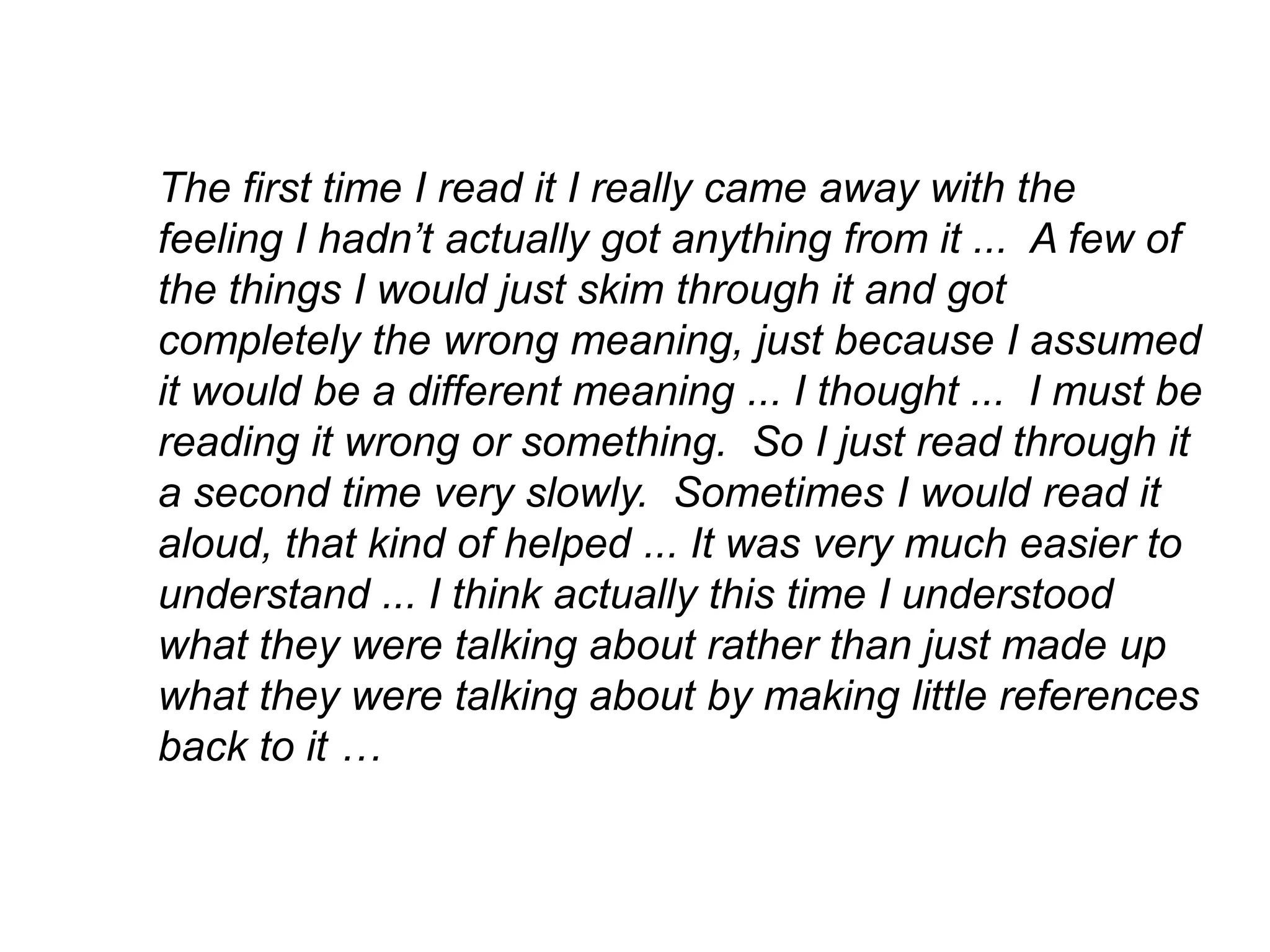
The first time I read it I really came away with the
feeling I hadn’t actually got anything from it ... A few of
the things I would just skim through it and got
completely the wrong meaning, just because I assumed
it would be a different meaning ... I thought ... I must be
reading it wrong or something. So I just read through it
a second time very slowly. Sometimes I would read it
aloud, that kind of helped ... It was very much easier to
understand ... I think actually this time I understood
what they were talking about rather than just made up
what they were talking about by making little references
back to it …
There’ll be a topic in the book which the question
comes under, and then you hunt through that
section to see if they’ve got any... Hopefully, they’ll
have the exact question and you can copy it
straight down without doing any work at all ...
Usually you have to hunt out the various related
equations, then you just apply these to the
problem. That’s all really.
Strategic learning
• Well-organised form of Surface approach; the
  motivation is to get good marks.
• Learning construed as a game: acquisition of
  technique improves performance.
• Insofar as learning is not a game, it breaks
  down.

• Atherton J S (2011) Learning and Teaching; Deep and Surface
  learning [On-line: UK] retrieved 19 September 2011 from
  http://www.learningandteaching.info/learning/deepsurf.htm
The lecturer told us his marking scheme, and 16 of the
  possible 20 marks went for the design, building and
performance of the bridge. It was a model bridge, and
only 4 marks, 20% of the marks, were available for the
report. So obviously I didn’t put much effort into that at
 all ... I’m well aware that I’m here to get a degree you
 know, you don’t write what you think, you write what
   the tutor wants you to think. And in engineering in
  general there’s not much room for that. I think there
  would be a lot more room for it in subjective things,
      and I would do it even more then, presumably.
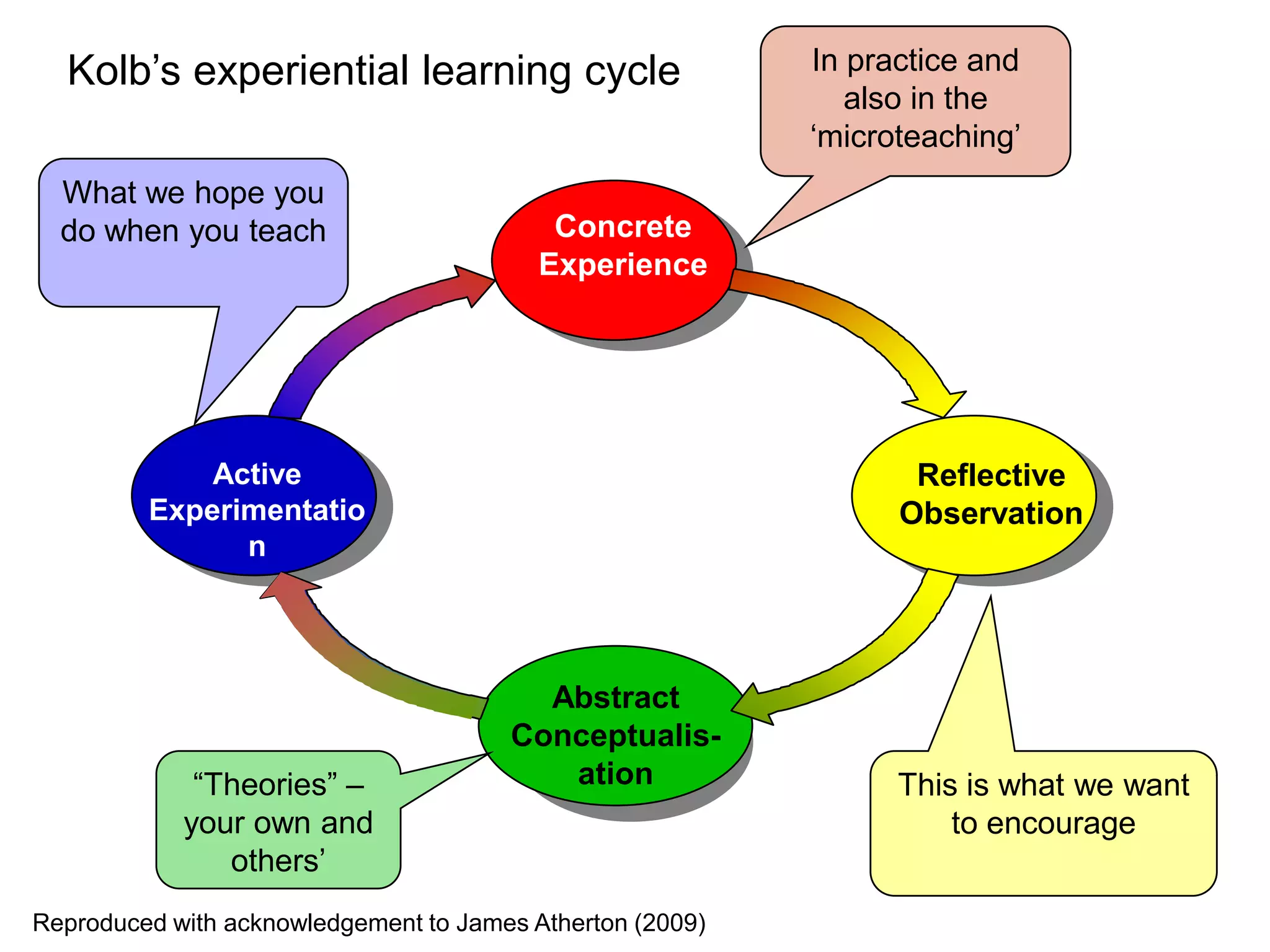
Kolb‟s experiential learning cycle                       In practice and
                                                              also in the
                                                           „microteaching‟
  What we hope you
  do when you teach                        Concrete
                                          Experience


             Active                                               Reflective
         Experimentatio                                          Observation
               n


                                         Abstract
                                       Conceptualis-
             “Theories” –                 ation                  This is what we want
            your own and                                             to encourage
               others‟
Reproduced with acknowledgement to James Atherton (2009)
Product and Process
• Learning as Process

• Learning as Product or outcome

• Learning and teaching as a subject of
  inquiry, a field or discipline in its own right
   – pedagogy, andragogy
Social Learning


Q: Is learning purely a possession of the individual
that can be found inside their heads?
• Learning is in the relationship between people
• We educate for learners to become part of a
   community of practice, e.g. a disciplinary
   community. (See Lave & Wenger)
• There is a connection between knowledge and
   activity
Summary


•   Deep, surface & strategic
•   Learning Cycles
•   Process and product
•   Social and individual
Summary: good practice


•   encourage student-tutor contact
•   encourage student-student co-operation
•   encourage active learning
•   give prompt feedback
•   emphasise time on task
•   have and communicate high expectations
•   respect diverse talents and ways of
    learning
                         (Chickering & Gamson, 1987)

independent of the mode of engagement

What is learning?

  • 1.
    First Steps intoTeaching and Learning in Higher Education What is Learning?
  • 2.
  • 3.
    Programme • What isLearning? • Core Concepts for Teaching in HE • Planning & Running Sessions • Next Steps
  • 4.
    Aims • Introduce thegroup to one another • Provide basic guidance on  Learning theories  Objective-led teaching • Practice a small piece of “microteaching” • Address some of your practical challenges of teaching
  • 5.
    Your Objectives • Withpartner, pairs or a three • What do you hope to be able to DO better as a result of this course
  • 6.
  • 7.
    Objective led • Objectivesdefine students knowledge, understanding, intellectual and subject specific skills at each level. • Objectives clarify the purpose of the course – for you and your students • Objectives help you decide and prioritise which topics to teach, and in what depth • Objectives help define appropriate teaching and learning strategies • Thinking about how students demonstrate their learning leads naturally to purposeful assessment tasks
  • 8.
    Objectives What do Ihope you will be able to do better as a result of this morning‟s sessions? • Describe some approaches to learning • Write [effective] learning outcomes • Elaborate/develop [some] “effectiveness criteria” for teaching
  • 9.
    Learning “I want totalk about learning. But not the lifeless, sterile, futile, quickly forgotten stuff that is crammed in to the mind of the poor helpless individual tied into his seat by ironclad bonds of conformity! I am talking about LEARNING - the insatiable curiosity that drives the adolescent boy to absorb everything he can see or hear or read about gasoline engines in order to improve the efficiency and speed of his 'cruiser'. I am talking about the student who says, "I am discovering, drawing in from the outside, and making that which is drawn in a real part of me." I am talking about any learning in which the experience of the learner progresses along this line: "No, no, that's not what I want"; "Wait! This is closer to what I am interested in, what I need"; "Ah, here it is! Now I'm grasping and comprehending what I need and what I want to know!” Carl Rogers Rogers, C. and Freiberg, H. J. (1993) Freedom to Learn (3rd edn.)
  • 10.
    My Learning andview of students learning With a partner, discuss and produce a joint „poster‟ on the following: • How do you learn best? • How [have / will] your own learning experiences influence(d) how you teach? • What strategies and techniques [do you / would you] employ to help students learn?
  • 11.
    Some models /theories of learning • Learning Cycles • Approaches to Learning • Process / product • Deep / Surface • Social Learning
  • 12.
    What is Learning? Writedown, in one sentence, your definition of learning.
  • 13.
    Conceptions of Learning 1.Learning as a quantitative increase in knowledge. Learning is acquiring information or „knowing a lot‟. 2. Learning as memorising. Learning is storing information that can be reproduced. 3. Learning as acquiring facts, skills, and methods that can be retained and used as necessary. 4. Learning as making sense or abstracting meaning. Learning involves relating parts of the subject matter to each other and to the real world. 5. Learning as interpreting and understanding reality in a different way. Learning involves comprehending the world by reinterpreting knowledge. How do your definitions fit with these?
  • 14.
    Deep and surface •Surface learning – Rote learning or memorisation • Deep learning – Learning with understanding • 2 examples follow: – How would you characterise these? – Discuss with your neighbour(s) • MARTON F and SÄLJÖ (1976) "On Qualitative Differences in Learning — 1: Outcome and Process" Brit. J. Educ. Psych. 46, 4-11
  • 15.
    The first timeI read it I really came away with the feeling I hadn’t actually got anything from it ... A few of the things I would just skim through it and got completely the wrong meaning, just because I assumed it would be a different meaning ... I thought ... I must be reading it wrong or something. So I just read through it a second time very slowly. Sometimes I would read it aloud, that kind of helped ... It was very much easier to understand ... I think actually this time I understood what they were talking about rather than just made up what they were talking about by making little references back to it …
  • 16.
    There’ll be atopic in the book which the question comes under, and then you hunt through that section to see if they’ve got any... Hopefully, they’ll have the exact question and you can copy it straight down without doing any work at all ... Usually you have to hunt out the various related equations, then you just apply these to the problem. That’s all really.
  • 17.
    Strategic learning • Well-organisedform of Surface approach; the motivation is to get good marks. • Learning construed as a game: acquisition of technique improves performance. • Insofar as learning is not a game, it breaks down. • Atherton J S (2011) Learning and Teaching; Deep and Surface learning [On-line: UK] retrieved 19 September 2011 from http://www.learningandteaching.info/learning/deepsurf.htm
  • 18.
    The lecturer toldus his marking scheme, and 16 of the possible 20 marks went for the design, building and performance of the bridge. It was a model bridge, and only 4 marks, 20% of the marks, were available for the report. So obviously I didn’t put much effort into that at all ... I’m well aware that I’m here to get a degree you know, you don’t write what you think, you write what the tutor wants you to think. And in engineering in general there’s not much room for that. I think there would be a lot more room for it in subjective things, and I would do it even more then, presumably.
  • 19.
    Kolb‟s experiential learningcycle In practice and also in the „microteaching‟ What we hope you do when you teach Concrete Experience Active Reflective Experimentatio Observation n Abstract Conceptualis- “Theories” – ation This is what we want your own and to encourage others‟ Reproduced with acknowledgement to James Atherton (2009)
  • 20.
    Product and Process •Learning as Process • Learning as Product or outcome • Learning and teaching as a subject of inquiry, a field or discipline in its own right – pedagogy, andragogy
  • 21.
    Social Learning Q: Islearning purely a possession of the individual that can be found inside their heads? • Learning is in the relationship between people • We educate for learners to become part of a community of practice, e.g. a disciplinary community. (See Lave & Wenger) • There is a connection between knowledge and activity
  • 22.
    Summary • Deep, surface & strategic • Learning Cycles • Process and product • Social and individual
  • 23.
    Summary: good practice • encourage student-tutor contact • encourage student-student co-operation • encourage active learning • give prompt feedback • emphasise time on task • have and communicate high expectations • respect diverse talents and ways of learning (Chickering & Gamson, 1987) independent of the mode of engagement

Editor's Notes

  • #14 How do your definitions link to these?
  • #16 Intention to understand ideas for oneselfRelating ideas to previous knowledge and experienceLooking for patterns and underlying principlesChecking evidence and relating it to conclusionsExamining logic and argument cautiously and criticallyBecoming actively interested in the course content
  • #17 Intention to cope minimally with course requirementsStudying without reflecting on purpose or strategyTreating the course as unrelated bits of knowledgeMemorising facts and procedures routinelyFinding difficulty in making sense of new ideasFeeling undue pressure and worry about work
  • #19 Intention to achieve the highest possible gradesPutting consistent effort into studyingFinding the right conditions and materials for studyingManaging time and effort effectivelyBeing alert to assessment requirements and criteriaGearing work to the perceived preferences of lecturers