The document summarizes a presentation on curriculum mapping for a science curriculum committee. It defines curriculum mapping and describes its benefits, such as eliminating gaps and repetitions in curriculum across grade levels. It outlines the process of mapping, including collecting curriculum data, reviewing for patterns and areas for improvement, and creating individual teacher maps with essential questions, skills, assessments, and activities. Sample maps are provided and the benefits of individual and collaborative mapping for teachers are discussed.
GOAL OF SCIENCECURRICULUM WRITING To construct curricula with mapping and in the UbD format in order to promote higher order thinking skills, engage students in authentic performance assessment tasks, generate transfer and application of knowledge all of which improve student achievement as measured on criterion referenced tests such as the ASK3-8, teacher made tests, performance assessments.
3.
RESOURCES/MATERIALS Understanding byDesign Professional Development Workbook , Wiggins, McTighe NJCCCS (2009) NJ Focus Areas Science Curriculum website – http://sites.google.com/site/ncsdistrict/science-curriculum-committee ScottForesman, Pearson textbooks
Definition of CurriculumMapping Calendar-based curriculum mapping is a procedure for collecting and maintaining an operational data base of the curriculum in a school or district. Curriculum mapping provides the basis for authentic examination. Module 1, Figure 1
6.
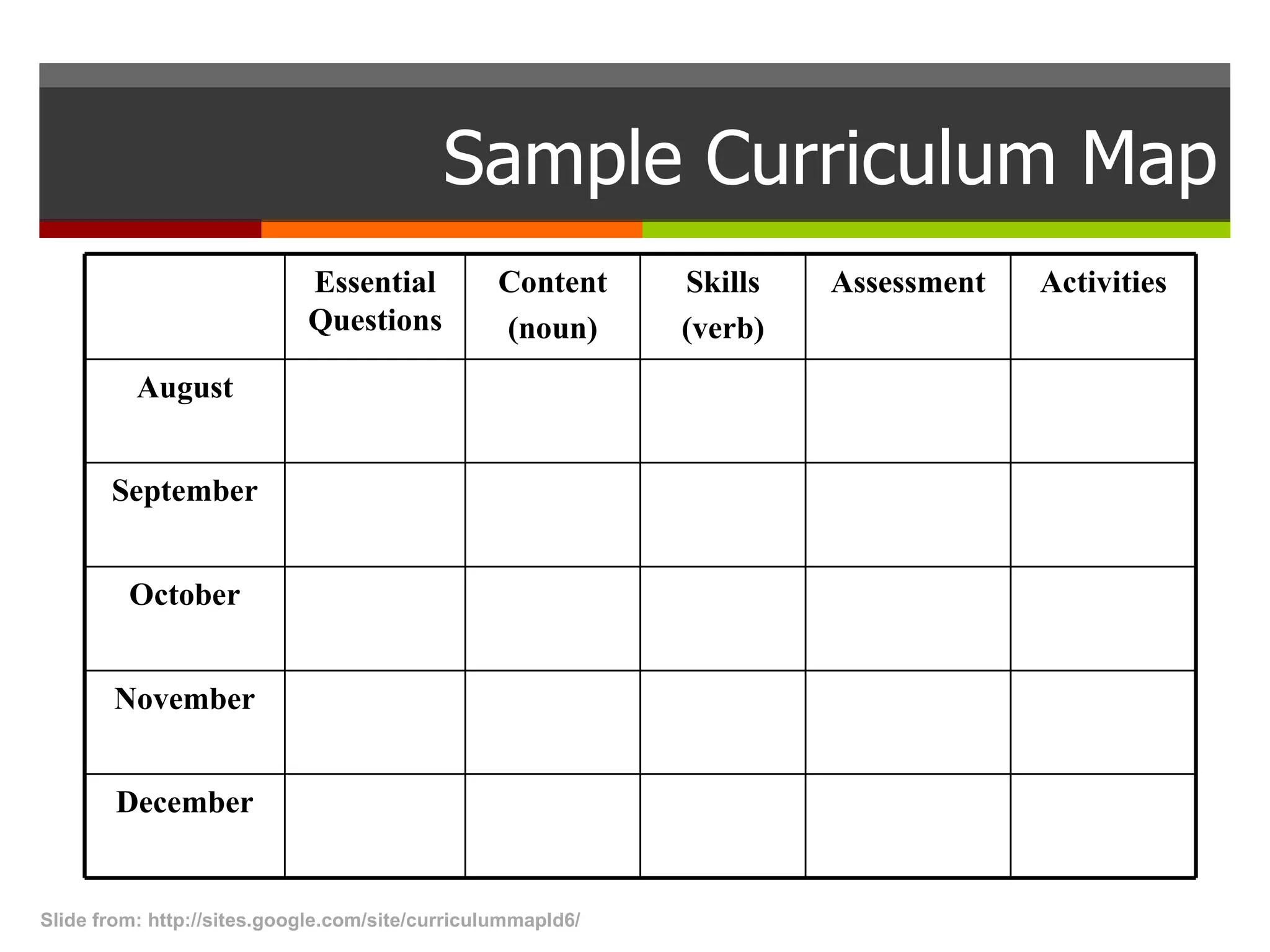
Sample Curriculum MapSlide from: http://sites.google.com/site/curriculummapld6/ Essential Questions Content (noun) Skills (verb) Assessment Activities August September October November December
7.
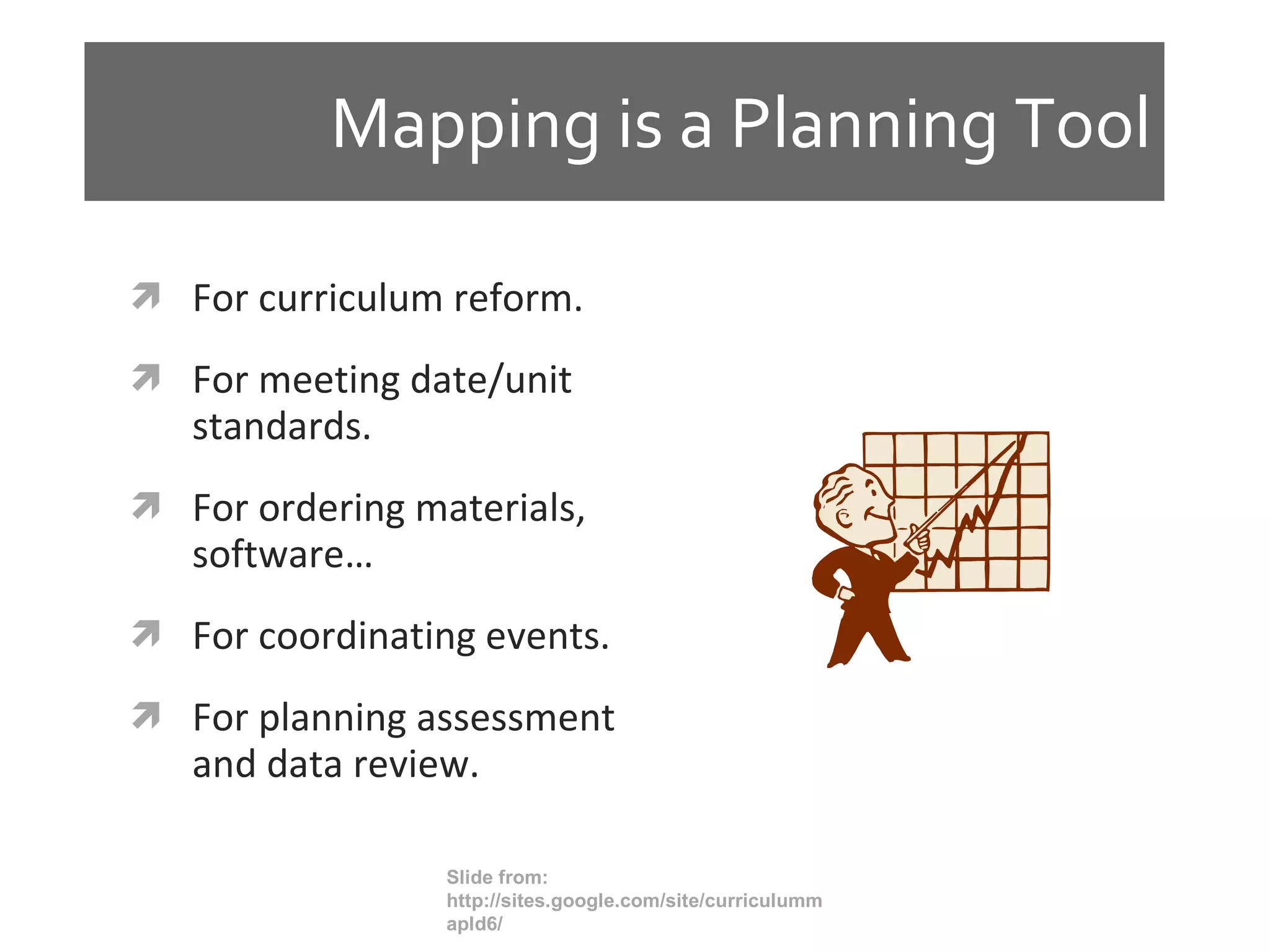
Mapping is aPlanning Tool For curriculum reform. For meeting date/unit standards. For ordering materials, software… For coordinating events. For planning assessment and data review. Slide from: http://sites.google.com/site/curriculummapld6/
8.
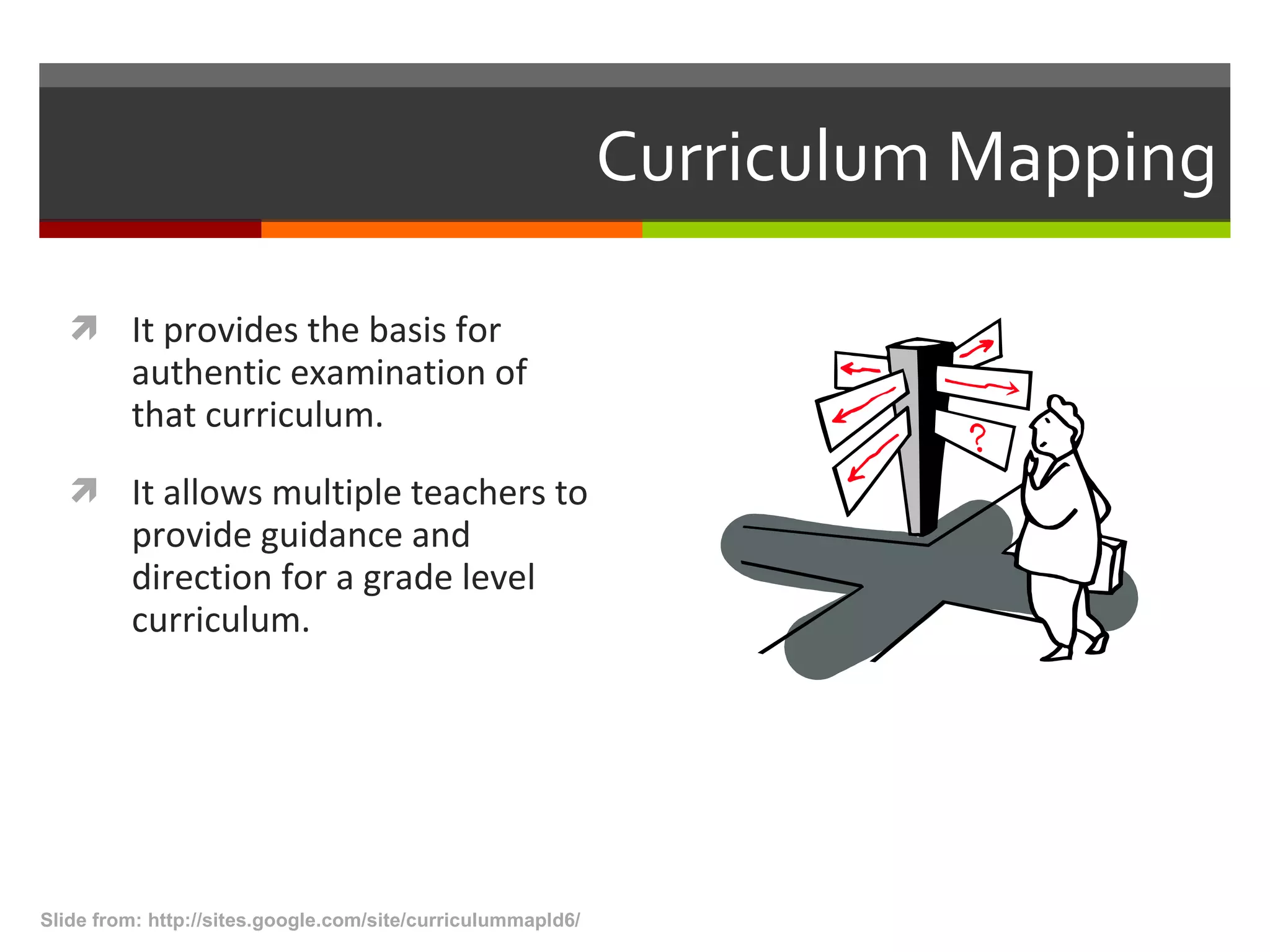
Curriculum Mapping Itprovides the basis for authentic examination of that curriculum. It allows multiple teachers to provide guidance and direction for a grade level curriculum. Slide from: http://sites.google.com/site/curriculummapld6/
9.
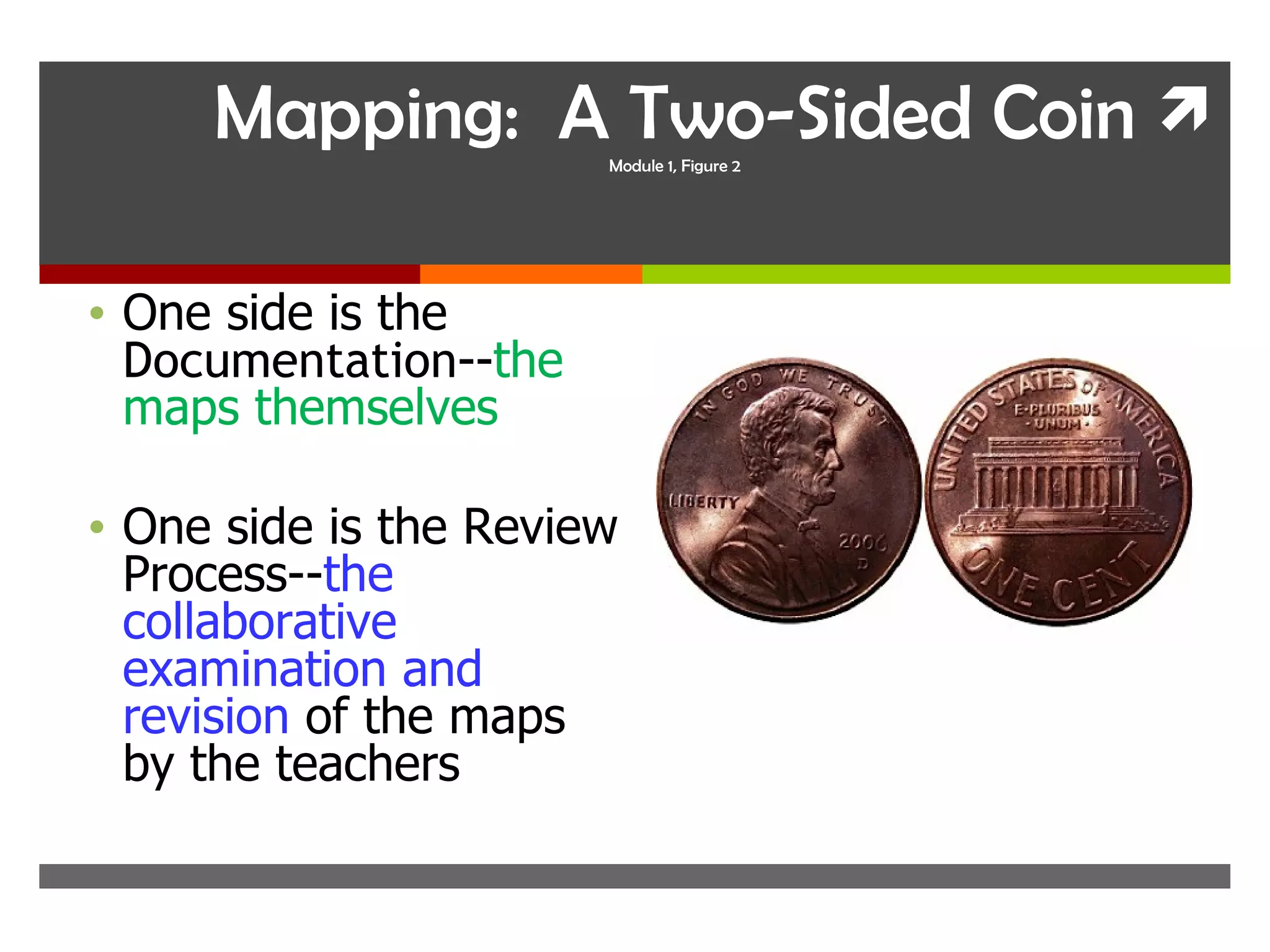
One side isthe Documentation -- the maps themselves One side is the Review Process-- the collaborative examination and revision of the maps by the teachers Mapping: A Two-Sided Coin Module 1, Figure 2
10.
Essential Question: WhyMap? Eliminate teaching in isolation If there are gaps within grade level, “there are virtual Grand Canyons” vertically. Wide angle lens on K-8 to make senses of our students’ experiences over time. Identify repetitions Will help us identify gaps in specific skills within grade level school year and over a group of school years. Validate standards
11.
Curriculum Mapping Attemptsto: Create a “snapshot” of the educational activities of every classroom within the school/grade level/content area. Capture the content skills and assessments taught by every teacher in the school/grade level/content area. Organize this information into an easily accessed visual that presents a timeline of instruction by teacher and course. Slide from: http://sites.google.com/site/curriculummapld6/
12.
Essential Questions: How can curriculum mapping impact student learning? What issues could be addressed through the mapping process? What are strengths and weaknesses of current curriculum. How can mapping address weaknesses? Look at sample maps from different grade levels and subjects provided in your binder. Study them. What are consistent elements that occur on all maps, types of information gleaned from the maps, and quality of elements (what is better on some?)
13.
Mapping is aCommunication Tool for Staff Between teachers in a school site. Between teachers in feeding and receiving sites. For future teachers. For a new/revised curriculum. Slide from: http://sites.google.com/site/curriculummapld6/
14.
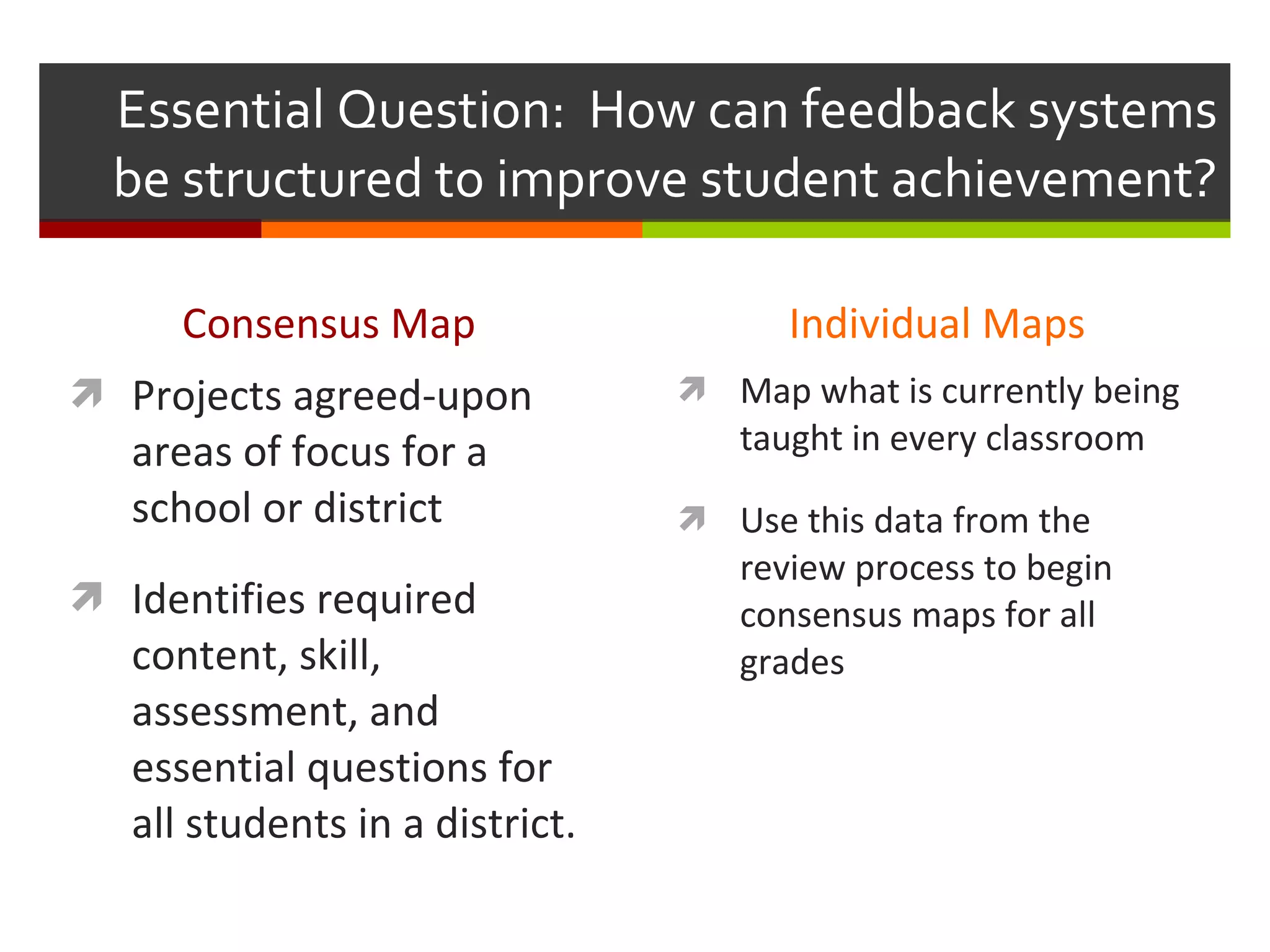
Essential Question: How can feedback systems be structured to improve student achievement? Consensus Map Projects agreed-upon areas of focus for a school or district Identifies required content, skill, assessment, and essential questions for all students in a district. Individual Maps Map what is currently being taught in every classroom Use this data from the review process to begin consensus maps for all grades
15.
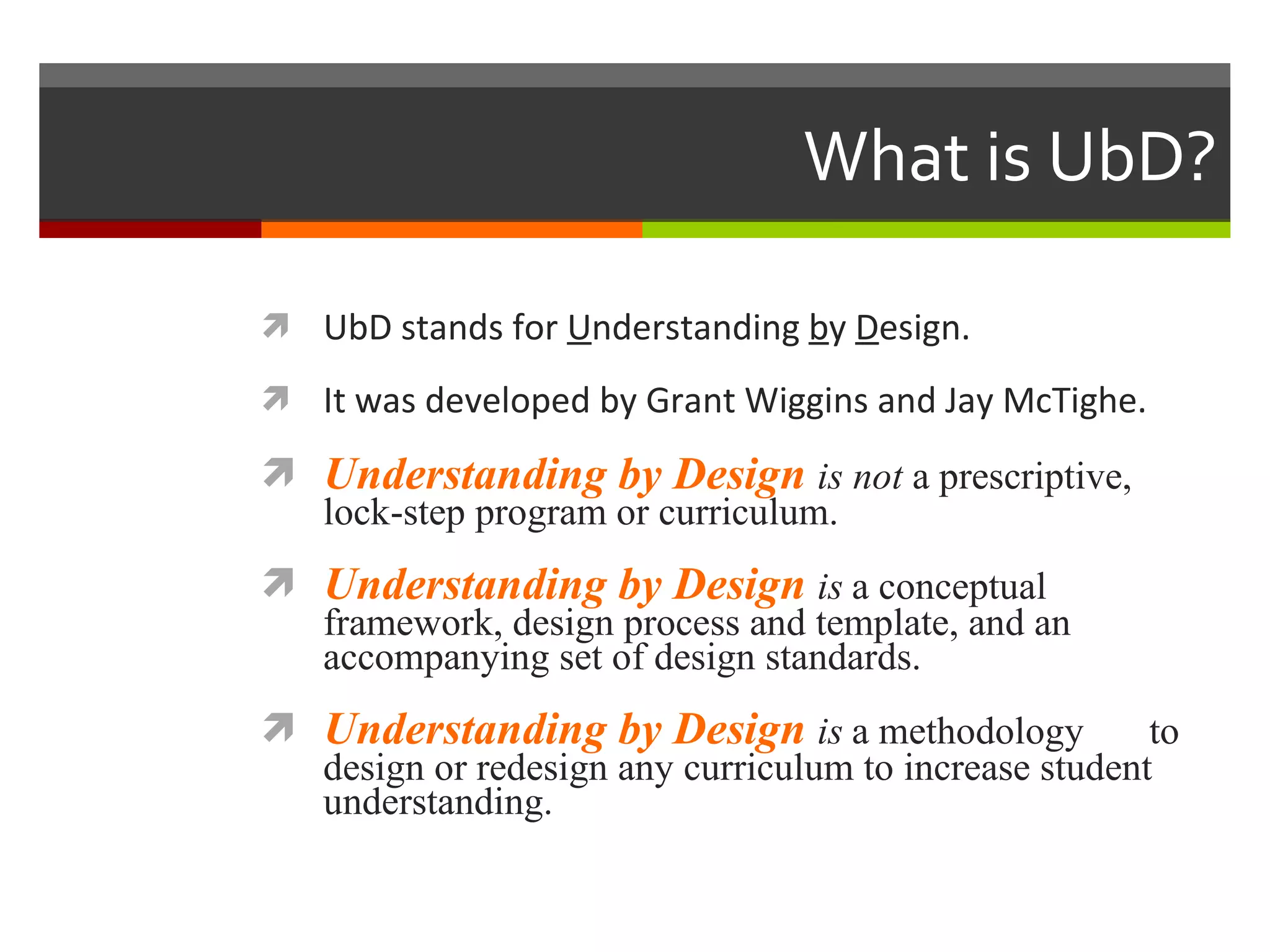
What is UbD?UbD stands for U nderstanding b y D esign. It was developed by Grant Wiggins and Jay McTighe. Understanding by Design is not a prescriptive, lock-step program or curriculum. Understanding by Design is a conceptual framework, design process and template, and an accompanying set of design standards. Understanding by Design is a methodology to design or redesign any curriculum to increase student understanding.
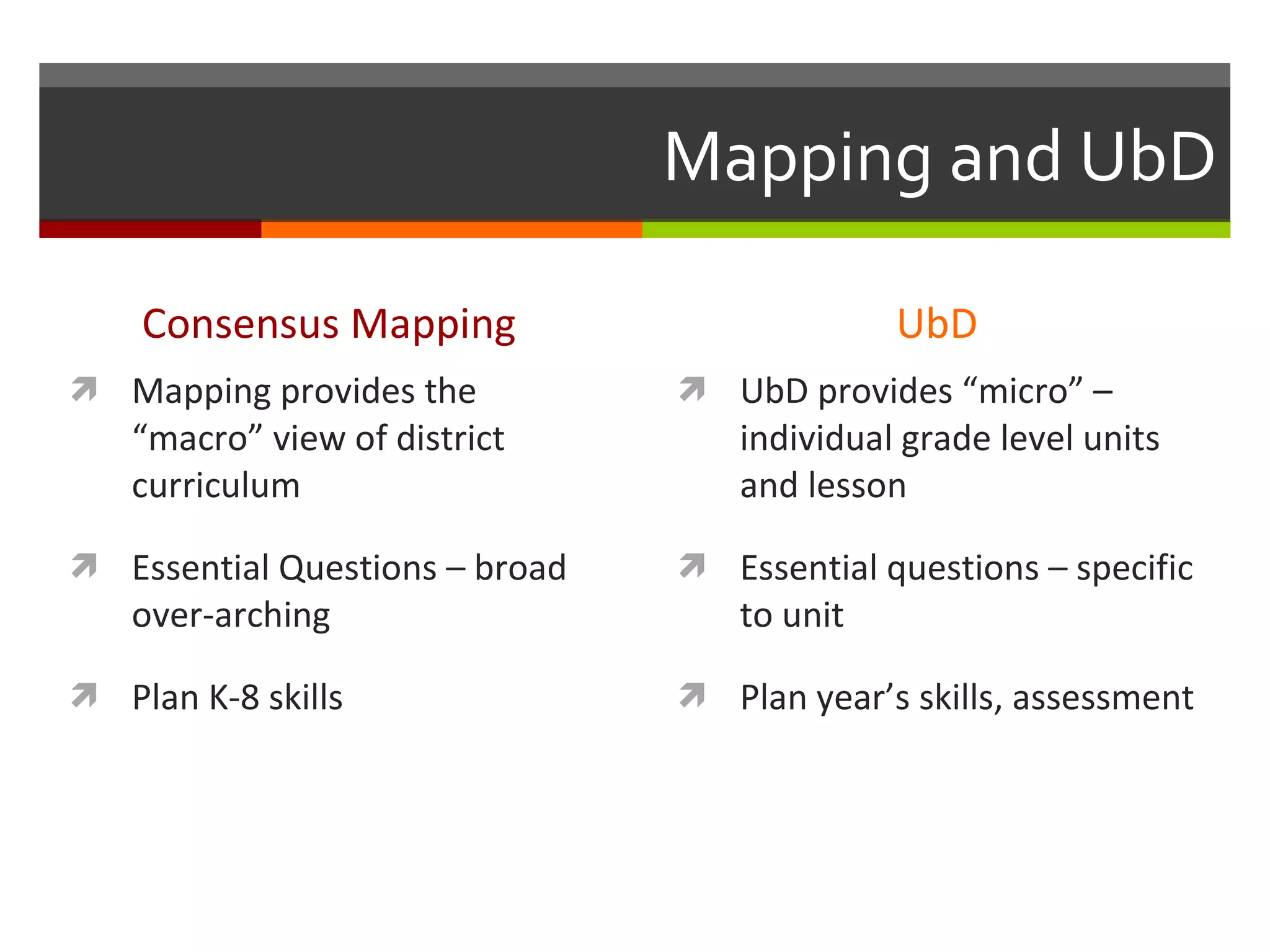
Mapping and UbDConsensus Mapping Mapping provides the “macro” view of district curriculum Essential Questions – broad over-arching Plan K-8 skills UbD UbD provides “micro” – individual grade level units and lesson Essential questions – specific to unit Plan year’s skills, assessment
18.
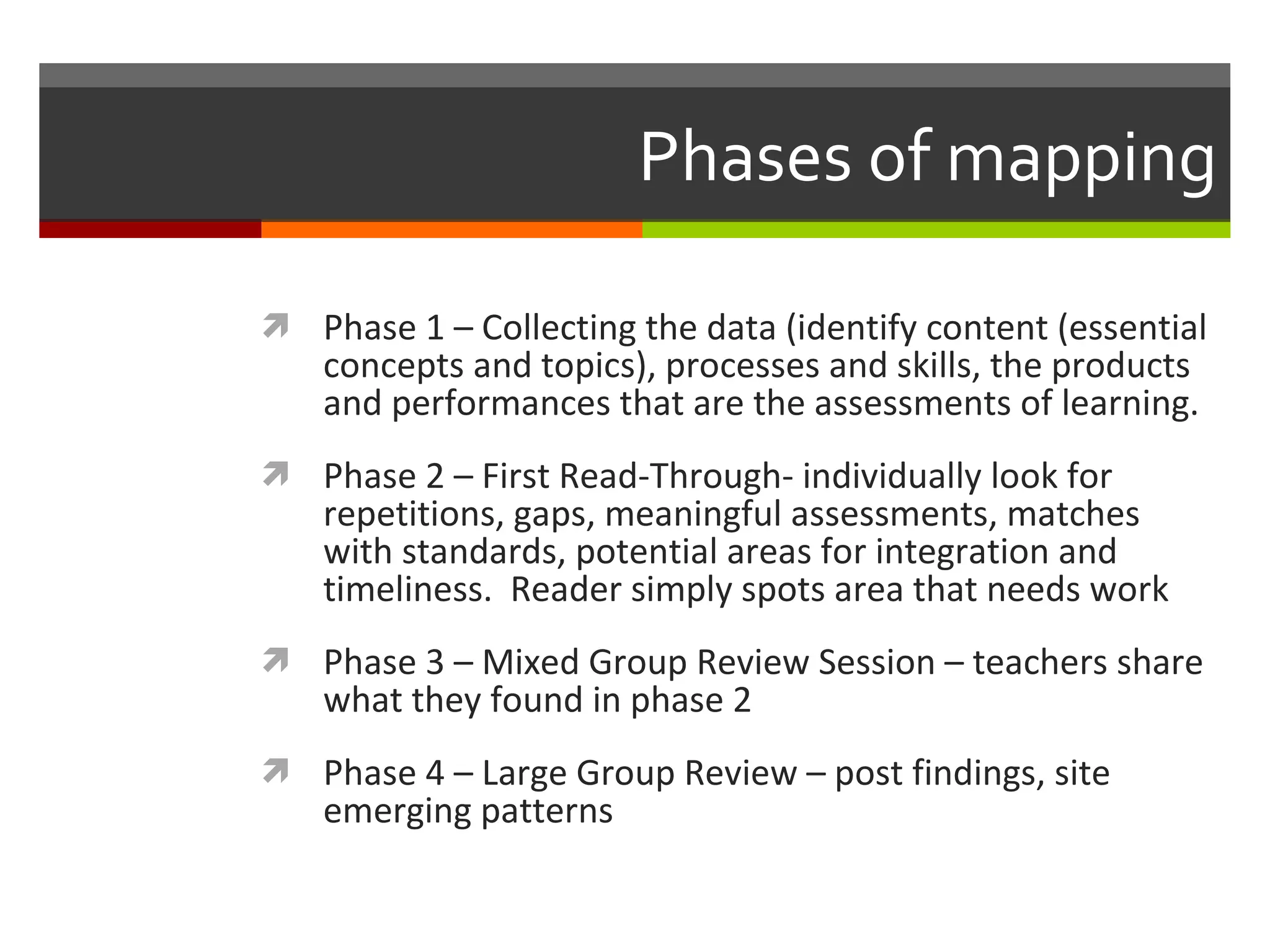
Phases of mappingPhase 1 – Collecting the data (identify content (essential concepts and topics), processes and skills, the products and performances that are the assessments of learning. Phase 2 – First Read-Through- individually look for repetitions, gaps, meaningful assessments, matches with standards, potential areas for integration and timeliness. Reader simply spots area that needs work Phase 3 – Mixed Group Review Session – teachers share what they found in phase 2 Phase 4 – Large Group Review – post findings, site emerging patterns
19.
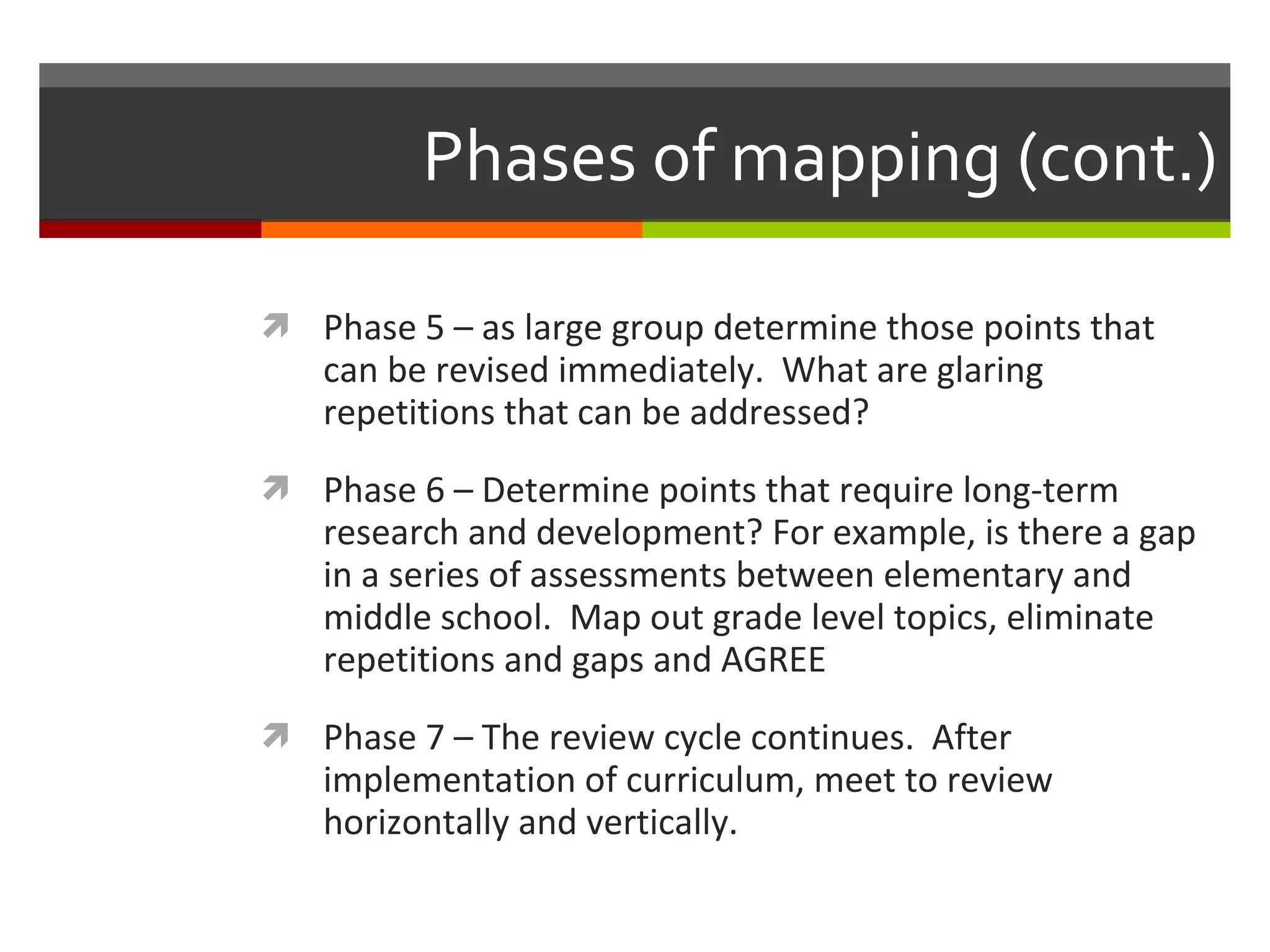
Phases of mapping(cont.) Phase 5 – as large group determine those points that can be revised immediately. What are glaring repetitions that can be addressed? Phase 6 – Determine points that require long-term research and development? For example, is there a gap in a series of assessments between elementary and middle school. Map out grade level topics, eliminate repetitions and gaps and AGREE Phase 7 – The review cycle continues. After implementation of curriculum, meet to review horizontally and vertically.
20.
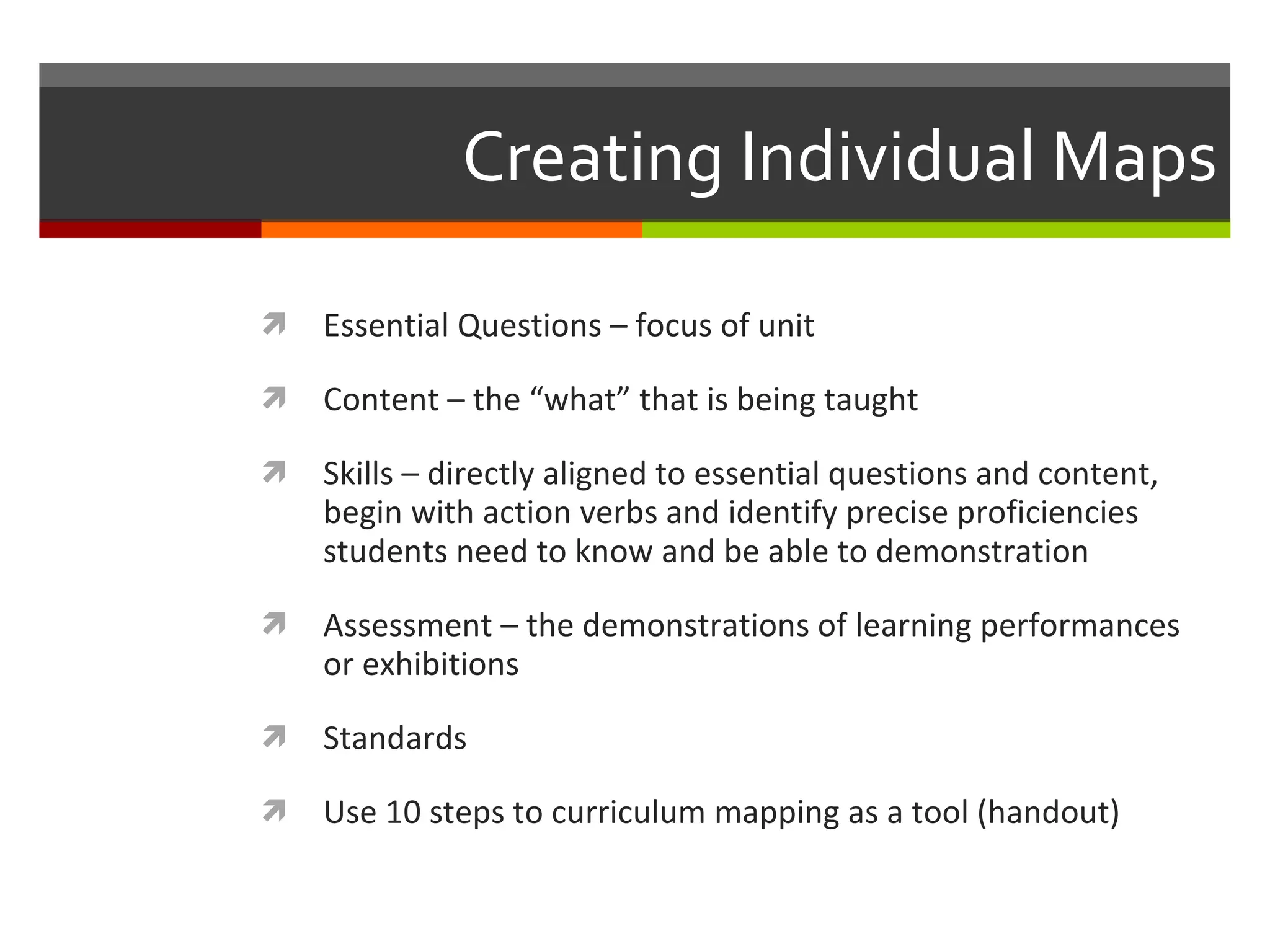
Creating Individual MapsEssential Questions – focus of unit Content – the “what” that is being taught Skills – directly aligned to essential questions and content, begin with action verbs and identify precise proficiencies students need to know and be able to demonstration Assessment – the demonstrations of learning performances or exhibitions Standards Use 10 steps to curriculum mapping as a tool (handout)
21.
Essential Questions …Focus on a broad topic of study. Have multiple answers and perspectives. They address “why” or “how”. They are “mental Velcro” that helps ideas stick in students’ minds. Slide from: http://sites.google.com/site/curriculummapld6/
22.
Essential Questions ExamplesWhich is more important – water or air? What is change? What if Shakespeare were a woman? Slide from: http://sites.google.com/site/curriculummapld6/
23.
Skills Skills arekey abilities and processes students will develop related to specific content. Skills are written beginning with a verb. Slide from: http://sites.google.com/site/curriculummapld6/
24.
Skills Examples Readinga map Writing a play Analyzing non-fiction text Writing persuasive essays Matching words and pictures Slide from: http://sites.google.com/site/curriculummapld6/
25.
Assessment Assessments arethe products or performances that demonstrate student learning. Assessments are what the student does (the actual product or performance), not the evaluation tool used to assess the product. Slide from: http://sites.google.com/site/curriculummapld6/
26.
Assessment Examples Grouppresentation Brochure Research Paper Essay exam Puppet show Debate Periodic Assessments Teacher Created Tests/Quizzes Slide from: http://sites.google.com/site/curriculummapld6/
27.
Activities Key activitiesthat lead to acquisition of knowledge and skills. Describe the "how" for the knowledge and skills. Slide from: http://sites.google.com/site/curriculummapld6/
28.
Activities Examples Writingpersuasive letters to local government Water analysis of local river Critique a work of art Create a 50 states quilt Slide from: http://sites.google.com/site/curriculummapld6/
29.
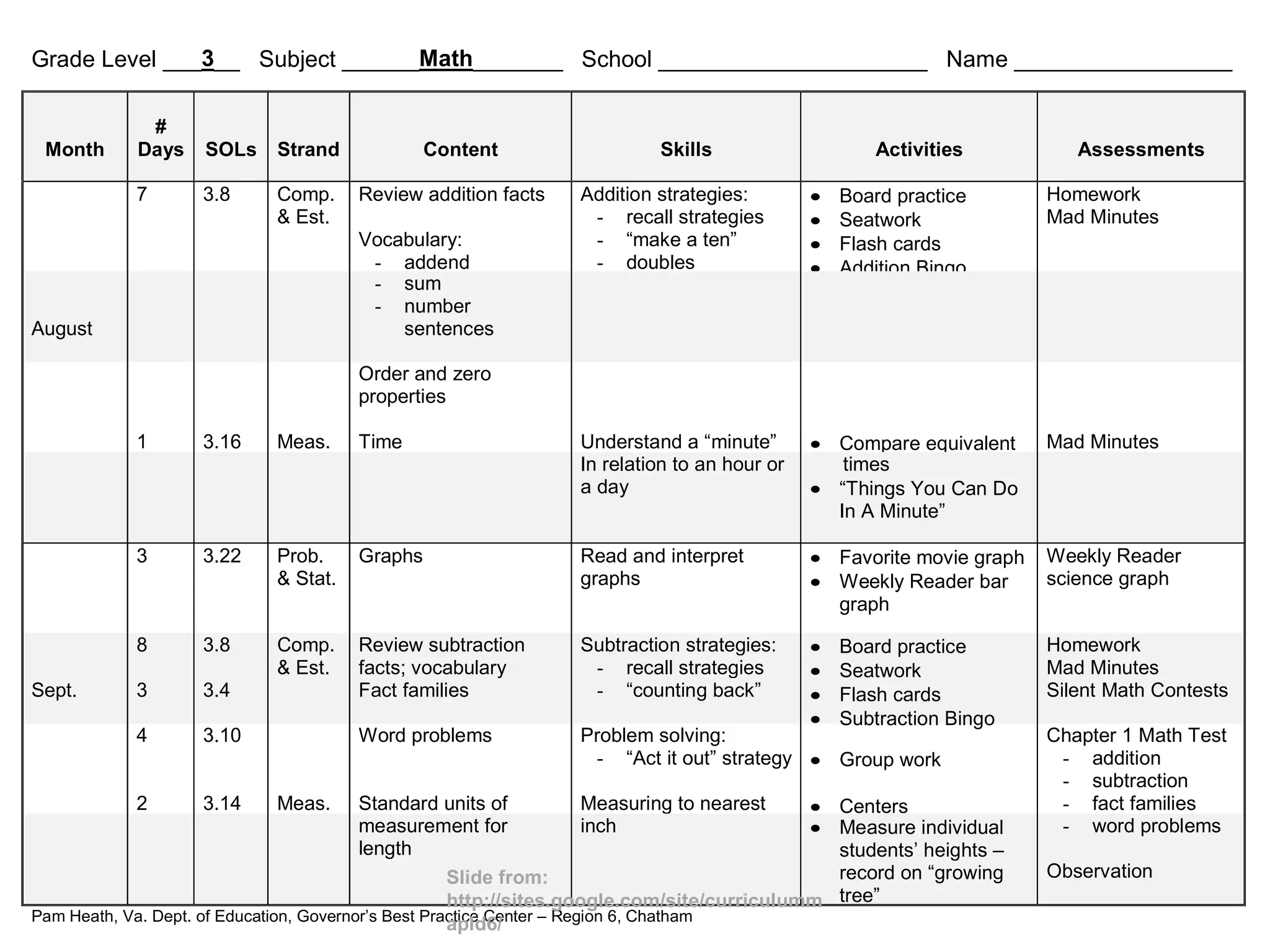
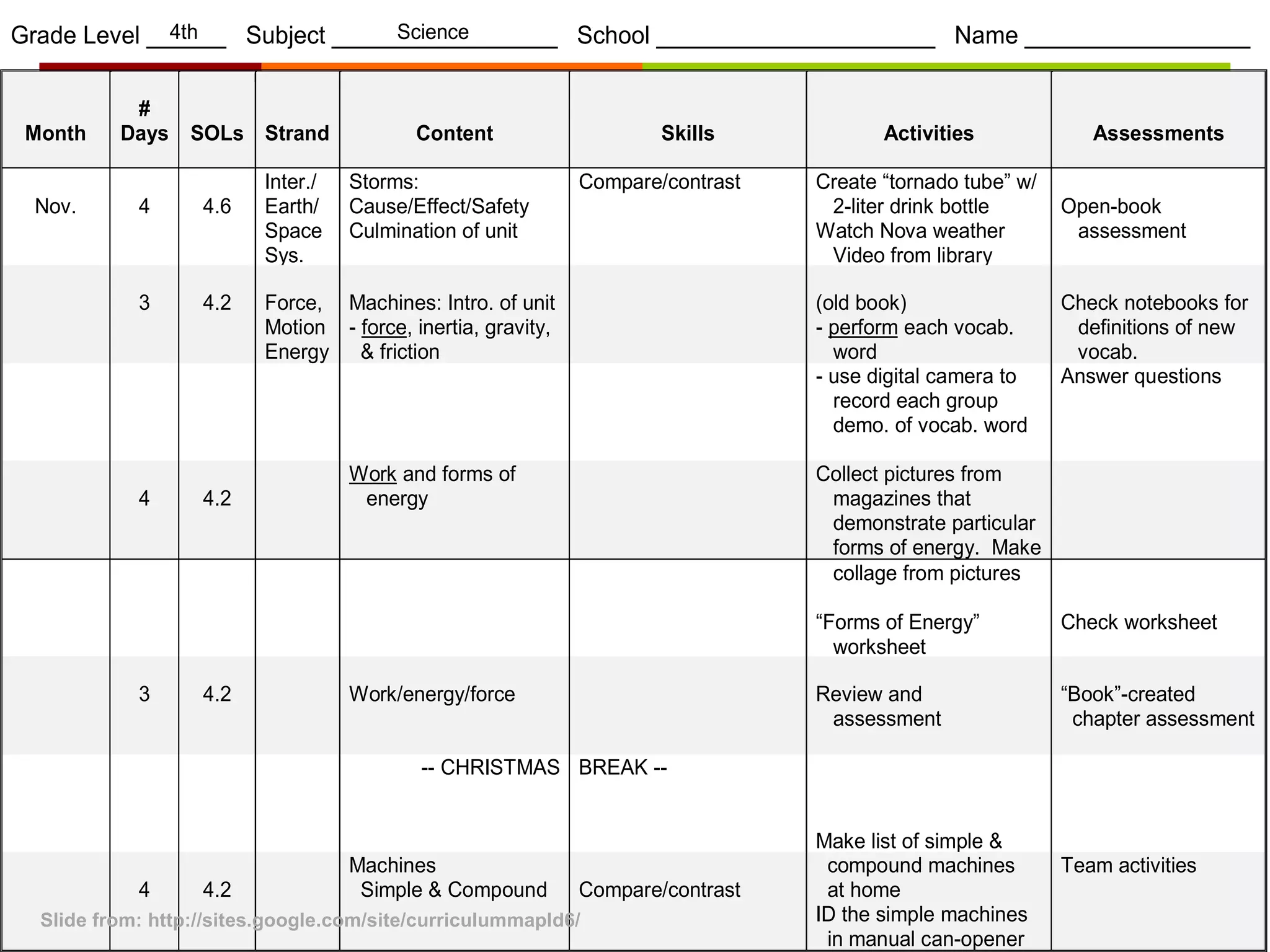
Curriculum Map SamplesThe following slides will include some examples of curriculum maps. Keep in mind that not all of the sections are included or required. Slide from: http://sites.google.com/site/curriculummapld6/
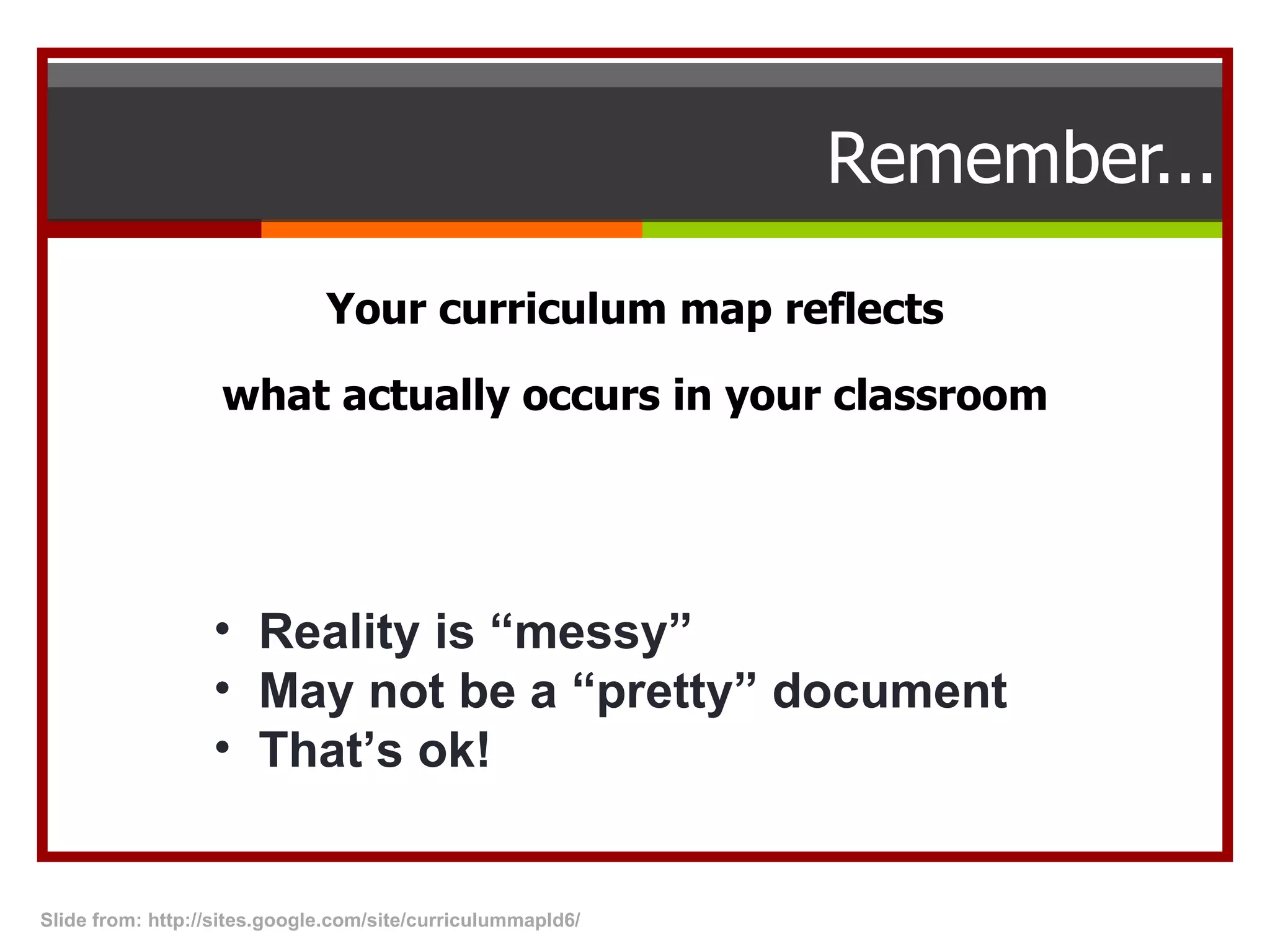
Remember... Your curriculummap reflects what actually occurs in your classroom Reality is “messy” May not be a “pretty” document That’s ok! Slide from: http://sites.google.com/site/curriculummapld6/
33.
Some Guidelines... Includeenough specifics to make the map useful (so it “tells” you something upon reflection) Use specific vocabulary vs. vague/generic terms Slide from: http://sites.google.com/site/curriculummapld6/
34.
Benefits as anindividual teacher... Can review timing, sequence, level of instruction Serves as documentation of successful instructional activities Assists in monitoring types of instructional methods used (ex., cooperative learning, direct instruction, etc.) Slide from: http://sites.google.com/site/curriculummapld6/
35.
As a groupof teachers of varied grade levels or varied courses within a department... Can examine for “gaps” in the curriculum Can note “repetitions” in the curriculum Provides opportunity to collaborate with colleagues across grade levels and courses Slide from: http://sites.google.com/site/curriculummapld6/
36.
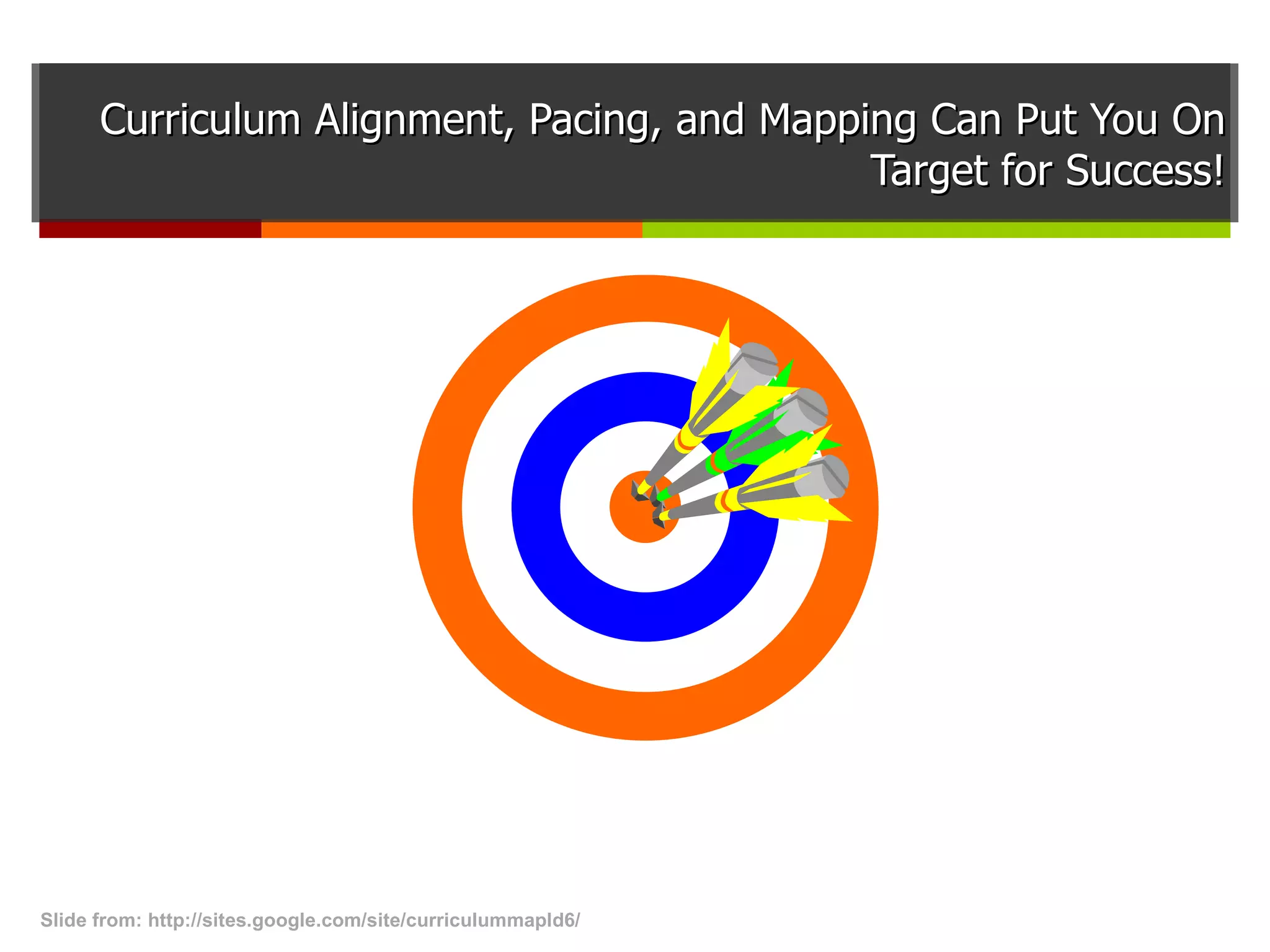
Curriculum Alignment, Pacing,and Mapping Can Put You On Target for Success! Slide from: http://sites.google.com/site/curriculummapld6/
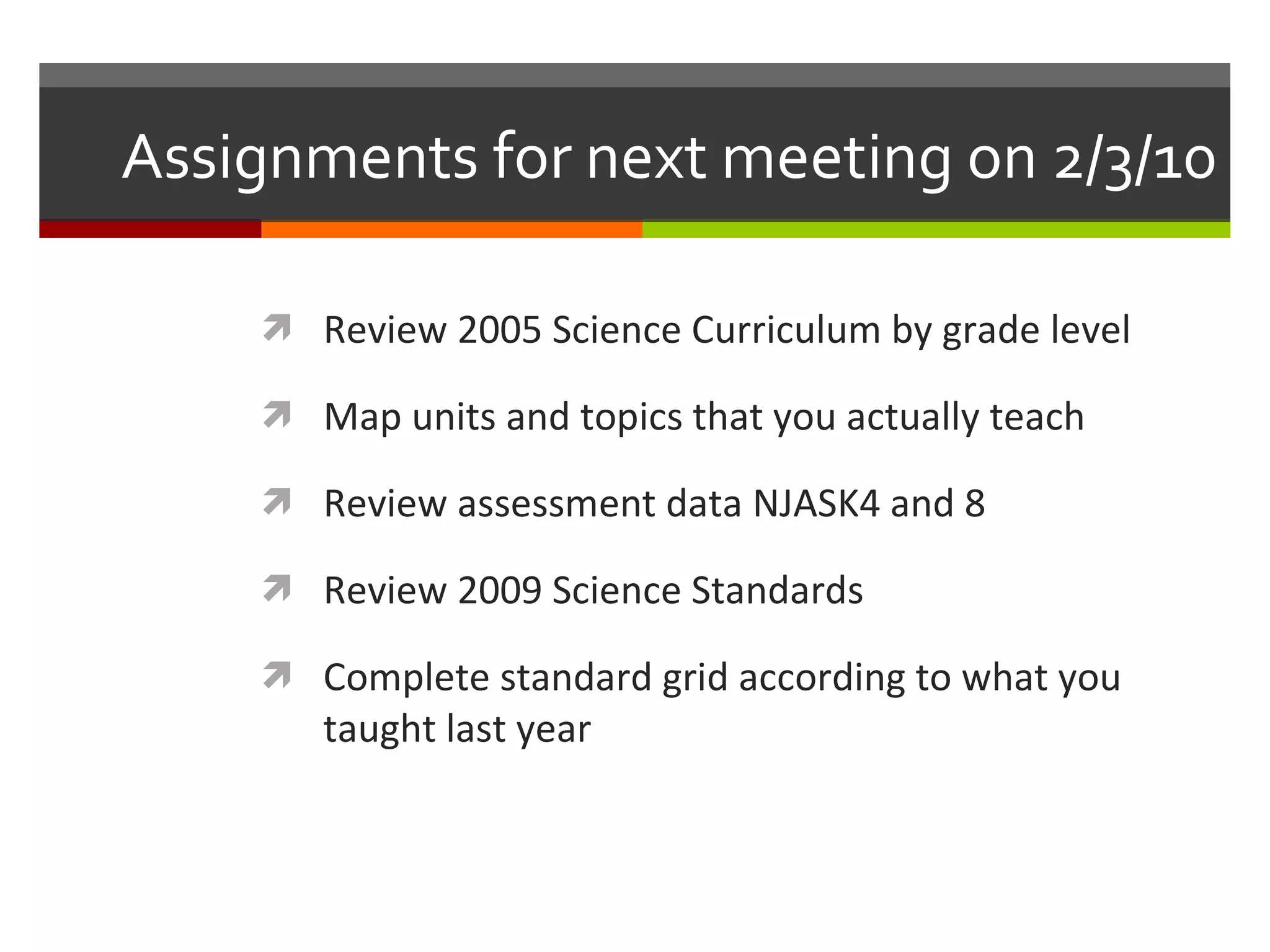
Assignments for nextmeeting on 2/3/10 Review 2005 Science Curriculum by grade level Map units and topics that you actually teach Review assessment data NJASK4 and 8 Review 2009 Science Standards Complete standard grid according to what you taught last year
Editor's Notes
#6 Teachers use the school calendar to collect basic information about their curriculum plans such as unit titles, projects, materials.
#10 Draw both sides of the coin. What could you include on each side of the coin that shows the connections with mapping? Discuss what happens if one side is missing. Share your group’s representation with the other groups. As a team process, what became clearer as you worked on this activity?
#11 Most individual elementary teachers find it takes about one hour to complete the content portion of the map for one school year; MS – 45 minutes per course
#13 We will identify essential questions both vertically and horizontally.
#15 Complete benefits of curriculum maps organizer at your tables, share specific benefits Consensus mapping identifies non-negotiables that will be taught in each grade or subject in school Consensus mapping provides the tools to build a cohesive learning community with teachers as the chief architects and builders Mapping provides a process for collegial dialogue as it focuses on alignment of content, skills, assessments, and activities across grade levels with ultimate goal to improve student achievement.