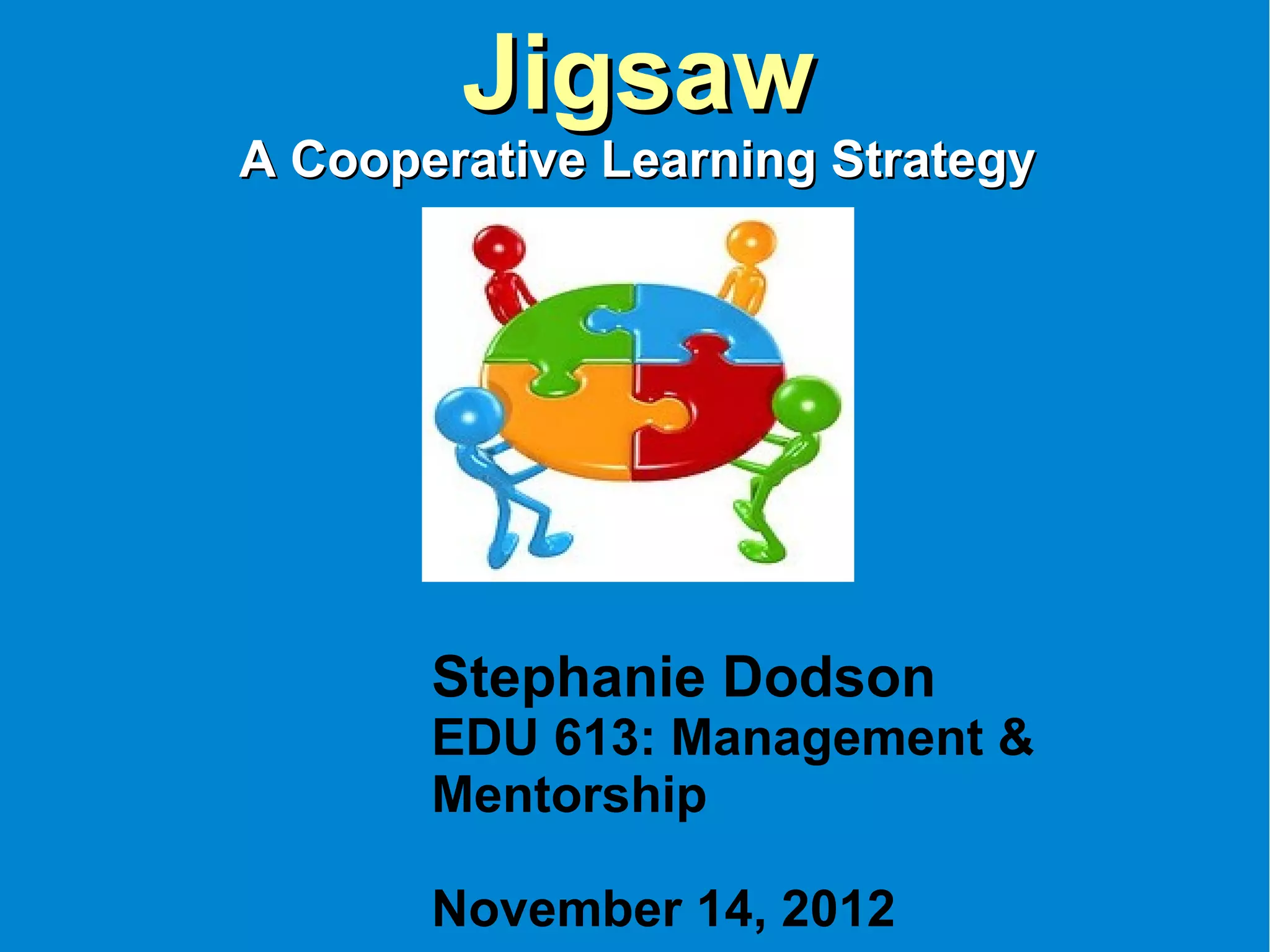
JigsawJigsaw
A Cooperative Learning StrategyA Cooperative Learning Strategy
Stephanie Dodson
EDU 613: Management &
Mentorship
November 14, 2012
What is Jigsaw Method?What is Jigsaw Method?
Jigsaw is a form ofJigsaw is a form of
cooperative learningcooperative learning
in which studentsin which students
function as keepersfunction as keepers
and givers ofand givers of
knowledge.knowledge.
Aronson & Patnoe (2011)
How it worksHow it works
1.Students are divided into two configurations: expert
groups and jigsaw groups.
2.Expert groups work together to study a
topic/information and plan how to present the material
to peers.
3.Next, students reassemble into jigsaw groups. Jigsaw
groups consist of “experts” for each topic.
4.Experts present their information to the jigsaw group.
Team members engage in discussion/feedback
sessions to help everyone master the material.
5.Each student completes a “process sheet” to
demonstrate their understanding of the topics
presented.
Aronson & Patnoe (2011)
Origins of Jigsaw MethodOrigins of Jigsaw Method

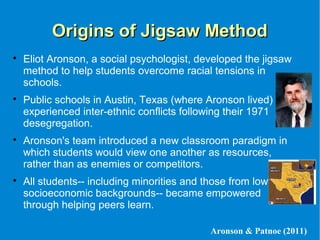
Eliot Aronson, a social psychologist, developed the jigsaw
method to help students overcome racial tensions in
schools.

Public schools in Austin, Texas (where Aronson lived)
experienced inter-ethnic conflicts following their 1971
desegregation.

Aronson's team introduced a new classroom paradigm in
which students would view one another as resources,
rather than as enemies or competitors.

All students-- including minorities and those from low
socioeconomic backgrounds-- became empowered
through helping peers learn.
Aronson & Patnoe (2011)
Traditional vs. Jigsaw ClassroomTraditional vs. Jigsaw Classroom
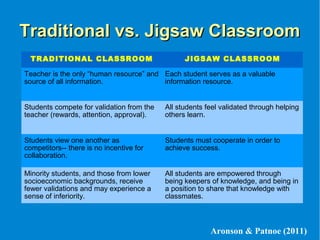
TRADITIONAL CLASSROOM JIGSAW CLASSROOM
Teacher is the only “human resource” and
source of all information.
Each student serves as a valuable
information resource.
Students compete for validation from the
teacher (rewards, attention, approval).
All students feel validated through helping
others learn.
Students view one another as
competitors-- there is no incentive for
collaboration.
Students must cooperate in order to
achieve success.
Minority students, and those from lower
socioeconomic backgrounds, receive
fewer validations and may experience a
sense of inferiority.
All students are empowered through
being keepers of knowledge, and being in
a position to share that knowledge with
classmates.
Aronson & Patnoe (2011)
Case Study: Chinese EFL ClassroomCase Study: Chinese EFL Classroom

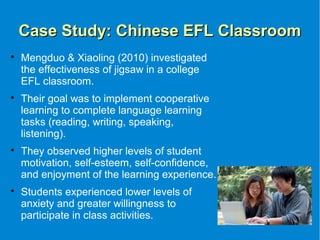
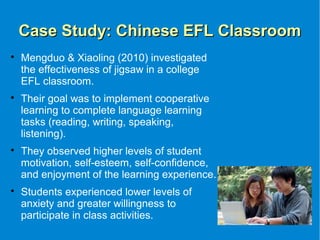
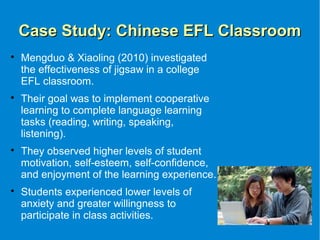
Mengduo & Xiaoling (2010) investigated
the effectiveness of jigsaw in a college
EFL classroom.

Their goal was to implement cooperative
learning to complete language learning
tasks (reading, writing, speaking,
listening).

They observed higher levels of student
motivation, self-esteem, self-confidence,
and enjoyment of the learning experience.

Students experienced lower levels of
anxiety and greater willingness to
participate in class activities.
Case Study: Chinese EFL ClassroomCase Study: Chinese EFL Classroom

Mengduo & Xiaoling (2010) investigated
the effectiveness of jigsaw in a college
EFL classroom.

Their goal was to implement cooperative
learning to complete language learning
tasks (reading, writing, speaking,
listening).

They observed higher levels of student
motivation, self-esteem, self-confidence,
and enjoyment of the learning experience.

Students experienced lower levels of
anxiety and greater willingness to
participate in class activities.
Accommodating StrongerAccommodating Stronger
& Weaker Students& Weaker Students

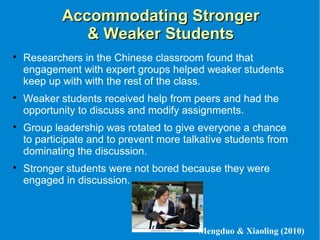
Researchers in the Chinese classroom found that
engagement with expert groups helped weaker students
keep up with with the rest of the class.

Weaker students received help from peers and had the
opportunity to discuss and modify assignments.

Group leadership was rotated to give everyone a chance
to participate and to prevent more talkative students from
dominating the discussion.

Stronger students were not bored because they were
engaged in discussion.
Mengduo & Xiaoling (2010)
Case Study: Chinese EFL ClassroomCase Study: Chinese EFL Classroom

Mengduo & Xiaoling (2010) investigated
the effectiveness of jigsaw in a college
EFL classroom.

Their goal was to implement cooperative
learning to complete language learning
tasks (reading, writing, speaking,
listening).

They observed higher levels of student
motivation, self-esteem, self-confidence,
and enjoyment of the learning experience.

Students experienced lower levels of
anxiety and greater willingness to
participate in class activities.
ReferencesReferences

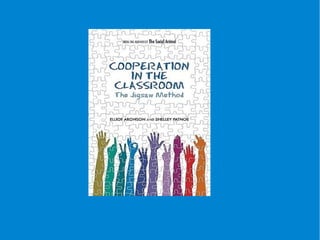
Aronson, E., & Patnoe, S. (2011). Cooperation in the classroom: The Jigsaw Method. (3rd ed.)
London: Pinter & Martin Ltd.

Lai, C., & Wu, C. (2006). Using handhelds in a Jigsaw cooperative learning environment.
Journal of Computer Assisted Learning, 22, 284-297. Retrieved from EBSCOhost.

Maden, S. (2011). Effect of Jigsaw I technique on achievement in written expression skill. Educational Sciences:
Theory & Practice, 11(2), 911-917. Retrieved from EBSCOhost.

Mengduo, Q., & Xiaoling, J. (2010). Jigsaw strategy as a cooperative learning technique:
Focusing on the language learners. Chinese Journal of Applied Linguistics, 33(4), 113-125.
Retrieved from EBSCOhost.

Sengul, S., & Katranci, Y. (2012). Teaching the subject sets with the ‘dissociation and re-
association’ (Jigsaw). International Online Journal of Educational Sciences, 4(1), 1-18.
Retrieved from EBSCOhost.

Tran, V., & Lewis, R. (2011). Effects of cooperative learning on students at An Giang University
in Vietnam. International Education Studies, 5(1), 86-99. Retrieved from EBSCOhost.

Weidman, R., & Bishop, M. (2009). Using the Jigsaw Model to facilitate cooperative learning in
an online course. The Quarterly Review of Distance Education, 10(1), 51-64. Retrieved from
EBSCOhost.

Jigsaw Cooperative Learning

  • 1.
    JigsawJigsaw A Cooperative LearningStrategyA Cooperative Learning Strategy Stephanie Dodson EDU 613: Management & Mentorship November 14, 2012
  • 2.
    What is JigsawMethod?What is Jigsaw Method? Jigsaw is a form ofJigsaw is a form of cooperative learningcooperative learning in which studentsin which students function as keepersfunction as keepers and givers ofand givers of knowledge.knowledge. Aronson & Patnoe (2011)
  • 3.
    How it worksHowit works 1.Students are divided into two configurations: expert groups and jigsaw groups. 2.Expert groups work together to study a topic/information and plan how to present the material to peers. 3.Next, students reassemble into jigsaw groups. Jigsaw groups consist of “experts” for each topic. 4.Experts present their information to the jigsaw group. Team members engage in discussion/feedback sessions to help everyone master the material. 5.Each student completes a “process sheet” to demonstrate their understanding of the topics presented. Aronson & Patnoe (2011)
  • 4.
    Origins of JigsawMethodOrigins of Jigsaw Method  Eliot Aronson, a social psychologist, developed the jigsaw method to help students overcome racial tensions in schools.  Public schools in Austin, Texas (where Aronson lived) experienced inter-ethnic conflicts following their 1971 desegregation.  Aronson's team introduced a new classroom paradigm in which students would view one another as resources, rather than as enemies or competitors.  All students-- including minorities and those from low socioeconomic backgrounds-- became empowered through helping peers learn. Aronson & Patnoe (2011)
  • 5.
    Traditional vs. JigsawClassroomTraditional vs. Jigsaw Classroom TRADITIONAL CLASSROOM JIGSAW CLASSROOM Teacher is the only “human resource” and source of all information. Each student serves as a valuable information resource. Students compete for validation from the teacher (rewards, attention, approval). All students feel validated through helping others learn. Students view one another as competitors-- there is no incentive for collaboration. Students must cooperate in order to achieve success. Minority students, and those from lower socioeconomic backgrounds, receive fewer validations and may experience a sense of inferiority. All students are empowered through being keepers of knowledge, and being in a position to share that knowledge with classmates. Aronson & Patnoe (2011)
  • 6.
    Case Study: ChineseEFL ClassroomCase Study: Chinese EFL Classroom  Mengduo & Xiaoling (2010) investigated the effectiveness of jigsaw in a college EFL classroom.  Their goal was to implement cooperative learning to complete language learning tasks (reading, writing, speaking, listening).  They observed higher levels of student motivation, self-esteem, self-confidence, and enjoyment of the learning experience.  Students experienced lower levels of anxiety and greater willingness to participate in class activities.
  • 7.
    Case Study: ChineseEFL ClassroomCase Study: Chinese EFL Classroom  Mengduo & Xiaoling (2010) investigated the effectiveness of jigsaw in a college EFL classroom.  Their goal was to implement cooperative learning to complete language learning tasks (reading, writing, speaking, listening).  They observed higher levels of student motivation, self-esteem, self-confidence, and enjoyment of the learning experience.  Students experienced lower levels of anxiety and greater willingness to participate in class activities.
  • 8.
    Accommodating StrongerAccommodating Stronger &Weaker Students& Weaker Students  Researchers in the Chinese classroom found that engagement with expert groups helped weaker students keep up with with the rest of the class.  Weaker students received help from peers and had the opportunity to discuss and modify assignments.  Group leadership was rotated to give everyone a chance to participate and to prevent more talkative students from dominating the discussion.  Stronger students were not bored because they were engaged in discussion. Mengduo & Xiaoling (2010)
  • 9.
    Case Study: ChineseEFL ClassroomCase Study: Chinese EFL Classroom  Mengduo & Xiaoling (2010) investigated the effectiveness of jigsaw in a college EFL classroom.  Their goal was to implement cooperative learning to complete language learning tasks (reading, writing, speaking, listening).  They observed higher levels of student motivation, self-esteem, self-confidence, and enjoyment of the learning experience.  Students experienced lower levels of anxiety and greater willingness to participate in class activities.
  • 12.
    ReferencesReferences  Aronson, E., &Patnoe, S. (2011). Cooperation in the classroom: The Jigsaw Method. (3rd ed.) London: Pinter & Martin Ltd.  Lai, C., & Wu, C. (2006). Using handhelds in a Jigsaw cooperative learning environment. Journal of Computer Assisted Learning, 22, 284-297. Retrieved from EBSCOhost.  Maden, S. (2011). Effect of Jigsaw I technique on achievement in written expression skill. Educational Sciences: Theory & Practice, 11(2), 911-917. Retrieved from EBSCOhost.  Mengduo, Q., & Xiaoling, J. (2010). Jigsaw strategy as a cooperative learning technique: Focusing on the language learners. Chinese Journal of Applied Linguistics, 33(4), 113-125. Retrieved from EBSCOhost.  Sengul, S., & Katranci, Y. (2012). Teaching the subject sets with the ‘dissociation and re- association’ (Jigsaw). International Online Journal of Educational Sciences, 4(1), 1-18. Retrieved from EBSCOhost.  Tran, V., & Lewis, R. (2011). Effects of cooperative learning on students at An Giang University in Vietnam. International Education Studies, 5(1), 86-99. Retrieved from EBSCOhost.  Weidman, R., & Bishop, M. (2009). Using the Jigsaw Model to facilitate cooperative learning in an online course. The Quarterly Review of Distance Education, 10(1), 51-64. Retrieved from EBSCOhost.