Enquiry-Based Learning
Dr Peter Kahn
University of Liverpool
Outline
• Introduction to enquiry-based learning (EBL)
• Opportunity to experience engaging in EBL
Practical ways forward
• Planning to use EBL with your own students

2
Why use EBL?
• What challenges do you currently face in your
teaching?
• Are there abilities, qualities or dispositions that
you have always wanted your students to develop
more fully?
• Are there any gaps between your aspirations for
student learning, and what actually happens?
• How satisfied are your students or other
stakeholders with existing patterns of student
learning?
3
What is Enquiry-Based Learning?
• EBL is learning that is driven by a process of
enquiry
– Engagement with a complex issue that allows for a
variety of responses.
– Students take responsibility for selecting the lines
of enquiry and the methods employed.
– Requires students to draw on existing knowledge
and identify their required learning needs.
– Students actively explore and seek out new
evidence.
4
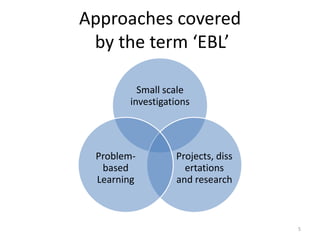
Approaches covered
by the term ‘EBL’
Small scale
investigations

Problembased
Learning

Projects, diss
ertations
and research

5
Problem-based learning
• PBL - a structured process of enquiry based
around a series of scenarios, in each of which:
– students in small groups define the issues
emerging from the problem;
– decide for themselves what further knowledge
they require in order to address these issues;
– allocate and undertake research to acquire the
required knowledge
– integrate findings in order to present outcomes.
6
Projects, dissertations and research
• Traditional use of projects
– Extended enquiries with an established record of usage within
higher education
– Employed towards the end of a degree programme
– Students make connections within a body of knowledge that
they have already mastered.

• Projects within an EBL context
– Early use of project-work to master a given body of knowledge
itself.
– Strategies required to ensure that the students direct the
project
– Earlier use suggests greater emphasis on smaller scale activity

7
Small-scale investigations
• Students are asked to complete a set task following a specified
process, and starting from a given stimulus, and within a limited
time-frame:
– Field-work
– Case-studies as the trigger for a focussed task (e.g. detailed business
scenario with the requirement to write a consultancy report).
– Workshops to master specific competencies
– Simulations

For some examples see:
https://intranet.birmingham.ac.uk/as/claddivision/ebl/casestudies/index.aspx
http://www.ceebl.manchester.ac.uk/resources/

8
The underlying basis for EBL
• Learning framed as the active construction of
knowledge rather than its passive reception
• Learning that allows scope for dialogue, and
understanding:
– Places relationships and exchanges between those
involved at the centre of learning

• Higher education tends to focus on knowledge
at the expense of commitment and identity.
9
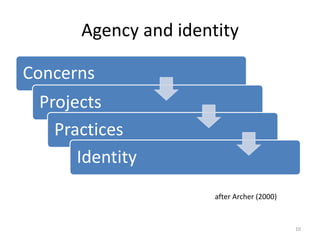
Agency and identity
Concerns
Projects
Practices
Identity
after Archer (2000)

10
Major issues
•
•
•
•
•
•

Student engagement and motivation
Development of a range of skills and personal qualities
Addressing gaps in students’ knowledge or capacities
Gaps between theory and practice
Fragmented learning on modular programmes
Passive/transmission approaches foster surface
learning
• Divergence between research and teaching for staff
• Mass higher education leading to a sense of anonymity
and social isolation
• Diversity of learner needs and interests
11
Supporting an enquiry
1. What will engage the students?
– An enquiry in which genuine scope is present for students
to select their own lines of attack or focus.

2. How accessible is the enquiry relative to:
– Students’ existing capacities to understand the area and to
manage an enquiry;
– the ease with which relevant resources can be identified?

12
3.

How will the students support each other?
– Timetabled group discussion to agree ways forward, division of
responsibilities, allocation of roles to fit existing
expertise/characteristics of the students.

4.

How will tutors facilitate the enquiry?
– Ask open-ended questions that challenge and extend, provide
encouragement, assist them in following the process; but don’t tell
them what to do or explain subject content.

5.

How will you initially introduce the approach?
– Introductory session(s); written guidance; seeing it in practice.

13
EBL experience
• Short EBL taster, based on a scenario as a starting
point. Agree a Chair and Scribe (who will report to the
entire group)
• Begin the initial phase of the enquiry:
– Issues: What are the key issues at stake in this enquiry?
– Lines: What initial lines of enquiry would you pursue?
– Staging: How would you stage the enquiry as it
progressed?
– Resources: What resources would support the progress of
the enquiry? Where could you locate these resources?
– Roles: What roles would you each take on in carrying out
the enquiry? How would these roles match your existing
expertise or experience?
14
Ideas for enquiries
• Starting points – detailed scenario that incorporates issues that
need following up; authentic situation within which the students
can directly engage in completing a task, choice of a topic to which
the process is applied.
• Process – social interactions (group or pair based - with roles,
discussion and division of labour all planned out); staging of the
enquiry (e.g. agreeing lines of enquiry, carrying out research,
pooling findings, preparing presentation).
• Outputs – report, presentation, portfolio, reflective account,
product, anthology, reader, conference, event, design, or single
article within, issue of or regular publication of a journal, magazine
or newspaper, script, commission, book, sermon, poster, proposal,
application, website, action plan, project plan, educational course.

15
Brainstorming
• What issues, tasks, activities, needs, authentic
situations, practice settings, interests might
provide a basis for student enquiry in your
own context?

16
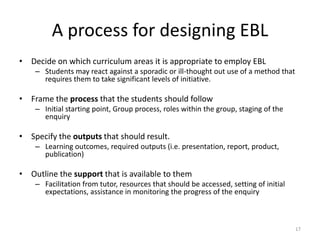
A process for designing EBL
• Decide on which curriculum areas it is appropriate to employ EBL
– Students may react against a sporadic or ill-thought out use of a method that
requires them to take significant levels of initiative.

• Frame the process that the students should follow
– Initial starting point, Group process, roles within the group, staging of the
enquiry

• Specify the outputs that should result.
– Learning outcomes, required outputs (i.e. presentation, report, product,
publication)

• Outline the support that is available to them
– Facilitation from tutor, resources that should be accessed, setting of initial
expectations, assistance in monitoring the progress of the enquiry

17
References
• Archer M (2000) Being Human: The Problem of
Agency, Cambridge University Press, Cambridge
• Kahn P E and O’Rourke K (2004) Guide to
Curriculum Design: Enquiry-Based Learning,
Higher Education Academy, York
• Morley J and Truscott S (2003) ‘The integration of
research-oriented learning into a Tandem
learning programme’, Language Learning Journal,
27, 52-58
18

An introduction to Enquiry-based Learning (EBL)

  • 1.
    Enquiry-Based Learning Dr PeterKahn University of Liverpool
  • 2.
    Outline • Introduction toenquiry-based learning (EBL) • Opportunity to experience engaging in EBL Practical ways forward • Planning to use EBL with your own students 2
  • 3.
    Why use EBL? •What challenges do you currently face in your teaching? • Are there abilities, qualities or dispositions that you have always wanted your students to develop more fully? • Are there any gaps between your aspirations for student learning, and what actually happens? • How satisfied are your students or other stakeholders with existing patterns of student learning? 3
  • 4.
    What is Enquiry-BasedLearning? • EBL is learning that is driven by a process of enquiry – Engagement with a complex issue that allows for a variety of responses. – Students take responsibility for selecting the lines of enquiry and the methods employed. – Requires students to draw on existing knowledge and identify their required learning needs. – Students actively explore and seek out new evidence. 4
  • 5.
    Approaches covered by theterm ‘EBL’ Small scale investigations Problembased Learning Projects, diss ertations and research 5
  • 6.
    Problem-based learning • PBL- a structured process of enquiry based around a series of scenarios, in each of which: – students in small groups define the issues emerging from the problem; – decide for themselves what further knowledge they require in order to address these issues; – allocate and undertake research to acquire the required knowledge – integrate findings in order to present outcomes. 6
  • 7.
    Projects, dissertations andresearch • Traditional use of projects – Extended enquiries with an established record of usage within higher education – Employed towards the end of a degree programme – Students make connections within a body of knowledge that they have already mastered. • Projects within an EBL context – Early use of project-work to master a given body of knowledge itself. – Strategies required to ensure that the students direct the project – Earlier use suggests greater emphasis on smaller scale activity 7
  • 8.
    Small-scale investigations • Studentsare asked to complete a set task following a specified process, and starting from a given stimulus, and within a limited time-frame: – Field-work – Case-studies as the trigger for a focussed task (e.g. detailed business scenario with the requirement to write a consultancy report). – Workshops to master specific competencies – Simulations For some examples see: https://intranet.birmingham.ac.uk/as/claddivision/ebl/casestudies/index.aspx http://www.ceebl.manchester.ac.uk/resources/ 8
  • 9.
    The underlying basisfor EBL • Learning framed as the active construction of knowledge rather than its passive reception • Learning that allows scope for dialogue, and understanding: – Places relationships and exchanges between those involved at the centre of learning • Higher education tends to focus on knowledge at the expense of commitment and identity. 9
  • 10.
  • 11.
    Major issues • • • • • • Student engagementand motivation Development of a range of skills and personal qualities Addressing gaps in students’ knowledge or capacities Gaps between theory and practice Fragmented learning on modular programmes Passive/transmission approaches foster surface learning • Divergence between research and teaching for staff • Mass higher education leading to a sense of anonymity and social isolation • Diversity of learner needs and interests 11
  • 12.
    Supporting an enquiry 1.What will engage the students? – An enquiry in which genuine scope is present for students to select their own lines of attack or focus. 2. How accessible is the enquiry relative to: – Students’ existing capacities to understand the area and to manage an enquiry; – the ease with which relevant resources can be identified? 12
  • 13.
    3. How will thestudents support each other? – Timetabled group discussion to agree ways forward, division of responsibilities, allocation of roles to fit existing expertise/characteristics of the students. 4. How will tutors facilitate the enquiry? – Ask open-ended questions that challenge and extend, provide encouragement, assist them in following the process; but don’t tell them what to do or explain subject content. 5. How will you initially introduce the approach? – Introductory session(s); written guidance; seeing it in practice. 13
  • 14.
    EBL experience • ShortEBL taster, based on a scenario as a starting point. Agree a Chair and Scribe (who will report to the entire group) • Begin the initial phase of the enquiry: – Issues: What are the key issues at stake in this enquiry? – Lines: What initial lines of enquiry would you pursue? – Staging: How would you stage the enquiry as it progressed? – Resources: What resources would support the progress of the enquiry? Where could you locate these resources? – Roles: What roles would you each take on in carrying out the enquiry? How would these roles match your existing expertise or experience? 14
  • 15.
    Ideas for enquiries •Starting points – detailed scenario that incorporates issues that need following up; authentic situation within which the students can directly engage in completing a task, choice of a topic to which the process is applied. • Process – social interactions (group or pair based - with roles, discussion and division of labour all planned out); staging of the enquiry (e.g. agreeing lines of enquiry, carrying out research, pooling findings, preparing presentation). • Outputs – report, presentation, portfolio, reflective account, product, anthology, reader, conference, event, design, or single article within, issue of or regular publication of a journal, magazine or newspaper, script, commission, book, sermon, poster, proposal, application, website, action plan, project plan, educational course. 15
  • 16.
    Brainstorming • What issues,tasks, activities, needs, authentic situations, practice settings, interests might provide a basis for student enquiry in your own context? 16
  • 17.
    A process fordesigning EBL • Decide on which curriculum areas it is appropriate to employ EBL – Students may react against a sporadic or ill-thought out use of a method that requires them to take significant levels of initiative. • Frame the process that the students should follow – Initial starting point, Group process, roles within the group, staging of the enquiry • Specify the outputs that should result. – Learning outcomes, required outputs (i.e. presentation, report, product, publication) • Outline the support that is available to them – Facilitation from tutor, resources that should be accessed, setting of initial expectations, assistance in monitoring the progress of the enquiry 17
  • 18.
    References • Archer M(2000) Being Human: The Problem of Agency, Cambridge University Press, Cambridge • Kahn P E and O’Rourke K (2004) Guide to Curriculum Design: Enquiry-Based Learning, Higher Education Academy, York • Morley J and Truscott S (2003) ‘The integration of research-oriented learning into a Tandem learning programme’, Language Learning Journal, 27, 52-58 18