ONLINE ASSIGNMENT
Topic:-
TEACHING LEARNING RESOURCES
Submitted to
Miss Dhanya Kumar
English Lecturer
Submitted by
Beena Babu.B
Option: English
Reg. No: - 165-14383005
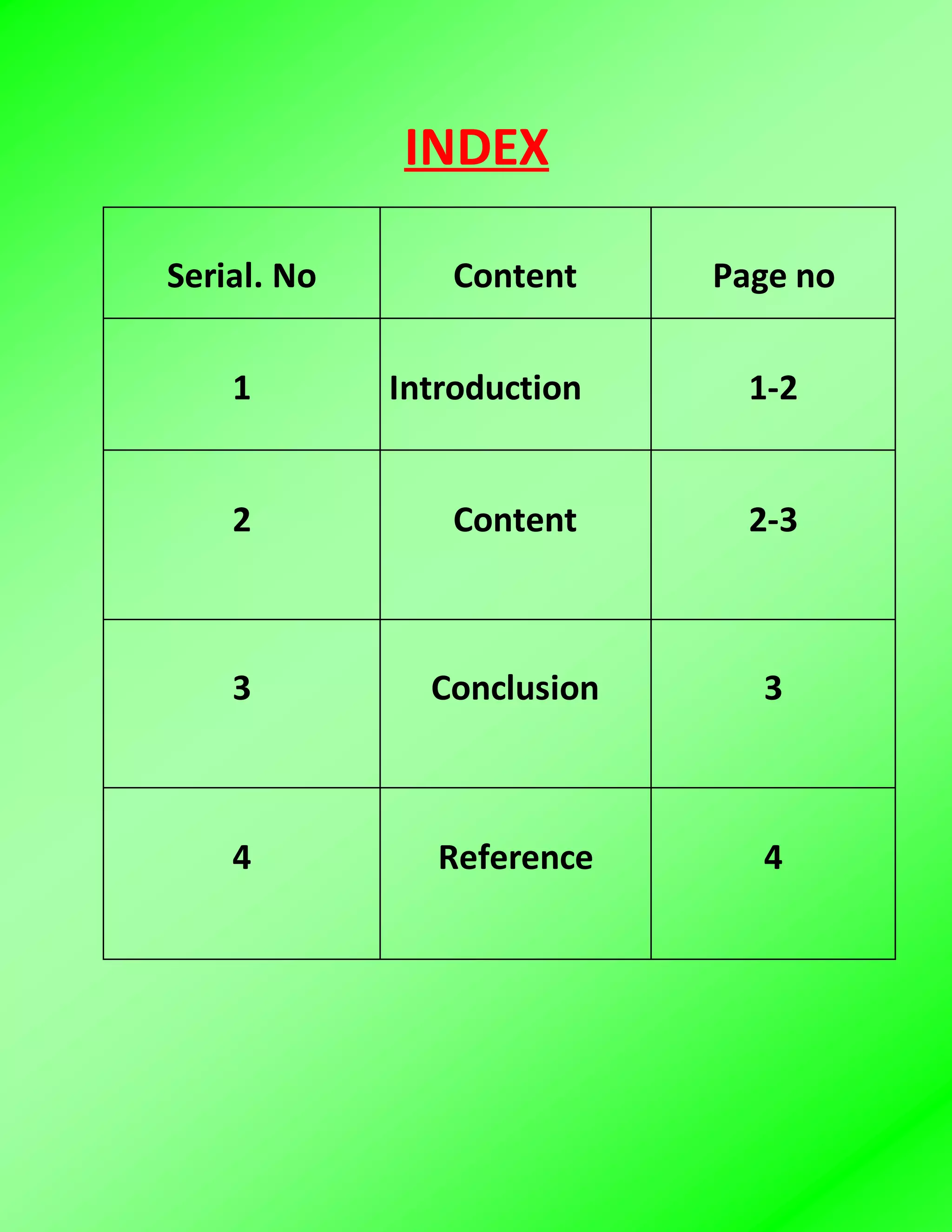
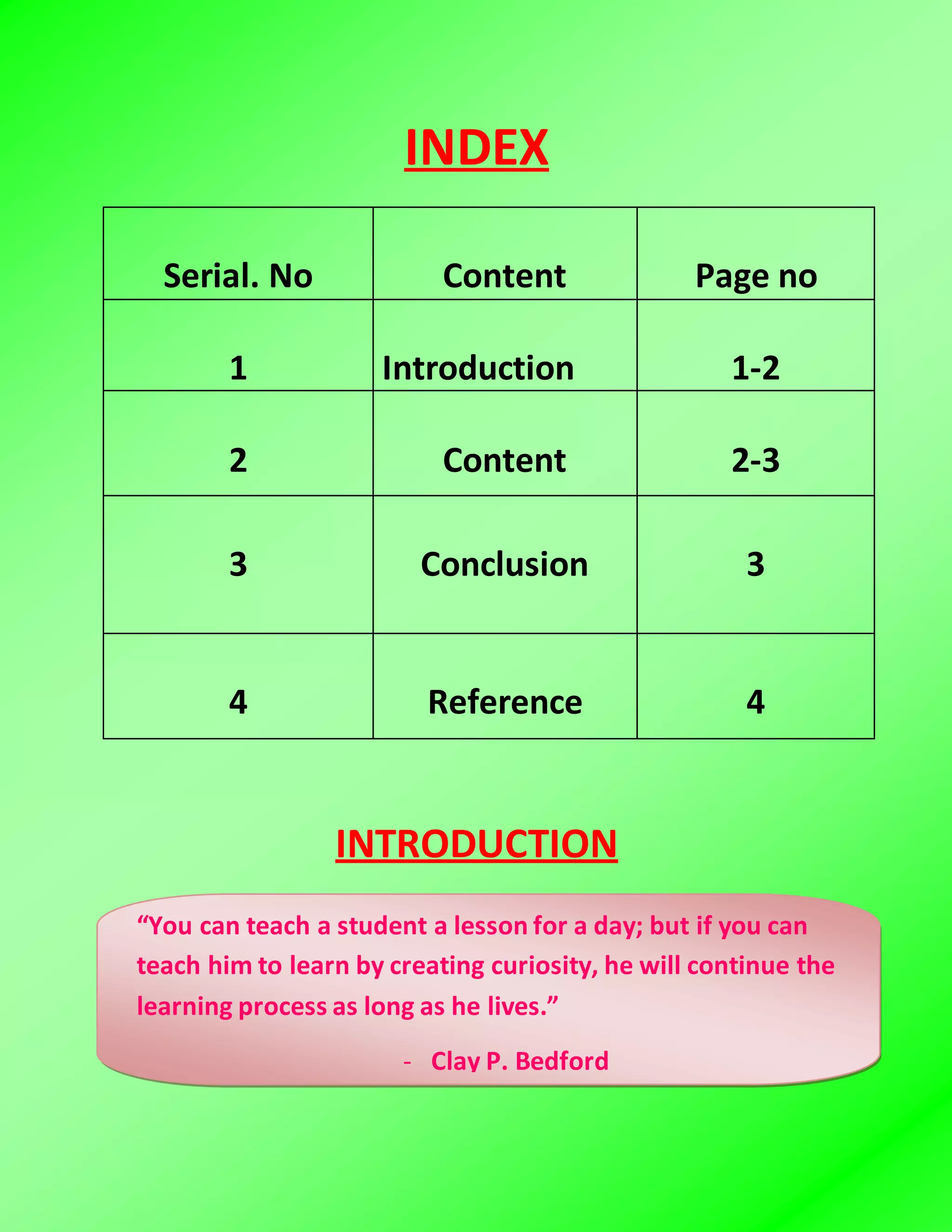
INDEX
Serial. No Content Page no
1 Introduction 1-2
2 Content 2-3
3 Conclusion 3
4 Reference 4
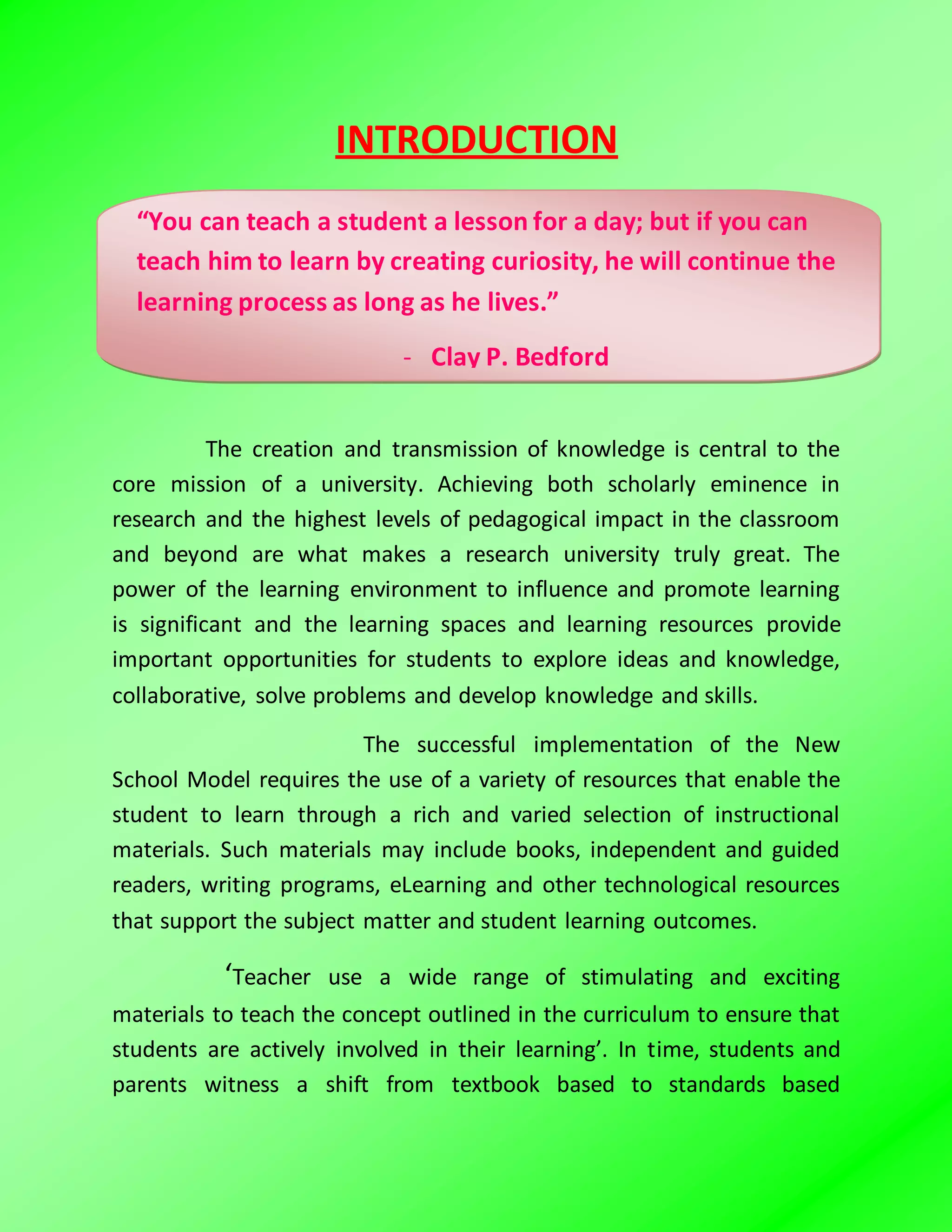
INTRODUCTION
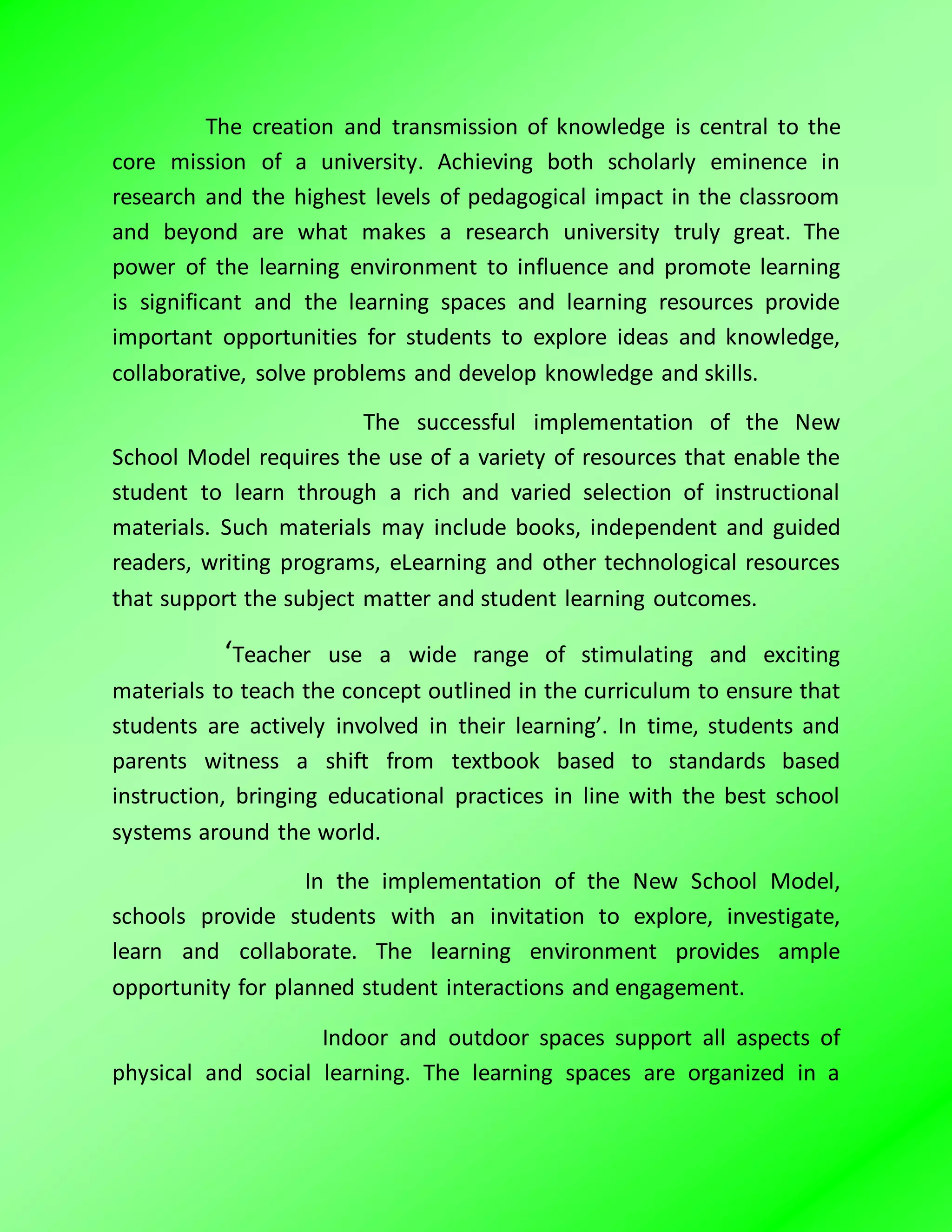
The creation and transmission of knowledge is central to the
core mission of a university. Achieving both scholarly eminence in
research and the highest levels of pedagogical impact in the classroom
and beyond are what makes a research university truly great. The
power of the learning environment to influence and promote learning
is significant and the learning spaces and learning resources provide
important opportunities for students to explore ideas and knowledge,
collaborative, solve problems and develop knowledge and skills.
The successful implementation of the New
School Model requires the use of a variety of resources that enable the
student to learn through a rich and varied selection of instructional
materials. Such materials may include books, independent and guided
readers, writing programs, eLearning and other technological resources
that support the subject matter and student learning outcomes.
‘Teacher use a wide range of stimulating and exciting
materials to teach the concept outlined in the curriculum to ensure that
students are actively involved in their learning’. In time, students and
parents witness a shift from textbook based to standards based
“You can teach a student a lesson for a day; but if you can
teach him to learn by creating curiosity, he will continue the
learning process as long as he lives.”
- Clay P. Bedford
instruction, bringing educational practices in line with the best school
systems around the world.
In the implementation of the New School Model,
schools provide students with an invitation to explore, investigate,
learn and collaborate. The learning environment provides ample
opportunity for planned student interactions and engagement.
Indoor and outdoor spaces support all aspects of
physical and social learning. The learning spaces are organized in a
manner that guides the student to different teaching and learning
opportunities, e.g. shared thinking and collaboration with others.
CONTENT
In the field of education TLM is a commonly used
acronym that stands for teaching or learning materials, “Broadly, the
term refers to a spectrum of educational materials that teachers use in
the classroom to support specific learning objectives as set out in lesson
plans.e.g: story books, blocks, sample of student writing, videos, games,
flashcards, models, OHProjectors’, transparencies etc…..
In this form of teaching and learning resources are
provided to support student’s independent study (in terms of time and
place) for e.g.: print study guides, Audio tapes /Videotapes, CD-
ROM/DVD, streamed /downloadable media-online or downloading of
recorded video or audio etc…… Learning resources are texts, videos,
software, and other materials that teachers use to assist students to
meet the expectations for learning defined by the curriculum.
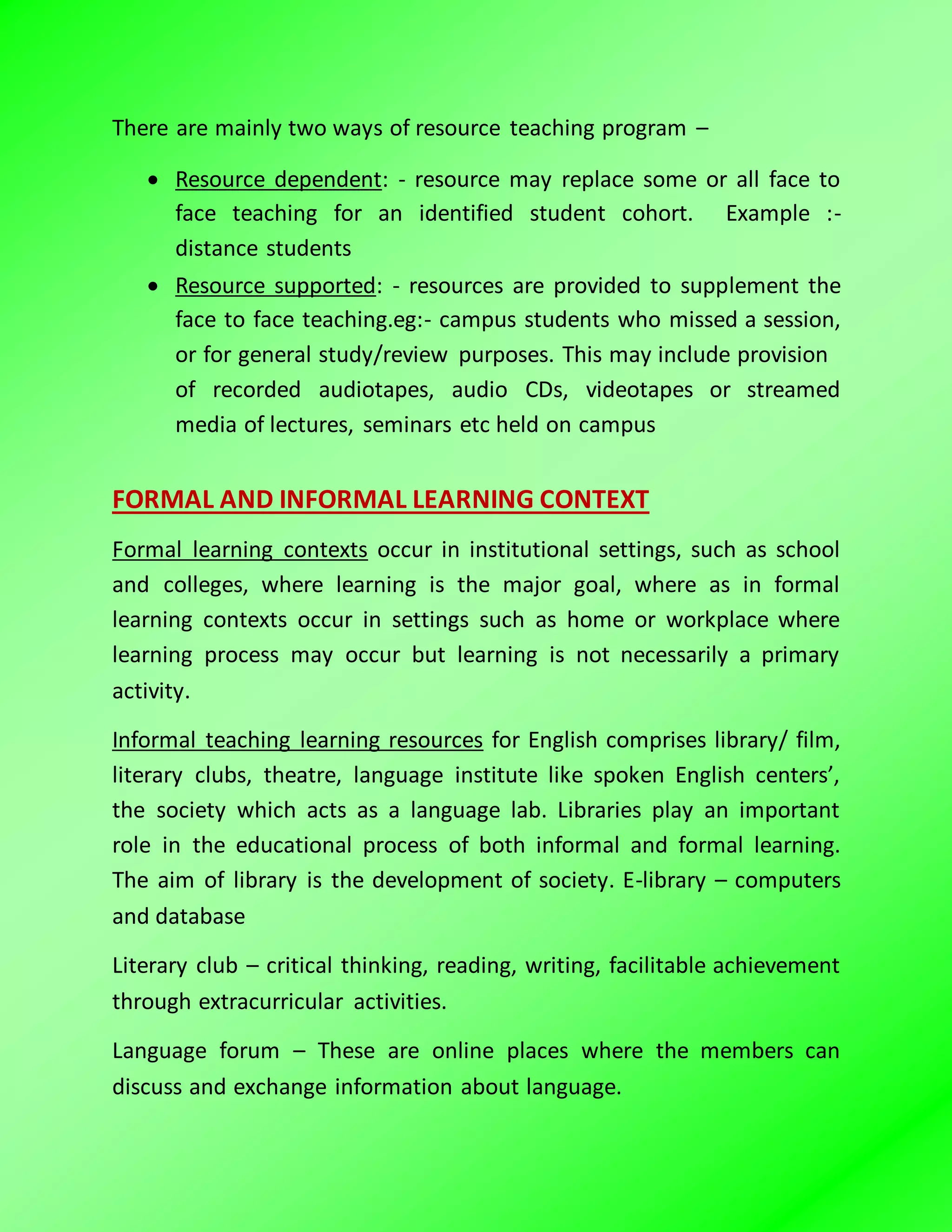
There are mainly two ways of resource teaching program –
 Resource dependent: - resource may replace some or all face to
face teaching for an identified student cohort. Example :-
distance students
 Resource supported: - resources are provided to supplement the
face to face teaching.eg:- campus students who missed a session,
or for general study/review purposes. This may include provision
of recorded audiotapes, audio CDs, videotapes or streamed
media of lectures, seminars etc held on campus
FORMAL AND INFORMAL LEARNING CONTEXT
Formal learning contexts occur in institutional settings, such as school
and colleges, where learning is the major goal, where as in formal
learning contexts occur in settings such as home or workplace where
learning process may occur but learning is not necessarily a primary
activity.
Informal teaching learning resources for English comprises library/ film,
literary clubs, theatre, language institute like spoken English centers’,
the society which acts as a language lab. Libraries play an important
role in the educational process of both informal and formal learning.
The aim of library is the development of society. E-library – computers
and database
Literary club – critical thinking, reading, writing, facilitable achievement
through extracurricular activities.
Language forum – These are online places where the members can
discuss and exchange information about language.
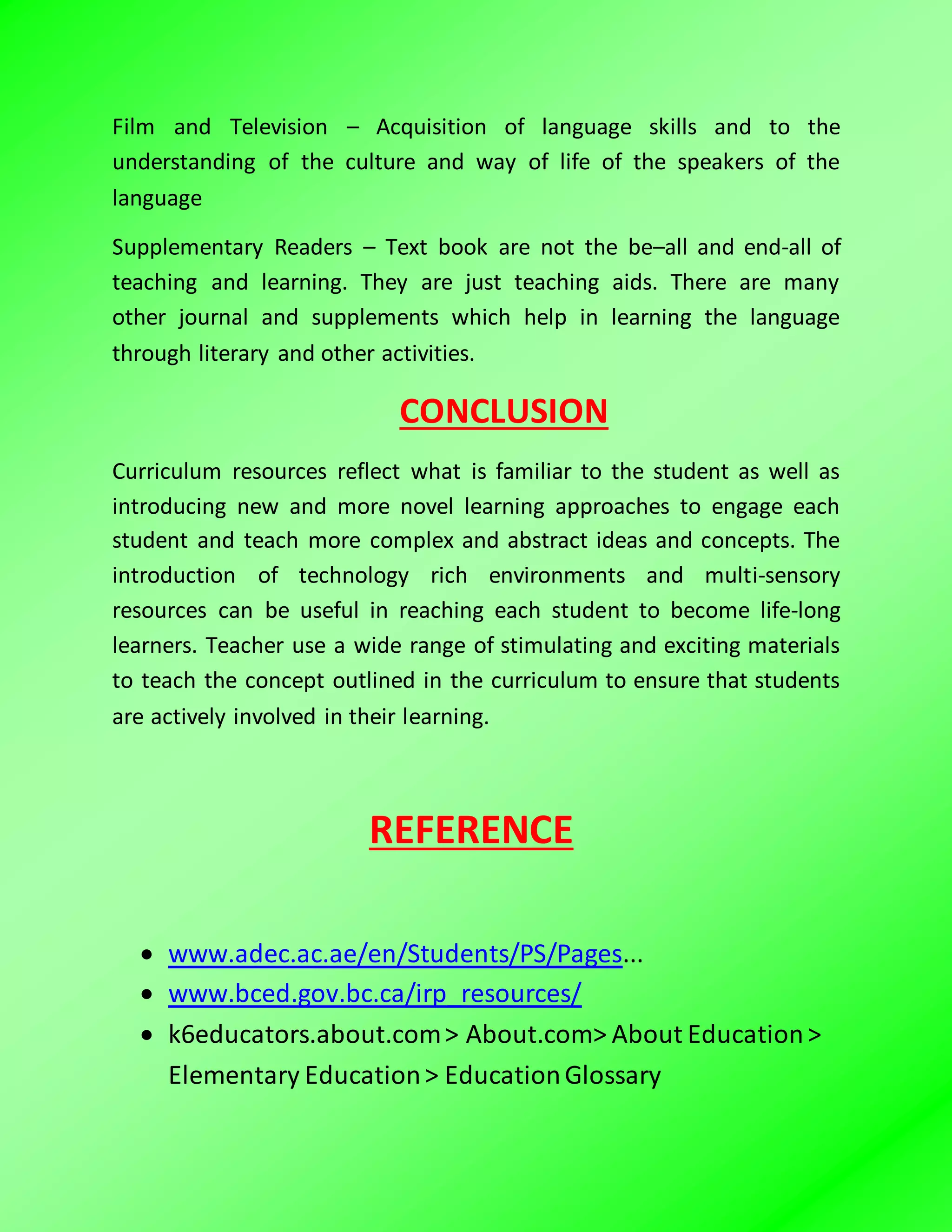
Film and Television – Acquisition of language skills and to the
understanding of the culture and way of life of the speakers of the
language
Supplementary Readers – Text book are not the be–all and end-all of
teaching and learning. They are just teaching aids. There are many
other journal and supplements which help in learning the language
through literary and other activities.
CONCLUSION
Curriculum resources reflect what is familiar to the student as well as
introducing new and more novel learning approaches to engage each
student and teach more complex and abstract ideas and concepts. The
introduction of technology rich environments and multi-sensory
resources can be useful in reaching each student to become life-long
learners. Teacher use a wide range of stimulating and exciting materials
to teach the concept outlined in the curriculum to ensure that students
are actively involved in their learning.
REFERENCE
 www.adec.ac.ae/en/Students/PS/Pages...
 www.bced.gov.bc.ca/irp_resources/
 k6educators.about.com> About.com> About Education>
Elementary Education> EducationGlossary
INDEX
Serial. No Content Page no
1 Introduction 1-2
2 Content 2-3
3 Conclusion 3
4 Reference 4
INTRODUCTION
“You can teach a student a lesson for a day; but if you can
teach him to learn by creating curiosity, he will continue the
learning process as long as he lives.”
- Clay P. Bedford
The creation and transmission of knowledge is central to the
core mission of a university. Achieving both scholarly eminence in
research and the highest levels of pedagogical impact in the classroom
and beyond are what makes a research university truly great. The
power of the learning environment to influence and promote learning
is significant and the learning spaces and learning resources provide
important opportunities for students to explore ideas and knowledge,
collaborative, solve problems and develop knowledge and skills.
The successful implementation of the New
School Model requires the use of a variety of resources that enable the
student to learn through a rich and varied selection of instructional
materials. Such materials may include books, independent and guided
readers, writing programs, eLearning and other technological resources
that support the subject matter and student learning outcomes.
‘Teacher use a wide range of stimulating and exciting
materials to teach the concept outlined in the curriculum to ensure that
students are actively involved in their learning’. In time, students and
parents witness a shift from textbook based to standards based
instruction, bringing educational practices in line with the best school
systems around the world.
In the implementation of the New School Model,
schools provide students with an invitation to explore, investigate,
learn and collaborate. The learning environment provides ample
opportunity for planned student interactions and engagement.
Indoor and outdoor spaces support all aspects of
physical and social learning. The learning spaces are organized in a
manner that guides the student to different teaching and learning
opportunities, e.g. shared thinking and collaboration with others.
CONTENT
In the field of education TLM is a commonly used
acronym that stands for teaching or learning materials, “Broadly, the
term refers to a spectrum of educational materials that teachers use in
the classroom to support specific learning objectives as set out in lesson
plans.e.g: story books, blocks, sample of student writing, videos, games,
flashcards, models, OHProjectors’, transparencies etc…..
In this form of teaching and learning resources are
provided to support student’s independent study (in terms of time and
place) for e.g.: print study guides, Audio tapes /Videotapes, CD-
ROM/DVD, streamed /downloadable media-online or downloading of
recorded video or audio etc…… Learning resources are texts, videos,
software, and other materials that teachers use to assist students to
meet the expectations for learning defined by the curriculum.
There are mainly two ways of resource teaching program –
 Resource dependent: - resource may replace some or all face to
face teaching for an identified student cohort. Example :-
distance students
 Resource supported: - resources are provided to supplement the
face to face teaching.eg:- campus students who missed a session,
or for general study/review purposes. This may include provision
of recorded audiotapes, audio CDs, videotapes or streamed
media of lectures, seminars etc held on campus
FORMAL AND INFORMAL LEARNING CONTEXT
Formal learning contexts occur in institutional settings, such as school
and colleges, where learning is the major goal, where as in formal
learning contexts occur in settings such as home or workplace where
learning process may occur but learning is not necessarily a primary
activity.
Informal teaching learning resources for English comprises library/ film,
literary clubs, theatre, language institute like spoken English centers’,
the society which acts as a language lab. Libraries play an important
role in the educational process of both informal and formal learning.
The aim of library is the development of society. E-library – computers
and database
Literary club – critical thinking, reading, writing, facilitable achievement
through extracurricular activities.
Language forum – These are online places where the members can
discuss and exchange information about language.
Film and Television – Acquisition of language skills and to the
understanding of the culture and way of life of the speakers of the
language
Supplementary Readers – Text book are not the be–all and end-all of
teaching and learning. They are just teaching aids. There are many
other journal and supplements which help in learning the language
through literary and other activities.
CONCLUSION
Curriculum resources reflect what is familiar to the student as well as
introducing new and more novel learning approaches to engage each
student and teach more complex and abstract ideas and concepts. The
introduction of technology rich environments and multi-sensory
resources can be useful in reaching each student to become life-long
learners. Teacher use a wide range of stimulating and exciting materials
to teach the concept outlined in the curriculum to ensure that students
are actively involved in their learning.
REFERENCE
 www.adec.ac.ae/en/Students/PS/Pages...
 www.bced.gov.bc.ca/irp_resources/
 k6educators.about.com> About.com> About Education>
Elementary Education> EducationGlossary

Online assignment

  • 1.
    ONLINE ASSIGNMENT Topic:- TEACHING LEARNINGRESOURCES Submitted to Miss Dhanya Kumar English Lecturer Submitted by Beena Babu.B Option: English Reg. No: - 165-14383005
  • 2.
    INDEX Serial. No ContentPage no 1 Introduction 1-2 2 Content 2-3 3 Conclusion 3 4 Reference 4
  • 3.
    INTRODUCTION The creation andtransmission of knowledge is central to the core mission of a university. Achieving both scholarly eminence in research and the highest levels of pedagogical impact in the classroom and beyond are what makes a research university truly great. The power of the learning environment to influence and promote learning is significant and the learning spaces and learning resources provide important opportunities for students to explore ideas and knowledge, collaborative, solve problems and develop knowledge and skills. The successful implementation of the New School Model requires the use of a variety of resources that enable the student to learn through a rich and varied selection of instructional materials. Such materials may include books, independent and guided readers, writing programs, eLearning and other technological resources that support the subject matter and student learning outcomes. ‘Teacher use a wide range of stimulating and exciting materials to teach the concept outlined in the curriculum to ensure that students are actively involved in their learning’. In time, students and parents witness a shift from textbook based to standards based “You can teach a student a lesson for a day; but if you can teach him to learn by creating curiosity, he will continue the learning process as long as he lives.” - Clay P. Bedford
  • 4.
    instruction, bringing educationalpractices in line with the best school systems around the world. In the implementation of the New School Model, schools provide students with an invitation to explore, investigate, learn and collaborate. The learning environment provides ample opportunity for planned student interactions and engagement. Indoor and outdoor spaces support all aspects of physical and social learning. The learning spaces are organized in a manner that guides the student to different teaching and learning opportunities, e.g. shared thinking and collaboration with others. CONTENT In the field of education TLM is a commonly used acronym that stands for teaching or learning materials, “Broadly, the term refers to a spectrum of educational materials that teachers use in the classroom to support specific learning objectives as set out in lesson plans.e.g: story books, blocks, sample of student writing, videos, games, flashcards, models, OHProjectors’, transparencies etc….. In this form of teaching and learning resources are provided to support student’s independent study (in terms of time and place) for e.g.: print study guides, Audio tapes /Videotapes, CD- ROM/DVD, streamed /downloadable media-online or downloading of recorded video or audio etc…… Learning resources are texts, videos, software, and other materials that teachers use to assist students to meet the expectations for learning defined by the curriculum.
  • 5.
    There are mainlytwo ways of resource teaching program –  Resource dependent: - resource may replace some or all face to face teaching for an identified student cohort. Example :- distance students  Resource supported: - resources are provided to supplement the face to face teaching.eg:- campus students who missed a session, or for general study/review purposes. This may include provision of recorded audiotapes, audio CDs, videotapes or streamed media of lectures, seminars etc held on campus FORMAL AND INFORMAL LEARNING CONTEXT Formal learning contexts occur in institutional settings, such as school and colleges, where learning is the major goal, where as in formal learning contexts occur in settings such as home or workplace where learning process may occur but learning is not necessarily a primary activity. Informal teaching learning resources for English comprises library/ film, literary clubs, theatre, language institute like spoken English centers’, the society which acts as a language lab. Libraries play an important role in the educational process of both informal and formal learning. The aim of library is the development of society. E-library – computers and database Literary club – critical thinking, reading, writing, facilitable achievement through extracurricular activities. Language forum – These are online places where the members can discuss and exchange information about language.
  • 6.
    Film and Television– Acquisition of language skills and to the understanding of the culture and way of life of the speakers of the language Supplementary Readers – Text book are not the be–all and end-all of teaching and learning. They are just teaching aids. There are many other journal and supplements which help in learning the language through literary and other activities. CONCLUSION Curriculum resources reflect what is familiar to the student as well as introducing new and more novel learning approaches to engage each student and teach more complex and abstract ideas and concepts. The introduction of technology rich environments and multi-sensory resources can be useful in reaching each student to become life-long learners. Teacher use a wide range of stimulating and exciting materials to teach the concept outlined in the curriculum to ensure that students are actively involved in their learning. REFERENCE  www.adec.ac.ae/en/Students/PS/Pages...  www.bced.gov.bc.ca/irp_resources/  k6educators.about.com> About.com> About Education> Elementary Education> EducationGlossary
  • 7.
    INDEX Serial. No ContentPage no 1 Introduction 1-2 2 Content 2-3 3 Conclusion 3 4 Reference 4 INTRODUCTION “You can teach a student a lesson for a day; but if you can teach him to learn by creating curiosity, he will continue the learning process as long as he lives.” - Clay P. Bedford
  • 8.
    The creation andtransmission of knowledge is central to the core mission of a university. Achieving both scholarly eminence in research and the highest levels of pedagogical impact in the classroom and beyond are what makes a research university truly great. The power of the learning environment to influence and promote learning is significant and the learning spaces and learning resources provide important opportunities for students to explore ideas and knowledge, collaborative, solve problems and develop knowledge and skills. The successful implementation of the New School Model requires the use of a variety of resources that enable the student to learn through a rich and varied selection of instructional materials. Such materials may include books, independent and guided readers, writing programs, eLearning and other technological resources that support the subject matter and student learning outcomes. ‘Teacher use a wide range of stimulating and exciting materials to teach the concept outlined in the curriculum to ensure that students are actively involved in their learning’. In time, students and parents witness a shift from textbook based to standards based instruction, bringing educational practices in line with the best school systems around the world. In the implementation of the New School Model, schools provide students with an invitation to explore, investigate, learn and collaborate. The learning environment provides ample opportunity for planned student interactions and engagement. Indoor and outdoor spaces support all aspects of physical and social learning. The learning spaces are organized in a
  • 9.
    manner that guidesthe student to different teaching and learning opportunities, e.g. shared thinking and collaboration with others. CONTENT In the field of education TLM is a commonly used acronym that stands for teaching or learning materials, “Broadly, the term refers to a spectrum of educational materials that teachers use in the classroom to support specific learning objectives as set out in lesson plans.e.g: story books, blocks, sample of student writing, videos, games, flashcards, models, OHProjectors’, transparencies etc….. In this form of teaching and learning resources are provided to support student’s independent study (in terms of time and place) for e.g.: print study guides, Audio tapes /Videotapes, CD- ROM/DVD, streamed /downloadable media-online or downloading of recorded video or audio etc…… Learning resources are texts, videos, software, and other materials that teachers use to assist students to meet the expectations for learning defined by the curriculum. There are mainly two ways of resource teaching program –  Resource dependent: - resource may replace some or all face to face teaching for an identified student cohort. Example :- distance students  Resource supported: - resources are provided to supplement the face to face teaching.eg:- campus students who missed a session, or for general study/review purposes. This may include provision
  • 10.
    of recorded audiotapes,audio CDs, videotapes or streamed media of lectures, seminars etc held on campus FORMAL AND INFORMAL LEARNING CONTEXT Formal learning contexts occur in institutional settings, such as school and colleges, where learning is the major goal, where as in formal learning contexts occur in settings such as home or workplace where learning process may occur but learning is not necessarily a primary activity. Informal teaching learning resources for English comprises library/ film, literary clubs, theatre, language institute like spoken English centers’, the society which acts as a language lab. Libraries play an important role in the educational process of both informal and formal learning. The aim of library is the development of society. E-library – computers and database Literary club – critical thinking, reading, writing, facilitable achievement through extracurricular activities. Language forum – These are online places where the members can discuss and exchange information about language. Film and Television – Acquisition of language skills and to the understanding of the culture and way of life of the speakers of the language Supplementary Readers – Text book are not the be–all and end-all of teaching and learning. They are just teaching aids. There are many other journal and supplements which help in learning the language through literary and other activities.
  • 11.
    CONCLUSION Curriculum resources reflectwhat is familiar to the student as well as introducing new and more novel learning approaches to engage each student and teach more complex and abstract ideas and concepts. The introduction of technology rich environments and multi-sensory resources can be useful in reaching each student to become life-long learners. Teacher use a wide range of stimulating and exciting materials to teach the concept outlined in the curriculum to ensure that students are actively involved in their learning. REFERENCE  www.adec.ac.ae/en/Students/PS/Pages...  www.bced.gov.bc.ca/irp_resources/  k6educators.about.com> About.com> About Education> Elementary Education> EducationGlossary