COLLABORATIVE LEARNING
BY :
1. Fina hayatul Husna
2. Munawati
3. Laila Fatimatuz Z
4. Yeni Fitria
5. Humam Fahmi S.
COLLABORATIVE LEARNING
1. THINK-PAIR-SHARE
2. BUZZ GROUP
3. TALKING STICK
4. NUMBER HEAD TOGETHER
5. TWO STRAY- TWO STRAY
1. THINK PAIR SHARE
DEFINITION :
Think-Pair-Share (TPS) is a learning
model that can make all of students
active in the class and give a chance
to discuss with their friends in pair.
Steps of Think-Pair-Share
• THINK, students think independently about the
question that has been posed, forming ideas of their
own.
• PAIR, students are grouped in pairs to discuss their
thought. This step alows student to compare or
discuus their answer about the question.
• SHARE, student’s pair share their ideas or conclusion
of discussion in front of the class.
Step Implementation of Think-Pair-
Share Method
• There are some steps implementation of Think-Pair-Share
method, which are:
• The teacher will explain the material first.
• The teacher will ask some question based on the material
to the students, then ask the students to think individually.
• The teacher organize the students in pair ( 2 students) to
discuss their answer of the question.
• The teacher ask some of pairs to come infront of the class
to share their answer about the materials.
The Advantages of Think-Pair-Share:
• Improve the thoughts of the students.
• Give more time to the students to think.
• Facilitate the students to understand the material because
every tudents will help each other.
The Disadvantages of Think-Pair-Share
• If the amount of the calss is very big, the teacher would
have trouble in guide students who need more attention.
• Need more time to presentation because there are many
pair of groups.
• The difference idea between students in pair.
2. BUZZ GROUP
A buzz group is a small, intense discussion
group usually involving to 3 persons responding to
a specific question or in search of very precise
information. The full plenary group is subdivided
into the small groups. It’s called a ‘buzz’ group
because it mimics the sound of people in intense
discussion!
Benefits
1. Highly participative.
2. Very focussed and direct.
3. Very frequently it integrates theory with
experience.
4. Short, intense and using trainees own
information so there is ownership of the
output by trainees. issue, many options and
contributions are offered.
When to use
BUZZ GROUP:•
1. It is a creative process.
2. Recalling/reviewing previous learning.
3. Linking elements/concepts/ideas together.
4. Reflecting back to what was previously discussed.
5. Probing issues in greater depth.
6. Transition from one issue to another.
7. Evaluating learning.
8. Connecting life experience with theory.
9. Helping the trainer to discover missing data or
misunderstandings and make corrections.
10. Raising unsuspecting issues that must be addressed to
make progress.
3. TALKING STICK
Concept of Talking Stick
Talking Stick method is developed by Spencer
Kagan (1992: 1). It is a group of study that student
learnt independently from one another, each student
has the same chance to express their ideas and concern
with equal participant of students.
Students can use the talking stick to:
• give an idea
• ask a question
• express a doubt
• respond to an idea
• ask for clarification
Step Implementation of Talking Stick Method
There are some steps implementation of talking stick, which are:
1. Start the session by placing the talking stick on the floor with
everyone sitting on chairs in a circle around it.
2. Trainer explains the rules and everyone agrees to abide by them.
Nobody who rejects the rules can take part.
3. Give someone the role of timekeeper.
4. If using topic or issue based material present it now.
5. Begin with one person holding the talking stick. When they are
holding the stick, they can talk for the agreed amount of time.
4. NUMBER HEAD TOGETHER
STEPS:
1. Divide the students into groups of four and give each one
a number from one to four.
2. Pose a question or a problem to the class.
3. Have students gather to think about the question and to
make sure everyone in their group understands and can
give an answer.
4. Ask the question and call out a number randomly.
5. The students with that number raise their hands, and
when called on, the student answers for his or her team.
The advantages of Numbered head Together (NHT) are:
• 1.Positive interdependence
• 2.Individual accountability
• 3.Equal participation
• 4.Simultaneous interaction
• 5.Multilevel
The disadvantages of Numbered Head Together (NHT) are:
• 1.The smart student will tend to dominate so that it can make the weak
students have interior and passive attitude.
• 2.The discussion process can go smoothly if there are students just simply
copy the work of smart students without having an adequate
understanding.
• 3.If there are homogenous group so it will be unfair for the group
contained of weak students.
• 4.Likelihood that number is called, called again by the teacher, means that
not all members of the group called by the teacher.
5. TWO STRAY-TWO STRAY
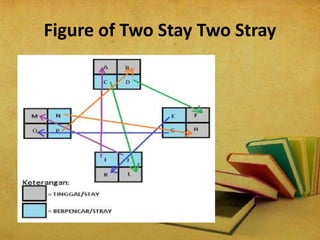
The steps in using the method of two stay two stray are as follows:
• Teacher divides students become some small groups, each group
consist of four people
• Each group discuss about the assignment that has been given by the
teacher
• Two people from each group will leave the group and visit at other
groups to share the result and information from the assignment
• Two people that stay in a group, receive the two students from the
other groups to share the result and information assignment
• Then two students who become visitors, they return to thei own
group and report the result
• Each group compares and discusses their result then one of the
students from each group present the results of their discussion in
front of the class.
Figure of Two Stay Two Stray
THANK YOU....

Collaborative learning

  • 1.
    COLLABORATIVE LEARNING BY : 1.Fina hayatul Husna 2. Munawati 3. Laila Fatimatuz Z 4. Yeni Fitria 5. Humam Fahmi S.
  • 2.
    COLLABORATIVE LEARNING 1. THINK-PAIR-SHARE 2.BUZZ GROUP 3. TALKING STICK 4. NUMBER HEAD TOGETHER 5. TWO STRAY- TWO STRAY
  • 3.
    1. THINK PAIRSHARE DEFINITION : Think-Pair-Share (TPS) is a learning model that can make all of students active in the class and give a chance to discuss with their friends in pair.
  • 4.
    Steps of Think-Pair-Share •THINK, students think independently about the question that has been posed, forming ideas of their own. • PAIR, students are grouped in pairs to discuss their thought. This step alows student to compare or discuus their answer about the question. • SHARE, student’s pair share their ideas or conclusion of discussion in front of the class.
  • 5.
    Step Implementation ofThink-Pair- Share Method • There are some steps implementation of Think-Pair-Share method, which are: • The teacher will explain the material first. • The teacher will ask some question based on the material to the students, then ask the students to think individually. • The teacher organize the students in pair ( 2 students) to discuss their answer of the question. • The teacher ask some of pairs to come infront of the class to share their answer about the materials.
  • 6.
    The Advantages ofThink-Pair-Share: • Improve the thoughts of the students. • Give more time to the students to think. • Facilitate the students to understand the material because every tudents will help each other. The Disadvantages of Think-Pair-Share • If the amount of the calss is very big, the teacher would have trouble in guide students who need more attention. • Need more time to presentation because there are many pair of groups. • The difference idea between students in pair.
  • 7.
    2. BUZZ GROUP Abuzz group is a small, intense discussion group usually involving to 3 persons responding to a specific question or in search of very precise information. The full plenary group is subdivided into the small groups. It’s called a ‘buzz’ group because it mimics the sound of people in intense discussion!
  • 8.
    Benefits 1. Highly participative. 2.Very focussed and direct. 3. Very frequently it integrates theory with experience. 4. Short, intense and using trainees own information so there is ownership of the output by trainees. issue, many options and contributions are offered.
  • 9.
    When to use BUZZGROUP:• 1. It is a creative process. 2. Recalling/reviewing previous learning. 3. Linking elements/concepts/ideas together. 4. Reflecting back to what was previously discussed. 5. Probing issues in greater depth. 6. Transition from one issue to another. 7. Evaluating learning. 8. Connecting life experience with theory. 9. Helping the trainer to discover missing data or misunderstandings and make corrections. 10. Raising unsuspecting issues that must be addressed to make progress.
  • 10.
    3. TALKING STICK Conceptof Talking Stick Talking Stick method is developed by Spencer Kagan (1992: 1). It is a group of study that student learnt independently from one another, each student has the same chance to express their ideas and concern with equal participant of students.
  • 11.
    Students can usethe talking stick to: • give an idea • ask a question • express a doubt • respond to an idea • ask for clarification
  • 12.
    Step Implementation ofTalking Stick Method There are some steps implementation of talking stick, which are: 1. Start the session by placing the talking stick on the floor with everyone sitting on chairs in a circle around it. 2. Trainer explains the rules and everyone agrees to abide by them. Nobody who rejects the rules can take part. 3. Give someone the role of timekeeper. 4. If using topic or issue based material present it now. 5. Begin with one person holding the talking stick. When they are holding the stick, they can talk for the agreed amount of time.
  • 13.
    4. NUMBER HEADTOGETHER STEPS: 1. Divide the students into groups of four and give each one a number from one to four. 2. Pose a question or a problem to the class. 3. Have students gather to think about the question and to make sure everyone in their group understands and can give an answer. 4. Ask the question and call out a number randomly. 5. The students with that number raise their hands, and when called on, the student answers for his or her team.
  • 14.
    The advantages ofNumbered head Together (NHT) are: • 1.Positive interdependence • 2.Individual accountability • 3.Equal participation • 4.Simultaneous interaction • 5.Multilevel The disadvantages of Numbered Head Together (NHT) are: • 1.The smart student will tend to dominate so that it can make the weak students have interior and passive attitude. • 2.The discussion process can go smoothly if there are students just simply copy the work of smart students without having an adequate understanding. • 3.If there are homogenous group so it will be unfair for the group contained of weak students. • 4.Likelihood that number is called, called again by the teacher, means that not all members of the group called by the teacher.
  • 15.
    5. TWO STRAY-TWOSTRAY The steps in using the method of two stay two stray are as follows: • Teacher divides students become some small groups, each group consist of four people • Each group discuss about the assignment that has been given by the teacher • Two people from each group will leave the group and visit at other groups to share the result and information from the assignment • Two people that stay in a group, receive the two students from the other groups to share the result and information assignment • Then two students who become visitors, they return to thei own group and report the result • Each group compares and discusses their result then one of the students from each group present the results of their discussion in front of the class.
  • 16.
    Figure of TwoStay Two Stray
  • 17.